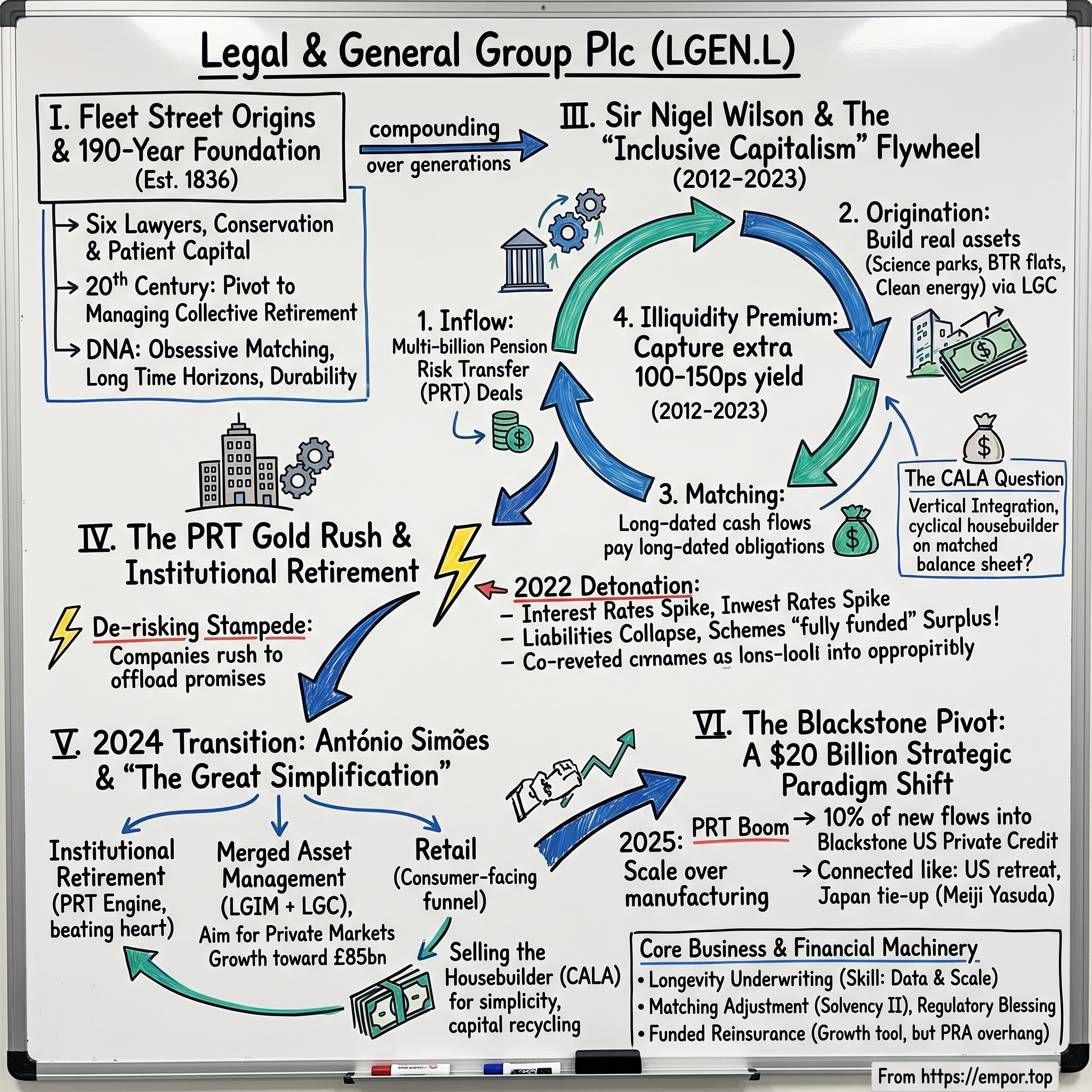
Legal & General Group Plc: The "Inclusive Capitalism" Flywheel and the Great Simplification
I. Introduction & Episode Roadmap
Picture a retired schoolteacher in Sunderland collecting her monthly pension. She has never heard of Solvency II, has no idea what a "matching adjustment" is, and could not tell you the difference between a bulk annuity and a gilt if her life depended on it. And yet her retirement — the roof over her head, the heating in January, the certainty that the cheque arrives on the same day every month for the next thirty years — depends almost entirely on the actuarial machinery of a single, unglamorous, 190-year-old British institution headquartered a few streets from the Bank of England.
That institution is Legal & General Group Plc, ticker LGEN.L on the London Stock Exchange. It is one of the largest asset managers in Europe, overseeing roughly £1.2 trillion of assets by the end of 2025 through its asset-management arm alone.1 It is the single largest player in the market that quietly absorbs the pension promises of corporate Britain. And it is, by almost any measure, one of the most important private-sector guarantors of the UK retirement system — a company whose failure is close to unthinkable precisely because so many people's old age is riding on it.
Here is the paradox at the heart of this story. A business this dominant, this systemically important, this deeply embedded in the plumbing of a G7 economy, ought to command a premium valuation. Instead, for much of the last decade L&G has traded like a value trap — a high-dividend, low-growth "widow-and-orphan" stock that the market has struggled to love. The shares have spent years going sideways even as the business grew, dogged by what analysts call the "conglomerate discount": the market's stubborn refusal to pay full price for a company doing five complicated things at once when it would happily pay up for one company doing a single thing brilliantly.
This is the tension the episode explores. On one side sits the multi-decade "Inclusive Capitalism" flywheel built by the legendary Sir Nigel Wilson, who ran the company from 2012 to the end of 2023 and turned it into a machine for converting pensioners' savings into science parks, build-to-rent flats, and clean-energy grids across the north of England. On the other side sits the "Great Simplification" — the deliberate dismantling of parts of that empire by his successor, the former HSBC banker António Simões, who took the chief executive's chair on January 1, 2024[^8] with a mandate to make the business legible to sceptical investors.
And layered on top of it all is a macro earthquake. When interest rates spiked in 2022 — supercharged by the UK's disastrous "mini-budget" — the present value of Britain's vast corporate pension liabilities collapsed, and thousands of chronically underfunded pension schemes woke up one morning fully funded, even in surplus. That set off a de-risking "gold rush" in which companies rushed to offload their pension promises onto insurers like L&G. It should have been the greatest tailwind in the company's history. Yet in July 2025, L&G did something that would have been heresy under Wilson: rather than manufacture more of its own matching assets, it handed a slice of its future to the American private-capital colossus Blackstone.[^6]
Over the next several sections we will trace how a Victorian society for lawyers became a trillion-pound retirement machine, why the pension-transfer boom is both its salvation and its expiry clock, and whether Simões's bet — simpler, more capital-light, more American — will finally close the discount or merely trade one set of risks for another.
It is worth stating the central "why win / why lose" spine at the outset, because everything that follows is a test of it. L&G wins from here if three things hold: that the bulk-annuity market's multi-decade runway is real and it can keep writing £10 billion a year at defensible margins; that its scale and two centuries of longevity data constitute a genuine cost-and-underwriting edge rather than a story; and that the simplification and partnerships convert into a re-rating and durable higher-fee growth. The case breaks if the pension boom proves shorter or lower-margin than hoped, if the strategic rewiring destroys more value in execution than it creates in focus, or if the capital-light partnerships quietly hand the best economics to Wall Street and Tokyo. We will hold each of these to the evidence rather than to management's telling. Let us start where every good origin story starts: in a room full of lawyers.
 Subscribe on LinkedIn
II. Fleet Street Origins & The 190-Year Foundation
In June 1836, six London lawyers gathered in the legal district around Lincoln's Inn Fields to solve a distinctly professional grievance: the existing life-assurance societies of the day would not give them a fair deal. Led by Sergeant John Adams — a barrister, not a soldier; "Sergeant" was a senior legal rank — and joined by Basil Montagu and four others, they founded a society that would insure the lives of members of the legal profession on terms they controlled themselves.12 Share ownership was restricted to lawyers, a closed shop that would not fully open to the general public until 1929.12
It was a modest, almost clubby beginning, and the young society was one of hundreds of joint-stock life offices spawned in the speculative boom of the 1830s. Most of them died. This one did not, for a reason that would define its character for the next two centuries: conservatism. The founders set an initial capitalization target of £1 million — an enormous sum for the era — and reached it through a share issue in 1839.12 From the start, the institution's edge was not cleverness or aggression but sheer, patient durability. It was a custodian of Victorian capital, and custodians who lose their clients' money do not last. This one survived by not losing it.
That instinct compounded across generations. The company opened its first office outside London in Manchester in 1889, incorporated in 1920, and crossed the £1 billion total-assets threshold by 1970.12 Along the way it made the pivotal twentieth-century pivot from insuring individual lives to managing collective retirement. As British industry unionized and the welfare state took shape, the great corporate defined-benefit pension scheme became the central institution of working-class old age — and L&G positioned itself as one of the firms that administered, invested, and eventually insured those promises. The DNA it inherited from the Fleet Street lawyers — long time horizons, obsessive matching of assets to obligations, allergy to reckless bets — turned out to be exactly the DNA a pension insurer needs.
That pension pivot also produced the company's second great franchise, and it is worth flagging here because it becomes central later. To manage the swelling pool of pension money, L&G built an investment arm — what became Legal & General Investment Management — and made an early, contrarian bet on index-tracking: cheap, passive funds that simply mirror the market rather than trying to beat it. It was an unglamorous product that most active managers sneered at, but it rode one of the great secular trends in finance, and over decades LGIM compounded into one of the largest asset managers in Europe. So by the time our modern story begins, L&G was not one business but two intertwined ones — a life-and-pensions insurer and a giant, low-fee asset manager — each feeding the other. That duality is the source of both the flywheel's power and the "conglomerate discount" that would later haunt the share price. The seeds of the twenty-first-century strategic debate were planted, quietly, in the twentieth.
The crisis that didn't break it
The clearest proof of that temperament came in 2008. The global financial crisis was, at its core, a catastrophe of financial institutions that had reached too far — into American subprime, into aggressive overseas expansion, into products they did not understand. Several of L&G's UK peers had spent the boom years chasing scale abroad and building sprawling, hard-to-manage international empires. When the tide went out, those strategies left deep scars; the wider British insurance sector spent years cleaning up value-destroying acquisitions and untangling complexity.
L&G, by contrast, came through relatively intact. It had not bet the balance sheet on foreign M&A sprees or exotic structured credit. Its book was boring, domestic, and matched. That relative resilience is worth dwelling on, because it is easy to mistake for luck. It was not. It was the predictable output of a 170-year-old institutional bias toward caution — the same bias that, decades later, would frustrate growth-hungry investors who wished the company would take more risk. The trait that protects you in a crisis is often the trait that bores the market in a boom. That duality is the throughline of everything that follows.
By the early 2010s, then, L&G was a conservatively run, well-capitalized, thoroughly British institution with an unglamorous but enviable position: it sat at the intersection of the nation's savings and the nation's retirement. What it lacked was a story — a narrative that could turn a stable utility into an engine of growth. In 2012, it hired the man who would give it one.
III. Sir Nigel Wilson & The "Inclusive Capitalism" Flywheel
Nigel Wilson did not look like a City grandee. The son of a bricklayer from the north-east of England, he had a PhD in economics from MIT, a blunt Teesside directness, and a conviction — repeated in speeches, op-eds, and government reviews for more than a decade — that British capitalism had a distribution problem. Too much of the nation's long-term savings, he argued, was parked in gilts and global equities while the physical fabric of Britain's own regional cities crumbled for want of patient capital. He had a phrase for the alternative: "inclusive capitalism." And running Legal & General from 2012 to the end of 2023, he had the balance sheet to try to prove it worked.
Wilson had not arrived as an insurance lifer. He joined L&G in 2009 as chief financial officer — in the teeth of the financial crisis — and stepped up to chief executive in 2012, staying until his handover to Simões at the end of 2023.14 Along the way he became one of the most publicly visible business figures in Britain, advising successive governments on housing, infrastructure, and levelling-up, and he was knighted in the 2022 New Year Honours for services to financial services, regional development, and sport.14 That public-policy fluency was not incidental to the strategy; it was the strategy. Inclusive capitalism only works if a company can position itself as the natural private-sector partner for public regeneration, and Wilson spent a decade cultivating exactly that relationship with Whitehall and with the councils of Cardiff, Newcastle, and Sunderland. The risk in that posture — one the market would eventually price in — is that a business so entangled with government priorities can start to look as though it is optimizing for national outcomes rather than for shareholder returns. The genius, and the ambiguity, of Wilson's tenure is that he insisted these were the same thing.
The genius of Wilson's framing was that it was not charity. It was a flywheel — a self-reinforcing loop in which doing social good and making shareholder returns were, if you designed it right, the same activity. It worked in four moves, and understanding it is essential to understanding both the bull case and the bear case for L&G today.
How the flywheel turned
The first move is the inflow. L&G writes multi-billion-pound pension-risk-transfer (PRT) deals — more on the mechanics shortly — in which a corporate pension scheme hands over its assets and, in return, L&G takes on the obligation to pay that company's retirees for the rest of their lives. Overnight, the insurer receives an enormous slug of premium and, with it, a set of payment promises stretching thirty and forty years into the future.
The second move is origination. Rather than simply buying government bonds to back those promises, Wilson directed capital into L&G Capital (LGC), the group's direct-investing arm, to build real, physical, cash-generating assets: science and technology parks, build-to-rent housing, clean-energy infrastructure, and urban-regeneration projects in cities the London-centric financial system had long ignored — Cardiff, Newcastle, Sunderland. A regenerated city-centre district, a portfolio of rented flats, a stake in a wind farm: each throws off long-dated, contractual, inflation-linked cash flows.
The third move is matching. Those long-dated cash flows are then used to pay the long-dated pension obligations. A stream of rent from build-to-rent apartments in 2045 is a beautiful thing to own if you owe a pensioner a cheque in 2045. This is the actuarial heart of the model: assets whose payment profile mirrors the liabilities, so that market gyrations in between matter far less.
The fourth move — the one that makes the whole thing pay — is the illiquidity premium. Because these physical assets are harder to sell in a hurry than a liquid government bond, they yield more: Wilson's team consistently argued they could capture an extra 100 to 150 basis points of yield over gilts. That extra yield is the magic. It let L&G price its annuities more cheaply than rivals while still earning an attractive return on equity, and it meant the pensioner, the shareholder, and the city of Sunderland could theoretically all win at once.
That, at least, was the theory, and for a decade the market largely bought it. But a flywheel is only as good as the assets feeding it — and here the story acquires its first real tension.
The CALA question
To manufacture housing assets, you eventually have to control the factory that makes houses. So in 2013, L&G bought a 46.5% stake in the Scottish homebuilder CALA Group, taking full ownership in 2018 at a total enterprise valuation of around £605 million.[^5]6 The strategic logic was pure vertical integration: rather than buying finished housing assets from developers at a developer's margin, L&G would own the developer and capture that margin itself, directing CALA to build the very homes its pension money would then own and rent.
It was an elegant piece of strategic chess — and also, quietly, a departure from 177 years of institutional caution. A life insurer is supposed to be a liquid, matched, low-drama balance sheet. A housebuilder is a capital-intensive, cyclical, boom-and-bust enterprise whose fortunes swing with mortgage rates, planning permissions, and the mood of the British property buyer. By absorbing CALA, L&G had grafted a chunk of UK housing-market cyclicality onto an institution whose entire appeal was its predictability. In good times, that looked like visionary integration. The question — as the market would later force the company to answer — was what it looked like when the cycle turned, and whether a pension insurer had any business owning a housebuilder at all. Wilson's successor would give a very clear answer. But first, the flywheel's fuel supply exploded in size.
IV. The PRT Gold Rush: Deep-Dive into Institutional Retirement
To understand why 2022 was the most consequential year in modern British pensions, you have to first understand a promise made two generations ago. For most of the twentieth century, large British employers offered "defined benefit" (DB) pensions: a guarantee to pay you a fixed percentage of your final salary, index-linked, until you die. It was a wonderful promise for workers and, it turned out, a financial time bomb for employers. People lived longer than expected. Investment returns disappointed. And the accounting rules forced companies to carry the swelling cost of those promises as a liability on their own balance sheets.
By the 2010s, corporate Britain was collectively sitting on well over £1 trillion of these legacy DB liabilities — a slow-motion millstone that every finance director dreamed of removing. The mechanism for removing it is the pension risk transfer, or bulk annuity: the company pays an insurer a lump sum, and the insurer takes over the pensions entirely, lifting the liability clean off the corporate balance sheet forever. For decades, though, the gold rush couldn't start, for one simple reason. Most schemes were underfunded — the assets they held were worth less than the promises they owed — and no company wants to crystallize a deficit by handing an insurer a cheque for the shortfall.
The 2022 detonation
Then interest rates exploded. Through 2022, central banks raced to raise rates, and in late September the UK staged its own spectacular own-goal: the Truss government's "mini-budget" sent gilt yields vaulting and briefly threatened to blow up the pension system's derivative hedges entirely. But the same rate spike that caused chaos also worked a strange alchemy on pension arithmetic. A pension liability is just the present value of future payments; when the discount rate (driven by gilt yields) rockets upward, that present value collapses. Almost overnight, schemes that had been chronically underfunded for years found themselves fully funded — many in outright surplus.
The dam broke. Suddenly thousands of pension schemes had exactly enough assets, or more, to buy their way out — and every trustee board in the country wanted to lock in that windfall before rates fell again. A structural, multi-decade de-risking wave had become an urgent, near-term stampede.
The double-edged sword: L&G inside the storm
Here is the twist the triumphant version of this story usually skips. The 2022 gilt spike did not just hand L&G a windfall of eager buyers; it also detonated a crisis in a business L&G itself was a leader in. Many pension schemes had for years used "liability-driven investment" (LDI) — leveraged derivative strategies that hedged their exposure to falling interest rates. When rates instead shot up in a matter of days, those hedges generated frantic collateral calls, forcing schemes to dump gilts to raise cash, which pushed yields higher still, which triggered more calls — a doom loop that the Bank of England ultimately halted only with an emergency intervention, buying up to £13.9 billion of gilts over roughly two weeks.13 And L&G's own investment arm, LGIM, was one of the largest LDI managers in the country, squarely in the eye of the storm.
The spectacle of L&G's chief executive being summoned before a House of Lords committee to explain the near-collapse — where Wilson and chair Sir John Kingman argued the firm could not have foreseen the mini-budget's market consequences and had not stress-tested for them13 — is a useful corrective to any tidy narrative. The same event that supercharged the PRT engine also exposed a genuine risk-management blind spot in a sister business, and it invited a fair question about how well a firm at the center of the pension system truly understood the tail risks in its own products. The macro tide, in other words, arrived as both gift and warning. It is worth holding that ambiguity in mind, because the rest of the sector's league-table euphoria tends to forget it.
The battle for supremacy
The UK bulk-annuity market has since run hot for three consecutive years, with total volumes expected to exceed £40 billion in 2025 across hundreds of transactions.4 And in this market, one name sits at the top of the table. In 2025, L&G completed £11.8 billion of global pension-risk transfers, of which £10.4 billion was written in the UK[^16] — comfortably the largest volume of any insurer and equivalent to roughly a quarter of the entire British market. The scale of individual deals tells the story: in a single year L&G took on the pension schemes of Ford (£4.6 billion), BP (£1.6 billion), and NatWest (£1.1 billion).10 These are not niche transactions; they are the retirement obligations of some of the largest employers in the country, moved wholesale onto one insurer's balance sheet.
L&G is not alone in the arena, and the competitive map matters. Its rivals fall into two camps. On one side are the diversified incumbents — Aviva, M&G, Standard Life (now part of Phoenix), and Just Group — insurers with long histories and broad businesses. On the other are the specialists and the new money: Pension Insurance Corporation (PIC), a pure-play bulk-annuity house that does nothing else, and Rothesay, backed by heavyweight capital including the Singapore sovereign fund GIC and Blackstone, which has built a reputation as an aggressive pricer willing to win big mandates on thin margins.10 The precise league-table shares shift year to year, but the shape is stable: L&G and PIC vie at the top, Rothesay and Aviva press hard behind, and everyone is chasing the same finite pool of schemes.
Why this is the profit engine
Here is the number that explains why L&G's leadership matters more than any slogan about inclusive capitalism. In its 2024 results, the Institutional Retirement division — the PRT engine — generated £1,105 million of operating profit, up 7% on the prior year.2[^3] To put that in perspective, the group's other divisions that year contributed far less: retail retirement and protection around £504 million, asset management around £401 million, and corporate investments a modest £95 million.[^3] Strip out central costs and the picture is unambiguous — the bulk-annuity book is the beating heart of the company, throwing off the majority of core earnings.
That concentration is both a strength and a vulnerability, and it deserves to be named as such rather than celebrated. A strength, because L&G is dominant in the single most attractive insurance market in Britain, with the scale, data, and capital to write £10 billion of high-quality business a year. A vulnerability, because a company whose profits lean this heavily on one engine is hostage to that engine's fortunes — the level of interest rates, the intensity of competition, and, above all, the finite supply of legacy DB schemes left to buy. When roughly two-thirds of your core profit comes from one activity, the health of that activity is not a segment story; it is the whole story.
Myth versus reality: the "risk-free machine"
A comfortable consensus narrative has grown up around bulk annuities: that they are close to a risk-free money machine — you take in the premium, buy matching assets, and clip a spread for forty years while the actuaries do the worrying. The reality is more textured. The margins are thin and shrinking under competitive pressure, as the numbers make plain: the Solvency II new-business margin on L&G's UK PRT fell from 7.4% in 2023 to 5.3% in 20242, meaning each pound of premium generated meaningfully less capital as rivals bid harder. The "risk-free" framing also glosses over the real exposures buried in the model — the longevity bet (people living longer than priced), the credit bet (the private and corporate assets backing the annuities defaulting), and, increasingly, the reinsurance and offshore-collateral risks we will come to. Bulk annuities are a good business, and L&G is good at it. But "good" and "risk-free" are not the same word, and conflating them is how investors get surprised. Which raises the obvious question a new chief executive would have to answer: if the engine is this good, why was the market still refusing to pay up for it?
V. The 2024 Transition: António Simões and "The Great Simplification"
When António Simões walked into Legal & General's offices as group chief executive on January 1, 2024[^8], he inherited a paradox rather than a problem. The business was not broken. The PRT engine was humming, the balance sheet was fortress-strong, and the dividend was among the most reliable in the FTSE 100. And yet the share price had gone almost nowhere for years, and the "conglomerate discount" refused to lift. Simões's job was not to fix a failing company. It was to convince a sceptical market to value a good one properly — a subtler and, in some ways, harder task.
Simões was an unusual choice for a British life insurer. A Portuguese national, a McKinsey alumnus, and a former global head of wealth and personal banking at HSBC — where he had also run the sprawling UK bank and the European business — he was a banker's banker, fluent in the language of capital allocation, cost discipline, and investor communication.[^8] He was not a lifelong actuary who had come up through the annuity book. That outsider's distance was arguably the point: he could look at the empire Wilson had built and ask, without sentiment, which parts actually created value and which merely created complexity.
Aligning the incentives
One early signal of intent was how the board tied Simões's own fortunes to the share price it wanted to move. His base salary was set at £1,210,300[^4], but the more revealing numbers were in the long-term structure. The shareholding requirement — the amount of company stock an executive must personally hold — was raised sharply to 350% of base salary, and made to apply not only during his tenure but for two years after he leaves.[^4] The performance share plan was similarly geared to 350% of salary, with payouts tied heavily to relative total shareholder return against a peer group (demanding top-quintile, roughly 80th-percentile performance for a full award), alongside earnings-per-share growth and climate and societal metrics.[^4] The message to investors was pointed: the new CEO gets paid handsomely only if the shares meaningfully outperform, and he cannot cash out and walk away the day the targets are hit. Whether that alignment produces genuine outperformance or merely well-designed optics is something only years of results can settle — but the design itself was a deliberate answer to years of investor grumbling.
The June 2024 blueprint
The strategy proper landed at a capital-markets event in June 2024, where Simões laid out the "Great Simplification."[^4]5 The diagnosis was blunt: the market could not understand, and would not pay for, a company sliced into a confusing patchwork of divisions and brands. The cure was consolidation into three clean pillars — Institutional Retirement, Asset Management, and Retail — each with a legible economic identity.
The boldest structural move was to merge the two halves of the investment business. For years L&G had run its public-markets asset manager — LGIM, one of Europe's largest fund managers and a pioneer of low-cost index investing, overseeing well over a trillion pounds of largely passive money — entirely separately from LGC, the private direct-investing arm that built the science parks and housing. On paper they were both "asset management," but they were opposite businesses: LGIM was a high-volume, ultra-low-fee scale machine competing with the likes of BlackRock and Vanguard on basis points, while LGC was a small, high-touch, high-fee shop building physical assets by hand. Simões collapsed them into a single Asset Management division, with an explicit ambition: to grow the higher-fee private-markets book aggressively, from around £48 billion toward roughly £85 billion by 2028.[^4]
The logic is straightforward once you see the fee gap. Passive public-markets management is a race to the bottom on price, where scale is the only defense and margins are measured in hundredths of a percent; private-markets assets — infrastructure, real estate, private credit — command fees an order of magnitude richer. Bolting L&G's private-origination engine onto its giant distribution machine was meant to manufacture more of the profitable stuff and sell it to more clients. By the end of 2025 the private-markets book had reached about £75 billion, up 32% in a year9 — real progress toward the target. But the merger carries a genuine risk the bears will press: the two divisions have profoundly different cultures, incentives, and time horizons, and forcing them together can trigger the departure of exactly the private-markets talent whose deal-sourcing relationships are the whole point — while the index side risks big institutional clients quietly pulling low-margin passive mandates during the disruption. Integration of this kind is easy to announce and hard to execute, and the market will judge it on retention and net flows, not org charts.
Beneath the two headline pillars sits the third, quieter one: Retail. This is L&G's consumer-facing franchise — workplace pension administration, individual retirement annuities, and protection (life and critical-illness cover). It is less glamorous than the bulk-annuity engine but strategically important as a funnel: the workplace defined-contribution business, with pension savings under administration that grew to roughly £114 billion by the end of 20259, captures younger savers early and, in principle, feeds them into L&G's retirement products decades later. The 2025 half-year results, which showed core operating EPS up 9% and management describing "strategic momentum building"[^22], were an early data point that the reorganized structure was at least not destroying value — though a single good half is not proof of a re-rating, and the market has heard confident half-year language from L&G before.
Selling the housebuilder
Then came the moment that most vividly captured the new discipline. In September 2024, L&G agreed to sell CALA Group — the housebuilder it had spent a decade absorbing — to Sixth Street Partners and Patron Capital for an enterprise value of around £1.35 billion.[^5]6 Against a cost basis of roughly £605 million, the exit recovered well over double what the company had put in.6 The company had reportedly begun exploring the sale months earlier, running a process with advisers at Rothschild.8
It is tempting to read the CALA sale purely as a victory lap — buy low, sell high, book the gain. On the arithmetic alone it was a genuinely good outcome: turning a roughly £605 million cost basis into a £1.35 billion enterprise value over a holding period spanning the 2010s housing recovery represents more than a doubling of invested capital, and crucially L&G chose to sell into a private-equity buyer's appetite rather than wait to be forced out by a housing downturn.[^5]6 Timing a cyclical exit near the top, rather than riding it back down, is the hard part of capital allocation, and here management got it right. The capital discipline was real: exiting a cyclical, capital-hungry housebuilder, and recycling the proceeds into buybacks and the core annuity engine, is exactly the kind of unsentimental portfolio surgery investors had been begging for.
But the deeper significance is philosophical. Selling CALA was a repudiation of one leg of Wilson's flywheel — the belief that L&G should own the physical factories that manufacture its matching assets. Simões was betting that the market's reward for simplicity would exceed the value of vertical integration. That is a defensible bet. It is also, unavoidably, an admission that owning a housebuilder had loaded the balance sheet with complexity and cyclicality the market would not pay for — the precise concern the bears had raised when L&G bought it. A charitable observer calls this disciplined capital recycling; a cynical one notes that booking a headline gain on an asset the market never wanted is also a convenient way to fund buybacks and paper over the fact that a decade-long strategic thesis has just been quietly abandoned. Both can be true at once.
Returning the cash
Finally, the new regime made a loud statement about capital allocation. Alongside a progressive dividend — L&G paid 21.36 pence per share for 2024 — the company launched a share-buyback programme, and as the balance sheet allowed, scaled it up dramatically: the 2024 results carried a £500 million buyback, and by the 2025 results in March 2026, backed by proceeds from asset sales, that had grown to a £1.2 billion buyback alongside a dividend lifted to 21.79 pence.2[^16] The signal was unmistakable. For a mature, cash-generative, asset-heavy business, Simões was prioritizing the reliable return of capital to shareholders over the pursuit of lower-margin growth. Whether that is prudence or a quiet admission that the company has run short of high-return places to reinvest is a debate we will return to. But the capital was real, and it was going back to owners. The question that now loomed was where the next leg of growth would actually come from — and the answer, announced in mid-2025, pointed across the Atlantic.
VI. The Blackstone Pivot: A $20 Billion Strategic Paradigm Shift
On July 10, 2025, Legal & General and Blackstone announced a strategic partnership that, on its surface, looked like a routine asset-management tie-up and, on closer inspection, represented a genuine break with the company's founding investment philosophy.[^6]3 Under the arrangement, L&G would channel a meaningful share of its future annuity money into Blackstone's vast private-credit machine — the American firm's engine for originating investment-grade loans to companies and projects, part of a credit platform managing hundreds of billions of dollars.3
The mechanics are specific. L&G committed to invest up to 10% of its anticipated new annuity-business flows into assets originated and managed by Blackstone, with reporting at the time framing the partnership as scaling toward as much as $20 billion of private credit over the coming years.[^6]7 In plain English: as L&G writes new bulk annuities and needs to buy long-dated, high-quality assets to back those pension promises, a growing slice of that money will now flow into American private credit sourced by Blackstone rather than into assets L&G originates itself.
Why this is heresy
To appreciate why this matters, recall the old thesis. The entire intellectual case for the Wilson-era flywheel was self-sufficiency: we manufacture our own matching assets — science parks, housing, infrastructure — cheaper and better than anyone else, and we pocket the illiquidity premium ourselves. The Blackstone deal is a tacit concession that this no longer scales. The PRT boom is throwing off more capital than L&G's own origination machine can possibly digest at the required quality and speed. There is only so much British infrastructure and housing you can build in a year; there is, apparently, almost no limit to how much high-grade private credit Blackstone can source globally. Faced with £10 billion a year of premium needing a home, L&G chose to rent Wall Street's origination engine rather than strain its own.
That is either a pragmatic masterstroke or a quiet surrender, and honest analysis has to hold both possibilities at once. The optimistic reading: this is capital-light international expansion. L&G gets immediate access to a diversified, investment-grade, dollar-denominated asset stream without building an American credit shop from scratch, freeing its own capital for buybacks and its own origination for the highest-return domestic projects. The skeptical reading: L&G is surrendering part of the very margin — the origination spread — that made its model special, and making itself dependent on a third party for a critical input. If Blackstone captures the origination fee, some of the illiquidity premium that used to flow to L&G's shareholders now flows to Blackstone's.
The megatrend behind the deal
To read the Blackstone partnership properly, you have to see it as one move in a much larger game reshaping global finance: the convergence of insurance balance sheets and private-capital firms. Over the past decade, the world's biggest alternative-asset managers realized that an insurer's annuity book is the perfect fuel for a private-credit engine — permanent, low-cost, long-dated capital that never faces a redemption run and desperately needs the kind of yield-y private assets these firms originate. Apollo effectively became an insurer by building and absorbing Athene; KKR did the same with Global Atlantic; Brookfield built its own annuity arm. The private-capital giants went and bought the liabilities.
Blackstone, notably, chose a different path — it largely declined to own insurers outright, preferring instead to manage assets for them, collecting fees without taking on the regulatory burden and balance-sheet risk of the insurance liabilities themselves. By the time of the L&G deal, Blackstone was already managing hundreds of billions of dollars of third-party insurance assets under exactly this model.3 Seen this way, the L&G tie-up is the mirror image of the Apollo playbook: instead of a private-capital firm acquiring an insurer, an insurer is renting a private-capital firm's origination machine. Both sides get what they lack — L&G gets scaled, diversified asset supply; Blackstone gets another giant, sticky pool of fee-earning insurance capital.
The strategic question for L&G shareholders is whether being the insurer in this arrangement is the better or worse side of the table. The bull says L&G keeps the crown jewels — the longevity underwriting, the client relationships, the regulated balance sheet — and simply outsources a commoditized input. The bear says the value in this convergence is migrating toward whoever controls asset origination, and L&G has just conceded that ground to a firm whose fee-taking ambitions are boundless. There is no way to settle that debate in advance; it will be visible only in the net spread L&G actually earns on Blackstone-sourced assets versus what it earns on its own, disclosed over several years. Investors should demand that comparison and be suspicious of any reluctance to provide it.
The American paradox
There is a further wrinkle that the outline's neat "expansion into US private credit" framing obscures, and it is worth naming because it complicates the story. At almost the same time L&G was leaning into America via Blackstone's credit, it was leaning out of America elsewhere. In February 2025, L&G had agreed to sell its US protection (term-life) business and a 20% economic interest in its US pension-risk-transfer operation to the Japanese insurer 明治安田生命 Meiji Yasuda, for a headline valuation of around $2.3 billion, with Meiji Yasuda also taking a roughly 5% stake in L&G itself.[^19]11 That transaction — which completed toward the end of 2025 and reshaped the group's pro-forma solvency position[^16] — means L&G's American strategy is not a simple "go big in the US" narrative but something more nuanced: retreating from owning US insurance risk directly, while using American asset-origination and Japanese capital to fund a fundamentally UK-centric annuity engine. This is a company rewiring itself into a network of partnerships rather than a self-contained empire — and whether that network compounds value or merely fragments it is the central open question of the Simões era. To judge it, you have to understand the regulatory machinery that governs the whole thing.
VII. The Financial Machinery: Solvency II and the Matching Adjustment
Strip away the strategy and the personalities, and a life insurer is at bottom a very long, very complicated bet on two things: how long people will live, and whether the assets you bought will still be paying out when they do. Everything else — the flywheel, the simplification, the Blackstone deal — is downstream of getting those two calculations right. So it is worth slowing down to explain, in plain terms, how the machine actually works, because the machine is the moat.
Start with the liability side. When L&G takes on a pension scheme, it is promising to pay tens of thousands of named individuals a monthly income for the rest of their lives. The insurer's core skill is estimating, across a huge population, the average path of those lives — how many will still be collecting cheques in 2040, in 2050, in 2060. Overestimate longevity and you over-reserve and price yourself out of deals; underestimate it and you slowly go bust as pensioners outlive your assumptions. This is longevity underwriting, and it is a game of data and scale.
The matching adjustment, demystified
Now the asset side, and the single most important regulatory concept in the entire business: the matching adjustment. Under Solvency II — the European-derived capital regime that governs UK insurers — the value an insurer must place on its liabilities depends on the rate used to discount them. The matching adjustment is a regulatory mechanism that lets an insurer discount its liabilities at a higher rate — and therefore hold less capital against them — provided it backs those liabilities with a pool of assets whose cash flows are highly predictable and closely matched to the payments owed, and which it intends to hold to maturity.[^15]
Here is the intuition. If you own a portfolio of assets that will reliably spit out exactly the cash you need, exactly when you need it, then the day-to-day market price of those assets is almost irrelevant — you are never going to sell them; you are going to collect their coupons and hand the proceeds to pensioners. Solvency II rewards that certainty by letting you ignore short-term market volatility and book the extra yield those assets earn (including the illiquidity premium) as a benefit to your balance sheet, rather than as a risk. In effect, the matching adjustment is the regulatory blessing that turns the whole flywheel from a nice idea into a capital-efficient one. It is why originating long-dated, cash-matching private assets is so valuable: those assets qualify for the adjustment, cheap liquid gilts capture less of it. The UK's post-Brexit reforms to Solvency II, finalized by the Prudential Regulation Authority through 2024, broadened the range of assets eligible for this treatment — a regulatory tailwind explicitly designed to encourage insurers to funnel more capital into productive, long-term investment.[^15]
Where the solvency ratio comes in
All of this rolls up into a single headline number that investors watch obsessively: the Solvency II coverage ratio, the ratio of an insurer's eligible capital to the regulatory minimum. L&G reported 232% at the end of 20242 and, on a pro-forma basis adjusting for the Meiji Yasuda transaction and the enlarged buyback, around 210% at the end of 2025.[^16] A ratio comfortably above 200% means the company holds roughly twice the capital regulators demand — a fortress cushion that both protects pensioners and, crucially, funds the dividends and buybacks that keep shareholders happy. The solvency ratio is the pressure gauge on the whole engine; when it is high, capital can be returned, and when it falls, everything else gets squeezed.
This is where L&G's oldest asset becomes its subtlest advantage. Its nearly two centuries of proprietary longevity and claims data — the accumulated record of how its own vast population of policyholders has actually lived and died — give it a deep, hard-to-replicate basis for pricing risk. Newer, private-equity-backed competitors can raise capital quickly, but they often lean more heavily on third-party reinsurers to take longevity risk off their hands, which means sharing the economics. L&G's data heritage lets it retain more of that risk, and more of the reward, on its own book. It is not a flashy edge, and it can be overstated — reinsurance is a legitimate tool L&G uses too, and data alone does not guarantee good pricing. But in a business where the whole game is estimating the unknowable, having 190 years of the actual answers is not nothing.
The regulatory overhang worth flagging: funded reinsurance
There is a genuine, live regulatory judgment sitting over this entire model, and honest analysis has to flag it. To write ever-larger volumes of bulk annuities without commensurately larger capital raises, UK insurers have increasingly leaned on "funded reinsurance" — arrangements, often with reinsurers based in offshore jurisdictions like Bermuda, that take both the longevity and the asset risk off the insurer's balance sheet in exchange for the assets and a fee. It is an efficient way to grow, but it introduces two subtle dangers that the Prudential Regulation Authority has grown openly wary of. The first is concentration: if many UK insurers reinsure into the same handful of offshore counterparties, a single reinsurer's failure could ricochet across the sector. The second is "recapture" risk: if a reinsurer does fail, the insurer takes back the underlying collateral — increasingly concentrated in illiquid, private-credit-related assets — which may be lower quality than assumed, hard to value, and potentially non-compliant with matching-adjustment rules just when it is needed most.15
The PRA formalized its expectations in a July 2024 supervisory statement and has since signalled it may go further, consulting on harder limits because it worries a principles-based approach is insufficient.15 Why does this matter for the L&G story specifically? Because it sits at the exact intersection of the two big strategic bets we have already met: the pivot toward private credit (via Blackstone) and the reliance on partnerships and offshore structures to scale. The regulator is, in effect, scrutinizing the plumbing that makes the capital-light growth model work. A tightening here would not sink L&G — its own book is more self-funded than some rivals' — but it could raise the capital cost of the very growth the bull case depends on. It is the kind of unglamorous, technical overhang that never makes headlines until, suddenly, it does. What that machinery adds up to, in terms of durable business lessons, is worth extracting deliberately.
VIII. Playbook: Core Business & Investing Lessons
Every great business story leaves behind a set of transferable lessons — the strategic principles that generalize beyond the specific company. L&G's history offers four, and the most interesting thing about them is that the company itself has spent the last two years partially revising two of its own founding lessons. That tension is exactly what makes them worth studying.
Lesson 1: Liability-driven asset manufacturing is a genuine edge — until it isn't. The core insight of the Wilson flywheel was profound: if you have decades-long liabilities, you can capture value that liquid investors cannot, by originating the illiquid, long-dated assets that precisely match those obligations and pocketing the premium for doing so. That is a real structural advantage, and it is the foundation of L&G's ability to price annuities competitively while earning attractive returns. But the Blackstone pivot exposes the limit: the edge only holds while your own origination can scale with your inflows and while you keep the origination margin yourself. Outsource origination, and you keep the liability edge but rent out the asset edge. The lesson for investors is to watch who captures the spread, not just whether the model exists on paper.
Lesson 2: The conglomerate discount is real, and simplicity has a price the market will pay. For years, L&G traded below the sum of its parts because investors could not cleanly value a company doing index management, private equity, housebuilding, protection insurance, and bulk annuities all at once. The merger of LGIM and LGC and the divestment of CALA are, in effect, a live experiment in whether stripping out complexity re-rates the stock. The theory is sound and the market's preference for focus is well documented across sectors. But the jury is still out on whether this simplification closes this discount — and a skeptic would note that merging two very different investment cultures is itself a source of new complexity and execution risk.
Lesson 3: The macro tide lifts all boats, but only the prepared can swim in it. The 2022 rate spike handed the entire UK insurance sector a once-in-a-generation opportunity by turning pension deficits into surpluses. But an opportunity you cannot operationally digest is just a missed opportunity. The reason L&G could write £10 billion of bulk annuities in a single year is that it had spent a decade building the underwriting, origination, and capital infrastructure to do so at scale. The tailwind was available to everyone; the capacity to ride it was not. For investors, the lesson is to distinguish businesses that merely benefit from a macro trend from those that were built to absorb it — the difference shows up in market share.
Lesson 4: In a mature, asset-heavy business, capital allocation usually beats growth. L&G's decision to lean into buybacks and a disciplined, progressive dividend rather than chase every marginal, lower-margin deal reflects a hard truth about mature financials: when a business generates more capital than it can reinvest at high returns, returning that capital reliably is often the more dependable path to shareholder value than manufacturing growth for its own sake. The nuance — and the bear's rejoinder — is that a company leaning on buybacks may also be signalling a shortage of high-return reinvestment opportunities. Capital discipline and growth exhaustion can look identical on a results slide. These four lessons set up the central debate: from here, does L&G win, and what could break the case?
IX. Analysis: Bull vs. Bear Case & Porter's 5 Forces
To war-game L&G's future, it helps to first map the battlefield it fights on — the UK bulk-annuity market — using two classic frameworks, and then to state the bull and bear cases as sharply as possible.
Porter's Five Forces on the UK PRT market
Threat of new entrants — low. This is one of the highest-barrier markets in finance. To write bulk annuities you need enormous regulatory capital, a Solvency II licence, decades of longevity data to price risk credibly, and the trust of pension trustees betting their members' retirements on your solvency for forty years. You cannot start a bulk-annuity insurer in a garage. The barriers protect incumbents like L&G handsomely.
Bargaining power of buyers — medium to high. This is the force that most constrains insurer profitability, and it is easy to underrate. The buyers are sophisticated corporate pension trustees advised by specialist consultants such as Mercer and LCP, who run competitive, multi-insurer auctions explicitly designed to squeeze pricing. A trustee is not a naïve retail customer; it is a professional buyer extracting the keenest possible price. This is why bulk-annuity margins are thin and why an aggressive pricer like Rothesay can take share — the buyers reward it.
Bargaining power of suppliers — low. The insurers effectively are the supply of long-term capital. There is no scarce upstream input holding them to ransom.
Threat of substitutes — low. There is genuinely no other way to remove a defined-benefit pension liability completely and permanently from a corporate sponsor's balance sheet. Alternatives like superfunds (consolidator vehicles) exist at the margins, but full buyout by a regulated insurer remains the gold standard for finality. This is a structural strength for the whole industry.
Intensity of rivalry — high. With L&G, PIC, Rothesay, Aviva, M&G, and Just Group all chasing the same finite pool of schemes, and buyers running them against each other in auctions, competition on price is fierce and unrelenting. This is the force that caps how good the boom can be for any single player.
Hamilton Helmer's 7 Powers applied to L&G
Of Helmer's seven sources of durable competitive advantage, three genuinely apply to L&G — and it is worth being disciplined about which do and don't.
Scale economies are real: managing well over £1 trillion of assets and running a £10-billion-a-year annuity book spreads fixed underwriting, technology, and back-office costs across a base few rivals can match, lowering unit costs. Cornered resource is the most defensible claim: L&G's proprietary, nearly two-century longevity dataset is a genuinely scarce asset that cannot be bought or quickly rebuilt, and its long-standing municipal and regeneration origination relationships give it access to deals others struggle to source. Switching costs apply in an unusual, backward-looking way: once a scheme is bought out, those pensioners are locked to L&G for the rest of their lives — the revenue, once won, is extraordinarily sticky for decades.
What L&G largely lacks from Helmer's list is equally telling: there is little network economy (my annuity is not more valuable because yours exists), no meaningful brand pricing power in a consultant-run auction, and no counter-positioning moat, since rivals happily use the same model. The honest read is that L&G's powers are real but concentrated in scale and data, not in anything that lets it charge premium prices. In a buyer's-power market, that matters.
The bull case
The optimistic thesis rests on three pillars. First, the PRT boom is structural, not cyclical: with well over a trillion pounds of DB liabilities still sitting on corporate balance sheets and only a fraction transferred so far, the market leader has a multi-decade runway of high-margin business ahead of it. Second, the Great Simplification and the CALA exit could finally collapse the conglomerate discount, and even a modest re-rating toward peers would be worth a great deal to shareholders on top of a high single-digit dividend yield. Third, the Blackstone and Meiji Yasuda partnerships give L&G capital-light access to global asset origination and international capital without the risk and drag of building those platforms itself, potentially accelerating the private-markets fee engine toward its £85 billion target.
The bear case
The skeptical thesis is equally coherent, and a good long-term investor should be able to argue it convincingly. First, the "gold rush" has an expiry date: the pool of legacy DB schemes is finite, and once the bulk of them are bought out — plausibly sometime in the 2030s — the high-growth engine that drives two-thirds of profit simply runs down, leaving a slower-growing back-book. Second, the strategic rewiring carries execution risk on every front: merging LGIM's low-fee passive culture with LGC's private-investing culture could trigger talent departures and passive outflows, while outsourcing origination to Blackstone risks fee compression and dependence on a partner whose interests are not identical to L&G's. Third, the whole capital-light growth model leans on reinsurance and offshore structures that the regulator is actively scrutinizing15; a tightening of the rules on funded reinsurance could raise the capital cost of exactly the growth the bulls are counting on. Fourth, an activist would press hard on the deeper question the buybacks raise — if management is returning £1.2 billion a year to shareholders, is that a sign of admirable discipline or of a mature business quietly running out of high-return places to grow? The bull says the former; the bear notes that the two are observationally identical until the growth actually reappears.
There is one more stress-test worth naming, because it is the kind of thing a short-seller would zero in on: narrative consistency. In the space of two years, L&G has told the market that owning a housebuilder was strategic (until it sold it), that manufacturing its own matching assets was its core edge (until it outsourced a chunk to Blackstone), and that the US was a growth market (while selling most of its US insurance operation to a Japanese buyer). Each individual move is defensible. But a skeptic would ask whether a company that keeps reversing its own prior convictions has a durable strategy or merely a series of reactions — and whether the "Great Simplification" is genuine focus or simply the dismantling of bets that did not pay off. The generous reading is that Simões is unsentimentally correcting his predecessor's overreach; the harsh reading is that L&G is still searching for what it wants to be. The verdict, as ever, will be written in the numbers — which brings us to what actually to watch.
X. Epilogue & What to Watch
The honest conclusion of this story is that Legal & General is neither the misunderstood compounder its promoters describe nor the value trap its detractors fear — it is a systemically important, extraordinarily durable retirement machine undergoing a deliberate and unfinished transformation, whose outcome is genuinely unresolved. Simões has made his choices: simpler, more capital-light, more networked, more shareholder-friendly. Whether those choices close the discount or merely trade a familiar set of risks for a newer one is a question the market has not yet answered, and neither should we.
For investors who want to track how that question resolves without drowning in the quarterly noise, three key performance indicators cut through everything else.
First, the Solvency II coverage ratio. This is the master gauge. As long as it sits comfortably above 200%, the company has the surplus capital to keep funding dividends and buybacks; if it drifts toward the regulatory floor — whether from aggressive capital returns, a spike in new business strain, or market shocks — the entire capital-return thesis tightens. It fell from 232% at end-2024 to a pro-forma ~210% at end-2025 as capital was returned and the Meiji Yasuda deal reshaped the balance sheet2[^16]; the direction and pace of that number is the single most important thing to monitor.
Second, net PRT flows and their margins — not just the headline volume. Writing £10 billion of bulk annuities is only good business if it is written at a healthy margin. The market should watch not merely whether L&G sustains £8–£10 billion of annual volume, but at what Solvency II margin — a figure that compressed from 7.4% on 2023 UK PRT to 5.3% on 2024 business as competition bit.2 Volume with thinning margins is the classic late-boom trap; volume and margin discipline together is the signal that the franchise is still winning on quality, not just price.
Third, private-markets AUM growth toward the £85 billion target. This is the clearest single test of whether the Great Simplification is actually creating value rather than just rearranging the org chart. The merged Asset Management division reached roughly £75 billion of private-markets assets by the end of 2025, up 32% in a year9, against an £85 billion goal for 2028. Hitting or beating that trajectory would validate the higher-fee growth story; stalling would hand the bears their case.
Beyond the KPIs, a handful of milestones will tell the tale over the next few years: how smoothly the Blackstone alliance actually deploys capital and whether it dilutes or enhances the origination margin; whether Simões continues to prune non-core assets with the discipline the CALA sale suggested; how the Meiji Yasuda partnership reshapes the American footprint; and, above all, whether the market finally begins to reward a simplified, focused Legal & General with the valuation its critics have long said it deserves. The schoolteacher in Sunderland will get her pension either way — that is the whole point of the machine. The open question is only whether the people who own the machine will be rewarded for how well it runs.
References
-
2025 Full Year Results presentation slides — Legal & General Group, 2026-03-11 ↩
-
2024 Full Year Results: Core operating profit up 6%, with a £500m buyback — Legal & General Group, 2025-03-12 ↩↩↩↩↩↩
-
L&G and Blackstone Announce Strategic Partnership to Accelerate Growth Ambitions — Blackstone Inc., 2025-07-10 ↩↩↩
-
2025 on track to break more records for UK BPA market, with volumes expected to exceed £40bn — Lane Clark & Peacock LLP, 2025 ↩
-
L&G Seeks Simplified Strategy Under New CEO — Financial Times, 2024-06-12 ↩
-
L&G Sells Housebuilder Cala for £1.35bn to Sixth Street and Patron Capital — Financial Times, 2024-09-17 ↩↩↩↩
-
Insurers Rush to US Private Credit in Landmark Yield Partnership — Financial Times, 2025-07-11 ↩
-
Legal & General Explores Housebuilder Cala Sale with Rothschild — Reuters, 2024-03-22 ↩
-
2025 Full Year Results press release and analyst pack — Legal & General Group, 2026-03-11 ↩↩↩
-
UK bulk annuity insurers' year-end 2025 results: Signs of a steadying market — Milliman, 2026 ↩↩
-
Legal & General to Sell 20% Stake in PRT Business to Meiji Yasuda — Chief Investment Officer (ai-CIO), 2025-02-07 ↩
-
Legal & General Group plc — Company History — International Directory of Company Histories ↩↩↩↩
-
L&G blames government for LDI crisis and backs consultant regulation — Pensions Expert, 2022-11-22 ↩↩
-
Sir Nigel Wilson — Executive and Governance Office, Newcastle University ↩↩
-
CP8/26 – Funded reinsurance consultation paper — Bank of England Prudential Regulation Authority, 2026-04 ↩↩↩
 LinkedIn
 WhatsApp
 Reddit
 Hacker News
 Email
Email Kindle
 RSS Feed
 Spotify
 Apple Podcasts
 Amazon Music
 Audible
 YouTube