Leonardo S.p.A.: The Rebirth of Europe's Defense Titan
I. Introduction & Episode Roadmap
On the morning of April 9, 2026, a short notice appeared on the website of Italy's Ministry of Economy and Finance. It listed the state's nominees for the boards of the country's largest listed companies. Eni kept its chief executive. Enel kept its chief executive. Leonardo S.p.A. — the company whose share price had risen roughly six-fold in three years, whose order book had swollen to record size, and whose chief executive had just presented a five-year plan promising to take revenues from €19.5 billion to €30 billion — did not.1
Roberto Cingolani, the experimental physicist who had spent three years dismantling Leonardo's reputation as Europe's most frustrating defense stock, was out. The market's reaction was immediate and negative; the shares fell in early trading the following day.2 Nobody in Rome offered a public explanation. Opposition politician Carlo Calenda called the removal "absurd" and demanded one.2 Anonymous sources briefed reporters that Cingolani's fascination with cyber, artificial intelligence and "non-kinetic" warfare had drifted too far from what generals actually wanted to buy, which in 2026 was ammunition, armour and radars.2
That single episode is the best possible introduction to Leonardo, because it contains the whole investment argument in miniature. Here is a company with a genuinely improved operating engine — revenues of €19.5 billion in 2025, up 11%; EBITA of €1.75 billion, up 18%; free operating cash flow of €1.0 billion; net debt cut 44% to €1.0 billion; and an order backlog above €46 billion covering roughly 2.4 years of production.3 And here is a controlling shareholder — the Italian state, with 30.2% of the equity — that can remove the architect of that improvement without giving reasons, on a three-year political clock.[^4]
By the numbers, the transformation is real. New orders reached €23.8 billion in 2025, a book-to-bill of 1.2x.3 The first quarter of 2026 was stronger still: €9 billion of orders, a book-to-bill near 2.0, and a backlog that vaulted past €56 billion once the acquired Iveco Defence Vehicles business was consolidated.4 The stock traded around €53 in late July 2026, giving a market capitalisation near €30.6 billion, well off its 52-week high of €66.26 but still a different universe from the €10.50 share price of 2023.51
The core question is therefore not whether Leonardo has done well. It plainly has. The question is why, and how much of it survives the next downturn. Three explanations compete. The first is that Europe rearmed and every defense stock on the continent went up — a rising tide, no seamanship required. The second is that a decade of painful internal surgery, begun long before the war in Ukraine, finally converted a federation of squabbling subsidiaries into something resembling a single company. The third is that Leonardo has been buying and joint-venturing its way into a structurally better position — land systems, sixth-generation combat air, space, uncrewed aircraft — in a window when European governments are unusually willing to pay. All three are partly true. Sorting out the proportions is the work of this piece.
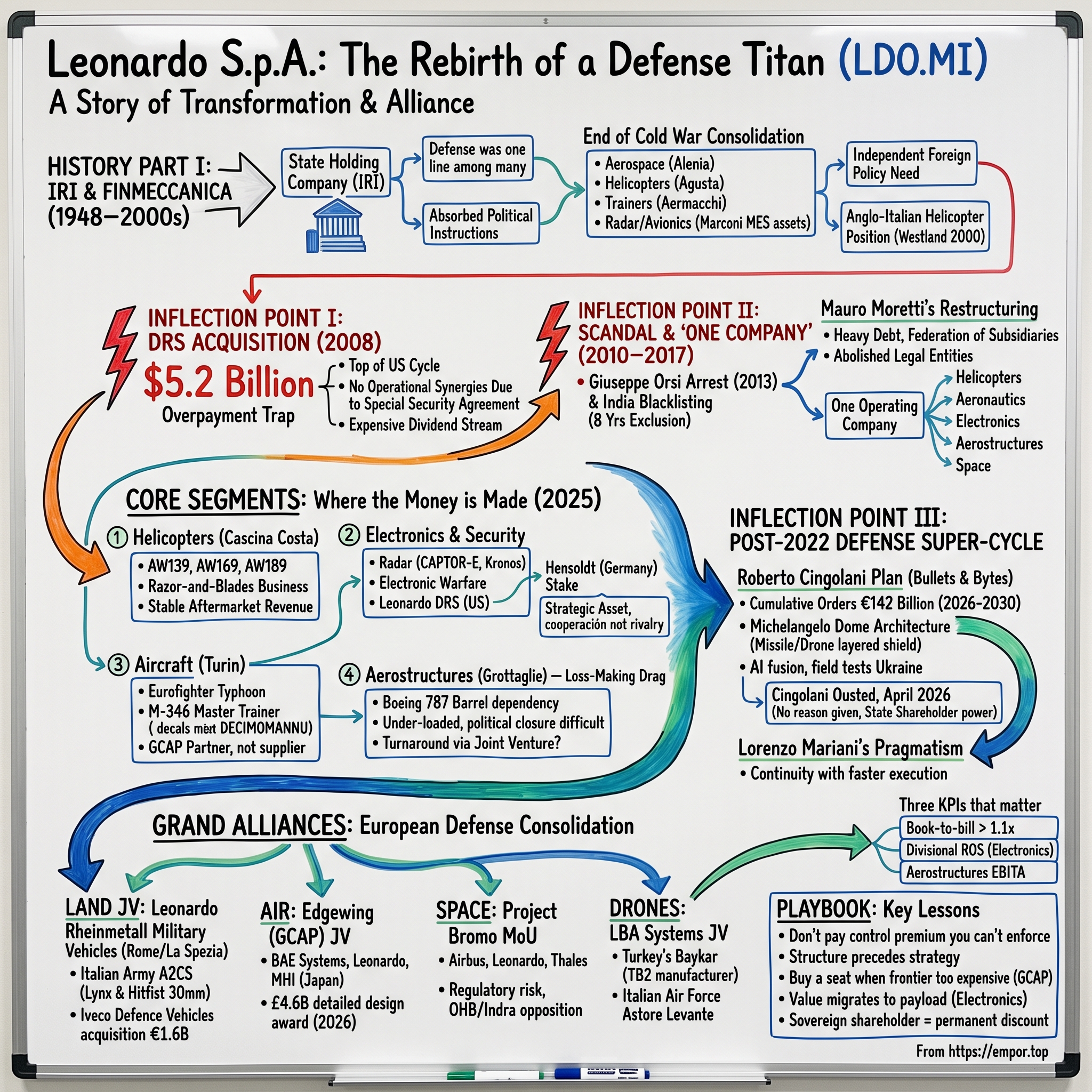
The road ahead: from a post-war Italian state holding company to Finmeccanica's global ambitions and its spectacular scandals; the cautionary tale of the $5.2 billion DRS Technologies acquisition in 2008; Mauro Moretti's brutal "One Company" restructuring; a segment-by-segment tour of where the money is actually made — helicopters, defense electronics, combat aircraft, the loss-making aerostructures unit, and the space joint ventures; the post-2022 super-cycle and the Cingolani plan; the grand alliances with Rheinmetall, BAE Systems and 三菱重工業 Mitsubishi Heavy Industries; and finally an honest stress test of the bull and bear cases, framed by Hamilton Helmer's 7 Powers and Porter's Five Forces.
It begins, as so much of Italian industry does, with the state.
 Subscribe on LinkedIn
II. History Part I: From State Conglomerate to Finmeccanica (1948–2000s)
Post-war Italy had a problem that would sound familiar to anyone who has studied a bankrupt conglomerate: it owned a great many industrial assets, none of which it could sell, and most of which lost money. The vehicle for holding them was IRI — the Istituto per la Ricostruzione Industriale, a state holding company originally created in the 1930s to rescue banks and their industrial hostages. In 1948, IRI created Finmeccanica as a financial sub-holding to sit on top of its mechanical engineering companies: shipyards, locomotive works, engine makers, and a scattering of aviation firms.
It is important to be clear about what Finmeccanica was for the first four decades of its life. It was not a defense company. It was a balance sheet. It held stakes, arbitrated between fiefdoms, and absorbed political instructions about which factories in which regions should keep which workers. Its subsidiaries built trains, generated power, made cars and engines. Defense was one line of business among many, and by no means the most important.
What changed everything was the end of the Cold War — which, counterintuitively, is what made Finmeccanica a defense company rather than unmaking it. Across the 1990s, European defense budgets collapsed and national champions consolidated because the alternative was extinction. Italy's answer was to sweep its remaining strategic aerospace and defense assets under one roof. Alenia, the aerospace arm, was folded in. Agusta, the helicopter maker from Cascina Costa near Milan, came under Finmeccanica control. Aermacchi, the Varese trainer-aircraft specialist whose jets had taught generations of pilots to fly, was absorbed. Alenia Spazio consolidated the space activities. Through a series of asset swaps with British and French counterparts — most consequentially the carve-up of Marconi Electronic Systems assets, which put serious radar and avionics capability into Italian hands — Finmeccanica assembled a defense electronics business that could stand comparison with Thales or BAE Systems.
The strategic logic was defensible and, in hindsight, correct. A mid-sized European country that wants an independent foreign policy needs a sovereign industrial base: someone who can build the radar, integrate the fire-control system, and keep the helicopters flying without asking Washington's permission. Italy decided it wanted that, and Finmeccanica was the answer. The 2000 acquisition of Westland from Britain, creating AgustaWestland, made the helicopter business genuinely Anglo-Italian and gave it a real position in the United Kingdom — a piece of industrial diplomacy whose value would only become fully apparent two decades later when the same relationship underpinned the trilateral fighter programme.
But the model came with a governance structure that has never been resolved, and which explains a great deal of what follows. Finmeccanica was progressively privatised — listed on the Milan exchange, with real institutional shareholders and a real share price. Yet the Italian state retained a controlling position, today 30.2% held through the Ministry of Economy and Finance, alongside golden-power legislation that lets Rome veto changes of control and strategic disposals.[^4] The MEF nominates the board. The board appoints the chief executive. And the mandate runs three years, which happens to be roughly the half-life of an Italian governing coalition.
This is a hybrid: a listed company with a sovereign owner whose objective function includes employment in Campania and Puglia, industrial offsets in export campaigns, and the political optics of Italian jobs. Investors who bought Finmeccanica in the 2000s were buying a business whose largest shareholder had never once behaved like a shareholder.
It is worth pausing on why the state kept the stake at all, because the logic is not sentimental. Defense is one of the few industries where the customer, the regulator, the export licensor and the shareholder can be the same entity. A government that wants its army supplied during a crisis, its export campaigns backed by diplomatic weight, and its technology kept out of foreign hands has rational reasons to hold equity rather than merely write contracts. The cost of that arrangement is borne by minority shareholders in the form of decisions that optimise for something other than return on capital — and, as the last decade demonstrated repeatedly, in the form of executive turnover driven by court calendars and coalition arithmetic.
There is a second inheritance from the IRI years that shows up in the accounts to this day: geography. Italian industrial policy distributed plants across the country for employment reasons rather than logistical ones, which is why Leonardo operates a dense network of sites from Varese in the north to Grottaglie in the deep south. A company with that footprint cannot respond to a demand shock by consolidating capacity the way an American peer would. It has to grow into its fixed costs instead. That single structural fact explains both the chronic under-absorption in the civil businesses during lean years and the strong operating leverage the group has enjoyed since 2022, when volumes finally arrived to fill the factories.
For a while, none of this mattered, because the 2000s were good. Post-9/11 defense budgets expanded, helicopter demand from oil-and-gas and emergency services boomed, and Finmeccanica's chief executive Pier Francesco Guarguaglini — an engineer with an appetite for scale — looked at the numbers coming out of the world's largest defense market and concluded that the only serious growth was in America. That conclusion led directly to the most expensive decision in the company's history.
III. Inflection Point I: The DRS Acquisition & The Overpayment Trap (2008)
In the spring of 2008, the U.S. defense budget was near a modern peak, two ground wars were consuming equipment at a furious rate, and every European prime with ambitions looked across the Atlantic with envy. The Pentagon spent more on defense than the next dozen countries combined. Guarguaglini wanted in.
The target was DRS Technologies, a New Jersey-based supplier of electro-optical sensors, thermal imaging, naval computing and combat systems — precisely the kind of unglamorous, high-content electronics business that rides on every American vehicle, ship and soldier. Finmeccanica agreed to pay $81 per share in cash, valuing the transaction at $5.2 billion including roughly $1.6 billion of assumed debt, and completed the purchase in October 2008.67
Consider the timing. The agreement was struck in May 2008; it closed in the same month that Lehman Brothers' collapse froze global credit markets. Finmeccanica funded a multi-billion-dollar cash acquisition, at a premium of roughly 30% to the undisturbed share price, at what would prove to be very close to the top of the American defense spending cycle. The multiples paid were rich by European standards of the day — on the order of one-and-a-half times revenue and low-teens EBITDA — for a business whose customer was about to enter a decade of budget austerity.
But the price was only half the problem. The deeper issue was structural, and it is the single most instructive detail in Leonardo's history.
When a foreign company buys an American defense contractor with classified programmes, the U.S. government does not simply wave it through. It imposes a Special Security Agreement or a proxy structure, which effectively firewalls the American subsidiary from its foreign parent. A separate, U.S.-citizen board governs the classified work. Italian executives cannot walk into DRS's secure facilities, cannot review the programme details, cannot reassign engineers between Rome and Arlington. The parent owns the cash flows; it does not own the operations.
Which means every synergy assumption in the deal model was, by construction, unavailable. There would be no combined R&D. No shared production. No cross-selling of Italian radar into American programmes or vice versa. Finmeccanica had paid a control premium for an asset it was legally forbidden to control. It had bought a very expensive dividend stream and called it a strategy.
The bill came due quickly. American defense spending peaked and then fell hard under the Budget Control Act and the sequester. DRS's core markets — armoured vehicle electronics, ground systems — were precisely the ones that shrank most as the wars wound down. Finmeccanica's 2012 accounts carried goodwill impairments of roughly €1.15 billion, concentrated in the defense and security electronics business that housed DRS, part of a broader wave of write-downs that pushed the group to heavy statutory losses in that period.8 The company had turned shareholder cash into goodwill and then turned goodwill into an accounting entry.
And yet. The postscript is genuinely interesting, because it complicates the simple morality tale. Leonardo did not sell DRS at the bottom. It held, restructured, and waited more than a decade. Then, in November 2022, it merged DRS with RADA Electronic Industries — an Israeli maker of compact tactical radars used in counter-drone and active-protection systems — in an all-stock deal that simultaneously listed the combined company on Nasdaq and gave it a fast-growing product line. Leonardo retained 80.5% of the listed entity.9 A year later, in November 2023, Leonardo sold 18 million shares at $17.75 in a secondary offering, trimming its holding to roughly 73%, monetising value while keeping consolidation.10 By late July 2026 the stake stood at about 72%, and Leonardo DRS had grown into a $3.6 billion-revenue business with $4.2 billion of 2025 bookings, an $8.7 billion backlog, and 2026 guidance of $3.85–3.95 billion of revenue.11
What should investors take from this? Two things, and they point in opposite directions. First, the deal was a capital allocation error of a specific and repeatable kind: paying a control premium for an asset over which control is legally impossible. Second, the eventual recovery came not from the original thesis but from a different one — using the U.S. listing as a currency and a valuation mechanism, letting the American business run itself under American management, and taking the cash. The lesson is not that bad deals come good if you wait. It is that the value of DRS today has almost nothing to do with why Finmeccanica bought it.
The write-downs, however, arrived at the worst possible moment, because by 2013 the company had a far more urgent problem than accounting.
IV. Inflection Point II: Scandal, Crisis, & The "One Company" Transformation (2010–2017)
On February 12, 2013, Italian police arrested Giuseppe Orsi, the chairman and chief executive of Finmeccanica, at his home near Milan. The charges concerned a contract signed three years earlier: twelve AW101 helicopters, sold to India for the transport of the president, prime minister and other VVIPs, worth around ₹3,600 crore.12 Prosecutors alleged that middlemen had been paid to steer the tender. Bruno Spagnolini, the head of AgustaWestland, was charged alongside him.
The commercial consequences were immediate and severe. India cancelled the contract. Then India blacklisted the entire group — not just AgustaWestland but Leonardo as a whole — barring it from bidding for Indian defense business at a moment when India was one of the world's largest arms importers and a natural market for Italian helicopters, torpedoes and naval guns.13 An entire growth region went dark.
The legal story ended less dramatically than it began. In 2016 a Milan court convicted both men; in January 2018 the appeals court found no evidence of corruption in the transaction and acquitted them.12 The ban was formally lifted in November 2021, after the company withdrew its claims against the Indian government over three helicopters it had delivered but never been paid for.13 Investigations by Indian agencies continued after that date. What the episode cost in absolute terms is not disclosed and probably not calculable, but eight years of exclusion from a top-three import market is a large number by any method.
The scandal is the visible part. The invisible part was worse: by 2014 Finmeccanica was carrying heavy debt, a portfolio of unrelated civil businesses, and an organisational structure that made improvement almost impossible. It was not a company. It was a holding structure containing roughly a dozen independent operating companies — AgustaWestland, Alenia Aermacchi, Selex ES, DRS and others — each with its own chief executive, its own sales force, its own R&D budget, its own brand, and its own political protectors. Two Finmeccanica subsidiaries could and did bid against each other in the same export campaign. Radar engineering was duplicated across sites. The centre could set targets but could not enforce them.
Into this walked Mauro Moretti in May 2014. Moretti was not an aerospace man. He was a railwayman — a former union figure who had spent years running Ferrovie dello Stato, the Italian state railway, where he had made his reputation by closing lines, cutting headcount and modernising a bureaucracy that had defeated his predecessors. His style was blunt to the point of abrasive. He was the opposite of the diplomatic engineer-executive the sector was used to, and he was hired precisely for that.
Moretti's diagnosis was that no strategy could work while the subsidiary structure survived, because the subsidiaries were where the power lived. His solution, executed with effect from January 1, 2016, was to abolish them. The legal entities were merged into a single operating company, Finmeccanica S.p.A., organised into divisions — Helicopters, Aircraft, Aerostructures, Airborne & Space Systems, Land & Naval Defence Electronics, Defence Systems, Security & Information Systems. Divisional heads reported to the centre. Sales became a single group function. R&D was pooled. The historic brands — Agusta, Westland, Alenia, Selex — were simply switched off.
For anyone who has watched conglomerates attempt this, the striking thing is that it actually happened. Most "One Company" programmes are a slide deck and a new logo. This one killed corporate entities with their own boards, their own headquarters and their own century-old names. The cultural violence was enormous; the AgustaWestland brand in particular carried genuine commercial equity in the helicopter market. Moretti did it anyway, on the argument that duplicated overhead and internal competition were costing more than the brands were worth.
The rebranding followed the restructuring rather than preceding it. Shareholders approved the change in 2016, and from January 1, 2017 the company became Leonardo S.p.A. — named for Leonardo da Vinci, positioning the group as technology-led, and, not incidentally, erasing a name that had become shorthand in the Italian press for corruption trials.
The financial evidence that the surgery worked is easy to state and was slow to arrive. Between 2016 and 2021 the group's reported margins improved only modestly and the share price went nowhere; the restructuring removed duplication and improved control, but it did not, by itself, create growth. What it did create was the capacity to respond. A divisionalised company with a single sales organisation and a central R&D budget can redirect resources toward radar and electronic warfare when demand shifts; a federation of subsidiaries cannot, because each subsidiary defends its own programme. When European demand exploded after 2022, Leonardo was able to convert it into orders and then into revenue at a pace that would have been impossible under the old structure. Investors evaluating restructurings should note the shape of that payoff curve: several years of cost and disruption, no visible reward, and then a step change that arrives only when the external environment turns.
Moretti did not get to enjoy it. On January 30, 2017 an Italian court convicted him over the 2009 Viareggio rail disaster, in which a derailed freight train carrying liquefied gas killed 32 people during his tenure at the railway. The government declined to renew his mandate, and in May 2017 the board appointed Alessandro Profumo — the former chief executive of UniCredit, one of Italy's best-known bankers — as chief executive.14 Profumo would himself be convicted of false accounting in October 2020 over his earlier role at Banca Monte dei Paschi di Siena, a verdict later overturned on appeal, while serving as Leonardo's chief executive.15
Pause on that sequence, because it matters more than any single financial metric in this story. In the space of a decade Leonardo had a chairman arrested, a chief executive convicted over a rail disaster, and a successor convicted in a banking case — three consecutive leaders leaving under legal or political cloud, and a fourth removed in 2026 without explanation. Governance risk at this company is not theoretical or historical. It is a recurring feature of the security.
But the machine underneath had been rebuilt. And when the world changed in 2022, Leonardo — for the first time in its existence — was structurally capable of responding. To understand what it was responding with, we need to look at where the money actually comes from.
V. Core Segment Deep-Dive: Economic Engines & Materiality
If you want to understand Leonardo as a business rather than as an Italian institution, ignore the org chart and follow the profit. In 2025 the group generated €19.5 billion of revenue and €1.75 billion of EBITA, a 9.0% margin.3 Those two numbers are distributed very unevenly.
A. Helicopters Division (AgustaWestland Legacy)
Start at Cascina Costa, in the flat country north-west of Milan, where Agusta has built rotorcraft since the 1950s. The Helicopters division generated €5.83 billion of revenue in 2025, up 11.1%, with EBITA of €523 million, up 12.5% — roughly 30% of group revenue and 30% of divisional profit.16 The division delivered 182 aircraft during the year.16
The economics of helicopters are not the economics of aircraft. A commercial airliner programme is a bet-the-company affair with a decade of negative cash flow. A helicopter family is closer to a razor-and-blades business with a very long blade cycle. Leonardo's signature product, the AW139, is a medium twin-engine machine that has become the default aircraft for offshore oil and gas crew transfer, air ambulance work, law enforcement and VIP transport. The AW169 sits below it, the AW189 above it, and the AW101 — the largest, the aircraft at the centre of the Indian scandal — serves heavy military and search-and-rescue roles.
The commercially important fact is that these are not one-time sales. A helicopter operator flying offshore in the North Sea buys the airframe once and then buys parts, scheduled overhauls, training, simulator time and software updates for thirty years. Aftermarket support is a substantial share of divisional revenue, and it is structurally higher-margin than new-build, because the customer has already sunk the certification, the pilot type ratings and the maintenance infrastructure into that specific airframe. Switching to an Airbus H175 means requalifying pilots, retraining mechanics, replacing tooling and renegotiating with the aviation authority. Very few operators do it casually.
That is genuine switching-cost power, and it shows up in the numbers as remarkably stable service revenue through cycles. But investors should be careful not to over-romanticise it. The competitive set — Airbus Helicopters, Sikorsky under Lockheed Martin, Bell within Textron, Boeing's rotorcraft arm — is small, sophisticated and well capitalised. In the civil market, demand is cyclical and tied to offshore energy capex and corporate spending. And Helicopters grew only 3.8% in the first quarter of 2026 after several years of double-digit expansion, which management characterised as consistent with full-year guidance rather than as a slowdown.17 The honest reading is that helicopters are the group's cash-generative core with a real moat in the installed base, not its growth engine.
One further nuance in the military half of the business: Leonardo participates in the NH90 through the multinational NHIndustries consortium alongside Airbus Helicopters, a programme that has been a long-running lesson in how European collaborative procurement can erode returns. Multiple national configurations, competing assembly arrangements and shifting requirements produced an aircraft that arrived late and expensive relative to its original promise. The relevance today is that Leonardo's growth strategy leans heavily on exactly this structure — multinational ventures with shared workshare — which is why the governance design of the newer programmes deserves more scrutiny than the technology.
Two forward options deserve mention. The AW609 civil tiltrotor — an aircraft that takes off like a helicopter and cruises like a turboprop — has been in development for many years and remains uncertified for commercial service, an expensive open-ended bet on a market that does not yet exist. More material near-term is NATO's Next Generation Rotorcraft Capability programme, where Leonardo is positioned as a lead industrial participant in defining what replaces the current European medium helicopter fleet in the 2035–2040 window.
B. Defense Electronics & Security (Europe & Leonardo DRS)
This is the profit engine, and it is not close. Defence Electronics & Security produced €8.35 billion of revenue in 2025 — the largest division — with EBITA of €1.075 billion at a 12.9% return on sales, materially above the group average.16
What does it actually make? Radar, in several flavours: the electronically scanned CAPTOR-E radar that gives the Eurofighter Typhoon its ability to detect and track targets without physically moving the antenna; the Kronos family of naval and land radars; airborne early-warning sensors. Electronic warfare systems that detect, jam and spoof enemy emissions. Avionics, mission computers, secure communications, identification systems. Through Leonardo DRS in the United States, it adds thermal imaging and electro-optical sensors, naval electric power conversion for the U.S. Navy's newest ships, ground-vehicle computing and, via the RADA product line, the compact radars that feed active protection systems such as Trophy — the technology that detects an incoming anti-tank missile and destroys it in flight before it reaches the vehicle.
The reason this is the highest-margin part of the group comes down to what customers are paying for. When a navy buys a frigate, most of the money goes into steel, propulsion and labour, all of which are competitively bid and thin-margin. The combat management system — the software and sensors that decide what is a threat and how to engage it — is a fraction of the cost and a large fraction of the value, and it is very hard to substitute once the ship is designed around it. Electronics is where the intellectual property lives, where the software content compounds, and where upgrades can be sold repeatedly across a platform's life without building anything new.
The competitive picture is genuinely tough. Thales in France and BAE Systems in Britain are peers of comparable scale and capability; Germany's Hensoldt is a focused sensor specialist; RTX and Northrop Grumman dominate in the United States. Leonardo's response to Hensoldt was to buy into it: a 25.1% stake acquired for approximately €606 million at €23 per share, agreed in April 2021 and completed in January 2022.1819 The stake has since been diluted to about 22.8% by a Hensoldt capital increase, and in July 2026 chief executive Lorenzo Mariani ended a period of public speculation by confirming Leonardo will keep it, citing the strength of the German market and the scope for cooperation rather than rivalry.20 That reverses Cingolani's February 2026 signalling that "different options" including a sale to the German government were on the table.20 Investors should note the reversal for what it is: a strategic asset whose purpose has been redefined twice in six months without a change in the underlying facts.
Momentum here is strong. In the first quarter of 2026, European electronics grew EBITA 25% with a double-digit return on sales, while Leonardo DRS improved EBITA 15% despite roughly $10 million of currency headwinds.17 When analysts at BNP Paribas pressed the chief financial officer on a 200 basis-point margin improvement at DRS, the answer was programme performance, operating scale and the absence of prior-year rare-materials cost hits — a concrete, checkable explanation rather than an appeal to mix.17
C. Aircraft Division
The Aeronautics business — combat and trainer aircraft, excluding aerostructures — generated about €4.24 billion of revenue in 2025, up 11.1%, with order intake of €5.8 billion, a 55% jump driven by a Kuwaiti logistics support contract, higher GCAP orders and recovering commercial fuselage demand.16
Leonardo's position in combat air is that of a full partner rather than a subcontractor. In the four-nation Eurofighter consortium alongside BAE Systems and Airbus, it runs a final assembly line at Turin and supplies major structures and a substantial share of the mission electronics. That distinction — partner, not supplier — is what qualifies Italy for a seat at the sixth-generation table two decades later.
The M-346 Master is the quiet commercial success of the division: an advanced jet trainer that has become a standard for NATO and partner air forces preparing pilots for fifth-generation fighters. What makes it interesting economically is that Leonardo does not merely sell the aeroplane. It sells the training system — ground-based simulators, courseware, mission planning, and in some cases the flying school itself at Decimomannu in Sardinia, where allied air forces send students. Once a country's pilot pipeline runs through your syllabus and your simulators, replacing the aircraft means replacing the entire training architecture. That is switching cost built out of software and process rather than metal, and it is a better business than airframe manufacturing.
The C-27J Spartan tactical transport rounds out the division — a niche product with a steady stream of small orders from air forces that need something between a helicopter and a C-130.
D. The Aerostructures Drag: Boeing 787 Dependency & Turnaround Case
Now the ugly part. At Grottaglie, near Taranto in Puglia, Leonardo operates one of the world's most advanced composite manufacturing plants. It bakes carbon-fibre barrel sections of the Boeing 787 Dreamliner fuselage in giant autoclaves and ships them to South Carolina. It also builds structures for the ATR regional turboprop and other civil programmes.
It has lost money for years. In 2025 the Aerostructures division recorded an EBITA loss of €134 million on roughly €745 million of revenue — a return on sales of minus 18%. That was an improvement on 2024's €168 million loss and minus 22.5% margin, but it is still a business destroying more than a sixth of its revenue.21 In the first quarter of 2026 the loss was €45 million on €222 million of revenue, improvements of 19% and 48% respectively year on year, helped by Boeing raising Leonardo's delivery rate from four shipsets a month to eight.17
The causal chain is simple and almost entirely outside Leonardo's control. Boeing's 787 programme suffered years of quality escapes, regulatory scrutiny and production halts. When Boeing cuts rates, Leonardo's fixed costs — a specialised plant, a skilled workforce protected by Italian labour law, autoclaves that cost the same whether they run once a week or five times — do not fall. The result is a structurally under-loaded factory in a region where closing it is politically unthinkable. The European Parliament received a formal question in 2026 about employment protection at the Grottaglie site, which tells you how the plant is viewed in Rome and Brussels.22
Management's answer has evolved through several versions, and the evolution is itself evidence. The company said in earlier years it would not sell the business. Then it explored a carve-out and alliances, on the explicit reasoning that it could no longer wait for Boeing to fix itself.23 Then it sought a partner: talks with Saudi Arabia's sovereign wealth fund were reported and never confirmed by the company, which has cited confidentiality throughout.24 In February 2026 Cingolani said a joint-venture accord would be signed by end-June, and claimed the combination could treble the size of the business and place it in the world's top three.24 On the Q1 call, executives confirmed a June 30 "go/no-go" deadline and named ministerial funding incentives as the critical blocker.17 June 30 passed without a deal. On July 21, 2026, Mariani said the project was still "moving forward" but that negotiations had slowed because of disruption from conflict in the Middle East, pushing the target to year-end.25
Four missed deadlines on the same transaction is a fact, not an opinion. Break-even, once targeted for 2025, is now discussed in terms of 2028–2029.23 For 2026 the unit is still expected to be a cash drag of more than €100 million.25 Investors valuing Leonardo should treat the aerostructures resolution as an option with real value if exercised and zero if not — and should notice that the counterparty has never been publicly named after more than a year of talks.
E. Strategic Optionality: Space & Cyber Security
Two smaller businesses carry disproportionate strategic weight. Space is held through joint ventures rather than consolidated: Leonardo owns 33% of Thales Alenia Space, the manufacturing arm that builds satellites and orbital infrastructure, and 67% of Telespazio, the services arm that operates them and sells Earth observation data — including from the COSMO-SkyMed radar satellite constellation used for defense and civil monitoring.26 Space revenue grew sharply in the first quarter of 2026, roughly doubling on satellite services strength, from a small base.17
Cyber & Security Solutions is the fastest-improving business in the group in percentage terms: revenue of €798 million in 2025, up 23.1%, with EBITA up 63.3% to €80 million — a 10% return on sales.16 It houses the Davinci-1 supercomputer, digital-twin simulation, secure sovereign cloud and the security operations that protect Italian critical infrastructure. It is far too small to move the group's earnings today. Its relevance is as the technical substrate for everything the company now says about multi-domain warfare.
Taken together, the segment picture yields a clear conclusion. Roughly four-fifths of Leonardo's profit comes from electronics and helicopters; combat aircraft supplies the backlog and the geopolitical relevance; aerostructures subtracts; space and cyber are options. Any thesis about margin expansion is fundamentally a thesis about electronics growing faster than everything else — which is exactly what management has promised. Whether that promise is credible depends on what happened after February 2022.
VI. Inflection Point III: The Post-2022 Defense Super-Cycle & Cingolani Era
For thirty years, European defense budgets operated on an unspoken assumption: that large-scale conventional war on the continent was over, and that defense spending was a legacy obligation to be managed downward. Governments called the savings the peace dividend. Defense executives called it slow strangulation. Between 1990 and 2020, most European armies shrank their tank fleets by an order of magnitude, ran ammunition stocks down to weeks of consumption, and treated 2% of GDP as an aspiration rather than a floor.
Russia's full-scale invasion of Ukraine in February 2022 ended that in about a fortnight. What followed was not a normal cyclical upturn but a repricing of an entire asset class. Governments that had spent decades cutting discovered they had to buy air defense, artillery, ammunition and electronic warfare simultaneously, and that the industrial capacity to supply them had been allowed to atrophy. For the surviving primes, the constraint flipped overnight from demand to supply.
It is worth being precise about how a budget announcement becomes a Leonardo order, because the lag is long and investors routinely misjudge it. A government first commits to a spending level, usually as a share of GDP. That commitment then has to pass through a national budget, be allocated to a service branch, be converted into a requirement, survive a competition or a government-to-government negotiation, and finally be signed as a contract — a process that typically consumes two to four years for a major platform. Ammunition and consumables move faster; complex systems move slower. This is why the European order wave of 2024 through 2026 reflects political decisions taken in 2022 and 2023, and why order intake can keep rising for years after the political peak has passed. It also cuts the other way: if European appetite cools in 2026 and 2027, the damage would not appear in Leonardo's revenue until the end of the decade. Backlog is a shock absorber, not an insurance policy.
Italy's own position within that wave deserves a sceptical note. Italy carries one of the highest public debt burdens in the developed world, and its defense spending has historically sat below the NATO benchmark. A large portion of the country's recent increases has been achieved through accounting definitions and multi-year commitments rather than immediate cash outlays. Leonardo's domestic order flow is therefore more exposed to Italian fiscal politics than the group's European positioning implies — one reason the company's growth strategy has leaned so heavily on Germany, Britain, Japan and the Gulf rather than on Rome alone.
Into that environment, in May 2023, walked Roberto Cingolani — a genuinely unusual appointment. Cingolani was an experimental physicist by training, founder and long-time scientific director of the Istituto Italiano di Tecnologia in Genoa, a nanotechnology researcher with a substantial academic publication record. He had served as Italy's Minister for Ecological Transition in the Draghi government, and had been Leonardo's chief technology officer before taking the top job. He was, in short, a scientist running an arms manufacturer.
His framing of the business was distinctive and, in the end, contested. Cingolani argued that the defining shift in defense was not more hardware but the fusion of hardware with computation — his phrase on the Q1 2026 call was "bullets and bytes," and he claimed Leonardo was "the only industrial company in the world that has all the hardware platforms and the AI digital capabilities."17 That claim is worth examining sceptically: RTX, Lockheed Martin, Thales and BAE would all dispute it, and none of them lacks digital capability. What is defensible is the narrower point that Leonardo owns an unusually broad platform set — helicopters, fighters, radars, satellites, and now land vehicles — inside one company.
The strategy took physical form in November 2025 with the unveiling of the "Michelangelo Dome," a proposed multi-domain defense architecture stitching together land, naval, airborne and space sensors, command-and-control, artificial intelligence and effectors into a single layered shield against missiles and drones.27 The commercial claim attached to it is large: Leonardo estimated the concept could unlock €21 billion of new business over a decade, of which €6 billion between 2026 and 2030.28 The first field test is scheduled to take place in Ukraine before the end of 2026, with an initial iteration for the Italian Ministry of Defence targeted for end-2027.29 Investors should file this under credible-but-unproven: no contract of consequence has yet been signed against the €21 billion figure, and integrating heterogeneous national air defense systems is a problem Europe has failed to solve for thirty years for political, not technical, reasons.
The financial architecture came on March 12, 2026, when Leonardo published FY2025 results alongside an updated 2026–2030 Industrial Plan. The targets are ambitious: cumulative orders of €142 billion and cumulative revenues of €126 billion over five years, with 2030 exit-rate revenues of €30 billion, EBITA of €3.59 billion and free operating cash flow of €2.06 billion.3031 Implied revenue growth is roughly 9% compounded from 2025, and the EBITA target implies a margin approaching 12% against 9.0% in 2025 — margin expansion of roughly three points, to be delivered mainly by electronics mix, scale absorption of fixed costs, and the removal of the aerostructures drag.30 Headcount is planned to rise from 62,700 at end-2025 to about 75,500 by 2030.28
Capital discipline was the third leg. Net debt of €1.0 billion at end-2025 was down 44% year on year, a proposed dividend of €0.63 per share was up 21%, and free operating cash flow of €1.0 billion rose 21%.3 Guidance for 2026 was set at approximately €25 billion of orders, €21 billion of revenue, €2.03 billion of EBITA and €1.11 billion of free operating cash flow, with net debt around €0.8 billion excluding the €1.7 billion Iveco acquisition.3
A useful discipline here is to compare the plan against what the same management said earlier. The 2026–2030 targets were an upgrade rather than a reset: the prior plan's ambitions were raised as order momentum exceeded expectations, and the group had already upgraded its 2025 guidance mid-year on orders and cash flow before delivering on it.3233 That is the right direction of travel — raising targets after beating them rather than cutting them after missing. But investors should also notice what the plan does not do. It does not disclose backlog margin. It does not quantify how much of the 2030 revenue target depends on programmes not yet contracted, such as the Michelangelo architecture. And its margin bridge assumes the aerostructures drag disappears, a step that had already slipped repeatedly by the time the plan was published.34
Then, four weeks after presenting that plan, Cingolani was removed.1 He presented one final set of results — the Q1 2026 call on May 6, the day before the shareholders' meeting that replaced him.17 Whatever one concludes about his strategy, the sequence establishes something important about this security: the person who sets the five-year plan does not control whether they are present to execute it.
VII. The Grand Alliances: Consolidation of European Defense
There is a structural fact that governs everything Leonardo does strategically, and it is arithmetic rather than ideology. A sixth-generation fighter costs tens of billions of dollars to develop. Italy's entire annual defense budget is a fraction of that. No European country except possibly France can fund a frontier combat aircraft alone, and France is attempting it inside its own troubled trilateral programme. For Leonardo, partnership is not a preference. It is the only available path to remaining a prime contractor rather than becoming a supplier to someone else's prime.
Land: Rheinmetall, and then Iveco
European land systems had long been dominated by the Franco-German KNDS group, formed from Krauss-Maffei Wegmann and Nexter, which owned the Leopard and Leclerc tank franchises. Italy had no credible heavy armour of its own and faced buying German or French — a strategically uncomfortable position for a country with a large army and a state-owned defense champion.
The answer was a 50:50 joint venture with Rheinmetall, Germany's fastest-growing defense company. Leonardo Rheinmetall Military Vehicles was cleared by the German competition authority in January 2025 and established with corporate headquarters in Rome and operational headquarters in La Spezia.3536 The industrial logic: Rheinmetall brings the vehicle platforms — the Panther KF51 tank and the Lynx KF41 infantry fighting vehicle — while Leonardo brings turrets, electronics, fire control and, critically, Italian workshare and access to the Italian Army's procurement pipeline.
The first contract arrived on November 5, 2025: 21 vehicles under the Italian Army's A2CS programme, comprising five Lynx KF-41s with Rheinmetall's Lance turret and 16 vehicles built on the same chassis fitted with Leonardo's Hitfist 30mm turret, with first delivery expected by end-2025.37 Twenty-one vehicles is a rounding error against the programme's stated ambition of some 1,050 armoured combat vehicles across the A2CS and main battle tank programmes, which is why the JV is discussed in terms of tens of billions of euros over a decade or more.37 But the first contract is what converts a memorandum into a business, and it landed roughly a year after the venture was formed — fast by European defense procurement standards.
Leonardo then went considerably further. On July 30, 2025 it agreed to buy Iveco Group's defense business — Iveco Defence Vehicles and the Astra brand — at an enterprise value of €1.7 billion, closing on March 17, 2026 at a final cash consideration of €1.6 billion after contractual adjustments.3839 The acquired business runs five plants across Italy, Germany, Romania and Brazil with about 2,000 employees, and it makes the trucks and armoured vehicles the Italian Army actually uses.39 The deal added roughly €5.6 billion to backlog on consolidation and is expected to contribute about €1.2 billion of orders, €1.1 billion of revenue and €0.12 billion of EBITDA over nine months of 2026.417
This is a significant reversal of the DRS lesson: an acquisition where operational control is complete, the customer is the domestic ministry, and the industrial fit with the Rheinmetall venture is obvious. It is not, however, free of complexity. On the Q1 call, J.P. Morgan pressed on which part of IDV might eventually be sold to Rheinmetall; the chief financial officer disclosed roughly a 60/40 revenue split between trucks and armoured vehicles and said a disposal was "one of the option," with the outcome pending discussion.17 Buying a business and immediately negotiating the sale of its larger half to your joint-venture partner is a defensible piece of portfolio surgery, but it is also an admission that the whole asset was not the target.
Air: GCAP and Edgewing
The Global Combat Air Programme is the most consequential thing Leonardo is involved in, and the least visible in near-term earnings. It is a trilateral effort by Italy, the United Kingdom and Japan to field a sixth-generation combat aircraft by 2035 — stealthy, networked, operating with uncrewed "loyal wingman" aircraft, carrying sensors and processing power that make the airframe as much a data node as a weapons platform.40
What makes GCAP structurally different from Eurofighter — a programme notorious for national vetoes, duplicated assembly lines and political paralysis — is the governance. The three governments created an international organisation to act as a single customer, and industry created a single joint venture to act as a single prime. That venture, Edgewing, was launched in June 2025 with BAE Systems, Leonardo and Japan Aircraft Industrial Enhancement Co. each holding 33.3%, headquartered in Reading, England.41 Edgewing designs and develops the aircraft, then subcontracts manufacture and final assembly to BAE Systems, Leonardo, 三菱重工業 Mitsubishi Heavy Industries and the wider supply chain.41
The design is deliberately intended to prevent the Eurofighter failure mode, in which each nation demanded its own variant and its own workshare and the programme paid for it in cost and schedule. Whether the design works is not yet demonstrable. What is demonstrable is money changing hands: an initial contract of £686 million was placed with Edgewing in April 2026, followed on July 3, 2026 by a £4.6 billion, 18-month award running to December 31, 2027 to carry the aircraft through advanced concept, assessment and detailed design.[^43]42 A demonstrator aircraft is due to fly before the end of 2027.42
Scepticism remains warranted on funding rather than engineering. On the Q1 call, a Bank of America analyst raised concerns about the UK's willingness to fund its share; Cingolani's response was that "it would be a big mistake to abandon because one of the partners has a momentary difficulty" — a fair point that is also, notably, not a statement that the money is committed.17
Space, and the drone flank
The most audacious consolidation is in space. On October 23, 2025, Airbus, Leonardo and Thales signed a memorandum of understanding to merge the bulk of their space businesses into a new company — internally "Project Bromo" — with Airbus at 35% and Leonardo and Thales at 32.5% each, roughly 25,000 employees and about €6.5 billion of revenue on 2024 figures, headquartered in Toulouse and targeted to begin operating in 2027.43 Launch vehicles are excluded. The strategic rationale is blunt: European satellite manufacturers are being outcompeted on cost and cadence by American constellation operators, and three sub-scale players cannot each fund the transition to industrialised mass production.
The obstacle is Brussels. On June 24, 2026, Airbus's Guillaume Faury and Leonardo's Mariani jointly urged the European Commission to clear the deal as the parties approached a formal antitrust filing; a decision is not expected before the second half of 2027, and Germany's OHB and Spain's Indra have opposed it.43 For investors, Bromo is a multi-year deconsolidation story with regulatory risk, not a 2026 earnings event.
Finally, uncrewed systems — where Leonardo chose partnership over building from scratch. In June 2025 it established LBA Systems, a 50:50 joint venture with Turkey's Baykar, the manufacturer of the TB2 drones that became famous in Ukraine.44 The venture reached full operational readiness in July 2026 with regulatory authorisations in place, and has begun building the first Astore Levante uncrewed aircraft for the Italian air force from a Baykar design.45 Buying access to combat-proven, cost-competitive drone technology rather than spending a decade developing it is a rational trade — and an implicit acknowledgment that European primes were slow to the most important weapons category of the past five years.
There is a pattern in these four transactions that is easy to miss when they are read as separate news events. In each case, Leonardo brought something specific and hard to replicate — Italian workshare, sovereign customer access, sensors and mission electronics — and traded it for something it could not build alone: a tank platform, a sixth-generation airframe programme, satellite manufacturing scale, a combat-proven drone line. That is a coherent doctrine, and it is the correct doctrine for a company of Leonardo's size facing competitors two and three times larger. It is also, unavoidably, a doctrine of shared control. In a 50:50 venture, neither partner can force a decision; in a three-way venture with government shareholders behind each partner, disagreement escalates to diplomacy. The financial expression of that risk is that a growing share of Leonardo's future earnings will be equity-accounted, non-controlled, and dependent on partners whose own strategic priorities can shift with their own elections.
A related question, less discussed but commercially significant, is what all this does to Leonardo's export position. The company's traditional strength in third markets — the Gulf, South-East Asia, North Africa, Latin America — rested partly on being a mid-sized, politically flexible supplier: a European alternative that came with fewer strings than an American package and less baggage than a French or British one. Deeper integration with German, British and Japanese partners narrows that flexibility, because export approval now runs through more capitals. Every additional partner in a programme is an additional government that can veto a sale. The Eurofighter programme has demonstrated this repeatedly, with individual member states blocking or delaying deliveries to particular customers on human-rights or foreign-policy grounds. Leonardo's alliance strategy buys scale at the price of export autonomy, and investors modelling the export contribution to the 2030 revenue target should treat that trade as real rather than theoretical.
Four major alliances in two years is a lot of structural change. It also means Leonardo's future increasingly runs through entities it does not solely control — which brings us to the question of who is running the company, and how well.
VIII. Strategy, Management Credibility, & Skeptical Investor Stress Test
On May 7, 2026, Leonardo's shareholders' meeting approved the 2025 accounts and appointed a new board for the 2026–2028 term, with Francesco Macrì elected chairman with 99.456% of the capital represented.46 The same day, the new board appointed Lorenzo Mariani as chief executive officer and general manager, with Gian Piero Cutillo as co-general manager.47 The chairman was granted powers over group security, national and international institutional relations, governance and anti-corruption, institutional communications and sustainability — a notably broad remit for a non-executive chair.47
Mariani is a company man in the most literal sense. A former Italian navy officer, he spent much of his career inside Leonardo and its predecessor entities, running the electronics business and serving as commercial director before becoming co-general manager under Cingolani.2 He then went to MBDA, the European missile joint venture, heading its Italian operations. Analysts reading the appointment saw pragmatism rather than disruption — as one put it, there would be "no learning curve as defense budgets accelerate."2
The early evidence supports that reading. At the Farnborough International Airshow on July 20, 2026, Mariani's message was continuity in substance: multi-domain integration, the Michelangelo Dome, the Rheinmetall venture and IDV, GCAP, and the drone partnership with Baykar. His framing sentence — "Innovation, speed of execution and strategic partnerships are key enablers" — is Cingolani's strategy with the physics vocabulary removed.48 Where he has differed is in closing open questions: the Hensoldt stake stays.20 The aerostructures deadline moves to year-end.25 Both are decisions his predecessor had left hanging.
Now the stress test. A sceptical investor would put four challenges to this management team, and management's answers deserve to be weighed rather than accepted.
Challenge one: is Leonardo still a low-margin metal-basher hostage to Boeing? The answer is largely no, and the numbers support it. Aerostructures represents under 4% of group revenue, and defense-driven divisions supply the overwhelming majority of EBITA.1621 But "largely no" is not "no." The unit still consumed more than €100 million of cash in 2025 and is expected to do so again in 2026, and the promised structural fix has slipped four times.25 A sceptic would also note that the group's 9.0% EBITA margin remains below what a pure defense electronics peer earns, meaning the metal-bashing critique is only half retired.
Challenge two: does state ownership destroy value? In April 2026 this stopped being hypothetical. The controlling shareholder removed a chief executive who had delivered order growth, margin expansion, debt reduction and a six-fold share price increase, four weeks after he presented a five-year plan, without publishing a reason.1[^4] Management's counter-argument — that Cingolani had in practice restructured the Italian footprint without political obstruction because a rising backlog made it painless — is true and beside the point. The risk was never that Rome blocks restructuring during a boom. It is that Rome sets the CEO's tenure on a political rather than an operational clock, and that the objective function of a 30.2% shareholder with golden powers is not identical to that of the other 70%. This is a permanent structural discount factor, and the events of 2026 argue it should be larger, not smaller, than investors assumed in 2024.
Challenge three: can multi-nation joint ventures actually deliver? The evidence is mixed but improving. Eurofighter is the cautionary precedent — four nations, four assembly lines, decades of delay. GCAP has been architected specifically to avoid that, with a single government customer organisation and a single industrial prime in Edgewing.41 The £4.6 billion contract into detailed design and a demonstrator targeted for 2027 are real milestones, not press releases.42 The Rheinmetall venture converted to a signed Italian Army order within a year.37 Against that, Project Bromo faces a Commission decision that may not arrive before late 2027, with two European competitors actively opposing.43 The fair conclusion: bilateral ventures with a clear domestic customer are executing; multilateral ventures dependent on Brussels are not yet proven.
Challenge four: is the growth organic or bought? This one deserves more attention than it usually gets. Reported 2026 growth flatters the underlying business because Iveco Defence Vehicles contributes roughly €1.1 billion of revenue for nine months, and the Q1 backlog jump to €56 billion included €5.6 billion of acquired backlog.417 Strip those out and the organic picture is still good — Q1 revenue grew about 10% excluding currency effects — but investors tracking the plan should insist on organic disclosure rather than headline growth.17
On incentives, the shareholders' meeting that installed the new board also approved the remuneration report, which is where the detailed weightings between order intake, EBITA margin, cash conversion and sustainability targets are disclosed.46 The structural point for investors is simpler than any individual weighting: in a company where the controlling shareholder can end a chief executive's tenure regardless of performance against those targets, long-term incentive plans do less alignment work than they would elsewhere. An executive who knows the mandate is three years long has a rational preference for actions that show results inside three years — order intake and reported margin — over actions whose payoff arrives in 2032, such as the aerostructures fix or the sixth-generation fighter. That is not an accusation against any individual. It is an observation about the incentive geometry created by the ownership structure, and it argues for reading multi-decade programme commitments with an extra degree of caution.
On guidance discipline, the record is respectable. Leonardo upgraded 2025 guidance on orders and cash flow at the half-year and delivered against it.323 When Mediobanca's analyst pressed on the Q1 call about why 2026 guidance was not raised after a 31% order jump, the chief financial officer declined, citing geopolitical and currency uncertainty and noting the first quarter is "the weakest contributor to the full year."17 Declining to raise guidance on one strong quarter is the behaviour of a management team that intends to be believed later. It is a small but genuine credibility marker.
Capital allocation now sends a mixed signal. The company restored a meaningful dividend, cut leverage sharply, and in May 2026 launched a modest buyback — a maximum of 2 million shares, about 0.345% of capital, explicitly to serve long-term incentive and employee share ownership plans rather than to return capital.49 Simultaneously it deployed €1.6 billion of cash on IDV.39 That is a company prioritising strategic expansion over shareholder distribution, which is defensible in a super-cycle and worth watching closely if order growth ever slows.
IX. Strategic Frameworks: Powers & Porter's 5 Forces
Frameworks are only useful if applied without generosity, so here they are applied that way.
Hamilton Helmer's 7 Powers, tested
Cornered Resource — strong, but it is a licence, not an asset. Leonardo's most durable advantage is its status as Italy's sovereign defense supplier. A foreign prime cannot easily win a primary Italian military contract without Italian industrial participation, and golden-power rules give Rome the ability to enforce that. This produces a protected revenue base with limited price competition. The honest caveat: this "resource" is granted by the same shareholder that fired the chief executive. It can be narrowed by European procurement integration, or by a future government deciding that buying American off the shelf is faster. It is a strong power with a political expiry clause.
Switching Costs — strong, and the best-evidenced power in the portfolio. Thirty-year platform lifecycles, type-rated pilots, certified maintenance chains, mission-specific software and training ecosystems all make replacement genuinely expensive. The M-346 training system and the AW139 aftermarket are the clearest examples: the customer's own organisation is built around the product. This is the power most visible in the financials, in the stability of service revenue through the lean years of 2013–2020.
Scale Economies — moderate. Leonardo has real scale in medium helicopters and in radar production relative to smaller regional players. But against Thales, BAE Systems, RTX or Lockheed Martin, Leonardo is the smaller party in most direct comparisons, with roughly €19.5 billion of revenue versus considerably larger American peers.3 The company is buying scale through joint ventures precisely because it does not have enough of it alone. Calling this a power overstates it; calling it a deficiency being actively remediated is more accurate.
Process Power — moderate, and hard to verify. Decades of complex systems integration, security-cleared manufacturing and military certification do constitute know-how that cannot be bought. The counter-evidence sits in the same building: the aerostructures division has failed for years to run a composite plant profitably, which is a process failure by any definition. Process power is real in electronics and thin in manufacturing.
Absent powers. There is no network effect and no meaningful brand power in the consumer sense — defense ministries run competitions, not brand preferences. There is no counter-positioning: Leonardo does not have a business model that incumbents cannot copy. Any thesis relying on those is unsupported.
Porter's Five Forces, in the current environment
Threat of new entrants — very low. Capital intensity, security clearances, certification regimes and multi-decade customer relationships make de novo entry essentially impossible in Leonardo's core categories. The genuine exception is at the low end: Baykar built a globally competitive drone business in about fifteen years, and Leonardo's response was to partner with it rather than compete.44 That is the shape of the real entrant threat — cheap, software-led, attacking from below.
Buyer power — high, and structurally so. The customer is a monopsonist. Defense ministries set budgets, define requirements, control export licences and can cancel programmes. They also audit costs. This is why defense primes rarely earn software-like margins despite apparently strong moats: the buyer knows what things cost. Export markets offer somewhat better pricing but bring political risk, offset obligations and licence dependency.
Supplier power — moderate to high. Engines are the classic chokepoint: Leonardo does not make them and depends on Safran, Pratt & Whitney and Rolls-Royce. Titanium, specialised alloys, rare earths and defense-grade microelectronics are constrained, and the Q1 2026 call explicitly referenced prior-year rare-materials cost impacts at DRS.17 Skilled labour is its own supply constraint, which is why the plan requires adding roughly 13,000 people by 2030.28
Threat of substitutes — low at the system level, real at the platform level. Nothing substitutes for an air defense network. But cheap attritable drones substitute for some manned aircraft missions, and loitering munitions substitute for some artillery. Leonardo's strategy of integrating uncrewed systems into its architecture rather than resisting them is the right response; whether it captures the value or merely the integration fee is unresolved.
Rivalry — asymmetric. At home, rivalry is low by design. In third markets — the Gulf, South-East Asia, Latin America, Eastern Europe — it is ferocious, with Airbus, Thales, BAE, KNDS, Hanwha, and the American primes all competing on price, financing and government-to-government support. Export margins are where competitive pressure actually shows up.
Set against peers, the picture sharpens. BAE Systems has a comparable sovereign position in Britain plus a large and genuinely integrated American business that Leonardo does not have, because BAE's US operations were built to operate inside the American security architecture rather than bolted on afterwards. Thales has a deeper software and civil-adjacent portfolio and a French state relationship that functions more predictably than Italy's. Rheinmetall has the purest exposure to the ammunition and land-systems categories that are consuming European budgets fastest, which is why its re-rating has been the most violent of the group. Leonardo's distinctive claim is breadth — helicopters, combat air, radars, satellites, land vehicles and drones under one roof — and breadth is a genuine advantage only if the pieces are integrated into something a customer will pay a premium for. That is precisely what the Michelangelo architecture is meant to prove, and it is precisely what remains unproven.
The composite verdict: Leonardo's moat is real but narrow, resting mainly on switching costs and a politically granted home position rather than on scale or technology leadership. That is a defensible business, not an exceptional one — which is precisely why the valuation debate is about multiples rather than growth.
X. Financial Anatomy, Valuation, & Bull vs. Bear Case
Strip away the geopolitics and Leonardo is a fairly legible financial machine. Orders come in lumpy and large; backlog converts into revenue over two to three years; margins depend on mix; and cash flow is violently seasonal, with the first quarter always negative and the fourth quarter carrying the year.
That seasonality confuses people every May. Free operating cash flow in the first quarter of 2026 was minus €411 million — an improvement of 29% year on year, but still a large negative number.4 The chief financial officer's explanation was structural: defense customers pay on milestones weighted to year-end, so "first quarter is the weakest contributor to the full year."17 The correct response is to ignore quarterly cash flow entirely and judge the company on the full-year figure, which was €1.0 billion in 2025, up 21%.3
The improvement in financial quality over three years is substantial and worth stating plainly. Revenue compounded from roughly €15 billion to €19.5 billion. EBITA margin rose to 9.0%.3 Net debt fell to €1.0 billion, down 44% in a single year, against a group generating €1.75 billion of EBITA — leverage of well under one turn, which for a company that once carried multiples of that after the DRS purchase represents a genuine balance sheet repair.3 The dividend rose 21% to a proposed €0.63.3
Two accounting features deserve flagging because they materially affect how the reported numbers should be read. First, EBITA is a non-statutory measure that Leonardo, like most European defense groups, uses in preference to operating profit; it sits above restructuring charges, above the amortisation of intangibles arising on acquisitions, and above the goodwill impairments that dominated the early 2010s. The gap between EBITA and statutory operating profit is where past acquisition mistakes are buried, and the IDV purchase will add fresh purchase-price-allocation intangibles to amortise.39 Second, a growing share of Leonardo's strategic value sits in entities it does not consolidate — the space joint ventures today, and potentially both the aerostructures venture and Project Bromo tomorrow.43 Equity-accounted earnings are lower quality than consolidated earnings: they carry no cash claim until a dividend is declared, and they obscure the underlying revenue and cost trends. A group that keeps moving assets into joint ventures is a group whose reported revenue line tells you progressively less about what it actually controls.
The historical valuation discount had a rational basis. For years Leonardo traded at a substantial discount to BAE Systems, Thales and Rheinmetall on enterprise value to EBITDA, and the reasons were specific rather than sentimental: a chronically loss-making civil division, Italian sovereign risk embedded in the funding cost, a state shareholder with unclear objectives, and a track record of governance incidents. As those factors have improved, the discount has narrowed. The share price journey — roughly €10.50 in 2023 to €62 by early April 2026, before settling around €53 in late July — tells you the re-rating has already occurred.15 The interesting question for a long-term investor is no longer whether the discount closes but whether the remaining discount is justified, and April 2026 supplied a fresh argument that at least part of it is.
The bull case, at its strongest
European rearmament is not a one-year event. It is a rebuild of stocks, capabilities and industrial capacity that had been run down for three decades, and the political consensus behind it has survived multiple election cycles. Leonardo's backlog of over €56 billion covers more than two and a half years of production, providing visibility that most industrial companies never have.4 Mix shift is doing real work: defense electronics already earns close to 13% return on sales, and every point of revenue that migrates from aerostructures toward electronics and cyber lifts the group.16 The alliance structure — Rheinmetall in land, Edgewing in air, Bromo in space, Baykar in drones — converts a mid-sized national champion into a participant in every major European consolidation simultaneously, with multi-decade production runs attached. If aerostructures is genuinely resolved into a scaled joint venture, a persistent cash drain becomes at worst neutral and at best an equity stake in a top-three global player. The 2030 targets of €30 billion revenue and €3.59 billion EBITA, if delivered, imply a business roughly twice its current earnings power.30
The bear case, at its strongest
Start with the observation that the entire re-rating happened during the steepest defense spending upswing in European post-war history — which means essentially none of the current multiple has been tested against a normal budget environment. European fiscal capacity is finite; Italy's debt-to-GDP ratio is among the highest in the developed world, and defense procurement is discretionary in a way that pensions and healthcare are not. Budget fatigue does not require peace, only competing priorities.
Execution risk is concentrated in exactly the places where the growth is promised. GCAP is a 2035 aircraft whose funding beyond December 2027 is not committed, in a programme structure that has never been tested at scale.42 The Rheinmetall venture has delivered 21 vehicles against an aspiration of over a thousand.37 Bromo may not clear Brussels before late 2027 and faces active opposition.43 The aerostructures joint venture has missed four announced deadlines with an unnamed partner.25
Then there is the governance question, which the bear case should now lead with rather than bury. A controlling shareholder that removes a successful chief executive without explanation four weeks after a strategic plan launch has told investors something durable about how this company is governed.12 It does not make Leonardo uninvestable. It does make the cost of equity permanently higher than for a peer with a dispersed shareholder base.
Supply chain and labour add operational risk: titanium and specialised alloys remain constrained, engine suppliers hold pricing power, and a plan requiring roughly 13,000 additional employees by 2030 assumes an availability of aerospace engineers that European competitors are simultaneously bidding for.28 Finally, Boeing remains an uncontrolled variable — the 787 rate recovery to eight shipsets a month is welcome and reversible.17
Myth versus reality
Myth: Leonardo is a pure play on European rearmament. Reality: roughly a fifth of group revenue comes from Leonardo DRS, whose customer is the U.S. Department of Defense, and a meaningful share of helicopter revenue is civil.11 The company is more diversified — and more exposed to the dollar and to U.S. budget politics — than the "European defense" label implies. The Q1 2026 currency headwind at DRS was a live reminder.17
Myth: the state stake protects shareholders. Reality: it protects the company's existence and its domestic order flow. It does not protect minority shareholders' interests, as April 2026 demonstrated.
Myth: the backlog is the same thing as future profit. Reality: backlog is contracted work at contracted prices. In an inflationary input environment with multi-year fixed-price contracts, a large backlog can be a liability as easily as an asset. The relevant question is not backlog size but backlog margin, which is not separately disclosed.
The three KPIs that matter
Most metrics for this company are noise. Three are not.
One: book-to-bill. This is the leading indicator for everything. It was 1.2x in 2025 and roughly 2.0x in the first quarter of 2026.34 Sustained readings above 1.1x mean the super-cycle is still delivering; a slide toward 1.0x would signal that European order flow has normalised long before revenue reflects it. Because backlog converts over two to three years, book-to-bill turns roughly two years before reported revenue does.
Two: divisional return on sales in Defence Electronics & Security. The entire margin-expansion thesis rests on electronics mix. It was 12.9% in 2025.16 If group margin is to approach 12% by 2030, this division must hold or improve its return on sales while growing faster than the group. If electronics ROS stalls while revenue grows, the plan's margin bridge breaks regardless of what happens elsewhere.
Three: aerostructures EBITA and cash absorption. This is the single largest self-help item and the clearest test of management credibility. The loss narrowed from €168 million in 2024 to €134 million in 2025, and to €45 million in the first quarter of 2026.2117 Investors should track both the loss trajectory and whether a named partner and signed structure appear by the end of 2026, since management has now committed to that date publicly.25
XI. Playbook: Key Business & Investing Lessons
One: never pay a control premium for an asset you cannot control. The 2008 DRS purchase is the cleanest case study in modern European industrial history of a deal whose synergies were legally prohibited on the day it closed. American security agreements firewalled the subsidiary from its Italian parent, which meant the entire integration thesis was fiction while the €3.4 billion of cash was real.6 Every cross-border acquisition in a regulated sector deserves the same question: after closing, what exactly will we be permitted to do that we cannot do today? If the honest answer is "receive dividends," then the correct price is a financial buyer's price, not a strategic buyer's price. Note also the deal's timing at a cyclical peak — the two errors compound, and they usually travel together.
Two: structure precedes strategy. Moretti's abolition of the operating subsidiaries in 2016 was unglamorous, brutal and unpopular, and nothing that followed would have been possible without it. When a group's operating companies each have their own chief executive, sales force and R&D budget, the parent cannot allocate capital — it can only negotiate. Investors evaluating any conglomerate transformation should look first at whether the legal and reporting structure has actually changed, or whether a new strategy has simply been layered on top of the old power map. Words are cheap; killing a subsidiary board is not.
Three: when you cannot afford the frontier alone, buy a seat rather than a franchise. Leonardo's response to sixth-generation economics was not to attempt an Italian fighter. It was to take a third of Edgewing.41 Its response to European land systems was not to design a tank but to take half of a venture with the company that already had one.35 Its response to drones was not a decade of internal development but half of a venture with a proven manufacturer.44 Each of these trades control and margin for relevance and scale. That is usually the right trade for a sub-scale player — but investors should price it honestly: earnings from joint ventures are lower quality than consolidated earnings, and strategic control is genuinely diluted.
Four: in modern defense, the value is migrating from the platform to the payload. The clearest evidence inside Leonardo is the margin gap: defense electronics earns close to 13% return on sales while civil aerostructures loses 18%.1621 Same company, same country, same workforce policies — completely different economics, because one sells intellectual property embedded in sensors and software and the other sells shaped carbon fibre to a specification someone else wrote. The strategic instruction that follows is to migrate capital and talent toward the sensing, processing and integration layers of every platform you touch. Cingolani understood this better than most executives in the industry, and it is not entirely clear that understanding it is what the Italian state wanted from him.
Five: with a sovereign controlling shareholder, governance is a permanent line item, not a footnote. Four consecutive chief executives leaving under legal or political circumstances is a pattern, and patterns should be priced.1214151 The practical implication for a long-term investor is that Leonardo's strategy has a maximum reliable horizon of about three years — the length of a board mandate — regardless of what the five-year plan says.
XII. Epilogue & What to Watch
Stand at Grottaglie and you can see both Leonardos at once. In one hall, autoclaves bake carbon-fibre barrels for an American airliner whose production rate is set in Seattle, in a business that has lost money for the better part of a decade and whose future depends on an unnamed foreign investor. A few hundred kilometres north, engineers are writing the sensor fusion software for an aircraft that will not fly in service until 2035, inside a joint venture headquartered in England, funded by three governments.
That is the company as it stands in the summer of 2026: a genuine industrial turnaround, materially better capitalised and better organised than at any point in its history, executing on a defense cycle it did not create, and owned by a shareholder that has just demonstrated it will change the leadership of that turnaround without explaining why.
The summary judgment is more qualified than the share price chart suggests. Leonardo has moved from an unfocused state holding company to a coherent, alliance-centred defense group with a defensible position in electronics, a durable helicopter franchise and a seat at every major European consolidation table. That transformation is real and mostly attributable to internal work done between 2014 and 2023, before the war made everything easier. What has not changed is the ownership structure, the political clock on management tenure, and the dependence of the most valuable future programmes on decisions made in London, Tokyo, Berlin and Brussels rather than Rome.
Five things will settle the argument over the next twelve to twenty-four months.
The aerostructures resolution. Management has now publicly committed to a year-end 2026 target after four missed deadlines, and has still not named the partner.25 A signed structure with a credible industrial investor would remove a cash drain and validate management's willingness to act on underperforming assets. Another slip, or a quiet abandonment, would say something less flattering about both the asset and the process.
Order momentum after the acquisition boost fades. The 2026 numbers are flattered by Iveco Defence Vehicles consolidation.4 From 2027, growth must be organic to validate the plan. Book-to-bill is the number that reveals this first.
GCAP funding beyond December 2027. The current £4.6 billion contract runs to the end of 2027 and a demonstrator is due to fly before then.42 What matters is whether the three governments commit to full-scale development after that, and whether the UK's fiscal position permits it. This is the largest single determinant of Leonardo's position in combat air for the next thirty years.
The regulatory path for the space combination. Project Bromo would remove Leonardo's space manufacturing exposure from the group's own accounts and replace it with a minority position in a much larger European entity, and the European Commission is not expected to rule before the second half of 2027 with competitors actively opposing.43 A clearance would validate the thesis that European industrial consolidation is now politically possible; a prohibition or a heavily remedied approval would suggest the opposite, with implications for every other cross-border combination Leonardo is contemplating.
Whether the Mariani era looks like continuity or correction. So far the evidence points to continuity with faster decision-making: the Hensoldt stake retained, deadlines reset rather than abandoned, the Michelangelo architecture and the alliance portfolio carried forward intact.2048 But the first real test comes with the next full-year results and any revision to the 2026–2030 plan he inherited rather than wrote. A management team that quietly reduces targets it did not set is behaving rationally; investors should simply know whether that has happened, and should compare the language of the next plan against the March 2026 document line by line.
Leonardo's cash flow for the next several years is largely already contracted. Its value beyond that depends on programmes that do not yet exist, joint ventures it does not fully control, and a shareholder whose priorities are set in a parliament rather than a boardroom. Both halves of that sentence are load-bearing.
References
-
Italy's Meloni Ousts Leonardo CEO, Renews Heads of Eni, Enel — Bloomberg, 2026-04-09 ↩↩↩↩↩↩↩
-
Italian government shakes up Leonardo leadership, replacing Cingolani as CEO — Defense News, 2026-04-10 ↩↩↩↩↩↩
-
Leonardo: Board of Directors approves FY2025 results and 2026 guidance — Leonardo S.p.A., 2026-03-12 ↩↩↩↩↩↩↩↩↩↩↩↩
-
Leonardo: Board of Directors approved the 1Q2026 results — Leonardo S.p.A., 2026-05-06 ↩↩↩↩↩↩↩
-
Finmeccanica acquires DRS Technologies for US$5.2B — Vision Systems Design, 2008 ↩↩
-
DRS Technologies Inc — Form 8-K, merger completion — U.S. Securities and Exchange Commission, 2008 ↩
-
Finmeccanica Annual Report 2013 — Finmeccanica S.p.A., 2014 ↩
-
Leonardo DRS Announces Closing of Merger with RADA — Leonardo DRS, Inc., 2022-11-28 ↩
-
Leonardo announces pricing of secondary offering of a minority stake in Leonardo DRS common stock — Leonardo S.p.A., 2023-11-17 ↩
-
Leonardo DRS Announces Financial Results for Fourth Quarter and Full Year 2025 — Leonardo DRS, Inc., 2026-02-24 ↩↩
-
Italian court finds no scam in IAF's Rs 3,600 crore AgustaWestland VVIP helicopter deal — ThePrint ↩↩↩
-
India removes Leonardo from list of banned companies — Defense News, 2021-11-16 ↩↩
-
Leonardo, Alessandro Profumo appointed CEO — FIRSTonline, 2017-05 ↩↩
-
Leonardo CEO found guilty of fraud in previous job — Defense News, 2020-10-15 ↩↩
-
Leonardo SpA FY25 orders surge on Aeronautics strength, debt shrinks — Investing.com, 2026-03 ↩↩↩↩↩↩↩↩↩
-
Earnings call transcript: Leonardo's Q1 2026 results showcase strong growth — Investing.com, 2026-05-06 ↩↩↩↩↩↩↩↩↩↩↩↩↩↩↩↩↩↩↩
-
Leonardo to acquire a 25.1% stake in HENSOLDT AG for approx. €606 million — Leonardo S.p.A., 2021-04-24 ↩
-
Leonardo: completes the acquisition of 25.1% in HENSOLDT — Leonardo S.p.A., 2022-01-03 ↩
-
Leonardo To Retain Hensoldt Stake — Aviation Week, 2026-07 ↩↩↩↩
-
FY 2025 Preliminary Results Presentation — Leonardo S.p.A., 2026-02-25 ↩↩↩↩
-
Parliamentary question: Employment crisis and protection of workers at the Leonardo plant in Grottaglie (E-001543/2026) — European Parliament, 2026 ↩
-
Leonardo Aerostructures can no longer wait on Boeing solution, explores carve-out, alliances — CompositesWorld ↩↩
-
Leonardo to set up aerostructures joint venture by mid-year — Defense News, 2026-02-26 ↩↩
-
Leonardo plans for aerostructures JV advance but deadline slips to year-end — FlightGlobal, 2026-07 ↩↩↩↩↩↩↩
-
Thales Alenia Space — Joint Venture Profile & Capabilities ↩
-
Leonardo: Cingolani presents 'Michelangelo – The Security Dome' — Leonardo S.p.A., 2025-11-27 ↩
-
Leonardo updates 2026–2030 Industrial Plan to strengthen global security capabilities and multi-domain defence architecture — Defence Industry Europe, 2026-03 ↩↩↩↩
-
Ukraine will host first test for Leonardo's Michelangelo security dome — SpaceNews, 2026-03 ↩
-
Leonardo: 2026-2030 Industrial Plan Update — Leonardo S.p.A., 2026-03-12 ↩↩↩
-
Leonardo unveils new plan: 142 billion orders to 2030 expected — Il Sole 24 Ore, 2026-03 ↩
-
Leonardo: Board of Directors approves FY2024 results and 2025 guidance — Leonardo S.p.A., 2025-03-11 ↩↩
-
Leonardo: Board of Directors approved 9M2025 results — Leonardo S.p.A., 2025-11-05 ↩
-
Transformed Leonardo is primed for major growth, CEO Cingolani says — FlightGlobal, 2026-03 ↩
-
Joint venture between Rheinmetall and Leonardo cleared — Bundeskartellamt, 2025-01-20 ↩↩
-
Leonardo and Rheinmetall: first contract to supply armoured vehicles for the Italian Army — Leonardo S.p.A., 2025-11-05 ↩↩↩↩
-
Leonardo to acquire Iveco Defence — Leonardo S.p.A., 2025-07-30 ↩
-
Leonardo completes the acquisition of Iveco Group's defence business — Leonardo S.p.A., 2026-03-18 ↩↩↩↩
-
GCAP marks major milestone: industry partners launch joint venture company Edgewing — Leonardo S.p.A., 2025-06-20 ↩↩↩↩
-
GCAP Fighter Project Advances with £4.6 Billion Contract Award to Edgewing — The Aviationist, 2026-07-03 ↩↩↩↩↩
-
Airbus, Leonardo and Thales agree to combine space businesses — SpaceNews, 2025-10-23 ↩↩↩↩↩↩
-
Leonardo and Baykar establish joint venture for unmanned technologies — Leonardo S.p.A., 2025-06-16 ↩↩↩
-
Leonardo and Baykar's LBA Systems JV achieves full operational readiness — Leonardo S.p.A., 2026-07-21 ↩
-
Leonardo's Shareholders' Meeting approves 2025 financial statements and appoints the new Board of Directors and Francesco Macrì Chairman — Leonardo S.p.A., 2026-05-07 ↩↩
-
Leonardo: the new Board of Directors appoints Lorenzo Mariani as Chief Executive Officer and General Manager — Leonardo S.p.A., 2026-05-07 ↩↩
-
Leonardo at the Farnborough International Airshow 2026: multi-domain integration, industrial partnerships and global security — Leonardo S.p.A., 2026-07-20 ↩↩
-
Leonardo: start of the share buyback programme — Leonardo S.p.A., 2026-05-19 ↩
 LinkedIn
 WhatsApp
 Reddit
 Hacker News
 Email
Email Kindle
 RSS Feed
 Spotify
 Apple Podcasts
 Amazon Music
 Audible
 YouTube