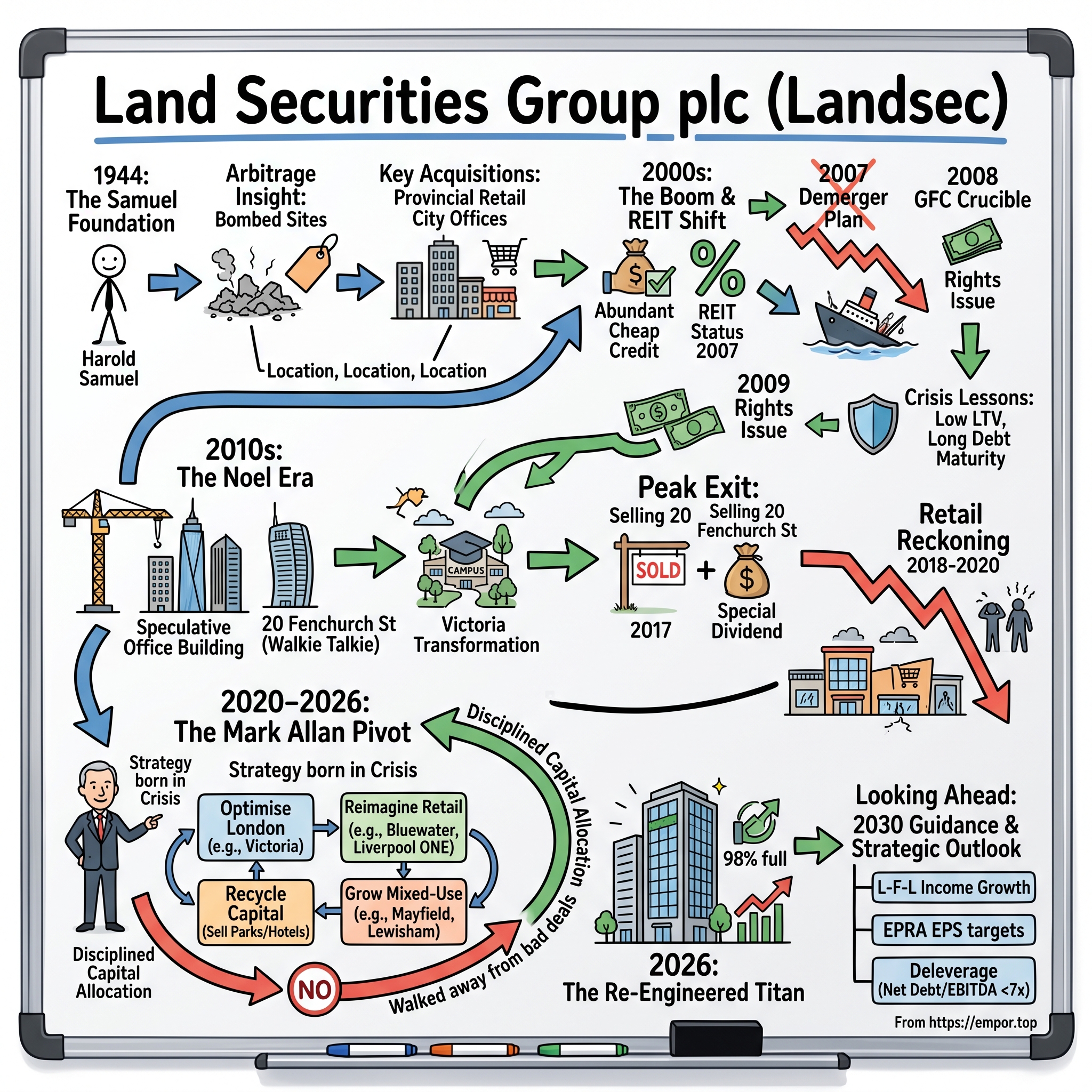
Land Securities Group plc (Landsec): The Re-Engineering of Britain's Commercial Property Titan
I. Introduction & Episode Roadmap
On a mild Thursday morning in May 2026, Mark Allan stood in front of a webcast camera in London and delivered a sentence that would have sounded absurd at any point in the previous six years. Landsec's buildings, he said, were 98% full — the highest occupancy the company had recorded in two decades — and the rents it was charging were rising at their fastest pace in nearly twenty years.1
Rewind six years and the same company was watching its shopping centres collect less than half their rent, its office towers sit empty under government lockdown orders, and a new chief executive walk through the door of a business whose core product — the physical workplace — had just been declared obsolete by half the commentariat.
That gap between 2020 and 2026 is the story. It is not a story about a property company getting lucky on a cycle. It is a story about a very old, very large, very slow institution deciding what it was not going to be, and then selling several billion pounds of assets to prove it.
The scale. Land Securities Group plc — everyone calls it Landsec — is Britain's largest listed commercial landlord by portfolio value. As of 31 March 2026 it owned a combined portfolio valued at £10.8 billion producing £624 million of annualised rent.1 The map runs from the West End (a 2.3 million square foot estate around Victoria, plus the illuminated advertising screens at Piccadilly Lights) through the City and Southwark, out to Greater Manchester, and across a set of retail destinations most Britons have physically stood in: Bluewater in Kent, Trinity Leeds, St David's in Cardiff, Liverpool ONE, White Rose. Add to that two enormous regeneration land banks — Mayfield next to Manchester Piccadilly station, and MediaCity in Salford.
The tension. Landsec's shares have spent years trading well below the accounting value of the bricks. On 26 July 2026 the stock changed hands around 693p against an EPRA net tangible asset value of 882p per share — roughly a fifth below book, with a market capitalisation near £5.1 billion.21 That gap has narrowed considerably from the mid-thirties percentage discount the shares carried as recently as spring 2026, but it has not closed. The central question for an investor is whether the discount is the market being slow, or the market being right: whether reported property valuations are real, whether the rental growth is durable, and whether a company that has now promised roughly 5% annual earnings growth to 2030 can actually deliver it.1
What this episode covers. The origin story of a man who bought a company owning three houses in Kensington and turned it into the largest property owner in the world. The 2007 conversion to REIT status and the crisis that followed. The Robert Noel decade, when Landsec built some of London's most recognisable towers and then sold the most famous one at what turned out to be close to the top. The 2020 reckoning and Mark Allan's diagnosis that Landsec had spent decades accumulating assets in businesses where it had no edge. The mechanics of how a modern REIT actually earns money — reversion, yields, net effective rent — explained without the jargon. Then the hard part: an activist-style stress test of capital allocation, a 7 Powers and Porter analysis against British Land, Derwent and Great Portland, a risk radar, and the two or three numbers that genuinely matter from here.
Start where it started: with a man, a war, and a great deal of rubble.
 Subscribe on LinkedIn
II. Origins & The Harold Samuel Legacy: "Location, Location, Location"
In the spring of 1944, with V-1 rockets still falling on London and the outcome of the war not yet settled, a 31-year-old estate agent named Harold Samuel bought control of a small, largely dormant company called Land Securities Investment Trust Ltd. Incorporated in 1905, it owned three houses in Kensington and some government stock.3 It was, in every meaningful sense, a shell.
What Samuel saw was not the shell. It was the arbitrage.
The bombed-out arbitrage. London, Plymouth, Exeter, Hull and Coventry had been comprehensively wrecked. Sites that had once carried buildings now carried rubble, and rubble had no rent roll, which meant valuers marked it at almost nothing. Samuel's insight was that the land underneath the rubble was unchanged. A corner plot in the City of London remained a corner plot in the City of London regardless of what the Luftwaffe had done to the structure standing on it. He began buying demolished sites.3
Then he layered on financial engineering that was, for the era, genuinely clever. The Attlee government ran a cheap-money policy, and Samuel used borrowed capital aggressively while rates were low, setting up subsidiary companies specifically to work around borrowing restrictions. He also hunted for owners who had not understood the tax consequences of the Town and Country Planning Act of 1947, buying assets from vendors who did not fully price what they held.3 This is the recurring pattern in property fortunes: the money is made when someone on the other side of the table has not done the arithmetic.
Compounding into dominance. The 1951 acquisition of Associated London Properties for £2.1 million nearly doubled the company's assets. By 1955 Samuel had taken full control of Ravenseft Properties, which specialised in redeveloping provincial shopping centres — the beginning of Landsec's retail DNA. City Centre Properties followed in 1968, pushing assets to £325 million, and in 1969 the takeover of The City of London Real Property Company made Samuel, by contemporary reckoning, the largest property owner in the world.3
The phrase. Samuel is widely credited with coining the industry's most repeated maxim — "location, location, location" — though the tricolon appears in print as early as 1926, so the attribution is more folklore than fact. What is not folklore is the operating principle behind it. Samuel's argument was that a prime site absorbs a downturn and re-emerges; a secondary site absorbs a downturn and stays absorbed. Rent on a great pitch falls and then recovers. Rent on a mediocre pitch falls and then discovers there is no bid.
That claim was tested brutally in 1974, when the UK property market crashed and Land Securities' share price fell from 279p in 1973 to 100p. The company came through better than its peers for an unglamorous reason: Samuel had not borrowed beyond what the business could actually repay.3 He stayed chairman until his death in August 1987, by which point the company had become the first UK property company with more than £3 billion of assets.3
Why this matters to a 2026 investor. Two inheritances survive from the Samuel era, and both are load-bearing today. The first is the physical portfolio itself — freeholds and long leaseholds in the West End and the City that no amount of capital can recreate, because the sites are finite and the planning system is hostile. The second is the balance-sheet conservatism, which shows up in the modern company as the longest average debt maturity in the UK REIT sector.
The inheritance also carried a liability. Ravenseft's provincial shopping centres and the decades of "buy the whole country" expansion left Landsec, by the 2010s, owning a great deal of British real estate that was neither prime nor scaled — the very secondary assets Samuel's own doctrine warned about. Undoing that took a crisis, and it took most of the last six years. But before the undoing came the boom.
III. The Boom, The REIT Conversion, and The GFC Crucible (2000–2010)
The mid-2000s in UK commercial property had the texture of an arms race. Cheap credit was abundant, securitisation had made lenders relaxed, and every large landlord in the country was racing to add scale — regional shopping centres, London office towers, out-of-town retail parks. Capital values rose not because rents were rising but because the yield investors demanded kept falling. That is a critical distinction, and it is the one the market forgot.
A quick primer, because everything that follows depends on it. A property's value is roughly its annual rent divided by a yield. If a building earns £10 million a year and buyers accept a 5% return, it is worth £200 million. If those same buyers decide they want 6.5%, the building is worth £154 million — a 23% loss — even though not a single tenant has left and not a single pound of rent has changed. In the 2000s, yields compressed and everyone felt brilliant. The lesson of 2008 was that the mechanism runs in reverse, and faster.
The REIT conversion. On 2 January 2007, Land Securities confirmed it had elected Real Estate Investment Trust status effective 1 January 2007, having had its notification accepted by HM Revenue & Customs in late December 2006.4 The company described itself at the time as one of the three largest REITs in the world and the UK's largest by market capitalisation.4
The bargain was straightforward: stop paying UK corporation tax on rental profits and property capital gains, and in exchange distribute at least 90% of tax-exempt property rental profits to shareholders. The entry ticket was a conversion charge of approximately £300 million, payable in full in July 2007.4
The tax saving was real and permanent. But the structural consequence was underappreciated in the euphoria: a company that must pay out the overwhelming majority of its rental profit cannot self-fund large developments from retained earnings. It must go to the debt and equity markets instead. In a rising market that is a feature — cheap external capital, tax-free income, growing dividends. In a falling market it is a trap, because the external capital disappears exactly when it is needed.
Then the tide went out. In November 2007, at what turned out to be almost precisely the peak, Landsec announced plans to break itself into separate listed businesses covering retail property, London offices, and Trillium, its property-outsourcing arm.5 It was a fashionable idea — unlock the conglomerate discount, let each business be valued properly.
It never happened. The financial crisis stopped it cold. Landsec suspended the demerger in November 2008, and the sales process for Trillium dragged on far longer than anticipated.5 Trillium eventually went to Telereal for £750 million, completing in January 2009 — a valuation well below the £1 billion-plus the business had commanded during 2007 and 2008.5 The lesson is one that recurs across this story: strategic reorganisations announced at the top of a cycle are executed, if at all, at the bottom of it.
The rescue. By February 2009 Landsec was raising equity. The company launched a rights issue to raise net proceeds of £755 million, issuing roughly 290.7 million shares at 270p — a 5-for-8 offer struck at a 51% discount to the closing price on 18 February 2009, fully underwritten by Citibank, JPMorgan Cazenove and UBS, and put to shareholders at a general meeting on 9 March 2009.6 Chief executive Francis Salway paired the capital raise with a reset of the dividend to a level the board considered sustainable, arguing that the company needed a balance sheet that could withstand further falls in property values and still leave it able to act when the market turned.6
Read that carefully, because it is the single most consequential paragraph in Landsec's modern history. A 51% discount rights issue is not a financing decision; it is a confession. It transfers enormous value from shareholders who cannot follow their money to those who can, and it happens only when the alternative is worse.
What the crisis permanently changed. Three behaviours date from this period and persist in the company's DNA today: a structurally lower loan-to-value target, a deliberate lengthening of debt maturities so that no single refinancing window can force a sale, and a preference for tenants whose covenants survive recessions. The modern balance sheet — with average debt maturity of 8.6 years, roughly twice the UK sector average, and no requirement to refinance any debt until 2028 — is a direct descendant of the 2009 humiliation.1
Salway handed over in 2012 to a man who had spent the crisis watching, and who concluded that the right response to a broken market was not to hide, but to build.
IV. The Robert Noel Era & Shaping Modern London: Mega-Developments & The Peak Exit (2012–2020)
Picture the City of London in 2010. Development had stopped. Banks would not lend on speculative office schemes. Cranes had come down. Every rational actor was waiting for visibility.
Landsec's London managing director at the time, Robert Noel, made the opposite call: start building now, precisely because nobody else is. The logic is a property developer's version of counter-cyclical investing. An office tower takes roughly four years from commitment to completion. If you commit in the trough, you deliver into a recovery in which almost no competing supply exists — because everyone else waited for the recovery to be visible before they started, by which time they are four years behind. Construction costs are also lowest when contractors are hungriest.
Noel became group chief executive in 2012 and ran the company until 2020. The strategy defined the era.
20 Fenchurch Street. The building the public calls the Walkie Talkie — a top-heavy 37-storey tower with a public "Sky Garden" on its upper floors — was developed as a 50:50 joint venture between Landsec and Canary Wharf Group, completing in 2014.7 It arrived with an engineering embarrassment attached: its concave glass façade concentrated sunlight onto the street below with enough intensity to damage vehicles parked there, generating the sort of headlines developers do not want. Remedial shading solved the physics. It did not dent the leasing, because the building did what a City tower is supposed to do — offered large, modern, well-connected floorplates to insurance and financial tenants at a moment when almost nothing comparable was available.
A myth worth correcting. The Leadenhall Building — the "Cheesegrater" a few streets away — is frequently bundled into Landsec's story. It was not Landsec's. It was developed and owned in a 50:50 joint venture between British Land and Oxford Properties, and sold in March 2017 to CC Land, the vehicle of Chinese property magnate Cheung Chung Kiu, for £1.15 billion.8 The distinction matters because it shows how the City's skyline was actually carved up: two rival British REITs each took one landmark tower, and both sold to Asian capital within months of one another, in the same window, at the same stage of the cycle.
Victoria. The less photogenic but arguably more valuable achievement of the Noel decade was the transformation of Victoria — historically a place people passed through on the way to a train — into a genuine West End business district. Cardinal Place, Nova Victoria and the surrounding blocks turned a transport corridor into a campus. The payoff is visible in 2026's numbers: across the entire 2.3 million square foot Victoria estate, Landsec reported having just one 20,000 square foot floor available, with recent lettings above £100 per square foot and negotiations on newer space running significantly ahead of that.1 Building an estate rather than a scattering of buildings is what allows a landlord to control the environment, the amenity and, ultimately, the rent.
The peak exit. In July 2017, Landsec and Canary Wharf Group agreed to sell 20 Fenchurch Street to Infinitus Property Investment, a subsidiary of Hong Kong's 李錦記 Lee Kum Kee health products group, for approximately £1.3 billion — at the time the largest single-asset office transaction in UK history, surpassing the £1.175 billion paid for the HSBC Tower in December 2014.7 Landsec's half generated £641 million, of which the company returned £475 million to shareholders as a one-off dividend.7 Noel's framing was characteristically dry: the sale secured significant value, and because gearing was unchanged, the firepower remained.7
Judged with the benefit of nine years' hindsight, this was the single best capital allocation decision in Landsec's modern history. The company sold a trophy asset into competitive bidding at the top of a global yield-compression cycle, roughly a year after the Brexit referendum and years before interest rates normalised and City office values fell. The counterfactual — holding the tower through 2022's gilt crisis with the associated debt — is not pleasant.
Two caveats keep this from being an unqualified triumph. First, returning £475 million to shareholders as a special dividend rather than redeploying it was a choice that prioritised optics over compounding; a REIT that sells its best building and hands back the cash has shrunk. Second, the company simultaneously kept a great deal of what it should have been selling.
The cracks. Between 2018 and 2020, UK retail entered a structural reckoning. E-commerce penetration climbed, occupancy costs became unsustainable for mid-market chains, and a wave of Company Voluntary Arrangements — the UK's landlord-cramming restructuring tool — rolled through the tenant base. Debenhams and Arcadia failed. Intu, the shopping centre landlord that had bet everything on regional malls, collapsed. Landsec's secondary retail and sub-scale regional offices, the accumulated sediment of seventy years of expansion, began dragging on total returns.
Noel announced his retirement in 2019. His successor would arrive with a very different diagnosis — and would arrive at the worst possible moment.
V. The 2020 Reckoning & The Mark Allan Pivot: A Modern Strategy Born in Crisis
Mark Allan's appointment was announced on 25 November 2019, with a start date no later than 1 June 2020.9 He arrived in April 2020, roughly a fortnight after the United Kingdom entered its first national lockdown.
It is difficult to overstate how bad the timing looked. Landsec's offices were legally required to be empty. Its shopping centres were shut. Rent collection in retail collapsed. And the prevailing narrative — reinforced daily by every white-collar worker discovering video calls — held that demand for offices had been permanently impaired.
The man. Allan is not a traditional property grandee. He is a chartered accountant who joined student-housing developer Unite Group from KPMG in 1999, became its chief financial officer from 2003 to 2006, then ran it as chief executive from 2006 to May 2016 — a period spanning the financial crisis. He then spent three years running St Modwen Properties, a regeneration and residential developer, before Landsec.9 He is also a member of the Royal Institution of Chartered Surveyors.
That biography matters. Allan came from two businesses where the landlord operates the asset rather than merely owning it, and where returns come from development and operations rather than yield compression. He was not steeped in the tradition of collecting institutional rent cheques from a diversified portfolio. Landsec's chair Cressida Hogg framed the hire around exactly that — a CEO who had successfully run two property companies and brought strategic insight for the company's next phase.9
The diagnosis. Allan spent his first six months conducting a strategic review, and what he concluded was uncomfortable for an incumbent: Landsec was over-diversified into businesses where it had no competitive advantage. It owned hotels, leisure assets and retail parks at sub-scale. It owned regional shopping centres that required wholesale restructuring rather than incremental asset management. Central London — then 64% of portfolio value — was where the durable franchise actually sat, alongside a strong internal team and a low-leverage balance sheet that had survived the pandemic without drama.10
The four priorities. At a capital markets event in October 2020, Allan set out the plan: optimise the central London business through targeted capital recycling; reimagine retail by growing outlets while substantially restructuring the six regional shopping centres; recycle capital out of sub-scale sectors — hotels, leisure and retail parks — over time; and grow through mixed-use urban opportunities in London and other major UK cities.10 The disposal programme was sized at around £4 billion over four to five years.
Strip away the corporate language and the message was blunt: we are going to sell a large chunk of this company, and the parts we keep will be the parts where we are genuinely one of the best owners in Britain.
Execution, 2021–2024. Strategy decks are cheap. What followed was the expensive part.
In November 2021, Landsec agreed to acquire U+I Group for £190 million — 149p per share, an 86% premium to the previous closing price.11 U+I was a specialist urban regeneration developer that had run into funding difficulties on the first phase of Mayfield in Manchester. It held a 50% stake in that 24-acre scheme — planned for around two million square feet of offices, 1,500 homes and a six-acre public park — plus Morden Wharf on the Greenwich Peninsula.11 The rationale was a platform purchase: Landsec bought a front-end development team and a consented regeneration pipeline, and paired them with a balance sheet U+I did not have. Allan's line at the time was that the combination would help accelerate the strategy.11
An 86% premium is an eye-catching number, and it deserves scrutiny rather than applause. It tells you U+I's equity was distressed, that the market had written down its development pipeline severely, and that Landsec was paying up for optionality it could not otherwise buy. Whether that was a good price depends entirely on whether Mayfield ever gets built at an acceptable return — a question that remains open in 2026, as we will see.
Landsec also consolidated MediaCity in Salford. Having taken a 75% stake in 2021, it acquired Peel's remaining 25% in November 2024 for £22 million in cash plus the assumption of £61 million of secured debt, taking full control of the 52-acre scheme including the dock10 television facility and a 218-bed hotel.12 The discount to book value on that stake reflected Landsec surrendering contracted future income from wrapper leases to Peel.12
And in retail, it went the other way — buying, not selling, but only in the very best locations. On 25 June 2024 Landsec acquired a further 17.5% of Bluewater from Singapore's GIC for £120 million, lifting its stake to 66.25% and adding £10.3 million of annualised net rental income.13 Six months later, on 17 December 2024, it bought a 92% interest in Liverpool ONE from the Abu Dhabi Investment Authority and Grosvenor for £490 million in total consideration — £455 million upfront at a net initial yield of about 7.5%, with £35 million deferred for two years.14 Allan's rationale was a specific claim about consumer geography: the top 1% of UK shopping destinations provide brands with access to around 30% of in-store retail spend, which is why retailers were consolidating into fewer, bigger, better stores.14
What the pattern reveals. Between 2021 and 2024, Landsec sold sub-scale assets at whatever the market would bear and bought high-yielding interests in destinations it already knew intimately. Buying out a joint-venture partner in an asset you already manage is the lowest-risk acquisition in real estate: no diligence surprises, no integration, immediate control. The 7.5% yield on Liverpool ONE against a cost of debt in the mid-threes made it arithmetically accretive from day one.141
The honest counter-argument is that this is not a moat; it is a spread trade on cheap legacy debt. If Landsec's borrowing cost rises toward its acquisition yields, the accretion disappears. Which brings us to the machine itself, and how it actually earns money.
VI. Core Engine Room: London Office Dynamics, Asset Segments, & Operational Proof Points
Walk into a Landsec office building at Victoria on a Wednesday in 2026 and the thing that strikes you is not the architecture. It is that the building is full. Not "recovering." Full. The company's office portfolio ran at 98.6% EPRA occupancy at 31 March 2026 — its highest in more than a decade — against 93.3% for the central London market as a whole.1
That five-point gap is the entire investment case compressed into one statistic, and it deserves unpacking rather than celebrating.
The architecture of the portfolio. Landsec now reports in four segments.1
Office-led places generate 50% of income and carry £7.0 billion of value. Within that, the West End accounts for 61% of value, City and Southwark 33%, and Greater Manchester 6%. Annualised rent is £311 million against a net estimated rental value of £484 million — a gap that exists largely because a big development pipeline was still completing.
Retail-led destinations generate 41% of income across £2.96 billion of value, split between shopping centres and outlets. Around 85% of these assets sit in the top 1% of UK retail destinations by sales, which between them capture roughly 31% of national in-store non-food retail spend.
Residential-led places contribute just 2% of income and £318 million of value — four future development sites in London and Greater Manchester with consent or allocation for around 9,000 homes, two of which currently earn a modest interim income as retail.
Other assets — mostly retail and leisure parks — supply the remaining 7% of income across £544 million, and are explicitly earmarked for disposal over time because Landsec judges it has neither scale nor advantage there.
Myth versus reality: did hybrid work kill the office? The consensus claim was that remote work would permanently destroy office demand. The reality in the data is more specific and more interesting. Aggregate demand did fall. What happened next was a violent bifurcation. Occupiers cut total square footage while competing harder for the small subset of buildings that are new, well-connected, heavily amenitied and energy-efficient. Landsec owns roughly 0.5% of the UK's approximately 900 million square feet of office space — virtually all of it in the West End and the City including Bankside.1 It is not exposed to the average office market. It is exposed to the tail that is winning.
Supply reinforces the effect. Build cost inflation and higher interest rates have made new development uneconomic for most sponsors, so project starts keep being deferred. Meanwhile existing office stock is actively leaving the market through conversion to residential and hotel use.1 Constrained supply plus concentrated demand equals rising rents — which is what Landsec reported: office estimated rental values up 7.1% in FY2026, its strongest in ten years.1
A note of caution the company itself supplies: because the office portfolio is 99% full, further like-for-like income growth now depends almost entirely on lease events — expiries, breaks and rent reviews — rather than on filling empty space.1 The easy growth has been harvested.
Reversion, explained simply. The most important concept in this business is reversion, and it sounds far more technical than it is. Leases are long. Rents get fixed at signing. If market rents rise for five years while a tenant's contracted rent stays flat, that tenant is under-renting the space — and when the lease expires or is reviewed, the landlord can reprice. Landsec's office reversionary potential stood at 17% at March 2026, up from 12% at the half year.1 Translation: if every lease reset to today's market rate tomorrow, office income would be roughly 17% higher. It is embedded, contracted-into-the-future growth that requires no acquisitions and no development — but it arrives slowly, only as leases roll.
The evidence that reversion is being converted rather than merely claimed is in the releasing statistics. Across the portfolio, rental uplifts on relettings and renewals nearly doubled to 15% in FY2026 from 8% the prior year.1 In retail specifically, uplifts went from 1% in FY2024 to 7% in FY2025 to 15% in FY2026 — a three-year trajectory that suggests genuine pricing recovery rather than a single favourable comparison.1
Retail: the surprise winner. For a decade, "UK shopping centre" was investment shorthand for value destruction. Landsec's FY2026 retail numbers complicate that story. Occupancy reached 97.7%, the highest in more than twenty years. Retail sales across the portfolio hit £2.8 billion, up 6.3% against a UK benchmark of 1.1%; footfall rose 2.7% against a benchmark of 0.1%. Since FY2022, sales growth at Landsec's destinations has cumulatively outrun the national average by 19 percentage points. The portfolio draws 170 million annual visits and, on the company's own reckoning, reaches one in four people in the UK.1
New supply is effectively zero, for a reason worth stating plainly: replacement cost is roughly double existing values.1 Nobody builds a shopping centre when it costs twice what it is worth on completion. That is not a moat management built. It is a moat the last fifteen years of value destruction built for them — and it is durable precisely because it cannot be arbitraged away by capital.
Yields, in plain English. Three yield measures recur. Net initial yield is the cash rent being received today divided by value — Landsec's combined portfolio ran at 5.4%.1 Topped-up net initial yield adjusts for rent-free periods that have not yet expired, giving 6.1%. Equivalent yield is the blended long-run return a valuer assumes across the life of the leases, at 6.3%.1 The gap between the first and last numbers is the valuer's estimate of embedded growth. A large gap means the valuation depends on future rent increases materialising — an assumption, not a fact.
One more distinction that trips up newcomers: net effective rent. Headline office rents are inflated by incentives — rent-free periods, fit-out contributions — which can knock roughly 20% off the real economics. Retail leases carry far lighter incentives. Allan made this point directly to Barclays analyst Paul May on the FY2026 results call when explaining why the company targets a 150–200 basis point spread between retail and office yields on recycling decisions: offices sell at materially lower net yields than their headline suggests.18
Lease length and inflation. The weighted average unexpired lease term across the combined portfolio was 5.7 years — 6.4 years in offices, 4.3 in retail.1 That is short by historical UK standards, where 15- and 25-year leases were once normal. Short leases cut both ways: they expose the landlord to vacancy faster in a downturn, but they let a landlord reprice into inflation far more quickly on the way up. In a period of rising market rents, short leases are an advantage — which is part of why retail, with the shortest terms, has delivered the fastest reversion capture.
So what. The operational evidence is genuinely strong and, importantly, it is corroborated by external benchmarks rather than resting on management assertion: Landsec's retail sales growth versus BRC data, its office occupancy versus the central London average. The vulnerability is not demand. It is that this is now a mature, nearly full portfolio whose growth must come from lease events, cost control and capital rotation — a slower, more grinding source of earnings than the leasing recovery of the past three years. And it is worth remembering that valuations still depend on yields staying put; office capital values were essentially flat in FY2026 (down 0.1%) despite 7.1% rental growth, because a 14 basis point yield widening plus business rates and build cost effects ate the entire gain.1
Underneath the two big segments sit several smaller businesses that get little attention but carry disproportionate strategic weight.
VII. Hidden Engine & Growth Options: Myo, Retail Parks, and Urban Regeneration
In October 2025, Landsec opened its seventh Myo flexible office next to King's Cross station. By the following May it was 75% let, and management expected it to be substantially full by summer 2026 — roughly nine months from opening. The detail that made analysts sit up: nearly 80% of lettings went to artificial intelligence businesses or companies adjacent to them.1
What Myo actually is. Flexible workspace — short leases, fitted-out suites, shared amenity — was, for a decade, a business run by intermediaries. WeWork and IWG signed long leases from landlords and re-let them short to occupiers, capturing the spread. The model's flaw was exposed in every downturn: long-term fixed obligations funded by short-term cancellable income. WeWork's US operating entity filed for bankruptcy in 2023.
Myo inverts that. Landsec owns the buildings, so there is no master lease and no intermediary margin. It converts existing floors within its own assets into flex space — spending £21 million on such conversions during FY2026.1 Myo now accounts for 5% of office-led income, with stabilised locations running at 84% occupancy and rents in line with budget.1
The strategic point is not the revenue. At 5% of one segment's income, Myo will not move the group's earnings. Its value is defensive and informational. A large corporate tenant taking five floors on a ten-year lease increasingly wants an escape valve — space for a project team, an acquired business, a temporary expansion — without renegotiating its core lease. If the landlord cannot provide it, a competitor with a flex platform can. Myo keeps that conversation inside the building. It also functions as a live sensor on demand: the King's Cross AI concentration told Landsec something about which occupier cohort is expanding before it appeared in any market survey.
The claim that Myo earns higher margins than third-party operators is structurally plausible — no master-lease rent, no separate corporate overhead, existing building services — but Landsec does not disclose Myo's standalone profitability, so the margin advantage remains asserted rather than demonstrated. Treat it as a sensible design, not a proven earnings engine.
Retail parks: harvesting, not holding. Retail parks are the unglamorous middle of the portfolio — open-air terraces of large-format stores, mostly out of town. They throw off decent cash but grow slowly. Landsec's approach has been to sell into a strong bid rather than defend the position. During FY2026 it sold four such assets for a combined £261 million, exiting a third of the segment. The disclosed economics are instructive: those assets yielded 6.4% net rental income — reasonable in absolute terms, but roughly 100 to 150 basis points below the income return available in major retail destinations, with far weaker like-for-like growth.1
That is capital recycling stated with unusual precision, and it is the correct way to evaluate a disposal: not "did we sell above book" but "did we redeploy into something with a better forward return." Management flagged that fewer such disposals should be expected over the next twelve months because the remaining parks have a more attractive income profile — an admission that the easy pruning is done.1
The regeneration option. Mayfield sits on 24 brownfield acres beside Manchester Piccadilly station, with the River Medlock running through it. The full masterplan envisages more than 2.3 million square feet of offices supporting some 13,000 jobs, 1,500 homes, over 200,000 square feet of retail and leisure, a 650-bed hotel and 13 acres of public realm — including Mayfield Park, Manchester's first new park in over a century, which opened ahead of the wider scheme.
During FY2026 Landsec secured a resolution to grant detailed planning consent for the first 879 homes at Mayfield, and part-outline, part-detailed consent for 2,800 homes at Lewisham in south-east London. Combined with existing consent for 1,800 homes at Finchley Road and an allocation for 2,700 at MediaCity, the company now holds four projects capable of delivering around 9,000 homes over the next decade.1
Here is where an independent reading diverges sharply from the pitch. Consent is not the same as viability. Landsec disclosed that current net yields on cost for these residential schemes sit at around 5.0% — and that policy improvements now being discussed could add perhaps 50 to 75 basis points.1 For context, the committed development pipeline Landsec is finishing carries a gross yield on total development cost of 8.1%.1 A 5% yield on cost, against a cost of debt of 3.6% and an equity market pricing the shares at a meaningful discount to book, is not obviously value-creating.
Management said as much. Asked on the FY2026 call by UBS analyst Zachary Gauge whether a twelve-month viability assessment meant residential development would be abandoned if the numbers did not work, Allan was direct: management would determine viability within six to twelve months, and if the numbers did not stack up, capital would not go in.18 Critically, no residential upside is included in the FY2030 earnings target at all.1
That is the right disclosure posture, and it is worth crediting: a company can hold a large land bank as genuine optionality — cheap to carry, valuable if policy shifts — provided it does not pretend the option is already in the money. The public-sector direction of travel has helped, with London's affordable housing requirement reduced from 35% to 20%, the Community Infrastructure Levy halved, and design requirements eased.1 Even so, the earliest possible start is late 2027 once detailed design, Building Safety Act approvals and site preparation are accounted for.1
Which means the near-term story is not development. It is what management does with several billion pounds of recyclable capital — and that is where the argument gets sharp.
VIII. Capital Allocation, M&A Benchmarking, and The Skeptical Investor Stress Test
Every REIT trading below book value eventually faces the same question from the same kind of investor. It surfaced again on the FY2026 results call in May 2026, put to Mark Allan by Adam Shapton of Green Street: if you say retail acquisitions are the priority, what about buying your own shares instead?18
It is the right question, and Landsec's answer is unusually specific.
The scorecard first. Judging capital allocation requires looking at what actually happened over a full cycle, not at what was promised.
The 2017 tower disposal remains the high-water mark — an asset sold into peak competitive bidding, years before the rate cycle turned, at a price no subsequent buyer would have paid. Against that, the U+I purchase is unresolved: Landsec bought a distressed developer's platform and pipeline at a very large premium to a depressed share price, and nearly five years later the flagship asset has planning consent but not an economic return.
The retail consolidations look better on current evidence. Buying out partners at high single-digit yields, funded by disposals at lower yields, is arithmetically accretive and operationally low-risk. Landsec added a further 2.8% of Liverpool ONE for £15 million during FY2026, lifting its stake from 93.7% to 96.5%, and spent £48 million completing the forward purchase of a newly developed office at Oval agreed back in 2021.1 Total acquisitions for the year came to just £80 million, against £720 million the prior year.1
That collapse in acquisition activity is itself a data point. Management looked at several retail opportunities and declined all of them, citing discipline on quality, capex risk and price.1 Allan told Shapton that most of the assets coming to market carry significant capital expenditure requirements, which Landsec prices over a three-to-five-year repositioning period, and that it had walked away from assets with large maintenance backlogs.18 Saying no is harder to praise than saying yes, and more revealing.
The disposal side, examined honestly. Landsec sold £705 million of assets in FY2026, at a cost to net tangible assets of 1.1% and a net loss on disposal of £74 million.1 Selling below book is not automatically bad — but it is an admission that carrying values were optimistic, and it should temper any assumption that the remaining book is conservative.
The composition tells the story. The largest single sale was Queen Anne's Mansions for £245 million — a 1970s Victoria office block let to the Government since that decade, with the tenant intending to vacate when the lease expires in December 2028. Most of its valuation was tied to redevelopment potential, with the remainder unwinding as each rent payment was received; the asset generated roughly a 0% total return.1 Landsec also sold £101 million of London offices at a 4.9% net effective income yield, and £72 million of pre-development sites carrying a negative 0.4% income yield that would have required over £400 million of capex to build out.1
Read as a group, these are not distressed sales. They are the systematic elimination of assets that consume capital without producing return — precisely what the strategy promised. The awkward part is the earnings mechanics: the Queen Anne's Mansions sale converted residual finance lease income into a capital receipt, creating a 1.8% earnings drag in FY2026 and a 4% drag in FY2027.1 Landsec disclosed this clearly and repeatedly rather than burying it, which is a point in favour of the disclosure culture.
The buyback answer. Allan's response to Shapton was quantitative rather than rhetorical. Shopping centre yields in the mid-sevens, adjusted for leverage, imply equity income returns around 9% — broadly in line with where Landsec's own shares were trading. Given roughly equivalent returns, management preferred deploying into quality retail assets when available, while refusing to dilute portfolio earnings for the sake of doing a deal.18
The FY2026 announcement went further, stating explicitly that Landsec continues to monitor the option of deploying capital in its own shares as part of its capital allocation framework, but currently views major retail as more attractive on both near and longer-term horizons.1
Stress-testing that answer. The honest assessment is that this is a defensible position, not an obviously correct one, and there are three real objections.
First, the comparison assumes Landsec can actually buy quality retail. It bought none in FY2026. An unexercised preference for acquisitions is functionally a decision not to allocate capital at all.
Second, a buyback shrinks the platform. Landsec's overheads are now £62 million, down 26% over three years and at their lowest level in over twenty years.1 That fixed cost is spread across the portfolio; shrinking the asset base without shrinking overhead raises the cost ratio. This is a genuine argument, though it applies with more force to a small company than one with £10.8 billion of assets.
Third — and this is the strongest counter-argument to management — Landsec's shares traded at a discount for years while the company continued to fund development. The FY2026 disposals were executed at a loss to book. If assets can only be sold below carrying value, the argument that shares are cheap relative to net asset value weakens, because net asset value is itself the disputed number.
Which is exactly where Barclays' Paul May pushed on the call, challenging why management had shifted from net-asset-value-based metrics to earnings-focused ones, and why it continued reporting estimated rental values at all. Allan's answer was candid: the sector's persistent discount suggests a valuation-led framing has not worked, and with occupancy above 98% the traditional reversion metric becomes noisy.18 Investors can reasonably read that either as intellectual honesty about what drives value — income growth — or as a convenient change of scorecard by a management team that has not closed the discount. Both readings have support.
Management credibility, assessed on behaviour. The record over the last two years is mixed in a specific and informative way.
On guidance discipline, the company has consistently under-promised and slightly over-delivered. FY2026 like-for-like net rental income guidance started at 3–4%, was raised to 4–5% at the half year in November 2025, and landed at 4.6%.161 Earnings guidance of 2–4% delivered 2.2% reported, or the top of the range adjusted for an unplanned disposal.1 Cost targets have been beaten early: the goal of sub-£65 million overheads by FY2027 was hit a year ahead.1
On targets, the FY2030 earnings ambition has been raised twice — from around 60p at the February 2025 capital markets event to around 62p at the November 2025 half year, held there in May 2026.15161 Raising a long-dated target twice in fifteen months invites the question of whether the original was deliberately conservative. Management attributed the increase to higher retail income growth, further overhead savings and lower development capital.16 Two of those three are within its control, which supports the explanation.
Leverage targets have also tightened rather than loosened: net debt to EBITDA target moved from below 8x to below 7x, with loan-to-value expected below 35% over time.161 Tightening a leverage target while the share price is depressed is the opposite of the behaviour that usually precedes trouble.
The genuine caution is that the FY2030 target embeds assumptions — roughly 4% like-for-like income growth annually, successful lease-up of the London development pipeline, and £800 million of retail acquisitions across FY2028–FY2030 contributing perhaps £5–6 million of earnings in FY2028, as CFO Vanessa Simms detailed on the call.18 Management's stated protection is that around 80% of the growth comes from the existing portfolio and platform, meaning it does not depend on transactions.1 That is a testable claim, and the next two years will test it.
Alignment. Allan's base salary stood at £904,736 at 31 March 2026, with total FY2026 single-figure remuneration of £2.683 million — down from £3.695 million in FY2025, largely because long-term incentive vesting fell.17 Executive directors must hold shares worth 300% of salary; Allan held 678,232 shares at year end, comfortably above the requirement.17 The CEO-to-average-employee base salary ratio was 13:1, low by FTSE 100 standards.17
The most revealing governance detail is the actual vesting outcome of the 2023 long-term incentive plan, which paid out at 38.1% of maximum. Relative total shareholder return against FTSE 350 real estate peers ranked ninth of nineteen — median, earning 8.33 of a possible 40 percentage points. Total return on equity landed just above threshold, earning 2.67 of 40. The carbon reduction measure paid out in full at 20 of 20, with emissions down 51% against a 35% maximum target.17
That is a plan working as designed. The operational and shareholder-return measures paid poorly because performance was mediocre; the environmental measure paid fully because it was comfortably exceeded. It also raises a fair governance question: an environmental target beaten by a wide margin was arguably set too low. The FY2026–2029 plan has responded by reweighting — total return on equity to 35%, carbon to 15%, with a new 5% diversity measure — and by raising the total return threshold from 2% to 4% per annum.17 Raising the bar after a soft vest is the correct direction.
Strategy and incentives now broadly point the same way. Whether that produces a durable advantage depends on whether Landsec possesses something competitors cannot copy.
IX. The Strategic Playbook: 7 Powers, Porter's 5 Forces, and Corporate Lessons
Ask what Landsec owns that a rival with unlimited capital could not assemble, and the honest answer narrows quickly. Most of what a REIT does — raise debt, buy buildings, lease space, manage service charges — is replicable. The question is what is left after you strip out the replicable parts.
Cornered resource: the strongest claim, and the most literal. Hamilton Helmer's framework treats a cornered resource as preferential access to a coveted asset on terms that create differential returns. Real estate is the purest possible example, because the asset is physically unique. There is exactly one Piccadilly Lights. There is one 2.3 million square foot contiguous estate at Victoria. There is one Bluewater serving south-east England, and one Liverpool ONE anchoring a city centre.
Two mechanisms make these positions genuinely uncopiable rather than merely expensive. The first is planning: the UK consent regime for large central London schemes takes years and produces uncertain outcomes. The second is economics — replacement cost for major retail runs at roughly double existing values.1 When it costs twice as much to build a competitor as to buy the incumbent, no competitor gets built.
The limitation is that a cornered resource protects value; it does not automatically grow it. A trophy asset held at the wrong yield still loses money when rates rise. Landsec's own FY2026 office valuation — flat despite the strongest rental growth in a decade — proves the point.
Scale economies: real, and measurable in basis points. Landsec's medium-term notes carry AA and A+ ratings from S&P and Fitch respectively, and its £2.87 billion of MTNs plus most bank loans sit inside a Security Group secured on a floating pool of assets valued at £10.4 billion.1 The structure permits assets to be swapped in and out, which is unusually flexible for secured funding, and it delivers a weighted average cost of debt of 3.6% with 89% of debt cost fixed or hedged and average maturity of 8.6 years — twice the UK REIT sector average.1
This matters more than it sounds. In a business where asset yields sit in the 5–7% range, a 100 basis point funding advantage is a very large share of the spread. Smaller specialists like Derwent London and Great Portland Estates cannot access sterling debt on comparable terms at comparable scale, and private equity buyers fund at materially wider spreads. When Landsec bid 7.5% for Liverpool ONE, the arithmetic worked partly because its money was cheaper than a rival's.
The vulnerability: this is a legacy advantage locked in during a low-rate era. As debt matures and refinances, the spread narrows. Landsec's cost of debt already ticked up from 3.4% to 3.6% during FY2026.1
Counter-positioning: the weakest of the three claims. The argument that Landsec's decarbonisation programme strands competitors' assets is intuitive but the evidence is thinner than the pitch. Landsec has 68% of its overall portfolio and 73% of offices rated EPC B or better, up from 56% a year earlier, with emissions down 33% against a 2019/20 baseline against a 47% reduction target by 2030 and net zero by 2040.1 It has been retrofitting air source heat pumps at Palace Street and One New Change, and rolling AI building management technology across twenty assets — cutting energy consumption around 10% at the eight where it is live.1
All of that is credible execution. But it is not counter-positioning in Helmer's sense, because rivals are not structurally prevented from copying it. British Land, Derwent and Great Portland are running comparable programmes. The regulatory pressure that would have stranded laggards has also just eased, as the risk section below explains. What Landsec really has here is a capital advantage — the balance sheet to fund retrofits at scale — which is scale economies wearing a green jacket.
Porter's five forces, war-gamed.
Rivalry: high, and asymmetric. The direct comparison with British Land is instructive because both reported to March 2026. British Land grew underlying profit 5% to £294 million, lifted EPRA net tangible assets 4% to 590p, grew its portfolio 2.3% to £10.1 billion, and posted 4.9% ERV growth with 96.9% occupancy and 39.2% loan-to-value.19 Landsec posted stronger occupancy and stronger rental growth but weaker asset value growth — its net tangible assets rose 0.9% versus British Land's 4%, and its total accounting return was 5.6% against British Land's higher figure.119
The reason is portfolio mix, and it is worth understanding rather than glossing. British Land leaned into retail parks and logistics — segments Landsec is exiting — and its campuses delivered exceptionally strong rental growth from a lower occupancy base with more space to fill. Landsec's portfolio was already full, leaving less room for a leasing-driven revaluation, and it took real losses crystallising disposals. On operating metrics Landsec looks better. On the total return that actually accrues to shareholders, it did not win FY2026. That is a fact management's framing tends to route around, and investors should hold both numbers side by side.
Threat of new entrants: very low. Planning friction, land cost and construction inflation form a formidable barrier. Landsec's own decision not to commit meaningful new development capital for around 18 months, on grounds that returns do not justify the risk, is itself evidence of how high that barrier now sits.1
Threat of substitutes: moderate, and evolving in an unexpected direction. Video conferencing permanently reduced aggregate desk demand. The newer question is artificial intelligence, and here the evidence cuts both ways. Landsec's own framing is that AI will reduce back-office and processing roles but that in high-value London locations this is more than offset by new roles, new businesses and new international demand — with Myo King's Cross offered as the proof point.1 That is a single building, and it is far too early to treat it as evidence about the office market as a whole. In retail, the company argues that agentic commerce increases the value of physical experience, reinforcing the "fewer, bigger, better stores" pattern.1 Both arguments are plausible; neither is yet demonstrated at portfolio scale.
Bargaining power of buyers (tenants): bifurcated. For commodity office space, tenants hold the whip hand. For the top slice, they do not — 15% releasing uplifts and 98.6% occupancy are the signature of a landlord with pricing power. The risk is that the definition of "top slice" keeps narrowing.
Bargaining power of suppliers: moderate and rising. Build cost inflation contributed directly to Landsec's FY2026 office valuation drag, and construction contractor fragility remains a live risk for any UK developer.1
The lessons. Two carry beyond this company.
The first is that in cyclical asset businesses, exit discipline dominates holding period. Selling a trophy tower at the top funded a decade of resilience; being unable to sell Trillium at the top cost a fortune. Landsec's current disposal programme — accepting a 1.1% hit to book value to eliminate zero-return assets — is the same discipline applied unglamorously.
The second is that offices stopped being passive yield instruments. A modern prime office is an operating business: amenity, hospitality, flexible space, energy management, data on how the building is used. That shift raises the operational bar and permanently disadvantages passive owners, which is the real reason the flight to quality has been so severe.
The strategy is coherent. What could still break it is the subject of the final analysis.
X. Current Risk Radar & Bull vs. Bear Case
In the FY2026 results, alongside the record occupancy, Allan inserted a phrase that had not appeared in the previous year's commentary: elevated geopolitical risk, and specific uncertainty about the longer-term impact of the Middle East conflict on investment markets and global interest rates.1 It is a reminder that a UK landlord with entirely domestic assets is nonetheless a leveraged bet on the global cost of capital.
Risk one: the cost of capital, which sets the value of everything. This is the dominant risk and the one management can least control. Commercial property values move inversely to the yield investors demand, and that yield is anchored to long-dated government bonds. Landsec's FY2026 office valuation was flat despite exceptional rental growth precisely because valuation yields widened 14 basis points.1 A larger move would overwhelm even strong operating performance.
The mitigants are unusually solid. Landsec need not refinance any debt until 2028, has £185 million of committed development capex remaining, and holds covenant headroom that would allow property values to fall roughly 36% before touching the 65% loan-to-value threshold that triggers operational restrictions, and around 58% before default at 100% loan-to-value. Earnings could fall roughly 54% before hitting the 1.45x interest cover threshold.1 That is genuine protection against forced selling — the mechanism that destroyed leveraged landlords in 2008.
What it does not protect is the equity value. A landlord can be perfectly solvent and still see its net asset value halve.
Risk two: regulation, and a live example of why regulatory risk cuts both ways. In 2021 Landsec set out a net zero transition investment plan built on the assumption that all its assets would need to reach EPC B by 2030 under Minimum Energy Efficiency Standards, and reflected that cost in its valuations.1
In June 2026, the UK Government changed the rules. Its interim response to consultation confirmed that from 2031 — not 2030 — commercial buildings above 1,000 square metres in England and Wales must reach EPC B where cost-effective, while buildings at or below that size remain subject to the existing EPC E minimum. The previously proposed interim EPC C milestone was dropped entirely, and existing flexibilities including the seven-year payback test and exemptions were retained. Enforcement penalties, shell-and-core exemptions and tenant obligations remain undecided, and secondary legislation is still required.20
The strategic implication is uncomfortable for the counter-positioning thesis. Landsec front-loaded retrofit capital on the expectation of a harder deadline. A softer regime gives laggard owners more time and reduces the stranding risk that was supposed to advantage well-capitalised landlords. Landsec's buildings are still better; the regulatory tailwind is simply weaker than assumed. Investors should also note the remaining uncertainty — a regime whose penalties and exemptions are undefined is a live overhang, not a resolved one.
Risk three: footprint contraction beneath the headline rents. The bifurcation story has an underappreciated arithmetic problem. A tenant renewing at a 15% higher rent on 20% less space has just reduced the landlord's income from that lease. Landsec's portfolio-level income growth has been positive because vacancy fell and reversion was captured simultaneously. With the office portfolio at 99% occupancy, the vacancy tailwind has been exhausted, and management explicitly guided that office like-for-like growth will moderate from FY2026's 6.0%.1 If per-tenant footprints keep shrinking, headline rent growth and net income growth can diverge — and only the second one pays dividends.
Risk four: development and planning execution. The current committed pipeline totals £643 million of total development cost against £185 million of remaining spend, at an 8.1% gross yield on cost.1 The near-term earnings mechanics are worth understanding: four completing projects should produce around £63 million of annualised net effective rent, but £43 million of associated interest costs stop being capitalised on completion, creating a temporary £6–8 million earnings drag in FY2027 before reversing sharply once let.1
The concentration risk is real. Timber Square completed 54% let to BP as its new global headquarters. Thirty High, at £35 million of estimated rental value, was due for sectional completion in summer 2026 with active customer interest covering almost 100% of the space — but that is interest, not signed leases, and management's own base case assumes lease-up within roughly twelve months post-completion.1 The FY2028 high-single-digit earnings growth target depends materially on that happening. It is the single most falsifiable claim in the company's guidance.
The bull case. Landsec owns assets that cannot be recreated, in a market where new supply is economically impossible, let to tenants who are consolidating into exactly these locations. That produces pricing power documented by external benchmarks rather than management assertion — retail sales beating the national average by 19 percentage points cumulatively since FY2022, office occupancy running more than five points above the central London market.1 Reversion of 17% in offices is contracted, embedded growth requiring no new capital. The cost base is at a twenty-year low. The balance sheet is being deleveraged toward a stricter target while development risk falls to under 2% of portfolio value. And with the shares below book, the income return alone — 5.8% at net tangible asset value on management's calculation1 — plus mid-single-digit earnings growth constitutes the return, before any narrowing of the discount.
The bear case. The discount may not be an anomaly but an accurate assessment. UK commercial property has delivered poor long-run real returns; public markets may simply be right to price a low-growth, capital-intensive, cyclically exposed asset class below stated book. FY2026 provided direct support for that scepticism: Landsec sold £705 million of assets at a £74 million loss to book value, and its net tangible assets grew 0.9% while British Land's grew 4%.119 A company whose defence of not buying back shares rests on those shares being cheap relative to net asset value has a problem if net asset value is the number in doubt.
Decarbonisation capital expenditure — £24 million in FY2026 within a £74 million office capex programme1 — continues to consume cash that could fund distributions, in service of a regulatory deadline that has just slipped. The residential platform, sized at £2 billion-plus in ambition, currently earns 2% of income at yields on cost around 5% and has no start date before late 2027.1 And the growth algorithm is now dependent on grinding execution: capturing reversion lease by lease, cutting an already-minimal overhead further, and completing a London development programme into a market where geopolitical uncertainty could freeze occupier decisions.
The two cases are not irreconcilable. The bull case is about the operating business, and the operating evidence is strong. The bear case is about the asset values and the cost of capital, and those are largely outside management's control. Which is why the metrics that matter are narrower than most investors assume.
XI. Epilogue, Key KPIs, & Strategic Outlook
Eighty-two years after Harold Samuel bought a company owning three houses in Kensington, the business he built has just done something he would have recognised: sold the mediocre, kept the irreplaceable, and refused to borrow beyond what the rent could service.
The transformation Mark Allan began in 2020 is now largely mechanical rather than strategic. The portfolio has been reshaped. The overheads have been cut to a twenty-year low. The development risk has been retired. What remains is execution against a specific, dated, falsifiable set of promises: stable earnings in FY2027 as the Queen Anne's Mansions effect washes through, high-single-digit growth in FY2028 as the London pipeline leases up, and roughly 5% compound annual earnings growth to around 62p by FY2030.1
That is unusually concrete guidance for a property company, and it converts an opaque investment case into something that can be checked. Three things are worth watching, and only three.
One: like-for-like net rental income growth, segment by segment. This is the purest read on whether the pricing power is real and whether reversion is actually converting into cash. It strips out acquisitions, disposals and valuation opinion. Management has guided to roughly 3–5% for FY2027 with office growth moderating from FY2026's 6.0%.1 A print at the bottom of that range, or below it, would signal that the leasing cycle has peaked and that footprint contraction is offsetting rent increases. A print at the top would validate the reversion thesis. Watch the office and retail lines separately — they are driven by different mechanisms and could easily diverge.
Two: EPRA earnings per share against the stated glide path. Landsec has deliberately made earnings, not net asset value, its primary scorecard — a change management defended openly under analyst challenge.18 Having set that scorecard, it should be held to it. The FY2028 high-single-digit growth figure is the critical test, because it depends almost entirely on leasing up Thirty High and the remaining Timber Square space within twelve months of completion. If those buildings let on schedule, the earnings algorithm works. If they sit half-empty into FY2028, both the near-term number and the FY2030 target lose credibility at once.
Three: net debt to EBITDA, on the path to below 7x. Loan-to-value is the more commonly quoted leverage measure, but it is contaminated by valuation opinion — an appraiser's judgement can improve it without a pound of debt being repaid. Net debt to EBITDA is harder to manipulate because it measures debt against actual cash earnings. Landsec ended FY2026 at 8.4x and has committed to below 7x within two years without relying on material disposals.1 That commitment can only be met by earnings growing into the debt. It is therefore the cleanest single check on whether the entire thesis — that a full portfolio with growing reversion and shrinking development drag produces real cash growth — is working.
The final reflection. Landsec is a case study in what institutional change actually looks like when it is done at scale: not a dramatic reinvention, but six years of selling things at a small loss, cutting costs, declining deals, and narrowing the definition of what the company is for. The company that emerges owns less, in fewer places, with a cleaner story — a portfolio where 91% of income comes from two segments in which it can plausibly claim to be among the best operators in Britain.1
Whether that translates into shareholder returns depends on a question no management team controls: what the world decides prime British real estate is worth. The operating business has been fixed. The valuation argument remains open — and the market, for now, is still keeping its distance.
References
-
Results for the year ended 31 March 2026 — Landsec, 2026-05-14 ↩↩↩↩↩↩↩↩↩↩↩↩↩↩↩↩↩↩↩↩↩↩↩↩↩↩↩↩↩↩↩↩↩↩↩↩↩↩↩↩↩↩↩↩↩↩↩↩↩↩↩↩↩↩↩↩↩↩↩↩↩↩↩↩↩↩↩↩↩↩↩↩↩↩↩↩
-
Land Securities Group (LON:LAND) Stock Price & Overview — StockAnalysis, 2026 ↩
-
Conversion to REIT — Land Securities Group plc RNS via Investegate, 2007-01-02 ↩↩↩
-
Telereal buys Trillium for £750m — IPE Real Assets / PropertyEU ↩↩↩
-
Land Securities launches £755 million rights issue to shore up balance sheet — Proactive Investors, 2009 ↩↩
-
London's Walkie Talkie sold in record £1.3bn deal — IPE Real Assets, 2017-07 ↩↩↩↩
-
London's 'Cheesegrater' building sold for £1.15 billion — RTÉ, 2017-03-01 ↩
-
Mark Allan is appointed as next CEO of Landsec — ACROSS Magazine, 2019-11-25 ↩↩↩
-
Land Securities sets out new strategy — QuotedData, 2020-10 ↩↩
-
Landsec to acquire U+I for £190m — Place North West, 2021-11-01 ↩↩↩
-
Peel sells remaining 25% stake in MediaCity to Landsec — Place North West, 2024-11-04 ↩↩
-
Landsec acquires additional 17.5% stake in Bluewater — Landsec, 2024-06-25 ↩
-
Landsec acquires 92% stake in Liverpool ONE shopping centre — Landsec, 2024-12-17 ↩↩↩
-
Landsec hosts Capital Markets Event: trading update and strategy — Landsec, 2025-02-27 ↩
-
Results for the half year ended 30 September 2025 — Landsec, 2025-11-14 ↩↩↩↩
-
Land Securities Group H2 2026 Earnings Call Transcript — MarketBeat, 2026-05-14 ↩↩↩↩↩↩↩↩
-
UK Government Announces Changes to Minimum Energy Efficiency Standards for Commercial Property — Mayer Brown, 2026-06 ↩
 LinkedIn
 WhatsApp
 Reddit
 Hacker News
 Email
Email Kindle
 RSS Feed
 Spotify
 Apple Podcasts
 Amazon Music
 Audible
 YouTube