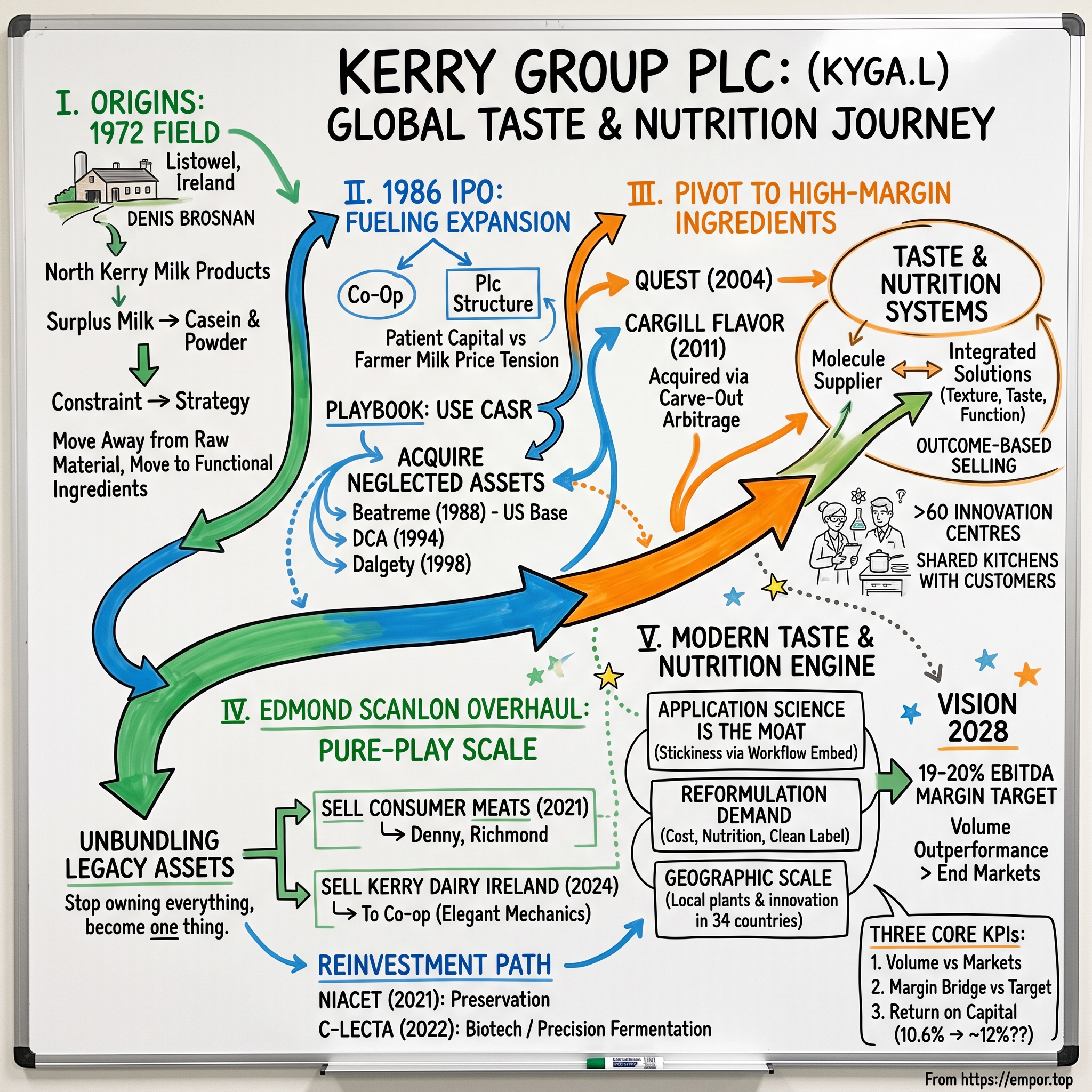
Kerry Group plc: The Transformation of an Irish Dairy Co-Op into a Global Taste & Nutrition Titan
I. Introduction & Episode Roadmap
In 1972, a 27-year-old named Denis Brosnan arrived at a muddy field outside Listowel, County Kerry, to run a milk-processing plant that did not yet have staff, an office, or a telephone line.5 The venture was called North Kerry Milk Products, and its purpose was blunt and unglamorous: take the surplus milk of west-of-Ireland dairy farmers and turn it into casein and milk powder for export. Ireland had not yet joined the European Economic Community. The farmers who supplied the plant measured their world in gallons and creamery collection routes.
Fifty-four years later, the company that grew out of that field operates 119 manufacturing facilities across 34 countries, runs more than 60 customer innovation centres, employs roughly 1,200 scientists, and has spent about €3 billion on research and development over the past decade.2 It does not sell a single consumer brand. What it sells instead is invisible: the savoury note in a fast-food chicken sandwich, the enzyme that keeps a supermarket loaf soft for an extra three days, the fermentation-derived compound that lets a beverage company cut sugar by a third without the drink tasting like diet soda.
In the year ended 31 December 2025, Kerry Group generated revenue of €6,758 million, EBITDA of €1,208 million, and an EBITDA margin of 17.9% — up 80 basis points on the prior year.1 Volumes grew 3.0% in a food and beverage market that management described as "relatively subdued."[^16] Free cash flow was €643 million. Return on average capital employed was 10.6%.1 Those last two numbers matter as much as the first three, and we will spend real time on why.
The separation that took fifty-two years
The event that makes this story worth telling now happened on the last day of 2024. Kerry completed the first phase of the sale of Kerry Dairy Ireland — the milk business, the Irish and UK dairy brands, the six manufacturing sites, the farmer relationships — to Kerry Co-operative Creameries, the very co-op that founded the company.3 The enterprise value of the whole transaction was €500 million, with €350 million changing hands in phase one for a 70% stake.419
The mechanics were unusual and, from a governance standpoint, elegant. The Co-op did not pay mostly in cash. It paid mostly in Kerry Group shares — surrendering the 19,045,396 A ordinary shares it held, which were redeemed and cancelled, while 16,187,024 new shares were issued directly to individual Co-op members.3 Kerry Group's share count fell by 2,858,372 to 166,440,652 A ordinary shares, and the anchor institutional shareholder that had sat atop the register since the 1986 flotation ceased to exist as a block.34[^24] The farmers got their dairy business back. The plc got a clean cap table and a portfolio with nothing left in it but taste and nutrition.
That is the transformation in one transaction: a company that began as a co-operative's milk-drying plant ended up selling the milk business back to the co-operative in order to become a business-to-business ingredients and biotechnology firm.
What this story is really testing
The narrative is tidy. The investment question is not, and this piece is organised around three uncomfortable ones.
First, does Kerry actually compete on equal footing with the flavour and fragrance specialists? Givaudan, dsm-firmenich, Symrise and International Flavors & Fragrances all earn structurally higher margins than Kerry does.141517 Givaudan's group EBITDA margin was 23.4% in 2025 — more than five percentage points above Kerry's.14 Either Kerry's business is genuinely different in kind, or it is the same business done less profitably. The answer determines whether the "pure-play re-rating" thesis is real or wishful.
Second, is application science a moat or a service business with good customer relationships? Kerry's claim is that by embedding technologists inside customer development kitchens and selling integrated systems rather than single molecules, it creates switching costs that a molecule supplier cannot. That is a testable proposition. The evidence for it is Kerry's persistent volume outperformance of its end markets — an average of 3.8% annual volume growth over four years, which management characterises as more than 300 basis points above the market.12 The evidence against it is that the same company has grown volumes below its own 4-6% medium-term target for several consecutive years and earns a return on capital only modestly above a plausible cost of capital.1
Third, has Edmond Scanlon's capital allocation created value or merely reshuffled it? Since 2017 he has sold the consumer meats and meals business, sold the dairy business, bought roughly €2 billion of preservation and biotechnology assets, and returned €1.5 billion through buybacks since November 2023.2910 Reported basic earnings per share in 2025 actually fell 5.7%, to 400.2 cent, even as adjusted earnings per share rose.1 The gap between those two numbers is where a skeptical investor should start.
The story that follows moves from a muddy field in North Kerry to a fermentation laboratory in Leipzig. It begins with a man who took a job nobody else wanted.
 Subscribe on LinkedIn
II. Origins & The Denis Brosnan Era: The Co-Op That Outgrew Ireland
Irish dairy in the early 1970s was a business of structural disadvantage disguised as abundance. Grass grew brilliantly from April to September and barely at all from November to February, which meant Irish milk supply was violently seasonal. A processing plant built to handle peak-summer volume sat half-idle through winter. Farmers, organised into small local creameries, sold what they produced and took what the market gave. The product — butter, skim powder, casein — was a commodity priced in London and Chicago, not in Listowel.
North Kerry Milk Products was created in 1972 to operate a newly built dairy ingredients plant, with three shareholders splitting the equity: Ireland's state-owned Dairy Disposal Company at 42.5%, a federation of eight small farmer co-operatives at 42.5%, and the American firm Erie Casein Company at 15%.5 The American stake is worth pausing on. Erie Casein was there because casein — the protein isolated from skim milk — had industrial uses in the United States, and because somebody in Kerry understood early that the customer worth having was not the Irish housewife but the American food manufacturer.
Brosnan ran it from day one.5 Two years later, in 1974, the plant became a subsidiary of a newly formed entity, Kerry Co-operative Creameries Limited, which began life with revenues of roughly €29 million and the distinction of being the smallest of Ireland's six major agricultural co-operatives.5 Smallest is the operative word. Kerry had no natural right to win. It had a weak milk pool by Irish standards, no brands, no international footprint, and a governance structure — the co-operative — designed to maximise the price paid to farmers rather than the returns earned by the enterprise.
The insight: get out of the milk business while staying in it
What Brosnan and his colleagues understood, and what most of their peers did not, was that the value in dairy was migrating away from the raw material and toward what could be done with it. Milk powder was a price-taker's product. But if you took the same milk stream and fractionated it into functional proteins, flavour precursors and specialty ingredients sold into food manufacturers' formulations, you were no longer competing on the price of a tonne of powder. You were competing on whether your ingredient made the customer's product work.
This is the intellectual seed of everything Kerry became. The seasonality that made Irish dairy structurally awkward pushed the company toward higher-value, lower-volume products that could absorb the fixed cost of an underused plant. Constraint bred strategy.
1986: the year the co-op learned to use a stock exchange
By the mid-1980s the ambition had outrun the balance sheet. A co-operative can borrow, but it cannot easily issue equity, and it answers to members who would rather receive a higher milk price today than fund an acquisition in Wisconsin. Brosnan's answer was a piece of corporate engineering that Irish agriculture had not seen before: incorporate a public limited company, have it acquire the co-operative's assets in exchange for 90 million shares, and list it.5
Kerry Group plc came into being in 1986, with the Co-op retaining a controlling anchor stake and individual farmer-members holding shares through it.5 In its first full year as a listed company, the group reported revenues approaching IR£300 million and net profits of nearly IR£6.3 million.5 The listing has now run for 39 years, over which Kerry has compounded its dividend at a 16% annual rate — a fact management still cites, and one of the more genuinely impressive numbers in European listed food.1
The dual structure it created was both the engine and the irritant of the next four decades. It gave Kerry permanent, patient capital and an anchor shareholder that would not flip the stock. It also gave it a shareholder whose interests — milk price, farmer employment, Irish manufacturing footprint — were not identical to those of an institutional investor in London. That tension took until 2024 to resolve, and resolving it is arguably Scanlon's single largest achievement.
The playbook: use consumer cash flow to buy industrial technology
The early strategy was deliberately two-handed. On one hand, Kerry bought consumer meat and chilled-foods brands in Ireland and Britain — Denny, Mattessons, Richmond — building a business with strong local share, predictable cash generation and the scale to matter to Tesco and Sainsbury's.[^6] These were not glamorous assets. Chilled sausages and cooked ham are low-margin, capital-hungry, and permanently squeezed between input costs and retailer buying power.
But they threw off cash. And Brosnan spent it abroad, in a different business entirely.
The pivotal move came in 1988, when Kerry bought Beatreme Food Ingredients from Beatrice for $130 million — a sum roughly equal to Kerry's entire market capitalisation at the time.5 Read that again. A two-year-old listed company from County Kerry bet its whole equity value on an American food ingredients business. Beatreme brought dairy-based flavours, coatings and seasoning systems, and — more importantly — American customers, American application laboratories, and a seat at the table with US food manufacturers.
The pattern repeated and scaled. DCA Food Industries followed in 1994 for $402 million, and Dalgety's food ingredients division in 1998 for IR£384 million.5 Each was a carve-out: a business owned by a larger parent that had stopped investing in it, available at a price that reflected the seller's indifference rather than the asset's strategic worth to a specialist buyer.
What the origin story tells an investor
Three things carry forward from this era, and all three still shape how Kerry behaves in 2026.
The first is that Kerry has always been a buyer of other people's neglected assets rather than a builder of category-defining brands. That is a specific competence — diligence, integration, cost extraction, cross-selling into an existing customer base — and it is a competence with a shelf life, because it depends on a supply of motivated sellers.
The second is that Kerry learned to fund transformation from businesses it intended eventually to exit. The consumer foods division was never the destination; it was the fuel tank. Understanding that makes the 2021 and 2024 divestments look less like strategic reversals and more like the final stage of a plan that had been running for thirty years.
The third is cultural. This is a company whose founding executives came out of agricultural co-operatives, not out of chemistry departments or consulting firms. Its instinct is operational and commercial rather than scientific — a bias that shows up positively in Kerry's application-and-service model, and negatively in the persistent question of whether it owns enough genuinely proprietary science to defend premium pricing.
Brosnan handed the chief executive's office to Hugh Friel in 2001. Friel inherited a company with two engines running in opposite directions — and made the decision that finally tipped the balance.
III. Building the Taste & Nutrition Engine: The Pivot to High-Margin Ingredients
Picture a Kerry board meeting somewhere in the early 2000s. On one side of the page is a consumer foods business selling bacon and sausages into an increasingly concentrated British grocery oligopoly, where four retailers set the terms and every year brought another round of price negotiations conducted with all the warmth of a hostage exchange. On the other side is an ingredients business selling into thousands of food manufacturers worldwide, where the customer's question is not "how cheap?" but "can you make this work?"
Both businesses were growing. Only one of them was getting structurally more attractive.
The realisation that crystallised in this period was that consumer packaged goods in mature Western markets had become a capital-intensive way to earn a capped return. Retailer own-label was expanding. Category growth was flat. Capital had to be spent on chilled logistics and factory automation that produced no pricing power. Meanwhile the ingredients customers — global food and beverage manufacturers — were doing something interesting: cutting their own R&D headcount and outsourcing the hard formulation work to suppliers.
Kerry decided to become the supplier that took that work.
Quest, 2004: buying critical mass in bio-ingredients
In March 2004, Kerry agreed to acquire the food ingredients business of Quest International from the British chemicals group ICI for US$440 million.6 The business came with over 900 employees and nine production sites spread across the Netherlands, Scotland, Ireland, the United States, Canada, Malaysia and the Philippines, and its product range read like a checklist of the modern food-formulation toolkit: emulsifiers, proteins, hydrocolloids, yeast, enzymes and cultures.6
The strategic logic was visible in the seller's own explanation. ICI wanted to concentrate on flavour and fragrance — the glamorous, high-margin end — and treated food ingredients as the leftovers.6 Kerry's then chief executive Hugh Friel framed the purchase as expanding Kerry's position in "taste and texture ingredients" while addressing industry priorities in health, nutrition and food safety.6 That phrasing matters. Kerry was not buying aroma chemicals. It was buying the unglamorous functional stuff that makes food behave — the things that thicken, emulsify, stabilise, preserve and ferment.
For a layperson: a flavour house sells you the strawberry note. Kerry was assembling the ability to sell you the strawberry note plus the system that keeps the yoghurt from separating, keeps the fruit pieces suspended, keeps the whole thing safe on the shelf for six weeks, and lets you drop the sugar content by 25% without the product tasting thin.
Cargill Flavor Systems, 2011: paying just over one times sales for a beverage seat
Seven years later Kerry bought Cargill's global flavours business for $230 million.7 Cargill Flavor Systems generated roughly $200 million in annual sales and employed about 700 people across the United States, Puerto Rico, Mexico, Brazil, France, the United Kingdom, South Africa, India, Malaysia and China, with sales offices in a dozen more countries.7
The price is the analytically interesting part. Just over one times revenue for a flavour business is not a specialist-flavour-house valuation; it is a carve-out valuation. Flavour and fragrance assets in that era routinely changed hands at multiples of sales, not fractions above them. Kerry got it cheap for the same reason it got Beatreme, Quest and Dalgety cheap: it was buying from a parent for whom the asset was non-core, and it was willing to do the unglamorous work of integration.
What the deal bought strategically was beverage. Cargill's unit had particular depth in beverage and dairy applications and in cheese-based savoury flavours — precisely the categories where Kerry was thinner.7 Beverage is the highest-velocity innovation category in food; a soft-drink company reformulates and launches constantly. Owning a credible beverage flavour capability is what later allowed Kerry to sell sugar-reduction systems into the drinks industry at scale.
From ingredients to systems: what "Taste & Nutrition" actually means
The vocabulary shift from "food ingredients" to "taste and nutrition" was not a marketing exercise, though it was certainly also that. It described a change in what the company sold and how it got paid.
Selling an ingredient means competing on specification and price. If a customer needs a particular emulsifier, three suppliers can quote, and the purchasing department picks. Selling a system means the customer brings a problem — "we need to cut sodium 30% in this snack without losing the crave" — and the supplier returns with a formulated answer combining flavour modulation, taste-enhancing compounds, texture agents and process guidance. The customer is no longer buying an input. It is buying an outcome, and the outcome is embedded in a recipe that took months of joint development and consumer testing to validate.
That is why Kerry built application centres rather than just factories. The company today runs more than 60 innovation centres and employs around 1,200 scientists, adding facilities in Frankfurt, Dubai and South Jakarta during 2025 alone.12 These are effectively shared development kitchens where Kerry technologists work alongside customer product developers. The physical proximity is the product.
The capital allocation record, honestly assessed
The common bull-case claim is that Kerry systematically bought assets more cheaply than flavour-house peers were paying. The record supports the direction of that claim but not a precise multiple comparison, because Kerry did not disclose EBITDA multiples for most of its historical deals.
What can be verified is the pattern: Beatreme from Beatrice, Quest from ICI, food ingredients from Dalgety, flavours from Cargill — four large purchases, all carve-outs from parents that had decided the business did not fit.567 Kerry's edge was never that it outbid specialists for prime assets. It was that it consistently bought orphaned assets from distracted owners and then did the integration work.
The limitation of that model is equally clear, and it becomes central in the modern era. Carve-out arbitrage is a finite resource. Once the obvious orphans have been adopted, a serial acquirer must either pay full prices for good assets or build capability internally. Kerry's post-2017 acquisitions — as we will see — were bought at prices that look nothing like the bargains of 1988.
By 2017 Kerry had two decades of ingredient acquisitions bolted onto a consumer foods business that no longer belonged. The company needed someone willing to amputate.
IV. The Edmond Scanlon Overhaul: Unbundling Legacy Assets for Pure-Play Scale
Edmond Scanlon did not arrive from outside with a consultant's deck. He joined Kerry's graduate development programme in 1996, moved through finance, then global flavours, then regional leadership, and became group chief executive in 2017.8 By the time he took the job he had spent over twenty years inside the company, including running its Asia-Pacific business — the part of Kerry that had always operated with the least legacy baggage and the most greenfield ambition.8
That biography explains a lot about his tenure. An insider knows where the bodies are buried, which is useful when the strategy requires digging them up. It also means the divestments he executed were not repudiations of a predecessor's strategy; they were the completion of a logic he had grown up inside.
The mandate was straightforward to state and brutal to execute: stop being a company that owns a bit of everything, and become one thing.
2021: selling the family silver to Pilgrim's Pride
In June 2021, Kerry agreed to sell its Consumer Foods Meats and Meals business — the Denny, Richmond and Mattessons brands, the factories, the retailer relationships built over three decades — to Pilgrim's Pride for approximately €819 million.109 The deal completed in September of that year.9
For an Irish company, this was not a neutral transaction. Denny bacon is a cultural artefact in Ireland in roughly the way Heinz beans are in Britain. Selling it to a subsidiary of a Brazilian-controlled meat processor was, in the Irish press, an event. For Kerry the plc, it was arithmetic: the meats and meals business consumed capital, delivered low single-digit margins, exposed the group to UK grocery price wars and to livestock and labour cost inflation, and contributed nothing to the ingredients story that institutional investors were being asked to value.
The proceeds had a specific destination. Kerry had already agreed, three days after the Pilgrim's announcement, to buy Niacet — and the sale proceeds were explicitly earmarked to repay the bridge facility funding that purchase.10 The consumer business was liquidated, in effect, to fund the preservation platform.
The Niacet trade: what Kerry pays for what it wants
Niacet is the clearest window into modern Kerry capital allocation, because unusually the company disclosed the multiple.
In June 2021 Kerry agreed to acquire Hare Topco, trading as Niacet, from funds advised by SK Capital Partners for €853 million ($1,015 million) on a cash-free, debt-free basis.10 Niacet made organic-acid-based preservation systems — the technology that stops bread going mouldy and extends the shelf life of meat, with clean-label and low-sodium versions for customers who no longer want long chemical names on the pack. It expected pro forma annualised revenue of about $220 million and EBITDA of about $66 million for 2021, an EBITDA margin near 30%.10
Kerry paid an implied 15.4 times EV/EBITDA excluding synergies.10 That is a full price. It is roughly what a specialist would pay for a high-quality niche asset with pricing power, and it is emphatically not the carve-out arbitrage of the Brosnan era. Scanlon's public rationale was that the acquisition would be growth- and margin-enhancing and accretive to adjusted earnings per share in year one.10
The analytical point is that Kerry's acquisition strategy changed character under Scanlon. The company stopped buying cheap turnarounds and started paying market prices for high-margin technology. That is defensible — you cannot build a 30%-margin preservation platform out of bargains — but it raises the bar for execution. At 15.4 times, the returns depend on the revenue synergies actually appearing.
The biotechnology pivot
The second leg of reinvestment was biotechnology, and it is worth explaining in plain terms because it sits at the centre of Kerry's forward-looking claim.
Traditional flavour chemistry either extracts compounds from nature (expensive, supply-constrained, weather-dependent) or synthesises them in a chemical plant (cheap, reliable, and increasingly unwelcome on a "clean label"). Precision fermentation offers a third route: engineer a microorganism — yeast, bacteria, fungus — to produce the target compound, then grow it in a tank. The output is chemically identical to the natural version, produced at industrial scale, without a plantation and without a synthesis route the marketing department has to hide.
On 15 February 2022 Kerry announced two acquisitions in this space: c-LEcta, a Leipzig-based specialist in precision fermentation, bio-processing and bio-transformation employing over 100 people, and Enmex, a Mexican enzyme manufacturer.11 The c-LEcta transaction was valued at €137 million and completed in early March 2022.[^13] Kerry's chief science and technology officer, Albert McQuaid, framed the combination as accelerating "innovation capabilities in enzyme engineering, fermentation and bio-process development."11
Those purchases sat alongside a proactive-health portfolio Kerry had assembled over the preceding years covering probiotics, immune-health ingredients and botanical extracts — the raw materials of the supplements and functional-food business.2
By 2025 the investment had become visible in the operating story. Kerry opened a new biotechnology centre in Leipzig, expanded enzyme capacity in Cork, and told investors that roughly 40% of its taste solutions were fermentation-enabled.12 Innovations launched during the year included next-generation fermentation-derived salt and sugar reduction technologies, an enzyme system delivering natural sweetness, and cocoa replacement systems that reproduce authentic cocoa taste using less than half the cocoa raw material.1 That last one is not a science-fair project — with cocoa prices having been violently unstable, a system that halves cocoa content while holding taste is a direct answer to a customer's biggest input-cost problem.
2024: unwinding the co-operative
Which brings the story back to the transaction described at the outset — and to its finer machinery, which reveals a great deal about how Kerry negotiates.
The business being sold was substantial: Kerry Dairy Ireland generated €1,283.4 million of revenue in 2023 but only €53.4 million of EBITDA, a margin near four percent.4 The €500 million enterprise value implied 9.4 times EBITDA.4 Kerry, in other words, sold at roughly nine times what it had bought Niacet at fifteen times — the textbook direction for portfolio surgery, though the buyer here was a related party rather than a competitive auction.
The €350 million phase-one consideration was not straightforward cash. It comprised approximately €251 million in Kerry shares through the redemption of the Co-op's holding, €56 million in cash funded by acquisition debt, and €43 million via a loan agreement.4 Kerry retained 30% and receives a fixed annual dividend of €7.5 million during the joint-ownership period.4 The Co-op holds a call option to buy the remaining 30% for €150 million at any time up to 31 July 2035; if it has not exercised by 31 July 2030, Kerry holds a matching put option to force the sale on the same terms.4 Shareholders approved the deal at an extraordinary general meeting on 19 December 2024, and phase one closed eleven days later.[^23]3
Two details deserve a skeptic's attention. First, Kerry established a €50 million fund within Kerry Creameries Limited to settle ongoing disputes and arbitrations with milk suppliers over historical milk pricing — an acknowledgement that the farmer relationship carried real, quantified legal liability.4 Second, the €7.5 million annual dividend on a 30% stake in a business earning €53.4 million of EBITDA is a fixed, contractually-defined return rather than a share of actual profits, which conveniently removes Kerry's exposure to dairy earnings volatility during the wind-down.
What the surgery cost
Here is the honest accounting. Scanlon's portfolio work removed roughly €2 billion of low-margin revenue from the group and replaced part of it with high-margin technology. Group EBITDA margin has expanded by 320 basis points since 2021.2 That is the win.
But selling profitable businesses shrinks earnings. Scanlon acknowledged on the full-year 2025 call that the 7.5% constant-currency earnings-per-share growth was "stated after the dilution from the Dairy Ireland disposal in the prior year."[^16] Reported revenue fell 2.5% in 2025.1 Return on average capital employed was flat year-on-year at 10.6%, with underlying improvement offset by currency translation.1 For a company that has spent five years selling low-return assets and buying high-return ones, a flat return on capital is the number that a skeptical investor will keep circling.
The transformation is complete. The proof that it was worth doing is not.
V. Inside Taste & Nutrition: Industry Structure, Economics, & How Kerry Wins
Walk into a customer innovation centre — Kerry's or a competitor's — and it looks less like a laboratory than like a professional kitchen with analytical instruments along one wall. There are ovens, fryers, extruders, beverage-filling lines, a sensory panel booth. A snack company's development team arrives with a brief: this cracker needs 30% less salt, must taste identical, must hold crunch for nine months, and must launch for the autumn shelf reset. Over the following weeks a Kerry technologist and the customer's food scientist iterate together, run consumer panels, adjust, and eventually arrive at a formula.
That formula then goes onto a specification sheet, into a factory trial, through a regulatory label review, and onto a pack. And it stays there — often for years.
Understanding why that stickiness exists, and what it is worth, is the core of the investment case.
The shape of the business today
Kerry now reports as a single taste and nutrition business, split geographically. In 2025, the Americas generated €3,674 million of revenue with volume growth of 3.8% and an EBITDA margin of 20.3%, up 60 basis points.1 Europe generated €1,440 million with volumes slightly negative at -0.5%, but margin up 90 basis points to 17.5%.1 Asia-Pacific, Middle East and Africa generated €1,644 million with 4.2% volume growth and a 16.7% margin, up 70 basis points.1
Read across those three lines and a clear picture emerges. The Americas is the profit engine and the growth engine simultaneously — an unusual combination, and the single most important region for the equity story. Europe is a margin-improvement story built on cost programmes rather than demand. APMEA is the growth option: lower margin today, but with volumes running fastest and management targeting a move toward high single-digit volume growth over the coming years.[^16]
By channel, foodservice grew volumes 4.6% in 2025 against a backdrop of soft restaurant traffic, while retail grew more slowly.1 Emerging markets grew 5.3%.1 Kerry does not disclose a precise revenue split between packaged-goods customers and foodservice, so the frequently-quoted 70/30 mix should be treated as an estimate rather than a reported figure.
The competitive set, measured honestly
Here is where the bull case meets arithmetic.
Givaudan, the largest pure flavour and fragrance house, reported 2025 sales of CHF 7.5 billion with 5.1% like-for-like growth and an EBITDA margin of 23.4%.14 Its Taste & Wellbeing division — the part most comparable to Kerry — generated CHF 3.64 billion at a 21.0% EBITDA margin, but grew only 2.4% like-for-like.14 Its Fragrance & Beauty division grew 7.9% and earned 25.7% margins, with fine fragrance surging 18.3%.14
Symrise reported 2025 revenue of €4.93 billion with organic growth of 2.8% and an adjusted EBITDA margin of 21.9%.15 Its Taste, Nutrition & Health segment ran at a 23.3% EBITDA margin in the first half of the year.16 IFF, the largest by revenue, generated net sales of roughly $10.9 billion in 2025, down about 5% as reported, and spent the year restructuring its portfolio.17 dsm-firmenich, formed from the 2023 merger of DSM and Firmenich, remains the largest and most complex of the four.18
Two conclusions follow, and they cut in opposite directions.
Kerry earns materially lower margins than every one of them. At 17.9%, Kerry sits three to five points below the flavour houses.11415 The bull explanation is mix: Kerry sells more physical volume of functional ingredients — proteins, texturisers, coatings, preservation systems — where raw material is a larger share of the sales price. A flavour compound sold at high concentration carries enormous gross margin on a tiny weight; a texturising system does not. The bear explanation is simpler: Kerry does less proprietary chemistry and more service, and service is worth less.
Both explanations are partly right, and the resolution is in the second conclusion.
Kerry grows volumes faster than the comparable peer segments. Kerry's 3.0% volume growth in 2025 exceeded Givaudan's Taste & Wellbeing like-for-like growth of 2.4% and Symrise's group organic growth of 2.8% — and Kerry's figure is pure volume, with pricing actually negative 0.3%.11415 Over four years Kerry has averaged 3.8% volume growth.1 If Kerry were simply a lower-quality version of a flavour house, it should be losing share to the flavour houses. On the volume evidence, it is not.
Why the customer keeps buying: mechanism, not slogan
Three mechanisms plausibly explain the outperformance, and each can be tested.
Reformulation demand is structurally rising, and it plays to Kerry's shape. Management has told investors that more than 60% of food and beverage development activity now involves reformulating existing products rather than launching new ones, driven by cost reduction, nutritional improvement and clean-label objectives.2 Reformulation is Kerry's home ground: it is a systems problem, not a molecule problem. When a customer removes sugar, the product loses not just sweetness but mouthfeel, browning behaviour, bulk and shelf stability. Fixing all of that simultaneously requires exactly the multi-technology toolkit Kerry has assembled.
Foodservice innovation intensity has risen. On the full-year call, Scanlon described limited-time offers and seasonal launches in foodservice as being at "an all-time high," with operators pushing menu novelty and value offerings to defend traffic.[^16] Every new menu item is a formulation project on a compressed timeline. Kerry claims it can deliver at least 400 basis points of average market outperformance in that channel — a specific, falsifiable claim that investors can check quarter by quarter.[^16]
Raw-material substitution has become a commercial problem, not just a technical one. When cocoa, natural extracts or specific botanicals spike or become unavailable, customers need reformulated versions of existing products fast. Kerry explicitly positioned its 2025 innovations — cocoa replacement systems, fermentation-derived taste — against "supply constrained raw materials."1 This is a genuinely defensible niche: the supplier who can hold a taste profile while changing the input list is worth more when inputs are unstable.
The switching-cost question
The most-cited element of the Kerry moat is that once a formulation is embedded in a customer's product, changing supplier is expensive. That is directionally true and worth explaining precisely.
Changing a taste system means reformulating, re-running consumer sensory testing to confirm the product still tastes the same to shoppers, re-validating shelf life, re-checking allergen and regulatory labelling in every market where the product sells, re-qualifying the factory process, and accepting the risk that a beloved product now tastes subtly wrong. For a brand with meaningful revenue at stake, the saving on ingredient cost rarely justifies that chain of risk.
But the honest caveat is that the strength of this lock varies enormously by product. A bespoke savoury system co-developed over eighteen months for a global quick-service chain is genuinely sticky. A commodity enzyme or a standard emulsifier is not. Kerry does not disclose what share of revenue sits in each bucket, and it does not publish a customer retention rate — the widely repeated ">95% retention" figure is not a disclosed metric. Investors should treat the moat as real but unquantified.
The evidence that the model works is in the volume line and in the margin trajectory. Whether it works well enough to justify a flavour-house valuation is a question about management — and management is where we go next.
VI. Management Credibility, Capital Allocation & Conference Call Stress Test
On the morning of 17 February 2026, Kerry's shares fell despite a results release headlined "Strong Market Outperformance and Continued Strategic Development."1 Volumes had grown. Margins had expanded 80 basis points. A new €300 million buyback had been announced. And the stock went down.
The reason was visible three pages into the release. Free cash flow had dropped to €643 million from €766 million, cash conversion had fallen from 95% to 81%, and net debt had risen to €2,244 million.1 Reported basic earnings per share had declined 5.7%.1 On the call, Barclays analyst Alex Sloane put it to the chief financial officer directly: was the shortfall a one-off, or was consensus simply in the wrong place?[^16]
Marguerite Larkin's answer is a good place to start assessing this management team, because it was unusually specific.
The CFO who answers with numbers
Larkin joined Kerry as chief financial officer in 2018 from a global professional services firm, where she had led audit and assurance work across food and beverage, pharmaceutical and technology clients. She is a Fellow of Chartered Accountants Ireland.8 Her disclosure style on calls reflects that background: when challenged, she tends to decompose rather than deflect.
Asked about the cash shortfall, she noted that working capital days had ended 2025 at about 41, against a prior year-end of 29 days that she reminded analysts had been flagged at the time as "exceptionally low," with mid-30s described as normal.[^16] She attributed the increase to three specific drivers: lower trade payable days caused partly by sourcing changes made as part of the group's tariff mitigation strategy, timing on performance-related incentives, and higher receivables from second-half revenue mix skewed toward the Americas and APMEA.[^16] She then committed to a range — working capital days back to 35-40 in 2026 — and to 80%-plus cash conversion.[^16]
That is a specific, checkable answer with a forward commitment attached. Investors can verify it at the next reporting date. It is the opposite of the vague "timing" explanations that should worry shareholders.
The tariff detail is also a small but genuine piece of second-layer diligence: Kerry changed its sourcing footprint in response to trade policy, and it cost the company payable days. That is a real, if modest, cash consequence of geopolitics landing on an Irish ingredients company's balance sheet.
Guidance discipline: the record is good, and slightly softening
Management's guidance behaviour over the last two years is worth laying out because it cuts both ways.
For 2025, Kerry guided to 7-11% constant-currency adjusted earnings-per-share growth and reaffirmed that range at the third-quarter update in October 2025.[^16] It delivered 7.5%.1 That is inside the range — but at the bottom of it, following 9.7% growth in 2024.1 For 2026, the guidance range was set at 6-10%.1 The midpoint has therefore stepped down from 9% to 8% across two years.
On volumes, the gap is wider. Kerry's medium-term framework targets 4-6% volume growth. The four-year average has been 3.8%, and Scanlon conceded on the full-year call that this was "a little lower than where we'd like it to be," while immediately reframing it as market outperformance of over 300 basis points.[^16] For 2026, when Goodbody's Patrick Higgins asked directly about the volume outlook, Scanlon said Kerry was "taking a similar approach in 2026 as how we approach 2025," expecting volumes "in the same zone."[^16] In April, with first-quarter volumes at 3.1%, Barclays pressed on whether roughly 3% was sustainable if input costs turned inflationary in the second half; Scanlon replied that guidance was unchanged and volumes should be "similar to 2025."1312
The fair reading: Kerry has hit its earnings guidance, which is the promise that matters most to the market. But it has consistently underdelivered against its own volume ambition and has quietly reset expectations downward rather than restating the medium-term target. A skeptical investor should ask why the 4-6% target remains on the page when four years of evidence say 3-4%.
Margins are where the record is strongest. Larkin guided 2025 margin expansion to 70 basis points or greater; the company delivered 80.[^16]1 She has guided 2026 to 60 basis points or greater, with all three regions expected to expand.[^16] The 2026 target range of 18-19% EBITDA margin is on track, and the 2028 target of 19-20% has been reaffirmed repeatedly across the full-year call, the CAGNY presentation and the first-quarter update.[^16]213 Narrative consistency here is high.
Where the accounting judgment sits
The largest analytical flag in Kerry's reporting is the persistent gap between adjusted and basic earnings.
In 2025, adjusted earnings per share were 481.5 cent while basic earnings per share were 400.2 cent — a difference of 81.3 cent, composed of 36.0 cent of brand-related intangible amortisation and 45.3 cent of net non-trading items.1 The non-trading charge of €74 million after tax comprised €54 million of Accelerate programme investment, €7 million of acquisition integration costs, and a €13 million loss on disposal of businesses and assets.1
The defence is that these are genuine transformation costs. The challenge is that Kerry has been running "Accelerate" restructuring programmes more or less continuously. Accelerate Operational Excellence completed in 2025; Accelerate 2.0 was initiated the same year and runs until 2028, with expected costs of roughly €140 million to deliver about €100 million of recurring annual savings, and around €50 million of charges expected in 2026 alone.1[^16] When restructuring charges recur every year for the better part of a decade, "exceptional" becomes a stylistic choice rather than an economic one. Investors tracking Kerry should watch basic earnings per share alongside the adjusted figure, precisely because the two have diverged.
Brand amortisation of €59 million a year is a different matter — a non-cash charge reflecting historical acquisition accounting, which most analysts reasonably add back.1
The capital allocation ledger
Kerry's deployment in 2025 was heavily tilted toward shareholders rather than growth. The group spent €301 million on net capital investment, €314 million on research and development, paid €215 million in dividends, and repurchased €500 million of shares — 5,698,393 of them.1 Total buybacks since November 2023 have reached €1.5 billion.2 A new €300 million programme was announced with the full-year results and commenced on 17 February 2026; by 31 March the company had spent €62.6 million under it, with total repurchases of €105.2 million in the first quarter.112
The dividend rose 10.1% to 140 cent for 2025, with a final dividend of 98 cent payable on 8 May 2026.1 Net debt to EBITDA stood at 1.9 times, up from 1.6, with EBITDA covering net interest 22.2 times, undrawn committed facilities of €1.5 billion, weighted average debt maturity of 6.5 years and no significant repayments due until 2029.1[^16] The group repaid €950 million of senior notes in September 2025 and updated its €3 billion EMTN programme in August.1 Credit metrics are comfortable; refinancing risk is low.
M&A has slowed markedly. Kerry made only two small bolt-ons in 2025 — a coffee extraction capability in Pennsylvania and a first manufacturing footprint in Egypt.[^16]1 Asked by Berenberg's Fulvio Cazzol about the pipeline, Scanlon named three target areas: emerging-market footprint, proactive health technologies with "strong science and clinical foundations," and fermentation capability.[^16]
Here is the activist-style stress test. A company generating €643 million of free cash flow, carrying under two turns of leverage, and earning a 10.6% return on capital chose to return roughly €715 million to shareholders in 2025 while investing €301 million in capacity. That is a capital-return-led allocation, not a growth-led one. Buying back stock is the right answer if management believes the shares are undervalued and the M&A pipeline is unattractive. It is the wrong answer if the business has reinvestment opportunities that would compound faster. Kerry has effectively told the market it prefers the former — a reasonable position after a decade of acquisitions, but one that makes the volume growth line carry all the weight of the equity story.
One further governance note: chair Tom Moran retired at the annual general meeting on 30 April 2026 after leading the board through the transformation, with non-executive director Fiona Dawson — appointed to the board in 2022, with an executive career in consumer food and beverage — named as chair designate.1 Board renewal at the top of a company that has just completed a structural overhaul is worth watching, though the succession was internal and orderly.
Kerry's management has done what it said it would do on portfolio and margin. It has not yet done what it said it would do on volume. That distinction frames everything in the strategic analysis.
VII. Strategic Analysis: 7 Powers, Porter's 5 Forces, & Risk Radar
Imagine you are running a competitor and you have been given unlimited capital to take share from Kerry. Where do you attack?
You would not attack the flavour library — Givaudan's is bigger. You would not attack on price — the functional ingredients are commoditising anyway. You would attack the relationship: the fact that a Kerry technologist sits inside the customer's development process and therefore hears about the next project before anyone else does. To dislodge that, you would need to replicate application laboratories in every major market, hire hundreds of food scientists, and then wait years for formulations to come up for renewal.
That thought experiment is the honest way to size Kerry's moat.
Seven Powers, applied with skepticism
Switching costs — strong, but unevenly distributed. The mechanism was described earlier: reformulation, sensory re-testing, regulatory relabelling and process re-qualification make supplier changes costly for embedded systems. The important qualification is that Kerry's portfolio spans genuinely bespoke systems and near-commodity ingredients, and only the former carry the lock. Negative pricing of 0.3% in 2025 and 1.3% in the first quarter of 2026 — both attributed to input cost deflation being passed through — indicate that Kerry's contracts largely index to raw material costs rather than capturing pure value-based pricing.112 A business with unlimited pricing power would not pass deflation through so quickly.
Scale economies — real, and concentrated in footprint. Operating 119 plants across 34 countries and more than 60 innovation centres creates an advantage that is geographic rather than purely industrial: Kerry can serve a regional customer in Indonesia or Egypt with local manufacturing and local application support, which a smaller specialist cannot.2 Scanlon returned to this point in April 2026, when UBS's Charles Eden asked whether Middle East customers had pulled forward orders because of geopolitical risk. His answer was that local footprint and supply-chain de-risking had given customers enough confidence that they did not need to.13 That is scale doing something specific — converting into customer behaviour rather than just unit cost.
Process power — improving, and now partly digital. Kerry's proprietary advantage historically sat in sensory know-how and formulation libraries built over decades. It is now being extended in two directions. The fermentation and enzyme platforms acquired since 2022 add genuine biological intellectual property. Separately, the Accelerate 2.0 programme has pushed automation into operations, with Larkin describing the use of agentic artificial intelligence to automate operational decisions across supply chain and new product development, robotic process automation in shared service centres, digital predictive maintenance, and "digital manufacturing twins" used to simulate and standardise plant execution.[^16] Kerry reduced its manufacturing footprint from 124 facilities in 2024 to 119 by the end of 2025, closing and exiting seven sites during the year.[^16]
Some caution is warranted on the digital claims. Automation programmes are easy to describe and hard to verify from outside; the check is whether the promised €100 million of recurring savings shows up in margin. So far the programme's predecessor delivered ahead of projections, which is a point in management's favour.1
Counter-positioning — weak. Kerry does not do something its competitors cannot copy for structural reasons. Givaudan, Symrise and IFF all run application centres and all sell integrated solutions. Kerry's position is a matter of degree and emphasis, not of an incumbent being unable to respond. This power should be discounted.
Branding, cornered resource, network economies — largely absent. Kerry sells to industrial buyers who care about performance and price, not brand equity. It owns no scarce raw material position. There is no network effect. Investors should not credit the company with powers it does not have.
Porter's five forces
Buyer power is the dominant force, and it is high. Large packaged-goods manufacturers and quick-service chains are sophisticated, concentrated, and professionally equipped to squeeze suppliers. The counterweight is that these same customers have outsourced formulation capability and depend on Kerry for cost-reduction and nutritional reformulation work that they cannot do internally at speed. The evidence for that counterweight is Kerry's ability to grow volumes while pricing goes slightly negative — customers are buying more of the service even as the raw-material component deflates.
Supplier power is moderate and rising in pockets. Kerry's input basket spans dairy derivatives, botanicals, spices, natural oils, cocoa and fermentation feedstocks. Larkin flagged in April 2026 that Kerry expected deflation in the first half of the year and some inflation in the second, specifically naming spices and natural oils, with energy costs managed through the pricing model and surcharges.13 Individual botanical and extract markets are thin and weather-exposed. Kerry's diversification limits the damage, but the cocoa work exists precisely because a single input became unmanageable.
Threat of new entrants is low at scale and meaningful at the edges. Nobody is going to build a global application network from scratch. But well-funded biotechnology startups can and do target single high-value molecules — a fermentation-derived sweetener, a novel protein — and can undercut an incumbent in one niche without needing the footprint.
Substitutes are a modest threat, concentrated in customer insourcing. The main substitute for buying a Kerry system is a customer building it internally. Historically the trend has run the other way, with manufacturers cutting internal R&D. If that reverses — if a large customer decides formulation is strategic and rebuilds capability — it would hurt. There is no current evidence in Kerry's disclosures of that reversal, but it is the substitution risk worth monitoring.
Rivalry is intense but disciplined. The four large flavour and nutrition houses plus Kerry compete hard on capability and service, but the industry has not historically engaged in destructive price wars, in part because customers value continuity over marginal savings.
Risk radar
GLP-1 weight-loss adoption is the most-discussed structural risk and the least resolved. The mechanism is straightforward: if a meaningful share of consumers in developed markets eat materially less, aggregate food and beverage volume falls, and Kerry's customers sell fewer units of everything. The offset Kerry describes is that GLP-1 users reformulate their diets toward protein, fibre and functional nutrition — categories where Kerry sells. The company has published consumer research segmenting GLP-1 users and has positioned botanical extracts and protein systems accordingly, and CAGNY materials referenced GLP-1 support formats using Kerry's clinically-backed botanical ingredients.2 What is notable is that in the two most recent earnings calls, analysts did not press management on GLP-1 at all.[^16]13 Either the sell side has concluded the effect is not yet visible in Kerry's numbers, or it is a slow-moving risk nobody can size. Investors should not read management silence as absence of risk.
Persistent end-market volume softness is the risk that is already happening. Management has described end markets as flat to subdued in every communication for two years.[^16]12 Kerry's model tolerates this — it grows by taking share of the customer's formulation spend — but there is a floor. If retail and foodservice volumes decline outright, outperforming a shrinking market produces shrinking revenue.
Europe is the specific execution problem. European volumes were negative in 2025, and the region's margin gains came from footprint closures rather than demand.1 Bank of America's Matthew Yates asked directly whether the volume weakness was a consequence of the restructuring — whether Kerry was choosing margin over volume in the region. Scanlon rejected that framing, said Kerry expects 1-2% volume growth in Western Europe "at the best of times," and confirmed a new regional president had been appointed.[^16] By the first quarter of 2026 Europe had returned to 0.4% growth, with management characterising the improvement as second-half weighted.1213 This is a genuine watch item: two years of flat-to-negative volumes in a third of the business is not a rounding error.
Currency translation is a mechanical but material drag. The euro's strength cost Kerry 4.5% on earnings per share in 2025 and management forecast roughly 4% again in 2026, with a 7.9% adverse translation impact in the first quarter alone.112 This does not affect the business economically, but it does mean reported euro results can decline while the underlying business grows — a persistent source of confusion in headlines.
China remains the weakest geography. Volumes were slightly negative in 2025 and progressed less than management expected.[^16] Kerry's response has been a strategic pivot: helping Chinese customers develop products for export into Southeast Asia, the Middle East and Africa, and positioning reformulation technology against Chinese government guidelines encouraging lower salt, sugar and saturated fat.[^16] The region returned to growth in the first quarter of 2026.12 It is a small part of the group but a large part of the long-term Asian growth narrative.
Execution risk on Accelerate 2.0 is the transformation risk. Closing plants across North America and Europe while maintaining service to customers whose formulations are produced in those plants is operationally delicate. Management flagged that disposal revenues of about €60 million — under 1% of group revenue — will exit in 2026 as part of the footprint work, with limited further business disposals expected.[^16]
None of these risks is existential. Collectively they explain why the market has not simply awarded Kerry a flavour-house valuation on the strength of the portfolio transformation.
VIII. Bull vs. Bear Case & 3 Core Investor KPIs
At around €82 per share in late July 2026, Kerry's market capitalisation stood near €13 billion, with the shares having traded between roughly €64 and €91 over the preceding year.202122 The stock has been, in the plainest terms, a battleground between a structural improvement story and a stubborn growth problem.
Myth versus reality
Three consensus narratives about Kerry deserve fact-checking before the cases are laid out.
Myth: Kerry is now essentially a flavour house and should be valued as one. Reality: Kerry's 17.9% EBITDA margin sits well below Givaudan's 23.4% and Symrise's 21.9%, and the gap is structural rather than temporary — it reflects a portfolio weighted toward functional systems where raw material is a larger share of price.11415 Even if Kerry hits its 2028 target of 19-20%, it would still trail today's peer margins.2 The re-rating case rests on growth quality and cash returns, not on margin convergence.
Myth: the dairy separation unlocked immediate earnings power. Reality: it was earnings-dilutive. The disposal reduced group earnings, and Scanlon explicitly noted that 2025's growth was reported after absorbing that dilution.[^16] The benefit was mix, governance simplification and margin optics — not a step-change in profit.
Myth: management is delivering against its targets. Reality: partially. Margin and earnings-per-share guidance have been met; the volume target has not been met for four consecutive years, and the guidance midpoint has drifted lower.1[^16]
The bull case
The reformulation cycle is a multi-year demand driver that Kerry is uniquely configured to serve. If the majority of industry development activity is renovation rather than new launch, and if regulatory pressure on labelling intensifies, the addressable spend per customer rises without Kerry needing end-market volume growth. Scanlon has repeatedly pointed to potential front-of-pack labelling regulation in the United States as an unrealised catalyst, telling analysts in April 2026 that customers were "proactively looking" ahead of possible changes.13 If federal action arrives, it would force simultaneous reformulation across thousands of products on a compressed timeline — a demand shock that favours the supplier with the broadest toolkit and the most application capacity.
Margin expansion has a concrete, funded mechanism. Unlike vague margin ambitions, Kerry's path runs through a defined programme with a stated cost and a stated benefit, and its predecessor delivered ahead of plan.1 Roughly 40 basis points of the 2025 expansion came from the Accelerate programmes alone.[^16] Footprint reduction from 124 to 119 plants is verifiable, physical progress.[^16]
Biotechnology genuinely differentiates from here. With about 40% of taste solutions already fermentation-enabled, a dedicated biotechnology centre in Leipzig and enzyme capacity expansion in Cork, Kerry has built something the pure application-service critique does not fully capture.21 Precision fermentation solves problems — cocoa substitution, natural sweetness, clean-label preservation — that neither extraction nor synthesis can solve at acceptable cost.
Capital returns are substantial and sustained. €1.5 billion of buybacks since late 2023, against a €13 billion market capitalisation, is real share-count reduction, and the dividend record over four decades is one of the strongest in European consumer.21
The bear case
Volume growth may simply be a 3% business, not a 4-6% business. Four years of evidence point that way. If 3% is the run rate, then the equity story depends almost entirely on margin expansion and buybacks — both of which are finite. Margin cannot expand forever; the 2028 target implies roughly 200 basis points of remaining runway from 2025 levels.
Return on capital is unimpressive for a business claiming a moat. At 10.6%, flat year-on-year, Kerry earns a return that is respectable but not obviously above its cost of capital.1 The balance sheet carries substantial goodwill and intangibles from three decades of acquisitions, and average capital employed of €7.9 billion against €837 million of adjusted profit is not the profile of an asset-light compounder.1 Management has said returns should move toward 12%, but the 2025 outcome showed no progress.
Pricing is not a lever. Negative pricing in both 2025 and the first quarter of 2026 demonstrates that Kerry passes input costs through in both directions.112 In an inflationary period that supports volumes; in a deflationary one it suppresses revenue. Either way it means Kerry does not have the pricing power of a business with a true monopoly on a customer's formulation.
The adjusted-earnings gap is widening, not closing. With restructuring charges of roughly €50 million expected in 2026 and the Accelerate programme running to 2028, the divergence between adjusted and basic earnings has years left to run.[^16] An investor paying a multiple of adjusted earnings for a company whose statutory earnings have declined is taking a position on the quality of the add-backs.
Europe and China are both unproven turnarounds. Both depend on new regional leadership and market recovery rather than on anything within Kerry's control.
The related-party history deserves scrutiny. The dairy business was sold to the company's own former anchor shareholder, at a multiple that was reasonable but not market-tested, with a €50 million fund established to resolve milk-pricing disputes and a fixed dividend on the retained stake.4 The outcome looks fair, and independent shareholders approved it overwhelmingly.[^23] But an activist would note that a related-party transaction of this scale, resolved without a competitive process, is precisely the sort of thing that requires the benefit of the doubt to be earned rather than assumed.
The three KPIs that actually matter
Kerry publishes a great deal. Three metrics carry the case.
1. Volume growth, and specifically the spread over end markets. This is the single cleanest test of whether the application-science model works. Kerry reports volume separately from price and currency in every quarterly statement, which makes it easy to track. What matters is not the absolute number but the gap: management claims over 300 basis points of average outperformance and at least 400 basis points in foodservice.1[^16] If the spread narrows while end markets stay flat, the moat thesis is weakening. If the spread holds and end markets recover, the operating leverage is significant.
2. EBITDA margin progression against the 2028 target. Kerry has committed publicly and repeatedly to 19-20% by 2028, having set an interim 18-19% marker for 2026.213 The company also discloses the margin bridge each year, splitting the contribution between the Accelerate programmes, operating leverage and mix, currency, and portfolio changes.[^16] Watching that decomposition matters more than watching the headline: margin bought through disposals and plant closures is worth less than margin earned through mix and leverage, because the former runs out.
3. Return on average capital employed. This is the discipline check. Kerry has spent a decade buying assets at increasingly full prices and is now returning cash aggressively instead. If the strategy has created value, returns on capital should rise as low-return dairy and consumer assets exit and high-margin biotechnology scales. Two consecutive years at 10.6% say that has not happened yet.1 A sustained move toward the 12% management has signalled would be the strongest possible evidence that the transformation worked. Continued flatness would suggest the group simply exchanged one set of average returns for another.
IX. Playbook & Durable Business Lessons
There is a photograph that does not exist but should: Denis Brosnan standing in a field in 1972, and Edmond Scanlon standing in the Leipzig biotechnology centre in 2025. Between them sits a single continuous decision, repeated across five decades in different forms — the decision to move one step further away from the raw material and one step closer to the customer's problem.
Four lessons generalise.
1. Unbundle slowly enough to fund the transition. The conventional wisdom on conglomerate transformation is to move fast and take the pain. Kerry did the opposite, holding consumer foods for three decades while using its cash flow to buy the ingredients business it actually wanted, and only selling once the destination business could stand alone. The cost was a persistent conglomerate discount and a complicated story. The benefit was that no external capital was required to fund the pivot and no crisis forced the timing. The lesson is not that slow is always right — it is that a low-growth, cash-generative legacy business is an asset if you know exactly what you intend to buy with it, and a trap if you do not.
2. Sell the solution, not the chemical — but understand what that costs you. Kerry's journey from milk powder to single ingredients to integrated systems raised its value to customers and its growth rate. It did not raise its margins to flavour-house levels, because a solutions business carries more physical material, more service headcount and more application infrastructure than a molecule business. Moving up the value chain in food does not mean moving up the margin chain. Investors evaluating any "solutions" pivot should ask which of the two is actually happening.
3. Embed in the customer's workflow, and accept that the moat is a headcount. The switching costs Kerry enjoys exist because its technologists sit inside customer development cycles. That is a durable advantage, but it is a paid-for advantage: over 60 innovation centres and 1,200 scientists represent a permanent operating cost, not a one-time capital investment that then throws off free rent.2 The moat requires continuous funding. When margins get squeezed, the temptation to cut application headcount is the single most dangerous cost-saving a business like this can make.
4. Governance evolution takes as long as it takes. The co-operative structure that gave Kerry patient capital in 1986 became a constraint by 2015 and was only resolved in 2024 — thirty-eight years later. The resolution succeeded because it gave the farmer-shareholders something they genuinely wanted, the dairy business, rather than simply buying them out. Complex legacy ownership structures cannot be engineered away by a clever transaction; they are unwound by finding the trade where both sides get what they actually value. That took patience across three chief executives.
The final lesson is the one that should stay with an investor. Kerry has proved it can reshape a portfolio, expand margins on a defined plan, and return substantial capital. What it has not yet proved is that the pure-play business it constructed grows faster than the sum of the parts it dismantled. The company has spent fifty-four years earning the right to be judged on a single question: can a taste and nutrition business that sells outcomes rather than molecules compound volume through a soft consumer market? Everything else — the margin bridge, the buyback, the biotechnology narrative — is downstream of that answer.
References
-
Kerry Group Preliminary Statement of Results for the year ended 31 December 2025 — Kerry Group plc, 2026-02-17 ↩↩↩↩↩↩↩↩↩↩↩↩↩↩↩↩↩↩↩↩↩↩↩↩↩↩↩↩↩↩↩↩↩↩↩↩↩↩↩↩↩↩↩↩↩↩↩↩↩↩↩↩
-
Kerry Group Conference: Biotech Push, Volume-Led Growth, and 19–20% EBITDA Margin Target by 2028 (CAGNY 2026 presentation coverage) — Yahoo Finance, 2026-02 ↩↩↩↩↩↩↩↩↩↩↩↩↩↩↩↩↩
-
Kerry Group: Completion of Kerry Dairy Ireland Transaction — Kerry Group plc, 2025-01 ↩↩↩↩
-
Proposed Sale of Kerry Dairy Ireland (RNS announcement) — Kerry Group plc via Investegate, 2024-11-12 ↩↩↩↩↩↩↩↩↩
-
Kerry Group plc — International Directory of Company Histories via Encyclopedia.com ↩↩↩↩↩↩↩↩↩↩
-
Quest sells food ingredient business to Kerry — Just Food, 2004-03 ↩↩↩↩↩
-
Kerry Group to acquire Cargill's global flavours business — FoodNavigator, 2011-09-22 ↩↩↩↩
-
Pilgrim's Pride to buy Kerry Group's Meats and Meals business — Reuters, 2021-06-17 ↩↩↩
-
Kerry reaches agreement to acquire Niacet for €853m — Kerry Group plc, 2021-06-21 ↩↩↩↩↩↩↩
-
Kerry announces significant strategic biotechnology acquisitions — Kerry Group plc, 2022-02-15 ↩↩
-
Kerry Group Q1 Interim Management Statement 2026 — Kerry Group plc, 2026-04-30 ↩↩↩↩↩↩↩↩
-
Earnings call transcript: Kerry Group's Q1 2026 growth driven by innovation — Investing.com, 2026-04-30 ↩↩↩↩↩↩↩↩
-
Symrise Reports First Half 2025 Results — Symrise AG, 2025 ↩
-
Investor Relations — International Flavors & Fragrances Inc. ↩↩
-
Kerry Group to sell dairy business to Kerry Co-op in €500m deal — Reuters, 2024-11-07 ↩
 LinkedIn
 WhatsApp
 Reddit
 Hacker News
 Email
Email Kindle
 RSS Feed
 Spotify
 Apple Podcasts
 Amazon Music
 Audible
 YouTube