IWG plc: The Office Empire Trying to Escape Its Leases
I. Five Thousand Centres, One Hard Question
At the start of November 2026, International Workplace Group told the market that its network had crossed a line few companies in any industry ever reach. There were now more than 5,000 IWG centres around the world, carrying the Regus, Spaces, HQ, Signature and other brands, from business parks outside Texas cities to railway-station towers in Europe and Asia.1 In the same trading update, the group said its system-wide revenue for the third quarter had reached about $1.26 billion.1
It was the kind of number built for a headline. It was also not the company's sales.
The listed group, the entity whose shares trade in London under the ticker IWG, reported revenue of about $1.03 billion for that quarter.1 The quarter-of-a-billion-dollar gap between those two figures is not an accounting error or a sleight of hand. It is the whole strategy in miniature. System-wide revenue counts the money customers spend across every centre wearing an IWG brand, including centres that a hotel group, a landlord or a franchisee has paid for and runs. Group revenue counts only what flows through IWG's own income statement. From partner centres, that is a fee, not the full rent a customer pays for a desk.
So the milestone raises a question rather than answering one. A network of 5,000 centres is enormous, but a network is only as valuable to shareholders as the slice of its economics that reaches them, and as safe as the obligations hidden underneath it. IWG's history is, in large part, the story of what happens when those obligations come due at the wrong moment.
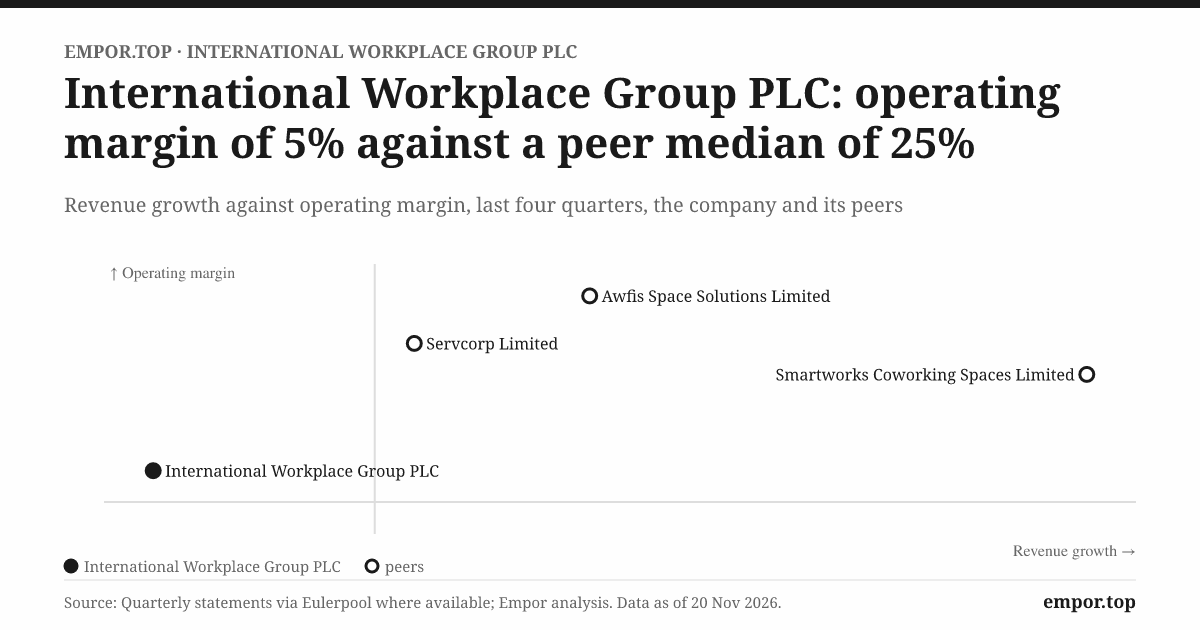
The starting point for anyone trying to answer that question is deeply uncomfortable. In 2025 the group took in about $3.76 billion of revenue, yet its operating margin was only about 2.9%.2 Out of every $100 that customers paid IWG, less than $3 was left as operating profit, before interest on its bonds and before tax. Net profit was a rounding error against that revenue base, so the shares, at about $3 billion of market value on 20 November 2026, traded at more than 300 times trailing earnings. That multiple says less about investor exuberance than it does about how thin the earnings are. Divide anything by almost nothing and you get a very large number.
The balance sheet adds the other half of the tension. At the end of September, IWG's net financial debt, its bonds and bank borrowings less cash, stood at about $874 million.1 That figure is manageable for a company of this size. But it excludes the far larger commitments IWG has made to landlords, which show up as lease liabilities of roughly $6.3 billion.2 The bond market sees one number; the landlords see another; the shareholder has to weigh both.
Four questions run through this story. The first is whether network growth can finally lift durable earnings, after more than a decade in which revenue grew far faster than profit. The second is whether the partner model, in which other people fund the centres, can genuinely shrink IWG's exposure to leases rather than simply adding a new, lighter layer on top of the old, heavy one. The third is whether IWG's cash flow is strong enough to fund expansion, dividends and buybacks at the same time. The fourth is human. In June 2026, Mark Dixon, who founded the company in 1989 and ran it as chief executive for almost four decades, handed the CEO title to Christian Schmitz and became Executive Chair, while remaining the largest shareholder by a wide margin.3 Whether a new chief executive can steer a founder's company while the founder is still in the building is a question every long-term investor in IWG now has to answer.
The answers start in Brussels, with a young British entrepreneur who noticed that businesspeople needed offices more than they needed buildings.
 Subscribe on LinkedIn
II. A Flexible Office Before "Flexible Work"
Mark Dixon did not arrive at office space through property. He arrived through sandwiches. He left school at 16 and started a sandwich delivery business called Dial-a-Snack, which made its rounds on a butcher's bicycle; a hot dog van followed, and then a bakery business, The Bread Roll Company.4 These were small, scrappy, cash-in-hand ventures, and they taught the lesson that would define his later empire: customers pay for convenience, and the operator who removes friction can charge for it.
After selling his food business, Dixon relocated to Brussels, and it was there, in 1989, that he opened the first Regus business centre.4 The setting mattered. Brussels was the administrative capital of a European market that was about to become a single market, and companies from around the world wanted a foothold there without the cost and delay of setting up a full office. Dixon's insight was that many of those businesses did not want to sign a ten-year lease, buy furniture, install telephone lines and hire a receptionist. They wanted to walk into a ready-made office, with the phones working and someone at the front desk, and pay for it by the month.
That proposition sounds obvious now. In 1989 it was a niche service, the domain of serviced-office operators catering to visiting executives and start-ups. Dixon's ambition was to turn that niche into a global network, so that a company in one city could find the same kind of room, sold the same way, in dozens of others. Decades later, the network spans more than 120 countries.2
The economics underneath that proposition were set on day one, and they never changed. Customers wanted short commitments. Landlords, for the most part, wanted long ones. Regus stood in the middle, signing multi-year leases on floors of buildings and then reselling that space in small slices, for weeks or months at a time, at a premium. When demand was strong, the spread between what customers paid and what the landlord charged could be very attractive. When demand fell, the customers could leave quickly, and the landlord's rent did not.
The first great test of that mismatch arrived just as Regus reached the height of its ambition. The company listed on the London Stock Exchange in 2000, at the very top of the technology boom, when start-ups and internet companies were among the most enthusiastic buyers of flexible space.5 Then the boom broke. Technology-sector demand collapsed, particularly in the United States, and Regus's American operation began losing money on leases it could not walk away from.6
In early 2003, Regus's US business filed for Chapter 11 bankruptcy protection.6 The reasoning in the company's own filing was blunt: the US operation had tried to renegotiate its leases with landlords, and negotiation alone had not been enough to bring rents into line with the reduced demand.6 Bankruptcy court offered a tool that a handshake could not, the legal power to reject or reshape unprofitable lease contracts.
The rescue required more than the court. Regus sold a majority of its UK business to a private equity buyer, raised fresh equity through a rights issue, and restructured its finances.5 For the shareholders who had bought into a fast-growing global network, it was a brutal lesson. The company had not failed because customers stopped wanting flexible offices forever. It nearly failed because the customers' flexibility and the company's inflexibility collided in a downturn.
It would be tempting to treat 2003 as ancient history, a youthful mistake from the dot-com era. That would be a mistake. The structural tension that produced it, short customer commitments resting on long property commitments, is the same tension that sits underneath today's $6.3 billion of lease liabilities. The 2003 episode is less a footnote than an early warning.
Dixon's response to the crisis was characteristically aggressive. Rather than retreat from the US, he went back in, bigger. In 2004 Regus agreed to buy HQ Global Workplaces, one of the leading American providers of outsourced office space, for up to $302.5 million, or about £163.5 million, paid in cash and financed partly through a share placing and new debt.7 The deal gave Regus a far larger American footprint at a moment when US office demand was depressed and assets were available.
Was it a bargain? The honest answer is that the disclosed figures do not allow a confident verdict. The purchase price is public, but a reliable multiple of the earnings Regus acquired is not something the announcement allows anyone to compute with confidence, so the deal cannot fairly be labelled cheap or expensive. What can be said is that it fitted a pattern. Dixon tended to expand into weakness, buying when others were retreating, and the network grew faster as a result.
Over the following years, the group added brands to reach different kinds of customer. Regus remained the workhorse business-centre brand; HQ came with the American acquisition; Spaces brought a more design-led, community-oriented style; Signature and others served the premium end; and the company eventually renamed itself to reflect a multi-brand group rather than a single business-centre chain.2 The enduring asset through all of this was not any one building. It was the network and the operating platform behind it: the booking systems, the sales channels, the standardised way of running a centre.
That platform is real. But the returns on the individual acquisitions that built it are almost impossible to isolate from the wider estate, because the centres were absorbed, rebranded, closed and reopened over decades. By the time Dixon was describing his business in a 2025 interview, his pitch was the same one he had made in Brussels: companies want workspace solutions that do not require upfront investment.8 The customer's need had stayed constant. What was about to change was what the customer expected the room to feel like.
III. WeWork Changed the Image; IWG Had to Change the Offer
In the middle of the 2010s, a new company made office space glamorous. WeWork's spaces looked nothing like a traditional business centre. There were exposed brick walls, beer taps, communal kitchens, neon signs and a sales pitch about community and purpose. Its co-founder spoke of elevating the world's consciousness. Venture capital poured in, and by the time WeWork filed for its long-awaited initial public offering in August 2019, it had become the most famous name in the category.9
For Regus, the contrast was awkward. Its centres were efficient, professional and everywhere, but they were associated in the public mind with grey carpet, beige partitions and a receptionist who signed for parcels. WeWork made flexible office space a cultural phenomenon. Regus had been doing flexible office space for thirty years, and somehow it looked like the old guard.
To understand why that mattered, it helps to understand what IWG actually sells. A business that walks into one of its centres can rent a private office for a team, a desk in a shared coworking area, a meeting room for an afternoon, a virtual office that provides a business address and mail handling, or a membership that grants access across the network. The providers in this market compete on four things: location, flexibility of terms, service quality and the experience of being in the space. WeWork's insight was that the fourth one could be a selling point in its own right, especially for younger companies and employees who wanted their workplace to feel more like a hotel lobby than a corporate floor.
The truth about WeWork, though, turned out to be less about design and more about leases. The company had expanded at extraordinary speed by signing long, expensive leases in prime buildings, betting that it could fill them at high prices. Its IPO collapsed under scrutiny. By August 2023, WeWork warned that there was substantial doubt about its ability to remain in business.10 It filed for bankruptcy later that year and emerged from Chapter 11 in June 2024, a much smaller company with a restructured lease portfolio.11
The common reading of that saga is that WeWork's fall proved IWG was the sensible one. The record supports a narrower conclusion. WeWork's collapse demonstrated that lease-heavy expansion in this industry can destroy enormous value, which is exactly the risk IWG itself confronted in 2003 and, as the next chapter shows, again in 2020. It does not prove that IWG automatically wins customers or earns superior returns. WeWork's real legacy was to change what customers expected from a flexible office, and to make the category more visible to large corporations that had never considered it. IWG benefited from the visibility and had to respond to the expectations.
It responded mainly through Spaces and through refreshed formats, and through sheer scale. IWG's network had reached about 3,500 locations by the end of 2023.12 In a 2026 survey of flexible-office operators, the property adviser JLL counted IWG at roughly 4,260 locations, WeWork at 586 and the CBRE-owned Industrious at more than 200.13 By location count, IWG is not just the largest operator in that comparison. It is several times larger than its nearest global rivals put together.
Location counts, however, are not revenue share, and they are certainly not proof of pricing power. A small suburban Regus centre counts as one location, and so does a flagship tower floor. The competitive set is also much broader than the global names. In the United States, WeWork and Industrious compete for premium urban customers. In Asia, The Executive Centre has built a premium network. In the UK, Workspace Group owns and lets flexible space across London, and a long tail of regional operators competes city by city.13 Perhaps most importantly, landlords themselves have built flexible offerings inside their own buildings, which means IWG's suppliers can also become its competitors.
What does IWG's breadth actually buy it? The strongest argument is distribution. A multinational company that wants to give employees access to workspace in dozens of cities, or to open a small team in a new market without a property search, can do it with one provider. That breadth may help IWG win enterprise accounts. But IWG does not publish its largest customers' share of revenue, and says only that no single customer accounts for more than 1%.2 Nor does it publish a group-wide customer retention rate.
That leaves the moat question unresolved rather than answered. Some elements of advantage are tangible: the scale of the network, the recognisability of the brands, and the resilience that comes from thousands of small customers who typically pay in advance and leave deposits.2 Low customer concentration is a genuine strength, because the loss of any one account cannot sink the business. But low concentration is not the same as high switching costs. Customers' commitments are generally short; local competition is fragmented and fierce; and a landlord with an empty floor can always offer a tenant flexible terms directly. A company that cannot show how often its customers stay, or how much it can raise prices without losing them, has not yet proven that its scale translates into pricing power.
There is a further trap in the WeWork-shaped telling of this story. Coworking, the open-plan, community-led product that made WeWork famous, is easy to treat as a separate high-growth business that deserves its own valuation premium. In IWG's case it is better understood as an evolution of the core product: one more way of selling desks to companies that need them. The bulk of IWG's revenue still comes from the traditional work of renting offices and workspace to businesses, with services and other income making up most of the rest.2 The image changed. The underlying business, and its underlying risk, did not.
That risk was about to be tested more severely than at any point since the dot-com bust, because in 2020 the customers did not simply become cautious. They went home.
IV. The Pandemic Reopened the Lease Question
In the spring of 2020, offices across much of the world emptied almost overnight. Employees set up laptops at kitchen tables. Commuter trains ran nearly empty. Glass towers that had housed thousands of workers sat dark. For a company whose product was the physical office, it was the nightmare scenario arriving at full speed.
There was an optimistic theory, and IWG's management articulated versions of it. Companies would want to decentralise, giving employees access to small offices close to home rather than forcing them back into distant headquarters. A flexible network spread across suburbs and smaller towns, the argument went, was perfectly positioned for that shift. In the long run, that argument has some force; hybrid work has, in fact, become a mainstream corporate strategy. In the short run, it ran straight into an uncomfortable fact. Whatever the customers did, the landlords still expected rent.
The financial results tell the story of what happened next. IWG reported a net loss of about $646 million for 2020, and the group remained loss-making in every year from 2020 through 2023.14 Revenue fell, occupancy dropped, impairments were booked against centres whose prospects had darkened, and the company closed sites that could no longer pay their way. The dividend, which had been paid every year through 2019, disappeared, and it did not return until 2023.2
The most revealing moment came in the United States. In 2020, certain of IWG's US subsidiaries entered Chapter 11, echoing the 2003 episode almost two decades earlier.14 The listed group itself continued operating, and the restructuring was confined to particular entities, using the same legal tool Regus had used in 2003.
There was, in fact, a reason those entities could be put through bankruptcy without dragging the parent down. For years, IWG had structured many of its leases through special-purpose vehicles, centre-level companies that sign the lease and hold the obligation. That structure gave the group some ability to ring-fence a failing centre. It was a sensible piece of defensive engineering, and it worked as designed in 2020. It also tells investors something important about the business: the company built legal walls around its leases precisely because it knew how dangerous those leases could be.
Set the two crises side by side and the pattern becomes hard to dismiss. In 2003 the trigger was a technology bust that hit a concentrated pool of start-up customers. In 2020 it was a pandemic that hit everyone. The triggers were different; the vulnerability was identical. Each time, customer demand could shrink in weeks while property costs remained contracted for years. And each time, the business needed a court process in its largest market to realign its costs.
That is the strongest disconfirming evidence against a simple claim often made about IWG: that global scale means resilience. Scale does diversify demand. A downturn in one city or one sector can be offset by strength elsewhere, and thousands of small customers are safer than a handful of large ones. But scale cannot diversify away a shock that hits offices everywhere at once, and it cannot make a fixed lease flexible. The history does not reject the resilience claim outright; IWG survived both crises without the listed parent failing. It narrows it. The network provides diversification against local and sector-specific shocks, not protection against a broad collapse in office use.
The recovery that followed was real but modest. IWG returned to small reported profits in 2024 and 2025, with net income of roughly $15 million to $18 million in each year, depending on the measure, on revenue of about $3.8 billion.2 Those are not the profits of a company that has escaped its past. They are the profits of a company that has stopped bleeding.
Meanwhile, the obligation that caused the trouble is still there. At the end of 2025, those lease liabilities had an average of roughly six and a half years left to run.2 Put another way, the company owes landlords about one and two-thirds times its entire annual revenue, and those commitments stretch well beyond any customer's contract. On top of that, banks had issued about $344 million of guarantees and letters of credit at year-end, mostly supporting landlord leases.2
If the pandemic taught Mark Dixon anything, it was that the answer could not simply be better leases. It had to be a different answer to a more basic question: who should fund the centre, and who should carry the risk when it is empty?
V. The Partner Deal That Could Change the Economics
On 5 December 2023, IWG held an Investor Day that was meant to mark the end of the pandemic era and the beginning of something new.15 The company announced it would resume paying dividends. It set a medium-term ambition of reaching $1 billion of adjusted EBITDA, a measure of profit before interest, tax, depreciation and amortisation that IWG calculates in its own way. And it made a strategic commitment that went to the heart of its history: future growth would come primarily from managed and franchised locations, funded and owned by partners rather than by IWG.15
To understand why that mattered, it helps to see the two businesses IWG now runs side by side.
The first is the business the company has always run. IWG signs a lease on a floor or building, fits it out, staffs it and sells space to customers. It keeps all the revenue those customers pay, and it bears all the costs, including the rent. In good years, it captures the full spread between what customers pay and what the space costs. In bad years, it eats the full loss. This is the company-owned estate, and it is where most of the group's revenue still comes from.
The second is the partner model, which works much like a hotel franchise. A property owner, an investor or an operator funds and runs a centre, and IWG provides the brand, the booking platform, the sales channels and the know-how. IWG earns fees, either for managing the centre on the owner's behalf or for licensing its brand to a franchisee. Its revenue per centre is far smaller, but so is its risk. If the centre struggles, it is the partner who bears the rent and the fit-out bill. The company says managed and franchised locations require no IWG capital expenditure.2
It is the same move hotel groups such as Marriott and Hilton made decades ago, when they shifted from owning hotels to managing and franchising them. Those companies discovered that brand and distribution could earn high returns without the capital and cyclical risk of owning property. IWG is attempting the same transformation in an industry where the brand power and the customer economics are less proven.
That distinction matters here. In 2025, IWG's group revenue was about $3.76 billion, against system revenue of about $4.5 billion.2 The gap shows how network growth can outpace growth in the revenue that reaches IWG's accounts.
The growth of the partner model has been rapid. Managed and franchised centres rose from about 28% of IWG's locations in 2024 to about 41% in 2025.2 Yet those centres accounted for only about 29% of rooms and about 20% of system revenue.2 The arithmetic says something important. Partner centres are, on average, smaller or earlier in their life than company-owned ones, and many have not yet reached maturity. The location count is running far ahead of the revenue and profit contribution. In 2025, managed and franchised fee income in IWG's own accounts was about $126 million, against roughly $2.4 billion of workstation revenue from the company-owned estate and about $1.3 billion of services and other income.2 The future may belong to the fees. The present still belongs to the leases.
The pace of signing has been remarkable. In 2025, IWG signed more than 1,100 new centres, up by more than a quarter on the prior year, and opened about 769 capital-light centres against an internal target of 575.2 In 2024, around 95% of new signings were capital-light.12 For a company that spent decades growing by signing leases, that is a genuine change in behaviour, and the fact that openings outran the target suggests the partner pipeline is real rather than aspirational.
But a signing is not a centre, and an opened centre is not a mature one. A signed deal is a pipeline entry: a partner has agreed to open a site, but the space may not be fitted out, open or full for months or years. Some signings will never open at all. The number that ultimately matters is not how many partners sign, but how many centres open, fill and start paying recurring fees that grow over time.
The company-owned estate offers a useful reality check on how hard that last step can be. IWG recorded right-of-use asset impairments, in effect write-downs of the value of its leased centres, of about $100 million in 2023, $54 million in 2024 and $21 million in 2025, all related to underperforming company-owned centres.2 The trend is clearly improving, and the fall from $100 million to about $21 million suggests the weakest sites from the pandemic era have largely been dealt with. But the charge has not disappeared. Even a company with thirty-five years of experience still opens centres that do not earn their keep, which is a reminder that site selection and local economics decide whether a centre works, whoever funds it. In the partner model, a poor site hurts the partner first. If it happens often enough, it hurts IWG's ability to sign the next partner.
The investment profile has changed too, though not as dramatically as the partner story might suggest. IWG's net capital expenditure in 2025 was about $174 million, roughly 4.6% of revenue.2 That figure included about $82 million of growth capex and about $92 million of maintenance capex, both higher than the year before.2 Maintenance spending, the money required simply to keep existing company-owned centres attractive, is now larger than growth spending. The capital-light model reduces the capital needed for each new location. It does not reduce the cost of maintaining the thousands of centres IWG already leases.
Then there is the gap between ambition and delivery. The $1 billion adjusted EBITDA target set in December 2023 remains a medium-term goal. For 2026, the company's guidance is a range of $585 million to $625 million of adjusted EBITDA, which it tightened during the year while saying it expected results above market consensus.1 That is real progress from the roughly $531 million achieved in 2025, but it still leaves a gap of almost $400 million to the ambition.2 By the company's own December 2025 Investor Day, the narrative had shifted further toward the partner engine, with recurring managed fee revenue becoming a headline measure.16 Management guided to about $80 million of recurring managed fee revenue for 2026.1
That figure deserves a moment. At $80 million, recurring managed fees are meaningful and growing, but they are small against a group that generates billions of dollars of revenue from its leased estate. In the third quarter of 2026, managed and franchised fee revenue grew about 28% year on year.1 Fast growth from a small base is exactly what a successful transition looks like in its early years. It is also what a transition that never reaches scale looks like in its early years. The difference only becomes visible over time.
Acquisitions are not the main engine of this story, and it would be misleading to suggest otherwise. IWG's current expansion is driven overwhelmingly by partner signings rather than by buying other operators. There is no evidence of a modern acquisition spree, or of a comparable recent purchase on which to judge whether IWG overpays.
The core uncertainty is therefore one of trade-offs. When IWG grows through partners, it gives up the full operating spread it would earn from a company-owned centre in exchange for a fee, and in exchange for not having to fund the fit-out or sign the lease. That is a good trade if the fees are durable, if the partners succeed and if the capital saved is significant. It is a less good trade if partner centres struggle, if fees are slow to ramp, or if the company-owned estate, which still carries the leases, continues to generate thin margins. Lower capital intensity is a means. Higher returns for shareholders are the end. And the cleanest place to test whether the means is producing the end is in the cash.
VI. The Cash That Looked Better Than the Profit
Here is a puzzle that has confused IWG investors for years. Add up the company's net results across the twelve years from 2014 to 2025, and you get a cumulative net loss of about $280 million.2 Add up its cash from operations over the same twelve years, and you get about $7.4 billion.2 A business that lost money in aggregate generated billions of dollars of operating cash. How?
The answer lies in how accounting treats a lease-heavy business, and it is the most important technical idea in this story.
Under modern accounting rules, when IWG signs a long lease, it records two things on its balance sheet. One is a right-of-use asset, the value of being allowed to use the space. The other is a lease liability, the obligation to pay rent over the lease's life. Each year, the asset is depreciated, which shows up as a large non-cash expense in the income statement. Meanwhile, the rent payments that reduce the lease liability are classified not as operating cash outflows but largely as financing cash flows, the same category as repaying a loan.
Think of it like a homeowner who bought a house on a mortgage. The mortgage payment is real cash leaving the bank account every month, but if you only looked at the household's "operating" cash flow, ignoring mortgage repayments, the family would look far richer than it is. IWG's operating cash flow looks strong partly because rent, the single largest cost of running an office business, is pushed into another part of the cash-flow statement.
In 2025, the numbers make the point vividly. IWG reported operating cash flow of about $364 million, against net income of about $15 million.2 The reconciliation between the two added back about $357 million of depreciation and amortisation, plus impairments and credit-loss charges.2 And then, elsewhere in the statement, the company paid about $1.47 billion in lease cash payments.2 That last number is the one to hold. It is roughly four times the operating cash flow and almost 40% of group revenue. It is the rent, and it is not optional.
So operating cash flow is not cash available to equity holders. The real measure of how much money is left for shareholders is what remains after leases, after capital expenditure and after interest on financial debt. On that basis, IWG's cash generation looks much more modest. The company's own preferred measure, cash generation from business activities, was about $360 million in 2025, which captures the business after lease payments and before discretionary spending.2 That is a decent number. It is also one that has to fund growth capex, dividends, buybacks and debt reduction all at once.
A single year can also mislead because of working capital, the money tied up in or released from day-to-day trading. IWG bills customers monthly, typically 30 to 60 days in advance, and customers generally pay before they use the space.2 That is a lovely feature in a growing business, because customers effectively fund part of the company's operations. But it also means that changes in billing timing and collections can swing cash flow sharply. In 2025, a fall in receivables and prepayments released about $243 million of cash, while a fall in deferred revenue, the money customers had paid in advance, consumed about $236 million.2 Those two movements nearly cancelled out, but in a different year they might not. An investor who annualises one strong cash year without checking working capital can be badly misled.
The longer view offers more context but also requires care. Over the twelve years from 2014 to 2025, IWG generated about $3.6 billion of free cash flow, defined as operating cash flow less capital expenditure.2 Of that, about $306 million, less than a tenth, went to dividends, and cash on the balance sheet rose by about $219 million.2 At first glance it might seem that billions of dollars of free cash vanished. The truth is that most of it went to the landlords, in the lease payments that sit in the financing section, and to the other claims of a business that has repeatedly restructured, refinanced and reinvested. That $3.6 billion was never all distributable to shareholders. It was the money available before the rent.
Against that backdrop, IWG's recent capital returns stand out. In 2025, the company repurchased and cancelled about 48.5 million shares for about $130 million, roughly 4.5% of its share capital, while also paying dividends.2 In the third quarter of 2026 alone, it bought back another 15.8 million shares for about $39 million, and raised the ceiling of its 2026 buyback programme to $200 million.1 All this from a company whose reported net profit in 2025 was in the tens of millions of dollars and whose lease liabilities remain substantial.
The dividend tells a similar story. In 2025, IWG's dividends paid amounted to about 78% of its net profit, compared with a median of about 47% over the previous nine years in which it paid one.2 That payout is high not because the dividend is large, which it is not, but because profit is so small. The combination of a dividend that consumes most of reported profit and a buyback several times larger means IWG is returning cash on the basis of its cash generation rather than its accounting earnings. That can be perfectly rational, especially if management believes the shares are undervalued. But it rests on the assumption that the cash after leases and investment will remain robust through the next downturn.
There is also a quieter balance-sheet signal worth noting. IWG's interest costs and currency movements have a material effect on its tiny profit. In 2025, net finance expense was about $100 million, against profit before tax of only about $43 million.2 Small changes in interest rates or exchange rates can therefore swing reported earnings substantially. The group has hedged its euro and sterling bonds into dollars, so the bonds themselves carry little currency risk, but its operations still earn revenue in dozens of currencies.1
So what would make the capital-return policy convincing? The forward test is straightforward to state. If IWG can sustain healthy cash generation after lease payments and growth capex, while also bringing down net financial debt from its September 2026 level, then buybacks and dividends look like the fruits of a stronger business.1 If buybacks continue while debt stays flat or rises and lease obligations remain heavy, they look more like a choice to reward shareholders today at the expense of resilience tomorrow. That choice, and the judgement behind it, now belongs to a new chief executive.
VII. The Founder Moves to the Chair; a New CEO Takes the Wheel
On 16 June 2026, IWG announced that Douglas Sutherland, the independent chairman, became Deputy Chair to oversee board effectiveness during the transition.3 Dixon handed over day-to-day control, though not the chair.
Schmitz arrived with a very different background from Dixon's. Where Dixon was a self-made entrepreneur who started with sandwiches, Schmitz is a product of the consulting and private equity world. Before joining IWG, he spent six years as chief executive of Selecta, a European vending and coffee services company owned by the private equity firm KKR, and earlier worked as a partner at McKinsey and a director at KKR Capstone, the firm's operational improvement arm.3 He joined IWG in 2025 as Chief Transformation Officer, and later became global head of the company's regions, before being elevated to the top job.3
That background is relevant to IWG's current challenge. Selecta was a business of thousands of small sites and machines, where performance depended on operating discipline, location economics and cost control. IWG is, in a sense, a similar business at a larger scale: thousands of centres, each of which needs to earn its keep. A CEO trained to squeeze performance out of a distributed network of small units is a logical fit for a company whose biggest question is whether each centre, owned or partnered, earns an adequate return.
The timeline matters for judging him fairly. The 2025 results and the bonuses paid for them belong overwhelmingly to the prior arrangement, with Dixon as CEO. Schmitz contributed as Chief Transformation Officer, but those results are not his record as chief executive. As of November 2026 he has run the company for barely five months, which is too short to separate his performance from the momentum he inherited.
What can be judged is the management team's record against the targets it set. In 2025, IWG reported adjusted EBITDA of about $531 million, against a bonus target of $526 million. Cash generation from business activities was about $360 million, well ahead of a target of $240 million. And 769 capital-light centres opened, comfortably above a target of 575.2 These numbers show a management team that met or beat its own goals in the year that mattered most for the strategic pivot.
Those results also fed through into pay. Dixon's total remuneration for 2025 was about £4.5 million, roughly double the prior year, while chief financial officer Charlie Steel received about £3.5 million, up sharply from about £1.1 million.2 A large part of the increase came from the vesting of long-term incentive awards, including performance shares granted in 2023 and, for Steel, a one-off recruitment award from 2022.2 Pay was linked to targets that were met, which is how incentive schemes are supposed to work. But the scale of the increase, at a company still earning very little net profit, drew some dissent. At the May 2026 annual general meeting, the remuneration report received about 87.6% support, with about 12.5% voting against.17 The company noted that investors holding roughly 12% of voting rights through swap arrangements were unable to vote at all.17 That is not a shareholder revolt, but it is a meaningful minority signalling discomfort.
The more important governance question is ownership. As of March 2026, Dixon held about 25.8% of IWG's voting rights through Estorn Limited, a company he wholly owns.2 The next-largest holder, Toscafund, had about 9.7%, having cut its stake from about 18% in early 2023, and Rubric Capital held about 5%.218 No single holder controls IWG, but Dixon's quarter-stake, combined with his move to Executive Chair, gives him a degree of influence that most chairmen of FTSE companies do not have.
That cuts both ways. On one side, Dixon's wealth is overwhelmingly tied to IWG's share price, which aligns him with outside shareholders in a way that a hired chief executive with a modest stake never could be. He has every incentive to see the strategy succeed. On the other side, a founder who remains Executive Chair, owns a quarter of the company and has made every major decision for thirty-seven years may find it hard to let a new CEO make his own choices, and harder still to let him reverse decisions the founder made. The board, which is majority non-executive, and Sutherland's role as Deputy Chair are supposed to manage that tension.2 Whether they do so will become visible only when Schmitz and Dixon disagree.
The capital-allocation record they share is also worth weighing. Since the 2023 Investor Day, the company has resumed dividends, run continuous buybacks, issued euro-denominated bonds in 2024, 2025 and 2026, and repurchased most of its 2027 convertible bond.219 It increased and extended its revolving credit facility to $1 billion, running to 2031, in July 2026.19 These are the actions of a company with good access to debt markets and confidence in its cash flows. They also mean that shareholder returns and new borrowing have gone hand in hand, while lease obligations, many times larger than financial debt, remain the dominant claim on the business.
The most useful early test of the new CEO came with the third-quarter trading update in November 2026. The prepared message emphasised momentum and cost discipline: group revenue up about 9%, managed and franchised fee revenue up about 28%, and full-year EBITDA guidance tightened with management signalling results above consensus.120 The shares jumped on the day.20 But analysts on the call pressed on two issues, the slowing of revenue per available room in the company-owned estate and what that implies for 2027.2021
That slowdown is the number to watch. RevPAR, or revenue per available room, measures how much revenue the company earns from each room it has available, combining occupancy and price into a single figure, the same way hotel analysts measure a hotel's health. In IWG's company-owned centres, RevPAR growth slowed from about 6% year on year in the first quarter of 2026 to about 2% in the third quarter.122 A deceleration of that size in the business that still generates most of the group's revenue matters more than any number of new partner signings.
How Schmitz explains such slowdowns will reveal a great deal about the kind of CEO he is. The strongest management teams explain weakness with specific, centre-level evidence: which markets slowed, which formats underperformed, what price changes were made and what the response will be. Weaker ones reach for broad explanations, hybrid work, artificial intelligence, macroeconomic uncertainty, that are true of the whole industry and therefore explain nothing about the company. Schmitz's private equity training suggests he will favour the former. The next few results will show whether he does.
VIII. The Next Centre Has to Earn Its Place
Every week, somewhere in the world, a landlord with an empty floor sits down to weigh the options. The landlord can lease the space to a single tenant on a long lease, if one can be found. The landlord can fit it out as flexible workspace and run it directly, under the building's own brand. The landlord can bring in a specialist operator like WeWork or Industrious. Or the landlord can sign up with IWG, take a Regus or Spaces brand, and pay IWG a fee to fill and run the space.
That moment of decision is where IWG's future is won or lost. And it explains why the company's scale, impressive as it is, does not by itself prove a durable competitive advantage.
The competitive structure is difficult: rivalry is local, customer commitments are short, and landlords can become competitors. Conventional leases, in-house offices and remote work are substitutes.
That is a tough industry structure for any operator. The question is whether IWG has a source of power that lets it earn better returns than the structure would suggest.
Using Hamilton Helmer's framework of the seven powers, the evidence is mixed. Scale economies exist in the platform: IWG can spread the cost of its technology, sales channels and brand marketing over thousands of centres in a way no regional operator can. A form of network effect is plausible for customers who want access across many locations, since every additional centre makes a membership more useful, though the company does not publish data proving that this drives retention or pricing. Brand is real but uneven; Regus is the most recognisable name in the category, but recognition is not the same as a price premium. Switching costs are weak, because customers' contracts are short and moving to another provider is easy. There is no counter-positioning that rivals cannot copy, no cornered resource and no process power that has yet shown up in superior margins. Margins this thin are not the fingerprint of a company with strong pricing power.
Short customer commitments and unproven pricing power leave IWG with a distribution advantage rather than a proven moat. Its breadth may help it win multinational accounts and makes it attractive to partners: a landlord signing with IWG gets access to the company's booking platform and customer base in a way that a smaller operator cannot offer. But low customer concentration is resilience, not lock-in.
The partner model adds a twist to this analysis. In the partner business, IWG's real customers are not only the companies renting desks but also the property owners signing management and franchise agreements. Those owners will judge IWG by one thing: whether centres under its brands earn more than they would under any alternative. If they do, partners will keep signing and IWG's fee base will compound. If they do not, partners will drift to other operators or run the space themselves, and the pipeline will dry up. The partner strategy therefore converts IWG's competitive question from "can we fill our own centres?" into "can we fill everyone's centres better than they could?"
The win case is straightforward to articulate. Partner locations allow IWG to extend its network into cities and suburbs where it could never justify signing a lease, with little capital of its own. Every new location strengthens the value of a network membership and the reach of the booking platform. As hybrid work remains a mainstream corporate strategy, demand for flexible space close to where people live could keep rising, and IWG's breadth and established brands could capture a disproportionate share of that demand. In that world, fee revenue grows rapidly, company-owned centres earn healthy returns and lease liabilities shrink relative to the business.
The lose case is equally clear. Hybrid work may reduce total office demand rather than redistributing it. Customers may use several providers rather than committing to one network. Local operators and landlords may offer comparable flexibility at lower prices. And the company-owned estate, which still bears the rent, may continue to suffer from occupancy swings and execution problems that keep margins thin.
The specific risks run through identifiable mechanisms rather than abstract macroeconomic worry. Economic weakness reduces both occupancy and the prices IWG can charge, because short-term customers are the first to cut back. Persistent lease payments magnify that downside, since revenue can fall far faster than rent. Currency translation affects reported results, because IWG reports in dollars but earns across more than 120 countries, and the company itself has named dollar strength as a scenario risk.1 Site-level underperformance can create impairments, as the recent charges show. Artificial intelligence could change how much office space companies need, or help IWG run its centres more efficiently; but the company has not shown AI to be a material standalone source of revenue, and treating it as one would be speculation.
The credit market's view offers a useful second opinion. In February 2026, Fitch affirmed IWG's credit rating at BBB with a stable outlook, which places the company in investment-grade territory.23 That reflects the group's ability to generate cash and access debt markets. But the rating applies to IWG's financial debt, which is small relative to its leases, and bondholders rank differently from shareholders. A rating that is comfortable for a bondholder whose claim is under $1 billion does not settle the risk for an equity holder whose position sits behind $6 billion of lease obligations.
That brings the analysis back to the third-quarter update. The headline growth was strong, but the company-owned RevPAR slowdown, from about 6% to about 2% over the year, is the single most important piece of evidence about the health of the core.1 If it reflects a temporary pause, the strategy is on track. If it signals that demand in the company-owned estate is softening heading into 2027, then the partner story will need to grow much faster to compensate.
Three measures, more than any others, will settle the investment case. The first is managed and franchised recurring fee revenue, which management guides to about $80 million for 2026 and which grew about 28% in the third quarter; it shows whether the partner engine is turning signings into durable income.1 The second is company-owned RevPAR and the returns on those centres, where growth slowed to about 2% in the third quarter; it shows whether the core estate, which still produces most of the revenue, is healthy.1 The third is lease liabilities and lease cash payments relative to group revenue, with liabilities of about $6.3 billion and annual payments of about $1.5 billion at the end of 2025 against $3.8 billion of revenue; it shows whether the transformation is genuinely reducing the risk that nearly broke the company twice.2 Together they answer the question the market is ultimately trying to price.
IX. Analysis & Bear vs. Bull Case
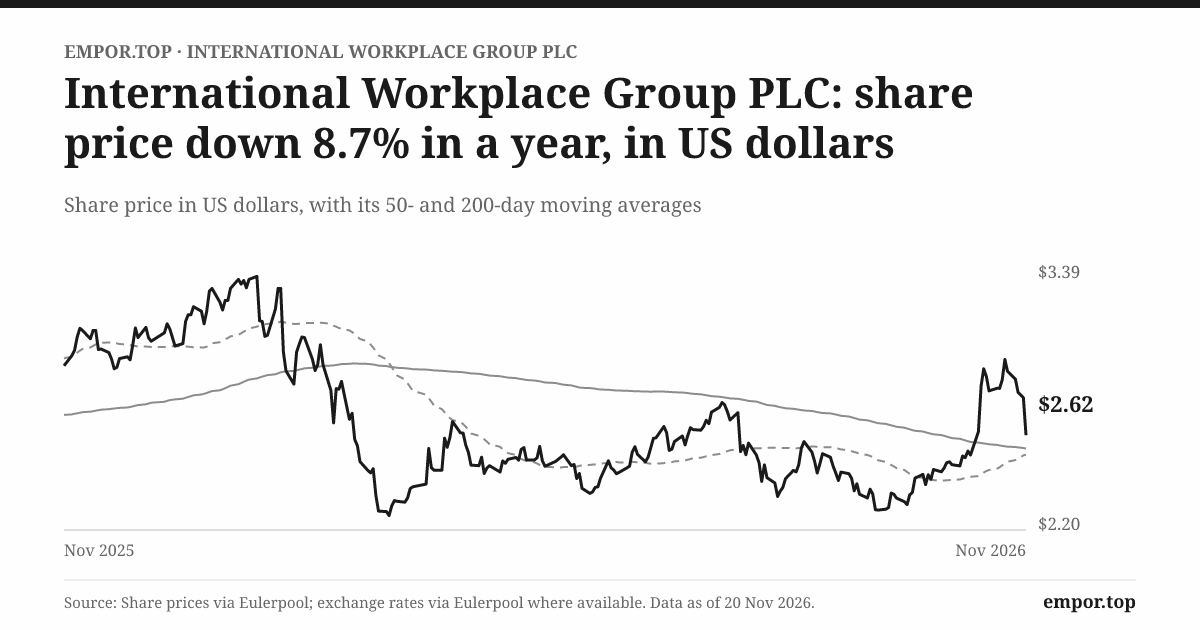
On 20 November 2026, IWG's shares closed at about $2.62, roughly 21% below their 52-week high. At that price, the market valued the equity at about $3.0 billion. Add the net financial debt and the lease liabilities, and the enterprise value, the theoretical cost of buying the whole business including its obligations, comes to about $10.4 billion.
That gap, more than $7 billion between what the shares are worth and what the whole enterprise is worth, is the story of this company in a single sum. Most of it is leases. A shareholder who buys IWG is buying a small equity slice sitting on top of a very large stack of property commitments.
The valuation multiples reflect that structure. The trailing price-to-earnings ratio of about 328 times, against a five-year median of about 22 times, is not a meaningful verdict on value. It simply reflects earnings so small that the ratio explodes. Enterprise-value-based multiples are more informative. IWG trades at about 2.7 times enterprise value to sales and about 19 times enterprise value to EBITDA. Even these must be read with caution, because lease accounting inflates both enterprise value and EBITDA in ways that differ from company to company, and because IWG's mix of leased centres, partner centres and digital services is changing quickly.
Peer comparison offers context rather than a benchmark. Workspace Group, the London-listed flexible workspace provider, traded at about 7.5 times enterprise value to sales and about 15 times EBITDA in November 2026.24 But Workspace owns most of its buildings, a fundamentally different model with different risks, returns and accounting. Its multiples tell an investor how the market prices a property-owning flexible operator, not how it should price a lease-heavy network shifting toward fees.
So what would have to be true for the share price and the growth plan to make sense together? The market appears to be assuming that IWG's earnings will grow substantially from today's thin base, that the partner model will deliver recurring fees at scale, and that the lease burden will become less dangerous over time. None of those assumptions is unreasonable. None is yet proven.
The bull case begins with scale. IWG is the largest global operator in JLL's comparison, and its partner model allows it to add coverage without funding each new location.13 If it completes a transition like the hotel franchise companies, it could be early in a long compounding story.
The bear case begins with the record. Group revenue grew only about 3.8% a year from 2022 to 2025, much slower than the growth in locations, while earnings remain very low.2 A bear would argue that IWG has been very good at growing the size of the network and much less good at turning that size into profit, and that the partner model may simply be a new way to grow the location count without solving the underlying economics.
The bull points to momentum: management tightened its full-year guidance, signalling EBITDA ahead of consensus, while third-quarter group revenue and managed and franchised fees grew.1 Capital-light openings beat their 2025 target, and cash generation from business activities was well ahead of plan. These are signs of a strategy gaining traction.
The bear points to the core. The deceleration in company-owned RevPAR, from about 6% to about 2% during 2026, together with continuing lease liabilities of about $6.3 billion, raises the question of whether reported growth can become durable shareholder cash.12 If the company-owned estate, which still generates the bulk of revenue, is slowing, then the fee business needs to grow much faster than it has so far to offset it.
An activist looking at IWG would focus on capital returns. Buybacks can create real value if shares are undervalued and if the cash used genuinely remains after leases, maintenance and investment. IWG's management clearly believes its shares are cheap, and it has backed that belief with hundreds of millions of dollars. But a skeptic would ask why a company with more than $6 billion of lease liabilities, almost $900 million of net financial debt and a history of two US restructurings is spending more on buybacks than it earns in net profit. A buyback that crowds out resilience is not a gift to shareholders. It is a bet on the next downturn being mild.
The same activist might also ask harder questions about disclosure. IWG does not publish a group-wide customer retention rate, a breakdown of returns on company-owned centres by vintage or format, or a clear series showing how much of its fee income is recurring versus one-off. Each of these would help investors test the transformation story. Their absence does not prove anything is wrong, but it leaves investors relying on management's framing more than they should.
Bringing the forces and powers together sharpens the picture. Industry structure is unfavourable: fragmented, local competition; powerful buyers with short commitments; landlords who can compete with their own operators. IWG's strongest source of power is scale in its platform and distribution, which may become stronger as the partner network grows. Its weakest is the absence of switching costs. A strong network in a weak industry can earn good returns, as the hotel franchisors proved, but only if partners and customers keep choosing it.
The neutral threshold is therefore clear. The investment case strengthens if recurring fees grow rapidly, if company-owned RevPAR and centre returns hold steady or rise, and if lease liabilities fall relative to revenue. It weakens if openings outrun realised fees, if the company-owned estate's economics deteriorate, or if capital returns continue to outpace debt reduction while leases remain heavy. The share price embeds a hope that the first scenario is unfolding. The evidence, so far, says it is plausible but not yet established.
X. Playbook: Business & Investing Lessons
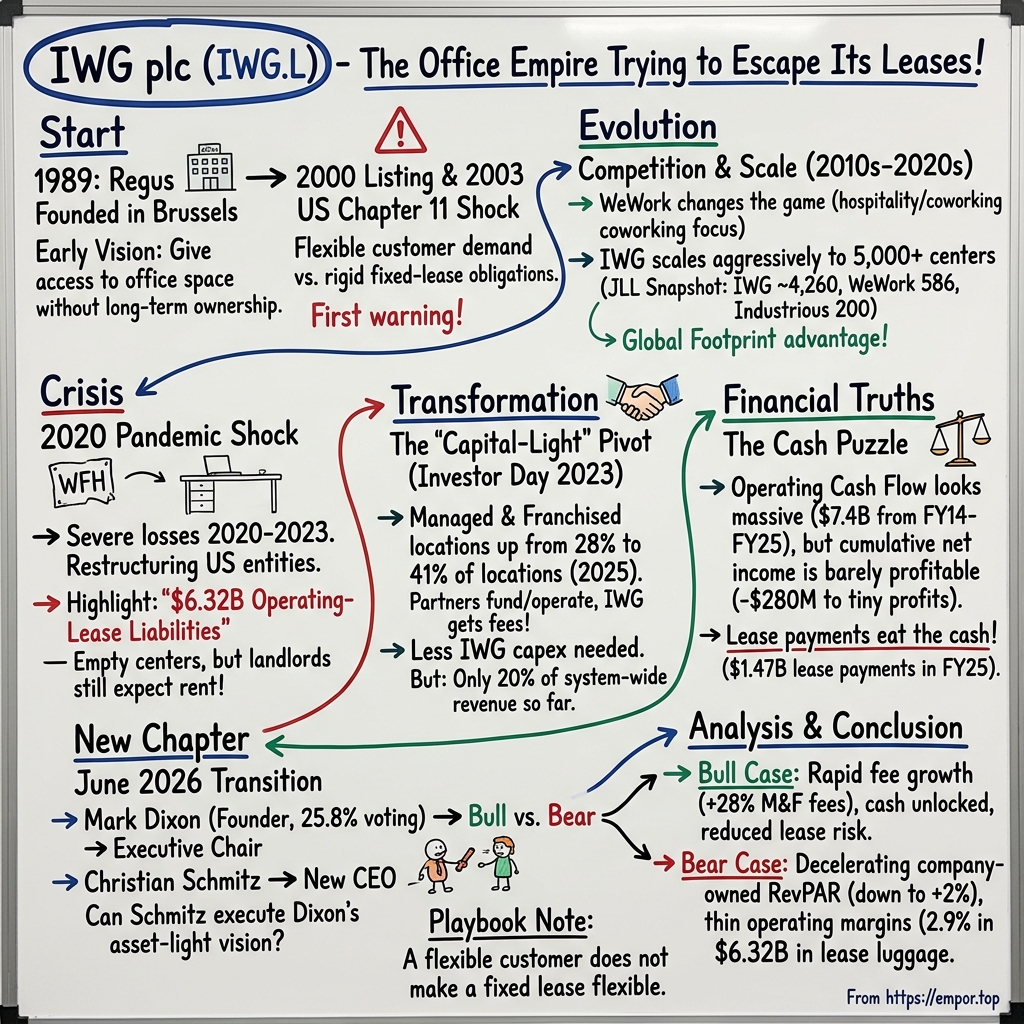
The first lesson is that a flexible customer does not make a fixed lease flexible. The 2003 and 2020 US restructurings made the same point: the customer's flexibility is a liability for the operator unless the operator's costs can bend as fast. For founders building any business that sells short-term access on top of long-term commitments, whether offices, data centres or aircraft, the question to ask before every expansion is simple: who carries the commitment when the customer leaves? IWG's whole strategy since 2023 is an attempt to answer that question differently, which is the strongest evidence that the old answer was wrong.
The second lesson is to count the fee, not just the centre. IWG's 5,000-centre network illustrates the distinction: a partner centre contributes a fee to the listed company, not the full revenue a customer pays. For investors in any franchise or platform business, the headline unit count tells you about reach. The fee per unit, and how reliably it recurs, tells you about value. A network that grows its door count faster than its fee income is building a map, not a moat.
The third lesson is that cash flow is a beginning, not a conclusion. IWG's operating cash flow, before lease payments, illustrates the point. An investor who stopped at the operating cash flow line would have concluded the business was a cash machine. An investor who followed the cash to the landlord would have seen a business working very hard to stay slightly ahead of its rent. In any company where a large, recurring cost sits outside operating cash flow, whether leases, capitalised development or customer acquisition, the real question is not how much cash comes in but how much is left after the obligations no one can skip.
The fourth lesson is that a founder's ownership can align incentives and concentrate power at the same time. Dixon's position as a major shareholder and Executive Chair illustrates both sides. For investors, the founder's stake is neither a reason for comfort nor a reason for alarm on its own. What matters is how the board behaves when the founder and the new CEO disagree, and the first real test of that has not yet arrived.
The fifth lesson is that a promise earns credibility one reporting period at a time. IWG's progress toward its $1 billion adjusted EBITDA ambition illustrates the point: the company has met its own annual targets, but the larger ambition remains unproven. It will be proven, or disproven, by the unglamorous results of thousands of individual centres: whether they fill, whether they hold their price and whether partners keep signing. In businesses built on many small units, strategy is announced at investor days and decided at the front desk.
XI. Epilogue
Tonight, IWG stands at an interesting point in its long history. The network is larger than it has ever been. The partner model has grown quickly since it was announced. The founder has stepped back from day-to-day leadership for the first time in almost four decades. And the share price, at about $2.62, sits well below its high for the year, as the market weighs momentum in the fees against slowing growth in the core.
The next decisive moment is scheduled for 2 March 2027, when IWG reports its full-year 2026 results.1 That report will cover the first year in which Schmitz served as CEO for part of the year, and it will test three things at once. The first is whether adjusted EBITDA lands inside or above the $585 million to $625 million guidance range. The second is whether recurring managed fee revenue reaches the roughly $80 million management guided to, and how quickly it is growing as the year ends. The third is what happens to net financial debt, which stood at about $874 million at the end of September.1
Each outcome carries a different meaning. A result at the top of the range, with fees ahead of plan and debt falling, would suggest the transformation is building momentum and that the new CEO inherited a business capable of compounding. A result that meets guidance but shows further slowing in company-owned RevPAR would suggest the core estate is weakening even as the partner network grows, and the question for 2027 would become whether fees can grow fast enough to compensate. A result that disappoints on cash or debt, while buybacks continue, would sharpen the activist's question about whether the company is prioritising shareholder returns over resilience.
Investors will also be listening closely to the analyst questions on that day. The third-quarter call showed analysts pressing on the RevPAR slowdown and the outlook for 2027. How Schmitz answers those questions, with specific evidence from centres and markets or with broad references to hybrid work and macroeconomic conditions, will reveal more about his leadership than the headline numbers.
Beyond the March results, the real test lies in 2027 itself. It will be the first full year in which Schmitz is responsible for the operating record from start to finish. The returns on company-owned centres, the conversion of signed partner deals into opened, earning centres, and the trajectory of lease liabilities relative to revenue will all be his record to own.
The capital-light thesis does not need one great quarter. It needs years of evidence that fees, returns and lease exposure are all moving in the right direction at the same time. IWG has delivered the first part of that evidence. The rest remains to be earned.
XII. Outro
Go back to Brussels in 1989. A businessperson walks into a room that someone else has furnished, picks up a phone that someone else has connected, and gets to work without signing a lease. That simple transaction is still the heart of IWG. The customer buys convenience and flexibility. The company takes on the work, and the risk, of making the space available.
For thirty-seven years, that arrangement has made IWG the largest flexible office network in the world, now more than 5,000 centres strong, with about $1 billion of group revenue in a single quarter. It has also left the company owing landlords more than $6 billion, and twice forced its American operations through bankruptcy court. The customers got the flexibility. The company kept the leases.
The partner model is IWG's attempt to change that bargain, to sell flexibility without carrying all the property risk itself. If it works, IWG becomes something more like a brand and platform company than a landlord in disguise. If it does not, the network will keep growing while the shareholder's slice stays thin.
IWG's next chapter is a test of whether the world's biggest flexible-office network can finally become a flexible business.
References
-
Q3 2026 Trading Update — International Workplace Group plc, 2026-11-03 ↩↩↩↩↩↩↩↩↩↩↩↩↩↩↩↩↩↩↩↩
-
Annual Report and Accounts 2025 — International Workplace Group plc, 2026-03-17 ↩↩↩↩↩↩↩↩↩↩↩↩↩↩↩↩↩↩↩↩↩↩↩↩↩↩↩↩↩↩↩↩↩↩↩↩↩↩↩↩↩↩↩↩
-
IWG PLC Announces Leadership Changes — Investegate RNS, 2026-06-16 ↩↩↩↩
-
Regus Rights Issue and Reorganisation Documents — Regus, 2003-11-14 ↩↩
-
Regus Chapter 11 and Lease Restructuring Filing — SEC, 2003-04-25 ↩↩↩
-
Acquisition of HQ Global Workplaces Inc by Regus Group plc — Regus, 2004-07-16 ↩
-
Mark Dixon on Flexible Workspace in Spain — Cinco Días, 2025-08-19 ↩
-
WeWork's Future After Warning About Its Ability to Stay in Business — Associated Press, 2023-08-09 ↩
-
WeWork Has Emerged From Bankruptcy — Associated Press, 2024-06-11 ↩
-
Annual Report and Accounts 2024 — International Workplace Group plc, 2025-03-18 ↩↩
-
Results of Annual General Meeting — International Workplace Group plc, 2026-05-19 ↩↩
-
Notification of Major Holdings — London Stock Exchange, 2025-05-01 ↩
-
Interim Results 2026 — International Workplace Group plc, 2026-08-11 ↩↩
-
Earnings call transcript: IWG Q3 2026 lifts outlook as stock jumps — Investing.com, 2026-11-03 ↩↩↩
-
IWG Q3 2026 Trading Update Call Transcript — Stock Analysis, 2026-11-03 ↩
-
Q1 2026 Trading Update — International Workplace Group plc, 2026-05-12 ↩
-
Fitch Affirms IWG at BBB, Stable Outlook — Cbonds, 2026-02-13 ↩
-
Workspace Group Valuation Ratios — Stock Analysis, 2026-11-21 ↩
 LinkedIn
 WhatsApp
 Reddit
 Hacker News
 Email
 Kindle
 RSS Feed
 Spotify
 Apple Podcasts
 Amazon Music
 Audible
 YouTube