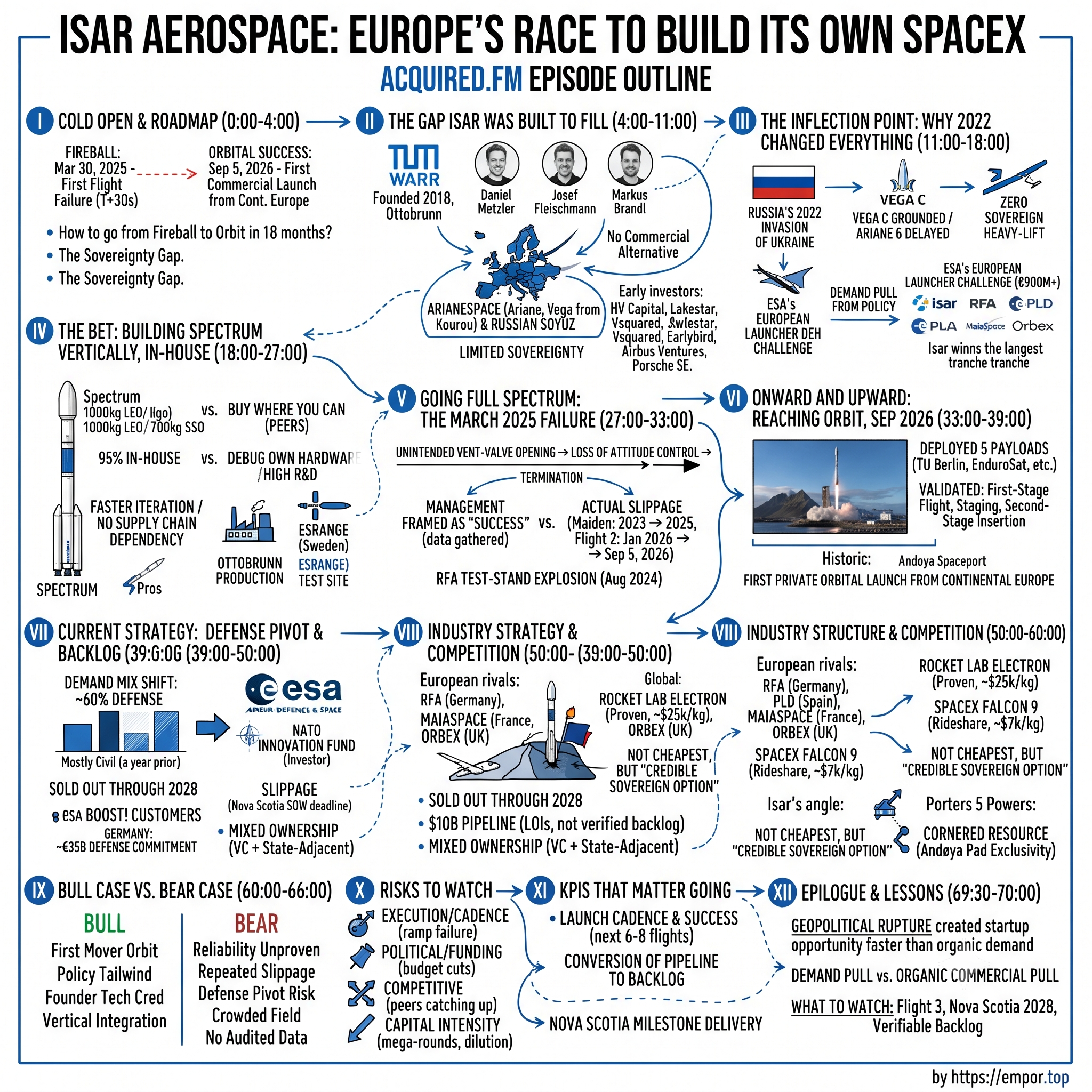
Isar Aerospace: Europe's Race to Build Its Own SpaceX
I. Cold Open & Roadmap
At 10:12 p.m. Central European Summer Time on Saturday, 5 September 2026, a 28-metre rocket burning liquid oxygen and propane lifted off a pad on the island of Andøya, inside the Arctic Circle in northern Norway. Roughly nine minutes later it had transited maximum dynamic pressure, shut down and separated its first stage, lit a single upper-stage engine, jettisoned its fairing, crossed the Kármán line and reached orbital velocity. Then it let go of six small payloads.12
That sequence — routine for SpaceX, familiar to Rocket Lab — had never before been completed by a commercially built, commercially operated launch vehicle flying from continental European soil. Europe has put satellites in orbit for half a century, but always on state-directed vehicles flying from Kourou in French Guiana. A privately financed startup, founded eight years earlier by three students from a Munich rocketry club, had just done it from a fjord.13
The hook is what happened seventeen months before. On 30 March 2025, the same rocket family flew for about thirty seconds, lost attitude control during a roll manoeuvre after an unintended vent valve opened, and was terminated over the sea.45 The company's press release that day was headlined "Isar Aerospace lifts off successfully," and chief executive Daniel Metzler said the flight "met all our expectations, achieving a great success."4 Eighteen months later the same vehicle design reached orbit on its second try — a genuinely rare outcome among new entrants, and one that says something real about the engineering organisation underneath the public-relations vocabulary.
But reaching orbit is where the interesting analytical work begins, not where it ends. Isar Aerospace SE is a private company with no audited public revenue, no disclosed backlog, no disclosed burn rate, and a most-recent private mark of roughly €2 billion post-money set in a round that closed on 9 June 2026 — before the successful flight, and after four separate stand-downs of that same flight attempt.678 Its chief executive says a listing "is not on the table."9 Its stated pipeline is "more than $10 billion"; its booked launch contracts, per the same reporting, are "several hundred million dollars."10 Its anchor commercial customer signed in April 2021 and has not yet flown.11
This story runs in that gap — between what has been demonstrated and what has been claimed. It covers the sovereignty vacuum Isar was built to fill; the 2022 geopolitical rupture that converted a founder's thesis into state policy; the vertical-integration bet and what it has actually cost in schedule; the 2025 failure and what it proved; the 2026 orbital success and what it did not prove; the abrupt shift toward defence revenue; the crowded, deliberately multi-vendor field of state-funded European rivals; and the question a public-market investor would have to answer before underwriting any of it — whether "sold out through 2028" describes a business or a pipeline.
 Subscribe on LinkedIn
II. The Gap Isar Was Built to Fill
Isar Aerospace was founded in March 2018 in Ottobrunn, a suburb southeast of Munich, by Daniel Metzler, Josef Fleischmann and Markus Brandl. All three studied aerospace at the Technical University of Munich, and all three came out of WARR, the university's student rocketry group, where Metzler led a forty-person team building a high-altitude research rocket between 2016 and 2018.312 The first component prototypes were built in the MakerSpace run by UnternehmerTUM, the university's entrepreneurship centre.12 The company took its name from the river that runs through Munich.3
The founding thesis was narrow and, at the time, unfashionable. Europe had exactly one sovereign path to orbit: the Ariane and Vega families, marketed by Arianespace and flown from the Guiana Space Centre. There was no venture-backed commercial alternative on the continent, and nothing sized for the small and medium satellites that were beginning to define the market. In the United States, SpaceX had already made Falcon 9 the default, Rocket Lab was months from its first orbital success, and a dozen other startups were chasing the small-launch tier. In Europe, essentially nobody was.
The reason this mattered more than it appeared in 2018 is structural rather than commercial. European satellite operators and governments were not merely paying more for launch; they were dependent on a single state-linked provider whose cadence, pricing and manifest priorities they did not control. For mid-size payloads, the practical backstop had for years been the Russian Soyuz, flown from Kourou under a Franco-Russian arrangement. That is a dependency chain with two single points of failure, one of them in Moscow.
Capital arrived early and in size. Bulent Altan, an early SpaceX engineering leader, put in angel money in 2018.3 A $17 million Series A followed in April 2020 with Earlybird and Airbus Ventures; a further €75 million came in December 2020 from Lakestar and HV Capital.3 In July 2021 Porsche SE — the Stuttgart holding company that controls Volkswagen — took what it described as a low-single-digit stake as part of a $75 million extension, and HV Capital and Porsche SE took board influence.1314 By March 2023 a $165 million Series C had closed with 7-Industries Holding, Bayern Kapital, Lombard Odier Investment Managers, UVC Partners and Vsquared Ventures alongside the existing syndicate, backed additionally by EU and European Investment Fund programmes.15
Institutional validation arrived alongside the private money, and it is worth separating the two. In January 2022 Isar won the European Commission's Horizon Prize for Low-Cost Space Launch, a €10 million grant.3 Prizes, grants and design competitions are the currency of early European deep technology, and they are genuinely useful — they are non-dilutive, they signal technical credibility to procurement officers, and they pay for hardware. They are not revenue, they are not backlog, and they do not test whether a customer will pay a commercial price for a delivered service. That distinction runs through this entire story, because almost every external endorsement Isar has accumulated over eight years — the Horizon Prize, the ESA Boost! programme, the European Launcher Challenge tranche, the German Space Agency's Microlauncher Competition — is a public-sector award rather than a commercial purchase. Each is real. None is proof of a market.
By that point Isar was the most heavily capitalised independent new-space company in the European Union. It is worth being precise about what that fact does and does not signal. It is not evidence of flight-proven hardware, because there was none: Isar would not attempt an orbital launch for another two years. It is evidence that a syndicate of European growth investors, a family holding company with an industrial balance sheet, a state development bank affiliate and a national venture arm all concluded that the sovereignty gap was worth pricing before the engineering was proven. That is an underwriting posture common to defence and infrastructure assets and rare in venture: the buyers were paying for a strategic option, and the option's value depended on a political event none of them controlled.
That event arrived in February 2022.
III. The Inflection Point: Why 2022 Changed Everything
Russia's invasion of Ukraine severed the Soyuz-from-Kourou arrangement immediately. Europe's mid-size launch backstop disappeared not over a procurement cycle but over a weekend. The compounding failures followed quickly: Vega C was grounded after a December 2022 launch failure, and Ariane 6 — the flagship next-generation heavy-lift vehicle intended to replace Ariane 5 — slipped years past its original schedule and did not fly until 2024. For a stretch, the continent that had run one of the world's two reliable commercial launch franchises had effectively no sovereign path to orbit for institutional payloads it could not defer.
This is the moment Isar's story stops being a founder's thesis and becomes a matter of state policy. Governments that had regarded commercial launch startups as an interesting but optional hedge began treating them as strategic infrastructure. The intellectual shift is worth naming precisely, because everything downstream depends on it: European institutions did not discover a commercial market for small launch. They discovered a national-security requirement and decided to buy their way to one.
The clearest expression of that decision is the European Launcher Challenge. ESA structured it as a deliberately multi-vendor competition — the explicit design goal was that no single European launch provider would emerge with the leverage Arianespace had held. The first contracts were signed in late August 2026, and the awarded amounts tell the story: Isar Aerospace took the largest tranche at €197.8 million, funded mainly by Germany with contributions from Austria and Norway; Rocket Factory Augsburg took €186.9 million, mainly German with a UK contribution; and Spain's PLD Space took €158.9 million, funded by Spain with a German contribution.1617 ESA said a contract to MaiaSpace, the ArianeGroup-backed reusability venture, was "nearing completion."16 Isar signed its ESA contract on 27 August 2026, describing roughly €200 million in programme commitments covering next-generation vehicle development, test and launch infrastructure, and launch cadence.18
Three points about this award deserve to sit in the foreground rather than in a risk appendix.
First, Isar's share of the awarded pot is roughly 36 per cent. It is the largest single tranche and it is not a majority. ESA is not picking a champion; it is funding a field. Lucía Linares, ESA's head of strategy and launches, framed the programme with a line that reads as institutional risk management rather than endorsement: "getting to space is not easy and never guaranteed."18
Second, the money is programme funding tied to milestones and infrastructure, not a simple purchase order for launches. It is closer to development co-funding than to backlog, and a reader should not treat the €197.8 million as revenue recognised or even as revenue contracted in the ordinary commercial sense.
Third, the multi-vendor design is not costless to the vendors. It caps the pricing power any winner can extract from the institutional customer, and it guarantees that Isar will face at least two and probably three state-funded European competitors on every future tender. Metzler himself sized the eventual market in March 2023: "Probably you're going to have three to four players in the U.S., maybe two players or so within Europe."15 ESA has funded three, with a fourth pending. By the chief executive's own arithmetic, the programme is over-funding the field by one or two.
The evidence that this is not a theoretical concern arrived in February 2026, when Orbex — one of the original five ELC finalists, a Scottish launcher developer that had already drawn £26 million in taxpayer-backed loans — filed a notice of intention to appoint administrators after fundraising, merger and sale talks all collapsed.19 Member states had subscribed €34.9 million to Orbex under the challenge, the United Kingdom providing €21.7 million and Denmark €8 million.19 Orbex received no contract. State selection is not a survival guarantee; it is a subsidy that runs out.
So the correct frame for what follows is demand pull from policy, not organic commercial pull. That distinction governs how every backlog, pipeline and cadence claim in this story should be read.
IV. The Bet: Building Spectrum Vertically, In-House, From Scratch
Spectrum is a two-stage, liquid-fuelled orbital launch vehicle: 28 metres tall, two metres in diameter, nine engines on the first stage and one multi-ignition engine on the second, rated at up to 1,000 kilograms to low Earth orbit and 700 kilograms to sun-synchronous orbit.20 It burns liquid oxygen and propane — an unusual choice; most competitors use kerosene or methane — through the Aquila engine, a high-pressure turbopump-fed design Isar developed itself.20
The strategic decision underneath the hardware is the one that matters. Isar chose to build the overwhelming majority of the vehicle in-house rather than assemble it from an established supplier base. The company describes Spectrum as "designed, produced, and tested almost entirely in-house"; independent accounts put in-house content around 80 per cent.321 Metzler's stated rationale in 2023 was cost: "I believe that you can be much cheaper if you're actually fully vertically integrated — if you know how to do it."15
The case for the bet, and the case against it
The argument for vertical integration in European launch is stronger than it would be in the United States. There is no mature commercial supplier ecosystem for small-launch propulsion and structures on the continent; the existing European aerospace supply chain is organised around Ariane-programme volumes, Ariane-programme margins and Ariane-programme timescales. A startup that tried to "buy where you can" in Europe would be buying from vendors whose cost structures and lead times were shaped by exactly the incumbent it was trying to undercut. Building it yourself also compounds: every engine test, every tank weld, every valve failure adds to a proprietary body of manufacturing knowledge that a competitor cannot licence.
The argument against it is equally concrete, and Isar's own record is the strongest available evidence for it. An established supply chain does not just sell you parts; it sells you decades of accumulated failure history embedded in those parts. A company that builds its own valves, its own pressurisation systems and its own composite overwrapped pressure vessels has to discover those failure modes itself, in flight hardware, on its own schedule.
That is precisely what happened. The first flight was lost to an unintended vent valve opening.5 The second flight was then stood down repeatedly: on 21 January 2026 for a pressurisation valve issue; on 25 March 2026 after an unauthorised vessel entered the danger area and the resulting countdown delay drove a rise in engine fuel temperatures; on 9 April 2026 for a leak in a composite overwrapped pressure vessel; and on 15 June 2026 after off-nominal behaviour in the rocket's fluid systems.522 A further attempt on 4 September 2026 was also called off before the vehicle flew on 5 September.231
Read as a set, that is five documented stand-downs across roughly eight months, of which four trace to fluid, valve or pressurisation systems — the same subsystem family that destroyed the first flight. Only one, the range violation, was external. This is the vertical-integration tradeoff showing up in the schedule rather than in a slide: Isar has to debug its own plumbing, and debugging plumbing has cost it the better part of a year. It does not falsify the long-run cost thesis. It does narrow the claim considerably: whatever manufacturing advantage vertical integration eventually produces, it has so far manifested as a slower path to flight, not a faster one, and the promised cost advantage remains entirely undemonstrated because Isar has never disclosed a launch price or a unit cost.
The infrastructure built ahead of the demand
The physical buildout has run well ahead of proven flight rate. The Ottobrunn site handles development and manufacturing; a second test site opened at Esrange Space Center in Kiruna, Sweden, on 4 February 2026 in partnership with SSC Space, purpose-built for Isar's vertical-integration requirements and specified to test more than thirty engines per month plus fully integrated stage acceptance.24 A new series-production facility at Parsdorf, near Munich, spanning roughly 40,000 square metres, is targeted at capacity for up to forty Spectrum vehicles annually.217 Launch vehicles three through seven were already in production at the time of the second flight.1
Thirty engine tests a month implies roughly three vehicles' worth of first-stage engines monthly. A forty-vehicle factory implies a launch every nine days. Isar has flown twice in eighteen months. The infrastructure is sized for a business that does not exist yet, which is the correct way to build a launch company and also the reason the capital requirement is so large.
What the funding cadence actually bought
The financing history tracks that buildout closely, and the instruments matter as much as the amounts. After the $165 million Series C in March 2023, Isar took a €65 million Series C extension in June 2024, then a $70 million extension involving the NATO Innovation Fund the same year.325 On 25 June 2025 it signed a €150 million convertible bond with Eldridge Industries, the Miami-based holding company — debt that converts to equity at a valuation set at a future financing or listing, terms not disclosed.2625 Then on 9 June 2026 came the €270 million Series D, with Island Green Capital and Molten Ventures new alongside HV Capital, Lakestar, UVC Partners with KfW Capital, a consortium of DACH family offices, and the NATO Innovation Fund reaffirming.6727
Cumulative funding is reported at roughly €870 million.8 The Series D was struck at a post-money valuation of about €2 billion.8 Bloomberg reported the raise in progress on 23 March 2026 at that €2 billion level — which places the price-setting conversation before the March, April and June stand-downs and roughly six months before the vehicle reached orbit.28 The mark was set on the promise, not on the proof. That the proof subsequently arrived is fortunate for the holders; it does not retroactively make the mark a valuation.
V. "Going Full Spectrum": The March 2025 Failure — and What It Actually Proved
The first orbital attempt lifted off from Andøya on 30 March 2025. Roughly thirty seconds into flight, during a roll manoeuvre, Spectrum lost attitude control. The flight termination system activated and the vehicle came down in the sea. Nobody was hurt and the range was clear.45 Isar's investigation, published in September 2025, identified two root causes: an unintended vent valve opening and the subsequent loss of attitude control during the roll. The remediation was software missionisation improvements and increased environmental margins to strengthen controllability.5
Management's framing that day is worth quoting in full because it is the single best available read on how this team communicates a miss. The press release was headlined "Isar Aerospace lifts off successfully during first test flight of orbital launch vehicle." Metzler said: "Our first test flight met all our expectations, achieving a great success. We had a clean liftoff, 30 seconds of flight and even got to validate our Flight Termination System." And: "We demonstrated that we can not only design and build but also launch rockets."4
Some of that is defensible. A first flight that clears the pad, survives the first thirty seconds and demonstrates a working termination system genuinely does retire risk, and the flight data is genuinely valuable. But "met all our expectations" is not a description of a vehicle that lost control and was destroyed. This is the first entry in a pattern that recurs: Isar's public communication systematically converts misses into milestones. An investor underwriting this company before a listing should note that the company's own characterisation of an event is not usable as evidence about that event, and should reserve judgement for behaviour and dates.
The base rate, which is the fairest lens
Judged in isolation, a first-flight loss reads badly. Judged against the peer base rate for a vertically integrated new entrant, it reads as unremarkable. Rocket Factory Augsburg, the closest German analogue, lost its entire first stage in a static-fire explosion on the pad at SaxaVord in Shetland in August 2024 — before ever attempting a launch — and then spent eighteen months on a technical overhaul of the Helix engines, tank pressurisation systems and ground procedures.293031 Orbex never flew at all and is in administration.19 MaiaSpace has scrapped its planned suborbital demonstration and pushed its first orbital attempt to the second half of 2027, its third successive slip.32 PLD Space is still targeting a late-2026 Miura 5 debut from Kourou that has not happened.33
Against that field, a controlled first-flight termination with no public-safety consequence, followed by an orbital success on flight two, is not merely middling — it is the best execution record in the European cohort. That is the strongest single fact in the bull case and it should not be diluted.
The disconfirming thread that carries forward
What the failure does not excuse is the calendar. In March 2023, in the coverage of the Series C, Isar's inaugural flight was scheduled for the second half of 2023.15 It flew on 30 March 2025 — a slip of roughly eighteen months on a milestone the company was actively marketing to investors while raising $165 million. The second flight was then guided to no earlier than 21 January 2026 and flew on 5 September 2026, a further slip of more than seven months across four announced stand-downs.221 In June 2026, alongside the Series D, the company publicly targeted a 15–21 June window; that window also passed.722
Set that against the commercial language, which moved in the opposite direction. In the same period during which flight two slipped seven months, Isar went from marketing a launch vehicle to marketing a book of business "sold out through 2028" with a pipeline "more than $10 billion."10 Schedule confidence and commercial confidence are not independent variables for a launch company. Every month of slip is a month of manifest that has to be pushed, and a manifest that is already declared full through 2028 has no slack to absorb it.
The honest verdict on management credibility, tested against the longest record available: the technical claims have held up — the vehicle works, and it worked sooner than any funded European peer. The schedule claims have not held up once. The distinction is not cosmetic. It means an investor can reasonably believe Isar will eventually fly reliably, and should not believe any specific date on which it will do so, including the dates underpinning the 2028 sell-out and the 2028 Canadian debut.
VI. "Onward and Upward": Reaching Orbit, September 2026
The mission Isar named "Onward and Upward" carried six payloads selected through the German Space Agency at DLR's Microlauncher Competition, a programme funded through ESA's Boost! commercial launch support initiative.134 Five were CubeSats from academic and commercial teams: TU Berlin's CybeeSat, carrying a miniaturised transceiver, cybersecurity payloads and radiation-tolerant perovskite solar cells; the University of Maribor's TriSat-S, testing battery performance after extended hibernation and an optical navigation system; NTNU's FramSat-1, a demonstrator for Norwegian-built space technology; entries from the TU Wien Space Team and EnduroSat.34 The sixth was an in-orbit technology demonstration from Dcubed.345 All customer payloads were deployed and the first stage made a controlled descent into the Norwegian Sea.5
Metzler's line afterwards: "Today, Isar Aerospace opened space from Continental Europe. Launch is the global space industry's largest bottleneck, and now there is a true alternative for commercial and institutional customers." And: "We achieved within years what the European space industry took decades to accomplish. Europe now has sovereign access to space."1
What a single orbital flight does and does not establish
It establishes a great deal. First-stage flight through max-Q, main engine cutoff, stage separation, second-stage ignition, fairing jettison, orbital insertion and spacecraft separation are the discrete technical hurdles that kill most launch startups, and Spectrum cleared all of them consecutively.1 It also validates the fix from flight one, which is a real signal about the engineering organisation's ability to diagnose and close a failure.
It does not establish reliability, because reliability is a statistical property and the sample size is one. It does not establish cadence, which is the operational property that determines whether fixed costs can be absorbed. And it establishes nothing whatsoever about cost, because Isar has never published a launch price, a cost per kilogram, or a unit cost, and as a private company is under no obligation to. A single successful flight converts Isar from a company that might have a product into a company that has one. It does not convert it into a business.
Choosing the right unit of analysis
Because Isar is an asset-heavy manufacturer selling a small number of very large transactions, the vocabulary of recurring software revenue does not apply and should not be forced onto it. There is no annual recurring revenue, no net revenue retention, no cohort curve, no customer acquisition payback period. The economically meaningful metrics for this business are a different set entirely, and each of them is currently undisclosed.
The first is flight rate, because it is the denominator under every fixed cost the company carries — the Ottobrunn and Parsdorf factories, the Esrange test complex, two launch complexes and several hundred engineers. The second is realised price per launch and the trend in it, since a launch business either holds price as cadence rises or discovers that it was selling scarcity rather than a service. The third is recurring cost per vehicle, which is the only number that would actually test the vertical-integration thesis; a manufacturer that is genuinely learning should show unit cost falling on a predictable curve as vehicles three through seven and beyond come off the line. The fourth is manifest concentration — how much of the book sits with ESA, the German government and one or two primes — because a launch company with three customers has the revenue quality of a defence contractor, not of a transport operator. The fifth is contract structure: whether payments are milestone-based deposits taken years before flight, which flatter cash flow and create deferred-revenue liabilities, or payment on delivery, which does not.
Revenue recognition for this business is lumpy and largely event-driven. A launch operator typically collects deposits across a multi-year integration period and recognises the bulk of the revenue when the mission flies. That means a manifest can look full while very little revenue has been recognised, and it means a single slipped launch can move a year's reported figures materially. It also means the phrase "sold out through 2028" describes an obligation to deliver, not an entitlement to cash. Firefly's balance sheet shows what this looks like once audited: $151 million of current deferred revenue and a further $22 million non-current at 30 June 2026, sitting against $734 million of trailing revenue.50 Isar's equivalent figures are not disclosed.
The historic framing also needs care. The claim that is accurate and defensible is narrow: this was the first orbital launch by a privately built, privately operated vehicle from continental European soil.1 That is genuinely novel. It is not "the first successful European new-space company" — Rocket Lab, founded in New Zealand and headquartered in the United States, has flown Electron commercially for years. It is not the first orbital launch by a European startup in any absolute sense, since geography is doing the work in that sentence. And it is not, on its own, evidence that Europe has "sovereign access to space" at any useful scale: one flight of six subsidised academic CubeSats, on a mission whose customers were themselves paid for by an ESA programme, is a capability demonstration, not a service.
That last observation deserves to be stated plainly rather than buried, because it is the cleanest available test of the commercial-demand narrative. The maiden revenue flight of Europe's commercial launch champion carried payloads that a government agency competition selected and a government programme funded. The customers were real; the demand was policy.
VII. Current Strategy: The Defense Pivot and the "Sold Out Through 2028" Claim
The single most consequential recent disclosure did not come from a filing. It came from Metzler describing his own order book. Within twelve months, Isar moved from almost entirely civil demand to roughly 60 per cent defence.10 The company's own July 2026 material put defence-related inbound requests at "over 50%," a shift it described as a move away from a prior commercial focus.21
Management presents this as validation. It is at least as consistent with a second reading, and an underwriter has to hold both. If defence demand is genuinely surging while civil demand holds, the mix shifts because the numerator grew. If civil and commercial orders were softer than the pipeline language implied, the mix shifts because the denominator shrank. Isar publishes no revenue, no bookings and no backlog, so there is no way to distinguish these from outside. What can be said is that a demand mix that moves fifty-plus points in twelve months is not a stable base for extrapolating any of the growth claims that predate it, and that the same management communicating this shift is the management that called a thirty-second flight "a great success."
The anchor customers, tested
The structural backing is real and worth naming. Airbus Defence and Space contracted Isar for a small Earth-observation satellite launch with options — the first such agreement between an established European prime and a privately financed European launcher.11 The NATO Innovation Fund has been an investor since 2024 and reaffirmed in the Series D.2527 Germany's defence minister, Boris Pistorius, toured the Ottobrunn production floor on 23 July 2026 and announced an intention to invest €35 billion in space over coming years as part of an interconnected NATO security architecture; Metzler's response was "The defence of our free world begins in space."21 In March 2026 Isar signed Astroscale UK's ELSA-M in-orbit demonstration, and on 1 September 2026 it signed Astroscale Japan's ADRAS-J2 active debris removal mission — part of JAXA's Commercial Removal of Debris Demonstration — targeted for launch between 2027 and 2028 from Andøya.35
Now the falsification, placed where it belongs. The Airbus contract was announced on 22 April 2021.11 It has not flown. Five years and four months later, the marquee validation of the entire "established primes will buy from a startup" thesis remains an unflown agreement of undisclosed value for a single satellite. That is not a scandal — launch manifests slip and the customer's satellite may not have been ready either — but it is the most directly relevant piece of evidence available about how fast Isar converts a signed contract into delivered revenue, and the answer so far is: it has not, once.
The second test is harsher. In January 2023 Isar announced a multi-launch services agreement with Spaceflight Inc., then a leading global rideshare aggregator, covering one dedicated launch to sun-synchronous orbit from Andøya in 2026 with an option for an additional dedicated launch in 2025.36 In June 2023 — five months later — Firefly Aerospace acquired Spaceflight Inc. and redirected it from rideshare logistics to Firefly's own orbital transfer vehicles, discontinuing the rideshare business.37 Neither the 2025 option nor the 2026 dedicated launch appears on any Isar manifest. Isar's first announced US-market commercial agreement was absorbed by a direct competitor within half a year and produced nothing.
Taken together: of Isar's two earliest flagship commercial launch agreements, one is five years unconverted and the other's counterparty was bought by a rival and dismantled. That does not reject the claim that Isar can win commercial customers — it has since won Astroscale twice and holds ESA Boost! smallsat customers. It sharply narrows the claim about conversion. The relevant post-listing key performance indicator is not contracts signed. It is contracts flown.
Testing "sold out through 2028"
The headline claim is that Isar is sold out through 2028 with more than $10 billion in pipeline, and that the commercial focus has moved to securing 2029 and beyond.10 The same reporting discloses the figure that actually matters: booked launch contracts of "several hundred million dollars."10
The gap between those two numbers is the entire analytical content of the paragraph. A pipeline is an aggregation of opportunities weighted by nothing in particular; it typically includes letters of intent, memoranda of understanding, framework agreements, options, and multi-year programme values that depend on budget cycles not yet voted. A booked contract is a signed obligation. The ratio here is on the order of twenty to forty times. For comparison, Rocket Lab — a listed company that must define and audit backlog — reported $769 million of revenue in the single quarter ended 30 June 2026.38 Isar's entire booked contract base, on management's own characterisation, is smaller than one quarter of a listed peer's revenue.
"Sold out through 2028" also has a denominator problem that cuts the other way. Being sold out is only impressive relative to capacity. Isar has flown twice. If its realistic 2027–2028 capacity is, say, four to eight flights, then "sold out" describes a manifest of a handful of missions — which is entirely consistent with "several hundred million dollars" of bookings and entirely inconsistent with the scale implied by a $10 billion pipeline. The claim is simultaneously true and much less informative than it sounds.
Expansion geography, and the same slippage signature
On 7 July 2026 Isar signed a facilities usage agreement with Maritime Launch Services for a dedicated launch complex at Spaceport Nova Scotia in Canada: US$112.5 million over ten years, with options for two further five-year extensions, structured as US$3.75 million per quarter with a thirty-month fee waiver following the first year, plus per-launch cost-plus fees. The scope covers a launch pad, assembly-integration-and-test facilities, a launch operations centre and payload integration. Pad handover was set for 1 November 2026, infrastructure completion for 31 December 2027, and first launches for 2028 — with the whole thing conditional on agreeing a statement of work and programmatic milestones by 1 September 2026.39
That deadline was not met. On 4 September 2026 the two parties announced a fourteen-day extension to 15 September to complete the statement of work.40 Maritime Launch's chief executive said the additional time would allow the teams to complete the planning work; Isar's vice-president of mission and launch operations said the work had been "intensive and productive."40 It is a two-week slip on a paperwork milestone and should not be inflated. It is also the third distinct instance in this story of an Isar-announced date being missed, and the first one on the Canadian programme, which has not yet begun construction and is already behind.
Canada is not optional geography. The Andøya pad Isar holds exclusively for up to twenty years supports launch inclinations from 87.4 to 108 degrees — polar and sun-synchronous trajectories whose ground tracks avoid populated areas.41 That is an excellent site for Earth observation and much of defence imaging, and it is structurally incapable of serving mid-inclination orbits. Isar's own mission material describes the Canadian complex as being for mid- to high-inclination orbits.5 Until Nova Scotia works, Isar's serviceable market is the polar and sun-synchronous segment only. That is a narrower reachable market than "1,000 kilograms to LEO" implies, and it is a fact about the asset, not a risk factor.
Ownership, governance and what cannot be seen
Isar Aerospace SE is registered at the Munich district court under HRB 290907, converted from an Aktiengesellschaft to a Societas Europaea on 13 February 2024, with registered share capital of €167,825 as of 26 June 2026.42 That last figure is the only hard capital-structure datum in the public record, and it must be handled carefully. German no-par-value share companies commonly set nominal capital equal to the number of shares outstanding, which would imply a share count in the low hundreds of thousands — but that convention cannot be assumed, and even if it holds, registered capital captures only issued shares. It says nothing about the split between ordinary and preferred classes, the employee option pool, warrants, or the shares that Eldridge's €150 million convertible bond will eventually claim.
The shareholder register mixes three kinds of money with three different objective functions. Financial venture capital seeking a return: HV Capital, Lakestar, Earlybird, Vsquared, UVC Partners, 7-Industries, Lombard Odier, Molten Ventures, Island Green Capital. Strategic and state-adjacent capital: Porsche SE at a low-single-digit stake with board influence, Airbus Ventures, KfW Capital alongside UVC, Bayern Kapital, and the NATO Innovation Fund.3131415627 And credit: Eldridge, holding a convertible instrument whose economics sit ahead of common equity until it converts.
That mix is an asset while the government relationship is the primary value driver and a governance question the moment it stops being one. A NATO-affiliated fund and a state development bank affiliate are excellent shareholders for a company selling sovereignty; their objectives may diverge sharply from a growth investor's at a moment when the value-maximising move is, say, selling launch capacity to a non-European customer, or accepting an acquisition offer. Whether any of these holders carry veto rights, board seats beyond Porsche SE's, or side letters governing customer approval is not public. Founder control has been diluted across more than a dozen rounds since 2018 and the current founder stake is not disclosed.
Two further items belong on any pre-filing diligence list. First, the founding team is intact — Metzler as chief executive, Fleischmann as chief technology officer, Brandl as a named co-founder — and the one senior structural change was constructive: Björn Dressler, previously vice-president of production, was appointed chief operating officer effective 1 June 2024 so that Fleischmann, who had carried both the chief operating and chief technology roles for eighteen months, could focus on technical development.43 Separating those roles at a company scaling manufacturing is good practice, not a red flag.
Second, and less comfortable: Isar's statutory accounts for 2023 were filed on 27 November 2025, and its accounts for 2022 were filed on 6 January 2026 — after the 2023 accounts.42 German filing obligations are not onerous, and a company that files a two-year-old set of accounts after a one-year-old set is a company whose finance function is not yet operating on a public-company reporting rhythm. That is a diligence item, not a scandal, but it is directly relevant to how quickly this company could produce audited, timely, quarterly numbers if it did decide to list.
For now it says it will not. Metzler stated in September 2026 that the company remains well funded and that a listing "is not on the table."9 Capital allocation continues to run through private mega-rounds timed to launch milestones — a pattern visible in the data: the Series D was negotiated in the weeks before a launch attempt and closed roughly twelve weeks before the vehicle reached orbit.2861
VIII. Industry Structure & Competition: A Crowded, State-Subsidized Field
This section carries more of the underwriting weight than any other, because Isar has no second segment. There is no software business, no satellite manufacturing arm, no services annuity to weigh against launch. The company is one product, one vehicle, one market. Whatever the investment case is, it is entirely a bet on the structure of European launch.
The European cohort: same money, different points on the curve
Rocket Factory Augsburg is the closest analogue — German, Augsburg-based, backed by the space technology group OHB, built around a mass-production philosophy and staged-combustion Helix engines. Its trajectory diverged from Isar's on 19 August 2024, when its first stage was destroyed in a static-fire test at SaxaVord Spaceport in Shetland before it had ever reached a launch attempt.2930 The company spent roughly eighteen months on a technical overhaul covering the Helix engines, tank pressurisation and ground operating procedures, has since shipped both stages to SaxaVord, and now targets a maiden flight around the end of 2026 carrying seven satellites coordinated by DLR — after its own slip from an earlier summer 2026 target.31 It received €186.9 million from the European Launcher Challenge, roughly 94 per cent of Isar's tranche.16
PLD Space, in Elche, Spain, is developing Miura 5 for a debut from Kourou, still targeted for late 2026, with civil works on its launch complex in the final phase and investment there raised to €35 million across 2025–2026.33 It received €158.9 million from the challenge.16 MaiaSpace, the ArianeGroup subsidiary pursuing a partially reusable first stage, dropped its planned suborbital demonstration and slipped its first orbital attempt to the second half of 2027 — a third consecutive schedule slip since founding — with its ELC contract still pending at the time of the first awards.3216 Orbex, the fifth finalist, is in administration.19
Two structural conclusions follow. First, Isar is meaningfully ahead. It is the only member of this cohort to have flown, let alone reached orbit, and its nearest rival is at least a year behind with a destroyed-stage history and no flight data of its own. Second, being ahead confers less than it would in a normal market, because the reason the rivals still exist is that European states are paying for them to. Rivalry in a subsidised industry does not clear the way ordinary rivalry does: competitors that cannot earn their cost of capital keep flying anyway, because their capital is a national industrial policy line item. Orbex is the counterexample that proves the rule — it took a full collapse of private fundraising, merger and sale talks, on top of £26 million of taxpayer-backed loans, before the state stopped being able to keep it alive.19
The global reference points that set the price ceiling
The competitive pressure that actually constrains Isar's pricing does not come from Augsburg or Elche. It comes from Hawthorne and Long Beach.
Rocket Lab's Electron lists at roughly $7.5 million for 300 kilograms to low Earth orbit — about $25,000 per kilogram — which is the reference price for a dedicated small launch with a customer-chosen orbit and schedule.44 SpaceX's Transporter rideshare programme entered 2026 at $350,000 for up to 50 kilograms to sun-synchronous orbit with incremental mass at $7,000 per kilogram, a level SpaceX has been steadily raising alongside a Falcon 9 list price that reached $74 million.45 Falcon 9 rideshare is not a perfect substitute — the customer takes SpaceX's orbit, SpaceX's schedule and SpaceX's dispenser — but for a very large share of sun-synchronous Earth-observation payloads it is a good enough substitute at roughly a quarter of the per-kilogram price.
Which means Isar's competitive angle is not, and probably never can be, cost leadership. Metzler's 2023 thesis that vertical integration makes you "much cheaper" has not been tested against a published price and, on a per-kilogram basis, has an extremely hard ceiling above it. The actual angle is a different question entirely: Isar is the only firm that can currently answer "we need a European, non-Chinese, non-Russian, non-single-vendor launch option, and we need it on our own schedule." That is a real, defensible, differentiated proposition. It is also a proposition whose value is set by political urgency rather than unit economics, and political urgency is not a moat — it is a market condition.
Sizing the reachable market, not the category
Category numbers for "the global launch market" are not useful here, because Isar cannot address most of that category. The disciplined way to size this business is to start from the budgets that are actually named and the orbits Isar can actually reach.
On the institutional side, the visible commitments are specific. The European Launcher Challenge has awarded roughly €544 million across three companies with a fourth pending, spread over multi-year programmes, of which Isar's share is €197.8 million.16 Member states subscribed a further €34.9 million to Orbex that is now unallocated following its administration.19 Germany has stated an intention to invest €35 billion in space over unspecified coming years, but that figure covers satellites, ground systems, communications and defence architecture — launch is a modest slice of any space budget, and Isar competes for that slice against RFA on German soil.21 ESA's Boost! programme funds smallsat access at the scale of academic CubeSat missions.134
On the commercial side, the reachable market is bounded by physics and geography before it is bounded by competition. Until Nova Scotia is operational, Isar can only fly to polar and sun-synchronous orbits from Andøya's 87.4-to-108-degree inclination range.41 That is the Earth-observation and imaging segment, which is real and defence-relevant, and it is also the single segment where SpaceX's Transporter rideshare is most directly substitutable at roughly $7,000 per incremental kilogram.45 The customers who will pay a premium over that are those for whom orbit choice, schedule control or launch provenance is worth several times the price — European and allied government imaging programmes, sovereignty-constrained defence payloads, and missions like Astroscale's debris-removal demonstrations that need a specific orbit at a specific time.35
Framed that way, the realistic near-term market share question is not "what fraction of global launch" but "what fraction of European and allied sovereign polar-orbit missions, against RFA and PLD, at a price above rideshare." That is a defensible business. It is a much smaller one than the pipeline language implies.
Applying the powers framework honestly
Of Hamilton Helmer's seven powers, two are arguably present in embryo and neither is yet a moat.
Counter-positioning is the strongest claim. Isar's fully in-house, vertically integrated manufacturing model is something the incumbent Ariane ecosystem cannot copy quickly, not because the engineering is unreachable but because copying it would require European primes to disintermediate their own national supplier networks — the political architecture on which the Ariane programme rests. That is a genuine structural asymmetry, and it is the kind of asymmetry counter-positioning describes. But counter-positioning only pays if the new model is economically superior, and Isar has not yet demonstrated that. No published price, no published unit cost, no published gross margin. The power is structurally available; it has not been converted.
Cornered resource is the weaker claim, usually attached to the Andøya arrangement — exclusive access to a launch pad for up to twenty years, signed in April 2021.41 It is a real asset and a real barrier for anyone who wanted that specific pad. It is narrow in three ways: it is one pad at one spaceport in a Europe that is simultaneously standing up SaxaVord, expanding Esrange and building small-launch infrastructure at Kourou; the site supports only 87.4-to-108-degree inclinations, so it cannot serve mid-inclination missions at all;41 and Isar is paying US$112.5 million over ten years for a second pad in Canada precisely because the first one does not cover the market.39
The other powers are absent. There is no scale economy yet, because there is no scale — two flights. There is no network economy in launch. There is no switching cost worth naming: satellite operators integrate to a payload user guide and a mechanical interface, and once a second or third European launcher reaches orbit, moving between them is an engineering inconvenience, not a lock-in. There is no branding power in a business where the customer is a procurement office. Process power — accumulated, hard-to-copy operational know-how — is the one Isar is genuinely building, but process power by definition takes years of repetition to establish, and repetition is exactly what has not happened yet.
Read through Porter, the structure is unusual and not especially attractive. Buyer power is high and concentrated: European governments and ESA are simultaneously Isar's largest customer, its regulator, and the funder of its three closest competitors. Supplier power is low, by design — that is what vertical integration bought. Threat of substitution is high, in the form of Falcon 9 rideshare at a quarter of the per-kilogram price for any customer willing to share a ride. Threat of new entry is technically formidable and politically trivial, since the barrier to entry in this industry is a member-state budget line rather than private capital. And rivalry is structurally irrational, because the rivals are not required to earn a return.
Price is not value: what the €2 billion mark does and does not mean
The last observable price for Isar equity is the €270 million Series D at approximately €2 billion post-money, closed 9 June 2026, negotiated at that level as early as March 2026.6828 Using the exchange rate implied by the round's own dual-currency reporting — €270 million described as $312 million, and €250 million as $289 million — €2 billion translates to roughly $2.3 billion.286
Several things have to be stripped out before that number can be used as an anchor.
It is a preferred-share price, not a common-share price. Series D investors in a European deep-technology company at this stage will hold preferred stock carrying, at minimum, a liquidation preference ranking ahead of common, and quite possibly participation rights, anti-dilution protection, information rights, and consent rights over financings and sale. None of those terms is public. What is certain is directional: preferred shares with downside protection are worth more per share than common shares without it, so a €2 billion post-money on preferred implies a common-equivalent value strictly below €2 billion, by an amount nobody outside the cap table can compute.
It sits above a debt layer. Eldridge's €150 million convertible bond ranks ahead of all equity until it converts, and it converts at a valuation set at a future financing or listing — terms not disclosed.2625 If that conversion carries the customary discount to the next round or listing price, existing holders take dilution at a price they do not set. In a listing scenario, that instrument alone is a material and currently unquantifiable claim on the equity.
It rewards a strategic and a financial buyer differently. Porsche SE, Airbus Ventures, KfW Capital, Bayern Kapital and the NATO Innovation Fund are not marginal price-setters seeking a risk-adjusted return; some of them are buying strategic access, industrial-policy alignment or option value on a national capability.131527 When a round's syndicate includes buyers with non-financial objective functions, the clearing price contains a premium that a public market will not pay.
And the round was priced on promise. The €2 billion level was under negotiation in March 2026, before three of the four flight-two stand-downs and six months before orbit.2822 Investors were pricing the sovereignty option, exactly as they had been since 2020.
One arithmetic observation puts the mark in perspective. Isar has raised roughly €870 million in cumulative funding.8 Against a €2 billion post-money, paid-in capital represents something like forty-three per cent of the headline value. Nearly half the company's stated worth is the money that has been put into it. For a business with two flights and undisclosed revenue, that is not an unreasonable place for a private mark to sit — but it is a long way from a valuation derived from cash flows.
The enterprise-value bridge cannot be built. Isar does not disclose its cash balance, and the last statutory accounts in the public register cover 2023.42 The convertible bond is debt-like until conversion. The Nova Scotia agreement creates a fixed US$3.75 million quarterly obligation across ten years — economically lease-like — with a thirty-month fee waiver after year one, so its present value depends on assumptions about the waiver and the extension options.39 The Andøya pad's financial terms have never been disclosed. Any enterprise value stated for Isar today would be a construction, not a calculation, and no equity-value multiple derived from the €2 billion mark should be compared with an enterprise-value multiple for a listed peer.
Building a peer set, and what it says
The direct operating peer set — same business model, same customer type, same monetisation, same capital intensity — has exactly two listed members, and neither is a clean match.
Rocket Lab (Nasdaq: RKLB) is the aspirational comparable, not the direct one. It is the only listed pure-play small-launch operator with a flight-proven vehicle and a real cadence record, and it has spent years diversifying into space systems and components. At $65.87 per share it carried a market capitalisation of roughly $38.1 billion; trailing-twelve-month revenue through 30 June 2026 was about $2.61 billion, trailing gross margin about 35 per cent, and trailing net loss roughly $744 million, with cash of about $2.13 billion against $134 million of total debt at quarter end.3846 That works out to roughly 14 times trailing enterprise value to revenue. The share price has ranged between $37.57 and $151 over the preceding year.46 Rocket Lab is what Isar aspires to become over a decade — and even Rocket Lab, eight years past its first orbital success and at eight times Isar's most optimistic near-term revenue scale, has not reached profitability and prints a 35 per cent gross margin, not a software margin.
Firefly Aerospace (Nasdaq: FLY) is the closer structural comparable and the more instructive one. It flies Alpha, a small launcher in Spectrum's payload class, and it also builds lunar landers and spacecraft, so its revenue is a mix rather than pure launch — an important comparability caveat. Firefly priced its initial public offering at $45 per share on 6 August 2025, raised $868.3 million, opened at $70 and closed its debut day at a valuation near $9.8 billion.4748 Thirteen months later it traded at $22.90, a market capitalisation of about $3.76 billion — roughly half the offer price and about a third of the debut peak of $62.17 reached within the preceding year.49 Trailing-twelve-month revenue through 30 June 2026 was about $734 million at an 18 per cent gross margin, with a trailing net loss of roughly $1.25 billion and net cash of about $582 million.50 That is roughly 4.3 times trailing enterprise value to revenue.
The exclusions matter as much as the inclusions. Airbus and other European primes are not peers: they are diversified industrial groups with civil aviation, defence and space divisions, and their multiples reflect a completely different revenue quality. AST SpaceMobile, Intuitive Machines and Redwire are space-sector names with different business models — satellite communications infrastructure, lunar services, and space components respectively — and using them would be sector matching, not peer matching. SpaceX is not usable as a comparable at all: it is private, its economics are dominated by Starlink subscription revenue rather than launch, and its private marks are set in secondary transactions with their own scarcity dynamics. Recent-IPO comparables like Firefly must be read as pricing observations from a specific window of enthusiasm, not as stable multiples.
Now place Isar against them. At roughly $2.3 billion of equity value, Isar carries about 61 per cent of Firefly's market capitalisation on undisclosed revenue that, given two flights of subsidised CubeSats and no delivered commercial mission, cannot plausibly be a meaningful fraction of Firefly's $734 million. If a reader wanted to make the multiple work at Firefly's 5.1 times price-to-sales, Isar would need something near $450 million of trailing revenue, which it manifestly does not have. If a reader instead used Firefly's own path — a company that reached $734 million of revenue and still lost $1.25 billion in a year, whose shares halved from the offer price — the comparison points somewhere less flattering: it suggests that public markets, having repriced the closest available analogue by half, would be an unforgiving venue for a company at an earlier point on the same curve.
IX. Bull Case vs. Bear Case
The bull case
The strongest version of the bull case does not lean on the sovereignty narrative at all. It leans on execution relative to the field. Isar is the only European Launcher Challenge participant that has reached orbit. Rocket Factory Augsburg destroyed a first stage on a test stand and lost eighteen months to the rebuild.2931 MaiaSpace has slipped three times and abandoned its intermediate demonstration.32 PLD Space has not flown. Orbex is in administration.19 Isar failed once, diagnosed the failure, published root causes, implemented fixes and put payloads in orbit on the next attempt.51 In an industry where the modal outcome for a first-generation vehicle is multiple failures or no flight at all, that is a demonstrated organisational capability, not a claim.
The policy tailwind is genuine and structurally slow to reverse. The 2022 rupture was not a news cycle; it produced a permanent reassessment of European launch dependency, an ESA programme committing more than half a billion euros in first-round contracts, and a German defence ministry stating an intention to invest €35 billion in space.1621 Sovereignty programmes are budget lines with multi-year political constituencies attached. They do not disappear in a quarter.
The founding team has technical credibility and continuity. Three TUM rocketry alumni who have run the company for eight years, still in place, with the chief technology and chief operating roles sensibly separated in 2024 as manufacturing scaled.433 The shareholder base includes an industrial holding company with a board seat, a NATO-affiliated fund, a German state development bank affiliate and a Bavarian state venture arm — capital that is patient by construction.132715
And vertical integration, whatever it has cost in schedule, is a real structural choice with real optionality. A company that owns its engine design, its manufacturing processes and its test infrastructure can scale production on its own decision rather than a supplier's, can iterate hardware without renegotiating contracts, and accumulates process knowledge that competitors buying from the same European supplier base cannot replicate. The Parsdorf facility targeting forty vehicles a year and the Esrange site rated for thirty engine tests a month are the physical expression of that optionality.2124
The bear case
Two flights is not a business. One success establishes that the vehicle can work; it establishes nothing about whether it works nine times out of ten, or whether it can be turned around in six weeks rather than six months. Every unit-economic claim about launch depends on flight rate, because the cost base is overwhelmingly fixed — a factory, a test site, two pads and several hundred engineers — and fixed costs divided by two flights a year produce a number no customer will pay.
The schedule record is the clearest disconfirming evidence and it is unambiguous. Maiden flight marketed for the second half of 2023 during a $165 million raise; flown March 2025.15 Second flight guided to no earlier than 21 January 2026; flown 5 September 2026 after four stand-downs.221 A June 2026 window announced alongside the Series D; missed.7 The Nova Scotia statement-of-work deadline of 1 September 2026; extended to 15 September.3940 Four announced dates, four misses. Any reader who wants to underwrite "sold out through 2028" or "first Canadian launches in 2028" is underwriting a forecasting record that has not yet produced a single met date.
The demand-mix shift is genuinely ambiguous. Moving from almost entirely civil to roughly 60 per cent defence in twelve months is either a company capturing a surge or a company backfilling a softer commercial order book.10 Without disclosed bookings there is no way to tell, and the same disclosure vacuum means the $10 billion pipeline cannot be reconciled against the "several hundred million dollars" of actual booked contracts.10 The conversion record does not help the optimistic reading: the Airbus agreement of April 2021 has not flown, and the Spaceflight Inc. multi-launch agreement of January 2023 evaporated when Firefly acquired the counterparty and shut its rideshare business five months later.113637
The competitive structure is designed to prevent Isar from earning monopoly economics. ESA deliberately funded three rivals, with a fourth pending, explicitly so that no single vendor could hold the continent hostage the way the previous arrangement did.16 Isar's government relationship is therefore an advantage of degree, not of kind, and it erodes the moment RFA or PLD reaches orbit. Above that sits Falcon 9 rideshare at roughly $7,000 per kilogram, which caps what any European launcher can charge a price-sensitive commercial customer.45
And the disclosure gap is itself a risk. There is no audited revenue, no backlog definition, no burn rate, no runway, no cash balance, no unit economics, no customer concentration, no cap table. Statutory accounts in the German register run only through 2023, filed in November 2025.42 Every operating claim in this story is management's, and management's own most-quoted characterisation of a destroyed rocket was that it "met all our expectations."4
A transparent scenario framework, and why it matters
Because no revenue is disclosed, any intrinsic-value work has to be built from the ground up on stated assumptions rather than reported figures. What follows is a framework, not a forecast, and every input is an estimate a reader should be free to reject.
The critical unknown is realised price per launch. Isar has never disclosed one. Anchoring off peers, Electron sells 300 kilograms dedicated at roughly $25,000 per kilogram; a 1,000-kilogram-class dedicated vehicle competing for European institutional and defence business would plausibly realise somewhere between $12 million and $18 million per flight, with defence and responsive-launch missions at the upper end and rideshare-style aggregated commercial missions at the lower.4445 Call it $15 million as a central assumption.
In a downside scenario, cadence plateaus at four to six flights a year through the end of the decade — the outcome if fluid-system and pressurisation issues keep recurring, or if Nova Scotia slips past 2028 and mid-inclination demand remains unreachable. Launch revenue lands in the $60–90 million range, supplemented by ESA and national development contracts, for total revenue perhaps $120–180 million by 2031. Gross margin stays low, in the 10–20 per cent range, because fixed cost absorption is poor. The company remains loss-making, needs several hundred million euros more of capital, and raises it at a flat or lower mark. Equity value in that world is plausibly a few hundred million to under a billion euros, with today's holders substantially diluted.
In a base scenario, cadence reaches twelve to eighteen flights a year by 2031–2032 — a real achievement, roughly a launch every three to four weeks — producing $180–270 million of launch revenue plus $60–120 million of development, infrastructure and defence programme work, for total revenue in the $250–390 million range. Gross margin matures toward 25–30 per cent, in the neighbourhood of where Firefly sits today and below Rocket Lab's 35 per cent.5038 Operating result approaches breakeven. Applying a 4-to-6-times enterprise-value-to-revenue multiple consistent with where the listed small-launch comparable trades gives an enterprise value of roughly $1.0–2.3 billion in 2032. Discounting at 15 to 20 per cent — appropriate for a pre-cadence hardware business — brings that to something like $0.35–1.0 billion in present terms, before the dilution required to fund the intervening capital programme.
In an upside scenario, Isar hits something close to its stated production capacity: thirty to forty flights a year by the early 2030s, realised pricing supported at $16–18 million by defence demand and responsive-launch premiums, launch revenue of $500–700 million plus $150–250 million from defence systems and infrastructure work, for total revenue of $650–950 million. Gross margin reaches 35–40 per cent as the Parsdorf line absorbs fixed cost; operating margin reaches 12–18 per cent. At 6-to-8-times revenue or the equivalent on operating earnings, enterprise value in 2032 lands around $4.0–7.5 billion; discounted at 15 to 20 per cent, roughly $1.3–3.2 billion today, again before dilution of perhaps 25 to 40 per cent from the €800 million to €1.2 billion of further capital such a ramp would consume.
The sensitivities dominate the output. Halve the assumed price per launch and the base case falls below the downside. Double cadence and the base case reaches the upside. Move the discount rate from 15 to 20 per cent and every figure falls by roughly a quarter. The framework is not precision; it is a way of asking what has to be true.
Reconciling the framework with the mark
What the €2 billion post-money — roughly $2.3 billion — embeds is now visible. It sits at or above the top of the base-case range and inside the upside range only if one applies a low discount rate and ignores future dilution. In plain terms, the private mark prices Isar as if the upside scenario is the expected case rather than the optimistic one: a company reaching a launch every ten days, holding pricing well above Falcon 9 rideshare economics on the strength of sovereignty preference, capturing the dominant share of a deliberately multi-vendor European programme, and doing it on a schedule from a management team that has missed four consecutive publicly announced dates.
That does not make the mark irrational. It makes it a different kind of price. Private rounds in strategic-technology assets clear on scarcity, narrative and optionality: there is exactly one European company that has put payloads in orbit on its own commercial vehicle, and an investor who wants exposure to European launch sovereignty has essentially one place to buy it. Strategic and state-adjacent buyers in the syndicate are not solving for a risk-adjusted financial return. Preferred structure protects the downside in a way common stock does not. Free float is zero, so no marginal seller sets the price.
Every one of those supports would weaken in a listing. Scarcity value collapses when shares trade daily. Narrative premia compress against reported numbers. Preference protection disappears on conversion to common. And free float creates the price discovery that private marks avoid. Firefly is the live demonstration: a direct peer with real revenue, a lunar landing and a flight-proven small launcher, priced at $45, opened at $70, and thirteen months later trading at $22.90.474849
The honest synthesis
Isar has cleared the single hardest technical bar in this industry — reaching orbit — before any of its government-funded peers, and it did so on flight two after a clean root-cause investigation. That is real, rare and not adequately captured by any scepticism about its commercial claims.
Whether it becomes a durable launch business or one of several subsidised national champions splitting a nascent market is genuinely unresolved, and nothing that happened on 5 September 2026 resolved it. The evidence that will settle it is cadence data from 2027 and 2028, a disclosed and funded backlog, and a published price per launch. None of those exists today. The company has told the market what it expects them to show. The record of what this company's forecasts have been worth is the reason to wait for the data instead.
X. Risks to Watch
Execution and cadence risk. The gap between "reached orbit once" and "reliable monthly cadence" is where most launch companies fail, and the mechanism is straightforward. A launch business carries an overwhelmingly fixed cost base — factory, test infrastructure, pads, engineering headcount — against revenue that only arrives when a vehicle flies. If flight rate does not ramp, fixed cost per launch stays punitive and gross margin never reaches a level that supports the business. Worse, contracted delivery windows compound: a manifest declared sold out through 2028 has no slack, so a single vehicle-level anomaly cascades across every subsequent customer commitment. The specific technical version of this risk for Isar is concentrated and identifiable — four of the five documented stand-downs before the successful flight involved valve, pressurisation or fluid-system behaviour, the same subsystem family that destroyed flight one.225
Political and funding risk. The demand that created this market is a government decision, and it can be a different government decision. Isar's largest single funding commitment, the €197.8 million European Launcher Challenge tranche, is subscribed by Germany, Austria and Norway; its defence pipeline depends on a stated German intention to invest €35 billion in space over unspecified "coming years"; its second-largest visible customer relationship runs through ESA programmes.1621 The structural hazard is that government is simultaneously regulator, largest customer and funder of the competition — three roles whose interests do not always align with a supplier's margin. A coalition reshuffle in Berlin, a defence budget reprioritisation toward land systems, or a genuine de-escalation of the European security environment would each soften the pull that made this business fundable in the first place. Orbex is the case study in what happens when state support proves insufficient rather than absent.19
Competitive risk. ESA's multi-vendor design is explicit policy, not an accident, and it means Isar's government relationship is by construction non-exclusive.16 RFA is targeting a maiden flight around the end of 2026 with two stages already at SaxaVord; PLD is targeting a late-2026 Miura 5 debut from Kourou; MaiaSpace expects to fly in the second half of 2027.313332 Each of those reaching orbit narrows whatever first-mover allocation or pricing advantage Isar currently enjoys with institutional buyers. Above the European field, Falcon 9 rideshare at approximately $7,000 per incremental kilogram to sun-synchronous orbit sets a ceiling on what any dedicated small launcher can charge a customer whose payload is not time-critical or sovereignty-constrained.45
Capital intensity and financing risk. This is a business that consumes cash structurally, and Isar has no plan to list. Metzler has said an initial public offering "is not on the table."9 That means the Parsdorf factory, the Nova Scotia complex, the cadence ramp and the working capital of vehicles three through seven all have to be funded through further private rounds or debt. The known committed obligations alone include US$3.75 million per quarter to Maritime Launch Services under a ten-year agreement.39 Cumulative funding of roughly €870 million has been consumed across eight years with essentially no delivered commercial revenue, which — as an inference from the capital raised rather than a disclosed figure — implies cash consumption running at something in the order of €100–200 million a year at current scale and rising as production scales.8 Neither the cash balance nor the runway is public. Future round terms, conversion price on the Eldridge instrument, and the dilution both imply are unknowns that should be flagged rather than assumed benign.
Disclosure and governance risk as a pre-filing matter. Lock-up provisions, use of proceeds, final accounting policies, formal risk factors, audited segment reporting, executive compensation and equity incentive detail, related-party transactions and insider selling arrangements do not exist for Isar because no filing exists. Their absence is not evidence of safety; it is simply an absence of evidence. The specific items a future prospectus would need to resolve are: the full capitalisation including preferred classes, option pool, warrants and the convertible's conversion mechanics; the definition and audited value of backlog; customer concentration, given that a handful of relationships appear to constitute most of the book; the economics of the Andøya and Nova Scotia site agreements; any consent, veto or customer-approval rights held by state-adjacent shareholders; and the company's ability to produce timely audited accounts, which its record of filing 2023 statements in November 2025 and 2022 statements in January 2026 does not currently support.42
XI. KPIs That Matter Going Forward
Launch cadence and success rate across the next six to eight flights. This is the single most informative series, and it tests the vertical-integration thesis directly. What matters is not the count but the interval and the failure pattern: how many weeks between flight two and flight three, whether that interval compresses on flights four through eight, and whether any subsequent anomaly again traces to valve, pressurisation or fluid systems. Vehicles three through seven are already in production, so the hardware constraint is largely retired and the binding constraint is now operational.1 A second orbital success within six months of the first would materially strengthen the process-power argument. A twelve-month gap, or a second fluid-system failure, would substantially weaken it.
Conversion of pipeline into disclosed, funded, delivered launch contracts — and the civil-versus-defence mix. The specific tests are whether the Airbus Earth-observation mission signed in April 2021 actually flies, whether the two Astroscale missions convert on their 2027–2028 targets, and whether the company ever publishes a backlog figure that can be reconciled against the "several hundred million dollars" of bookings and the "$10 billion" pipeline.113510 The mix trend matters independently: if defence continues climbing past 60 per cent, the company is becoming a defence contractor with a different multiple, a different customer concentration profile and a different set of political dependencies than the commercial launch business its valuation narrative describes.
Milestone delivery on Nova Scotia. Pad handover was scheduled for 1 November 2026 and infrastructure completion for 31 December 2027, ahead of a 2028 first launch, on an agreement whose preliminary statement-of-work deadline already required a fourteen-day extension.3940 These are simple, dated, publicly verifiable checkpoints on a programme that has not yet started construction, and they are the cleanest available leading indicator of whether this management team's stated timelines can be trusted at all. A pad handover that happens on 1 November 2026 would be the first met date in this story.
The catalysts that will force the reckoning
Three events over the next eighteen months would move the underwriting more than any statement management makes. A third orbital flight, and the interval that precedes it, is the first — it converts a single success into the beginning of a reliability record or exposes the September flight as a one-off. The next financing is the second: whether it is a further private round, a listing, or the conversion of the Eldridge instrument, the terms will reveal what a fresh set of buyers will pay now that the technical risk has partly retired, and a flat or structurally protected round after an orbital success would be far more informative than the €2 billion mark that preceded it.268 The third is the resolution of the European Launcher Challenge cohort: RFA's maiden flight, PLD's Miura 5 debut, and MaiaSpace's contract award will together establish whether Isar's lead is a year or a generation.31333216
The profitability reckoning itself sits further out and will arrive through the cost line rather than the revenue line. A launch company can grow revenue for years while gross margin stays thin, because each incremental launch consumes a vehicle that costs real money to build. The moment that forces the issue is the one where cadence has ramped, the factory is full, and the market can finally see whether unit cost has fallen enough to make the model work — or whether the sovereignty premium was doing all the work all along.
XII. Epilogue & Lessons
The durable lesson has little to do with rockets. Geopolitical rupture can manufacture a national-champion opportunity faster than organic commercial demand ever could. Three students who founded a company in 2018 on a thesis about European launch dependency were, within four years, holding the only credible private answer to a question that a war had turned into state policy. No amount of product-market fit work generates that. The 2022 Soyuz cutoff, the Vega C grounding and the Ariane 6 delay did in eighteen months what a decade of commercial pitching could not.
The second half of the lesson is less flattering and equally durable. State-manufactured demand is not the same as market demand, and it comes with a specific pathology: a government that decides it needs a capability will usually fund several suppliers, because redundancy is the point. ESA has now committed more than €540 million across three companies with a fourth pending, in a market that the chief executive of the largest recipient publicly estimated could support "maybe two players or so within Europe."1615 The same policy impulse that created Isar's opportunity is actively funding the overcapacity that could destroy its economics — and it has already funded one company, Orbex, all the way into administration.19
What to watch is short and specific. Flight three, and how long it takes. Whether the 2028 Nova Scotia target holds or joins the four dates that did not. And whether "sold out through 2028" ever becomes something an outside investor can see, count and verify — a disclosed, funded, audited backlog rather than a sentence in an interview. On 5 September 2026, Isar Aerospace proved it can build a rocket that reaches orbit. Everything that determines whether it is a business remains, as of today, undisclosed.
References
-
History for European spaceflight: Isar Aerospace reaches orbit and deploys payloads on second flight — Isar Aerospace, 2026-09-05 ↩↩↩↩↩↩↩↩↩↩↩↩↩↩
-
Isar Aerospace launches Spectrum rocket after months of delays — NASASpaceFlight.com, 2026-09 ↩
-
Isar Aerospace lifts off successfully during first test flight of orbital launch vehicle — Isar Aerospace, 2025-03-30 ↩↩↩↩↩
-
Isar Aerospace secures EUR 270m to provide sovereign space capabilities globally — Isar Aerospace, 2026-06-09 ↩↩↩↩↩↩
-
Isar Aerospace Announces New Launch Date Alongside Series D Funding — European Spaceflight, 2026-06 ↩↩↩↩↩
-
Isar Aerospace lands €270M Series D to scale global launch capacity — Vestbee, 2026 ↩↩↩↩↩↩↩
-
SpaceX's European rival Isar Aerospace plans rapid expansion after first orbital launch — Investing.com, 2026-09 ↩↩↩
-
Isar Aerospace Sold Out Through 2028 As Military Demand Surges — Aviation Week ↩↩↩↩↩↩↩↩
-
Airbus Defence and Space to use Isar Aerospace for satellite launch services — Isar Aerospace, 2021-04-22 ↩↩↩↩↩
-
Spectacular Success for TUM Spin-off Isar Aerospace — Technical University of Munich, 2026 ↩↩
-
Porsche SE invests in rocket technology start-up Isar Aerospace — Porsche SE, 2021-07 ↩↩↩↩
-
Launch vehicle startup Isar Aerospace lands an additional $75M in funding — TechCrunch, 2021-07-28 ↩↩
-
Isar Aerospace raises $165 million to bring more sovereign launch to Europe — TechCrunch, 2023-03-28 ↩↩↩↩↩↩↩↩↩
-
ESA Awards €544 Million in European Launcher Challenge Contracts — European Spaceflight, 2026-08 ↩↩↩↩↩↩↩↩↩↩↩↩
-
PLD Space, Isar Aerospace, and Rocket Factory Augsburg Land ESA Contracts in Launch Challenge — Via Satellite, 2026-08-27 ↩
-
Isar Aerospace signs contract with ESA under the European Launcher Challenge — Isar Aerospace, 2026-08-27 ↩↩
-
Orbex files for initial bankruptcy administration as talks on sale/merger collapse; UK launcher policy under question — Space Intel Report, 2026-02 ↩↩↩↩↩↩↩↩↩
-
German Minister of Defence Boris Pistorius visits Isar Aerospace, underscoring strategic priority of sovereign access to space for defence and deterrence — Isar Aerospace, 2026-07-23 ↩↩↩↩↩↩↩↩
-
Isar Aerospace Could Attempt Second Spectrum Flight as Early as 4 September — European Spaceflight, 2026-09 ↩↩↩↩↩↩
-
Isar Aerospace Calls Off 4 September Spectrum Launch Attempt — European Spaceflight, 2026-09-04 ↩
-
Isar Aerospace opens second test site at Esrange Space Center — Isar Aerospace, 2026-02-04 ↩↩
-
Isar Aerospace Raises €150M Through Convertible Bond Agreement — European Spaceflight, 2025-07 ↩↩↩↩
-
Isar Aerospace signs agreement with Eldridge Industries for EUR 150m financing — Isar Aerospace, 2025-06-25 ↩↩↩
-
NATO Innovation Fund reaffirms backing of Isar in EUR 270 Million round to provide NATO nations with space capabilities — NATO Innovation Fund, 2026-06 ↩↩↩↩↩
-
German rocket startup Isar Aerospace seeks €250 million funding round — Bloomberg, 2026-03-23 ↩↩↩↩↩
-
RFA first stage destroyed in static-fire test — SpaceNews, 2024-08-20 ↩↩↩
-
Europe's 1st commercial rocket by RFA explodes on test stand at Scotland spaceport — Space.com, 2024-08-19 ↩↩
-
Rocket Factory Augsburg reaches launch site for first orbital flight — Interesting Engineering, 2026 ↩↩↩↩↩
-
MaiaSpace Pushes Inaugural Launch of Maia Rocket to 2027 — European Spaceflight, 2026 ↩↩↩↩↩
-
PLD Space accelerates Miura 5 toward 2026 debut with milestones update — NASASpaceFlight.com, 2026-01 ↩↩↩↩
-
Isar Aerospace Reaches Orbit on Second Attempt — Payload, 2026-09 ↩↩↩↩
-
Astroscale Japan Selects Isar Aerospace to Launch ADRAS-J2 — Astroscale, 2026-09-01 ↩↩↩
-
Isar Aerospace and Spaceflight Inc. Sign Launch Agreement to Service Global Market — Isar Aerospace, 2023-01-25 ↩↩
-
Firefly Aerospace acquires Spaceflight Inc. — SpaceNews, 2023-06 ↩↩
-
Rocket Lab USA, Inc. Form 10-Q for the quarter ended 30 June 2026, filed 2026-08-10 — U.S. Securities and Exchange Commission ↩↩↩
-
Isar Aerospace Signs US$112.5M Deal for Dedicated Launch Site in Canada — European Spaceflight, 2026-07 ↩↩↩↩↩↩
-
Maritime Launch Services and Isar Aerospace Extend Deadline to Finalize Statement of Work and Programmatic Milestones — PR Newswire, 2026-09-04 ↩↩↩↩
-
Launch site secured: Isar Aerospace signs exclusive launch pad in Norway for up to 20 years — Isar Aerospace, 2021-04 ↩↩↩↩
-
Isar Aerospace SE, Ottobrunn, Germany, District Court of Munich HRB 290907 — North Data ↩↩↩↩↩
-
Isar Aerospace appoints Björn Dressler as Chief Operating Officer — Isar Aerospace, 2024 ↩↩
-
Electron: Launch Cost, Next Launch, Specs & Record (2026) — SpaceNexus ↩↩
-
SpaceX Raises Falcon 9 Launch Price to $74M, Rideshare Now $7,000/kg (2026 Update) — SatBase, 2026 ↩↩↩↩↩
-
Firefly Aerospace prices shares at $45, above the expected range — CNBC, 2025-08-06 ↩↩
-
Rocket maker Firefly Aerospace soars over 30% in market debut to land at $8.5 billion valuation — CNBC, 2025-08-07 ↩↩
-
Firefly Aerospace Inc. Form 10-Q for the quarter ended 30 June 2026, filed 2026-08-11 — U.S. Securities and Exchange Commission ↩↩↩
 LinkedIn
 WhatsApp
 Reddit
 Hacker News
 Email
Email Kindle
 RSS Feed
 Spotify
 Apple Podcasts
 Amazon Music
 Audible
 YouTube