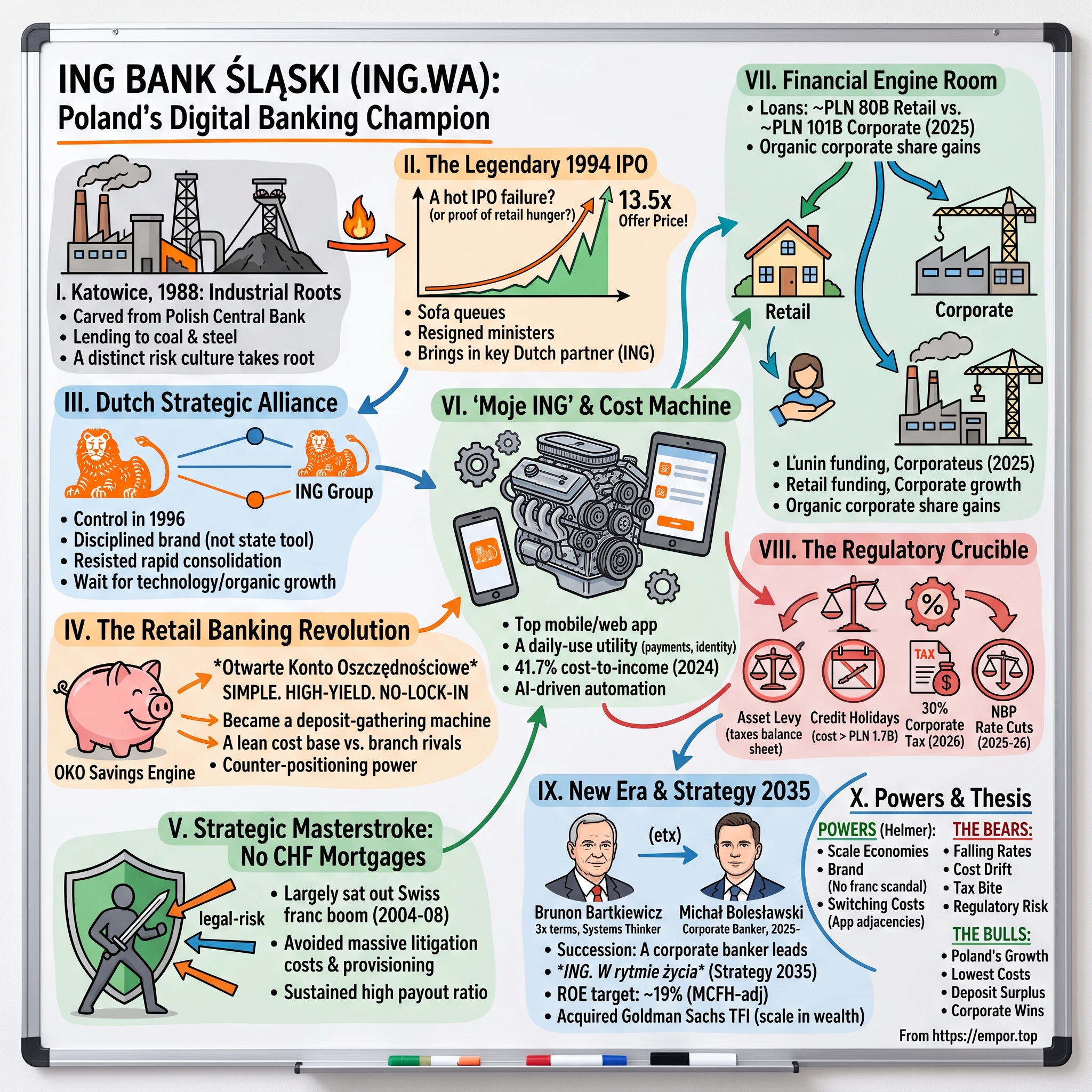
ING Bank Śląski: The Story of Poland's Digital Banking Champion
I. Introduction & Episode Roadmap (00:00 - 08:00)
On a February morning in 2026, in a press room in Warsaw, a bank that most non-Polish investors could not place on a map reported that it had earned PLN 4,633 million in a single year — up six percent — while spending just 42.9 groszy of every zloty of revenue on running itself.5 Two years earlier, that efficiency figure had been 41.7 percent.5 In a European banking industry where a cost-to-income ratio in the mid-fifties is considered respectable and the high forties is considered excellent, ING Bank Śląski has spent the better part of a decade operating in a band that most Western European lenders describe in strategy decks as an aspiration.
That is the surface fact. The interesting question is how a bank carved out of the Polish central bank in 1988, headquartered in the coal-and-steel city of Katowice, and originally built to lend to the state-owned smelters of Upper Silesia, ended up as the most operationally efficient large bank in one of Europe's fastest-growing economies — and, by management's own account on the fourth-quarter 2025 call, the third-largest bank in Poland, having passed Santander Bank Polska.6
The answer is not a single brilliant stroke. It is two decisions taken roughly a decade apart, both of which looked like mistakes at the time.
Two decisions that looked wrong for years
The first was counter-positioning. In the early 2000s, when Polish incumbents ran expensive branch networks, charged for basic current accounts, and paid savers almost nothing, ING Bank Śląski went the other way: a simple, high-yielding, no-lock-in savings account — Otwarte Konto Oszczędnościowe — marketed relentlessly, that turned the bank into a deposit-gathering machine. The consequence is visible in the balance sheet today: PLN 233.4 billion of client deposits against PLN 181.2 billion of loans at the end of 2025, a loan-to-deposit ratio of roughly 77 percent against a Polish banking sector average nearer 65 percent.56 ING is not deposit-poor; it is deposit-rich and, unusually for a bank of its efficiency, still has room to lend.
The second was an act of refusal. Between 2004 and 2008, Polish banks sold Swiss-franc mortgages to hundreds of thousands of unhedged retail borrowers because CHF rates were low and the zloty was strong. ING Bank Śląski largely sat it out. It lost retail share for years. Then, from roughly 2019 onward, Polish and European courts began striking down those contracts, and the sector booked tens of billions of zloty in legal-risk provisions. ING's franc book was small enough that by mid-2021 the bank was telling analysts it had stopped creating new provisions entirely because the existing PLN 270.3 million was, in its view, sufficient.14
Why this story is being told now
Those are the two loadbearing walls of the bull case. This piece will test them, and it will test what has been built on top of them since — because the story does not end in a state of grace. The interesting part of ING Bank Śląski in 2026 is that the environment has turned. The National Bank of Poland has been cutting rates since spring 2025, taking the reference rate down 200 basis points to 3.75 percent by March 2026.17 The Polish state raised the corporate income tax rate on banks to 30 percent effective January 2026.15 The Court of Justice of the European Union delivered its first WIBOR judgment in February 2026 — a partial win for banks that settled less than the headlines suggested.16 And in April 2025, after roughly two decades in the chair across three separate terms, Brunon Bartkiewicz handed the bank to Michał Bolesławski.10
Here is the roadmap. We start in Katowice in 1988 and pass quickly through the most famous stock market debut in Polish history — a debut that made retail investors rich in seconds and cost a finance minister his job. We follow the Dutch takeover and the deliberate decision not to buy Polish banks while everyone else was consolidating. We spend real time on the savings account and the advertising campaign that made it a household product, and then on the franc mortgages ING did not write. We take apart the cost machine and the Moje ING app. We open the engine room and look at how corporate and retail actually contribute. We walk into the regulatory crucible — the asset levy, the credit holidays, the new tax, WIBOR. We meet the new chief executive and read the November 2025 strategy he has staked the next decade on. And we close with a structural analysis: Helmer's 7 Powers, Porter's five forces, the small number of metrics that actually matter, and the case for and against.
It begins with coal.
 Subscribe on LinkedIn
II. Silesian Industrial Roots & The Legendary 1994 IPO (08:00 - 20:00)
Picture Katowice in 1989. Slag heaps on the horizon, the air thick enough to taste, the Wujek coal mine a few kilometres from the city centre still carrying the memory of the 1981 massacre. This was the industrial heart of the Polish People's Republic, and it was about to be handed a market economy it had no institutions to run.
One of those missing institutions was a commercial bank. In 1988, the Council of Ministers carved Bank Śląski out of the National Bank of Poland, one of nine regional commercial banks spun out of the central bank to create something resembling a lending market; it began operating in Katowice in 1989.1 In 1991 it was converted into a joint-stock company wholly owned by the State Treasury.1
Understand what that meant in practice. A newly minted commercial bank inherited a loan book made of state-owned steelworks, coal mines, and machine plants — enterprises whose customers were disappearing along with the Comecon trading bloc, whose cost structures were built for a command economy, and whose creditworthiness was, in any Western sense, fictional. The first years of Polish commercial banking were less about growth than about triage: figuring out which industrial borrowers could survive and which were already dead.
It is worth pausing on how genuinely difficult that was, because it explains the culture that formed. There were no credit scoring models, because there was no history of arm's-length lending to score against. There were no reliable financial statements, because Polish enterprise accounting had been designed to report plan fulfilment rather than economic profit. Inflation ran at rates that made any nominal covenant meaningless within months. And the bank's own staff had been trained to disburse allocations, not to underwrite risk. The institutions that came through that period intact did so by building a risk function from nothing and by learning, expensively, that a loan officer's optimism is not a credit assessment.
That is the environment in which a distinctly conservative underwriting culture took root at Bank Śląski — a culture that would, fifteen years later, produce the single most consequential decision in this story.
The day Poland discovered the stock market
Then came January 25, 1994, and one of the strangest days in the history of European capital markets.
The Securities Commission had approved the bank's shares for public trading in September 1993.1 The offering priced at 500,000 old zloty per share — this was before the 1995 denomination that lopped four zeros off the currency. Over 820,000 individual investors subscribed, a record for the young Warsaw Stock Exchange that has never been broken; the allocation was so oversubscribed that retail buyers were rationed to three shares each.2 Poles queued for days outside brokerage offices. It was, for a country four years out of communism, a mass participation event in capitalism itself.
On the first day of trading, the price closed at 6.75 million old zloty — 13.5 times the offer price.2
That is not a hot IPO. That is a pricing failure of historic proportions, and Poland treated it as such. The State Treasury had sold a national asset for a fraction of what the market would pay. Prosecutors opened an investigation into whether bank officials had colluded to inflate the price. The Securities Commission suspended Bank Śląski's brokerage licence. Prime Minister Waldemar Pawlak dismissed the privatisation minister, and Finance Minister Marek Borowski resigned over the affair.3 For years afterward, "Bank Śląski" in Polish meant not a bank but a scandal — and simultaneously, in the popular imagination, the proof that the stock exchange could make ordinary people rich overnight.4
What the IPO actually left behind
There is a temptation, in a story like this, to draw a straight line from the 1994 mania to today's retail franchise: everyone knew the name, so everyone banked there. That line is too neat and it does not survive contact with the evidence. What actually happened is that the bank spent the second half of the 1990s as a mid-sized regional lender with a well-known name and no particular consumer proposition. Household recognition is not distribution. It is only an option on distribution, and options expire unexercised more often than not.
What the IPO did deliver was subtler and more durable. First, it established from day one that this was a listed company with a real free float and real minority shareholders — a governance fact that shaped everything afterward, because the bank never became a policy instrument in the way state-controlled Polish banks periodically have. Second, and immediately, it brought in the shareholder who would define the next thirty years. In the same month as the debut, a Dutch buyer stepped in and bought 2.4 million shares — 25.9 percent of the capital.1
For investors, the takeaway from this period is less about brand than about ownership structure. Poland's banking sector split, early and permanently, into three tribes: state-controlled national champions, foreign-owned subsidiaries, and independents. Which tribe a bank landed in determined its cost of capital, its governance stability, its appetite for political risk, and — as the next fifteen years would show — whether it would be run for growth, for scale, or for survival. Bank Śląski landed in the foreign-owned tribe in January 1994, and the identity of that owner is where the modern story really starts.
III. The Dutch Strategic Alliance: ING Group Takes Command (20:00 - 33:00)
The Dutch were early, and they were patient, which in Central European banking in the 1990s was an unusual combination.
ING's 25.9 percent stake taken in January 1994 was not a portfolio investment; it was a beachhead.1 By 1996, ING had increased its holding to 54.08 percent of the capital, taking outright control.1 Then, for five years, relatively little visible happened — which is itself the point. This was the era when Western European banks were buying Central European assets at speed, often paying up for market share and then discovering that the acquired institutions came with legacy loan books, incompatible IT, and unionised branch networks.
The consolidation moment came in 2001. In August of that year, existing shareholders' pre-emption rights were excluded and ING Bank N.V. took up an entire new share issue; on September 6, 2001, the institution began operating under the name ING Bank Śląski S.A., with the local operations of ING's Warsaw branch folded in.1 Out went the regional Silesian identity. In came the orange lion, one of the more disciplined brand systems in European finance, and with it a set of things a mid-sized Polish bank could not have built alone: wholesale banking capability, international risk models, correspondent networks, and — critically for what came later — a group-level willingness to fund technology.
Ownership settled where it remains. ING Bank N.V. holds 75.00 percent of ING Bank Śląski's 130.1 million shares, with the balance in a genuine free float dominated by Polish pension funds — OFE Allianz Polska at roughly 6.07 percent and OFE Nationale-Nederlanden at 5.55 percent as of mid-2026.7
The 75 percent question
That 75/25 split deserves a moment, because it is simultaneously the bank's greatest governance asset and its most permanent structural limitation.
The asset side is straightforward. A three-quarters owner that is itself a listed, regulated European bank imposes a kind of discipline that Polish state-controlled peers have periodically lacked. Management terms at PKO Bank Polski and Bank Pekao have historically tracked the electoral cycle with uncomfortable fidelity; boards rotate, strategies restart. ING Bank Śląski, by contrast, ran with one chief executive across most of the last two decades. Long tenure is not automatically good — it can calcify — but it does allow a bank to run a ten-year cost programme, which is roughly what happened.
The limitation side is equally real, and any honest analysis has to sit with it. With 75 percent held by a single strategic owner, there is no realistic takeover premium, no activist campaign that can force change, and no scenario in which minority holders determine capital allocation. The dividend policy is set with the parent's balance sheet and the Polish regulator's recommendations both in the room. When ING Group needs capital in Amsterdam, the payout ratio in Katowice is a lever. Minorities ride along; they do not steer.
The deals ING Bank Śląski refused to do
The more interesting strategic choice of the ING era, though, was what the bank did not do.
Poland's banking market consolidated aggressively over two decades. Santander absorbed Kredyt Bank and then Deutsche Bank Polska's retail arm. BNP Paribas swallowed Raiffeisen Polbank's core. mBank was built and rebuilt. Getin Noble was eventually resolved. Nearly every large Polish bank today is a composite of three or four predecessor institutions, each merger carrying goodwill, integration cost, IT migration risk, and — as it turned out — inherited foreign-currency mortgage books.
ING Bank Śląski essentially opted out. Its acquisitions were small, adjacent, and operational rather than transformational: the 2011 combination with ING Bank Hipoteczny, the 2011 purchase of ING ABL Polska which brought the leasing and factoring subsidiaries in-house, the 2016 absorption of ING Securities, and a small credit union in Sanok in 2017.1 These are tuck-ins that simplify a group structure. They are not market-share purchases.
The strategic logic is defensible and the results support it: organic customer acquisition builds a homogeneous loan book on a single technology stack, which is precisely the precondition for the cost ratio the bank now runs. The counterargument is worth stating too. Organic growth is slow, and for most of the 2000s and 2010s ING Bank Śląski was a distant fourth or fifth in Polish retail by scale, watching acquisitive peers vault ahead. The strategy only looks obviously correct in hindsight, after the acquired franc portfolios turned toxic. Management deserves credit for the discipline; it should not be credited with having predicted the specific catastrophe that vindicated it.
What the bank did have was a plan for winning customers one at a time. That plan had a name, and it had a face.
IV. The Retail Banking Revolution: "Liczy się każdy grosz" & The OKO Savings Engine (33:00 - 48:00)
To understand what ING did to Polish retail banking, you have to understand what Polish retail banking felt like before it.
In the early 2000s, a Polish current account was something you paid for. Monthly maintenance fees, transfer fees, ATM fees, statement fees. Savings, if you wanted a decent rate, meant a term deposit — money locked away for three, six, twelve months, with a penalty for breaking it. Liquid balances sitting in a current account earned essentially nothing. The economics of the incumbent model were simple: an expensive branch network funded by cheap deposits and dense fee schedules, sold to a population with no memory of consumer choice in banking.
ING attacked the single most emotionally loaded line in that structure. Otwarte Konto Oszczędnościowe — the Open Savings Account, universally shortened to OKO, which happens to also mean "eye" in Polish — offered a competitive rate on fully liquid savings, no lock-up, no maintenance fee, money movable on the same day. It was not a financial engineering breakthrough. It was a product that told Polish savers they did not have to choose between earning something and having access to their own money.
Why the incumbents could not copy it
Counter-positioning, in Helmer's sense, requires more than a better product; it requires that the incumbent be unable to copy you without damaging itself. That condition held. A bank with a large, expensive branch estate funded by near-zero-cost current accounts cannot match a high liquid savings rate across its whole deposit base without destroying its own net interest margin. It can match on a small promotional tranche. It cannot match structurally. ING, with a leaner cost base and a deliberately smaller physical footprint, could price the product as its permanent proposition rather than as a promotion.
Then came the marketing, and here the bank did something genuinely shrewd. Rather than sell a rate, it sold a disposition. The long-running savings campaign built around the idea that every penny counts — running for years across television, cinema, outdoor and transit under lines such as "Są rzeczy, na których nie warto oszczędzać. Na całej reszcie — warto!" ("There are things not worth economising on. On everything else — it is!") — was fronted by Marek Kondrat, one of Poland's most recognisable film actors.21
The choice of Kondrat is worth dwelling on, because it explains something about the franchise. He was not a finance personality. He was a serious actor with an everyman credibility, someone who had also very publicly left acting to run a wine business — a person Poles associated with quiet competence rather than salesmanship. The campaigns did not shout about rates. They made saving a matter of self-respect and independence. For a country where an entire generation had watched inflation destroy savings in the late 1980s and early 1990s, that framing did real work.
What a granular deposit base is actually worth
The economic consequence is the part investors should focus on, and it is visible in the balance sheet three decades later. A bank funded by sticky, granular retail savings deposits has a fundamentally different risk profile from one funded by wholesale markets or by large corporate balances. Granular deposits are slower to run, cheaper in a crisis, and — crucially under Basel liquidity rules — attract favourable treatment in the liquidity coverage ratio. And because ING gathered far more deposits than it initially lent, it spent years as a structural net lender in the Polish interbank market, holding a large book of Polish treasuries and central bank bills.
That surplus is still there and still shaping strategy. At the end of 2025, deposits of PLN 233.4 billion against a loan book of PLN 181.2 billion left the loan-to-deposit ratio around 77 percent — meaningfully higher than the sector's 65 percent, but still well short of the level at which funding becomes the binding constraint on growth.56 Read correctly, that gap is the bank's growth runway: ING can expand lending for years without buying expensive wholesale funding or bidding up deposit rates, which is exactly the position a bank wants to be in when it is trying to take share.
The honest counterpoint is that a deposit franchise built on price is defended by price. High-liquid-savings positioning wins customers when the bank is the cheapest place for a saver to sit, and it can lose them when a competitor — or a fintech offering, or a money market fund — becomes cheaper. ING's own recent numbers show where this pressure now shows up: off-balance-sheet investment and mutual fund products grew 33 percent in 2025 to PLN 33.9 billion.5 Some of that is genuine wallet expansion. Some of it is savers, tired of falling deposit rates, walking their money one step further out the risk curve. A deposit franchise that converts into a fund franchise keeps the customer; it does not keep the same margin.
Still, by the mid-2000s ING had a funding engine and a growing retail base. The obvious thing to do with cheap funding is to lend it out aggressively. Which brings us to the moment when the entire Polish banking industry decided to do exactly that — in Swiss francs.
V. The Strategic Masterstroke: Avoiding the Swiss Franc Mortgage Trap (48:00 - 60:00)
Between 2004 and 2008, a Polish family walking into a bank to ask about a mortgage was frequently presented with two options. A zloty loan, at a rate driven by Polish policy rates that were then running in the mid-single digits. Or a loan indexed to the Swiss franc, at a rate driven by Swiss policy rates that were then running near zero. The monthly payment on the franc loan could be a third lower. Salespeople, working to volume targets, pointed at the smaller number.
What was rarely explained with any force was the structure of the bet. The borrower earned zloty and owed francs. If the zloty weakened against the franc, the borrower's outstanding principal — not just the payment, the principal — would rise, in zloty terms, without limit. The household was, in effect, running an unhedged short position in a safe-haven currency, financed by its own home.
The bet nobody explained
The industry wrote these loans by the hundreds of thousands. At several major Polish lenders, franc-indexed products came to dominate the mortgage book. Then 2008 arrived, the zloty sold off, and the Swiss National Bank's eventual abandonment of its euro floor in January 2015 delivered a second shock. Polish households that had borrowed at roughly 2.2 zloty to the franc found themselves owing at rates well north of 4.
ING Bank Śląski held back through the boom years. The bank's franc exposure never approached peer levels, and management had publicly argued for tighter macroprudential limits on foreign-currency lending to unhedged retail borrowers. It did eventually offer franc mortgages, briefly, in 2008 — under real commercial pressure, having watched competitors take retail mortgage share for four straight years — before the global credit freeze ended the experiment. The result was a portfolio measured in hundreds of millions of zloty rather than tens of billions.
Vindication, arriving fifteen years late
For most of the following decade, this looked like a conservative bank leaving money on the table. The vindication came through the courts.
From roughly 2019, Polish courts and the CJEU began finding indexation clauses in these contracts abusive under the EU unfair terms directive, with remedies ranging from converting the loan to a zloty loan at the original low franc-linked rate, to annulling the contract entirely. The sector response was a wave of legal-risk provisioning that ran into tens of billions of zloty and, at several banks, consumed multiple years of earnings.
ING's exposure to all of this was of a different order of magnitude. As of mid-2021, its net foreign-currency mortgage portfolio stood at PLN 534.4 million, of which PLN 521.3 million was franc-indexed, against which the bank had built PLN 270.3 million of provisions during 2020 — and had created no new provisions through the whole of 2021, with Vice-President Bożena Graczyk telling the market the existing level was "absolutely sufficient" for the portfolio's situation.14 At that point 617 cases were pending against the bank, on disputed unpaid principal of PLN 162 million.14
Those are not systemically meaningful numbers for a bank now earning over PLN 4.6 billion a year. That is the entire point.
What did ING do with the capital its competitors were burning? The honest answer requires care, because "the money went into technology and growth" is exactly the sort of claim a management team likes to make and an analyst should test. The testable version is this: over the period when peers were provisioning heavily, ING sustained an elevated payout ratio, kept its capital ratios comfortably above requirements, and grew its loan book organically without capital raises. All three of those are observable. The 2024 dividend distributed PLN 3,276 million — 75 percent of that year's net profit, or PLN 25.18 per share — with payment on May 12, 2025.10 A bank carrying a live, multi-billion-zloty litigation overhang does not distribute three-quarters of its earnings; its regulator will not let it.
The forward-looking caution is that this advantage is a wasting asset. Franc portfolios across the sector are shrinking fast through settlements, court-ordered annulments, and repayment. ING's own currency mortgage balance fell around 40 percent year on year to roughly PLN 62 million by early 2026. Once the sector finishes working through the problem, the relative advantage disappears, and ING competes on the merits of its cost base and its distribution rather than on the absence of a legacy wound. Investors should be clear that "no franc problem" is a reason ING is where it is today, not a reason it will outgrow peers tomorrow.
Which raises the obvious question: what is the durable advantage? For that, we have to look at what the bank spent the 2010s building.
VI. "Moje ING" & The Cost-Efficiency Machine (60:00 - 73:00)
Walk into an ING Bank Śląski location in a Polish city and the first thing you notice is what is missing. There is very little glass, very few tellers, and almost no queue for cash. Cash goes in and out through machines. The staff who are there are there to sell and advise, not to count notes. The floor plate is small.
This is not an aesthetic choice. It is the physical expression of an accounting identity.
A bank's cost-to-income ratio is, at heart, a question about what fraction of its revenue is consumed by people and buildings. Traditional retail banking put a person in a room in every town to perform transactions — deposits, withdrawals, transfers, statements — that generate no revenue at all. The entire economic history of digital banking is the story of moving those zero-revenue transactions to a marginal cost of approximately nothing, and then deciding whether to keep the savings or compete them away.
ING Bank Śląski moved them early and kept a meaningful share of the savings. The result: a cost-to-income ratio of 41.7 percent in 2024 and 42.9 percent in 2025, including the Polish bank levy.5 To put that in perspective, a large European retail bank running in the mid-fifties is considered to be performing acceptably. ING Bank Śląski runs more than ten percentage points better while operating in a market with a punitive asset tax and rising wage inflation.
Poland leapfrogged, and the app became a utility
The consumer-facing expression of that architecture is Moje ING — "My ING" — the bank's integrated web and mobile platform. For readers outside Poland, some context on the market is needed to understand why this matters more here than it would in, say, Germany. Poland leapfrogged a generation of payments infrastructure. It has BLIK, a bank-owned mobile payment scheme that lets users pay online and in shops and send money person-to-person using a six-digit code generated in their banking app, with no card network involved. It has near-universal contactless acceptance. And it has profil zaufany and bank-mediated digital identity, meaning citizens routinely authenticate to government services through their banking app.
The practical effect is that in Poland, the banking app is not a place you go to check a balance. It is a daily-use utility — payments, identity, government forms, transfers — that people open several times a week. That changes the nature of the switching cost. Moving your current account is annoying anywhere. Moving it when the app is also your payment method, your identity credential, and the thing your household bills are wired to is a materially larger undertaking. The stickiness is real, and it is not primarily about the interface quality; it is about the number of adjacent jobs the app has absorbed.
There is a useful analogy for what happened to bank distribution over this period. Think of a traditional branch network as a chain of physical shops, each of which must be staffed all day regardless of how many customers walk in, and most of whose foot traffic consists of people performing errands that generate no revenue — checking a balance, moving money between their own accounts, paying a utility bill. Digitisation did not make those errands cheaper. It made them free, and it moved them out of the shop. What remains in the shop is the small subset of interactions that actually pay: mortgage conversations, business banking, wealth advice.
A bank that made this shift early gets to shrink and repurpose its estate while its revenue base keeps growing. A bank that made it late is left carrying leases, tellers and cash-handling infrastructure it can only unwind slowly, because branch closures are politically sensitive and staff reductions are expensive. This is why cost-to-income gaps between European banks are so persistent: the gap is not a management quality difference that can be closed in a year, it is an accumulated stock of decisions embedded in property leases, headcount and core systems.
For the same reason, the current wave of AI-driven automation in banking is likely to widen gaps rather than narrow them. Language models are good at exactly the work that clogs a bank's middle and back office — reading documents, summarising client interactions, drafting credit memos, triaging service requests, handling first-line queries. A bank that has already digitised its processes end-to-end can point these tools at clean, structured workflows. A bank whose processes still involve paper hand-offs and manual re-keying has to fix the plumbing first. ING Bank Śląski's long-term strategy makes this explicit, putting artificial intelligence at the centre of its target of 95 percent process automation.9 Whether that target is achievable is genuinely unknown; what is not in doubt is that the bank starts from a better position than most to attempt it.
The strategic consequence is a cost position that compounds. Software has high fixed cost and near-zero marginal cost per user. Spread the same core banking and app development spend across a growing customer base — 4.7 million retail clients at the end of 2025, up 133,000 year on year, plus 594,000 corporate clients — and the per-customer technology cost falls every year the base grows.5 That is scale economies operating in their purest form, and it is why ING can add customers without adding proportionate cost.
The cracks in the cost story
Two qualifications keep this from being a clean story.
First, the cost ratio has been drifting the wrong way. Total costs rose 8 percent in 2025 against income growth of 5 percent, which is what pushed the ratio from 41.7 to 42.9 percent.5 In the first quarter of 2026 the ratio was 48.7 percent against 47.9 percent a year earlier, on costs up 7 percent.8 Some of this is seasonal — Polish banks book the full year's Bank Guarantee Fund contribution in the first quarter, which mechanically inflates Q1 cost ratios — but the year-on-year comparison is like-for-like, and it is deteriorating. Polish wage inflation is the primary culprit, and technology talent in Poland is not cheap: the country is a major European engineering hub, which is a competitive advantage when hiring and a cost problem when retaining.
Second, digital efficiency is now table stakes rather than a differentiator. mBank was built digital-first. Every large Polish bank has a competent app. The moat is not "we have an app"; the moat is a decade-long accumulated cost advantage in a business where a ten-point cost-to-income gap translates directly into either fatter margins or the ability to underprice a competitor's loan and still earn an acceptable return. That advantage is real but it is defended by continuous investment, and the November 2025 strategy explicitly targets a cost-to-income ratio of around 37 percent excluding the bank levy on a 2035 horizon — an ambition that requires the current drift to reverse.9
The group's technology operations sit partly outside the bank itself. ING Hubs Poland, based in Katowice and Warsaw, provides technology and operational services to ING units globally, giving the Polish organisation access to engineering scale and a career ladder that a standalone Polish bank of this size could not offer. It is a genuine structural advantage in talent retention, though the bank does not disclose the intra-group economics in a way that lets an outside investor size it.
Cost efficiency, though, is only half of a bank. The other half is what it lends to, and who pays for it.
VII. Financial Engine Room & Segment Deep Dive: Retail vs. Corporate (73:00 - 87:00)
The common mental model of ING Bank Śląski — the orange lion, the savings account, the app — is a retail bank. The balance sheet says something more interesting.
At the end of 2025, corporate loans stood at PLN 100.7 billion, having grown PLN 4.6 billion over the year, against retail loans of PLN 80.4 billion, up PLN 9.2 billion.6 The corporate book is the larger of the two by a wide margin. ING Bank Śląski is, in asset terms, a corporate bank that funds itself with retail deposits — which is a genuinely advantaged structure, because it pairs the cheapest, stickiest liability in banking with a lending book that carries better pricing and much heavier ancillary fee flow than mortgages do.
The corporate bank hiding inside the retail brand
Take the corporate franchise first, because it is the least understood part of the story.
ING's corporate proposition in Poland is not primarily about balance sheet. It is about being the bank that a Polish mid-cap exporter, or a German or Dutch multinational's Polish subsidiary, plugs into. That means transaction banking and cash management — the plumbing through which a company's payables, receivables, and multi-currency accounts run. It means trade finance and letters of credit. It means FX hedging for a company that sells in euro and pays wages in zloty. And it means the asset-based finance products the bank brought in-house in 2011: ING Lease for equipment and vehicles, ING Commercial Finance for factoring.1
The competitive mechanism here is worth spelling out because it is the least replicable thing ING Bank Śląski owns. Poland's economy is deeply integrated into the German and wider Western European industrial supply chain. A large share of Polish corporate activity is cross-border by nature. A Polish bank with no international network has to correspondent-bank that flow through someone else. ING Bank Śląski is a full member of a Dutch banking group with a genuine wholesale franchise across Europe and beyond, which means a company operating in Warsaw, Rotterdam, and Frankfurt can hold one relationship rather than three. That is not marketing; it is a real structural reason a treasurer chooses this bank.
The leasing and factoring businesses deserve a sentence of explanation, because they are where a corporate bank quietly earns its keep. Leasing finances a specific asset — a truck fleet, a production line, a warehouse racking system — with the asset itself as security, which makes it lower-risk lending that a mid-sized Polish company will take even when it is reluctant to draw on a general credit line. Factoring advances cash against a company's unpaid invoices, which is one of the most useful products in existence for a business whose customers pay in ninety days and whose suppliers want paying in thirty. Both are high-frequency, relationship-deepening products with better spreads than plain corporate lending, and both generate a stream of information about a client's actual trading activity that a lender cannot get from annual accounts.
Owning those businesses inside the bank, rather than as separately listed or jointly held vehicles, means the revenue lands in the consolidated numbers without minority leakage and the client data lands in the same risk systems. It is an unglamorous structural advantage, and it is one reason the corporate segment can grow share without a proportionate increase in risk.
The evidence that it works shows up in share. Corporate lending market share rose from 9.1 percent in 2016 to 11.9 percent by the end of 2025 — nearly three points of share gained organically in a competitive oligopoly over nine years, which is a substantial achievement.6 Corporate deposit share moved from 7.8 percent to 9.8 percent over a comparable period. On the fourth-quarter 2025 call, management guided to corporate lending growth of 10 to 11 percent in 2026, framed against a Polish GDP forecast of 3.7 percent.6 That is a target to hold them to: it implies growing the corporate book at roughly three times nominal GDP, which is either continued share gain or loosening credit standards, and the two look identical in the first two years.
Buying mortgage share, and what it costs
The retail side has been the faster-growing half recently, and mortgages are the reason. New mortgage sales reached a record PLN 19.2 billion in 2025, up 32 percent, putting ING second in the Polish market and lifting its zloty mortgage share to 14.2 percent.5 New cash loan sales rose more than 19 percent to PLN 6.9 billion, and the total retail credit portfolio grew 13 percent.5 In the first quarter of 2026 the momentum continued: PLN 5.9 billion of new mortgage sales — a quarterly record — at an 18.5 percent market share, with cash loan sales up 24 percent.8
An 18.5 percent share of new mortgage production for a bank with 14.2 percent of the stock is a bank taking share aggressively, and that deserves scrutiny rather than applause. Mortgage share is the easiest thing in banking to buy: price a few basis points under the market and volume arrives. The questions an investor should be asking are what the new production is earning relative to the back book, what loan-to-value and debt-service ratios look like on the new cohort, and whether the mix is shifting toward fixed-rate lending in a falling-rate environment — because fixed-rate mortgages written near a cycle trough are a long-duration asset that will look expensive if rates back up. The bank's long-term strategy sets a cost-of-risk ambition below 0.6 percent, a level it notes it has maintained over the past decade.9 That is the number that will eventually reveal whether the 2025–26 mortgage surge was well underwritten.
Beyond lending, the third leg is fee and investment income, and it is where the bank is now spending its strategic energy. Investment funds and off-balance-sheet products grew 33 percent in 2025, active investment clients rose 14 percent to 182,000, and pension product clients jumped 32 percent to 232,000.5 Fee and commission income in the fourth quarter of 2025 was PLN 598 million, up 6 percent year on year.6
The strategic reason for the push is straightforward and should be stated plainly: fee income does not depend on interest rates. In a bank whose earnings have been carried by net interest income during a high-rate cycle now unwinding, building a durable annuity of asset-management and pension fees is the single most sensible defensive move available. Whether ING can build it at scale is the open question, and in April 2026 the bank answered it with money — which is where the leadership story picks up.
But first, the environment those earnings were generated in, because Polish banking is not a normal regulatory jurisdiction.
VIII. The Regulatory Crucible & Interest Rate Super-Cycle (87:00 - 98:00)
There is a recurring pattern in Polish banking that every investor in the sector eventually learns: the sector's profits are, to a meaningful degree, a policy variable.
Start with the asset levy. Introduced in 2016, the podatek bankowy taxes banks on their assets rather than their profits, at a monthly rate of 0.0366 percent — roughly 0.44 percent a year — with government securities excluded from the base.[^21]15 Read the design carefully and its consequences follow mechanically. A tax on assets is a tax on lending, payable whether or not the loan is profitable, and it is not payable on Polish government bonds. The predictable result across the sector was a structural tilt of bank treasury books toward sovereign paper — a policy that finances the state cheaply while making marginal corporate and household lending less attractive at the margin. It also means the levy sits in operating costs, which is why ING's cost-to-income ratio "including the bank levy" is the honest way to quote it.5
When parliament writes down your loan book
Then the credit holidays. In 2022, with inflation running hot and mortgage payments rising sharply, the Polish government legislated wakacje kredytowe: borrowers could suspend up to eight mortgage instalments — two per quarter in the second half of 2022 and one per quarter through 2023 — with no interest accruing on the suspended payments. This was not a deferral. It was a legislated transfer from bank shareholders to mortgage borrowers, and accounting rules required banks to recognise the whole expected cost up front as a reduction in the gross carrying value of the loans.
ING Bank Śląski estimated the hit at approximately PLN 1.7 billion, recognised in July 2022, on the assumption that 70 percent of eligible borrowers would take up the programme — and warned it expected its first quarterly loss in fourteen years as a result.13 Bartkiewicz publicly declined to revise the 70 percent estimate downward, noting clients were already applying for all eight instalments.13 A scaled-back version of the programme returned in 2024 with tighter eligibility.
Two things are worth extracting from that episode. First, the magnitude: a single act of legislation cost roughly a third of a typical year's net profit at the time. Second, and more revealing, the disclosure behaviour. Management quantified the hit immediately, used a conservative take-up assumption, and refused to soften it when it would have been easy to guide to a lower number. That is a credibility data point, and it is the kind of behaviour that should be weighted when assessing whether to trust the same team's long-term targets.
The rate cycle giveth, and now taketh away
Against that policy drag ran the great rate cycle. The National Bank of Poland took its reference rate from 0.10 percent in late 2021 to 6.75 percent by September 2022 to fight inflation. For a bank funded by a very large base of low-cost retail deposits and lending largely at floating rates linked to WIBOR, this was close to a best-case scenario: asset yields repriced fast, deposit costs repriced slowly and incompletely, and net interest income expanded dramatically. The high-teens-to-low-twenties returns on equity that ING Bank Śląski has posted in recent years — 20.4 percent in 2024 and 20.8 percent in 2025 on an MCFH-adjusted basis — were earned in that environment.5
That environment has now reversed. The MPC began easing in May 2025 and cut six times through the year, then again in March 2026, taking the reference rate to 3.75 percent — 200 basis points below the spring 2025 level and the lowest since April 2022.17 Falling policy rates run the earlier film backwards: floating-rate loan yields fall immediately, while deposit costs are already low and cannot fall as far. This is the core cyclical risk in the equity, and it is not a tail risk — it is happening now.
Management's response has been to lean into fixed-rate mortgage origination, hedge the structural interest rate position, and push fee income. Whether that offsets the compression is the central open question for the next two years.
A thirty percent tax, and one WIBOR verdict
Then, in January 2026, the state raised the price of being a bank again. The corporate income tax rate for Polish commercial banks went to 30 percent for 2026, stepping down to 26 percent in 2027 and settling at 23 percent from 2028 — up from the previous 19 percent — with the government expecting roughly PLN 6.6 billion of additional revenue in 2026 alone, justified by record sector profits and defence spending needs.15 A partial offset arrives later: the asset levy rate falls to 0.0329 percent from 2027 and 0.0293 percent from 2028.15
The effect landed immediately and visibly. In the first quarter of 2026, ING Bank Śląski's gross profit rose 3 percent year on year to PLN 1,351 million — but net profit fell nearly 19 percent to PLN 823 million, missing the analyst consensus of PLN 889 million.8 The operating business grew. The state took a larger share. That is the cleanest possible illustration of why Polish bank earnings cannot be modelled from operating trends alone.
Finally, WIBOR. For years the bear case on Polish banks included the possibility that WIBOR-linked zloty mortgages would follow franc mortgages into mass litigation. On February 12, 2026, the CJEU delivered its first ruling on the question, in case C-471/24, and the outcome was a qualified win for the banks: the court held that WIBOR itself complies with the EU Benchmarks Regulation and that the technical soundness of the index does not by itself make clauses containing it abusive.16 But the ruling did not end the matter. It applies to mortgages governed by the relevant EU regime, leaving older pre-2018 loans in a greyer zone, and it leaves national courts to assess whether individual borrowers were adequately informed about interest rate risk — with several further CJEU references pending.16 The tail risk is smaller than it was in 2025. It is not gone.
Into this environment stepped a new chief executive — with a strategy that runs to 2035.
IX. New Leadership & The Strategic Horizon: Michał Bolesławski's Era (98:00 - 108:00)
Brunon Bartkiewicz is one of the more unusual figures in European banking, mostly because of how many times he did the same job.
Born in 1962, he studied at the Faculty of Foreign Trade at Warsaw's School of Planning and Statistics — now SGH — and taught there in the international finance department before the transition.11 He joined a brokerage house in 1990, moved to Bank Śląski in 1991, entered the management board in 1992, and became president in 1995, at thirty-three, three years into the bank's life as a listed company.11 In 2000 he left for Amsterdam to join the management board of ING Direct N.V., the group's pioneering branchless-bank venture — a formative posting, because ING Direct was the institution that proved a bank could gather deposits at scale with no branches at all.11
He came back as president in 2004, left again in 2010 for ING Direct's management team covering Spain, Italy, France, the UK and Australia, later oversaw ING's operations across France, Italy, Poland, Spain, Romania and Turkey, and from mid-2014 served as the group's chief innovation officer.11 In 2016 he returned to Katowice as president for a third time and stayed until April 29, 2025.1110
That biography explains a great deal about the bank. Bartkiewicz's two long absences were spent inside the branchless-banking and innovation parts of ING Group — precisely the disciplines that produced the cost structure and digital architecture described earlier. He did not import a strategy consultant's deck; he imported an operating model he had helped run elsewhere. His public manner was that of a systems thinker rather than a salesman, more comfortable discussing organisational design and technological change than quarterly beats, and the 2022 credit-holiday episode showed a willingness to deliver bad news bluntly.
A corporate banker takes the chair
His successor is, by design, a continuity appointment — but of a specific kind.
Michał Bolesławski's succession was decided long in advance. The supervisory board resolved to appoint him in September 2024, the Polish Financial Supervision Authority approved him in December 2024, and he took the chair on April 29, 2025, when Bartkiewicz's term expired.1012 A three-quarter-year lead time with regulatory clearance secured in advance is orderly succession planning of the sort that state-influenced peers have frequently failed to execute.
The specific kind matters: Bolesławski is a corporate banker. Twenty-four years inside ING, managing director of the business clients division from 2006, and from 2008 vice-president of ING Bank Śląski responsible for corporate banking.12 The bank has handed the top job not to a retail or digital executive but to the person who ran the segment that now holds the larger loan book. Read alongside the 2026 corporate lending guidance and the strategy's emphasis on financing infrastructure, energy transition and defence projects, the appointment reads as a deliberate signal about where growth is expected to come from.5
A ten-year plan, and a cheque to back it
In November 2025 he put his name on a strategy with a name — "ING. W rytmie życia", "ING. In the Rhythm of Life" — and, unusually, a 2035 horizon.9
The targets are ambitious to the point of requiring scrutiny. Total clients above 7.5 million by 2035, from 5.1 million in 2024; individual clients above 6.6 million from 4.6 million; corporate clients above 800,000 from 573,000; private banking clients above 50,000 from 15,000.9 Investment product market share up to more than 12 percent from around 6 percent, one million investment clients, and a doubling of both retail and corporate deposits.9 Mortgage lending up 2.5 times, consumer credit share above 8 percent, corporate credit doubled, leasing share to 5 percent.9 On the operating side, 95 percent process automation and 99 percent service quality.9 And financially: ROE around 19 percent MCFH-adjusted, cost-to-income around 37 percent excluding the bank levy, cost of risk below 0.6 percent, and dividends of up to 75 percent of net profit.9
Several observations are warranted.
First, a ten-year strategy is an unusual disclosure choice. It is generous in ambition and cheap in accountability — no management team will be judged in 2035 on a target set in 2025. The useful part is directional: it tells you what the bank intends to become, which is a wealth and investment business bolted onto a lending business, with AI-driven automation carrying the cost line.
Second, the ROE target of around 19 percent is below the 20.8 percent delivered in 2025.59 That is management implicitly acknowledging that recent returns were flattered by the rate cycle and the new tax regime will take a bite. It is a more honest number than a promise of permanently rising returns, and it is worth noting that they did not round it up.
Third, the strategy came with a cheque. In November 2025 ING agreed to acquire the remaining 55 percent of Goldman Sachs TFI — having held 45 percent since 2019 through ING Investment Holding — and closed the transaction on April 24, 2026 for PLN 405 million after KNF and European Commission clearance.19 The acquired manager held roughly PLN 56 billion of assets under management and nearly 778,000 clients at the end of 2025, ranking second in Poland by capital-market assets; it rebranded as ING TFI from June 22, 2026, and the deal reduced the consolidated total capital and Tier 1 ratios by around 32 basis points.19
This is the one place where the long-standing organic-only narrative bends, and it should be named as such rather than smoothed over. A bank that spent two decades declining to buy market share bought a fund manager the moment its strategy required scale in investments. The transaction is defensible on its own terms — the price is modest relative to earnings, the capital cost is small, the bank already knew the asset intimately after six years as a minority holder, and buying an established fund platform is far faster than building one. But investors should watch it as a precedent. The discipline that produced ING Bank Śląski's clean balance sheet was, in part, a discipline about not buying things.
Capital returns have meanwhile continued on pattern. For 2025, the AGM on April 16, 2026 approved PLN 26.71 per share — PLN 3,475 million in total across 130.1 million shares, again roughly 75 percent of net profit — with a record date of April 22 and payment on April 27, 2026.185 Total capital ratio ended 2025 at 14.98 percent against 15.67 percent a year earlier, and stood at 15.81 percent with a Tier 1 ratio of 14.24 percent at the end of the first quarter of 2026.520 The declining trend is the arithmetic consequence of paying out three-quarters of earnings while growing risk-weighted assets at high single digits — sustainable at current levels, but not a lever with much slack left in it.
Which brings us to the structural question: what actually protects this business, and what could break it?
X. Playbook, 7 Powers, & Bear vs. Bull Investment Thesis (108:00 - 120:00)
Strip away the narrative and ING Bank Śląski is a wager on a specific proposition: that a durable cost advantage, a cheap and granular funding base, and a cross-border corporate franchise can compound in a fast-growing economy faster than the Polish state can tax the results away. Let us test each leg.
Hamilton Helmer's 7 Powers, applied honestly.
Scale economies are present and genuine, but they are not the classic version. The relevant fixed cost is technology and compliance, spread across a growing client base with group-level engineering support. Every additional customer added to the same core banking platform lowers per-customer cost. The evidence is the sustained ten-plus-point cost-to-income gap versus European averages. The qualification is that the ratio has been widening, not narrowing, for two years.
Switching costs are moderate and rising — not because of contracts, but because of accumulated adjacencies. When one app carries payments, identity, government authentication, salary credit and household bills, the friction of leaving is behavioural rather than contractual. This is real but it is symmetric: every Polish bank benefits from the same national infrastructure, so it protects incumbents generally rather than ING specifically.
Counter-positioning was the decisive power historically and is now largely spent. The high-liquid-savings model against fee-heavy branch incumbents worked because incumbents could not respond without cannibalising their own margins. That asymmetry no longer exists; the Polish market has converged on free accounts and competitive savings rates. Counter-positioning explains how ING got here. It does not explain how it grows from here.
Process power is the most plausible remaining candidate and the hardest to verify from outside. Digital-first underwriting, rapid onboarding, and an automation programme targeting 95 percent process automation would, if delivered, constitute an organisational capability that competitors cannot simply buy.9 The honest assessment is that this is currently more ambition than demonstrated moat. The proof will be a cost-to-income ratio that moves toward 37 percent while the client base grows — and right now it is moving the other way.
Brand is strong in Poland and materially reinforced by the absence of a franc-mortgage scandal at a moment when several rivals spent years in adversarial litigation against their own customers. Reputational asymmetry has commercial value in a market where trust in banks was damaged sector-wide. But brand in retail banking is shallow: it wins the consideration set and loses to a better rate.
Cornered resource and network economies are essentially absent. There is no proprietary asset and no user-to-user network effect in the core business; BLIK's network effect belongs to the industry consortium, not to ING.
Net: two durable powers (scale economies, brand), one rising (switching costs), one spent (counter-positioning), one unproven (process power). That is a real but not impregnable competitive position.
Porter's five forces. Rivalry is the dominant force and it is intense. Six large banks — PKO Bank Polski, Bank Pekao, Santander Bank Polska, mBank, ING Bank Śląski and Alior — compete in a market where lending products are close to commodities and share is bought with price. ING's 18.5 percent share of first-quarter 2026 mortgage production is evidence of how contestable that share is.8
Threat of new entrants is low. Capital requirements, KNF supervision, and an asset levy that taxes balance-sheet growth make de novo full-service banking in Poland uneconomic; the plausible entrants are foreign banks buying in, not startups building out.
Substitutes are a genuine and growing threat, but not in lending — they are in the two adjacent pools that matter most to this specific bank. Revolut and similar platforms have taken meaningful share of Polish foreign exchange and everyday payments among younger customers, chipping at the fee line. Money market and short-duration bond funds compete directly for the very savings balances that fund the loan book, and they compete harder as deposit rates fall.
Buyer power is moderate and rising as rate comparison becomes frictionless. Supplier power — which in banking means depositors and wholesale funders — is currently benign given the deposit surplus, and that is precisely the force that would bite hardest, and fastest, if the retail savings franchise ever weakened.
Myth versus reality. Three statements that circulate freely about this bank deserve correction.
The first myth is that ING Bank Śląski is a retail bank. It is not, in balance-sheet terms; corporate loans exceed retail loans by roughly PLN 20 billion.6 The retail franchise is primarily a funding and fee engine.
The second myth is that avoiding franc mortgages was a permanent structural advantage. It was a decade-long earnings advantage that is now amortising away as sector portfolios shrink. Underwriting the current thesis on it would be underwriting a fading asset.
The third myth is that a 75 percent parent stake guarantees stability. It guarantees governance continuity and it also guarantees that minority shareholders have no influence over capital allocation. Both are true simultaneously, and the second is rarely priced until it matters.
The activist's stress test. A skeptical investor sitting across the table from this management team would push on four things.
Payout discipline. Distributing 75 percent of earnings while the total capital ratio drifted from 15.67 to 14.98 percent, and while a PLN 405 million acquisition cost another 32 basis points, is a policy with a finite runway.519 If the loan book is genuinely to double by 2035, where does the capital come from — retained earnings that are currently being paid out, or a payout cut that the parent may not welcome?9
Cost drift. Two consecutive years of costs growing faster than income, against a long-term target of roughly 37 percent excluding the levy, is a gap that deserves an explanation more specific than wage inflation.58 Wage inflation affects every Polish bank; the question is why this one, whose entire equity story rests on efficiency, is not offsetting it faster.
Mortgage share aggression. Writing 18.5 percent of new production while holding 14.2 percent of the outstanding stock invites the obvious question of what is being priced and underwritten to win it.85 The answer will not be visible in the income statement for two or three years, which is exactly why it should be asked now.
Strategy drift. After two decades of organic-only positioning, buying the country's second-largest fund manager is a change in kind rather than degree.19 The transaction is defensible; the precedent is what to watch, because a management team that has crossed the M&A line once tends to find the second crossing easier.
How it stacks up against the field. Peer comparison is where the thesis either firms up or dissolves, so it is worth being specific about who ING Bank Śląski is actually racing.
PKO Bank Polski and Bank Pekao are the scale players, state-influenced, with the largest branch networks and the deepest relationships with public-sector and large-corporate borrowers. Their advantage is distribution reach and, in practice, a degree of policy alignment; their disadvantage is a cost base built for a different era and a governance structure that has historically absorbed political turnover. Santander Bank Polska and BNP Paribas Bank Polska are composites of multiple acquisitions, carrying the integration history and, in Santander's case, a franc mortgage legacy that ING does not have. mBank was the market's original digital challenger and remains a genuine technology competitor, but it entered the franc litigation cycle with one of the sector's heaviest relative exposures and spent years provisioning against it. Alior sits at the higher-risk, higher-yield end of consumer and SME lending, a different business model with a different loss profile.
Against that field, ING Bank Śląski's distinguishing characteristics are narrow but real: the lowest cost-to-income ratio among the large players, a loan-to-deposit ratio that leaves genuine funding headroom, a corporate book that has been gaining share organically rather than through acquisition, and a balance sheet with no material legacy litigation. Its distinguishing weakness is equally clear: it has no controlling position in any product category, and its retail scale, at 4.7 million clients, remains below the state-controlled leaders.5 It competes as the efficient challenger, not as the incumbent — which is a fine position when the market is growing and a difficult one when it is not.
Second-layer diligence, briefly. Three items sit below the headline numbers and are worth keeping in view.
The first is concentration by geography. This is a bank with essentially one country of operation, in a market where sovereign risk, currency risk, regulatory risk and credit risk all correlate. There is no geographic diversification to cushion a Polish shock, and the parent's presence does not change that — it changes who absorbs the loss, not whether it occurs.
The second is the composition of the new lending push. The 2025 strategy explicitly names infrastructure, energy transition and defence financing as target areas.9 Defence lending in particular is a growth market in Poland for obvious geopolitical reasons, and it comes with its own profile: long tenors, heavy state involvement, and exposure to political budget cycles rather than commercial demand. It is not inherently bad credit. It is different credit, and it will take years before its loss experience is observable.
The third is operational and cyber risk, which in a bank this digital is not a footnote. When roughly the entire customer relationship runs through one app and a shared national payments rail, availability and security incidents are franchise events rather than IT incidents. The bank does not disclose incident-level detail, and outside investors have limited ability to assess the control environment beyond regulatory findings — which is a genuine information asymmetry, not a criticism of this bank specifically.
The bull case. Poland remains one of Europe's structurally faster-growing economies, and ING Bank Śląski holds the operating position most levered to that growth. It has the lowest cost base among the large players and a deposit surplus that funds years of loan expansion without touching wholesale markets.
Its corporate franchise is winning share organically in the part of the market that is hardest to attack — transaction banking, trade, hedging and asset finance for companies embedded in cross-border supply chains — and it is doing so with a balance sheet carrying no legacy litigation drag. Behind it stands a parent that supplies international network, engineering scale and governance stability that a standalone Polish bank of this size could not replicate.
The investment and pension push, accelerated by an acquired platform holding roughly PLN 56 billion of assets, offers a credible path toward a stream of earnings that does not depend on the policy rate.19 And management has set its long-term return target below recent delivery rather than above it, which is a small but genuine marker of credibility in a sector where the opposite is more common.9
The bear case. Every leg of that has a countervailing pressure operating right now, not hypothetically.
Rates are falling, and net interest income remains the dominant earnings driver. The tax regime tightened materially in 2026, and the first quarter showed precisely how that flows through: operating profit up, net profit down nearly a fifth.815 Costs are outgrowing income for a second consecutive year.
Polish political risk toward banks has proven recurrent rather than episodic — an asset levy, two rounds of credit holidays, and a corporate tax rise inside a single decade — and nothing in the fiscal outlook suggests the sequence has ended. The WIBOR litigation channel has been narrowed but not closed, with further references pending.16 The franc advantage is amortising away. And the 75 percent parent stake means there is no strategic optionality, no activist lever, and no takeover floor under the shares.
The KPIs that actually matter. Three, and only three, are worth tracking.
Net interest margin, read together with cost of deposits. This is the single number that will determine earnings direction over the next two years, and the question it poses is behavioural rather than arithmetic.
As the National Bank of Poland cuts, how much of each cut does ING pass through to savers, and how much does it retain? Retain too much and the margin holds, but savings balances leak toward funds and toward competitors offering better rates. Retain too little and the margin compresses directly into earnings. The informative signal is not either number alone but the gap between how fast loan yields fall and how fast deposit costs follow.
Cost-to-income ratio, including the bank levy. The bank's entire structural claim rests here. Two years of drift is not yet a broken thesis, but a third would be. The relevant comparison is not the absolute level but the direction relative to the 37 percent ambition and relative to the gap versus large Polish peers.
Cost of risk. The mortgage and consumer loan books have expanded rapidly through 2025 and into 2026, and credit losses on new lending typically emerge two to three years after origination. Against the stated sub-0.6 percent ambition, this metric is the delayed verdict on whether the recent share gains were bought with price or with underwriting discipline.9
The next data point arrives shortly: ING Bank Śląski scheduled its second-quarter 2026 results for July 30, 2026, with the analyst conference the same morning.20 Three things are worth listening for — whether deposit costs are falling as fast as loan yields, whether the cost line has been brought back under income growth, and whether the mortgage machine is still running at record volumes and, if so, at what price.
The bank that emerged from a Silesian coalfield in 1988 and made 820,000 Poles briefly rich in 1994 has spent three decades converting patience into position. The open question for the next decade is whether patience is still the right instrument, in an environment where the rate cycle has turned, the state has raised its share of the profits, and the cost advantage that defines the whole thesis has, for two years running, been getting slightly smaller.
References
-
22 lata temu na akcje Banku Śląskiego zapisało się 800 tysięcy osób — Stowarzyszenie Inwestorów Indywidualnych ↩↩
-
Prywatyzacja Banku Śląskiego, czyli jak zostać miliarderem w kilka sekund — Forsal.pl ↩
-
Bank Śląski i legendarny debiut na giełdzie. To była prawdziwa gorączka — Money.pl, 2024-01-25 ↩
-
Wyniki ING Banku Śląskiego za 2025 rok — ING Bank Śląski (Informacja prasowa), 2026-02-10 ↩↩↩↩↩↩↩↩↩↩↩↩↩↩↩↩↩↩↩↩↩
-
ING Bank Śląski Q4 2025 slides: Net profit up 5% YoY despite missed forecasts — Investing.com, 2026-02-10 ↩↩↩↩↩↩↩↩
-
Akcjonariat: akcjonariusze ING Bank Śląski SA — BiznesRadar.pl ↩
-
Wyniki ING Banku Śląskiego po I kwartale 2026 roku — Bank.pl, 2026-04-30 ↩↩↩↩↩↩↩
-
„ING. W rytmie życia" — nowa długoterminowa strategia banku — ING Bank Śląski (Informacja prasowa), 2025-11-18 ↩↩↩↩↩↩↩↩↩↩↩↩↩↩↩
-
Zmiana na stanowisku Prezesa Zarządu ING Banku Śląskiego oraz decyzja o dywidendzie — ING Bank Śląski (Informacja prasowa), 2025-04-29 ↩↩↩↩
-
Brunon Bartkiewicz — były prezes zarządu w ING Bank Śląski — WNP.pl ↩↩↩↩↩
-
Zmiana warty w ING Banku Śląskim. Michał Bolesławski zostanie prezesem — Money.pl, 2024-10-24 ↩↩
-
Wakacje kredytowe: ING Bank Śląski oczekuje, że wnioski złoży 70 proc. uprawnionych klientów — Forsal.pl, 2022 ↩↩
-
ING BSK ocenia, że poziom rezerw na ryzyko dot. kredytów CHF jest wystarczający — StockWatch.pl, 2021 ↩↩↩
-
30 proc. CIT dla banków. Wchodzą w życie nowe przepisy podatkowe — Bankier.pl, 2026-01-01 ↩↩↩↩↩
-
TSUE: WIBOR zgodny z prawem UE — wyrok w sprawie C-471/24 — Prawo.pl, 2026-02-12 ↩↩↩↩
-
Decyzja RPP w marcu 2026. Rada jednak ścięła stopy procentowe — Bankier.pl, 2026-03 ↩↩
-
Akcjonariusze ING Banku Śląskiego zdecydowali o wypłacie 26,71 zł dywidendy na akcję — Inwestycje.pl, 2026-04-16 ↩
-
ING Bank Śląski sfinalizował przejęcie Goldman Sachs TFI — Bank.pl, 2026-04-24 ↩↩↩↩↩
-
Marek Kondrat w reklamie ING przekonuje, że są rzeczy „na których nie warto oszczędzać" — Wirtualnemedia.pl, 2019-12-23 ↩
 LinkedIn
 WhatsApp
 Reddit
 Hacker News
 Email
Email Kindle
 RSS Feed
 Spotify
 Apple Podcasts
 Amazon Music
 Audible
 YouTube