ING Groep N.V.: The Re-Engineered Lion
I. Introduction & Episode Roadmap: The Re-Engineered Lion
Picture two versions of the same orange lion.
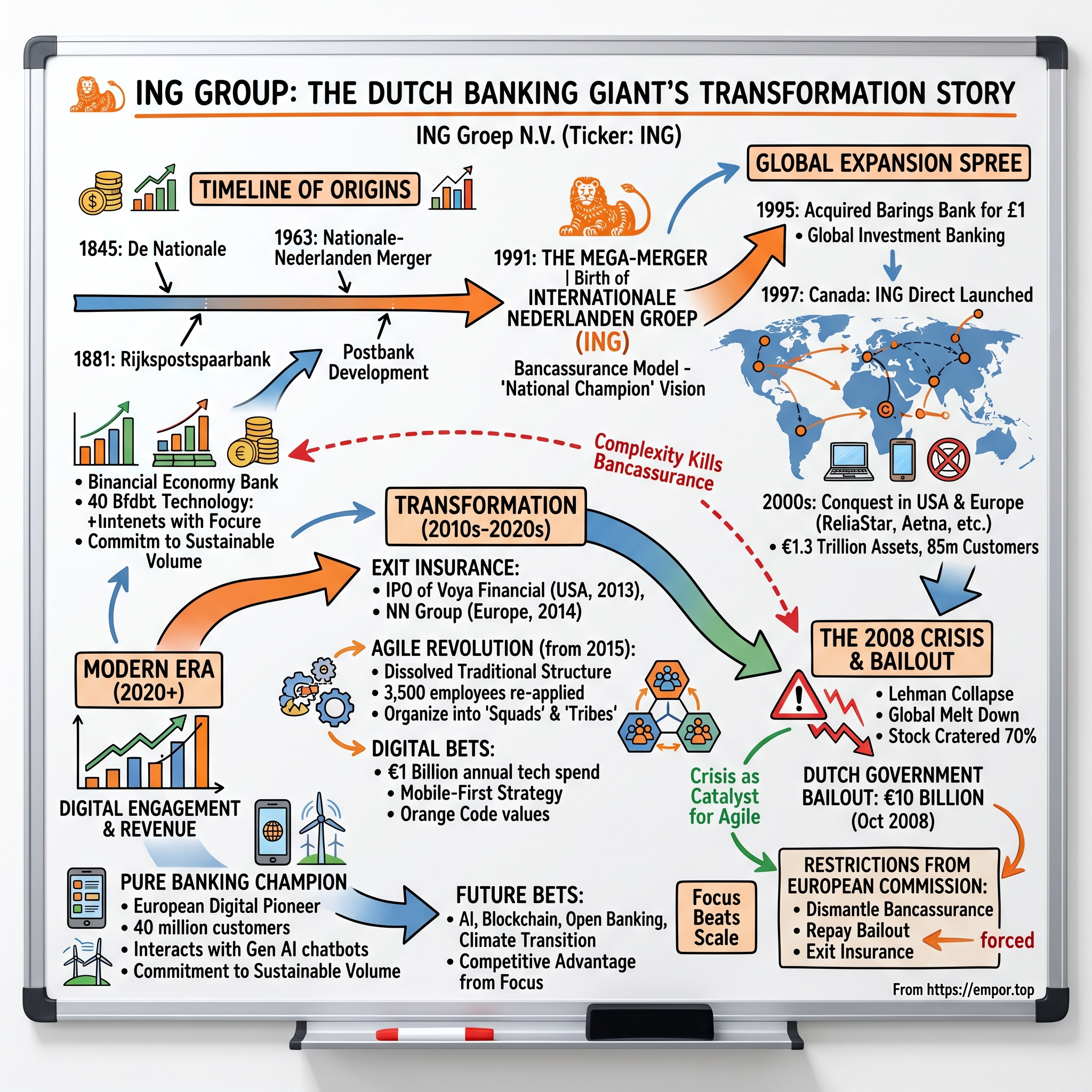
The first stood in 2007: a sprawling financial department store with operations across four continents. In Amsterdam, it ran the national postal savings bank. In Brussels, it owned a century-old commercial lender. In Hartford and Atlanta, it sold variable annuities and retirement plans to American schoolteachers. In Toronto, Sydney, Madrid, and Wilmington, it operated branchless direct banks advertised with an orange bouncing ball. In Latin America and Asia, it managed pension funds. The conglomerate logic was simple and seductive: insurance premiums and retail deposits were merely two varieties of other people's money, and a single balance sheet could comfortably house both.
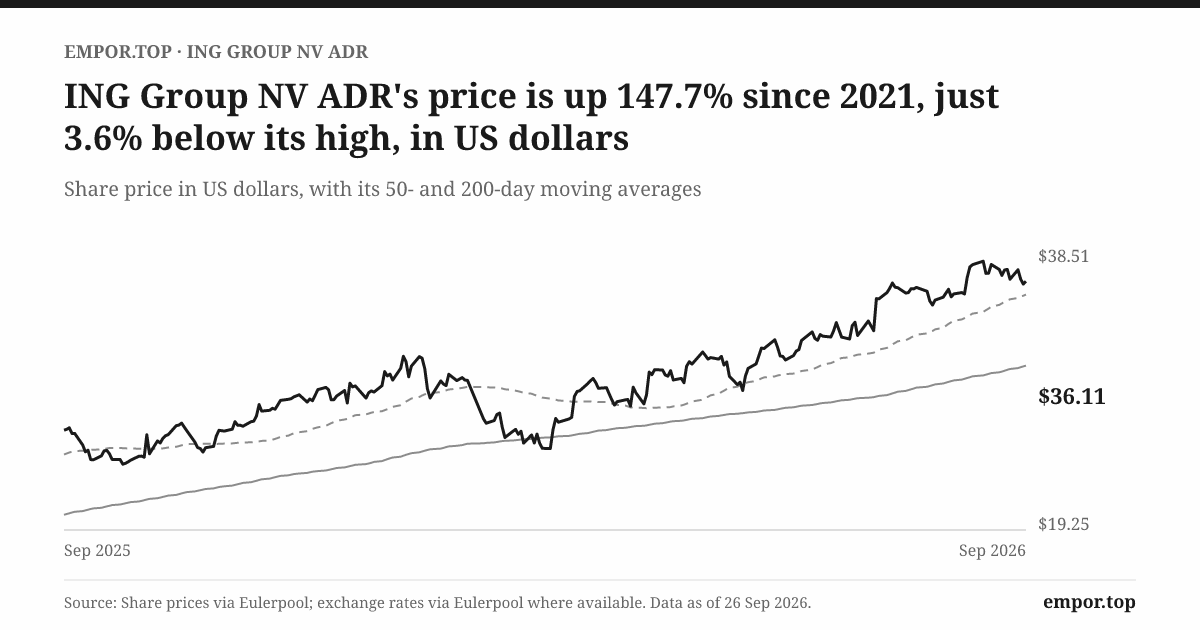
The second lion stands today, in September 2026. It sells no insurance of its own. Its former direct banks in the United States, Canada, and the United Kingdom belong to rival institutions. It has exited retail banking in France, Austria, and the Czech Republic. It paid the largest criminal settlement in Dutch corporate history over compliance failures that allowed illicit funds to pass through its accounts. Yet it is the more profitable, more focused, and more resilient institution of the two. In 2025, ING Groep reported €23.0 billion in total income, anchored by €15.3 billion in commercial net interest income and €4.6 billion in fee income, delivering a net profit of €6.3 billion and a return on equity of 13.2%.1 The group served nearly 41 million customers, including 15.4 million classified as "mobile primary" users who manage their daily financial lives through ING's app.1 Its balance sheet totaled €1,054 billion, supported by €721 billion in customer deposits.1
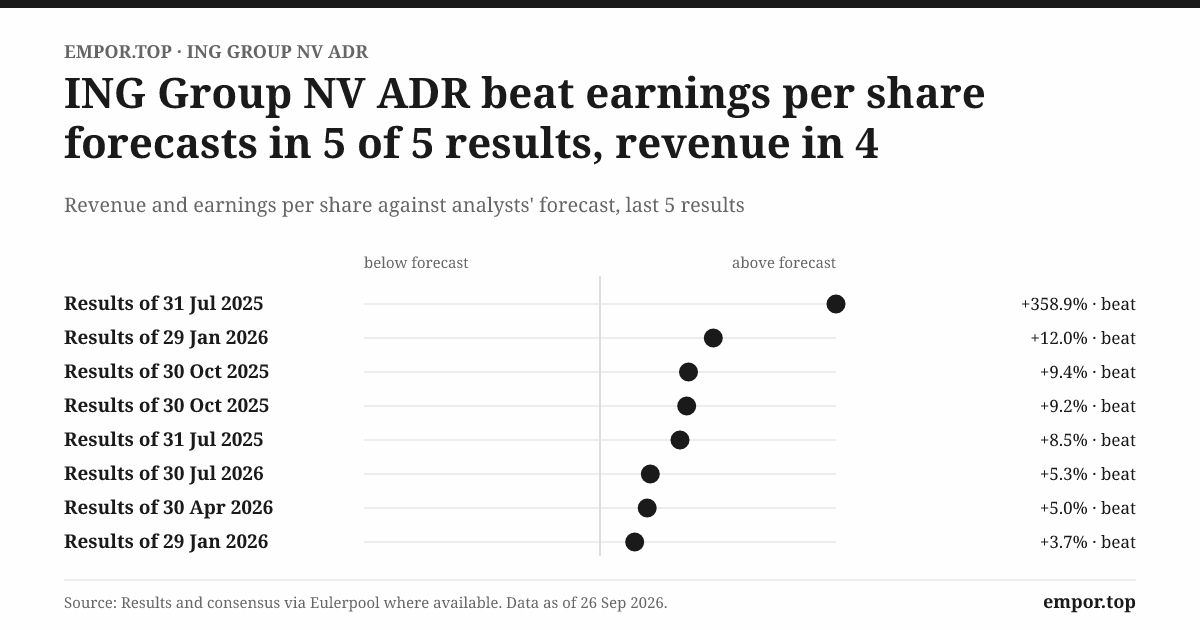
That momentum carried into 2026. In the second quarter, ING generated €1,947 million in net profit, achieved a 17.0% return on tangible equity, and held a CET1 capital ratio of 13.1%, prompting management to raise its medium-term financial outlook.2 Management now targets a return on tangible equity above 15% for 2026 and above 16% for 2027, alongside fee income of roughly €5 billion in 2026—reaching that milestone a year ahead of its original plan.23
Here lies the central paradox of the franchise. Following the 2008 financial crisis, the European Commission subjected ING to one of the most drastic state-aid restructuring programs in European banking history. Competitors that avoided mandatory breakups preserved their sprawling footprints. ING surrendered its global insurance arm, its fastest-growing overseas retail direct banks, and a decade of meaningful shareholder distributions. Yet the restructured bank ultimately emerged with cleaner unit economics and higher capital returns than many peers that kept their empires intact.
The explanation is not strategic genius alone. Part of it was cyclical good fortune: the European Central Bank's 2022–2023 interest-rate increases transformed an enormous pool of low-cost retail deposits into an earnings engine. Part of it was regulatory compulsion: Brussels mandated portfolio pruning that disciplined capital allocators should have undertaken voluntarily. And part of it was genuine operational execution, particularly in Germany and the Netherlands, where ING constructed a low-cost digital retail model that traditional branch-heavy competitors still struggle to match.
To understand the capital framework, one metric requires a plain-English translation at the outset. Common Equity Tier 1, or CET1, measures a bank's core loss-absorbing equity against its risk-weighted assets. It represents the thickness of the institution's regulatory crumple zone. Regulators establish the legal minimum; management sets an operating target above that threshold; and capital accumulated beyond that target represents distributable capacity for shareholder dividends and share buybacks. ING's CET1 target previously sat at roughly 12.5% before management raised it to approximately 13%.14 Every euro of capital preserved above that line forms the foundation of ING's shareholder-return thesis.
This analysis unfolds across seven parts. First, the bancassurance mirage: how postal savings and Dutch insurers merged into an all-weather financial conglomerate whose fundamental thesis failed in a systemic crisis. Second, the direct banking revolution: how a branchless, high-yield savings model upended retail deposits across multiple international markets. Third, the 2008 crucible: subprime US mortgage assets, a Dutch state bailout, and a forced European Commission breakup. Fourth, the Spotify era: Ralph Hamers's agile organizational overhaul, a €775 million anti-money-laundering settlement, and the costly unwinding of the pan-European "Maggie" software integration. Fifth, the operational discipline of the Steven van Rijswijk reset. Sixth, the business engine room, analyzed segment by segment. Finally, a stress-test layer examining the structural assumptions underpinning the investment case and identifying what could derail them.
The underlying question for European bank investors is straightforward: does ING possess a durable structural moat, or is it simply a well-managed deposit franchise that caught the peak of a favorable monetary cycle? The evidence suggests both realities coexist across different markets, and the trajectory begins with a nineteenth-century Dutch postal savings passbook.
 Subscribe on LinkedIn
II. Origins, The Bancassurance Colossus, & Empire Building (1845–2007)
Two bloodlines
In 1881, the Dutch government established the Rijkspostspaarbank, a national postal savings bank designed so that working-class families could place modest sums into a secure account at their local post office.5 The premise was thrift as public policy: a dockworker in Rotterdam did not need to enter an intimidating merchant bank when he could deposit a few coins across the counter where he bought stamps. That heritage of accessible, low-cost retail banking formed the foundational strand in ING's corporate DNA, explaining why the modern institution's core strength remains the sticky, low-cost savings of everyday households.
The postal bank was privatized in 1986 alongside the state giro payment service to form Postbank. In 1989, it merged with Nederlandsche Middenstandsbank, a lender created to serve small and mid-sized enterprises, to establish NMB Postbank Groep.5 Meanwhile, the second bloodline was insurance. Nationale-Nederlanden traced its heritage to nineteenth-century Dutch fire and life underwriters, and by the 1980s it stood as the country's dominant insurer.5
1991: The bancassurance bet
When Dutch financial deregulation dismantled the barrier between banking and insurance, the two institutions merged. In 1991, Nationale-Nederlanden and NMB Postbank combined to form Internationale Nederlanden Groep, later known simply as ING.5 The stated rationale was commercial synergy: cross-sell insurance policies through branch channels, offer banking products to insurance policyholders, and provide the enlarged institution with the balance-sheet scale to compete internationally.5
The underlying thesis concerned capital efficiency. A bank's deposit liabilities are short-dated and potentially volatile; an insurer's underwriting liabilities are long-term and predictable. Combining the two portfolios was expected to produce an institution far more stable than its individual parts. In benign economic conditions, this looked like prudent diversification. In reality, it created a conglomerate whose halves were tethered to the same systemic hazard: asset price deflation. When financial markets plunge, an insurer's minimum guaranteed returns become liabilities at the exact moment a commercial bank's credit portfolio suffers credit losses. The theoretical diversification proved effective in fair weather and illusory in a storm—a vulnerability that would surface in 2008.
The shopping spree
During the 1990s, ING expanded aggressively through cross-border acquisitions. Its most high-profile transaction arrived in 1995. Nick Leeson, a 28-year-old derivatives trader based in Singapore, had concealed catastrophic unauthorized trading losses that collapsed Barings Bank, the historic British merchant institution that had once helped finance the Louisiana Purchase. ING acquired the wreckage for a nominal sum.5 Overnight, the Dutch retail bank and domestic insurer gained an international investment-banking and emerging-markets franchise. Acquired at a distress valuation, Barings nonetheless introduced an investment-banking culture that European banks would spend much of the 2010s dismantling.
Geographic expansion continued in 1998 when ING purchased Belgium's Banque Bruxelles Lambert, creating a substantial second home market. Around the turn of the millennium, ING directed its capital toward the United States, spending heavily to acquire life insurance and retirement businesses, including Equitable of Iowa, ReliaStar, and Aetna's financial services operations.6 Those transactions purchased market share in American annuities and retirement plans near the peak of a protracted bull market. In hindsight, they represented some of the most value-destructive capital deployments in the group's history. When ING completed its divestment from US insurance and investment management in 2015, industry publications characterized the move as concluding "disastrous US business ventures."6 The verdict on this empire-building phase was clear: ING paid peak-cycle valuations for long-dated liabilities that deteriorated when equity valuations plunged and interest rates collapsed.
The orange ball
Yet that same expansionary era also produced ING's most durable retail innovation. In 1997, the group launched ING Direct in Canada under Arkadi Kuhlmann, an executive who sought to build a deposit-taking bank without physical branches.7 The economic rationale was straightforward. Eliminating brick-and-mortar leases, branch tellers, and physical maintenance allowed the institution to pass operating savings back to consumers through higher yields on simple, no-fee savings accounts with no minimum balance requirements. Marketed with a distinctive orange bouncing ball and an advertising message challenging the fee structures of established banks, the branchless proposition resonated with retail savers.
In strategic terms, this represented low-end disruption paired with counter-positioning. Incumbent commercial banks could not match ING Direct's aggressive interest rates without sacrificing the net interest margins on trillions of dollars in deposits already held in their physical branch networks. As a result, incumbents largely refrained from responding. ING subsequently rolled out the direct banking model to Spain, the United States, the United Kingdom, France, Italy, Australia, and—through the acquisition of DiBa—Germany. The scale was substantial: by the time Scotiabank acquired the Canadian business in 2012, it had grown into Canada's eighth-largest bank, holding roughly C$40 billion in assets, C$30 billion in deposits, and 1.8 million customers, all built without a traditional branch network.8
However, the direct banking model harbored a structural vulnerability. Attracting deposits represents only half of the banking equation; the other half requires deploying those liabilities into productive, yielding assets. In jurisdictions where ING Direct lacked a domestic lending operation—most notably the United States—it had to locate alternative investments. Treasury managers addressed the imbalance by purchasing fixed-income securities, including substantial volumes of US residential mortgage-backed bonds. While the deposit franchise proved innovative and cost-effective, the asset allocation quietly transformed a consumer savings platform into a leveraged holder of American residential real estate risk.
For investors, this era highlights two enduring themes of the ING narrative. The group's primary competitive advantage has consistently been on the liability side of the balance sheet, gathering stable, low-cost deposits from retail households. Conversely, its historical setbacks have almost invariably stemmed from asset allocation—either how it invested those deposits or the corporate acquisitions it funded with its own capital. That vulnerability would be tested during the financial crisis of 2008.
III. The Near-Death Experience: 2008 Bailout & Forced Dismantling (2008–2014)
A Sunday in October
On Sunday, October 19, 2008, five weeks after the collapse of Lehman Brothers, the Dutch finance ministry announced an emergency €10 billion injection of core capital into ING.9 It represented the inaugural deployment of the Dutch state's bank-support framework, and the financing terms established who held authority: ING agreed to repay the capital injection with a redemption premium of up to 50%.9 For an institution that had spent the preceding two decades acquiring distressed overseas lenders and underwriting operations, accepting public assistance marked an abrupt and humbling reversal.
Why did a bank anchored by a deep reservoir of domestic Dutch household savings require an emergency rescue? The vulnerability originated on the asset side of the balance sheet, driven by the securities portfolios accumulated inside ING Direct. A substantial portion of those investments had been allocated to Alt-A mortgage-backed securities in the United States—loans granted to borrowers who sat just above subprime credit profiles but carried incomplete documentation or income verification. When American housing prices dropped, secondary market trading froze, forcing sharp write-downs that eroded regulatory capital. Compounding the damage, ING's insurance operations suffered steep investment losses across their equity and credit portfolios. The bancassurance model, marketed as counter-cyclical diversification, manifested as systemic concentration: banking assets and insurance holdings deteriorated simultaneously under the same macro shock.
Offloading the toxic bonds
A state capital injection merely buys time if asset impairments continue to expand. On January 26, 2009, ING and the Dutch government introduced a secondary stabilization structure: the Illiquid Assets Back-up Facility, under which the state absorbed 80% of the downside risk on ING's portfolio of US Alt-A residential mortgage-backed securities.10 In practice, the facility functioned like a reinsurance policy for a burning building: taxpayers assumed the majority of potential losses in exchange for funding fees and a share of any future asset recoveries. Contemporary critics argued that the agreement shifted an excessive volume of private investment risk onto the public balance sheet.10 Regardless of the policy debate, the backstop achieved its immediate objective: it stabilized ING's capital position and extinguished the existential liquidity threat facing the group.
Brussels hands down the sentence
State aid inside the European Union carries strict regulatory consequences. Under competition law, sovereign bailouts granted to domestic banks distort the level playing field across the single market. In November 2009, the European Commission, directed on competition policy by Neelie Kroes, approved ING's restructuring program on terms that went far beyond typical recapitalization covenants.11 To dismantle the bank's subsidized scale, Brussels required ING to separate and divest its entire global insurance and asset-management footprint, carve out a domestic commercial banking operation to stimulate competition in the Netherlands, and sell ING Direct USA.11
The Commission's mandate was anchored in antitrust enforcement rather than corporate strategy, but it forced an unsparing examination of a question ING's leadership had long avoided: was the financial conglomerate worth more than the sum of its parts? The capital markets delivered a clear negative verdict across the subsequent seven years of required divestments.
The fire sales
In February 2012, Capital One completed the acquisition of ING Direct USA for approximately $9 billion in cash and shares.[^12] For Capital One, the transaction provided a massive foundation of low-cost retail deposits that funded years of consumer loan growth. For ING, the disposal produced an accounting gain but surrendered the fastest-growing and most valuable component of its international direct-banking franchise.
The asset sales continued across key international markets. In August 2012, Scotiabank agreed to acquire ING Bank of Canada for C$3.13 billion in cash, subsequently rebranding the business as Tangerine.8 In October 2012, Barclays agreed to acquire ING Direct UK's £10.9 billion deposit book at par value and its £5.6 billion mortgage book at an approximate 3% discount, forcing ING to record a transaction loss of roughly £259 million on the British exit.12 The contrasting outcomes provided a telling lesson in banking economics. In Canada and the United States, where ING Direct had established sustainable customer franchises backed by viable lending platforms, the operations fetched solid valuations. In the United Kingdom, where the direct bank had simply gathered deposits without developing a profitable domestic lending engine, the book was offloaded at a loss. The market paid for integrated banking franchises, not standalone deposit balances.
The separation of the insurance franchise took longer to execute. ING floated its US life, retirement, and investment-management operations in 2013 under the name Voya Financial, concluding its equity exit in March 2015 by raising roughly $2 billion in its final share placement.13 The European and Asian insurance and asset-management businesses were subsequently spun off in 2014 as NN Group; in April 2016, ING sold its remaining NN Group shares for approximately €1.4 billion, fulfilling the final divestment condition imposed by the European Commission.14
Paying back the state
By November 2014, ING had repaid the Dutch government in full. Accounting for regular coupon payments and early-redemption penalties, taxpayers received roughly €13.5 billion on the original €10 billion capital injection—a lucrative return relative to most European financial-crisis interventions.15 Dutch political leaders could showcase a bank bailout that generated a net profit for the public purse.
For private equity investors, the decade brought a far harsher reality. The rescue era inflicted substantial share dilution, forced a prolonged suspension of dividend payments, and permanently severed the group from its North American direct-banking and global insurance earnings streams. While the repayment narrative satisfied political oversight, it measured recovery exclusively from the perspective of taxpayers. For anyone who owned ING equity heading into 2007, the forced restructuring locked in a permanent loss of capital, even if the surviving bank operated on a sounder footing.
The strategic takeaway for investors is clear: ING did not embrace corporate focus voluntarily; it had focus imposed by European regulators. That historical context is essential when evaluating modern management claims regarding balance-sheet discipline. The institution that completed its restructuring in 2014 was simpler, better capitalized, and focused primarily on the Benelux region and Germany. How leadership handled that newfound focus—and how close the bank came to squandering it—forms the next chapter of the transformation.
IV. The Digital Vanguard & The "Spotify" Experiment (2014–2020)
Hoodies in Amsterdam
In 2015, ING's Amsterdam headquarters underwent an organizational experiment no major European lender had attempted at scale. Traditional corporate departments were dissolved. Employees were reorganized into agile, cross-functional "squads" grouped into "tribes"—an operational framework borrowed directly from Swedish music-streaming company Spotify. Staff were required to reapply for their jobs, prompting an exodus of veteran managers unwilling to adapt. The architect of this cultural overhaul was Ralph Hamers, a career ING executive who became chief executive in 2013 and would depart in 2020 to lead UBS.16
Hamers cut a distinct figure among European banking executives. Eschewing the conventional conservatism of Dutch financiers, he championed customer experience, digital platforms, and software engineering, arguing that ING should operate as a technology firm holding a banking license. The guiding pillar of his tenure, the "Think Forward" strategy, sought to position ING as Europe's primary mobile bank: onboarding retail clients digitally in minutes, scoring credit through automated algorithms, and expanding across Germany, Spain, Italy, Poland, and Romania by undercutting the friction of branch-heavy domestic incumbents.
For several years, the strategy delivered impressive operational metrics. ING's mobile application consistently earned top customer-satisfaction ratings, and its lean cost structures in Germany and the Netherlands became benchmarks across the continent. Yet the tech-inspired sprint masked two structural vulnerabilities that would reshape the institution's identity: one in regulatory compliance, the other in core technology.
Fracture one: the €775 million reckoning
On September 4, 2018, the Dutch Public Prosecution Service revealed that ING had agreed to pay €775 million to resolve a criminal investigation into chronic anti-money-laundering failures between 2010 and 2016: a €675 million fine alongside €100 million in disgorgement.1718 It stood as the largest criminal settlement in Dutch corporate history.
The prosecutors' findings were damning in their ordinariness. Client due-diligence protocols were consistently neglected, alerts from transaction-monitoring software went unreviewed, and customer files remained incomplete. Over several years, criminal networks moved illicit capital through ING accounts with minimal friction, including funds linked to the international bribery scandal surrounding telecom operator VimpelCom in Uzbekistan.17 The failure was not the work of an isolated rogue employee; it was institutional. In aggressively optimizing for digital customer acquisition and low operating overhead, ING had treated its statutory gatekeeper role—verifying customer identities and tracing fund flows—as a cost center to be minimized.
The executive fallout was immediate. Chief financial officer Koos Timmermans, who had supervised parts of the Dutch banking operations during the period under scrutiny, stepped down.18 Hamers was not charged in the corporate settlement, but Dutch financial activist Pieter Lakeman challenged that decision. In late 2020, The Hague Court of Appeal ordered prosecutors to investigate Hamers's individual liability. Following a multi-year inquiry, prosecutors determined that the evidentiary threshold for a conviction was not met, and in December 2025 the court agreed to end the case, citing the unlikelihood of a conviction and the disproportionate burden of continuing the proceeding.19
The financial fallout outlasted the headline settlement. For years afterward, ING broke out "KYC-related costs" as a distinct operating line, adjusting underlying performance against know-your-customer remediation.20 That accounting presentation underscored an uncomfortable reality for investors: the digital franchise's vaunted operating efficiency had been subsidized in part by persistent underinvestment in core compliance controls.
Fracture two: Maggie
The second misstep proved equally telling for the bank's strategic thesis. If ING was fundamentally a software platform, leadership reasoned, it should be able to run a single, unified technology stack across multiple national borders. That premise gave rise to Project Maggie: an ambitious program designed to build a standardized digital banking platform across several of ING's European "Challenger" markets, allowing consumer products engineered in a central hub to be deployed simultaneously across jurisdictions.
The economic theory was neat, but it collided with the fragmented reality of European financial regulation. Each national market operated under distinct consumer-credit statutes, clearing systems, tax-reporting requirements, deposit-guarantee schemes, and customer habits. A residential mortgage in Italy shared little legal plumbing with a home loan in Germany; a French checking account functioned under different statutory rules than a Spanish one. Engineering a single platform to satisfy those conflicting mandates proved akin to designing an automobile required to meet incompatible national safety codes while driving simultaneously on both sides of the road.
In the third quarter of 2020, ING conceded defeat, booking a €140 million impairment on capitalized software after deciding to significantly curtail the scope of Maggie.20 The Challengers division posted a pre-tax loss that quarter, with Maggie representing one of two substantial asset write-downs in the unit.20 Trade publication Euromoney framed the retreat as ING calling time on its most ambitious cross-border digital initiative.[^22]
Both fractures traced back to a common misconception. The Hamers era operated on the assumption that software architecture could dissolve the friction inherent in commercial banking: fragmented national jurisdictions, localized consumer law, and the strict gatekeeping obligations mandated by a banking license. Software had made ING cheaper and more convenient to use, but it could not engineer away regulatory reality. To clean up after both costly lessons, the supervisory board turned to an executive steeped in institutional discipline: the bank's chief risk officer.
V. The Steven van Rijswijk Reset: Pragmatism, Pruning, & Core Moats (2020–Present)
The risk officer takes the chair
When Ralph Hamers departed for Zurich in mid-2020, ING's supervisory board chose not to seek another digital visionary. Instead, it selected Steven van Rijswijk, who took over as chief executive on July 1, 2020.16 Van Rijswijk had joined the bank in 1995, building his early career in mergers and acquisitions, equity capital markets, and capital structuring before rising to global head of client coverage in Wholesale Banking and, in 2017, chief risk officer.16 Crucially, his tenure as chief risk officer placed him at the center of overhauling ING's statutory gatekeeper controls following the 2018 anti-money-laundering settlement.16
The appointment marked a deliberate cultural pivot. An economist trained at Erasmus University Rotterdam, van Rijswijk spoke in the measured vocabulary of capital adequacy and risk-adjusted returns rather than digital disruption and ecosystem platforms. Where Hamers had envisioned a tech company operating with a banking license, van Rijswijk pursued a more grounded objective: running a disciplined commercial bank that deployed technology effectively and systematically dismantled operations that failed to cover their cost of capital.
Pruning the outposts
The strategic pivot was tested within months. The central premise of the earlier direct-banking expansion had been to establish branchless beachheads across multiple international markets and let digital operating leverage generate profits. Evaluating the smaller outposts, van Rijswijk's team recognized a structural limitation: serving as a secondary high-yield savings account for a few hundred thousand depositors failed to secure the primary transaction accounts, direct salary deposits, and lending cross-sell required to generate attractive retail returns.
The retrenchment followed swiftly. In the Czech Republic, ING announced in early 2021 that it would exit retail banking by year-end, citing restricted customer-growth potential; it arranged for Raiffeisenbank to take on its roughly 375,000 local retail clients under preferential terms.21 In Austria, the group agreed to transfer its retail franchise, personnel, and approximately 150,000 retail clients holding current accounts, mortgages, and consumer loans to bank99, the financial arm of the Austrian postal service.22
The most significant withdrawal unfolded in France. Concluding that its local retail operation lacked the scale to compete profitably, ING reached a definitive agreement in April 2022 with Société Générale's digital subsidiary, Boursorama, allowing French retail clients a streamlined transition for everyday banking, deposit accounts, and investment services.2324 ING retained its French mortgage and consumer-loan portfolios to run off gradually, while maintaining its Wholesale Banking franchises in all three jurisdictions.2421
The French exit carried considerable symbolic weight. An institution that pioneered European direct banking ultimately surrendered its French customer base to a domestic digital rival. With more than 3.3 million clients at the end of 2021, Boursorama had captured dominant local market share.24 The retreat underscored a fundamental principle of modern retail banking: being branchless and early is insufficient without domestic scale.
A similar discipline was applied to peripheral digital ventures. Yolt, a personal-finance aggregation app incubated by ING to capitalize on European open-banking rules, shut down its consumer-facing platform in 2021 to pivot toward business-to-business technology.25 Roughly one year later, management decided to wind down the venture entirely.26
Growing the difference
With the peripheral exits behind it and central bank policy rates climbing, ING presented an updated strategic roadmap at its London Capital Markets Day on June 17, 2024, titled "Growing the difference." The medium-term targets for 2027 included a return on equity of 14%, a cost-to-income ratio between 52% and 54%, fee income of €5 billion, annual total income growth of 4% to 5%, and an annual intake of one million mobile primary customers, alongside a reaffirmed CET1 capital target of approximately 12.5%.4
Tracking the trajectory of those commitments offers an unvarnished view of operational execution. The customer acquisition target was achieved in 2025, when the bank added just over one million mobile primary users.1 Fee generation accelerated ahead of schedule, with management guiding to roughly €5 billion in fee income for 2026, reaching the target a year earlier than planned.3 Profitability expectations were upgraded in parallel: having guided in January 2026 to a return on tangible equity above 14% for 2026 and above 15% for 2027, management raised those expectations following the second quarter of 2026 to above 15% and above 16%, respectively.12 Concurrently, the group adjusted its operating CET1 ratio target upward from 12.5% to approximately 13%.1
That capital revision represents a notable trade-off for shareholders. Operating with a 13% CET1 ratio requires retaining more core equity against risk-weighted assets, which mechanically diminishes the residual capital available for share buybacks. Management framed the increase as a prudent recalibration to shifting regulatory standards and organic loan growth; an investor could equally view it as a quiet retreat from the distribution profile implied by the 2024 framework, even as headline return targets were raised.
Overall, van Rijswijk's administration has established credibility by consistently meeting or exceeding operational targets while addressing strategic trade-offs directly. Yet because this turnaround coincided with peak net interest margins across Europe, the ultimate test for the franchise is whether its earnings power endures as benchmark policy rates normalize. That dynamic is determined within the bank's core operating divisions.
VI. The Engine Room: Segment Economics, Industry Structure, & Capital Flows
A tour through the machine
An examination of ING's financial statements reveals five distinct operating engines, each performing a different economic function. In 2025, Retail Netherlands generated approximately €5.0 billion in income, Retail Germany roughly €3.0 billion, Retail Belgium (including Luxembourg) about €2.7 billion, the "Retail Other" division of growth and challenger markets €4.9 billion, and Wholesale Banking approximately €7.0 billion.1 In broad terms, wholesale operations accounted for three-tenths of group income, the Netherlands slightly more than a fifth, the challenger markets another fifth, and Germany and Belgium just over a tenth each.
The distribution of profitability, however, diverges sharply from top-line revenue. Measured by ING's return-on-equity framework—which allocates a 13% CET1 ratio across each segment's risk-weighted assets—Retail Netherlands generated an equity return of roughly 29% in 2025, Retail Germany earned about 27%, and Retail Other produced around 19%, while Retail Belgium delivered only about 10%.1 The contrast reveals the internal architecture of the bank: two core domestic markets running low-cost digital models serve as the group's primary earnings engines, while its most branch-dependent franchise lags substantially.
Retail Netherlands: the home castle
The Netherlands remains the institutional heart of the franchise, carrying forward the legacy of the postal savings bank. ING held €209 billion in customer deposits across its Dutch retail franchise at the end of 2025, operating at a cost-to-income ratio of 42%.1 In practical terms, that efficiency metric indicates the bank consumed just €42 in operating overhead—covering personnel, information technology, real estate, and regulatory compliance—for every €100 in revenue generated, at a time when many European universal lenders operated with cost ratios in the 60% range.
That operating leverage reflects a concentrated domestic market structure. Everyday banking in the Netherlands is dominated by a tripartite oligopoly of ING, Rabobank, and ABN AMRO. Dutch households overwhelmingly funnel paychecks, mortgage payments, and recurring utility bills through a single primary transaction account, creating formidable friction against switching lenders. Deposit flows illustrate how deeply integrated ING is within the domestic economy: retail deposits regularly surge every December when employers disburse mandatory "13th-month" holiday bonuses into customer accounts.1
Yet this domestic fortress imposes structural costs. ING is subject to the annual Dutch bank levy, which the group recognizes entirely in the first quarter before allocating the expense across operating segments.1 The domestic franchise also contends with strict national remuneration caps and persistent political scrutiny whenever widening net interest margins spark public debates over retail deposit rates.
Retail Germany: the low-cost machine
Retail Germany represents the purest surviving embodiment of the branchless ING Direct thesis. Operating almost entirely without a physical branch footprint, the business competes in one of Europe's most over-banked jurisdictions, where decentralized public savings banks (Sparkassen) and mutual cooperative lenders (Volksbanken) maintain extensive local branch networks. At the close of 2025, Retail Germany held €158 billion in customer deposits and maintained an operating cost-to-income ratio of approximately 46%.1
However, the German franchise also illustrates the structural limits of digital deposit gathering. Net interest income in Germany contracted modestly in 2025 as policy rates eased, even as rising customer demand for investment products drove a sharp increase in fee generation.1 During the second quarter of 2026, management disclosed that €7.8 billion in quarterly German deposit inflows stemmed from targeted "below-the-line" marketing campaigns aimed at existing account holders, noting that the bank historically retained approximately two-thirds of promotional balances once introductory interest rates expired.3 While a 67% retention rate indicates viable core deposit conversion, it also confirms that roughly one-third of marketing-driven inflows behaves as rate-sensitive liquidity that departs once promotional pricing ends. Low-overhead digital gathering can attract volume quickly, but a substantial layer of that funding remains vulnerable to yield-seeking depositors.
Retail Belgium: the legacy footprint
Belgium, established through the 1998 acquisition of Banque Bruxelles Lambert, presents a starkly different operational profile. In 2025, the Belgian unit generated roughly €2.7 billion in income while operating at a cost-to-income ratio of approximately 70%, yielding a segment return on equity of just 10%.1 Unlike the digital setups in the Netherlands and Germany, the Belgian market is characterized by intense competition from entrenched universal lenders such as KBC and BNP Paribas Fortis, and ING continues to maintain a comparatively heavier physical infrastructure. Expansion in the country has relied primarily on commercial and corporate lending.1 The segment's financial profile offers compelling evidence that ING's operational efficiency is not an inherent group-wide trait, but a direct consequence of specific national market structures and distribution models.
Retail Other: the challengers
The "Retail Other" division bundles operations across Poland, Romania, Spain, Italy, Australia, and select secondary markets. Together, these entities held €173 billion in deposits at the end of 2025 and operated at a collective cost-to-income ratio of roughly 59%.1 Poland, operating through listed subsidiary ING Bank Śląski, represents the largest contributor within the group, supported by high digital penetration but exposed to domestic regulatory interventions, including statutory mortgage payment moratoria and protracted litigation over legacy Swiss-franc mortgages. Customer growth across the retail division in 2025 was led by Spain and Romania, alongside Germany.1
Strategic execution in these challenger jurisdictions has focused on transitioning deposit-oriented customers into primary banking relationships characterized by direct salary deposits, consumer credit, and wealth management products. As part of that effort, ING agreed in 2025 to acquire the remaining equity in Polish asset manager Goldman Sachs TFI, targeting completion in the first half of 2026.1 In July 2026, the group agreed to acquire an approximate 40% stake in Singular Bank, a Spanish private wealth manager overseeing roughly €19 billion in client assets, from Warburg Pincus, with regulatory closing targeted for the first quarter of 2027.27 Closer to home, the group expanded its holding in Dutch private bank and wealth manager Van Lanschot Kempen to 20.3% during 2025.28
These transactions represent targeted capability acquisitions rather than transformative takeovers. The objective is to bolster fee income from wealth management—a revenue stream largely insulated from interest-rate fluctuations—without assuming the balance-sheet and integration hazards of cross-border bank consolidations. Given ING's pre-2008 history of value-destructive empire building, this tactical restraint aligns with its stated capital priorities, though investors will monitor whether management maintains that strict M&A discipline.
Wholesale Banking: the corporate engine
Wholesale Banking generated approximately €7.0 billion in total income in 2025, distributed across corporate Lending (€3.3 billion), Daily Banking & Trade Finance (€1.9 billion), Financial Markets (€1.5 billion), and Treasury & Other.1 Lending forms the division's anchor, contributing just under half of total wholesale revenue. Daily Banking & Trade Finance, which manages corporate cash management, cross-border payments, and working-capital facilities, provides the most durable customer lock-in: once a multinational treasury department integrates its liquidity pooling and payment rails into a primary banking partner, the operational friction of switching institutions becomes prohibitive.
The wholesale division is also where management has focused its capital-optimization efforts. ING executed two substantial risk-transfer transactions in 2025 to support its regulatory capital ratios, and by mid-2026 leadership reiterated its intent to optimize balance-sheet efficiency through synthetic risk transfers, secondary loan distributions, and credit-insurance arrangements.13 In functional terms, a synthetic risk transfer involves paying institutional investors to absorb credit risk on a defined tranche of corporate loans, thereby lowering the risk-weighted assets against which the bank must hold regulatory equity. While standard practice among sophisticated European lenders, it underscores that a portion of ING's reported capital-return improvement stems from structured liability management alongside underlying asset performance.
Wholesale Banking also serves as the centerpiece of the group's environmental targets. Having pledged at its 2024 Capital Markets Day to triple its annual renewable-energy financing to €7.5 billion by 2025, ING reported mobilizing €166 billion in total sustainable financing volume during 2025.41
The hidden businesses
Two supplementary units warrant perspective regarding overall earnings scale. ING Ventures and peripheral fintech holdings remain active across the portfolio, but their direct contribution to group profitability is immaterial. Concurrently, ING continues to unwind its legacy Russian operations. In January 2025, the bank reached an agreement to sell the business to Global Development JSC, anticipating an estimated post-tax loss of roughly €0.8 billion; by January 2026, the purchaser had not obtained the required regulatory clearances, leaving ING in ongoing dialogue with authorities regarding conflicting international legal requirements.1 While contained in balance-sheet scale, the unresolved disposal represents a persistent compliance and geopolitical exposure.
An analysis of the group's operating segments reveals a lender characterized by stark operational contrasts: world-class unit economics and digital efficiency in the Netherlands and Germany, balanced against structurally average returns and heavier cost bases in secondary markets. The durability of that earnings foundation under normalized interest rates forms the focus of the operational stress tests that follow.
VII. The Historical Falsification Layer: Testing Core Thesis Claims
Every investment thesis is a set of claims about the future. The best way to test those claims is against the company's own past. ING has a long, well-documented past, and it has conducted several expensive experiments that bear directly on today's bull case. Four claims matter most.
Test 1: "Pan-European digital scale"
The claim is that ING can use a common technology architecture to capture operating leverage across borders, something fragmented national banks cannot match.
The strongest disconfirming evidence is ING's own record. Maggie, the flagship cross-border platform, ended in a €140 million software impairment and a sharply reduced scope.20 Then came the exits from French, Austrian and Czech retail banking, in each case handing customers to a local or national player.212223 Boursorama, a purely French online bank, beat ING in France. Bank99, the Austrian post office bank, took ING's Austrian customers.
The counter-argument is that ING's best segments, the Netherlands and Germany, are highly efficient, and that the company still shares technology across countries, including a common mobile app now rolled out in Australia and elsewhere.1 Both statements are true. But the efficiency lives in the national segments, driven by national scale. The evidence rejects the grand version of the claim. ING is not a borderless pan-European bank. It is a federation of strong national banks sharing some infrastructure, brand and capital. The revised claim that survives is narrower: shared tooling lowers the cost of running each national bank, but it does not create scale where local scale is missing. The metric that would confirm or falsify the narrower claim is the cost-to-income ratio in the Retail Other segment. If shared technology truly works, that ratio should converge toward the Dutch and German levels over time; if it stays stuck near 60%, local scale is still the binding constraint.
Test 2: "Digital governance excellence"
The claim is that ING's data-driven, digital operating model gives it superior control of operational and compliance risk.
The disconfirming evidence is the 2018 settlement, which covered failures spanning 2010 to 2016, precisely the years when ING was building its reputation as Europe's digital leader.17 The mechanism is important: the same pursuit of low-friction onboarding and low costs that made ING attractive to customers also made it attractive to criminals. After the settlement, KYC remediation costs became large enough that management tracked them as a separate cost item.20
Has the problem been remediated? The evidence suggests substantial improvement: the man who led the risk function during the cleanup now runs the bank, and there has not been a comparable Dutch criminal settlement since.16 But the absence of a new scandal is not proof of excellence. The claim is narrowed: ING can run a compliant digital bank, but compliance is a permanent cost that caps how low its cost base can go. The ratio to watch is whether the cost-to-income ratio stays within the 52–54% target band even as regulatory spending continues; a sudden sharp fall should prompt questions about whether controls are being squeezed again.
Test 3: "Deposit immunity to rate cycles"
The claim is that ING's mobile primary customer relationships give it sticky, near-free funding that keeps net interest income resilient across interest-rate cycles.
The evidence runs in both directions, and that is the point. During the long era of negative ECB rates, banks like ING could not pass negative rates to most retail savers, so the margin on deposits was crushed. Then, in 2022–2023, the reverse happened: rates rose sharply, and banks were slow to raise savings rates, producing record deposit margins. Now rates have come down again, and ING's own numbers show the effect. Its commercial net interest margin fell from 2.37% in 2024 to 2.23% in 2025, and its overall net interest margin from 1.45% to 1.36%.1 Retail Germany's commercial net interest income declined by about 5% in 2025.1
Management has handled this well, growing volumes so that absolute commercial net interest income has held up, and guiding to €16.8–17.0 billion of commercial net interest income for 2026.3 ING also uses a "replicating portfolio," which works like a ladder of bonds: deposits are invested across a range of maturities so that when rates fall, the bank's income declines gradually rather than all at once. On the second-quarter 2026 call, the new CFO, Ida Lerner, stressed that liability-margin assumptions depend on "the interest rate curve" and "the replication part of the portfolio," as well as competition, without giving specific pass-through assumptions.3
The claim is narrowed. Deposit stickiness is real for primary transactional accounts in the Netherlands, but ING's German and challenger-market savings are more rate-sensitive, as the campaign data shows.3 ING's deposits are cheap, not immune. The metric that would test the narrower claim is the commercial net interest margin across the coming rate cycle: stability near current levels as volumes grow would support the resilient-franchise view; a steady slide would suggest the 2022–2024 earnings were more cycle than moat.
Test 4: "Fintech optionality"
The claim is that ING's internal innovation, labs and incubated ventures can produce valuable stand-alone businesses.
The record is thin. Yolt, the most visible attempt, closed its consumer app in 2021 and was phased out entirely within about a year.2526 The largest technology bet, Maggie, was impaired.20 ING's technology has clearly created value inside the bank through lower cost and better apps. There is little evidence it creates value outside the bank. The claim is rejected as a source of shareholder value. Current AI initiatives, such as generative-AI chatbots in Australia and agent-based mortgage processing, should therefore be judged by the internal metrics they affect, cost per customer and time to approve a mortgage, not as separate options with software-style valuations.13
Taken together, the falsification layer points to a consistent picture. ING's real edge is narrower and more local than its marketing suggests, but within those local markets it is real. The next question is how durable that edge is against competitors, which is where formal strategy frameworks help.
VIII. Strategic Moat Analysis: Porter's 5 Forces & Hamilton Helmer's 7 Powers
A war game
Imagine a strategy room in Frankfurt in 2026. On one side of the table sit ING-DiBa's planners. On the other, three distinct challengers: a local Sparkasse backed by a century of municipal presence, a neobank equipped with an agile mobile application and a fresh banking license, and a money-market fund offering yields higher than any standard savings account. Each takes aim at a different layer of ING's retail franchise. The strategic question is which defenses hold.
Porter's Five Forces
Threat of new entrants: low to moderate. Starting a commercial bank in Europe demands regulatory capital, European Central Bank and national supervisory clearance, mandatory deposit-guarantee contributions, and an expansive compliance infrastructure that ING learned through painful experience cannot be compromised. Digital challengers such as Revolut and N26 have successfully captured transactional and foreign-exchange volumes, particularly among younger consumers. What they have historically struggled to secure is the primary salary account and the residential mortgage—the two anchors where commercial lenders generate their returns. The regulatory and capital barriers do not make entry impossible; rather, they make profitable customer penetration exceptionally slow.
Bargaining power of depositors: moderate to high. For secondary savings accounts, depositors exercise considerable leverage. Reallocating a cash balance requires only a few taps on a smartphone, and ING's own German promotional campaign data underscores how quickly rate-sensitive balances depart once introductory pricing sunsets.3 Conversely, for primary checking accounts tied to automated salary deposits, recurring bill payments, and debit transactions, depositor power diminishes sharply because the operational friction of switching institutions remains a formidable deterrent.
Bargaining power of borrowers: high. Large corporate clients maintain relationships with multiple wholesale lenders, regularly playing them off against one another to compress loan pricing. In the retail sector, prospective mortgage borrowers increasingly cross-compare terms through digital aggregator platforms and independent brokers. European lending margins remain fiercely competitive, leaving ING with virtually no unilateral pricing power.
Threat of substitutes: moderate. Money-market funds and short-term sovereign paper compete directly with bank deposits whenever policy rates remain meaningfully positive. In corporate finance, private credit funds actively contest direct middle-market lending. At the retail point of sale, digital wallet providers insert themselves between consumers and the underlying institution, capturing customer engagement and transaction data even while the bank continues to warehouse the deposit.
Rivalry: high. European retail banking remains fragmented along national borders. In Germany, ING competes against decentralized public savings banks and cooperative lenders that are unburdened by commercial return-on-equity demands. In Belgium, ING's elevated cost-to-income ratio near 70% reflects the structural friction of challenging entrenched domestic incumbents on their home turf.1
Viewed through Porter's framework, ING operates in a structurally demanding industry. Any durable competitive advantage must therefore stem from company-specific strategic powers rather than favorable industry economics.
Hamilton Helmer's 7 Powers
Scale economies: strong, but local. This forms the core of ING's structural advantage. Information technology systems, regulatory reporting, and compliance infrastructure represent largely fixed operating expenses. Spread across €209 billion of Dutch customer deposits and €158 billion of German deposits, those central overhead costs shrink substantially on a per-euro basis.1 The financial evidence appears in the group's segment cost-to-income ratios: approximately 42% in the Netherlands and 46% in Germany, compared with roughly 70% in Belgium, where ING lacks comparable deposit dominance.1 Crucially, as the historical record demonstrates, this operating leverage is a function of concentrated national scale rather than cross-border synergy.
Switching costs: moderate to high on primary accounts, low on savings. This is the defensive moat that management's mobile primary customer strategy is engineered to reinforce. A customer whose salary direct-deposits, household mortgage, and automated utility payments run through ING's platform faces meaningful inertia against defecting to a rival. By contrast, a customer attracted solely by promotional savings yields faces virtually zero switching friction.
Counter-positioning: historically decisive, now largely spent. During the late 1990s and 2000s, ING Direct's branchless, high-yield model could not be replicated by traditional lenders without cannibalizing the net interest margins generated across their expensive brick-and-mortar networks. That dynamic was textbook counter-positioning. Today, every established European bank provides full-featured digital interfaces, while modern neobanks counter-position against ING by offering fee-free foreign exchange and multi-currency accounts. The strategic advantage has largely shifted from ING to newer digital challengers.
Cornered resource: weak. A European banking license and access to European Central Bank liquidity facilities are essential to operate, but they are neither scarce nor proprietary; every regulated competitor possesses equivalent access.
Network effects: negligible in retail. Consumer deposit and lending products exhibit no direct network dynamics. Modest two-sided network effects emerge only in Wholesale Banking, specifically within corporate cash management and supply-chain finance, where onboarding both corporate buyers and their supplier networks onto a single working-capital platform generates practical stickiness.
Process power: moderate. Automated underwriting and digital mortgage processing in the Netherlands and Germany enable rapid decisions. On the second-quarter 2026 earnings call, Chief Executive Steven van Rijswijk highlighted "agentic" mortgage processing as a way to "significantly reduce the time to yes" and serve more customers without adding staff.3 While such automation represents genuine operational capability, it remains subject to competitor replication as peer institutions roll out similar machine-learning workflows.
Branding: moderate. The orange lion identity commands recognition and signals institutional stability across northern Europe. Operating as an established, prudentially supervised institution provides an authentic trust advantage relative to unproven fintech entrants. However, brand equity remains vulnerable to operational lapses; the reputational damage from the 2018 anti-money-laundering settlement and executive compensation controversies illustrated that retail trust requires continuous governance discipline to preserve.
The strategic picture is cohesive. ING commands one decisive structural power—national scale economies in its two primary retail deposit fortresses—reinforced by moderate switching costs among primary account holders. Its historical counter-positioning has run its course, while other competitive moats remain modest or easily contested. This establishes a durable but strictly bounded competitive advantage, one whose ongoing resilience depends on strict capital allocation and vigilant regulatory compliance.
IX. Management, Governance, & The Dutch Regulatory Straightjacket
A pay fight that became a national scandal
In March 2018, ING's supervisory board proposed raising Ralph Hamers's compensation by 50%, to roughly €3 million, intending to bring his remuneration closer to the median of European banking peers.29 What followed was one of the most intense public backlashes in modern Dutch corporate history. Politicians across the ideological spectrum condemned the proposal, retail depositors reportedly closed accounts in protest, and the Dutch finance minister labeled the package disproportionate.29 Within days, the supervisory board rescinded the plan, acknowledging that it had "underestimated the public response."29
The episode crystallized the unwritten terms of the Dutch banking bargain. Although ING is a publicly traded commercial institution listed in Amsterdam and New York, the domestic public continues to view major banks as quasi-utilities that were preserved with taxpayer assistance during the financial crisis. That implicit social contract shapes operational boundaries across the enterprise, from executive pay packages and capital distributions to the political scrutiny surrounding retail deposit pricing.
The quiet operator
Steven van Rijswijk's tenure as chief executive has been defined by strategic restraint. The deliberate retail exits in France, Austria, and the Czech Republic, the wind-down of peripheral ventures like Yolt, and a preference for minority wealth-management stakes reflect leadership focused on operational discipline rather than balance-sheet expansion. His quarterly messages to the market have remained remarkably consistent: expand mobile primary relationships, accelerate fee generation, maintain tight cost control, and return surplus capital. In the group's 2025 annual results, van Rijswijk highlighted a "consistently executed" strategy navigating geopolitical uncertainty, supported by steady expansion in fee income, customer intake, and corporate lending.1
The finance leadership has undergone a similar transition. Tanate Phutrakul, who steered the group's balance sheet through the post-restructuring capital-return cycle, stepped down as chief financial officer following the April 2026 annual general meeting. His successor, Ida Lerner, had served as CFO of Norway's DNB since 2021, following earlier positions at HSBC and Nordea.30 Recruiting an external finance chief from one of northern Europe's most consistently profitable institutions signaled a commitment to return discipline. It also placed capital allocation in new hands, and equity investors will evaluate her tenure by whether ING's distribution framework remains just as predictable.
The capital hierarchy
Following the second quarter of 2026, ING's stated capital hierarchy established three priorities: first, funding profitable organic balance-sheet growth; second, pursuing selective bolt-on acquisitions that meet strict hurdle rates; and third, distributing structural excess capital above its operating target of roughly 13% CET1 to shareholders.32 The baseline dividend policy targets a 50% payout of resilient net profit. For the 2025 financial year, ING paid or proposed €3.2 billion in cash dividends, supplemented by a €0.5 billion special cash distribution and €3.1 billion in share repurchases announced over the year.1
In practical terms, ING distributed approximately €6.8 billion to shareholders against full-year net earnings of €6.3 billion, effectively paying out more than 100% of its annual profit by running down its accumulated capital buffer.1 That pace of distribution is inherently self-limiting. As ING's CET1 ratio declined from 13.6% at year-end 2024 to 13.1% by mid-2026, the bank's core capital closed in on its upgraded 13% operating target.1 Consequently, future distributions will have to mirror recurring net earnings rather than drawn-down capital reserves. The upward revision of the CET1 target, paired with capital deployments into wealth managers, signals that the era of total capital distributions exceeding annual profits is coming to a close.
The pay straitjacket
The Netherlands restricts variable compensation in the financial sector far more aggressively than European Union directives require, generally capping annual bonuses at 20% of fixed salary for domestic staff, compared with the 100% benchmark—or 200% with explicit shareholder approval—permitted under EU rules elsewhere. During the 2018 debate, Hamers's compensation was noted as sitting at roughly one-tenth the level of his American banking counterparts.31 That statutory ceiling cuts both ways. While it curbs short-term balance-sheet risk-taking, it simultaneously hampers ING's ability to recruit and retain senior personnel across investment banking, trading, and specialized technology, where the bank competes directly with institutions based in London, Frankfurt, and New York.
For equity investors, the Dutch governance model operates as an institutional safeguard against reckless empire-building, but it also creates structural friction in developing higher-margin wholesale businesses.
These governance constraints are central components of the equity thesis. They explain both the institution's balance-sheet discipline and its strategic limitations, setting up the core bull-versus-bear debate that follows.
X. The Bull vs. Bear Case & Activist Stress Test
The bull case: a cash-return machine with growing fees
The bull thesis rests on four pillars, each with evidence and a caveat.
First, cheap funding. ING holds €721 billion of customer deposits, with the Dutch and German retail banks alone holding €367 billion.1 That funding base, gathered at low cost through digital channels, gives ING a structural advantage over banks that rely more on wholesale funding. The caveat, established earlier, is that a portion of those deposits is rate-sensitive.
Second, efficient home markets. Retail Netherlands and Retail Germany earn returns well above ING's cost of equity, with cost-to-income ratios in the low- to mid-40s.1 If ING continues to win customers in Germany and the Netherlands, it is growing its most profitable franchise.
Third, a fee pivot. Fee income rose 15% in 2025 to €4.6 billion and 14% year on year in the second quarter of 2026, with management expecting about €5 billion for 2026 and €5.3–5.5 billion for 2027.123 Assets under management reached €322 billion by mid-2026, up 27% year on year.2 Fees from investment products, insurance distribution and wholesale services are less sensitive to interest rates than lending margins, making the income mix more resilient.
Fourth, momentum. ING's second-quarter 2026 return on tangible equity of 17% and its raised 2026 and 2027 outlooks suggest that volume growth and fees are more than offsetting margin pressure.2 Management expects total income above €24.5 billion in 2026 and above €26 billion in 2027.3
The bear case: margin compression and macro traps
The bear thesis is equally concrete.
First, net interest income still dominates. Commercial net interest income was €15.3 billion of €23.0 billion of total income in 2025, about two-thirds.1 Margins are already compressing: the commercial margin fell 14 basis points in 2025.1 If ECB rates settle lower for longer, the replicating portfolio will keep rolling into lower yields for years.
Second, the macro exposure. Wholesale Banking lends heavily to European industry, including German manufacturing and automotive supply chains, which have been under pressure. Risk costs remain below ING's through-the-cycle average, but wholesale risk costs were 38 basis points of average lending in the fourth quarter of 2025, well above retail levels.1 Low risk costs can reverse quickly in a downturn.
Third, the neobank flank. Revolut, Trade Republic and N26 are winning young customers with investment, FX and payments products. They do not yet dominate primary accounts, but they compete directly for the fee income ING is counting on to replace margin.
Fourth, regulation. The implementation of the final Basel capital standards, including output floors that limit the capital benefit of banks' internal risk models, bears most heavily on low-risk mortgage books like ING's Dutch portfolio. Combined with the move to a higher CET1 target, that means more capital must be held for the same business.
Myth vs. reality
Myth: ING is a tech company with a banking licence. Reality: that was the Hamers-era aspiration, and the record of Maggie and Yolt shows it did not translate into technology businesses.2026 ING is a bank whose technology lowers its costs in the markets where it already has scale.
Myth: the breakup was a triumph. Reality: it was a triumph for Dutch taxpayers, who got their money back with a premium.15 For the shareholders of 2007, it locked in the loss of the insurance, US and Canadian earnings streams at prices set by a forced seller.
Myth: ING's returns are now structurally higher. Reality: returns are higher, and the fee and volume trends are encouraging.2 But the 2025 group return on equity of 13.2% was achieved with margins already falling from their peak, and part of the recent uplift comes from risk-transfer deals and the switch to a tangible-equity measure, which ING itself said adds about 40 basis points to the headline ratio.1 "Higher" is proven; "structural" still needs a full rate cycle to prove.
Myth: digital customers are loyal customers. Reality: primary-account customers are loyal; savings-only customers follow the rate. The German campaign disclosure, in which about a third of fresh money tends to leave once promotions end, is the cleanest evidence ING has published on the difference.3
The activist stress test
An activist investor with a skeptical eye would press on a single contradiction. If the falsification layer shows that ING's cross-border retail synergies are limited, why is ING a single group at all? Couldn't ING-DiBa stand alone as Germany's leading direct bank? Couldn't the Polish subsidiary, already listed, be fully separated? Wouldn't the sum of the parts exceed the whole?
Management's answer would rest on three arguments: a shared wholesale banking network that serves multinational clients across ING's countries, pooled treasury and liquidity management that lets deposits in one market fund loans in another, and a single, strongly rated holding company with lower funding costs. Those are real benefits. But they are also difficult for outsiders to quantify, and ING does not publish a sum-of-the-parts analysis. The strongest counter-argument to a breakup is the 2008–2016 experience itself: the last time ING was broken up, the pieces were sold at prices dictated by circumstance, and it is not obvious a voluntary breakup would fare better.
An activist might also challenge the higher CET1 target, asking why capital that was once excess is now required, and demanding clearer disclosure of the conditions under which ING would return to a lower target. And the Russia exit, still pending approvals as of early 2026, is a reminder that small legacy exposures can generate outsized headaches.1
The bull case wins if fee growth and volume growth continue to outrun margin compression. The bear case wins if rate cuts, credit costs and capital rules converge. Which way it breaks will show up first in a few specific numbers.
XI. Key Performance Indicators (KPIs) to Watch & Playbook Lessons
Three numbers that matter
1. Commercial net interest margin. This spread reflects the net income ING generates across customer lending and deposits, serving as the primary barometer of whether the deposit franchise operates as a structural moat or a cyclical beneficiary of monetary policy. The commercial margin contracted from 2.37% in 2024 to 2.23% in 2025.1 The critical test is whether that spread stabilizes as the replicating portfolio reinvests into prevailing yields, and whether management must resort to aggressive promotional pricing to defend deposit volumes.
2. Mobile primary customer net additions. ING targets one million net additions annually, a threshold it achieved in 2025.14 This metric separates sticky banking relationships from yield-seeking hot money by tracking depositors who funnel salaries and daily transactions through ING's platform, building tangible switching costs. A persistent deceleration would serve as an early warning that customer growth is being purchased with introductory yields rather than earned through primary utility.
3. Cost-to-income ratio. Management established a 2027 operating target band between 52% and 54%, after the group ran at 54.6% in 2025.41 This ratio measures whether digital efficiency can consistently outrun wage inflation, mandatory compliance overhead, and technology investments. An efficiency ratio climbing back toward the upper 50s while net interest margins compress would provide the clearest indication that the bear case is taking hold.
Playbook lessons
Diversification that fails in a crisis is not diversification. ING's bancassurance model appeared balanced in benign economic environments, only to unravel in 2008 when banking assets and insurance liabilities deteriorated simultaneously under the same asset-price deflation. The European Commission mandated the conglomerate's breakup, and the focused commercial lender that survived ultimately emerged as the more profitable, capital-efficient institution.
Counter-positioning has an expiration date. ING Direct's branchless, high-yield model was a disruptive innovation in 1997. By the 2020s, traditional incumbents had deployed capable digital interfaces, while mobile neobanks began counter-positioning against ING with fee-free cross-border tools. When an innovative distribution model becomes the baseline standard of an industry, a bank must pivot to national scale economies and high switching costs—the precise transition ING has attempted with its mobile primary relationship push.
Europe is not a single market. Despite a common currency and harmonized supervisory frameworks, European retail banking remains bound by national borders, local consumer statutes, and fragmented clearing rails. The costly write-down of Project Maggie and the strategic exits from France, Austria, and the Czech Republic provide clear empirical proof: retail banking scale cannot be engineered cross-border from a central software hub; it must be won jurisdiction by jurisdiction.
Culture cannot outrun compliance. An agile organizational design and a technology-inspired aesthetic do not alter a commercial bank's statutory obligations as a financial gatekeeper. When anti-money-laundering controls and customer due diligence are treated as operating friction to be minimized, the eventual remediation bill arrives with punitive interest.
XII. Epilogue: The Disciplined Orange Lion
Go back to that post office counter in 1881, where a working family deposited a few guilders into a state savings passbook. The core of ING's business in 2026 remains recognizably similar: gather the savings of ordinary households cheaply and safely, and deploy them prudently. Between then and now came an expansive detour: an all-weather financial conglomerate that sold American annuities, acquired a collapsed British merchant bank for a nominal sum, and funded US mortgage securities with Canadian and American retail deposits. That detour pushed the institution to the brink of collapse in 2008. The forced restructuring that followed, mandated by European competition authorities rather than initiated by management, ultimately rescued the bank from its own empire-building.
The ING of 2026 is not the technology company Ralph Hamers sought to build. The bank pursued that ambition and learned, through Project Maggie and Yolt, that software architecture cannot dissolve fragmented national borders or statutory gatekeeping obligations. It learned, through a €775 million settlement, that treating regulatory compliance as friction to be minimized is a false economy. What has emerged instead is a narrower and far more profitable institution: a federation of digitally efficient national lenders anchored by dominant, low-cost deposit franchises in the Netherlands and Germany, supported by a corporate Wholesale Banking division and an expanding fee engine.
There is a distinct symmetry in where the group now looks for growth. The postal savings bank was created to help working families save; the contemporary frontier is encouraging their descendants to invest. Assets under management and brokerage volumes, private-banking stakes in Spain and the Netherlands, and investment accounts opened through the app represent the modern equivalent of the savings passbook.22827 If that transition succeeds, ING will secure a durable revenue stream insulated from European Central Bank interest-rate decisions. If it falters, the institution remains, at its core, an exceptionally efficient deposit gatherer riding the waves of the monetary cycle.
Whether that franchise represents a durable structural moat or simply an opportune position at the peak of a favorable rate cycle remains the central debate for investors. The coming years of declining policy rates, tighter regulatory capital requirements, and aggressive neobank competition will provide the answer. Management under Steven van Rijswijk has established a credible record of delivering on its targets, and the balance sheet remains sound. Yet corporate history provides an enduring warning for ING's shareholders: the orange lion is most dangerous to itself when it forgets what kind of institution it was built to be.
References
-
ING posts FY2025 net result of €6,327 million, driven by continued growth in customer balances and fee income — ING Groep, 2026-01-29 ↩↩↩↩↩↩↩↩↩↩↩↩↩↩↩↩↩↩↩↩↩↩↩↩↩↩↩↩↩↩↩↩↩↩↩↩↩↩↩↩↩↩↩↩↩
-
ING posts 2Q2026 net result of €1,947 million, reflecting accelerated growth in customer base and customer balances — ING Groep, 2026-07-30 ↩↩↩↩↩↩↩↩↩
-
Earnings call transcript: ING beats Q2 2026 forecasts and lifts outlook — Investing.com, 2026-07-30 ↩↩↩↩↩↩↩↩↩↩↩↩↩↩
-
ING Capital Markets Day 2024: 'Growing the difference' — ING Groep via GlobeNewswire, 2024-06-17 ↩↩↩↩↩
-
ING history and heritage: from our origins to today — ING Groep ↩↩↩↩↩↩
-
At long last: ING completes exit from disastrous US business ventures — HousingWire, 2015 ↩↩
-
Scotiabank reaches agreement to acquire ING Bank of Canada and announces common share offering — Scotiabank, 2012-08-29 ↩↩
-
Dutch state to pump €10bn into troubled ING — France 24, 2008-10-19 ↩↩
-
ING and the Dutch government pass taxpayers the bill — Euromoney ↩↩
-
European Commission approves restructuring plan and state aid repayment terms for ING — European Commission, 2009-11-18 ↩↩
-
ING Group exits its stake in Voya Financial — Voya Financial, 2015-03-09 ↩
-
ING completes divestment programme with final sale of 45.7 million NN Group shares for EUR 1.4 billion — Yahoo Finance, 2016-04 ↩
-
ING repays final tranche of Dutch state bailout, returning €13.5B total — Financial Times, 2014-11-07 ↩↩
-
Steven van Rijswijk to succeed Ralph Hamers as CEO of ING — ING Groep via GlobeNewswire, 2020-06-19 ↩↩↩↩↩
-
Settlement of criminal investigation into serious shortcomings in AML/CTF — Dutch Public Prosecution Service (Openbaar Ministerie), 2018-09-04 ↩↩↩
-
ING Bank N.V. agrees to €775 million settlement with Dutch authorities — Reuters, 2018-09-04 ↩↩
-
Former ING CEO Ralph Hamers cleared of further prosecution in money laundering case — NL Times, 2025-12-03 ↩
-
ING posts 3Q2020 net result of €788 million (Form 6-K, Exhibit 99.1) — ING Groep / SEC, 2020-11-05 ↩↩↩↩↩↩↩
-
ING to leave Czech retail banking market by end 2021 — ING Groep, 2021 ↩↩↩
-
ING to transfer Retail Banking operations, staff and customers in Austria to bank99 — ING Groep, 2021-07 ↩↩
-
ING and Boursorama finalise deal to offer the best banking alternatives for French ING retail customers — ING Groep via GlobeNewswire, 2022-04-05 ↩↩
-
Societe Generale announces the signing of a definitive agreement between Boursorama and ING — Société Générale, 2022-04-05 ↩↩↩
-
Yolt to focus on growth of Yolt Technology Services as it intends to close its smart money app — ING Groep, 2021-09 ↩↩
-
ING accelerates growth in Private Banking with strategic investment in leading Spanish wealth manager Singular Bank — ING Groep, 2026-07-06 ↩↩
-
ING completes acquisition of Van Lanschot Kempen stake — ING Groep, 2025-07 ↩↩
-
ING withdraws 50% pay rise for CEO after 'underestimating public response' — DutchNews.nl, 2018-03 ↩↩↩
-
ING to appoint Ida Lerner as chief financial officer — ING Groep, 2025-10-29 ↩
-
The CEO of the biggest Dutch bank is paid a tenth of his American counterparts, and it's a national scandal — Quartz, 2018-03 ↩
 LinkedIn
 WhatsApp
 Reddit
 Hacker News
 Email
Email Kindle
 RSS Feed
 Spotify
 Apple Podcasts
 Amazon Music
 Audible
 YouTube