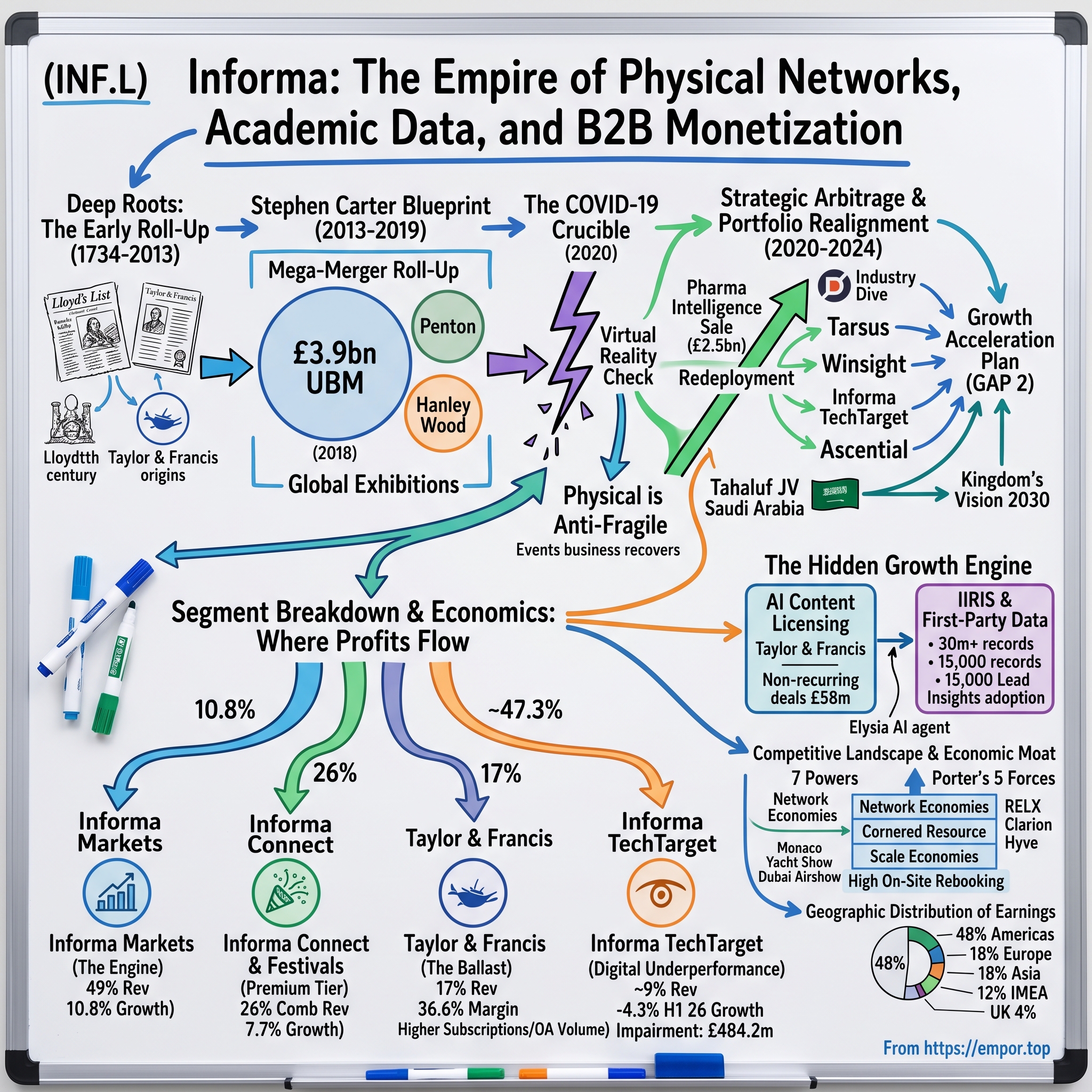
Informa plc: The Empire of Physical Networks, Academic Data, and B2B Monetization
I. Introduction & Episode Roadmap
On 17 November 2025, several hundred investors and analysts gathered in Dubai for a presentation by British FTSE 100 firm Informa plc. The deck carried a simple headline: Compounding Growth. Opening the presentation, Informa's investor relations director explained the decision to host the event in the Gulf rather than a hotel ballroom near Bishopsgate: it allowed attendees to "feel the vibrancy of this amazing city" and see how deep the company's roots in Dubai had grown.1 The second day featured a visit to the Dubai Airshow, one of the world's largest aerospace trade exhibitions, which Informa co-owns with the Dubai World Trade Centre.
Seated alongside Informa chief executive Stephen Carter was His Excellency Helal Saeed Almarri, head of Dubai's tourism department and director general of the Dubai World Trade Centre. Almarri outlined a venue expansion designed to add more than 50% extra capacity by the end of 2025 and roughly 100% by the end of the following year.1 Carter, who took charge of Informa in December 2013, recalled the portfolio he inherited a decade prior: a group owning "about 9 or 10 Trade Shows in the world, 11, if you include the Monaco Yacht Show," before moving to group those assets into a distinct division branded Global Exhibitions.1 The underlying premise presented to the room was that management had placed a long-term bet on physical gathering places across high-growth corridors, and that the strategy was compounding.
Four months later, conflict involving the United States and Iran disrupted Gulf airspace.2 Dozens of exhibitions and conferences across Dubai, Riyadh, Bahrain, and Qatar were postponed or cancelled. Informa rescheduled more than fifteen major brands out of the first half of 2026 and into the second — moving LEAP to September in Riyadh, Middle East Energy to September in Dubai, and Gitex Global to December.3 The company maintained its local staffing and venue commitments. When Informa released its half-year results on 30 July 2026, group adjusted operating profit had fallen 5.3% on a reported basis despite a 6.8% rise in underlying revenue, as event revenues shifted to the second half while fixed operating costs remained in the first.3
That gap — between the long-term growth narrative presented in Dubai and the operational, geopolitical exposure of managing over 800 physical events across 40 countries — defines the company's central investment case.
The company. Informa plc trades on the London Stock Exchange under the ticker INF.L. For the fiscal year ended 31 December 2025, the group reported revenue of £4,041.4m and adjusted operating profit of £1,139.8m. This yielded an adjusted operating margin of 28.2%, adjusted diluted earnings per share of 55.6p, and free cash flow of £884.8m — marking its fifth consecutive year of double-digit adjusted EPS growth.4 Measured by exhibition revenue, Informa is the world's largest trade show operator, ranking ahead of RELX's RX division, Messe Frankfurt, and Clarion Events.5 The group also owns Taylor & Francis, one of the five major global academic publishers, alongside a 57% controlling stake in Nasdaq-listed Informa TechTarget.17 In early August 2026, the company's shares traded around 900p, giving the group a market capitalisation of roughly £11bn.6
The thesis, stated neutrally. Informa's core thesis holds that major business-to-business trade shows act as natural monopolies benefited by inflation-linked pricing, negative working capital, and low capital intensity. Proponents argue that pairing this cash-generative event portfolio with subscription-based academic publishing and a proprietary data network creates a durable foundation for mid-to-high single-digit organic growth. The counterargument contends that top-line expansion has relied heavily on acquisitions rather than organic development, that live events carry higher geopolitical and cyclical risks than structural-growth claims suggest, and that recent digital investments have impaired capital.
Why this company is worth understanding. Informa remains one of the few major listed corporations whose core offering cannot be digitised, automated, or stored as inventory. Revenue in its largest division relies entirely on professionals travelling to physical locations. In a public equity market that has long rewarded asset-light, digital subscription models, physical events might appear structurally disadvantaged. Yet live events have proved to be the company's most resilient cash generator, whereas its digital, data-focused units have experienced write-downs and operational friction.
This dynamic illustrates both the strength and vulnerability of physical networks: the very physical presence that insulates trade shows from digital disintermediation leaves them fully exposed when regional transport corridors close.
Roadmap. The narrative begins with the eighteenth-century origins that shaped the company's current portfolio. It then examines the Carter era: a roll-up strategy that transformed Informa from a traditional British publisher into the leading B2B event operator, culminating in the £3.9bn acquisition of UBM. Next comes the impact of COVID-19 as an operational stress test, followed by subsequent portfolio realignments. The analysis then breaks down segment economics — examining how space is monetised — before evaluating management's newer growth initiatives in first-party event data and AI content licensing. Finally, it reviews competitive dynamics, economic moats, management execution, and key downside risks.
 Subscribe on LinkedIn
II. Deep Roots & The Early Roll-Up Playbook (1734–2013)
In the 1730s, Edward Lloyd's London coffee house near the Thames served as an informal trading floor where shipowners, captains, underwriters, and merchants gathered to exchange intelligence on vessel movements and maritime losses. Lloyd's List emerged as the printed record of those conversations — capturing the information exhaust of a physical network. The underlying business model anticipated Informa's modern strategy: convene key industry participants in a single location, then monetise the information that flows among them.
Sixty years later, London printer Richard Taylor launched The Philosophical Magazine in 1798 to catalogue scientific discoveries. In 1852, he partnered with chemist William Francis to establish Taylor & Francis.7 Though operating in publishing rather than shipping, the core commercial logic was identical: researchers needed a trusted, canonical forum to publish and validate their work, and academic institutions were willing to pay for access.
Both eighteenth-century ventures relied on a distinct structural advantage: neither Edward Lloyd nor Richard Taylor generated the underlying content. Ships sailed, insurers priced risks, and scientists ran experiments independently. Instead, the publishers controlled the coordination point where information was recorded and exchanged. Controlling a canonical coordination point creates a durable asset. It produces no physical goods directly, yet proves difficult to displace because moving market participants elsewhere requires convincing an entire industry to migrate simultaneously.
Informa's modern strategy remains an extension of this concept. A major trade show serves as a coordination point in physical space, while a high-impact academic journal serves as a coordination point for scholarly reputation. More recently, intent-data platforms represent an effort to establish digital coordination points across B2B markets — an initiative whose commercial viability remains unproven, as later sections detail.
These maritime and publishing lines remained separate for two centuries before converging during a wave of British media consolidation in the late 1990s. In 1998, conference organiser IBC Group plc merged with Lloyd's of London Press to form Informa, uniting live events with specialist publishing.7 Six years later, on 10 May 2004, Informa expanded its academic reach by completing a £509m merger with Taylor & Francis, issuing 17 Informa shares for every 10 Taylor & Francis shares.8
Informa subsequently pursued a debt-funded roll-up strategy. In July 2005, the group acquired conference operator IIR Holdings for $1.4bn (£768m), supported by a two-for-five rights issue that raised £311m net.8 The acquisition made Informa the world's largest publicly listed events, conference, and training company.7 Two years later, in July 2007, Informa acquired market intelligence provider Datamonitor for 650p per share in cash, valuing the business at approximately £502m.8
The 2008–2009 financial crisis exposed vulnerability in this expansion model. At the time, Informa's event operations relied heavily on small, regional conferences funded by corporate training budgets — discretionary expenditure that corporate clients quickly cut during economic contractions. Unlike major global trade shows with self-reinforcing network effects, smaller compliance seminars lacked pricing power and customer lock-in. Compounded by debt accumulated during the 2005–2007 acquisition drive, financial leverage mounted. In May 2009, Informa issued 170,050,097 new shares in a rights issue that raised roughly £242m net to restore balance sheet stability.8
The crisis highlighted a fundamental structural flaw: Informa operated as a loose holding company of autonomous assets sharing a corporate listing and treasury function, but lacking unified technology platforms, centralized customer data, or group-wide portfolio standards. While acquisition activity had expanded total revenue scale, it had not generated competitive synergies or defensible operational advantages.
This period illustrated the limits of acquiring assets based primarily on business adjacency. Pre-2013 deals were justified on the grounds that live conferences, business publishing, market data, and corporate training served overlapping corporate clients. However, adjacency provided no guarantee of market defensibility. IIR operated numerous small conferences rather than indispensable industry flagships, while Datamonitor produced market research that was not fully embedded in daily operational workflows. When corporate budgets tightened, clients easily reduced spending. Conversely, Tier-1 trade exhibitions — where entire industry supply chains physically converge — possess distinct lock-in characteristics, as exhibitors and buyers risk commercial isolation if they withdraw.
Between 2010 and 2013, Informa focused on balance sheet recovery and selective portfolio adjustments. The group made targeted event acquisitions, buying Canadian exhibition operator MMPI in 2012 and acquiring a stake in Baiwen, organiser of the China Beauty Expo, in 2013.7 Although these additions were too modest to alter group financial performance immediately, they shifted management's focus toward large-scale, international trade exhibitions.
By late 2013, Informa remained a diversified British information conglomerate with pressured margins and lagging digital capabilities. Its events portfolio continued to lean heavily toward smaller conferences; according to Carter's subsequent retrospective, the group controlled only about ten major global trade shows at the time.1 Meanwhile, its core long-term assets — Tier-1 exhibitions and Taylor & Francis's academic publishing operations — were sub-scale or under-capitalised.
When Stephen Carter, former chief executive of UK media regulator Ofcom, assumed the chief executive role on 1 December 2013, he inherited a group requiring strategic direction.9 The central question facing investors was whether subsequent restructuring would build genuine competitive advantage or merely assemble a larger collection of disparate assets.
III. The Stephen Carter Blueprint & The Mega-Merger Roll-Up (2013–2019)
Stephen Carter brought a non-traditional background to the role of FTSE 100 chief executive. Prior to joining Informa, he served as the founding chief executive of UK communications regulator Ofcom, chief of strategy to Prime Minister Gordon Brown, and minister for communications, technology, and broadcasting as Lord Carter of Barnes. His career also included executive leadership of advertising agency J. Walter Thompson UK and cable operator NTL. This trajectory produced an executive skilled in industry structure, media regulation, and complex commercial negotiations involving national infrastructure and venue concessions.
Carter joined Informa's board as a non-executive director in May 2010, became CEO-designate in September 2013, and assumed the role of group chief executive on 1 December 2013.9 His initial focus was operational diagnosis. He separated the trade show portfolio from the broader conference unit into a standalone division, naming it Global Exhibitions despite inheriting only eight or so major shows — a move intended to signal the group's long-term strategic focus.1
In 2014, management launched the Growth Acceleration Plan (GAP), reorganising the group into four divisions and redirecting capital from cost containment toward platform investments and targeted acquisitions.7 Central to GAP was a strategic pivot up the value chain from content-led conferences to transaction-led trade exhibitions. While content-led events rely on ticket sales to hear speakers and face competition from digital alternatives, transaction-led exhibitions monetize floor space by convening industry buyers and sellers, creating higher switching costs and stronger network effects.
Because establishing mature trade exhibitions organically requires decades, Informa pursued targeted acquisitions. In November 2014, the company raised approximately £207m by placing 45 million shares at 460p to acquire Hanley Wood Exhibitions, securing flagship events including North America's World of Concrete.8 The group expanded its healthcare and nutrition portfolio the following year by acquiring Virgo Publishing in 2015.7
A larger structural shift followed on 15 September 2016, when Informa agreed to acquire US-based Penton Information Services from MidOcean Partners and Wasserstein & Co for $1.56bn. The transaction was financed through $1.46bn in cash and $100m in Informa equity, supported by a fully underwritten one-for-four rights issue at 441p that raised £715m.108 Penton added approximately 30 trade shows — including Natural Products Expo, Farm Progress, and WasteExpo — alongside B2B media assets and data products.10 The acquisition established the United States as Informa's largest geographical market,10 and later that year the company joined the FTSE 100 index.7
The Penton transaction highlighted the strategy of acquiring market-leading positions in essential industry supply chains. Major exhibitions like Natural Products Expo function as primary commercial clearinghouses for their respective sectors. By operating the central gathering point for buyers and suppliers, the owner gains strong pricing power, as exhibitors face high commercial costs if they choose not to participate.
The financing structure of these acquisitions reflected a preference for equity funding over high debt leverage. Informa funded Hanley Wood through an equity placing, Penton through a combination of debt and a rights issue, and the subsequent UBM combination primarily through share issuance. While issuing equity diluted existing shareholders, it limited debt accumulation and preserved balance sheet resilience against unexpected operational downturns.
To integrate these acquisitions, management adopted an operating model that centralized capital allocation, technology systems, and customer data, while delegating local brand management and client relationships. This operational posture was summarized in internal corporate materials as "Think Big, Act Small" and "More Freedom, Fewer Barriers."3 By standardizing back-office infrastructure while preserving event branding, the group integrated four major acquisition platforms within eight years.
The UBM merger. On 30 January 2018, Informa announced a recommended offer for UBM plc, the world's largest pure-play business-to-business events organiser, valuing UBM at approximately £3.9bn in shares and cash.11 Upon completion on 15 June 2018,11 the combination established Informa as the world's largest trade show operator ahead of Reed Exhibitions. The transaction added major event brands across fifteen industry sectors, including pharmaceutical event CPHI, maritime show Marintec, fashion marketplace MAGIC, and cybersecurity conference Black Hat. Management targeted at least £60m in annual recurring pre-tax cost savings, projecting £50m in 2019 against £80m in one-off integration costs.31 Under an Accelerated Integration Plan, the initial combination phase was completed on schedule in October 2018.32
Executing the integration within five months unified sales, technology, and management structures prior to 2019. This single operational structure proved critical when global business travel was halted two years later.
Economically, the merger delivered substantial operational overlap in administrative infrastructure, venue contracting, and sales networks without cannibalizing revenues across non-competing industry verticals. However, by expanding Informa's live event footprint, the acquisition heightened the group's exposure to regional disruptions and reliance on physical attendance.
What the era actually proved, and what it did not. By 2019, Informa had assembled a global trade show business paired with a high-margin academic publisher, generating strong free cash flow with manageable financial leverage.
The 2013–2019 expansion demonstrated management's capacity to identify market-leading event assets, execute large-scale acquisitions, utilize equity financing to protect balance sheet solvency, and complete swift operational integrations. However, because reported financial growth was heavily driven by acquisitions, it remained unproven whether Informa could generate durable organic growth or build group-level synergies beyond the standalone economics of the acquired exhibitions.
This distinction between an asset aggregator and an operational developer defined the company's valuation debate entering the 2020s. An aggregator relies on acquiring mispriced assets, whereas an operator creates compounding value through organic top-line growth and operational efficiencies — explaining why management subsequently shifted focus toward underlying revenue metrics. Furthermore, six years of aggressive expansion in physical trade shows left the group's financial performance fully reliant on uninterrupted global travel and in-person business gatherings.
IV. The COVID-19 Crucible, Strategic Arbitrage & The Reinvestment Programme (2020–2024)
In the first week of March 2020 the phones at Informa's Blue Fin Building offices in Southwark started ringing with the same question from every direction: is the show going ahead? Within weeks the answer everywhere was no. Convention centres in Shanghai, Las Vegas, Frankfurt and Dubai emptied. An entire industry — one whose product cannot be delivered remotely, cannot be stockpiled, and cannot be deferred without cost — went to zero revenue while retaining its cost base.
The numbers were brutal. Informa's first-half 2020 revenue fell 42% to £814.4m and the group booked a statutory pre-tax loss of £801.2m.12 More than £1bn of budgeted 2020 event revenue was cancelled.12 The response was fast and unsentimental: the final dividend was scrapped, roughly £130m of annualised cost was removed including salary sacrifices by senior management, lenders were approached about covenant waivers, and in April 2020 the company issued 250,318,000 new shares — approximately 19.99% of existing share capital, the maximum permitted without a shareholder vote — as the funding centrepiece of a COVID-19 Action Plan.8
Two things about that equity raise deserve comment. First, it was dilutive and it was done at a depressed price, which is a real and permanent cost to the shareholders of 2019. Second, it was done in April, early, before the depth of the crisis was known, and it removed solvency from the list of questions the company had to answer for the following two years. Management chose survivability over per-share optics. That was the right trade, and it is the single strongest data point in favour of this management team's crisis judgement — but it should be recorded as a cost, not a triumph.
The virtual events reality check. The pandemic ran a controlled experiment that the industry had been arguing about for a decade. If trade shows are just information transfer, digital substitutes should work. They did not. Virtual event platforms proliferated and monetised poorly, and the reason is structural rather than technological. A trade show is not an information product; it is a trust and serendipity product. An exhibitor pays to be discovered by buyers they did not know existed, to have a supplier's samples handled, to have a distributor's contract negotiated over three days in a way that video calls cannot compress. The willingness to pay lives in the unplanned encounter and the physical demonstration, neither of which survives a scheduled thirty-minute video slot. When the halls reopened, exhibitors returned; the virtual products largely did not survive as standalone businesses.
Two other things happened in 2020 that only look significant in hindsight. Informa launched FasterForward, its sustainability programme, and created Omdia by consolidating its technology research assets into a single brand.7 The first mattered because convention centres, air travel and stand construction are carbon-intensive, and corporate exhibitors increasingly face internal pressure to justify event travel; an organiser without a credible sustainability answer will eventually face procurement resistance. The second mattered because it was the first attempt to give Informa's scattered technology assets a coherent identity — a project that would eventually lead, via several turns, to Informa TechTarget.
In 2021 the company launched a second Growth Acceleration Plan, GAP 2, as the recovery framework.7 Its logic was explicitly two-sided: rebuild the events business as demand returned, and simultaneously reshape the portfolio while asset prices were unusual.
The portfolio arbitrage. With the equity base repaired and events recovering, management made the most consequential capital allocation decision of the Carter era — and it was a sale, not a purchase.
On 10 February 2022, Informa agreed to sell Pharma Intelligence — the Citeline suite of clinical trial and drug development data products, plus Biomedtracker, Datamonitor Healthcare, Scrip and TrialScope — to Warburg Pincus, with Mubadala Investment Company co-investing.13 Informa sold 85% and retained 15%.14 Reported valuations of the transaction ranged from roughly $2.3bn to $2.6bn depending on treatment of the retained stake and debt; Informa's own transaction disclosures group the 2022 intelligence divestments — Pharma Intelligence, Maritime Intelligence and EPFR fund flow data — at a combined £2.5bn.8 The deal completed on 1 June 2022.14
The timing is what makes this remarkable. Early 2022 was the absolute peak of private equity appetite for recurring-revenue data assets. Rates were still near zero, leveraged loan markets were wide open, and any business with the words "SaaS-like" attached to it commanded multiples that had no precedent. Informa sold into that window. Within nine months, the financing environment for exactly that kind of asset had shut. Whatever else one concludes about this management team, they demonstrated an ability to distinguish between assets we like and assets someone else likes more than we do — which is rarer among corporate managers than it should be, because selling a good business is culturally harder than buying one.
Proceeds went three ways: debt reduction, a share buyback programme of £1bn committed from February 2022 through 2023, and redeployment into events and B2B digital.8
The redeployment. Between 2022 and 2024 Informa spent aggressively:
Industry Dive (2022) was acquired for a total enterprise value of $525m — a portfolio of B2B digital newsletters and journalism across roughly two dozen verticals, valuable less for its advertising revenue than for its permissioned reader data.
Tarsus Group (March 2023) cost $940m, funded with cash plus $210m of new Informa shares — the largest post-pandemic exhibitions acquisition, adding packaging, aviation, beauty and Chinese healthcare positions.15
Winsight (May 2023) cost $380m plus a $20m earn-out, bringing the National Restaurant Association Show and the Technomic research business into a new US foodservice vertical.16
Informa TechTarget combined Informa Tech's digital businesses with Nasdaq-listed TechTarget. Completion was announced on 2 December 2024, with the combined company's stock beginning trading under the ticker TTGT on 3 December and Informa holding 57% on a fully diluted basis.17
Ascential plc was bought for approximately $1.55bn, announced on 24 July 2024, with scheme shareholders receiving 568p in cash per share — a substantial premium to the undisturbed price — bringing the Cannes Lions International Festival of Creativity and the Money20/20 fintech events.18 The scheme became effective on 9 October 2024.19 Lions was placed into a newly created division, Informa Festivals, while Money20/20 initially sat within Informa Connect.19
Alongside the acquisitions ran a quieter and arguably more original strategy: partnership rather than ownership. On 30 November 2022, Informa and the Saudi Federation for Cybersecurity, Programming and Drones launched a joint venture called Tahaluf, explicitly framed as supporting the Kingdom's Vision 2030 economic diversification agenda, with a mandate to launch large-scale events across technology, food, pharmaceuticals, beauty, real estate and healthcare.29 Tahaluf built LEAP into one of the largest technology events in the world and began importing established Informa brands — Cityscape, CPHI, Cosmoprof — into Saudi Arabia. Saudi Arabia's Events Investment Fund subsequently acquired a stake in the venture.30
The structural insight here is important and is not obvious. In markets where the state is the principal sponsor of an industry's growth — the Gulf, and increasingly Southeast Asia — a foreign organiser cannot simply arrive and launch a show. It needs venue access, visa facilitation, ministerial endorsement and a domestic exhibitor base. A joint venture buys all four at the price of sharing the economics. It also, as the 2026 results demonstrated, ties a meaningful slice of the group's growth to a region's political stability. The 2023 acquisition of the HIMSS Global Health Conference added a comparable position in US healthcare technology.7
Two of these deals are defensible on the same logic as Penton and UBM: Tarsus and Winsight added defensible category positions at events multiples. Ascential is more debatable — Informa paid a premium price for two of the highest-margin, most brand-dependent event franchises in the world, assets whose value depends on continued advertising-industry and fintech-industry health rather than on physical supply chains. Cannes Lions is the marketing industry's annual self-celebration; its economics are excellent and its cyclicality is real.
TechTarget is the one that has gone wrong so far, and we will deal with it directly in the next section rather than defending it here.
By the end of 2024, the portfolio had been almost entirely reconstructed: sell the intelligence assets at peak private-market multiples, buy physical network positions and digital demand generation. Informa entered 2025 with a four-division structure and a new operating programme. The question was whether the pieces would compound — or merely coexist.
V. Segment Breakdown & Proportional Economics: Where the Profits Flow
At World of Concrete in Las Vegas each January, the core business model is on full display. Hundreds of thousands of square feet are filled with concrete-pouring equipment, formwork systems, diamond blades, and skid-steer attachments arranged in a grid. A mid-sized manufacturer of concrete pumps flies in a machine costing more than a house at its own expense to showcase it for three days. The exhibitor pays Informa for the floor space, pays a contractor to construct the booth, pays freight costs, and covers travel and lodging for its team. Most exhibitors repeat this process annually, often committing to the following year's booth space before leaving the hall.
That rebooking cycle underpins the financial model. Informa collects cash for floor space six to twelve months before incurring most event delivery costs. Working capital is structurally negative, as pre-funding customers finance operations, while capital expenditure runs at roughly 3% of revenue because Informa does not own the venues.3 The result is an asset-light cash-flow engine built on third-party real estate.
In 2025, group revenue of £4,041.4m and adjusted operating profit of £1,139.8m broke down across four operational divisions.4
Informa Markets — the engine (£1,964.1m revenue, ~49% of group). This division handles transaction-led exhibitions, including major brands such as CPHI Worldwide, World of Concrete, Marintec China, MAGIC, Gulfood, and the Dubai Airshow. Underlying revenue grew 10.8% in 2025.4 Revenue is derived overwhelmingly from sponsorship and exhibitor booth fees, while ticket sales and subscriptions account for a small minority.3 In the first half of 2026, the division generated £991.5m, representing 10.4% underlying growth, and management reported in July 2026 that roughly 90% of full-year exhibitor revenue was already secured.3
Informa Connect and Informa Festivals — the premium tier (£640.6m and £397.9m revenue, ~26% combined). Connect operates content-led events where delegates pay high registration fees for executive networking and industry content, including SuperReturn, BIO-Europe, and FAN EXPO. Festivals houses the former Ascential assets—such as Cannes Lions and Money20/20—alongside the Game Developers Conference (GDC). In 2025, Connect achieved 6.8% underlying revenue growth while Festivals posted 7.7%; Festivals' reported revenue more than doubled primarily because the 2024 comparison reflected only a partial period of ownership.4
The performance of the Festivals division highlights the operational risks inherent in premium brand events. In the first half of 2026, Festivals' underlying revenue grew by only 1.9%, which management attributed to the repositioning and relaunch of GDC.3 While a single-period strategy shift can explain temporary softness, it also illustrates that premium events carry heightened brand sensitivity: pricing power relies on maintaining a premier industry status that lacks contractual guarantees.
Taylor & Francis — the ballast (£670.8m revenue, ~17% of total, ~22% of adjusted operating profit). The group's academic publishing arm produces more than 2,700 peer-reviewed journals and over 200,000 specialist book titles through imprints such as Routledge and CRC Press. It operates at an adjusted operating margin of 36.6%, comfortably the highest among Informa's divisions.34
The economic engine of academic publishing differs fundamentally from live events. Historically, university libraries purchased annual subscriptions for journal bundles. Researchers contributed articles without direct monetary compensation, peer reviewers evaluated submissions without fee, and the publisher curated, validated, indexed, and distributed the work. The division's primary competitive advantage lies in its prestige infrastructure rather than the raw text. Because academic career progression depends heavily on publishing in journals with recognized impact factors and indexing citations, institutional libraries face high switching costs when considering cancellation, supporting high operating margins.
However, this business model faces regulatory and institutional headwinds. Open Access mandates from research funders are shifting the revenue model from reader-funded subscriptions to author-funded article processing charges. This transition converts a predictable subscription annuity into a volume-driven model dependent on article submissions and competitive on speed and price. In response, Informa has focused on expanding publication volume, recording more than 20% growth in research submissions and double-digit growth in published Open Access articles in 2025, a trajectory sustained through the first half of 2026.34
At first glance, Taylor & Francis's reported 2025 figures showed contraction, with revenue down 3.9%, underlying growth down 2.1%, and adjusted operating profit down 2.7%.4 However, these headline declines reflected tough prior-year comparisons. Excluding non-recurring AI data-access contracts signed in 2024, underlying revenue grew 3.6% in 2025.4 Excluding AI contract revenue, management guided to roughly 4% underlying growth for 2026, with a longer-term goal of 5%—compared to a historical baseline that management characterized as 0% to 2% during the traditional print and subscription era.3 In the first half of 2026, underlying growth reached 5.4%.3 While this indicates operational momentum, distorted baseline comparisons from one-off AI licensing deals make long-term trend evaluation difficult.
Informa TechTarget — digital underperformance (£368.0m revenue, ~9% of total, 3% of adjusted operating profit). This division provides B2B digital services, combining buyer intent data, lead generation, and technology media to help enterprise technology vendors identify prospective corporate buyers.
The operational mechanism relies on aggregated readership activity. When corporate technology buyers engage with articles across TechTarget's digital network, their reading patterns generate behavioral intent signals. By consolidating these interactions, the platform identifies specific corporate accounts actively researching solutions, allowing vendors to target prospective clients more efficiently than through unprompted outreach.
However, actual commercial performance has lagged initial acquisition underwriting. In June 2025, Informa recorded a non-cash goodwill impairment of £484.2m against Informa TechTarget after the listed unit's market capitalization dropped below its net asset value amid a 4.3% first-half underlying revenue decline.4 For full-year 2025, the division posted a statutory operating loss of £562.5m, generating £36.6m in adjusted operating profit at a 9.9% margin.4 This impairment was the primary driver reducing group statutory operating profit from £542.8m in 2024 to £141.7m in 2025, and pushing statutory diluted earnings per share down from 22.2p to 0.8p.4
This underperformance stems from broader market shifts alongside operational integration issues. Enterprise technology clients have redirected marketing and demand-generation budgets toward artificial intelligence infrastructure, while search engine traffic—the core audience feeder for digital media properties—has been disrupted by AI answer engines that fulfill user queries without directing traffic to publisher sites.3 During the H1 2026 earnings call, management estimated the revenue shortfall against its original combination model at $30m to $50m, citing AI-driven audience displacement, subdued US enterprise technology spending, and integration complexity.20 Division underlying revenue contracted 1.3% in the first half of 2026—a modest improvement over prior declines, but trailing management's stated target of positive full-year growth.320
As a standalone reporting entity, Informa TechTarget reported 2025 GAAP revenue of $486.8m and adjusted EBITDA of approximately $87.3m, while guiding for a return to top-line growth in 2026 with adjusted EBITDA of $95m to $100m.21 Achieving these targets represents the primary near-term test of whether the division's challenges reflect temporary integration friction or structural shifts in digital demand generation.
Geographic distribution of earnings. Segment reporting masks the extent to which Informa's financial performance depends on global geography. In the first half of 2026, the Americas generated 48% of group revenue, Asia (including Australia) accounted for 18%, Continental Europe represented 18%, the India–Middle East–Africa (IMEA) region provided 12%, and the UK—Informa's corporate headquarters and primary listing venue—contributed just 4%.3 Consequently, the domestic British market has a minimal impact on the company's operating results.
Regional growth targets further clarify management's geographic priorities. For 2026, management projected underlying growth of over 5% in the Americas on more than $1.5bn in event revenue; over 10% in Europe on more than $800m; over 10% across Southeast Asia, Japan, and South Korea on more than $250m; over 5% in Hong Kong on approximately $150m; and under 5% in mainland China on more than $360m.3 Meanwhile, the IMEA region generated $300m in revenue during the first half of 2026 alone.3
Mainland China represents the only major region where Informa guides to growth below 5%. Informa holds established Chinese assets, including CPHI China, Marintec China, Furniture China, Hotelex Shanghai, China Beauty Expo, and CIOE, making China larger by revenue than the entire IMEA region. However, a slowing domestic economy, constrained international business travel, and strong domestic competition limit expansion, positioning the market as a mature stabilizer rather than a growth engine.
Management's six growth levers. Management categorizes its B2B live events expansion across six operational levers.3 The first is price and yield optimization—increasing rates per square meter and improving product mix. The second is market penetration, attracting new exhibitor and attendee segments to existing events. The third is geographic replication, expanding established event brands into new territories, such as scaling Money20/20 across North America, Europe, Asia, and the Middle East. The fourth is capacity expansion, utilizing an expected 20% to 30% increase in regional venue space over five years to accommodate previously constrained shows. The fifth is attendee monetization, including premium ticketing, hosted buyer programs, and targeted matchmaking. The sixth is digital amplification services, encompassing data and marketing products.
The first four levers rely on traditional trade show operational playbooks backed by historical performance. By contrast, the fifth and sixth levers represent newer, digital-focused initiatives that management projects will contribute roughly one percentage point toward its targeted 7%+ growth rate in 2026.3 These data-driven levers remain the least proven elements of the expansion model.
Implications of the revenue mix. Approximately three-quarters of Informa's revenue—and an even larger share of operating profit—depends directly on in-person gatherings. Academic publishing provides high-margin, counter-cyclical stability. Conversely, B2B digital services, originally intended to transition the business toward a data-led model, generate minimal profit while suffering substantial capital write-downs. Ultimately, Informa remains more heavily concentrated in physical event operations than its four-division corporate structure suggests—a vulnerability directly exposed during regional travel disruptions.
VI. The Hidden Growth Engine: First-Party Data (IIRIS) & AI Content Licensing
In May 2024, Informa disclosed a non-exclusive data access partnership with Microsoft in a market update. The announcement triggered swift scrutiny across the academic community.
The AI licensing story. Taylor & Francis agreed to license its academic content to Microsoft for artificial intelligence model training in a deal valued at nearly £8m (around $10m) in its first year, followed by recurring payments over the subsequent three years.22 A second, unnamed AI partner entered a similar agreement shortly thereafter. By the end of 2024, the group recorded more than $75m (roughly £58m) in non-recurring data access revenue within Taylor & Francis, serving as the primary driver of the division's reported 14.5% underlying revenue growth that year.23
The financial mechanics of content licensing carry high operating margins because the incremental cost of licensing an existing digitized archive is negligible. Consequently, data licensing revenue flows almost entirely into operating profit. Within a division generating roughly £670m in annual revenue, £58m of near-100% margin revenue creates a substantial earnings boost—explaining why Taylor & Francis's reported 2025 revenue appeared to contract when comparing against the 2024 baseline.
Evaluating these transactions requires distinguishing between recurring operational growth and one-time content sales. Management explicitly categorized these contracts as non-recurring and urged investors to exclude them when calculating underlying baseline growth. During the first-half 2026 earnings presentation, management stated it was negotiating with two additional AI developers and noted stable pricing, arguing that validated scholarly research is becoming an increasingly scarce input for AI models.20 Proponents contend that as AI developers exhaust public web text and face heightened copyright enforcement, verified academic repositories will command sustained premiums. Conversely, critics argue these transactions represent one-time archive transfers, requiring AI developers to purchase only incremental content updates in subsequent years.
In a related development, a US federal court approved a $1.5bn copyright settlement in July 2026 between AI developer Anthropic and a class of authors and publishers over unauthorized training data.24 During Informa's first-half earnings call, analysts estimated Taylor & Francis's potential settlement share at £25m to £50m; management responded that calculation details remained under review for full-year disclosure and emphasized that any settlement proceeds would be recorded as an exceptional item rather than operating revenue.20 Consequently, any proceeds represent a single legal recovery rather than an ongoing commercial revenue stream.
The author backlash. The controversy surrounding AI licensing directly impacts the long-term sustainability of the publishing asset. Multiple scholars published by Taylor & Francis reported they were neither informed of the Microsoft agreement nor given an option to opt out, and received no additional compensation for model training use.22 Researchers criticized the arrangement as setting a concerning precedent for academic data commercialization, while the Society of Authors raised formal concerns regarding publishers monetizing creator output without prior consultation.25 Industry practices varied: peers including Wiley and Oxford University Press pursued similar licensing partnerships, whereas Cambridge University Press implemented an opt-in model for contributing authors.22
From a commercial perspective, management maintains that structured, fee-bearing license agreements offer superior protection compared to unauthorized web scraping. However, publisher revenues ultimately depend on maintaining relationships with top academic contributors. If author dissatisfaction damages Taylor & Francis's reputation, the long-term risk manifests in lower submission quality and diminished journal impact factors. Although research submissions grew over 20% in 2025, reputation erosion in academic publishing typically unfolds gradually over multiple years before becoming visible in financial metrics.
IIRIS and first-party data. Beyond academic publishing, Informa's data strategy focuses on its live events portfolio through IIRIS, a centralized customer data platform that consolidates attendee, exhibitor, and reader interactions across group brands into a unified identity layer. By mid-2026, the group reported holding over 30 million first-party data records and a reach across B2B audiences exceeding 8 million individuals.3
The commercial rationale for IIRIS addresses a historical limitation of trade show operations: organisers traditionally sold physical booth space annually with minimal visibility into attendee interactions on the exhibition floor. By tracking participant engagement, Informa offers exhibitors actionable lead intelligence through its Lead Insights product, which identifies prospective buyers and rank-orders follow-up priorities. By mid-2026, approximately 15,000 exhibitors across 160 events had adopted Lead Insights, transforming a once-a-year space lease into an ongoing service arrangement.3
Internally, Informa deployed a proprietary AI agent named Elysia, enabling staff to build over 3,000 internal productivity applications by mid-2026, alongside automated lead capture tools and post-event analytical summaries.3
Myth versus reality. Three prevailing market narratives surrounding Informa's digital and data strategy require rigorous evaluation.
First, the assumption that artificial intelligence is unequivocally beneficial for academic publishers oversimplifies contrasting forces. While proprietary scholarly archives provide high-margin training data, generative AI tools also risk displacing traditional information queries. If researchers use AI synthesis tools to evaluate scientific literature, institutional libraries may face declining usage, weakening their justification for costly subscription packages. This dual dynamic was visible across Informa's own portfolio in 2025, where Taylor & Francis captured AI licensing gains while Informa TechTarget suffered digital revenue displacement. The net long-term financial impact across academic publishing remains uncertain.
Second, the assertion that possessing millions of audience records constitutes a defensible competitive moat is unproven. Audience databases are widely owned across corporate events and trade publishing. A true data moat depends on whether proprietary information increases customer pricing tolerance or measurably improves event rebooking rates—outcomes Informa claims but does not separately disclose in financial reporting.
Third, first-party data initiatives do not transform Informa into a standalone software or data company. Management's segmental breakdown confirms that three-quarters of revenue continues to originate from physical trade shows. First-party data serves primarily as a retention tool to increase event customer stickiness and operating margins rather than an independent revenue growth engine.
Management projected that attendee value initiatives and digital marketing services would contribute approximately one percentage point toward its targeted 7%+ B2B Live Events organic growth in 2026.3 While this provides a measurable performance benchmark, Informa does not report standalone financial metrics for IIRIS or Lead Insights. Until independent segment disclosures are provided, first-party data is best evaluated as an operational enhancement rather than a proven secondary growth driver. This contrasts with peers such as RELX, which spent fifteen years embedding analytics into its core publishing workflow to build demonstrable pricing power—a transition Informa is in the early stages of pursuing.
VII. Competitive Landscape, Industry Structure & The 7 Powers / 5 Forces Framework
Consider a private equity firm with $2bn and a mandate to compete with Informa in global B2B exhibitions. The immediate question is where to attack.
A newcomer cannot attack head-on. Launching a rival to CPHI in pharmaceutical ingredients is unviable because the entire industry already blocks out those dates on its calendar, and no exhibitor will pay for a second stand at a venue buyers will not attend. Nor can a competitor undercut on price: booth rentals represent a fraction of total attendance costs compared to travel, freight, and staffing—meaning a 20% price discount will not move an exhibitor who fears missing key clients. The primary entry path is acquisition. Competitors must acquire independent shows from founding families and regional operators, competing with Informa in the deal market rather than on the exhibition floor.
This dynamic defines the competitive structure of the global trade show industry, explaining why market consolidation has remained relentless.
Who the players are. Ranked by exhibition-organizing revenue, Informa leads the global market at roughly $2.74bn in 2024, including the contribution from Ascential.5 RELX's RX division ranks second, having generated over $1.5bn in 2025 revenue with 8% underlying revenue growth and a 9% increase in underlying adjusted operating profit.26 Messe Frankfurt occupies third place, ahead of Blackstone-backed Clarion Events and fifth-placed Comexposium. Hyve and dmg events entered the top ten, with Hyve roughly doubling its revenue through acquisitions such as HLTH.5 Combined revenue across the top twenty organizers expanded from $8.77bn in 2023 to just over $10bn in 2024.5
Two structural insights emerge from this landscape. First, because the top twenty operators command only a fraction of a highly fragmented global market, the acquisition roll-up strategy retains significant runway—though executing it will require ongoing capital commitment from Informa. Second, European state-backed entities like Messe Frankfurt, Messe Düsseldorf, and Comexposium operate on a fundamentally different model than commercial organizers: they own their venues and benefit from municipal backing, giving them local cost advantages but restricting their ability to expand internationally. Informa's approach is the exact inverse—maintaining an asset-light posture with no real estate ownership to maximize global mobility.
This distinction highlights two contrasting business models within the trade show sector.
The venue owner model—represented by Messe Frankfurt, Messe Düsseldorf, and in a modified form by the Dubai World Trade Centre—monetizes physical infrastructure. It carries heavy fixed costs and balance-sheet real estate, driving an incentive to maximize hall utilization across all event types. Its local competitive position is highly defensible, as duplicate exhibition grounds are rarely constructed. However, its geographic expansion is constrained by the immobility of its physical assets.
The organiser model—operated by Informa, RX, Clarion, and Emerald—owns event brands and customer relationships while leasing space from venue owners. Operating with mostly variable costs, organizers enjoy global mobility. Their primary constraint lies in their status as tenants, which leaves them vulnerable to landlord pricing leverage in supply-constrained venue markets.
Informa's joint venture in Dubai represents an effort to bridge this divide. By pairing its event portfolio with the Dubai World Trade Centre's physical capacity, market access, and government relationships, Informa transforms its key venue supplier into a strategic partner and shares in venue economics. However, this structure requires sharing brand economics and conceding minority interests in attributable earnings. Whether this arrangement remains value-accretive across a full operating cycle remains unproven, particularly after regional geopolitical conflict tested scheduling flexibility in early 2026.
In the United States, publicly listed Emerald Holding offers a contrasting case study. Emerald operates a portfolio of domestic trade shows lacking international reach, relying primarily on acquisitions rather than organic expansion to drive top-line growth, whereas RELX's RX division has compounded organically at 8%.33 Emerald demonstrates the structural limitations facing a sub-scale organizer: constrained geographic optionality, absence of a group-wide data architecture, and weaker purchasing power when competing for target assets against larger acquirers.
7 Powers. Applying Hamilton Helmer's 7 Powers framework requires distinguishing Informa's genuine competitive advantages from management narrative.
Network Economies — This represents Informa's strongest structural advantage. A trade show operates as a two-sided marketplace where value to exhibitors and attendees increases with participation from both groups, often causing market share to concentrate into a single dominant event. In most industry verticals, a single flagship show commands the market, while secondary events capture a fraction of the value. This network density grants Informa pricing power, enables high on-site rebooking rates, and preserved its event franchises through the COVID-19 pandemic shutdown.
Cornered Resource — Partially present. Flagship assets such as Cannes Lions, the Monaco Yacht Show, Money20/20, and the Dubai Airshow possess unique brand equity that cannot be easily replicated. Informa's top fifty B2B event brands generated over $2bn in total revenue in 2026, with individual event contributions ranging from $16m to $140m, including more than ten brands generating over $50m each.3 However, these disclosures also indicate that no individual brand accounts for more than approximately 3.5% of group revenue. While this provides broad portfolio diversification, it also implies that no single cornered resource dictates group performance.
Switching Costs — Defensible in academic publishing, but less applicable to live events. While an exhibitor faces a high commercial risk by skipping an industry's primary gathering, that lock-in reflects network effects rather than true switching costs. The distinction is critical: true switching costs persist through cyclical demand shocks, whereas network effects remain vulnerable when market participation contracts.
Counter-Positioning — The least compelling power claim. The argument that physical events provide an antidote to digital advertising fatigue describes a broader secular trend rather than a proprietary advantage. Competitors such as RX, Clarion, and regional operators benefit equally from this tailwind, explaining industry growth rather than Informa's relative market share gains.
Scale Economies — A significant, underemphasized advantage. Group-wide technology infrastructure, centralized data architecture, unified marketing capabilities, and combined venue and hotel procurement deliver measurable cost advantages per event that independent operators cannot duplicate. This scale margin enables Informa to pay higher acquisition multiples for target shows while still generating accretive returns.
Porter's Five Forces. Threat of new entrants: Minimal in established industry verticals due to network effects, though higher in emerging sectors where execution speed outweighs incumbency. Threat of substitutes: Low, as demonstrated by the rapid return to live events post-pandemic. However, AI-driven procurement tools pose a long-term risk to the product discovery role of trade shows, even if they cannot replicate in-person transaction clearing. Bargaining power of buyers: Modest among individual exhibitors, though elevated in consolidated sectors where a small group of anchor exhibitors commands substantial floor space. Bargaining power of suppliers: Moderate but evolving. While convention centers operate as local monopolies with strong pricing leverage, venue capacity is expanding, with 20% to 30% additional space expected over the next five years across Informa's key growth markets; furthermore, the joint venture in Dubai transforms a major venue supplier into an equity partner.3 Competitive rivalry: Moderate on the exhibition floor, but intense in the M&A market, where acquisition multiples can compress capital returns.
In sum, Informa maintains a durable competitive moat around its individual flagship exhibitions. However, its moat at the group level remains narrower than the individual event moats suggest. While group-level data, procurement, and platform scale deliver real efficiencies, a significant portion of corporate capital is deployed competing for acquisitions against private equity sponsors.
A useful benchmark. The primary public peer for evaluating Informa is RELX. Both groups operate market-leading exhibition businesses alongside academic publishing divisions, though RELX also owns legal and risk analytics platforms that lack a direct Informa equivalent. In 2025, RELX expanded group underlying revenue by 7% to £9,590m, supported by 8% underlying revenue growth in its RX exhibitions unit; by comparison, Informa's B2B Live Events businesses delivered 9.5% underlying revenue growth and a 12.6% increase in underlying adjusted operating profit.426 Within the events sector, Informa has become both the larger and faster-growing operator—achieving a key objective established during the 2018 UBM acquisition.
However, financial valuation comparisons reveal a persistent divergence. RELX has historically commanded a premium valuation multiple relative to Informa. That premium reflects RELX's integration of scientific and legal data into workflow analytics and decision tools that clients embed directly into daily operations—generating recurring subscription revenue, high customer retention, and organic pricing power without reliance on continuous M&A. In 2025, RELX increased adjusted operating profit by 9% to £3,342m at a group operating margin substantially higher than Informa's, while its RX exhibitions division alone maintained operating margins above 40%.2633
Informa's strategy for narrowing this valuation gap centers on combining Taylor & Francis's academic publishing assets with its IIRIS first-party data network. However, the commercial efficacy of this digital transformation remains unproven at scale. Equity markets continue to value Informa primarily as a premier physical events operator rather than an integrated information analytics platform. Demonstrating that data integration can generate organic, software-like compounding remains the central long-term test for the company's valuation.
VIII. Management Credibility, Capital Allocation & Activist Stress Test
Listen to the H1 2026 earnings call and you hear a management team under polite but persistent pressure. Analysts wanted specifics on Gulf events. What were 2027 bookings pacing at? What were the assumptions behind the second-half recovery? Could management break out the rescheduled brands individually? The answers were consistent and consistently non-granular: 2027 bookings tracking slightly ahead of the prior year; regional variation is enormous; and a refusal to provide brand-by-brand guidance on the grounds that it would turn an investor update into an operating review.20
That refusal is defensible — no events company guides show by show — but it is also the kind of answer that, repeated across several quarters, erodes an analyst's ability to check the story. Investors should note where the disclosure line is drawn and watch whether it moves when results are good.
The track record. Assess management by behaviour over time and the record has four distinct chapters.
Target-setting. At the November 2025 Capital Markets Day, Informa committed to consistent 5%+ underlying revenue growth over three years, faster underlying profit growth, 8%+ underlying EPS growth, and more than £3.5bn of free cash flow across 2025–2028.27 For 2026 specifically it guided to 6%± group underlying revenue growth, 7%+ in B2B Live Events, 4%± at Taylor & Francis excluding data contracts, positive growth at Informa TechTarget, and double-digit underlying adjusted EPS growth.4 These are specific, checkable, and were reaffirmed at the half year despite the Middle East disruption.3
Delivery. 2025 delivered 6.3% underlying revenue growth, 8.7% underlying adjusted operating profit growth, a fifth consecutive year of double-digit adjusted EPS growth, and 106% operating cash conversion.4 Free cash flow of £884.8m was described as ahead of plan.4 On the operating metrics management asked to be judged on, they delivered.
Explaining misses. The TechTarget shortfall has been acknowledged specifically and quantified — $30m to $50m against plan, with three named causes — rather than blamed on "market conditions."20 The £484.2m impairment was disclosed at the half year rather than deferred to the full year. That is above-average candour for a FTSE 100 company.
Narrative consistency. This is where the sharpest question sits. The Dubai Capital Markets Day was an extended argument that the IMEA region was Informa's highest-conviction growth corridor, delivered from a stage in Dubai with the Trade Centre's chief executive alongside. Four months later, that corridor was the source of the group's only material earnings disappointment. Management did not change the story: it doubled down, kept headcount and brand investment in the region, appointed a heavyweight international media executive — David Lynn, formerly president and chief executive of ViacomCBS Networks International — as inaugural CEO of the Dubai partnership inD from 4 May 2026, and set inD a growth plan for 2027 to 2029.28
Consistency under pressure is a credibility positive. It is also, unavoidably, a concentration of risk on a single judgement call.
Capital allocation, assessed. The framework is explicit: 90%+ operating cash conversion, capex at about 3% of revenue, progressive dividends, then inorganic investment and share buybacks flexed against each other, within a target leverage range of 1.5x to 2.5x net debt to adjusted EBITDA.3
The record within that framework:
The Pharma Intelligence divestment stands as the best-timed decision of the era, for reasons already covered. It funded deleveraging, a £1bn buyback and the redeployment programme.8
UBM achieved the strategic objective — global leadership — and delivered its stated synergies, but carried incremental debt into a pandemic nobody forecast. Judged on process rather than outcome, it was a reasonable deal at a full price.
Ascential remains unproven. Informa paid a substantial premium for premium assets; Festivals' 1.9% underlying growth in the first half of 2026 is not yet evidence either way, given the GDC relaunch.3
TechTarget has, so far, destroyed value on the face of the accounts. The £484.2m impairment is non-cash, but non-cash does not mean costless: it is the accounting recognition that capital deployed did not earn its keep. The integration costs are cash — £84.4m of integration costs in 2025, principally relating to TechTarget and Ascential.4
Where the leverage and the accounting sit. Net debt including IFRS 16 stood at £3,066.2m at the end of 2025, with leverage of 2.4x — at the top of the stated range, and above the 1.5x–2.0x sweet spot that a conservative investor would prefer.4 Leverage remained at 2.4x at the 2026 half year, with free cash flow reducing it by 0.2x and buybacks adding 0.2x back.3 Adjusted net finance costs rose by £64.1m to £143.7m in 2025 as the €1.75bn note issued in October 2024 ran for a full period and a €700m note was refinanced at a higher rate.4 A €500m six-year Eurobond completed in 2026 extended average debt maturity to 4.4 years, with a forward weighted average cost of debt around 4.9% and £1.3bn of available liquidity, against ratings of BBB from Fitch, Baa2 from Moody's and BBB from S&P.3
Interest cost has therefore roughly doubled in two years, and every future acquisition is being financed at meaningfully higher rates than the deals of 2022–23. That materially raises the hurdle rate on the roll-up.
On accounting judgement: the gap between adjusted and statutory profit is very large and deserves scrutiny. In 2025, adjusting items in operating profit totalled £998.1m against adjusted operating profit of £1,139.8m.4 Roughly a third of that is the TechTarget impairment, but £342.5m is acquired intangible amortisation — the annual accounting cost of the acquisitions themselves, excluded from adjusted results.4 Informa's justification is standard and defensible: acquired intangible amortisation is not an ordinary operating cost, and the company does treat software and non-acquired product development amortisation as ordinary. But for a company whose strategy is acquisition, permanently excluding the amortisation of what it buys flatters the adjusted picture. An investor should look at both, and should note that statutory diluted EPS of 0.8p and adjusted diluted EPS of 55.6p describe the same year.4
The activist stress test. What would a skeptical investor push on?
Portfolio complexity. Informa now runs three live-events divisions, an academic publisher and a separately listed US digital business. A sum-of-the-parts argument writes itself: Taylor & Francis would attract a premium multiple as a standalone academic asset, and the events business is arguably worth more without a dilutive digital arm attached. The counter-argument is that Informa has already run this play once, profitably, with Pharma Intelligence — which suggests management would sell again if the price were right rather than defend the conglomerate on principle.
The TechTarget stake. Holding a controlling but not wholly-owned position in a listed US company creates complexity, minority interests that reduce attributable earnings, and an externally visible mark on management's judgement. Non-controlling interests rose to £42.7m in the first half of 2026 from £15.4m, largely from the creation of inD.3 An activist would ask directly: what is the plan if TechTarget misses its 2026 growth target?
The M&A treadmill. This is the central bear argument and it deserves a straight answer. In 2025, reported revenue growth of 13.7% comprised 6.3% underlying, 1.3% phasing, 8.0% from acquisitions and disposals, and negative 1.9% from currency.4 So more than half of headline growth was bought. However, the underlying number itself is calculated on a pro-forma basis that includes acquisitions from the first day of ownership in the comparative period — which means 6.3% is a genuine like-for-like figure, not a disguised acquisition effect. The fair conclusion: Informa is both organically growing at mid-single digits and consolidating. That is a more honest position than either camp usually concedes. The risk is not that the organic growth is fake; it is that the acquisition arithmetic gets harder as interest costs rise and private equity competes for the same assets.
Incentives. The remuneration structure runs a short-term plan with a maximum of 200% of salary for the chief executive, where financial measures — which may include underlying revenue growth, profit and cash flow — must make up at least 75% of the weighting, and a long-term plan with a maximum of 400% of salary measured over three financial years with a further two-year holding period, using measures that may include operating profit, operating cash flow, relative total shareholder return and ESG.9 Executive directors must hold shares worth 400% of salary for the chief executive and 275% for others, with post-employment holding requirements of 200% and 150% for two years.9 This is a reasonable structure: long horizons, cash flow explicitly measured, meaningful personal capital at risk. The critique available to an activist is that measures built on operating profit and EPS can be advanced through acquisition as well as through operations — the classic tension in any roll-up's pay design.
Currency, tax and the quieter exposures. Informa reports in sterling and earns roughly half its revenue in the Americas, which makes the dollar a material and underappreciated swing factor. The company discloses that a one-cent movement in the dollar-sterling rate moves annual revenue by about £21m, adjusted operating profit by about £8m, and adjusted EPS by 0.5p.3 With the average rate moving from 1.30 in the first half of 2025 to 1.35 in the first half of 2026, currency subtracted 1.7 percentage points from reported revenue growth and 1.9 points from adjusted operating profit growth in that period.3 Currency was also a 1.9-point drag on 2025 reported revenue.4 None of this affects the underlying business, but it does mean that a sterling-based investor's reported earnings will diverge from operating performance in both directions, and that management's habit of guiding on constant-currency underlying measures is analytically necessary rather than evasive.
The adjusted effective tax rate was 20.5% in 2025, up from 19.5%, and held at 20.5% through the first half of 2026 — stable, and unremarkable, which is what an investor wants.34 On the softer overlays: Informa has been included in the Dow Jones Sustainability Index for eight consecutive years, carries an AAA MSCI ESG rating and an A- CDP score.4 These matter less as ethical signals than as commercial ones, given that corporate exhibitors increasingly need a defensible answer on event travel emissions.
The exposure that receives least attention and probably deserves more is data privacy. A business whose emerging growth story rests on unifying more than 30 million first-party records across events, publications and digital properties, and on selling behavioural intent signals about named business buyers, is operating in exactly the area that GDPR, its successors and US state privacy regimes are tightening. A material regulatory finding, or a breach of the identity graph that underpins IIRIS, would damage both the product and the trust relationship with attendees who supplied the data at a badge scan. Informa has not disclosed a material incident, and none is alleged here — but the risk is structural to the strategy rather than incidental to it.
Buybacks versus deals. Informa returned around £620m in cash to shareholders in 2025, including a 2025 dividend of 22.0p per share, up 10%, and approximately £350m of buybacks.4 The 2026 buyback was set at £200m in January, raised to £250m in March on the explicit rationale of "equity market dislocation and depressed equity values," and raised again to £350m at the half year, with £430m+ of total cash returns year-to-date.34 By March 2026 the company had bought 8,702,552 shares at an average price of 834p.4
Buying back stock while explicitly stating that the market is undervaluing it is a legitimate signal — but it is also a signal that management has not found acquisitions clearing its return hurdle. Read charitably, that is discipline. Read skeptically, it is a company running out of accretive things to buy at a moment when its cost of debt has doubled. Both readings are consistent with the evidence.
IX. Playbook & Key Business / Investing Lessons
Stripping away company-specific details, Informa's execution over the past decade yields five core strategic lessons, each accompanied by an important limiting condition.
1. Physical marketplaces are anti-fragile to digital abundance — up to a point. Before 2020, many investors assumed video conferencing and digital channels would structurally displace trade shows. The forced remote-work experiment disproved that premise. As information becomes infinitely reproducible and machine-generated, scarce value shifts toward verification, trust, and serendipitous interaction — goods most efficiently delivered by gathering people in person. Informa's concept of the "AI time dividend" illustrates this dynamic: as automation absorbs routine administrative tasks, the relative value of professional time shifts toward activities requiring physical presence.4
The limiting condition is that physical gatherings protect an event's transaction function far more than its discovery function. If artificial intelligence tools become the primary mechanism for procurement managers to identify new suppliers, the marketing value of exhibiting erodes even if deal-closing value persists. That pressure would appear first among smaller exhibitors whose primary objective is customer discovery.
2. Sell assets when external buyers place a higher valuation on them. The Pharma Intelligence divestment demonstrated not market timing, but the recognition of a structural valuation gap. As a subscription data asset housed within a British events conglomerate, the business commanded a mid-teens earnings multiple in public markets; as a standalone entity sold to private equity in a low-rate environment, it commanded a far higher valuation. The broader lesson is that conglomerate discounts operate in both directions: assets whose growth stories are obscured inside a broader group often possess the cleanest standalone appeal to external buyers.
The limiting condition is that capturing this arbitrage requires executive teams to accept a smaller revenue footprint — a trade-off many corporate leaders resist.
3. Static archives can be monetized as active assets — with strict attention to earnings recurrence. Taylor & Francis converted a two-century academic publishing archive into high-margin revenue by licensing content for artificial intelligence model training. This mechanism applies broadly to organizations controlling proprietary, verified, and structured content repositories.
The critical limiting condition for investors is distinguishing between ongoing licensing rent and one-time asset sales. Informa's accounting treats these data-access contracts as non-recurring items and excludes them from underlying baseline guidance. Investors should similarly treat AI content licensing as non-recurring optionality rather than a predictable, compounding growth engine.
4. Leverage operational shocks to execute structural restructuring. The pandemic disruption enabled Informa to eliminate low-margin legacy conferences, flatten management tiers, renegotiate venue agreements, and modernize core technology platforms — actions that might have faced prolonged internal friction during normal operating conditions. Organizations that emerge stronger from systemic shocks are typically those that use operational crises to execute overdue structural reforms.
The limiting condition is that strategic restructuring requires surviving the initial disruption with balance sheet flexibility intact. Informa secured that flexibility through an early, dilutive equity issuance in April 2020, incurring upfront shareholder cost to ensure operational survival.
5. Acquire defensible market positions rather than short-term revenue. The key distinction between Informa's successful and underperforming acquisitions lies in whether the target held a structurally protected market position or merely a viable business. Acquisitions such as Penton, UBM, Tarsus, Winsight, and the Ascential event portfolio added category-defining gatherings with high customer lock-in. Conversely, assets like Datamonitor and portions of the digital media portfolio inside Informa TechTarget represented respected brands operating in contested markets. The former group preserved pricing power through major disruptions, whereas the latter proved vulnerable to corporate budget cuts. True revenue quality is determined not by initial growth rates or margins, but by the commercial consequences facing customers if they choose to withdraw.
The limiting condition is that protected market positions command high transaction multiples, restricting the pool of viable targets rather than lowering acquisition costs.
An underlying sixth lesson carries direct implications for the coming five years: every core advantage in event operations compounds within a specific industry vertical rather than across unlinked markets. Scale as the world's largest exhibition organizer does not guarantee success when launching into an unrelated vertical or region; dominance belongs to whichever show holds the premier position in that specific market. Consequently, the roll-up model requires continuous capital deployment and strict M&A discipline, facing its most rigorous test when borrowing costs are elevated.
X. Key KPIs to Watch & Epilogue
Most companies invite investors to track a dozen metrics. For Informa, three carry almost all the information.
1. B2B Live Events underlying revenue growth, and the forward-booked percentage behind it. This is the core engine — around three-quarters of group revenue — and management has committed to 7%+ underlying growth for 2026, against 8.0% delivered in the first half.3 What makes it uniquely trackable is the disclosure that accompanies it: because exhibitors pay months ahead, Informa publishes how much of the year is already secured. At the 2026 half-year, around 85% of major-brand event revenue was already traded or booked, roughly $4.5bn of the full-year target was committed or visible, and more than $800m of first-half 2027 revenue was already committed.3 Watch two things together: the growth rate, and whether the forward-booked percentage at each reporting date is pacing ahead of or behind the same point the prior year. A booked figure that stops pacing ahead is the earliest possible warning that pricing power or rebooking is softening — well before it appears in reported revenue.
2. Adjusted operating margin, divisional and group. The group delivered 28.2% in 2025, with B2B Live Events at 28.6% and Taylor & Francis at 36.6%.4 The first half of 2026 saw group margin fall to 26.6% from 28.4%, almost entirely because Gulf revenue moved to the second half while the regional cost base was deliberately retained.3 Management stated on the call that it expected full-year margin to be slightly up year-on-year once the deferred events ran.20 That is a specific, checkable promise. Margin is the cleanest single test of whether Informa's price increases are outrunning venue, labour and travel cost inflation — and whether the group-level scale advantages described earlier are real.
3. Informa TechTarget revenue growth and adjusted EBITDA. The smallest division by profit is the largest by uncertainty. The company has guided to positive revenue growth and $95m–$100m of adjusted EBITDA in 2026, against $486.8m of revenue and about $87.3m of adjusted EBITDA in 2025.21 Underlying revenue was still down 1.3% at the half year.3 Whether that guidance is met determines not only a segment's contribution but the market's read on whether management's judgement in digital is materially worse than its judgement in physical events. A second consecutive year of decline would move the debate from execution to strategy.
Two things deliberately excluded from this list: AI licensing revenue, because the company itself characterises it as non-recurring and guides investors to strip it out; and leverage, because at 2.4x within a 1.5x–2.5x stated range it is a constraint on future action rather than a live risk.
The case, and what breaks it. Informa wins from here if the leading positions in its top fifty brands continue to permit above-inflation pricing, if capacity expansion in Dubai, Riyadh, Bangkok and Jakarta gets filled at acceptable yields, if Taylor & Francis's submission growth converts into published revenue at the guided 4–5%, and if the data layer adds the promised point of growth. The evidence for the first is strong and directly observable. The evidence for the second is management assertion plus venue construction. The third is early but real. The fourth is unverifiable from outside.
The case breaks in four identifiable ways. Geopolitics is the live one: a business with 12% of revenue in a region where airspace can close is more fragile than "structural growth" language admits, and the 2026 disruption is a demonstration, not a hypothetical.3 Cost of capital is the slow one: with debt now around 4.9% and leverage at the top of the range, the roll-up arithmetic that produced a decade of returns is harder than it was. AI is the ambiguous one: it has already displaced revenue at TechTarget while creating a licensing windfall at Taylor & Francis, and nobody — including management — can yet say which effect dominates over five years. And execution is the ordinary one: a group running three events divisions, a publisher and a listed US subsidiary has more ways to disappoint than a focused operator.
Epilogue. There is a pleasing symmetry to this company. In the 1730s, information about shipping had value because ships were physical, cargo was physical, and the people who insured them needed to be in the same room to price the risk. Nearly three centuries later, in a world where information itself has become nearly free and increasingly synthetic, Informa's most valuable assets are — still — the rooms. Not the content, not the data, not the software: the three days each year when an entire industry has to be in one building.
What has changed is that the rooms are now instrumented. Every badge scan, every stand visit, every article read feeds a first-party dataset that the company is attempting to turn into its next moat, at exactly the moment that machines have learned to read everything humans have ever written. Whether Informa becomes the data business it describes, or remains an exceptionally well-run collection of irreplaceable gathering places with a data layer bolted on, is the open question. Both are viable businesses. Only one justifies the compounding story told from that stage in Dubai.
References
-
Informa PLC Capital Markets Day 2025 Transcript — Informa plc, 2025-11-17 ↩↩↩↩↩
-
The Gulf built a global events empire, now war is putting it on ice — CNBC, 2026-03-25 ↩
-
Informa Group 2026 Half-Year Results: Performance & Growth — Informa plc, 2026-07-30 ↩↩↩↩↩↩↩↩↩↩↩↩↩↩↩↩↩↩↩↩↩↩↩↩↩↩↩↩↩↩↩↩↩↩↩↩↩↩↩
-
Informa PLC 2025 Full-Year Results: Compounding Growth — Informa plc, 2026-03-12 ↩↩↩↩↩↩↩↩↩↩↩↩↩↩↩↩↩↩↩↩↩↩↩↩↩↩↩↩↩↩
-
Stax Top 20 Exhibition Organizers Ranked by 2024 Revenue — Grant Thornton / Stax, 2025 ↩↩↩↩
-
INF Informa plc share price and analysis — London Stock Exchange ↩
-
Corporate Transactions — Informa plc Shareholder Centre ↩↩↩↩↩↩↩↩↩↩
-
Informa PLC Directors' Remuneration Policy 2025-2027 — Informa plc, 2025 ↩↩↩↩
-
Informa Press Release: Acquisition of Penton — Informa plc, 2016-09-15 ↩↩↩
-
Informa completes acquisition of UBM — Conference News, 2018-06-15 ↩↩
-
Informa half-year 2020 results: £1bn+ cost of Covid-19 revealed as it books £801m pre-tax loss — Press Gazette, 2020-07-28 ↩↩
-
Warburg Pincus Announces Acquisition of Pharma Intelligence from Informa — Warburg Pincus, 2022-02-10 ↩
-
Completion of Pharma Intelligence Acquisition by Warburg Pincus from Informa Plc — Warburg Pincus, 2022-06-01 ↩↩
-
Informa Acquires Tarsus Group in $940 Million Mega Deal — TSNN, 2023 ↩
-
Informa Continues Expansion Into Specialist B2B Foodservice Market With Acquisition of Winsight for $380 Million — TSNN, 2023 ↩
-
Creation of Informa TechTarget, the B2B Growth Accelerator for the Technology Sector — Business Wire, 2024-12-02 ↩↩
-
UK's Informa to buy Cannes Lions owner Ascential for $1.55 bln — Reuters, 2024-07-24 ↩
-
Ascential plc: Scheme of Arrangement Becomes Effective — Investegate RNS, 2024-10-09 ↩↩
-
Earnings call transcript: Informa H1 2026 results — Investing.com, 2026-07-30 ↩↩↩↩↩↩↩
-
Informa TechTarget Reports Fourth Quarter and Full Year 2025 Results — Nasdaq, 2026-03-11 ↩↩
-
Academic authors 'shocked' after Taylor & Francis sells access to their research to Microsoft AI — The Bookseller, 2024-07-19 ↩↩↩
-
'AI time dividend' fuels booming 2024 income from events for Informa — Press Gazette, 2025 ↩
-
Anthropic's landmark $1.5B copyright settlement is approved — TechCrunch, 2026-07-20 ↩
-
Taylor & Francis AI deal sets "worrying precedent" — Inside Higher Ed, 2024-07-29 ↩
-
2025 Informa Capital Markets Day — Investegate / Informa plc RNS, 2025-11-17 ↩
-
Informa PLC: Appointment of inD CEO — Informa plc, 2026-04-16 ↩
-
SAFCSP and Informa launch 'Tahaluf' joint venture to support Saudi Vision 2030 — PR Newswire, 2022-11-30 ↩
-
Saudi Arabia's Events Investment Fund acquires stake in Tahaluf, the Informa-KSA strategic joint venture supporting Vision 2030 — Informa plc ↩
-
Recommended Offer for UBM plc by Informa PLC — Informa plc, 2018-01-30 ↩
-
Informa trading update: 'Combination phase' with UBM completed on schedule — Exhibition News, 2018 ↩
-
Earnings: RELX's Exhibition Division Delivers 8% Growth as Emerald Leans on Acquisitions — TSNN ↩↩
 LinkedIn
 WhatsApp
 Reddit
 Hacker News
 Email
Email Kindle
 RSS Feed
 Spotify
 Apple Podcasts
 Amazon Music
 Audible
 YouTube