 Chat with
this content: Summary, Analysis, News...
Chat with
this content: Summary, Analysis, News...
 Subscribe on LinkedIn


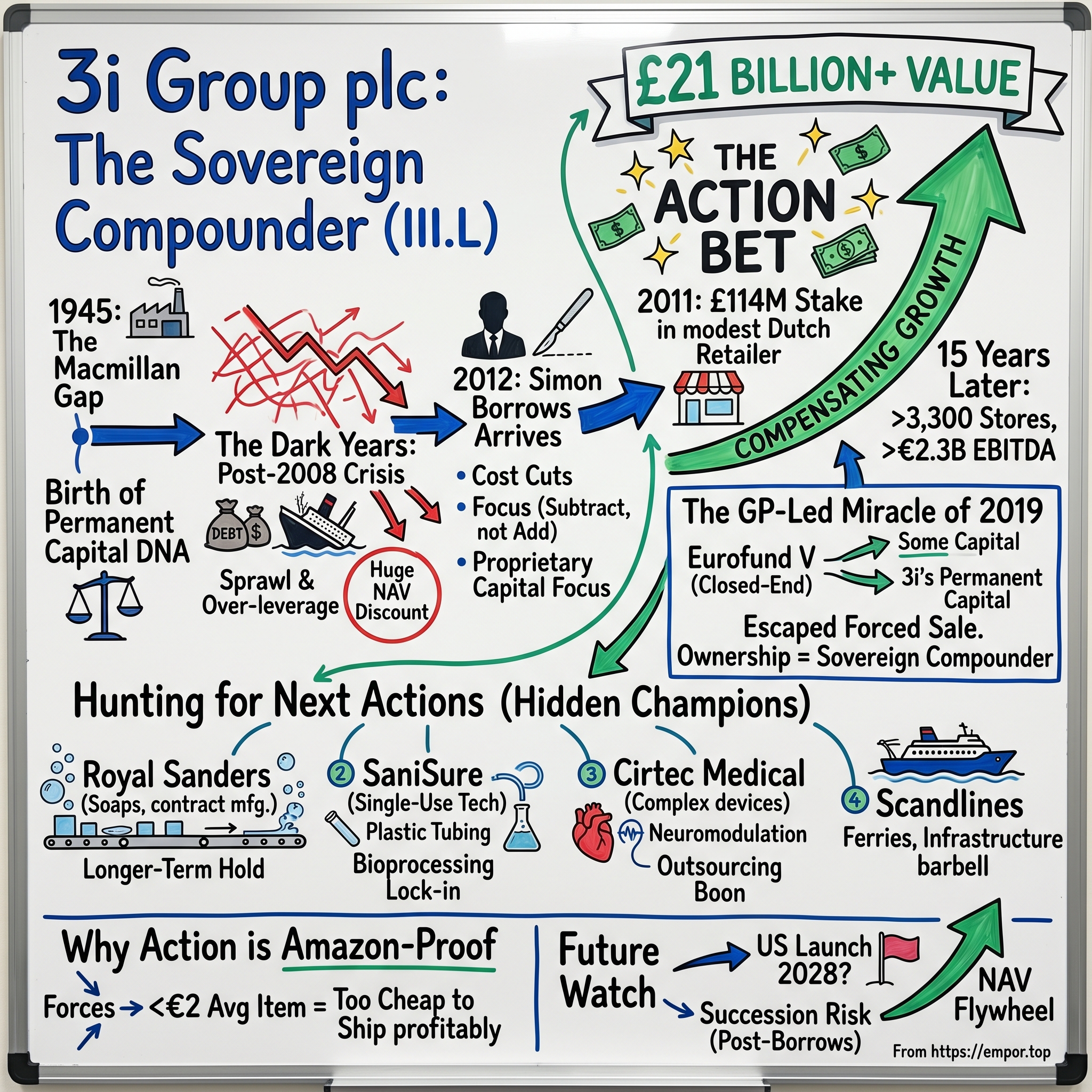
3i Group plc: The Sovereign Compounder of Private Equity
I. The £114 Million Bet That Became £21 Billion
In 2011, a buttoned-up British investment firm with roots in post-war reconstruction wrote a cheque of roughly £114 million in equity for a majority stake in a modest Dutch discount retailer. The business sold notebooks for a euro, detergent for under two, and laundry pegs by the bagful. It had fewer than 260 stores, clustered mostly across the Netherlands and Belgium, and almost no one outside the Benelux had heard of it. To the sophisticated dealmakers of the City of London and Wall Street, it looked like exactly the kind of unglamorous, regional retail concept that private equity firms flip in five years and forget.
That retailer was Action. The investment firm was 3i Group plc, listed in London under the ticker III.L.1
Fifteen years later, the math has become almost difficult to type without double-checking. Action now operates more than 3,300 stores across Europe and generates over €2.3 billion of operating EBITDA.2 3i carries its stake in the business at a value north of £21 billion — a return that, against that original sliver of equity, runs well past 100 times the money invested.[^3] There is no widely accepted accounting convention that makes that number look ordinary. It is, by almost any honest measure, the single greatest private equity investment in global financial history, and it is held not inside a glossy Silicon Valley venture fund but on the balance sheet of an institution that the British market had written off as a relic.
That is the puzzle at the heart of this story. Because in 2011, 3i was not a winner. It was a survivor at best — a sprawling, debt-laden, globe-spanning conglomerate of investment activities, its share price trading at a brutal discount to the value of its own assets, activists circling, and the financial press composing its obituary. The question this episode unpacks is how a semi-stuffy, 1945-vintage British institution transformed itself from that wreck into one of the most concentrated, highest-performing compounding engines in the world.
The answer turns on a single, deeply unfashionable idea: that the structure of your capital determines the destiny of your returns. Most of finance is organized around forced selling. Mutual funds chase quarterly performance; private equity funds must liquidate and return cash to investors on a clock. 3i, almost by accident of its history, possessed something nearly unique — a permanent balance sheet, what management came to call "proprietary capital," that allowed it to hold a winner for as long as the winning lasted. The genius of modern 3i was not in finding Action. Plenty of people could have found Action. The genius was in building a machine that did not have to sell it.
Here is the roadmap for how we get there. We start in the rubble of post-war Britain, where a structural flaw in the banking system gave birth to 3i's permanent capital DNA. We then walk through the firm's near-death experience — the years it forgot that DNA and tried to become an ordinary asset gatherer, culminating in the 2011 crisis. We meet Simon Borrows, the investment banker who arrived to perform corporate surgery and stayed to become an owner-operator. We benchmark the Action acquisition in forensic detail and explain why traditional private equity almost always fails to keep its unicorns. We dissect the 2019 financial-engineering masterstroke that rescued Action from forced liquidation. We tour the "hidden" champions — Royal Sanders, SaniSure, Cirtec Medical, Scandlines — that management hopes will become the next Action. And finally we war-game the moat using Hamilton Helmer's 7 Powers and Michael Porter's Five Forces to answer the question every investor asks: in the age of Amazon and 拼多多 Pinduoduo, how is a chain of physical discount stores still standing — and growing?
Let's go back to where it began, in a Britain still digging itself out of war.
II. The Macmillan Gap and the Accident of Permanent Capital
To understand why 3i could do something in 2019 that no Blackstone or KKR fund could, you have to understand a problem identified in a dry government report nearly a century ago — a problem with a wonderfully British name: the Macmillan Gap.
In 1931, in the aftermath of the financial chaos that followed the First World War and the onset of the Great Depression, a committee chaired under the eye of figures including the economist John Maynard Keynes examined the machinery of British finance. They found something missing in the middle. At the top of the economy, the great corporations could raise capital easily — they floated shares on the London Stock Exchange and issued bonds to institutions. At the bottom, a corner shop could get a short-term overdraft from its local bank manager. But in the vast middle — the ambitious manufacturer in Birmingham, the regional engineering firm, the growing company that needed patient, long-term capital to expand but was too small to go public — there was a void. Banks lent short and called their loans back; the stock market would not bother with anything that small. This structural hole became known as the Macmillan Gap, and it strangled exactly the kind of medium-sized industrial company that a recovering nation most needed.3
Fast-forward to 1945. The war is over, the country is broke, and the imperative to rebuild British industry is existential. The Bank of England, together with the major clearing banks, finally moves to fill the gap. They establish the Industrial and Commercial Finance Corporation — the ICFC — explicitly to provide long-term capital to small and medium-sized British businesses that the rest of the system ignored.3 Over the following decades the ICFC grew, merged with a sister body focused on larger industrial finance, expanded across the country branch by branch, and eventually rebranded under the name that survives today: Investors in Industry, mercifully shortened to 3i. The company listed on the London Stock Exchange in 1994.3
Here is the part that matters, the seed of everything that follows. The ICFC was not built as a fund. It was built as a permanent institution with its own balance sheet — capital that belonged to the company itself, not to outside investors who could demand it back on a schedule. When the ICFC backed a Midlands toolmaker in 1955, no clock started ticking that said "you must sell this position by 1965 to return cash to limited partners." There were no limited partners in that sense. There was just a balance sheet, and the patience to let an investment mature.
Contrast that with the architecture of modern private equity, the architecture that Blackstone, Carlyle, KKR, Apollo, and virtually every brand-name buyout shop run on. Those firms are general partners, or GPs. They raise money from limited partners, or LPs — the pension funds, sovereign wealth funds, endowments, and insurers who actually supply the capital. That money comes in the form of closed-end funds with a legally defined life, typically around ten years. The GP has a few years to invest the money, then must spend the back half of the fund's life selling those investments and handing cash back to the LPs, because the LPs were promised their money returned within a decade. It is a beautiful model for generating fees and forcing discipline. It is a terrible model for holding a once-in-a-generation compounder, because the calendar, not the business, dictates when you sell.
This is the strategic hook of the entire 3i story, and it is worth stating plainly because everything downstream depends on it. A traditional GP that bought Action in 2011 would have been contractually obligated to sell it around 2017 or 2018 — at which point the business was a fraction of what it would become. 3i's post-war heritage, the accident of being structured as a permanent institution rather than a fund, gave it the option that the rest of private equity structurally cannot exercise: the option to simply not sell. To act, in other words, as a sovereign compounder — owning a winning business indefinitely and capturing every euro of its growth, rather than renting it for a few years and being forced to give it away at the bottom of its trajectory.
There is a deep irony here, and it sets up the next act. For most of its history, 3i treated its permanent capital structure as a quaint inheritance rather than a weapon. By the late 1990s, dazzled by the riches the American buyout barons were minting off the fee-and-fund model, 3i's leadership decided that the thing to do was to stop being weird and old-fashioned — and start being just like everyone else. That decision very nearly killed the company.
III. The Dark Years: How 3i Almost Forgot Who It Was
If you want to watch an institution lose its identity, study 3i in the late 1990s and 2000s. The firm looked at the gleaming towers of American private equity, at the staggering personal fortunes being assembled by men who managed other people's money for a two-and-twenty cut, and concluded that its quiet, balance-sheet-driven, fund-itself approach was a competitive disadvantage to be corrected rather than a moat to be defended.
So 3i did what envious incumbents do. It chased assets under management. It set about raising large third-party funds — pools of outside LP money it would manage for fees, just like a proper GP. The flagship of this effort was Eurofund V, an enormous buyout vehicle raised in the mid-2000s that would, years later, become the unlikely vessel carrying the Action investment.[^5] The logic was seductive: managing OPM — other people's money — meant collecting management fees and carried interest on a far larger capital base than 3i's own balance sheet could ever supply. Why compound slowly on your own money when you could earn fees on billions of someone else's?
The asset-gathering impulse came bundled with a second disease: geographic sprawl. Flush with capital and ambition, 3i planted flags across the globe. It opened offices in Spain and Italy, chasing southern European buyouts. It pushed into Asia, establishing operations in 香港 Hong Kong and 上海 Shanghai.4 It tried to be all things to all markets — venture capital here, growth equity there, large buyouts somewhere else, infrastructure, debt, across more than a dozen jurisdictions and through a corporate structure that had ballooned to nearly twenty offices worldwide.4 Each office carried real estate, salaries, bonuses, travel, and management attention. Each new line of business diluted focus. The firm was running hard in every direction at once, and the synergies between, say, a Shanghai venture deal and a Milanese buyout were essentially zero.
Then 2008 arrived.
The Global Financial Crisis was an extinction-level event for over-leveraged, sprawling investment companies, and 3i had volunteered for the front line. The firm had carried significant debt at the corporate level — a fatal choice for an investment company, because when markets crash, the value of your assets falls while the face value of your debt does not, and the gap is borne brutally by your equity. 3i's portfolio valuations swung violently. Its bloated cost base kept consuming cash regardless of performance. And the market, looking at this picture, did the thing that punishes investment companies most savagely: it slapped a huge discount on the shares.
This discount mechanism is worth pausing on, because it recurs throughout the 3i story and it confuses people. An investment company like 3i has a Net Asset Value, or NAV — essentially the summed-up value of everything it owns, minus what it owes, divided by the shares outstanding. In a rational world the share price would hover near the NAV. But sentiment, leverage fears, and doubts about whether the stated asset values are even real can drive the price far below NAV. By the depths of the crisis and into the years after, 3i frequently traded at a discount of more than 50% to its NAV.5 Read that again: the market was saying it would rather pay less than fifty pence for a pound of 3i's assets, because it did not trust the leverage, the cost base, or the valuations.
By 2011, the verdict was nearly unanimous. 3i was an archaic, over-leveraged relic of British industrial history, a conglomerate discount waiting to be broken up. Activist investors were circling, sensing that the sum of the parts was worth more than the whole if someone would just take an axe to the corporate overhead. The company that had been built to solve a structural gap in British finance had become, itself, a structural problem.
What 3i needed was not a strategist with a clever new market to enter. It had entered too many markets already. What it needed was the opposite — someone with the discipline to subtract, the credibility to face down the activists, and the conviction to drag the firm back to the one thing its history had made it uniquely good at. In October 2011, that person walked in the door. And he happened to be the very banker who had taken 3i public seventeen years earlier.
IV. Simon Borrows and the Art of Subtraction
Simon Borrows did not arrive at 3i as an outsider learning the business. He arrived as a man returning to something he had helped create. Back in 1994, as a rising star in investment banking, Borrows had been intimately involved in 3i's listing on the London Stock Exchange.3 In the decades since, he had built a formidable reputation in the clubby world of independent advisory, ultimately serving as chairman of the boutique investment bank Greenhill & Co. in Europe.6 He was, in the parlance of the City, a serious person — a dealmaker who had spent a career sitting across the table from CEOs at their most vulnerable moments, advising on the mergers, defenses, and restructurings that define corporate fates.
He joined 3i as Chief Investment Officer in October 2011, and within months, in May 2012, he took over as Chief Executive.6 What followed was one of the most clear-eyed corporate restructurings in modern British finance, and its defining quality was a willingness to make the firm smaller in order to make it stronger — to subtract rather than add, in an industry addicted to growth for its own sake.
Borrows started with the cost base, and he did not tinker. He set a target to strip roughly £40 million out of annual operating costs, and he hit it by cutting deep into the organization — reducing the global workforce by more than a third.[^9] In an investment firm, where the assets walk out the door every evening, cutting headcount that aggressively is a delicate, dangerous business; cut the wrong people and you destroy the franchise. Borrows did it anyway, betting that a leaner, more focused team would outperform a bloated one.
Then he attacked the geographic sprawl. The map that 3i had spent a decade coloring in, Borrows began erasing. He closed six of the firm's nineteen offices, pulling out of Spain and Italy and shutting down the Asian outposts in 香港 Hong Kong and 上海 Shanghai.4 The strategic logic was ruthless and correct: 3i would concentrate where it had genuine edge and genuine deal flow — Northern Europe and North America — and abandon the vanity of being a global brand. The infrastructure of a sprawling empire was dismantled in favor of a tight, defensible territory.
But the deepest change was philosophical, and it is the move that made everything afterward possible. Borrows stopped chasing assets under management. He walked 3i away from the mega-fund arms race, away from the dream of competing with Blackstone for the title of biggest fund manager, and he re-oriented the firm around the one asset it had been ignoring: its own permanent balance sheet. Instead of investing primarily to earn fees on outside money, 3i would increasingly invest its own proprietary capital — which meant that when an investment compounded, 3i captured 100% of the upside rather than skimming a management fee and handing the bulk of the gains to third-party LPs.7 He took the inheritance the firm had spent fifteen years trying to disown and made it the centerpiece of the strategy. The "weakness" of being a permanent-capital balance-sheet investor was reframed, correctly, as the single greatest structural advantage 3i possessed.
It is one thing for a CEO to preach long-term ownership. It is another to build a compensation structure that forces the executives to actually live it, and this is where Borrows the dealmaker revealed himself as Borrows the owner-operator. The remuneration architecture he operated under was deliberately spartan at the base and enormous at the top, with everything tied to results that take years to materialize. His base salary was kept relatively modest for a man running a firm of this scale — on the order of £744,000 — while well over 90% of his potential total compensation was performance-linked.[^11] The long-term incentive plan stretched vesting over a five-year horizon: half the award vesting only after year three, and a quarter each in years four and five — all of it tied to hard measures of value creation, namely Net Asset Value growth and Total Shareholder Return.[^11] You cannot game a five-year NAV-growth target with a clever quarter. You have to actually build durable value and wait.
The ultimate alignment, though, was not in the incentive plan. It was in the open market. Over the years, Borrows accumulated a genuine ownership stake in the company he ran — by early 2026 holding directly somewhere around 1.76% of 3i Group plc, a position worth well over £400 million.8 That is not the holding of a hired-gun manager collecting a salary. That is the stake of a principal whose personal net worth rises and falls with the share price he is responsible for. When Borrows declined to sell a winning asset, he was, quite literally, putting hundreds of millions of his own money where his strategy was.
All of which set the stage for the decision that would define his tenure and the firm's history. Because right around the time Borrows was wielding the axe on costs and offices, a small team in 3i's Benelux operation was quietly watching a discount retailer in the Netherlands compound at a rate that, if you looked closely enough, was almost impossible to believe.
V. The Best Private Equity Deal in History
The treasure-hunt feeling is the whole point. Walk into an Action store and there is no elegant merchandising, no aspirational lighting, no carefully curated brand story. There are pallets and shelves stacked with several thousand different products — household cleaners, batteries, toys, garden tools, stationery, snacks, socks, picture frames, phone chargers — and a startling number of them cost less than two euros. The assortment rotates constantly, so the trip becomes a hunt: you came for laundry detergent and left with a €1.50 set of storage boxes and a €0.79 packet of crayons you did not know you needed. It is dopamine retail at rock-bottom prices, and it is profoundly, almost embarrassingly, effective.
Action was founded in 1993 in the Dutch town of Enkhuizen, built on the simple, unromantic proposition that if you sold genuinely useful everyday goods at prices low enough to feel like an error, people would come back again and again.9 By 2011, the formula was producing remarkable store economics. The real estate was cheap, often in secondary retail parks rather than prime high streets. Inventory turned over rapidly, which meant the business generated cash rather than swallowing it. And the proposition was so compelling that new stores reached profitability fast and customers returned with metronomic regularity. To 3i's Benelux team, watching from nearby, it was the rarest thing in investing: a business that was both growing quickly and gushing cash, with a model that had not yet been tested outside its home market.
In 2011, 3i and its managed fund Eurofund V acquired a majority stake in Action, taking control of the business and backing its management team to grow.[^5] Now we get to the part that separates a good deal from a legendary one — the price.
Action was acquired at an enterprise value of approximately €500 million, struck at a multiple of around 8.3 times EBITDA.[^5] To a non-specialist, an EBITDA multiple is simply a way of expressing how many years of the business's core operating profit you are paying to own the whole thing — pay 8.3x and, holding profit flat, it would take about eight years of earnings to get your money back. The lower the multiple, the cheaper the business relative to what it earns.
So was 8.3x cheap? To answer that, you compare it to what the public market was paying for similar businesses at the time. Discount retail comparables — companies like B&M in the United Kingdom, or Dollar General in the United States — were trading in the range of roughly 12 to 15 times EBITDA.10 3i, in other words, bought Action at something like a 30 to 45% discount to where comparable public discount retailers were valued. Far from overpaying, they got a bargain.
Why was such a bargain available? Because the market underwrote Action as a parochial curiosity. It was seen as a Benelux-only concept — a quirky Dutch format that worked in the flat, dense, bicycle-friendly Netherlands but had no proven ability to travel. The conventional wisdom held that discount retail is intensely local, that supply chains and consumer tastes do not cross borders cleanly, and that a chain of 260-odd stores in the Low Countries had limited geographic runway. That skepticism — the belief that the format could not scale — is precisely what created the discount. The seller and the broader market were pricing in a ceiling that 3i suspected did not exist.
And here is the masterclass in what 3i did next, because it is the opposite of what most private equity firms do. The standard buyout playbook is to acquire a business and then change it — re-engineer the operations, swap out management, layer on debt, cut costs, optimize for a sale in five years. 3i did almost none of that to the core proposition. Instead of changing the model, they poured fuel on it. They backed the existing management team and the existing formula and pointed it at the borders. Stores rolled out into Germany, into France, into Belgium — and the "cheap and cheerful" Dutch format, the thing the market swore could not travel, traveled beautifully.2 German shoppers loved the treasure hunt. French shoppers loved the prices. The thesis that Action was a local concept disintegrated, and as it did, the value of 3i's €114 million equity cheque began its climb toward the stratosphere.
There was, however, a problem buried in the structure of the deal — a ticking clock that had nothing to do with how well Action performed and everything to do with the legal vehicle it was held in. Action was sitting inside Eurofund V, and Eurofund V was a fund. Funds, as we established, have to end. By the time anyone fully appreciated what 3i had on its hands, that clock was running down, and the firm faced a choice that would either crown the investment or squander it.
VI. The GP-Led Miracle of 2019
By 2019, Action was no longer a quirky regional retailer. It was a European phenomenon, compounding its store count and its profits at a pace that put it among the fastest-growing retailers on the continent. And 3i was staring directly at the structural trap we described at the very beginning of this story — the trap that the firm's permanent-capital heritage was supposed to let it avoid, but which the specific legal wrapper of this specific asset threatened to spring anyway.
The trouble was Eurofund V's vintage. It was a 2006-era fund, and by 2019 it was deep into the back end of its legal life.[^5] The LPs in that fund — the pension funds and institutions who had committed capital back in the mid-2000s — were entitled to their money back. Under the ordinary rules of the private equity game, 3i's fiduciary duty to those LPs left only one path: sell Action, crystallize the gain, and distribute the cash. The asset would have to go — either floated on a stock exchange in an IPO, or sold to a mega-buyout fund with the firepower to write a multi-billion-euro cheque.
This is the exact moment where the careers of most private equity firms reveal their structural ceiling. A traditional GP, in 2019, sells Action. It books a phenomenal return, sends triumphant letters to its LPs, collects an enormous slug of carried interest, and walks away — having handed the compounding engine of a lifetime to whoever bought it next. The buyer goes on to capture the next decade of growth. The seller gets a great IRR and a permanent case of seller's remorse. This is why traditional private equity, structurally, almost never keeps its unicorns: the model is designed to force the sale precisely when the business is hitting its stride.
3i refused to play it that way. Instead, Borrows and his team executed what became one of the most celebrated GP-led single-asset secondary restructurings in the history of the industry — a piece of financial engineering elegant enough to satisfy two completely opposed constituencies at once.11 The mechanism worked like this. 3i created new investment vehicles — the 3i 2020 Co-investment structure — and used them to effectively buy Action out of the dying Eurofund V at a fresh, independently negotiated valuation. That valuation put Action's enterprise value at approximately €10.25 billion, or around 18.2 times EBITDA.[^16]
Pause on that journey for a moment, because it is the whole story compressed into two numbers: an enterprise value of about €500 million in 2011 had become €10.25 billion by 2019. The business was now valued at more than twenty times what 3i paid for it eight years earlier.
The restructuring gave the original Eurofund V LPs a genuine choice — the choice the traditional model never offers them. They could cash out entirely, taking their winnings off the table. Or they could roll their interest over into the new vehicle and stay invested in Action's future. For those who cashed out, the numbers were the kind that get framed on office walls: a gross money multiple of roughly 31.3 times their original investment, and a gross internal rate of return of about 75%.[^16] An LP who had put a euro into the relevant part of Eurofund V got back something like thirty-one euros. That is not a good private equity outcome. That is a generational one.
And on the other side of the transaction stood 3i, doing the thing its entire restructured identity was built to do. Rather than letting Action escape, 3i deployed its own proprietary balance-sheet capital to buy out the exiting LPs, increasing its direct ownership of the business in the process.[^16] Over the years that followed it kept leaning in, lifting its direct stake from roughly 44% through the 2019 transaction and onward to around 62.3% by late 2025.[^17] Where a normal GP sold its winner, 3i bought more of it — and funded that purchase not with a new fund it had to raise and someday liquidate, but with permanent capital it never has to give back.
Critics, predictably, raised an eyebrow at the optics. When a firm buys an asset partly from a fund it manages, using vehicles it controls, at a price it has a hand in setting, the obvious accusation is that 3i was "buying from itself" at a flattering valuation — marking Action up to suit its own book. It is a fair question to ask of any GP-led deal, and it is exactly the kind of conflict that regulators and LP advisory committees scrutinize. But the defense was grounded in market reality. At 18.2x EBITDA, Action was actually valued in line with — or even below — fast-growing public discount peers like B&M, which traded in the 16 to 18x range at the time, and Action was compounding its EBITDA at well over 25% a year.10 A business growing profits at 25%-plus annually arguably deserves a higher multiple than a slower-growing peer, not a lower one. The valuation, far from being a self-dealing inflation, looked defensible against the public comps — and it bought 3i the one thing it most wanted: indefinite, permanent ownership of the asset on its own balance sheet, free at last from the tyranny of a fund's expiry date.
The trap had been sprung and survived. Action was now 3i's to hold for as long as it chose. But that very success created a new and uncomfortable kind of risk — the risk of a portfolio increasingly dominated by a single, magnificent asset. Which raised the question that has consumed Borrows and his team ever since: where is the next Action?
VII. The Hidden Champions: Hunting for the Next Action
Concentration is a double-edged sword, and 3i has spent the last several years living on the edge of it. With Action grown to represent roughly three-quarters of the value of 3i's entire private equity portfolio, the firm is, to a first approximation, a leveraged bet on a single European discount retailer wrapped in a London-listed holding company.[^18] That concentration is the source of its spectacular returns and, simultaneously, its most obvious vulnerability. So the central strategic task occupying management is the search for businesses that can absorb meaningful capital and compound the way Action has — the hunt for the next quiet monster.
It helps to understand how 3i is actually built, because the firm is really two distinct engines bolted to one balance sheet. The first and dominant engine is the Private Equity portfolio, a book worth on the order of £29.7 billion, which is where Action and the other operating businesses live — high-growth, proprietary-capital-backed ownership stakes.[^18] The second engine is Infrastructure, with assets under management of roughly £6.9 billion, run largely through a separately listed vehicle, 3i Infrastructure plc, ticker 3IN.L.[^18] This second engine is a different animal entirely: it is fee-generative and defensive, holding essential assets in areas like digital communications, the green energy transition, and transport, throwing off steady yield rather than explosive growth. Together they give 3i a barbell — a high-octane equity portfolio on one end, a stable infrastructure income stream on the other.
Within the private equity book, three businesses in particular have been groomed as potential heirs to Action, and they are worth knowing because they tell you what kind of moats 3i looks for.
The first is Royal Sanders, and it is the closest thing 3i has to a second Action in spirit. Royal Sanders is a leading European manufacturer of personal care products — soaps, shampoos, body washes, lotions — made largely on a private-label and contract basis, meaning it produces the goods that retailers sell under their own store brands rather than under a flashy consumer brand of its own.[^19] It is an unglamorous, picks-and-shovels business, and that is exactly the point. 3i acquired it in 2018 and has run a deliberate consolidation strategy, using Royal Sanders as a platform to roll up a highly fragmented European private-label manufacturing sector through a steady cadence of bolt-on acquisitions — including the purchase of Vendoleo in 2025.[^19] The strategy is patient compounding: buy a fragmented industry one piece at a time, integrate, and grow the earnings base. The market recognized the maturity of this thesis when, in its FY2024 reporting, 3i formally designated Royal Sanders as its second official "longer-term hold" asset — joining Action in that elite category — after the business crossed an internal threshold of £100 million in EBITDA.[^20] That designation is 3i's way of saying: this one, too, we intend to keep and compound rather than flip.
The second is SaniSure, and it represents a deliberate move into a completely different, higher-science end of the economy. SaniSure is a global leader in what the industry calls Single-Use Technology, or SUT, for bioprocessing.[^21] If that phrase means nothing to you, here is the plain-English version. When a pharmaceutical company manufactures a biologic drug — the complex, protein-based medicines and cell and gene therapies that increasingly define modern medicine — it has historically used large stainless-steel tanks and tubing that must be painstakingly cleaned and sterilized between each batch, an expensive and contamination-prone process. Single-use technology replaces those steel systems with pre-sterilized, disposable plastic bags, tubing, and containers that you use once and throw away. It is faster, cleaner, and far less prone to costly contamination. SaniSure designs and supplies these components, and the beauty of the business is the lock-in: once a SaniSure component is specified — "designed in" — to a drug maker's validated manufacturing process, it is extraordinarily difficult and risky to swap it out, because any change can trigger a costly regulatory re-validation. That stickiness translates into high-margin, recurring revenue, and it makes SaniSure a pure-play bet on the secular boom in biologics and advanced therapies.
The third is Cirtec Medical, which plays an adjacent but distinct tune in the same broad healthcare orchestra. Cirtec is a specialized contract designer and manufacturer of complex, often implantable medical devices — think neuromodulation systems that send electrical signals to nerves, or precision components for structural heart procedures.[^22] The investment thesis rides a powerful and durable tailwind: the giants of the medical device industry are increasingly outsourcing the design and manufacture of their most complex products to specialized, heavily regulated third parties who can do it better and cheaper than they can in-house. Cirtec sits in exactly that outsourcing sweet spot, in a niche where regulatory complexity and engineering difficulty create high barriers to entry. Like SaniSure, it is a bet that the boring, regulated, mission-critical middle of the healthcare supply chain is a wonderful place to own a business.
And on the infrastructure side of the barbell sits the most charming asset in the portfolio: Scandlines, a ferry operator running the short, busy crossings between Germany and Denmark.12 Scandlines is the closest thing in the real world to a toll bridge. It carries cars, trucks, and passengers across a body of water on routes where the alternatives are limited and the demand is steady regardless of the economic weather. The cash flows are predictable, non-cyclical, and rich — the defensive yin to Action's growth-driven yang. It is exactly the kind of asset 3i's permanent capital is suited to own: dull, essential, and reliably cash-generative for decades.
None of these four is going to become Action overnight; Action is, after all, a once-in-financial-history event. But collectively they reveal the pattern behind 3i's hunt — a preference for businesses with structural lock-in, fragmented industries ripe for consolidation, and demand that does not blink when the economy does. Which brings us to the deepest question of all, the one that determines whether the crown jewel itself can keep compounding: in an age when e-commerce has flattened entire retail categories, why hasn't Amazon simply crushed Action?
VIII. Why Action Is Amazon-Proof
Every investor who first encounters the Action thesis asks the same skeptical question, and it is the right question to ask. We have lived through two decades in which e-commerce systematically dismantled physical retail — booksellers, electronics chains, department stores, toy stores, all hollowed out by the relentless convenience of a package on the doorstep. So how, exactly, does a chain of physical discount stores not only survive but thrive against Amazon, against 拼多多 Pinduoduo, against the flood of ultra-cheap goods from 名创优品 Miniso and the global discount machine? To answer that properly, we war-game the moat through two frameworks — Hamilton Helmer's 7 Powers and Michael Porter's Five Forces — and the answer turns out to be both structural and, satisfyingly, almost arithmetic.
Start with Helmer's framework, which identifies the specific, durable sources of competitive advantage that let a business sustain returns. Action exhibits several of them in textbook form.
The primary power is Scale Economies. Action is the largest non-food discount retailer in Europe, and that scale feeds directly into its cost structure in a way no regional competitor can match. The company buys a focused assortment — on the order of 6,000 core SKUs — but it buys them in colossal, centralized volumes for more than 3,300 stores across multiple countries.2 When you are placing orders that large, your purchasing power over suppliers becomes overwhelming; you secure per-unit prices that a smaller chain buying for a few hundred stores simply cannot approach. That procurement advantage flows straight to the shelf as lower prices, which drives more volume, which increases purchasing scale further — a self-reinforcing loop that systematically lets Action underprice not just other discounters but traditional supermarkets across whole categories. Scale here is not a vanity metric; it is the engine of the entire cost advantage.
The second power is Process Power, and it lives in Action's supply chain and store operations, which function with an almost industrial precision. The stores are highly standardized in layout, so a shopper or an employee moving between any two Action locations finds essentially the same environment, which slashes training costs and operational complexity. Replenishment is rapid and systematized, fed by a proprietary logistics network of regional distribution centers. And the inventory itself churns relentlessly — a large share of the assortment rotates constantly, which is what powers the "treasure hunt" feeling for customers while keeping working capital ultra-lean for the company.2 This is a hard thing to copy not because any single piece is secret, but because the integrated whole — the layouts, the logistics, the replenishment cadence, the supplier relationships — has been refined over decades and works as a system.
The third power operates not at the store level but at the parent level, and it is the most elegant of all: Counter-Positioning. This is the structural advantage we have circled throughout this story — 3i's permanent proprietary capital model, counter-positioned against the entire traditional GP industry. A conventional private equity competitor cannot simply copy 3i's "hold forever" approach, because that competitor's whole business depends on raising new funds every few years and selling assets to demonstrate returns and return capital to LPs. To hold a cash-flow monster like Action indefinitely, a traditional GP would have to blow up the very fund-and-fee model that pays its bills. 3i can hold; its competitors structurally cannot follow without self-harm. That is counter-positioning in its purest form, and it is why 3i, not some larger and more famous buyout firm, is the one quietly compounding Europe's best retail asset.
Now turn to Porter's Five Forces, and specifically to the force everyone worries about: the threat of substitutes — namely, e-commerce. This is where the "Amazon-proof" claim stops being a slogan and becomes arithmetic.
The average price of an item sold at Action is under €2.2 Sit with that number, because it is the entire defense. The economics of e-commerce — the picking, the packing, the last-mile delivery of a physical object to a person's front door — carry a roughly fixed cost per parcel that does not shrink no matter how cheap the contents are. It costs a delivery network real money to get a box from a warehouse to a doorstep, and that cost is stubbornly high relative to a €1.50 bottle of detergent or a €1 notebook. No one — not Amazon, not 拼多多 Pinduoduo, not any delivery service on earth — can profitably ship a single one-euro item to a home. The shipping cost alone dwarfs the product's value. E-commerce is brilliant at delivering things where the item value comfortably exceeds the fulfillment cost; it breaks down completely at the bottom of the price spectrum, and the bottom of the price spectrum is precisely where Action lives. Action's physical, ultra-low-cost, treasure-hunt footprint is therefore not vulnerable to e-commerce — it is structurally insulated from it. The very cheapness that makes the proposition irresistible to shoppers is the same cheapness that makes it impossible to disrupt online.
The remaining forces only deepen the moat. The bargaining power of suppliers is strikingly low: because Action buys in such enormous volumes, suppliers — frequently major consumer-goods manufacturers looking to offload surplus production or run customized low-cost packaging — depend on Action to clear inventory at scale, which tilts pricing power firmly toward the retailer. And competitive rivalry, while real, is geographically muted. Competitors exist — B&M in the UK, and globally the Japanese hundred-yen and variety chains like 株式会社大創産業 Daiso — but none has replicated Action's specific, continental-European scale, and it is that scale-driven cost advantage that local rivals cannot match.10 A competitor can copy the store format; it cannot easily copy the purchasing power that comes from 3,300 stores.
So the moat is not magic. It is physics and arithmetic — the fixed cost of a delivery van set against the price of a one-euro notebook, and the purchasing power of continental scale set against a fragmented field of local imitators. Which makes the bull case for 3i unusually concrete. But concreteness cuts both ways, and the same concentration that powers the upside defines the risk. It is time to war-game both sides.
IX. Bull, Bear, and the Question of Simon Borrows
The bull case for 3i rests on two pillars, and the first is geographic runway. For all of Action's success, the map is far from filled in. The chain has continued pushing into new European territories, with management having signaled plans to enter Bulgaria around 2027 — but the genuinely transformative item on the horizon is the United States.13 Action has been preparing a launch into the American market, targeting the Southeast region, planned for 2028.13 The significance is hard to overstate. The United States is the largest consumer market on earth, with a deeply entrenched culture of dollar-store and discount shopping. If Action's format — the same format the market once swore could not even leave the Netherlands — can travel across the Atlantic and work in America, the company's total addressable store count could plausibly double. That is the optionality embedded in 3i's share price: a second continent's worth of runway, largely unproven and therefore largely unpriced.
The second pillar of the bull case is the proprietary capital flywheel, which is the entire architecture of this story turned into a self-funding machine. The cash dividends thrown off by mature, cash-generative businesses like Action and Royal Sanders flow back to 3i's balance sheet, and that cash can be reinvested directly into the next generation of high-growth assets — the SaniSures and Cirtecs of the healthcare portfolio, or new platforms entirely — without 3i ever having to go cap-in-hand to third-party LPs to raise a fund. The winners fund the hunt for the next winners. It is a closed loop of compounding, and it is exactly the model 3i was structurally built for in 1945 and rediscovered under Borrows after 2012. As long as the flywheel spins, 3i can grow its NAV without dilution and without the fundraising treadmill that constrains every traditional GP.
But every concentrated bet carries a concentrated risk, and the bear case is just as concrete.
The first and most obvious is concentration risk. 3i is, to be blunt, close to a one-stock stock. With Action representing the overwhelming majority of the private equity portfolio's value, the fate of 3i's NAV is bound tightly to the fate of a single retailer in a handful of European countries. If consumer spending in France or Germany — Action's two largest markets — were to slow materially, or if the business were to stumble operationally, or face a regulatory or supply-chain shock, the impact on 3i's valuation would be severe and immediate. There is no diversified portfolio cushioning the blow. The same focus that produced the spectacular returns removes the margin for error.
The second bear argument is more subtle and lives in the world of how the market chooses to value 3i — the NAV premium question, and the short thesis that has periodically attached to it. Recall that for years after the financial crisis, 3i traded at a steep discount to its NAV. In the modern era, the opposite has often been true: 3i has frequently traded at a premium to its stated NAV, with the market willing to pay more than the accounting value of the assets because it believes Action is conservatively carried and still compounding fast. Skeptics and short-sellers — the genre of activist research firms that probe exactly these situations — have at various points questioned whether that premium is justified, scrutinizing the valuation methodology behind Action's carrying value.14 The risk for shareholders is one of re-rating. If sentiment shifts — if the market decides to value 3i as an ordinary, diversified investment trust deserving of a discount, rather than as a hyper-focused operating company deserving of a premium — the share price could de-rate sharply even if Action's underlying business does nothing wrong. In a premium-to-NAV stock, multiple compression is its own distinct risk, separate from operational performance.
The third risk is the most human: key-man risk. The entire modern strategy — the cost discipline, the focus, the conviction to hold Action through the 2019 restructuring, the proprietary capital model — is inseparable from Simon Borrows. He is the architect, and he is, as of 2026, an executive in his late sixties.15 The uncomfortable question for long-term holders is succession. If and when Borrows steps back, does 3i retain the ruthless cost discipline and strategic focus he imposed, or does the institution drift back toward the empire-building, asset-gathering instincts that nearly destroyed it before he arrived? Cultures built by a single dominant leader are fragile precisely because they are personal. The £400-million-plus stake aligns Borrows perfectly while he is in the chair; it says nothing about who sits there next. For an investor underwriting a multi-decade compounding thesis, the durability of the institution beyond its current CEO is not a footnote — it is central.
If you strip all of this down to what an investor should actually watch quarter after quarter, the dashboard is mercifully short. The first and most important indicator is Action's like-for-like sales growth and store-count expansion — because Action is the asset, and its same-store sales trajectory plus the pace of new openings is the single clearest read on whether the compounding engine is still running. The second is the valuation multiple at which 3i carries Action and the resulting NAV growth, because that is where the bull and bear cases collide; a rising NAV driven by genuine earnings growth is healthy, while NAV gains driven primarily by multiple expansion are more fragile. And the third, for those watching the long arc, is progress on the "next Action" candidates and the US launch — evidence that the proprietary capital flywheel is producing a second generation of compounders rather than leaving 3i a single magnificent asset slowly approaching maturity. Track those three, and you are tracking the thesis.
X. The Lesson: Structure Dictates Destiny
So what is the ultimate lesson of 3i and Action, when you stand back from the dazzling numbers and the financial engineering?
It is that structure dictates destiny. Had 3i been organized as a conventional ten-year private equity fund — the way nearly every brand-name firm in the industry is organized — it would have been forced to sell Action around 2017 or 2018, booking a perfectly respectable several-times-money return and handing the next decade of compounding to whoever wrote the cheque. It would have been celebrated as a great deal. It would also have been a catastrophic act of value destruction relative to what holding the asset actually produced. The only reason 3i could make the rational decision — to keep its winner and let it run — is that an accident of post-war British history had given it a permanent capital structure rather than a fund with an expiry date. The 1945 institution built to fix the Macmillan Gap turned out, three-quarters of a century later, to possess the one structural feature that the entire modern private equity industry lacks. In investing, your holding period is your greatest competitive advantage, and 3i's holding period was, quite literally, forever.
From that central truth fall three lessons worth carrying away.
The first is to let your winners run. The temptation in investing is to act — to trade, to crystallize gains, to feel the satisfaction of a closed position. But the largest fortunes are made not in the buying or the selling but in the waiting, in the discipline to sit on a compounding asset through years of growth while everyone around you finds reasons to take profits. 3i's billions came not from cleverly timing an entry and exit but from refusing to exit at all.
The second is that alignment is everything. The reason 3i held Action rather than selling it for a quick, career-making fee is inseparable from the fact that the man making the decision had hundreds of millions of pounds of his own money riding on the long-term outcome. Simon Borrows did not behave like a fund manager optimizing for this year's carry because his incentives were not a fund manager's incentives. When the decision-maker is a genuine owner, the decisions change.
And the third is that moats can be physical. In an era intoxicated by software, by network effects and digital platforms and the supposed inevitability of online disruption, 3i's crown jewel is a chain of physical stores selling one-euro notebooks. Its moat is not code. It is the unbridgeable arithmetic of a delivery van's cost set against a product priced too low to ship, reinforced by the purchasing power of continental scale. Some of the most resilient competitive advantages in the modern economy are not digital at all — they are built on physical scale and low-margin, high-volume logistics that e-commerce, for all its power, simply cannot touch.
References
-
3i Group plc Official Website (company heritage and history) — 3i Group ↩↩↩↩
-
3i Group plc (III.L) Company Profile and Strategy History — Reuters ↩↩↩
-
3i Group plc Share Price and Analysis — London Stock Exchange ↩
-
3i Group plc Official Website (board and leadership) — 3i Group ↩↩
-
3i Group plc Official Website (proprietary capital model) — 3i Group ↩
-
3i Group plc (III:LN) Quote and Insider Holdings — Bloomberg ↩
-
3i Group plc Stream (Action valuation and retail peer coverage) — Financial Times ↩↩↩
-
GP-Led Single-Asset Restructuring of Action — Secondaries Investor ↩
-
3i Group plc Stream (Action expansion plans, US and new markets) — Financial Times ↩↩
-
3i Group plc (III.L) Analyst and Short-Interest Coverage — Reuters ↩


 RSS Feed
 Spotify
 Apple Podcasts
 Amazon Music
 Audible
 YouTube