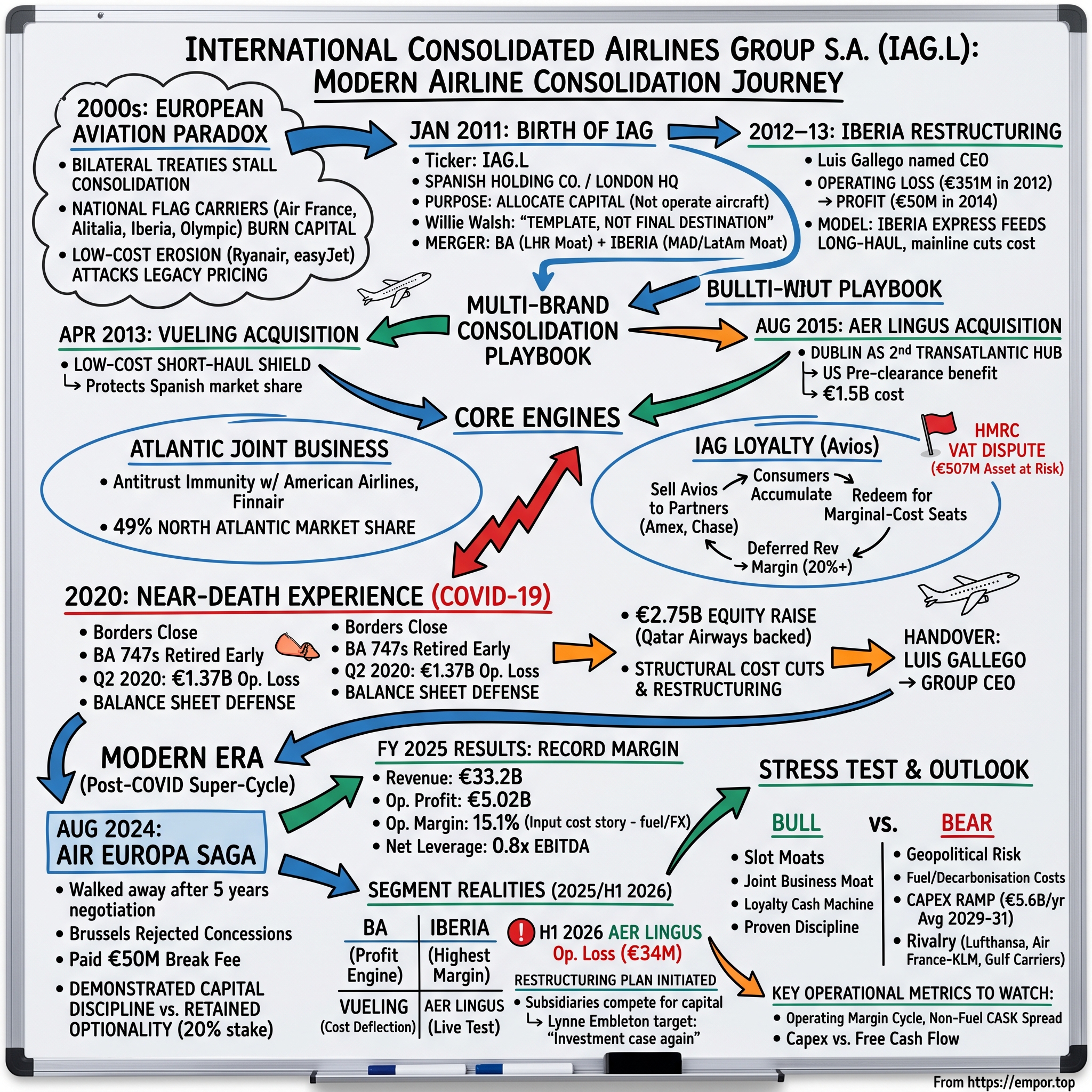
International Consolidated Airlines Group S.A. (IAG.L): The Architecture of Modern Airline Consolidation
I. Introduction & Episode Roadmap
On the morning of Monday, 24 January 2011, a new ticker appeared simultaneously on the exchanges of London, Madrid, Barcelona, Bilbao, and Valencia. It represented a company that had never flown a passenger, painted an aircraft tail, or held a route licence. International Consolidated Airlines Group S.A. was a Spanish-registered holding company with a head office in London, 406 aircraft it did not operate, and roughly 57 million annual passengers it did not carry.1 Everything it owned was held through operating subsidiaries. What IAG actually did — its core strategic purpose — was allocate capital.
That distinction sounds like a legal footnote. It turned out to be the foundation of the business model.
Fifteen years later, the entity born from the merger of two struggling flag carriers reported annual revenue of €33.2 billion and an operating profit before exceptional items of €5.02 billion — a 15.1% operating margin at the top of the group's own 12–15% medium-term target range.2 Return on invested capital reached 18.5%, up from 17.3% the prior year. Free cash flow stood at €3.1 billion, and net leverage was 0.8 times EBITDA. For an industry that Warren Buffett once described as a place where a farsighted capitalist at Kitty Hawk would have done investors a favour by shooting down Orville Wright, these are exceptional numbers.
Six months later, however, the group reported that first-half 2026 operating profit had fallen 6.4% to €1.76 billion, that Aer Lingus had swung to a €34 million operating loss, and that full-year capacity growth had been cut to zero after Middle East conflict shuttered a slice of the network.[^3] The share price, trading at 433.5 pence in early August 2026, sat well below its 52-week high of 492.9p, giving the group a market capitalisation of roughly £19.1 billion — a valuation implying that public markets remain skeptical that these earnings are permanent.3
That tension defines the investment case. The central question is whether IAG has built a structure fundamentally different from the European legacy carriers that destroyed capital for four decades, or whether it simply enjoyed a post-pandemic cyclical peak with a cleaner balance sheet than its peers.
The bullish thesis rests on four core claims. First, that the holding-company structure effectively disciplines capital by forcing operating airlines to compete for funding rather than automatically receiving it. Second, that the group controls scarce infrastructure, principally slot portfolios at London Heathrow and Madrid Barajas, that competitors cannot replicate. Third, that IAG Loyalty, the business behind Avios, is a capital-light, high-margin annuity embedded within a cyclical industrial carrier. Fourth, that management has maintained capital discipline under pressure — demonstrated when it walked away from the Air Europa acquisition in August 2024 and paid a €50 million break fee rather than accept regulatory remedies that would have gutted the deal's logic.4
Each claim can be empirically tested. Some withstand scrutiny better than others.
Here is the roadmap for this analysis. The story begins in the European aviation market of the 2000s, where bilateral treaties and ownership regulations stalled consolidation while low-cost carriers like Ryanair and easyJet eroded legacy pricing power. It traces how Willie Walsh built the multi-brand group — combining Iberia, Vueling, and Aer Lingus — and imposed strict return hurdles that European airline managements had rarely faced. It evaluates IAG Loyalty to test whether the high-margin narrative matches disclosed figures, which fall below market folklore. It covers the 2020 pandemic crisis, the €2.75 billion emergency equity raise, and the leadership transition to Luis Gallego. It examines the post-pandemic recovery, the abandoned Air Europa deal, and an ongoing tax dispute with HMRC that could alter how Avios revenue is accounted for. It breaks down the unit economics of each operating airline, including Aer Lingus's shift into an operating loss. It stress-tests the group's competitive moat using Hamilton Helmer's 7 Powers and Porter's Five Forces. Finally, it concludes with the critical operational metrics that track whether the long-term thesis remains intact.
 Subscribe on LinkedIn
II. The European Aviation Paradox & The Birth of IAG (1997–2011)
Picture a map of Europe in 2003 with a flag planted on every capital city, and beneath each flag, an airline. Not a business exactly — more a national appendage with wings. Air France for France. Alitalia for Italy. Sabena for Belgium, until it was not. Olympic for Greece. Iberia for Spain. Each had its own maintenance base, its own pilot union, its own political patron, and its own persistent inability to earn its cost of capital.
The reason this menagerie survived was not commercial. It was legal.
Aviation is governed by bilateral air service agreements, a framework inherited from the Chicago Convention of 1944 and built on a simple premise: a country grants landing rights to another country's airlines, and those airlines must be substantially owned and effectively controlled by nationals of that country. Buy a foreign airline outright and you risk voiding its traffic rights — the very asset you paid for. In the United States, when the industry imploded in the 2000s, Chapter 11 bankruptcy provided a mechanism to shred labour contracts, dump pension obligations, and merge. Delta absorbed Northwest. United took Continental. American merged with US Airways. Three mega-carriers emerged with rationalised hubs and restored pricing power.
Europe had no such release valve. Instead, it relied on state aid, political rescues, and a slow, grinding erosion.
Into that erosion flew the low-cost carriers. Ryanair and easyJet did not just undercut legacy short-haul fares; they attacked the underlying economics that legacy fares depended on. A flag carrier's short-haul network existed largely to feed the long-haul hub — a passenger flying Manchester to Heathrow was really a passenger flying Manchester to Singapore. The low-cost carriers offered that Manchester passenger a direct flight to Alicante for £29 and removed the leisure segment from the equation, leaving legacy carriers operating high-cost regional operations for a shrinking pool of connecting traffic. Short-haul stopped being a profit centre and became a subsidised distribution channel — a structurally unprofitable position.
By 2008, British Airways and Iberia were both cornered — but cornered differently, which made them a complementary pair.
British Airways owned the single most valuable piece of aviation real estate on earth: capacity at London Heathrow. Heathrow served as the premium long-haul hub where corporate travellers paid for schedule frequency and were relatively insensitive to fare. But BA carried structural burdens — a pension deficit that at points exceeded the airline's market value, labour agreements written in an era when the carrier was a state monopoly, and revenue heavily concentrated on North Atlantic routes that swung with the US economic cycle. The 2008 financial crisis hit BA's premium cabins directly, and cabin crew industrial action was still running when IAG listed.1
Iberia's problem set was inverted. Its labour relations were equally contentious, with Spanish aviation unions having a long history of shutting down operations. Its short-haul market was being eroded by Vueling and Ryanair. Yet it held an asset BA could not replicate: Madrid Barajas as the primary European gateway to Latin America. Language, history, migration flows, and business ties made the Madrid–Latin America corridor a durable franchise rather than a mere route map. Iberia had the strategic gateway but lacked operating discipline. BA had operational discipline problems in a different form alongside a strong balance-sheet-adjacent asset base.
The merger structure, completed in January 2011, was a piece of legal engineering as much as commercial strategy. Rather than one airline purchasing the other — which would have triggered ownership-and-control clauses and put traffic rights at risk — the two carriers became sister subsidiaries beneath a newly created Spanish-registered parent company headquartered in London. British Airways remained British and preserved its bilateral agreements. Iberia remained Spanish and retained its Latin American rights. Both preserved their brands, air operator certificates, liveries, and separate management teams. What was pooled above them was central strategy, capital allocation, fleet procurement, and final authority over capital distribution.
Willie Walsh was explicit at the listing that this structure was a template rather than a final destination. His stated goal was for "more airlines but, importantly, the right airlines to join the group," describing the debut as "the first step towards creating a multinational multi-brand airline group."1
This contrasted with the alternative consolidation model of the era. Air France and KLM had merged in 2004 under a superficially similar dual-brand structure, but spent subsequent years demonstrating the limits of a corporate centre lacking real authority. Decisions at Air France-KLM were frequently mediated through French and Dutch political interests; hub rationalisation between Paris Charles de Gaulle and Amsterdam Schiphol was deferred; and group financial returns reflected those structural compromises. The key distinction was not the organizational chart, but whether the holding company possessed the authority to deny capital to its own operating units.
This principle formed the core strategic hypothesis of IAG's founding. Airline management teams are often structurally biased toward growth — acquiring more aircraft, expanding routes, and building scale — because operational culture rewards size and aircraft orders are placed years before financial returns materialize. A holding company that forces operating units to compete for capital against strict return thresholds fundamentally alters those managerial incentives. Whether IAG has executed this strategy consistently, or merely articulated it, remains a central analytical question within the investment case.
For its first two years, however, the new structure faced a more immediate operational challenge: one of its primary airlines was generating substantial operating losses.
III. The Multi-Brand Consolidation Playbook: Iberia, Vueling, & Aer Lingus (2011–2019)
In March 2013, Willie Walsh named a 44-year-old aeronautical engineer from Getafe, a suburb of Madrid, to run Iberia. The new chief executive had started his career training officers in the Spanish air force and spent the preceding decade working in the least glamorous corners of the industry.5
Luis Gallego was not a traditional flag-carrier executive. He had advanced through maintenance management at regional franchise Air Nostrum, helped launch the Barcelona-based low-cost carrier Clickair—which later merged into Vueling—and served as Vueling's chief operating officer. He then built Iberia Express from scratch as its founding chief executive, establishing a low-cost short-haul subsidiary designed to feed Iberia's long-haul network at unit costs the parent company could not match. Gallego was a cost engineer from the low-fare sector assigned to restructure Spain's most politically protected airline.
The financial position he inherited was precarious. Iberia recorded an operating loss of €351 million in 2012. Gallego narrowed that loss to €166 million in 2013 before returning the carrier to profitability in 2014 with a €50 million operating profit.5 The turnaround relied on capacity reductions, thousands of job cuts, wage reductions, and protracted negotiations with unions. Gallego's reputation—methodical, focused on unit cost, and averse to public conflict—was established during this restructuring.
The strategic repositioning was as significant as the cost reductions. Mainline Iberia ceased competing on price in full-service short-haul markets against Vueling and Ryanair, transferring short-haul feeder routes to Iberia Express. That allowed the mainline fleet to concentrate on higher-yielding Latin American long-haul routes where Madrid held a defensible geographic position. Short-haul operations were redefined as a feeder network rather than a standalone profit center—a structural model that would subsequently inform group strategy.
Acquisition one: buying the competitor rather than fighting it.
While Gallego restructured Iberia, the holding company expanded. In April 2013, IAG launched a tender offer for Vueling at €9.25 per share. The offer secured roughly 82% of the shares IAG did not already control, raising its indirect stake to 90.5% for about €123.5 million.6 Because Iberia already held 45.85% prior to the offer, the transaction functioned primarily as a consolidation of control.
The timing proved advantageous. IAG acquired an expanding, low-cost short-haul carrier during the Spanish sovereign debt crisis when domestic equity valuations were depressed. Rather than acquiring a traditional airline, IAG secured a lower-cost operating platform. Vueling could process short-haul traffic at unit costs unattainable by Iberia mainline, protecting group market share without diluting the legacy carrier's fare structure. Crucially, Vueling retained operational independence—maintaining its own management team, base, and business model—while reporting to the group level.
Acquisition two: the geography trade.
The acquisition of Aer Lingus proved more complex and costly. IAG's initial offer in December 2014 valued the Irish flag carrier at approximately €1 billion and was rejected. Securing the airline required raising the offer to €2.50 per share in cash plus a 5-cent dividend—valuing Aer Lingus at roughly €1.5 billion—while obtaining regulatory approval from the Irish state, which held a 29.7% stake, and agreement from Ryanair, which held a blocking position. Shareholders approved the deal on 18 August 2015, ending nearly eight decades of state ownership after IAG committed that Aer Lingus would remain "an iconic Irish brand with its base and management team in Ireland."7
The acquisition provided two strategic assets. The first was Aer Lingus's slot portfolio at London Heathrow. The second was Dublin Airport's U.S. Customs and Border Protection pre-clearance facility, which allows passengers to complete U.S. immigration and customs checks before departure and arrive in the United States as domestic passengers. For European travelers, this pre-clearance mechanism turned Dublin into an efficient transatlantic hub, enabling connecting itineraries from continental Europe to pass through Ireland and arrive in the U.S. without long immigration queues.
This infrastructure provided IAG with a second North Atlantic corridor operating at a lower cost base than Heathrow and free from London's slot constraints. With Heathrow operating at capacity, expanding North Atlantic volume required an alternative hub, which Dublin provided.
The machine underneath: the Atlantic Joint Business.
These operations rely on a key piece of regulatory architecture: antitrust immunity across the North Atlantic.
The Atlantic Joint Business links British Airways, Iberia, Aer Lingus, and Finnair with American Airlines under an agreement that allows them to coordinate flight schedules, set fares jointly, and share revenue on transatlantic routes. These practices, which would otherwise breach competition laws, are permitted under grants of immunity from U.S. and European regulators. On routes such as London Heathrow to New York JFK, the joint business operates as a coordinated alliance rather than competing against itself.
In its 2025 financial report, IAG noted that the joint business holds a 49% market share on North Atlantic routes, running 136 daily flights to 34 North American destinations.2 This arrangement grants the alliance a commanding position across the industry's most lucrative long-haul market.
For investors, this antitrust immunity is a primary driver of group operating margins, but it also represents a regulatory vulnerability. Because transatlantic immunity is granted by government authorities rather than permanently owned, any future regulatory reassessment would directly affect the group's most profitable business segment.
By 2019, this multi-brand structure had established a highly profitable operational footprint. Before examining the severe disruption that followed when international borders closed in 2020, however, an internal business unit merits detailed review.
IV. The Hidden Cash Machine: IAG Loyalty & The Avios Ecosystem
When American Express pays IAG for a batch of Avios points, what exactly has been sold?
Not a flight. Not a seat. Not even a promise of a specific seat. What has been sold is a unit of currency that IAG issues, redeemable against inventory IAG controls, at exchange rates IAG sets. The bank pays real cash today. IAG books deferred revenue and delivers, at an unspecified future date, a seat that in many cases would otherwise have flown empty.
That is the mechanism observers describe when calling loyalty programmes "money printers," and its economic power is substantial. It is also routinely overstated, making IAG Loyalty a useful test of whether an investment thesis relies on audited disclosures or market folklore.
What the business actually is.
IAG Loyalty is not purely a points issuer. It contains two distinct operational engines: the core loyalty business and British Airways Holidays, a package-holiday and accommodation provider. At its dedicated investor day on 3 June 2026, the company disclosed that the standalone loyalty division operates with margins above 20%, whereas the holiday division generates margins of roughly 10%.8 The combined figure appears in group reporting; in the first half of 2026, IAG Loyalty generated an operating profit of £239 million on a 19.3% operating margin, representing a £48 million year-on-year increase.9
A 19% operating margin represents strong profitability for a travel services segment, though it falls short of the 25% to 30% estimates frequently cited in sell-side notes. That discrepancy stems entirely from consolidating the lower-margin holiday business within the same reporting unit. Financial models treating IAG Loyalty as a pure-play points business operating at 30% margins reflect a structure that does not exist in the company's financial statements.
For full-year 2025, IAG Loyalty delivered an operating profit of £469 million, up from £420 million the prior year, reaching roughly double its 2019 profit level.2 Management's medium-term targets, presented at the June 2026 investor day, outline an ambition to achieve €1 billion in operating profit, margins above 18%, free cash flow conversion exceeding 100%, and annual capital expenditure capped below £50 million.8
That capital expenditure ceiling highlights the core structural difference between the units. Requiring less than £50 million in annual capital commitment while targeting €1 billion in profit gives the loyalty business a capital profile fundamentally distinct from the group's airline operations, which absorbed €3.4 billion in capital expenditure across aircraft, product enhancements, and IT during 2025 alone.2
How the flywheel actually turns.
The division's unit economics operate through three sequential steps, with the margin generated primarily in the final phase.
In step one, IAG sells Avios in bulk to third-party commercial partners, led by financial institutions, hotel operators, and retailers. Financial services partners—specifically co-brand credit card issuers—account for more than 80% of external Avios revenue.8 In 2025, IAG secured long-term renewals for its two largest non-airline partnerships with American Express and JPMorgan Chase.2
In step two, those commercial partners distribute Avios to consumers to incentivize specific behaviors, such as card acquisition, transaction volume, and hotel bookings. The card issuer is buying a customer-acquisition and retention mechanism denominated in flight rewards, settling the transaction in upfront cash.
In step three, the consumer redeems the accumulated points. The arbitrage occurs when a point is redeemed for a seat that would otherwise have flown vacant, incurring marginal costs limited to catering, incremental fuel weight, and minor passenger taxes—a small fraction of the upfront revenue received from the partner. The programme's operating margin represents the spread between the price financial institutions pay per point and the airline's marginal cost to fulfill the redemption.
This model also generates a structural working capital advantage visible on the cash flow statement. Cash is collected when points are issued, whereas the corresponding service obligation is settled at a future date or expires unredeemed. In 2025, the group noted that positive working capital movements were supported by upfront cash flows from the American Express contract renewal.2 By collecting funds prior to service delivery, the division operates with a self-funding working capital structure.
Where the story gets more complicated.
Two operational factors constrain this economic model.
First, the low-marginal-cost thesis weakens as passenger load factors rise. IAG's average group passenger load factor reached 85.6% in 2025.2 At high occupancy levels, reward redemptions increasingly displace paying passengers rather than filling unsold capacity. Higher load factors transform redemptions into direct revenue displacement rather than low-cost inventory clearing, prompting loyalty programmes to restrict reward seat availability and implement dynamic point pricing during peak demand periods. Consequently, near-zero marginal fulfillment cost represents an optimal operational scenario rather than a constant baseline.
Second, active engagement is concentrated within a subset of total membership. While IAG reported 46 million total enrolled loyalty members in 2025, active customers totaled 10.6 million, growing at approximately 13% annually.8 Disclosures also show that British Airways Executive Club members account for 83% of loyalty revenue per booking, with revenue from elite-tier members growing more than fifteen times faster than revenue from general members.2 While this concentration demonstrates strong pricing power among affluent frequent flyers, it also exposes the loyalty division's revenue base to cyclical contractions in corporate travel.
The valuation argument, and its limit.
Bullish valuation arguments often contend that airline loyalty programmes should trade at valuations typical of fintech companies rather than legacy carriers. Precedent exists in the U.S. market, where carriers such as United, Delta, and American pledged MileagePlus, SkyMiles, and AAdvantage as standalone collateral during the 2020 liquidity crisis. Management has actively highlighted this distinction; at the June 2026 investor day, IAG cited third-party research valuing IAG Loyalty at $10.34 billion, positioning it as the fourth most valuable airline loyalty programme globally and the highest-valued outside the United States.8
This figure represents an analytical benchmark rather than a transaction valuation, as IAG has announced no plans to spin off, list, or sell a stake in the business. Set against the group's market capitalisation of roughly £19.1 billion,3 a $10.3 billion valuation for the loyalty division alone would imply that public markets assign negligible or negative equity value to the group's five operating airlines, their network infrastructure, and more than €30 billion in annual passenger revenue generating a 15% operating margin. This disparity indicates that markets either discount third-party loyalty valuations, apply a conglomerate discount to airline earnings, or both.
The underlying asset remains a capital-light, high-margin, cash-generative business that doubled its operating profit between 2019 and 2025 while the core airline operations navigated severe disruption. This earnings stability provides genuine diversification within the holding company structure. Furthermore, hosting a dedicated loyalty investor day in June 2026 underscores management's explicit effort to encourage equity analysts to re-evaluate the subsidiary's standalone contribution.
An ongoing tax dispute with the UK tax authority regarding the treatment of Avios revenue represents an additional analytical consideration. That dispute forms an important chapter in the group's post-pandemic history, marking the transition from crisis management to defending the corporate structure of its recovery.
V. Near-Death Experience: COVID-19, Restructuring, & Leadership Transition (2020–2022)
Willie Walsh was scheduled to retire in March 2020, with his successor already named. Then international borders closed, and the executive who had spent his career driving European aviation consolidation delayed his departure to manage the industry's severe crisis.
"It is the worst crisis we have ever faced," Walsh said, "far worse than both 9/11 and the financial crash in 2008."10
Financial results underscored the scale of the shock. In the second quarter of 2020, IAG swung from an operating profit of €960 million in the prior-year period to a €1.37 billion operating loss.10 Long-haul premium travel — the group's highest-margin segment and the primary rationale for its slot valuations at Heathrow — evaporated almost completely. Because airline cost bases are largely fixed over the short term — with aircraft leases, debt service, maintenance obligations, and airport facility commitments persisting regardless of flight activity — revenue collapsed while cost commitments remained.
Management mounted a full-spectrum balance-sheet defense, making choices in 2020 that explain the group's contemporary leverage profile.
Equity first, and early. IAG announced a €2.75 billion capital increase and presented it to shareholders at a virtual annual meeting on 9 September 2020, where it passed with over 99% of votes cast.10 The issue was heavily discounted and fully underwritten. Qatar Airways, the group's largest shareholder — which had expanded its initial 2015 stake to 20.01% in 2016 and 25.1% in February 2020 — backed the capital raise.11
An underwritten rights issue required significant equity dilution, but it provided certainty without political conditions. Unlike European peers such as Alitalia and TAP, which accepted government bailouts that imposed state oversight on route networks, employment levels, and operational strategies, IAG raised private capital. Existing shareholders absorbed substantial dilution, but the holding company preserved its operational independence.
Debt and government-backed liquidity as the second line. To supplement equity funding, the group secured export-credit-backed aircraft financing and government-supported credit facilities in the UK and Spain, suspended dividend payments, and fully drew its existing credit lines.
Then the structural cuts. British Airways permanently retired its entire Boeing 747-400 fleet ahead of schedule, eliminating high-capacity, four-engine aircraft unsuited for depressed demand. Management restructured flight crew and ground staff contracts, triggering prolonged labor disputes in the UK that strained workforce relations. Restructuring stretched across operating units for years; as late as 2024, IAG booked a €160 million exceptional charge related to employee restructuring at its SOUTH ground-handling subsidiary in Spain.2
The handover. Following the shareholder vote on 9 September 2020, Walsh stepped down and Luis Gallego, who had restructured Iberia, took over as group chief executive.10 In early 2022, Nicholas Cadbury joined as chief financial officer from hospitality operator Whitbread, bringing consumer-sector balance-sheet discipline to the post-crisis organization.
This leadership transition marked a shift in strategic priorities. While Walsh's tenure focused on structural expansion — orchestrating the original merger, executing key acquisitions, and establishing strict return hurdles — Gallego's mandate centered on operational execution. His priorities shifted to rebuilding punctuality, restoring operating margins across individual carriers, and deleveraging the balance sheet without recurring public union disputes.
Gallego's appointment reflected his operational track record. Rather than appointing a growth-oriented executive, the board selected a manager experienced in cost restructuring, capacity discipline, low-cost feeder integration, and long-haul network protection, applying those methods across all five group airlines.
By 2022, international travel restrictions had eased, passenger demand returned, and the strategic focus moved from solvency to capital deployment during the recovery.
VI. The Modern Era: Luis Gallego, Post-COVID Super-Cycle, & The Air Europa Saga (2023–2025)
On 1 August 2024, IAG made an announcement that cost the company €50 million and stood as arguably its most consequential strategic decision of the year.
Understanding that decision requires rewinding five years. In November 2019, IAG agreed to acquire Air Europa—Spain's third-largest airline and Iberia's main domestic and Latin American competitor at Madrid—for approximately €1 billion. The strategic rationale was straightforward: integrating Air Europa into Iberia would establish Madrid as an undisputed Latin American superhub, eliminate Iberia's principal rival on its core network, and build the hub density that Heathrow already provided British Airways.
When the pandemic struck, Air Europa's valuation collapsed. IAG renegotiated the purchase price to €500 million in 2021. In August 2022, rather than finalizing the transaction, IAG restructured the deal into a 20% minority stake—effectively taking an option on the airline while waiting for regulatory clarity. In 2024, IAG proposed acquiring the remaining 80% for roughly €400 million.4
The European Commission's competition directorate remained unconvinced. The combined entity would have controlled over half the seats on 49 of Air Europa's 59 routes. IAG offered concessions, including surrendering up to 52% of Air Europa's 2023 flight frequencies and guaranteeing that no route would be operated solely by Iberia and Air Europa together. Brussels rejected these remedies, reasoning that relinquishing slots to unspecified future entrants offered no assurance that service would continue or that fare increases would be prevented.4 The Commission concluded the acquisition would harm competition across numerous domestic, short-haul, and long-haul routes.12
IAG terminated the deal. It paid Globalia a €50 million break fee, retained its 20% minority stake, and issued a market announcement confirming the transaction's end.13
Why the decision matters.
The conventional narrative presents this outcome as a demonstration of strict capital discipline. That interpretation is largely accurate, but it requires qualification.
What management refused to do was accept a compromised deal in which it paid full value for an asset whose operational utility had been dismantled by regulators. Surrendering 52% of Air Europa's frequencies would have left IAG with the brand, liabilities, and workforce, but stripped of the network density that justified the purchase. While acquirers frequently claim a willingness to walk away from bad deals, few do so after five years of negotiations, three price revisions, an active regulatory review, and a €50 million penalty at the exit. The behavioral evidence of discipline in this case is unusually clear.
The counter-argument is that discipline was imposed on IAG rather than freely chosen. With the European Commission reportedly leaning toward a formal prohibition, voluntary termination capped financial exposure at the €50 million break fee and avoided an adverse regulatory ruling. That represented sound tactical execution, but it is not identical to walking away from an otherwise viable deal.
Subsequent developments further complicated the picture for Madrid hub consolidation. In November 2025, Air Europa finalized an agreement for Turkish Airlines to acquire approximately 26% of the company for €300 million, making the Turkish flag carrier a larger shareholder than IAG.14 Globalia's majority stake was diluted, and Air Europa deployed the proceeds alongside internal funds to repay a €475 million loan from Spanish state holding company SEPI a year ahead of schedule, in addition to a €141 million bank loan originating from May 2020.14
Consequently, IAG holds a 20% non-controlling minority stake in a domestic competitor whose largest external shareholder is a rapidly expanding global network carrier with Latin American ambitions, and whose balance sheet was repaired using competitor capital. This is a materially weaker outcome for Madrid hub consolidation than the 2019 vision. Investors should view management's framing of retaining optionality with healthy skepticism: IAG owns a minority position in an independent business now strengthened by a formidable rival.
The super-cycle and the underlying financial realities.
While the Air Europa negotiations unfolded, IAG's core operations generated the strongest financial results in the group's history.
In financial year 2024, the group generated €32.1 billion in revenue and €4.44 billion in operating profit before exceptional items—a 13.8% operating margin—while achieving a return on invested capital of 17.3%.2 Dividends resumed, and in February 2025, IAG announced a €1 billion share buyback.
Results expanded further in 2025. Revenue rose 3.5% to €33.2 billion, while operating profit before exceptional items climbed 13.1% to €5.02 billion, lifting the operating margin to 15.1%—at the top of the group's medium-term target range. Adjusted earnings per share grew 22.4% to 69.5 euro cents, outstripping operating profit growth due to lower finance costs and the reduction in share count from buybacks. Net debt fell to €5.95 billion, bringing net leverage down from 1.1 times to 0.8 times EBITDA.2
The composition of this growth is telling. Group capacity grew by just 2.4%—below initial expectations due to engine availability issues that grounded long-haul aircraft. Passenger revenue per available seat kilometer was virtually flat at 8.24 euro cents, while non-fuel unit costs increased 2.8%. Profit growth was driven primarily by external cost relief: a 6.9% decline in fuel and emissions charges delivered €525 million in savings, alongside a €165 million favorable foreign exchange movement.2
In plain terms, 2025's record margin was primarily an input-cost story rather than an indicator of expanding pricing power. While operational execution improved—on-time performance rose 4.6 percentage points to 82.4% and customer net promoter scores gained 6.9 points, helping protect premium yields2—interpreting a 15.1% operating margin as proof of structural pricing power misreads the numbers. Flat unit revenue accompanied by falling input costs reflects temporary margin expansion, not structural pricing strength.
Assessing management credibility.
Evaluating management performance by execution rather than corporate messaging yields a balanced, though nuanced, assessment.
On the positive side, management consistently delivered against its medium-term financial targets: maintaining operating margins between 12% and 15%, return on invested capital between 13% and 16%, and net leverage below 1.8 times EBITDA.2 Capital returns expanded in a measured sequence: a €1 billion buyback announced in February 2025 was followed by a €1.5 billion authorization in February 2026, bringing total three-year excess cash distributions to €2.85 billion. This was accompanied by an 8.9% dividend increase per share for 2025, adhering to a policy of returning surplus capital when net leverage sits between 1.0 and 1.5 times.2 Management also maintained its commitment to limit annual capacity growth to 2% to 4% over the medium term—an unusual degree of supply restraint in the airline sector.
Conversely, three specific areas require careful investor attention.
First, an unresolved tax dispute carries significant balance-sheet risk. Beginning in 2022, HM Revenue & Customs reviewed IAG Loyalty's value-added tax treatment for periods dating back to March 2018. On 29 October 2024, HMRC ruled that a standard 20% VAT applies upon the issuance of Avios points, challenging IAG's long-standing accounting method of applying VAT at redemption, where flight rewards are zero-rated. IAG appealed to the First-tier Tribunal. To pursue the appeal, the group paid HMRC a net €507 million, recorded as a non-current asset on the balance sheet expecting full recovery, along with an additional €89 million for subsequent periods disclosed as a contingent asset. The Tribunal hearing is scheduled for the fourth quarter of 2026, with a ruling expected in 2027; the High Court agreed on 6 January 2026 to stay a parallel judicial review pending the Tribunal outcome.2
The directors state they are satisfied that an adverse outcome is not probable and continue to classify the €507 million as recoverable.2 However, this represents an accounting judgment rather than a settled fact. An unfavorable ruling would force a write-off of the asset and alter the ongoing economics of Avios issuance—the very loyalty engine highlighted during IAG's June 2026 investor day. As the largest accounting judgment in the group's financial statements, it warrants closer scrutiny than it typically receives.
Second, executive turnover at the financial level introduces uncertainty. In January 2026, Chief Financial Officer Nicholas Cadbury announced his departure to pursue other opportunities outside the company. José Antonio Barrionuevo—British Airways' chief financial and transformation officer since July 2023, former Iberia CFO for seven years, and an alumnus of JP Morgan and McKinsey—assumed the CFO role in June 2026.15 While the succession was internal and Barrionuevo brings extensive group experience, a CFO departing after four years during a capital expenditure expansion remains a notable transition.
Third, IAG's relationship with its primary hub infrastructure has grown increasingly adversarial, creating strategic constraints as growth ambitions meet regulatory and physical limits.
VII. Segment Breakdown, Economics, & Capital Allocation
To test whether the holding-company model genuinely disciplines capital, the clearest evidence lies not at British Airways, but at Aer Lingus.
The five businesses, and what each one is actually for.
British Airways serves as the group's profit engine and premium franchise. In 2025, it generated revenue of £14.7 billion and an operating profit of £2.23 billion, achieving a 15.2% operating margin — up a full percentage point from the previous year — while expanding capacity by just 1.7%.2 Its principal strategic role is to monetize London Heathrow. A £7 billion transformation program launched in 2023, spanning fleet renewals, IT upgrades, operational punctuality, and customer experience, had delivered more than 1,200 individual projects by early 2026. Mainline punctuality reached 82%, its highest level since 2011, while customer satisfaction scores rose 10.5 points — a gain that Chief Executive Sean Doyle attributed roughly 70% to improved operational reliability alone.16
That final figure highlights a core commercial reality: premium travelers pay primarily for schedule reliability rather than cabin amenities. Flight punctuality defines the product. Consequently, British Airways' past IT outages and operational disruptions represented far more than public relations setbacks; they directly threatened the premium pricing power required to absorb Heathrow's high operating costs.
Iberia has emerged as the group's highest-margin operating unit. In 2025, revenue of €8.1 billion yielded an operating profit of €1.31 billion, delivering a 16.2% operating margin — an expansion of 4.7 percentage points.2 A carrier that recorded an operating loss of €351 million in 2012 now generates higher operating margins than British Airways. Latin America remains its primary growth driver: Iberia expanded service to Buenos Aires up to three daily flights and São Paulo up to two daily flights, while deploying the long-range narrow-body Airbus A321XLR to South America for the first time to open routes to Fortaleza and Recife in Brazil.2 In addition, its maintenance, repair, and overhaul division generated €225 million in third-party revenue in 2025, contributing to a total maintenance revenue line of €1.045 billion.2
The introduction of the Airbus A321XLR fundamentally alters route economics. Traditionally, long-haul routes required wide-body aircraft seating 250 to 350 passengers, requiring substantial passenger volume to sustain profitability. As a single-aisle aircraft with roughly half that seating capacity and transatlantic range, the XLR allows an airline to serve secondary long-haul markets — such as regional cities in Brazil or mid-sized metropolitan areas in the United States — profitably at daily frequencies rather than lower weekly schedules. This capability turns previously marginal routes into viable connections while allowing an incumbent to defend market share through flight frequency rather than excess capacity. IAG took delivery of nine A321XLR aircraft in 2025.2
Vueling functions as the group's low-cost defensive shield. In 2025, it generated €3.26 billion in revenue and €393 million in operating profit, delivering an operating margin of 12.0% — a modest 0.3 percentage point decline.2 An average load factor of 90.5% reflects consistent demand management.2 Vueling's strategic objective is not rapid network expansion, but protecting Spanish short-haul market share against low-cost competitors like Ryanair while feeding Iberia's Madrid and Barcelona hubs at unit costs mainline carriers cannot match. IAG plans to introduce Boeing 737 aircraft into Vueling's fleet, a decision management expects will reduce ownership and operating expenses. Introducing a new aircraft type into an Airbus-dominated narrow-body fleet underscores that Vueling's operations are governed strictly by unit-cost discipline.2
IAG Loyalty was examined in detail in Section IV.
Aer Lingus represents the live test of IAG's holding-company framework.
In 2025, Aer Lingus reported stable performance, generating €2.53 billion in revenue and €282 million in operating profit for an 11.1% operating margin — up 2.5 percentage points as it recovered from prior-year industrial disputes.2 In the first half of 2026, however, the carrier reported a €34 million operating loss, down from an €80 million profit in the prior-year period. This reflected a €103 million loss in the first quarter partially offset by a €69 million profit in the second quarter, alongside a 4.7% decline in passenger revenue per available seat kilometer.9 Operating costs increased 8% while revenue fell 3%, despite higher passenger volumes.17
The margin deterioration stemmed from expanded transatlantic capacity added by U.S. carriers into Dublin, alongside rising fuel and supplier expenses. Aer Lingus's primary acquisition rationale — serving as a low-cost gateway for North Atlantic traffic — proved vulnerable to competition, as competing American carriers expanded direct Dublin services where U.S. Customs pre-clearance benefits passengers regardless of airline choice.
The strategic response illustrates the group's capital allocation mechanism. Chief Executive Lynne Embleton informed the market that the carrier expected full-year 2026 operating profit to reach only low single-digit millions — compared to €282 million in 2025 — and announced a restructuring plan. The initiative includes reducing senior management by more than 25%, trimming overall network capacity by roughly 6%, negotiating up to 500 total job reductions with unions (including approximately 70 pilots), and investing in premium economy and upgraded business cabins, with ten Airbus A330 aircraft scheduled for refitting in 2027.17 On the H1 2026 earnings call, Embleton explicitly stated the target: "We're confident that we can get to being an investment case for IAG again."9
That statement encapsulates the holding-company model: operating subsidiaries are not guaranteed capital allocation. To secure group funding, Aer Lingus must demonstrate a credible path toward IAG's target operating margin range of 12% to 15%, whereas its trailing margin stood at 9.8% compared to the group average of 10.9%.17 The subsidiary is effectively forced to compete for internal capital.
Whether this mechanism produces superior long-term returns remains an open question. During the H1 2026 call, financial analysts questioned whether Aer Lingus's restructuring timeline and cost reductions could restore group-level margins rapidly enough to justify continued fleet investment.9 Withholding capital from an underperforming subsidiary enforces financial discipline; however, if the underlying challenge is product competitiveness rather than operational inefficiency, restricting investment risks accelerating competitive decline. IAG has yet to prove which dynamic will prevail at Aer Lingus.
The unit-cost engine.
Airline profitability fundamentally depends on the spread between passenger revenue per available seat kilometer (RASK) and operating cost per available seat kilometer (CASK). An available seat kilometer measures one flight seat flown one kilometer. Because jet fuel prices fluctuate independently of management action, non-fuel CASK serves as the primary metric for internal cost discipline.
In 2025, IAG reported non-fuel costs per ASK of 6.01 euro cents — a 2.8% increase — against passenger revenue per ASK of 8.24 euro cents, which rose 0.1%.2 Non-fuel unit costs expanded faster than unit revenue. Overall unit costs declined 0.4% solely because fuel cost per ASK fell 9.1%.
In the first half of 2026, those dynamics inverted: fuel unit costs rose 12.5%, while non-fuel unit costs declined 1.3%, as a 5.4% reduction in supplier unit costs offset a 2.4% increase in employee unit costs.18 Management indicated that it expected to recover approximately 60% of the fuel price increase through ticket pricing and internal cost measures.9
That recovery rate illustrates the boundaries of IAG's pricing power. While the group successfully reduced non-fuel expenses during an adverse input environment, passing through only 60% of higher fuel costs leaves the remaining 40% to reduce operating profit directly. Fuel hedging mitigates short-term volatility — IAG was roughly 70% hedged for the remainder of 2026 and 40% hedged for 2027, recording €769 million in H1 2026 hedging gains9 — but hedging defers fuel cost adjustments rather than permanently eliminating them.
Heathrow: the cornered resource that is also a hostage situation.
IAG does not disclose British Airways' exact share of London Heathrow slots in its audited financial reports. Industry estimates indicate British Airways controls slightly more than 50% of total airport slots, accumulated through historical grandfather rights, secondary market acquisitions, and long-term leases. The underlying commercial reality is structural capacity constraints: Heathrow operates at virtually 100% capacity, with slot pairs trading on secondary markets at prices reaching tens of millions of dollars.
While slot scarcity forms British Airways' primary competitive moat, it also grants the airport operator significant financial leverage over its largest tenant. In January 2025, the UK government reaffirmed support for a third Heathrow runway, and on 25 November 2025 selected Heathrow Airport Limited's expansion scheme as the preferred basis for planning review, rejecting a competing, lower-cost "Heathrow West" proposal supported by IAG, Virgin Atlantic, and the Arora Group.2 Subsequently, the Civil Aviation Authority granted early cost recovery approval, enabling Heathrow to levy planning and design charges on airlines — capped at £320 million for 2025–2026, equivalent to roughly 15 pence per passenger in 2028 and rising to an estimated 30 pence thereafter — toward a project targeted for completion around 2035.19 IAG advocated capping passenger charges at £23, whereas Heathrow requested increases toward £33.80, leading British Airways to publicly warn that pre-funding development costs risks rendering expansion "unaffordable for consumers."19
This dynamic creates a strategic dilemma for IAG. Its most defensible asset is capacity constraints at an airport controlled by an independent operator. Constructing a third runway would expand capacity, allowing rival airlines to enter and potentially diluting British Airways' premium yield advantage. Conversely, maintaining current capacity limits prevents British Airways from expanding at its primary hub. Furthermore, regulatory frameworks permit Heathrow to pass capital expenditure onto airlines through airport charges, increasing non-fuel unit costs. In its 2025 financial disclosures, IAG stated that while it supports hub growth in principle, "the cost must be far lower to ensure Heathrow remains globally competitive."2
Where the money goes.
IAG's capital allocation framework prioritizes balance-sheet strength before capital deployment. Targets include maintaining net leverage below 1.8 times EBITDA, gross leverage between 1.5 and 2.0 times, investment-grade credit ratings from Moody's and S&P, and an undrawn $3 billion revolving credit facility. The group has also systematically increased its unencumbered aircraft fleet, acquiring 16 of 25 aircraft deliveries unencumbered in 2025, with a majority of the 17 deliveries planned for 2026 structured identically.2
Capital expenditure reached €3.4 billion in 2025 and is guided to approximately €3.6 billion in 2026 before stepping up substantially. Management projects annual capital expenditure to average €4.9 billion across 2027–2028 and €5.6 billion across 2029–2031, before normalizing near €4.5 billion annually from 2032 onward.2 Total contracted capital commitments rose to €20.2 billion at year-end 2025 from €12.6 billion previously, driven by orders for 71 long-haul aircraft scheduled for delivery between 2028 and 2033, alongside options for 23 additional aircraft.2
Shareholder distributions represent the final tier of capital allocation, executed via ordinary dividends supplemented by share buybacks when leverage metrics allow.
The upcoming capital expenditure ramp represents a critical driver of future cash flow dynamics. In 2025, free cash flow of €3.1 billion funded €3.4 billion in capex alongside distributions, supported by €6.6 billion in operating cash flow.2 If annual capital expenditure rises to €5.6 billion between 2029 and 2031, an equivalent operating cash flow would leave roughly €1 billion in annual free cash flow prior to debt service or shareholder returns. Recent share buybacks reflect a temporary capital expenditure trough rather than a permanent structural cash surplus. Management explicitly outlined this transition in its disclosures, noting that ongoing balance-sheet fortification is designed to prepare the group "towards a step up in capital expenditure."2
VIII. Playbook: Business & Investing Lessons
Strip away the aircraft, and IAG serves as a case study in organizational design as a source of financial return. Five core lessons extend beyond the aviation industry.
1. The holding company as a capital allocator, not an operational headquarters.
The critical design choice was separating who runs the business from who funds it. In a conventional integrated airline, the executive who operates the network also determines capital distribution — an arrangement that frequently encourages expansion, because operational leadership is rewarded for scale rather than capital efficiency. IAG's structure places a strict return hurdle between operating executives and capital deployment.
The evidence that this structure functions beyond an organizational chart is behavioral: Aer Lingus must present its own investment case to secure funding rather than receiving capital by default. The evidence that it has limits is that the group still pursued a five-year commitment to Air Europa that concluded only when regulatory opposition forced an exit. Organizational structures constrain managerial incentives; they do not eliminate them.
The broader lesson is that in capital-intensive, cyclical sectors, capital allocation is often worth more than incremental operating improvements. It is also rarely reflected in standard valuation multiples because it yields no tangible product, appearing primarily in the avoidance of value-destroying growth.
2. Cornered resources outweigh operational excellence in commoditized markets.
Airlines sell a standardized service — transportation between two destinations — characterized by transparent pricing, negligible switching costs, and immediate competitive responses. In that environment, operational efficiencies are quickly eroded by price competition. What remains durable is physical scarcity: competitors cannot construct a second London Heathrow, and its finite slot portfolio is already fully allocated.
The subtlety is that a cornered resource retains value only while capacity remains constrained, making its owner structurally cautious regarding hub expansion. IAG's position on Heathrow expansion — supporting a third runway in principle while opposing higher passenger fees to fund it — reflects this structural reality. A dominant carrier benefits from capacity scarcity, and diluting that scarcity through expensive airport investments risks eroding premium pricing power.
3. The significance of abandoned transactions.
Capital discipline is difficult to verify during industry upswings because most acquisitions appear accretive when market conditions are favorable. It becomes observable at the point of maximum sunk expenditure. IAG had invested five years and three renegotiations in the Air Europa transaction, yet ultimately walked away rather than accept regulatory remedies that undermined the deal's strategic logic.
The key analytical takeaway extends beyond simple management discipline. The critical indicator is the timing and cost of the decision. While return thresholds are easily stated in investor presentations, they carry weight only when enforced at a tangible cost — in this case, a €50 million break fee and the forfeit of a primary domestic consolidation target.
4. Embedding a financial services business within an industrial carrier.
Loyalty programs represent a significant business model innovation: they convert a cyclical, capital-intensive transport carrier into an issuer of corporate currency, monetized by selling points directly to financial institutions. Cash is collected upfront, long before service delivery, generating a self-funding working capital structure. The operating margin reflects the spread between the wholesale price per point and the marginal cost of fulfilling redemptions.
However, the primary lesson is not that loyalty programs operate as effortless profit engines. Their value depends fundamentally on the quality of the underlying redemption inventory. Avios commands premium pricing from card issuers because points are redeemable for high-demand long-haul seats at London Heathrow. A loyalty currency tied to a commoditized airline would lack comparable pricing power. The program monetizes the underlying network moat; it does not replace it.
5. Countering low-cost competition requires a low-cost platform, not incremental cost cuts.
Legacy carriers facing low-cost competition historically sought to reduce expenses within existing organizational frameworks. That approach consistently failed because legacy cost structures — including seniority-based wage scales, fleet complexity, and hub-and-spoke ground operations — cannot be incrementally restructured. IAG's solution was structural: establishing independent, lower-cost operating platforms with distinct management teams, labor contracts, and fleet deployments to handle price-sensitive traffic.
Vueling, Iberia Express, LEVEL, BA Euroflyer, and BA CityFlyer were created to serve this strategic function. Short-haul Europe represents 34% of the group's total capacity and is served through a deliberate mix of network carriers and lower-cost subsidiaries.2 The trade-off is operational complexity, as managing five distinct brands entails separate overheads, labor agreements, and IT architectures. The strategic benefit is insulation: low-cost subsidiaries absorb short-haul fare competition without forcing mainline premium products to reprice.
Whether these structural advantages hold against the broader competitive landscape is the next question.
IX. Strategic Analysis: 7 Powers, Porter's 5 Forces, & The Investor Stress Test
Hamilton Helmer's 7 Powers, applied honestly.
Cornered Resource — strong, and the primary power. Slot portfolios at London Heathrow, Madrid Barajas, and Dublin, combined with grants of antitrust immunity across the North Atlantic, constitute a genuine cornered resource. A well-funded new entrant with better aircraft and lower costs cannot buy its way into a meaningful Heathrow long-haul position because slots are unavailable in the required volume and the airport operates at full capacity. This represents the most durable element of the group's competitive moat. Its vulnerabilities are political rather than commercial: potential slot reform, shifts in antitrust policy, or a materially expanded Heathrow.
Network Economies — moderate, and often overstated. The oneworld alliance and the Atlantic Joint Business deliver genuine connectivity advantages, while Avios creates switching costs for frequent flyers — the disclosed fact that elite-tier revenue is growing more than fifteen times faster than other members' revenue is evidence of accumulating engagement, not just membership.2 However, airline network effects are fundamentally weaker than those in software or digital marketplaces. A passenger's loyalty remains constrained by fare differentials and specific city pairs. Alliances are contractual rather than structural: partners such as Finnair or American Airlines could, in principle, exit.
Scale Economies — moderate. Group-level fleet procurement, fuel hedging, IT, and maintenance yield tangible savings, while the €20.2 billion order book provides negotiating leverage with the aircraft manufacturing duopoly. Yet the cost curve in commercial aviation flattens quickly. Ryanair, operating with a fraction of IAG's total revenue, maintains a dramatically lower cost per seat. Scale offers efficiency at the margin; it does not confer a decisive structural advantage.
Counter-Positioning — weak, and mostly historical. The Vueling and Iberia Express structure represented genuine counter-positioning when established, as legacy incumbents could not replicate it without cannibalising their core operations. That competitive window has closed. Lufthansa operates Eurowings, Air France runs Transavia, and every major European legacy group now maintains a low-cost subsidiary. What remains is execution quality rather than structural asymmetry.
Switching Costs — moderate for elite flyers, negligible otherwise. An economy leisure passenger comparing fares on a booking aggregator faces virtually no switching costs.
Branding and Process Power — limited. British Airways commands a yield premium at Heathrow, but the brand carries reputational scar tissue from pandemic-era labor disputes and past operational outages. Process power comparable to manufacturing benchmarks is not evident here.
Porter's Five Forces.
Threat of new entrants: very low on constrained long-haul, high on point-to-point short-haul. No entrant is constructing a new Heathrow-based long-haul network. Conversely, any operator with leased A320 aircraft can launch a short-haul route tomorrow.
Supplier power: very high, and getting worse. This represents IAG's most understated structural vulnerability. Airbus and Boeing maintain a tight manufacturing duopoly, while jet engine suppliers form an even tighter oligopoly. The operational consequences are already visible in group disclosures: 2025 capacity growth fell below initial targets because reduced engine availability grounded long-haul aircraft, forcing Vueling to lease nine used A320ceo aircraft to offset maintenance delays linked to the Pratt & Whitney geared turbofan issue.2 Airports operate as regional monopolies with regulated pass-through pricing, as demonstrated by the Heathrow fee dispute. Labor has also regained bargaining power amid pilot and technician shortages, contributing to a 3.6% increase in employee costs in 2025 as total headcount grew 3.2% to 75,871.2
Buyer power: high in economy, moderate in premium. Fare transparency across digital channels is complete. The compensating factor is that airline profit pools reside primarily in premium cabins, where corporate travelers prioritize schedule frequency and lounge access, and where the traveler is rarely the bill payer.
Threat of substitutes: low on long-haul, real and growing on short-haul. No practical substitute exists for long-haul transatlantic travel. Within Europe, however, high-speed rail presents direct competition — Spain's AVE network directly competes with Iberia's and Vueling's domestic routes — while video conferencing has permanently absorbed a portion of intra-European business travel. Reflecting these shifts, IAG's domestic passenger volumes across Spain and the UK fell 1.5% in 2025.2
Rivalry: high, and asymmetric. Lufthansa Group and Air France-KLM compete directly for European long-haul traffic. Delta, United, and American compete across the North Atlantic — and, as Aer Lingus's recent performance demonstrates, quickly add capacity into IAG hubs when demand shifts. Ryanair and easyJet compete on short-haul unit costs in a manner IAG cannot structurally match. Meanwhile, Gulf and Turkish carriers compete on Europe-to-Asia routes where IAG is structurally weaker; British Airways' Asia-Pacific capacity remains below 2019 levels due to long-haul fleet constraints.2
The activist stress test.
If a skeptical investor constructed a short thesis, or an activist presented a break-up proposal, six core arguments would form the basis of their case.
"You are a conglomerate discount waiting to happen." The group holds five operating airlines, a loyalty business, a holiday operator, a maintenance division, and a cargo unit within a single listed entity. IAG's June 2026 investor day implicitly acknowledged that public markets do not fully reflect IAG Loyalty's standalone value. An activist would ask the obvious question: if the loyalty division merits a fintech valuation multiple that the parent equity fails to capture, why retain it within the conglomerate? While valid structural counter-arguments exist — namely that Avios derives its value from airline redemption inventory, creating complex intercompany pricing dynamics — management has not publicly addressed a potential separation.
"The record margin was a fuel gift." Disclosed figures confirm that 2025 profit growth was driven substantially by €525 million in fuel savings and €165 million in favorable foreign exchange movements, offsetting flat unit revenue and rising non-fuel expenses.2 The first half of 2026 tested this dynamic, resulting in a 6.4% profit decline as the group passed through only roughly 60% of higher fuel expenses.9 The operating margin remains strong, but it has not been proven cycle-proof.
"Your best asset is a rented one." Heathrow slot portfolios represent grandfathered rights at a regulated monopoly airport currently seeking to raise passenger charges by approximately 45%. Furthermore, IAG failed to secure its preferred low-cost expansion scheme.19 The competitive moat is real, but the airport operator holds ultimate control over the infrastructure.
"Aer Lingus is a capital allocation failure." IAG paid €1.5 billion in 2015 for an operating carrier that, eleven years later, generated a first-half operating loss, announced a 6% network reduction, initiated negotiations for up to 500 redundancies, and publicly petitioned the parent company for future capital investment.17 Critics contend this demonstrates what occurs when a perceived cornered resource faces direct competition, as U.S. carriers expanded direct transatlantic services into Dublin.
"Madrid was lost and you are calling it discipline." The group's non-controlling 20% stake in Air Europa now sits alongside Turkish Airlines' 26% holding.14 The strategic consolidation of the Madrid hub that IAG envisioned in 2019 is substantially harder to achieve, while a key regional competitor's balance sheet was recapitalized using third-party funds.
"There is a half-billion-euro asset on the balance sheet contingent on winning a tax case." The €507 million HMRC tax receivable, alongside an €89 million contingent asset, relies on the directors' judgment that an adverse legal ruling is not probable, with the First-tier Tribunal hearing scheduled for the fourth quarter of 2026.2
Governance considerations. Qatar Airways holds approximately 25% of IAG's equity.11 An anchor shareholder that operates a major competing global network presents distinct governance considerations — acting as a supportive shareholder during the 2020 liquidity crisis, yet holding long-term commercial interests that may not fully align with minority equity holders regarding network strategy, alliance choices, or future industry consolidation.
None of these vulnerabilities invalidates the investment case on its own. Collectively, however, they define the structural limits of what IAG's current earnings demonstrate.
X. Risk Radar, Top KPIs, & Bull vs. Bear Case
Primary operational risks.
Geopolitical disruption is directly affecting current operations. Conflict in the Middle East forced IAG to suspend a substantial portion of its Gulf and Levant network. On the first-half 2026 earnings call, management disclosed that the Middle East accounted for approximately 3% of group capacity. Most suspended services to Gulf states, Israel, and Jordan were expected to remain grounded, with resumption staged gradually—Doha from 1 September 2026 and Riyadh from 1 October. Consequently, full-year capacity guidance was reduced from roughly 1% growth to flat, while Chief Executive Luis Gallego declined to provide capacity guidance for 2027 until operational visibility improves.9 Driven by the same regional disruption, IAG Cargo revenue fell 9.4% in the first half of 2026.
The operational impact extends beyond lost capacity. Airspace closures force aircraft onto longer rerouted flight paths, increasing fuel consumption and disrupting crew and fleet scheduling across the broader network. Consequently, a 3% capacity exposure exerts a disproportionate drag on operating margins.
Fuel and the decarbonisation cost stack. Fuel and emissions charges totaled €7.08 billion in 2025.2 Beyond underlying commodity prices, regulatory compliance imposes an escalating burden: the group spent €378 million in 2025 on emissions trading schemes and CORSIA compliance—a €77 million year-on-year increase—and anticipates an additional €150 million increase in 2026 as free allowance allocations are phased out.2 Furthermore, sustainable aviation fuel (SAF) premiums absorbed €222 million in 2025—roughly double the 2024 expense—despite SAF representing only 3.3% of total fuel volume.2 European Union ReFuelEU Aviation and UK regulatory mandates require this proportion to expand significantly through the 2030s. Because SAF trades at a steep premium to conventional jet fuel and compliance is mandatory, these regulations directly inflate unit costs. IAG's disclosures explicitly highlight that European carriers face a structural cost disadvantage relative to non-European competitors operating under different regulatory regimes.2
Supply chain constraints and fleet delivery. Manufacturer delays present a direct growth constraint. When asked on the first-half 2026 call regarding Boeing 777X quality issues following rejections by other carriers, Gallego noted that IAG had deliberately opted not to take early production aircraft.9 While this strategy mitigates initial reliability risks, it defers long-haul fleet expansion rather than resolving underlying supply chain bottlenecks.
Labor cost inflation and industrial relations. Excluding prior-year exceptional items, employee cost per available seat kilometer rose 3.8% in 2025.2 Meanwhile, Aer Lingus entered restructuring negotiations with trade unions that have already expressed opposition to compulsory redundancies.17 Additionally, Iberia's 2025 selling expenses included customer compensation vouchers stemming from operational disruptions during the year.2 Maintaining workforce stability remains an ongoing operational requirement rather than a permanent condition.
Demand trends and competitive dynamics. On the first-half 2026 call, Gallego acknowledged that intra-European short-haul markets remain intensely competitive with constrained pricing power, predicting that financially weaker competitors may eventually reduce capacity.9 On transatlantic routes, British Airways Chief Executive Sean Doyle reported a 16% increase in second-quarter business revenue, supported by U.S. point-of-sale growth exceeding 22%. However, Doyle also noted that total Europe–U.S. capacity would remain flat in the second half of 2026, with published London–U.S. capacity down approximately 3% as airlines adjusted schedules to match demand.9 While premium demand remains resilient, carriers are proactively adjusting capacity across key corridors.
The three metrics that matter.
Tracking these key performance indicators across quarterly disclosures reveals whether execution aligns with management's stated strategy.
1. Operating margin, across the group and individual operating airlines. IAG targets a medium-term group operating margin of 12% to 15% through the cycle. The group achieved 15.1% in 2025 and 10.9% in the first half of 2026, while reaffirming its full-year guidance of 12% to 15%.218 However, the performance dispersion across individual carriers provides a clearer test of the holding-company model: Iberia delivered 16.2%, British Airways 15.2%, Vueling 12.0%, and Aer Lingus recorded a negative operating margin in the first half of 2026.29 If Aer Lingus restores profitability toward target levels without requiring disproportionate capital allocation, the model is revalidated. If performance lags, the subsidiary remains a structural drag, highlighting the limits of internal capital competition.
2. Non-fuel unit cost (CASK) growth relative to unit revenue (RASK) growth. Comparing non-fuel unit costs against passenger revenue per available seat kilometer indicates whether margin expansion reflects structural cost control or fluctuating input prices. In 2025, non-fuel unit costs rose 2.8% against a 0.1% increase in unit revenue, generating a negative spread.2 In the first half of 2026, the trend inverted as non-fuel unit costs fell 1.3%.18 Sustaining this positive spread once favorable supplier cost comparisons expire will determine whether unit margins can expand during periods of flat capacity growth.
3. Capital expenditure relative to free cash flow. While net leverage currently benefits from a temporary capital expenditure trough, annual capex is projected to rise from €3.6 billion in 2026 to an average of €4.9 billion across 2027–2028, and €5.6 billion across 2029–2031.2 The key financial indicator is whether operating cash flow expands sufficiently to fund this fleet modernization program without curtailing shareholder returns or increasing leverage.
The bull case, stated fairly.
The positive thesis rests on irreplicable infrastructure assets: slot portfolios at London Heathrow, an immunized joint business controlling nearly half of North Atlantic passenger traffic, a leading European network into Latin America, and a high-margin loyalty business. Around these assets, management has executed in alignment with its capital allocation framework: delivering 15.1% operating margins, reducing net leverage to 0.8 times EBITDA, committing €2.85 billion in total capital returns over three years, capping capacity expansion at 2% to 4%, and terminating the Air Europa acquisition when regulatory conditions undermined its strategic logic.24
The valuation case builds on these metrics. Trading at 433.5 pence per share with a market capitalization of approximately £19.1 billion in early August 2026, set against 2025 adjusted earnings per share of 69.5 euro cents and an 18.5% return on invested capital, IAG trades at a mid-single-digit price-to-earnings multiple.32 This valuation indicates that public markets either price current earnings as a cyclical peak or apply a persistent sector discount despite balance-sheet fortification and capital returns.
The bear case, stated fairly.
The cautious thesis highlights the sector's structural exposure to unexpected macroeconomic and geopolitical shocks, as demonstrated by the pandemic and Middle East airspace disruptions that reduced planned 2026 capacity growth by a full percentage point.9
Furthermore, 2025's record 15.1% operating margin relied heavily on external input relief. Unit revenue remained virtually flat while non-fuel unit costs increased, leaving profit growth dependent on lower jet fuel prices and currency tailwinds.2 When fuel prices rose in 2026, unrecovered fuel expenses directly reduced operating income, as the group passed through only roughly 60% of the cost increase.9
Capital expenditure commitments present an impending cash flow requirement: annual capex is scheduled to increase from €3.6 billion to €5.6 billion over five years, supported by €20.2 billion in contracted aircraft commitments, alongside rising SAF mandates and carbon compliance charges.2 Consequently, free cash flow conversion is projected to moderate, indicating that recent share buybacks reflect a temporary spending trough rather than a permanent cash surplus.
Additionally, external expansion has stalled. The Air Europa transaction ended due to regulatory opposition, with Turkish Airlines subsequently acquiring a 26% stake.14 Meanwhile, IAG declined to participate in TAP Air Portugal's partial privatization, with Gallego informing analysts that the structure "was not interesting for our shareholders," while adding that while he believed "the best place for TAP is IAG," he did not object "if finally they go with Air France or Lufthansa."9 While this decision reflects discipline, it also leaves IAG without immediate acquisition targets as European peers continue consolidation.
Finally, Aer Lingus faces restructuring after swinging to a first-half operating loss, while an unresolved HMRC tax dispute involves a €507 million asset on the balance sheet pending a 2026 First-tier Tribunal hearing.217
In summary, IAG has demonstrated that a multi-brand holding company can operate a European airline group at double-digit operating margins during favorable demand environments, supported by a deleveraged balance sheet. What remains unproven is whether the group can sustain those margins through an adverse operating cycle while executing a substantial capital expenditure expansion. First-half 2026 results represent the initial phase of that operational test.
XI. Epilogue & Outro
Return to that January morning in 2011. Two airlines that had spent decades as instruments of national policy—one carrying the Union flag on its tail fin, the other a symbol of Spanish state industry—placed themselves beneath a holding company whose primary function was deciding which operating unit deserved capital.
Nothing about that arrangement guaranteed success. Air France-KLM had attempted a similar dual-brand structure, only to produce years of political stalemate and deferred hub rationalization. What distinguished IAG was not the organizational chart alone, but management's willingness to enforce its mandate: restructuring Iberia through substantial job and wage cuts, acquiring a low-cost platform in Vueling rather than competing against it, purchasing Aer Lingus to secure a Dublin pre-clearance hub, raising private emergency equity during the 2020 pandemic rather than accepting state aid with operational conditions, and ultimately walking away from the Air Europa deal when regulatory remedies undermined the transaction's strategic logic.
By 2025, that framework had produced a peak 15.1% operating margin in an industry historically incapable of earning its cost of capital, generating €3.1 billion in free cash flow, expanding shareholder distributions, and bringing net leverage down to 0.8 times EBITDA.
Yet the clearer test of the model is unfolding in 2026. In the first half of the year, rising fuel prices, Middle East airspace closures, and expanded U.S. carrier competition in Dublin pushed Aer Lingus into an operating loss. Rather than pivoting strategy or subsidizing underperformance, the holding company required the subsidiary to restructure and earn its internal capital allocation back. Whether that discipline produces an operational recovery or accelerates a competitive decline remains an open question—and stands as the primary live test of IAG's holding-company architecture.
What the empirical record demonstrates is narrower than corporate marketing claims, yet stronger than European aviation history would predict. Organizational design, cornered physical assets, loyalty economics, and capital discipline can temporarily enable a structurally difficult industry to generate attractive returns. Whether those mechanisms can sustain superior returns permanently through an upcoming capital expenditure step-up, volatile fuel cycles, and unresolved regulatory disputes is a question only future execution will answer—and one that investors must evaluate on evidence rather than assumption.
References
-
BA-Iberia merger makes share debut — Al Jazeera, 2011-01-24 ↩↩↩
-
IAG full year results 2025 — International Consolidated Airlines Group S.A., 2026-02-27 ↩↩↩↩↩↩↩↩↩↩↩↩↩↩↩↩↩↩↩↩↩↩↩↩↩↩↩↩↩↩↩↩↩↩↩↩↩↩↩↩↩↩↩↩↩↩↩↩↩↩↩↩↩↩↩↩↩
-
London Stock Exchange Company Page: IAG.L — London Stock Exchange ↩↩↩
-
IAG terminates acquisition of Spain's Air Europa — ch-aviation, 2024-08-01 ↩↩↩↩
-
Luis Gallego: Who is the new boss of IAG — and ultimately Aer Lingus? — The Irish Times, 2020-01-09 ↩↩
-
Vueling Shareholders accept IAG offer — Investegate / IAG RNS, 2013-04-26 ↩
-
Aer Lingus joins IAG as shareholders approve deal — The Irish Times, 2015-08-18 ↩
-
IAG Loyalty Investor Day 2026 presentation summary — Quartr, 2026-06-03 ↩↩↩↩↩
-
Earnings call transcript: IAG posts resilient H1 2026 results — Investing.com, 2026-07-31 ↩↩↩↩↩↩↩↩↩↩↩↩↩↩↩
-
IAG shareholders back €2.75 billion rights issue — RTÉ, 2020-09-09 ↩↩↩↩
-
Qatar Airways ups stake in British Airways parent IAG to 25% — AeroTime, 2020-02-19 ↩↩
-
EU Competition Commission statement on IAG / Air Europa proposed acquisition — European Commission Press Corner, 2024-08-01 ↩
-
Statement re Air Europa — London Stock Exchange RNS, 2024-08-01 ↩
-
Air Europa finalises stake sale agreement with Turkish Airlines — CAPA Centre for Aviation, 2025-11-05 ↩↩↩↩
-
IAG names José Antonio Barrionuevo as new CFO as Cadbury steps down — Investing.com, 2026-01-09 ↩
-
A message from CEO Sean Doyle to colleagues following release of IAG annual results — British Airways Media Centre, 2026-02-27 ↩
-
Aer Lingus loses €34m in first half ahead of planned cuts in staff — The Irish Times, 2026-07-31 ↩↩↩↩↩↩
-
IAG H1 2026 slides: sector-leading margins amid fuel headwinds — Investing.com, 2026-07-31 ↩↩↩
-
Airlines face higher charges at Heathrow to pay for expansion plans — The National, 2026-07-29 ↩↩↩
 LinkedIn
 WhatsApp
 Reddit
 Hacker News
 Email
Email Kindle
 RSS Feed
 Spotify
 Apple Podcasts
 Amazon Music
 Audible
 YouTube