Holcim Ltd: The Transformation of a Heavy Industrial Titan
I. Introduction & Episode Roadmap
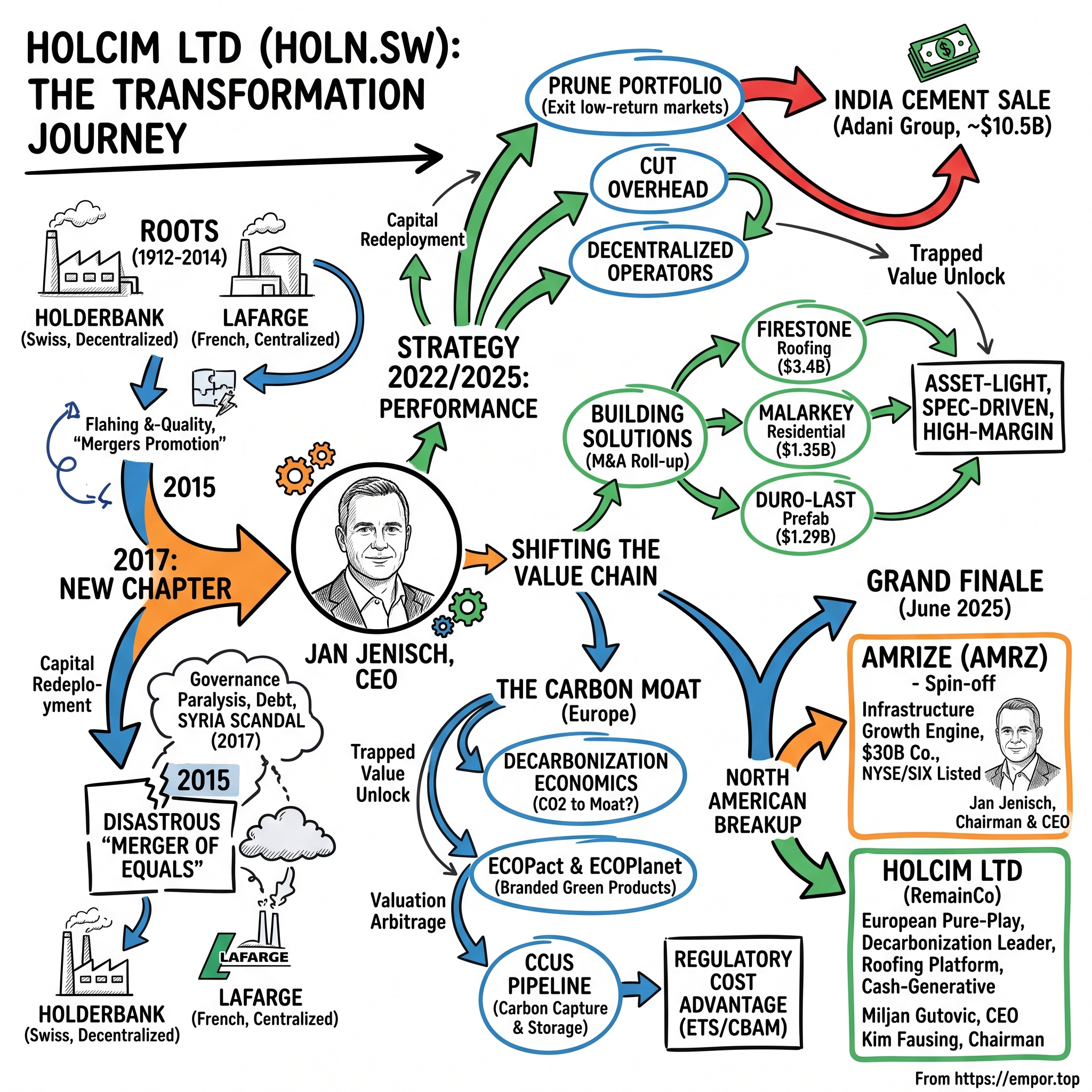
On the morning of June 23, 2025, two bells rang almost in unison. In New York, a new ticker — AMRZ — began trading on the floor of the New York Stock Exchange. In Zurich, the same symbol lit up the board at the SIX Swiss Exchange. Amrize, the North American building-materials business that Holcim had spent decades assembling, walked out the front door as an independent, roughly $30 billion company, handed to shareholders one-for-one as a dividend-in-kind.3 The Holcim that remained behind — the "RemainCo" in banker shorthand — was suddenly a smaller, more European, more concentrated animal than it had been the day before.
That single act of corporate self-amputation is the clearest window into the question this story is really about. Holcim Ltd (HOLN.SW, listed on the SIX Swiss Exchange) spent most of the 2020s trying to argue that a 110-year-old cement company — the archetype of a heavy, cyclical, carbon-belching commodity business — deserves to be valued like something lighter, greener, and faster-growing. The central thesis is deceptively simple to state and genuinely hard to prove: can a company whose core product is quite literally rock, kiln, and dust escape the low multiple that markets reflexively assign to commodity manufacturers?
The reason the question matters now, rather than a decade ago, is that management has spent real money and real optionality trying to answer it. On one side of the ledger, Holcim exited exactly the kind of asset that once defined it — cashing out of India, the world's second-largest cement market, by selling its controlling stakes in Ambuja Cements and ACC to the Adani Group in a transaction valued at roughly $10.5 billion, netting about $6.4 billion in cash.68 On the other side, it plowed billions into commercial roofing, insulation, and waterproofing — businesses that carry the word "cement" nowhere on their packaging. And then it performed the grand finale: spinning off North America entirely, betting that two focused equities would be worth more than one sprawling conglomerate.
Layered on top is the decarbonization story, which Holcim frames not as a liability but as a moat. European carbon regulation — the Emissions Trading System and the new Carbon Border Adjustment Mechanism — is designed to make emitting expensive. Holcim's argument is that if you must pay to pollute, the low-carbon producer with the branded green product wins. That is a genuinely interesting inversion. It is also, as we will see, a claim that deserves to be tested rather than accepted.
It is worth naming the consensus narrative up front so we can test it rather than absorb it. The bullish story, roughly, is: "Holcim has transformed itself from a carbon-heavy commodity cement maker into a high-margin, low-carbon building-solutions leader, and the North American spin-off unlocks the trapped value." Almost every clause in that sentence is partly true and partly a claim awaiting proof. Holcim's margins genuinely expanded, and a real roofing business genuinely exists — but the largest share of revenue is still cement, concrete, and aggregates; the "solutions" business is a growing minority, not the core; and the spin-off relocated the valuation debate rather than ending it. The job of this piece is to hold each part of the narrative against the evidence, crediting what the numbers support and flagging what remains management aspiration.
Here is the roadmap. We begin with the strange physics and microeconomics of cement, because you cannot understand this company without understanding why cement is local, heavy, and unlike almost any other commodity. We trace the Swiss-French roots of Holderbank and Lafarge, then the disastrous 2015 "merger of equals" and the Syria scandal that nearly broke the combined firm. We examine the Jan Jenisch turnaround, the handover to CEO Miljan Gutovic, the roofing roll-up, the carbon strategy, and finally the North American breakup — stress-testing the bull and bear cases through Hamilton Helmer's 7 Powers and Porter's Five Forces. Throughout, the posture is neutral: management says it will win, and our job is to ask what evidence supports that and what could falsify it.
 Subscribe on LinkedIn
II. The Heavy Physics & Microeconomics of Cement
Stand at the base of a cement kiln and you are looking at one of the largest moving machines on earth: a steel cylinder longer than a football field, tilted slightly downhill, rotating slowly, with a flame at its lower end burning hot enough to melt rock into a glowing, molten trickle. Raw ground limestone crawls in at the top; small gray marbles of clinker tumble out the bottom, radiating heat. It is a spectacle that has, in its essentials, powered human construction for well over a century — and it is the reason cement is simultaneously indispensable and one of the hardest industries on the planet to decarbonize.
Start with the chemical reaction inside that kiln, which has barely changed in two thousand years. Take limestone — calcium carbonate, CaCO₃ — grind it, and heat it to roughly 1,450°C. The heat drives off carbon dioxide and leaves behind calcium oxide, the reactive core of what becomes clinker, then cement. Written out, it is almost innocent: CaCO₃ → CaO + CO₂. But that little liberated CO₂ molecule is the whole problem. Roughly 60% of cement's carbon footprint comes not from the fuel burned to heat the kiln but from the calcination reaction itself — the chemistry of the rock releasing gas. This is the single most important fact an investor in this industry can internalize: you cannot decarbonize cement by plugging the kiln into a wind farm. Even with perfectly clean electricity and zero-carbon fuel, the majority of the emissions would remain, because they are baked into the molecule. That is why carbon capture, not renewable power, sits at the center of every serious cement decarbonization plan.
Now consider the second strange feature: cement barely travels. It is the definition of a low value-to-weight product. A ton of cement is worth roughly a hundred-odd dollars, and a truck can carry maybe twenty-five tons. Drive that truck a couple of hundred kilometers and the diesel, the driver, and the time have quietly eaten the margin alive. The rule of thumb in the industry is that cement moves economically only about 150 kilometers by road before freight costs make it uncompetitive — perhaps a few times that by water or rail, where bulk transport is cheaper. The practical consequence is profound. Cement is not a global market with a single price, the way oil or copper is. It is a patchwork of hundreds of local markets, each one bounded by how far you can haul a heavy gray powder before someone with a closer plant undercuts you.
That geography is what makes cement economically unique. A plant with a limestone quarry beside a growing city is not really selling a commodity — it is selling proximity. Competitors cannot simply ship product in from a cheaper region, because the freight barrier protects the incumbent like a wall. This is why cement markets so often resemble regional oligopolies: a handful of players, each dominant in their own catchment area, with an uneasy interest in not blowing up prices for everyone.
The third feature is capital intensity, and it is brutal. A new greenfield cement plant can require $300 million or more in capital, plus five to ten years of environmental permitting, plus a limestone quarry concession that regulators hand out sparingly and jealously. Once built, the plant is a fixed-cost machine — heavy depreciation, and thermal energy and electricity often running 30–40% of production cost. High fixed costs create a nasty behavioral dynamic in downturns: when demand falls, a plant still wants to run near capacity to absorb its fixed costs, which tempts everyone to chase volume and crater price at exactly the wrong moment. Discipline in a downturn is the difference between a good cement market and a bloodbath.
There is one more cost lever worth understanding, because it becomes a competitive weapon later in the story: what you burn in the kiln. A cement kiln does not care much whether its heat comes from coal, petroleum coke, or shredded municipal waste, worn-out tires, and biomass. Large operators have spent years raising their "alternative fuel" substitution rate — feeding the kiln with pre-processed waste that municipalities will often pay them to take. Done well, this simultaneously lowers fuel cost and lowers net emissions, and it is a capability that requires scale, permits, and waste-sourcing networks that small regional players struggle to replicate. File that away; it is one of the quieter advantages that separates a global operator from a local one.
So how do you actually make money here? At the unit level, it comes down to the net realized price per ton minus the cost of thermal fuel, power, and freight to the customer. The winners tend to be vertically integrated: they own the limestone reserves, run the clinker kilns, grind the cement, and then push it downstream into ready-mix concrete and aggregates — the gravel and crushed stone that go into every road and foundation.
Integration matters for a subtle reason beyond capturing margin at each stage. A cement plant's worst enemy is an idle kiln; by owning its own ready-mix and aggregates operations, an integrated producer effectively guarantees a baseload of demand for its own cement, smoothing the utilization that its brutal fixed-cost structure demands. Aggregates, meanwhile, are the unsung hero of the building-materials world — low-tech crushed rock, but with the same freight-bounded local-monopoly economics as cement and none of the process emissions. A well-placed aggregates quarry can be one of the most quietly durable assets in all of industrials.
Hold that integrated structure in mind, because the strategic story of the last decade has been Holcim deliberately shifting where in this value chain it wants to make its money — away from the carbon-heavy kiln, and toward the branded product bolted onto the finished building. To understand why that shift felt so radical, we have to go back to where the whole edifice was built.
III. Cartels, Conglomerates, & Deep Roots (1912–2014)
The story begins in a small Swiss village whose name became a byword for cement. In 1912, in Holderbank in the canton of Aargau, Ernst Schmidheiny took control of a cement works and began knitting together a company that would carry the village's name across the world. Holderbank grew into an empire built on a very Swiss temperament: engineering discipline, decentralized local operation, financial conservatism, and a patient willingness to hold minority and majority stakes in plants across Europe and Latin America. The Schmidheiny family would loom over Swiss industry for generations. The defining cultural DNA — let the local plant manager run the local plant, keep the balance sheet strong, expand steadily — would still be visible a century later.
The Schmidheiny name is worth pausing on, because it carried both brilliance and shadow. The family sat at the center of Swiss industry for the better part of a century, controlling not only cement but also, through the related Eternit business, fiber-cement building products — a heritage that would later entangle heirs in the long, painful global reckoning over asbestos. It is a reminder that the building-materials industry's history is inseparable from questions of health, environment, and liability, and that "boring" heavy industry has repeatedly produced litigation that outlives the executives who created the exposure. That pattern — an operational decision in one era becoming a legal and reputational bill in another — is one this company would meet again in a far more dramatic form.
Parallel to Holderbank, and older, ran a French dynasty. Lafarge traces its origins to 1833, when Auguste Pavin de Lafarge began commercial lime production in the Ardèche. The company earned an early piece of industrial mythology by supplying lime for the Suez Canal in the 1860s, and it grew into a centralized French industrial flagship — grander, more Parisian, more comfortable operating enormous plants in far-flung emerging markets than its careful Swiss counterpart. Where Holderbank was federated and frugal, Lafarge was centralized and expansive. These were not merely two companies; they were two philosophies of how to run heavy industry — and, eventually, two immune systems that would reject each other's transplants.
Both spent the 1990s and 2000s in the same race: the emerging-market land grab. The logic was intoxicating and, for a while, correct. A country's cement consumption tracks its stage of development almost like a physical law — as a poor nation builds its first highways, ports, apartment blocks, and factories, cement demand per capita climbs steeply, then plateaus once the basic infrastructure exists. Get into a market early, during the steep part of that curve, and you ride a multi-decade tailwind of urbanization. As Asia, Eastern Europe, and Latin America urbanized, cement demand followed the cranes, and whoever planted plants nearest the fastest-growing cities would own decades of concrete demand.
The flaw in the strategy, which only became obvious later, was that this growth came bundled with the very features that would eventually depress the industry's valuation: enormous upfront capital, exposure to volatile currencies and political regimes, and — as the world's attention turned to climate — some of the highest carbon intensity of any manufacturing on earth. The emerging-market kilns that looked like growth engines in 2005 looked like carbon and capital liabilities by 2020. The strategic reversal at the heart of this story is, in one sense, simply Holcim reading that change a beat earlier than the market. The crown jewel of this era, at least in hindsight, was India. Through a series of moves, the Holcim side built a dominant dual-brand position — Ambuja Cements and ACC — in what would become the world's second-largest cement market. Owning two respected national brands in a market with structural, multi-decade urbanization tailwinds looked, at the time, like exactly the kind of asset a global cement champion should treasure. That it would later be sold, not celebrated, tells you how thoroughly the strategic logic of the industry would be rewritten.
Underneath the expansion ran a less flattering current. The economics of local oligopoly — high fixed costs, freight-bounded markets, the temptation to coordinate rather than compete — repeatedly attracted the attention of antitrust regulators. European competition authorities over the years scrutinized and penalized regional capacity discipline and allocation behavior across the cement sector. For investors, the legacy lesson is not a specific fine but a structural truth: an industry whose geography naturally produces local dominance will always live under a regulatory microscope, and "market discipline" and "collusion" can be uncomfortably close neighbors. This was the industrial world — proud, entrenched, cash-generative, and quietly controversial — into which the two dynasties would decide, in 2014, to combine. It was supposed to be a coronation. It became something closer to a near-death experience.
IV. The Megamerger Mirage & The Syria Dark Cloud (2014–2017)
On paper, the logic was almost irresistible. In 2014, Holcim and Lafarge agreed to merge into a single colossus — LafargeHolcim — with a combined enterprise value in the region of $40–50 billion, more than CHF 40 billion in sales, and roughly CHF 1.4 billion in promised annual cost synergies. It was pitched as a "merger of equals," the phrase that should make any experienced investor reach for the exits. Two proud industrial cultures, two headquarters, two sets of country barons — all to be fused into one harmonious global leader. The strategic slide was beautiful. The execution was a case study in why mergers of equals so often curdle.
The trouble started before the ink was even dry. As the two sides moved toward completion, the exchange ratio itself became a battleground: cement prices and emerging-market currencies moved against Lafarge, and Holcim's shareholders balked at the original terms, forcing a renegotiation that soured relations before the companies had spent a single day as one. The very fact that partners were fighting over who got the better of a "merger of equals" told you the whole premise was a fiction — in a true merger of equals, no one keeps score, and here both sides were keeping score obsessively.
The trouble then worked its way down. Governance was a negotiated balance of Swiss and French interests, which meant that when tensions arose, there was no single owner of the outcome — only a deadlock to be managed. The cultures did not blend so much as grind: Zurich's cost-focused, decentralized plant managers versus Paris's more centralized corporate apparatus. Even the choice of who would run the combined company became a public fight, with the original CEO designate ultimately stepping aside before completion amid boardroom friction. Synergy targets slipped. Debt swelled to well over CHF 18 billion. And the ultimate scorecard of value creation — return on invested capital — sagged toward or below the company's own cost of capital, which is the financial way of saying the merger was, for a painful stretch, destroying value rather than creating it.
For an investor, the operational post-mortem is as instructive as the governance one. Two overlapping global networks did not automatically become more efficient by sharing a logo; because cement markets are local, the promised synergies had to be extracted plant by plant, market by market, and every one of those extractions required a country manager who trusted head office enough to execute. When trust is the scarce input and the two head offices are at war, synergy capture slows to a crawl. That is the deep reason cross-border industrial mega-mergers so often disappoint: the value lives in thousands of local decisions, and those decisions are made by people, not by the strategy deck.
Then came the part that no synergy model had priced in. During the Syrian civil war, legacy Lafarge management had kept its Jalabiya cement plant in northern Syria running through 2013 and into 2014 by making payments to armed groups — including the Islamic State and the al-Nusrah Front — and by tolerating arrangements to keep raw materials and staff moving through territory those groups controlled. When the facts surfaced, they detonated. There were board-level investigations, French criminal proceedings, and the 2017 resignation of CEO Eric Olsen, who denied personal responsibility even as he stepped down. The reputational damage was severe and slow to heal.
The legal reckoning arrived years later and set a genuine precedent. In October 2022, Lafarge — by then a subsidiary of the merged group — pleaded guilty in a U.S. federal court to conspiring to provide material support to foreign terrorist organizations, and agreed to pay $778 million in penalties.910 The U.S. Department of Justice described it as the first corporate prosecution of its kind — a company criminally convicted for material support to terrorism. For a business that had marketed itself on solidity and permanence, it was an almost unthinkable sentence to have to write.
The investing lessons here are durable and worth stating plainly, because they recur throughout this story. First, "merger of equals" is frequently a euphemism for "no one is truly in charge," and governance paralysis can neutralize even flawless industrial logic. Second, when you acquire a sprawling emerging-market footprint, you also acquire its compliance history — and a single legacy plant in a war zone can impose a valuation penalty that dwarfs any operational synergy. The combined company that emerged from this period was wounded, over-levered, and trading at a discount that reflected as much distrust as it did cyclicality. It needed not just a new CEO but a new operating philosophy. In September 2017, it got one.
V. The Turnaround Masterclass: Jan Jenisch & Strategy 2022/2025
When Jan Jenisch arrived as CEO in September 2017, he did not come from the cement establishment, and that was precisely the point. He came from Sika AG, the Swiss specialty-chemicals and construction-materials company, where he had built a reputation for fast, decentralized, performance-obsessed management and a track record of compounding growth at margins a cement executive could only dream of. Sika's world was the opposite of Holcim's: high-value chemical additives, adhesives, and sealants sold on performance and specification rather than on price per ton. Jenisch had spent his career learning how a building-materials company escapes the commodity trap — which is precisely the trick he would be hired to perform on a far heavier scale.
There is a telling piece of biography here. During Jenisch's tenure running Sika, the company became the target of an unwanted takeover approach, and he helped lead a determined, years-long defense of its independence and its ordinary shareholders' interests against a much larger suitor. Whatever one makes of the details, the episode revealed a temperament: combative, shareholder-focused, and unafraid of a public fight. That was not the profile of a caretaker. He looked at LafargeHolcim — bloated, indebted, demoralized, straddling two grand headquarters — and saw an organization that had confused size with strength. His playbook was not subtle, and it did not need to be.
The first move was to attack the center. Jenisch slashed corporate overhead, thinned out layers of middle management between the executive suite and the plants, and pushed profit-and-loss accountability back down to the country CEOs who actually ran the business. The message was cultural as much as financial: this was to be a company of operators, not committees. The instinct traced straight back to the old Holderbank DNA of local autonomy — but applied now with the urgency of a turnaround.
The second, more consequential move was portfolio surgery. Jenisch began pruning the very assets that a traditional cement CEO would have defended: capital-intensive, high-carbon, low-return operations in volatile jurisdictions. Over several years the company exited or sharply reduced positions in markets including Indonesia, Malaysia, Brazil, Zimbabwe, and Northern Ireland. The philosophy was heresy to the growth-at-all-costs mindset of the emerging-market land-grab era: revenue for its own sake is worthless if it earns below the cost of capital and drags down returns.
It is worth sitting with how counterintuitive this was at the time. For decades, the reflex of every cement chief executive had been to plant flags: more countries, more kilns, more tons, because scale was the whole religion of the industry. Jenisch's willingness to walk away from entire national markets — to shrink the map on purpose — ran against every instinct the sector had trained into its leaders. The bet was that capital freed from a low-return plant in a volatile currency could earn far more redeployed into a business Holcim actually wanted to be in, and that a smaller, higher-quality company would command a higher multiple than a sprawling, lower-quality one. Markets, which had spent years discounting the post-merger conglomerate, gradually began to reward the discipline as the returns showed up in the numbers.
The crown jewel of the pruning was India — and here the numbers tell the strategic story. In May 2022, Holcim agreed to sell its controlling stakes in Ambuja Cements and ACC to Gautam Adani's Adani Group, in a transaction valued at approximately $10.5 billion including the mandatory open offer, with Holcim itself receiving roughly $6.4 billion in cash proceeds when the deal closed in September 2022.678 What made this a masterstroke rather than a mere retreat was the price. Holcim exited a fast-growing but capital-hungry, carbon-heavy business at a valuation that industry observers pegged well above the typical mid-single-digit-to-low-double-digit EBITDA multiples that heavy cement assets fetch. Selling a low-return commodity business near a cyclical and strategic peak — to a determined buyer who wanted scale in a hurry — and then redeploying the cash into higher-return, lower-carbon, asset-lighter businesses is close to the platonic ideal of capital allocation. And notably, management stated the transaction carried no material tax leakage at the Holcim level, sharpening the net economics further.
The scorecard validated the approach. Under "Strategy 2025: Building for Growth," Holcim set financial targets — expanding recurring EBIT margins, de-leveraging the balance sheet toward net debt of around 1.2x EBITDA or below, and lifting cash returns — and then hit them roughly two years ahead of schedule. Recurring EBIT margins that had been stuck in the low-to-mid teens climbed steadily; by 2024, the full group posted a record recurring EBIT of CHF 5,049 million on net sales of CHF 26,407 million, a recurring EBIT margin of 19.1%, the highest in the company's modern history.2 For a business that markets had left for dead as a cyclical carbon dinosaur, delivering ahead of guidance did something no slide deck could: it rebuilt credibility. The question that then loomed was whether that credibility could survive a leadership handover — and whether the man who built it would truly let go.
VI. Current Management Credibility & Governance
Succession is where turnaround stories often quietly unravel, and Holcim's version came with a twist worthy of the plot. In May 2024, Miljan Gutovic became CEO — an internal veteran who had run Holcim's Europe region and its Asia-Middle-East-Africa operations, and who had been a principal architect of the company's European decarbonization and bolt-on M&A playbook.[^6] He was not a caretaker; he was the operator who had actually executed much of the strategy in the field. Jenisch, meanwhile, did not simply retire. He moved up to Chairman of the board, preserving strategic continuity and, in the eyes of critics, keeping a founder-like grip on the most important capital-allocation decisions.
Then the structure changed again, and this is the governance detail that a careful investor should not skate past. When Holcim spun off its North American business as Amrize, Jenisch left the Holcim chairmanship to become Chairman and CEO of Amrize — following the growth engine across the Atlantic rather than staying with the parent he had rebuilt.3 That tells you something honest about where the perceived value and excitement sat. Into the Holcim chair stepped Kim Fausing, a board member since 2020 and the CEO of Denmark's Danfoss Group, whose appointment shareholders approved at the 2025 Annual General Meeting.45 So the company that carries the historic name is now chaired by an outsider industrialist, while the architect of its revival went with the spin-off. Neutrally stated: the man who best understood the turnaround chose the American pure-play over the European RemainCo.
On incentives, Holcim's disclosures tie executive pay to a mix of financial and sustainability metrics — recurring EBIT margin, return on invested capital, free-cash-flow conversion, and CO₂-reduction targets. That is a defensible design on paper, because it forces management to care about returns and carbon simultaneously rather than buying growth with shareholders' capital. The harder question is calibration: sustainability KPIs are only as demanding as the thresholds behind them, and a skeptic is right to ask whether "net-zero-aligned" targets are genuinely stretch goals or comfortably achievable ones dressed up for an ESG audience. The evidence that matters is behavioral, and here the record is genuinely strong: this is a management team that set explicit multi-year targets under Strategy 2025 and beat them early, that sold India near a peak rather than clinging to it, and that has consistently explained its capital-allocation hierarchy the same way across filings and calls.
One popular framing deserves a neutral correction, because it is often repeated as if it were a strength. Holcim is not a founder-controlled company with a dominant insider owning a commanding block of the equity; the historic Swiss family interests were diluted over decades of expansion and merger, and the shareholder base today is a broadly dispersed, institution-heavy register typical of a large European blue chip. That is neither good nor bad in itself, but it changes the analysis: alignment here rests on incentive design and demonstrated behavior, not on a large personal stake that automatically welds management's fortunes to outside shareholders'. Investors relying on "skin in the game" as their governance comfort should look at the actual ownership disclosures rather than assume it.
That distinction sharpens the case for judging management by its track record, which is the fairest lens available. The capital-allocation hierarchy is the spine of everything that follows: cash flows first into high-return organic capex and green technology; then into value-accretive bolt-on acquisitions in higher-margin building solutions; then into a growing, progressive dividend; and finally into buybacks, particularly when the shares trade at a conglomerate discount to their perceived sum of parts. It is a coherent framework, and — judged across successive annual reports and earnings calls — management has narrated it consistently rather than lurching from story to story, which is itself a marker of credibility. Whether it produces durable value depends entirely on whether the "value-accretive bolt-on" step actually clears its cost of capital — which brings us to the roofing roll-up that Holcim has bet its re-rating on.
VII. Solutions & Products Roll-up: M&A Benchmarking
Picture the strategic problem Jenisch faced with the India cash in hand. He had just sold a business that made money the old-fashioned, carbon-heavy way. He needed somewhere to put the proceeds that would earn higher returns, consume less capital, grow faster, and — ideally — not require a limestone quarry or a kiln. His answer was to climb the building. Instead of making the gray powder at the foundation, Holcim would increasingly make the branded systems at the top and the skin: commercial roofing membranes, insulation, waterproofing, specialty mortars, and adhesives. Management branded this the "Solutions & Products" push (today reported as the "Building Solutions" division), with an explicit ambition to grow it from a small slice of revenue toward roughly 30% of group sales.
The anchor acquisition came early. In January 2021, Holcim agreed to buy Firestone Building Products from Bridgestone for $3.4 billion — a deal it valued at around 13x pre-synergy EBITDA, falling to roughly 10x after expected synergies.[^14]11 Firestone, later rebranded Elevate, gave Holcim an instant, scaled position in North American commercial roofing — a business with a decisive difference from cement: it is asset-light, specification-driven, and tied to the enormous, non-discretionary market for re-roofing existing buildings. A flat commercial roof does not care about the interest rate; when it leaks, it gets replaced. That demand profile is far steadier than new-construction cement volumes.
Two more deals filled out the platform. In late 2021, Holcim agreed to acquire Malarkey Roofing Products for $1.35 billion, pushing into U.S. residential roofing shingles — a different customer, different channel, and exposure to the steady replacement cycle of American homes.16 Then in early 2023 came Duro-Last, a Michigan-based maker of custom prefabricated commercial roofing membranes, for $1.29 billion. The Duro-Last price is the most instructive of the three: at roughly 7.9x EBITDA after synergies on a business doing about $540 million in annual sales, it was struck at a far more sober multiple than Firestone, suggesting Holcim was learning to buy these assets with more discipline as its own expertise grew.17
Now hold the roofing math next to the cement math, because the contrast is the whole investment case for the shift. Cement demands continuous heavy maintenance capex — call it 4–6% of sales just to keep the kilns and quarries running — before you spend a franc on growth. Commercial roofing needs a fraction of that, often under 2% of sales, because there is no kiln to reline and no quarry to remediate. Lower capital intensity and steadier, renovation-driven demand translate, in principle, into higher and more stable returns on invested capital. That is the promise: trade a business that earns cyclical mid-teens returns for one that can earn twenties with less reinvestment.
Why roofing specifically, and not some other downstream product? Because commercial roofing has an unusually attractive demand structure hiding inside a dull exterior. The majority of the market is re-roofing, not new build — every flat commercial roof in North America is on a replacement clock measured in decades, and when it fails, replacement is non-negotiable regardless of where interest rates sit. That gives the business a recurring, maintenance-driven quality closer to a consumables company than to a cyclical construction supplier. Layer on secular tailwinds — energy-efficiency retrofits, insulation upgrades driven by building codes, and the growing demand for weather-resilient envelopes as extreme-weather claims rise — and you have a market that can grow through a construction downturn rather than collapsing with it. That counter-cyclical ballast is exactly what a company trying to shed its cyclical reputation wants to own.
The skeptic's counter is equally important and deserves airtime. Roofing is not a proprietary technology moat; it is a competitive market with real rivals, and roll-ups live or die on integration and on not overpaying. There is also a geographic-management question a neutral analyst should ask: can a Swiss-headquartered cement company truly run a portfolio of acquired American roofing brands better than their previous owners did? The counterpoint — and part of the logic of the eventual North American separation — is that these roofing crown jewels arguably belonged with an American management team and American investors in the first place. The Firestone multiple was full, and the value creation depends on synergies that are easy to promise and harder to verify from the outside. And there is a mix-shift subtlety: bolting acquired revenue onto the group flatters the "Solutions" share of sales without necessarily proving that the underlying organic engine is compounding. The honest read as of the FY2025 results is encouraging but not yet conclusive: Building Solutions generated CHF 5.851 billion of the group's CHF 15.7 billion in net sales, a meaningful and growing share — but the durability of its returns through a full construction cycle remains the thing to watch.1 The roofing bet is about escaping commodity economics through product. The parallel bet — escaping them through regulation — is stranger and even more contested.
VIII. The Carbon Moat: Decarbonization Physics & Economics
Here is the counterintuitive idea at the heart of Holcim's European strategy: that the very carbon regulation designed to punish cement could become a competitive weapon in the hands of the lowest-carbon producer. To see why, you have to understand two pieces of European policy machinery. The first is the EU Emissions Trading System, the cap-and-trade market that puts a price on each ton of CO₂. Historically, cement makers received large volumes of free allowances to shield them from foreign competition. Those free allowances are being phased down over the coming decade, which means that emitting carbon is turning from a footnote into a hard, rising cash cost on the income statement. The second is the Carbon Border Adjustment Mechanism, which imposes a carbon charge on imported goods like cement so that a producer in a country with no carbon price cannot simply ship cheap, dirty product into Europe and undercut compliant local firms. Together, ETS and CBAM are meant to do one thing: make the carbon content of your product show up in its price, whether it was made in Germany or imported from abroad.
If that machinery works as designed, the strategic implication is genuinely favorable to a low-carbon leader. When carbon has a price and imports are taxed for their emissions, the producer who emits less per ton has a structural cost advantage — and can plausibly charge a premium for a demonstrably greener product without losing the sale. This is the logic behind Holcim's branded green suite. ECOPact is its low-carbon ready-mix concrete, marketed as delivering anywhere from 30% up to 100% lower CO₂ than local standard concrete depending on the mix, without sacrificing structural performance. ECOPlanet is the low-carbon cement line, leaning on calcined clay, ground demolition waste, and other clinker substitutes to cut the carbon-heavy clinker content. ECOCycle is the circular platform that feeds recycled construction and demolition debris back into new products. The commercial traction is real and measurable: by FY2025, ECOPact had grown to 31% of the company's ready-mix net sales, up from 26% a year earlier.1 That adoption curve is the single best piece of evidence that customers will actually pay for lower-carbon material rather than just say they will.
Then there is the harder, more capital-intensive frontier: carbon capture, utilization, and storage. Because most of cement's emissions come from the calcination reaction itself, CCUS is not optional flair — it is the only known path to genuinely deep decarbonization of clinker. Holcim has a pipeline of dozens of CCUS projects across Europe and North America, including the flagship Go4Zero project in Belgium aimed at producing net-zero cement. This is where the "process power" argument gets interesting, and where it also gets vulnerable. The bull framing is that CCUS retrofits are so expensive — often hundreds of millions per site — that smaller, undercapitalized regional competitors simply cannot afford them, and will be forced to close plants or sell out, consolidating the market around well-capitalized leaders that can spread the cost across a large network and access public co-funding.
It helps to demystify what carbon capture actually involves, because the word makes it sound tidier than it is. Capturing CO₂ from a cement kiln means installing equipment that strips the carbon dioxide out of the exhaust gas, compressing it into a liquid-like state, and then transporting it — by pipeline or ship — to a site where it can be pumped deep underground into old geological formations and sealed away, or used as feedstock in other industrial processes. Every step in that chain costs money and energy, and — critically — most of the chain is infrastructure the cement company does not own and cannot build alone: the pipelines, the shipping, the storage reservoirs, the regulatory approvals for injecting gas underground. A cement plant can install a capture unit and still have nowhere to send the captured carbon if the surrounding network is not ready.
But a neutral analyst has to flag the other edge of that sword. CCUS remains largely pre-commercial: it is expensive, energy-hungry, and dependent on CO₂ transport-and-storage infrastructure and public subsidy that are still being built out. The bull's "smaller rivals can't afford it" argument cuts both ways — if the technology proves uneconomic even at scale, then being the company that spent the most on it is not a moat but a stranded cost. And CBAM itself is not a finished, battle-tested regime; its design, coverage, and enforcement are still evolving, and importers and trading partners have every incentive to lobby, litigate, and find workarounds. Betting a re-rating on the durability and effectiveness of a young, politically contested piece of climate policy is a real assumption, not a settled fact. If carbon prices spike before CCUS is operating at scale, Holcim's European plants are exposed to a rising cash cost with the mitigation not yet in place — a timing risk, not just an execution risk. And the same regulation that could hand Holcim a moat could equally saddle it with a decade of heavy compliance capex that depresses free cash flow. In other words, "regulation as moat" is a genuine hypothesis with real early evidence in the ECOPact adoption data — but it is a hypothesis whose payoff sits in the future and depends on policy staying its course. Which is exactly the kind of ambiguity that made the next decision so momentous: if Europe is where the carbon burden is heaviest, what do you do with the one region where growth is easiest?
IX. The Crown Jewel Split: The North American Spin-off
The answer, announced on January 28, 2024, stunned even seasoned observers with its boldness: Holcim would not milk its North American business for the RemainCo's benefit. It would give it away — to shareholders — as a fully independent, U.S.-listed company.[^3]131415 The logic was a pure valuation-arbitrage argument, and it is worth walking through slowly because it is the crux of the entire investment thesis. North America had quietly become Holcim's best asset: its fastest-growing, highest-margin region, generating on the order of $11–12 billion in annual sales and a disproportionate share of group profit, riding a once-in-a-generation wave of U.S. federal spending — the Infrastructure Investment and Jobs Act, the Inflation Reduction Act, and the CHIPS and Science Act, which together were pumping money into roads, bridges, clean-energy plants, and reshored factories.
And yet this jewel was trapped inside a Swiss-listed conglomerate that the market valued like a European industrial. Holcim's shares changed hands at a mid-single-digit-to-high-single-digit multiple of forward EBITDA, while U.S. pure-play building-materials peers — CRH, Vulcan Materials, Martin Marietta — commanded low-to-mid-teens multiples and higher. Same rock, same roads, wildly different valuation, simply because of the listing venue and the conglomerate wrapper.
Holcim was not theorizing in a vacuum here — it had a live precedent staring it in the face. Irish rival CRH had moved its primary listing to the New York Stock Exchange in 2023, explicitly to sit closer to the deep pool of U.S. capital and the richer multiples awarded to American infrastructure names, and its shares had responded well. If a peer could re-rate simply by changing which flag flew over its ticker, the argument went, then surgically extracting Holcim's best American assets and floating them directly on Wall Street should capture the same premium in a purer form. That real-world comparable gave the spin-off thesis more credibility than a typical break-up pitch — but it also set a benchmark against which Amrize would now be measured. The spin-off was designed to collapse that gap by creating two clean stories: Amrize, a high-growth, infrastructure-levered U.S. compounder that American investors could value on American comps; and Holcim RemainCo, a cash-generative, high-dividend European and global business anchored in decarbonization leadership and the roofing platform.
Management executed it with unusual speed. Shareholders approved the separation at the May 2025 AGM, and the spin-off completed on June 23, 2025, structured as a dividend-in-kind of one Amrize share for every Holcim share held as of June 20, with Amrize listing under AMRZ on both the NYSE and the SIX Swiss Exchange.35 Amrize walked away with 2024 revenue of about $11.7 billion, some 19,000 employees, and more than 1,000 sites across the United States and Canada — and, tellingly, with Jan Jenisch as its Chairman and CEO.3 The old parent kept the name; the new spin-off kept the man most associated with the turnaround.
Now the neutral stress test, because this is precisely where a skeptical long/short investor earns their fee. Is this fundamental value creation or financial engineering? The honest answer is: potentially both, and the distinction matters. Splitting the company does not add a single ton of concrete capacity or a single new customer — it rearranges the wrapper. If the market was genuinely mispricing the sum of the parts, the split unlocks real, durable value by letting each piece find its natural buyer. If the "conglomerate discount" was partly a fair discount for a business with heavy European carbon liabilities and cyclical exposure, then the split simply relocates that discount onto the RemainCo without erasing it.
Which raises the sharpest bear question of all: what is Holcim RemainCo now? Strip out the fast-growing American engine and you are left with a business disproportionately exposed to a low-growth European market, carrying the heaviest carbon-compliance capex burden on the planet, at exactly the moment ETS free allowances are being withdrawn. The risk is that RemainCo re-rates not upward toward roofing multiples but downward toward the multiple of a capital-intensive utility saddled with an environmental tax bill. There are also the ordinary frictions of any breakup: potential tax leakage, duplicated corporate overhead across two head offices, and the delicate question of how to split debt and pension liabilities fairly between parent and child. Structuring the separation as a dividend-in-kind of Amrize shares — rather than a sale — was designed in part to be tax-efficient for the company and its shareholders, but breakups routinely surface frictions that only become visible in the years after the confetti settles, from stranded costs to service agreements between the two companies that quietly favor one side.
The FY2025 results gave the first real read on the standalone RemainCo, and on the surface they were reassuring: net sales of CHF 15.7 billion, a recurring EBIT margin that expanded rather than collapsed to 18.3%, and free cash flow of over CHF 2 billion funding a dividend at a comfortable 53% payout.1 In other words, the amputated company did not bleed out — it kept its margin discipline and its cash generation intact in its first year alone. But one clean year, in a still-reasonable macro environment, is not yet proof that the European-centric survivor can compound rather than merely defend, particularly once the ETS free-allowance phase-out bites harder. Whether it can comes down to a small number of powers that either endure or erode.
X. Playbook & Strategic Powers
Step back from the deals and the accounting, and ask the question that outlasts any single quarter: what, if anything, structurally protects this business from competition? Hamilton Helmer's 7 Powers framework is a useful scalpel here, because it forces you to separate durable advantage from mere operational competence.
The most convincing power Holcim holds is the Cornered Resource — and it is literally in the ground. A limestone quarry with a valid concession sitting within 150 kilometers of a growing metropolitan area is close to irreplaceable. You cannot manufacture a new one; you can only find a rare site, win a multi-year permit, and hope no one blocks it. The freight barrier we discussed earlier converts each of these quarries into a protected local franchise. Bolted onto that are hard-to-replicate port, rail, and terminal logistics networks that took decades to assemble. This is the power an investor should trust most, because it is grounded in physics and permitting rather than in management's promises.
The second power is Scale Economies, and Holcim genuinely has them: global procurement leverage over energy, petcoke, and alternative fuels; R&D scale to develop low-carbon chemistries that a small regional player cannot fund; and — increasingly — the capital scale to afford CCUS retrofits that smaller competitors cannot. This is real, though it is worth noting that scale in cement is regionally bounded; being huge globally helps with procurement and R&D but does not let you ship cheaply into a competitor's 150-kilometer circle.
The third and most contested power is Counter-Positioning through branded green products. The claim is that by aggressively marketing ECOPact and ECOPlanet at premium prices, Holcim forces legacy competitors into an uncomfortable bind: match the low-carbon offering (expensive to do) or keep selling commodity product and absorb the rising carbon penalty. The early ECOPact adoption data lends this some credibility, but counter-positioning is only a true power if rivals genuinely cannot or will not respond — and Heidelberg Materials, CRH, and others are pursuing their own low-carbon and CCUS programs. This is better described as a lead than a lock. The fourth power, Switching Costs, lives in the roofing business, where deep specification relationships with architects, structural engineers, and contractors — who write specific branded systems into their designs — create genuine stickiness, since re-specifying and re-certifying a roofing system mid-project is costly and risky.
Running the same battlefield through Porter's Five Forces sharpens the picture. The threat of new entrants is very low — the capital intensity, permitting timelines, and quarry scarcity are a near-perfect barrier. The threat of substitutes is likewise very low: mass timber and structural steel nibble at niche applications, but there is no scalable replacement for concrete in the world's foundations, roads, and dams. Buyer power is low-to-moderate, because the customer base is a fragmented mass of local contractors, and Holcim has repeatedly demonstrated the ability to pass through input-cost inflation in its pricing. Supplier power is moderate — the company is exposed to regional power utilities and thermal-fuel markets, partly mitigated by a high substitution rate of alternative fuels (waste and biomass) in its kilns. And rivalry among existing competitors is moderate: the regional-oligopoly structure, with Heidelberg Materials, CEMEX, CRH, Vicat, and Buzzi Unicem each strong in their own catchments, generally supports local price discipline rather than ruinous nationwide price wars. It is worth war-gaming the rivals directly, because "moat" claims mean little without naming who is attacking. Heidelberg Materials, the German heavyweight, is pursuing its own aggressive CCUS agenda and has arguably matched or led Holcim on certain first-of-a-kind carbon-capture milestones — which is precisely why the counter-positioning "power" is better described as a race than a monopoly. CRH, having repositioned itself toward the United States, competes hardest exactly where the growth and the premium multiples are. CEMEX, long constrained by a heavy post-crisis debt load, has spent years deleveraging and is now a leaner competitor in the Americas. And a fringe of regional players — Vicat, Buzzi Unicem, and dozens of local operators — hold their own protected catchments. The honest conclusion is that Holcim is a leader in a concentrated field of well-run peers, not a lone giant among minnows. Its edge is real but relative, and it is contested every day by companies pursuing versions of the same playbook.
The net picture is an industry with unusually strong structural protection at the commodity layer — which is exactly why the market's low multiple has always been about carbon and cyclicality, not about competitive fragility. Those two threats are where the bull and bear cases actually collide.
XI. Risk Radar & Bull vs. Bear Stress Test
Before scoring the debate, walk the risk radar — but only the risks whose mechanism actually bites this business. The first is a macro construction downturn. Holcim's volumes are ultimately levered to cranes in the sky, and elevated central-bank interest rates weigh directly on commercial real-estate development and residential housing starts across Western Europe and, for the roofing business, North America. The transmission is mechanical: higher rates, fewer projects, lower plant utilization, and — because of those high fixed costs — sharply lower incremental margin. The second is input-cost inflation. Electricity, natural gas, petcoke, and diesel freight are large, volatile line items; the company has shown pricing power to pass them through, but pass-through always lags, and a fast spike can compress margins for a quarter or two before price catches up.
The third risk is the one most specific to this company: European carbon-price volatility. If EU ETS allowance prices surge before Holcim's CCUS projects are operating at commercial scale, the RemainCo faces a rising cash cost with its primary mitigation still under construction — a genuine timing exposure, not a hypothetical one. The fourth is M&A and execution risk. The entire re-rating thesis rests on buying roofing and building-solutions assets that actually clear their cost of capital; overpay for a bolt-on, or fail to integrate a residential-roofing deal, and the "value-accretive" story quietly becomes value-neutral. Layer on the ordinary post-spin frictions — overhead duplication, tax leakage, and the optics of a company whose turnaround architect departed with the growth engine — and you have a full, fair list of what a skeptic would press on.
One risk that is conspicuously mild is the balance sheet itself. Post-spin, Holcim carried net financial debt of roughly CHF 3.8 billion against a business generating well over CHF 2 billion in annual free cash flow — modest leverage that leaves refinancing and cost-of-capital risk low and preserves the firepower for both dividends and bolt-on M&A.1 That financial conservatism is a direct inheritance from the old Holderbank temperament, and it is the cushion that lets management contemplate heavy decarbonization capex without betting the company. It is a genuine strength, and a fair analysis should credit it as readily as it flags the softer worries.
An activist or skeptical long/short investor would press on a few softer points that don't show up in the headline margin. First, governance optics: the architect of the turnaround left the parent to run the spin-off, which invites the uncomfortable question of whether the more attractive business — and the more motivated leadership — went with Amrize, leaving RemainCo with the harder, carbon-laden half. Second, disclosure and complexity: after years of buying, selling, and rebranding divisions, a critic would demand crisp, consistent segment reporting that lets outsiders verify that acquired roofing returns are genuinely above the cost of capital rather than flattered by purchase accounting and synergy assumptions. Third, the buyback-versus-discount tension: management says it will repurchase stock when the shares trade cheap, but a company perpetually claiming to be undervalued while also spending heavily on carbon-capture capex has to prove it can do both without stretching the balance sheet. None of these is a smoking gun; together they are the fair price of admission for a company that has asked investors to trust a decade of continuous reinvention.
For an investor who wants to cut through the noise, three KPIs carry most of the signal. The first is the Building Solutions share of group sales and its divisional margin — the single clearest gauge of whether the escape from commodity economics is real and compounding organically rather than just being acquired; watch it against the goal of roughly 30% of sales at attractive, expanding margins. The second is CO₂ intensity, the specific net emissions per ton of cementitious material, because it is simultaneously the compliance-cost driver, the green-premium enabler, and the honest scoreboard for whether the decarbonization strategy is working; the direction of travel toward the mid-400s kg CO₂ per ton is what matters. The third is group return on invested capital, the summary statistic for whether all this portfolio reshaping actually created value; if ROIC holds comfortably above the mid-teens as the smaller, post-spin company matures, the strategy is working, and if it drifts down toward the cost of capital, it is not.
So, why does Holcim win from here — and what breaks the case? The bull case is that the spin-off unlocks a lasting re-rating, the roofing platform keeps compounding at high returns with low capital intensity, and European carbon regulation hardens into a genuine moat where the low-carbon leader takes share and premium price while weaker rivals close plants. In that world, RemainCo is not a stranded utility but a disciplined, cash-rich, decarbonization-and-solutions champion returning capital through a progressive dividend and opportunistic buybacks. The evidence for this case is not merely rhetorical: management delivered Strategy 2025 ahead of plan, ECOPact adoption is climbing, and the India sale proved genuine capital-allocation discipline. The bear case is that RemainCo inherits a persistent European industrial discount, CCUS capex depresses cash conversion for years, a prolonged construction slump erodes cement utilization, and the roofing roll-up turns out to be a full-price bet on synergies that never fully materialize. The most intellectually honest position is that both cases are live, and the FY2025 numbers — CHF 15.7 billion in sales, an 18.3% recurring EBIT margin, CHF 2.15 billion of free cash flow, and a CHF 1.70 dividend at a 53% payout — tilt the early evidence toward the bull without settling the argument.1 Management's forward framework, NextGen Growth 2030, unveiled at the 2025 Investor Day, commits the standalone company to 3–5% annual organic net-sales growth and 6–10% recurring EBIT growth backed by roughly CHF 18–22 billion of capital-deployment capacity through 2030 — coherent targets that will now be judged the same way Strategy 2025 was: by whether the company beats them or explains why it did not.12 The next few years of those three KPIs will do the settling.
XII. Epilogue & Core Investing Lessons
Strip away the chemistry, the freight math, and the ticker symbols, and Holcim's decade offers a compact syllabus in corporate value creation — and in its limits. The first lesson is that portfolio pruning can beat portfolio growth. For a generation, cement CEOs equated more plants and more markets with more value; Jenisch proved the opposite, showing that shedding capital-intensive, low-return assets in volatile jurisdictions could lift returns even as revenue shrank. Selling India was not a retreat from strength but a redeployment toward it.
The second lesson is that even commodity companies can bend the laws of price-taking — but only through specific, defensible mechanisms, not slogans. Local geographic dominance protected by the freight barrier, and branded low-carbon products that customers will actually pay a premium for, are the two levers Holcim has used to inch away from pure commodity status. Whether that inch becomes a mile depends on regulation holding and on the green premium proving durable, which is why the neutral verdict has to remain open.
The third lesson is about navigating a compliance catastrophe. The Lafarge Syria affair could have permanently defined the company; instead, decisive leadership, a clean plea that closed the legal chapter, and years of consistent execution rebuilt institutional trust. The lesson is not that scandals don't matter — the $778 million penalty and the reputational scar were very real — but that credibility, once shattered, can be reconstructed through boring, repeated delivery against promises.
The fourth and most transferable lesson is the arithmetic of capital allocation itself: sell cyclical, carbon-heavy assets near peak multiples, and recycle the proceeds into asset-light, higher-return platforms bought at more sober prices. Exiting Indian cement at a rich multiple to fund roofing acquisitions at high-single-digit post-synergy multiples is, in the abstract, the holy grail — buy low, sell high, and upgrade the quality of the business in the process. There is a final, more philosophical lesson buried in this story, and it is the one most useful to a long-term investor watching any industrial transformation. A company can execute brilliantly at the level of individual decisions — sell India well, buy Duro-Last at a sensible price, beat Strategy 2025 early — and still leave the ultimate verdict undecided, because the biggest bet of all rests on things outside management's control: whether European carbon policy holds its shape, whether the market grants RemainCo a fair multiple, and whether a re-rating that looks obvious on a banker's slide actually materializes in a live order book of buyers. Good execution earns a company the right to place the bet; it does not guarantee the bet pays.
The open question, and the one every long-term investor in HOLN.SW is really underwriting, is whether the final, boldest move — cleaving the company in two — proves to be the culmination of that discipline or the moment the story got ahead of the evidence. The chemistry of cement has not changed in two thousand years. Whether the economics of this particular cement company have truly changed is a question the next few years, and those three KPIs, will answer.
References
-
Full-Year 2025 Results: double-digit recurring EBIT growth with industry-leading margin of 18.3% — Holcim Ltd, 2026-02 ↩↩↩↩↩
-
Full-Year 2024 Results: record performance in 2024 — Holcim Ltd, 2025-02-28 ↩
-
Holcim Completes Spin-Off of North America Business — Holcim Ltd, 2025-06-23 ↩↩↩↩
-
Kim Fausing Proposed as Chairman of the Board of Directors of Holcim — Holcim Ltd, 2025 ↩
-
Holcim Shareholders Approve All Proposals at 2025 Annual General Meeting — Holcim Ltd, 2025-05-14 ↩↩
-
Adani Group to Acquire Holcim's Stake in Ambuja Cements and ACC for $10.5 Billion — Reuters, 2022-05-15 ↩↩
-
Holcim Completes Sale of Indian Businesses to Adani Group — Reuters, 2022-09-16 ↩
-
Holcim Closes Ambuja Cement Sale to Adani, Gets $6.4 bn in Cash — Business Standard, 2022-09-16 ↩↩
-
Lafarge Pleads Guilty to Conspiracy to Provide Material Support to Foreign Terrorist Organizations — US Department of Justice, 2022-10-18 ↩
-
Lafarge Pleads Guilty in US Court to Supporting ISIS, to Pay $778 Million Fine — Reuters, 2022-10-18 ↩
-
Holcim to Buy Firestone Building Products for $3.4 Billion from Bridgestone — The Wall Street Journal, 2021-01-07 ↩
-
Holcim Unlocks Value with NextGen Growth 2030 — Holcim Ltd, 2025 ↩
-
Holcim Plans US Listing for North American Business in Major Corporate Split — Reuters, 2024-01-28 ↩
-
Holcim Pursues US Listing for $30 Billion North American Operations — Financial Times, 2024-01-28 ↩
-
Holcim to Spin Off North American Unit in US Listing — Bloomberg, 2024-01-28 ↩
-
Holcim to Acquire Malarkey Roofing Products — Holcim Ltd, 2021-12-22 ↩
-
Holcim Acquiring Duro-Last in $1.29 Billion Agreement — Roofing Contractor, 2023-02-08 ↩
 LinkedIn
 WhatsApp
 Reddit
 Hacker News
 Email
Email Kindle
 RSS Feed
 Spotify
 Apple Podcasts
 Amazon Music
 Audible
 YouTube