Halma plc: The Compounder of Niche Lifesavers
I. Introduction & Episode Roadmap
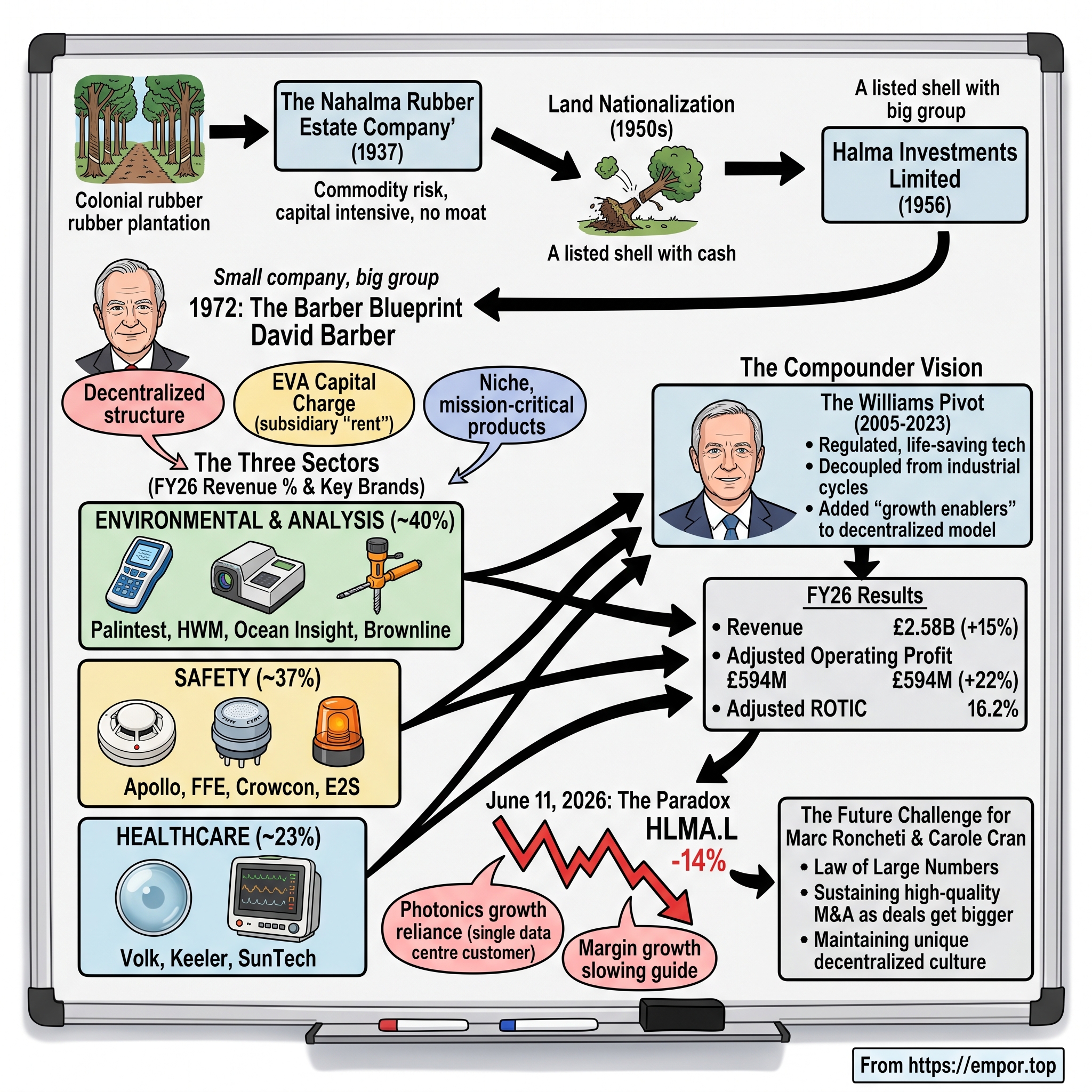
On the morning of June 11, 2026, Marc Ronchetti walked investors through what should have been a victory lap. Halma plc — the FTSE 100 group that trades on the London Stock Exchange under the ticker HLMA.L — had just closed a financial year in which revenue crossed £2.5 billion for the first time in its history, landing at £2,582.3 million, up almost 15%. Adjusted operating profit had blown past £590 million to £594.5 million, a 22% jump. It was, by the company's count, the 23rd consecutive year of adjusted profit growth, and it extended a dividend record — 47 straight years of raising the payout by 5% or more — that no other company on the London market can match.1
By lunchtime, the stock had fallen roughly 14%, with intraday losses brushing 15%.27
That is the paradox worth sitting with. Here is a business that earns operating margins of 23%, converts more than nine-tenths of its profit into cash, and generates an adjusted return on total invested capital north of 16% — a company that has, for nearly half a century, done the single hardest thing in public markets: compound quietly and relentlessly without blowing itself up.1 And the market took one look at its best-ever numbers and knocked a seventh of its value off in a single session. How does quality get punished?
The short answer — which the rest of this story will unpack — is that the market was not reacting to what Halma did. It was reacting to what Halma implied about tomorrow: a single photonics customer had quietly grown to roughly a fifth of group revenue, the premium growth that customer supplied was set to cool, and management guided that margins would stop climbing.2 At more than 30 times earnings, a compounder is priced for continuation, not deceleration. When the continuation wobbles, the multiple does the damage.
But to understand why any of that matters, you have to understand what Halma actually is — because it is one of the most misunderstood large-cap businesses in Britain. The world obsessively studies Danaher and Constellation Software as the templates for serial acquisition. Halma has quietly out-compounded most of them, and almost nobody outside the UK talks about it. It is not really one company. It is a federation of nearly 50 autonomous businesses, each selling unglamorous, mission-critical products — fire detectors, gas sensors, water-quality instruments, blood-pressure modules, optical spectrometers — into markets defined by one thing: the cost of failure is catastrophic, and regulation makes the sale non-optional.
Here is the road we will travel. We start in the tea estates of colonial Ceylon, because Halma's corporate shell is older than the light bulb. We meet David Barber, the industrialist who took a cash husk and wrote the decentralized creed still running the company today. We trace Andrew Williams' 18-year reengineering of the portfolio away from metal-bashing and toward regulated, life-saving technology. We open up the machine — the three sectors, the unit economics, the EVA capital charge that governs behavior inside 50 subsidiaries. We meet Marc Ronchetti and the CFO-to-CEO pipeline that reveals what Halma really values. We benchmark a record £447 million M&A year and ask, bluntly, whether Halma is overpaying. And we perform an autopsy on June 11 — the day the compounding narrative met the law of large numbers.
Let's begin where the money did: on a rubber plantation that no longer exists.
 Subscribe on LinkedIn
II. The Colonial Shell: From Sri Lankan Tea to Halma Investments (1894–1972)
The origin of one of Britain's finest compounders has nothing to do with safety, sensors, or technology. It begins with tea.
In 1894 — the year Rudyard Kipling published The Jungle Book and the British Empire was near its zenith — a company was incorporated to work agricultural land in colonial Ceylon, the island now called Sri Lanka. Its name was The Nahalma Tea Estate Company Limited.10 For four decades it did the unremarkable, cyclical, weather-and-commodity-whipped work of a plantation operator: grow leaf, ship it to a market half a world away, pray on the price. There was no moat here, no pricing power, nothing that resembled the business Halma would become. There was only land, labor, and a commodity.
By the 1930s, tea economics had soured, and the company did the pragmatic thing a commodity operator does — it switched crops. In 1937 it pivoted to rubber and rebranded as The Nahalma Rubber Estate Company Limited.10 Rubber was a wartime and industrial-age staple, and for a while it paid. But the deeper lesson of this early era is one that would eventually harden into Halma's founding philosophy in reverse: this was precisely the kind of business the modern Halma was built to avoid. Capital-intensive, price-taking, exposed to forces entirely beyond management's control.
History then did the company a strange favor. In the early 1950s, in the wake of Sri Lankan independence, land reform swept the island and foreign-owned estates were nationalized.10 The rubber plantations — the company's entire reason for existing — were taken. What remained was not an operating business at all. It was a corporate husk with a stock-market listing and a pile of cash, stripped of its assets and searching for a purpose.
In 1956, the shell acknowledged its own reinvention. It dropped the crops from its name entirely and became Halma Investments Limited — keeping the "Nahalma" root, shedding the tea and rubber, and declaring itself an investment and industrial holding company.10 For the better part of two decades it drifted as a minor holding vehicle, a listing in search of a thesis.
That thesis arrived in 1972, in the form of a UK industrialist named David Barber, who — alongside co-founder Mike Arthur — took control of the shell and listed it on the London Stock Exchange that same year.6 Barber's insight was contrarian for the 1970s, an era mesmerized by giant, vertically integrated industrial conglomerates. He wanted the opposite. He would avoid the cyclical, capital-hungry heavy industries everyone else chased, and instead buy tiny, wildly profitable, cash-generative niche engineering companies — the kind of businesses where compliance requirements and technical certification did the work of protecting margins that scale and brute force never could.
There is a neat irony worth dwelling on before we leave the plantation behind. The very traits that made the tea-and-rubber business a bad one — commodity pricing, capital intensity, exposure to weather, politics and forces beyond management's control — became the negative template for everything Halma would later seek out. Barber had, in effect, inherited a perfect example of the kind of business to avoid, and he built his entire acquisition philosophy as its mirror image: instead of commodities, proprietary niche products; instead of price-taking, pricing power; instead of capital intensity, cash generation; instead of exposure to the uncontrollable, demand anchored by regulation. The dispossession in Ceylon was not merely how Halma got its cash and its listing. In a roundabout way, it taught the company what it never wanted to be again.
The husk had found its operator. The question was whether Barber's blueprint would survive contact with reality — and with the seductive, ruinous temptation every conglomerate eventually faces.
III. The Barber Blueprint: Establishing the Decentralized Creed (1972–2005)
To appreciate what David Barber built, you have to appreciate what he refused to build. The 1970s and 1980s were the golden, and then the disastrous, age of the conglomerate. The prevailing corporate fashion was to assemble sprawling empires, centralize everything that could be centralized, strip out "duplicated" overhead, rebrand the acquired companies under a single corporate banner, and run the whole thing from a gleaming headquarters staffed by an army of planners. The theory was synergy. The practice, again and again, was value destruction — bloated central costs, demoralized local managers, and the slow suffocation of the very entrepreneurial energy that had made the acquired businesses worth buying.
Barber's model was the deliberate inverse, and it is best captured in a phrase that still defines Halma internally: small company, big group. Each business Halma acquired stayed a business. It kept its own legal entity, its own local board, its own brand, its own culture, and — critically — its own management running its own P&L.6 There was no rebranding to "Halma this" or "Halma that." No forced march to a shared headquarters. No head-office commissar arriving to strip out the founder. The center stayed almost aggressively lean — a small London office whose job was capital allocation and light coordination, not operational control.
This structure is not merely an org-chart preference. It is a competitive weapon in the acquisition market itself, and this is the part that outsiders consistently miss. When a founder who has spent 30 years building a specialist fire-detection or gas-sensing company decides to sell, they face a choice that is only partly about price. Sell to private equity, and the business gets levered up, cost-cut, flipped in five years, and the founder's name is often the first thing erased. Sell to a big strategic acquirer, and the company gets absorbed, renamed, and folded into someone else's org chart. Sell to Halma, and the company keeps its name, its people, its autonomy — the founder's life's work is, in effect, guaranteed continuity.
That reputation turned Halma into what it likes to call the "parent of choice," and the practical payoff is that Halma can frequently win high-quality businesses without getting dragged into the competitive, margin-destroying bidding wars that inflate prices. Whether that advantage still holds as the deals get bigger is a question we will stress-test later — because the "parent of choice" edge is far more real for a £10 million family firm than for a £230 million platform that every private-equity fund and trade buyer in Europe is also chasing.
Picture the founder's dilemma to see why this works. A specialist engineer has spent three decades building a business that dominates one obscure corner of the world — say, gas-detection instruments for confined-space work, or gyroscopic guidance for underground drilling. The company throws off cash, employs a loyal team, and carries the founder's name and reputation. When retirement looms, the market offers three exits, and two of them come with grief. Private equity brings leverage, cost-cutting and a five-year clock ticking toward a flip; the founder watches strangers optimize the culture out of the place. A large trade buyer brings absorption; the company disappears into someone else's brand and org chart, and the founder's people report to a division head three time zones away. Halma offers a third door: keep your name, keep your team, keep running your P&L — just do it inside a group that will fund your growth and never sell you on. For a founder who cares about legacy at least as much as the last few percentage points of price, that is not a close call. Halma is, in effect, selling continuity, and continuity is a thing many founders will accept a lower headline price to secure.
The foundational acquisitions of this era show the pattern. Apollo Fire Detectors — acquired in the 1980s — became the archetype: a low-cost, exhaustively certified fire-detection product that is, quite literally, legally required in commercial buildings across dozens of countries. In roughly the same window Halma moved into diagnostic ophthalmology through businesses such as Volk Optical and Keeler, makers of the lenses and instruments eye doctors use every day. None of these were exciting. All of them shared the same DNA: small, essential, certified, and defended by the cost and friction of regulatory approval.
Barber also gave the company its financial spine. The goal was crisp and durable — double earnings every five years — which compounds to roughly a 15% annual growth rate, to be achieved through a blend of high-single-digit organic growth and a steady drumbeat of bolt-on acquisitions.6 It was an ambition specific enough to hold managers accountable and modest enough, per deal, to be repeatable.
The subtlest and most enduring piece of the blueprint, though, was cultural and mathematical at once: Halma pushed an Economic Value Added mentality deep into its subsidiaries. In plain English, EVA forces a business to pay an internal "rent" on the capital it uses. A subsidiary manager who wants cash — to build inventory, buy a machine, or fund a working-capital swing — is charged for that capital, so growth that doesn't earn a return above its cost actively destroys the manager's own scorecard.8 The effect is profound. It quietly rewires 50 separate management teams to care not about revenue for its own sake, but about capital-efficient profit. It is the reason Halma could decentralize decision-making to the edge without decentralizing discipline.
The everyday analogy is a family that runs 50 corner shops but makes each shopkeeper borrow their working capital from the family bank at a real interest rate. A shopkeeper who wants to triple the inventory on the shelves has to be confident the extra sales will more than cover the interest — otherwise the "growth" makes their own year look worse, not better. Overnight, every shopkeeper stops hoarding stock they don't need, stops chasing revenue that ties up cash for thin margins, and starts obsessing over the return on every pound they pull from the center. Multiply that behavior across an entire federation and you get the thing that most decentralized companies never manage: local autonomy that produces group-level discipline rather than group-level chaos. It is worth noting that Halma's founders were not doctrinaire about the exact metric — the earliest incarnations leaned on simpler earnings-per-share hurdles — but the underlying instinct, that capital must be priced or it will be wasted, ran through the company from the beginning and eventually hardened into the formal EVA system that governs bonuses today.8
The corporate scaffolding took shape alongside the philosophy. The shell listed on the London Stock Exchange in January 1972, was renamed Halma Limited in 1973, and re-registered as a public limited company — Halma plc — in 1981.6 Barber himself stayed at the center of it for the better part of three decades, serving as chief executive for roughly twenty years and remaining chairman until 2003, a continuity of leadership that let the culture set slowly and deeply rather than lurching with each new boss.6 That long tenure matters more than it might seem. A decentralized model built on trust, autonomy and consistent capital rules only works if those rules stay stable long enough for fifty management teams to believe them; a company that changed its operating philosophy every five years could never earn the "parent of choice" reputation, because founders selling their businesses are, in effect, betting that Halma will still be Halma in a decade. Barber's longevity was itself part of the moat.
By the time Barber's long shadow lifted and the company handed the reins to a new generation, the creed was set in concrete. What the next CEO had to decide was not how Halma operated — but what it should own.
IV. The Williams Era: Pivoting to Regulated Lifesavers (2005–2023)
When Andrew Williams became chief executive in 2005, Halma was a good company sitting on a slow-moving threat. Its heritage was general mechanical and electrical engineering — and general engineering, Williams understood, was exactly the kind of activity that low-cost Asian manufacturers were about to commoditize. A well-made valve or bracket, however cleverly engineered, competes ultimately on cost. And on cost, a British mid-cap cannot win.
Williams' answer was not to fight that war but to leave the battlefield. Over 18 years he steadily rotated Halma's center of gravity away from things that were merely manufactured and toward things that were mandated — products whose demand was created not by the economic cycle but by law, regulation, and non-negotiable macro trends. He organized the whole enterprise around a deceptively simple purpose: growing a safer, cleaner, healthier future.8 Three long-term tailwinds anchored the portfolio: Safety (workplace protection, fire safety, infrastructure resilience), Environmental and Analysis (water quality, air monitoring, precision instruments), and Healthcare (diagnostics, patient monitoring, therapeutic devices).
The logic linking those three is the analytical heart of the Williams pivot. Regulation does not care about GDP. Fire codes tighten whether or not the economy is booming. Clean-water and emissions standards ratchet in one direction — upward — across the developed and developing world. Aging populations need more diagnostic and monitoring equipment every single year. By deliberately buying businesses lashed to these forces, Williams was engineering demand that was structurally decoupled from the industrial cycle. That is the difference between selling a component and selling compliance.
It is worth being precise about what "decoupled from the cycle" does and does not mean, because it is the load-bearing claim of the entire Halma thesis and it is not absolute. Halma's businesses are not immune to recessions — a construction slowdown eventually means fewer new buildings to fit with fire detectors, and a hospital capital-spending freeze eventually means fewer new patient monitors. What the regulatory anchoring does is change the shape of demand: it puts a floor under it. A commercial building that already exists must keep its fire and life-safety systems certified and functional regardless of the economy, which means a large slice of Halma's demand comes from mandatory replacement, maintenance and upgrade rather than from discretionary new-build. That recurring, non-negotiable base is what lets the group grow through downturns that would flatten a pure capital-goods manufacturer — and it is exactly why Williams spent 18 years dragging the portfolio toward products that are legally required rather than merely useful.
The transformative deal of the era was the acquisition of Ocean Optics in 2004, the platform that seeded Halma's optical-analysis franchise — today the spectroscopy business branded Ocean Insight, inside the Environmental & Analysis sector. Photonics — the science of generating and manipulating light — sounds exotic, but the everyday application is mundane and enormous: a spectrometer shines light through a sample (water, gas, blood, a manufactured film) and reads the returning spectrum to tell you precisely what the sample is made of. That capability is a picks-and-shovels input to environmental monitoring, medical diagnostics, and industrial quality control. Halma kept deepening the bet across the following decade, extending from spectroscopy into custom photonic components, and its broader photonics operations would, two decades later, become both a crown jewel and the source of its most acute vulnerability — a plot point we will return to.
Williams also evolved what the lean corporate center was for. Under Barber it was primarily an allocator of capital. Under Williams it added a second role: a provider of "growth enablers." The center — still tiny, still refusing to become a bureaucracy — began offering subsidiaries things they could not easily build alone: access to global distribution channels, help with digital and IoT transformation, and structured talent and leadership development.8 The trick was to add these services without adding the heavy-handed central control that kills decentralization. It is a genuinely difficult needle to thread, and the evidence that Halma threaded it is in the numbers.
The subtle risk in adding central services is that it is the thin end of the wedge toward the very bureaucracy Halma exists to avoid. Every "enabler" the center offers is a small erosion of subsidiary self-reliance and a small addition to head-office headcount and cost. Williams' achievement was to add services that the operating companies genuinely wanted — help entering a new geography, a shared digital capability none could build alone — while holding the line against services that merely justified a bigger center. The test of whether Halma has stayed on the right side of that line is simply whether central costs remain a small, stable fraction of the group; in FY26 they ran at roughly £53 million against £2.58 billion of revenue, or barely 2%, which suggests the discipline has held.1 It is a number worth watching, because central-cost creep is the quiet way decentralized compounders eventually turn into ordinary conglomerates.
Because here is what Williams proved over 18 years: decentralized scaling does not have to dilute capital efficiency. He grew the group many times over, compounded the dividend through his tenure, and kept group returns on invested capital consistently in the mid-teens — the range Halma still occupies today.1 For long-term investors, that is the single most important takeaway of the Williams era. Plenty of acquirers grow. The rare ones grow while holding returns steady, which means the growth is being bought at prices that still create value rather than merely inflating the empire.
By 2023, Williams had done for the portfolio what Barber did for the structure. The stage was set for a successor who would be tested less on vision than on discipline — on whether the machine could keep running as it got very, very big. But before we meet him, we need to open the machine up and look at how it actually makes money.
V. Inside the Machine: Sizing the Sectors & Unit Economics
Strip away the corporate language and Halma is a portfolio of roughly 50 small monopolies-of-the-niche. To understand it, you have to size it — and then understand why a £50 sensor can be one of the best businesses in the world.
Start with the shape of the group. In the year to March 2026, revenue of £2,582.3 million split across three sectors.1 Environmental & Analysis was the largest and fastest-growing, at roughly £1,038 million — about 40% of the group — home to water-safety and analysis brands such as Palintest, HWM and Alicat, to the spectroscopy business Ocean Insight, and to the fast-growing custom-photonics operations that would come to dominate the FY26 story.8 Safety was the cash engine, around £948 million, roughly 37%, built on fire detection (Apollo, FFE), industrial gas detection (Crowcon) and elevator safety (Avire), all of them protected by the alphabet soup of global certifications — UL, FM, CE — that a competitor must earn before it can even quote for business.8 Healthcare was the smallest at about £598 million, roughly 23%, spanning clinical-workflow location technology (CenTrak), patient monitoring (SunTech, Riester), ophthalmology (Keeler, Volk) and regenerative products (NovaBone).8
The growth rates behind those revenue lines tell the more interesting story, and they explain a lot about the year. Environmental & Analysis did not just lead — it exploded, with reported revenue up roughly 34% and organic growth around 36%, a figure that would be extraordinary for any industrial business and is almost entirely attributable to the photonics surge inside it.1 Safety and Healthcare, by contrast, grew mid-single digits organically — a healthy but far more pedestrian 6% to 7% pace.1 Look at where the profit sits, though, and the picture rebalances: Safety and Environmental & Analysis each contributed roughly £250 million of sector operating profit, while Healthcare added about £143 million.1 In other words, Safety remained the steady, high-margin ballast of the group even as Environmental & Analysis grabbed the growth headlines — and that concentration of the year's excitement in a single fast-growing pocket is precisely the vulnerability that would detonate on results day. When one sector's outsized growth is doing the heavy lifting for the whole group, the group's fortunes become hostage to that sector's — a dependency the market had been happy to celebrate on the way up.
Now the part that actually matters — the unit economics — because the sector labels don't explain why this business earns 23% margins and the numbers alone won't either. The magic is a specific asymmetry that recurs in nearly every Halma niche: low relative cost, catastrophic cost of failure.
Consider a fire-detector head that costs perhaps £30 to £100, or a water-flow sensor of similar price, or a blood-pressure module inside a hospital monitor. Each is a rounding error against the value of the thing it protects — a million-pound building, a city's water network, a patient's life. But if that cheap component fails, the consequences are ruinous: lives lost, a utility poisoned, a regulator's sanction, a lawsuit that dwarfs the entire product line. When the downside of failure is that lopsided against the price of the part, the buyer stops shopping on price. They buy the certified, trusted, proven option and they do not agonize over a 10% price increase, because 10% of £50 is nothing next to the risk of getting it wrong.
That asymmetry is the source of Halma's pricing power — the ability, demonstrated through recent inflationary years, to pass rising input costs straight through to customers who cannot risk switching to an uncertified alternative. It is why a federation of tiny industrial businesses can behave, financially, like a software company: high margins, strong cash conversion, and demand that barely flinches at price.
Who else plays this game? It's worth war-gaming the competitive set, because "niche aggregator" has become a crowded category. At the small end, UK-listed peers like Judges Scientific (JDG.L) and SDI Group (SDI.L) run recognizably similar playbooks — buy small, cash-generative scientific-instrument makers, keep them autonomous — but at a fraction of Halma's scale, which both limits and, arguably, extends their runway. A company buying £5 million businesses off a £100 million revenue base has an almost unlimited pond of targets and can move the needle with tiny deals; that is the enviable position Halma occupied thirty years ago and has now grown out of. At the large end sit the global platform compounders: Danaher (DHR) and Roper Technologies (ROP) in the US, and Constellation Software in Canada, which operate the same decentralized-acquisition philosophy at a level of size and deal-flow Halma has not reached. Constellation, in particular, has industrialized the model to an extreme — hundreds of vertical-market software businesses acquired through a machine explicitly built to keep finding ever-smaller targets so the law of large numbers never quite catches up.
The comparison to those giants is where the analytical edge sharpens, because it reveals both what Halma has and what it lacks. What Halma has that a pure roll-up does not is organic growth — its FY26 organic constant-currency revenue growth of 16% is a number most serial acquirers would envy, and it means Halma is not merely a machine for buying earnings but a collection of businesses that genuinely grow on their own.1 What Halma lacks, relative to Constellation's software franchises, is the near-zero marginal cost and recurring-revenue stickiness of software; a fire detector, however certified, still has to be manufactured, shipped, and sold again next time. Halma sits in an unusual middle: big enough to be a FTSE 100 constituent and a credible acquirer of £200 million-plus platforms, small enough that a genuinely niche £15 million bolt-on still moves the needle. Whether that middle position is a sweet spot or a squeeze is the central tension of the modern Halma story — and it brings us to the man now charged with resolving it.
VI. The Ronchetti Regime: Alignment & Capital Allocation
There is a tell in how Halma chooses its leaders, and it is worth pausing on, because it reveals what the company actually believes creates its value.
Marc Ronchetti did not come up through sales, or engineering, or running one of the operating companies. He came up through finance. He joined Halma in 2016 as Group Financial Controller, became Group Chief Financial Officer in 2018, and on April 3, 2023 succeeded Andrew Williams as Group Chief Executive.11 If that path sounds familiar, it should — it echoes the trajectory of Halma's own culture of financial discipline, in which the person allocating capital across 50 businesses is, almost by design, someone who thinks first about returns. Steve Gunning bridged the CFO seat through the leadership transition; then, in April 2025, the role passed to Carole Cran — a Halma non-executive director since 2016 and former chief financial officer of Aggreko and Forth Ports — who now presents the numbers alongside Ronchetti.12 For a company whose entire edge is disciplined capital allocation, putting a finance mind in the top job is not an accident. It is the strategy expressed as an appointment.
The deeper question for any serial acquirer, though, is not who runs it but how they are paid — because incentives, not intentions, govern behavior when a tempting, oversized, ego-gratifying acquisition lands on the desk. This is where Halma's use of Economic Value Added becomes more than an operational tool and turns into a governance mechanism. Executive incentives are anchored heavily to EVA, which means that if the company overpays for an acquisition, the capital charge on that inflated purchase price flows straight through and reduces the profit measure the executives are scored on, for years afterward.8 The longer-term Executive Share Plan layers on further discipline, benchmarking against adjusted EPS growth and returns on invested capital.8 The design intent is explicit: make empire-building financially painful for the empire-builders themselves.
It is a genuinely well-constructed system, and a skeptical investor should still probe its limits, which we will. EVA discipline restrains overpaying; it does not, by itself, prevent the structural drift toward larger, more competitive deals that scale forces on any successful acquirer. And it is worth noting the ordinary reality that Ronchetti's personal shareholding, like most hired-hand CEOs, is a modest fraction of the company — meaningful alignment comes from the incentive structure far more than from founder-scale ownership.
That structure expresses itself as a clear capital-allocation hierarchy, and the order tells you where Halma believes the best returns lie. First comes organic investment — bottom-up, high-return R&D funded by the operating companies themselves, running at roughly 4.7% of sales, or £123 million in FY26, up 13%.1 The logic is that a pound reinvested into an existing, high-return niche business at, say, mid-teens returns is the single best use of capital available, and it requires no integration risk. Second comes bolt-on acquisitions, held to the standard that they must earn their keep — clearing a returns hurdle within a few years or the deal has failed on its own terms. Third comes the dividend, sized to keep that unbroken 47-year record intact while still leaving ample cash to reinvest.1
The elegance of this ranking is that it puts the dividend — the thing income investors prize most — last, precisely so that it is never funded at the expense of the reinvestment that generates the growth. It is the opposite of financial engineering. And in FY26, that reinvestment machine ran hotter than it ever had.
There is a single number that captures whether all of this discipline actually creates value, and it is the spread between what Halma earns on its capital and what that capital costs. In FY26 the group's adjusted return on total invested capital was 16.2%, against an estimated weighted-average cost of capital of roughly 10.2%.1 That six-percentage-point gap is the whole game. A company that earns above its cost of capital creates value every time it reinvests a pound; a company that earns below it destroys value no matter how fast it grows. Halma's roughly-16% return, sustained over decades and across dozens of businesses, is the quantitative proof that its acquisitions and its organic reinvestment have — on average — cleared the bar rather than merely inflated the size of the enterprise. And it reframes the entire "are they overpaying?" debate that dominates the bear case: the question is not whether the multiples Halma pays look high in isolation, but whether the combined return on everything it owns stays comfortably above that ~10% cost line. The day ROTIC drifts toward the cost of capital is the day the compounding stops working, regardless of what the revenue line does. That is why, of all the metrics Halma reports, this is the one to guard most jealously — and why management ties its own long-term pay to it.
VII. The Record M&A Year & The Valuation Multiples Benchmark
In the 2025/26 financial year, Halma deployed a record £447 million across five acquisitions — the most it has ever spent buying businesses in a single year.1 For a company built on a steady diet of small bolt-ons, this was a step change in scale, and it deserves to be examined deal by deal, price by price, because the central bear-case worry about Halma lives right here: is the company paying too much?
Start with the largest. In December 2025, Halma acquired the E2S Group for £230 million in cash.3 E2S, founded in 1992 and headquartered in London with operations in the US and France, designs high-performance warning and signaling devices — the beacons, sirens and alarms used in genuinely hazardous industrial environments like oil and gas, renewables and heavy manufacturing, where a failure to warn can kill.3 It slotted straight into the Safety sector. The price tag is where it gets interesting: with E2S forecast to generate roughly £44 million of revenue for the calendar year, Halma paid an implied trailing multiple of about 5.2 times sales.3 Against garden-variety industrial businesses that change hands at 2 to 3 times revenue, that is a steep premium — and management's justification is exactly the thesis of this whole story: E2S occupies a specialized, hazard-warning niche with outstanding margins, and you do not get to buy those cheaply.
Next, in August 2025, Halma paid €150 million — roughly £129 million — for Brownline BV, a Netherlands-based specialist in gyroscopic guidance systems for horizontal directional drilling.4 The technology is a neat example of Halma's habit of buying into structural tailwinds: Brownline's systems let contractors steer a drill underground with pinpoint accuracy, installing power cables, fiber and water pipes without digging up the street — a capability that gets more valuable every year as cities densify and electrification accelerates.4 It joined Environmental & Analysis as a standalone company. On trailing revenue of about €37 million, the price implied an EV/revenue multiple of roughly 4.1 times — again, a premium, again defended by niche dominance and the energy-transition demand behind it.4
The third notable deal came in January 2026: Safetec Srl, an Italian specialist based near Milan, acquired for €72.5 million (about £63 million).5 Safetec — despite occasional mislabeling as a marine business — designs customized fire-and-gas safety systems for large industrial projects across power generation, oil and gas, and pharmaceuticals, serving customers concentrated in the Middle East, Europe and Africa.5 It too became a standalone entity inside the Safety sector, on forecast revenue of roughly €30 million.5 Two smaller deals rounded out the five, and the acquisition machine did not stop at year-end: Halma completed two further bolt-ons shortly after the financial year closed for a combined roughly £75 million, adding to Environmental & Analysis and to the Healthcare ophthalmology franchise.1 The cadence itself is the point — a business buying seven companies in barely more than twelve months is running a genuinely industrialized deal pipeline, not opportunistically catching the occasional target.
Notice, too, what the FY26 deals reveal about where Halma is fishing. Three of the five acquisitions — E2S, Safetec, and Brownline in its infrastructure niche — cluster around industrial and infrastructure safety, sectors driven by energy transition, electrification and heavy-industry compliance. That is a deliberate tilt: Halma is leaning into the parts of its opportunity set where the regulatory and structural tailwinds are strongest and where the acquisition targets are still plentiful enough to buy without a full auction. But all three are also mid-sized platforms rather than tuck-ins, and that shift toward larger, more visible targets is exactly the drift the bear case worries about.
So: is Halma overpaying? This is the fault line between two investment philosophies, and it is worth stating both honestly. The traditional value investor looks at 4 to 5 times revenue for non-software, physical-product manufacturing businesses and recoils — at those multiples, there is essentially no margin of safety, and any operational stumble at the acquired company vaporizes the returns. That critique is not wrong; it is a real risk, and it grows as the deals get bigger.
Halma's counter-case rests on cash and returns rather than rhetoric. Its high-margin, regulation-protected niches throw off cash almost immediately, so the effective payback on a well-chosen deal is faster than the headline revenue multiple suggests. Crucially, the company funds this entire program without stressing its balance sheet: operating cash conversion ran at 93% in FY26, and net debt sat at just 1.16 times adjusted EBITDA — comfortably conservative, and financed from internal cash flow plus low-cost debt rather than from issuing shares.1 That last point matters enormously for long-term holders: growth funded by cash flow compounds for shareholders; growth funded by equity issuance compounds away from them. Halma has, so far, stayed firmly on the right side of that line.
To make the counter-case concrete rather than rhetorical, walk through the intuition behind a deal like E2S. A 5.2-times-revenue price sounds alarming until you layer on the margins. If a business like E2S earns the kind of operating margin Halma's specialist safety niches command — comfortably into the 20s as a percentage of sales — then 5.2 times revenue translates into a far more digestible multiple of profit, and against a business still growing organically, the effective payback shrinks further each year. The whole reason Halma can pay revenue multiples that make traditional industrial buyers wince is that it is not buying industrial-average margins; it is buying regulation-protected, pricing-power margins, and a high-margin pound of revenue is simply worth more than a low-margin one. The bear's rejoinder is equally valid: this math only holds if the acquired margins prove durable and the growth persists, and paying up front for both leaves no cushion if either disappoints. There is no arithmetic that resolves this cleanly — it is a judgment about the durability of niche advantages, and that judgment is precisely what a buyer is being asked to underwrite at these prices.
The honest verdict is that the multiples are high and the discipline is real, and both things being true at once is exactly why the stock trades where it does — and exactly why it fell so hard when the market's confidence in "the returns will justify the price" briefly cracked. Which brings us to June 11.
VIII. The June 11, 2026 Inflection Point: Anatomy of a 12% Selloff
The prepared remarks were, on their face, flawless. Revenue up 15%. Adjusted EBIT up 22%. Adjusted EPS up 21% to 114.05 pence. Adjusted return on total invested capital rising 120 basis points to an exceptional 16.2% — a level of capital efficiency most industrial businesses can only dream about.1 Margin had expanded 140 basis points to 23.0%. Ronchetti and Cran presented, in the language of the release, a record year on almost every line.1 If you stopped reading there, you would expect the stock to rise.
The market was not listening to the prepared remarks. It was listening to the outlook — and to the answers under pressure.
The first crack was photonics. Halma's photonics business had been a monster in FY26, growing revenue roughly 52% on the year.2 But that number carried a secret that the results laid bare: an enormous share of that growth came from a single customer — a data-centre buyer riding the AI infrastructure boom — and that one customer had swelled to account for roughly 20% of Halma's entire group revenue, up from about 15% a year earlier, while supplying something close to half of the group's organic growth.2 Photonics had contributed around 8 percentage points of Halma's organic growth in FY26. For FY27, management guided that this premium contribution would cool to roughly 5 percentage points as global industrial and data-centre demand normalized.12 On the call, Ronchetti declined to name the customer, describing a deep, multi-generation co-development relationship — reassuring on stickiness, but doing nothing to dissolve the underlying concentration risk that analysts had suddenly woken up to.2
The second crack was the margin ceiling. FY26's 23.0% margin was a record — flattered slightly by a one-off gain, without which the underlying margin was nearer 22.7% — and management guided FY27 margins to be broadly flat.1 Read coldly, that guidance says the easy operating leverage is done; from here, profit growth has to come almost entirely from the top line, with little help from margin expansion. For a business the market had priced as an ever-improving compounder, "flat" was a jarring word.
The Q&A hardened the mood rather than softening it, which is where you learn the most about how management actually thinks under pressure. Analysts pressed on several fronts at once. There was the currency question — the group faced a roughly 2.8-percentage-point revenue headwind from a weakening US dollar, which meant reported growth would look softer than the underlying business.2 There was Healthcare, where management acknowledged the drag from earlier customer overstocking working its way through the system, a reminder that even Halma's most defensive-sounding sector is not immune to the ordinary whip of inventory cycles. And there was the operational question of whether the photonics business could even scale to meet its hyperscaler customer's appetite — a discussion about resource, headcount and supply chain that, tellingly, framed the constraint as Halma's own ability to keep up rather than as any shortfall in demand. Ronchetti's answers were composed and specific, and he leaned on the depth of the customer relationship — multi-generation co-development, embedded manufacturing — as the reassurance. But composure did not change the arithmetic the analysts were doing in real time: a fifth of the group riding on one customer in one end-market, with the growth rate already guided to roughly halve. Confidence, once it starts to reprice, is not restored by tone.
Put those two together and you get the mechanics of the selloff. Halma had long enjoyed a premium valuation — a price/earnings multiple above 30 — precisely because investors treated it as a bulletproof compounder whose growth and returns only ever improved.7 At 30-plus times earnings, there is no tolerance for deceleration, because the entire multiple is a bet on the future looking better than the present. The moment the market registered (a) a cooling in the crown-jewel photonics unit, (b) alarming customer concentration inside that unit, and (c) group margins hitting a ceiling, the premium became indefensible, and valuation compression did the rest — shaving roughly 14% off the stock within hours.27
This is where the activist-style stress test becomes unavoidable, and it is the most important strategic question hanging over Halma. The company is now running headlong into the law of large numbers. To meaningfully move a £2.5 billion revenue base, Halma can no longer rely solely on £10 million bolt-ons; it increasingly has to buy £130 million and £230 million platforms like Brownline and E2S. But larger targets are exactly where Halma's cherished advantages weaken. Bigger companies attract competitive auctions, private-equity bidders and higher multiples; the "parent of choice" halo that lets Halma buy a founder's small firm without a fight carries far less weight when a bank is running a full sale process for a €200 million asset. And bigger acquisitions carry proportionately bigger integration risk into a model whose entire premise is not integrating. The AI-photonics customer concentration is the acute, near-term version of this fragility; the scale bottleneck is the chronic, long-term version. Both are now, correctly, on the table.
A genuinely skeptical investor would push the stress test one step further, into governance and disclosure. When a single customer quietly grows from 15% to 20% of group revenue over a single year, the reasonable question is when shareholders should have been told, and how — a concentration of that magnitude arguably deserved earlier and more prominent flagging than a results-day disclosure that the market clearly experienced as a surprise.2 The related worry is transparency: management's refusal to name the customer or quantify the relationship's terms, while understandable on commercial-confidentiality grounds, leaves investors unable to independently assess the single largest swing factor in the group's near-term growth. Neither is a scandal, and Halma's overall disclosure and governance reputation is strong. But the episode is a reminder that even the most trusted management teams should be held to the standard of telling investors about a material concentration before it becomes the headline, not alongside the guidance cut that reprices the stock.
The selloff, in other words, was not the market misunderstanding Halma. It was the market pricing in — abruptly and perhaps excessively — the exact tensions this business has always carried, but which its flawless track record had allowed everyone to ignore.
IX. Strategic Frameworks: Hamilton Helmer's 7 Powers & Porter's 5 Forces
Step back from the drama of a single trading day and the deeper question is structural: what actually protects Halma's returns, and how durable is that protection? Two frameworks make the answer legible.
Start with Hamilton Helmer's 7 Powers, which asks what specifically stops a competitor from competing away your profits.
Switching costs are the dominant power, and they are unusually deep here. Halma's subsidiaries sell heavily regulated, low-cost components that are embedded inside larger, certified systems. Ripping out an Apollo fire-detector head, or a SunTech blood-pressure module, is not a simple swap — it can require re-certifying the entire system it sits inside with a safety or medical regulator, whether that is a fire authority, UL, or the FDA. The buyer faces cost, delay, and regulatory friction to save a few pounds on a part, so they don't. That is switching cost enforced not by contract but by regulation, and it is the single most important reason Halma's pricing power is real rather than rhetorical.
Cornered resource describes Halma's M&A reputation. Its standing as a perpetual "parent of choice" is, in effect, a privileged position in the private acquisition market — founders who want their legacy preserved seek Halma out, giving it access to high-quality businesses at disciplined prices that a pure financial buyer cannot easily replicate. The important caveat, established earlier, is that this resource is potent at small scale and dilutes as deal sizes climb into competitive-auction territory.
Process power is the most underappreciated, and the hardest to copy. The decentralized EVA operating system — the capital-charge discipline woven through the compensation and decision-making of 50 separate companies over half a century — is not a policy a rival can adopt by memo. It is organizational architecture, built culturally over decades, and that embeddedness is precisely what makes it durable.
Now Porter's 5 Forces, which maps the competitive weather around those powers.
The threat of new entrants is very low, and for a reason that is Halma's whole thesis: ever-stricter safety and environmental regulation is a moat that gets deeper over time, not shallower. A would-be competitor must spend years and serious money securing certifications before it can even bid — regulation, the thing that constrains Halma, protects it far more.
The bargaining power of buyers is limited, because Halma's end markets are fragmented — no single customer dominates most of its businesses — and because the products are largely non-discretionary, mandated-by-law purchases rather than nice-to-haves. The glaring, freshly-exposed exception is the photonics data-centre customer at ~20% of group revenue, a concentration that hands one buyer real leverage and stands out precisely because it so violates Halma's usual fragmentation.
Competitive rivalry is muted-to-moderate: because each operating company competes in a narrow technical niche, the contest is fought on quality, reliability and regulatory approval rather than on price, which is the kind of rivalry that preserves margins instead of eroding them.
It is just as instructive to note which powers Halma does not substantially rely on, because that tells you where it is not protected. Halma has little in the way of classic scale economies — its defining feature is a federation of small companies, none of which individually enjoys the cost advantage of a giant manufacturer, which is precisely why it cannot compete in commoditized, volume-driven engineering and never tries to. Nor does it lean on branded power in the consumer sense; almost nobody outside a procurement department has heard of Apollo, Crowcon or SunTech, and the trust those names carry lives with specifiers and regulators, not the public. And it has no network economies to speak of — one more customer buying a gas detector does not make the detector more valuable to the next customer. Recognizing the absent powers matters because it clarifies that Halma's entire durability rests on the three it does have — switching costs, its acquisition cornered-resource, and process power — and on the regulatory weather that reinforces them. Kick out the regulatory prop, or let switching costs erode through standardization, and the edifice looks a good deal less certain.
The frameworks converge on a consistent picture — genuine, regulation-anchored moats around the core, with two identifiable stress points (deal-scale drift and customer concentration) that the frameworks help locate rather than dissolve. That is the right setup for weighing the bull and bear cases directly.
X. The Bull vs. Bear Case & Key KPIs to Track
Every great compounder eventually becomes an argument between two credible camps. Halma's is unusually well-defined, because both sides are looking at the same undisputed facts and disagreeing only about what the future does to them.
The bull case is that the compounding train simply keeps running. The structural tailwinds beneath Halma — tightening environmental law, water scarcity, workplace-safety standards, aging populations needing more diagnostics — are long-duration and largely decoupled from the economic cycle, which means the demand that drives organic growth doesn't wait for GDP.8 The M&A engine is self-refueling: a fortress balance sheet at 1.16 times EBITDA and 93% cash conversion provide a continuous war chest for bolt-ons without touching the equity, so growth compounds for shareholders rather than diluting them.1 And the EVA-anchored incentive system is a structural guardrail against the value-destroying mega-deal that has sunk so many other serial acquirers.8 In this telling, June 11 was a valuation reset, not a business impairment — the operating machine is exactly as good as it was on June 10.
The bear case is that the growth is being squeezed from three directions at once. First, valuation: a premium multiple above 30 times earnings is acutely vulnerable if growth slows from the mid-teens toward high single digits, and multiple compression on a highly-rated stock does far more damage than any single year of earnings ever could — the June selloff was a live demonstration.7 Second, the scale bottleneck: as the base grows, finding enough genuinely niche businesses to buy gets harder, pushing Halma toward larger, more competitive, higher-multiple targets that threaten to drag down the very returns on invested capital that define its quality. Third, the margin cap: with margins guided flat around 23%, EPS growth now leans almost entirely on top-line execution, which shrinks the room for error precisely when the top line's biggest recent driver — photonics — is both decelerating and dangerously concentrated in one AI-boom customer.2
The honest synthesis is that both cases are correct about different time horizons. The moats are real and the balance sheet is genuinely strong; the vulnerabilities are also real and are functions of success — you only face the law of large numbers because you got large. Nothing about June 11 falsified the bull case, but it did put a price on the bear case that the market had previously refused to acknowledge.
It is worth pausing on the consensus narrative and separating myth from reality, because Halma attracts a particular kind of adoring shorthand. The myth is that Halma is a "recession-proof" business whose regulated end-markets make its growth all but automatic — a bond dressed as an equity. The reality is more textured: the regulatory anchoring puts a floor under demand and smooths the cycle, but Halma still absorbed a real currency headwind, a genuine Healthcare destocking drag, and a photonics growth rate about to halve — none of which is the behavior of an automatic machine.2 A second myth is that the decentralized model means the center takes no risk; in reality the center takes the single biggest risk in the whole enterprise every time it writes a £230 million cheque, and the quality of those capital-allocation decisions — not the autonomy of the subsidiaries — is what will make or break returns from here. And a third myth is that the 47-year dividend record proves durability; it proves consistency, which is not the same thing. A dividend can keep rising for years on the strength of a business model whose growth engine is quietly slowing — the record is a beautiful output, not an independent guarantee. Stripping the halo off is not bearish; it is the precondition for judging the company on evidence rather than reputation.
For investors trying to follow this story from here without drowning in the dozens of metrics Halma reports, three KPIs cut to the core of the thesis:
1. Adjusted ROTIC. This is the single truest measure of whether Halma is still Halma — whether capital is being allocated with discipline. Management operates it in a mid-teens range; it printed 16.2% in FY26.1 A durable slide below roughly 12% would be the clearest possible signal that the company is overpaying for acquisitions or misallocating internal capital — that the scale bottleneck is winning.
2. Organic constant-currency revenue growth. This strips out the M&A and the currency noise to show whether the underlying businesses are genuinely winning share. FY26 was a stellar 16% (helped heavily by photonics), against a long-run target of high single digits to low double digits.1 The number to watch is not the headline but its composition — specifically how much is photonics, and how exposed that slice remains to one customer.
3. Operating cash conversion. The quiet enabler of everything — the dividend streak and the acquisition pipeline both run on cash, not accounting profit. It was 93% in FY26 and has typically run above 90%.1 A sustained drop would threaten Halma's ability to fund growth and dividends internally, which is the whole reason it has never needed to dilute shareholders. Watch it especially through periods of fast growth, because rapid expansion consumes working capital — the FY25 figure of 112% and the FY26 figure of 93% partly reflect the swing between years of destocking and years of restocking, so a single number in isolation can mislead; the trend across several years is what matters.1
A final word on how to read these three together. They are deliberately chosen to triangulate the one thing that can kill this business as an investment — not a bad year, which Halma can absorb, but a structural deterioration in the quality of its capital deployment. ROTIC measures whether the returns are still there; organic growth measures whether the underlying businesses are still winning without the crutch of M&A; and cash conversion measures whether the whole model can still self-fund. If all three hold, the June 2026 selloff will read, in hindsight, as a valuation reset in a business that kept compounding. If they slip together, it will read as the early evidence that scale finally caught up with the model. The reader does not need to forecast which — only to watch the three numbers and let Halma's own results settle the argument.
XI. Outro & Lessons for Compounders
The enduring lesson of Halma is that decentralization is not a management style — it is a capital-allocation strategy in disguise. By keeping headquarters deliberately, almost stubbornly lean and pushing responsibility to the edge, Halma solved the problem that destroys most acquirers: how to grow to FTSE 100 scale without acquiring the bloat, the bureaucracy, and the diseconomies that usually come with it. It kept the entrepreneurial urgency of 50 small companies while gaining the balance sheet of a large one, and it enforced discipline through a capital charge rather than a chain of command. That combination — autonomy at the edge, discipline in the wiring — is the machine, and it is genuinely hard to copy precisely because it is cultural rather than procedural.
The equally important lesson, delivered violently on June 11, 2026, is about the fragility of quality as an investment — which is a different thing from the fragility of the business. The business did not break. Its margins are at records, its returns are exceptional, its balance sheet is a fortress. What broke, for a day, was the market's willingness to pay a flawless-compounder multiple for a company that had just admitted its growth would normalize and its crown jewel had grown uncomfortably dependent on a single AI-era customer. Even the highest-quality business cannot escape the gravity of its own valuation when the growth curve bends. A 30-times multiple is not a reward; it is a debt the future has to repay.
There is a broader lesson here for anyone who invests in "quality compounders" as a category, and it is worth stating plainly because the Halma episode is a near-perfect case study. The market's swift, brutal repricing of a company that had just posted record numbers was not irrational — it was the mechanical consequence of a valuation that had come to embed near-perfection.9 When a stock is priced for continuation, the investor is no longer being paid for the business being good; they are being paid only for the business being better than the good already assumed. That is a subtle and dangerous place to stand, because it means even flawless execution can produce a losing outcome if expectations were set higher still. The genius of Halma's operating model — its decades of consistency — is precisely what lured the market into assuming the consistency was permanent and pricing it accordingly. Quality, in other words, can become its own trap: the better a business's reputation, the more the market pre-pays for its future, and the less margin of safety remains for the buyer. This is not a Halma-specific flaw; it is the central hazard of investing in beloved compounders at any price, and June 11 simply made it vivid.
None of this is a verdict. It is a set of tensions to watch resolve. Halma remains a masterclass in building a business designed to survive regulatory shifts, economic crises, and management transitions — a quiet giant that compounds wealth, in the most literal sense, by helping to save lives and protect the environment. Whether it can keep compounding at the pace its price still implies now depends on the least romantic and most decisive factors of all: how well it deploys ever-larger sums of capital as the law of large numbers tightens its grip, and whether the discipline that got it here survives the temptations of the deals it must now do. The next several years of ROTIC, organic growth, and cash conversion will settle the argument. The record so far earns Halma the benefit of the doubt. It does not, as June proved, earn it the benefit of infinity.
References
-
Full Year Results 2025/26 — Halma plc, 2026-06-11 ↩↩↩↩↩↩↩↩↩↩↩↩↩↩↩↩↩↩↩↩↩↩↩↩
-
British device maker Halma's shares slump on slower annual growth forecast — Reuters via Yahoo Finance, 2026-06-11 ↩↩↩↩↩↩↩↩↩↩↩
-
Halma grows its safety capabilities into highly regulated industrial market (acquisition of E2S Group) — Halma plc, 2025-12-05 ↩↩↩
-
Halma expands into trenchless drilling technology to support the energy transition (acquisition of Brownline BV) — Halma plc, 2025-08-27 ↩↩↩
-
Halma acquires Italian fire and gas safety firm Safetec — Proactive Investors, 2026-01-09 ↩↩↩
-
Halma Shares Fall 14% After Photonics Concentration Concern — Financial News, 2026-06-11 ↩↩↩↩
-
Halma plc Annual Report and Accounts 2026 — Halma plc, 2026 ↩↩↩↩↩↩↩↩↩↩↩
-
British device maker Halma's shares slump on slower annual growth forecast — Global Banking & Finance Review / Reuters, 2026-06-11 ↩
-
Marc Ronchetti — Group Chief Executive — Halma plc, 2023-04-03 ↩
-
Halma appoints new Chief Financial Officer (Carole Cran) — Halma plc, 2025-01-08 ↩
 LinkedIn
 WhatsApp
 Reddit
 Hacker News
 Email
Email Kindle
 RSS Feed
 Spotify
 Apple Podcasts
 Amazon Music
 Audible
 YouTube