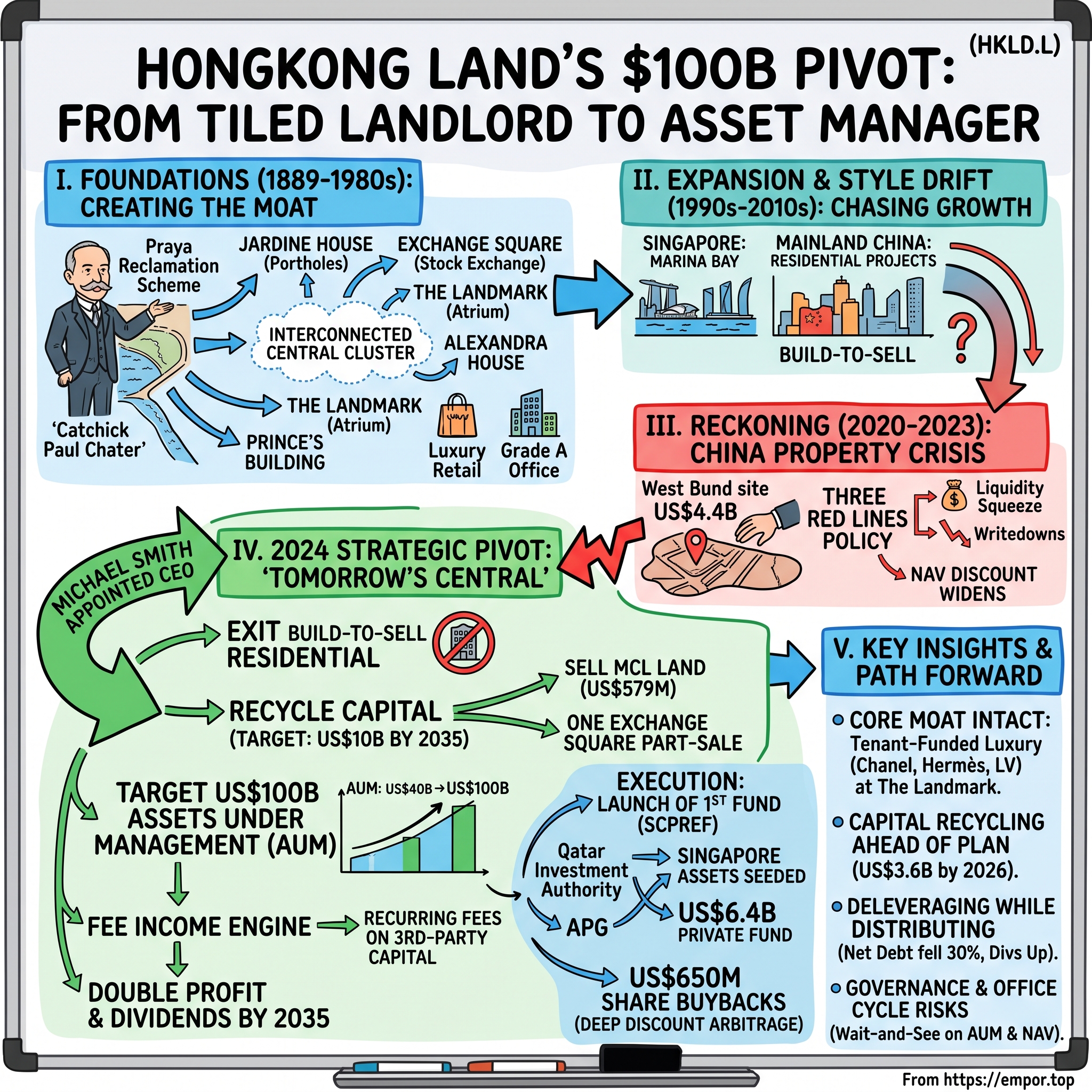
Hongkong Land Holdings Limited: The Asian Real Estate Titan's $100B Pivot
I. Introduction & Episode Roadmap
Stand at the corner of Des Voeux Road and Pedder Street in 中环 Central, Hong Kong, and look up. You are surrounded on all four sides by the same landlord. To your east, The Landmark, where Hermès and Louis Vuitton anchor an atrium that functions as the unofficial living room of Asian old money. To your north, Jardine House, its 1,700 circular portholes staring out over Victoria Harbour like the eyes of an institution that has watched the city grow up. Cross the street without ever touching the pavement, gliding through an air-conditioned skybridge, and you pass Prince's Building, then Alexandra House, then the granite plaza of Exchange Square, home to the Hong Kong stock exchange itself. You have walked through roughly half a mile of the most valuable commercial real estate on the planet, and you have never left the property of a single company: 香港置地 Hongkong Land Holdings Limited.
Here is the paradox that makes Hongkong Land one of the most fascinating value puzzles in Asian markets. The company owns something close to irreplaceable — a contiguous campus of roughly a dozen interconnected Grade A towers in the beating heart of a global financial center, plus prime assets in Singapore's Marina Bay and mainland China. Its net asset value per share stood at US$14.30 at the end of 2025.4 Yet the stock, listed on the London Stock Exchange under the ticker HKLD, traded through mid-2026 around US$7, a discount of nearly half to the company's own audited estimate of what its buildings are worth.3 For decades, investors have asked the same question: why does the market refuse to pay for these crown jewels?
The answer, and the drama, arrived on 30 October 2024. Under a newly installed chief executive, Michael Smith — a man who spent his career not as a Hong Kong property insider but as a fund manager and investment banker — Hongkong Land announced the most radical strategic overhaul in its 135-year history. The company would stop building homes to sell, a business it had chased aggressively across mainland China during the boom years. It would recycle up to US$10 billion of capital out of those legacy assets over a decade. It would reinvent itself as a manager of other people's money, targeting US$100 billion in assets under management by 2035, and it promised to double both underlying profit and dividends per share along the way.1
This is a story about whether a landlord can become an asset manager. It is a story about a British colonial trading empire, a family holding company in Bermuda that has controlled this business for generations, and a bet on Chinese property that went badly wrong at precisely the wrong moment. Most of all, it is a live test of a thesis every long-term investor should find irresistible: can a genuinely world-class physical moat — land you literally cannot replicate — survive a decade of Hong Kong office deflation, China write-downs, and a conglomerate governance discount, and still reward the patient owner?
Hold the two halves of that question in your head at once, because the tension between them is the entire investment case. On one side sits an asset base that is, by any sober appraisal, extraordinary — the kind of property portfolio that private-equity giants dream of assembling and never can, because the land does not come up for sale and the incumbent has owned it since before there were skyscrapers to put on it. On the other side sits a share price that behaves as if the market believes none of that quality will ever reach the pocket of an outside shareholder. Both perceptions have been correct for a long time. The reconciliation of the two — the closing, or the permanence, of the gap between what the assets are worth and what the shares fetch — is what the next decade will decide, and it is why a business that could easily read as sleepy and colonial is instead one of the more intellectually charged situations in Asian equities.
Empor's posture here is neutral. We are not management's investor-relations arm, and a ten-year transformation announced by a company trading at half of book value deserves to be believed only to the extent it is proven. So throughout this story we will keep two ledgers side by side: what Hongkong Land has claimed it will do, and what it has actually done. As of mid-2026, with the first full year of execution reported, there is finally real evidence on both sides of that ledger — and it is more interesting than either the die-hard bulls or the reflexive skeptics predicted.
We will trace the arc from harbor reclamation in 1889 to the trophy towers of Central; from the Singapore expansion that copied the playbook to the mainland residential detour that broke it; through the record-shattering Shanghai land purchase of 2020 and the impairments that followed; into Michael Smith's 2024 pivot and the early evidence from 2025 and 2026 on whether he can execute it. Then we will war-game the business through Porter's Five Forces and Hamilton Helmer's 7 Powers, stress-test it like a skeptical activist, and lay out the bull and bear cases without picking sides. Let's begin where the land itself began — underwater.
 Subscribe on LinkedIn
II. The Founding Context & The Jardine Empire (1889–1980s)
In 1889, the shoreline of Hong Kong Island ran roughly where Des Voeux Road sits today. Everything seaward of it — the ground beneath the modern financial district — did not yet exist. It had to be manufactured. And the man who set out to manufacture it was an Armenian-Calcutta financier named Catchick Paul Chater, whose name survives on 遮打道 Chater Road and Chater Garden, the small green lung around which the Central towers now cluster.
Chater, in partnership with James Johnstone Keswick of the great trading house Jardine, founded The Hongkong Land Investment and Agency Company in 1889 with a startlingly literal business plan: create the city's financial center by dredging Victoria Harbour and reclaiming land from the sea.2 The Praya Reclamation Scheme was audacious civic engineering dressed as a property play. Where there had been water, there would be streets, wharves, and — crucially — freehold and long-lease commercial plots owned by Hongkong Land. It is the origin of the moat, and it is worth pausing on the logic: the company did not merely buy prime land, it created the prime land, and it created it in the one spot that could never be relocated because it sat at the harbor's edge beside the colonial government. Scarcity was designed in from the first shovel.
Chater himself is worth lingering on, because he embodies a truth about Hong Kong that the colonial mythology tends to bury: the city's foundations were laid as much by an Armenian merchant from Calcutta as by any Englishman. Orphaned young, Chater arrived in Hong Kong in the 1860s with little, made an early fortune in bullion and exchange broking, and possessed the two qualities every great property fortune requires — an eye for undervalued land and the patience to wait for a city to grow into it. He co-founded not only Hongkong Land but also the utility and wharf companies that electrified and provisioned the colony. When he looked at Victoria Harbour, he did not see water; he saw the balance sheet of the future. That is the founder's temperament stamped into the company's DNA from day one: think in decades, buy what cannot be replaced, and let time do the compounding.
The corporate umbrella overhead was 怡和洋行 Jardine Matheson, the swashbuckling British trading house — a 大班 taipan empire built originally on the China trade — that would come to treat Hongkong Land as its property arm and controls roughly half the company to this day, a stake in the region of 50 percent held through the Jardine group.3 That control matters enormously to the modern investment case, and we will return to it, but its 20th-century roots were defensive. In the 1980s, as corporate raiders circled Hong Kong's cash-rich, asset-heavy conglomerates, the Jardine companies built an intricate cross-shareholding lattice — Jardine Matheson and Jardine Strategic each owning large slices of the other — specifically to make themselves indigestible. Shipping magnate 包玉刚 Sir Y.K. Pao and a rising property tycoon named 李嘉诚 Li Ka-shing were among those whose ambitions the structure was designed to frustrate. The Jardine defense web worked. It kept the empire independent. It also entrenched a controlling family's grip in a way public minority shareholders are still paying for through a valuation discount decades later.
There is a deeper lesson in that defensive lattice for anyone studying controlled companies. The Jardine cross-holding was, in a sense, the original poison pill — engineered years before the term entered the American corporate lexicon, and far more durable than anything a Delaware lawyer ever drafted. It did not merely raise the cost of a takeover; it made one structurally impossible, because each Jardine entity's shares were locked inside another Jardine entity in a self-referential loop. The genius of it was permanence. The cost of it, borne quietly by generations of minority investors, was that the market could never discipline the parent, never force a sale of the crown jewels, never arbitrage away a discount. The families won their independence. The float paid the insurance premium — and is still paying it.
Meanwhile, the physical monopoly took shape tower by tower. Jardine House rose in 1973 as the tallest building in Asia at completion, its round windows an instant icon of the skyline — locals nicknamed it "the house of a thousand orifices," an affectionate jibe at the porthole façade that has since become one of the most recognizable silhouettes in Asia.2 Exchange Square opened in 1985 and promptly became the address of the Hong Kong stock exchange itself — a landlord whose tenant is the marketplace where its own shares trade. Prince's Building, Alexandra House, The Landmark: one by one, Hongkong Land assembled not a portfolio of scattered trophies but a single connected estate. Crucially, the company almost never sold. In an industry where developers routinely build to flip, Hongkong Land built to hold, treating each tower as a permanent addition to the estate rather than a trade. That refusal to sell is what allowed the campus to become contiguous in the first place — you cannot assemble a connected empire if you keep selling the pieces.
The masterstroke that turned adjacency into advantage was the pedestrian skybridge network — an elevated, air-conditioned web of covered walkways stitching every Hongkong Land tower in Central into one continuous, weatherproof interior.2 Think about what that engineering did economically. A banker at Exchange Square could reach a luxury boutique at The Landmark, a law firm at Jardine House, and a lunch reservation at Prince's Building without descending to street level or stepping into Hong Kong's brutal summer humidity. Foot traffic was channeled, permanently and by design, through company-owned retail arcades. Rival buildings across the road were, quite literally, a bridge too far. Contiguity plus connectivity created switching costs for tenants and a captive audience for retailers — the two ingredients that let Hongkong Land charge a premium over standalone towers a hundred meters away. The moat was not the buildings. The moat was that they were joined.
By the late 1980s, then, Hongkong Land was not just a landlord; it was the infrastructure of Central itself, wrapped inside a family-controlled trading conglomerate. The obvious question for any management team sitting on a cash machine like that is: what do you do next? The answer, for the next thirty years, was to try to build a second Central somewhere else — and then, fatefully, to try to build something entirely different.
III. Regional Expansion & The Build-to-Sell Style Drift (1990s–2010s)
The specter haunting Hong Kong in the early 1990s had a date attached to it: 1 July 1997, the handover of the colony from British to Chinese sovereignty. For a company whose entire asset base sat on Hong Kong soil and whose controlling family was the very embodiment of the British colonial establishment, the political risk was existential in the imagination if not in fact. The Jardine group's response was a piece of corporate insulation as deliberate as any skybridge: it re-domiciled its holding structures to Bermuda and shifted Hongkong Land's primary share listing to London, with a secondary listing in Singapore.2 The shares of a company whose buildings you could touch in Central would now legally live an ocean away, denominated in US dollars, beyond the immediate reach of any future sovereign whim.
That decision is a study in the double edge of caution. It protected capital and gave nervous international investors a familiar venue. But it also began Hongkong Land's long estrangement from its natural shareholder base. A Hong Kong landlord trading in London on the FTSE's fringes, followed by a handful of analysts, quoted in a currency few of its tenants used — the arrangement seeded the very illiquidity and neglect that would later feed the NAV discount. Safety and obscurity, it turned out, were sold as a bundle.
The estrangement went further than geography. In 1994, in a bruising dispute with the Hong Kong stock exchange over shareholder protections, the entire Jardine group delisted its shares from Hong Kong altogether — the very city where all the value lived. For a company whose buildings a Hong Kong investor could see from their office window, the shares became something you had to buy in London or Singapore, in US dollars, through a structure domiciled in Bermuda. The psychological distance this created is hard to overstate. The local retail and institutional investors who best understood the assets, who walked through The Landmark every week, were structurally discouraged from owning the stock. A moat is only worth what the market will pay for it, and Hongkong Land spent three decades making itself deliberately hard to buy for the very people who understood it best.
With the home base secured, management went looking for a second act, and found it 2,500 kilometers south in Singapore. Through joint ventures with local partners including Keppel and 长实集团 CK Asset Holdings, Hongkong Land helped develop One Raffles Quay and, later, the Marina Bay Financial Centre — prime office towers wrapped in retail and plugged directly into Singapore's subterranean transit network. It was the Central playbook, transplanted: cluster the towers, connect them underground, and rent Grade A space to the banks. The execution was genuinely good, and it made Hongkong Land a top-tier landlord in Singapore's central business district. This was expansion done right — replicating a proven moat in a market with similar dynamics of scarcity and prestige.
Then came the detour that would define the next two decades. As mainland China's economy detonated into growth, Hongkong Land moved into tier-one and strong tier-two cities — Beijing, Shanghai, Chengdu, Chongqing, Hangzhou. Some of that expansion was faithful to the model. In Beijing, the company built 王府井 WF CENTRAL, an ultra-luxury retail destination on the famous Wangfujing shopping street, proving the Central retail formula could travel. But alongside the trophy-landlord strategy, Hongkong Land did something different in character: it plunged into Chinese residential development — buying land at auction, building apartment blocks, and selling the units for a quick profit.
The Singapore chapter deserves credit precisely because it shows Hongkong Land at its disciplined best, and it sets up the contrast that follows. Marina Bay was a greenfield financial district willed into existence by the Singapore government on reclaimed land — a striking echo of Chater's own Praya scheme a century earlier. Hongkong Land recognized the pattern instinctively and partnered its way into the anchor towers, then applied the identical formula: cluster the offices, connect them to the MRT, wrap them in retail, and lease to the banks. It worked because the underlying dynamic was the same one that made Central valuable — scarce, prestigious, government-blessed land in a place global finance had to be. Diversification that replicates your actual edge is not drift; it is compounding. What came next was different in kind.
This is the "build-to-sell" business, and it is worth being precise about why it represented a style drift rather than a simple diversification. A landlord's economics are slow, predictable, and high-margin: you own an asset, you collect rent for decades, and the rent compounds. A residential developer's economics are the opposite: capital-intensive, cyclical, and binary. You bid against desperate rivals in a land auction, you sink billions into construction, and your profit depends entirely on selling the finished units before the credit cycle turns. There is no recurring revenue, no compounding tenant base, no moat — only a race to convert land into sold apartments faster than the next developer and before the government changes the rules. It is a perfectly good business for a specialist who lives and breathes it. It is a strange business for a company whose entire identity was built on never selling anything. During China's housing boom, the returns on equity looked spectacular, which is precisely the seduction. A company sitting on the world's best rental moat began chasing a developer's fast money — trading the durable for the lucrative, and quietly re-rating its own risk profile from bond-like landlord to leveraged homebuilder. For a while, the music played and the returns rolled in. The problem with betting on a cycle is that you have to be right about when it ends.
IV. The China Property Reckoning & The $4.4B West Bund Gamble (2020–2023)
On 20 February 2020, as COVID-19 was shutting down cities across China and the rest of the world was weeks from lockdown, Hongkong Land walked into a Shanghai government land auction and made history. It bid RMB 31.05 billion — roughly US$4.4 billion — for a 23-hectare mixed-use site along the 西岸 West Bund in Xuhui district. It was the most expensive land parcel ever sold in mainland China.8
Sit with the timing for a moment, because it is almost unbelievable in hindsight. This was the top of the market. Within months, Beijing would roll out the 三道红线 Three Red Lines — a set of leverage limits designed to force-deleverage the entire Chinese property sector — and the policy would detonate a liquidity crisis that took down the industry's biggest names. Hongkong Land had paid a record, top-of-cycle price for the single largest parcel in the country, at the exact inflection point where the government decided the party was over. It is one of the more vivid capital-allocation cautionary tales in recent Asian real estate: even a disciplined, A-rated, century-old institution is capable of buying the very top when the boom's logic feels self-evident.
It is worth explaining what the Three Red Lines actually did, in plain terms, because the mechanism is the whole story. Beijing drew three financial lines in the sand — limits on a developer's debt-to-assets, debt-to-equity, and cash-to-short-term-debt ratios — and told developers that crossing them capped how much new debt they could raise. Overnight, the entire industry's business model, which ran on perpetually rolling over cheap debt to buy the next parcel and build the next tower, was choked off. Developers who had been sprinting on borrowed money suddenly could not refinance. Presales stalled, projects halted, and buyers — who in China routinely pay for apartments before they are built — began to fear their homes would never be finished. The policy was not a bug; it was a deliberate, controlled demolition of a bubble Beijing had decided was dangerous. The trouble for anyone holding Chinese property assets was that a controlled demolition still buries whatever is standing nearby.
To be fair to the decision, West Bund was a mixed-use project weighted heavily toward the commercial, long-hold assets Hongkong Land actually understands — offices and retail it intended to keep, not just apartments to flip. The problem was the broader residential book. As the crisis spread, buyer sentiment across China collapsed, and marquee developers 恒大 Evergrande and 碧桂园 Country Garden defaulted, dragging confidence down with them. Hongkong Land's mainland build-to-sell inventory — the apartments it had queued up to sell during the good years — had to be written down as prices fell and projects stalled.
Here it is worth correcting a widely repeated but imprecise number, because the truth is more revealing than the myth. Hongkong Land did report enormous non-cash losses. In 2023, the company swung to a net loss attributable to shareholders of US$582 million, driven by roughly US$1.3 billion in non-cash losses.9 But the bulk of that US$1.3 billion was not Chinese residential impairment — it was the downward revaluation of its investment properties, chiefly its Hong Kong and Singapore office and retail towers, as market capitalization rates rose. The actual write-downs specific to the mainland build-to-sell residential inventory were far smaller in 2023, in the region of US$90 million, growing to roughly US$314 million in 2024.10 The distinction matters for diagnosis: Hongkong Land's reported pain came more from its core landlord assets being marked down in a rising-rate world than from the residential misadventure alone. In 2024, the two forces compounded into a net loss attributable to shareholders of nearly US$1.4 billion, and underlying profit — management's preferred operating measure that strips out revaluations — fell 44 percent to US$410 million.10[^13]
This correction is not pedantry; it changes what an investor should worry about. If the write-downs had been overwhelmingly Chinese residential, the fix would be straightforward: finish the projects, sell the apartments, and never do it again — a painful but bounded problem. But because the larger losses came from revaluing the core landlord assets downward, the pain reaches into the heart of the business the entire bull case depends on. A rising discount rate applied to Hong Kong and Singapore office towers is not a legacy mistake to be worked off; it is a live repricing of the crown jewels themselves. The distinction is the difference between a self-inflicted wound that heals and a market shift that may or may not reverse. Investors who anchored on "it was all the China residential bet" missed the more uncomfortable reality that the market was marking down Central itself.
The second headwind blew straight through the crown jewels. Hong Kong's Grade A office market entered a structural slump. Western investment banks cut headcount, Chinese financial institutions trimmed their expensive Hong Kong footprints, and hybrid working thinned demand for desks. Market-wide vacancy in Central's Grade A offices climbed past 13 percent — a level that would have been unthinkable in the district's boom years.15 Spot rents fell sharply from their peak, and because leases roll over on multi-year cycles, every renewal became a downward reset, a slow bleed of "reversionary" rent as old high-priced leases expired into a cheaper market. Notably, Hongkong Land's own portfolio held up far better than the market — its Central office vacancy sat around 6 to 7 percent, roughly half the district average, a real-world demonstration of the flight-to-quality that its trophy assets command.4 But "better than a bad market" is still not "good." The core engine was running slower, the mainland bet had soured, and the stock languished near a third of book value. Something had to give. In April 2024, it did — in the form of a new man in the corner office.
V. The 2024 Strategic Pivot: Michael Smith & The $100B Vision
For most of its modern history, Hongkong Land was run by property lifers — executives who came up through the business of leasing towers and knew every square meter of the Central estate. Robert Wong, chief executive since 2016, was exactly that: a long-serving insider steeped in the company's DNA. So when Jardine Matheson announced on 21 November 2023 that Wong would retire and hand the reins on 1 April 2024 to an outsider named Michael Smith, the choice itself was the message.56
Smith was not a Hong Kong landlord. He was a capital allocator. He had served as Regional CEO for Europe and the United States at Mapletree Investments — the Singapore real estate group, backed by state investor Temasek, that had grown from a domestic landlord into a serious global fund manager overseeing tens of billions in third-party capital — and before that spent years in real estate investment banking, including as a partner at Goldman Sachs in Singapore.5[^7] His entire career was about the thing Hongkong Land conspicuously was not: turning property into managed funds, raising money from institutions, and earning fees. Hiring him was Jardine Matheson stating, without stating it, that the family had lost patience with a controlled trophy-landlord trading at a 60-to-70-percent discount and wanted the balance sheet worked.
The choice of a Mapletree alumnus specifically is the tell. Mapletree is, in Asian real estate circles, the canonical example of the exact transformation Hongkong Land now wants to attempt: a company that took its own prime buildings, spun them into REITs and private funds, sold stakes to institutions, and kept earning management fees on assets it no longer had to own outright — converting a slow, balance-sheet-heavy landlord into a faster-growing, capital-light manager. Smith had helped run precisely that machine, in the Western markets no less, where the institutional capital is deepest. Jardine Matheson did not hire a generic turnaround executive; it hired someone who had lived inside the playbook it wanted copied. That is either a masterstroke of pattern-matching or a case of importing a model that may not transplant — and which reading is correct is, again, an empirical question that only time and execution can settle.
Smith moved fast, and he moved on the retail crown jewel first. On 26 June 2024, before the grand strategy was even public, Hongkong Land unveiled "Tomorrow's CENTRAL" — a transformation of The Landmark backed by more than US$1 billion of combined investment, of which Hongkong Land itself would commit over US$400 million across roughly three years.7[^9] The rest came from the tenants. Some of the most powerful luxury houses in the world — the release named maisons including Chanel, Dior, Hermès, Louis Vuitton, Cartier, Prada, Saint Laurent, Tiffany & Co., and Van Cleef & Arpels — agreed to co-invest in dramatically enlarged flagship stores, several expanding toward 10,000 square meters or more.7
Read that structure carefully, because it is the single strongest piece of evidence in the entire bull case. In the depths of a Hong Kong property downturn, the world's most discerning retailers were voluntarily putting their own capital into a single landlord's building to make their stores bigger. That is not the behavior of tenants with options. It is revealed preference — a luxury ecosystem that believes its customers will only congregate in one place, and that place is The Landmark. Whatever was happening in the office market, the retail moat was demonstrably intact and monetizable. Smith had found his proof point.
Consider what a luxury maison is actually buying when it doubles a Landmark flagship to 10,000 square meters and helps pay for the renovation. It is not buying floor space; Hong Kong has plenty of empty floor space. It is buying adjacency to its rivals and access to the specific pool of ultra-high-net-worth shoppers — mainland Chinese, Southeast Asian, and local — who treat Central as the one address worth visiting. A Hermès store is worth more next to a Chanel store than it is alone, because the cluster is the destination, not any single boutique. This is why luxury retail behaves so differently from offices: an investment bank leases a floor because it needs desks and will move to save money, but a luxury house anchors itself where its customers already are and cannot leave without leaving the customers behind. Smith understood that the office cycle and the retail moat were two entirely different animals, and that the market was mistakenly pricing the whole company off the weaker one.
Then came the headline event. On 30 October 2024, Hongkong Land issued a strategic update that amounted to a repudiation of two decades of strategy.116 The commitments were specific and, for this famously cautious company, startlingly bold:
Exit build-to-sell, completely. Hongkong Land would make no new investments in build-to-sell residential development — the business it had chased across China and Southeast Asia — and would wind down existing projects, recycling the capital out as they completed.1[^14]11
Recycle up to US$10 billion by 2035. Roughly US$6 billion would come from winding down the build-to-sell inventory and about US$4 billion from recycling selected investment-property assets, redeployed into ultra-prime commercial real estate and fund vehicles.1
Become a fund manager. The company would pivot to managing third-party capital through private funds and REIT-like vehicles, targeting growth in assets under management from around US$40 billion toward US$100 billion by 2035.1[^16]
Double profit and dividends, and de-concentrate. Management committed to doubling underlying profit before interest and tax and doubling dividends per share by 2035, funded by growing recurring rental and fee income — and to capping any single city's contribution to underlying profit at 40 percent, an explicit acknowledgment of how dangerously dependent the group had become on Hong Kong.1[^16]
Why would fee income be worth so much more than rent to justify all this upheaval? Because of how markets capitalize the two. A landlord's rent is tied to the value of the buildings; own US$40 billion of towers and the market roughly values you off that asset base, minus a discount for all the reasons we have discussed. But a fund manager earns a recurring fee — typically a percentage of the assets it manages plus a share of the profits — on capital that mostly belongs to other people. That fee stream requires little of the manager's own balance sheet, scales without proportional new investment, and is valued like an annuity on a high multiple. In the language of the trade, it is "capital-light." A dollar of fee income can be worth several times what a dollar of rental income is worth in the market's eyes. That multiple arbitrage — turning heavily-discounted asset value into premium-rated fee value — is the mathematical engine of the entire pivot, and it is why Smith keeps insisting the strategy is a re-rating catalyst rather than merely a growth plan.
What should a neutral investor make of a plan this sweeping? The strategic logic is coherent. But a ten-year target with three staggered execution windows is also, conveniently, a plan whose success cannot be judged for a long time. The right posture is skepticism informed by evidence, and on the October 2024 call the analysts supplied the skepticism directly. They pushed on the obvious contradiction: if your stock trades at a fraction of NAV, why recycle billions into new investments and funds instead of simply buying back your own wildly cheap shares? And can you really liquidate mainland assets into an illiquid, distressed market without accepting brutal discounts to book value? Smith's answer leaned on the re-rating logic — that a fee-earning platform is a permanent catalyst in a way a one-off buyback is not — and on the promise of investment-committee discipline across the three windows. Those are reasonable arguments. They are also, in October 2024, entirely unproven. The only thing that could turn the pivot from slide deck into fact was execution — and by 2026, the first real evidence was in.
VI. Segment Economics, Capital Allocation, & Moat Analysis
To understand whether the pivot can work, you have to understand where the money actually comes from — and Hongkong Land is really two businesses stapled together, pulling in opposite directions.
The core engine: Investment Properties. This is the landlord business — the contiguous Central estate of roughly a dozen towers, the Singapore stakes in Marina Bay Financial Centre and One Raffles Quay, Beijing's WF CENTRAL, and the commercial phases of Shanghai West Bund. It is the overwhelming majority of the group's underlying operating profit, and it runs at the fat operating margins that come with owning irreplaceable assets and leasing them to tenants who cannot easily leave. Within it, the interplay between office and retail is the key mechanism to grasp. The Grade A office book is under cyclical pressure from vacancy and reversionary rent declines. But the ultra-luxury retail — Central and WF CENTRAL — behaves differently: leases often blend a base rent with a percentage of the tenant's sales, so a thriving boutique pays the landlord more. In a downturn, luxury retail's pricing power and scarcity act as a stabilizer against office softness. The Tomorrow's CENTRAL co-investment is the vivid proof that this stabilizer is real and, if anything, strengthening.
There is a subtlety here that sophisticated investors should not miss: the retail stabilizer works only as long as mainland and regional luxury consumption holds up. The percentage-of-sales lease structure that makes The Landmark so lucrative in good times cuts the other way in bad ones — if shoppers stop spending, the turnover rent shrinks with them. So the very mechanism that lets Hongkong Land capture the upside of a luxury boom also exposes it to a luxury bust. In 2024 and 2025, Chinese luxury spending softened under a slowing economy and a more cautious consumer, and the resilience of Central retail became a genuine open question rather than a given. The moat is real; it is not weatherproof.
The legacy drag: Development Properties. This is the build-to-sell business — residential projects across Chongqing, Chengdu, Wuhan, Singapore, and Southeast Asia. It is capital-hungry, earnings-volatile, and freshly scarred by impairments. Under the new strategy it is not a growth segment at all; it is inventory to be sold and capital to be freed. The entire point of the 2024 pivot is to shrink this side of the house to zero and redeploy the proceeds. The uncomfortable catch is timing: Hongkong Land must sell this inventory into the very same weak Chinese property market that impaired it, which means the choice on every project is between waiting for prices that may never return and accepting a discount that crystallizes the loss. Capital recycling, elegant on a slide, is on the ground a series of difficult sales in a buyer's market.
The NAV disconnect. Now to the central puzzle. At the end of 2025, Hongkong Land reported net asset value of US$14.30 per share; the stock traded around US$7.43 Why would the market value a portfolio of world-class assets at roughly half what the company's own valuers say it is worth? Several forces stack up. First, the Jardine control stake of around half the company means minority holders can never force a sale, a break-up, or a takeover — the assets are permanently locked. Second, investors carry scar tissue from mainland write-downs and reasonably fear more. Third, Hong Kong office values are still repricing downward, so the "audited NAV" itself is a moving target that has been moving the wrong way. Fourth, a long history of slow capital returns trained the market to expect little. A conglomerate discount is not irrational; it is the market pricing in illiquidity, governance friction, and the risk that value stays trapped. The pivot is, at its core, an attempt to prove that judgment wrong.
Hamilton Helmer's 7 Powers. Which of Helmer's durable advantages does Hongkong Land actually possess? The strongest is Cornered Resource: you genuinely cannot assemble another contiguous twelve-building campus in Central Hong Kong, because there is no land and the incumbent owns what exists. That is as close to a physical monopoly as commercial real estate offers. Layered on top is a form of network effect in luxury agglomeration — Hermès stays near Chanel stays near Louis Vuitton because affluent shoppers cluster where the other flagships are, and The Landmark is where they cluster. There are real switching costs for the office tenants too: exchanges, law firms, and private banks wired into specific buildings' infrastructure and prestige addresses do not move casually. And there is process power / balance-sheet strength — Moody's rates the operating company A2 and S&P rates it A, with conservative gearing that lets Hongkong Land endure downturns that bankrupt leveraged rivals.14 The honest caveat: these powers protect the core rental moat superbly, but they say almost nothing about whether Smith can win in fund management, which is a completely different game requiring a track record the company does not yet have.
It is worth naming the competitive set precisely, because the peers illuminate what Hongkong Land is and is not. 太古地产 Swire Properties is the closest analog — another old British-lineage landlord with a connected trophy estate, its Pacific Place and Taikoo Place campuses playing a similar contiguity game in Admiralty and Quarry Bay. 新鸿基地产 Sun Hung Kai Properties and 恒基兆业地产 Henderson Land Development are the great local Chinese-family developers, deeper in residential and, increasingly, adding new Central-district office supply that competes directly for the same tenants. 九龙仓置业 Wharf REIC owns the Harbour City and Times Square retail behemoths across the harbour in Tsim Sha Tsui and Causeway Bay — a rival luxury-retail cluster with its own gravitational pull. And 长实集团 CK Asset Holdings, the property empire built by 李嘉诚 Li Ka-shing — the very tycoon the Jardine defense web was designed to keep out decades earlier — is the master capital allocator of the group, famous for selling assets at the top and hoarding cash for the bottom.
Porter's Five Forces, briefly, sharpens the same picture. The bargaining power of office tenants is currently high because the district is oversupplied, but the bargaining power of luxury retail tenants is low because the space is scarce. The threat of new entrants in Central is effectively nil — there is no land — while in Singapore and the mainland it is real. The threat of substitutes is the subtle one: decentralization. As firms weigh cheaper Grade A space in Kowloon East, Wong Chuk Hang, or across the border in the 大湾区 Greater Bay Area, "a prestigious Central address" competes against "a perfectly good office at half the rent." And rivalry among Hong Kong's mega-landlords is intense — the five names above all compete for the same tenants and, increasingly, for the same institutional capital Smith now wants to manage. Notice that in the new game Smith has chosen, the competitive field widens dramatically: he is no longer just up against Hong Kong landlords but against global fund-management titans. The moat around the land is pristine. The contest for the next dollar of growth is wide open. That tension — an impregnable core wrapped around an unproven pivot — is the whole investment case, and it leads directly to the lessons this saga teaches.
VII. Playbook: Business & Investing Lessons
Lesson 1: Beware style drift into commoditized markets. The most expensive mistake in this story was not a bad building; it was a category error. A company with arguably the finest rental moat in Asia decided that the moat's slow, boring, compounding cash flows were not enough and went chasing a developer's fast returns in the most competitive, most cyclical, most policy-exposed market imaginable. Chinese residential development had no moat — anyone with capital could bid at the same auctions — and Hongkong Land's world-class advantages in Central were completely non-transferable to it. The lesson generalizes far beyond real estate: when a company with a durable edge in one business ventures into an adjacent business where it has no edge, the market is usually right to worry, and "high returns during the boom" is exactly the siren that lures disciplined operators onto the rocks.
Lesson 2: Physical contiguity multiplies asset moats. Owning one trophy tower is nice; owning twelve joined by private skybridges is a different asset class entirely. The connection converts a collection of buildings into a captive ecosystem that controls foot traffic, raises switching costs, and commands rents a standalone tower across the street cannot. When you evaluate any physical-network business — malls, ports, railroads, fiber — ask not just what it owns but how the pieces connect, because contiguity is where the pricing power hides.
Lesson 3: The asset-light pivot is a culture change, not a press release. Announcing that you will become a fund manager is the easy part. Actually becoming one requires institutional-investor relationships, a demonstrated track record of generating returns on other people's money, a fundraising machine, and an internal culture that thinks like a general partner rather than a building owner. Consider the incentive shift alone: a landlord is rewarded for owning the best buildings forever; a fund manager is rewarded for raising capital, deploying it, harvesting fees, returning it, and raising the next fund — a perpetual-motion machine of relationships and reporting that has almost nothing in common with collecting rent. It demands a fundraising team, an investor-relations function built for pension funds and sovereign wealth rather than public-market analysts, a governance structure that treats limited partners' interests as paramount even when they conflict with the parent's, and a compensation model that pays people to move capital rather than to sit on it. Brookfield, CapitaLand, and Mapletree took years — in some cases decades — to build those muscles, and each stumbled along the way. Hongkong Land is attempting the transformation at 135 years old, from a standing start, and the first fund is a beginning, not a validation. The market should — and does — demand proof over time, not promises. Watch, specifically, whether the second and third funds raise capital as easily as the first, because that is when the strategy stops being about the quality of the seed assets and starts being about whether the market trusts Hongkong Land as a manager.
A useful second-layer check on the pivot's health is the credit story, because rating agencies watch capital discipline more coldly than equity investors do. Through the entire transformation, Moody's held the operating company at A2 and S&P at A, both stable — meaning the agencies judged that exiting build-to-sell, recycling assets, and returning capital were being done without impairing the balance sheet's fortress quality.14 That is a meaningful, independent tick in the credibility column: it is easy to fund buybacks and dividends by quietly levering up, and the agencies are precisely the referees who would flag it. Net debt falling roughly a third by the end of 2025, even as cash flowed out to shareholders, tells the same story from the other direction.4 The delevering-while-distributing combination is only possible because the asset sales are real and the proceeds are landing.
Lesson 4: Family and conglomerate control discounts are real, and they cut both ways. Jardine Matheson's roughly half-ownership gives Hongkong Land something rare and genuinely valuable: a multi-decade time horizon and immunity from the short-term pressures that push public companies into value-destroying decisions. But the same control isolates management from the discipline of the public market — no activist can force a change, no acquirer can arbitrage the discount — and the result is a structural valuation penalty that has persisted for decades. Control is not free. Minority shareholders pay for someone else's permanence, and they should price that in with clear eyes. Those four lessons frame the debate that a skeptical investor would now bring to the table.
VIII. Analysis, Skeptical Stress Test, & Bull vs. Bear Case
Imagine a sharp-elbowed activist investor sitting across from Michael Smith. Here is where they would press hardest.
"If your stock trades at half of NAV, why aren't you buying back every share you can instead of building funds?" This is the single most powerful challenge, and it goes to the heart of capital allocation. Every dollar Smith spends acquiring a new prime asset at fair value buys roughly a dollar of NAV; every dollar spent buying back Hongkong Land's own stock at a 50 percent discount buys two dollars of NAV. Mathematically, the buyback is the more accretive use of capital by a wide margin. Smith's defense is that a fund-management platform re-rates the entire company permanently by attaching a higher multiple to fee income, whereas buybacks are a finite, one-time arbitrage. Both things can be true — and the honest answer, visible in the 2025–2026 results, is that the company chose to do both, which we will come to. But the tension is real, and an investor should watch closely whether recycled capital keeps flowing disproportionately to buybacks (a signal management truly believes its own stock is the best asset) or to empire-building funds (a signal to be more skeptical).
"Can you actually compete for global capital against Blackstone, CapitaLand, and ESR without a track record?" Fund management is a trust business, and trust is earned through cycles of delivering returns to limited partners. When a sovereign wealth fund decides where to place a billion dollars, it looks for a manager with a decade of audited fund returns across a full cycle — a "track record" in the industry's most literal sense. Hongkong Land has none as a third-party manager; it has always invested its own balance sheet. It is a debutante in a room full of veterans who have raised dozens of funds and returned capital through multiple downturns. The counter-argument is that Hongkong Land does not need a performance track record to raise its first fund, because the seed assets themselves are the pitch: institutions are not betting on Smith's stock-picking, they are buying fractional ownership of Marina Bay towers they could never acquire on the open market. The assets are the track record. That works for the first fund. Whether it works for the tenth — where investors will demand evidence that Hongkong Land can acquire and improve assets, not just contribute the ones it already owns — is the harder, unanswered question.
"What if the Greater Bay Area permanently erodes Hong Kong's rent premium?" If 大湾区 Greater Bay Area integration and the rise of Shenzhen and Shanghai as financial centers structurally narrow the gap between Central rents and mainland rents, then the crown jewels are worth permanently less, and no amount of fund-management cleverness fully offsets a shrinking core. This is the deepest bear risk because it attacks the moat itself rather than the strategy.
The risk radar. Three material risks dominate. First, Hong Kong office structural repricing — new Grade A supply arriving into an already soft market, from gleaming towers like Henderson Land's The Henderson in Central to Sun Hung Kai's developments around the West Kowloon terminus, adds desks precisely when demand is weak, and financial-sector retrenchment could prolong the reversionary rent bleed for years. The mechanism to watch is straightforward: every high-priced lease signed in the boom that now rolls over resets downward, so even a landlord with high occupancy quietly earns less per square foot with each renewal. Second, China luxury consumption — the pillar holding up the retail stabilizer is mainland demand, and 共同富裕 common prosperity policy signals, an anti-extravagance mood, and a slowing Chinese economy could crimp the very turnover rents that make WF CENTRAL and The Landmark so resilient. Third, execution risk on the US$10 billion recycling — selling mainland residential and non-core commercial assets at anything near book value in a distressed, illiquid market is far easier to promise than to do, and every sale forced through at a discount both crystallizes a loss and hands ammunition to skeptics who doubt the reported NAV in the first place. There is a fourth, slower-burning risk worth flagging: the transformation itself is a multi-year execution marathon dependent heavily on one executive's playbook, and key-person and cultural-change risk in a 135-year-old institution learning to think like a fund manager should not be dismissed as soft. Cultures that spent a century refusing to sell do not always take naturally to a business built on recycling.
Now, the crucial update: what has actually happened since the pivot? As of the FY2025 results released on 5 March 2026, the early scorecard is more encouraging than skeptics feared. Net profit attributable swung back to a positive US$1,263 million from the prior year's US$1.4 billion loss, underlying profit was US$458 million, dividends per share rose 9 percent to 25.0 US cents, and net debt fell about 30 percent to US$3,577 million.4[^22] More tellingly, Hongkong Land reported roughly US$3.6 billion of capital recycled — around 90 percent of its interim 2027 target already banked.13 It sold part of One Exchange Square in April 2025 and offloaded its Singapore residential arm MCL Land to Malaysia's Sunway Group for about US$579 million.1213 It launched a buyback program that grew in stages to a cumulative US$650 million commitment running to mid-2027, cancelling the repurchased shares and shrinking the share count by roughly 2.4 percent by early 2026.13 And in February 2026 it launched its first flagship fund — the Singapore Central Private Real Estate Fund (SCPREF), around US$6.4 billion in scale and billed as Singapore's largest commercial real estate private fund, seeded with its stakes in Marina Bay Financial Centre and One Raffles Quay and backed by the Qatar Investment Authority and Dutch pension manager APG.[^17]12 Smith called 2025 a "landmark year."[^22]
That last item is the most important data point in the entire story, because it directly answers the "can you raise third-party capital?" challenge. Sovereign wealth and pension money agreeing to co-invest in Hongkong Land's Singapore towers is exactly the validation the strategy required — a real fund, real limited partners, real fee income, not a slide. It does not prove the US$100 billion target is reachable, but it converts the pivot from aspiration into a going concern.
Equally important is what the numbers reveal about management credibility, which for a company with Hongkong Land's history of slow execution is not a given. Set the promises of October 2024 against the delivery reported in March 2026, and the narrative has so far held together across filings rather than drifting: the company said it would recycle capital, and US$3.6 billion is in the door; it said it would return cash to shareholders, and dividends rose 9 percent while buybacks retired shares; it said it would delever, and net debt fell roughly a third; it said it would build a fund platform, and SCPREF exists. Crucially, the buybacks matter as a signal, not just a return. By choosing to cancel repurchased shares at a deep discount to NAV alongside funding new investments, management partly conceded the activist's point — that its own stock was among the most accretive assets it could buy — rather than dismissing it. That willingness to do both, and to explain the phasing when analysts pressed on it, is the kind of behavior that, sustained over several more years, is what actually closes a credibility discount. One good year does not erase decades of pattern. But it is the first year in a long time where the doing matched the saying.
The bull case, then, rests on a coherent chain: the luxury-retail moat is not just intact but tenant-funded; the fund-management engine has demonstrably started; capital recycling is running ahead of schedule while the balance sheet delevers; and buybacks plus doubling dividends give shareholders a return even before any re-rating. If Smith keeps executing, the logic runs, the NAV discount narrows and both fee streams and distributions compound.
The bear case is equally coherent: Hong Kong Grade A office rents may be in a structural, not cyclical, decline, dragging NAV down faster than fees can grow; further mainland write-downs may accompany the very asset sales that recycling requires; the fund platform, one deal in, could stall if global LPs stay wary; and the Jardine control discount may simply prove permanent, leaving the stock stranded far below asset value no matter how well the operating business performs. In this reading, a good company stays a bad stock — a fate that has, after all, befallen Hongkong Land for the better part of two decades.
It is worth puncturing two myths that cling to this story, because the consensus narrative gets both wrong. The first myth is that Hongkong Land was primarily a victim of the Chinese residential crash. As we have seen, the larger share of its reported losses came from marking down its own core Hong Kong and Singapore towers, not the mainland apartments — the residential bet was a real error, but it was not the main driver of the headline losses, and framing it that way understates how much the pain traces to the crown jewels repricing. The second myth is the opposite exaggeration: that the NAV discount is pure market irrationality waiting to be arbitraged away. It is not. A large slice of the discount is the rational price of illiquidity, permanent family control, and genuine uncertainty about where Hong Kong office values ultimately settle. An investor who believes the discount will close simply because the assets are good has not engaged with why it has stayed open so long. The interesting question is not whether the discount is "deserved" — parts of it clearly are — but whether Smith's fee engine and capital returns can shrink the undeserved portion of it.
There is also a quieter risk that deserves naming: the balance-sheet strength that is a genuine 7 Powers advantage can, in a controlled company, curdle into complacency. A landlord that can never be taken over, funded by a family that thinks in generations, faces little of the pressure that forces ordinary companies to allocate capital sharply. The very durability that let Hongkong Land survive downturns is also what let it drift into Chinese residential and sit on a widening discount for years without consequence. The 2024 pivot is, read charitably, the moment the parent finally imposed on itself the discipline the market could not. Whether that discipline outlasts the current management and the current news cycle — or fades once the discount narrows and the pressure eases — is the deepest governance question of all, and it will not be answered for years.
The neutral truth is that both cases are live, and the FY2025 evidence tilts the execution question modestly toward the bulls while leaving the structural questions — Hong Kong's long-run rent premium and the durability of the control discount — genuinely open. Which brings us to what an investor should actually watch.
The three KPIs that matter most:
-
Central portfolio rental reversions and occupancy. Track physical occupancy and the percentage change on lease renewals across the Central estate. This is the pulse of the core moat; if reversions stop falling and occupancy holds its premium to the market, the largest profit engine has stabilized.
-
Net capital recycled toward the US$10 billion target. Cumulative proceeds realized from build-to-sell completions and asset sales, benchmarked against the phased milestones. The pace — and, critically, whether sales clear near book value or at painful discounts — reveals whether the pivot is disciplined or forced.
-
Third-party funds under management and fee income. AUM raised in vehicles like SCPREF and the recurring fee contribution to profit. This is the single number that determines whether Hongkong Land becomes a re-rated asset manager or stays a discounted landlord. Watch two things within it: the total AUM marching toward the US$100 billion goal, and the share of it that is genuinely third-party capital rather than Hongkong Land's own balance sheet relabeled. A fund seeded entirely with the company's own towers is a good start but a modest achievement; a fund where outside institutions supply most of the money is the real proof that the franchise can scale beyond what Hongkong Land already owns. Fee income as a percentage of total profit is the cleanest single tell of whether the capital-light engine is actually turning.
These three are enough. Resist the temptation to track everything; a company this large throws off dozens of metrics, but occupancy and reversions tell you if the core is intact, net capital recycled tells you if the strategy is executing on schedule, and third-party AUM tells you if the re-rating thesis is real. Everything else is detail.
IX. Epilogue & Conclusions
The arc is almost novelistic. A company that began in 1889 by dredging land out of Victoria Harbour — manufacturing the very ground beneath Hong Kong's financial district — spent a century turning that reclaimed earth into the most valuable connected estate in Asia, became a pillar of British colonial commerce, then wandered into the Chinese property boom and got caught in its collapse, and now, at 135 years old, is attempting to reinvent itself one more time as a modern fund manager.
What makes Hongkong Land such a clarifying case for long-term investors is that it isolates a single, fundamental question with unusual purity. Strip away the noise, and the debate is this: can a genuinely world-class physical moat — land that cannot be replicated, a luxury ecosystem tenants pay to join, a balance sheet built to outlast downturns — survive macroeconomic deflation, geopolitical repricing, and a governance discount, especially when management chooses to disrupt itself rather than wait to be disrupted? The moat around the assets is not in serious doubt. What is being tested, in real time and with real money, is whether that moat can be translated — into fee income, into a closed valuation gap, into returns for the minority shareholder who has watched the assets appreciate for decades while the stock sat stubbornly below their worth.
There is a poetry to the fact that the company's answer, if it comes, will echo its origin. Chater's founding insight was that value in Hong Kong was not found but created — you made the land, and the wealth followed. Smith's wager is a modern version of the same idea: that value is no longer created by owning more buildings but by managing them for others, converting the discount on bricks into a premium on fees. Both bets are attempts to manufacture worth that the market cannot yet see. The first one built a city's financial district. Whether the second one closes a valuation gap that has defied every previous attempt is the question the next decade will settle.
By mid-2026, the first chapters of that answer were being written: a real fund launched, capital recycling running ahead of plan, dividends rising, net debt falling, and a discount that had narrowed but not closed. None of it proves the destination, and a single strong year cannot undo the market's long-earned caution. But for the first time in a generation, the doing has begun to match the saying — and for a company that spent decades letting its crown jewels sit underpriced, that alone is the most consequential development in its modern history. The verdict on the rest belongs to the next decade, and to the three numbers above, which any patient owner can watch tick, quarter by quarter, toward 2035.
References
-
Strategy Update — Hongkong Land Holdings (RNS via Investegate), 2024-10-29 ↩↩↩↩↩↩
-
Hongkong Land Holdings Limited (HKLD.L) Company Profile — Reuters ↩↩↩
-
2025 Preliminary Results — Hongkong Land Holdings (RNS via Investegate), 2026-03-05 ↩↩↩↩↩
-
Hongkong Land Appoints Singapore-Based Mapletree's Michael Smith as CEO — South China Morning Post, 2023-11-21 ↩↩
-
Directorate Change — Hongkong Land Holdings (RNS via Investegate), 2023-11-21 ↩
-
Hongkong Land and Luxury Retail Tenants to Invest More Than US$1 Billion in The LANDMARK — Nasdaq / Company Press Release, 2024-06-26 ↩↩
-
Hongkong Land Pays Record 31 Billion Yuan for Shanghai Land Plot — South China Morning Post, 2020-02-20 ↩
-
Hongkong Land 2023 Preliminary Announcement of Results — Bermuda Stock Exchange, 2024-03 ↩
-
2024 Preliminary Results — Hongkong Land Holdings (RNS via Investegate), 2025-03 ↩↩
-
Hongkong Land to Stop Investing in Build-to-Sell Property, Pivot to Fund Management — The Straits Times, 2024-10-30 ↩
-
Hongkong Land Launches Singapore's Largest Commercial Real Estate Private Fund — Jardine Matheson Newsroom, 2026-02 ↩↩
-
Hongkong Land's SCPREF, Share Buyback Programme Increases — The Edge Singapore, 2026 ↩↩↩
-
Moody's Affirms Hongkong Land's A2 Rating — cbonds, 2024-05 ↩↩
-
Central Vacancy Rates Continue to Go Up — JLL Hong Kong, 2024 ↩
-
Strategic Update Announcement — London Stock Exchange RNS (HKLD), 2024-10-30 ↩
 LinkedIn
 WhatsApp
 Reddit
 Hacker News
 Email
Email Kindle
 RSS Feed
 Spotify
 Apple Podcasts
 Amazon Music
 Audible
 YouTube