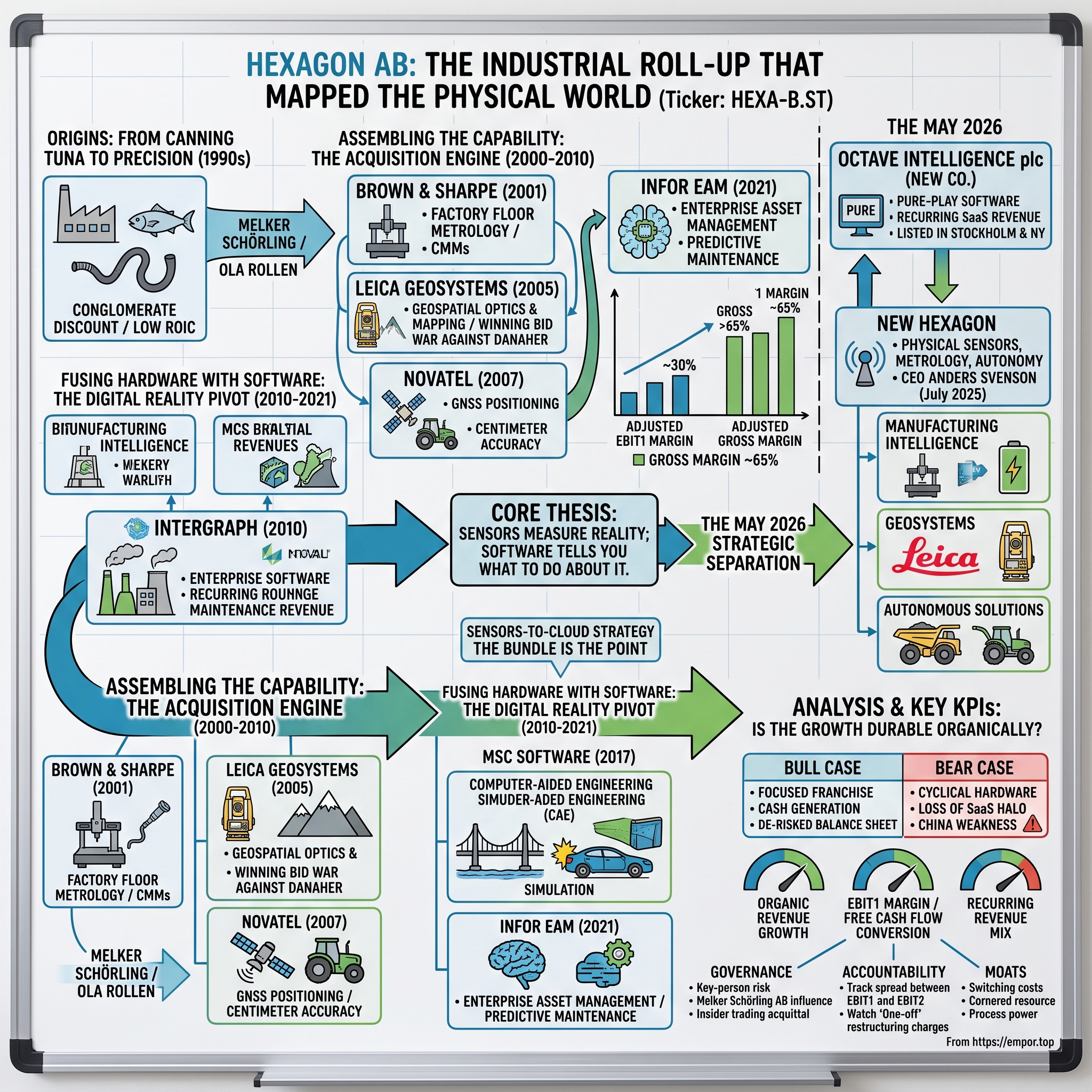
Hexagon AB: The Industrial Roll-Up That Mapped the Physical World
I. Introduction & Episode Roadmap
Picture a coordinate measuring machine on the floor of an aerospace supplier somewhere in Bavaria. A robotic probe glides across a freshly machined turbine blade, touching it hundreds of times a second, and reports back that the surface is off by four microns — roughly one-twentieth the width of a human hair. That deviation, invisible to the eye, is the difference between a part that flies and a part that gets scrapped. The machine measuring it, the software interpreting the data, and quite possibly the CNC controller that will correct the next cut all trace back to a single Swedish company. That company was once, almost comically, in the business of canning tuna.
The story of Hexagon AB (publ) is one of the strangest and most instructive corporate transformations in modern European industry. In the early 1990s, "Hexagon" was a shell for a grab-bag of unloved Swedish industrials — fish processing, rubber engineering, vehicle components, hydraulic hoses — assembled during a national financial crisis. Three decades later, it reported group net sales of €5,401.1 million for 2024 and adjusted operating earnings (which the company labels EBIT1) of €1,602.9 million, an EBIT1 margin of 29.7%.1 Its shares (HEXA-B.ST) trade on Nasdaq Stockholm, and by 2026 the group carried an enterprise value that market data services placed broadly in the €25–35 billion range.2
The overarching thesis is deceptively simple. Hexagon is the ultimate serial acquirer — well over 170 deals since 2000 — that used M&A not to diversify for its own sake but to assemble a single capability: capturing the physical world in sub-micron precision, then wrapping mission-critical software around that captured data. Sensors measure reality; software tells you what to do about it. That bundle drove adjusted gross margins above 65% and operating margins near 30%, numbers that look far more like enterprise software than like the machine-tool business Hexagon superficially resembles.1
To appreciate how far the company traveled, hold two images side by side. In the first, circa 1995, a Swedish holding company reports modest revenue from a scatter of unrelated industrial subsidiaries, its stock a quiet line item on the Stockholm exchange followed by almost no one outside Sweden. In the second, thirty years later, the same corporate entity operates in dozens of countries, employs tens of thousands of engineers, and sells the invisible infrastructure of precision that sits behind modern cars, aircraft, smartphones, dams, tunnels, and driverless mine trucks. The through-line connecting those two images is not a product. It is a capability the company came to call "digital reality" — the ability to capture the physical world as data and then act on it — and the financial engine that funded its assembly: relentless, disciplined acquisition.
But this is not a victory lap. A neutral investor has to ask what is real here and what is packaging. Hexagon's headline profitability rests on adjustments — EBIT1 versus the messier EBIT2 — and its growth has always been a blend of organic demand and acquired revenue that management has been accused of blurring. Even the most recent full year underlined the tension: for 2025, Hexagon reported operating net sales of roughly €5,426.5 million but organic growth of only about 2%, with the full-year adjusted operating margin easing to 27.2%.13 Those are not the numbers of a runaway grower; they are the numbers of a mature, high-quality industrial franchise feeling the industrial cycle. And in May 2026 the company did something that reframed the entire investment case: it spun off its purest software assets into a separately listed company called Octave Intelligence plc, distributing the shares to Hexagon holders and listing them via Swedish Depositary Receipts on Nasdaq Stockholm and as Class B ordinary shares on Nasdaq New York.3 The stated logic was to escape the conglomerate discount and let the market value pure-play software at software multiples — while re-centering "New Hexagon" on physical sensors, metrology, optical measurement, and autonomous positioning.
So the question that animates everything below is this: was Hexagon a genuinely durable compounding machine, or a well-financed accounting-and-acquisition story that has now been asked, by its own board, to prove it can grow without buying growth? To answer it, this episode walks through the conglomerate's origins under financier Melker Schörling; the twenty-year M&A playbook of Ola Rollén, from Brown & Sharpe to the hostile capture of Leica Geosystems; the software pivot through Intergraph, MSC, and Infor EAM; the segment economics of where the profits actually live; the mechanics and motivation of the Octave separation; the governance questions around key-person risk and an insider-trading trial; the competitive moats tested against Helmer and Porter; and a skeptic's stress test of the accounting — before laying out the bull and bear cases and the handful of KPIs that will tell you whether "New Hexagon" is working.
It begins, improbably, with a Swedish holding company that almost nobody wanted.
 Subscribe on LinkedIn
II. Industrial Origins: From Swedish Holding Company to Precision Hardware (1992–2000)
Sweden in the early 1990s was not a place that produced global champions. The country was living through the worst financial crisis in its post-war history: a property and credit bubble had burst, the krona was under speculative attack, the central bank at one point pushed overnight interest rates to 500% to defend the currency, and the banking system had to be effectively nationalized. Into that wreckage, industrial assets were being reshuffled, restructured, and repriced at fire-sale levels. Hexagon, in its modern form, was assembled out of exactly this environment — a loose federation of small Swedish industrial holdings gathered under a listed vehicle, the kind of orphaned conglomerate that a distressed market throws off.
What did it actually own? A little of everything and a lot of nothing coherent. There was fish and food processing. There was rubber and polymer engineering. There were vehicle components and hydraulic hoses — the unglamorous plumbing of heavy machinery. It was, in the language of a later era, a "diworsified" bucket: low return on capital, negligible organic growth, no unifying technology or customer. The market treated it accordingly, as a sum-of-parts holding company whose parts were not worth much.
It is worth dwelling on why a business like this exists at all, because the answer explains everything that followed. Conglomerates of the Swedish 1990s were often less strategic constructions than accidents of finance — assets that ended up under one roof because a bank, a restructuring, or a family succession put them there, not because they belonged together. Such vehicles trade at a discount for a reason: capital gets trapped in low-return businesses, management attention is spread thin across incompatible industries, and no investor can buy a clean exposure to anything. The market's skepticism is rational. The opportunity, for someone with a clear thesis and the stomach to act on it, is that the same skepticism makes the whole thing cheap. What Hexagon needed was not more assets. It needed an owner willing to tear the structure down to a single load-bearing idea.
The pivotal human being in this period was Melker Schörling, a Swedish financier who had run the industrial conglomerate Securitas and later Skanska, and who had developed a reputation as a patient, concentrated owner who backed operators and let them run. Schörling did not see Hexagon's grab-bag of assets as the point. He saw a public listing, a balance sheet, and an opportunity to build something with focus. His anchor ownership vehicle, Melker Schörling AB, would become the durable center of gravity behind Hexagon for the next thirty years — and, as we will see, the source of persistent questions about key-person and controlling-shareholder risk.
Schörling's most consequential decision was a hire. In 2000 he recruited Ola Rollén, then in his mid-thirties, to become President and CEO. Rollén had come up through Swedish heavy industry — steel and specialty-alloy businesses including Avesta Sheffield and the heating-technology group Kanthal — environments that teach you two things: how brutally cyclical commodity manufacturing is, and how much more valuable it is to sell something proprietary that customers cannot easily source elsewhere. Rollén arrived with a thesis that would define the company: get out of undifferentiated industrials, and get into precision.
Rollén's temperament mattered as much as his résumé. Colleagues and the trade press over the years described a CEO who was blunt, opportunistic, and unusually comfortable with risk — a dealmaker who trusted his own read of a target more than a banker's model, and who was willing to move fast and aggressively when a distressed asset came loose. That personality is a feature and a hazard in equal measure. It is exactly the profile you want running a roll-up, where speed and conviction win auctions and wring value out of businesses others have written off. It is also exactly the profile that concentrates a company's fate in one person's judgment — a tension that would surface, years later, in a Norwegian courtroom and in every governance discussion about Hexagon since.
The strategic logic Rollén and Schörling settled on was not to fix the tuna and rubber businesses. It was to treat the entire legacy portfolio as a source of funding for a completely different company. In effect, the plan was to run the old Hexagon into liquidation while building a new one on top of it — a corporate version of dismantling a house for its materials while quietly erecting a better structure next door.
The epiphany that Rollén and Schörling arrived at was that industrial metrology — the science of dimensional measurement — was an extraordinary and strangely overlooked niche. Consider what it takes to measure a jet-engine component or an automotive chassis die to within microns. It is not something a general machine shop can improvise; it requires purpose-built machines, calibrated optics, and validated software, and the barriers to entry are genuinely high. More importantly, once such a system is installed and validated on a factory floor, ripping it out is painful: measurement processes get written into quality certifications, and re-qualifying a new vendor's equipment can stall production. And the industry was wildly fragmented — dozens of regional and family-owned specialists across Europe, North America, and Asia, most of them undercapitalized and ripe for consolidation by anyone with financial discipline and a global sales network.
That combination — high technical barriers, deep workflow embedding, and a fragmented supplier base — is a roll-up strategist's dream. So Hexagon did two things at once. It began systematically liquidating the legacy industrial assets, the tuna and the rubber and the hoses, treating them not as businesses to nurture but as capital to be recycled. And it turned that capital toward buying its way into precision measurement. The old Hexagon was being sold for parts to fund the new one. The first big test of whether that strategy could scale would come almost immediately, on the other side of the Atlantic, at a storied but bankrupt American toolmaker.
III. The Serial Roll-Up Playbook: Ola Rollén & The Transformation Era (2000–2010)
The playbook Rollén ran for the next two decades had a recognizable shape, and it is worth naming before the deals blur together. Find a technically excellent business in precision hardware that was distressed, family-owned, or otherwise mispriced. Buy it, often out of some form of financial trouble, at a reasonable multiple. Then strip out duplicated administrative overhead, fold its products into Hexagon's expanding global sales channel, move manufacturing toward lower-cost geographies, and hold each division accountable to a hard operating-margin target. Buy capability cheaply; extract synergy relentlessly; repeat. It was private-equity discipline executed inside a permanent, publicly listed holding company.
The foundational deal came in 2001, when Hexagon acquired the metrology business of Brown & Sharpe, the once-legendary Rhode Island toolmaker, out of financial distress for roughly USD 160 million.4 For a company trying to establish itself in measurement, this was instant credibility and instant scale. Brown & Sharpe brought coordinate measuring machines — the CMMs that would become Hexagon's signature product — along with measuring software and, crucially, factories and installed bases across North America and Europe, including operations descended from Italy's DEA and Germany's Leitz. In one stroke Hexagon went from aspirant to a genuine player in factory-floor metrology. It is hard to overstate how much a distressed seller matters to this kind of story: Rollén was buying decades of accumulated engineering and customer relationships at the price the market assigns to a business that cannot pay its bills.
There is a small piece of irony worth savoring. Brown & Sharpe had once been an American manufacturing colossus, a nineteenth-century pioneer of precision machine tools whose name sat alongside the giants of the Industrial Revolution. By 2001 it was a wounded, over-diversified relic — a cautionary tale about how even the finest engineering heritage can be squandered by financial mismanagement. Hexagon, itself a wounded over-diversified relic only a few years earlier, bought it and did to the metrology assets exactly what it had done to itself: cut away everything that did not serve the core, and pour resources into the part that did. The pupil had become the surgeon.
What made a CMM worth building a company around? Think of a coordinate measuring machine as an extraordinarily precise digital hand. A part is placed on a granite table, and a probe on a moving bridge touches its surface at thousands of coordinates, recording each contact point in three-dimensional space to within microns. Feed those points into software and you can compare the physical object, atom by atom almost, against the perfect digital blueprint the engineer designed. In industries where a part that is slightly wrong can ground a fleet or recall a million cars, that comparison is not a nicety — it is the quality gate the entire production line depends on. Owning the machine that guards that gate is a powerful place to stand.
If Brown & Sharpe established the model, the 2005 fight for Leica Geosystems established the ambition. Leica Geosystems — the surveying and geospatial descendant of the Swiss optical house Wild Heerbrugg, and a genuine icon of precision optics — had agreed to be acquired by the American serial acquirer Danaher Corporation. Danaher was, in effect, the American version of what Hexagon wanted to become: a disciplined, decentralized compounder with a famous operating system. For a small Swedish company to gate-crash a Danaher deal was audacious. Hexagon launched a hostile counter-bid, valuing Leica at around CHF 1.4 billion (roughly €1.2 billion), and won a high-stakes bidding war for control.5
The drama of the fight is easy to miss in hindsight, but it was a genuine David-and-Goliath moment. Danaher was already a revered American compounder with a battle-tested operating playbook and a balance sheet many times Hexagon's size; conventional wisdom said a small Swede simply could not outbid it for a Swiss crown jewel. Rollén's willingness to gate-crash and escalate a bidding war against such an opponent told the market something about the company's ambition — and about the CEO's appetite for confrontation. Winning it did more than add a business; it announced that Hexagon intended to be a consolidator of the entire measurement industry, not a niche player waiting for scraps.
Was it expensive? Contemporary analysts thought so — the price implied something like sixteen times operating earnings, rich for the era and for a hardware business. But what Leica brought was not easily replicated at any price: world-class optical engineering, surveying total stations, laser measurement, airborne LIDAR, and one of the most prestigious brands in the entire measurement world. (A note on the name, since it confuses people: the Leica of cameras and the Leica of surveying share a common ancestor in the old Wild Heerbrugg and Ernst Leitz lineage but have been separate companies for decades — Hexagon bought the geospatial one, not the camera maker.) Leica pushed Hexagon out of the factory and into the wider physical world — construction sites, mines, road networks, the built environment. Metrology measures a part; geospatial measures a landscape. Owning both meant Hexagon could credibly claim to capture reality at every scale, from a turbine blade to a mountain range.
The third pillar of the era came in 2007 with NovAtel, the Canadian specialist in high-precision GNSS — Global Navigation Satellite System — positioning. Hexagon agreed to acquire NovAtel for USD 50 per share, valuing the equity at roughly US$450 million, and its tender offer closed in late November 2007 with the great majority of shares tendered.6 To translate the jargon: consumer GPS in a phone is accurate to a few meters, which is fine for finding a restaurant and useless for steering a tractor down a crop row or guiding a driverless haul truck around an open-pit mine. NovAtel's technology closed that gap to centimeters, and in some configurations to millimeters, by correcting the tiny timing errors that make ordinary GPS fuzzy. It was, in hindsight, one of Hexagon's most strategically prescient purchases, because centimeter-grade positioning is the enabling ingredient for autonomy — a theme that would only pay off fully a decade later, when mining companies and agricultural equipment makers began removing humans from the cab entirely.
Step back and the pattern of the decade is unmistakable. Brown & Sharpe gave Hexagon the factory floor. Leica gave it the outdoor, geospatial world. NovAtel gave it precise position on the move. Each acquisition extended the same core competence — measuring where things are, exactly — into a new domain, and each was bought when the seller was distressed, family-controlled, or being fought over by someone else. This was not empire-building for its own sake; it was the methodical assembly of a single franchise across every scale at which precision matters.
Underneath the deal-making, Rollén was installing an operating culture. Each acquired unit was held to strict divisional accountability, with a benchmark expectation of 20%-plus operating margins delivered through cost synergies, shared manufacturing, and a unified sales network. The message to the sprawling collection of proud, formerly independent engineering houses was consistent: keep the technology, lose the overhead, hit the number. That discipline is what separated Hexagon from an ordinary conglomerate that merely accumulates businesses. But hardware, however precise, carries an uncomfortable long-run truth — sensors get commoditized, and margins on things you can hold in your hand tend to erode. Rollén's next act was to attack that problem head-on, by moving up the stack into software.
IV. Fusing Hardware with Software: Intergraph, MSC, & The Software Margin Surge (2010–2021)
By the end of the 2000s, Hexagon had a hardware problem hiding inside its hardware success. It made superb instruments, but instruments are objects, and objects are eventually copied, undercut, and driven toward the cost of their components. The way out was to stop selling the measurement and start owning the decision the measurement enabled. If Hexagon's sensors captured a factory's reality, the high-margin, defensible layer was the software that turned that reality into designs, corrections, dispatch orders, and asset-management workflows — software that customers would embed so deeply they would never rip it out. Insiders came to call this the "sensor-to-cloud" or "digital reality" strategy. In plain terms: bundle the razor with an indispensable, subscription-like blade.
The transformational move was the 2010 acquisition of Intergraph Corporation of the United States for USD 2.1 billion, funded through a combination of a rights issue and debt.7 The financing itself is telling: asking shareholders for fresh equity to fund a deal of that size, only two years after the global financial crisis, took nerve and required a board and an anchor owner willing to back the CEO's judgment. Intergraph was not a metrology company at all. It sold enterprise engineering software: 3D design tools for process plants, power stations, and shipyards (its Process, Power & Marine business) and geospatial systems for public safety, including the software behind emergency 911 dispatch. Analysts pegged the price at roughly thirteen times EBITDA — a full price for the time. But Intergraph changed what Hexagon fundamentally was. Overnight it went from a maker of measuring machines to a genuine enterprise-software company with recurring maintenance revenue and sticky, mission-critical installations inside utilities, energy majors, and government agencies. It was the hinge on which the whole margin story would later turn.
Why does software change the economics so completely? Consider the unit economics of a coordinate measuring machine versus a software license. The machine is a physical object: it costs real money in steel, granite, motors, and optics to build each one, so the gross margin is capped by the bill of materials no matter how many you sell. A software license costs almost nothing to reproduce — the second copy, and the ten-thousandth, are essentially free. Better still, enterprise software throws off recurring maintenance and subscription revenue year after year with little incremental cost, and it embeds itself so deeply in a customer's operations that switching becomes unthinkable. When Hexagon layered Intergraph's software onto its sensor base, it was not merely adding a product line. It was grafting a fundamentally superior economic model onto a fundamentally physical company.
Through the late 2010s, Hexagon kept layering software onto the sensor base. In 2017 it acquired MSC Software for USD 834 million, buying its way into computer-aided engineering, or CAE — simulation software that lets engineers crash-test a car or stress-test a bridge inside a computer before anything physical is built.8 That put Hexagon in direct competition with simulation heavyweights like Ansys and Dassault Systèmes, and, more strategically, let it close a loop: simulate a design, manufacture it, measure the real part, and feed the discrepancy back into the next simulation. Design, make, and measure — traditionally three separate worlds — could now, at least in theory, talk to each other inside one vendor's stack.
Then, in 2021, came the boldest software bet: the USD 2.75 billion acquisition of the Enterprise Asset Management business of Infor — the software often called Infor EAM — from Koch Industries.9 The reported price implied roughly eleven times revenue, an aggressive SaaS-style multiple that told you two things at once: how much Hexagon believed in recurring software economics, and how far it was willing to stretch to buy them. The timing is worth flagging with a skeptic's eye: 2021 was the peak of the software-valuation boom, when investors were paying historic multiples for anything with recurring revenue, and Hexagon paid a peak-era price. Whether that was visionary or over-exuberant is a question the goodwill on its balance sheet still quietly poses. EAM software runs the maintenance brain of an industrial operation — tracking every pump, motor, and turbine, predicting failures before they happen, and scheduling repairs so a refinery or a fleet does not grind to a halt because a bearing seized. Combined with earlier and later additions such as ETQ in quality management and Bricsys in CAD design, it rounded out a portfolio that looked less like a metrology firm and more like an industrial-software conglomerate stapled to a sensor business.
That framing — "an industrial-software conglomerate stapled to a sensor business" — is the seed of the whole 2026 separation. For a decade, management insisted the staple was the point: sensors and software were better together because the data flowed between them. But an investor could look at the same portfolio and see two very different businesses, with two different customer bases, two different sales motions, and two different natural sets of shareholders, forced to share one stock. The software pivot that saved Hexagon's margins also planted the contradiction that would eventually split the company in two.
The financial fingerprint of this decade-long pivot is the single most important fact about Hexagon's economics. Adjusted gross margins, which sat around 40% when Rollén arrived, climbed above 65% by the mid-2020s.1 Adjusted operating (EBIT1) margins, roughly 12% in the mid-2000s hardware era, reached 29.7% in 2024, generating more than €1.6 billion of adjusted operating earnings.1 The honest analytical read is twofold. On one hand, this is real: software genuinely does carry higher incremental margins, and recurring revenue genuinely is worth more than one-time equipment sales. On the other hand, the very same acquisitions that built those margins also loaded the balance sheet with goodwill and gave management a large and growing set of "adjustments" — amortization, restructuring, purchase-price accounting — that separate the flattering EBIT1 from the more sobering statutory numbers. Both of those threads run straight into the segment economics, where the money is actually made.
V. Segment Deep Dive & Industry Economics: Where the Profits Live Today
Strip away the corporate narrative and Hexagon-as-it-entered-2026 was a portfolio of measurement franchises with genuinely differentiated economics. The consolidated baseline for 2024 sets the frame: group net sales of €5,401.1 million, adjusted operating earnings (EBIT1) of €1,602.9 million, and an EBIT1 margin of 29.7%.1 What that group average hides, though, is a wide spread of profitability underneath — and understanding where the margin actually lives is the difference between owning the story and owning the business. The FY2024 divisional breakdown, before the Octave separation reshuffled the deck, ran roughly as follows.1
Manufacturing Intelligence was the largest engine at about €1,955.7 million of revenue — some 36% of the group — earning EBIT1 of roughly €531.2 million, a 27.2% margin. Geosystems contributed about €1,555.4 million (29% of sales) at a notably richer 31.8% margin. Asset Lifecycle Intelligence, the smallest of the big software units at around €831.7 million (15%), was the most profitable at 35.7%. Autonomous Solutions, roughly €558.0 million (10%), ran at 34.4%. And Safety, Infrastructure & Geospatial, about €497.1 million (9%), was the laggard at 23.1%. The pattern is worth pausing on: the software-heavy units (ALI, Autonomous) carried the fattest margins, the classic hardware-plus-software units (MI, Geosystems) sat in the high-20s to low-30s, and the more services-exposed SIG business trailed. That spread is precisely what would later make the case for splitting the company.
Manufacturing Intelligence — the core industrial engine
Walk onto the body-in-white line of an EV plant and you are standing inside Manufacturing Intelligence's addressable market. This is the division of coordinate measuring machines, laser trackers, portable measuring arms, optical scanners, quality-inspection software (its widely used PC-DMIS package), and the CAD/CAM/CAE tools from MSC and ETQ. Its customers are automotive tooling shops, aerospace primes like Boeing and Airbus and their supply chains, and electronics manufacturers — anywhere a fraction of a millimeter decides whether a product works. The competitive set is serious: Germany's Carl Zeiss (through Zeiss Industrial Metrology) is a peer of roughly comparable stature in high-end optical and CMM measurement; Japan's 株式会社ミツトヨ Mitutoyo dominates precision hand tools and shop-floor gauging; 株式会社トプコン Topcon and ニコン Nikon Metrology compete in adjacent optical and inspection niches; and FARO Technologies (FARO) plays as a smaller, focused specialist in portable arms and laser scanners.
How does Hexagon defend a business where every one of those rivals makes an excellent instrument? Its answer is the closed loop. A standalone CMM measures a part and prints a report; Hexagon's pitch is that its sensors capture shop-floor dimensions and feed real-time corrections directly back into CNC machines and simulation models, so the factory tunes itself. Whether customers fully use that loop or simply buy the hardware and software piecemeal is a fair question — the vision is more integrated than the average installation — but the loop is the source of whatever switching-cost advantage the division genuinely has.
The end-market exposure also cuts to the heart of the bull-bear debate. Manufacturing Intelligence is levered to the retooling of the automotive industry for electric vehicles — new battery-pack tooling, new chassis dies, new inspection regimes — which is a multi-year tailwind. But it is equally levered to the industrial capex cycle, and when carmakers freeze tooling budgets or semiconductor-equipment orders roll over, this division feels it first. Its 27.2% margin is excellent for a business with a heavy hardware component, but it is the group's most cyclically exposed large unit, and its fortunes track the health of global factory investment more tightly than any other part of Hexagon.
Geosystems — the spatial-world standard
If Manufacturing Intelligence lives indoors, Geosystems lives on the construction site, the mine bench, and the road. This is the Leica-branded franchise: total stations that surveyors have trusted for generations, terrestrial and airborne LIDAR, construction lasers, and the BLK line of reality-capture devices that scan a room or a building into a 3D point cloud in minutes. If you have ever seen a survey crew standing behind a tripod-mounted instrument on a roadside, you have watched Geosystems' core product at work; the modern version increasingly does the same job from a drone, a backpack, or a handheld scanner, turning a physical space into a navigable digital twin. Its markets are civil infrastructure, building construction, land surveying, and mining.
The defining rivalry here is with America's Trimble Inc. (TRMB), a comparably scaled competitor across construction and geospatial positioning, alongside Japan's 株式会社トプコン Topcon and a value tier where Hexagon fields its own GeoMax brand against lower-cost Asian entrants. Geosystems' 31.8% margin says the Leica brand and optical performance still command a premium — this is arguably Hexagon's purest example of durable pricing power rooted in reputation and precision rather than lock-in. Surveyors trust Leica the way photographers once trusted a particular lens: the brand is shorthand for reliability under field conditions where an error is expensive and hard to catch. That trust is a real asset, but it is also a softer moat than a regulated certification — a genuinely better or cheaper competitor product can, over time, erode brand preference in a way it cannot erode a locked-in factory process.
Autonomous Solutions — hidden high-margin optionality
The smallest of the retained franchises is in some ways the most interesting. Autonomous Solutions is where NovAtel's centimeter-grade positioning grew up. It sells high-precision GNSS, autonomous fleet management for open-pit mining, and automated steering for off-road and agricultural vehicles — the invisible spatial nervous system for machines that have to know exactly where they are when GPS alone is not nearly good enough. At a 34.4% EBIT1 margin on roughly €558 million of revenue, it punches well above its size, and it is levered to two powerful secular themes: mining automation (driverless haul trucks running around the clock without a cab) and the broader push toward autonomy in industries where a few centimeters of error is the difference between productivity and catastrophe.
The economics of mine automation explain why customers pay for this. A large open-pit mine runs a fleet of haul trucks the size of houses, each requiring a human driver working in shifts, subject to fatigue, breaks, and the ever-present risk of a costly accident on a haul road. Remove the driver and let the trucks run continuously, guided by centimeter-accurate positioning, and the productivity and safety math changes dramatically. That is a value proposition mining companies will pay real money for, and it is defended by the same precision-and-reliability barrier that protects the rest of Hexagon. For investors, Autonomous Solutions is the clearest piece of embedded optionality in "New Hexagon" — small today, structurally advantaged, and pointed at markets that are only beginning to scale, with a defense application angle (precise positioning that survives GPS jamming and spoofing) that has become newly relevant as defense budgets rise.
The software units that were leaving
The two divisions not retained by "New Hexagon" — Asset Lifecycle Intelligence and Safety, Infrastructure & Geospatial — are worth understanding precisely because they departed. ALI, the most profitable unit in the group at a 35.7% margin, is the home of the Intergraph plant-design software and the Infor EAM asset-management franchise: pure enterprise software that runs the design and maintenance of the world's refineries, power plants, and process facilities, with a heavy base of recurring revenue. SIG, the lower-margin unit at 23.1%, houses the public-safety and geospatial software — the 911-dispatch and emergency-response systems — where a larger services and integration component drags on profitability. Together with ETQ and Bricsys, these were the assets whose economics looked and behaved most like a software company, and least like a sensor maker.
Which raises the obvious question. If the software-heavy units carried the richest margins and the market rewards software most generously, why keep them bolted to a sensor company at all? By 2026, Hexagon's board had concluded that it should not.
VI. The Strategic Separation: The May 2026 Octave Spin-Off & The "New Hexagon"
Every conglomerate eventually collides with the same piece of market arithmetic, and Hexagon's collision had a name: the conglomerate discount. Through the mid-2020s, capital markets handed pure-play engineering- and industrial-software companies — the Autodesks, PTCs, Ansyses, and Bentleys of the world — lofty enterprise-value multiples on the strength of their recurring, high-margin, subscription revenue. Hexagon, despite generating a great deal of exactly that kind of revenue inside its software divisions, was valued by the market closer to an industrial hardware company. The blended business was, in effect, being taxed for its own complexity: investors could not cleanly own "the software" without also owning the cyclical sensor business, and so paid a lower multiple for the whole than the parts might fetch apart.
There is real evidence behind the discount, not just a management grievance. Through the mid-2020s, the market persistently valued Hexagon's blended enterprise nearer the multiples of an industrial-instruments company than those of its software peers, even though a large slice of its earnings came from exactly the kind of recurring, high-margin software that investors elsewhere paid up for. The mechanism is straightforward: a generalist software investor could not own Hexagon's ALI franchise without also underwriting the cyclicality of its CMM business, and an industrial investor did not want to pay software multiples for sensors. Caught between two shareholder bases, the stock satisfied neither, and the sum traded below the parts.
The board's response, years in the making and studied under earlier CEO Paolo Guglielmini, was structural surgery. In 2026 Hexagon carved out its purest software businesses — Asset Lifecycle Intelligence, Safety, Infrastructure & Geospatial, ETQ, and Bricsys — into a standalone company, Octave Intelligence plc. Shareholders approved the separation at a general meeting on April 24, 2026, and the distribution completed on May 28, 2026, with Octave's shares reaching investors as Swedish Depositary Receipts on Nasdaq Stockholm and as Class B ordinary shares listed on Nasdaq New York.3 Octave stepped out as a focused operational-intelligence software and SaaS company of roughly 7,200 employees across more than 45 countries — including a substantial base in the United States and a large engineering and delivery presence in India.10 The dual Stockholm-and-New-York listing was itself a statement of intent: chase the deeper pool of U.S. software investors and their more generous multiples, while keeping the Swedish home-market base that Hexagon shareholders were rolled out of. The choice to domicile the new entity as a UK "plc" and list Class B ordinary shares in New York, rather than simply spinning a Swedish AB, signaled that Octave was being built for a global — and specifically American — software audience from day one.
What is left is "New Hexagon," and it is a deliberately narrower, more physical company. It re-anchors around Manufacturing Intelligence, Geosystems, and Autonomous Solutions — the sensor hardware, optical metrology, edge software, and positioning IP. The pitch to investors is that a focused measurement-and-autonomy company can be understood and valued on its own terms, freed from the perennial "is this software or hardware?" argument. CEO Anders Svensson's mandate is correspondingly operational rather than acquisitive: drive organic efficiency, shorten product-release cycles, and maximize free-cash-flow conversion, without the capital burden of the endless software roll-up that defined the previous era.
A neutral read has to hold two ideas at once. Spin-offs of this kind do frequently unlock value, because focused management teams and cleaner investment theses tend to attract investors who were previously deterred by complexity — and there is a real argument that Hexagon's software and sensor businesses had grown far enough apart that common ownership added cost without adding much synergy. But separation also destroys whatever "digital reality" integration story justified keeping sensors and software together in the first place. For twenty years, management argued that the magic was the bundle — the sensor feeding the software feeding the decision. Splitting it is, at some level, a concession that the bundle was worth less than the sum of two focused pieces. And it strips "New Hexagon" of its highest-margin software halo, leaving it to prove it can hold a premium valuation as, essentially, the world's best measurement-instrument company.
There are also unglamorous risks that spin-offs routinely carry and that investors should not wave away. Two independent public companies mean two head offices, two boards, two sets of listing and compliance costs, and the duplication of shared services that a single group used to spread across a bigger base — stranded costs that can quietly erode the very margins the split was meant to showcase. There are commercial entanglements to unwind: transition-services agreements, shared customers who bought the integrated pitch, and cross-selling relationships that no longer have a single owner. And a spin-off is a moment of maximum distraction for management at exactly the time both companies need to execute cleanly. None of this dooms the transaction, but it is the kind of friction that turns a value-unlocking thesis on paper into a multi-year slog in practice. Whether "New Hexagon" clears it depends heavily on who is running it, and on the discipline of the capital-allocation regime he installs.
VII. Current Management, Governance, & Capital Allocation under Anders Svensson
For twenty-two years, Hexagon and Ola Rollén were nearly synonymous. He arrived in 2000 as a mid-thirties operator with a thesis about precision, and he left the CEO chair in late 2022 having built one of Europe's most acquisitive industrial-technology companies, transitioning to Chairman of the Board. That kind of founder-operator tenure is a double-edged inheritance. It produced strategic consistency and a distinctive dealmaking culture; it also produced a company whose identity, network, and capital-allocation instincts were unusually concentrated in one person — the textbook definition of key-person risk. His successor, Paolo Guglielmini, a former head of Manufacturing Intelligence, took over in 2022 and set in motion the structural study that would eventually produce the Octave separation, before the CEO role passed on again.
The churn itself is worth a beat of attention, because leadership stability is part of governance quality. In the space of roughly three years, Hexagon moved from a founder-scale CEO of twenty-two years to a successor who did not last long in the seat, through an interim arrangement, to a fresh external hire — while simultaneously executing the largest structural change in the company's history. A charitable reading is that the board was deliberately reshaping leadership to fit a post-roll-up, operationally focused future, and that a clean external appointment was the right way to signal the break. A more cautious reading is that rapid CEO turnover during a strategic overhaul is exactly the kind of instability that can fumble execution, and that it places an unusual amount of weight on a new chief executive who is still learning the business.
The current chief executive is Anders Svensson, appointed in January 2025 and taking office on July 20, 2025, succeeding an interim leadership arrangement under Norbert Hanke.11 Svensson is a Swedish chemical engineer by training with a career forged in heavy industrial operations — leadership roles across Sandvik's manufacturing and machining and rock-processing businesses, followed by a stint as CEO of the material-handling group Konecranes.11 That résumé is a deliberate signal. Hexagon did not hire a software visionary or another dealmaker; it hired a lean-manufacturing operator, someone whose instincts run to organic execution, throughput, and cost discipline. For a company pivoting from "buy growth" to "earn growth," the choice of operator over acquirer is itself a piece of strategy.
No portrait of Hexagon's governance is complete without the episode that tested it. Between 2016 and 2019, Rollén was the subject of an insider-trading investigation in Norway, brought by the economic-crime authority Økokrim, over personal 2015 purchases of shares in Next Biometrics — a Norwegian company unconnected to Hexagon. Prosecutors sought an eighteen-month prison term. Rollén was acquitted by an Oslo court in early 2018; prosecutors appealed; and in June 2019 the Borgarting Court of Appeal acquitted him again, clearing him fully of all charges.12 The legal outcome was unambiguous. But for outside investors the saga did its own quiet damage, spotlighting how much of Hexagon's story rode on a single individual, and how tightly the company was bound to its anchor owner, Melker Schörling AB, which controlled a large block of the voting rights — roughly a fifth — and thus outsized influence over the company's direction.
That controlling-shareholder structure cuts both ways, and an activist would press on it. A patient anchor owner can enable the long-horizon, through-the-cycle thinking that made the roll-up possible; the same concentration can entrench management, dampen accountability, and complicate any outside pressure for change. It is a governance fact to weigh, not a scandal to allege.
On capital allocation, the post-spin framework is explicitly more conservative than the debt-fueled mega-deal era it replaces. Management's stated posture leans toward disciplined organic R&D — historically around a tenth of sales — and smaller, targeted technology bolt-ons rather than transformational acquisitions, with a leverage target of keeping net debt below roughly 2.5 times EBITDA and a cash-conversion goal of turning more than 80% of EBIT1 into free cash flow. Executive incentives are weighted toward EBIT1 growth, cash conversion, and relative total shareholder return against global industrial peers.
Here the analyst's job is to watch behavior, not slogans. There is a genuine tension baked into those incentives worth naming: an executive rewarded on EBIT1 growth has a structural temptation to keep buying earnings, because acquisitions are the fastest way to grow a top and bottom line — which is precisely the pattern the spin-off was supposed to break. The mitigant is that the incentive structure also leans on cash conversion, and cash conversion is far harder to fake with acquisitions, because deals consume cash and load the balance sheet before they produce it. If, over the next several years, Hexagon can show organic growth, high cash conversion, and a shrinking gap between its adjusted and statutory profits, it will have earned the right to be believed. If instead the bolt-ons quietly get bigger, the "one-off" charges keep recurring, and leverage drifts back up, investors will be entitled to conclude that the company simply cannot help itself. This is a management team asking for trust it has not yet, in its new incarnation, had the chance to earn.
The credibility test is simple and will play out over the next several years: this is a company that spent two decades promising discipline while doing enormous deals, so investors are right to treat "we will now grow organically and return cash" as a claim to be verified against behavior, not a fact already in evidence. What underpins the claim, and whether the underlying business can actually defend its economics without buying more of them, is a question of moats.
VIII. Competitive Moats: Helmer's 7 Powers & Porter's Five Forces
War-game Hexagon against its rivals and the first thing you notice is that "measurement" is not one market but many, each with its own defensibility. Applying Hamilton Helmer's 7 Powers framework brings the real sources of advantage into focus — and, just as usefully, exposes where the moat is thinner than the marketing suggests.
The clearest power is switching costs, and it is strongest inside Manufacturing Intelligence. When an aerospace or automotive plant validates a quality-inspection process around Hexagon CMMs and PC-DMIS software, that process becomes woven into regulatory certifications, standard operating procedures, and the muscle memory of the workforce. Swapping vendors is not just a purchasing decision; it can trigger re-certification, compliance review, and retraining, with production risk attached. That friction is real and it is what lets the division hold high-20s margins against excellent competitors. But it is worth being precise: switching costs bind the installed process, not every future sale. A greenfield plant, or a customer standardizing on a rival for a new program, faces far less friction — which is why Zeiss, Mitutoyo, and Trimble keep winning business and why Hexagon's moat is a retention moat more than a conquest moat.
The second power is a cornered resource — the accumulated, hard-to-replicate intellectual property. Sub-micron optical sensor design, NovAtel's proprietary GNSS positioning algorithms, and Leica's inheritance of decades of Swiss optical-glass and instrument craftsmanship are not things a competitor spins up in a product cycle. Closely related is process power: the proprietary factory-calibration know-how required to build and certify laser and optical measurement devices to sub-micron repeatability, embedded in Hexagon's own manufacturing that a low-cost entrant cannot simply copy. And there is a counter-positioning angle worth stating carefully: pure software vendors — the CAD and PLM houses — cannot easily replicate Hexagon's hardware-plus-software bundle because they have no sensor-manufacturing or on-site metrology capability, while pure hardware makers lack the software depth. Hexagon sits in a genuinely awkward-to-attack middle. (The irony, of course, is that the Octave spin-off just voluntarily separated the two halves of that middle — a reminder that this power was always more compelling in slide decks than in the market's valuation.)
Running the same business through Porter's Five Forces sharpens the picture. The threat of new entrants is low: capital intensity, sub-micron precision requirements, and dense patent thickets in optics and LIDAR keep newcomers out of the high end. Buyer power is moderate — industrial OEMs are sophisticated and price-conscious, but compliance and switching friction limit how hard they can push. Supplier power is low-to-moderate, tempered by Hexagon's heavy vertical integration in critical optical components. The threat of substitutes is the one to watch: consumer-grade LIDAR, machine vision, and computer-vision AI are advancing quickly and are already "good enough" for many rough-tolerance jobs — they cannot yet touch sub-micron industrial metrology, but the frontier is moving, and complacency here would be a mistake. And competitive rivalry is unambiguously high, a permanent knife-fight against Zeiss, Trimble, Topcon, Mitutoyo, and FARO across every niche.
It is worth war-gaming the substitute threat concretely, because it is the force most likely to change the industry over a decade. The march of computer vision and low-cost LIDAR — the same sensing revolution that put credible depth cameras into phones and self-driving prototypes onto public roads — is a genuine long-run question for a company whose premium rests on being the most precise. The reassurance is that "most jobs" and "the jobs Hexagon is paid the most for" are different sets: a construction contractor may happily scan a job site with a cheap sensor, but no aerospace regulator will certify a turbine disk on a smartphone camera, and no mine will run driverless haul trucks on consumer GPS. The high end, where tolerances are measured in microns and errors are measured in grounded fleets or fatalities, is defended by physics and regulation, not just brand. The risk is not that AI vision replaces Hexagon at the top; it is that "good enough" sensing eats the industry from the bottom, compressing the volume tiers and leaving Hexagon defending a smaller, if richer, high-precision citadel. A management team that ignored that dynamic would be making a mistake; the AI-driven analytics Hexagon itself is building into its software are, in part, an answer to it.
The honest synthesis: Hexagon's moat is real but selective. It is deepest where regulated, certified workflows lock customers in, and where brand and optical craftsmanship command a premium; it is shallower in the open-field contests for new installations and against a rising tide of cheaper, AI-driven sensing. A durable business, yes — but not an unassailable one, which is exactly why the skeptics' questions about the numbers matter so much.
IX. The Skeptical Investor Stress Test: M&A Accounting, Goodwill, & Organic Growth Realities
Every serial acquirer eventually invites the same uncomfortable audit, and Hexagon has never been exempt. Point a short-seller's flashlight at the story and three shadows appear: the blur between organic and acquired growth, the mountain of goodwill on the balance sheet, and the persistent gap between the profit management highlights and the profit the statutory accounts actually report.
Start with growth transparency, the oldest critique of the roll-up model. When a company completes well over 170 acquisitions across two decades, top-line growth becomes a chemistry problem: how much is genuine organic demand for the products, and how much is simply revenue that was purchased? Skeptics have long argued that Hexagon's underlying organic growth — historically running somewhere in the mid-single digits, roughly 3–7% through the cycle — was flattered by a steady drumbeat of inorganic additions, and that the distinction was not always as crisp in the reporting as investors would like. This is not an allegation of wrongdoing so much as a demand for clarity, and it is exactly why organic growth becomes the single most important number to track for a company that has promised to stop buying its way forward.
The 2025 numbers give the critique some teeth. With full-year organic growth of only about 2% and a full-year adjusted margin of 27.2%, the retained business grew slowly and gave back some margin in a soft industrial environment.13 A defender would point to the cycle — automotive and China weakness, tough comparisons — and note that a couple of points of organic growth in a down year is respectable for an industrial. A skeptic would counter that this is precisely the moment the roll-up's underlying engine is exposed: with the M&A machine idled ahead of the spin-off, the organic core is what you actually see, and what you see is a mature business, not a compounder. Both are right, which is why the honest posture is to watch the number across a full cycle rather than judge it on one year.
There is a genuine "myth versus reality" worth stating plainly here. The myth, cultivated over twenty years, is of Hexagon as a technology growth company. The reality is closer to a superb collection of high-quality, cyclical industrial franchises assembled by a talented capital allocator, whose growth-company optics were substantially a product of continuous acquisition and favorable adjusted-earnings presentation. That is not a criticism of the assets, which are excellent. It is a calibration of expectations: strip out the deals, and what remains is a good business growing at mid-single digits through the cycle, not a hyper-growth story.
Next, goodwill. Buying dozens of businesses at premium multiples deposits an enormous amount of goodwill and intangible assets on the balance sheet — Hexagon's pre-separation balance sheet carried goodwill well into the eleven figures. Goodwill is not inherently sinister; it is the accounting residue of paying more than book value for a business, which any acquirer of quality companies will do. The risk is that it sits there untested until, one day, a unit underperforms and the auditors require a non-cash impairment that vaporizes a chunk of reported equity in a single stroke. Post-separation, investors have to watch whether the acquired software and sensor units continue to justify their carrying values, or whether some of that goodwill eventually gets written down.
Then there is the EBIT1-versus-EBIT2 question, which is really a question about what "profit" means at Hexagon. The company routinely leads with EBIT1 — adjusted operating earnings that exclude acquisition-related amortization, restructuring charges (including programs it has branded internally, such as efficiency drives), and purchase-price-allocation effects. EBIT2 folds some of that back in and sits meaningfully lower. The 29.7% EBIT1 margin that anchors the whole investment case is, by construction, the flattering version.1 The reasonable defense is that amortization of acquired intangibles is a genuinely non-cash item and that stripping it out gives a cleaner read on operating performance. The reasonable skepticism is that a company that acquires continuously will always have "one-off" restructuring and integration costs — which raises the question of whether those charges are truly exceptional or simply a structural, recurring cost of the business model dressed up as non-recurring. Sell-side analysts have repeatedly pressed management on precisely this: how much of the adjusted-out cost is real cash leaving the building, and when do the "one-offs" stop. It is the right question, and investors should keep asking it.
The practical way to hold management accountable on this is to track the spread between EBIT1 and EBIT2 over time, and to compare it against what the company says its restructuring programs will cost and when they will end. If the adjustments shrink as promised, the skepticism eases. If a new "transformation" or "efficiency" program appears every couple of years to replace the last one that was supposed to be finished, the pattern speaks for itself: the exceptional has become the routine, and the headline margin flatters a business that spends more to run than it admits. This is not a hypothetical concern for serial acquirers; it is the single most common way roll-ups overstate their true earning power.
Finally, the post-spin execution risk that ties the others together. "New Hexagon" has just handed away its most software-like, most recurring, highest-margin assets to Octave. The bet is that a focused measurement-and-autonomy company can sustain a premium industrial valuation on its own merits. The bear's rejoinder is that, stripped of the SaaS halo, the market may re-rate it as what it more visibly now is — a superb but cyclical maker of industrial instruments. Which of those views wins is, in the end, the whole ballgame.
X. Analysis & Bull vs. Bear Case
Zoom out and Hexagon in mid-2026 is a company that has just voluntarily bet against its own conglomerate history. For twenty years the thesis was integration and acquisition; the new thesis is focus and organic execution. Judging whether that bet pays off does not require a forecast — it requires watching a small number of things closely and being honest about the mechanisms that could make or break the case.
The three KPIs that matter most
First, organic revenue growth. For a company that spent two decades acquiring, the entire post-spin premise is that the core technology can grow on its own. If organic growth can sustain something like mid-single digits or better through the industrial cycle, it validates genuine, M&A-independent demand for the sensors and software. If it sags toward zero when the deal machine is idle, the skeptics were right about what was really driving the top line. This is the number that adjudicates the whole story.
Second, EBIT1 margin together with free-cash-flow conversion. The margin tests whether pricing power and the software mix survive the loss of the Octave assets; cash conversion — management targets north of 80% of EBIT1 turning into free cash flow — tests whether the reported profit is real. Watching them together is deliberate: a high margin that does not convert to cash is a warning that the adjustments are doing more work than the business is. Investors should track the gap between EBIT1 and statutory EBIT2 as part of the same discipline.
Third, recurring software and service revenue mix. Even after spinning out its purest software, "New Hexagon" retains substantial embedded software and subscription revenue inside Manufacturing Intelligence and Geosystems. The share of revenue that is recurring rather than one-time equipment sales is the best single proxy for how durable and how cyclical the remaining business really is — the higher and stickier that mix, the more defensible the valuation.
The bull case
The bull owns a focused, cash-generative franchise that occupies an unusually defensible position: the indispensable bridge between the physical world and the digital models of it, with genuine switching costs in regulated manufacturing, real brand equity in Leica-grade geospatial, and embedded optionality in autonomous positioning that is levered to mining automation, defense demand, and the retooling of factories for electric vehicles. The bull argues the Octave separation is exactly the catalyst focus-starved investors wanted — a cleaner story, an operator-CEO obsessed with efficiency and cash, a de-risked balance sheet, and room for multiple expansion and capital returns now that the endless roll-up capex is behind it. In this reading, secular tailwinds — reshoring, infrastructure megaprojects, autonomy, defense — do the heavy lifting while management harvests margin.
The bear case
The bear sees a cyclical hardware company wearing software's clothing, and worries the clothes just left with Octave. Without the SaaS halo, "New Hexagon" is more visibly exposed to the industrial capex cycle — automotive tooling freezes, semiconductor-equipment downturns, and commercial-construction slowdowns hit measurement demand directly, and the business has meaningful exposure to a Chinese industrial and construction recovery that has repeatedly disappointed. China deserves its own line: Hexagon sells heavily into Chinese automotive, electronics, and construction, all of which have been weak, and all of which carry the added overhang of geopolitics — export controls, localization pressure, and the risk that precision-measurement and positioning technology gets caught in the crossfire of technology-transfer restrictions. The bear also notes that the substitute frontier — cheaper LIDAR, machine vision, AI-driven sensing — is advancing into the low end, that the moat is a retention moat vulnerable on new installations, and that a company which promised discipline for twenty years while doing giant deals has not yet earned the benefit of the doubt on its new organic-growth-and-return story. Layer on the governance concentration around a controlling anchor shareholder and a history of continuous "one-off" adjustments, and the bear's stress test is coherent, not cranky.
The activist's checklist and the risk radar
An activist looking at "New Hexagon" would circle a familiar set of pressure points, and they double as the investor's risk radar. Capital allocation: will the freshly de-levered company return cash and stay disciplined, or quietly restart the acquisition treadmill under a new label? Disclosure: will management narrow the gap between the flattering EBIT1 and the statutory EBIT2, and stop treating perpetual integration costs as exceptional? Governance: does the concentrated voting power of the anchor owner entrench management and blunt accountability, and how independent is a board chaired, until recently, by the architect of the entire strategy? Goodwill: does the balance sheet still carry acquisition premiums — including the peak-cycle price paid in the 2021 software boom — that a downturn could force into impairment? And execution: can two newly separated companies deliver on the value-unlock thesis without stranded costs and distraction eating the benefit? None of these is a red flag on its own; together they are the reasons a serious investor watches this company closely rather than taking its transformation on faith.
The synthesis is that Hexagon has spent a quarter-century proving it can buy the physical-to-digital franchise. What it has not yet proven — and what the Octave spin-off now forces it to demonstrate in public, quarter by quarter — is that it can grow that franchise organically, convert its adjusted profits into real cash, and hold a premium multiple as a measurement company standing on its own. The instruments Hexagon builds resolve reality to a few microns. Over the next several years, the market will resolve, with rather less precision, whether the company itself was a durable compounder or a brilliantly financed accumulation. The KPIs above are the calipers; the reading is not yet in.
References
-
Hexagon Year-End Report 1 January – 31 December 2024 — Hexagon AB (via Cision), 2025-01-30 ↩↩↩↩↩↩↩
-
Information Statement of Octave Intelligence plc (Form 10-12B/A) — U.S. Securities and Exchange Commission, 2026 ↩↩
-
Hexagon bids $1.2 bln for Swiss Leica Geosystems — Reuters, 2005-06-13 ↩
-
Hexagon to acquire leading GNSS provider (NovAtel) — Hexagon AB, 2007-10-08 ↩
-
Hexagon acquires Intergraph for $2.1 billion — Reuters, 2010-07-07 ↩
-
Hexagon enters into agreement to acquire MSC Software, a leading provider of CAE (simulation) software — Hexagon AB, 2017-02-02 ↩
-
Hexagon to Buy Infor EAM Business From Koch for $2.75 Billion — Bloomberg, 2021-08-23 ↩
-
Hexagon proposes distribution and listing of Octave Intelligence plc and provides update on planned spin-off — Hexagon AB (via PR Newswire), 2026 ↩
-
Anders Svensson appointed as new President and CEO of Hexagon — Hexagon AB (via Cision), 2025-01-20 ↩↩
-
Ola Rollén acquitted from all charges for the second time — Hexagon AB (via PR Newswire), 2019-06-26 ↩
-
Hexagon Year-End Report 1 January – 31 December 2025 — Hexagon AB, 2026-01-30 ↩↩
 LinkedIn
 WhatsApp
 Reddit
 Hacker News
 Email
Email Kindle
 RSS Feed
 Spotify
 Apple Podcasts
 Amazon Music
 Audible
 YouTube