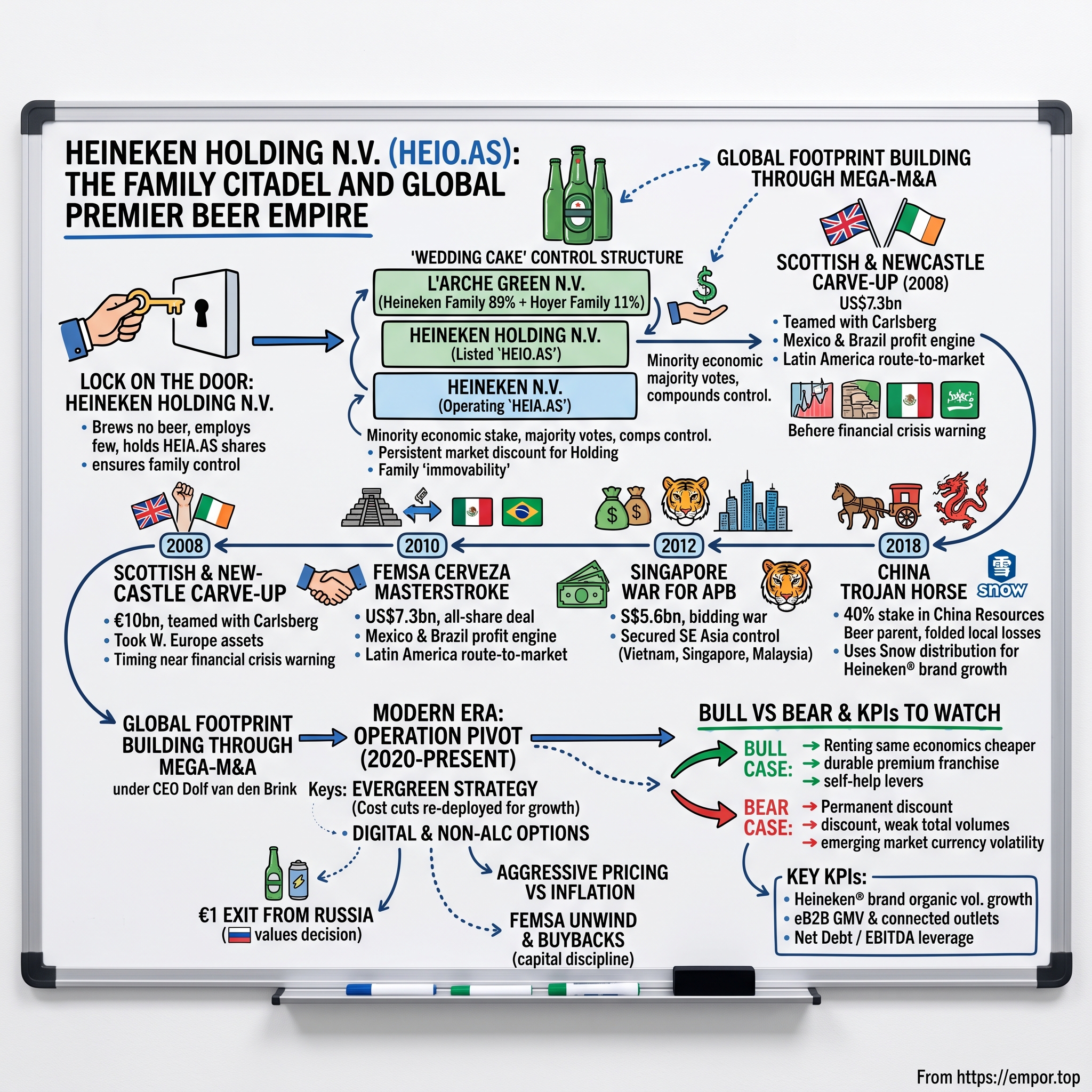
Heineken Holding N.V.: The Family Citadel and the Global Premium Beer Empire
I. Introduction & Episode Roadmap
There is a peculiar object trading on Euronext Amsterdam under the ticker HEIO.AS. It brews no beer. It employs almost no one. It owns no breweries, no trucks, no advertising department, no Formula 1 sponsorship. Its entire reason for existing is to hold a single block of shares in another company — and to make absolutely certain that one Dutch family never loses control of it. That other company is Heineken N.V. (HEIA.AS), the world's most international premium brewer, a business that in the financial year 2025 turned roughly €28.9 billion of net revenue (before exceptional items and amortisation) into €4.39 billion of operating profit.5 Heineken Holding N.V. is the lock on the door.
Here is the mechanical heart of the whole story, and it is worth stating plainly before anything else: Heineken Holding owns exactly 50.005% of the issued share capital of Heineken N.V., and every single share of Heineken Holding is matched, one-for-one, by a share of Heineken N.V. sitting underneath it. The dividend paid on the two is identical, net of trivial administrative cost.1 So an investor buying HEIO.AS is buying, in economic substance, a share of HEIA.AS — the same beer, the same brands, the same cash flows. And yet the market has, for decades, priced Heineken Holding at a persistent discount to the value of the stake it holds. As of late 2025, Heineken Holding carried a market capitalisation of roughly €17 billion, while its look-through claim on Heineken N.V. — a company worth around €38.7 billion — was worth closer to €19.5 billion.4 Same risk, same yield engine, different price tag. That gap is the puzzle we will pull apart.
This is not, therefore, only a beer story. It is a story about how a 160-year-old family built a structure so watertight that no activist, no private-equity raider, and no hostile acquirer can ever force it open — and about what that permanence buys, and what it costs the outside shareholder. The core thesis to test is whether Heineken's premium global brand, its route-to-market dominance in a handful of enormous profit pools, and its family-enabled long-termism together constitute a durable competitive advantage in a global beer oligopoly — or whether flat-to-declining volumes, emerging-market currency chaos, and a generation drinking less alcohol are quietly eroding the moat while the family holds the fort.
The scale of the underlying operating company is worth fixing in the mind before we go further, because it is the thing both share classes ultimately own. In FY2025 Heineken N.V. generated a reported €35.9 billion of revenue before it strips out excise duties, converted that into €4.39 billion of operating profit on a clean basis, and earned a return on invested capital of 22.7% — a genuinely high figure for a capital-intensive manufacturer, up 57 basis points on the prior year.5 It sells around 240 million hectolitres of beer a year across more than seventy countries, roughly twelve to thirteen percent of all the beer brewed on the planet. The mother brand, Heineken®, is one of a tiny handful of consumer products recognisable on every inhabited continent. This is not a small, fragile thing the family is protecting. It is one of the great franchises of the modern consumer economy — which makes the mechanics of who controls it, and at what price an outsider can buy in, all the more worth understanding.
The roadmap for the episode: first, the governance machine and the discount it produces. Then the origin — Gerard Adriaan Heineken, the marketing obsessive Freddy Heineken, and the abrupt 2002 succession to his daughter Charlene de Carvalho-Heineken. Then two decades of empire-building through mega-M&A: Scottish & Newcastle, FEMSA, Asia Pacific Breweries, and the trojan-horse alliance with 华润啤酒 China Resources Beer. Then the modern era under Dolf van den Brink — the EverGreen cost programme, the FEMSA unwind, the €1 exit from Russia, and the pricing war against inflation. Then the segment economics, the digital and non-alcoholic optionality, the competitive war-game against Anheuser-Busch InBev and Carlsberg, the live risk radar, the playbook, and finally the bull and bear cases with the handful of KPIs that actually matter. Let us start with the lock on the door.
 Subscribe on LinkedIn
II. Dual-Class Governance & Holding Structure Mechanics
Picture a wedding cake. Not the whole thing — just the vertical cross-section, tier stacked on tier, each one smaller and more exclusive than the one below. That is the Heineken control structure, and each layer exists for exactly one purpose: to convert a minority of the family's economic wealth into a majority of the group's votes.
Start at the top of the cake. There is a private company called L'Arche Green N.V., and it is owned 88.98% by the Heineken family and 11.02% by the Hoyer family, a long-standing family ally.2 L'Arche Green is the family's fist. Below it sits Heineken Holding N.V., the listed entity HEIO.AS; L'Arche Green controlled roughly 53% of it as of the end of 2024.7 And Heineken Holding, in turn, holds that magic 50.005% of Heineken N.V.1 Do the arithmetic and the family's actual economic stake in the operating brewer is a fraction of the whole — but through the tiers, the votes compound. Control the top of the cake and you control the bottom, even though you paid for only a slice.
Why go to this trouble? Because Freddy Heineken, who engineered it, had watched what happened to founding families that raised public capital without protecting their votes: they got diluted, then out-voted, then shown the door. His structure guarantees the opposite. Heineken N.V. can issue equity to fund acquisitions — as it did spectacularly for FEMSA — without the family's grip ever loosening, because the dilution happens below the control layer. The family never has to choose between growth capital and control. It gets both.
Now, the discount. This is where the outside investor's interest sharpens. Since Heineken Holding is economically a mirror of Heineken N.V. — one share backing one share, identical dividend — pure logic says the two should trade at the same price.1 They do not. Heineken Holding has historically traded at a meaningful discount to its underlying stake, in a band that has often sat in the low-to-mid teens as a percentage. At late-2025 prices the gap implied by the market caps was roughly the low teens — Heineken Holding at about €17 billion against a look-through claim nearer €19.5 billion.4 For an asset with, by construction, identical fundamental economics, that is free yield: buy the holding company and you collect the same euro of dividend on a smaller invested base, which mechanically lifts your dividend yield.
So why does the discount refuse to close? Three reasons, and none of them are about the beer. First, liquidity and index mechanics: Heineken Holding is smaller and less liquid than Heineken N.V., and certain benchmark indices weight or include stocks on free-float and voting criteria that the holding structure complicates, so a slice of passive demand simply never arrives. Second, and more fundamentally, there is no catalyst — and there can never be one. In an ordinary holding-company discount, the market at least dreams of a wind-up, a merger of the two lines, or a raider forcing the issue. Here, none of that is possible. L'Arche Green's lock means a collapse of the two share classes into one, a liquidation, or a hostile bid is not difficult — it is structurally foreclosed. The discount is not a temporary dislocation waiting for an event; it is a permanent feature of an asset that can never be catalysed.
This is the activist's nightmare, and it is worth dwelling on because it defines the entire investment. Imagine Elliott Management or Third Point building a position and demanding the obvious value-unlocking trade: collapse HEIO into HEIA, close the discount, everyone pockets the difference. They would get precisely nowhere. They cannot out-vote L'Arche Green. They cannot call a meeting that matters. They cannot threaten a sale, because there is no one who can sell. The family's control is not a matter of persuasion or proxy math; it is welded into the corporate architecture. For a skeptical investor this cuts both ways. The governance is, by any modern standard, shareholder-unfriendly — minority owners have essentially no route to force change, and the discount is the market's honest price for that powerlessness. But the same immovability is precisely what lets management make ten-year bets without a raider breathing down its neck, which we will see mattered enormously in China.
There is a subtlety worth adding for the diligent owner, because the "identical economics" claim has one asterisk. Heineken Holding's stake in Heineken N.V. is not frozen at a round number; it drifts slightly with each company's own share activity. At the end of 2025, Heineken Holding's interest stood at 50.494% of Heineken N.V.'s outstanding capital, a touch above the 50.005% floor the structure is designed never to breach.3 The difference matters only at the margin — Heineken N.V. buying back and cancelling its own shares mechanically nudges the Holding's percentage up — but it is a reminder that the two entities are not literally the same instrument. They are twins joined at the dividend, not a single share wearing two tickers. The administrative expenses at the Holding level are genuinely trivial, and the one-for-one share matching means the per-share dividend is, in practice, the same euro flowing to both.1 For the investor, the upshot is that the analytical shortcut — "value Heineken N.V., apply the discount, that's Heineken Holding" — is very nearly exact, and the small imprecision runs, if anything, slightly in the Holding's favour over time as buybacks concentrate its stake.
The practical takeaway for a long-term owner is unglamorous but real: Heineken Holding is a way to rent the same underlying business at a structurally cheaper entry multiple and a higher running yield, in exchange for accepting that the discount is a companion you will likely never be rid of. You are not buying an arbitrage that converges. You are buying identical beer economics at a standing markdown, and getting paid a little extra to hold it. To understand why the family guards that beer so fiercely, we have to go back to a brewery called The Haystack.
III. Concise Founding Roots, Freddy Heineken, & Family Legacy
On 15 February 1864, a 22-year-old named Gerard Adriaan Heineken bought a struggling Amsterdam brewery called De Hooiberg — "The Haystack" — a business that had been operating since 1592.8 Family legend holds that he talked his mother into financing the purchase with an argument about public health: better that Amsterdammers drink clean beer than filthy canal water and gin. Whether or not that pitch was sincere, it was shrewd, and it set a pattern the company would repeat for a century and a half — sell beer not as a vice but as a superior, aspirational product.
The technical inflection came two decades later. In 1886, a chemist named Hartog Elion, who had trained under Louis Pasteur, isolated a pure yeast strain in the Heineken laboratory — the famous "A-yeast" that gave the lager its consistent, faintly fruity signature and, crucially, made the taste reproducible batch after batch, brewery after brewery, country after country.8 That reproducibility is easy to skim past, but it is the quiet foundation of everything that followed. A brand that tastes identical in Amsterdam, Lagos, and Ho Chi Minh City can be globalised; a brand that drifts cannot. Gerard died in 1893, and control passed down through the family, but the company remained a Dutch story for another half-century.
Then came Freddy. Alfred Henry "Freddy" Heineken — born in 1923, grandson of the founder — is the man who turned a good Dutch lager into a global icon, and he is the reason both the brand and the family fortress exist in their modern form.9 Freddy started on the shop floor of the New York importer in the 1940s, learned American marketing at its source, and came home convinced that beer was not a commodity to be sold on price but a lifestyle to be sold on desire. He obsessed over the label, the bottle, the way the brand looked on a bar. He is remembered inside the company as much as an advertising man as a brewer, and under his hand Heineken went from a name known mainly in the Netherlands to one recognised around the world.9
Freddy's second act of genius was defensive rather than creative. Having rebuilt the family's ownership by buying back stock, he constructed the Heineken Holding structure precisely so the family could never again be diluted out of control as the group tapped public markets for growth.9 It was, in effect, an insurance policy written against his own descendants' future need for capital. He chaired the group from 1971, stepped back from the executive board in 1989, and remained a looming presence until his death.9
There is one episode that reveals the stakes better than any balance sheet. In November 1983, Freddy Heineken and his driver Ab Doderer were kidnapped and held for a ransom of 35 million Dutch guilders — one of the most notorious crimes in postwar Dutch history.9 He survived, but the episode hardened an already fierce instinct for control and privacy that would echo through the family's stewardship for decades.
The ransom, when it was set, came to 35 million Dutch guilders — an enormous sum for the era, and a number that fixed in the public imagination just how much wealth the green bottle had generated.9 The episode also foreshadowed a family trait that would define the next generation's stewardship: an almost obsessive preference for privacy and control over public visibility.
The succession, when it came, was abrupt. Freddy Heineken died in January 2002, leaving a fortune valued at around 9.5 billion guilders and, more consequentially, the keys to the citadel to his only child, Charlene de Carvalho-Heineken.9 She had lived largely out of the public eye in London, raising five children; overnight she became the controlling shareholder of one of the world's great consumer companies. For years she has ranked among the wealthiest women in the world on the strength of that inheritance, but the more relevant fact for investors is behavioural, not numerical: she chose engagement over abdication. Many heirs to great fortunes become absentee owners, cashing dividends while professional managers run the show. Charlene did the opposite, treating the controlling stake as a responsibility to be actively discharged rather than a lottery ticket to be spent. What happened next surprised the skeptics who assumed the heiress would be a passive custodian. Together with her husband, Michel de Carvalho — a former investment banker with a genuinely cinematic backstory as a child actor and Olympic-level bobsledder — Charlene took an active governance role. She defended the structure, resisted approaches to break it up or sell out, and backed a two-decade campaign of aggressive global consolidation. The family that had spent a century protecting its control now used that control to go on the offensive. That offensive is our next chapter.
IV. Two Decades of Mega-M&A: Building the Global Footprint
If the twentieth century made Heineken a brand, the first two decades of the twenty-first made it an empire — and it did so through four enormous, very different deals, each one a case study in how (and how not) to buy your way to global scale. The family's permanent capital was the enabling condition; management's willingness to write ten-figure cheques was the execution. Let us take them in order, and grade them honestly.
Inflection Point 1: The Scottish & Newcastle Carve-Up (2008). In early 2008, Heineken teamed up with its Danish rival Carlsberg to launch a joint £7.8 billion takeover of Britain's Scottish & Newcastle — roughly €10 billion at the time — and then split the carcass between them.10 The offer of £8.00 a share was announced in January 2008 and the target was delisted that April.10 Heineken took the Western European prizes: the UK business, plus operations in Ireland, Finland, Belgium, and Portugal.10 Carlsberg took the Russian crown jewel, Baltic Beverages Holding, and France's Kronenbourg. The strategic logic for Heineken was to bulk up in mature, high-value Western markets. The timing was, in hindsight, close to catastrophic: Heineken paid a top-of-cycle price for low-growth, mature assets and loaded up on debt mere months before the global financial crisis detonated. The UK business in particular required years of grinding restructuring to justify the price. It is the deal in the set that a value investor would flag as a warning about buying maturity at a premium at the peak.
Inflection Point 2: The FEMSA Cerveza Masterstroke (2010). Two years later came the mirror image — arguably the single best deal in modern Heineken history. In January 2010, Heineken agreed to absorb the beer operations of Mexico's Fomento Económico Mexicano (FEMSA) in an all-share transaction valued at roughly US$7.3 billion, including about US$2.1 billion of assumed debt.1112 The elegance was in the currency: Heineken paid not with cash but with paper, issuing FEMSA a roughly 20% economic interest in the Heineken group.11 For that, Heineken acquired Dos Equis, Sol, and Tecate, dominant distribution across Mexico, and a foothold in Brazil — high-margin Latin American volume that would become the group's single most important profit engine.11 FEMSA's José Antonio Fernández Carbajal joined the supervisory board as vice chairman, aligning a powerful Mexican partner with the family's interests.11 Zero cash out the door, a generational profit pool in, and a locked-in ally: this is what capital-efficient M&A looks like when it works.
Inflection Point 3: The Singapore War for Asia Pacific Breweries (2012). The APB battle was the most dramatic of the four — a genuine bidding war fought across a Singapore summer against a Thai billionaire, เจริญ สิริวัฒนภักดี Charoen Sirivadhanabhakdi, whose ThaiBev and TCC vehicles were circling the same prize. At stake was Asia Pacific Breweries, home of Tiger Beer and the route to market across Vietnam, Singapore, and Malaysia. Heineken had grown its footprint in Asia over decades through a joint venture with Fraser & Neave, and when the Thai group started accumulating F&N shares — threatening to slip a rival into the APB boardroom through the back door — Heineken decided it could no longer tolerate sharing control of its crown Asian asset. It moved to buy out Fraser & Neave's direct and indirect APB stake outright, ultimately agreeing to pay S$5.6 billion — S$53.00 a share — to secure control and shut the Thai challenger out.1314 The transaction lifted Heineken's effective interest in APB from the low-to-mid forties toward full ownership, with a mandatory general offer for the remaining shares pushing the all-in outlay materially higher than the headline stake price.13 It was an expensive victory — the price was rich by any historical brewing multiple, a fact Heineken did not much dispute — but the logic was that Southeast Asia's demographics and the premiumisation of Tiger and Heineken® in the region would compound for decades. Complete ownership of Tiger and unfettered control of that distribution was judged worth the premium. Whether the price was worth it depends entirely on how long that Southeast Asian tailwind blows — a question Vietnam's recent troubles, which we will come to, have made uncomfortably live. The pattern across these first three deals is already instructive: Heineken will pay up, sometimes dearly, for control of a route to market it deems strategic, and it treats distribution density as the asset worth overpaying for rather than the brewery bricks themselves.
Inflection Point 4: The Trojan Horse in China (2018). For years, China was Heineken's great embarrassment — a vast market where its own breweries lost money and its distribution was hopeless against the local giant, 华润啤酒 China Resources Beer, maker of Snow, the best-selling single beer brand on earth by volume since 2008.15 Everyone knew China would eventually be the world's most important beer market; Heineken simply could not figure out how to win in it. The scale problem was almost comic: a foreign premium brand trying to build national distribution in a country where the incumbent already had it, one province and one million-outlet network at a time. The 2018 deal solved the problem by inverting it: rather than keep fighting the champion, Heineken bought a piece of it. In agreements signed in November 2018, Heineken took a 40% stake in the controlling entity of China Resources Beer for HK$24.3 billion, giving it an effective economic interest of around 20.7% in the Chinese brewer; China Resources reciprocated by buying about 0.9% of Heineken N.V. for €464 million; and Heineken folded its loss-making Chinese operations into CR Beer.15 Heineken's net investment came to roughly €1.9 billion.15 In exchange, the premium Heineken® brand got the licence and the muscle of CR Beer's colossal nationwide sales and distribution network — the very thing Heineken had never been able to build itself.33
The financial logic is elegant once you see it. Heineken stopped consolidating loss-making Chinese breweries onto its own income statement and instead booked a share of a profitable associate's earnings, while handing the hard, unglamorous work of moving cases through the world's largest beer market to the company best equipped to do it. The premium Heineken® brand, riding CR Beer's rails, grew rapidly in China from a tiny base. It is the deal that best captures the family-enabled long game: partner with the local champion, hand it your weak assets, and ride its distribution to premium growth rather than burning capital fighting a war you cannot win. And it is precisely the kind of decision — accept years of losses, then restructure the entire approach through a minority stake with delayed payoff — that a quarterly-driven, activist-exposed management might never have had the patience to make. Having assembled the footprint across four continents and a decade of dealmaking, the question for the 2020s became whether Heineken could actually make it all earn its keep. Enter Dolf van den Brink.
V. The Modern Era: EverGreen Strategy, Leadership & Operational Pivot (2020–Present)
Dolf van den Brink took over as chief executive and chairman of the executive board of Heineken N.V. on 1 June 2020 — arguably the worst possible moment to inherit a company that sells beer in bars, since the bars of the world were, at that instant, closed by pandemic.16 He was not an outsider parachuted in to shake things up; he was Heineken to the core, a 22-year company man who had run Heineken USA, then Heineken Mexico, then the entire Asia Pacific region before taking the top job.16 He also held, unusually for a beer CEO, a master's degree in philosophy alongside his business degree — a detail his admirers cited as evidence of a systems thinker and his critics filed under "over-thinks it."16
Van den Brink's signature was a strategy called EverGreen, launched in early 2021 as a comprehensive attempt to drag the company off the treadmill of chasing gross volume and onto a discipline of profitable, sustainable growth.20 The original framing came with a specific, quantified promise: an operating margin (beia) of around 17% by 2023, funded by structural cost savings redeployed into premiumisation, digital, and sustainability. It was a bold target, and it very quickly ran into reality. By February 2022, with barley, aluminium, and energy costs exploding, management was already publicly walking back the timeline, telling investors the 2023 margin goal was in doubt as input costs surged.19 For a skeptic keeping a scorecard on management credibility, this is the first entry: an ambitious margin target set with confidence, then softened within a year as the world changed. To management's credit, they said so plainly rather than pretending; to the bears' point, the episode showed how exposed even a premium brewer's margins are to commodity whiplash.
What EverGreen did deliver, over its full run, was cost. The programme ultimately generated on the order of €3 billion in cumulative gross savings, and in October 2025 management relaunched it as "EverGreen 2030," pledging a further €2 billion of gross cost cuts over five years.18 The sharpest edge of that plan is human: Heineken said it would reduce 5,000 to 6,000 roles over two years, including around 400 jobs at the Amsterdam head office from 2026, while pouring more than €1 billion into a "Digital Backbone" spanning 70-plus markets and expanding its shared-services hub in Hyderabad.518 The analytical read is that after the pandemic and the inflation shock, Heineken concluded organic volume growth alone would not deliver the margins it wants, so it is buying margin through structural cost — a defensible move, but one that tells you management does not expect the top line to do the heavy lifting.
The van den Brink era also featured two decisive acts of capital and geopolitical discipline. First, the FEMSA unwind. In February 2023, FEMSA announced it would sell down its long-held stake to refocus on its own retail and fintech businesses; Heineken agreed to support the exit and buy back €1 billion of its own shares.21 When the sell-down completed at the end of May 2023, Heineken itself purchased €333 million of stock directly from FEMSA — about €235 million of Heineken N.V. shares at €92.75 and €98 million of Heineken Holding shares at €77.25 — opportunistically retiring equity at a depressed valuation.22 Buying back your own shares at a distressed price from a forced seller is close to a textbook capital-allocation win, and it applied at both the operating and holding-company level.
Second, and far more fraught, was Russia. When Heineken vowed to leave after the 2022 invasion of Ukraine, it discovered — as many Western multinationals did — that leaving is harder than arriving. The exit finally completed on 25 August 2023, with Heineken selling its seven Russian breweries and roughly 1,800 employees to the local Arnest Group for the symbolic sum of €1, and booking a total loss of about €300 million.2324 Russia had represented roughly 4% of global volumes.24 Management framed it as protecting brand integrity and refusing to profit from the war; a cynic would note that €1 and a €300 million write-off is also what a fire sale looks like when the alternative is worse. Both readings are true. It was a values decision and a value destruction simultaneously, and Heineken chose the exit anyway.
Then there was pricing. From 2022 through 2025, Heineken did what the whole consumer-staples industry did: it passed hyper-inflationary input costs through to the shelf via aggressive, sometimes double-digit price increases, and it accepted the volume it lost as the price of protecting margin. The gambit largely worked on the profit line — FY2024 operating profit (beia) rose 8.3% organically to €4,512 million at a 15.1% margin, and FY2025 added another 4.4% organically to €4,385 million reported at a 15.2% margin — but the volume cost was real and lingering, especially in Europe.65 It is worth pausing on the gap between two versions of FY2024 profit that reveal how much noise sits inside the headline: on a clean, before-exceptionals basis Heineken earned net profit of €2,739 million and diluted earnings of €4.89 a share, but on a fully reported basis — after a large non-cash impairment tied chiefly to its Chinese associate and other one-offs — net profit was just €978 million and reported EPS only €1.74.6 The difference is not accounting sleight of hand so much as a signal: the reported number carried a heavy write-down against the very China stake the 2018 deal had been built on, a reminder that even a clever structural bet can require a sober markdown when the market's growth disappoints. By FY2025 the clean picture had steadied — net profit grew 4.9%, diluted EPS came in at €4.78, free operating cash flow reached €2.6 billion at 87% cash conversion, and net revenue per hectolitre rose 3.8% as price and premium mix did the work that volume could not.526 The most telling development came in the tone: by the FY2025 results in February 2026, management was explicitly steering the narrative away from "price-led" and back toward "balanced" volume-and-price growth, an admission that the pricing lever had been pulled about as far as consumers would tolerate.25
The capital-returns story sharpened in this period too, and it is central to the investment case for both share classes. Alongside FY2025 results, Heineken proposed a dividend of €1.90 a share, widened its dividend payout policy to a 30–50% range of net profit (up from 30–40%), and launched a €1.5 billion two-year share buyback, the first €750 million tranche of which completed on 20 January 2026 with a second tranche to follow.5 For a family-controlled company, buybacks are doubly attractive: they return cash to all shareholders while, at the operating level, gently concentrating Heineken Holding's percentage stake — a structure where returning capital and reinforcing control point in the same direction. On the deployment side, Heineken also moved to consolidate FIFCO, the Central American brewer and beverage group with around $1.15 billion of revenue, guiding that the integration would add roughly 2–3% to earnings per share — a bolt-on that extends the Latin American profit pool the FEMSA deal first opened.5 The final, and most current, twist arrived in January 2026, when van den Brink himself announced he would step down as CEO at the end of May 2026 after nearly six years, moving to an eight-month advisory role and handing the Supervisory Board the task of finding a successor.17 His departure — with the EverGreen 2030 cost programme barely begun and a new CFO, ex-Reckitt executive Harold van den Broek, having only arrived in June 2025 — leaves the leadership of the operating company in transition at a delicate moment.17 To judge what the next leader inherits, we need to open up the segments.
VI. Segment-Level Breakdown & Regional Economics
A global brewer is really four or five different companies wearing one green logo, and the only way to understand Heineken's risk and reward is to walk the map. Heineken reports across four regions — Europe; the Americas; Asia Pacific; and Africa, Middle East & Eastern Europe — and the striking thing is how differently each one behaves.6 The revenue is concentrated where the growth is slowest, and the profit margin is fattest where the political risk is highest. That tension is the essence of the business.
Europe (roughly 35–40% of revenue). This is the ancestral home and the hardest slog. Western European beer is a mature, structurally declining category, dominated by the off-trade — supermarkets and grocery chains that hold real bargaining power over any brewer that needs shelf space. Heineken's answer here is premiumisation: pushing Birra Moretti in the UK, Cruzcampo in Spain, and the mother brand itself up-market to extract more revenue per litre even as total litres drift down. It is a defensive game, and in the near term it has not been going especially well. In FY2025 the European region saw net revenue fall 3.2%, total volume drop 3.4%, and operating profit decline 4.9% — the softness that management blamed partly on cautious consumers and retailer disruptions.26 For investors, Europe is the "show me" region: high absolute profit, but the place where the trading-down risk from stretched consumers is most visible and most immediate.
The Americas (roughly 30–35% of revenue, and the profit heart of the company). This is what the FEMSA deal bought, and it has aged beautifully. Mexico is Heineken's single most important profit generator — a high-volume, premiumising market where Tecate, Dos Equis, and Sol sit alongside the Heineken® brand — and Brazil has been transformed from a low-value slog into a genuine premium battleground, with Heineken® and Amstel taking share directly from Anheuser-Busch InBev's Brahma and Skol. Brazil deserves special mention because it is the clearest proof of the premiumisation playbook working in an emerging market: Heineken entered a market dominated by a value incumbent, refused to fight on price, and instead dragged Brazilian drinkers up-market toward its premium labels, converting a low-margin volume game into a higher-margin brand game. The analytical point is that Heineken's most valuable profit pool sits in Latin America, not Europe, which is why Mexican consumer health and the Brazilian real matter more to the earnings than any number of German or British data points. It also means the FIFCO consolidation in Central America and the group's broader Latin exposure make the region the single biggest swing factor in whether Heineken's overall profit grows or stalls in any given year.
Asia Pacific (roughly 15–20% of revenue, the highest-margin region of all). This is the smallest region by revenue but the richest by margin, historically running operating margins well above the group average. The engine is Vietnam — a high-margin market anchored by Tiger and Heineken® — supplemented by Cambodia and the equity earnings flowing in from the CR Beer stake in China. But Asia Pacific has recently been the source of the sharpest pain. Vietnam, in particular, was hammered by a combination of strict anti-drunk-driving enforcement and a genuine economic slowdown, and Heineken singled out Tiger as disproportionately hit, describing a brand in need of revitalisation.25 The lesson is that a region can be both the highest-margin and the highest-torque: when Vietnam sneezes, Heineken's most profitable litres catch the cold.
Africa, Middle East & Eastern Europe (roughly 10–15% of revenue). This is the region of enormous long-term promise and brutal short-term volatility. Nigeria, through Nigerian Breweries, is the marquee market, alongside South Africa, Egypt, and Ethiopia. The demographics are a genuine multi-decade tailwind — young, growing, urbanising populations. But the currencies are a nightmare. The collapse of the Nigerian naira and severe devaluation of the Ethiopian birr have repeatedly gutted the euro value of otherwise strong local results. In FY2025, currency translation alone reduced group operating profit by €113 million, driven chiefly by the birr and the naira; and yet Nigeria's operating profit still rose 62% in local terms on a transformed cost base and pricing.25 That single juxtaposition — booming local profit, savaged by translation — is the entire African investment case in one line: the operations can be doing everything right and the reported euros can still go backwards. Having toured the map, the more interesting question is where the future growth actually hides — and much of it is not on the map at all, but in two newer businesses.
VII. Hidden Growth Drivers & Digital Optionality
Every mature company tells a story about its optionality — the businesses that are small today but might matter enormously tomorrow. For Heineken there are two that deserve genuine scrutiny rather than a promotional wave: the non-alcoholic category and the digital B2B platform. Both are real. Neither is a sure thing.
Heineken 0.0 and the alcohol-free bet. A decade ago, non-alcoholic beer was a punchline — the drink you ordered when you had already given up on the evening. Heineken made a large, early, and so-far vindicated bet that this was about to change, and it built Heineken® 0.0 into the world's leading international alcohol-free beer, now sold in well over a hundred markets.27 The strategic beauty of the category is threefold. First, the economics: 0.0 sells at or above the price of regular beer per litre, but in most major markets it attracts far lower or zero excise duty, so a larger slice of the price falls to gross margin. Second, it expands the occasions where beer can be sold — lunchtimes, workdays, before driving, during Dry January — reaching drinkers the alcoholic range legally or practically cannot. Third, it rides a genuine secular wave: industry analysts have projected non-alcoholic beer overtaking ale in volume terms, a structural shift in how younger consumers drink.28
The numbers give the bet real substance. Heineken® 0.0 is available in more than 117 markets and holds roughly an 18% share of a global non-alcoholic beer category worth on the order of $13.7 billion, a category compounding at around 10% a year — and in FY2024 the 0.0 brand grew about 10%, extending a run of roughly 53% cumulative organic volume growth between 2020 and 2024.27 Those are the growth rates of a young business inside a mature one, and they arrive with a structurally better margin than the core because of the excise-duty advantage. When a brewer can sell a product at full price while the taxman takes a fraction of his usual cut, every incremental hectolitre is worth more to the bottom line than a hectolitre of ordinary lager.
But the skeptic should hold two caveats. The non-alcoholic beer market, while growing fast, is still a small single-digit percentage of total beer volume — it is a powerful growth vector, not yet a company-mover, and even industry forecasts of non-alcoholic beer overtaking ale describe a shift within a niche rather than a takeover of the category.28 And Heineken's global leadership does not translate everywhere: in the United States specifically, the fast-growing challenger Athletic Brewing has out-run Heineken 0.0 in the domestic non-alcoholic segment, a useful reminder that a first-mover global brand can still be beaten in a key market by a focused local upstart.27 The 0.0 story is a real edge; it is not an unassailable one.
The eB2B platform. The less visible bet is arguably the more strategically interesting. Heineken has been digitising its route to market through an eB2B platform that lets small bars, restaurants, and independent retailers order directly through an app rather than through a sales representative. By full-year 2024, that platform was capturing on the order of €13 billion in gross merchandise value across more than 700,000 active customers, largely in the fragmented traditional trade of emerging markets; in the first half of 2025, GMV grew about a third year on year to €6.3 billion.629 The strategic value is not the app itself but what it captures: proprietary point-of-sale data on what sells where, lower cost-to-serve as digital orders replace expensive rep visits, larger average baskets, and the option to earn fees distributing third-party products across the same pipes.
To grasp why this matters, picture the traditional way beer reaches a small bar or corner shop in Mexico or Nigeria: a sales representative physically visits, takes an order on paper or a clipboard, and the whole relationship lives in that rep's head and route. Digitising it flips the model. The outlet self-serves through an app, the brewer sees in real time what is selling where, orders get larger because the full catalogue is always visible, and the cost of serving each outlet falls because the expensive human visit becomes occasional rather than constant. Over time the platform becomes a data asset — a live map of demand across hundreds of thousands of outlets — and potentially a toll road, since a brewer with the pipes can distribute third parties' products for a fee. That is the prize Heineken is chasing.
The honest framing requires naming the competitor, because Heineken is not the pioneer here — Anheuser-Busch InBev is, with its BEES platform, and the scale gap is instructive. BEES processed around $52.5 billion of GMV in 2025, up 12%, with AB InBev reporting that roughly 72% of its revenue now flows through B2B digital channels.3031 The two companies define and disclose GMV differently, so a direct "who is bigger" comparison is treacherous, but the order of magnitude tells the story: the global scale leader got there first and is further along. Heineken's eB2B is a credible, fast-growing follower building a real data-and-distribution asset — not a category-defining lead, and not yet a proven profit driver in its own right. Optionality, in other words, is exactly the right word for both of these businesses: valuable if they compound, and not yet essential if they don't. Which brings us to the structural question underneath everything — is the beer oligopoly itself a good place to own a business?
VIII. Deep Dive: Industry Structure, Competitive Landscape & Economic Moats
To understand whether Heineken can win from here, war-game the board it plays on. Global beer is one of the most consolidated consumer industries on earth — a handful of giants control the overwhelming share of volume — and the shape of that oligopoly determines how much of Heineken's success is skill and how much is simply the favourable geometry of an industry with very few players.
The players. At the top sits Anheuser-Busch InBev, the volume monster, brewing roughly a quarter of the world's beer — on the order of 495 million hectolitres a year — a company assembled through one of history's great serial rollups, from Interbrew and AmBev to Anheuser-Busch and finally the roughly $100 billion swallowing of SABMiller in 2016.32 Its strength is unmatched scale; its burden is the heavy leverage that rollup left behind, a debt load that for years constrained its freedom to manoeuvre. Heineken is the clear number two by volume, at roughly 240 million hectolitres, and the number one in genuinely international premium — a pure-play premium emphasis, geographically the broadest of any brewer, and notably less encumbered by debt than AB InBev. Then Carlsberg, the number three at around 100 million hectolitres, strong in Western and Eastern Europe and Asia but lacking Heineken's global brand reach; and 朝日グループホールディングス Asahi Group Holdings, which vaulted into the premium European conversation by buying the assets AB InBev was forced to shed for SABMiller antitrust clearance — Peroni, Grolsch, and Pilsner Urquell among them.32 Sitting slightly apart is 华润啤酒 China Resources Beer, gigantic by volume on the strength of Snow but overwhelmingly domestic — and, crucially, a partner rather than a rival to Heineken since 2018.
The structure of that rivalry matters more than the raw rankings. When four or five players control most of a category and the barriers to a sixth are prohibitive, the incumbents mostly compete on brand and distribution rather than on ruinous price wars, because everyone understands that torching prices destroys the whole pool. This is the quiet gift of oligopoly to Heineken's economics: it can invest in brand equity and premium positioning with reasonable confidence that a rational rival will do the same rather than trigger a race to the bottom. The danger, as we will see, comes not from the other brewers but from outside the category entirely.
Helmer's 7 Powers, applied honestly. Three of Hamilton Helmer's seven powers plausibly apply to Heineken. The first is Brand. The Heineken® mark is a genuine global icon, reinforced by decades of top-tier sponsorship — UEFA Champions League, Formula 1, the James Bond franchise — that buys top-of-mind awareness few consumer brands anywhere can match. Brand power lets Heineken charge a premium the private-label lager on the next shelf cannot, and it is the single most durable advantage the company has. The second is the Cornered Resource — but here the resource is not a mine or a patent; it is the family control structure itself. L'Arche Green's lock is what allowed management to spend years losing money in China, then restructure the entire approach via the CR Beer deal, without a quarterly-driven raider forcing a premature retreat. Patient capital is a competitive weapon when your rivals are levered and impatient. The third is Scale Economies and a distribution moat: in Mexico, Vietnam, the Netherlands, and the UK, Heineken's route-to-market density — the direct-store-delivery networks that get cold beer into hundreds of thousands of outlets — is something a craft entrant simply cannot replicate. You can brew a better beer in a shed; you cannot build a national cold-chain distribution network in one.
Porter's five forces, applied skeptically. The barriers to entry in mass and premium lager are extremely high — brewing is capital-intensive and distribution is a logistics fortress — which is exactly why the industry consolidated into an oligopoly in the first place. Buyer power splits by channel: low in the on-trade, where a bar needs the brands drinkers ask for by name, but moderate-to-high in European off-trade, where a few giant grocery chains can squeeze even Heineken on price and shelf space. The force that should worry a long-term owner most is the threat of substitutes. Beer is no longer competing only with beer. Spirits, ready-to-drink canned cocktails, hard seltzers, and the broader wellness-driven move away from alcohol are all nibbling at beer's share of the total drinking occasion, particularly among younger consumers. The oligopoly protects Heineken from other brewers; it does not protect beer itself from the possibility that the next generation simply drinks less of it. That substitution risk is the sharpest item on the current risk radar.
IX. Current Risk Radar & Management Stress Test
Strip away the brand romance and a sober owner is left with a handful of concrete ways this business can disappoint. They are worth naming precisely, because each has a mechanism, and each shows up in the actual numbers management has to explain on its calls.
Emerging-market currency and hyperinflation. This is the most reliable source of unpleasant surprises. Heineken earns a rising share of its profit in currencies — the Nigerian naira, the Ethiopian birr, the Argentine peso — that can devalue faster than any operational improvement can offset. The mechanism is double-edged: devaluation both shrinks the euro value of repatriated profit and inflates the cost of dollar-denominated imported inputs like barley and aluminium. The €113 million currency hit to FY2025 operating profit, concentrated in the birr and naira, is not a one-off; it is a recurring feature of where Heineken's growth now lives.25 A skeptic's fair challenge: how much of Heineken's celebrated emerging-market growth survives translation into the currency shareholders actually spend?
Price elasticity and European volume friction. Having pushed prices hard through the inflation years, Heineken now faces the hangover: consumers, especially in Europe, trading down from premium Heineken® and Birra Moretti to cheaper private-label supermarket lagers. The FY2025 European numbers — volume down 3.4%, profit down 4.9% — are the early evidence that the pricing lever has limits.26 Management's pivot back to "balanced" growth is a tacit admission of exactly this.25 The stress-test question is whether the volume being lost is a temporary post-inflation adjustment or a permanent ceding of ground to private label.
Substitution and demographic drift. The longest-dated risk is the quietest: Generation Z drinks measurably less alcohol than its predecessors, and ready-to-drink cocktails and hard seltzers are competing for the share of throat that beer once owned uncontested. Heineken's own 0.0 push is partly a hedge against this very trend — but a company hedging against declining core demand is telling you something about the core.
Execution and transformation risk. EverGreen 2030 asks the organisation to strip out €2 billion of gross cost while cutting 5,000 to 6,000 roles and rewiring its digital plumbing across seventy-plus markets — all at once, and all while breaking in new leadership.518 Large corporate restructurings have a well-earned reputation for delivering the disruption up front and the promised savings late, if at all. The mechanism to watch is whether the cost-out programme quietly starves the brand investment and route-to-market density that are the actual moat; a brewer that cuts its way to a good margin for a year or two while hollowing out its distribution advantage would be trading a durable asset for a temporary number. Management insists the savings are being redeployed into premiumisation and digital rather than merely banked, but that is a claim to be verified against the volume and share data, not accepted on faith.
What the calls actually reveal. The FY2025 results call in February 2026 is a useful window into how management handles pressure, because analysts pushed on precisely the sore points. On Europe, management did not hide behind macro platitudes; it attributed the 3.2% net-revenue decline to specific causes including cautious consumers and retailer disruptions, and framed the recovery as a matter of rebuilding volume rather than squeezing more price.2526 On Vietnam, it singled out Tiger as disproportionately hit and described an active brand-revitalisation effort rather than waiting for the market to heal itself.25 On Africa, it drew the sharpest contrast of the call — Nigeria's operating profit up 62% in local terms and the wider Africa-Middle East region growing net revenue in the mid-teens with stable volume and strong price/mix — while simultaneously conceding that currency translation had stripped €113 million off group operating profit.25 The through-line across FY2023, FY2024 and FY2025 commentary is a deliberate shift in vocabulary from "price-led" to "balanced" growth, and to management's credit that shift has been narrated openly as consumers reached the limit of price tolerance, rather than sprung on investors as a surprise.25 An analyst looking for evasion would note the absence of a hard, dated margin target in the new EverGreen 2030 framing — guidance is deliberately directional (profit growth ahead of revenue) rather than a specific percentage by a specific year, which is either prudence after the 2023 miss or a convenient way to avoid being held to a number.18
Myth versus reality. Two consensus narratives deserve a fact-check. The first myth is that Heineken Holding is a "cheap way to buy Heineken" in the sense of a mispricing that will correct. The reality is that the discount is not a mistake the market will fix; it is the rational price of permanent illiquidity and zero governance rights, and it is structurally incapable of closing on its own.1 The second myth is that Heineken is a defensive, recession-proof staple. The reality is more nuanced: its most valuable profit pools sit in emerging markets whose currencies can erase a year of operating progress in a quarter, and its European core is in genuine volume decline. It is a high-quality franchise, but "defensive" undersells how much of its earnings power rides on the naira, the real, the peso, and Vietnamese consumer confidence.
The management-credibility stress test. Here the record is genuinely mixed, and an honest analysis holds both sides. On the debit side: the original EverGreen 17% margin target was set with confidence in 2021 and softened within a year;19 the 2020 CEO is departing mid-transformation just as EverGreen 2030 begins and a new CFO, in the seat only since mid-2025, settles in — injecting leadership uncertainty at an inconvenient moment.17 On the credit side: management has generally been candid about misses rather than evasive, explained the Vietnam and Europe softness in specific operational terms on the FY2025 call rather than blaming the weather, and demonstrated real capital discipline in the opportunistic FEMSA buyback and the clean, if costly, Russia exit.2225 A useful test of credibility is consistency of narrative across time, and here Heineken scores reasonably well: the premiumisation-over-volume message has been stable across several years of calls and presentations, even as the specific margin target moved. The pattern is of a competent, communicative management team that occasionally over-promises on quantified targets but does not obviously spin or blame-shift — worth watching, not disqualifying. The best way to keep watching is through a disciplined bull-and-bear frame.
X. Playbook & Strategic Investing Lessons
Step back from Heineken specifically and three transferable lessons fall out of the story — the kind an investor can carry to the next family-controlled compounder or the next consumer-staples turnaround.
Lesson one: holding-company discounts are a yield trade, not an arbitrage. The HEIO versus HEIA gap is the cleanest teaching case imaginable. Because the two are economically identical, the discount is pure structural friction — and precisely because it is structural, it rarely closes without a corporate catalyst that the family's lock has made impossible. The investor who buys Heineken Holding expecting the discount to converge will likely wait forever. The investor who buys it for the enhanced running yield on identical underlying assets, and treats the discount as a permanent companion, has understood the trade correctly. Buy the yield and the asset safety, not the convergence.
Lesson two: premiumisation is the shield against secular volume decline. Global beer volume is flat-to-declining, and no amount of marketing changes that. What premiumisation does is decouple revenue from volume: if the world drinks the same number of litres but trades up to more expensive ones, the brewer's top line and margin can keep rising even as unit volume stalls. Heineken's entire European strategy — pushing Birra Moretti, defending the mother brand's price premium — is a bet that value per litre can outrun the decline in litres. It is the right strategy for a mature category, and its limit is consumer willingness to pay, which the recent European softness suggests is not infinite.
Lesson three: in complex markets, rent the local champion's distribution rather than fighting it. The China pivot is the masterclass. For years Heineken tried to compete against 华润啤酒 China Resources Beer and bled capital doing it. The winning move was to stop competing, take a minority stake in the champion's parent, hand over its own weak assets, and ride Snow's distribution to premium growth. The lesson generalises: where a market's route-to-market is controlled by an entrenched local incumbent, a well-structured partnership can convert an unwinnable war into a high-return alliance — provided, crucially, you have the patient capital to wait for it to pay off. Which returns us, one last time, to the family. With the lessons drawn, the final task is to weigh the case for and against owning this thing.
XI. Bull vs. Bear Case & Key KPIs to Watch
The bull case. Start with the entry point: through Heineken Holding, an investor buys the same premium global beer business as Heineken N.V. at a structurally cheaper valuation and a higher dividend yield, for identical fundamental risk — the discount is a permanent tax on liquidity that the patient owner simply pockets as extra yield.4 On top of that sits a genuine premium franchise: the Heineken® brand grew volume 8.8% in FY2024 and a further 2.7% in FY2025 even as total group volume fell, evidence that the premium end is taking share from the mainstream even in a soft market.65 EverGreen 2030's €2 billion cost programme offers a self-help lever on margin that does not depend on the top line cooperating,18 and the emerging-market and digital businesses — Latin American profit growth, the CR Beer premium engine in China, the eB2B data asset, and the 0.0 category — supply the long-dated optionality. A brewer with the number-one international premium brand, family-enabled patience, ROIC of 22.7% in FY2025, and a widened 30–50% dividend payout policy is not an obviously broken business.5
The bear case. The discount that the bull calls free yield, the bear calls a permanent trap: the family's lock means no catalyst will ever release the value, so an investor could hold for a decade and watch the gap never close. The volume story is genuinely weak — total volume fell 1.2% in FY2025, Europe is shrinking, Vietnam is troubled, and the pricing lever that protected profit through the inflation years is now largely spent, forcing a pivot back to "balanced" growth that may mean slower profit growth ahead.525 And the emerging-market engine, for all its local vigour, keeps handing back euros to currency: €113 million of FY2025 operating profit erased by translation, with no sign the naira or birr will stabilise.25 Layer on a CEO departing mid-transformation and a new financial leadership team, and the bear sees a maturing, low-growth staple with structural governance friction, real demand headwinds, and leadership in transition — priced at a discount for reasons that are entirely rational.
The synthesis. Both cases rest on the same facts read through different lenses, which is the mark of a genuinely balanced situation rather than a mispriced one. The bull is buying durable premium brand equity and patient capital at a standing markdown; the bear is selling a low-growth category with currency leakage and no governance escape hatch. Which one is right depends less on the beer than on three things you can actually track.
The three KPIs that matter most:
-
Heineken® brand organic volume growth. This is the single cleanest read on whether the premium franchise — the entire investment thesis — is still winning share against mainstream and private label. When this number is comfortably positive while total volume is flat, premiumisation is working; when it converges toward zero, the shield is cracking.5
-
eB2B gross merchandise value and connected outlets. This tracks whether the digital route-to-market bet is compounding into a genuine data-and-distribution moat or stalling as a follower to BEES. Watch the GMV growth rate and the active-customer count together — rising GMV on flat customers means basket growth; rising both means the network is still spreading.29
-
Net debt / EBITDA leverage. Heineken's flexibility to keep buying back stock, pay a rising dividend, and act opportunistically depends on keeping leverage in a conservative band — it stood at 2.2x on a beia basis at the end of FY2024.6 Watch it drift: a rising ratio would signal that currency losses and soft volume are eating into the balance-sheet firepower that funds the very capital returns the bull case relies on.
Track those three, and the abstract debate about family citadels and holding-company discounts resolves into something concrete — a quarter-by-quarter test of whether the world's most international premium brewer can still grow the premium, monetise the digital, and hold the line on the balance sheet, all while one family keeps its hand firmly, permanently, on the lock.
References
-
Heineken Holding N.V. Annual Report 2025 — Heineken Holding N.V., 2026-03 ↩
-
Heineken Holding N.V. (HEIO.AS) Overview — StockAnalysis ↩↩↩
-
HEINEKEN N.V. reports 2025 full year results — Heineken N.V., 2026-02-11 ↩↩↩↩↩↩↩↩↩↩↩↩
-
HEINEKEN N.V. reports 2024 full year results — Heineken N.V., 2025-02-12 ↩↩↩↩↩↩
-
Heineken Holding N.V. Annual Report 2024 — Heineken Holding N.V., 2025-02-19 ↩
-
FEMSA Agrees to Exchange Beer Operations for 20% Economic Interest in Heineken — PR Newswire, 2010-01-11 ↩↩↩↩
-
Heineken to buy FEMSA beer operations in $7.3 billion all-share deal — Reuters, 2010-01-11 ↩
-
F&N accepts Heineken's S$5.6bn Asia Pacific Breweries offer — BeverageDaily, 2012-08-20 ↩↩
-
Heineken wins control of Asia Pacific Breweries for $6 billion — Reuters, 2012-08-19 ↩
-
HEINEKEN and China Resources sign definitive agreements to join forces in China — Heineken N.V., 2018-11-05 ↩↩↩
-
Dolf van den Brink started as CEO and Chairman of the Executive Board — Heineken N.V., 2020-06-01 ↩↩↩
-
Heineken CEO Dolf van den Brink to step down — Just Drinks, 2026-01-12 ↩↩↩
-
Heineken targets EUR 2 billion cost cuts as it launches EverGreen 2030 — inside.beer, 2025-10 ↩↩↩↩↩
-
Heineken casts doubt on 2023 margin target as input costs rise — CNBC, 2022-02-16 ↩↩
-
Heineken outlines EverGreen strategy and €2 billion cost reduction target — Financial Times ↩
-
FEMSA to sell Heineken stake in bid to lift stock price — Bloomberg, 2023-02-16 ↩
-
HEINEKEN N.V. purchases €333 million in shares from FEMSA — Heineken N.V., 2023-05-31 ↩↩
-
HEINEKEN completes exit from Russia — Heineken N.V., 2023-08-25 ↩
-
Heineken completes exit from Russia, selling assets for 1 euro — Reuters, 2023-08-25 ↩↩
-
Earnings call transcript: Heineken H2 2025 sees profit growth amid market challenges — Investing.com, 2026-02-11 ↩↩↩↩↩↩↩↩↩↩↩↩
-
Heineken FY2025 presentation slides: premium brands drive growth amid volume challenges — Investing.com, 2026-02-11 ↩↩↩↩
-
Heineken 0.0 alcohol-free beer innovation success — BeverageDaily, 2026-01-23 ↩↩↩
-
Non-alcoholic beer to pass ale in sales volume this year — CNBC, 2025-05-29 ↩↩
-
HEINEKEN N.V. Half-Year 2025 Press Release — Heineken N.V., 2025-07 ↩↩
-
AB InBev's BEES ecommerce revenue climbs in 2024 — Digital Commerce 360, 2025-03-11 ↩
-
AB InBev Reports Full Year and Fourth Quarter 2025 Results — AB InBev via Business Wire, 2026-02-11 ↩
-
AB InBev sells SABMiller eastern Europe brands to Asahi — BeverageDaily, 2016-12-13 ↩↩
-
China Resources Beer (Holdings) Company Limited — Investor Relations ↩
 LinkedIn
 WhatsApp
 Reddit
 Hacker News
 Email
Email Kindle
 RSS Feed
 Spotify
 Apple Podcasts
 Amazon Music
 Audible
 YouTube