Helvetia Holding AG: The Swiss Insurance Powerhouse & Modern Consolidation Engine
I. Introduction & Episode Roadmap
On the morning of December 8, 2025, a new ticker blinked to life on the SIX Swiss Exchange. Where "HELN" had traded for years, the screens now read "HBAN" — Helvetia Baloise Holding AG.[^1] To a casual observer it was a cosmetic swap, four letters for four letters. To anyone who understood Swiss finance, it was the culmination of one of the most consequential domestic mergers the country's insurance industry had seen in a generation: two of the oldest names in Swiss insurance, both founded in the mid-19th century within a few years and a few hundred kilometres of each other, folded into a single entity that overnight became the largest multi-line insurer in the country.[^1]
That is where this story ends — for now. But to understand why it happened, and whether it will actually work, you have to go back much further, and you have to resist the temptation to take the company's own telling at face value. Helvetia's official history begins in 1858 in the eastern Swiss textile town of St. Gallen, where a group of merchants pooled capital to insure something surprisingly modern for its era: goods in transit, by land, river, and sea.[^12] From that narrow beginning, the firm spent 167 years accreting scale — canton by canton, then country by country, then deal by deal.
The elevator pitch is straightforward. Helvetia Baloise is now a roughly CHF 20 billion business-volume insurer, anchored in Switzerland with a substantial second home in Europe, and it is in the middle of digesting a merger of near-equals.[^2] The more interesting question — the one a long-term investor actually needs answered — is whether the thing that makes Helvetia distinctive is genuine competitive advantage or simply the accumulated inertia of a very old, very conservative Swiss institution that happens to sit inside one of the world's most protected financial markets.
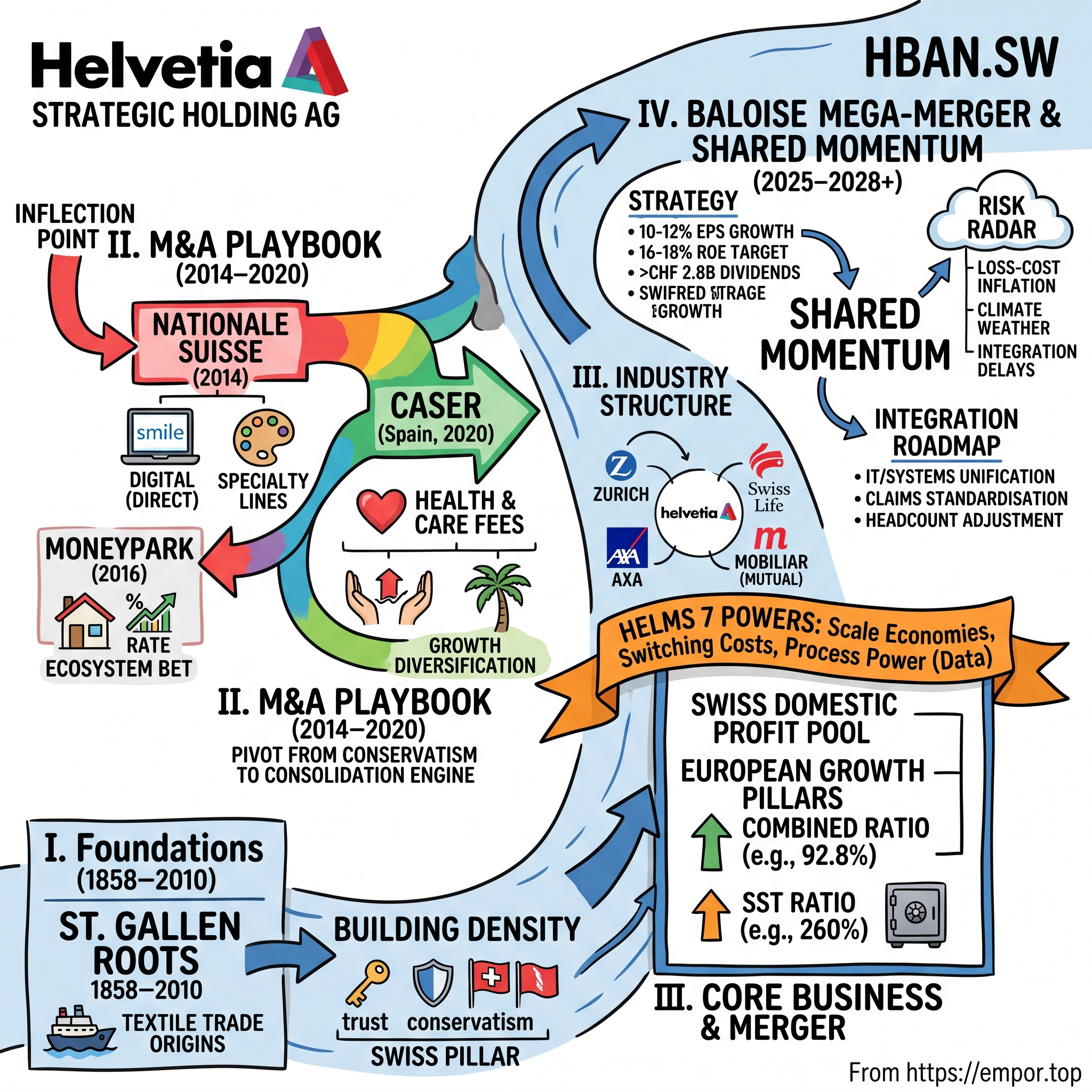
The core thesis management wants you to believe is a tidy one: that a disciplined, 167-year-old insurer has repeatedly used targeted M&A — Nationale Suisse in 2014, MoneyPark in 2016, Caser in Spain in 2020, and now the Baloise combination — to lift underwriting margins, diversify into higher-return fee income, and manufacture a dependable dividend compounder. Every piece of that claim is testable, and this episode will test it.
Consider the numbers management leads with. The combined group is targeting a property-and-casualty combined ratio — the single most important gauge of underwriting profitability — of around 92.8% on a pro-forma basis, down from the mid-90s.[^2] It carries a Swiss Solvency Test ratio of roughly 260% at the group level, with the legacy Helvetia entity standing near 320% on its own.[^2] And under a three-year plan branded "Shared Momentum," it has committed to 10%–12% annual growth in underlying earnings per share, a 16%–18% underlying return on adjusted equity, and more than CHF 2.8 billion in cumulative dividends across 2026–2028.[^2] Those are ambitious, specific, falsifiable targets. Whether they survive contact with catastrophe seasons, integration friction, and a slow-melting block of guaranteed Swiss life liabilities is the whole game.
There is a useful analogy for what an insurer actually is, and it is worth planting early because the whole investment case hangs on it. An insurance company is a bank that runs in reverse. A bank takes your deposit and promises to give it back on demand; it makes money by lending that deposit out at a higher rate. An insurer takes your premium and promises to pay only if something bad happens; it makes money in two ways — by collecting more in premiums than it eventually pays in claims, and by investing the pile of money it holds in the meantime, the so-called "float." The genius and the danger of the model are the same: the insurer is paid today for a promise it may not have to honour for decades, which means an insurer can look wildly profitable for years while quietly accumulating liabilities that only reveal themselves later. This is why conservatism, reserving discipline, and capital strength are not boring accounting footnotes in insurance — they are the entire ballgame. Keep that reversed-bank picture in mind; almost every judgment in this story flows from it.
Here is the roadmap. We start with the founding and the long, slow build into a Swiss pillar. We walk through the two decades of M&A that reshaped the company, treating each deal not as a press release but as a capital-allocation decision with winners and losers. We meet the current leadership — Group CEO Fabian Rupprecht and Chairman Thomas von Planta — and ask whether their track record earns the market's trust. We map the industry structure and the competitors circling Helvetia: Zurich, Swiss Life, AXA Switzerland, and the mutual insurer Die Mobiliar. We dissect the Baloise merger and the Shared Momentum strategy. We size the hidden growth drivers against their true economic weight. And we close with the strategic frameworks, the risk radar, and an explicit bull-versus-bear ledger anchored on the handful of numbers that actually decide the outcome.
One methodological note before we begin, because it shapes everything that follows. This is a story told from the outside, by people who owe the company nothing. Where management makes a claim — that its underwriting is disciplined, that its synergies are on track, that its moat is durable — we will treat that claim as a hypothesis to be checked against evidence, not as a fact to be repeated. Sometimes the evidence backs management up. Sometimes it does not. The point of the exercise is to know the difference. Let's begin where the company began — in a town better known for lace than for underwriting.
 Subscribe on LinkedIn
II. Foundation & Early History: St. Gallen Roots to Swiss Pillar (1858–2010)
Picture St. Gallen in the 1850s. The town sat at the heart of a booming embroidery and textile trade, its merchants shipping cloth across Europe and beyond at a moment when the railways were still being laid and the Suez Canal was more than a decade from opening. Goods moved by cart, by barge, by ship — and every one of those journeys carried the risk of loss. Into that gap stepped a group of eastern Swiss businessmen who, in 1858, chartered the Allgemeine Versicherungs-Gesellschaft Helvetia, the first company in Switzerland to insure risks of transport by land, river, and sea.[^12]
It is worth pausing on how modern that was. Marine and transport insurance was, at the time, one of the most sophisticated corners of finance — a business of assessing routes, cargoes, weather, and counterparties, and pricing all of it into a premium. Getting it wrong meant ruin: a single lost ship could wipe out a year of premiums if the underwriter had priced the risk carelessly or concentrated too much of the book on one route. The founders of Helvetia were not selling a commodity; they were selling a promise backed by capital and by the judgment to price uncertainty. That DNA — underwriting as a craft of disciplined risk assessment rather than a race to the cheapest price — is the through-line management still invokes 167 years later, and it is fair to note that a founding myth is not the same thing as a present-day moat.
The choice of St. Gallen was no accident. The town was the beating heart of a global textile trade, and textiles meant logistics — bales of embroidery and cloth crossing borders, loaded onto barges down the Rhine and onto ships at northern ports, exposed at every leg to fire, theft, storm, and shipwreck. Where there is trade, there is risk; where there is risk that merchants cannot bear alone, there is demand for someone to pool it. Helvetia was, in effect, a piece of financial infrastructure that the textile economy needed in order to function. That origin — insurance as the silent enabler of commerce rather than a product sold for its own sake — is a useful frame for understanding why insurers embed themselves so deeply into an economy that they become almost impossible to dislodge.
Why did Switzerland, of all places, become a global nucleus of insurance? The answer is not sentiment; it is structure. Switzerland offered the raw ingredients that insurance capital craves: durable political stability, a hard currency in the Swiss franc, deep pools of domestic savings, and — critically — a culture and later a regulatory regime that prized solvency above growth. An insurer is, at bottom, a balance sheet that collects premiums today and pays claims for decades. In a country whose entire economic identity was built on being a safe place to store value, insurers could raise capital cheaply, retain policyholders for lifetimes, and compound quietly. The same forces that made Zurich and Geneva banking capitals made Switzerland fertile ground for insurers.
There is a second, subtler advantage that is easy to miss. Switzerland's neutrality and its distance from the great continental wars of the 20th century meant that its financial institutions were never expropriated, never nationalised, never forced to rebuild from rubble. While German and French insurers had their reserves consumed by inflation, currency collapse, and reconstruction across two world wars, Swiss insurers kept compounding through the entire period. That uninterrupted continuity is itself a competitive moat of a kind — the ability to make hundred-year promises credibly because the institution has demonstrably kept its promises for over a century. Trust, in insurance, is not a marketing slogan; it is the product. And trust is precisely the asset that accrues to the survivors and cannot be manufactured quickly by a newcomer with capital.
Helvetia spent its first century doing the unglamorous work of building density. It knit together an agency network across the country's linguistic patchwork — the German-speaking north and east, French-speaking Romandy, and Italian-speaking Ticino — an underappreciated feat, because it meant selling trust in three languages and three regional cultures inside one small country. It pushed early into neighbouring European markets: Germany, Italy, Austria, and eventually Spain. And over the decades it consolidated a series of Swiss and European carriers into what became the Helvetia Group, transitioning from a cluster of specialist and regional insurers into a diversified, publicly listed holding company on the SIX Swiss Exchange.[^12]
The strategic posture through all of this was conservatism bordering on the austere. Low equity gearing. Long-dated policyholder protection. Strict Swiss statutory accounting that tended to understate rather than flatter. For a long-term investor this cuts both ways. Conservatism is why Helvetia survived world wars, currency shocks, and financial crises that vaporised flashier competitors — the compounding power of simply not blowing up. But conservatism is also why Helvetia, for most of its history, was a solid, sleepy, mid-tier insurer rather than a European champion. It did not lose; it also did not dominate.
That equilibrium — safe, profitable, unremarkable — held roughly until the 2010s. But two forces were quietly closing the vise. The first was demographics and market saturation: a small, wealthy, already fully insured country offers precious little organic growth, because almost everyone who can be insured already is. The second, and more corrosive, was the collapse in interest rates that followed the 2008 financial crisis and persisted for the better part of a decade. For an insurer — a reversed bank that lives on the return it earns from its float — near-zero and even negative interest rates were an existential slow-drip. The investment income that had padded returns for decades thinned out, and the legacy life policies written years earlier, promising customers guaranteed returns of two or three percent, turned from profit centres into millstones the moment the bonds backing them could no longer earn those rates.
A generation of Helvetia's management concluded that standing still in that environment was itself the riskiest option. If organic growth at home was capped and investment income was structurally impaired, the only remaining levers were consolidation — buying scale to spread fixed costs — and geographic expansion into markets with better growth and less punishing rate dynamics. That strategic conclusion is the hinge on which the entire modern story turns. It is also where the risk profile of the company fundamentally changed, because it moved Helvetia from the relatively safe business of underwriting risks it understood into the far more dangerous business of buying other companies. Which brings us to the two decades of dealmaking that turned a sleepy pillar into a consolidation engine — and to the first big test of whether Helvetia's vaunted underwriting discipline would extend to capital allocation.
III. The M&A Playbook: Inflection Points of the Last Two Decades
Every insurer says it is a disciplined acquirer. Almost none of them are, because insurance M&A is a graveyard of destroyed value: hidden reserve deficiencies, culture clashes, overpaid premiums justified by "synergies" that never materialise. So the fair way to judge Helvetia is not by what it said at each deal announcement, but by what the deals did to the business over the following five and ten years. Three transactions define the modern company.
Inflection Point 1: Nationale Suisse and smile (2014)
In the summer of 2014, Helvetia moved on a rival that had been circling the same Swiss customers for over a century. On July 7, 2014, it announced an agreed takeover of Basel-based Nationale Suisse in a transaction valuing the target at roughly CHF 1.8 billion — about USD 2 billion.1 The offer was structured as CHF 80 per Nationale Suisse share, delivered as CHF 52 in cash plus 0.068 of a new Helvetia share for each target share — a mix that let Helvetia pay up while sharing some of the integration risk with the sellers.1 The combination created what was then Switzerland's third-largest insurer, with projected premium volume around CHF 9 billion and targeted annual cost savings of roughly CHF 100–120 million.1
The strategic logic was consolidation, but the more interesting prizes were the specialty capabilities and one small digital jewel. Nationale Suisse brought high-margin niche underwriting — art, marine, and engineering risks — the kind of specialist lines where pricing skill, not scale, drives returns. And it brought smile, Switzerland's leading direct online insurer, a business that sold motor and household cover straight to consumers over the internet with almost no agent commission.4 In 2014, owning a native digital insurer looked prescient; it gave Helvetia a low-cost distribution channel and a laboratory for direct-to-consumer insurance long before "insurtech" became a buzzword.
What does the evidence say about execution? Helvetia paid roughly book value rather than a frothy premium, and the targeted cost synergies were the kind of concrete, near-term overhead reductions — duplicate systems, overlapping headquarters functions — that acquirers can actually deliver, as opposed to speculative revenue synergies that rarely show up. There is an important tell in the deal structure itself: by paying part of the price in Helvetia stock rather than all cash, Helvetia forced Nationale Suisse's own shareholders to keep skin in the game. If the integration went badly and the combined company's shares fell, the sellers would bear part of that pain alongside the buyer. That is the behaviour of a disciplined acquirer wary of the winner's curse, not a management team desperate to plant a flag.
The strategic subtlety worth dwelling on is that Nationale Suisse was not really a growth acquisition; it was a consolidation acquisition, and the two are governed by completely different economics. A growth deal is a bet on the target's future — you pay up for revenue you hope will materialise. A consolidation deal is a bet on your own ability to cut costs — you pay for a customer base you already understand and then eliminate the duplication between two similar firms operating in the same market. Consolidation deals are, empirically, far more likely to create value, because the synergies are within the acquirer's control rather than dependent on the market cooperating. That the deal did not blow up, and that smile and the specialty lines remain identifiable contributors more than a decade later, supports the narrative that Helvetia can integrate a domestic peer without destroying it. That is a real, if modest, data point in management's favour. It does not, by itself, prove the firm can integrate something the size of Baloise — a deal roughly its own size rather than a fraction of it — but it is the closest historical analogue the bulls can point to.
Inflection Point 2: The MoneyPark Ecosystem Bet (2016)
Two years later, Helvetia tried something more speculative. In 2016 it acquired a 70% stake in MoneyPark, Switzerland's largest independent mortgage broker, for around CHF 107 million.2 This was not an insurance deal at all. It was a bet on ecosystems — the then-fashionable idea that an insurer could own the customer's entire "home" journey, from finding a mortgage to insuring the property to servicing the household, and mine that funnel for cross-selling leads.
On paper it was clever. A person shopping for a mortgage is, almost by definition, about to need home insurance, life cover, and a pension conversation. Own the mortgage-advice moment and you own the introduction. By 2019, Helvetia and MoneyPark were pooling their sales capabilities to widen the group's mortgage and advice offering.2
The reality check arrived with the interest-rate cycle. Mortgage brokerage is a volume business tethered to origination activity, and when rates rose sharply in 2022–2023, refinancing and new-mortgage volumes across the market cooled. A platform whose economics depend on transaction flow suddenly looked far more cyclical than the stable insurance cash flows Helvetia was built on. Worse, the cross-selling thesis — that mortgage customers would convert neatly into insurance customers — turned out to be far harder to prove in practice than in a strategy deck. Cross-selling across product lines is one of the most over-promised and under-delivered ideas in all of financial services; customers stubbornly refuse to buy their mortgage, their car insurance, and their pension from the same brand simply because a spreadsheet says they should.
The episode is a useful corrective to the "disciplined operator" story, and it deserves to sit in the ledger next to the successes. Buying a distribution platform whose fortunes swing with the macro rate cycle imported precisely the kind of volatility that insurance underwriting is specifically designed to avoid. It was a reminder that "ecosystem" strategies can be a polite word for adjacency risk, and that even a careful acquirer can misjudge how much of a target's value is really just leverage to a rate cycle it does not control. The charitable reading is that MoneyPark was a small, cheap option — roughly CHF 107 million is a rounding error against a CHF 20 billion group — and that buying optionality on a new distribution model is a reasonable use of a modest sum even if it does not pay off.2 The less charitable reading is that it revealed a recurring pattern in Helvetia's dealmaking: the firm is at its best buying boring, cash-generative insurance businesses it understands, and at its most fallible when it reaches for a fashionable strategic narrative about platforms and ecosystems. Hold that pattern in mind; it is the single most useful lens for judging the far larger bets that followed.
Inflection Point 3: Caser and the Spanish Pivot (2020)
The boldest move came in the teeth of the pandemic. On June 26, 2020, Helvetia completed the acquisition of a 69.4% majority stake in the Spanish insurer Caja de Seguros Reunidos — Caser — for approximately EUR 800 million, financing two-thirds through a hybrid bond and one-third through new shares.[^5] By business volume, it was the largest acquisition in Helvetia's entire history and an explicit decision to build Europe into a genuine second pillar alongside the Swiss home market.[^5]
The strategic reasoning was sharper than it first appears. Switzerland's insurance profit pool is heavily weighted toward life insurance products carrying long-dated guarantees — promises to pay a fixed return that become painfully expensive when interest rates are low. Caser offered a way to redeploy capital away from those capital-hungry guarantees and into Spanish non-life property-and-casualty, plus something unusual: a "Health & Care" ecosystem of nursing homes, senior residences, and clinics that generates recurring service fees rather than underwriting risk.3 In other words, Helvetia was buying both a growth market and a stream of fee income structurally decoupled from the insurance cycle.
The financing structure also tells you something about how Helvetia thinks about its balance sheet. Rather than draining capital or over-relying on debt, it split the roughly EUR 800 million bill two ways — two-thirds funded by a hybrid bond, one-third by issuing new shares.[^5] Hybrid bonds occupy a clever middle ground: rating agencies and regulators treat them as partly equity-like capital, so the structure let Helvetia fund a large deal without either gutting its solvency ratio or flooding the market with new stock and heavily diluting existing shareholders. It was, in short, financed the way a solvency-conscious Swiss insurer would finance something — protecting the fortress balance sheet even while spending big.
Here the evidence on the deal itself has been more favourable. Acquired at a valuation in the low-teens on earnings, Caser expanded Helvetia's non-life premium base and diversified its fee income outside the German-speaking core, and Spanish non-life has been a demonstrably attractive market with better growth characteristics than saturated Switzerland. There is genuine strategic elegance in the trade Helvetia was making: it was rotating capital out of the low-return, guarantee-heavy Swiss life business — the millstone the low-rate era had created — and into higher-return Spanish property-and-casualty plus a stream of demographic-driven care fees. That is textbook capital reallocation, moving money from where it earns poorly to where it earns better.
The read-through for capital allocation is now clear enough to state as a rule. Helvetia's best deals have been the ones where it bought durable, cash-generative businesses it understood at sensible prices — Nationale Suisse and Caser — protecting its balance sheet in the process. Its shakier bets have been the ones chasing a strategic story about platforms and ecosystems, like MoneyPark. That distinction matters enormously for how one should judge the Baloise merger, which is far larger and far harder than anything that came before — a genuine merger of equals rather than a bolt-on, and therefore both the greatest opportunity and the greatest execution risk in the company's modern history. But before we get to that megadeal, we need to meet the people now responsible for making it pay.
IV. Current Management, Governance, & Leadership Execution
When Fabian Rupprecht walked into Helvetia's headquarters as Group CEO on October 1, 2023, he inherited a company at an inflection point and a legacy he had not created.[^6] He is a German-Swiss dual national with a 28-year insurance career spent largely outside Switzerland — a deliberate contrast to the insular, homegrown executives who traditionally ran Swiss insurers. Before Helvetia he had run International Insurance and sat on the Management Board at the Dutch NN Group, and before that he had spent years at AXA, including as CEO of the Middle East and Africa region and CFO for emerging markets and the Mediterranean.[^6] That résumé matters, because it is the résumé of a portfolio operator and capital optimiser, not a lifelong domestic underwriter.
He succeeded Philipp Gmür, a Swiss lawyer who had spent three decades at Helvetia and led it as Group CEO from 2016, departing at the end of 2022 after an era defined by expansion — Caser most of all.[^6] The contrast between the two men is almost archetypal of a certain corporate life cycle. Gmür was the consummate insider: a lawyer who had joined in 1993, risen through the Swiss home market, and embodied the institution's culture and continuity. He was the right leader for an era of ambition and acquisition, when the company needed someone who could rally a proud Swiss firm behind the audacious idea of buying its way into Spain.
Rupprecht is the deliberate opposite: an outsider, a career international operator, hired precisely because he was not steeped in Helvetia's traditions. Boards reach for that profile at a specific moment — when a company has finished its acquisitive growth phase and now needs someone willing to make unsentimental decisions about integration, cost, and portfolio focus that an insider, bound by loyalties and legacy, might flinch from. His years running international businesses at AXA and NN Group are the résumé of a portfolio manager who thinks in terms of return on capital by geography and line of business, not of a homegrown underwriter defending the old ways.[^6] His mandate, as management frames it, is a pivot from expansion to execution — technical underwriting rigour, operational integration, and digital modernisation rather than the next flag on the map. Whether that framing survives is itself a question, given that within eighteen months the "no more flags" CEO found himself planting the biggest flag of all.
Then came the deal that dwarfed his mandate. Within eighteen months of his arrival, Rupprecht found himself steering not a tidy modernisation program but the integration of a near-equal, Baloise, into a combined group with roughly 22,000 employees serving around 13 million customers.[^1] Overseeing him sits Chairman Thomas von Planta, who was elected to chair the merged Helvetia Baloise Holding.[^1] The governance question a skeptical investor should ask is blunt: does a board reconstituted to balance two merging institutions retain the spine to hold management accountable to specific targets, or does it become a coalition managing a delicate cultural truce? The answer will show up over the next three years in whether the board enforces the plan or dilutes it.
On paper, incentives are pointed in the right direction, and the choice of metrics is itself revealing. Management compensation and the group's public commitments are tied to underlying return on adjusted equity, targeted at 16%–18%, and to underlying EPS growth of 10%–12% a year.[^2] The distinction between these and softer targets matters more than it might seem. A management team can grow revenue, premiums, or assets simply by buying more companies or writing more policies at inadequate prices — activity that looks like progress but destroys value if the returns do not clear the cost of capital. Return on equity and per-share earnings growth are much harder to game, because they are denominated by the capital and share count deployed to produce them. Tying pay to those measures is a way of forcing management to answer the only question that matters for a serial acquirer after a decade of buying things: is the enlarged company actually earning more on each franc of shareholder capital than it did before? An investor should still watch the fine print — how "underlying" and "adjusted" are defined can quietly flatter the numbers, and adjusted figures that strip out the very restructuring and integration costs the strategy incurs deserve scrutiny — but the choice of yardstick is the right one.
The real test of any management team, though, is behaviour over time, and here Helvetia's leaders deserve a measure of credit for specificity. They have not hidden behind vague ambition. They put hard numbers on the merger: a target of roughly CHF 350 million in annual pre-tax merger synergies, rising to around CHF 650 million once broader efficiency measures are included, with about CHF 139 million of run-rate synergies — roughly a fifth of the total — already booked by the end of 2025, and 90% expected to be realised by the end of 2028.[^2] They were equally explicit about the human cost, guiding to a reduction of 2,000 to 2,600 full-time positions by 2028, of which more than 1,100 had already been actioned by the first quarter of 2026, to be managed through natural turnover and Swiss social-partnership arrangements rather than blunt layoffs.[^2]
Stating a headcount-reduction number publicly, in a country with strong social-partnership norms, is a form of accountability: it is a promise you can be held to. Whether the evolution from the old "Helvetia 2025" plan into the post-merger "Shared Momentum" strategy represents genuine continuity or a convenient rebranding is something we can only judge against delivery. For now, the honest verdict is that this is a credible, appropriately experienced team that has set falsifiable targets — which is the necessary precondition for trust, not proof of it. To assess whether those targets are achievable, we have to understand the machine they are running.
V. Core Business Room: Industry Structure, Segments, & Economics
Strip away the corporate storytelling and an insurer is two businesses stapled together. The first is underwriting: collect premiums, pay claims, and try to keep the second reliably smaller than the first. The second is investing: take the "float" — premiums held before claims come due — and earn a return on it. Helvetia Baloise runs both across a handful of segments, and the mix of those segments explains almost everything about where its profits come from and how volatile they are.
The centre of gravity is Switzerland. The Swiss segment is the group's primary earnings engine — comfortably the majority of its economic value — built on market-leading positions in motor, property, casualty, and commercial pension products. This is the profit pool that funds everything else, and it is attractive for an unglamorous reason: the Swiss market is concentrated, highly regulated, and expensive to enter, which keeps price competition rational and loss experience predictable. Decades of proprietary Swiss claims data let Helvetia price local risks with a precision a new entrant simply cannot match.
The second pillar is Europe — principally Spain, Germany, Italy, and Austria — where Caser anchors the non-life volume and the Spanish Health & Care ecosystem supplies fee income.3 Europe is the growth story and the diversifier; it dilutes Helvetia's dependence on a single small home market and adds businesses whose returns are not correlated to Swiss catastrophe seasons or Swiss interest rates. And wrapped around both is a Specialty Markets segment — active reinsurance, marine, art, and engineering risks — the inheritance from Nationale Suisse, where the edge is niche pricing expertise rather than distribution scale.
Now the competitive terrain, which is best understood as a war fought on multiple fronts against opponents wielding very different weapons. Zurich Insurance Group is the global heavyweight — a multinational with a balance sheet, a brand, and a corporate-and-commercial franchise that operate on a scale Helvetia Baloise cannot match; against Zurich, the merged group competes not on size but on local intimacy and focus. AXA Switzerland brings the muscle of a French global giant to the domestic market, a formidable competitor in exactly the motor and property lines that form Helvetia's core. Swiss Life is the specialist that dominates the life-and-pensions arena, a reminder that in the highest-value corner of the market — occupational pensions for a wealthy, ageing population — Helvetia is a strong participant rather than the undisputed leader.
And then there is Die Mobiliar — Schweizerische Mobiliar — the cooperatively owned mutual whose very structure is a strategic problem for everyone else, and which deserves special attention because it distorts the competitive economics of the entire market. A mutual is owned by its policyholders rather than by outside shareholders, which changes its incentives at the root. It does not need to extract a profit margin to satisfy a stock market; it can return surpluses to members as premium rebates, price patiently through soft markets, and take a genuinely long-term view because no quarterly earnings call is waiting to punish it. The result is ferocious customer loyalty and a brand that consistently tops Swiss trust and satisfaction rankings. For a listed insurer, competing against a beloved mutual on price is close to un-winnable, because the mutual can always undercut you and call the difference a "rebate" rather than a loss. This is precisely why Helvetia does not try to win on price. Instead it leans on the density of its tied-agent force — the human relationships that make switching feel like effort — on bancassurance partnerships that put insurance products in front of bank customers, on broker relationships in the commercial space, and on the direct digital reach of smile for the price-sensitive online segment.4 It is a strategy of distribution breadth precisely because a strategy of pure price would run straight into Mobiliar's structural advantage.
Which brings us to the metrics that actually matter, and here it is worth slowing down, because the vocabulary of insurance is designed to intimidate. The single most important number is the combined ratio. It is simply the sum of claims paid and expenses incurred, divided by premiums earned. Below 100% means the insurer made money on underwriting alone, before earning a cent on its investments; above 100% means it paid out more than it took in and is relying on investment returns to bail out the underwriting. On a pro-forma combined basis the group reported a combined ratio of 92.8% for 2025 — with legacy Helvetia's non-life ratio improving to 93.1%, a 1.8-point gain, and Baloise's at 92.2%.[^2] Roughly eight francs of underwriting profit for every hundred francs of premium is a genuinely healthy result, and the year-on-year improvement is the clearest evidence that the "technical underwriting discipline" management keeps talking about is showing up in the numbers rather than just the slides.
The second number is solvency. The Swiss Solvency Test, or SST, is FINMA's regulatory yardstick for whether an insurer holds enough capital to survive a severe shock.[^9] A ratio of 100% means an insurer holds exactly the required capital; the group's pro-forma SST of roughly 260% means it holds more than two and a half times that minimum, with legacy Helvetia near 320% standalone.[^2] That is not merely a safety cushion — it is optionality. Excess capital is what funds dividends, absorbs a bad catastrophe year, and pays for acquisitions without a rights issue. It is the balance-sheet fortress that underwrites the entire dividend thesis.
The third stream is fee and commission income — the high-margin, capital-light earnings from asset management, the MoneyPark advice business, and the Spanish healthcare services — money earned without putting the balance sheet at risk on an insurance policy. Why do investors prize this so highly? Because insurance underwriting is inherently lumpy: a single bad hail season or flood can turn a profitable year into a loss, and the market hates that unpredictability. Fee income, by contrast, tends to be steadier and requires far less capital to be set aside against it, which means each franc of fee profit typically deserves a higher valuation than each franc of underwriting profit. A meaningful, growing fee stream is therefore not just diversification; it is a potential re-rating story — a way to make the whole company worth more per franc of earnings. How durable and how large that fee stream really becomes is one of the genuine open questions of the investment case.
Underneath all of this sits the investment engine — the return earned on the float and the shareholders' capital, running to a portfolio of many billions of francs. In a normal insurer this is where a surprisingly large share of profit is quietly made, and it is also where a surprisingly large share of risk quietly hides. The group's investment income rises and falls with interest rates, credit spreads, and — importantly for a Swiss institution — the value of real estate, an asset class Swiss insurers have traditionally held in size. When rates were pinned near zero, this engine sputtered; as rates normalised, it revived, but it also carries the mirror-image danger that a sharp repricing of bonds or property could dent both earnings and the capital base at once. The merger with Baloise is the event that will determine how all three of these engines — underwriting, fees, and investments — combine at scale, so it is where we turn next.
VI. The Helvetia-Baloise Mega-Merger & "Shared Momentum" Strategy
For years, the parlour game in Swiss finance was guessing which of the mid-sized insurers would combine. Helvetia and Baloise were the obvious dance partners — comparable in size, overlapping in geography, both perennially a tier below Zurich, both carrying histories stretching back to the 19th century. In April 2025 the guessing stopped. The two announced a merger of near-equals to create Helvetia Baloise Holding AG, and on December 5, 2025, the deal formally completed, with the combined shares beginning to trade under the ticker HBAN three days later.[^1]
The mechanics tell you it was a merger of equals dressed in the legal clothes of an acquisition. Baloise shareholders exchanged their shares at a ratio of 1:1.0119 for 46,392,407 newly issued Helvetia Baloise shares, lifting the total share count to 99,418,092.[^1] The result, in the company's own words, is the largest multi-line insurer in Switzerland and a leading position across Europe.[^1] The strategic rationale is the oldest one in insurance: scale. In a business where fixed costs — IT platforms, regulatory compliance, claims infrastructure, brand — are enormous and largely duplicated between two similar firms, bolting them together should, in theory, spread those costs across a far larger premium base and lift the return on every franc of capital.
"In theory" is doing real work in that sentence, and this is where an independent read diverges from the press release. Insurance mergers of equals are notoriously treacherous — arguably the single hardest species of deal in all of corporate finance. The phrase "merger of equals" is itself a diplomatic fiction, because two organisations can never truly be equal in the room where decisions get made; someone's IT platform gets kept and someone's gets scrapped, someone's headquarters shrinks, someone's executives are the ones who leave. The polite framing papers over a brutal internal contest for who wins each of a thousand such choices, and the speed and clarity with which those choices get made is the difference between a smooth integration and a multi-year quagmire.
The specific hazards are well known because they have sunk so many deals before. Two of everything — two IT stacks, two actuarial cultures, two sales forces, two sets of proud executives, two head offices in a small country where both are civic institutions — has to become one. The value is entirely in the ruthless elimination of that duplication, and every dimension of it is fraught. Merging core insurance IT systems is notoriously the hardest technical project in financial services, a multi-year undertaking where data gets corrupted, migrations slip, and costs balloon. Merging cultures is harder still, and invisible until it fails: the best underwriters and brokers are precisely the people most able to walk out the door to a competitor during the disruption, taking their client relationships and their pricing judgment with them. Competitors know this, which is why rivals circle a merging firm like sharks, poaching talent and pitching nervous corporate clients during exactly the window when the merged entity is least able to respond. Get the integration right and you unlock hundreds of millions in permanent savings and a genuinely stronger franchise; get it wrong and you spend years distracted, bleed the very talent and customers the deal was meant to consolidate, and end up quietly writing down the synergies you promised.
Management has at least been unusually concrete about the blueprint. The synergy target is roughly CHF 350 million a year in pre-tax merger synergies, climbing to around CHF 650 million with wider efficiency measures, driven by unifying IT systems, standardising claims workflows, and stripping out duplicated corporate overhead.[^2] Crucially, the plan front-loads proof: about CHF 139 million of run-rate synergies — a fifth of the total — were already realised by the end of 2025, with 90% targeted by the end of 2028, and the merger of the two Swiss insurance companies themselves was slated for completion around mid-2026.[^2] The restructuring is being phased, with 2,000 to 2,600 positions to be adjusted by 2028 under Swiss social-partnership standards, and more than 1,100 already actioned by early 2026.[^2] Early, visible synergy capture is exactly what you want to see; it is the difference between a plan and a hope. But the hardest integration work — merging core IT and actuarial systems — is precisely the part that tends to slip, and it is back-end loaded toward 2028.
There is one more structural feature of this deal that a careful investor should register, because it changes the risk calculus relative to Helvetia's earlier acquisitions. Nationale Suisse, MoneyPark, and Caser were all bolt-ons — targets meaningfully smaller than Helvetia, where a failed integration would have been a bruise, not a mortal wound. Baloise is different in kind, not just degree. Combining two firms of comparable size means that if the integration falters, there is no healthy majority to absorb the damage; the problem is the whole company. That is why the Baloise deal is simultaneously the most value-creating and the most dangerous move in Helvetia's history, and why the track record of successful small integrations, reassuring as it is, only partially reduces the uncertainty here. Past success with bolt-ons is evidence of competence, not a guarantee that competence scales to a deal of this magnitude.
The financial commitments wrapped around the merger are branded "Shared Momentum," the group's 2026–2028 strategy, and they are the yardstick against which everything else should be measured. The headline targets: underlying EPS growth of 10%–12% a year, underlying return on adjusted equity of 16%–18%, and cumulative dividends exceeding CHF 2.8 billion over the three years, anchored by a proposed 2025 payout of CHF 7.70 per share.[^2] The group also committed to a dividend per share more than 50% higher in 2029 than in 2025 and to defending a credit rating of at least "A+" for its core entities.[^2] Note what these targets share: they are all returns-on-capital and cash-return metrics, not growth-for-its-own-sake metrics. That framing is a tacit acknowledgement that after a decade of getting bigger, the job now is to make the bigness pay — to convert scale into per-share value rather than merely into a larger balance sheet. It is, in effect, management publicly pre-committing to be judged on efficiency, which is the right thing to promise and the hard thing to deliver. The commitment to defend at least an "A+" credit rating is worth flagging too: for an insurer, the rating is not vanity but raw material, because a strong rating is what lets it win large commercial and corporate mandates whose buyers will not place risk with a weakly rated carrier. Protecting the rating is therefore a constraint on how aggressively the group can lever up or return capital, and a signal that it intends to keep the fortress balance sheet intact through the integration. Whether all of this pays off depends heavily on a set of smaller businesses the merger conveniently spotlights — the hidden drivers.
VII. Hidden & Growth Drivers: Sized to Economic Weight
Every insurance story has its shiny objects — the fast-growing, high-margin, easy-to-love businesses that management loves to showcase and that can, if you are not careful, distract from where the money actually comes from. Helvetia Baloise has three worth understanding, provided we keep them in proportion.
The first is smile, the direct digital insurer inherited from the Nationale Suisse deal.4 Its appeal is structural: by selling motor and household cover straight to consumers online, it sidesteps the agent commissions that eat into traditional insurance margins, giving it a low customer-acquisition cost and a natural home for embedded-insurance partnerships — the model where cover is sold at the point of another purchase, like insuring a car at the dealership or a phone at checkout. In a market where distribution is expensive and increasingly digital, owning a native online insurer is a genuine asset. It is also, in the context of a roughly CHF 20 billion group, small — a promising option, not a profit engine.
The second is the Caser Health & Care ecosystem in Spain: ownership of nursing homes, senior-living residences, and clinics.3 This is the most conceptually interesting piece, because it is barely an insurance business at all. It earns recurring service fees from an ageing population — a demographic tailwind almost independent of underwriting cycles, catastrophe seasons, or interest rates. For an insurer whose earnings are otherwise hostage to hailstorms and bond yields, a stream of fee income tied to Spanish demography is a real diversifier. The risk is the mirror image: running physical care facilities is an operationally intensive, labour-heavy, politically sensitive business quite unlike collecting premiums, and it is not obvious that an insurer is the natural best owner of a chain of nursing homes.
The third is active reinsurance and the specialty lines — marine, art, engineering — where the edge is deep niche expertise and the margins can be attractive precisely because few competitors have the data or the appetite to price such idiosyncratic risks.
This is also the right place to puncture a piece of the consensus narrative — the myth-versus-reality check. The story management and admirers like to tell is that Helvetia Baloise is quietly transforming into a diversified, tech-enabled, fee-driven financial-services platform, with insurance as merely one leg. The reality, on the numbers, is that it remains overwhelmingly a traditional European multi-line insurer whose fortunes are set by underwriting discipline and investment returns, with a promising but still-small tail of digital and fee businesses attached. That is not a criticism — being an excellent traditional insurer is a perfectly good thing to be, and arguably a safer thing than being a mediocre tech platform. But an investor who buys the transformation story at a transformation valuation, when the underlying reality is a well-run insurer, is setting themselves up for disappointment. The honest framing is optionality: these businesses could become material, and it costs relatively little to own the chance that they do, but the base case must be built on the underwriting engine.
Here is the proportionality check management would prefer you skip, stated plainly. All three of these drivers are complements, not the core. The overwhelming majority of Helvetia Baloise's economic value still comes from the deeply traditional business of underwriting motor, property, casualty, and pension risk across Switzerland and Europe. The digital and fee-based businesses offer real optionality and a better growth narrative, but if they were to stumble, the group would be dented, not broken; if the core Swiss non-life engine were to falter, no amount of insurtech or Spanish nursing homes would save it. A sober investor watches the shiny objects for optionality and watches the combined ratio for survival. That distinction — where the durable advantage actually lives — is exactly what the strategic frameworks are built to test.
VIII. Strategic Frameworks: Helmer's 7 Powers & Porter's 5 Forces
It is one thing to say a company has a moat; it is another to name it and pressure-test it. Two frameworks do that work. Hamilton Helmer's 7 Powers asks which specific, durable advantages let a firm sustain returns above its cost of capital. Michael Porter's 5 Forces asks how the surrounding industry structure divides up the profit. Run Helvetia Baloise through both and a nuanced picture emerges — real advantages, but of a particular and somewhat modest kind.
Start with the Powers that genuinely apply. The clearest is scale economies. Insurance is a fixed-cost-heavy business — claims platforms, IT, regulatory and actuarial machinery, national marketing — and spreading those costs across the enlarged Swiss and European footprint is the entire economic thesis of the Baloise merger. If the group can serve more customers off one integrated platform, its per-policy cost falls below what a smaller rival can achieve. This is a real power, but it is also a conditional one: it only exists if the integration actually consolidates the two platforms rather than running them in parallel. The moat is, quite literally, contingent on execution.
The second is switching costs, concentrated in the commercial and group-pension book. A large company does not casually re-tender its occupational pension scheme or its complex commercial property-and-casualty program; those arrangements are administratively embedded, entangled with payroll, HR, and years of claims history, and painful to move. Retail motor insurance switches on a price comparison; a corporate pension mandate does not. That stickiness is a genuine source of pricing power in exactly the segments where it is most valuable.
The third is process power — the accumulated, proprietary advantage of decades of Swiss loss data. Underwriting is ultimately a prediction problem, and the firm with the longest, richest history of local claims can price motor, property, and specialty risk more accurately than a newcomer working from generic tables. This is quiet and hard to replicate, and it is arguably Helvetia's most durable edge. What the group conspicuously lacks is a network effect or a true brand power of the sort that lets a company charge a premium purely on name — in insurance, the "brand" that commands loyalty is more often the mutual Die Mobiliar than any listed carrier.
Now Porter. The threat of new entrants is very low, and this is the industry's single most attractive feature: FINMA's stringent capital and SST requirements, combined with the need for dense distribution and deep local data, make greenfield entry into Swiss insurance almost prohibitively hard.[^9] The bargaining power of buyers splits neatly — modest in retail, where individuals take the standard price, but high in corporate broked lines, where sophisticated buyers and their brokers extract every basis point. The threat of substitutes is low for the compulsory lines: motor liability, building fire cover, and mandatory occupational pensions are legally required, which means a guaranteed demand pool no fintech can wish away. And competitive rivalry is high among the top Swiss players, which is what keeps combined ratios honest and pushes everyone toward digital distribution and fee diversification.
It is worth naming the powers Helvetia Baloise conspicuously does not have, because the absences are as instructive as the presences. It has no counter-positioning — no novel business model that incumbents cannot copy without damaging their own; if anything, it is Mobiliar's mutual structure that counter-positions against the listed players. It has no cornered resource — no exclusive licence, patent, or scarce input that rivals are locked out of. And it has only a weak brand power in the technical sense: Swiss consumers do not pay a premium to be insured specifically by Helvetia the way they might pay up for a luxury good, and to the extent brand loyalty exists in Swiss insurance, the mutual tends to command more of it. The powers Helvetia does hold — scale economies, switching costs, and process power — are all real, but they are of the kind that must be actively maintained through good execution rather than the kind that persist automatically once established.
The synthesis is worth stating plainly, because it resists both the bull's romance and the bear's cynicism. Helvetia Baloise operates in a structurally attractive, hard-to-enter industry, and it holds real if unspectacular advantages — scale, switching costs in its stickiest segments, and superior local data. What it does not have is a dominant, unassailable moat that guarantees outsized returns regardless of execution. Its advantages are the kind you can squander through a botched integration or preserve through a disciplined one. That conditional, execution-dependent character of the moat is the single most important thing to understand about the company, and it is precisely why the risk radar and the analyst scrutiny matter so much.
IX. Financial Stress Test, Risk Radar, & Analyst Q&A Nuances
Imagine the worst plausible year. A brutal European storm season drives a spike in property and motor claims. Repair costs — already elevated by supply-chain and labour inflation — climb further. Swiss commercial real estate, a meaningful slice of the investment portfolio, reprices downward as rates gyrate. And in the middle of all of it, the company is still trying to merge two IT systems and two corporate cultures. That is not a doomsday fantasy; it is a realistic description of how several of Helvetia Baloise's live risks could arrive at once. Stress-testing the story means taking each seriously.
The first is loss-cost inflation. Insurance is uniquely exposed to the price of the things it pays for — car parts, construction materials, medical labour, legal settlements. When those costs rise faster than the premiums written to cover them, the combined ratio deteriorates even if the insurer does nothing wrong operationally. European motor and property lines have felt exactly this pressure from supply-chain and labour cost increases, and the group's ability to push through rate increases fast enough to stay ahead of claims inflation is a live, ongoing contest rather than a solved problem.
The second is integration execution risk, and it is the dominant risk of the current moment. Every franc of the CHF 350 million synergy target assumes the successful merging of Baloise's legacy systems, cultures, and distribution into a coherent whole.[^2] The danger is not a single dramatic failure but a slow one: timelines slipping, key underwriters and brokers defecting to rivals during the disruption, and management attention consumed by internal plumbing while the market moves. The early synergy capture is reassuring; the back-loaded IT integration through 2028 is where the real hazard lives.
The third is asset-side risk — the investment book that generates net investment income. As a large Swiss insurer, the group carries meaningful exposure to Swiss real estate and long-dated bonds, which makes its investment earnings sensitive to commercial-property revaluations and interest-rate shifts. A sharp move in either direction ripples through both reported profit and the SST ratio that underpins the dividend. And layered beneath all of this is the slow bleed of legacy Swiss life contracts written years ago with guaranteed interest rates — obligations that are expensive to service and that run off only gradually, dragging on returns until they finally mature out of the book. There is no dramatic fix for this; it is simply a headwind that the rest of the business must out-earn each year until time solves it.
A fourth risk deserves explicit mention because it is structural and worsening rather than cyclical: climate-driven catastrophe frequency. A property-and-casualty insurer is, in a real sense, short the weather. It has priced its policies on decades of historical loss patterns, and if the underlying climate is shifting those patterns — more frequent and more severe European hail, flood, and windstorm events — then yesterday's pricing models systematically under-charge for tomorrow's risk. The insurer can re-price each year, but it is always looking in the rear-view mirror, and a run of bad seasons can erode margins faster than pricing can catch up. Reinsurance absorbs the tail of the very largest events, but it comes at a rising cost that itself reflects the same trend. This is not a reason to avoid insurers, but it is a reason to treat any single year's combined ratio with humility and to watch the multi-year trend instead. Alongside it sit the quieter modern hazards common to all large financial institutions — cyber and data-privacy risk across two now-merging IT estates, and the ever-present regulatory overhang of operating under FINMA's demanding capital regime, where a change in solvency rules or a supervisory intervention could reshape how much capital the group must hold and therefore how much it can return.[^9]
This is exactly the terrain where earnings calls earn their keep, because prepared remarks and the analyst Q&A tend to reveal very different things. In management's set-piece commentary, the group has leaned into its metric-backed strengths — the concrete rate increases pushed through in non-life, the front-loaded synergy capture, the fortress solvency ratio. Where analysts have pushed back, according to the tenor of the results presentations around the merger, is on the softer and more uncertain claims: the realistic timeline for delivering the full Baloise cost synergies, the resilience of the combined ratio against a genuinely bad natural-catastrophe year, and the drag from the legacy life book.[^2] Management has generally been forthcoming and specific on the underwriting and capital questions, and noticeably more cautious and hedged on the fintech and ecosystem cross-sell timelines — which is itself a useful tell. When executives are precise about the core and vague about the adjacencies, it usually means the core is where the real conviction lies. An investor should weight the confident, quantified claims more heavily than the aspirational ones, and treat the ecosystem narrative as optionality rather than a promise. That balance of the proven and the aspirational is the natural bridge into the closing ledger.
X. Bull vs. Bear Case & Investor Playbook
So where does this leave a long-term investor trying to decide whether Helvetia Baloise wins from here — and what would break the case? Lay the two arguments side by side, because the honest answer is that both are coherent, and which one dominates depends almost entirely on execution over the next three years.
The bull case starts from position. Helvetia Baloise is now the scale leader in a structurally attractive, hard-to-enter Swiss market, with the pricing discipline and distribution density to defend its turf and the process power of decades of local data to price it well. Its balance sheet is a genuine fortress — a pro-forma SST ratio around 260% is far more capital than it needs to survive a severe shock, which converts directly into dividend security and acquisition optionality.[^2] Its combined ratio is already healthy and improving, evidence that the underwriting discipline is real.[^2] Its expanding fee income — from Spanish healthcare, asset management, and digital distribution — offers a path to smoothing the underwriting cycle. And it is returning enormous capital: more than CHF 2.8 billion of cumulative dividends targeted across 2026–2028, a payout that on the current share price implies one of the more generous dividend yields in European insurance.[^2] If the Baloise synergies land as planned, the group compounds book value and dividends at a double-digit clip, and the stock behaves like the dependable Swiss cash machine the bulls describe.
The bear case attacks the same facts from the other side. The entire thesis rests on integration going right, and insurance mergers of equals have a long history of going wrong — synergies delayed, talent lost, customers poached, management distracted, and the promised savings quietly written down years later. The CHF 350 million synergy number is a target, not an achievement, and the hardest part — the core IT and actuarial system migrations — sits at the back end, toward 2028, precisely where large programs tend to slip.[^2] Even if integration succeeds, a bad European catastrophe year could erode the very underwriting margins the story depends on, and climate-driven weather volatility only raises that risk. And beneath the surface, the slow runoff of capital-intensive legacy Swiss life guarantees will keep dragging on returns for years.
Now put an activist hat on and go looking for pressure points, because the discipline of imagining the most hostile credible critique is the best test of any long thesis. The first line of attack would be portfolio complexity and the "diworsification" charge: a Swiss insurer that also runs a chain of Spanish nursing homes and clinics, a mortgage-broking platform, and an active reinsurance book invites the pointed question of whether these pieces genuinely belong under one roof, or whether a focused pure-play insurer would command a higher valuation with the distractions stripped out and sold. Conglomerate structures in financial services frequently trade at a discount for exactly this reason, and a sharp-elbowed investor would demand the company prove that each non-core asset earns its place rather than merely occupying management's attention. The second line of attack is disclosure and the "underlying" adjustments: any time earnings are reported on an adjusted basis that conveniently excludes the restructuring and integration costs the strategy is actively incurring, a skeptic is entitled to ask what the unadjusted, all-in return on capital really looks like, and whether the headline targets flatter reality. The third is capital allocation discipline itself: a firm that has just spent a decade on an acquisition spree, and has promised to henceforth prioritise returns and dividends, has to prove the promise by actually returning capital and resisting the next shiny deal — the credibility gap between "we will be disciplined now" and a track record of serial buying is real, and only delivery closes it.
The bear, crucially, does not need the company to fail. The bear only needs execution to be merely average, in which case a fully valued stock delivers ordinary returns while carrying above-ordinary integration risk — a poor trade even if nothing dramatic goes wrong. That asymmetry, more than any single catastrophe scenario, is the sharpest version of the case against.
Run the frameworks back through this lens and the verdict is deliberately unromantic. Helvetia Baloise is a good business in a good industry with real but conditional advantages, run by a credibly experienced team that has set specific, falsifiable targets. It is not a company with an unassailable moat that wins regardless of what management does; it is a company whose advantages will be either compounded or squandered by how well it executes an unusually hard integration. The bull and bear cases are not really competing predictions — they are the two ends of the same execution spectrum.
Which is why the discipline for following this story is to ignore the noise and watch a small number of numbers that cannot be spun. Three stand above the rest.
The first is the net combined ratio. It is the truest measure of whether the underwriting engine — the actual core of the business — is healthy, and whether the promised discipline survives contact with catastrophe seasons and claims inflation. Sustained performance comfortably below 93% would validate the operational story; a drift back toward and above 95% would signal that either pricing discipline or claims experience is slipping.[^2]
The second is the Swiss Solvency Test ratio. It is the capital buffer that underwrites the entire dividend and optionality thesis. As long as it holds well above the group's internal comfort threshold — management has anchored expectations around a 220% floor — the balance sheet remains a source of strength; a sustained slide toward that floor would be the earliest warning that dividends or growth ambitions are under pressure.[^2]
The third is underlying return on adjusted equity. It is the single cleanest scorecard for whether the whole strategy — the M&A, the merger, the fee diversification, the capital discipline — is actually producing returns on the capital deployed. Progression toward and through the 16%–18% target range would be the hardest possible evidence that Shared Momentum is working; stagnation below it, regardless of how the revenue lines grow, would be the tell that scale did not translate into value.[^2]
Everything else in this story — the 1858 founding, the specialty lines, the Spanish nursing homes, the digital insurer, the merger's soaring language — is context. These three numbers are the verdict, and over the next three years they will settle the argument that management's slides can only assert.
References
-
Helvetia Agrees to Buy Nationale Suisse in $2 Billion Deal — SWI swissinfo.ch, 2014-07-07 ↩↩↩
-
Swiss Insurance Group Helvetia Makes Fintech Moves — Fintech News Switzerland, 2016 ↩↩↩
-
Caser Seguros Official Corporate Site — Caja de Seguros Reunidos, S.A. ↩↩↩
-
Smile Digital Insurance Platform — Smile.direct Switzerland ↩↩↩
 LinkedIn
 WhatsApp
 Reddit
 Hacker News
 Email
Email Kindle
 RSS Feed
 Spotify
 Apple Podcasts
 Amazon Music
 Audible
 YouTube