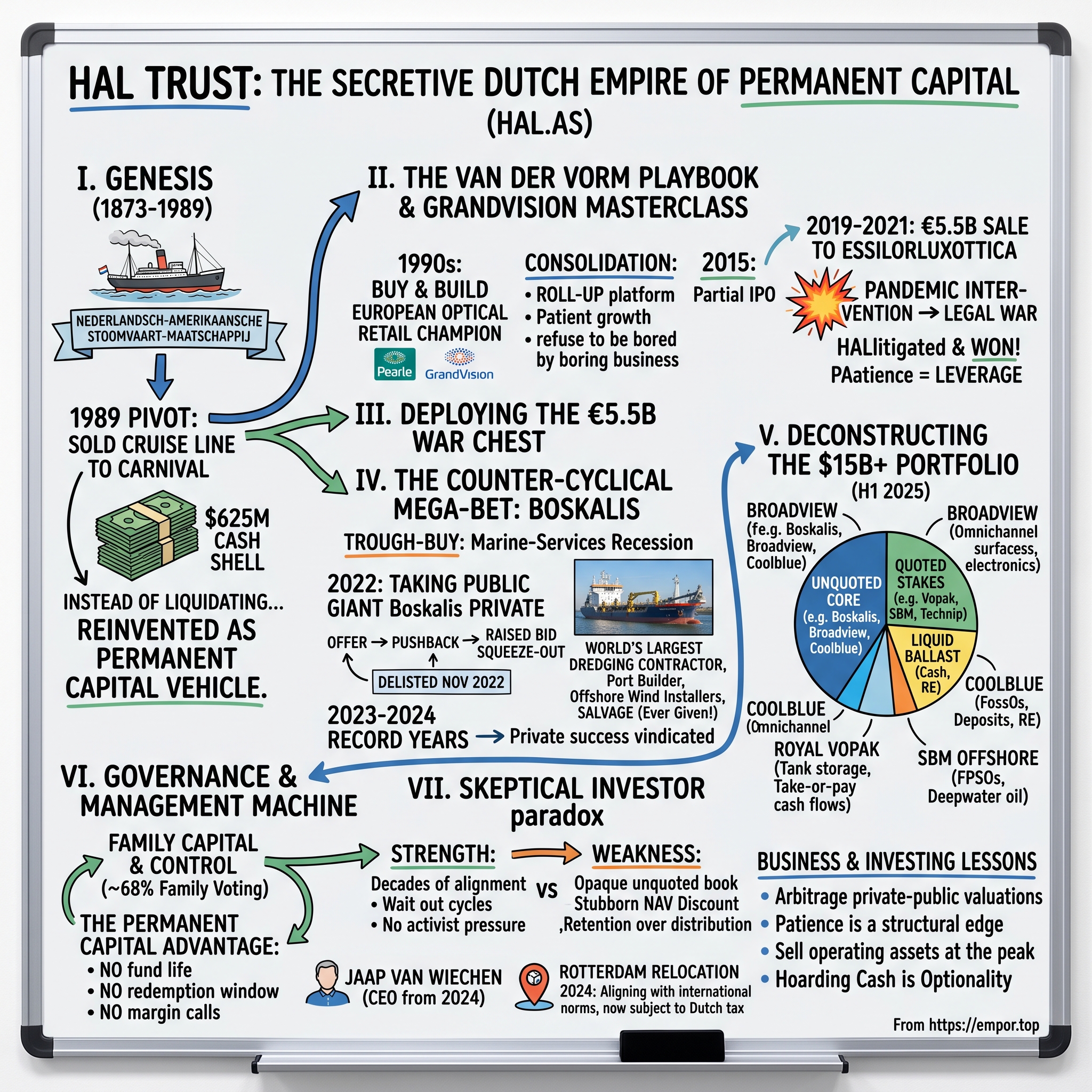
HAL Trust: The Secretive Dutch Empire of Permanent Capital
I. Introduction & Episode Roadmap
Start with the number that frames everything else. At the close of 2025, HAL Trust reported a net asset value of €16.4 billion, or €181.84 per share.1 On the Euronext Amsterdam screen that same NAV traded, in July 2026, at around €165 a share — a market capitalization near €14.9 billion, and a persistent discount to the company's own stated book value.2 Hold both of those facts in your head, because the gap between what HAL says it is worth and what the market will pay for it is the central puzzle of the entire enterprise.
HAL — the letters stand for Holland America Line, the shipping company from which it descends — is an investment holding controlling a portfolio that spans marine construction, tank storage, floating oil production, surface materials, gas shipping, consumer electronics retail, media, and eyewear. Its crown jewel, the dredging and offshore-services giant Royal Boskalis Westminster, it owns outright. Others — Royal Vopak, SBM Offshore, Technip Energies, Safilo — it holds as large listed stakes.3 The whole thing is steered by a controlling family and a lean head office that treats disclosure as a cost to be minimized rather than a virtue to be advertised.
To an American investor, the closest mental model is Berkshire Hathaway crossed with a European family dynasty: a permanent pool of capital, a controlling owner who thinks in decades, a genuine allergy to leverage and to the quarterly ritual, and a willingness to hold cash and wait. But the differences matter as much as the resemblance. HAL is smaller, far more concentrated in cyclical industrial assets, far less communicative, and — crucially — far more dependent on private-company valuations that outsiders cannot independently check. Where Berkshire's holdings are mostly visible and its philosophy is broadcast to the world every spring, HAL's largest single asset is an unlisted dredging company marked on the company's own books, and its philosophy must be inferred from its actions because it will not narrate itself. This is a business that communicates through deeds, not words, and reading it requires watching what it buys and sells rather than listening to what it says.
Several threads run through what follows, and it is worth naming them up front so the story doesn't dissolve into a list of deals.
The first is the ultimate pivot: turning a single asset sale — the cruise line, sold for cash in 1989 — into a multi-decade compounding engine, decoupling the family's fortune from the fate of any one industry.
The second is the GrandVision masterclass: how HAL spent twenty-five years building a European optical-retail champion, agreed to sell it to the world's largest eyewear group for billions, and then had to fight that same buyer through Dutch courts and arbitration when the pandemic gave the buyer cold feet — and won.
The third is the counter-cyclical mega-bet: how HAL used the proceeds to take a public industrial giant, Boskalis, entirely private, buying out minority shareholders at a moment of its own choosing.
The fourth is the permanent-capital advantage: the roughly two-thirds family voting control that frees management from fund-expiry deadlines, activist campaigns, and the tyranny of the quarter — and lets it wait out cycles that would bankrupt a leveraged buyout fund.
And the fifth is the investor paradox: the stubborn discount to net asset value, and the honest question of whether minority holders are being compounded for or quietly captured.
To understand any of it, you have to go back to the water.
 Subscribe on LinkedIn
II. The Genesis: From Ocean Steamships to a $625 Million Cash Shell (1873–1989)
Picture Rotterdam in 1873. The city is a churning port at the mouth of the Rhine delta, and a new steamship venture is being incorporated to run the most emotionally charged trade route of the nineteenth century: the transatlantic passage. The company was christened the Nederlandsch-Amerikaansche Stoomvaart-Maatschappij — the Netherlands-America Steamship Company, or NASM — and it would soon become far better known by the name of the service it operated, the Holland America Line.4 Its ships carried Dutch and Eastern European emigrants westward toward Ellis Island and a new life, and carried cargo and mail back east. The company flag, a distinctive green-white-green banner, still sits at the top of every HAL press release issued today — a small, deliberate act of corporate memory by an organization that otherwise says almost nothing.
For most of a century, this was simply a shipping business, and a cyclical, capital-hungry one at that. In its heyday around the turn of the twentieth century, the line was one of the great conveyor belts of the age of migration, moving hundreds of thousands of Europeans toward America in steerage while carrying a thinner, more profitable stream of first-class passengers and mail above them. It was a business exquisitely exposed to forces entirely outside its control: immigration quotas, war, economic depression, and the price of coal. When the United States clamped down on mass immigration in the 1920s, the ships that had been built to carry emigrants had to find new work, and the line began the slow drift from transport toward tourism that would take another forty years to complete.
Two world wars savaged its fleet and its trade — vessels requisitioned, sunk, or interned, routes closed, and the company forced to rebuild almost from scratch more than once. Anyone studying HAL's temperament today should sit with that history for a moment, because it explains something about the institutional psychology that followed. This was an organization that had learned, in the hardest possible way, that a business concentrated in a single physical asset class exposed to war, cycle, and disruption is perpetually one shock away from ruin. The instinct to diversify, to hold cash, to never again be a hostage to one industry's fate, was earned across a century of very real losses.
Then came the disruption that eventually kills every point-to-point ocean carrier of passengers: the jet airplane. By the 1960s a family in Rotterdam bound for New York flew; they did not spend a week at sea. The economics were brutal and one-directional — an aircraft crossed the Atlantic in hours what a liner crossed in days, at a fraction of the cost per passenger. Holland America Line did what the survivors of that disruption did — it pivoted from transportation to leisure, reinventing the transatlantic crossing as the leisurely, discretionary pleasure of the cruise vacation. The ship was no longer a way to get somewhere; it was the destination.
Somewhere in this long maritime story, the Van der Vorm family established the dominant voting position that would define everything after. They were shipping people who had accumulated control over the enterprise, and by the late 1980s they faced a decision that would look, in hindsight, like one of the great pieces of timing in European business. The cruise industry was consolidating into an arms race. Winning meant ordering ever-larger, ever-more-expensive megaships and marketing them globally against emerging giants. That was a game for operators with enormous fleets and enormous balance sheets — and it was precisely the kind of capital-devouring, single-industry commitment a prudent family owner might not want to make with its entire net worth.
So in 1989 they sold. Holland America Line — the cruise operations, the fleet, the brand, the very name — went to Micky Arison's Carnival Corporation, the ascendant Miami-based cruise powerhouse.4 The reported consideration was in the neighborhood of US$625 million, though contemporary accounts cited figures in Dutch guilders that don't map cleanly onto a single dollar number, so the precise sum is best treated as "around $625 million" rather than a hard figure.4 What matters is not the exact digits but the choice that followed them.
Here is the fork in the road, and it is the most important decision in this entire history. A family that sells its operating business for a large pile of cash has two obvious options: distribute the money to the owners and wind the company down, or reinvest it. Most do the former. The Van der Vorms did the latter — and, crucially, they did it inside a permanent, listed vehicle rather than a private family office. They kept the listing on the Amsterdam exchange, kept outside minority shareholders along for the ride, and set a new mandate: take the cruise-sale proceeds and reinvest them in controlling stakes in medium-sized, mostly unquoted European businesses, alongside a handful of strategic listed industrial holdings.
They built the corporate plumbing to match the ambition. The listed entity became HAL Trust, whose units traded on Euronext Amsterdam; HAL Trust in turn owned HAL Holding N.V., the actual investment company, which for decades was registered in Curaçao and administered from a small office carrying a Monaco address.5 The offshore structure was tax-efficient and low-profile — two qualities the family evidently prized. And the mandate was, in its essence, permanent: no fund life, no redemption window, no obligation ever to sell anything.
That permanence is easy to state and hard to appreciate. It meant HAL could buy an asset and hold it for twenty-five years. It meant HAL could sit on a mountain of cash for years, earning nothing, waiting for a downturn to hand it a bargain. It meant HAL never faced a margin call, a limited-partner revolt, or a redemption run. The cruise line had been a single physical asset exposed to a single industry's cycle; the cash shell that replaced it was a blank canvas. What the family painted on it over the next three decades is the rest of this story — and the first great demonstration of the method was an unglamorous business most investors never think about: selling eyeglasses.
III. The Van der Vorm Playbook & The GrandVision Masterclass (1989–2021)
In the early 1990s, if you wanted to understand how HAL thought, you would not have looked at shipping or heavy industry. You would have looked at the optician on the corner. European optical retail in that era was a gloriously unsexy, wildly fragmented market: thousands of independent opticians, low consumer trust, opaque pricing, and — the detail that made the whole thing interesting — structurally high gross margins and beautifully recurring revenue. People's eyes deteriorate on a schedule. Prescriptions expire. Frames go out of fashion. A well-run optical chain is, in effect, a subscription business wearing a retail disguise.
Why is optical retail such a good business once someone imposes scale on it? Consider the unit economics. A pair of prescription spectacles carries a gross margin most retailers would kill for — the frames and lenses cost a fraction of the retail price, and the value the customer pays for is a blend of correction, convenience, and fashion rather than raw materials. The eye exam that precedes the sale builds a relationship and a health record that a pure e-commerce player struggles to replicate. Demand is non-discretionary and recurring on a biological clock. And the market, before consolidation, was a patchwork of independent shops with no purchasing power, no brand, and no data. Put a few thousand of those shops under one roof and you gain buying leverage over lens manufacturers, a recognizable brand that lowers customer-acquisition cost, and a data engine that tells you exactly when each customer is due for a new prescription. The whole is worth vastly more than the sum of the corner shops.
HAL saw this and executed one of the great buy-and-build campaigns in modern European retail. It acquired the Dutch optician chain Pearle, used it as a consolidation platform, and spent two decades rolling up opticians across the continent — chain by chain, country by country — folding them into an entity that eventually took the name GrandVision. This was the "HAL operating system" in its purest form: identify a fragmented niche with good underlying economics, buy the leader, fund a patient roll-up, professionalize operations, and let time and scale do the compounding. There is no financial wizardry here — no leverage magic, no accounting sleight of hand — just a very long holding period, a willingness to keep writing checks for tuck-in acquisitions year after year, and a refusal to be bored by a boring business. That last quality is rarer than it sounds; most investors lack the temperament to spend twenty-five years patiently compounding a chain of opticians when flashier opportunities beckon every quarter.
The harvest came in stages. In February 2015, after roughly two decades of building, HAL floated GrandVision N.V. on Euronext Amsterdam. The initial public offering was priced at €20.00 per share, HAL's subsidiary sold roughly a fifth of the company into the market, and HAL retained a commanding majority — a stake that would later be pinned at 76.72%.6 The IPO did two things at once: it crystallized a public valuation for an asset HAL had built in private, and it kept control firmly in HAL's hands. A partial exit, not a surrender. Classic.
The full exit is where the story turns into a thriller.
The €5.5 billion deal — and the buyer's remorse
The buyer's identity mattered enormously to why this deal happened at all. EssilorLuxottica was the product of the 2018 merger of France's Essilor, the world's largest lens maker, and Italy's Luxottica, the world's largest frame maker and owner of Ray-Ban and Oakley — a combination assembled by the late Leonardo Del Vecchio, an orphan turned billionaire who had built Luxottica from a small Italian workshop into a vertically integrated eyewear empire. For a company that already dominated the manufacturing of lenses and frames, GrandVision offered the missing link: retail distribution, thousands of storefronts through which to sell its own products directly to consumers. This was vertical integration on a grand scale, and it was precisely GrandVision's value as the largest independent optical retailer in Europe that made it both strategically irresistible and, once acquired, a source of competitive anxiety for rival opticians. HAL, in other words, had built the one asset its natural buyer most needed to complete its empire — which is exactly why it could command a premium price.
On July 31, 2019, HAL agreed to sell its entire 76.72% stake in GrandVision to EssilorLuxottica at €28.00 per share.[^7] The agreement carried a small kicker: if the deal took more than twelve months to close, the price would step up by 1.5%, to €28.42.[^7] The value attributed to HAL's majority stake was roughly €5.5 billion, one of the largest private-equity-style realizations Europe had seen.7 For a business HAL had assembled optician by optician, it was a spectacular payday-in-waiting.
Then the world shut down.
By the spring of 2020, COVID-19 lockdowns had closed thousands of GrandVision stores across Europe. And EssilorLuxottica — having agreed in the sunlit summer of 2019 to pay a premium price — discovered, in the manner of many an acquirer staring at a suddenly cheaper world, reasons to be unhappy. The buyer alleged that GrandVision had mismanaged the business during the pandemic in breach of the deal's covenants: cutting payments to suppliers, seeking rent relief, drawing on credit lines. In July 2020, EssilorLuxottica went to the Rotterdam District Court seeking information about how GrandVision had run itself through the crisis, and HAL and GrandVision responded by launching arbitration to force the buyer to honor the deal.[^9] What had been a friendly transaction became legal trench warfare.
This is the moment the permanent-capital philosophy earned its keep. A leveraged buyout fund with a fixed life and nervous limited partners might have blinked — might have renegotiated the price down, or settled, to get the cash in the door before its clock ran out. HAL, answerable to no such clock, simply refused to yield. It litigated.
The rulings went HAL's way. On September 2, 2020, the Dutch court dismissed EssilorLuxottica's central information claims, and the arbitration and appeals that followed likewise failed to give the buyer an exit.[^9] European Commission merger clearance arrived in March 2021.[^10] Cornered, EssilorLuxottica completed the purchase on July 1, 2021 — at the stepped-up price of €28.42 per share, because more than twelve months had passed.8 HAL had not merely held the line; the delay the buyer caused had increased the price it ultimately paid.
The lesson embedded here is not that HAL is a brilliant litigator. It is that patience, when it is structurally guaranteed rather than merely intended, is itself a bargaining chip. A counterparty that knows you cannot be forced to sell, cannot be waited out, and does not fear your own clock, negotiates from weakness. HAL turned the absence of pressure into leverage. Whether the proceeds were then deployed as shrewdly as they were extracted is a separate question — and it takes us straight to the biggest check HAL ever wrote.
IV. Deploying the €5.5 Billion War Chest: The Privatization of Boskalis (2021–2023)
Cash is a wonderful thing to have and a terrible thing to hold. By 2021, HAL was sitting on billions in proceeds in a European environment of zero and negative interest rates — a balance sheet stuffed with liquidity that earned nothing and dragged down the return on the whole enterprise. Permanent capital solves the problem of forced selling; it does nothing to solve the problem of what to do with a war chest when the world is expensive. The pressure on HAL was not the pressure to sell but the harder, quieter pressure to deploy well.
The target it chose was one it already knew intimately. Royal Boskalis Westminster is a Dutch marine-services champion: the world's largest dredging contractor, a builder of ports and artificial coastlines, an installer of the foundations and cables that anchor offshore wind farms, and — through its SMIT Salvage arm — one of the handful of firms on earth that can rescue a stricken ship. In March 2021, Boskalis had a very public moment of glory when SMIT helped refloat the container ship Ever Given, which had wedged itself across the Suez Canal and throttled roughly a tenth of global trade for the better part of a week.[^12] That is the sort of capability that cannot be improvised; it rests on custom vessels and accumulated expertise that take decades and hundreds of millions to build.
It is worth dwelling on what Boskalis actually does, because the businesses HAL prizes tend to be the ones ordinary investors find hardest to picture. Dredging, the company's core, is the industrial art of moving vast quantities of sand and silt from the seabed — to deepen shipping channels so ever-larger vessels can reach port, to reclaim new land from shallow water (much of the modern Netherlands, and a good deal of Singapore and Dubai, exists because someone dredged it into being), and to defend coastlines against the encroaching sea. It is elemental, unglamorous, and utterly essential, and it is performed by ships that are themselves marvels of engineering: trailing suction hopper dredgers that vacuum the seabed and store the spoil in their own hulls, and cutter dredgers that grind through rock and hard clay. Alongside the dredging sits a portfolio of offshore-energy services — installing the foundations, cables, and heavy structures of offshore oil, gas, and wind — and the salvage-and-towage arm that produced the Ever Given rescue.
HAL had held a large minority position in Boskalis for years, watching it grind through the brutal 2015–2020 downturn in offshore oil and gas that hammered marine-services demand. That downturn is the crucial context for the buyout's timing. When the oil price collapsed after 2014, energy majors slashed offshore spending, and the specialized vessels that serve them — Boskalis's included — suddenly had too little work and too much capacity. Day rates fell, contracts dried up, and the marine-services sector spent five years in a grinding recession that crushed valuations across the industry. A patient owner watching that unfold would have reached an obvious conclusion: the cycle would turn, the offshore-wind buildout would eventually demand exactly these vessels, and the moment of maximum pessimism was the moment to buy. By early 2022, HAL owned roughly 46% of the company and decided it wanted the rest.[^13]
The offer, the pushback, and the squeeze-out
On March 10, 2022, HAL announced an intended voluntary cash offer for all Boskalis shares it did not already own, at €32.50 per share — a premium of about 28% to the prior day's close.[^13] (After Boskalis paid a €0.50 dividend that May, the headline offer was restated as €32.00 on a cum-dividend basis, which is why some accounts cite €32 and others €32.50; both describe the same economics.[^13]) The move was quintessential HAL: pounce on a deeply cyclical, capital-intensive, cash-generative business at a point when public markets were still discounting the memory of its downturn.
Boskalis's independent directors were not simply going to wave it through. They argued the price failed to capture the value of a recovering dredging market and a swelling pipeline of offshore-wind work. The standoff resolved in the way these things usually do when a determined controlling buyer wants an asset: HAL raised its bid. On August 29, 2022, it lifted the offer to €33.00 per share cum-dividend — economically €33.50 including the dividend already paid, a premium of roughly 32% to the pre-offer price — and Boskalis's board unanimously recommended it.[^14] The equity value implied for the whole company was in the region of €4.2 billion.[^13]
From there the machine ground toward totality. HAL declared the offer unconditional on September 7, 2022, and by the final tally on September 20 it held 98.3% of Boskalis.[^14][^15] With that supermajority in hand, HAL delisted Boskalis from Euronext Amsterdam effective November 9, 2022 — ending a stock-market listing that had run for more than half a century — and moved to a statutory buy-out to sweep up the last minority holders and take the company to 100%.[^16]
The strategic symmetry is almost too neat. HAL sold a public consumer-retail asset, GrandVision, near a cyclical and valuation peak, and recycled the cash into 100% ownership of a cyclical industrial asset near a trough. That is the core of the HAL method stated as baldly as possible: harvest the richly valued, accumulate the cheaply valued, and use the permanence of the balance sheet to bridge the gap in time between the two.
And the trough thesis was quickly vindicated by the assets themselves. As a private company under HAL, Boskalis went on a tear: 2023 was a record year, with EBITDA above €1 billion and net profit around €600 million, and 2024 delivered revenue of roughly €4.4 billion, EBITDA that Boskalis headlined at €1.3 billion, and net profit of €781 million.[^17] Whether HAL timed the bottom by genius or by luck is unknowable; that it bought a business about to print record numbers is not. The prize is now the anchor of the entire portfolio — which is where we turn next.
V. Deconstructing the $15B Portfolio: Segments, Scale, and Core Drivers
If you could open the hood of HAL and look at the engine, you would see three chambers. The largest, by far, is the collection of unquoted companies HAL controls outright or nearly so — the private operating businesses that generate real cash and that HAL values internally. The second is a book of large stakes in publicly listed companies, marked to market every day on the exchange. The third is a ballast of real estate and liquid assets — cash, deposits, and property — that provides both stability and dry powder. The unquoted chamber is the biggest and the least transparent; the quoted chamber is the most visible; the liquid chamber is the option value. Together they add up to that €16.4 billion NAV.1
Let us walk the private businesses first, because they are where HAL's identity lives.
The unquoted core
Boskalis is the anchor engine, now wholly owned, and we have already met it. Its moat is physical and financial at once: a fleet of purpose-built vessels — trailing suction hopper dredgers, mega cutters, fallpipe and cable-lay ships — that cost hundreds of millions of euros each and take years to commission. You do not enter this business by writing a business plan; you enter it by ordering ships from a shipyard with a multi-year backlog and then proving, over decades, that you can execute complex marine projects without catastrophic cost overruns. That is a barrier to entry measured in capital and reputation, and it explains why the world's mega-dredging work is shared among only a handful of players.
Broadview Holding, roughly 97.4% owned, is HAL's hidden materials giant, and few consumers realize how often they touch its products.9 Broadview is a buy-and-build vehicle in high-pressure laminate — the durable decorative surfaces that clad kitchen counters, office façades, laboratory benches, and washroom partitions — and it owns a wall of brands you have probably seen without registering: Trespa, Arpa, FENIX, Homapal, and Westag among them.10 The transformational move came in June 2019, when Broadview bought Formica — the very company whose name became a generic term for the laminate itself — from New Zealand's Fletcher Building for roughly $840 million.9 That acquisition vaulted Broadview into the top tier of the global surfaces industry, with the scale in procurement and distribution that consolidation is supposed to deliver. (One footnote on the record: the laminate maker FunderMax, sometimes attributed to Broadview, is a separate Austrian company and is not part of the group.10)
Coolblue, about 56.4% owned, is the most contemporary business in the stable and, in some ways, the most impressive.11 It is a Dutch-born omnichannel electronics retailer operating in the Netherlands, Belgium, and Germany, with revenue of roughly €2.56 billion, and it has done something genuinely difficult: competed against Amazon and won meaningful loyalty by out-servicing it.11 Coolblue's edge is not price; it is the experience — its own delivery vans and installation crews, obsessive customer service, and physical stores that function as showrooms rather than warehouses. In a category where Amazon's scale is supposed to be decisive, Coolblue's persistence is a live test of whether service and locality can hold a moat against a hyperscaler. The evidence so far — continued share and revenue growth in its core markets — suggests it can, at least in a small, dense, high-service geography. Whether that translates to the much larger German market is the open question, and worth watching.
Anthony Veder and FD Mediagroep round out the private book. Anthony Veder — and here the popular description needs correcting, because HAL owns about 62.9% of it, not the whole thing — is a specialized gas-shipping company running a fleet of tankers that carry liquefied gases.12 FD Mediagroep, fully owned, is the leading Dutch business-media group, publisher of Het Financieele Dagblad and operator of the radio station BNR Nieuwsradio.13 There is a quiet irony in a company famous for saying nothing to investors owning the country's premier financial newspaper; HAL keeps FD editorially independent, and the arrangement is best read as a portfolio holding, not a mouthpiece.
The quoted stakes
The listed side of the portfolio reads like a map of the European energy-and-infrastructure transition. HAL holds about 51.4% of Royal Vopak, the world's largest independent tank-storage operator, whose terminals store oil, chemicals, gases, and increasingly the feedstocks of a lower-carbon economy under long-term, take-or-pay contracts — infrastructure-grade cash flows of exactly the kind a permanent owner covets.3 It holds roughly 23.4% of SBM Offshore, a world leader in the giant floating production vessels (FPSOs) that develop deepwater oil fields off Brazil and Guyana; about 17.1% of Technip Energies, an engineering house at the center of LNG, carbon capture, and hydrogen projects; and about 49.8% of Safilo, the Italian eyewear manufacturer — a residual thread from HAL's long history in optical.3 A smaller stake of around 15% in the German silicon-wafer maker Siltronic sits alongside them.14
Each of these deserves a sentence on why HAL holds it. Vopak is, in essence, a toll road for liquids: it owns the tanks through which oil, chemicals, and gases must pass on their journey through the global supply chain, and it rents that capacity under multi-year contracts that pay whether or not the customer actually uses the space — the "take-or-pay" structure that makes the cash flows resemble a utility more than a commodity play. SBM Offshore builds and leases FPSOs, the floating factories the length of several football fields that sit above deepwater oil fields, process the crude as it comes up, store it, and offload it to tankers — assets so expensive and specialized that the contracts to operate them stretch across decades. Technip Energies is the engineering brain behind large energy-infrastructure projects, increasingly positioned at the intersection of the old economy (LNG) and the new (carbon capture, hydrogen). Safilo is the odd one out, a manufacturing business in an industry HAL knows intimately from its GrandVision years, and a reminder that not every position in the book is a strategic masterstroke — some are simply legacies HAL has chosen not to exit.
What ties the quoted book together is not a sector but a temperament: large, often influential minority or majority positions in capital-intensive, infrastructure-flavored businesses, held for the long haul rather than traded. The daily mark-to-market on these names is what makes HAL's NAV visibly move; it is also, as we will see, part of why the market struggles to price the whole.
The liquid ballast
The third chamber is the least discussed and, in a sense, the most strategically important: the cash, deposits, real estate, and other liquid assets that sit on HAL's balance sheet earning modest returns. To a conventional analyst obsessed with return on equity, idle cash looks like a drag — capital that could be working harder. To HAL, it is the loaded gun in the drawer. The willingness to hold liquidity for years, accepting the near-term cost, is what allows the group to move decisively when a Boskalis-scale opportunity appears at a Boskalis-scale discount. This is a genuine philosophical divide in investing: whether cash is dead weight to be minimized or optionality to be preserved. HAL has planted its flag firmly on the second side, and the Boskalis buyout is the clearest vindication of that choice. The cost of holding the cash for years was real; the payoff, buying a record-breaking business at a trough, was larger.
The portfolio, then, is coherent in method even where it is eclectic in sector: control or near-control, capital intensity, cash generation, and time. But a portfolio is only as good as the people allocating it — and at HAL, that has always meant a very small number of people, most of them named Van der Vorm.
VI. The Governance & Management Machine: Jaap van Wiechen, Family Capital, and Secrecy
To grasp how HAL is run, imagine the opposite of a modern listed company. There is no investor-relations department staging quarterly theater, no earnings call where a CEO fields analyst questions, no glossy capital-markets day. Investor communication consists of an annual report, a half-year report, and terse press releases, most of them announcing that a deal has been done rather than explaining why. The head office employs fewer than twenty investment professionals. This is deliberate, and it is a competitive statement as much as a cultural one: HAL believes that talking less and holding longer beats the disclosure-and-guidance machine that governs its peers.
Consider what this silence actually buys. A company that never issues quarterly guidance can never miss it, and so can never be whipsawed by the market's punishment of a short-term shortfall into decisions that damage long-term value. A management team that never hosts an earnings call spends none of its energy managing a narrative and all of it managing the businesses. And an organization that refuses to explain its next move gives competitors nothing to anticipate. There is a real edge in opacity for a buyer of assets — HAL's counterparties often do not know what it is thinking until the tender offer lands. But the same opacity has a cost, and it is borne almost entirely by minority shareholders, who must value more than half of HAL's NAV on faith in internal marks they cannot audit. The discretion that protects the strategy is the same discretion that widens the discount. You cannot have one without the other, and HAL has decided which side of that trade it prefers.
It is worth pausing to separate myth from reality here, because HAL attracts a good deal of both. The myth is that HAL is a kind of impenetrable black box, a secretive family fund that tells outsiders nothing. The reality is more prosaic: HAL discloses roughly what the law requires — audited annual and half-year accounts, holding-by-holding NAV components, major transactions — and simply declines to do the voluntary performance theater that dominates modern investor relations. It is not that HAL hides the numbers; it is that HAL refuses to sell them. A second myth is that the family's control means minorities are being fleeced. The reality, on the evidence of decades of NAV per share compounding and consistently paid dividends, is that the family has behaved as a rational long-term compounder whose interests have largely coincided with those of outside holders. The risk is not that this has gone wrong; it is that nothing structural would stop it from going wrong if the family's disposition ever changed.
The people
For decades the presiding intelligence was Martijn van der Vorm. He chaired HAL's board of management for twenty-one years, until 2014, and then served as chairman of the supervisory board until May 2025 — roughly four decades at or near the top of the enterprise.15 He was, by all accounts, the architect of the modern HAL: the quantitative, patient, unsentimental capital-allocation culture that turned a cruise-sale windfall into a €16 billion machine. He was also famously private, living reclusively — for years in Monaco — and shunning the public stage even as he directed one of the Netherlands' great fortunes. He died in April 2026, at the age of 67, an event that closed a chapter on the founder-operator era of HAL's second life.15 For investors, his passing sharpens a question that hangs over every family-led compounder: how much of the track record was the system, and how much was the man?
Day-to-day leadership now sits with Jaap van Wiechen, who became chairman of HAL's executive board — functionally the CEO — on April 1, 2024, having served on the board since 2014.5 He succeeded Melchert (Mel) Groot, who had chaired the executive board since 2014 and spent some thirty-five years with the organization before retiring on March 31, 2024.5 The handover is notable for its continuity: this is an internal succession of long-tenured insiders, not a break. Van Wiechen was not parachuted in to shake things up; he was raised inside the house over a decade at the table where the Boskalis and GrandVision decisions were taken. The culture is being passed down within the walls, which is either reassuring evidence of institutional durability or a warning that the group's insularity is being perpetuated, depending on your priors. What an investor cannot yet judge — and should watch closely — is whether the new generation of leadership will match the capital-allocation discipline of the Martijn van der Vorm era, or whether the absence of the founder-operator who set the standard will, over time, loosen it. A permanent-capital vehicle is ultimately only as good as the judgment of the small group entrusted with the permanence.
The Rotterdam relocation
In a rare structural change, HAL announced in November 2023 that it would move its place of effective management from Curaçao to the Netherlands, with a head office in Rotterdam, effective April 1, 2024.5 The consequences were not cosmetic. From that date HAL Holding became subject to Dutch corporate income tax, and its dividends became subject to 15% Dutch dividend withholding tax — a meaningful shift for a company that had long operated through a low-tax offshore structure.5 Management framed it as aligning the group with international tax norms and with the location of its principal European assets. An investor might reasonably read it as a pragmatic accommodation to a world that has grown far less tolerant of offshore holding structures — and as a mild headwind to after-tax returns that HAL evidently judged unavoidable.
The family and the alignment question
Underpinning all of it is control. The Van der Vorm family is reported to command roughly 68% of HAL Trust through family-connected entities, with a further block long associated with the heirs of the late industrialist Hans Melchers, leaving a free float of only around 15%.16 That concentration is the source of HAL's greatest strength and its most-debated weakness in a single fact. On the strength side, it delivers near-perfect alignment on the metric that matters — long-run NAV per share — and immunizes management from the short-termism, activism, and fund-life pressures that distort the behavior of nearly everyone else in capital markets. The family's wealth and the minority's wealth ride in the same vehicle, compounding on the same terms.
On the weakness side, that same control means the ordinary mechanisms of shareholder accountability simply do not function here. There is no plausible hostile takeover, no proxy contest, no board a dissident could realistically win. Minority holders own economics but essentially no governance. Everything therefore rests on the family choosing, indefinitely, to treat outside shareholders as partners rather than as a captive source of permanent capital. So far the record — decades of NAV compounding and steady, if conservative, dividends — supports the benign reading. But it is a reading that depends on trust rather than on rights, and that dependency is the hinge on which the entire investment case swings. It is exactly the kind of structural edge that the strategy frameworks were built to dissect.
VII. Hamilton Helmer 7 Powers & Porter's 5 Forces Analysis
Strip away the maritime romance and the family mystique, and ask the analyst's cold question: where, precisely, does HAL's advantage come from, and is it durable or merely inherited? Two frameworks — Hamilton Helmer's 7 Powers and Michael Porter's Five Forces — are useful scalpels, provided we use them to test the thesis rather than to decorate it.
Helmer's 7 Powers, applied to HAL itself
The dominant power at the holding-company level is best described as a cornered resource: permanent, concentrated family capital. This is not a moat in the usual product sense; it is a structural advantage in the time domain. A private-equity fund lives on a ten-year clock and must return capital to its limited partners. A public company lives on a ninety-day clock and must answer to activists and index funds. HAL lives on no clock at all. That lets it do three things almost no one else can: hold assets through an entire cycle without flinching, sit in cash for years awaiting a dislocation, and execute multi-billion-euro privatizations without a single capital call. The GrandVision litigation and the Boskalis trough-buy were both expressions of this one power. The honest caveat is that a cornered resource of this kind is only as valuable as the judgment deploying it — permanence amplifies good allocation and bad allocation alike.
At the operating-company level, the relevant power is scale economies, and it is real but confined to specific holdings. Boskalis's specialized fleet and Broadview's consolidated surfaces platform each enjoy genuine scale advantages — in Boskalis's case the sheer capital cost of the vessels, in Broadview's the procurement and distribution leverage that came from absorbing Formica. These are defensible positions in their niches. But note the limit: scale economies live in the subsidiaries, not in HAL. HAL does not manufacture anything; it owns companies that do. Its own edge is allocation and permanence, not operating scale.
The third candidate is process power — the repeatable "HAL operating system" of finding fragmented niches, buying the leader, funding a patient roll-up, and holding for fifteen or twenty years. GrandVision was the textbook case. The skeptical view is that process power is the hardest of the seven to prove and the easiest to over-claim: a handful of successful roll-ups over thirty years is a pattern, but it is not obviously a system that will keep producing at €16 billion of scale, where the universe of targets large enough to matter is far smaller than it was when HAL was buying opticians.
Porter's Five Forces, applied to the core asset (Boskalis and marine services)
Because Boskalis anchors the portfolio, the competitive structure of marine services is the structure that matters most.
Threat of new entrants is very low. Shipyard backlogs, the hundreds of millions required per specialized vessel, and the decades of technical track record required to win complex government and offshore-developer contracts together form an almost impassable barrier.
Bargaining power of buyers is moderate. Governments, port authorities, and offshore-wind developers are large, sophisticated customers who can push on price — but for the truly demanding mega-projects, only three or four firms worldwide (Boskalis, Belgium's DEME and Jan De Nul, and the Netherlands' Van Oord) have the capability, which limits how hard buyers can squeeze.
Bargaining power of suppliers is moderate, concentrated in the handful of specialized shipbuilders and marine-engine makers capable of delivering this equipment.
Threat of substitutes is very low. There is no software that deepens a harbor or reclaims land from the sea; the work is irreducibly physical.
Competitive rivalry is moderate. The oligopolistic structure permits reasonably rational bidding among the big players — but "moderate" is doing honest work here, because a downturn in offshore energy, as the 2015–2020 slump showed, can turn a comfortable oligopoly into a margin-destroying scramble for scarce work.
HAL among its peers
HAL is not the only creature of its kind, and placing it beside its cousins sharpens the picture. The family-controlled, permanent-capital holding company is a distinctly European (and Warren Buffett–American) species: Italy's Exor, controlled by the Agnelli family; Sweden's Investor AB, controlled by the Wallenbergs; France's various family holdings; and, across the Atlantic, Berkshire Hathaway itself. All share HAL's core insight — that patient, permanent, concentrated capital under aligned family or founder control can compound value in ways that time-boxed funds and quarter-driven public companies cannot. And all share HAL's central affliction: the holding-company discount, the market's stubborn refusal to pay full price for a diversified pool of assets it cannot itself control or break up.
What distinguishes HAL within this group is the combination of its unusually high proportion of unquoted value and its unusually low tolerance for disclosure. Investor AB and Exor hold largely listed stakes that the market can price daily; HAL keeps more than half its NAV in private companies marked internally, which makes its discount both wider and harder to arbitrage. Berkshire, for all its own reticence, hosts a famous annual meeting and writes a widely read shareholder letter; HAL does neither. The comparison flatters HAL in one respect — its assets are genuinely high quality and its capital-allocation record genuinely good — and indicts it in another: of the major family holding companies, it is among the least communicative and the least accountable to the outside owners who ride alongside it. An investor choosing among these vehicles is really choosing how much opacity they will accept in exchange for how much alignment.
The frameworks converge on a nuanced verdict rather than a triumphant one. HAL's advantages are real and, in the case of its permanent capital, close to unique. But they are advantages of structure and patience, not of untouchable product moats — and they are cyclical at the operating level. Which is exactly the tension a skeptic would press on.
VIII. The Skeptical Investor Stress Test: The NAV Discount & Activist Paradox
Now put on the short-seller's glasses, because the single most persistent fact about HAL is not a triumph but a discount. For years the shares have traded below the value of what HAL owns. On the company's own reported book NAV of €181.84, the July 2026 share price near €165 is a discount of roughly 9%.12 But that understates the phenomenon, because analysts who re-mark HAL's unquoted businesses — Boskalis, Coolblue, Broadview — to estimated fair value rather than conservative book carry argue the true intrinsic value is materially higher, which pushes the effective discount into the 20–35% range depending on the assumptions.17 Either way, the market is paying less than the parts appear to be worth. Why?
Why the discount persists
Three reasons, none of them mysterious.
First, the control lock-in. With roughly two-thirds of the votes held by the family, the classic mechanisms that normally close a holding-company discount — a takeover, a breakup, an activist forcing a sale of the crown jewels — are off the table. The discount cannot be arbitraged away by anyone from the outside, so it need not close.
Second, the opacity of the unquoted book. More than half of HAL's value sits in private companies whose worth rests on internal models and periodic marks, not a live market price. Public investors, unable to independently verify those valuations, rationally demand a margin of safety — a discount — for the uncertainty. The more of your NAV is unobservable, the wider that discount tends to run.
Third, the retention over distribution. HAL runs a deliberately conservative dividend — €3.50 per share proposed on the 2025 result, up from €2.90 on 2024 — and prioritizes hoarding cash for the next mega-deal over returning it to shareholders.1 For an investor who wants cash today, retained capital in the hands of a family that may not deploy it for years is worth less than a euro on the euro.
The activist thought experiment
Imagine an activist somehow accumulated a large HAL stake. The playbook would write itself: spin off or separately list Boskalis and Broadview to surface their value; force a large special dividend from the cash pile; demand quarterly calls and modern disclosure to narrow the information gap. Every one of these would, on paper, attack the discount.
And every one of them would fail — because the family's voting block makes them unenforceable. This is the paradox at the heart of owning HAL: the very control that makes the discount possible also makes it permanent, and it converts the ordinary activist toolkit into a wish list. An investor in HAL must accept, going in, that they are a minority passenger in a family vehicle, entitled to ride but not to steer.
There is a harder edge to this, visible in HAL's own conduct. When HAL bought out the Boskalis minorities, those minority shareholders pushed back hard on the initial price and extracted a raise — a reminder that HAL, on the buying side of a squeeze-out, negotiates as hard as any acquirer and starts low.[^13][^14] A shareholder is entitled to wonder how a company that drives a tough bargain against other companies' minorities regards its own. The benign answer is that decades of NAV compounding and honored dividends speak louder than a single hard-nosed tender. The uncomfortable answer is that minorities have no recourse if that ever changes. Both answers are true at once, and holding them together is the honest posture toward HAL. From there, the question becomes what an investor should actually take away.
IX. Playbook: Business & Investing Lessons from HAL Trust
Step back from the deals and the discount, and HAL resolves into a small set of transferable principles — the operating philosophy of a firm that has thought harder than almost anyone about the relationship between time and capital.
Sell operating assets at the peak to build permanent investment capital. The founding act of modern HAL was the willingness to exit its own heritage business — the cruise line — when the price was right and the capital demands of staying were rising, and to convert a single-industry operating company into a diversified, permanent pool of investable capital. The lesson is not "sell everything"; it is that a fortune concentrated in one aging industry is fragile, and that converting it, at a good price, into optionality is an act of strength, not surrender.
Arbitrage the gap between public and private valuations. HAL's central trade, repeated across decades, is to sell into strength and buy into weakness across the public-private divide. It floated and then sold GrandVision when public markets were paying a rich multiple, and it took Boskalis private when public markets were still punishing a cyclical trough. The discipline is easy to state and brutally hard to execute, because it requires acting against the prevailing mood — selling what everyone loves and buying what everyone fears.
Patience is a competitive advantage, not merely a virtue. Holding GrandVision for a quarter-century, and then refusing to settle through a two-year legal war rather than accept a lower price, unlocked value that a time-constrained fund would have surrendered. When your capital has no expiry date, patience stops being a personality trait and becomes a structural edge you can press against counterparties who lack it.
Keep overhead brutal and incentives aligned to the only number that matters. Running a €16 billion portfolio with fewer than twenty investment professionals means almost none of the value created leaks out as holding-company cost, and tying the culture to long-run NAV per share rather than to assets gathered or fees earned keeps the machine pointed at compounding rather than empire-building. In an industry that monetizes activity, HAL monetizes restraint.
The through-line is that HAL has made constraints other investors resent — no exit deadline, no quarterly audience, no need to grow assets under management — into sources of advantage. That is the bull case in one sentence. The bear case lives in the same sentence read backwards.
X. Analysis, Bull vs. Bear Case, & Key KPIs to Watch
So where does this leave a long-term investor trying to decide whether HAL wins from here — and what would break the case?
The bull case
The bull case begins with asset quality riding structural tailwinds. Full ownership of Boskalis plants HAL squarely in two multi-decade megatrends: climate adaptation, where rising seas mean more dredging, coastal defense, and land reclamation, and the energy transition, where offshore wind means installing thousands of turbine foundations and cables. The listed book — Vopak's storage infrastructure, Technip Energies' role in LNG and hydrogen, SBM's deepwater production — layers on further exposure to the plumbing of the energy system. These are not fads; they are capital-intensive, long-cycle businesses with high barriers to entry, exactly what a permanent owner should want to hold.
It continues with the discount as embedded optionality. Because the shares trade below NAV, any narrowing of that gap — through a large distribution, a value-surfacing listing, or simply improved sentiment toward the unquoted marks — delivers a return independent of the underlying assets compounding. The investor is buying a euro of assets for meaningfully less than a euro, and getting the compounding on top.
And it rests on balance-sheet firepower. HAL's liquidity and its willingness to sit on it mean that when the next dislocation arrives — a distressed European seller, a market crash, a cyclical trough in one of its niches — HAL will be one of the few buyers able to act decisively and without financing conditions. Optionality is worth the most precisely when everyone else is constrained.
The bear case
The bear case starts with the family-discount trap: the possibility that the discount simply never closes, because the control structure, the thin disclosure, and the low payout that cause it are permanent features, not temporary frictions. An investor could be right about the assets and still earn only the compounding, never the re-rating — and pay an opportunity cost for the shortfall.
It deepens with cyclical concentration. For all its diversification across sectors, HAL's portfolio is heavily weighted toward capital-intensive, economically sensitive industries — dredging, offshore energy services, construction materials, silicon wafers. A synchronized global downturn, an energy-price collapse, or a construction slump would hit multiple holdings at once. The 2015–2020 offshore slump is not ancient history; it is a live illustration of how ugly the trough can get.
And it ends with capital-allocation execution risk — the flip side of the cornered-resource power. Permanent capital with no external check magnifies mistakes as surely as it magnifies wins. A war chest deployed into an overpriced unquoted target, or a Boskalis mega-project that suffers serious cost overruns, would compound against shareholders with the same patience that has so far compounded for them. With Martijn van der Vorm gone and the allocation now in successor hands, the market has less of a track record to underwrite the judgment doing the deploying.
A skeptic would add two more items to the current risk radar. The first is the fragility of the very energy-transition thesis the bulls celebrate. The offshore-wind buildout that is supposed to keep Boskalis's vessels busy for decades has itself hit turbulence — soaring equipment and financing costs, project delays, and outright cancellations have battered wind developers in recent years, and Boskalis's order book is only as reliable as its customers' willingness to keep sanctioning projects. A structural tailwind can stall for years even if it eventually blows. The second is the plain cost of the Rotterdam relocation: by moving its effective management onshore, HAL accepted Dutch corporate income tax and a 15% dividend withholding tax it had previously avoided, a permanent haircut to after-tax returns.5 It was likely the prudent response to a world hostile to offshore structures, but prudence is not free, and the drag is now baked in. Neither risk is a thesis-killer on its own; together they are a reminder that even permanence cannot insulate a portfolio from cycles, taxes, and the possibility that a favored megatrend arrives later and messier than promised.
The three KPIs that actually matter
Amid all the moving parts, three metrics tell you whether the machine is still working.
First, NAV per share compound growth, benchmarked against a broad total-return index like the AEX over rolling multi-year windows. This is the scoreboard. HAL exists to grow intrinsic value per share over long periods; if it stops beating a passive index over five-year stretches, the entire premise — that active, permanent, family-led allocation adds value — is in question.
Second, the operating performance of the unquoted core — the revenue growth, margins, and cash conversion at Boskalis, Broadview, and Coolblue, disclosed in the annual report. Because these private businesses are more than half of NAV and are marked by internal models, their real operating results are the ground truth beneath the valuations. Deteriorating margins or weak cash conversion here would be the first sign that the marks are optimistic.
Third, the net cash position and the return on redeployed capital — how much dry powder HAL holds and, crucially, what internal rate of return it earns when it finally spends it. A war chest is only an asset if it is deployed well; watching what HAL buys next, and at what price, is the single best read on whether the capital-allocation engine that made the last thirty years is still firing.
Watch those three, and you are watching the things that will decide whether HAL Trust's next three decades resemble its last — or whether permanence, having been the family's greatest weapon, becomes the minority's quietest trap.
References
-
HAL Trust — Annual results 2025 (NAV €16,418m / €181.84 per share; net income €1,597m; dividend €3.50) — HAL Holding N.V., 2026 ↩↩↩↩
-
HAL Trust (HAL.AS) share price and market capitalization — Financial Modeling Prep / Euronext Amsterdam, 2026-07-24 ↩↩
-
HAL Trust — Report on the first half year 2025 (quoted and unquoted holdings) — HAL Holding N.V., 2025 ↩↩↩
-
Holland America Line — history, NASM founding (1873) and 1989 sale to Carnival Corporation — Wikipedia ↩↩↩
-
HAL Holding N.V. press release — relocation of effective management to the Netherlands (1 April 2024), tax consequences, and Van Wiechen/Groot succession — HAL Holding N.V., 2023-11-23 ↩↩↩↩↩↩
-
GrandVision listed on Euronext Amsterdam (IPO priced at €20.00, Feb 2015) — De Brauw Blackstone Westbroek ↩
-
S&C Advises EssilorLuxottica on €5.5 Billion Majority Investment in GrandVision — Sullivan & Cromwell LLP, 2021-07 ↩
-
EssilorLuxottica acquires HAL's 76.72% interest in GrandVision at €28.42 and announces mandatory public offer — EssilorLuxottica via GlobeNewswire, 2021-07-01 ↩
-
Broadview Holding completes acquisition of Formica Group (~$840 million from Fletcher Building) — PR Newswire, 2019-06 ↩↩
-
Broadview Materials brand portfolio (Trespa, Arpa, Formica, FENIX, Homapal, Westag) — Broadview Materials ↩↩
-
Coolblue — HAL ownership (56.4%) and revenue (~€2.56bn) — HAL Investments ↩↩
-
Anthony Veder — HAL ownership (62.9%) and gas-shipping fleet — HAL Investments ↩
-
FD Mediagroep — HAL ownership (100%); Het Financieele Dagblad and BNR Nieuwsradio — HAL Investments ↩
-
HAL Trust — Report on the first half year 2025 (Siltronic and other quoted stakes) — HAL Holding N.V., 2025 ↩
-
Rotterdam businessman and donor Martijn van der Vorm dies at 67 — DutchNews.nl, 2026-04-29 ↩↩
-
HAL Investments — Van der Vorm family control (~68%) and shareholding structure — Wikipedia ↩
-
HAL Trust H1 results — analysis of discount to estimated intrinsic value versus reported book NAV — Bosinvest, 2025 ↩
 LinkedIn
 WhatsApp
 Reddit
 Hacker News
 Email
Email Kindle
 RSS Feed
 Spotify
 Apple Podcasts
 Amazon Music
 Audible
 YouTube