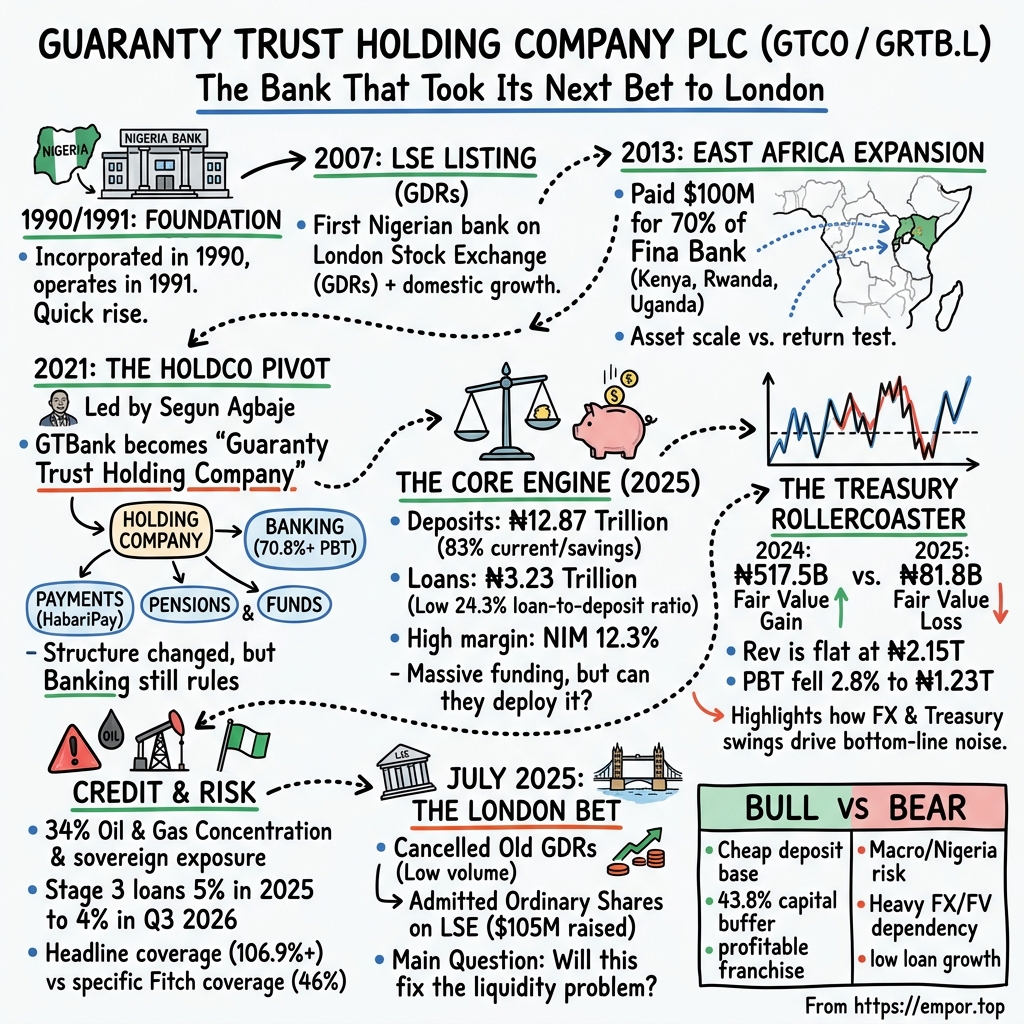
Guaranty Trust Holding Company: The Bank That Took Its Next Bet to London
I. The London Listing That Had to Work
At eight o'clock on the morning of 9 July 2025, London time, a Nigerian bank did something that sounds routine and was anything but. Guaranty Trust Holding Company Plc, the parent of GTBank, had its ordinary shares admitted to the main market of the London Stock Exchange, the same shares that already traded in Lagos, now quoted in a second city.1 To get there it had sold about 2.29 billion new shares and raised $105 million of gross proceeds.1 Group CEO Segun Agbaje called the day "a major milestone" and added a line that would become the test of the whole exercise: "this was not just about raising capital."1
The strange part of the story is that GTBank was not a newcomer to London. It had been the first Nigerian bank on the London Stock Exchange back in 2007, when it raised international money through global depositary receipts, the certificates that let foreign investors hold a claim on shares sitting with a custodian back home.2 For eighteen years those GDRs were the bank's window to global capital. And in the same week that the new ordinary shares arrived, the company gave notice that it was closing that window. Its stated reason was blunt: the GDRs were being cancelled "due to low volumes being traded on the main market of the London Stock Exchange."3 The cancellation was to take effect no later than 31 July 2025.3
So here was the contradiction that opens this story. One of the most profitable banks in Africa, an institution that rating agencies describe as the most profitable lender in Nigeria,4 had a London listing that hardly anyone traded. Its fix was not to leave London but to come back in a different wrapper, swapping a depositary receipt for the real share and selling new stock to do it. The shares launched under the ticker GTHC, with a planned switch to GTCO once the old GDR line was gone.1 The listing sits in the Financial Conduct Authority's category for international commercial companies with a secondary listing, which is regulatory language for a company whose home market remains elsewhere.1
The money matters less than it looks. For a group that reported about ₦1.23 trillion of profit before tax in 2025,5 $105 million was a modest sum, a small fraction of what the bank earns in a single year. What GTCO was really buying was a market: a place where a fund manager in London or New York could buy and sell its ordinary shares in a familiar venue, without wrestling with Nigeria's currency controls every time they wanted out. The new issue was the price of admission. Whether the admission was worth it depends on what happened after the opening bell, on the trading volumes that the old GDRs never generated, and the company does not yet publish a London-only turnover figure that would settle the question.
There are early clues about who showed up. By the end of 2025, Citibank held about 14.4% of GTCO's shares as custodian for the depositary interests that underlie London trading, a holding that carries no beneficial-owner rights of its own but signals how much of the register now sits on the London side of the bridge.6 Custody is not liquidity, though. A share can be held abroad and still barely trade. The rest of the register is just as diffuse: GTCO counted about 510,000 shareholders at the end of 2025, no beneficial owner held more than 5%, and the largest names on the list were Nigerian nominee and pension custodian accounts holding shares on behalf of many investors.6 It is a company owned by the market, which makes the market's ability to trade it all the more important.
This is a story about four questions, and the London listing touches all of them. The first is whether GTCO can grow its profits without the extraordinary treasury and fair-value gains that flattered its record in 2024. The second is whether its businesses outside Nigeria, and outside banking, can ever become more than a rounding error in the profit pool. The third is whether its buffers against bad loans are thick enough for a book concentrated in oil and gas and in the Nigerian state itself. The fourth is the one this scene raises directly: can a Lagos bank build a London market for its shares that actually trades?
It helps to be precise about what is being discussed. Guaranty Trust Holding Company Plc is the listed holding company. It was created in 2021 by reorganising Guaranty Trust Bank Plc, and most of the history in this story belongs to that predecessor bank and the consolidated group around it.7 The holding company now sits above a Nigerian bank, banks across West and East Africa and the United Kingdom, and smaller businesses in payments, funds management and pensions.7
And it helps to know where the money comes from tonight. In 2025, the Nigerian banking subsidiary generated about 71% of group profit before tax, and the banking subsidiaries elsewhere in West Africa added about 28%.8 That leaves a thin sliver for East Africa, Britain and everything that is not a bank. On paper GTCO is a pan-African financial services group with a London listing. In its economics, it is still overwhelmingly a Nigerian bank with some neighbours. The question running through every chapter that follows is whether that is changing, and what it would take to know.
To understand why a bank with this record needed to try twice in London, it is necessary to go back to Lagos at the start of the 1990s, when a group of young professionals decided that Nigeria needed a different kind of bank.
 Subscribe on LinkedIn
II. The Bank Built for a Different Nigeria
In 1990, Nigeria's Federal Executive Council granted a banking licence to a new institution called Guaranty Trust, and the company was incorporated as a limited liability company the same year.2 Its founding team was young by the standards of Nigerian finance, and two names stood at the front: Fola Adeola as the first managing director and Tayo Aderinokun as his deputy.2 The bank opened its doors in February 1991, at a head office its staff came to call "the Plaza."2
The timing was audacious. Nigeria at the start of the 1990s was a country of military government, a falling naira and a banking system crowded with lenders that had sprung up after liberalisation. Many of them were thinly capitalised and closely tied to their owners. GTBank's founders set out to look and behave differently: a bank for corporate customers and professionals, with a reputation for service and a culture built around young, well-trained staff. The company's own history dwells on the small things, such as how quickly the first board meeting followed the licence and the branches that followed in Ikeja, on Lagos's Broad Street and in the northern city of Kano by 1992.2 That year the bank reported a profit of ₦52 million.2
The early arc moved quickly. GTBank became a public limited company in April 1997 and listed its shares on the Nigerian Stock Exchange that September.2 In 2001 it won a universal banking licence and became the first Nigerian-owned bank to report ₦2 billion of profit before tax.2 The next year it opened subsidiaries in The Gambia and Sierra Leone, and in 2005 it won approval to enter Ghana.2 Then came the move that set up this story's opening scene. In 2007 GTBank listed on the London Stock Exchange, the first Nigerian bank to do so, and raised international capital through GDRs; the same year it issued a $350 million Eurobond.2
That access to foreign money mattered more than it might seem, because of what came next. In 2008 and 2009 the Nigerian stock market collapsed by about 70%, and many of the country's banks had to be rescued.9 The central bank injected ₦620 billion of liquidity into the system and replaced the leadership of eight banks.9 Governor Sanusi Lamido Sanusi later laid out what had gone wrong in a lecture in Kano in February 2010. Oil money and foreign inflows had poured into the banks, and too much of it had flowed into the stock market "mostly in the form of margin loans and proprietary trading camouflaged as loans," while "major failures in corporate governance at banks" let the damage spread.9 His examples were lurid. Chief executives had set up special-purpose vehicles to lend depositors' money to themselves; 30% of one bank's share capital had been bought with customer deposits; another bank's chief controlled more than a third of it through vehicles that borrowed customer money.9 Much of the capital raised by the so-called mega banks, Sanusi said, was "fake capital financed from depositors' funds."9
GTBank's leadership came through that purge intact. Aderinokun, who had succeeded Adeola at the top, was still running the bank when he went on medical leave in 2011, and the next change of command came through illness and an internal succession plan rather than a regulator's order.10 That is a meaningful fact in a country where survival itself sorted the strong from the weak. It is also the root of the reputation that still surrounds the institution: a conservatively run, highly profitable lender with a strong corporate franchise. The longer record supports the profitability part. Across the decade to 2020, the group's revenue grew at about 12% a year in naira and its net profit at nearly 18% a year, and return on equity spent most of the 2010s between roughly a quarter and a third.11 Fitch, assessing the group in 2026, said its operating profit had averaged about 15% of risk-weighted assets over the previous four years, which in the agency's view made it the most profitable of all Nigerian banks.4
But a reputation is not the same thing as a moat, and the honest version of this story has to separate the two. A Nigerian bank's profits are shaped by forces that have little to do with how well it serves customers. When the central bank pushes interest rates up, a bank sitting on cheap deposits earns more on its government securities. When the naira collapses, a bank with dollar assets books translation gains. When regulators raise capital requirements, the banks that already have capital look stronger without having done anything new. Some of GTBank's long record of high returns reflects choices it made: an insistence on cheap funding, careful lending and a lean cost base. Some of it reflects being a well-capitalised survivor in a high-rate, devaluing economy. The data that would cleanly separate the two, such as customer retention, pricing relative to rivals and market share by product over time, are not published.
There is also the matter of currency, which turns a naira success story into a more ambiguous one for a foreign shareholder. Measured in naira, the group's equity grew strongly through the 2010s. Measured in dollars, it went the other way for a while: shareholders' equity of about $2.2 billion at the end of 2014 had shrunk to about $1.6 billion by 2018, as successive devaluations ate away at its value.11 That gap between a strong local franchise and a weak currency is the backdrop to everything GTBank later tried to do abroad, including buying a bank in Kenya.
What did the founders build that still gives the company an edge? The best answer the record supports is a culture of profitable, low-cost banking that survived Nigeria's worst crisis with its management intact. The rest of this story tests whether that culture can travel, diversify and keep earning when the macro winds stop blowing at its back. The first test came in East Africa.
III. A $100 Million Ticket into East Africa
In October 2013, word reached the market that GTBank, then described as Nigeria's largest lender by market value, had agreed to pay about $100 million for 70% of Fina Bank, a Kenyan lender with operations in Kenya, Rwanda and Uganda.12 The deal still needed regulators in all four countries to sign off.12 Fina was a modest institution. At the end of March 2013 it had about $184 million of loans and $285 million of customer deposits.12 GTBank's annual report put its total assets at about $338 million and noted that the transaction also included a $30 million capital injection.13
The logic, in management's own words, was about where Africa's growth was heading. Earlier that year Agbaje had told reporters that GTBank was targeting East African nations because of their "appreciable gross domestic product, growing investments and ease of doing business."12 At the time GTBank operated in six countries outside Nigeria, all of them in West Africa or Britain.12 Kenya offered something different: a regional financial hub with a deep mobile-money culture and a gateway into a growing East African trading bloc. Fina, renamed under the Guaranty Trust brand, gave the bank a licence and branches in three markets at once.2
The deal is worth pausing on, because it was the clearest example of the bank buying a footprint rather than building one. Paying about $100 million for 70% implies a value for the whole equity of roughly $143 million. Set against total assets of about $338 million, that is a price of roughly 40 cents for every dollar of the balance sheet. That ratio is tempting to call a cheap or expensive multiple, but it is neither. A bank's price is normally judged against its book equity and its earnings, and the public record of the deal does not give a clean figure for Fina's net assets or profits. The $30 million capital injection further muddies the comparison, because part of the money was going into the bank rather than to the sellers. The honest verdict is that GTBank bought immediate regional access at a price whose cheapness cannot be established from what the company published.
What can be judged is what the platform became. GTBank's acquisition happened in a year when its total profit was large. In 2012, profit excluding discontinued operations had jumped about 69% to ₦87.2 billion, or roughly $541 million.12 East Africa, in other words, was a small bet relative to the parent. And thirteen years later, it remains small. On the full-year 2025 call, management said East Africa accounted for about 0.9% of the group, and when analysts asked about weak results there and in the UK, the answer was that lower yields had hurt and "we will do better in 2026."14 Management also said its focus in East Africa was organic growth rather than more acquisitions.14
That 0.9% is the most revealing number in this chapter. The group's headline diversification looks impressive: about 28% of profit before tax in 2025 came from banks in West Africa outside Nigeria.8 But that figure is about the older West African subsidiaries, in markets such as Ghana, and it is boosted when those countries' currencies hold up better than the naira. It says nothing about whether the Kenyan acquisition created value. On the evidence management itself offered, the acquired East African platform is a footprint without a meaningful profit pool, more than a decade after the cheque was written.
The fairer reading is not that the deal failed outright. The record shows no write-off of the investment in the materials reviewed, and East Africa's small share reflects both a modest starting base and currency moves that shrank its naira value. It may simply have taken longer than expected to build a franchise against entrenched Kenyan rivals. But the original case was about regional earnings, and those earnings have not arrived at a scale that moves the group. So the question the Fina deal leaves hanging is a precise one: how much of GTCO's geographic diversification came from what it bought, and how much from what it built in West Africa and from currency swings? The available evidence points to the second.
The man who signed the Fina deal had, by then, been running the bank for two years. He would go on to reshape its corporate structure entirely.
IV. Segun Agbaje's Bank Becomes a Holding Company
Segun Agbaje did not arrive at the top of GTBank from outside. He joined in 1991 as one of its pioneer staff, after a stint at Ernst & Young in San Francisco, and he held a bachelor's degree and an MBA from the University of San Francisco along with the alumni status of Harvard Business School.10 He became an executive director in January 2000 and deputy managing director in August 2002.10 In April 2011, when Tayo Aderinokun went on medical leave, Agbaje became acting managing director.10 Aderinokun died that year, and on 22 June 2011 the board ratified Agbaje as managing director and chief executive, subject to central bank approval.10 The chairman at the time called him "the natural successor" under the bank's "well defined succession plan."10
That detail matters to investors more than most biography does. In a banking system where the 2009 crisis had exposed founder-led lenders with weak governance, GTBank's succession was internal, orderly and planned. Agbaje has now led the institution for fifteen years, first as CEO of the bank and then as Group CEO of the holding company. That long tenure is both a source of continuity and a reason to judge him by the record rather than by the reputation, which is what the later chapters of this story do.
The defining structural decision of his tenure came in 2021. GTBank reorganised itself so that a new parent, Guaranty Trust Holding Company Plc, sat on top of the bank and alongside new non-bank subsidiaries.7 The reorganisation issued no new shares; existing bank shareholders simply became shareholders of the holding company.7 The company completed the restructuring in 2021, when the holding company became its parent.2
Why bother? Nigerian banking regulation limits what a commercial bank can do directly. A holding company structure lets a group own a pension fund administrator, an asset manager and a payments company as sister businesses, each with its own licence, rather than as awkward appendages of a deposit-taking bank. The strategic pitch was that GTCO would become a broader financial services platform, earning fees from managing savings, processing payments and serving customers digitally, rather than relying on the spread between deposits and loans. The prospectus for the London listing describes exactly that shape: banking, funds management, pensions and payments.7
The payments ambition had an earlier history. In 2018 GTBank launched Habari, a lifestyle and content app with super-app aspirations, and the effort later evolved into HabariPay, the group's payments subsidiary, which runs the Squad payments product.62 The shift from a consumer content app to a merchant payments business is evidence of a strategy that learned and adjusted. It is not, by itself, evidence of a material new profit stream. Launching a product, winning a licence or reporting fast volume growth all count as progress. None of them count as earnings until they show up in segment profits.
So what does the holding company look like in the accounts? The answer is: still a bank. Fitch noted that GTBank, the Nigerian operating bank, accounted for about 95% of group assets at the end of 2025, and that non-interest income was 23% of operating income.4 On the full-year 2025 call, management itself said the non-bank subsidiaries accounted for about 3% of the group's income.14 At the half-year results in 2026, Agbaje described GTCO as "a business that no longer depends on banking alone."15 The numbers do not yet support the strong version of that sentence. Banking supplies almost all the profit; the asset manager, the pension business and HabariPay supply activity, ambition and a small share.
There are signs of traction worth acknowledging. On the half-year call, Agbaje said that about 10% of the bank's deposit base now came through wealth management relationships, and that point-of-sale volumes had risen more than threefold.16 He also said that fee expenses had risen because of the asset management and HabariPay businesses, a reminder that building these platforms costs money before it makes money.16 These are real operating signals. The question is the one any holding-company strategy faces: do the new businesses earn returns that justify the capital, talent and management attention they consume?
That is answerable only over time, and only through segment profit before tax. Counting subsidiaries, licences or app downloads proves nothing. The verdict for now is that the 2021 reorganisation created genuine options, and that the claimed diversification remains small in earnings terms, at about 3% by management's own count. A holding company is a promise. The segments have not yet paid it.
That leaves the obvious next question. If GTCO's profits still come overwhelmingly from banking, what exactly does a Nigerian bank sell, and why has this one been so good at it?
V. What a Nigerian Bank Sells
Picture a trader in Lagos who keeps her working cash in a GTBank current account. She is paid by customers through transfers and card terminals, she pays her suppliers the same way, and at the end of the month a balance sits in her account earning little or nothing. Multiply her by millions of retail customers, add the payroll and collection accounts of large Nigerian companies, and the result is the raw material of a Nigerian bank's profit: a vast pool of money that costs almost nothing to hold.
What the bank does with that money is the whole business. It can lend it to companies and households. It can place it with other banks. Or it can buy government securities, which in Nigeria have often paid double-digit yields. The difference between what the bank earns on those assets and what it pays depositors is the spread, and the spread on a very large, very cheap deposit base is what made GTBank famous. On top of that, the bank charges fees for moving money, issuing cards, processing payments and serving companies. And then there is a third, more volatile layer: trading and fair-value movements on the securities and currencies it holds, which can amplify reported profit in a good year and subtract from it in a bad one.
In 2025 the first two layers worked very well. Interest income rose about 23% to roughly ₦1.65 trillion, and net interest margin, the spread earned on interest-bearing assets after funding costs, widened from about 10.9% to 12.3%.5 Fee income grew about 26%, helped by higher transaction volumes.5 For context, a net interest margin above 12% would be extraordinary for a bank in Europe or the United States, where margins of 2% to 3% are normal; even in Nigeria's high-rate economy it reflects an unusually cheap funding base. The third layer went the other way. Non-funded income, which bundles fees together with trading and other income, fell about 38% to roughly ₦497 billion, because the other-income line collapsed.5 That reversal deserves its own chapter, and it gets one next.
The heart of the franchise is the funding. Fitch reported that 83% of GTCO's customer deposits in 2025 were current and savings accounts, the cheapest money a bank can raise, and said the group had the lowest cost of funding of all domestic Nigerian banks.4 On the half-year call in 2026, management put the cost of funds at about 1.8%.16 In an economy where government bills and central-bank facilities have paid far more than that, a bank that can gather deposits at under 2% and park them safely at many times that rate has a structural earnings engine. Cheap deposits also helped the bank run lean. Its cost-to-income ratio was about 28% in 2025, meaning it spent roughly ₦28 to earn every ₦100 of operating income.17
Here is the twist that makes GTCO unusual. It has all this cheap money, and it lends remarkably little of it. At the end of 2025 the group held about ₦12.87 trillion of customer deposits but only about ₦3.23 trillion of gross loans, a loan-to-deposit ratio of about 24%.8 Most banks in the world lend out the large majority of their deposits. GTCO lends out roughly a quarter.
Management has a clear explanation, and it is worth hearing in full because it reveals how Nigerian banking actually works. About 80% of GTBank's loans are corporate, and on the half-year call Agbaje said most of those corporate loans "were being priced below the SDF rate."16 The SDF is the central bank's standing deposit facility, the rate it pays banks for parking surplus cash overnight. If the best companies in Nigeria can borrow from banks for less than a bank earns by doing nothing at the central bank, then lending to them is a poor use of money. On the full-year call, management was even more direct: "we're not obsessed with loan growth. Our obsession is really more portfolio yield on the asset side and the NIM."14 Management also pointed to the central bank's cash reserve requirements, which lock up a large slice of deposits, as part of why the ratio looks so low.14
That is a coherent answer, and it is also a choice with consequences. A bank whose profit comes from parking deposits in government paper and central-bank facilities is, in practice, a leveraged bet on Nigerian interest rates and on the Nigerian state's creditworthiness. When rates are high, the model prints money. When rates fall, the margin compresses, and the bank needs either loans or fees to replace it. Management has signalled that it wants to shift toward retail and small-business lending, which today make up only about 13% and 2% of the loan book respectively, aiming for about 20% combined next year.16 That is the right direction if margins are to hold. It is also a direction in which GTCO has, so far, only a small presence.
Where does GTCO sit among its rivals? Fitch ranks it as Nigeria's fifth-largest banking group, with about 6% of domestic banking-system assets and only about 4% of domestic loans in 2025.4 With total assets of roughly ₦17.8 trillion at the end of 2025,17 it is smaller than the country's biggest groups, yet its profitability has been consistently higher. That combination, a mid-sized balance sheet with top-tier returns, is the strongest available evidence that the franchise has something real: it does not win by being the biggest, it wins by being the cheapest to fund and the most selective about where to put money.
But "something real" is not the same as "impregnable," and the competitive pressure is visible. Nigerian companies and affluent individuals bank with several institutions at once, so a corporate treasurer can move a balance to whichever bank offers the best service or rate. Fintechs have changed the deposit game. On the half-year call, Agbaje put it plainly: "We're not only fighting with banks anymore for these deposits, we're fighting with other fintechs."16 Mobile wallets and payment companies now compete for the same low-balance transactional accounts that make up the cheapest layer of a bank's funding, and they are compressing the fee economics of payments. What GTCO does not publish is the evidence that would show whether its customers are stickier than rivals': retention rates, the share of customers who treat it as their main bank, or how its deposit pricing compares with peers over time. The low-cost deposit base is concrete. The claim that it is uniquely durable is plausible, but unproven.
Where does that leave HabariPay and the other non-bank businesses in this picture? As optionality. Payments are the strategically logical extension of a franchise built on transactional accounts: if GTCO can process its customers' payments and those of merchants who do not bank with it, it can earn fees that do not depend on interest rates. That growth shows the product is being used.16 But until segment profits grow, payments remain a hope rather than a second engine.
So the core of the business is a funding-and-distribution machine of real quality, earning exceptional margins from cheap deposits deployed largely into safe, high-yielding assets. The weakness of that model is that it depends heavily on what the Nigerian state and its central bank do with interest rates and the currency. In 2025, the currency moved in a direction that exposed exactly that dependence.
VI. The Treasury Gain That Became a Loss
In 2024, GTCO's income statement carried a line that would have made any bank chief executive smile: about ₦517.5 billion of fair-value gains, much of it from revaluing foreign-currency positions as the naira weakened.5 That year the group reported profit before tax of about ₦1.27 trillion, a record, and fair-value gains supplied a large share of it.17 In 2025 the same line turned into a loss of about ₦81.8 billion.5 A swing of roughly ₦600 billion, in a single line, in a single year.
The effect on the headline results was striking precisely because everything else looked healthy. Total revenue was essentially flat, at about ₦2.15 trillion in both years.8 Interest income and fees were growing strongly. Yet profit before tax slipped about 3% to roughly ₦1.23 trillion, and profit after tax fell about 15% to roughly ₦866 billion.5 The other-income line, which had been about ₦499 billion in 2024, roughly 39% of profit before tax, shrank to about ₦140 billion in 2025, about 11% of it.8 Put simply, the core banking engine grew fast enough to absorb most of a ₦600 billion swing in treasury results, but not all of it.
Why does a bank make or lose money when the currency moves? Think of GTCO as holding a large pile of dollars, in cash, securities and contracts, while keeping its books in naira. When the naira weakens, each dollar is worth more naira, and the revaluation shows up as a gain. When the naira strengthens, the opposite happens. Many banks shelter their income statements from these swings through hedge accounting, which lets matching gains and losses on a hedge and the thing it protects offset each other. GTCO uses currency forwards and swaps but does not apply hedge accounting, so the fair-value movements flow straight through the income statement.8 In 2025 the naira appreciated by about 7%, and the gains reversed.8
This is why treasury is not a side business at GTCO. At the end of 2025 the group held about ₦5.46 trillion in cash and bank balances and roughly ₦6.05 trillion in investment securities, together far larger than its loan book.8 A bank this liquid earns most of its money from how it manages those balances: which securities it buys, at what maturities, in which currency. The upside is that those assets are mostly safe and easy to sell. The downside is that the income they generate is set by markets the bank does not control.
Management has been candid that it accepts the volatility. Asked on the full-year call whether it would reduce a large equity position held at fair value through other comprehensive income, management said: "No, we're not gonna get out of that position. Any losses that arise during an appreciation situation, we'll take it."14 In the half-year 2026 results, the same pattern recurred on a smaller scale: a revaluation loss of about ₦46 billion, which Agbaje attributed to the group's "long position" in foreign currency as the naira firmed by about 4%.16 Profit before tax for the half rose only about 0.4%.15 There is a logic to holding the position: it protects the bank's capital against a future devaluation, a risk that Nigerian history suggests is never far away. But it means reported profits will keep swinging with the currency.
Tax added a second layer of pressure that is easy to miss. Nigerian rules changed so that interest earned on treasury bills is no longer tax-deductible, while bonds and foreign income still are. One analyst on the full-year call put GTCO's 2025 effective tax rate at about 39%, roughly ten points higher than the year before, and management said it was steering toward a mix of roughly 70% bills and 30% bonds to bring the rate back down toward 27%.14 By mid-2026, the effective rate was about 31%.16 That is why profit after tax has fallen faster than profit before tax. In the first nine months of 2026, pre-tax profit was about ₦880 billion, down about 2% from a year earlier, while after-tax profit fell from about ₦700 billion to about ₦615 billion; the company attributed the after-tax decline to changes in company income tax rules affecting capital allowances.18
The 2026 numbers also show the core engine slowing. Interest income, which grew 23% in 2025, rose only about 5% in the first nine months of 2026, and fee income about 1%.18 Net interest margin had already slipped to about 11.8% by mid-year, and management told analysts it expected further compression toward 11%.16 Some of that is the natural result of lower rates. Some of it reflects a loan book that did not grow. Either way, the funded and fee income that cushioned 2025 is no longer accelerating.
That puts management's full-year target under pressure. Analysts on the half-year call cited a profit-before-tax goal of ₦1.4 trillion for 2026; Agbaje said the ₦46 billion revaluation loss accounted for roughly the gap, and that "we are aware what the second half target is to hit the NGN 1.4, and we are going to push for it."16 The arithmetic since then is not kind. Profit before tax was about ₦603 billion at the half and about ₦880 billion after nine months, which implies roughly ₦277 billion in the third quarter alone.1518 To reach ₦1.4 trillion, the fourth quarter would have to deliver about ₦520 billion, nearly double the third quarter's run rate. That is possible only with a large one-off gain or a sharp currency move in GTCO's favour.
The deeper conclusion is about what kind of earnings GTCO has. The core banking lines, interest and fees, proved resilient in 2025 and are now growing slowly. The treasury and currency lines are large enough to turn a strong year into a record or a decline. The settling figure that GTCO does not report is core profit before tax excluding fair-value movements, with a matching comparison for the prior year. Investors can approximate it, but until the company publishes it consistently, every headline profit number contains an unknowable dose of currency luck.
A brief note on cash flow belongs here, because a bank's cash flow statement can mislead. GTCO reported 2025 operating cash flow of about ₦2.73 trillion against profit of about ₦866 billion.8 For an industrial company that would signal superb cash conversion. For a bank it mostly reflects deposits flowing in and assets being repositioned: customers' money passing through the balance sheet. Old measures sometimes quoted for GTBank, such as receivable days rising from 7 to 44 between 2017 and 2020, are artefacts of applying industrial-company metrics to a bank. The meaningful tests are elsewhere: in the loan book, its stages, its coverage and its cost of risk.
VII. The Risk Hidden Inside the Loan Book
In the 2025 audit report, Ernst & Young singled out one matter above all others: the impairment of loans to customers.8 Auditors flag a "key audit matter" when an area involves large sums, complex models and heavy judgement. For GTCO, that judgement has a specific shape. Fitch reported that oil and gas companies accounted for about 34% of the group's gross loans in 2025, an exposure equal to about 34% of the capital Fitch counts as the bank's core loss-absorbing buffer.4
To understand why that matters, start with how banks grade loans under the IFRS 9 accounting standard. Stage 1 loans are performing normally. Stage 2 loans have shown a significant increase in risk. Stage 3 loans are credit-impaired: the borrower is in serious trouble or has stopped paying. At the end of 2025, about 5.0% of GTCO's group loans sat in Stage 3; by the end of September 2026, that had improved to about 4.0%.18 Fitch noted that the ratio had stayed within a range of roughly 4% to 6% since 2019, which suggests a book that is chronically carrying some stress but has not deteriorated sharply.4
Now the coverage figures, which are where the story gets subtle. GTCO reported coverage of credit-impaired loans of about 107% at the end of 2025, rising to about 131% by the third quarter of 2026.18 Those numbers sound like the bank had set aside more than enough to cover every impaired loan. Fitch, looking at the same year-end, put specific allowance coverage of impaired loans at only about 46%.4 Both figures can be correct, because they measure different things. GTCO's headline coverage includes a regulatory risk reserve, an additional buffer Nigerian rules require banks to hold out of equity on top of their accounting provisions. Fitch's figure counts only the provisions charged specifically against impaired loans. On the half-year call, management itself gave both versions: about 46.5% coverage on the narrow measure, and about 103% including reserves.16
The difference is not a footnote. A regulatory reserve is real capital that can absorb losses, but it has not been charged against profit and was not set aside against specific borrowers. The narrower measure tells you how much of each impaired loan the bank has already written down. At 46%, GTCO is implicitly assuming that, on average, it will recover more than half of what impaired borrowers owe, through collateral, restructuring or repayment. That assumption may be reasonable for secured oil-and-gas loans with valuable assets behind them. It is also exactly the kind of judgement the auditor flagged. On the full-year call, management noted that recovery on one large problem exposure was running on a 13-year restructuring.14 Recoveries measured in decades test the patience of any provisioning model.
Why is oil and gas such a concentrated risk? Because the sector's borrowers share the same exposures: the global oil price, Nigerian production volumes, pipeline security and the naira. When oil falls or production is disrupted, many of these borrowers suffer at once. A loan book where a third of the money rides on a single sector is less a diversified portfolio than a leveraged view on Nigeria's main export.
The second concentration is the Nigerian state itself. Because GTCO lends so little and holds so much in government securities and central-bank balances, its exposure to the sovereign is enormous. Fitch measured it at about 1.6 times the group's core capital in 2025.4 This is one reason Fitch's rating of GTCO, a single B with a stable outlook affirmed in May 2026, is constrained by the sovereign: no matter how profitable the bank is, it cannot be safer than the government whose paper fills its balance sheet.4 Fitch said the bank's standalone strength would otherwise imply a notch higher.4
The recent trend does give the bulls something to point to. Cost of risk, the annual charge for expected loan losses as a share of the loan book, fell from about 4.9% in 2024 to about 2.2% in 2025, and to about 0.9% in the first nine months of 2026.1718 Coverage including reserves rose, and Stage 3 fell. That is favourable evidence. Two caveats keep it from being conclusive. First, the loan book shrank by about 4% in the first nine months of 2026, to roughly ₦3.0 trillion of net loans.18 When the denominator shrinks, ratios can improve without the underlying problem loans getting better. Second, the bank-level Stage 3 ratio was about 3.4% both at the end of 2025 and at the third quarter, while the group ratio was higher.18 The improvement, in other words, came at the group level, and the pristine core of the bank was already better than the group average.
Off the balance sheet, GTCO had about ₦438 billion of transaction-related bonds and guarantees at the end of 2025, down from about ₦593 billion a year earlier.8 These are promises to pay if a customer fails to perform on a contract, and they generally require a customer default before any cash leaves the bank. Litigation provisions were about ₦10 billion, small against the group's profit.8 Neither is a material overhang on present evidence.
The verdict on credit is that asset quality improved into 2026, but the concentrations that make the book risky have not gone away. Investors would need three pieces of evidence that GTCO does not publish in a form that settles the matter: recoveries and write-offs on impaired loans tracked by the year they were made, specific coverage reported consistently alongside the headline reserve-inclusive figure, and a falling share of oil and gas in the loan book. Until then, the buffers look adequate for an ordinary year and untested for a bad one.
All of which raises a natural question. If GTCO's loan book is a modest slice of its balance sheet, where does the rest of its strength come from, and what did it cost?
VIII. The Price of Staying Funded
At the end of 2025, GTCO's balance sheet carried about ₦12.87 trillion of customer deposits and only about ₦310 billion of what it called other borrowed funds.8 Add roughly ₦129 billion of debt securities and ₦28 billion of lease liabilities, and the bank's market borrowing amounted to a sliver of its funding.8 For an industrial company, a debt-to-equity ratio would capture its leverage. For a bank, the defining liability is the deposits, and those are not ordinary corporate debt. They are customers' money, repayable on demand, but also the cheapest and most stable source of funding a bank can have when customers trust it.
That is why standard financial screens can be misleading about GTCO. A screen that shows borrowings falling from more than $1.5 billion in the mid-2010s to about $322 million by 2020 is technically accurate but beside the point.11 What matters is how much of the deposit base is sticky, how cheap it is and how much liquidity and capital stand behind it. On those tests GTCO looks strong. Deposits grew about 24% in 2025, from about ₦10.4 trillion.17 Fitch described the group's funding as mainly stable and inexpensive customer deposits, with comfortable liquidity in both naira and foreign currency.4 The group's capital adequacy ratio was about 43.8% at the end of 2025, meaning that for every ₦100 of risk-weighted assets the group held nearly ₦44 of regulatory capital.17 Fitch's own core capital measure told a similar story, at about 48.7%.4
But financial strength has a history, and part of that history is equity issuance. GTCO did not build its 2025 capital purely from retained profit. In 2024 it ran a public offer that issued about 4.7 billion new shares; the London offer in 2025 added about 2.29 billion more; and a private placement added another 125 million.6 The 2024 and 2025 raises came as Nigeria's central bank pushed banks to strengthen their capital bases under a new recapitalisation regime.7 That context matters. These were not rescue raises; no covenant or refinancing pressure appears in the 2025 accounts. They were capital raised to meet a regulator's rising bar and to fund growth.
They were also dilution. Each new share is a claim on the same future profits. In 2025, share issuance reduced earnings per share relative to what they would otherwise have been.6 For shareholders, the question is whether the new capital will be deployed at returns that justify it. Here the low loan-to-deposit ratio and high capital ratio point in an uncomfortable direction: GTCO raised equity while its loan-to-deposit ratio was low. On the full-year call, an analyst asked why the capital ratio was expected to fall from about 43% toward 35%. Management did not explain the path in detail; it said it was "comfortable" with high capital.14 By the third quarter of 2026, the group's ratio had indeed fallen to about 34%, still very high.18
What about the holding company's own capital needs? On the half-year call, analysts asked whether new regulatory rules would require additional capital at the holding-company level. Agbaje's answer was that GTCO was waiting for the outcome of the regulator's exposure draft, adding, "I'm not really the regulator."16 That is honest, and it also means a further capital call cannot be ruled out.
The live test of the funding franchise in 2026 has been deposit growth. Management set a target of about 40% deposit growth for the year.14 By mid-year, deposits had grown about 10%, to roughly ₦14.2 trillion.15 When an analyst asked about closing the gap, Agbaje's answer was unusually frank: "I would only tell you that we're going to try to struggle."16 By the end of September, deposits had slipped back to about ₦14.0 trillion, about 9% above the start of the year.18 That decline in the third quarter, after the half-year call, is a small but telling data point. Competition for deposits, from banks and fintechs alike, appears to be real.
So the verdict on financial strength is clear in one direction and qualified in another. GTCO is clearly strong on liquidity and capital. It holds a cheap, mostly stable deposit base, enormous holdings of liquid securities and a capital ratio that would satisfy almost any regulator. But that strength was built partly with new equity, and it sits alongside a loan book that has not grown in 2026 and a deposit target that will almost certainly be missed. Strength that is not deployed is safety, not growth. The person responsible for deciding how to deploy it has been in the job for fifteen years, and his record deserves a closer look.
IX. The CEO's Record Is Still Being Written
In 2025, the pay of GTCO's key management rose from about ₦5.06 billion to about ₦9.20 billion.8 Almost all of the increase came from one line: the expense for share appreciation rights, which climbed from about ₦4.22 billion to about ₦7.49 billion.8 Share appreciation rights pay out when the share price rises, so they tie management's rewards to what shareholders experience. They also mean that a rising share price, whatever its cause, can sharply increase what executives earn.
Segun Agbaje sits at the centre of that structure. At the end of 2025 he held about 32.1 million GTCO shares directly and about 9.5 million indirectly.6 Those holdings give him a personal stake in the share price that goes beyond any annual bonus. What GTCO does not publish is a full breakdown of his individual pay by component across years, so it is not possible to compare the chief executive's total compensation directly with the group's profit growth. The disclosure is aggregate.
How should an investor judge a chief executive who has run the same institution for fifteen years? Not by awards, which Nigerian banking has in abundance, and not by biography. The right test is promises against outcomes, and the willingness to explain misses with figures. On that test, Agbaje's recent record is mixed in an instructive way.
Start with the promises for 2026. On the full-year 2025 call, management set out a list of targets: loan growth of about 25%, deposit growth of about 40%, a return-on-equity hurdle of 30% ("hopefully we'll do better than that"), and a dividend payout "back over 50%."14 By the half-year call, loans had grown about half a percent; Agbaje confirmed the figure himself: "we are half a percent."16 Return on equity was about 24.6%, below the hurdle.16 Deposits were up about 10%. By the end of September, net loans had fallen about 4% from the start of the year, and deposits were up about 9%.18 Barring an extraordinary fourth quarter, every one of those growth targets will be missed.
Now look at how management explained the shortfall. On loans, the answer was concrete about the cause: corporate borrowers wanted loans priced below what the bank could earn at the central bank, and GTCO declined to chase them. That explanation is consistent across the full-year and half-year calls, and it is economically sensible. What was missing was any specific plan for how the bank would reach 25%, beyond a stated shift toward retail and small-business lending. On deposits, the answer was frank about the problem and vague about the fix. On profit, management named the revaluation loss and committed to "push" for the ₦1.4 trillion target, without laying out how the second half would build to it.16
There is a pattern here worth naming. Management sets ambitious, round-number targets at the start of the year, then explains the gap with real but external causes: rates, the currency, competition. The explanations are generally truthful. The targets, however, were set while those same conditions were visible. A sceptical investor would ask whether the targets are planning tools or signalling devices. Neither answer is damning. But the gap between what is promised in March and what is delivered by September is now a measurable fact, and it should temper how much weight the next year's targets receive.
Dividends are where management has been most consistent. GTCO paid a record dividend of ₦12.76 per share for 2025.17 At the half year it held the interim dividend at ₦1, explaining that "paying a heavy interim dividend at half year would be like ending a football match at halftime."16 Over the long record, payouts have typically ranged from about 36% to 63% of profit, with a median around 45%.11 The company paid out generously while also selling new shares in 2024 and 2025. That combination, returning cash with one hand and raising it with the other, is not unusual for banks facing a regulatory capital bar, but it is the kind of capital allocation that deserves scrutiny rather than applause.
Reinvestment in the core tells a quieter version of the same story. GTCO does not disclose research and development spending as a separate line. Its average headcount rose only about 3% in 2025, to roughly 5,980 people, while revenue was flat in naira, and cash spent on property, equipment and software fell from about ₦263 billion in 2024 to about ₦207 billion in 2025, or from about 12% of revenue to under 10%.8 That is not a harvest; the bank is still investing heavily in technology and branches. But it is a moderation, at the same moment that management is asking the business to win a deposit fight against fintechs that live entirely on software.
Weigh the capital allocation record as a whole and it tells a consistent story. The Fina acquisition bought a regional platform that remains about 1% of the group. The holding company strategy added payments, pensions and asset management that together produce about 3% of income. The 2024 and 2025 equity raises added capital to a group that was already lending only a quarter of its deposits. None of these was a disaster; there is no evidence of large write-offs among them in the 2025 accounts. But none has yet transformed the economics either. The core bank, the one Agbaje inherited and has run well, still produces almost all of the value.
On governance, the evidence is proportionate. The 2025 audit opinion from Ernst & Young was unmodified, with loan impairment as the key audit matter and no emphasis of matter.8 The board saw orderly change: chairman Hezekiah Oyinlola and independent director Helen Bouygues retired in 2025, and Babatunde Soyoye was appointed an independent director, subject to central bank and shareholder approval.6 GTCO says no single individual or group controls it, and no beneficial shareholder held more than 5% at the end of 2025.6 Individual voting results on director elections and pay are not disclosed.
The fair conclusion is that Agbaje's long tenure and meaningful shareholding provide a reasonable basis for alignment, and that his explanations of misses are more candid than many. What the record does not yet support is the claim that management can convert the group's capital and scale into durable growth. That claim is not refuted. It is unproven, and 2026 has made it harder to assert.
So how should an investor weigh it all? The best way is to set the bull and bear cases against each other directly.
X. Analysis & Bear vs. Bull Case
Lay the evidence side by side and GTCO looks like two different companies. One is a funding machine of rare quality, with strong growth in its core lines and a margin above 12%. The other is a bank whose recent results have weakened despite that strength. Both descriptions are true. The investment question is which one describes the next five years.
The bull case starts with funding. Fitch's assessment of GTCO's low-cost deposit franchise is the most important single piece of evidence about the business.4 Cheap funding is the bank's equivalent of a low-cost factory: in good times it produces fat margins, and in bad times it lets the bank keep earning when rivals are squeezed. Add a lean cost base, substantial capital and an improving loan book, and the bull argues that 2025 and 2026 are a period of earnings noise around a high-return franchise. If GTCO can redeploy its excess liquidity into retail and small-business loans at attractive yields, and preserve its fee growth, it could compound at high returns for years.
The bear case starts with concentration. GTCO remains economically tied to Nigeria and its dominant bank, with significant oil-and-gas and sovereign exposures, volatile treasury earnings and little profit from its diversification.4 It is also smaller than Nigeria's largest banking groups in balance-sheet scale, holding about 6% of system assets.4 The bear argues that GTCO's high returns have depended on high interest rates and a weak naira, and that both are now moving against it.
A disciplined way to test these claims is through the forces that shape competition in Nigerian banking. Rivalry among existing competitors is intense: the large banking groups compete for the same corporate clients, the same payroll accounts and the same retail customers, and a bank that misprices a loan or a deposit can lose the relationship. The threat of new entrants is moderated by licensing and capital rules, which the regulator has been raising, but it is real at the edge of the business, where fintechs can win payments and wallet customers without a full banking licence. Buyer power is meaningful: large corporates have relationships with several banks and, as management's own complaint about loans priced below the central-bank rate shows, they can push prices to levels GTCO will not accept. Supplier power, which for a bank means the power of depositors, is the force that matters most: if depositors can earn more elsewhere, from fintechs, money-market funds or rival banks, the cheap funding advantage erodes. And substitutes are growing, as mobile money and fintech payments chip away at the fee pool from transactions.
Read through Hamilton Helmer's seven powers, the framework for identifying a durable competitive advantage, GTCO's edge narrows to two candidates. The first is cornered resource in a loose sense: a deposit franchise built over three decades on brand and service, which is hard for a newcomer to replicate quickly. The second is something close to process power: a culture of cost discipline and selective lending that has produced top-tier returns through several cycles. The other powers are weaker. Scale economies favour the larger groups, not GTCO. Network effects exist in payments but GTCO does not dominate them. Switching costs are limited because customers multi-bank. Counter-positioning and branding help at the margin. The honest conclusion is that the moat is real in the form of cheap deposits, but narrower than the reputation implies, and it is being tested by fintech competition on exactly the funding side where it is strongest. The broader moat claim stays intact but unproven, because GTCO does not publish the retention, primary-bank share and deposit pricing data that would prove it.
What about valuation? Here the record needs care. Old screens of GTBank's market value and price-earnings ratio, some still showing data from 2021, are unusable. A more recent, if imperfect, comparison exists. On 15 October 2026, the Nigerian Exchange reported trailing price-earnings ratios of about 18 times for GTCO, against about 9.6 times for Zenith Bank and about 10.7 times for UBA.19 On those numbers, the market in Lagos pays nearly twice as much for each naira of GTCO's trailing earnings as for those of two large rivals. That premium appears to assume either that GTCO's earnings will recover from their tax- and currency-depressed level, or that its franchise deserves a higher multiple because of its funding quality and returns. The comparison has real limits. The earnings bases differ, the tax and fair-value distortions affect each bank differently, and Lagos and London prices are set by different investors. But it does suggest that the market is not pricing GTCO as a bank in decline. It is pricing it as a franchise whose quality is expected to reassert itself.
A sceptical long-short investor or activist would push on one question above all. If GTCO has this much excess liquidity and capital, why has lending lagged deposits for years, and what return justifies its current capital allocation? The management answer, that corporate loans are underpriced, is coherent for the corporate book. It does not explain why the retail and small-business books remain so small after a decade of strategic talk. An activist would also question whether the holding-company structure pays its way, and press for clearer reporting on underlying earnings.
The case comes down to three numbers worth tracking. The first is core profit before tax excluding fair-value and currency movements, which would show whether the funding machine is growing through treasury volatility. The second is loan growth read alongside Stage 3 and specific coverage, which would show whether credit is growing without weakening asset quality. The third is segment profit by business and geography, which would show whether diversification is real.
Weighed together, the evidence supports a calibrated verdict. The bull case is right that the funding franchise and profitability are real and that asset quality has improved. The bear case is right that the group remains concentrated in one country, one dominant subsidiary and a volatile treasury, that loan growth has stalled and that diversification has not delivered. Which one prevails depends less on management's ambitions than on interest rates, the naira and whether GTCO finds borrowers worth lending to. The history of the company offers some lessons about how to judge that.
XI. Playbook: Business & Investing Lessons
The Fina deal showed that a footprint is not a profit pool. Building a franchise that earns returns against entrenched local competitors is the hard part, and it is measured in segment profit, not in flags on a map.
The holding-company reorganisation showed that a holding company is a promise until the segments earn. Investors should treat structural reorganisations as the start of a test, not its result, and track segment profit year by year.
The 2024–25 treasury reversal showed how market movements can obscure franchise strength. Investors need to isolate core earnings, and GTCO could make that easier.
GTCO's capital raises and low loan-to-deposit ratio showed that capital strength has a price. Strength is valuable in a volatile country, but it must eventually earn its keep through lending, fees or growth, or it becomes a drag on returns.
Taken together, these lessons show a strong core franchise and newer businesses whose contribution remains less proven. The coming year will test whether that is changing.
XII. Epilogue
Tonight, GTCO stands at an awkward point in its story. Its nine-month profit is slightly below last year's. Its loan book has shrunk. Its deposit growth is about a quarter of its target. Its asset quality has improved. And its London shares, the reason this story began, have passed their first full year of trading.
The next moments that will decide the story are already scheduled. The full-year 2026 results, which last year's timetable suggests will arrive around the end of March 2027, will show whether the fourth quarter will deliver the near-doubling of quarterly profit needed to reach management's ₦1.4 trillion target, or whether the year will close below 2025. If the target is reached through a large fair-value gain, it will prove again how much the headline number depends on the currency. If it is missed, investors will learn how management explains the gap and what targets it sets for 2027.
The same results will reveal whether the lending pivot has begun. A loan book that grows again, especially in retail and small business, at yields above the central bank's deposit rate, would be the first concrete sign that GTCO can turn its excess liquidity into earnings. A book that keeps shrinking would confirm that the bank is, for now, content to remain a treasury-heavy deposit gatherer.
London will deliver its own verdict. The company has not yet published a full year of trading volumes for its ordinary shares on the London Stock Exchange. If those volumes are meaningfully higher than the old GDR line ever achieved, and if the share of the register held through the London custodian keeps rising, the listing will have done what the GDRs could not. If volumes stay thin, GTCO will have diluted its shareholders to raise $105 million for a second quote that few people use.
And the diversification question will get another data point. Segment profit for East Africa, the UK and the non-bank businesses will show whether management's promise to "do better in 2026" in those markets is being met, and whether HabariPay's growth in transaction volumes has started to produce profit worth reporting.
Each of these moments maps onto one of the four questions that opened this story. Can GTCO grow without fair-value gains? Can its non-Nigerian and non-bank businesses matter? Are its credit buffers enough for its concentrations? Can London become a real market for its shares? The evidence so far answers none of them definitively. Credit quality has improved. Everything else needs more proof.
XIII. Outro
In 2007, GTBank went to London as a pioneer, the first Nigerian bank on the London Stock Exchange. Eighteen years later it closed its GDR line because almost nobody traded it, and launched a new line of ordinary shares the same week, raising $105 million.
That is the whole company in a single image. Again and again, GTCO has reached beyond the profitable Nigerian bank it was built to be, into East Africa, into a holding company, into payments, into London. Each time the reach was real, and each time the economics stayed rooted in the bank at home. This time, the question is not whether GTCO can list in London. It is whether anyone will trade it.
References
-
GTCO Plc Becomes the 1st Financial Services Institution in West Africa to Achieve Listing and Trading of Its Ordinary Shares on the London Stock Exchange — GTCO, 2025-07-04 ↩↩↩↩↩
-
GTCO to List Ordinary Shares on London Exchange, Targets Global Capital and Higher Market Volume — Nairametrics, 2025-07-03 ↩↩
-
Fitch Affirms Guaranty Trust Holding Company at B; Outlook Stable — MarketForces Africa, 2026-05-15 ↩↩↩↩↩↩↩↩↩↩↩↩↩↩↩↩
-
Guaranty Trust Holding Company Plc Annual Financial Report (FY2025) — RNS via Investegate, 2026-03-31 ↩↩↩↩↩↩↩
-
2025 Annual Report — Guaranty Trust Holding Company Plc, 2026 ↩↩↩↩↩↩↩↩
-
Prospectus for Offering and Admission of Ordinary Shares to the London Stock Exchange — Guaranty Trust Holding Company Plc, 2025-07-04 ↩↩↩↩↩↩
-
2025 Consolidated and Separate Financial Statements — Guaranty Trust Holding Company Plc, 2026 ↩↩↩↩↩↩↩↩↩↩↩↩↩↩↩↩↩↩
-
The Nigerian Banking Industry: What Went Wrong and the Way Forward, Convocation Lecture by Sanusi Lamido Sanusi — Central Bank of Nigeria, 2010-02-26 ↩↩↩↩↩
-
Segun Agbaje Becomes Substantive CEO of GTBank — The Point, 2011-07-21 ↩↩↩↩↩↩
-
GTBank to Buy 70% of Kenya's Fina Bank for $100 Million — GTCO (BusinessDay reprint), 2013-10-17 ↩↩↩↩↩↩
-
Earnings Call Transcript: GTCO Q4 / Full-Year 2025 — Investing.com, 2026-04-28 ↩↩↩↩↩↩↩↩↩↩↩
-
GTCO Plc Releases 2026 Half Year Audited Results, Pays Interim Dividend of ₦1 — GTCO, 2026 ↩↩↩↩
-
GTCO H1 2026 Earnings Call Transcript — Stock Analysis, 2026-08-28 ↩↩↩↩↩↩↩↩↩↩↩↩↩↩↩↩↩↩
-
GTCO Plc Releases 2025 Full Year Audited Results, Declares Record Dividend of ₦12.76 — GTCO, 2026-03-31 ↩↩↩↩↩↩↩
-
GTCO Plc Releases 2026 Q3 Unaudited Results, Reports Profit Before Tax of ₦879.9 Billion — GTCO, 2026-10-27 ↩↩↩↩↩↩↩↩↩↩↩
-
P/E Ratio Report for 15 October 2026 — Nigerian Exchange Group, 2026-10-15 ↩
 LinkedIn
 WhatsApp
 Reddit
 Hacker News
 Email
 Kindle
 RSS Feed
 Spotify
 Apple Podcasts
 Amazon Music
 Audible
 YouTube