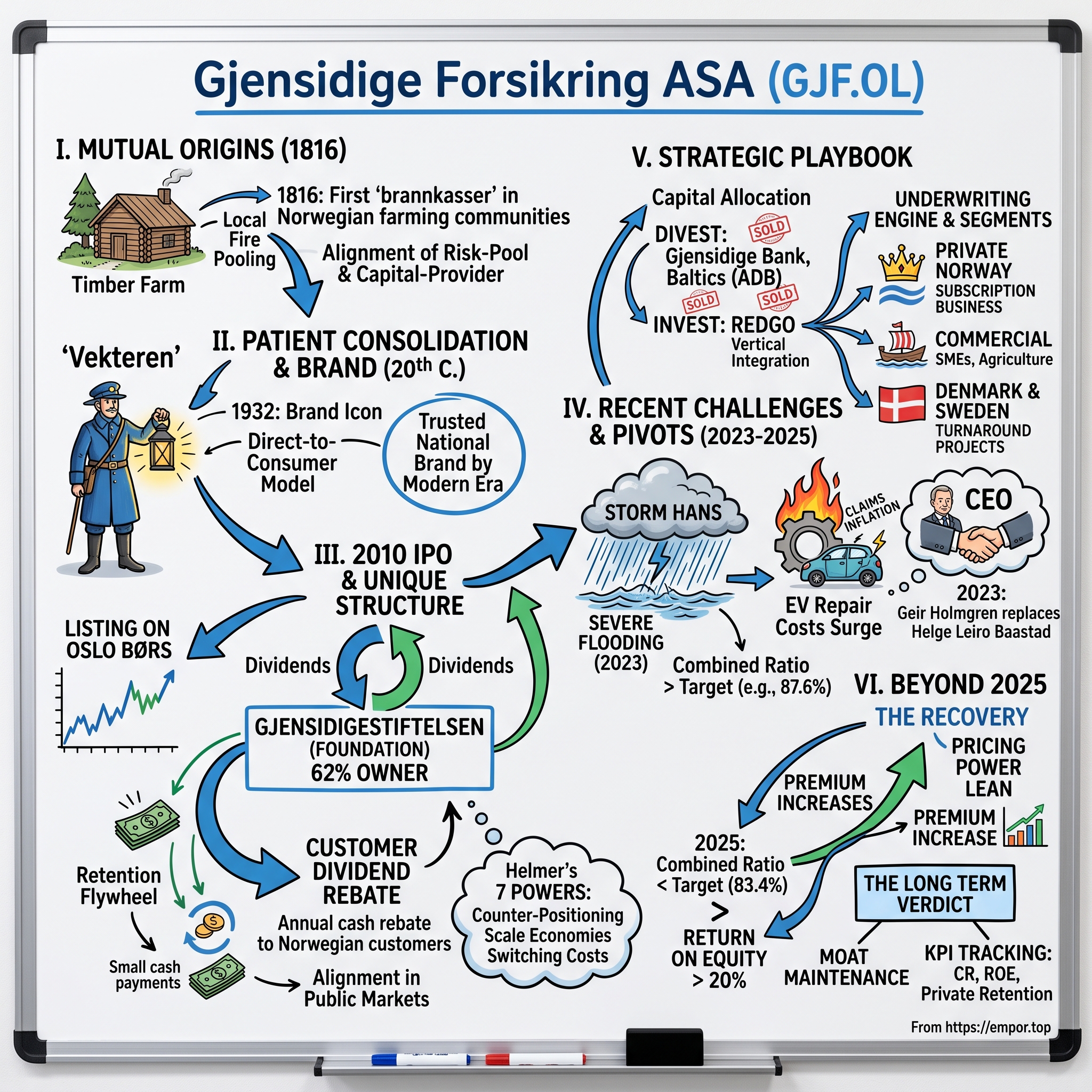
Gjensidige Forsikring ASA: The 200-Year Mutual That Mastered Public Markets
I. Introduction & Episode Roadmap
Picture a farmhouse in rural Norway in the early nineteenth century. It is built of timber, heated by an open hearth, roofed in turf, and standing hours by horse from the nearest town. If it burns — and wooden houses in a cold country with wood fires burned often — the family that built it is ruined. There is no insurance company that will underwrite it, because no distant capitalist in Christiania or Copenhagen can price a risk he cannot see. So the farmers do the only rational thing: they insure each other. Every household in the parish pledges to cover a share of any neighbor's loss. There is no shareholder, no premium in the modern sense, only a mutual promise. The Norwegian word for that promise is gjensidig — "mutual."
That promise, made between farmers who would never meet a financier, is the seed of what is today one of the most consistently profitable public insurers on earth. Gjensidige Forsikring ASA trades on the Oslo Børs under the ticker GJF.OL, and it is a Nordic financial heavyweight: the clear market leader in Norwegian property and casualty (P&C) insurance, with a market capitalization that has ranged around the mid-teens of billions of US dollars.1 Its combined ratio — the single most important number in insurance, measuring claims plus expenses as a percentage of premiums — came in at 83.4% for the full year 2025, meaning the company kept roughly sixteen and a half øre of underwriting profit on every krone of premium before it earned a cent on its investments.5 Its return on equity has run north of 20% in ordinary years.4 For an industry whose global average combined ratio hovers stubbornly around 100 — that is, break-even on underwriting — those numbers are not merely good. They are an anomaly that demands an explanation.
The central question of this story is deceptively simple: how did a loose network of nineteenth-century rural fire mutuals turn into one of the most durably profitable listed insurers in the world — and, more pointedly, is the machine that produced those returns a genuine structural advantage or a fortunate legacy that competitors will eventually erode?
To put a frame around the scale before we go deep: this is a company that in 2025 grew insurance revenue by more than 11%, earned a pre-tax profit of roughly NOK 8.5 billion, ran a cost ratio of 12.7% against a 14% target, and sat on a solvency ratio of 188% — near the top of its own 140–190% comfort band, meaning it holds well over the capital regulators demand.5 It is the kind of balance sheet that lets a company pay out three-quarters of its profit and still look overcapitalized. Those are not the vital signs of a mature, ex-growth utility; they are the vital signs of a franchise that converts premium into cash with unusual efficiency and then struggles, in the best possible way, to find enough uses for the capital it throws off.
The headline facts hint at why this company is unusual. It holds roughly a quarter of the Norwegian non-life market. It sells directly to customers rather than leaning on brokers. Its brand mascot is a nineteenth-century night watchman — Vekteren, "The Watchman" — carrying a lantern and a staff. And, most strangely of all, more than 60% of its listed shares are held by a foundation, Gjensidigestiftelsen, whose sole purpose is to take the dividends it receives as a shareholder and hand them straight back to Gjensidige's own insurance customers as an annual cash rebate.2 Read that again: the largest owner of a publicly traded insurance company exists to pay that company's customers to stay. It is one of the more elegant corporate structures in modern finance, and understanding it is the key to the whole business.
There is a consensus narrative about Gjensidige that will run through this story like a thread we keep tugging: that the customer dividend is an unbeatable moat, that management is uniquely disciplined, and that the combination has produced — and will keep producing — returns that competitors simply cannot touch. Parts of that narrative are demonstrably true. Parts of it are the kind of story a company tells about itself that sounds better in a marketing brochure than it survives in a spreadsheet. The job of a neutral platform is to separate the two, and a useful way to do it is myth-versus-reality: take each comfortable belief, hold it up to the operating data, and see which ones hold. We will do that repeatedly.
It also helps to name why this particular company is worth two hours of anyone's attention. Insurance is, for most investors, a byword for boredom — a low-multiple, cyclical, commoditized business where the best you can hope for is to not blow up. Yet here is a firm in that supposedly commoditized industry earning software-company returns on equity, in a small country, selling something as generic as motor cover. When an ordinary business earns extraordinary returns, there is always a reason, and the reason is always structural. Finding that structure — and testing whether it is durable or borrowed from a benign environment — is the entire game.
Here is the road we will travel. We begin with two centuries of mutual roots and the decision, in 2010, to abandon pure mutuality and enter the public markets. We will dissect the "customer dividend" and ask whether it is truly the unbeatable moat management claims it to be. We will follow a capital-allocation record that includes selling a bank at the top, buying a roadside-assistance network, and quietly exiting the Baltics. We will stress-test the underwriting engine against the two forces that have punished it recently — freak Nordic weather and claims inflation — and we will meet the executives steering the company through a leadership transition. Then we will lay out the bull and bear cases as honestly as we can, because a company this good invites complacency, and complacency is where investment theses go to die.
 Subscribe on LinkedIn
II. The 200-Year Foundation & Mutual Origins (1816–2009)
The origin story does not begin in a boardroom. It begins with fire, scarcity, and the peculiar social technology of rural Scandinavia. In 1816, in the aftermath of the Napoleonic Wars that had left Norway newly independent from Denmark and desperately poor, the first customer-owned fire mutuals — brannkasser — took root in Norwegian farming communities.1 These were not companies in any sense we would recognize. They were pooling agreements among neighbors, governed by local trust and enforced by the simple fact that everyone knew everyone. If your barn burned, the parish paid. If you were careless, your neighbors knew, and social pressure did the work that an actuary and a claims adjuster do today.
Why did this model take hold in Norway specifically, and why did it endure? The answer is geography and culture braided together. Norway was sparsely populated, its farms scattered across fjords and mountains, its building stock overwhelmingly wooden. Commercial insurers headquartered abroad could not economically price or police such dispersed, small-value risks — the cost of understanding a remote Norwegian farm exceeded the premium it could bear. Mutuality solved the information problem by pushing underwriting down to the people who already had the information: the neighbors. It is worth pausing on this, because the same principle — that proximity to the customer is an underwriting advantage, not just a marketing one — echoes straight through to the direct-distribution model Gjensidige runs two hundred years later.
It is worth naming the economic insight buried in that arrangement, because it is subtle and it recurs. A mutual does something a stock insurer structurally cannot: it aligns the interests of the risk-pool and the capital-provider into a single person. In a shareholder-owned insurer, the shareholder profits when premiums exceed claims, which means the shareholder's gain is, in a sense, the policyholder's loss — every krone of underwriting margin is a krone the customer overpaid relative to their expected claim. In a mutual, there is no such wedge, because the customer is the owner. That absence of a principal-agent conflict is why mutuals could earn trust in communities that (rightly) distrusted distant capital. Hold onto this idea, because Gjensidige's entire modern moat is an attempt to keep that alignment alive after deliberately reintroducing outside shareholders.
For most of the nineteenth and twentieth centuries the story is one of patient consolidation. Hundreds of tiny local mutuals gradually federated and merged, pooling reserves and standardizing terms, until they cohered into a national organization carrying the name that described what they were: Gjensidige. A parallel strand ran through life insurance; in 1847 a life-assurance institution with the tongue-twisting name Christiania almindelige gjensidige Forsørgelsesanstalt was founded, and over time these threads braided into a single brand.1 The company that eventually became Norway's largest car insurer did so partly by acquisition — in 1974 it absorbed the country's leading motor mutual and took pole position in what would become its most important line of business, and by 1976 it had formalized its identity as Gjensidige Norsk Skadeforsikring.1
This long consolidation is easy to skate past, but it did something competitively decisive: it concentrated Norwegian personal-lines insurance into a single trusted national brand before the modern era of price-comparison shopping arrived. By the time aggregators and digital challengers might have fragmented the market, Gjensidige already owned the relationship with a huge share of Norwegian households — and a relationship built over a century is not something a startup with a slick app can buy. The two hundred years are not merely heritage marketing. They are the reason the incumbency is so hard to dislodge.
Somewhere in this long institutional middle-age, in 1932, the life company adopted the image that would define Gjensidige in the public mind: the Vekteren, the night watchman, lantern in hand.1 It is easy to dismiss a logo as marketing froth, but the choice was psychologically shrewd. Insurance sells a promise about an unknowable future; a watchman is the human embodiment of vigilance against exactly the disasters — fire, theft, the calamity that strikes while you sleep — that insurance exists to cover. Over the decades the Watchman became one of Norway's most recognized commercial symbols, and brand recognition in a direct-sales insurance market is not vanity. It is distribution. Every krone of brand equity is a krone the company does not have to pay a broker to reach a customer.
By the late twentieth century Gjensidige had become something structurally unusual: a nationwide, deeply trusted, customer-owned insurer in a market that had evolved toward direct-to-consumer selling and, later, very high digital adoption. Norwegians bought insurance straight from the insurer, bundled home and auto and accident cover together, and stayed for decades. Broker penetration in personal lines remained low. These are the ingredients of stickiness, and stickiness is the raw material of pricing power.
The contrast with, say, the British or American personal-lines markets is illuminating. In markets where price-comparison websites and brokers intermediate the relationship, the insurer is a faceless supplier competing on quoted premium alone; loyalty is nil, acquisition costs are brutal, and the "loyalty penalty" — quietly raising renewal prices on customers too passive to switch — becomes the industry's dirty economic engine. Norway evolved differently. The direct relationship, the bundling, and the cultural trust in a homegrown mutual meant customers did not treat insurance as an annual commodity auction. That single difference in market structure — customer-as-relationship rather than customer-as-transaction — is worth more to margins than any clever pricing algorithm, and it is not something Gjensidige invented so much as inherited and then defended.
The internal Nordic expansions of the 2000s — into Denmark in 2006 with the acquisition of Fair Forsikring, and a run of seven deals across Denmark, Sweden, and the Baltics — were the first real test of whether that Norwegian magic travelled.1 The uncomfortable early answer, which management would spend the next two decades wrestling with, was that trust and habit do not export in a shipping container. A Danish or Estonian customer had no two-century relationship with the Watchman and no customer dividend to anchor them. Abroad, Gjensidige was just another insurer — a fact that pre-figured every margin disappointment to come.
So why would a 200-year-old mutual — an organization whose entire identity was built on not having outside shareholders — decide to go public? The pressures were building on several fronts by the 2000s. Growth, particularly the ambition to expand across the Nordics and into Denmark and the Baltics, required capital that a mutual can only generate slowly from retained earnings. A wave of acquisitions across Denmark, Sweden, and the Baltic states in the mid-2000s strained that model.1 Looming European solvency regulation — what became the Solvency II regime — would demand transparent, market-based capital. And a listed share is an acquisition currency and a governance discipline that a mutual simply does not possess. The question that consumed management was not really whether to access public markets. It was how to do so without severing the two-century bond of mutual alignment that was the source of all that customer loyalty. The answer they engineered is the heart of the next chapter.
III. The 2010 IPO & The Unbeatable "Customer Dividend" Moat
Most demutualizations are, at bottom, an act of expropriation dressed up as modernization. The classic pattern: management converts a customer-owned mutual into a shareholder-owned company, the members receive a one-time windfall of shares, and within a few years the new public company behaves like any other — optimizing for shareholders, and treating the former owners as ordinary customers to be repriced and, if necessary, churned. The alignment that made the mutual special evaporates. Gjensidige's designers looked at that template and rejected it.
When Gjensidige converted to a public limited company (an ASA) and listed on the Oslo Stock Exchange in December 2010, the shares were not scattered to the winds.1 Instead, the great majority landed in a single institution built for the purpose: Gjensidigestiftelsen, the Gjensidige Foundation, which emerged from the IPO holding roughly 62% of the company.1 And here is the mechanism that changes everything. The Foundation is not a passive endowment or a family trust. Its beneficiaries are, by design, Gjensidige's own general-insurance customers in Norway. When Gjensidige Forsikring pays an ordinary dividend to its shareholders, the Foundation — as the dominant shareholder — receives the lion's share of that cash. And it then passes that cash straight through to the policyholders, in proportion to the premiums they paid, as an annual customer dividend: kundeutbytte.2
Sit with the economics of that loop for a moment, because it is genuinely clever. A Norwegian who insures a house and two cars with Gjensidige pays premiums like anyone else. But at the annual general meeting each spring, the Foundation votes its shares, collects its dividend, and returns roughly a tenth of what that customer paid — the payout has run in the neighborhood of 10–15% of premiums, and was set at around 11% for the 2025 distribution.3 For the 2025 payout that meant a pool of roughly NOK 3.1 billion flowing to some 916,000 customers, of whom around 780,000 were private households receiving an average of about NOK 1,844 each.3 Over the fifteen years since the model began, the Foundation has channeled on the order of NOK 25 billion back to Norwegian policyholders.2 The customer effectively receives a guaranteed, recurring rebate on their insurance — funded not by Gjensidige shrinking its own margin, but by the dividend stream of a public equity the customer does not even have to own.
There is a governance elegance here that is easy to miss. The Foundation is not just a pass-through pipe; it is also, at more than 60% of the shares, the controlling shareholder — which means the interests steering the company at the general meeting are, ultimately, the customers' interests.2 In most public companies the tension between customers (who want lower prices) and shareholders (who want higher margins) is permanent and irreconcilable. At Gjensidige the dominant shareholder is made of customers, which softens that tension in a structurally durable way: the controlling owner has no interest in the company gouging the very policyholders who are its beneficiaries. That is a governance feature no amount of "customer-centric" mission-statement language at a rival can replicate, because at the rival the controlling owners are ordinary profit-seeking investors.
But a neutral analyst should immediately test the flip side, because there is one. A foundation holding a controlling stake with a mandate to please policyholders could, in theory, tilt the company toward under-pricing risk to make customers happy in the short run — the very failure mode that has bankrupted mutuals throughout history. The evidence says this has not happened: Gjensidige's combined ratios have been among the industry's best, which means the Foundation's control has coexisted with, rather than undermined, underwriting discipline. That coexistence is not guaranteed by the structure; it has to be actively maintained by a board and management that treat pricing rigor as non-negotiable. The moat, in other words, is structural, but it still requires competent operators to keep from rotting — a point the bulls sometimes forget.
Now the analytical question a neutral observer must ask: is this an actual competitive moat, or a marketing gimmick with good PR? Let us test it against Hamilton Helmer's 7 Powers framework, because management and its admirers lean heavily on the word "moat," and the word deserves scrutiny.
The strongest claim is counter-positioning — a power that exists when a newcomer's business model is one the incumbent cannot copy without damaging its existing business. The customer dividend is a near-textbook case, but the counter-positioning runs in Gjensidige's favor against would-be matchers. Suppose If (owned by Finland's Sampo), Tryg, or Fremtind wanted to neutralize the rebate by handing their own customers an equivalent cash-back. They could do it — but only by carving the money out of their own shareholders' profits, quarter after quarter, forever. Gjensidige's rebate comes from a foundation that sits outside the operating company's P&L; a rival's rebate would come from inside it. To match the perk, a competitor would have to permanently impair its own return on equity. That is the asymmetry that makes the structure hard to attack: it is not that rivals can't rebate, it is that rebating destroys their economics while leaving Gjensidige's intact.
The second power is scale economies. With roughly a quarter of the Norwegian P&C market, Gjensidige spreads the fixed costs of IT platforms, actuarial data, claims-handling infrastructure, and national marketing across the largest domestic premium base.4 More policies mean more data, which means sharper pricing, which means better risk selection, which — in a direct model with no broker skimming the margin — flows to the bottom line. A cost ratio of 12.7% in 2025, comfortably inside the company's own target, is the visible fingerprint of that scale.5
The third is switching costs and brand. Norwegian personal-lines customers bundle multiple policies, deal directly with the insurer, and — crucially — would forfeit their accumulated customer-dividend relationship by leaving. Retention in Private Norway has run above 90%, which for a commodity-seeming product like motor insurance is extraordinary.4
There is a subtler second-order effect worth spelling out, because it is where the moat quietly compounds. Because the rebate is proportional to premiums paid and to years of tenure, it rewards exactly the behavior an insurer most wants: buying more lines and staying longer. A customer who bundles home, auto, cabin, boat, and accident cover with Gjensidige gets a bigger annual check than one who buys a single motor policy, and every year of loyalty deepens the habit. The rebate is therefore not just a discount; it is a loyalty flywheel that mechanically increases share-of-wallet and lengthens customer lifetime. And here is the part rivals find maddening: because the money comes from the Foundation, Gjensidige can run this loyalty program essentially for free from the operating company's perspective, while a competitor trying to buy equivalent loyalty through discounts or cash-back would be funding it straight out of underwriting profit.
Now the myth-versus-reality test the whole section has been building toward. The consensus myth is that the customer dividend makes Gjensidige unbeatable. The reality is more precise and more useful: the customer dividend makes Gjensidige extremely hard to beat in Norwegian personal lines, does modest work in Norwegian commercial lines, and confers essentially no advantage outside Norway at all. That is a formidable moat — but it is a moat around the castle keep, not around the whole kingdom, and it does not protect the company from the two enemies that have actually hurt it lately, which are weather and repair-cost inflation, neither of which cares about a rebate scheme.
Intellectual honesty therefore requires naming the limits of the moat plainly. The customer dividend is powerful in Norway, where the Foundation's beneficiaries live. It does essentially nothing for Gjensidige in Denmark or Sweden, where the company competes as an ordinary insurer with none of the structural rebate advantage — which is precisely why, as we will see, those markets have been chronic margin laggards. The moat is real, but it is geographically bounded, and a bull who extrapolates Norwegian economics onto the whole group is making a category error. That tension — a fortress at home, a fair fight abroad — is the through-line of the capital-allocation story we turn to next.
IV. Strategic Focus & Capital Allocation: The M&A & Divestment Playbook (2010–2024)
If underwriting is how an insurer makes money, capital allocation is how it keeps it — and it is the discipline where most insurers quietly destroy value, empire-building into adjacencies and clinging to sub-scale foreign ventures out of sunk-cost pride. Gjensidige's post-IPO record is, by contrast, a study in subtraction. The most instructive move was not an acquisition but a sale.
The bank sale. In the 2010s Gjensidige had built an online retail bank, Gjensidige Bank, into a respectable digital lender. It was growing. It was profitable. And management sold it anyway. In July 2018, Nordea — the largest Nordic banking group — agreed to buy Gjensidige Bank for NOK 5.5 billion, a deal Reuters pegged at roughly USD 530 million, with completion following on March 1, 2019.789 The strategic logic is worth dwelling on because it reveals how management thinks. A bank and a P&C insurer look adjacent — both sell financial products to the same households — but they are capital-hungry in fundamentally different ways. Banking scale requires an ever-growing balance sheet and, under Basel rules, ever more regulatory capital; every krone tied up backstopping mortgages is a krone not compounding inside the high-return insurance engine. Rather than let a decent-but-dilutive business slowly drag down group returns, management sold it to an owner for whom banking scale was the core competence, and bolted on a distribution partnership so Nordea's branches could keep selling Gjensidige policies. The company then returned a large slug of the proceeds to shareholders. This is the opposite of diworsification: selling a good asset because an even better one deserves the capital.
The elegance of the deal was in what Gjensidige kept versus what it shed. It shed the capital-hungry balance sheet — the mortgages and deposits that dragged on return on equity — while retaining, through the distribution agreement, the one genuinely valuable thing the bank had produced: access to customers at moments when they were buying financial products. In effect, management arbitraged the market's willingness to pay a premium for banking scale (the price implied a healthy multiple of the bank's book value) against its own knowledge that the same capital would earn far more inside insurance. Selling a growing, profitable subsidiary requires a specific kind of unsentimental clarity; most management teams cannot bring themselves to do it, because a growing subsidiary feels like success and letting it go feels like retreat. The willingness to let go of "good" in pursuit of "best" is, more than any single ratio, the tell of a capital allocator worth trusting.
The Nordic expansion — and its honest scorecard. Alongside the pruning, Gjensidige had spent the prior decade building out its Nordic footprint. In Denmark it acquired Nykredit Forsikring in 2010, added the Gouda travel-insurance business in 2013, and later absorbed a portfolio from PenSam, assembling a top-five Danish position. In Sweden it grew through bolt-ons and organic effort in a market dominated by Länsförsäkringar and If. The neutral assessment is that these built genuine scale but not Norwegian-caliber margins; Danish underwriting in particular spent years as a turnaround project rather than a profit engine, a gap management has repeatedly had to explain to analysts. Expansion bought optionality and diversification; it did not replicate the home moat, and it would be a mistake to pretend otherwise.
The REDGO bet. In 2022 Gjensidige acquired Falck's Nordic roadside-assistance operations — spanning Norway, Sweden, Finland, Estonia, and Lithuania — and rebranded them REDGO.1 This one is a different species of move: vertical integration rather than horizontal expansion. The strategic idea is to control a piece of the auto-claims value chain. When a customer's car breaks down or crashes, the moment of towing and first response is both a major cost driver and a decisive customer-experience touchpoint. By owning the roadside network, Gjensidige can manage loss costs directly, steer repairs, and deepen the relationship at the instant the customer most needs help.
The analogy that clarifies the logic is a health insurer buying clinics: you integrate backward into the thing that generates your claims so you can control both its cost and its quality. Done right, owning the tow truck lets Gjensidige steer a stranded customer toward its own preferred repair network, capture data on what actually failed, and prevent the small roadside problem from escalating into an expensive total-loss claim — all while turning a stressful moment into a loyalty-building one. Done wrong, it saddles an insurer with a low-margin, capital- and labor-intensive logistics business that management has no special competence to run, and that distracts from the core underwriting engine. Vertical integration in insurance has a genuinely mixed history — for every synergy realized, there is a services subsidiary that quietly diluted returns — so a skeptic is right to withhold judgment until REDGO's contribution shows up as measurably lower motor loss costs or higher retention rather than as a line item management would prefer you not scrutinize.
The Baltic exit. The cleanest illustration of capital discipline came in 2024. Gjensidige's operations in Estonia, Latvia, and Lithuania had never achieved the scale to earn their keep. On July 25, 2024, the company agreed to sell its entire Baltic non-life business, ADB Gjensidige, to Munich Re's ERGO International for approximately EUR 80 million — a price reported at roughly two times book value — with the transaction completing on January 2, 2026.1011 Selling a sub-scale asset at twice book to a strategic buyer who can fold it into a bigger regional platform is exactly the behavior long-term shareholders should want, and exactly the behavior most managements fail to muster because admitting a market is sub-scale feels like admitting defeat. The willingness to shrink the map to protect returns is, in this business, a feature.
Underpinning all of this is a capital-return philosophy that keeps the company honest. An insurer that hoards capital tends to misallocate it — into overpriced acquisitions, into writing marginal business to feed an oversized balance sheet, into empire. Gjensidige has instead run a policy of paying out the great majority of profit — a payout target of at least 80% of net profit, topped up with special dividends when capital is surplus to needs — which for the 2025 financial year translated into a proposed NOK 14.50 per share, split between a NOK 10.00 ordinary dividend and a NOK 4.50 special, a payout ratio of roughly 76%.5 High payout is a discipline as much as a reward: capital returned cannot be capital wasted, and it forces every retained krone to justify itself against the alternative of simply handing it back. The 2025 shift in dividend policy — from "nominal high and stable" toward "growing regular dividends" — is a subtle but real change in posture, one we will return to when the earnings calls come into focus.5
Taken together, the pattern is coherent: sell what dilutes the core (the bank, the Baltics), buy what defends it (REDGO), return the surplus rather than empire-build, and be honest — if slow — about the parts of the Nordic expansion that have underdelivered. That coherence is what earns management the benefit of the doubt. It is not, however, a blank check: the same discipline that exited the Baltics has conspicuously not yet been turned on the perennially sub-scale Danish and Swedish books, and an activist would fairly ask why the pruning shears stop at the Norwegian border. That unresolved question hangs over the one thing all of this capital allocation exists to protect: the underwriting engine itself.
V. Underwriting Engine, Segment Economics, & Industry Structure
Strip away the foundation, the Watchman, and the M&A, and an insurer is finally just a machine for pricing risk. Feed it good data and disciplined judgment and it prints money; feed it optimism and it detonates. Gjensidige's machine has four main chambers, and they do not contribute equally.
Private Norway is the crown jewel — the segment that generates a disproportionate share of group profit relative to its share of revenue. This is the home market where every advantage compounds at once: the customer-dividend lock-in, direct distribution with no broker toll, proprietary pricing algorithms fed by decades of Norwegian claims data, brand recognition from the Watchman, and that 90%-plus retention rate.4 Motor, property, accident, and health cover for Norwegian households is, in effect, a subscription business with unusually low churn and unusually good pricing information. When people describe Gjensidige as a high-quality compounder, this segment is what they are really describing; the rest of the group is diversification and optionality wrapped around this core.
It is worth being concrete about what "proprietary pricing algorithms fed by decades of claims data" actually buys, because it is the least visible and possibly most durable advantage of the lot. Insurance profit is won or lost on selection — on charging the right price to the right risk. An insurer with a quarter of a national market has, by definition, seen more Norwegian fender-benders, burst pipes, and cabin fires than anyone else, and each of those claims is a data point that sharpens the next quote. This creates a quiet, self-reinforcing loop that is a genuine form of scale-driven advantage: more customers produce more data, more data produces sharper pricing, sharper pricing wins the profitable risks and sheds the unprofitable ones, and better risk selection produces the margins that fund the customer dividend that wins more customers. A subscale rival sees fewer claims, prices more crudely, and is therefore prone to adverse selection — winning the risks it underpriced and losing the ones it overpriced. In a data-driven business, the biggest book is not just the biggest; over time it is also the smartest.
Commercial Norway is the second engine — small and medium enterprises, agriculture (a nod to those farming roots), and commercial property. Margins here are healthy but the business is more exposed to competition and to the underwriting cycle than personal lines, and it is the segment most directly in the crosshairs of the resurgent Fremtind, the insurer formed by combining the operations of DNB and SpareBank 1. Commercial insurance is where disciplined pricing is most tested, because corporate buyers are more price-sensitive and better advised than households.
Denmark and Sweden are the growth-and-turnaround platforms. They add premium scale and geographic diversification, but as noted, they have historically earned lower margins than Norway, and the story management keeps telling is one of price increases, efficiency programs, and selective customer acquisition slowly grinding the combined ratio down toward group standards. Progress has been real but uneven, and these markets remain the clearest place for a skeptic to argue that group returns are being propped up by Norway.
The honest way to read Denmark and Sweden for an investor is as an ongoing referendum on whether the group's operational excellence is transferable or Norway-specific. If management can drag those combined ratios down toward Norwegian levels through pricing and efficiency, it validates the claim that Gjensidige is a superb underwriter — a skill that works anywhere — rather than merely the lucky owner of a Norwegian structure. If it cannot, then the bull thesis quietly narrows to "a wonderful Norwegian business with two mediocre foreign appendages," which is a materially less exciting proposition. A decade in, the jury is still out, and that ambiguity is itself the answer to anyone claiming the group's quality is fully proven.
Gjensidige Pensjonsforsikring — the pension arm — is the interesting piece of optionality. Unlike P&C, which is balance-sheet-heavy, the unit-linked pension and disability business is capital-light: the customer bears the investment risk, and Gjensidige earns fees on assets and margins on the disability cover. It has grown quickly, aided by Norwegian workplace-pension reform, and it earns attractive returns on the modest capital it consumes. It is not yet large enough to move the group needle decisively, but it is exactly the kind of high-return, low-capital adjacency that can quietly become material over a decade.
Now, the war-game. It helps to know the opponents. If — the Nordic P&C giant owned by Finland's Sampo — is the most formidable, a scaled, disciplined, pan-Nordic underwriter that competes with Gjensidige on roughly even technical footing and lacks only the customer-dividend structure. Tryg, the Danish-headquartered insurer, is the other regional heavyweight and a direct competitor across the Nordics, having itself grown through large acquisitions. And then there is Fremtind, the most interesting and most threatening newcomer: the combined insurance operation of DNB, Norway's largest bank, and the SpareBank 1 alliance. Fremtind matters because it pairs insurance product with something Gjensidige cannot fully match — the banks' branch networks and the moment-of-mortgage, moment-of-car-loan distribution that puts an insurance offer in front of a customer exactly when they need it. A bancassurance channel is the one distribution model that can rival direct-plus-brand, and Fremtind's re-consolidation of two banking giants' insurance arms is the single most credible long-term threat to the domestic oligopoly's comfortable economics.
The Norwegian P&C market is a textbook oligopoly, and understanding its structure through Porter's Five Forces explains why margins here are so much fatter than the global norm. Four players hold the vast majority of the market: Gjensidige at roughly a quarter, If/Sampo around a fifth, Tryg near 15%, and Fremtind in a similar mid-teens range.4 Run the forces:
- Threat of new entrants: very low. Solvency II demands serious regulatory capital before you can write a single policy. Scale advantages in claims handling and data compound over years. And the customer-dividend barrier means any entrant is fighting for share against an incumbent whose customers get paid to stay. Greenfield entry into Norwegian personal lines is close to a non-starter.
- Bargaining power of buyers: low to moderate. Insurance is essential and reasonably transparent, which should empower buyers — but bundling, direct relationships, and the rebate blunt that power in personal lines. It is stronger in commercial, where buyers are sophisticated.
- Rivalry: intense but disciplined. This is the crucial nuance. Four rational players in a mature market have learned, over cycles, that price wars are mutually destructive. Competition centers on service, brand, and claims experience rather than suicidal undercutting. That discipline is worth more to margins than any single company's cleverness — but it is also the fragile assumption on which the whole profit pool rests. Oligopoly discipline holds until it doesn't, and a newly aggressive Fremtind is the most plausible source of a crack.
- Threat of substitutes is negligible (you cannot really self-insure a house), and supplier power runs mainly through the cost of claims inputs — car parts, construction labor, reinsurance — which is exactly where the recent stress has come from.
Which brings us to the point where the theory of the moat meets the weather.
VI. Recent Inflection Points: Weather Shocks, Inflation, & Executive Transition (2023–2026)
For twenty years, one man's judgment sat at the center of the machine. Helge Leiro Baastad ran Gjensidige as CEO for roughly two decades, steering it through the 2010 demutualization and the transformation into a public-market standout. Handing off a franchise that good is one of the hardest things a board can do; do it badly and you can unwind a generation of compounding. In 2022 the board named his successor, and on January 2, 2023, Geir Holmgren took over as group CEO.12 Holmgren was not a splashy outside star. He came from within the Nordic insurance establishment — a long career at Storebrand, including running its life-insurance operation — and he inherited a company alongside the steady hand of long-serving CFO Jostein Amdal.12 The signal in that choice was continuity, not reinvention: a board telling shareholders it intended to keep running the same playbook rather than let a new chief prove himself by breaking things.
A word on why the continuity signal mattered so much. Baastad's two decades were not a caretaker tenure; they spanned the single most consequential decision in the company's modern history — the 2010 demutualization — and the entire build-out of the public-market track record. When a founder-scale figure departs after that long, the risk is twofold: that a successor either freezes, afraid to touch a beloved machine, or overcompensates, breaking things to signal a new era. Choosing Holmgren — an insider by industry if not by company, steeped in Nordic life-and-pension economics, and paired with a CFO who had lived through the same cycles — was the board betting on evolution over revolution. For shareholders in a business whose whole thesis is durability, that was arguably the correct bet, though it is worth noting the flip side an activist would raise: continuity-minded successions can also entrench complacency, and a company earning 20%-plus returns rarely feels urgency to change until the environment forces it to.
Management alignment is more than a slide in the investor deck here. Executive compensation is tied to the metrics that matter to owners — combined ratio, return on equity, and capital efficiency under Solvency II — and employee share ownership is unusually widespread across the organization, so that the people handling claims and pricing risk have skin in the same game as the shareholders. Alignment does not guarantee good outcomes, but its absence almost guarantees bad ones, and Gjensidige's version is more genuine than most.
He could hardly have picked a more punishing moment to take the reins. In August 2023, Storm Hans swept across Scandinavia, dumping torrential rain and triggering severe flooding across southern Norway. It became, by claims cost, likely the most expensive natural disaster in Norwegian history.6 For a home-and-property insurer, a single such event lands directly on the combined ratio. Full-year 2023 told the story in one number: the combined ratio deteriorated to 87.6%, up sharply from the low-80s of the prior year, as Storm Hans and a spike in large losses collided with rising underlying claims frequency.6 For a company that targets a combined ratio below 82%, an 87.6% is not a rounding error — it is a miss that demands an explanation, and management gave one.
The weather was only half the squeeze. The other half was claims inflation, and it is worth explaining plainly because it is the mechanism that will define the next several years. When you insure a car, you are not really insuring the car — you are insuring the cost of fixing or replacing it. That cost has been rising fast for reasons both cyclical and structural. Cyclically, post-pandemic supply-chain disruption pushed up spare-parts prices and repair-labor rates across Scandinavia. Structurally — and this is the more interesting part — Norwegian cars have become extraordinarily complex to repair. Norway has the highest electric-vehicle adoption on the planet, with EVs making up the overwhelming majority of new-car sales. A modern EV is a rolling computer studded with sensors, cameras, and a large, expensive battery pack; a fender-bender that once meant a cheap bumper repair can now mean recalibrating a sensor array or, in a worse case, condemning a battery pack that costs a meaningful fraction of the car's value. Average cost per motor claim has ratcheted up accordingly. The insurer that dominates the world's most electrified car market is, in effect, running a live experiment in EV claims economics — and paying tuition for it.
There is a deeper irony worth drawing out, because it turns one of Norway's proudest achievements into an insurer's headache. Norway subsidized its way to the world's most electrified vehicle fleet as a climate policy triumph — and in doing so handed its motor insurers a structural cost problem. The very technology that makes an EV clean makes it expensive to repair: a low-speed collision that would once have creased a steel bumper now risks damaging a sensor suite that must be recalibrated by a specialist, or intruding on a floor-mounted battery pack whose integrity, once in doubt, can force the insurer to write off an otherwise driveable car. Add scarce EV-certified body shops commanding premium labor rates, and the average motor claim in Norway has been inflating from two directions at once — frequency roughly steady, but severity climbing. This is not a cyclical blip that fades when supply chains heal; it is a structural re-rating of what it costs to insure a car, and Gjensidige, as the market leader in the world's EV vanguard, is discovering the new cost curve before almost anyone else on the planet. That is a disadvantage today and, conceivably, an informational advantage tomorrow — it will price the EV risk correctly before laggard rivals in other countries even understand it.
The combined effect pushed the combined ratio above target and compressed margins into 2024, when the full-year figure landed at 86.0% — better than the Storm Hans year but still well outside the sub-82% ambition — even as profit after tax rose to NOK 5.18 billion and return on equity held at a still-enviable 22.7%.4 The gap between a 22.7% ROE and an off-target combined ratio is itself informative: it shows how much cushion the franchise carries, earning strong returns even in a bad underwriting year thanks to scale, investment income, and the capital-light pension arm. Put differently, Gjensidige's bad year would be a very good year for most of its global peers — which is exactly the kind of resilience that separates a genuine franchise from a merely well-run cyclical.
Reinsurance deserves a plain-language word here, because it is the shock absorber the whole model rides on. An insurer like Gjensidige does not keep every risk on its own books; it buys catastrophe reinsurance that agrees to pay claims above a certain threshold — its "retention" — in any single event. Storm Hans mattered partly because it tested where that threshold was set, and analysts pushed management on whether a world of more frequent severe weather meant the program needed restructuring: lower retentions to cap the tail more tightly, at the cost of paying more premium to reinsurers who have themselves been raising prices. This is the quiet negotiation that determines how much of the next storm lands on Gjensidige's own combined ratio versus someone else's, and it is a cost that migrates rather than disappears — a point the bear case leans on and the bull case tends to underweight.
The countermeasure is where management credibility gets tested in real time, and the evidence here is reasonably persuasive. Gjensidige's response was to lean on its pricing power — pushing through double-digit premium rate increases in motor and property lines, accelerating cost efficiency, and restructuring reinsurance to better cap the tail of weather events. The critical uncertainty was whether customers would tolerate double-digit hikes or vote with their feet. By 2025 the numbers suggested the pricing was sticking without wrecking retention: the full-year combined ratio recovered to 83.4%, back inside the company's target band, the cost ratio fell to 12.7%, and insurance revenue grew 11.5% — growth that comes substantially from those very rate increases.5 Pre-tax profit reached NOK 8.5 billion.5 The company also took a NOK 423 million write-down on the book value of its core IT system, a reminder that even disciplined operators carry legacy-technology risk on the balance sheet.5 Whether the recovery reflects durable pricing power or a temporary reprieve before the next storm is the question the earnings calls exist to answer.
VII. Primary Transcript Evidence & Conference Call Analysis
The prepared remarks of an earnings call are theater; the Q&A is where the truth leaks out. Reading Gjensidige's calls across 2023 through early 2026, a consistent pattern emerges in how management frames adversity — and consistency of framing, tested against later results, is one of the better proxies for credibility that an outside investor has.
On the Q4 2023 call — the Storm Hans reckoning — management drew a sharp line between two very different problems, and the distinction mattered enormously to the investment case. One bucket was catastrophe losses: Storm Hans and the Oslo flooding, which management framed as severe but episodic, the kind of event reinsurance and pricing normalize over time. The other bucket was the underlying frequency loss ratio — the everyday claims trend stripped of weather — which had also drifted higher.6 Analysts pressed precisely where they should have: was the weather a one-off, or evidence that Nordic climate had structurally shifted the baseline? And did the reinsurance program's retention thresholds need resetting for a world of more frequent severe storms? A management team that blamed everything on the weather would have been waving a red flag; the fact that Gjensidige explicitly separated catastrophe noise from the underlying trend, and conceded the underlying trend was also deteriorating, is the kind of candor that earns credibility.
Why does that distinction between catastrophe and underlying trend carry so much analytical weight? Because the two demand completely different responses and imply completely different valuations. A catastrophe problem is a reinsurance problem — you buy more or cheaper cover, adjust your retention, and move on, and the market should look through a single bad storm. An underlying-frequency problem is a pricing problem — it means the everyday risk you are writing has gotten worse and your premiums have not kept up, which is corrosive and cumulative and requires re-rating the entire book. An investor who mishears "our underlying loss ratio drifted up" as "we had bad weather" will systematically misprice the recovery. Management's willingness to keep the two buckets visibly separate, quarter after quarter, is therefore not just candor for its own sake; it is the disclosure that lets an outsider judge whether the franchise is genuinely repairing or merely enjoying a run of calm skies.
Through the 2024 quarterly calls the conversation shifted from diagnosis to execution, and the analyst pressure moved with it. The central question became price elasticity: could Gjensidige raise motor and property premiums by double digits without triggering the churn that would hollow out the customer-dividend moat? This is the single most important tension in the whole story, because the bull case and the bear case both run straight through it. If customers absorb the increases, pricing power is proven and the moat holds. If they defect, the retention advantage was always partly an illusion of a benign pricing environment. CFO Jostein Amdal's recurring theme in the Q&A was the lag — the mechanical delay between when claims inflation hits the P&L and when repriced premiums catch up to it — and management's insistence that the two would reconverge as the rate increases earned through. The 2025 results, with the combined ratio back inside target and revenue up double digits, are the evidence that the reconvergence largely happened; the retention data holding above 90% is the evidence that the churn feared by analysts did not materially arrive.45
On capital deployment, the calls have been notably concrete rather than evasive — a good sign. Management walked analysts through the Baltic exit as a portfolio-cleanup consistent with the stated strategy of concentrating on high-margin Nordic markets, and through its capital-return capacity against a Solvency II target range of 140–190%.510 By the Q4 2025 call, the company reported a solvency ratio of 188% — near the top of the range, signaling ample capacity for the ordinary-plus-special dividend structure it favors — and simultaneously revised its dividend policy from "nominal high and stable" toward "growing regular dividends" at a minimum 80% payout over time.5 A dividend-policy change is exactly the kind of subtle signal worth catching: it tells shareholders management expects earnings to grow durably enough to support a rising base payout, a more confident posture than the flat, defensive policy it replaced. The proof of that confidence arrived early: the Q1 2026 update showed insurance profit surging and return on equity at 27.7%, the recovery visibly extending into the new year.13 The live version of the story, in short, is one of a management team that named its problems precisely, executed a repricing without breaking the franchise, and is now leaning into that success — a narrative that has, so far, been consistent across calls and validated by results rather than contradicted by them.
VIII. Risk Radar & Bear vs. Bull Investment Thesis
A franchise this admired is dangerous precisely because it invites investors to stop asking hard questions. So let us ask them, mapping the material risks first and then setting the bull and bear cases against each other as an activist or a skeptical long/short investor would.
The risk radar. Four risks are genuinely material, and they are mechanical rather than hand-wavy. First, climate. If Storm Hans was not an outlier but a preview — if Nordic weather has structurally shifted toward more frequent flooding and severe freeze-thaw cycles — then the actuarial models built on twentieth-century weather understate baseline claims frequency, and the sub-82% combined-ratio target becomes a permanently moving goalpost. Reinsurance can cap the tail, but reinsurers reprice, so the cost simply migrates from claims into reinsurance premium. Second, motor repair inflation. Norway's world-leading EV penetration means Gjensidige faces the highest structural repair-cost inflation of almost any motor book on earth; if battery and sensor repair costs keep outrunning premium increases, the largest personal line stays under pressure. Third, non-Norway execution. Denmark and Sweden remain sub-scale on margin, and a decade of "turnaround" language invites the fair question of when, exactly, the turn arrives. Fourth, price elasticity and churn. The cumulative double-digit increases have worked so far, but if they continue to outpace household income growth, the retention that underpins the entire moat could finally crack — and moats erode slowly and then all at once.
The bull case rests on the structural machine we have described. The customer-dividend mechanism is a genuine, hard-to-replicate counter-positioning advantage in the home market, funded from outside the operating P&L in a way rivals cannot match without impairing their own returns. Gjensidige is the scale leader in a disciplined oligopoly with direct customer relationships, demonstrated pricing power, and a cost ratio inside target. It throws off cash with high conversion, supporting a payout policy of at least 80% of profit plus periodic specials, and it carries under-appreciated optionality in the capital-light pension business and the REDGO vertical-integration bet. The 2023–2025 episode is, on this reading, the bull case's best evidence: the franchise absorbed the most expensive natural disaster in Norwegian history and a savage bout of claims inflation, repriced through it, held its customers, and came out the other side with the combined ratio back in target and ROE climbing — a live stress test that it passed. The early 2026 data extends the point, with insurance profit and return on equity both accelerating as the earned-through rate increases meet a calmer claims environment.13 For a bull, this is the whole thesis in miniature: a business that can be hit hard by exogenous shocks and still bend rather than break, because the underlying pricing power and cost position give it the tools to recover on its own timetable rather than the market's.
The bear case is not that any of that is false, but that it is priced for perfection and structurally more fragile than it looks. If severe weather is permanently more frequent, the combined-ratio target is aspirational rather than achievable, and every bad-weather year re-runs the margin squeeze. If claims inflation stays higher for longer, the repricing treadmill never stops, and each cycle risks the churn that finally tests whether retention was moat or mirage. And the competitive backdrop is not static: Fremtind, the combined insurance arm of DNB and SpareBank 1, is a re-consolidated domestic heavyweight that can press on commercial and personal share in ways that test the oligopoly's prized pricing discipline. An activist would additionally probe the perennial Danish/Swedish underperformance — why keep capital in markets that have lagged for a decade? — and would note that a business earning a 20%-plus ROE with a dominant home share has nowhere to go but toward slower growth or riskier expansion.
The activist's stress test sharpens all of this into pointed questions a skeptical owner would put directly to the board. Why has capital been left in Denmark and Sweden for a decade-plus of sub-Norwegian returns — is that diversification, or is it an inability to admit that the expansion thesis was weaker than the home-market thesis? If the customer dividend is such an unassailable moat, why does group return on equity depend so visibly on the Norwegian core carrying the laggard geographies? Is the REDGO vertical-integration bet earning its keep, or is it a services business whose costs are easier to find in the accounts than its synergies? And on governance: does a controlling foundation whose mandate is to please policyholders create any latent pressure to under-price, and how would minority public shareholders even know before it showed up in reserves? None of these is a knockout blow — the operating record answers most of them reasonably well — but a management team that could not answer them crisply would be a warning, and the value of asking is that it forces the bull case to earn its confidence rather than assume it.
The synthesis is that Gjensidige is a genuinely high-quality franchise whose central advantage is real but geographically bounded and cyclically exposed. The 7 Powers are strongest — counter-positioning, scale, switching costs — exactly where the Foundation operates, in Norway, and weakest everywhere else. The Five Forces favor the incumbent overwhelmingly at home, with the single live threat being a breakdown of oligopoly discipline. The bull and bear cases do not actually disagree about the machine; they disagree about the weather and the competition, which is to say about whether the past decade's economics are the baseline or the peak. That is the honest crux, and it is unresolved.
The three KPIs that resolve it over time — the numbers a long-term owner should watch and that this article deliberately does not attempt to forecast:
- Group combined ratio (management targets below 82%). The definitive measure of underwriting profitability and the direct scoreboard for the weather-and-inflation battle.
- Return on equity (management has targeted north of 20–24%). The test of whether the whole capital-efficient model still works after the reinvestment of retained earnings.
- Private Norway retention rate (above 90%). The single truest health-meter of the customer-dividend moat — the number that would reveal, before anything else, whether pricing has finally pushed customers too far.
IX. Playbook & Business Lessons
Step back from the quarterly noise and Gjensidige offers a small number of durable lessons, each of which generalizes well beyond insurance.
Lesson one: alignment can be engineered into a public structure, not just a private one. The conventional wisdom is that going public severs the bond between a company and its customer-owners. Gjensidige's designers proved that a foundation-ownership model can preserve mutual alignment inside a listed shell — turning what is usually a one-time demutualization windfall into a permanent, self-reinforcing retention engine. The deeper lesson for investors is to look for structural sources of customer loyalty that sit outside the operating P&L, because those are the ones competitors cannot compete away without hurting themselves. It is also a caution: such structures are powerful precisely where the beneficiaries live, and travel poorly across borders.
Lesson two: the hardest capital-allocation skill is selling good assets, not buying them. Any management can acquire; the rare discipline is offloading a profitable-but-dilutive business — Gjensidige Bank at scale, sold near the top to a natural owner — because the capital compounds harder inside the core. Growth for its own sake is how good insurers become mediocre conglomerates. The willingness to shrink the balance sheet to protect return on equity is a signal worth paying for.
Lesson three: pruning is as strategic as planting. The decision to exit the Baltics rather than nurse a sub-scale operation through another decade of "turnaround" is the same muscle as the bank sale, pointed in the other direction. Admitting that a market will never earn its cost of capital, and selling it to someone who can make it work, is unglamorous and rare. The recurring theme across all three lessons is subtraction as a competitive act — and the open question that keeps this a story rather than a verdict is whether the same discipline will eventually be turned on Denmark and Sweden, or whether those markets are the one place the pruning shears have gone dull.
There is a final, more uncomfortable lesson embedded in the whole arc, and it is the one most relevant to a long-term investor deciding what to do with a franchise this good. The greatest risk to a company that has compounded beautifully for two centuries is not a competitor or a storm; it is the temptation to believe the compounding is a law of nature rather than the product of a specific, defensible, and geographically bounded structure operating in a specific, benign market environment. Gjensidige's history is a case study in how deep a moat can be dug — the fusion of mutual alignment, brand, scale-driven data, and a foundation that pays customers to stay is about as good as competitive positioning gets in a commodity industry. But the same history is a reminder that moats protect against competitors, not against physics. Climate does not read the annual report, and repair-cost inflation does not care that 916,000 Norwegians got a rebate check. The company that wins from here is the one whose management keeps treating the moat as something that must be actively maintained rather than passively inherited — and the honest verdict, which this story deliberately leaves open, is that the past three years have tested exactly that, and the results so far suggest the operators understand the difference.
References
-
Gjensidige receives approval for 2025 dividend proposal (customer dividend distribution) — Gjensidige Forsikring ASA ↩↩
-
Higher profits in 2024, driven by significant improvement in the insurance service result — Gjensidige Forsikring ASA / Cision, 2025 ↩↩↩↩↩↩↩
-
Gjensidige Q4 2025 slides: profit rises despite IT system write-down, dividend increases — Investing.com, 2026 ↩↩↩↩↩↩↩↩↩↩↩
-
Gjensidige Forsikring ASA: Annual report 2023 / Q4 2023 results (Storm Hans, combined ratio 87.6%) — Gjensidige Forsikring ASA ↩↩↩
-
Nordea to acquire Gjensidige Bank and enter strategic partnership with Gjensidige — Nordea, 2018-07-02 ↩
-
Nordea buys Gjensidige Bank for $530 million — Reuters, 2018-07-09 ↩
-
Nordea completes acquisition of Gjensidige Bank — Nordea, 2019-03-01 ↩
-
Sale of Gjensidige's operations in the Baltics to ERGO International AG — Gjensidige Forsikring ASA / Cision, 2024-07-25 ↩↩
-
ERGO completes the acquisition of non-life insurer ADB Gjensidige in the Baltics — ERGO Group, 2026 ↩
-
Geir Holmgren appointed as new CEO in Gjensidige — Gjensidige Forsikring ASA, 2022 ↩↩
-
Gjensidige Q1 2026 slides: insurance profit surges 74%, ROE hits 27.7% — Investing.com, 2026 ↩↩
 LinkedIn
 WhatsApp
 Reddit
 Hacker News
 Email
Email Kindle
 RSS Feed
 Spotify
 Apple Podcasts
 Amazon Music
 Audible
 YouTube