Givaudan S.A.: The Invisible Empire of Scent, Flavor, and Formulation
I. Introduction & Episode Roadmap
Walk down any supermarket aisle, open any bathroom cabinet, spray on any perfume that costs more than a restaurant meal, and there is a decent chance you are experiencing the work of a company almost none of the people around you could name. The bottle says Dior. The tube says Colgate. The bag says Doritos. The label on the fabric softener says Downy. But the actual smell of Sauvage, the actual taste of that nacho-cheese dust, the clean-linen note that makes a detergent feel like it works — those were very likely composed inside the laboratories of a 130-year-old Swiss company headquartered in a quiet industrial suburb of Geneva called Vernier.
That company is Givaudan. It is the largest player in the global flavor and fragrance (F&F) industry, and it is the closest thing modern capitalism has to an invisible sensory monopoly hiding in plain sight. Industry participants and Givaudan itself have long argued that its creations touch a very large share of daily consumer sensory experiences worldwide — an unverifiable but revealing framing, because the striking thing is that it is even plausible for a business the average consumer has never heard of.8
The business model has a name worth introducing early, because everything downstream flows from it: call it B2B2C. Givaudan sells to businesses (the FMCG giants), but its fortunes are ultimately tethered to consumers, who never buy from Givaudan directly and never will. This is a fortunate place to sit. Givaudan gets the demand stability of consumer staples — people do not stop eating or washing in a recession — without bearing the costs and risks that make the consumer-facing companies' lives hard: no billion-dollar advertising budgets, no fickle brand loyalty to defend, no retail shelf wars, no exposure to a single product going out of fashion. When a soda brand loses share to a rival soda brand, Givaudan often supplies both, and shrugs. It is positioned to win the category regardless of which individual brand wins the consumer, provided the category itself keeps existing. That structural indifference to brand-level outcomes, combined with sensitivity to category-level volumes, is the quiet engine of the whole enterprise.
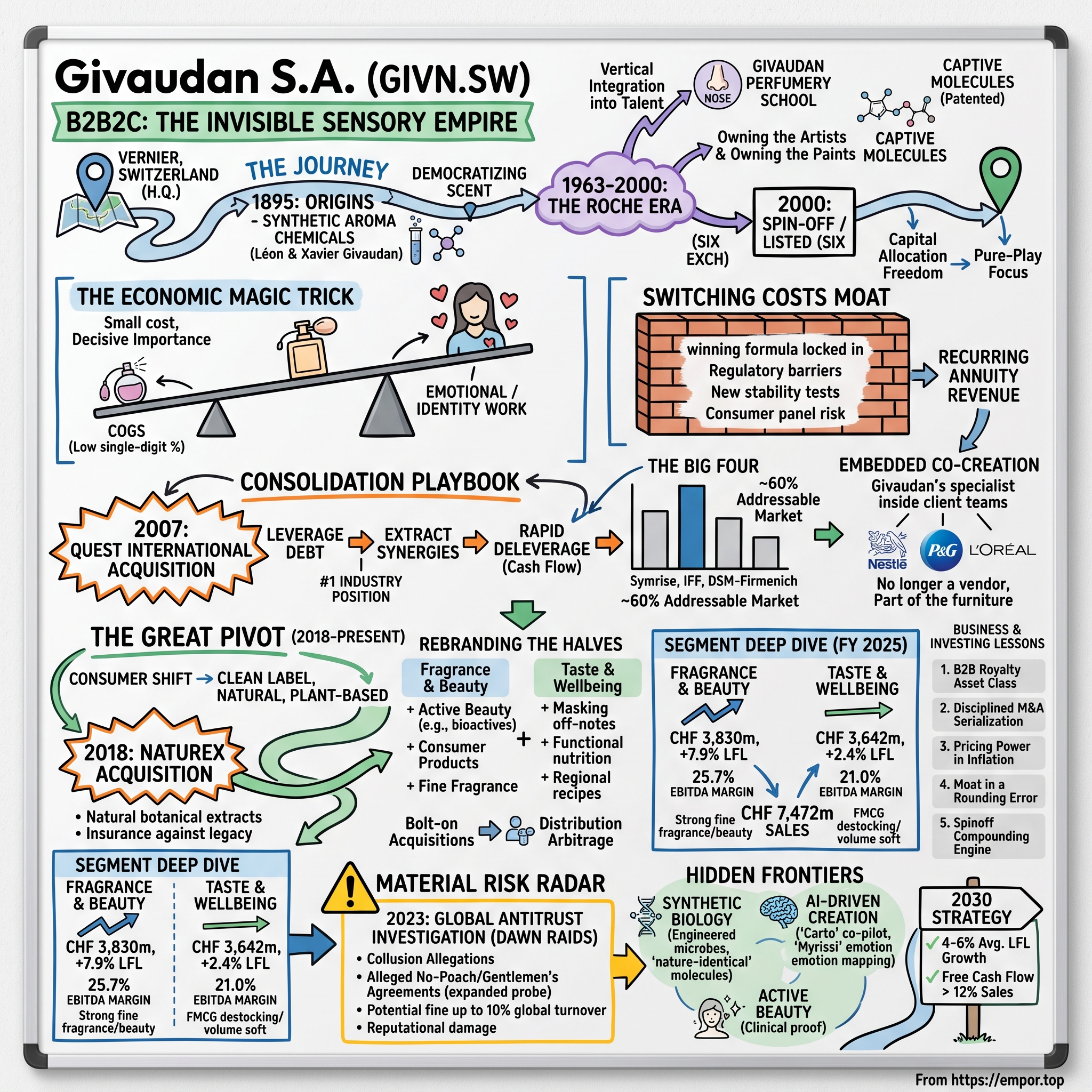
Here is the economic magic trick at the heart of this episode. The flavor or the fragrance inside a finished consumer product typically represents only a low-single-digit percentage of that product's cost of goods sold. Yet it does an outsized share of the emotional and identity work. Change the packaging of a soda and shoppers shrug. Change the taste and they revolt. That asymmetry — trivial cost, decisive importance — is the foundation of one of the most attractive oligopolies in the entire consumer economy. And it is why the industry has consolidated into what insiders call the Big Four: Givaudan, the merged DSM-Firmenich, International Flavors & Fragrances (IFF) of the United States, and Germany's Symrise. Together these four are estimated to control roughly 60% of the addressable market, a concentration that regulators have recently found extremely interesting for reasons we will get to.39
Givaudan sits at the top of that heap. In full-year 2025 the company reported sales of CHF 7,472 million, up 5.1% on a like-for-like organic basis, with EBITDA of CHF 1,751 million and a margin of 23.4%.2 Those are the numbers of a business that has learned to charge for something the customer cannot easily buy anywhere else and cannot easily reproduce in-house.
It is worth pausing on the structure of the game these four companies play, because it is unusual. Most industries are shaped like a pyramid — many suppliers competing for the favor of a few powerful buyers, with the buyers holding the whip. F&F inverts that intuition in one crucial respect. Yes, the buyers are colossal and concentrated; a handful of consumer-goods conglomerates account for a large share of every supplier's order book. But the thing they are buying is so cheap relative to the value it delivers, and so deeply woven into the identity of their own products, that the normal buyer leverage never fully materializes. The result is an oligopoly that behaves less like a commodity market and more like a set of parallel toll booths, each collecting a modest but astonishingly reliable levy on a share of global consumption. The whole episode is, in a sense, an investigation into how such a structure came to exist, how durable it really is, and what — a courtroom, a technological shift, a change of leadership — might finally crack it.
This is the story of how it got there. Our narrative spine runs along five threads. First, the improbable corporate birth: a chemistry-and-perfumery workshop that spent 37 years inside Swiss pharma giant Roche before being spun out in 2000 as a pure-play public company. Second, the M&A engine — two transformational deals, Quest International in 2007 and Naturex in 2018, that consolidated the industry and dragged Givaudan from synthetic chemistry toward natural ingredients. Third, the economics of switching costs, the reason a winning formula almost never gets swapped out. Fourth, the question of management credibility, freshly relevant because the 20-year CEO who built the modern company just handed over the keys. And fifth, the dark cloud now hanging over the entire industry: a coordinated global antitrust assault by regulators in Brussels, Bern, London, Washington, and now New Delhi into alleged cartel behavior and no-poach agreements.
Keep that last thread in mind. This is a business that looks, on the surface, like a serene compounding machine. The most interesting parts of the story are where that serenity gets tested. Let us begin where it began — in a Zurich chemistry lab in the closing years of the 19th century.
 Subscribe on LinkedIn
II. Origins & The Roche Era: Chemistry Meets Perfumery (1895–2000)
In 1895, two brothers, Léon and Xavier Givaudan, set up a business in Zurich to manufacture synthetic aroma chemicals, before relocating operations to Vernier, on the edge of Geneva, where the company's headquarters remain today.8 This detail matters more than it seems. The 19th-century perfume trade had been built on naturals — rose, jasmine, sandalwood — extracted at enormous cost from plants and animals. The Givaudan brothers belonged to a new breed of industrial chemist who realized that molecules responsible for a smell could be synthesized: manufactured in a reactor, at scale, at a fraction of the cost, with perfect consistency batch to batch. That was the original disruption. Scent stopped being agricultural and started being industrial.
The timing of that original bet was everything. The late 19th century was the golden age of synthetic organic chemistry, the same wave that gave the world synthetic dyes and the first pharmaceuticals, and Switzerland — with its concentration of chemical expertise around Basel and Geneva — sat at the center of it. The Givaudan brothers were riding a genuine technological revolution, not merely opening a workshop. Synthetic aroma chemicals democratized scent: fragrances that had once been the exclusive luxury of aristocrats, dependent on rare and costly naturals, could now be composed at industrial scale and priced for a mass market. That expansion of the addressable market — turning perfume from an elite indulgence into an everyday consumer good — is the deep current that has carried the whole industry ever since, and it explains why demand has proven so resilient across a century of wars, depressions, and recessions.
For its first half-century Givaudan was a respectable but regional specialty-chemicals house. The pivot that made it globally important came in stages. The company established the Givaudan Perfumery School — a formal, in-house academy to train "noses," the elite perfumers who compose fragrances the way a musician composes a score.7 This was an audacious act of vertical integration into talent. Perfumery is a craft that takes the better part of a decade to master and is passed down largely through apprenticeship. By building a school, Givaudan turned an artisanal guild into a proprietary talent pipeline, and it has trained a meaningful share of the world's working fine-fragrance perfumers ever since.7 When a resource is scarce, hard to replicate, and you own the factory that produces it, you have the beginnings of a durable advantage.
The economics of a captive molecule are worth dwelling on, because they explain a great deal about why this industry looks the way it does. When a Givaudan chemist invents a novel aroma molecule — a musk that lasts longer on skin, a top note that survives the harsh alkalinity of a laundry powder — the company can patent it, and for the life of that patent no rival is permitted to make or use it. A perfumer at Givaudan therefore composes with a palette of colors that competitors simply do not possess. It is as if one painter had exclusive access to a particular shade of blue. Multiply that across hundreds of proprietary molecules accumulated over a century, and you have a creative advantage that cannot be bought, only built, and only over decades. The perfumery school and the molecule library are two halves of the same strategy: own the artists and own their paints.
Then came Roche. In 1963, the Swiss pharmaceutical powerhouse Hoffmann-La Roche acquired Givaudan, later combining it with the French fragrance house Roure.8 On paper this looks odd — why would a maker of vitamins and drugs want a perfume company? The logic was chemistry. The same organic-synthesis capabilities that produced pharmaceutical actives could produce aroma molecules; the disciplines rhymed. Under Roche, Givaudan gained something priceless: patient capital and a deep-pockets parent that could fund the long, expensive work of building captive molecules — proprietary, patent-protected synthetic ingredients that no competitor could legally use. Roche married German-Swiss synthetic-chemistry rigor to elite French perfumery artistry, and the combination compounded quietly for decades.
But a subsidiary is never the priority. Inside a pharma company, a flavor-and-fragrance division competes for capital against blockbuster drug programs, and it usually loses. By the late 1990s Roche was sharpening its focus on pharmaceuticals and diagnostics, and a specialty-ingredients business — however profitable — no longer fit the story it wanted to tell shareholders. The decision was made to let it go.
In 2000, Givaudan was spun off and listed on the SIX Swiss Exchange as an independent, pure-play company, trading under the ticker GIVN.[^7] Roche distributed the shares to its own investors. For the first time in 37 years, Givaudan controlled its own capital allocation. Every franc of cash flow could now be reinvested in flavors and fragrances rather than diverted to a pharma parent's priorities — funding R&D at a sustained high single-digit percentage of sales, paying a generous dividend, and pursuing acquisitions on its own terms. The spinoff is easy to underrate, but it is arguably the single most important event in the modern company's history: independence turned a well-run division into a category king with the freedom to consolidate its own industry. And consolidate it did.
III. The Consolidation Playbook: The Quest Bet & Building Industry Scale (2001–2017)
Picture the F&F industry in 2006. It was fragmented enough to be messy and concentrated enough to be tempting. A handful of large players jostled for the biggest FMCG accounts, and everyone understood that scale mattered: more R&D, more perfumers, more captive molecules, more shots at winning the briefs — the competitive tenders — that consumer-goods giants issued whenever they launched a product. Givaudan, freshly independent and hungry, decided to make the boldest move on the board.
The target was Quest International, the flavor-and-fragrance division of the British chemicals conglomerate Imperial Chemical Industries. In November 2006 Givaudan announced the deal, and on March 2, 2007 it closed the acquisition of Quest for approximately CHF 2.8 billion.5 Quest was no minnow — it employed around 3,400 people and was itself one of the leading players in the global market.5 Swallowing it in a single gulp catapulted Givaudan clear of IFF into the undisputed number-one position in the industry, with an estimated global share around a quarter of the market.
The financing tells you something about management's temperament. Rather than pay entirely in cash or dilute shareholders heavily, Givaudan funded the purchase with roughly CHF 1.9 billion of debt, a CHF 750 million mandatory convertible bond, and cash on hand, and it targeted at least CHF 150 million of annual synergies with full benefits after year three.5 This is the recurring pattern in the Givaudan playbook: use leverage to buy a strategic asset, extract cost synergies by routing the acquired portfolio through a bigger sales network, and then deleverage rapidly out of the fat cash flows the combined business throws off. It is a roll-up, but a disciplined one — the opposite of empire-building for its own sake, at least in intention.
Integration, however, was genuinely hard, and it is worth being honest about that rather than airbrushing it. Merging two fine-fragrance operations meant overlapping client relationships, competing perfumers, duplicated labs, and the always-underestimated nightmare of stitching together legacy IT and formulation systems. Some client relationships and talent inevitably leaked during the transition, as they always do when two creative organizations are forced together. The deal was a strategic triumph, but the multi-year grind of realizing its value was a reminder that in a talent-and-relationship business, the synergies on the spreadsheet are not the synergies you actually capture.
The deleveraging that followed is the unsung discipline of the Givaudan model, and it is where a lot of would-be roll-ups quietly come undone. Buying a big asset with debt is the easy part; the hard part is generating enough cash, reliably enough, to pay that debt down before the next opportunity or the next downturn arrives — and to do so without starving the R&D and dividend that the equity story depends on. Because F&F throws off cash so consistently, Givaudan was able to carry the Quest debt down steadily even through a global recession, and it would run the same playbook a decade later after Naturex. The willingness to lever up for the right strategic asset, paired with the discipline to de-lever fast afterward, is what separates a value-creating acquirer from a serial diluter. It requires management to treat the balance sheet as a tool to be used and then repaired, not a permanent home for cheap debt.
Then the world nearly ended. The 2008 financial crisis arrived barely eighteen months after Quest closed, with Givaudan still carrying acquisition debt. Here the defensive character of the business revealed itself. People kept brushing their teeth, washing their clothes, and eating packaged food straight through the recession; the volumes of everyday staples barely flinched. And because the flavor or fragrance is such a small slice of a product's cost, Givaudan could pass raw-material inflation through to customers without triggering the volume collapse that a more visible cost line would provoke. The company came through the crisis with its margins and its number-one position intact — proof, under fire, that this was a consumer-staples business wearing a specialty-chemicals costume.
It helps to understand exactly what "winning a brief" means, because the brief is the atomic unit of competition in this industry. When Procter & Gamble decides to launch, say, a new lavender-scented fabric softener, it does not simply order a fragrance from a catalogue. It issues a brief — a detailed specification of the mood, the price point, the performance requirements, the regulatory constraints, the target consumer — to several F&F houses at once, and asks each to submit competing creations. Perfumers at Givaudan, DSM-Firmenich, IFF, and Symrise then race to compose something that will win a blind consumer test against the others. The house that wins gets the business, sometimes for the entire multi-year life of the product; the houses that lose get nothing but the cost of having competed. This is a brutal, winner-take-all creative contest repeated thousands of times a year across every product category, and it is why scale in perfumers, in molecules, and in consumer-testing data compounds so powerfully: the more briefs you win, the more data and relationships you accumulate, the more briefs you are positioned to win next time.
The other quiet revolution of these years was not a deal at all but a change in how the company worked with its customers. Givaudan embedded its flavorists and perfumers directly inside the product-development teams of the FMCG giants — Nestlé, Unilever, Procter & Gamble, L'Oréal — co-creating formulations rather than simply selling ingredients over a counter. Once your specialists are sitting in the client's kitchen helping design next year's product, and once the resulting formula is written into the client's specifications, you are no longer a vendor. You are part of the furniture. That embeddedness would become the load-bearing wall of the entire investment case — and the setup for the company's next act.
IV. The Great Pivot: Taste & Wellbeing, Active Beauty, and Naturals (2018–Present)
By the mid-2010s a slow tectonic shift was rippling through the consumer world, and Givaudan could feel it. Shoppers were turning against long ingredient lists they could not pronounce. "Clean label," "natural," "plant-based," and "free-from" stopped being niche and started being mainstream. For a company whose 19th-century founding disruption had been the replacement of naturals with synthetics, this was an existential plot twist. The core competence — industrial synthetic chemistry — was suddenly on the wrong side of consumer sentiment for a growing slice of the market.
Management's answer was the second transformational deal of the modern era. In 2018 Givaudan moved on Naturex, a French leader in natural botanical extracts, in a transaction that valued the company at roughly EUR 1.3 billion — around EUR 135 per share, a premium of some 42% over Naturex's undisturbed price.6 Givaudan completed the acquisition and delisted Naturex from Euronext Paris on September 18, 2018.6 Naturex brought EUR 405 million of 2017 sales, sixteen production sites, and roughly 1,700 people specialized in pulling flavors, colors, and functional ingredients out of plants rather than out of reactors.6
Notice the price. Quest had gone for something like 11 times EBITDA; Naturex commanded a far richer multiple, reflecting the fierce bidding for anything with a credible "natural" platform at the exact moment every food and personal-care brand wanted to reformulate. Paying up for Naturex was a bet that the clean-label shift was structural, not a fad — that Givaudan needed to own natural-ingredient capability rather than source it opportunistically. It was, in effect, insurance against its own legacy. Whether the price was worth it is the kind of question that only resolves over a decade, and reasonable skeptics noted that Givaudan was buying growth and optionality rather than a bargain.
Why did the clean-label wave hit so hard, and why did Givaudan feel compelled to spend more than a billion euros answering it? The mechanism runs through the FMCG customer. When Nestlé or Danone commits publicly to removing artificial colors and flavors from its products — as most of the food majors did over the 2010s — that commitment cascades straight onto their ingredient suppliers. Suddenly the brief is not "make this taste like strawberry" but "make this taste like strawberry using only natural, clean-label ingredients that survive our supply chain and pass regulatory muster in forty countries." A supplier that could only offer synthetic solutions would slowly be designed out of the next generation of products. Naturex was, in this light, less an act of ambition than an act of necessity — a way to make sure that when the natural brief landed, Givaudan had an answer rather than an apology.
Around the same time the company rebranded its two halves in a way that signaled the strategic reframing. The old Flavours division became Taste & Wellbeing, a name that pushed past mere flavor into sugar reduction, salt reduction, and functional nutrition. The old Fragrances division became Fragrance & Beauty, planting a flag in active cosmetic ingredients, not just scent. These were not cosmetic relabels; they redrew the boundaries of what Givaudan told investors it was in the business of doing.
Underneath the two big deals ran a steady drumbeat of bolt-on acquisitions that thickened the portfolio: the fine-fragrance house Drom and the specialty-ingredients maker Ungerer in 2019, and in 2021 Myrissi, a small French startup whose technology attempts to translate emotional and color responses into fragrance — an early bet on the AI-and-scent frontier we will return to later. The logic of a bolt-on differs from that of a transformational deal in an instructive way. When Givaudan buys a regional fine-fragrance house like Drom, it is rarely buying factories or even primarily technology; it is buying a book of client relationships and a roster of creative talent, and the value comes from routing that acquired portfolio through Givaudan's vastly larger global sales network while stripping out the duplicated back-office overhead the small house could never afford to run efficiently. A niche molecule that a regional player sold to a handful of local customers can, overnight, be offered to Givaudan's entire multinational client base. That distribution arbitrage — the same product reaching many times the customers — is where the synergy actually lives, and it is why the acquirer with the widest network can afford to pay more for a small target than the target could ever be worth on its own. The risk, again, is complexity: each bolt-on adds systems, sites, and integration work, and the discipline lies in absorbing them faster than they accumulate as drag. The method was consistent: buy a regional specialist or a niche capability, strip out duplicated overhead, and push its products through Givaudan's global distribution. Serialized, disciplined, unglamorous. The risk in any such program is "diworsification" — accumulating complexity and integration debt faster than value — and the honest verdict is mixed-to-favorable: Givaudan has generally digested its bolt-ons without blowing up returns, but the sheer number of moving parts is exactly what an activist would poke at. With the portfolio reshaped, the real question becomes where the money actually gets made.
V. Segment Deep Dive & Unit Economics: Where Revenue & Value Live
To understand Givaudan you have to hold a paradox in your head. It is a chemistry company that behaves like a software company. It sells a physical product measured in kilograms, but its true assets are intangible: formulas, tacit craft knowledge, embedded client relationships, and a library of proprietary molecules. The clearest window into how this works is the segment economics, so let us walk through them using the full-year 2025 baseline.2
Start with the group. In 2025 Givaudan generated CHF 7,472 million of sales, split across two roughly equal divisions.2 For most of the last decade the flavors side was the larger of the two, but 2025 marked a quiet crossover worth pausing on: Fragrance & Beauty reached CHF 3,830 million and grew 7.9% like-for-like, while Taste & Wellbeing came in at CHF 3,642 million and grew a more sluggish 2.4%.2 The fragrance business overtook the flavor business — and did so while earning a materially fatter margin. Fragrance & Beauty posted a 25.7% EBITDA margin against Taste & Wellbeing's 21.0%.2 The analytical takeaway is direct: in the current cycle, the beauty-and-scent engine is both the faster grower and the more profitable one, and the flavors business — buffeted by FMCG destocking and softer volumes — is the one management has more work to do on.
Before dissecting the divisions, it helps to picture how a single order actually creates value, because it reveals why the margins are what they are. A flavorist or perfumer, working from a client brief, composes a formula that might combine dozens of ingredients in precise ratios. That formula — the intellectual property — is the valuable part. The physical act of blending the ingredients into a compound and shipping it in drums is comparatively cheap and is done in high-throughput compounding plants around the world. In other words, Givaudan sells a physical product but prices the invisible design inside it. This is why the business can carry mid-20s EBITDA margins on what is, at the loading dock, a fairly ordinary chemical-blending operation: the customer is not really paying for the kilograms, it is paying for the formula, the craft, the regulatory clearance, and the guarantee of perfect batch-to-batch consistency that lets it put the same product on shelves in fifty countries.
Take Fragrance & Beauty first. It has three sub-businesses with very different personalities. The largest by volume is Consumer Products — the fragrances that go into soap, shampoo, fabric softener, and home cleaners. This is the ballast: high volume, essential demand, multi-year contracts, unglamorous and sticky. Next is Fine Fragrances, the prestige perfumery behind luxury houses. Volumes here are small, but margins are luxurious, because the value lives in the master perfumer's artistry and in captive molecules a rival cannot legally copy. Third, and strategically loudest, is Active Beauty — bioactive cosmetic ingredients like hyaluronic acid produced via biotechnology, peptides, and skin-microbiome modulators. Active Beauty is small but fast-growing, carries high gross margins, and pulls Givaudan deeper into the premium-cosmetics value chain alongside clients like L'Oréal and Estée Lauder.
A word on the technical problem Taste & Wellbeing exists to solve, because it is easy to underestimate. Consider plant-based meat. The challenge is not making a patty out of peas and soy — that part is straightforward. The challenge is that plant proteins carry inherent off-notes: beany, bitter, metallic flavors that the human palate has evolved to find slightly unpleasant. Masking those off-notes while building in the savory, roasted, umami character that makes a burger taste like a burger is a genuinely hard flavor-chemistry problem, and it is exactly the kind of problem a food startup cannot solve on its own. The same is true of taking sugar out of a soda without it tasting thin and chemical, or salt out of a soup without it tasting like nothing. In each case the flavor house is selling a solution to a problem the customer literally cannot engineer around. That is a far stickier value proposition than "we make things taste nice" — it is closer to "we make your reformulated product commercially viable at all."
Taste & Wellbeing is the other half — the flavors and functional ingredients that go into beverages, dairy, savory snacks, sweet goods, and health and nutrition products. Its value drivers are exactly the challenges of modern food: masking the off-notes in plant-based meat and dairy so they taste less like cardboard, cutting sugar without killing sweetness, cutting salt without killing savoriness. The economics rest on scale compounding plants and, crucially, on vast local libraries of proprietary recipes — tens of thousands of formulations tuned to regional palates. That library is a moat you cannot buy; you have to accumulate it, client by client, over decades.
The reason the 2024-to-2025 crossover deserves attention is that it complicates the tidy narrative of a serenely balanced business. For years Givaudan's pitch rested partly on diversification — two roughly equal legs, food and scent, smoothing each other's cycles. What 2025 exposed is that the two legs are not marching in step. Fragrance & Beauty is riding a genuine boom in fine fragrance and prestige beauty, categories where consumers have proven willing to keep spending even as they economize elsewhere; scent has become a small, affordable luxury. Taste & Wellbeing, meanwhile, is more exposed to the grind of packaged-food volumes, private-label pressure, and the destocking hangover. An investor who assumed the group was a single homogeneous compounder would have been surprised; the more accurate picture is of two related but distinct businesses, currently pulling at different speeds, with the higher-margin one happily in the lead.
Now the central mechanism, the one everything else depends on. Because the flavor or fragrance is such a small share of a finished product's cost, the customer has almost no incentive to squeeze it on price — the savings would be trivial. But because it defines the product's sensory identity, the customer has every incentive never to change it. Reformulating means new stability testing, new regulatory filings, new consumer panels, and the terrifying risk that loyal buyers notice the difference and defect. So the winning formula stays put, often for the entire life of the product, sometimes for decades. That is the switching cost, and it is the reason Givaudan could pass through the brutal raw-material and energy inflation of 2022–2023 and still recover its EBITDA margin toward the mid-20s by 2024, when the group posted CHF 7,412 million of sales, a 23.8% EBITDA margin, net income of CHF 1,090 million, and free cash flow of CHF 1,158 million, or 15.6% of sales.1 Pricing power, in this business, is not a slogan; it is arithmetic. What it is not, however, is unlimited — and testing where its limits lie has been the defining task of the man who ran the company for two decades.
VI. Management, Capital Allocation & Credibility: The Gilles Andrier Era
For twenty years the story of Givaudan and the story of Gilles Andrier were essentially the same story. Andrier joined the company in 1993 and became CEO in 2005, and he ran it until March 1, 2026 — a tenure of extraordinary length in an era when the average large-cap CEO lasts about five years.4 The numbers behind his stewardship are worth stating plainly because they are the ledger against which his credibility must be judged: over his run, Givaudan grew from roughly CHF 2.7 billion in sales to about CHF 7.4 billion, expanded from around 5,900 employees to 16,900, and saw its market capitalization climb from CHF 5.8 billion to CHF 36.6 billion.4 That is a multi-decade compounding record that few European industrial CEOs can match.
What kind of leader compiles a record like that? Andrier was a trained engineer who came up through the commercial and strategic ranks of the business rather than the laboratory, and colleagues consistently described a temperament suited to a long game: patient, analytical, uninterested in the theatrics that inflate quarterly narratives. He ran Givaudan the way a good steward runs a franchise he expects to hand on intact — protecting the culture of creativity that the perfumers and flavorists depend on, while imposing the financial rigor that keeps a creative business from indulging itself into mediocrity. That balance, between honoring the art and enforcing the arithmetic, is the central management challenge of any F&F company, and Andrier's two decades suggest he understood it about as well as anyone in the industry's modern history.
Andrier's style was the antithesis of the celebrity CEO. Low-key, engineer-minded, allergic to hype, he ran the company around a small set of financial disciplines and repeated them, call after call, year after year, until they became a kind of liturgy: like-for-like organic growth, free-cash-flow generation, and return on invested capital comfortably above the cost of capital. Management compensation and the strategy cycles were built around exactly these metrics — a five-year plan with explicit targets, publicly scored at the end. And here is the part that matters for credibility: they hit them. Over the 2021–2025 strategy cycle, Givaudan delivered average like-for-like growth of 6.8%, well above its own 4–5% target range, and average free cash flow of 12.5% of sales against a 12% minimum.2 When management sets a public target and then beats it across a full five-year cycle that included a pandemic and an inflation shock, that is the strongest possible evidence that the guidance discipline is real rather than promotional.
The capital-allocation hierarchy was equally consistent. First priority, organic R&D, funded at a sustained high-single-digit percentage of sales — the seed corn of future captive molecules and formulations. Second, the dividend, which Givaudan has raised or held for decades; the 2025 results carried a proposed dividend of CHF 72.00 per share, up 2.9%, extending one of the longest uninterrupted payout records in the Swiss market.2 Third, selective bolt-on M&A. Fourth, deleveraging — the rapid pay-down of debt after the big deals that we saw in the Quest and Naturex playbooks. The balance sheet was managed to keep leverage in a moderate band and brought back down quickly after acquisitions.
The most revealing test of management came not in a triumph but in a slump. Through 2023, Givaudan's FMCG customers went through a savage destocking cycle — having overordered during the supply-chain panics of 2021–2022, they slammed the brakes and ran down inventory, and Givaudan's volumes suffered. On the earnings calls of that period, analysts pressed management repeatedly on whether the weakness was structural. Andrier's team held the line: they refused to cut R&D to flatter short-term margins, maintained pricing discipline rather than buying volume back with discounts, and told investors the destocking was a temporary inventory phenomenon that would reverse. In 2024 volumes rebounded exactly as promised, and the margin recovered.1 Calling a cyclical bottom correctly, and behaving consistently while doing it, is precisely the kind of behavior that earns a management team the benefit of the doubt.
There is a subtler point buried in that destocking episode that speaks to how one should read this management team. Notice what they did not do. They did not blame the weather, or the currency, or vague "macro headwinds," and then quietly walk down the multi-year targets. They named the specific mechanism — customers had overstocked and were now working inventory back down — put a rough timeline on it, and staked their credibility on the reversal. When a management team offers a falsifiable explanation for a miss and then the explanation proves correct, that is worth far more than a decade of smooth quarters, because it tells you the team understands its own business and is willing to be held to account. The contrast with companies that serially reset guidance while insisting nothing is wrong is exactly the kind of behavioral signal a long-term investor should weight heavily. Givaudan's narrative across filings, presentations, and calls has been strikingly consistent over the years — the same handful of metrics, the same priorities, the same refusal to chase fashionable diversifications — and that consistency is itself a form of shareholder protection.
Which brings us to the succession, the live question hanging over the stock today. On August 27, 2025, Givaudan announced that Andrier would retire and be succeeded, effective March 1, 2026, by Christian Stammkoetter, who had run Asia, Middle East and Africa for Danone and brought more than 25 years in fast-moving consumer goods.4 At the same time, long-serving Chairman Calvin Grieder announced he would step down at the March 19, 2026 AGM, with the board proposing Andrier himself as the incoming Chairman.4 This is the classic double-edged Swiss succession: continuity is preserved by kicking the retiring CEO upstairs to chair the board, but governance purists will fairly note that an all-powerful former CEO becoming chairman can blunt independent oversight and make life hard for a new CEO trying to put his own stamp on the company. The bet that Stammkoetter — an outsider from the customer side of the industry rather than a lifelong F&F insider — can sustain a two-decade compounding streak is unproven, and it is the single biggest open question in the management story. He inherits a superb machine; whether he can keep it humming is exactly what the next few years will reveal.
VII. Competitive Landscape, Hamilton Helmer's 7 Powers & Porter's 5 Forces
If you wanted to war-game an attack on Givaudan, where would you even start? Run the business through Hamilton Helmer's 7 Powers framework and the answer is sobering for any would-be challenger, because Givaudan does not rely on a single moat — it stacks several.
The primary power is switching costs, and it is close to extreme. We have already met the mechanism: once a Givaudan formulation is locked into a launched product, ripping it out means regulatory re-approval, stability and shelf-life testing, consumer panels, and the risk of alienating buyers who bonded with the original. For a hero product doing hundreds of millions in sales, that reformulation risk is simply not worth the pennies saved. Dual-sourcing an exact scent or flavor profile is rare, because the profile is proprietary to the house that created it. This is why Givaudan's revenue base has a recurring, annuity-like quality that belies its "chemicals" label.
Stacked on top is process power — the decades of tacit knowledge held by master perfumers and flavorists, knowledge that lives in people and apprenticeship rather than in any manual a competitor could photocopy. Reinforcing that is a cornered resource: the portfolio of captive molecules, patent-protected aroma chemicals and bioactives that rivals cannot legally synthesize or use, giving Givaudan's creators a palette others simply do not have. And underpinning everything is scale economies: an R&D budget running into the hundreds of millions of francs a year funds synthetic biology, AI-assisted formulation, and clinical trials for active-beauty ingredients at a level long-tail regional players cannot dream of matching. Four overlapping powers, each individually strong, collectively formidable.
Porter's Five Forces tells the same story from a different angle. The threat of new entrants is very low: a credible global F&F company needs decades of client trust, a deep bench of trained noses, an owned molecule library, and the regulatory machinery to comply with REACH in Europe, the FDA in the US, and EFSA and dozens of national regimes — a wall of capital and time no startup can scale. The threat of substitutes is essentially nil, because scent and taste cannot be digitized away or removed from physical consumer goods; a soda still has to taste like something.
The bargaining power of buyers is the most interesting and the most debatable. On paper, Givaudan's customers are giants — a Nestlé, a Procter & Gamble, an L'Oréal — with enormous purchasing muscle, and they are concentrated enough to squeeze most suppliers. But the tiny-cost-share dynamic flips the usual power relationship: the customer simply does not care enough about a 1–2% cost line to fight over it, especially when the supplier owns the formula. So buyer power is real but muted. The bargaining power of suppliers — the farmers and chemical producers who provide essential oils and petrochemical precursors — is low to moderate, because that base is fragmented and Givaudan's scale lets it integrate backward and source directly from growers.
It is worth understanding how the competitive field reshaped itself, because the other three kings each took a very different path to scale, and their choices illuminate Givaudan's by contrast. Firmenich, the privately held Swiss house that was for decades Givaudan's closest rival in fine fragrance, chose in 2023 to merge with the Dutch nutrition-and-materials group DSM, creating DSM-Firmenich — a combination that bolted a large nutrition and health business onto a fragrance core, betting that the future lay at the intersection of taste, scent, and wellness. IFF, the American champion, took the most aggressive route of all: it absorbed DuPont's Nutrition & Biosciences division in a mega-deal, transforming itself almost overnight into a sprawling ingredients conglomerate — and then spent the following years wrestling with the debt and integration complexity that came with it, to the point of selling assets to repair the balance sheet. Symrise, the German player, grew more organically and through smaller bolt-ons. Set against these, Givaudan's approach looks conservative and coherent: it stayed close to its knitting, scaled within F&F and adjacent naturals, and avoided the kind of bet-the-company transaction that left a rival digesting a giant for years. In an industry where the temptation to transform through a single blockbuster deal has repeatedly destroyed value, restraint has been a competitive weapon.
That leaves competitive rivalry, which is genuinely intense — and it is the force that should keep an investor honest. The Big Four fight tooth and nail over every major FMCG brief. When four sophisticated giants chase the same handful of mega-accounts, the temptation to compete less and coordinate more is ever-present — which is precisely the theory regulators are now testing in court, and precisely where this story turns dark.
VIII. Material Risk Radar & The Antitrust Investigation
On the morning of March 7, 2023, officials arrived unannounced at fragrance-company offices across multiple countries. This was not a routine audit. It was a coordinated set of dawn raids, executed in concert by the European Commission, the Swiss Competition Commission (COMCO), the US Department of Justice's Antitrust Division, and the UK's Competition and Markets Authority, targeting Givaudan, Firmenich, IFF, and Symrise — the four companies that together hold roughly 60% of the fragrance market.39 The regulators' suspicion, stated plainly, was collusion: coordinating prices, allocating customers, and limiting the supply of certain fragrances.3 For an industry whose entire premium rests on the trust of its FMCG customers, an accusation that it had been quietly rigging the game against those same customers is close to the worst possible headline.
This is, without much competition, the single biggest overhang on the Givaudan investment case, and it has to be treated as an unresolved, open-ended risk rather than a footnote. The financial mechanics are stark: under EU rules, a cartel fine can reach up to 10% of a company's global annual turnover, which for Givaudan implies a theoretical maximum in the region of CHF 700 million — and that is before the civil litigation that inevitably follows a cartel finding.3 That litigation has already begun. In the United States, purchasers of fragrance products have filed class actions; one representative suit, brought by a Texas candle-supply company in New Jersey federal court in July 2023, alleged the defendants conspired to inflate prices by allocating products and customers.11 Symrise, for its part, has challenged the legality of the Commission's raid before the EU's General Court.11
The probe has since widened in two directions that make it harder to dismiss as a one-off. First, obstruction: in June 2024 the European Commission fined IFF EUR 15.9 million after a senior IFF employee deleted WhatsApp messages with a competitor during the March 2023 inspection.9 That fine is small in money terms but large in signal — it tells you the Commission is deadly serious and that there was communication between competitors worth deleting. Second, the investigations have expanded from pricing into labor markets. Regulators have probed alleged "no-poach" or "gentlemen's agreements" not to hire each other's staff, and in August 2025 the Competition Commission of India opened its own investigation into Givaudan, Firmenich (now under DSM-Firmenich), and IFF over exactly such agreements — reportedly India's first competition case centered on labor practices.10 As of today, no final decision or fine against Givaudan has been announced in the main cartel case; the company has stated it is cooperating, and the outcome remains genuinely uncertain, which is itself the problem — the market cannot price what it cannot yet size.
How should an investor actually think about this risk, given that it cannot yet be sized? The honest answer is that it introduces a genuine tail — a low-probability-but-high-severity scenario — that no amount of operational excellence can fully offset. Cartel cases in Europe grind on for years; a statement of objections, if one comes, would be followed by rounds of legal argument, and any fine could be appealed. The base case remains that Givaudan continues to compound while the legal process runs in the background, much as other European industrials have carried multi-year antitrust probes without operational disruption. But the reputational dimension is the part that is easy to underweight and hard to reverse. Givaudan's entire premium rests on being the trusted, indispensable partner that FMCG customers embed in their product development. If those same customers come to believe their suppliers were coordinating against them, the damage would not show up as a one-time fine — it would show up slowly, in tougher negotiations, more dual-sourcing, and a chipping-away of the trust that took a century to build. That is the scenario the bulls must take seriously, even if it never comes to pass.
The antitrust cloud is the loudest risk but not the only one. Raw-material and climate volatility is structural: Givaudan depends on natural crops — vanilla from Madagascar, citrus oils, patchouli from Indonesia — whose harvests swing with weather, disease, and geopolitics, and the company's own sustainability program is in part an attempt to secure those supply chains at source.12 Vanilla is the cautionary tale here: prices for natural vanilla have historically gyrated wildly, spiking many-fold in bad years as cyclones and speculation hit the thin Madagascar supply, and because vanilla is an input into a vast range of food and fragrance products, those swings ripple straight through the cost base. Backward integration and direct farm sourcing — building relationships with growers rather than buying on the spot market — are Givaudan's hedge, and they double as a sustainability story that customers increasingly demand. But no amount of sourcing sophistication fully neutralizes a crop failure, and climate change is widening the tails on exactly these agricultural exposures. FMCG volume stagnation and private-label penetration is a slower threat: if inflation-weary consumers keep trading down to unbranded staples, the pool of branded briefs that Givaudan feeds on grows more slowly, a pressure already visible in the sluggish 2025 volumes on the Taste side.2 And regulatory tightening on synthetic chemicals — the EU Green Deal and evolving REACH rules — could force expensive reformulation of legacy aroma compounds, though it cuts both ways, since Givaudan's natural and biotech capabilities position it to sell the replacements. Which is the perfect segue, because those replacements are where the company is placing its next bets.
IX. Hidden Frontiers & Future Materiality: Active Beauty, AI, & Biotech
Every mature company needs a believable answer to the question "where does the next decade of growth come from?" For Givaudan, the answer is not more soap perfume. It is the frontier where chemistry meets biology and software — and it is worth examining with a skeptical eye, because "frontier" narratives are where management teams are most tempted to overpromise.
The most tangible of these frontiers is Active Beauty and biotechnology. Instead of merely making a face cream smell nice, Givaudan increasingly makes the ingredients that are supposed to make it work: hyaluronic acid produced by fermentation rather than extraction, bio-fermented peptides, and compounds designed to protect or modulate the skin microbiome. Why does this matter financially? Because active cosmetic ingredients carry gross margins well above the traditional fragrance base, grow faster than the mature core, and deepen relationships with exactly the premium-beauty clients — L'Oréal, Estée Lauder — that Givaudan most wants to serve. It is a logical extension of the fragrance relationship into a higher-value, science-heavy product. The caveat is that this pits Givaudan against specialized cosmetic-ingredient players and requires clinical-efficacy proof, not just a nice story; it is a real business, but a competitive one where being big in fragrance does not automatically confer the right to win.
Sitting underneath both frontiers is synthetic biology, the least visible but potentially most consequential shift. For a century the industry made aroma and active molecules through petrochemical synthesis. Increasingly, some of those same molecules can be produced by engineered microbes — yeast or bacteria fermenting sugar into a target compound, the way a brewery makes alcohol. This matters for three reasons at once. It can be cheaper and more consistent than farming a scarce natural crop; it can be marketed as "nature-identical" or bio-based, satisfying the clean-label brief; and it can secure supply of molecules whose natural sources are volatile. A biotech-brewed vanilla note, for instance, sidesteps the wild price swings of Madagascar vanilla entirely. The strategic point is that synthetic biology blurs the old line between "natural" and "synthetic" that has organized the whole industry, and the players who master fermentation at scale may reset the cost curve for an entire class of ingredients. It is capital-intensive and technically hard, which favors the largest players — but it is also an arena where well-funded startups and specialty chemical firms are circling, so Givaudan's lead is far from guaranteed.
The second frontier is AI-driven creation, and here Givaudan has two concrete assets. The first is Carto, a proprietary system that pairs formulation software with sampling robots, letting a perfumer rapidly test enormous numbers of molecule combinations and predict how consumers will perceive the result. Think of it as a co-pilot for the nose: it does not replace the master perfumer's judgment, but it compresses the tedious trial-and-error of formulation from months toward days, letting a small team explore a design space that used to require armies of technicians. The second is Myrissi, the French startup acquired in 2021, whose technology attempts to map fragrances to the emotions and colors they evoke — an effort to make the notoriously subjective business of "will people like this smell" a little more predictable.
The honest analytical verdict on all of this is: promising, plausibly durable, but not yet proven at needle-moving scale. The strategic logic is sound — if Givaudan can formulate faster and better than a regional rival, it widens an already-wide moat, and technology of this kind is genuinely hard for a smaller competitor to replicate. But investors should watch for evidence in the numbers rather than in the press releases: faster win rates on briefs, higher-margin active-beauty growth showing up in the segment disclosures, R&D productivity that translates into share gains. Until then, these frontiers are best understood as credible optionality layered on top of a moaty core — not as the core itself. Step back from the frontier, and the more important lessons of this whole saga are about the core business model itself.
X. Playbook & Business/Investing Lessons
Strip away the specifics of vanilla and hyaluronic acid, and Givaudan is a case study in a handful of transferable ideas that founders and investors would do well to internalize.
The first is what we might call the "B2B royalty" asset class. Givaudan's genius is positional: it supplies a critical, tiny-cost, high-value input that sits at a choke point in someone else's product. Because the input is cheap to the customer but decisive to the end consumer, the supplier captures consumer-staples-like predictability and pricing power and switching-cost stickiness, all at once — without carrying the marketing spend, retail risk, or brand-fashion exposure of the consumer company it serves. The lesson for builders: owning a small-but-indispensable slice of a large value chain can be more durable than owning the whole visible product. Find the component nobody thinks about but nobody dares to change.
The second lesson is the disciplined serialization of M&A. Roll-ups have a deservedly bad reputation, because most of them destroy value — the acquirer overpays, fails to integrate, and drowns in complexity. Givaudan's record with Quest, Naturex, and a string of bolt-ons shows the harder path: buy assets that plug into an existing global network, extract real cost synergies, deleverage fast, and repeat. The discipline is in the saying no — and in resisting the ego-deals that wreck returns. It is not a flawless record, and the accumulated integration complexity is a fair target for critics, but the returns have held up where most serial acquirers' do not.
The third lesson is pricing power through an inflation shock. The 2022–2023 raw-material spike was a live experiment in whether Givaudan's theoretical pricing power was real. It was: the company pushed through double-digit input inflation and recovered its margin without a volume collapse, because the value proposition to the customer dwarfed the price increase in absolute terms. The generalizable principle is that a business whose product is essential but represents a trivial share of the customer's cost has a nearly magical ability to raise prices — a property worth hunting for in any business model.
There is a fifth lesson threaded through all of this that deserves its own mention: the moat that hides in a rounding error. The most counterintuitive feature of Givaudan's economics is that its indispensability is because of, not despite, how little it costs the customer. A supplier whose product represented 20% of a customer's costs would be the first line the procurement department attacked in every downturn. A supplier whose product represents 1% is beneath the procurement department's notice — too small to fight over, too important to risk changing. Founders instinctively want to sell the expensive, prominent thing; Givaudan's history suggests the more defensible position can be selling the cheap, invisible, load-bearing thing. The best moats are often the ones the customer does not even think to attack.
The fourth lesson is the spinoff compounding engine. Givaudan's 26 years of independence are a monument to what happens when a good business escapes a parent that was starving it of attention and capital. Freed from competing against pharma R&D for every franc, Givaudan could reinvest 100% of its cash flows into F&F leadership. Corporate parents are not always good stewards of their divisions; sometimes the single most value-creating act is simply to set a business free. Which leaves the question every investor ultimately has to answer: from here, does the case still hold?
XI. The Investment Spine: Bull vs. Bear Case & Key KPIs
Lay the two cases side by side and the tension is clean.
The bull case is that Givaudan is a nearly irreplaceable, high-margin node in the global consumer-goods supply chain — protected by the stacked powers we war-gamed earlier, blessed with structural tailwinds in natural ingredients, active beauty, health and nutrition, and plant-based formulation, and run with a proven ability to convert sales into cash. The financial evidence supports the quality claim: a mid-20s EBITDA margin, free cash flow consistently above 12% of sales, and a dividend record measured in decades.12 If the world keeps eating, washing, and smelling good, and if no rival can replicate the molecule library and the trained noses, then Givaudan compounds quietly for another decade the way it has for the last two.
The bear case is equally coherent, and an honest analysis has to give it real weight. First, valuation: a business this admired rarely trades cheaply, and a premium multiple leaves little margin for error if growth disappoints or a shock lands. Second, and most acute, the antitrust overhang — an unquantifiable potential fine of up to roughly 10% of global turnover, plus civil litigation and, worst of all, reputational damage to the trust that the whole model rests on.311 Third, volume risk: if FMCG customers keep struggling with consumer price fatigue and private-label share gains, the brief pipeline grows slowly, as the 2025 Taste & Wellbeing numbers already hint.2 Fourth, management transition risk: a brand-new CEO from outside the industry, with the architect of the old success now installed as chairman above him — continuity and constraint in the same arrangement.4
The valuation point deserves to be stated as a mechanism rather than a number. A business widely regarded as one of the highest-quality compounders in European industry tends to be priced as such, which means the market has already paid, in advance, for a great deal of future excellence. The practical consequence is asymmetry: if Givaudan merely keeps executing as it has, the reward may be modest because that outcome is largely expected; but if it stumbles — a bad antitrust ruling, a botched CEO transition, a structural slowdown in a key category — the fall could be sharp, because a premium multiple compressing toward the average is a long way down. Quality and safety are not the same thing at every price, and disentangling the two is the discipline the bear case demands.
The activist's stress test sharpens the bear points into questions worth asking out loud. Is the portfolio too complex after a decade of bolt-ons, and would the parts be worth more focused? Is the incoming-chairman arrangement good governance or a soft brake on a new CEO? Is the natural-ingredients business earning its cost of capital, or was Naturex a growth premium that never fully paid off? None of these is disqualifying, but a serious investor should want each one answered rather than assumed away.
How to adjudicate between bull and bear over time? Three KPIs carry most of the signal, and they map directly onto the disciplines management has publicly bound itself to. The first is like-for-like organic sales growth — the cleanest read on whether Givaudan is winning briefs and holding pricing, to be judged against the 2030 ambition of 4–6% average growth.2 The second is the pair of EBITDA margin and free-cash-flow conversion, the test of whether pricing power and cost discipline are intact, with the company targeting free cash flow above 12% of sales through the cycle.2 The third is the spread of return on invested capital over the cost of capital, the ultimate scorecard on whether all that M&A and R&D actually created value rather than merely growth. Watch those three, and you will know whether the compounding machine is still compounding — long before the headlines tell you.
XII. Epilogue & Closing Thoughts
There is a pleasing symmetry to Givaudan's arc. It began in the 1890s as two brothers in a chemistry workshop, betting that the smells of the natural world could be recreated in a reactor. A hundred and thirty years later, its most fashionable growth business is about putting nature back in — botanical extracts, fermented actives, clean labels — while its most futuristic one uses robots and algorithms to compose scents. The company has, in a sense, spent its whole history arbitraging the shifting consumer preference between the artificial and the authentic, and winning either way because it sells the ingredient underneath both.
It is also a company arriving at a genuine hinge point, which is what makes it interesting to study precisely now rather than in retrospect. For the first time in a generation, someone other than Gilles Andrier is setting the direction, and he is doing so under a 2030 strategy that promises 4–6% average like-for-like growth and free cash flow above 12% of sales — targets that are, notably, a shade more ambitious at the top end than the range Andrier consistently beat.2 At the same time, the industry's foundational premise of quiet, trusted oligopoly is being interrogated in courtrooms on three continents. The next chapter of the Givaudan story will be written at the intersection of those two facts: a new hand on the tiller, and an external environment less willing to take the industry's serenity for granted than at any point in its modern history.
What endures across that long history is the underlying idea: own the small, invisible, indispensable thing. Givaudan never had to build a consumer brand, fight for shelf space, or chase a fashion cycle. It simply made itself the party that FMCG giants cannot afford to change, and then defended that position with talent, patents, scale, and trust. The final lesson for founders, executives, and investors is that the most durable moats are often the least visible ones — that there is enormous, quiet power in being the essential component that never appears on the label. The open questions now are whether a new CEO can keep the machine running, and whether a courtroom in Brussels decides that the moat was, in part, an unlawful one. Both will be answered in the years ahead, and both are worth watching closely.
References
-
EU cartel probe targets fragrance makers Givaudan, Symrise, Firmenich — Reuters, 2023-03-07 ↩↩↩↩↩
-
Givaudan announces Chief Executive Officer and Chairman succession plans — Givaudan S.A., 2025-08-27 ↩↩↩↩↩
-
Givaudan announces closing of Quest International acquisition — chemeurope.com, 2007-03-02 ↩↩↩
-
Givaudan completes the acquisition and delisting of Naturex — Givaudan S.A., 2018-09-18 ↩↩↩
-
Givaudan Perfumery School & Creator Talent Pipeline — Givaudan S.A. ↩↩
-
IFF Fined €15.9 Million for Obstructing Suspected Fragrance Cartel Investigation — BeautyMatter, 2024-06 ↩↩↩
-
India launches probe into fragrance giants Givaudan, Firmenich and IFF over anti-poaching claims — Cosmetics Business, 2026 ↩
-
Lawsuits mount against Givaudan, Firmenich, IFF and Symrise amid fragrance antitrust investigation — Cosmetics Business, 2023 ↩↩↩
 LinkedIn
 WhatsApp
 Reddit
 Hacker News
 Email
Email Kindle
 RSS Feed
 Spotify
 Apple Podcasts
 Amazon Music
 Audible
 YouTube