Geberit AG: The Invisible European Monopoly Behind the Wall
I. Introduction & Episode Roadmap
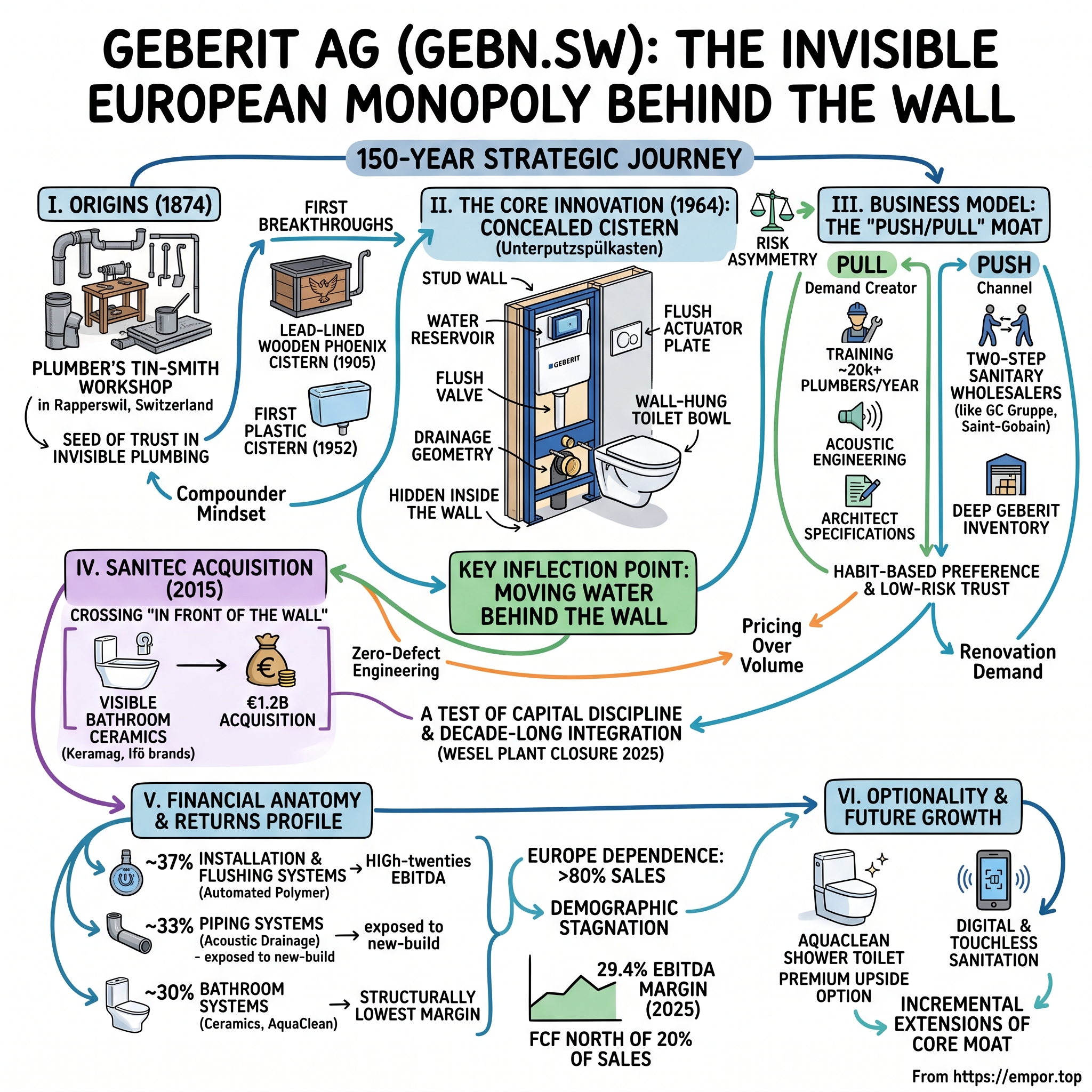
Walk into a newly built hotel in Zurich, a renovated apartment in Munich, or a refurbished office block in Amsterdam, and you will almost certainly use a Geberit product without ever seeing it. The toilet bowl hangs off the wall, floating a few centimetres above a floor you can mop in a single uninterrupted sweep. There is no bulky porcelain tank behind it. Instead, the water reservoir, the carrier frame bolted to the studs, the flush valve, and the drainage geometry are all hidden inside the wall — a piece of precision-engineered plastic and steel that the guest never thinks about, the architect specified without fanfare, and the plumber installed in a fraction of the time an older system would have taken. That invisibility is the whole business.
Geberit AG, headquartered in the lakeside Swiss town of Rapperswil-Jona, has spent a century and a half turning the least glamorous corner of the built environment — sanitary plumbing — into one of Europe's most durable profit machines. In its 2025 financial year the group generated net sales of roughly CHF 3.16 billion and an operating cashflow (EBITDA) margin of 29.4%, and it converts an unusually large share of that profit into hard cash.1 Those are not the economics of a commoditised building-products supplier. They are closer to the economics of a software company that happens to make things out of polymer and brass.
The central puzzle of this story is how that happens. Sanitary ware is, on paper, a mature, cyclical, low-growth industry tied to European construction — a sector that from 2022 to 2024 endured one of its sharpest downturns in a generation as the European Central Bank raised interest rates and residential building permits collapsed. Raw-material and energy costs spiked. Wholesale customers who had over-ordered during the boom spent two years working down their inventories. And yet through that storm Geberit held its margins in the high-twenties to low-thirties and kept returning cash to shareholders. The question worth interrogating — not accepting — is whether that resilience reflects a genuinely defensible business or simply a favourable moment that will not repeat.
This is a company that invites a skeptic's attention precisely because its own narrative is so polished. Management describes a fortress: an entrenched network of trained plumbers, decades of process know-how, and a brand that stands for zero-defect Swiss engineering. Much of that is real and measurable. Some of it is management framing that deserves to be tested against evidence — peer margins, customer behaviour, pricing outcomes during the downturn, and the returns on a large acquisition that took the company somewhere it had never been.
To do that, this episode traces the arc in ten movements. First, the century-long evolution from a tin-smith's workshop in Rapperswil to the inventor of the concealed cistern — and why one product moved the water tank into the wall and changed European bathrooms forever. Second, the mechanism that actually protects the profits: the "push/pull" channel strategy that captures the plumber, the specifier, and the wholesaler. Third, the 2015 acquisition of Finland's Sanitec — a €1.2 billion bet that carried Geberit from hidden hardware into visible ceramics, and a genuine test of capital discipline. Fourth, the financial anatomy: three product areas, a heavy European geography, and a returns profile that is the whole investment case. Fifth, the people running it and how their words on earnings calls have held up against what actually happened. Sixth, the real but modest optionality in shower toilets and digital sanitation. Seventh, the strategy frameworks — Helmer's 7 Powers and Porter's 5 Forces — used as tools of interrogation rather than celebration. Eighth, the bull and bear cases and the handful of numbers that actually matter. And finally, what the whole thing teaches about finding durable businesses in unglamorous places.
Begin where the water first moved behind the wall.
 Subscribe on LinkedIn
II. The Origins & The Invention of the Concealed Cistern (1874–1999)
In 1874, in the medieval old town of Rapperswil on the eastern shore of Lake Zurich, a plumber named Caspar Melchior Albert Gebert opened a workshop.2 He was, in the language of the trade, a Spengler — a tin-smith and installer who bent sheet metal, ran lead pipe, and fixed whatever the town's buildings needed to move water in and waste out. There was nothing in that modest beginning to suggest a future SMI-listed company. But the business carried a seed that would define everything that followed: plumbing is a trade where mistakes are catastrophic and invisible, and where the person who solves that problem earns trust that outlasts any single product.
The first real product breakthrough came from the founder's sons. In 1905, Albert Emil and Leo Gebert built a lead-lined wooden flushing cistern they called the "Phoenix."2 It sounds primitive today, but it was a serious piece of engineering for its era — a reliable overhead tank that let a household flush a toilet on demand, in a Europe still installing indoor plumbing building by building. The Phoenix anchored the company's reputation and gave it a franchise in the single most failure-sensitive object in the bathroom: the thing that holds water and releases it on command.
The material revolution arrived in the middle of the twentieth century. In 1952 Geberit produced its first plastic cistern, trading brittle, corrosion-prone materials for a moulded polymer that was lighter, cheaper to make at volume, and far more durable in a wet environment.2 Plastic injection moulding would become the company's core manufacturing discipline for the next seventy years — the reason a Geberit flush mechanism can be produced to tight tolerances, in enormous quantities, at a cost structure regional competitors struggle to match. But the plastic cistern of 1952 still sat where every cistern had always sat: bolted to the wall above the bowl, in plain and slightly ugly view.
Then came the idea that made the modern company. In 1964 Geberit launched the first plastic concealed cistern — the Unterputzspülkasten — and had it installed, fittingly, in a Swiss hotel bathroom.2 The concept was deceptively simple and genuinely radical. Take the water tank, the flush valve, and their plumbing, and move them out of sight into the hollow cavity of a stud wall. What remained visible in the bathroom was only a slim actuator plate and, eventually, a toilet bowl that could hang off the wall entirely.
Why did that matter so much? Start with the mundane and work up. A wall-hung toilet with a concealed tank leaves the floor clear, so a cleaner can mop the entire bathroom in one pass — a decisive advantage in hotels, hospitals, offices, and public facilities where cleaning labour is a real cost. It created the sleek, minimalist aesthetic that would come to define the European bathroom, freeing designers from the bulky porcelain monobloc. And it changed the geometry of risk. Concealing the mechanism inside the wall meant that the reliability of that mechanism was no longer a matter of convenience but of consequence: a leak behind finished drywall, above other occupied floors, is not a nuisance but a disaster that can cost tens of thousands to remediate and can destroy an entire fit-out.
That risk asymmetry is the hinge on which the whole business would eventually turn, so it is worth stating plainly rather than letting the company state it for us. When a component is hidden and its failure is expensive, the buyer's decision stops being about price and starts being about trust. An architect specifying a system behind the wall, a building inspector signing off on a code-compliant installation, and a master plumber putting a warranty and a reputation on the line all share the same incentive: they will pay more, not less, for near-zero failure rates, because the downside of a cheap failure dwarfs the upside of a cheap purchase. Geberit did not invent that dynamic, but from 1964 onward it built its entire commercial identity around being the answer to it.
Through the post-war decades, Geberit rode the European reconstruction and housing boom out of Switzerland and into its natural neighbours — Germany, Austria, and the Benelux countries, the German-speaking and northern European markets that remain the company's profit heartland today. It expanded the product set from flushing systems into supply and drainage piping, embedding itself deeper into the parts of a building that are decided by professionals rather than homeowners.
The internationalisation was methodical rather than glamorous, and it followed the logic of the moat rather than the map. Geberit did not chase every market; it went where two conditions held — a professionalised installer trade that could be trained, and building regulations strict enough to reward engineering over price. That is why the company became a fixture in Germany, the Nordics, and the Alpine and Benelux economies long before it was a serious presence anywhere else, and why its footprint still leans so heavily on those regions today. Each new market entered the same way: recruit and train the local plumbers, get the systems written into the local building specifications, seed the wholesale channel, and let the habit compound. It was a slow way to grow a company, but it was a durable one, because every market conquered that way became very hard for a rival to take back.
There was one important interruption to the family narrative before the public listing. In the second half of the 1990s Geberit passed through a period of private-equity ownership — a leveraged buyout that professionalised the company's finances, sharpened its focus, and set the stage for the public markets. When it listed on the SIX in 1999 it did so not as a sleepy family firm but as a business that had already been restructured for capital-market scrutiny, with a clear operating model and a returns discipline that would define its next quarter-century. The private-equity chapter, easy to overlook, is part of why the post-IPO Geberit behaved from day one like a compounder rather than a legacy manufacturer.
The final act of this founding era was financial. In 1999, after 125 years as a family- and later privately-held company — including a period under private-equity ownership in the 1990s — Geberit listed its shares on the SIX Swiss Exchange.[^3] The IPO converted a family enterprise into a public company with the governance, disclosure discipline, and capital-allocation framework of a modern compounder; the shares would join Switzerland's blue-chip SMI index in 2012.[^3] What the market bought in 1999 was not really a plumbing manufacturer. It was a franchise built on a hidden, failure-critical component and a professional customer who valued reliability over price. The next question is how the company turned that franchise into a moat — by capturing the one person who decides which brand goes into the wall.
III. The Business Model: The "Push/Pull" Channel Moat
Picture a bathroom renovation in a German apartment. The homeowner has opinions about tile colour and tap finish, and almost none about what happens inside the wall. The person who decides that is the Installateur — the trade plumber — standing in a half-demolished room with a van outside and three more jobs booked that week. He is not shopping for the cheapest cistern. He is choosing the system that will go in fast, pass inspection, never call him back for a warranty leak, and let him get to the next job. Understanding that this plumber, not the homeowner, is the real customer is the single most important idea in the Geberit story.
The plumbing value chain in Europe is a three-step affair, and Geberit sits cleverly across all three. Products are specified by architects and sanitary engineers who write them into building plans; they are distributed through two-step sanitary wholesalers — large consolidated players such as Germany's GC Gruppe, and building-materials distributors in the orbit of groups like Saint-Gobain; and they are installed by independent trade plumbers. Crucially, the end-consumer almost never buys a concealed system directly. The decision is made by professionals, which means the marketing that matters is not television advertising but trade credibility.
Geberit's answer to this structure is a strategy it calls "push/pull," and it is worth unpacking both halves because together they explain the pricing power that the headline margins only hint at.
The "pull" is demand created at the level of the plumber and the specifier. Geberit trains tens of thousands of plumbers, sanitary engineers, and architects every year at its network of information and training centres across Europe.3 A plumber who has learned the Geberit way — the snap-fit connections, the standardised Duofix and GIS mounting frames, the acoustic detailing that keeps a neighbour from hearing a flush through a shared wall — becomes faster and more confident with Geberit than with any alternative. That training is not charity; it is the mechanism by which a habit is formed. Once a tradesperson can install a Geberit frame in his sleep, an unfamiliar competitor system is not a saving but a risk: slower, unfamiliar, and carrying the possibility of a callback.
The "push" is what happens at the wholesaler. Distributors carry deep Geberit inventory not because Geberit forces them to, but because the plumbers who walk into their trade counters demand it. A wholesaler who does not stock the Geberit part the installer wants simply loses the sale — and often the rest of the basket — to the wholesaler down the road who does. Demand pulled through at the installer level obliges the channel to push the product, and the two reinforce each other. This is a genuine network structure: the more plumbers are trained on Geberit, the more wholesalers must stock it, the more it becomes the default specified in plans, the more worthwhile it is for the next plumber to learn it.
The economic engine underneath is the risk asymmetry introduced in the previous section, now expressed in numbers a plumber actually feels. Choosing a cheaper off-brand concealed cistern might save perhaps €20 on a job. But if a concealed fitting fails inside a customer's wall, the plumber — not the manufacturer, not the homeowner — is typically the one facing the liability, the remediation, and the reputational damage, which can run to thousands of euros and lost future work. Against a downside like that, €20 of upfront saving is not a temptation; it is a trap. Geberit's brand exists precisely to make that calculation obvious. This is the concrete, testable mechanism behind the "pricing power" that gets thrown around loosely — the price the installer avoids paying is measured against the catastrophe he avoids risking, and the two are not remotely the same order of magnitude.
Installation speed compounds the effect. Geberit's standardised, pre-assembled frames and snap-together connections are engineered so that a single plumber can mount and connect more concealed units per day than with a less integrated competitor system. In a European market where the true bottleneck on bathroom renovation is not product availability but the shortage of skilled installer hours — a point management would lean on heavily during the later construction slump — anything that lets one plumber do more billable work per day is worth far more than its sticker price. Labour, not hardware, is the scarce resource, and Geberit sells time.
There is a third leg to the strategy that is easy to miss because it operates one step further up the chain: specification lock-in at the level of the architect and sanitary engineer. Long before a plumber ever touches a job, someone has drawn the building and written the specification — the document that says, in effect, "install this system here." Geberit works relentlessly to be the default written into those specifications, supplying the planning software, the technical documentation, the acoustic and hydraulic data, and the BIM design objects that engineers drop into their models. Once a Geberit system is specified in a plan, it is the path of least resistance all the way down the chain: the wholesaler stocks it, the plumber installs it, and switching to an alternative requires someone to actively re-engineer and re-approve the design. This is how a component maker quietly converts itself into a standard, and standards are far stickier than products.
The acoustic dimension deserves a moment because it is a concrete, unglamorous proof point of the engineering depth that underpins the pricing power. In dense European multi-occupancy housing, the sound of a neighbour's toilet flushing through a party wall is not a trivial annoyance — it is regulated. Building codes in Germany and elsewhere impose strict noise-transmission limits, and Geberit's Silent-series drainage and its sound-insulated mounting frames are engineered specifically to meet them, with decades of acoustic simulation behind the product geometry. A plumber installing a certified low-noise Geberit system knows it will pass the acoustic inspection; a cheaper substitute might not, and a failed inspection means tearing out finished work. Regulation, in other words, does not threaten Geberit — it deepens the moat, because the company has spent decades making its products the easy way to comply.
It is worth being precise about what this moat is and is not. It is not a patent wall; many individual Geberit patents have long expired, and rivals such as Viega, TECE, and Grohe make perfectly functional concealed systems. The durable advantage is the installed base of habit — the trained hands, the specified plans, the stocked shelves — which is far harder to replicate than any single product. A competitor can copy a cistern in a year. Re-training a continent's plumbers to prefer a different frame, and re-writing the standard specifications that architects reach for by default, is the work of decades, and every year Geberit trains another cohort the gap widens rather than narrows. That is the real reason a supposedly commoditised product commands the margins it does — and it is also the reason the company's boldest strategic move was so contentious, because it deliberately stepped outside the wall, into a business with none of these protections.
IV. The 2015 Sanitec Acquisition: Crossing "In Front of the Wall"
On 14 October 2014, Geberit announced the largest acquisition in its history and, in a single stroke, walked out from behind the wall it had spent fifty years hiding inside. It agreed to buy Sanitec, a Finland-based, Stockholm-listed maker of bathroom ceramics, in a public tender offer of SEK 97 per share that valued the target at roughly CHF 1.2 billion — around €1.2 billion.45 For a company famous for the invisible hardware inside the wall, this was a deliberate crossing into everything in front of it: the toilet bowls, bidets, and washbasins that the homeowner actually sees and touches.
The strategic logic sat against a backdrop of leadership change. Albert Baehny, the long-serving chief executive who had run Geberit through the financial crisis and moved up to become chairman, handed the CEO role to Christian Buhl on 1 January 2015 — so the Sanitec integration would become the defining early test of a new leader's tenure.6 Geberit's problem, as management framed it, was one of coverage. It utterly dominated the technology behind the wall but had almost no presence in the visible ceramic sanitaryware in front of it. Sanitec offered instant scale in exactly that gap, and a portfolio of storied regional European brands: Keramag in Germany, Ifö in the Nordics, Koło in Poland, Allia in France, and Pozzi-Ginori in Italy.4 Overnight, Geberit could offer a complete system — the concealed frame and flush behind the wall married to a ceramic bowl in front of it, each optimised for the other.
Here the skeptic's questions matter more than the strategy deck, and they were asked loudly at the time. Sanitec was not a Geberit-quality business. In 2014 it generated net sales of about €689 million at an operating margin in the low double digits — an EBIT margin around 11%, less than half the profitability Geberit earned on its behind-the-wall systems.4 It ran 18 production facilities and employed roughly 6,200 people, many of them in energy-hungry ceramic kilns across Western Europe — a capital-intensive, labour-intensive, commodity-exposed manufacturing footprint that looked nothing like Geberit's automated injection-moulding lines.4 The bear case wrote itself: was Geberit's disciplined, high-return management about to dilute a world-class business by bolting on a mediocre one? Was this empire-building dressed up as strategy — buying revenue at the expense of the return on capital that was the entire reason to own the stock?
The valuation did little to settle the argument on its own. Paying a full mid-cycle multiple for an industrial asset earning half your margin is only a good deal if you can change the second number. The whole case rested not on the price paid but on execution — on whether Geberit could drag Sanitec's economics toward its own. The tender closed with overwhelming acceptance: by 2 February 2015, holders of 99.27% of Sanitec shares had tendered, and Geberit completed the purchase on 10 February 2015, folding the business in from that year.4 The financials show the immediate dilution the bears feared — group net sales jumped from about CHF 2.09 billion in 2014 to roughly CHF 2.81 billion in the first full combined year of 2016, but the blended EBITDA margin visibly compressed as the lower-margin ceramics volume washed through the mix.1
What followed over the next half-decade was the actual test, and it is the most instructive part of the episode because it reveals how this management team operates. The integration playbook had three moves. The first was brand rationalisation: methodically retiring beloved but sub-scale regional names — most prominently phasing out Keramag, a household name in German bathrooms, in favour of the single flagship Geberit brand. This was commercially risky and locally unpopular, and it signalled that management valued one coherent global brand over a collection of sentimental local ones. The second was manufacturing restructuring: closing or modernising inefficient ceramic plants, automating where kiln economics allowed, and concentrating production. The third was cross-selling the integrated proposition — rimless ceramic bowls engineered specifically around Geberit's own flushing hydraulics, so that the behind-the-wall and in-front-of-the-wall products worked better together than either did with a rival's.
The margin mathematics of the integration are worth making explicit, because they show why the deal was a decade-long project rather than a quick win. Before the acquisition, Geberit earned an EBITDA margin in the low thirties on its pre-Sanitec business. Bolting on a business roughly a third the size earning roughly half that margin mechanically dragged the blended group figure down — which is exactly what the reported numbers showed in the first full combined years, as the group margin compressed into the high twenties.1 Every basis point of recovery from there had to be manufactured: a plant closed here, a legacy brand retired there, a production line automated, a ceramic bowl re-engineered to command a better price by working seamlessly with a Geberit flush. There was no synergy spreadsheet that could deliver it; only years of operational grind. That is the honest character of the deal — not financial engineering but industrial engineering, executed slowly.
The evidence on whether it worked is mixed but leans favourable, and it should be read honestly. By the end of the decade, group EBITDA margins had recovered back toward the high-twenties, and returns on invested capital climbed back into the low-to-mid twenties in percentage terms — consistent with management having lifted the acquired business's profitability materially rather than merely riding a construction cycle.1 That is real execution, and it earned the team credibility it would draw on later. But the ceramics business remains structurally the lowest-margin, most energy- and labour-intensive part of the group to this day — a fact underlined in January 2025, a full decade after the deal, when Geberit announced the closure of a German ceramics plant at Wesel, taking roughly €18 million (about 60 basis points of group EBITDA margin) in one-off costs in 2025 with the main benefits expected only from 2027.1 Ten years on, in other words, management was still actively restructuring the footprint it bought. The Sanitec deal was neither the disaster the bears predicted nor the effortless triumph the company's retrospective narrative implies. It was a hard, patient, decade-long integration of a structurally inferior business into a superior one — and the fact that it broadly succeeded tells you more about the management team than any single quarter of results. That returns engine is what the next section takes apart.
V. Financial Anatomy & Segment Deep Dive
Strip away the Swiss mystique and Geberit is, at its core, three businesses stacked on top of one distribution moat, selling overwhelmingly into one continent. Understanding the group means understanding how those three businesses differ — because their blended average is what produces the roughly 29–30% EBITDA margin, and the mix between them is where the real story of pricing power and vulnerability lives.
The first and most profitable product area is Installation and Flushing Systems — the concealed cisterns, mounting frames, flush actuator plates, and electronic controls that are the historical heart of the company. In 2024 this accounted for roughly 37% of group net sales.7 It is the cash machine: highly automated plastic injection moulding, proprietary system design, and the deepest pricing power in the group, because this is precisely the hidden, failure-critical, professionally-specified hardware whose economics were laid out earlier. When Geberit talks about software-like margins, this is the segment doing the talking.
The second is Piping Systems, at roughly 33% of 2024 net sales — the building drainage and supply pipework that runs water, waste, gas, and heating media through a structure.7 Products such as the Silent-db20 acoustic drainage system and the Mepla and Mapress supply-piping lines carry serious engineering content, particularly in sound and fire insulation, and they benefit from strict European building regulations that mandate acoustic and safety performance in multi-occupancy buildings. Margins here are strong though generally below the flushing business, and demand is closely geared to new-build and major-renovation activity, which makes this the segment most exposed to the construction cycle.
The third is Bathroom Systems, at roughly 30% of 2024 net sales — and this is essentially the Sanitec legacy plus the shower-toilet business.7 It comprises the visible ceramics, bathroom furniture, shower enclosures, taps, and the AquaClean shower toilets. Its operating margin is structurally the lowest of the three, weighed down by the energy cost of firing ceramic kilns and the labour intensity of the process. Its strategic justification is not standalone profitability but wallet share: owning the visible fittings lets Geberit capture more of each project, cross-sell the integrated system, and — critically — provide the platform for the high-price AquaClean upsell.
Put those together and a clear analytical point emerges: Geberit's group margin is a weighted average that is being quietly dragged down by the ceramics it chose to acquire, and propped up by the flushing systems it has always owned. The high-twenties group margin is therefore not evidence that the whole business is uniformly excellent; it is evidence that a genuinely exceptional core is large enough to carry a merely-good acquisition. That is a more useful way to hold the number than the company's preferred framing of uniform quality.
Geography is the second defining feature, and it cuts both ways. Geberit is overwhelmingly a European company: in 2024, Germany alone accounted for about 29% of net sales, Switzerland about 11%, with meaningful contributions from Eastern Europe, the Benelux countries, Italy, Austria, and the rest of Europe, and only high-single-digit exposure to the Middle East and Africa and a small remainder elsewhere.7 Well over 80% of sales are European. On the bull side, this concentration in wealthy, heavily-regulated, renovation-hungry markets is exactly where Geberit's moat is deepest and where building codes reward its engineering. On the bear side, it means the company's fortunes are lashed to a single continent's construction and renovation cycle and to a structural demographic reality of slow-to-negative population growth in its core Western European markets — with limited offsetting scale in the faster-growing regions of Asia and the Americas.
A brief word on the cash mechanics is warranted, because they are the difference between a business that merely reports profits and one that can actually return them. Geberit runs a tight working-capital cycle for a manufacturer, and its capital expenditure is modest relative to the depreciation it charges — it is not a business that has to pour cash back into the ground to stand still. The consequence is that a very high share of the group's operating cashflow drops through to free cash flow. In 2025 the company generated free cash flow of roughly CHF 659 million, up more than 7% on the prior year, at what management described as an industry-leading free-cash-flow margin north of 20% of sales.1 That is the number that funds everything downstream — the dividend, the buybacks, the option to make the occasional bolt-on acquisition — without recourse to the balance sheet. A business can look profitable on an income statement and still starve for cash; Geberit's distinguishing financial feature is that its accounting profit and its distributable cash are close cousins rather than distant relatives.
The reason all of this is worth caring about is the returns profile it produces, which is the actual investment case. Geberit does not merely earn high margins; it converts them into cash and reinvests very little to do so. The business is not capital-light in the way a pure software company is — it runs real factories — but it throws off cash at a rate that most industrials envy, and it carries modest debt, typically keeping net debt below roughly one to one-and-a-half times EBITDA.1 Returns on invested capital have run in the low-to-mid twenties in percentage terms across recent years, dipping when the acquisition diluted them and when the construction slump hit volumes, and recovering as pricing and mix improved.1 A return on capital sustained in the low twenties, through a severe industry downturn, in a business people describe as commoditised, is the single most important fact about Geberit. It is either the signature of a genuine and durable competitive advantage or an anomaly waiting to mean-revert — and the way to tell the difference is to watch how management behaves and how the numbers hold up when things go wrong. That is exactly what the recent past provided.
VI. Current Management, Capital Allocation & Transcripts Analysis
The best stress test of a management team is not a good year; it is a bad one. Between 2022 and 2024, Geberit got a brutal one, and the way its leaders talked about it on successive earnings calls — and, more tellingly, whether their predictions came true — is the closest thing an outside investor has to a lie-detector test on the whole franchise.
The team on the line for those calls was defined by continuity. Christian Buhl had run the company since the start of 2015, having joined Geberit in 2004 as head of strategic planning before rising through the organisation.6 His public style is the opposite of the visionary founder-CEO: methodical, numbers-first, low on drama and rhetoric, high on operational detail. Alongside him, chief financial officer Tobias Knechtle handled the financial narrative. This is not a management culture that sells a dream; it is one that sets modest targets and grinds them out, which is precisely the kind of team whose credibility can be judged by whether the grinding actually delivers.
The macro backdrop they faced was severe. As the European Central Bank raised interest rates through 2022 and 2023 to fight inflation, residential building permits across Europe fell sharply, and new-build activity — the most cyclical part of Geberit's demand — went into a multi-year decline. At the same time, the company was being hammered on input costs, as polymer resins and energy prices surged in the wake of the 2022 energy shock. The strategic question management faced was stark: absorb the cost inflation and protect volumes, or pass it through in price and risk destroying demand and inviting cheaper rivals in.
Geberit chose price, aggressively and without apology. It pushed through sales-price increases of roughly 13% in 2022 to offset the raw-material and energy shock, and continued with high-single-digit to double-digit pricing into 2023.8 This was the moment the entire pricing-power thesis was put to a live test — and the results were revealing in both directions. In the short run, the pricing move interacted violently with the wholesale channel. Distributors, seeing price increases coming, front-loaded their orders and built inventory in the first half of 2022, pushing volumes to a record; then, through late 2022 and into 2023, they worked that inventory back down, and Geberit's volumes fell hard — down roughly 16% year-on-year in the first quarter of 2023 as the destocking ran its course.8
Here is where management credibility becomes measurable rather than rhetorical. Across those calls, analysts pressed repeatedly on the obvious fear: that double-digit price rises would permanently destroy volume, or hand share to lower-cost competitors like Viega, TECE, or Asian imports. Buhl and Knechtle held the line and made a specific, falsifiable prediction — that the volume collapse was overwhelmingly a temporary destocking effect in the channel rather than a loss of underlying demand or share, that it would run its course, and that the true bottleneck in European bathroom renovation was the shortage of skilled installer hours, not the price of the product. They refused to discount to chase volume.
That was a bet a skeptic should have wanted to see settled by results, not accepted on faith — and the results largely vindicated it. The margin outcome was the proof of pricing power: in the first quarter of 2023, even as volumes fell around 16%, the EBITDA margin expanded by roughly 220 basis points to about 33%, because disciplined pricing more than offset the volume loss and the cost inflation.8 A business that can raise price into a demand downturn, watch volumes fall double digits, and come out with higher margins is demonstrating something genuinely unusual. Over the following two years the destocking did indeed wash through, and by 2025 the company was again growing — but the way it grew is the more important tell. On the 2025 results call, management emphasised that the year's roughly 4.8% currency-adjusted sales growth was driven by volume, not price, in a still-flat European construction market.1 In other words, once the channel normalised, real underlying demand reasserted itself — precisely as management had predicted two years earlier. When a team makes a specific, unpopular call in a crisis and is proven right by subsequent data, that is worth more to an investor's assessment than any amount of prepared-remarks confidence.
The recovery calls of 2025 are the natural bookend to that crisis narrative, and they reward a close reading because they reveal whether the management team's language stayed consistent. It did. On the full-year 2025 results call, Buhl framed the coming year as a "stabilisation" of new-build activity after three years of decline rather than a broad recovery, and pointed to the renovation segment — around 60% of the business — as the part showing the first improving indicators.1 Knechtle walked through the margin bridge with the same numbers-first calm, explaining that the reported EBITDA margin of 29.4% would have been a full 30.0% but for the one-off Wesel ceramics-plant closure costs, an improvement of 40 basis points on an underlying basis.1 The pricing guidance for 2026 was almost pointedly modest — a general increase of only around 1% from April, plus a selective roughly 5% rise on copper piping to track commodity costs — the language of a company that took its big pricing action years earlier and is now letting volume do the work.1 Asked directly about margin sustainability, Buhl returned to the mechanism at the heart of this whole story: because Geberit sells components hidden in the wall rather than complete visible bathrooms, the price elasticity of demand for its products is structurally low.1 That is the same argument the company made at the depth of the crisis, now delivered from a position of recovery — a consistency of narrative across three very different years that is itself a form of evidence about how seriously to take management's framing.
The capital-allocation record tells a consistent story of discipline. Geberit runs a deliberately conservative balance sheet and returns the overwhelming majority of its free cash flow to shareholders through a steadily rising dividend and continuous buybacks. For 2025, the board proposed a dividend of CHF 12.90 per share — the fifteenth consecutive annual increase, at a payout ratio of about 71% of net income, slightly above its own stated 50–70% corridor.1 Alongside the dividend, the company kept buying back and cancelling shares: it retired 559,753 shares for CHF 300 million under a programme launched in May 2024, and continued repurchasing into 2025, such that total distributions of roughly CHF 503 million — about 76% of free cash flow — went back to shareholders in 2025 alone.1 The relentless shrinking of the share count is a quiet but powerful driver of per-share value, and the fact that the company funds it from cash rather than leverage is the behavioural signal that matters: a management team that says it is disciplined and then keeps net debt low and refuses to over-distribute is telling you the truth about its priorities.
Governance and incentives reinforce the pattern, and they are worth examining because they explain why the behaviour is consistent rather than accidental. Geberit's executive compensation is built around the metrics that actually drive long-term shareholder value in a business like this — earnings-per-share growth, returns on invested capital, and relative total shareholder return against a peer set — rather than around raw revenue or short-term share-price moves. That matters because incentive design is destiny: a management team paid on ROIC and per-share earnings will guard the return on capital and keep shrinking the share count, which is exactly what Geberit's leaders have done. It also aligns with the low-drama, operationally-obsessive culture that Buhl embodies — a team that treats the business as a machine to be optimised rather than a story to be sold. The governance is not flawless — the elevated payout ratio and the buybacks at premium prices are legitimate points of debate — but the structural alignment between what management is paid for and what long-term owners want is unusually clean, and it is a large part of why the capital-allocation record has been so consistent across a decade that included both boom and slump.
The activist-style challenge to all this is honest and worth stating. A skeptical investor could argue that the payout creeping above the company's own corridor, and the continued buybacks at a persistently premium valuation, amount to running out of better ideas — that a business with limited organic growth and a European geography is returning cash because it cannot find attractive places to reinvest it, and that buying back richly-valued stock is not obviously value-accretive. That critique has teeth, and it connects directly to the debate about whether the company's growth optionality is real — which is where shower toilets come in.
VII. Real Optionality: Shower Toilets & Digital Sanitation
Every mature compounder needs a growth story to justify its multiple, and Geberit's is a toilet that washes you. The AquaClean shower toilet — a bowl with an integrated, retractable warm-water spray that performs the function of a bidet, familiar to anyone who has used a bathroom in Japan — is the company's attempt to import a hygiene culture into European homes and, in the process, to sell a single fixture at a multiple of the price of an ordinary one. It is genuinely the most interesting growth vector in the portfolio, and precisely for that reason it deserves proportionate rather than inflated attention.
Start with why it is strategically appealing. A standard concealed cistern is a modestly-priced component; an AquaClean shower toilet is a premium appliance, with retail prices that can run from around the low thousands of euros to well above five thousand for top models. If Geberit can convert even a slice of the enormous installed base of ordinary European toilets to shower toilets over the coming decades, it replaces a low-price component sale with a high-price appliance sale on the same footprint — a mix-shift that expands revenue and margin per bathroom without needing a single new building to be constructed. That is the bull framing, and it is real. It also plays directly to the company's distribution moat: the AquaClean is sold through the same trained plumbers and specifiers who already default to Geberit behind the wall.
Now the honest sizing. The shower-toilet business is still a modest share of group revenue — a high-single-digit slice at most, not separately broken out in a way that lets outsiders pin it precisely — and it is a category Geberit has been pushing for well over a decade with steady rather than explosive adoption.1 Cultural change in something as private and habitual as toileting is slow, and the price premium is a real barrier in a cost-conscious renovation market. Management's most concrete recent move is telling on both counts: in 2024 it launched the AquaClean Alba, a deliberately lower-priced entry-level model designed to widen the funnel, and it flagged the shower-toilet category as a dedicated growth initiative including outside Europe.1 The launch of an entry-level model is a tacit admission that price has been holding the category back. The optionality is real, but it is a decade-plus grind, not an imminent inflection — and an investor should size it accordingly rather than underwrite the most optimistic version.
The competitive context sharpens the point. The shower-toilet category was pioneered and perfected not in Europe but in Japan, where TOTO's Washlet made the warm-water spray a mass-market standard decades ago, and where domestic penetration runs at levels Europe cannot imagine. Geberit is therefore not inventing a category so much as attempting to migrate a proven Asian norm into a resistant European culture — and it does so against both the Japanese incumbents who defined the product and European rivals eyeing the same premium prize. Geberit's edge in this fight is not that it makes a better spray; it is distribution, again. The AquaClean reaches the European renovation market through the same trained-installer and specification channel that carries everything else Geberit sells, which lowers the friction of adoption in a way a pure appliance brand cannot match. Whether that channel advantage is enough to overcome cultural inertia and price resistance is the genuine open question, and it is why a disciplined investor treats AquaClean as an option with real value but an uncertain payoff, not as a growth engine to be capitalised into the base case.
Two adjacent themes reinforce the same regulatory-tailwind logic without needing to be oversold. The first is water conservation. Geberit's own history credits it with introducing dual-flush technology in the late 1990s, letting a user choose a partial flush and cutting water consumption per flush dramatically versus older single-flush cisterns.2 Whatever the exact provenance, the durable point is that European water-efficiency regulation and green-building standards increasingly mandate low-flush and dual-flush specifications in new and renovated buildings — which favours the supplier with the deepest engineering in exactly that area. Regulation here is a moat-widener, not a threat.
The second is digital and touchless sanitation in commercial buildings. Infra-red sensor flushing, and networked water-management systems that automatically flush rarely-used outlets to prevent water stagnation, address a specific and serious problem in hospitals, airports, and large commercial facilities: the growth of Legionella and other bacteria in stagnant pipework. Automated hygiene flushing turns a plumbing system into a managed, code-compliant health control — a higher-value, stickier commercial proposition than a simple mechanical valve. It is a small business today, but it points in the same direction as everything else in this section: Geberit's growth options are incremental extensions of its core moat into higher-value, more-regulated niches, not bold leaps into new markets. Whether that is enough to justify a premium valuation is exactly the question the frameworks in the next section are built to interrogate.
VIII. Strategic Frameworks: 7 Powers & 5 Forces
It is easy to assert that Geberit has a moat; it is more useful to name the specific powers precisely, and then to ask where each is strongest and where it frays. Hamilton Helmer's 7 Powers and Michael Porter's 5 Forces are the two lenses for that interrogation, and used skeptically they sharpen both the bull and the bear case rather than simply flattering the company.
Begin with Helmer's framework, taking only the powers that genuinely apply. The strongest is a blend of switching costs and a cornered position at the level of the installer — the trained-plumber network described earlier. This is the load-bearing wall of the entire thesis. The cost of switching is not borne by Geberit's direct customer but by the plumber, in the form of lost speed, unfamiliarity, and liability risk, and it is reinforced every year the company trains another cohort. It is a real, durable, and unusually well-evidenced power. The honest caveat is that it is strongest in Geberit's core DACH and northern European markets and thins out considerably in geographies where the installed base of habit does not yet exist.
The second power is process power — the accumulated, hard-to-copy manufacturing know-how in high-volume plastic injection moulding, acoustic piping design, and tooling, refined over decades of yield optimisation. This is genuine but it is the power a skeptic should scrutinise most, because process advantages in mature manufacturing tend to erode as competitors and their equipment suppliers catch up. It is a contributor to the cost position, not a fortress on its own.
The third is scale economies, expressed less in raw purchasing power than in the ability to spread R&D — acoustic and hydraulic simulation, mould tooling, system engineering — across a sales base far larger than regional rivals like TECE or Sanit can muster. Geberit's roughly CHF 3 billion of sales funds an engineering effort a niche competitor simply cannot match per unit, which is why its systems stay a step ahead on the installer-friendly details that matter. This is real but bounded: against a genuinely global peer, Geberit is not uniquely large.
The fourth, and most historically interesting, is counter-positioning — though it is largely a power the company exercised in the past rather than one that protects it today. When concealed cisterns became the European standard, traditional ceramic-only makers were structurally slow to respond, and Geberit used its behind-the-wall hardware position to effectively dictate the terms of the front-of-wall ceramics that had to fit it. The Sanitec acquisition was, in a sense, the company monetising that historical counter-position. It is not an ongoing source of advantage so much as an explanation of how the current one was built.
Notably, several of Helmer's powers do not apply, and saying so is part of an honest analysis: Geberit has no meaningful network economies of the classic kind (its product is not more valuable to a user because others use it, except indirectly through the installer-habit effect), no branding power with end-consumers in the luxury-goods sense (homeowners mostly do not choose it), and no cornered resource in raw materials.
Now Porter's 5 Forces, which map the industry structure around those powers. The threat of new entrants is very low: the barrier is not primarily capital but the entrenched installer distribution channel, the specified building codes, and the decades required to build trust in a failure-critical product — you cannot buy your way into a plumber's habits. The threat of substitutes is very low in the crude sense that buildings will always need to move and dispose of water, and no non-water fixture replaces a toilet; the more real substitution risk is not technological but competitive, one brand's system for another's. The bargaining power of suppliers is low: Geberit's key inputs — polymer resin, brass — are commodities bought at scale, which is exactly why input-cost inflation, however painful in 2022, was ultimately something the company could pass through in price.
Before turning to the two forces that carry real tension, it is worth pausing on a piece of consensus mythology that this framework helps puncture. The popular framing — echoed in the very title of this episode — is that Geberit is a "monopoly." It is not, and the distinction is analytically important rather than pedantic. A monopoly faces no competition and can set price at will; Geberit faces real, capable competitors in every one of its product areas and cannot price without regard to them. What Geberit actually possesses is a regional category leadership in concealed systems — a leading, in its core markets often majority, share of a specific niche — protected by a distribution moat. That is a genuinely valuable position, but it is a fundamentally different and more fragile thing than a monopoly, and conflating the two leads to overestimating the durability of the pricing power. The disciplined way to hold the thesis is to respect the moat without romanticising it into something the market structure does not support.
The two forces that carry genuine tension are buyers and rivalry, and this is where the skeptic earns their keep. The bargaining power of buyers is low-to-moderate and arguably rising: the European sanitary wholesale channel is consolidating into ever-larger distributors, and a more concentrated channel is, all else equal, a more powerful negotiating counterparty. Geberit's defence is that the installer-driven pull-through means wholesalers cannot easily drop the brand — the demand is created below them — but a shrinking number of very large distributors is a structural pressure worth watching. And competitive rivalry is moderate: this is not a monopoly despite the episode's title. Geberit competes with Viega and TECE in concealed systems, with Grohe (owned by Japan's リクシル LIXIL) and Villeroy & Boch and Spain's Roca in the broader bathroom, and its dominance is real but geographically specific — leading, often more than half, in concealed systems in its core European markets, but far from dominant globally. The word "monopoly" is marketing; "regional category leader with a deep distribution moat" is the accurate description, and the difference matters when assessing how much pricing power is truly durable versus cyclically flattered.
The synthesis of both frameworks is this: Geberit's advantage is genuine, specific, and unusually well-evidenced in its core markets, resting primarily on installer switching costs and secondarily on process and scale — but it is neither uniform across its portfolio nor unlimited in geography, and the pressures on it (channel consolidation, the structurally lower-margin ceramics business, a mature European end-market) are real. That balanced verdict is the right foundation for weighing the bull and bear cases directly.
IX. Investment Playbook, Bull vs. Bear Case, & Key KPIs
Step back from the detail and Geberit offers a set of transferable lessons about where durable businesses hide — lessons the company embodies whether or not the stock is attractive at any given price. The first is to look for the crucial unseen component: the most defensible economics often sit not in the glamorous, visible product but in the hidden, failure-critical part behind the wall, where the cost of failure is high and price sensitivity is correspondingly low. The second is to own the gatekeeper rather than the consumer: Geberit never had to win the homeowner because it won the plumber who makes the brand decision on the vast majority of jobs, and controlling that chokepoint in the value chain proved more durable than any consumer brand. The third is the discipline of pricing over volume in a crisis: a true quality franchise protects its margins by realising price through an inflationary shock and accepting temporary volume pain, rather than discounting to defend units — and the 2022–2024 episode was a live demonstration of exactly that.
The bull case, stated at its strongest, rests on four pillars. First is the resilience of renovation demand: a large majority of Geberit's revenue is tied to renovation and remodelling rather than new build, and renovation of an ageing, energy-inefficient European housing stock is structurally steadier and less cyclical than new construction — a shock absorber the company leaned on through the downturn. Second is margin expansion through mix: the slow shift toward higher-value products — AquaClean shower toilets, electronic flush plates, integrated systems — should lift group margin over time even without volume growth. Third is the returns-and-capital-allocation engine: sustained high returns on capital, strong free-cash conversion, a relentlessly shrinking share count, and a conservative balance sheet compound per-share value quietly year after year. And fourth is the moat itself — the installer network and process advantages that have defended those returns through a genuine stress test.
The bear case is equally coherent and deserves to be taken seriously rather than dismissed. The first and heaviest concern is European dependence: with well over 80% of sales in a demographically stagnant Western Europe, Geberit's long-run organic growth is capped by the underlying reality of slow-to-negative household formation in its core markets, and it has not yet built offsetting scale in faster-growing regions. The second is valuation: the shares have historically traded at a premium earnings multiple, which is the market's way of pricing in the quality — but a premium multiple leaves little margin of safety if renovation demand stays subdued, if input costs spike again, or if the growth optionality disappoints. The third is currency: as a Swiss-franc reporter earning most of its money in euros and other currencies, Geberit faces a structural translation headwind from the franc's long-run strength, which repeatedly turned decent local-currency growth into flat or negative reported numbers — in 2024, currency effects alone knocked tens of millions of francs off net sales, leaving reported group sales flat despite underlying growth.7 The fourth, quieter concern is the capital-allocation critique raised earlier: distributions running above the company's own payout corridor and buybacks at premium prices can be read as an absence of higher-return reinvestment opportunities.
A peer comparison grounds the debate in something more concrete than adjectives. Set Geberit against the broader bathroom industry and its distinctiveness is precisely its margin structure. Grohe, the German fittings champion now owned by Japan's リクシル LIXIL, and Villeroy & Boch, the storied German ceramics-and-tableware group, and Spain's Roca all compete capably in the visible bathroom — but they operate in the more consumer-facing, more design-driven, more price-competitive front-of-wall world, and the industry economics there are structurally thinner than the mid-to-high-twenties EBITDA margins Geberit earns group-wide, let alone the mid-thirties its flushing systems command. The pure-play concealed-system specialists closest to Geberit's core — Viega and TECE, both privately held German firms — are formidable engineers but lack Geberit's scale and its combined behind-and-in-front-of-the-wall system offering. The comparison yields a clear analytical conclusion: Geberit's superior returns are not an accounting illusion or a quirk of one good year; they are the visible financial signature of occupying the single most defensible niche in the industry — the hidden, specified, failure-critical component — while its rivals are concentrated in the more contested, more visible, lower-margin parts of the same bathroom. That is the strongest single piece of evidence that the moat is real.
Weighing the two honestly, the "why it wins from here" case is that the moat is proven, the returns are real, and the renovation-plus-mix story provides a modest but durable growth path funded almost entirely by internal cash. The "what breaks it" case is that a mature European end-market, a rising and consolidating buyer channel, a structurally lower-margin ceramics business, and a demanding valuation together mean the stock's return depends heavily on multiple stability and on modest growth actually materialising — neither of which is guaranteed. This is not a business with an obvious catalyst; it is a compounder whose case turns on the durability of what it already has.
For an investor who wants to hold the story to account rather than re-underwrite it every quarter, three KPIs matter more than the rest, and they map directly to the bull and bear tensions above.
The first is currency-adjusted (local-currency) net sales growth in the core European markets, especially Germany and the wider DACH region. Germany alone is close to a third of sales, and it is the clearest read on whether underlying renovation and new-build demand is genuinely recovering as opposed to being flattered by price. Watching the volume-versus-price split within that growth — as management itself highlighted when it stressed that 2025 growth was volume-led — is the single best gauge of whether the demand recovery is real.
The second is the EBITDA margin, held against its recent high-twenties-to-low-thirties range. This is the direct scoreboard for pricing power and cost pass-through. Margin holding or expanding through periods of input-cost or volume pressure is the confirmation that the moat is intact; a sustained slide would be the earliest quantitative warning that competitive or channel pressure is finally biting. The one-off distortions — like the 2025 Wesel plant-closure charge — should be stripped out to read the underlying trend.
The third is free-cash-flow conversion, the share of profit that turns into distributable cash. Geberit's entire shareholder-return model — the rising dividend, the continuous buybacks, the low leverage — depends on converting a very high proportion of earnings into free cash flow, a ratio that has consistently run at industry-leading levels. As long as that conversion stays high, the capital-return engine is self-funding; if it were to deteriorate, the dividend growth and buybacks would have to give way. These three numbers, tracked over time, tell an investor almost everything about whether the thesis is still true.
X. Epilogue & Outro
There is a certain poetry in a company whose greatest achievement is that you never notice it. A tin-smith's workshop opened in a Swiss lakeside town in 1874 became, over 150 years, the definer of what a modern European bathroom looks like — not by making the most beautiful fixture in the room, but by owning the invisible mechanism inside the wall and the trust of the tradesperson who installs it. The concealed cistern of 1964 was the pivot: the moment Geberit stopped selling a visible object and started selling reliability, hidden from view, where the cost of failure was high enough that price stopped being the point.
Everything that followed — the push/pull capture of the plumber, the patient decade-long integration of Sanitec's ceramics, the pricing discipline through the worst construction downturn in a generation, the relentless conversion of profit into returned cash — is an elaboration of that single insight. The result is a business that earns software-like margins and low-twenties returns on capital in an industry everyone assumes is commoditised, and that has now demonstrated it can defend those economics when the environment turns hostile.
None of which settles the question of whether it is a good investment at any given moment, and this account has deliberately refused to pretend otherwise. The moat is real but geographically concentrated; the growth is durable but slow; the ceramics business is strategically sensible but structurally dilutive; the capital allocation is disciplined but arguably pushing against its own limits; and the valuation has historically demanded that all of this keep working. Geberit remains, more than anything, a benchmark case study — of how an industrial moat gets built one trained plumber at a time, of how pricing discipline separates a franchise from a commodity, and of how patient, unglamorous, high-return compounding actually looks from the inside. The company's own story says it has already won. The more useful posture is to keep watching the three numbers that would tell you if that remains true.
References
-
Annual results 2025 media release and Q4/FY2025 results call — Geberit AG / Investing.com, 2026 ↩↩↩↩↩↩↩↩↩↩↩↩↩↩↩↩↩
-
Geberit Corporate History & Innovation Milestones — Geberit AG ↩↩↩↩↩
-
Geberit Agrees to Buy Sanitec for $1.4 Billion in Ceramics Push — Reuters, 2014-10-14 ↩↩↩↩↩
-
Geberit to Buy Sanitec for 1.29 Billion Francs to Expand Products — Bloomberg, 2014-10-14 ↩
-
Annual Report 2024 (net sales by product area and region) — Geberit AG ↩↩↩↩↩
-
Geberit AG Earnings Call Transcripts Archive (2022–2023 pricing and destocking) — Seeking Alpha ↩↩↩
 LinkedIn
 WhatsApp
 Reddit
 Hacker News
 Email
Email Kindle
 RSS Feed
 Spotify
 Apple Podcasts
 Amazon Music
 Audible
 YouTube