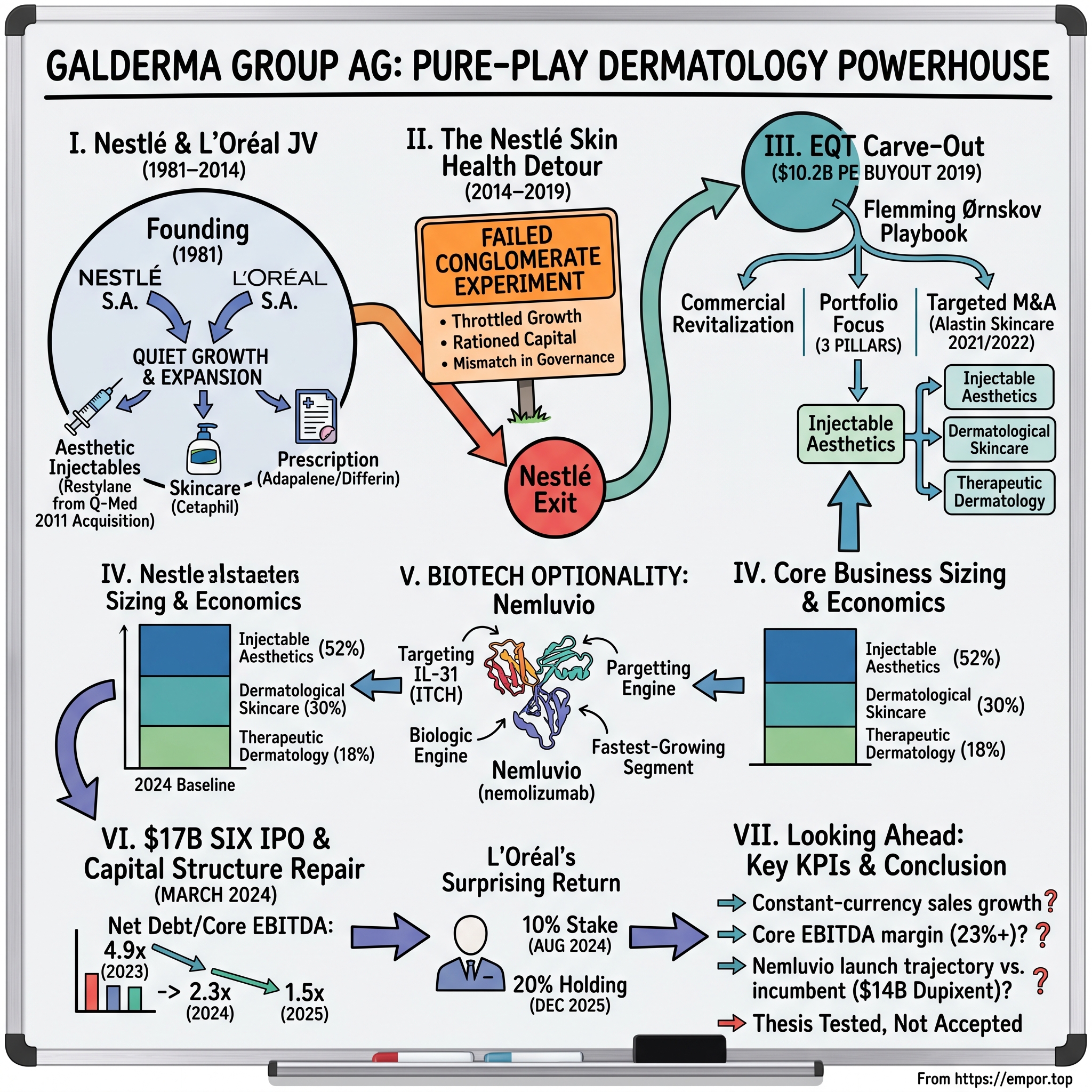
Galderma Group AG: The Pure-Play Dermatology Powerhouse
I. Introduction & Episode Roadmap
Picture a company that has been, in turn, a laboratory experiment run jointly by the world's largest food company and the world's largest cosmetics house; a neglected orphan shuffled between corporate parents who never quite knew what to do with it; a private-equity trophy loaded with more than ten billion Swiss francs of ambition and debt; and finally, one of the largest stock-market debuts Europe had seen in years. That company is Galderma Group AG, and its story is one of the more improbable arcs in modern healthcare — a business that spent four decades hiding in plain sight before anyone bothered to price it properly.
The hook is almost too neat. In 1981, Nestlé S.A. — the Swiss food titan behind Nescafé and KitKat — and L'Oréal S.A. — the French beauty empire — decided to pool their curiosity about skin and launch a 50/50 joint venture devoted entirely to dermatology. For over thirty years it grew quietly, compounding away in the background of two giants for whom it was, at best, a rounding error. Then, in 2014, Nestlé bought out its partner and tried to bolt the business onto a grand vision called "Nestlé Skin Health." That vision failed. By 2019 Nestlé had declared the whole thing outside its core and auctioned it to a consortium led by Sweden's EQT AB for CHF 10.2 billion.11 Five years after that, in March 2024, the reborn company listed on the SIX Swiss Exchange under the ticker GALD.SW at a market value near CHF 14.5 billion.3
Then came the twist that no screenwriter would dare invent. L'Oréal — which had sold its original half of Galderma to Nestlé a decade earlier — came back. In August 2024 it bought a 10% stake from the EQT consortium, and by December 2025 it had doubled that holding to 20%.56 The estranged co-parent had returned, this time as an arm's-length strategic shareholder in a company it once helped conceive.
Why does any of this matter to a long-term investor? Because dermatology occupies an unusually attractive corner of healthcare. It straddles three very different economic worlds at once: the cash-pay glamour of aesthetic injectables, where consumers pay out of pocket to look younger; the everyday loyalty of barrier-care skincare, where a bottle of Cetaphil sits in millions of bathroom cabinets; and the high-margin, patent-protected world of prescription biopharma, where a single new molecule can reshape a company's economics. Galderma is the only company operating at meaningful scale in all three simultaneously. That is the thesis worth testing — not accepting.
There is a reason the timing of this story is worth pausing on. Galderma is a young public company — barely two years on the exchange as of mid-2026 — which means most investors are meeting it for the first time without the accumulated context that makes its numbers legible. A casual glance sees a Swiss dermatology firm growing nicely with decent margins. A closer look sees something more unusual: a business that has been repriced four times by four different classes of owner, each of whom valued it on a different theory, and whose current valuation embeds a large, unproven bet on a single biologic drug. Understanding which theory is right requires understanding all four.
Here is the roadmap. We begin with the 1981 founding and three decades of quiet expansion. We then dissect the 2014 Nestlé takeover, the failed conglomerate experiment, and EQT's carve-out. We examine the playbook of Flemming Ørnskov, the specialty-pharma operator EQT installed to turn an orphan into an engine. We size the three core segments and their economics against a 2024 baseline and the fresher 2025 numbers. We probe the biotech option — Nemluvio, the itch drug that could re-rate the whole company — and ask whether the hype survives contact with a $14 billion incumbent. We walk through the IPO, L'Oréal's return, and the capital-structure repair. And we close with a structural analysis, a 7 Powers and Porter's stress test, and an honest bull-versus-bear reckoning. Throughout, the question is not whether Galderma tells a good story — it plainly does — but which parts of that story the evidence actually supports.
 Subscribe on LinkedIn
II. The Origins: Nestlé, L'Oréal, and the Birth of a Joint Venture (1981–2014)
Two of Europe's most powerful family-influenced corporations rarely sit at the same table. In 1974, Nestlé had already taken a large equity stake in L'Oréal, an arrangement designed partly to shelter the French cosmetics house during a politically turbulent era. Out of that unusual intimacy came a smaller, stranger idea. Skin, both companies realized, was a frontier neither owned alone. L'Oréal understood the surface of it — pigments, emulsions, the mass-market psychology of beauty. Nestlé wanted a foothold in higher-margin health sciences. In 1981 they split the difference and created Galderma as a fully integrated, 50/50 dermatology company, headquartered near the research cluster of Sophia Antipolis in the south of France.
The industrial logic was elegant on paper. L'Oréal, then guided by its principal shareholder Liliane Bettencourt, sought a medicalized extension of its cosmetics franchise — a way to speak to dermatologists, not just consumers. Nestlé, under the long shadow of Helmut Maucher, who took the helm in 1981 and became one of the defining European industrialists of his generation, wanted a beachhead in the "health and wellness" territory it would chase for the next four decades. (The precise personal roles of Maucher and Bettencourt in the founding are the stuff of corporate lore rather than press-release record, so treat them as the figureheads of the two parents rather than hands-on architects.)
There was also a subtler logic that only makes sense if you understand what dermatology is as a business. Skin is the body's largest organ, and it is unique in medicine because its conditions are simultaneously medical and cosmetic, chronic and visible, treated by specialists but also self-managed by consumers reaching for a drugstore cream. That dual nature is precisely what makes dermatology hard for any single kind of company to own. A pure pharmaceutical company understands the prescription but not the shelf. A pure cosmetics company understands the shelf but not the clinical-trial rigor and regulatory patience that prescription products demand. Galderma's founding premise was that a company purpose-built to sit astride both worlds could do something neither parent could do alone. It would take four decades and several changes of ownership before anyone proved the premise commercially — but the premise itself was sound from the start.
For most of its first three decades, Galderma did the unglamorous work of building a real pharmaceutical business one prescription at a time. Its foundation was topical prescription dermatology: acne, rosacea, and psoriasis — chronic, visible, under-treated conditions that dermatologists managed daily. The franchise that defined this era was adapalene, a synthetic retinoid marketed as Differin, and its combination successor Epiduo, which paired adapalene with benzoyl peroxide.29 Rosacea gave the company Metrogel and, later, the ivermectin cream Soolantra.29 None of these were blockbusters by big-pharma standards, but collectively they did something more valuable than any single hit: they built deep, durable relationships with board-certified dermatologists across dozens of countries. Galderma became a name a specialist trusted — a franchise built on the credibility of the prescription pad rather than the billboard.
That distinction matters more than it first appears, because it seeded the asset that would define the company's future. When you spend forty years sending sales representatives into dermatology practices, sponsoring the clinical studies specialists read, and earning a reputation for products that work, you accumulate something no marketing budget can buy overnight: standing with the exact physicians who write prescriptions and perform procedures. That accumulated credibility is the thread connecting the sleepy 1980s acne company to the 2020s biologics contender — the same dermatologists Galderma courted with Differin are the ones it now needs to convince to prescribe Nemluvio. Whether four decades of goodwill in topicals translates into pole position in high-cost biologics is an open question, but the relationships are real, and they are an asset the financial statements do not capture.
Inflection Point #1: The 2011 Q-Med acquisition. For thirty years Galderma was a prescription company. Then it made a move that quietly changed its DNA. In early 2011 it acquired Q-Med AB, a Swedish medical-technology firm founded by the chemist Bengt Ågerup, through a public tender offer that it raised to SEK 79 per share — valuing Q-Med at roughly SEK 7.9 billion, or about $1.2 billion.13 (A common retelling puts the price at $1.4 billion; that figure actually belongs to a separate 2014 deal in which Nestlé bought a bundle of filler and toxin assets from Valeant Pharmaceuticals, so it is worth keeping the two straight.14)
What Q-Med brought was not another prescription pad but a category. Its crown jewel was Restylane, the original stabilized hyaluronic-acid dermal filler, built on a proprietary process called NASHA — Non-Animal Stabilized Hyaluronic Acid. In plain terms: hyaluronic acid is a sugar molecule the body already makes, which binds water and gives skin its plumpness. Left alone it degrades in days. Q-Med's chemistry cross-linked and stabilized it into a gel that a physician could inject to smooth a wrinkle or restore volume, lasting months rather than days. The "non-animal" part mattered commercially as much as scientifically: earlier fillers derived from animal collagen carried allergy risk and required skin testing, while a synthetic, biocompatible hyaluronic acid could be injected on the spot, turning a multi-visit procedure into a lunch-hour appointment. That convenience was a large part of why the modern aesthetics market exploded.
That single technology dragged Galderma out of the reimbursed, insurance-mediated world of prescriptions and into the cash-pay world of aesthetic medicine — where the customer is also the payer, the decision is emotional, and the growth is driven by desire rather than diagnosis. The economics of the two worlds could hardly be more different. A prescription topical competes on formulary placement and faces generic cliffs; an aesthetic filler competes on the trust between a patient and an injector, gets paid for in full at the point of service, and enjoys pricing power that tracks consumer willingness to pay rather than an insurer's reimbursement schedule. It also put Galderma on a collision course with Allergan, whose Botox and Juvéderm franchises defined the market and whose commercial machine had a decade's head start. The company that had spent thirty years talking to dermatologists about acne was now selling beauty, one syringe at a time — and it had chosen, deliberately, to enter the one aesthetics segment where the incumbent was strongest. That reinvention set the stage for a far larger, and far more troubled, ownership drama.
III. The Nestlé Skin Health Detour & The $10B PE Buyout (2014–2019)
In February 2014, the decades-old marriage between Nestlé and L'Oréal was formally dissolved — at least as far as Galderma was concerned. In a single intricately engineered transaction, Nestlé acquired L'Oréal's 50% stake in Galderma at an enterprise value of roughly €3.1 billion (an equity value near €2.6 billion), taking full ownership.7 The payment mechanism revealed how tangled the two companies' balance sheets had become: rather than cash, Nestlé handed over L'Oréal shares, and in the same motion L'Oréal used the deal to buy back about 8% of its own stock from Nestlé, trimming the Swiss company's long-standing holding.7 The transaction completed that July.8
For Nestlé's leadership, this was not a divestment but a coronation. Chairman Peter Brabeck-Letmathe folded Galderma into the centerpiece of a new division — Nestlé Skin Health — built on the conviction that skin sat at the intersection of Nestlé's grand "Nutrition, Health and Wellness" strategy. The idea was to combine medical dermatology, consumer skincare, and even nutritional approaches to skin under one roof, creating a category-defining champion. It was a bold thesis. It was also, in hindsight, a category error.
Why the conglomerate model failed. The problem was structural, and it is a recurring one in corporate history: fast-moving, entrepreneurial businesses rarely thrive inside slow-moving giants. Aesthetic injectables live and die on the relationship between a sales rep and an individual injector — a plastic surgeon deciding this quarter whether to stock Restylane or Juvéderm. Consumer skincare moves at the speed of retail shelves and social media. Both were now governed by the capital-allocation rhythms and risk tolerances of a Swiss food conglomerate whose core competency was selling coffee and confectionery in enormous volume. R&D dollars were rationed against priorities set far from dermatology. Commercial aggression was muted. And while Galderma hesitated, Allergan — later swallowed by AbbVie Inc. — pressed its advantage in Botox and Juvéderm, extending a lead that would prove painfully hard to close.
There is a deeper lesson buried in this failure, and it is one long-term investors see repeatedly. Conglomerates do not fail their divisions through malice or incompetence; they fail them through the arithmetic of attention and capital. A Swiss food giant generating tens of billions in annual revenue simply cannot lavish board-level focus on a business a fraction of its size, no matter how promising. Its capital-allocation committees, tuned to the risk profile of coffee and bottled water, instinctively distrust the volatility of drug development and the marketing intensity of consumer aesthetics. And its compensation structures reward the executives running the big, safe businesses, not the ones fighting a scrappy war against Allergan. The result is predictable: the small, fast business is starved of exactly the ingredients — capital, autonomy, aligned incentives, urgency — that it needs most. Nestlé Skin Health was not sabotaged. It was simply neglected in the specific way large organizations neglect their most different children.
By 2018, Nestlé had a new chief executive, Mark Schneider, brought in from the healthcare company Fresenius with a mandate to sharpen the portfolio. Schneider was, by background, precisely the kind of executive who could recognize the problem — a healthcare operator running a food company, capable of seeing that a dermatology unit governed by packaged-goods logic would never reach its potential. He looked at Skin Health and reached the conclusion that the whole edifice sat outside Nestlé's core. He put it up for sale. The message was unmistakable: the grand vision of skin-as-nutrition had not worked, and Nestlé would rather have the cash than keep managing a business it did not understand.
Inflection Point #2: The 2019 EQT carve-out. What followed was one of the largest healthcare buyouts of the decade. In May 2019, Nestlé agreed to sell Nestlé Skin Health to a consortium led by the Swedish private-equity firm EQT AB and a wholly owned subsidiary of the Abu Dhabi Investment Authority, with Canada's PSP Investments alongside, for CHF 10.2 billion.910 The unit being sold had 2018 net sales of about CHF 2.8 billion and roughly 5,000 employees.9 The deal closed that October, and the consortium immediately did the most symbolically important thing available to it: it retired the "Nestlé Skin Health" label and restored the historic name — Galderma — declaring the business the world's largest independent global dermatology company.1112
The auction itself was fiercely contested. A carve-out of this size and quality — a global, profitable, brand-rich dermatology business — is exactly the kind of asset large buyout funds circle, and the process drew serious private-equity interest before the EQT-led group prevailed. That competitive tension is part of why the price landed where it did. Winning such an auction is a double-edged achievement: it validates the quality of the asset, but it also means the buyer paid a price set by the second-highest bidder's conviction, leaving little room for error.
Was CHF 10.2 billion a full price? Almost certainly. With segment EBITDA in the rough vicinity of CHF 550 million, the purchase implied a multiple in the high-teens-to-twenty range of trailing earnings — a rich valuation that only made sense if a buyer believed it could do what Nestlé had not: run the business faster, cut standalone corporate overhead, deleverage aggressively, and reignite commercial growth. (A frequently cited "~15x EBITDA" figure understates the true multiple and appears in no primary source.) In other words, EQT was not buying a cheap asset. It was buying a mispriced one — a good company trapped inside a bad owner — and betting that management, focus, and incentives could unlock the difference. The name of the executive it hired to make that bet would become inseparable from the Galderma story.
IV. The Flemming Ørnskov Transformation: Playbook & M&A (2019–2024)
When EQT needed someone to run a leveraged, orphaned dermatology company and turn it into a listable champion, it reached for a specialist in exactly that kind of surgery. Flemming Ørnskov is a Danish physician by training — an M.D. with a master's in public health — who had spent his career at the intersection of medicine and hard-nosed commercial execution.15 His defining act had come at Shire plc, the rare-disease specialist he led from 2013 to 2019, where he orchestrated the roughly $32 billion acquisition of Baxalta in 2016 and built Shire into a takeover target so attractive that Takeda eventually paid tens of billions to acquire it.1516 Ørnskov had a reputation as a relentless operator with a taste for M&A and a low tolerance for corporate drift — precisely the profile a private-equity owner wants pointed at a sleepy carve-out.
Ørnskov's Shire tenure is worth dwelling on, because it is the closest thing to a blueprint for what he tried to do at Galderma. Shire was itself a specialty-pharma roll-up — a company that grew by acquiring rare-disease and specialty assets, running them with commercial intensity, and building a portfolio attractive enough that a larger acquirer would eventually pay a premium for it. That is exactly what happened: Takeda ultimately bought Shire in a deal worth tens of billions. Ørnskov, in other words, had already run the full playbook of taking an under-appreciated specialty-healthcare business, sharpening its commercial edge, and delivering it to the market at a premium valuation. EQT was not hiring a caretaker. It was hiring a man who had done this specific thing before, and it was paying him to do it again.
He did not arrive alone. He brought Thomas Dittrich, another Shire alumnus, as chief financial officer, and rebuilt the senior ranks with operators seasoned in specialty pharma and med-tech rather than in packaged goods.16 The cultural signal was deliberate: Galderma would now be run like a focused healthcare company that had something to prove, not a division waiting for permission. For employees who had spent five years inside the slow-moving Nestlé apparatus, the change in tempo was jarring — decisions that once required layers of approval now happened in weeks, and the metrics that mattered narrowed to a handful the whole organization could recite.
The operational turnaround playbook. The Ørnskov playbook had two engines. The first was commercial revitalization. Sales incentive structures were overhauled to reward growth. The field force was reoriented from passive distribution toward direct, high-touch engagement with the injectors and dermatologists who actually drive volume in aesthetics. International expansion — particularly in North America and Asia-Pacific — was accelerated. The second engine was portfolio focus: low-margin, non-core assets were pruned, and capital was concentrated on three pillars the company would build the rest of its identity around — injectable aesthetics, dermatological skincare, and therapeutic (prescription) dermatology.
Inflection Point #3: Targeted capital deployment. Ørnskov's M&A under EQT was surgical rather than sprawling — a notable contrast with his acquisitive Shire years, and a sign that he read the Galderma situation as a focus-and-execute problem rather than a build-by-buying one. In late 2021 Galderma agreed to acquire Alastin Skincare, a physician-dispensed peri-procedural skincare brand built on patented TriHex Technology, completing the deal in January 2022.17 The strategic point of Alastin was not its modest standalone revenue but its fit: it slotted directly into the aesthetic injector's workflow, letting a clinic pair a filler or neuromodulator treatment with a branded pre- and post-procedure topical regimen — and capturing the margin on both. It was a bolt-on chosen for strategic coherence, not scale.
On the neuromodulator side, Galderma deepened its long-running partnership with Ipsen, which supplies the botulinum toxin Dysport for aesthetic use in key markets, while developing its own proprietary asset: a ready-to-use liquid botulinum toxin type A, RelabotulinumtoxinA, branded Relfydess and built on a formulation the company calls PEARL Technology.1833 The liquid formulation matters for a practical reason worth understanding: conventional botulinum toxins arrive as a freeze-dried powder that a clinician must reconstitute with saline before injecting — a fiddly, variable step that introduces room for inconsistency. A ready-to-use liquid removes that step, promising more consistent dosing and a smoother clinic workflow. It is exactly the kind of incremental, execution-oriented product improvement that can win share account by account. But it is worth flagging plainly that Galderma does not own its flagship toxin outright — Dysport is licensed from Ipsen — which is a structural dependence we will return to when we weigh the bear case.
Management credibility. How well did the playbook work? By the numbers that matter, it worked. Across the five years from 2019 through 2024, Ørnskov's team compounded net sales at a high-single-digit to low-double-digit constant-currency rate and pushed Core EBITDA past the symbolic $1 billion mark for the first time in 2024, at a 23.4% margin.1 Compensation was tied explicitly to the metrics the private-equity owners cared about — constant-currency sales growth, Core EBITDA expansion, and the execution of specific regulatory milestones such as FDA approvals. The result was a management team whose stated priorities and actual behavior lined up, quarter after quarter — the single most useful thing a long-term investor can observe. Whether that discipline survives the transition from private-equity ownership to public-market scrutiny is a separate question, and one the next chapters test. But first, the business itself deserves to be sized.
V. Core Business Sizing & Segment Economics
Strip away the ownership drama and the M&A choreography, and what is Galderma actually selling? The clearest way to see the company is to open its financials and follow the money into three distinct end-markets, each with its own customer, its own economics, and its own competitive war.
Financial anatomy. In fiscal 2024 — the last full year the outline treats as its baseline — Galderma reported net sales of $4,410 million, up 9.3% at constant currency, with Core EBITDA of $1,031 million at a 23.4% margin.1 The single most important qualitative fact behind that headline is the source of the growth: management characterized it as overwhelmingly volume-driven, with international markets delivering double-digit growth across all three categories.1 That distinction matters enormously. Growth that comes from selling more units to more patients reflects genuine end-market demand; growth that comes only from raising prices is a well that eventually runs dry. Galderma's mix pointed to the former — real demand, not just price inflation — which is exactly what a durable franchise should show.
By 2025, the picture had scaled further and faster. The acceleration was visible as the year unfolded: first-half net sales reached $2,448 million, up 12.2% at constant currency, and the nine-month figure hit $3,737 million, up 15.0% — a company that was speeding up rather than maturing.31 In full-year results reported in March 2026, Galderma posted net sales of $5,207 million — its first year above $5 billion — up 17.7% at constant currency, again primarily on volume, with Core EBITDA of $1,211 million at a 23.3% margin.2 We flag these fresher numbers because a 2026 reader should not mistake the 2024 baseline for the current state of the business; the trajectory has steepened rather than plateaued.
The most striking line in the 2025 results was not the top-line total but its composition. Therapeutic Dermatology — the sleepy, generic-pressured segment that grew just 6.1% in 2024 — exploded to 50.2% constant-currency growth in 2025.2 That single figure is the entire Nemluvio thesis made visible: a legacy prescription business, long treated as a value-eroding afterthought, suddenly transformed by a biologic launch into the fastest-growing part of the company. Whether that pace is sustainable or merely reflects the steep early ramp of a new drug is the question that dominates the rest of this story. But the direction of travel is unambiguous, and it changes how the whole business should be valued.
Rather than a chart, picture the 2024 revenue split as a pie cut into three unequal slices. The largest, at roughly half of sales, is Injectable Aesthetics — $2,299 million, up 9.6%. The middle slice, just under a third, is Dermatological Skincare — $1,331 million, up 10.7% and the fastest-growing of the three that year. The smallest, at just under a fifth, is Therapeutic Dermatology — $780 million, up a comparatively modest 6.1%.1 Each deserves its own dissection.
Segment 1: Injectable Aesthetics ($2,299M, ~52% of sales). This is the cash-pay heart of the company, and it splits into two roughly equal halves. Neuromodulators — the wrinkle-relaxing toxins — generated $1,285 million in 2024, up a brisk 11.8%, carried by Dysport in North America and select markets and, prospectively, by the proprietary liquid Relfydess.1 The competitive reality here is sobering: this is AbbVie's kingdom. Botox commands a majority-to-roughly-two-thirds share of the U.S. neurotoxin market by most third-party estimates — a dominance built over decades and reinforced by the fact that "Botox" is now a verb, the rare brand that has become the generic name for its entire category.27 That kind of linguistic ownership is a moat in itself: when a patient asks for "Botox" by name, the injector's default is set before the conversation begins. Galderma competes alongside Merz's Xeomin, Evolus's Jeuveau, and Revance's peptide-formulated Daxxify, which won FDA approval in 2022 on a promise of longer-lasting results.24 It is a crowded field of capable challengers, all fighting for the roughly one-third of the market Botox does not own, and the honest read is that Galderma is a strong number-two-tier player rather than a category leader in toxins — which is precisely why the owned liquid formulation and the biostimulator franchise matter so much to its aesthetics story. The second half, Fillers and Biostimulators, brought in $1,014 million, up a slower 7.0%.1 Here Galderma is genuinely strong: Restylane anchors the hyaluronic-acid filler suite, and Sculptra — a poly-L-lactic acid injectable — is a pioneer of "biostimulation," a concept worth pausing on. Rather than simply filling a hollow with gel, Sculptra provokes the skin to produce its own collagen over months, a slower but longer-lasting and more "natural" result. As consumer taste shifts from obvious volume toward subtle, self-generated rejuvenation, that positioning is a real asset — though AbbVie's Juvéderm and Merz's Belotero and Radiesse contest every account.
Segment 2: Dermatological Skincare ($1,331M, ~30% of sales). This is the trust business, and it operates on a completely different clock from injectables. Its anchor is Cetaphil, a sensitive-skin brand first formulated by a Texas pharmacist in 1947 and now sold in more than 70 countries — over 75 years of dermatologist recommendation compounded into one of the most ubiquitous names in barrier care.2532 The genius of a brand like Cetaphil is that it is boring in the best possible way: a gentle cleanser that a dermatologist recommends to a teenager with acne, a new mother worried about her baby's skin, and a retiree with rosacea, all for decades, building a habit that is nearly impossible to dislodge because the product carries no drama and every reason to keep buying it. It sits on pharmacy, food-and-drug, and e-commerce shelves worldwide, competing head-on with L'Oréal's CeraVe and La Roche-Posay, Beiersdorf's Eucerin and Aquaphor, and Kenvue's Neutrogena and Aveeno. That competitive set is instructive, because it is a reminder that Galderma's skincare franchise, however durable, is fighting some of the most sophisticated consumer-marketing organizations on earth — and CeraVe in particular has been one of the fastest-growing skincare brands of the past decade under L'Oréal's ownership. The irony that Galderma's most formidable skincare rival is now also its 20% shareholder is not lost on anyone.
The segment's second, higher-margin layer is Alastin, sold exclusively through plastic-surgery and dermatology clinics — a smaller but stickier business that cross-sells naturally with Restylane and Sculptra and carries meaningful switching costs for the clinics built around it. A clinic that has trained its staff and built its patient protocols around a peri-procedural regimen does not casually swap it out, and the product sits inside a workflow the clinic controls rather than on a shelf where a shopper can defect to a cheaper alternative. It is a small slice of revenue but a strategically pure one — exactly the kind of physician-dispensed, workflow-embedded product that reinforces the injectables franchise it sits beside.
Segment 3: Therapeutic Dermatology ($780M, ~18% of sales). This is the oldest part of the company and, until recently, the slowest. The legacy topical prescription portfolio — Epiduo, Soolantra, the acne treatment Aklief, the rosacea product Mirvaso — faces the inexorable arithmetic of generic erosion as patents lapse.29 That 6.1% growth in 2024 masked a business essentially treading water, with U.S. genericization offsetting gains elsewhere.1 Generic erosion is the oldest story in pharma, and there is no clever escape from it: once a molecule loses patent protection, cheaper copies arrive, and revenue that once flowed to the innovator flows instead to generic manufacturers and the patients and payers who benefit from lower prices. For a company whose therapeutic segment leaned on aging topicals, that dynamic set a low ceiling on growth — which is exactly why the segment looked, until 2024, like the least interesting third of the business.
The transformation of that judgment is the single most important development in Galderma's recent history. Bolted onto the tired topical franchise is a brand-new biologic engine, and in 2025 it turned the slowest segment into the fastest. A business that grows at 6% one year and 50% the next has not merely accelerated; it has changed character, from a value-eroding legacy portfolio into a growth-and-optionality story. That engine is important enough to warrant its own chapter.
VI. The Biotech Optionality: Nemluvio & The High-Margin Frontier
Every so often a company that markets itself as one thing turns out to be quietly incubating another. For Galderma — a business the market had filed under "aesthetics and skincare" — that hidden thing is a monoclonal antibody with an awkward name and an outsized ability to change the investment case.
What Nemluvio actually does. Nemluvio is the brand name for nemolizumab, a biologic drug originally discovered by Japan's 中外製薬 Chugai Pharmaceutical, to which Galderma holds worldwide rights outside Japan and Taiwan; in its home market Chugai sells the same molecule under the name Mitchga.35 That licensing structure is itself a fact worth holding onto: Galderma's most important growth asset is not something it invented, but something it in-licensed and then had the commercial conviction to develop and launch at scale — a bet on execution rather than discovery.
To understand why the molecule matters, you have to understand itch. Chronic, severe itch — the medical term is pruritus — is not a trivial nuisance; in conditions like prurigo nodularis it is a debilitating, sleep-destroying torment. The disease creates a vicious loop: inflammation triggers itch, the patient scratches, the scratching damages the skin into hard, intensely itchy nodules, and those nodules itch even more, driving still more scratching. Patients describe it as maddening, and it carries a heavy burden of sleep loss, anxiety, and depression. For decades the biology of itch was poorly mapped, which is why there were essentially no dedicated therapies. Nemluvio targets a specific receptor, IL-31 receptor alpha, and by blocking it interrupts the neuro-immune signaling loop that transmits the itch sensation and drives the associated inflammation.20 The analogy that helps: most anti-inflammatory biologics turn down the whole immune thermostat in a room; nemolizumab is aimed more precisely at the specific wire carrying the itch signal itself. IL-31 has even been nicknamed the "itch cytokine" for how directly it maps onto the sensation. In practice that translates to a distinctive selling point — rapid relief of itch, often within days rather than weeks — delivered by a subcutaneous injection roughly once a month.20 For a patient who has spent years unable to sleep through the night, speed of relief is not a marketing nicety; it is the entire value proposition.
The indications and the market. Nemluvio's clinical story unfolded quickly across 2024 and 2025. The U.S. FDA approved it for prurigo nodularis in August 2024 — based on the Phase 3 OLYMPIA program, and in a condition so underserved that only one rival biologic had reached it first — and then for moderate-to-severe atopic dermatitis in patients aged twelve and up in December 2024, opening a far larger market.1920 European approval for both indications followed in February 2025, with the UK and Switzerland close behind under the Access Consortium framework.21 The sequencing was strategically shrewd. By launching first in prurigo nodularis — a small, neglected market where it faced far less entrenched competition — Galderma could establish Nemluvio's real-world efficacy, build prescriber familiarity, and generate a body of commercial experience before wading into the vastly larger and more crowded atopic dermatitis arena. Atopic dermatitis is the prize: eczema is one of the most common chronic inflammatory skin diseases in the world, affecting a huge population across all ages, and it is the arena where the truly large biologic franchises — the multi-billion-dollar ones — are built. It is also, not coincidentally, the arena the incumbents defend most fiercely.
Why this re-rates the company — and the catch. The strategic significance is a matter of margin structure. Aesthetic fillers and skincare are good businesses, but a successful, patent-protected biologic operates at the rarefied gross margins of biopharma — commonly in the 80%-plus range. A meaningful biologic franchise would therefore not merely add revenue; it would lift the quality and durability of Galderma's entire earnings base and change the multiple the market is willing to pay. Management has leaned hard into this: after a strong atopic-dermatitis launch, Galderma roughly doubled its peak-sales projection for Nemluvio to more than $4 billion.30 That is a management estimate, not a fact, and it deserves the skepticism any peak-sales forecast earns. The verifiable numbers are more modest and more useful: Nemluvio recorded just $23 million of sales in 2024 as it launched, then scaled to roughly $452 million across 2025 — a rapid ramp, but still a fraction of the peak the company is promising.130 On patent duration, caution is warranted: the frequently repeated claim of exclusivity "into the late 2030s" is not cleanly documented in primary sources; what is confirmed is that the underlying Chugai patents are the subject of patent-term-restoration proceedings, which extend but do not precisely date the protection.28
The competition it has to beat. Here is the uncomfortable center of the bull case. Nemluvio is not entering an empty field — it is charging directly at Dupixent, the dupilumab biologic from Sanofi and Regeneron that generated $14.15 billion in global net sales in 2024 and grew 22%.22 Dupixent is one of the best-selling drugs on earth, with a decade's head start, an entrenched prescriber base spanning dermatology, allergy, and respiratory medicine, and a commercial machine of formidable scale. It has trained a generation of dermatologists to reach for it first, secured broad insurance coverage, and expanded into indication after indication, each one deepening its moat. Eli Lilly's EBGLYSS, an IL-13 inhibitor approved in September 2024, adds a second well-funded rival with the marketing budget of one of the world's largest pharmaceutical companies behind it.23
Nemluvio's differentiator — faster, more targeted itch relief and convenient monthly dosing against Dupixent's every-two-weeks schedule in some regimens — is real and clinically meaningful, and in prurigo nodularis specifically it competes on more even footing since that market is younger. But a better mechanism does not automatically win a market against an incumbent with a $14 billion franchise and thousands of sales reps who have spent years building relationships with the exact prescribers Galderma now needs to convert. Drug history is littered with clinically superior products that lost commercially because the incumbent's distribution and habit proved decisive. The decisive variable, in other words, is commercial execution: whether a company whose DNA was built on aesthetic injectors and pharmacy shelves can go toe-to-toe with the specialty-biologics playbook Sanofi and Regeneron have perfected over a decade. There is a genuine case that Galderma's deep dermatologist relationships — the ones it built selling acne creams for forty years — give it a warmer entry than a pure newcomer would have. There is an equally genuine case that selling a topical retinoid and selling a high-cost biologic that requires prior authorization and payer navigation are entirely different commercial sports. That tension is the single biggest open question in the entire Galderma story, and it will be answered in prescription data, not press releases. Which makes the timing of the company's leap onto the public markets all the more consequential.
VII. The $17B SIX IPO & L'Oréal's Surprising Return (2024–2026)
There is a particular kind of tension in the hours before a large IPO opens. The price is set the night before, the order book is closed, and everyone involved — the sponsors who have waited years for this exit, the bankers who staked their reputations on the range, the management team about to be judged by a public market that does not care about the private-company story — waits to see whether the first trade validates the bet or embarrasses it. For EQT, the stakes were unusually personal: this was the payoff on a CHF 10.2 billion wager placed at the top of the market five years earlier, through a pandemic that had briefly shuttered the very aesthetic clinics Galderma depended on. By early 2024, the firm had spent those years doing the unglamorous work — refocusing the portfolio, rebuilding the commercial engine, funding the Nemluvio bet — and it was time to show the market the result. On March 22, 2024, Galderma's shares began trading on the SIX Swiss Exchange, and the debut was emphatic.
The listing. The IPO priced at CHF 53.00 per share, the top of its range, and the stock opened at CHF 61.00 — a roughly 15% first-day pop that signaled real appetite for a scaled, growing, cash-generative dermatology pure-play.43 The offering was overwhelmingly primary: Galderma issued tens of millions of new shares to raise fresh capital, alongside only a token sliver of existing stock, for a placement volume of roughly CHF 2.0 billion, rising toward CHF 2.3 billion with the over-allotment.3 The implied market capitalization was about CHF 12.6 billion at the offer price and roughly CHF 14.5 billion at the opening — a figure often rounded up in the press toward the $17 billion mark, though $16 billion is nearer the mark at debut.3 Either way, it was the largest Swiss listing since 2017 and one of the larger global healthcare equity offerings in years.
The point of the proceeds. This was not an IPO designed to cash out sponsors — it was a balance-sheet repair. Galderma had been carried on the heavy debt load typical of a large leveraged buyout, and management directed essentially all of the primary proceeds toward paying it down. The effect was dramatic: net debt relative to Core EBITDA fell from 4.9 times at the end of 2023 to 2.3 times by the end of 2024, and continued down to roughly 1.5 times by the end of 2025.12 Deleveraging of that speed does two things for equity holders. It reduces financial risk, and it converts a rising share of operating cash flow from interest payments into reinvestment capacity — the compounding fuel a growth company actually wants. For a business that had been an LBO for five years, escaping the gravity of its own debt was the first order of business, and management executed it on schedule.
L'Oréal's irony-rich return. Then came the reunion. In August 2024, five months after the listing, L'Oréal announced it had acquired a 10% stake in Galderma, buying shares from the EQT-led consortium.5 The symbolism was extraordinary: ten years after selling its founding half of the company to Nestlé, L'Oréal was back on the register of the business it had helped create in 1981. And it was not finished. In December 2025 L'Oréal bought a further 10%, doubling its position to 20% and cementing itself as one of Galderma's largest shareholders.634 L'Oréal's chief executive Nicolas Hieronimus framed the logic plainly — aesthetics is "a key adjacency" to the core beauty business, and the 2024 investment had "proven very successful," so the group was eager to deepen the partnership.6
The arrangement is a study in commercial ambivalence. Alongside the equity, the two companies formed a scientific partnership pairing Galderma's clinical dermatology expertise with L'Oréal's depth in skin biology and evaluation methods.5 Yet they remain outright competitors on the shelf — Cetaphil against CeraVe, dermatological beauty against dermatological beauty. L'Oréal owns a fifth of a company whose skincare brands fight its own for the same consumers. A skeptical investor should note the tension embedded here: a 20% strategic holder is a stabilizing anchor and a validation, but it is also a large, sophisticated shareholder with its own agenda and its own competing products. The current register — EQT and its co-investors still significant, L'Oréal at 20%, Abu Dhabi's Luxinva and Canada's PSP alongside, and a public free float on SIX — is a crowded cap table whose incentives do not perfectly align. And it is worth naming the overhang plainly: the private-equity consortium that took the company public is still, years later, working down its position, and the way L'Oréal has stepped up to absorb those blocks has been fortunate for the share price. Not every future secondary placement will find so willing a buyer.
A word on management credibility. For a company barely two years public, the early evidence on management behavior is encouraging, and it is worth grading behavior rather than rhetoric. Through 2025, Galderma raised its full-year guidance at successive reporting points — a pattern of setting achievable targets and beating them, which is the opposite of the overpromise-underdeliver cycle that erodes trust.312 The narrative across the IPO prospectus, the earnings releases, and the leadership's public commentary has stayed consistent: the same three segments, the same emphasis on volume-led growth, the same deleveraging commitment executed on schedule. When management said it would use IPO proceeds to cut debt, it cut debt. When it set a Nemluvio ambition, it later raised rather than quietly walked back the number. None of this guarantees the future — and a raised peak-sales projection is still a projection — but consistency between what a management team says and what it does is precisely the behavioral signal long-term investors should weight, and so far the signal is positive. That complexity of ownership and the discipline of execution feed directly into the strategic lessons the whole saga offers.
VIII. Playbook: Business, Strategy, & Capital Allocation Lessons
Step back from the chronology and the Galderma story yields a handful of transferable lessons — the kind an investor can carry to the next carve-out, the next PE exit, the next "trapped asset" pitch.
The pure-play premium. The most durable lesson is the one embedded in the whole arc: focus is worth money. Inside Nestlé, Galderma was a conglomerate orphan — its growth throttled by mismatched governance, its capital rationed against coffee and pet food, its valuation invisible because it was never priced on its own. Freed and focused, the same assets supported a multibillion-franc public company with aligned incentives and dedicated capital. This is the perennial argument for the pure-play: undifferentiated conglomerates tend to trade at a discount to the sum of their parts because capital is allocated by committee and no division is fully accountable, while focused operators command a premium because incentives, talent, and reinvestment all point the same direction. Galderma is a near-laboratory demonstration of the gap between those two states — though the reader should remember that focus is a necessary condition, not a sufficient one. Plenty of focused companies still fail; what focus buys is the chance to be judged on your own merits.
The aesthetic and skincare flywheel. The second lesson is about how the three segments are meant to reinforce one another. The theory runs like this: a patient walks into a pharmacy and buys Cetaphil, building a baseline of brand trust; that trust, amplified by dermatologist recommendation, funnels some of those patients toward in-clinic prescription and aesthetic treatments; the aesthetic injection in turn creates demand for peri-procedural skincare like Alastin; and the clinic relationship deepens loyalty to Galderma's fillers and toxins. It is a genuinely coherent flywheel on paper. The honest caveat is that the loop is easier to draw than to prove — the consumer buying Cetaphil at a drugstore and the affluent patient getting Sculptra at a clinic are often different people, and Galderma has not published hard evidence quantifying the cross-sell. Treat the flywheel as a plausible strategic logic, not a demonstrated mechanism.
LBO as growth equity, not financial engineering. The third lesson reframes what EQT actually did. The caricature of private equity is cost-cutting and leverage — squeeze the asset, dress it up, flip it. EQT's Galderma looks different. The debt funded not asset-stripping but expansion: a bigger commercial field force, aggressive geographic push, and, most consequentially, the R&D and launch spend behind Nemluvio. That is closer to growth equity than classic buyout financial engineering, and it is a large part of why the business emerged from the LBO larger and faster-growing rather than hollowed out. Whether that was strategic foresight or a bet that happened to pay off is a fair debate — but the behavior is verifiable in the numbers.
Cash-pay versus reimbursed — a balanced risk profile. The final lesson is about where the money comes from, and it is genuinely attractive. Aesthetics and skincare are essentially 100% cash-pay: consumers reach into their own wallets, which shelters those revenues from government drug-price negotiation, insurer rebate games, and the reimbursement squeeze that haunts conventional pharma. The therapeutics business, including Nemluvio, plugs into traditional specialty-pharma reimbursement. Holding both means Galderma is neither fully exposed to consumer discretionary cycles nor fully exposed to healthcare pricing politics — a diversification of payer risk that few healthcare companies possess. The flip side, of course, is that it is also exposed to both. That duality is exactly what a rigorous competitive analysis has to weigh.
IX. Structural Analysis, 7 Powers, & Bull vs. Bear Stress Test
Strip the narrative away and ask the harder question: does Galderma actually possess durable competitive advantage, or is it simply a well-run company riding good end-markets? The frameworks of Hamilton Helmer's 7 Powers and Porter's Five Forces are useful precisely because they force that distinction.
7 Powers. Start with switching costs, which are strongest in injectable aesthetics. An experienced injector spends years mastering the specific handling characteristics of a filler platform — the viscosity, the flow, the way a particular gel sits under the skin — and their patients' outcomes ride on that muscle memory. Switching from Restylane to a rival means retraining and accepting unpredictable results, a real friction that protects the installed base. It is a genuine power, though a bounded one: it protects existing accounts far better than it wins new ones, and a young injector starting fresh has no such loyalty. Next, brand power, which is strongest in skincare. Cetaphil's 75-plus years of dermatologist endorsement make it a near-default recommendation, and Restylane's decades of clinical safety data as the pioneer hyaluronic-acid filler carry weight with cautious physicians.25 Then scale economies: a global salesforce spanning 90-plus countries and centralized manufacturing across Uppsala in Sweden, Alby-sur-Chéran in France, Baie-D'Urfé in greater Montreal, and Hortolândia in Brazil spread fixed costs over a large base.26 (Note the common error of citing an "Alfortville" plant — Galderma's French production site is Alby-sur-Chéran.) Finally, counter-positioning: Galderma's agility as a pure-play is, in theory, something its lumbering mega-pharma and mega-beauty competitors cannot easily replicate without cannibalizing their own structures. The weakest of the four claims is counter-positioning, since AbbVie's Allergan Aesthetics is itself a large, focused, well-run competitor — Galderma is not the only agile pure-play in the room.
Porter's Five Forces. Buyer power is split: high in mass skincare, where consumers face a wall of interchangeable options, but low in aesthetic injectables, where injector loyalty and physician recommendation blunt it. Supplier power is low — the raw hyaluronic acid and excipients are commoditized, with the value living in proprietary stabilization IP and sterile formulation. The threat of new entrants is low-to-moderate, because the regulatory barriers are formidable: fillers and toxins require rigorous FDA clearance, and a biologic like Nemluvio demands a multi-year, multi-hundred-million-dollar development path few can fund. The threat of substitutes is moderate — at-home devices and topical creams nibble at the edges but cannot replicate clinical efficacy. And competitive rivalry is unambiguously high: Galderma fights AbbVie in toxins and fillers, L'Oréal in skincare, and Sanofi/Regeneron in biologics, three separate wars against three of the most capable companies in their respective fields.
Myth versus reality. It is worth puncturing two pieces of the consensus narrative before scoring the bull and bear. The first myth is that Galderma is fundamentally an "aesthetics company" — a beauty play riding the tweakment boom. The reality, after 2025, is that the fastest-growing and potentially most valuable part of the business is a prescription biologic, and the market is increasingly pricing Galderma as a hybrid specialty-pharma-plus-aesthetics company rather than a pure consumer name. The second myth is that its toxin franchise is a proprietary crown jewel. The reality is more contingent: the workhorse neuromodulator, Dysport, is licensed from Ipsen, and Galderma's own liquid toxin, Relfydess, is still early in its commercial life.3318 Galderma does not fully own the single most important product category in its largest segment — a dependency that is easy to overlook when the numbers are good.
The bull case. The optimistic reading rests on three legs. First, biotech supercharge: if Nemluvio captures real share in prurigo nodularis and atopic dermatitis, the therapeutic segment could grow multiples from its 2024 base at biopharma gross margins, lifting the whole company's earnings quality and, potentially, its valuation multiple — a thesis the 2025 ramp toward roughly $452 million already partly validates.30 Second, consumer aesthetic resilience: structural tailwinds as younger demographics normalize "tweakments" and gravitate toward biostimulators like Sculptra, which sell a subtler, collagen-building result that fits changing tastes. Third, margin expansion: with the LBO debt largely repaid, operating leverage could push Core EBITDA margins from the low-23% range toward the high-20s over time, converting revenue growth into faster earnings growth. Underpinning all three is the payer diversification that lets the company lean on cash-pay aesthetics when drug pricing tightens and on reimbursed pharma when consumer spending softens.
The bear case — and the activist's questions. The skeptic's reading is equally coherent. First, commercial execution risk in biopharma: Galderma has never run a franchise against a $14 billion incumbent like Dupixent, and a slower-than-hoped Nemluvio uptake — from payer pushback, from Dupixent's expanding label, or simply from prescriber inertia — would deflate the single most important element of the re-rating story. The whole biopharma re-rating rests on a launch that is, as of mid-2026, still early. Second, macro sensitivity in aesthetics: cash-pay demand is discretionary, and a genuine consumer slowdown hits filler and toxin volumes directly, with no insurance floor to cushion the fall. The GLP-1 weight-loss wave complicates this picture, and it is very much live. On July 23, 2026, Galderma's chief executive told CNBC the company was seeing an early boost from the "Ozempic face" phenomenon, in which rapid GLP-1-driven weight loss hollows out facial fat and sends patients toward volumizing fillers and biostimulators.27 Practitioner surveys echoed the trend, with a large majority of clinicians reporting more patients seeking treatment for weight-loss-related facial changes.27 But the same drugs that hollow a face today could, at scale, reshape discretionary spending and body-image norms in ways no one can yet model — a tailwind and a wildcard at once.
Third — the classic activist concern — the private-equity overhang already flagged: large sponsor blocks still hang over the stock, and each placement tests the market's appetite. A skeptic would press further on several fronts. On governance and the cap table: a controlling-adjacent consortium plus a 20% strategic competitor is a complex ownership structure, and minority public shareholders sit behind sophisticated insiders whose exit timing they cannot control. On the toxin dependency: leaning on Ipsen for Dysport means a chunk of the flagship segment rests on a licensing relationship rather than owned IP. On margins: a Core EBITDA margin in the low-20s is respectable but not obviously evidence of pricing power — it may simply be the going rate for a business that must out-spend three deep-pocketed rivals on commercialization in three different markets at once, which is a reason margin expansion could prove harder than the bulls hope. And on the valuation itself: a company priced partly on a biologic still in its launch infancy carries the risk that the market has already paid for a success that has not yet been earned. None of these is disqualifying. All of them are reasons the story is a hypothesis to be tested against unfolding prescription data, margin trends, and sponsor behavior — not a conclusion to be assumed.
X. Epilogue, Key KPIs, & The Road Ahead
The arc is, in the end, a study in what focus and incentives can do to a good business that spent decades being run by owners who never fully believed in it. From a 1981 curiosity co-parented by a food company and a cosmetics house, through a failed conglomerate experiment, a ten-billion-franc leveraged buyout, and a headline IPO, Galderma arrived at 2026 as the only scaled pure-play spanning aesthetics, skincare, and prescription dermatology — with a biologic that could either vault it into the biopharma major leagues or expose the limits of its commercial reach.
For an investor tracking whether the story keeps compounding, three key performance indicators cut through the noise. The first is constant-currency net sales growth, the cleanest read on whether volume-driven demand across injectables and skincare is holding up; the company has been running in the high-single to high-teens range, and a durable slide toward low single digits would signal the end-market tailwind is fading. The second is Core EBITDA margin, the test of whether the pure-play premium translates into real operating leverage now that the debt is largely gone — watch for progress from the low-23% level toward the mid-to-high 20s, and treat stagnation as evidence that competitive spending is eating the gains. The third, and most decisive, is the Nemluvio launch trajectory — U.S. prescription fill rates in prurigo nodularis and atopic dermatitis — read alongside the net-leverage ratio. That single product is where the bull and bear cases are being settled in real time, and where the gap between management's $4 billion peak-sales ambition and the roughly $452 million actually booked in 2025 will either narrow convincingly or quietly stall.30
There is a broader lens worth holding as the story continues. Galderma today is really two companies wearing one ticker. One is a mature, cash-generative aesthetics-and-skincare business with genuine brand assets, real switching costs among injectors, and exposure to a consumer aesthetics market that is structurally growing but cyclically sensitive. The other is an early-stage specialty-biopharma company staking its future on out-executing two of the most formidable commercial machines in medicine. The first company largely funds and de-risks the second; the second is what could make the whole enterprise worth a great deal more — or, if the launch disappoints, what could leave the market feeling it overpaid for a promise. Investors are, in effect, underwriting both a proven operator and an unproven challenger in a single security, and the balance between those two identities will shift with every quarter of prescription data.
Galderma's transformation from sleepy joint venture to corporate orphan to leveraged buyout to listed pure-play leader is a genuine masterclass in portfolio focus and operational re-engineering — the part of the story that is already written and verifiable in the numbers. Whether it becomes an equally impressive masterclass in beating entrenched biopharma incumbents on their own turf is the chapter still being written, and the one that will determine whether the market's current view of the company proves too generous or not generous enough. It is the chapter worth watching most closely.
References
-
Galderma Delivers 2024 Record Net Sales of 4.410 Billion USD, Up 9.3% Year-on-Year at Constant Currency — Galderma Group AG Investor Relations, 2025-03-05 ↩↩↩↩↩↩↩↩↩
-
Galderma Delivers Record 2025 Results, Net Sales of 5.207 Billion USD — Galderma Group AG Investor Relations, 2026-03-04 ↩↩↩↩
-
Galderma Listed Its Shares on SIX Swiss Exchange — Largest Swiss IPO Since 2017 — SIX Group, 2024-03-22 ↩↩↩↩
-
Galderma Prices IPO at CHF 53 Per Share and Will Start Trading on SIX Swiss Exchange Tomorrow — Galderma Group AG, 2024-03-21 ↩
-
L'Oréal Groupe Acquires a 10% Stake in Galderma — L'Oréal Finance, 2024-08-05 ↩↩↩
-
L'Oréal Groupe to Reinforce Its Strategic Investment in Galderma With an Additional 10%, Bringing Its Holding to 20% — L'Oréal Finance, 2025-12-08 ↩↩↩
-
Strategic Transaction Approved by Boards of Nestlé and L'Oréal — Nestlé Global, 2014-02-11 ↩↩
-
Nestlé Acquisition of L'Oréal's 50% Stake in Galderma Completed — Nestlé Global, 2014-07-08 ↩
-
Nestlé Enters Into Exclusive Negotiations to Sell Nestlé Skin Health to a Consortium Led by EQT and ADIA — Nestlé Global, 2019-05-16 ↩↩
-
Consortium Led by EQT and ADIA Enters Exclusive Negotiations to Acquire Nestlé Skin Health — EQT Group, 2019-05-16 ↩
-
Nestlé Closes the Sale of Nestlé Skin Health — Nestlé Global, 2019-10-02 ↩↩
-
Galderma to Become the World's Largest Independent Global Dermatology Company After Completion of CHF 10.2 Billion Carve-Out — Galderma Group AG ↩
-
Statement by the Board of Directors of Q-Med in Relation to Galderma's Increased Offer of SEK 79 Per Share — GlobeNewswire, 2011-02-10 ↩
-
Valeant Pharmaceuticals to Sell Filler and Toxin Assets to Nestlé for $1.4 Billion — PR Newswire ↩
-
Ex-Shire CEO Flemming Ornskov Emerges as Galderma CEO After $10B Nestlé Spinout — Fierce Pharma ↩↩
-
Galderma Successfully Completes Acquisition of ALASTIN Skincare — Galderma Group AG, 2022-01-05 ↩
-
ASDS 2024: New Phase III READY-4 Data Demonstrate Long-Term Safety and Efficacy of Galderma's RelabotulinumtoxinA (Relfydess) — Galderma Group AG ↩↩
-
Galderma Receives U.S. FDA Approval for Nemluvio (nemolizumab) for Adult Patients Living With Prurigo Nodularis — Galderma Group AG, 2024-08-13 ↩
-
Galderma Receives U.S. FDA Approval for Nemluvio (nemolizumab) for Patients With Moderate-to-Severe Atopic Dermatitis — Galderma Group AG, 2024-12-13 ↩↩↩
-
Galderma's Nemluvio Approved in the European Union for Moderate-to-Severe Atopic Dermatitis and Prurigo Nodularis — Galderma Group AG, 2025-02-14 ↩
-
Regeneron Reports Fourth Quarter and Full Year 2024 Financial and Operating Results — Regeneron Pharmaceuticals, 2025-02-04 ↩
-
FDA Approves Lilly's EBGLYSS (lebrikizumab-lbkz) for Adults and Children 12 and Older With Moderate-to-Severe Atopic Dermatitis — Eli Lilly and Company, 2024-09-13 ↩
-
Revance Announces FDA Approval of DAXXIFY (daxibotulinumtoxinA-lanm) for Injection — Revance Therapeutics, 2022-09-08 ↩
-
Botox Maker Galderma Sees Early Boost From 'Ozempic Face' Trend as GLP-1 Use Climbs, CEO Says — CNBC, 2026-07-23 ↩↩↩
-
Determination of Regulatory Review Period for Purposes of Patent Extension; NEMLUVIO — Federal Register, 2025-08-26 ↩
-
Galderma Announces Availability of Soolantra (ivermectin) Cream — Galderma Group AG ↩↩↩
-
Galderma Doubles Nemluvio Peak Sales Projection to $4B-Plus After Strong Atopic Dermatitis Launch — Fierce Pharma ↩↩↩↩
-
Galderma Delivers Record First-Half 2025 Net Sales of 2.448 Billion USD — Galderma Group AG Investor Relations, 2025 ↩↩
-
Cetaphil Celebrates 70 Years of Healthy Skin — Galderma Group AG ↩
-
Galderma Welcomes Increased Equity Investment From L'Oréal — Galderma Group AG Investor Relations ↩
-
Chugai Announcement Regarding NEMLUVIO EC Approval — Chugai Pharmaceutical, 2025-02-17 ↩
 LinkedIn
 WhatsApp
 Reddit
 Hacker News
 Email
Email Kindle
 RSS Feed
 Spotify
 Apple Podcasts
 Amazon Music
 Audible
 YouTube