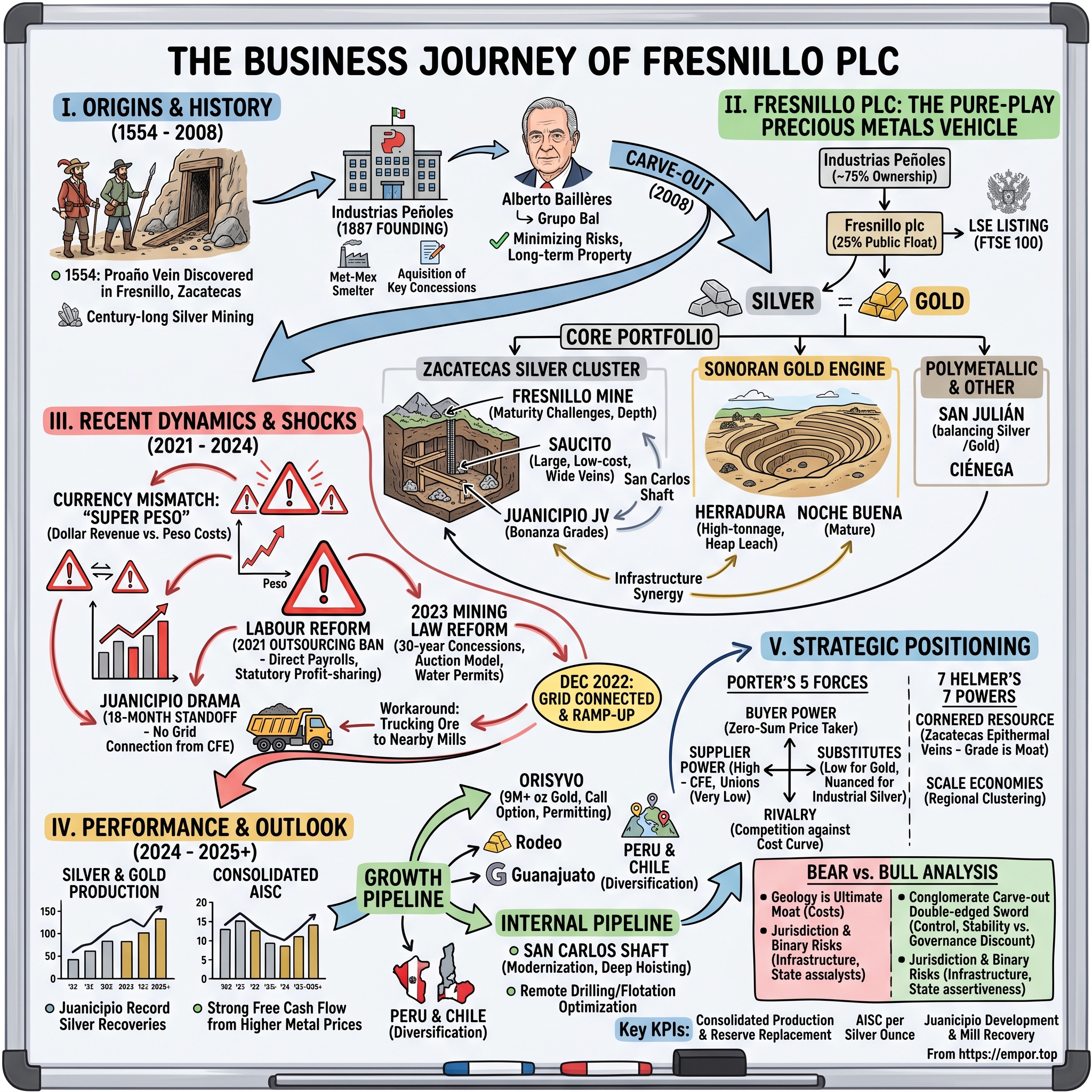
Fresnillo plc: The 500-Year Silver Giant Navigating Modern Mexico
I. Introduction & Episode Roadmap
Descend the shaft at the Fresnillo mine in the Mexican state of Zacatecas and the first thing you notice is the age of the rock — and the age of the enterprise digging into it. Miners have been pulling silver out of the Proaño hill here since 1554, when Spanish prospectors first cracked open an epithermal vein while Charles V still sat on the throne of a global empire.1 Kingdoms rose and fell, the Aztec world gave way to New Spain, New Spain gave way to an independent Mexico, and through all of it the same silver-bearing faults kept giving up their metal. It is one of the longest continuously mined ore districts on earth, and the modern company that owns it — Fresnillo plc — carries that geology as both an inheritance and a burden.
Here is the paradox that makes Fresnillo such a fascinating object of study. It is the world's largest producer of silver from ore and one of Mexico's largest gold miners.1 It trades on the London Stock Exchange, sits inside the FTSE 100, and reports in US dollars.2 Yet it is run out of Mexico City, its ore all comes out of a single country, and roughly three-quarters of its shares are held by one century-old Mexican industrial dynasty — the Baillères family, through their mining champion Industrias Peñoles and the family holding company Grupo Bal.1 So you have a London blue-chip that a British pension fund can buy in a click, wrapped around an asset base that is entirely captive to Mexican rock, Mexican politics, and Mexican family control. Tier-1 geology on one side of the ledger; concentrated single-country risk on the other.
The story we are going to tell runs along that fault line. We will start with the 500-year backstory and the 2008 carve-out that turned a division of Peñoles into a standalone precious-metals vehicle. We will walk the portfolio mine by mine — the deep silver veins of Zacatecas, the open-pit gold of the Sonoran desert, the polymetallic operations along the Chihuahua–Durango border — and try to size which assets actually generate the cash. We will dwell on the drama at Juanicipio, where a finished, world-class processing plant sat idle for a year and a half because a Mexican state utility would not flip the switch. We will map the macro headwinds — the "Super Peso," the outsourcing ban, the 2023 mining-law reform — that squeezed margins even as metal prices climbed. We will run the business through Helmer's 7 Powers and Porter's 5 Forces, weigh bull against bear, and finish with the handful of numbers that actually matter for anyone tracking this company.
A note on posture before we begin. Fresnillo's own investor materials are polished and, frankly, persuasive; management is technically credible and conservative by temperament. But our job here is not to echo the annual report. It is to separate what the company has proven from what it merely asserts, and to keep asking the uncomfortable question that geology alone can never answer: what happens to a magnificent orebody when the state that surrounds it decides to change the rules? That tension — extraordinary rock inside an increasingly assertive Mexican state — is the spine of everything that follows.
 Subscribe on LinkedIn
II. History & Corporate Origins: From Spanish Colonial Veins to LSE Carve-Out
Picture Zacatecas in the middle of the sixteenth century: a high, dry plateau at over 2,000 metres, days of hard travel from anywhere, worth crossing for exactly one reason. In 1554 prospectors located the Proaño vein in what would become the town of Fresnillo, and the district joined a silver belt that would eventually bankroll the Spanish crown and, some historians argue, help set global money prices for two centuries.1 For the next 300 years the work was brutal and manual — hand-dug adits chasing high-grade veins downward, ore hauled up on human backs. What matters for our story is not the romance of it but the durability: the same structural corridors that colonial miners chased are, in refined and mechanised form, the veins Fresnillo mines today. Geology this good does not get used up in a single lifetime, or ten.
The modern chapter begins in 1887 with the founding of Industrias Peñoles, which over the twentieth century assembled itself into Mexico's premier mining, smelting, and chemicals conglomerate.1 Peñoles did the patient, unglamorous work of aggregation — buying up concessions, consolidating the richest strike-lengths in central Mexico, and building the smelting and refining backbone (the Met-Mex complex at Torreón) that turns concentrate into saleable metal. By the time the company mattered on a global scale, it controlled a portfolio of precious-metals assets that no newcomer could ever assemble from scratch, because the ground was already spoken for.
The Baillères dynasty
Sitting above Peñoles was one of the most formidable figures in twentieth-century Mexican business: Alberto Baillères González. Through Grupo Bal he controlled not just Peñoles but the insurer Grupo Nacional Provincial, the luxury department-store chain El Palacio de Hierro, and the pension manager Profuturo — a sprawling private empire built with a financier's patience and a collector's eye for scarce, franchise-quality assets.11 Baillères treated mineral concessions the way he treated everything else: as long-duration property to be held, not flipped. He was the driving force behind the decision to give the precious-metals crown jewels their own public listing. In April 2021 he handed the presidency of Grupo Bal to his son, Alejandro Baillères Gual, and in February 2022 Alberto died in Mexico City at the age of 90, closing out more than half a century at the helm.11 The dynasty, and its grip on Fresnillo, passed to the next generation intact.
The 2008 carve-out
The pivotal corporate event came in May 2008, when Peñoles floated its precious-metals operations as Fresnillo plc on the London Stock Exchange, raising on the order of two billion dollars and immediately entering the FTSE 100.2 Read the structure carefully, because it defines everything about how this company is governed. Peñoles did not sell the business. It carved out roughly a quarter of the equity to the public market, kept about 75% for itself, and retained on its own books the base-metals mines, the smelters, and the chemicals operations.1 What London bought was a pure-play precious-metals vehicle — silver and gold, cleanly separated from lead, zinc, and industrial chemistry — with the liquidity and index membership that a Mexican listing could never offer.
Why do it this way? For Peñoles, a London listing put a transparent, dollar-denominated market price on its best assets, gave it a currency for future capital raising, and broadened the shareholder base without surrendering an ounce of control. For the incoming minority investor, the appeal was equally clear: direct, liquid exposure to the highest-grade silver district on the planet, run by an operator with a five-century head start. But the same structure that made the IPO attractive also hard-wired a permanent feature into the stock — a controlling shareholder who would set board composition, dictate capital allocation, and sit on both sides of significant commercial arrangements. That is not a scandal; it was disclosed from day one. It is, however, the single most important thing to understand before owning a share, and we will return to what it costs minority holders when we reach governance. For now, hold onto the shape of the deal: a global-market wrapper bolted onto a family-controlled, single-country orebody. The next question is what, exactly, that orebody contains.
III. Mine-Level Segment Economics & Core Portfolio
If you want to understand Fresnillo, forget the corporate map for a moment and think in two colours. There is silver, which comes mostly from deep, narrow, high-grade underground veins in a tight cluster around the town of Fresnillo in Zacatecas. And there is gold, much of which comes from vast, shallow, low-grade open pits in the Sonoran desert hundreds of kilometres to the northwest. These are almost opposite kinds of mining — one is precision surgery a kilometre underground, the other is industrial-scale earthmoving under the sun — and the company's economics are the blend of the two. In recent years silver and gold have each contributed on the order of 40–50% of revenue, with lead and zinc by-products topping up the rest; in 2025 the two metals delivered roughly 48.7 million ounces of silver and 600,000 ounces of gold.3 The trick to reading the business is to size assets not by acreage but by cash generated, and to notice how the mix shifts with metal prices.
The Zacatecas silver cluster — the crown jewels
The Fresnillo mine itself is the historical cornerstone: an ultra-deep, high-grade vein system that has thrown off cash for generations and still anchors the silver franchise. Its challenge is precisely its maturity. As the shafts chase the veins deeper, grades dilute and the logistics get harder — every tonne has to be hauled a longer distance to surface. Management's answer has been the San Carlos shaft, a deep-hoisting project meant to replace slow truck haulage with fast vertical hoisting and relieve the bottleneck; we will see later how that plays into the credibility question, because deep-mine capital projects are exactly where mining companies tend to slip on timing.
Saucito, commissioned in 2011, became one of the world's largest and lowest-cost primary silver mines almost immediately, on the strength of unusually wide, rich veins.1 Then came Juanicipio, the newest tier-1 asset, a bonanza-grade silver-gold system sitting right next to Saucito — so high-grade that even a modest tonnage delivers an outsized ounce count at a very low unit cost. Juanicipio is the reason Fresnillo's consolidated cost curve has improved even as the older mines age, and it earns its own section shortly because the story of how it came online is the best single window into the company's operating environment.
The open-pit gold engine — Sonora
Nine hundred kilometres away, Herradura is a different animal entirely: a massive open-pit, heap-leach gold operation where low-grade ore is stacked in enormous pads and percolated with cyanide solution to strip out the gold. It is high-tonnage, cash-generative, and — crucially — it gave Fresnillo a gold engine that could carry the company through the long silver bear market of the mid-2010s. In the first half of 2025, Herradura's optimisation and strong pad recovery drove group gold production up almost 16% and cut its all-in sustaining cost by roughly 28%, a reminder of how much diversification the Sonoran gold provides when silver stumbles.13 Its smaller sibling, Noche Buena, is a mature open pit moving through its final leaching phases toward end-of-life.
Polymetallic and regional operations
Straddling the Chihuahua–Durango border, San Julián was discovered and built organically, with two plants — one treating vein ore, one treating a disseminated ore body (the "DOB") — balancing gold and silver output. The DOB's planned closure in 2025 knocked group silver production down nearly 12% in the first half of that year, a clean illustration of how a single asset reaching the end of its life ripples straight into the consolidated numbers.13 Ciénega, in Durango, is a complex, long-lived underground gold-silver mine that rounds out the portfolio.
Cost structure
The economics of all this come down to a distinction every mining investor learns: cash cost versus all-in sustaining cost (AISC). Cash cost is what it takes to get an ounce out of the ground and processed; AISC adds the sustaining capital, the development, the corporate overhead — the true recurring cost of staying in business. For Fresnillo the AISC line is driven by diesel for haulage, steel grinding media for the mills, cyanide for leaching, and the sheer energy of moving rock up out of deep shafts. The company's structural advantage is scale and clustering: in Zacatecas, several mines feed centralised milling and flotation, spreading fixed costs across more tonnes than any junior could dream of. The Sonoran pits, standing alone in the desert, don't get that benefit — but their grades are cheap to leach. Understanding where each ounce sits on that cost curve is the whole game, and no single asset illustrates the stakes better than the one built last. That is where we turn next.
IV. The Juanicipio JV Drama & Mexican Infrastructure Bottlenecks
By late 2021, the picture at Juanicipio should have been a triumph. Fresnillo and its partner had spent years developing what is, by grade, one of the best silver discoveries of the century — a bonanza epithermal vein system in the Valdecañas structure, sitting so close to the existing Saucito infrastructure that the geology practically volunteered itself.[^6] The processing plant was finished, on schedule, ready to turn ore into concentrate. And then nothing happened, because the one thing Fresnillo could not build itself was a connection to the national power grid.
The joint venture and the discipline lesson
First, the structure. Juanicipio is a joint venture — 56% Fresnillo, which operates it, and 44% held by the Canadian-listed MAG Silver.[^6] The way Fresnillo got here is worth pausing on, because it is a quiet rebuttal to how much of the mining industry behaves. Fresnillo did not win Juanicipio in a bidding war or overpay in a top-of-cycle acquisition. It earned its operator's majority through early exploration and development alongside MAG, so that by the time the deposit was proven to be world-class, Fresnillo already controlled it at cost rather than at auction prices. In an industry littered with mega-deals that destroyed capital by buying discovered ounces at a premium, growing into a tier-1 orebody through the drill bit is the disciplined path — and it is the clearest evidence for the "capital discipline" the company likes to claim for itself.
The 18-month standoff
Now the drama. In December 2021, with the plant essentially ready, Mexico's state power utility — Comisión Federal de Electricidad, the CFE — declined to grant final approval for the tie-in to the national grid.[^7] The stated reason was administrative and pandemic-related: CFE said it lacked the staff to review the existing installation, supervise the physical connection, and approve the blackout-prevention equipment.[^7] The delay was floated as a matter of months. It stretched on far longer, and it landed against an unmistakable political backdrop. President Andrés Manuel López Obrador's administration was in the middle of a sustained push to reassert the primacy of state energy monopolies, and private power interconnections across the country found themselves waiting on approvals that had once been routine. Whatever the official framing, a finished, cash-ready plant sat dark while the metal stayed in the ground.
The workaround
Here is where the operating team earned its pay. Rather than let the ore — some of the richest they had ever touched — sit idle, Fresnillo trucked high-grade development ore from Juanicipio to the nearby Fresnillo and Saucito mills, which happened to have spare processing capacity.6 It was not elegant and it was not the full economic prize, but it kept the ounces flowing and demonstrated the practical value of owning a dense cluster of infrastructure in one district: when one node is blocked, you route around it. It is a small case study in why the Zacatecas clustering matters beyond unit costs — it buys operational optionality when the state throws sand in the gears.
Resolution and ramp-up
Finally, in late December 2022, after Fresnillo completed additional electrical testing that CFE had requested to verify the compatibility of new and legacy substation equipment, the system was energised and full commissioning began, with the plant targeting nameplate capacity through 2023.7 From there Juanicipio ramped into exactly what the geology promised: a low-cost engine of consolidated silver production. By 2025 the operation was posting record-breaking silver recovery rates and had become a prime driver of the group's improving cost profile.3 The episode resolved happily, but the lesson should not be sanded off in the retelling: a world-class asset was held hostage for a year and a half by a piece of infrastructure the company did not control, in a country where the government had made control of energy an ideological priority. That is not an operational risk you can drill your way out of — and it is a preview of the broader regulatory weather we turn to now.
V. Macro Shocks, Mexican Regulatory Headwinds, & Risk Radar
For most of 2022 through 2024, Fresnillo lived through a peculiar kind of frustration: metal prices were strong, and yet margins kept getting squeezed. The culprit was hiding in the exchange rate. This section is the risk radar — currency, labour law, mining law, and physical security — and each one traces back to the same root fact that the introduction flagged: the orebody is captive to Mexico, and Mexico had become a more expensive and more assertive place to operate.
The "Super Peso"
Start with the currency mismatch, because it is structural and unglamorous and quietly powerful. Fresnillo sells silver and gold into global markets, so essentially 100% of its revenue is priced in US dollars. But a large share of its costs — labour, local contractors, domestic suppliers — is incurred in Mexican pesos.3 For years the peso was a cheap-cost tailwind. Then came the "Super Peso": from 2022 into 2024 the currency strengthened markedly against the dollar, driven by high Mexican interest rates and nearshoring inflows. When the peso rises, every peso-denominated cost translates into more dollars, so AISC inflates even if nothing changes on the ground. The company was earning strong dollar prices for its metal while watching its dollar cost base climb for reasons that had nothing to do with mining efficiency. It is the cleanest example of why a single-country cost base is a genuine exposure and not a footnote — you can run a flawless mine and still lose margin to a macro variable set in Mexico City.
The 2021 outsourcing ban
Next, labour. On 23 April 2021, Mexico published a sweeping reform that outlawed most corporate subcontracting, requiring companies to move genuinely outsourced personnel directly onto their own payrolls within a three-month window.10 For a mining company that had historically run substantial parts of its operation through contractors, this was not a paperwork exercise. It meant absorbing large numbers of workers as direct employees, with the full weight of Mexican labour obligations attached — including statutory profit-sharing (the PTU, which entitles workers to a share of company profits) and union contract exposure. The reform lifted wages for previously outsourced workers by an estimated 6–13% economy-wide,10 and for Fresnillo it meant a structural step-up in direct labour cost that does not reverse when metal prices fall. Combined with the Super Peso, it re-based the cost curve upward at precisely the wrong moment in the cycle.
The 2023 mining-law reform
Then came the big one. In 2023, the López Obrador government pushed through a substantial overhaul of the Mining Law. New concessions would run 30 years instead of 50, be awarded by public auction rather than to whoever pegged the ground first, require environmental, social, and water permits up front, and carry an obligation to pay at least 5% of net profits to affected communities; concessions in protected natural areas were banned outright, and water-use permits for mining were tightened sharply.8 On paper this is a meaningful chilling of the greenfield exploration model that built companies like Fresnillo in the first place.
How much does it actually bite? Here is where you have to weigh management's claim against the mechanism. Fresnillo told the market it did not expect a material impact, noting that its existing operations were already fully permitted and that the average remaining term on its concessions was around 28 years.917 That is a fair point for the assets already in production — they are effectively grandfathered. The sharper edge is on the pipeline: a company whose entire strategy is finding and developing new deposits in proven belts now faces a slower, more contested, more expensive path to turning discoveries into mines. The reform doesn't threaten the cash flow of today. It taxes the optionality of tomorrow, and it does so in the one jurisdiction where all of Fresnillo's optionality happens to sit.
Security on the ground
Finally, the physical risk that rarely makes the headline metrics. Zacatecas and parts of Sonora have been among the more security-challenged regions of Mexico, which turns mundane logistics — moving concentrate by road, protecting employees, maintaining community relations — into a real operational discipline. It is hard to quantify and Fresnillo does not dwell on it, but it belongs on any honest risk radar: the same remoteness that keeps the orebody scarce also keeps it exposed. All of which raises the question of who is steering the company through this weather, and whether their track record earns trust. That is the governance question.
VI. Current Management, Governance, & Capital Allocation
Spend time with Fresnillo's leadership and a consistent personality emerges: technical, cautious, allergic to the swashbuckling deal-making that periodically seizes the mining sector. That temperament is the company's signature, and whether you find it reassuring or limiting is close to a Rorschach test for what kind of investor you are.
The executives
Chief executive Octavio Alvídrez has run Fresnillo since 2012, and he is the archetypal insider: before taking the top job he had been head of investor relations at parent Peñoles, so he understands both the rock and the capital markets that price it. His style is conservative and organic-growth-oriented — a preference for finding ounces through the drill bit in belts the company already knows, rather than chasing splashy international M&A.3 Above him sits Alejandro Baillères Gual as chairman, representing the family's controlling interest through Peñoles.11 The pairing tells you the culture: an operator who thinks in decades, reporting to an owner who thinks in generations.
Credibility through behaviour
The right way to judge management is by what they do over time, not what they say on any single call. On strategy, Fresnillo has been genuinely consistent — brownfield exploration in proven historic belts, no lurches into unrelated geographies, no bet-the-company acquisitions. That consistency is real and, in a sector famous for value destruction at the top of cycles, it counts for something.
But consistency of strategy is not the same as reliability of execution, and here the record is more mixed. Fresnillo has a history of missing operational guidance, and the causes recur: labour availability, ground-support challenges in the aging shafts at Saucito, and, of course, the CFE grid delay that stalled Juanicipio.13 A skeptic's read is that the company has repeatedly set targets it then had to walk back for reasons that, while often external, were also foreseeable in a mature underground portfolio. The more generous read is that management has been candid about the misses and specific about the fixes — the San Carlos shaft to solve deep haulage, the recovery optimisation that turned Juanicipio into a record-setter. The honest assessment sits in between: this is a credible operator that tends to be optimistic on timing, and investors should discount its guidance dates accordingly.
The related-party question
Now the governance discount, which is where a controlled company earns its skeptics. Fresnillo does substantial business with its own controlling shareholder. It sells lead and zinc concentrates to Peñoles' Met-Mex smelter at Torreón under long-term commercial agreements — a rational arrangement given the smelter's proximity, but also, unavoidably, a related-party transaction where the counterparty controls the board. The cleaner recent example is the Silverstream Contract: a financial arrangement dating to the 2008 IPO that gave Fresnillo economic exposure to silver produced at a Peñoles mine. In 2025 Peñoles bought the contract back for US$40 million, a transaction that crystallised a US$133 million after-tax loss for Fresnillo but removed its exposure to that mine's operational difficulties.13 Reasonable people can debate whether minority holders got the better or worse end of that deal — and that debate is exactly the point. When roughly 75% of the votes belong to your commercial counterparty, minority investors are structurally dependent on the fairness of independent directors and disclosure they cannot ultimately control. An activist would call this the permanent overhang on the equity, and they would not be wrong.
Capital allocation
Where the family control arguably serves minority holders well is the balance sheet. Fresnillo runs a conservative dividend policy — a stated commitment to return between 33% and 50% of profit after tax each year, split roughly one-third at the interim and two-thirds at the final.3 Crucially, the payout flexes with profits rather than being propped up by debt. When profits fell 54% in 2023, the dividend was cut hard rather than defended with borrowing.12 When 2024 and 2025 delivered windfall metal prices, the company topped up ordinary dividends with special payouts — total distributions of roughly US$547 million for 2024 and about US$950 million for 2025 — all while sitting on a net cash position of around US$1.9 billion at the end of 2025.153 That is the discipline of an owner who intends to hold through the entire commodity cycle and has no interest in a solvency scare at the bottom of it. It is genuinely conservative capital allocation — and it is one area where the interests of the family and the minority happen to align. With that stability established, the question becomes what the company is doing to grow, and how speculative those bets really are.
VII. Pipeline, New Opportunities, & Speculative Optionality
Every mining company sells investors a dream of the next great mine, and the discipline of reading one lies in refusing to let that dream crowd out the cash-generating present. Fresnillo's pipeline is real, but it is mostly long-dated optionality — the kind of thing that matters over a ten-to-twenty-year horizon, not next quarter. Keep it in proportion.
Orisyvo
The headline prospect is Orisyvo in Chihuahua, a genuinely enormous gold deposit holding something north of nine million ounces.3 On resource size alone it would be a company-maker. But the reasons it remains a project rather than a mine are instructive: the grade is low, the metallurgy is complex (the ore is not the kind you simply crush and leach), the topography is remote, and the capital intensity is daunting. Orisyvo is a call option on gold prices, metallurgical innovation, and — given the 2023 mining-law backdrop — a permitting environment willing to green-light a large new operation. Any one of those going wrong keeps it on the shelf. It is strategically significant precisely because it is optional, and it would be a mistake to value it as if it were coming online soon.
Earlier-stage and international
Behind Orisyvo sit earlier prospects — Rodeo and exploration around Guanajuato — that function as reserve-replacement candidates, the ongoing work of finding tomorrow's ounces to replace today's depletion. Reserve replacement is the treadmill every miner runs: deplete an orebody, and you must find its equal just to stand still. And then there is a small greenfield exploration presence in Peru and Chile — modest in scale, but strategically interesting as the only real hedge against the single-country concentration that defines the rest of the company. Whether that hedge ever amounts to anything is unproven; for now it is a toe in the water, not a diversification.
Modernising underground
The least glamorous but most consequential pipeline is inside the existing mines. The San Carlos shaft at Fresnillo is the flagship modernisation project — a deep hoisting shaft meant to bypass the truck-haulage bottleneck that slows a deep mine as it ages. Alongside it sit remote-controlled underground drilling and flotation-circuit optimisation, all aimed at the same enemy: grade decline. As the historic veins are worked, the company must run more tonnes through the mills just to hold output flat, and technology is the lever for doing that without letting unit costs run away. This is where the near-term value actually lives — not in a nine-million-ounce dream in the Chihuahua highlands, but in shaving cost and defending grade at the mines already turning rock into cash. Which brings us to the deeper question: what, structurally, protects this business at all?
VIII. Strategic Frameworks: Helmer's 7 Powers & Porter's 5 Forces
Strip away the narrative and ask the cold-blooded question an analyst has to answer: does Fresnillo have a durable advantage, or is it just a well-run company sitting on good rock at a favourable point in the cycle? Two frameworks help — Hamilton Helmer's 7 Powers and Porter's 5 Forces — and applied honestly, they cut in a specific and somewhat counterintuitive direction.
Helmer's 7 Powers
The dominant power here is Cornered Resource, and it is close to a textbook case. Fresnillo owns the highest-grade silver epithermal veins in the Zacatecas silver belt — an orebody that, as we have seen, has been productive since 1554 and cannot be replicated by a competitor no matter how much capital they raise.1 You cannot build the Fresnillo district; you can only own it, and Peñoles pegged that ground generations ago. When people say "geology is the moat," this is precisely what they mean: a scarce, high-quality resource that confers a structural cost advantage no amount of competitor spending can erode. It is the single most important fact about the company.
The second power is Scale Economies, but a regional and specific kind. In Zacatecas, clustered mines share centralised milling, flotation, haulage, and tailings infrastructure, driving unit costs per tonne below what a standalone junior could achieve.1 We saw the operational side of this during the Juanicipio standoff, when spare mill capacity absorbed stranded ore. The third, softer power is Process Power — five centuries of institutional knowledge about how these particular fault structures behave and how this particular ore responds to metallurgy. It is real but hard to measure, and one should be careful not to over-credit it; know-how leaks, and modern mining engineering is broadly available.
Notice what powers Fresnillo does not have. It has no Network Economies, no Switching Costs, no Branding power — a buyer of silver could not care less whose mine it came from. Its moat is entirely on the supply side, embedded in the rock. That is a strength (it is durable) and a limitation (it does nothing to protect the price the company receives).
Porter's 5 Forces
Porter sharpens exactly that point. Bargaining power of buyers is essentially zero-sum against the miner in a useful way and against the buyer in another: precious metals are pure global commodities sold at spot prices set on the LBMA and increasingly influenced by Eastern demand centres such as the 上海黄金交易所 Shanghai Gold Exchange. No single buyer can push Fresnillo around — but neither can Fresnillo command a premium. It is a price-taker, full stop. Bargaining power of suppliers, by contrast, is uncomfortably high: the company depends on the state utility CFE for power (a dependence that cost it 18 months at Juanicipio), on specialised labour unions whose leverage the 2021 reform increased, and on suppliers of cyanide, steel, and heavy equipment. The supply side is where Fresnillo is genuinely squeezed.
The remaining forces favour the incumbent. Threat of new entrants is very low — extreme capital intensity, decade-long permitting cycles, and the plain fact that the best belts are already pegged. Threat of substitutes is low for gold but more nuanced for silver: gold's role is monetary and cultural and hard to displace, while roughly half of silver demand is industrial — solar photovoltaics, power electronics, high-frequency infrastructure — which cuts both ways. Industrial demand is a growth story (every solar panel needs silver), but it also means substitution and thrifting are live risks if silver prices spike and engineers design the metal out. Competitive rivalry, in the customer sense, barely exists: miners don't compete for buyers, they compete against the cost curve. Fresnillo wins that race not by out-marketing anyone but by sitting near the bottom of the curve thanks to its grades.
Put the two frameworks together and the verdict is coherent: Fresnillo has a powerful, durable, supply-side moat around its costs, and essentially no protection on its prices. It is a low-cost owner of an irreplaceable resource, wholly exposed to the volatility of the metals it sells and to the demands of the state and suppliers that surround it. That is the structural reality underneath the bull and bear cases we build next.
IX. Analysis & Bear vs. Bull Case
So where does that leave a long-term investor trying to decide whether Fresnillo wins from here? The neutral spine of the story is this: an irreplaceable, low-cost silver-and-gold orebody, run by a disciplined but timing-optimistic operator, delivering strong cash returns when metal prices cooperate — all wrapped inside a single-country jurisdiction that has grown more expensive and more assertive, and a controlling-shareholder structure that permanently caps the minority's influence. The stock's own recent behaviour captures the leverage: through a silver rally, Fresnillo shares roughly doubled over the year into mid-2026, carrying its market value to around £20 billion and cementing its place as a FTSE 100 heavyweight.14 That is the two-way bet in a single price chart. Now let's make each side explicit and test it.
The bull case
The bull owns Fresnillo for the rock. This is the world's premier primary-silver asset base, with long reserve life in high-grade underground veins that no competitor can duplicate — the Cornered Resource made liquid. On top of that sits genuine operating leverage: because so much of the cost base is fixed, a rising silver price flows disproportionately to the bottom line, which is exactly what the 2024–2025 results showed, with revenue climbing to roughly US$4.36 billion in 2025 and pre-tax profit more than doubling.318 The bull adds three forward drivers. First, silver's structural demand story — solar PV manufacturing, electrification, and the metal's dual monetary-industrial identity — gives it upside that pure gold lacks. Second, Juanicipio at full tilt lowers consolidated AISC and pumps out free cash flow. Third, the pristine balance sheet — roughly US$1.9 billion net cash — means there is essentially no insolvency risk even through a multi-year price trough, so the option on higher metal prices never expires worthless.3 The bull's summary: you are buying an irreplaceable, un-levered, low-cost call option on silver and gold.
The bear case
The bear owns none of that, for four reasons that all trace back to the paradox we opened with. First, jurisdiction: everything is in Mexico, and Mexico has demonstrated — through the CFE standoff, the outsourcing ban, and the 2023 mining-law reform — that it will change the rules on energy, labour, concessions, and water in ways a shareholder cannot hedge. Tax scrutiny and permitting friction are live, not hypothetical. Second, structural cost inflation: the Super Peso, higher union labour rates, and rising ground-support costs in aging shafts have re-based the cost curve upward, and only some of that reverses. Third, the governance discount: with roughly 75% held by Peñoles, the free float is thin, related-party dealings are ongoing, and minority holders have effectively zero say over strategic control — a permanent valuation drag that no operational success erases.1 Fourth, grade decline: at the legacy Fresnillo and Saucito mines, the company must push ever more tonnes through the mills just to keep output flat, a treadmill that gets more expensive as it goes.13
The activist stress test
A skeptical long/short investor would press hardest on two things. On governance: are the Peñoles concentrate-sales and the Silverstream buy-back struck on terms a fully independent board would accept, and how would a minority holder ever know? On capital allocation: the special dividends are shareholder-friendly, but is returning windfall cash the best use of capital for a company whose reserve base needs continuous, expensive replacement — or is it the path of least resistance for a controlling owner who likes the cash? Neither is a scandal; both are the kind of unfalsifiable question that a controlled structure leaves permanently open. That irreducible uncertainty is the governance discount.
The KPIs that actually matter
Ignore the noise and watch three things. First, consolidated silver and gold production together with the reserve-replacement rate — and underneath it, the silver grades (grams per tonne) at Fresnillo, Saucito, and Juanicipio, because grade is the leading indicator of whether the orebody is aging gracefully or not. Second, AISC per silver ounce, the single cleanest gauge of whether management is winning or losing its fight against Mexican cost inflation and the peso. Third, development-ore throughput and mill recovery rates at Juanicipio, since that asset is the swing factor in the consolidated cost curve for years to come. Three numbers; everything else is commentary. Where you find the live version of that commentary is the earnings call — which is where we head next.
X. Earnings Transcripts & Primary Source Guide for Analysts
If you want to pressure-test everything above, the raw material is the company's own results cycle — and the gap between the polished prepared remarks and the live analyst Q&A is where the real signal hides. Here is how to read it.
The transcripts that matter
Start with the full-year 2024 and 2025 results, released in March 2025 and March 2026 respectively. These are where management laid out the AISC trajectory, the reserve-replacement picture, and capital-expenditure guidance against a backdrop of soaring metal prices.43 Read them together rather than separately: the 2024 call framed the Super Peso and labour costs as the central margin problem, while the 2025 call could point to Juanicipio's record recoveries and a US$950 million total payout as evidence the strategy was paying off.3 The contrast tells you how quickly the narrative can shift from cost defence to cash celebration when prices move — and warns you it can shift back.
Next, dig into the 2021–2022 fourth-quarter earnings and conference calls, which are the primary-source record of the CFE grid saga. This is the most valuable stretch of transcript in the company's history for judging management under pressure: watch how they communicated an open-ended regulatory delay they did not control, whether they over-promised on the resolution date, and how they described the trucking workaround. Management that narrates a crisis honestly — naming the cause, quantifying the cost, laying out the mitigation — earns more trust than management that minimises it, and this is the case study to grade them on.
Finally, the post-2023 mining-law reform Q&A sessions are where analysts pushed hardest on concession renewals, water-permit exposure, and whether exploration capital would have to be redirected.917 Management's answer — average concession life around 28 years, no material near-term impact — is on the record; the analyst's job is to keep checking it against reality as concessions actually come up for renewal.
Prepared remarks versus Q&A
The pattern across these calls is consistent and worth internalising. Analysts pressed repeatedly on the same sore points: unit-cost inflation, the contractor-to-employee labour transition, and silver-grade dilution in the main Fresnillo shaft. Management tended to give its most concrete, confident answers on engineering questions it could control — the San Carlos shaft completion, Juanicipio recovery optimisation — and its vaguest answers on questions that depend on the Mexican political climate, above all the long-term timeline for greenfield growth at Orisyvo. That asymmetry is itself the insight: this is a team that speaks precisely about rock and hardware and hedges about politics, because the rock and hardware are theirs and the politics are not. Which is, in the end, the whole company in miniature.
XI. Epilogue & Playbook Lessons
Step back from the mine plans and the metal prices, and Fresnillo leaves a long-term investor with three durable lessons that outlast any single commodity cycle.
Geology is the ultimate moat — but only for costs, not prices. Fresnillo's five-century orebody is the closest thing to a permanent competitive advantage that exists in heavy industry: a low position on the cost curve that no competitor can buy, build, or out-innovate. Over long horizons, that kind of resource quality tends to override administrative friction and operational stumbles, because a mine that can survive at the bottom of the cost curve outlives the ones that can't. But the same moat that guarantees Fresnillo can produce cheaply guarantees nothing about the price it receives — the company is, and always will be, a price-taker on a volatile commodity. Own it understanding which half of the equation the geology actually protects.
Conglomerate carve-outs are a double-edged sword. Peñoles' roughly 75% control gives Fresnillo something rare — a patient owner who thinks in generations, runs a fortress balance sheet, and will not blow the company up chasing a top-of-cycle deal. That stability is a genuine asset, and it is why the dividend flexes rather than the leverage. But the same control permanently locks in a governance discount: thin float, related-party dealings the minority cannot police, and zero say over strategic direction. You do not get the defensive benefits of family control without also paying its price, and the market will keep that discount attached to the stock for as long as the structure exists.
Infrastructure and social licence are binary risks. The Juanicipio standoff is the lesson that should stay with any resource investor: a finished, world-class, fully-financed plant produced exactly nothing for a year and a half because a state utility would not connect it to the grid. World-class assets are worthless without power, water rights, and community consent — and none of those are things a mining company ultimately controls. In a country that has made energy and resource sovereignty an ideological project, that binary risk is not a tail event to be modelled away. It is the weather the business operates in, every single day — and the reason that owning the best rock on earth still leaves you exposed to the one variable no geologist can drill through: the state that surrounds it.
References
-
Fresnillo plc Financial results for the year ended 31 December 2025 — Fresnillo plc, 2026-03-03 ↩↩↩↩↩↩↩↩↩↩↩
-
Fresnillo plc Financial results for the year ended 31 December 2024 — Fresnillo plc, 2025-03-04 ↩
-
Fresnillo FY24 Pre-tax Profit Surges, Declares Dividends; Sees Weak Silver, Gold Production In FY25 — Nasdaq, 2025-03-04 ↩
-
Fresnillo's Juanicipio project temporarily denied connection to Mexico's national power grid — Mining.com, 2021-12-28 ↩
-
Fresnillo begins full commissioning of Juanicipio project in Mexico with grid connection — International Mining, 2022-12-28 ↩
-
Update: Mining and Water Concessions Bill Approved in Mexico — Holland & Knight, 2023-04 ↩
-
Fresnillo sees no material impact from Mexico mining reform — Mining Weekly, 2023-05-09 ↩↩
-
Mexico: Subcontracting Reform Has Been Published! — Littler, 2021-04-26 ↩↩
-
Fallece el empresario mexicano Alberto Baillères — El Financiero, 2022-02-03 ↩↩↩
-
Fresnillo delivers 'sound' 2023 despite profits falling 54% — Sharecast, 2024-03-05 ↩
-
Fresnillo Plc Interim Results for the Six Months to 30 June 2025 — Mexico Mining Center, 2025-08-05 ↩↩↩↩↩
-
Fresnillo Share Price, Forecast & Financials (LON:FRES) — Stockopedia ↩
-
Final Results for the year ended 31 December 2024 — Investegate, 2025-03-04 ↩
-
Fresnillo Gold Output Rises 13.8% As Full-year Outlook Remains On Track — DirectorsTalk, 2025-10 ↩
-
Fresnillo Provides Update on New Mexican Mining Law — Mexico Business News, 2023-05 ↩↩
-
Fresnillo Full-Year 2025 Earnings Forecast: 3 March 2026 Results — IG, 2026-02-27 ↩
 LinkedIn
 WhatsApp
 Reddit
 Hacker News
 Email
Email Kindle
 RSS Feed
 Spotify
 Apple Podcasts
 Amazon Music
 Audible
 YouTube