Fresenius SE & Co. KGaA: The Re-Engineering of Europe's Healthcare Giant
I. Introduction & Episode Roadmap
Start with the paradox that defines Fresenius today. In February 2026, the company reported full-year 2025 revenue of €22.554 billion, group EBIT of €2.595 billion at an 11.5% margin, and Core earnings per share of €2.87 — up 12% in constant currency.12 Net debt to EBITDA had fallen to 2.7x, comfortably inside management's target corridor and a world away from the near-3.8x leverage of the crisis years.1 By almost any operating measure, this was a company delivering. And yet the equity still traded, for much of 2024 and 2025, at a valuation that implied deep investor skepticism — the classic signature of a conglomerate that markets have learned not to trust.
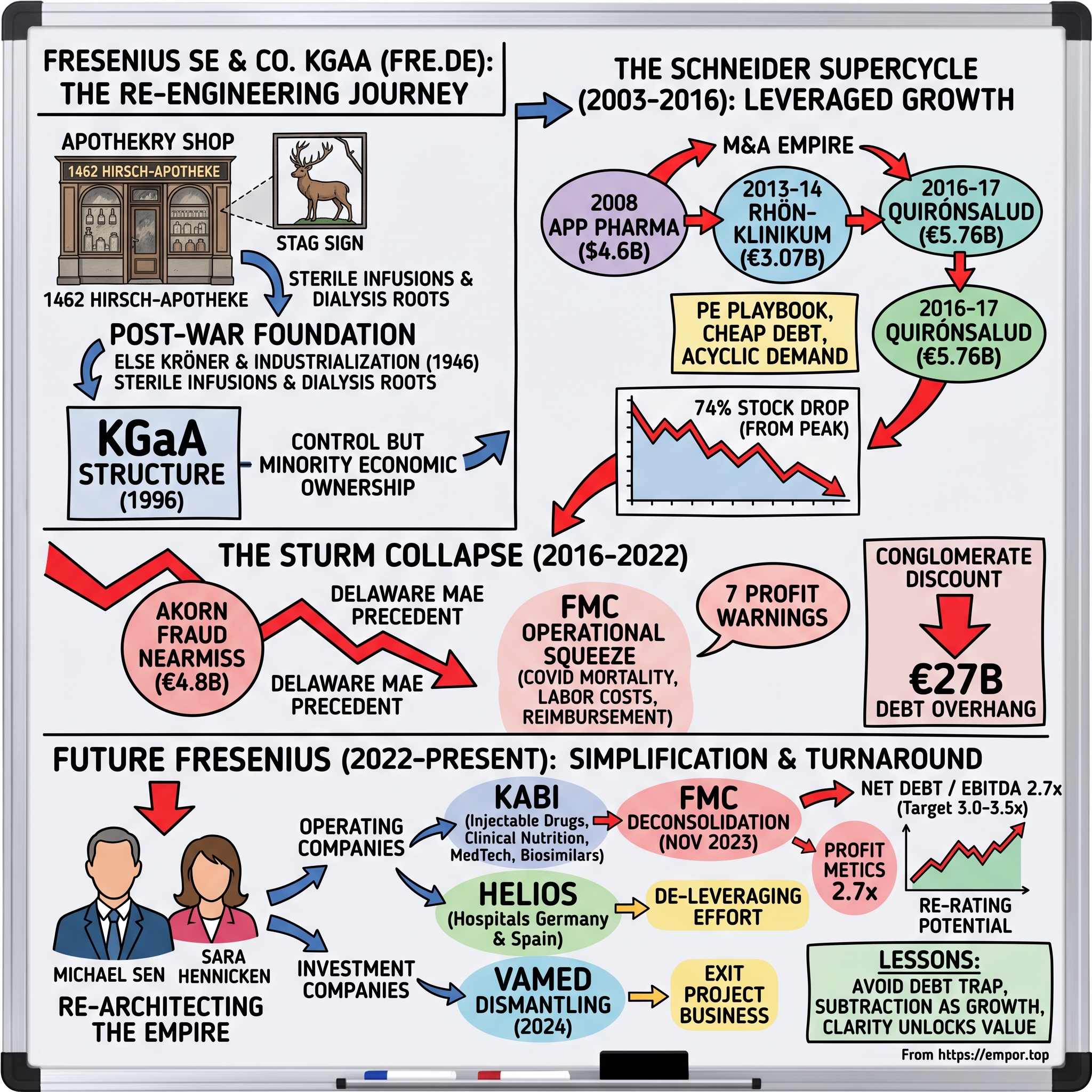
The core dilemma is whether a company assembled by decades of debt-funded acquisitions can be re-rated by subtraction. The old Fresenius was four businesses bolted together: a dialysis giant, a hospital operator, a generic-drug maker, and a hospital-projects contractor. The new Fresenius wants to be two operating companies — Fresenius Kabi (injectable drugs, clinical nutrition, biosimilars) and Fresenius Helios (hospitals in Germany and Spain) — plus one financial stake it would rather treat like a line item than a subsidiary: its roughly 32% holding in Fresenius Medical Care (FMC), deconsolidated in November 2023.3
The thesis of this episode is that Fresenius is the ultimate case study in the lifecycle of a healthcare conglomerate. It ran the aggressive-M&A playbook to its logical extreme under Ulf Mark Schneider, absorbed the consequences under Stephan Sturm — including the landmark Akorn v. Fresenius Delaware litigation — and is now being surgically un-bundled under Michael Sen and his #FutureFresenius program. Whether that surgery succeeds is not a question of narrative but of evidence: leverage ratios, biosimilar ramp curves, and the stubborn margin gap between German and Spanish hospitals.
Here is how the money splits today. Fresenius Kabi generated €8.6 billion of revenue in 2025 at a 16.4% EBIT margin — the group's highest-quality earnings, increasingly powered by biosimilars.2 Fresenius Helios generated roughly €13.5 billion, split between a large, heavily regulated German hospital network and the higher-margin Spanish operator Quirónsalud.2 FMC, a company with over $20 billion of revenue in its own right, now sits on Fresenius's balance sheet as an equity-accounted associate rather than a consolidated subsidiary.3 And Vamed, the legacy hospital-projects business, was effectively dismantled during 2024 after hundreds of millions in charges.4
One myth worth puncturing at the outset: the popular framing that Fresenius "spun off" or "sold" its dialysis business in 2023. It did neither. It still owns roughly a third of Fresenius Medical Care and remains its single largest shareholder; what changed was the accounting and control relationship, not the ownership. The distinction matters because the FMC stake — and the market's anxiety about the long-run future of dialysis — remains embedded in Fresenius's valuation, whatever the "clean healthcare company" narrative implies. A second consensus worth testing is the idea that the turnaround is essentially finished. The leverage math and the guidance record say the acute crisis is over; they do not yet say the business is a durable compounder, and conflating the two is the most common error in the current bull case.
To make sense of all this, the story runs in nine acts: origins from a Frankfurt apothecary to a post-war industrial firm; the Schneider supercycle of leveraged growth; the Sturm collapse; the Sen restructuring; the segment economics of Kabi and Helios; a strategic-frameworks war-game; a management and governance stress test; the bull-versus-bear valuation debate; and finally the lessons and the handful of numbers that actually matter. We begin, as all good origin myths do, with a shop and a name.
 Subscribe on LinkedIn
II. Origins of an Empire: From Apothecary to Post-War Industrial Powerhouse (1462–2003)
The oldest thing about Fresenius is a sign of a stag. The Hirsch-Apotheke — the "Pharmacy at the Sign of the Stag" — traces its Frankfurt roots back to 1462, and by the 18th century it had passed into the hands of the Fresenius family, a lineage that would eventually give the company its name and one of Germany's most famous analytical chemists. For most of that history, this was exactly what it sounds like: a pharmacy, compounding remedies by hand, one prescription at a time. The interesting part — the industrial part — starts in the 20th century.
In 1912, Dr. Eduard Fresenius founded the pharmaceutical company that bears his name, using the old apothecary as a base and pushing it toward something new: not just compounding custom medicines, but manufacturing standardized pharmaceutical products — serums, injectable solutions, nasal ointments — at scale. This was the crucial conceptual leap that separates a pharmacy from a pharmaceutical company. A pharmacy makes one thing for one patient; a manufacturer makes the same sterile thing a million times, reliably, and sells it to hospitals. Everything Fresenius later became — the infusion bags, the dialysis fluid, the generic injectables — is a descendant of that single idea.
Then came the hinge of the entire family saga. Dr. Eduard Fresenius died suddenly in 1946, in the wreckage of post-war Germany, leaving the business to his 19-year-old foster daughter, Else Kröner. She was a pharmacist by training and, as it turned out, an industrialist by instinct. Together with her husband, Dr. Hans Kröner, she took a company of roughly 30 employees and spent the next several decades turning it into a global supplier of medical essentials. The key innovation of the Kröner era was deceptively humble: the reliable, large-scale production of sterile liquid infusion solutions — the IV bags that hang beside every hospital bed — and, critically, dialysis equipment. Kidney dialysis would become the seed of Fresenius Medical Care, and infusion therapy the seed of Fresenius Kabi. Two of today's four historic pillars were born in a single postwar rebuilding.
It is worth pausing on Else Kröner herself, because German industrial history is thin on women who built global companies from nothing, and she did exactly that. She was not a founder's daughter waiting to inherit passively; she was a working pharmacist who, at 19, took over a bombed-out business in an occupied country with no capital markets to speak of, and who spent the next four decades personally driving its expansion into infusion therapy and dialysis. The infusion-solutions business she industrialized was, in its way, a bet on modern medicine itself: as hospitals in the postwar boom adopted intravenous therapy as standard care, the demand for reliably sterile fluids scaled with the entire healthcare system. She was betting on a rising tide, and she owned the tide's most essential commodity.
Else Kröner's most durable act, though, was not a product. It was a governance structure. Having no children, she arranged for her estate to pass to a charitable foundation, the Else Kröner-Fresenius-Stiftung, which to this day sits at the apex of the ownership pyramid and controls the voting rights of the ultimate parent. This is why Fresenius is unusually insulated from the market forces that discipline most public companies — a fact that would later be both its shield and, arguably, its curse. The foundation's mandate is to fund medical research; its power is to keep the company Fresenius. It is one of the largest medical-research funders in Germany, and its very reason for existence is a permanent, patient shareholder that will never sell and will never be raided. For a company in a business measured in decades — hospitals, drug plants, patient relationships — that permanence was, for most of its history, a feature.
The modern corporate architecture took shape in two moves in the 1980s and 1990s. Fresenius went public on German exchanges in 1986, opening the door to outside capital while the foundation retained control. Then, in 1996, came the masterstroke: Fresenius merged its dialysis division with the US company National Medical Care to create Fresenius Medical Care, listed in both Frankfurt and New York and instantly the world's leading provider of dialysis products and services. And here the company reached for a distinctly German legal tool — the KGaA, or Kommanditgesellschaft auf Aktien, a partnership limited by shares. The KGaA structure let Fresenius act as the controlling general partner of FMC, consolidating 100% of FMC's revenue and debt onto its own books while owning only a minority economic stake of roughly a third. For years this looked like leverage in the best sense: control without full ownership. Later, it would look like a trap, because the parent carried all of FMC's problems on its balance sheet while its own shareholders owned only part of the upside.
The final piece fell into place in 2001, when Fresenius acquired Wittgensteiner Kliniken and entered hospital operations directly — the embryo of what would become Fresenius Helios. By 2003, the four-part conglomerate was fully assembled in outline: dialysis, IV drugs and nutrition, hospitals, and hospital projects. What it lacked was an accelerant. It was about to get one, in the form of a 38-year-old CEO with a spreadsheet, a thesis about interest rates, and an appetite for debt.
III. The Ulf Mark Schneider Supercycle: Leveraged Growth & M&A Empire (2003–2016)
When Ulf Mark Schneider took over as CEO of Fresenius in 2003 at the age of 38, he was one of the youngest chief executives ever to run a major German listed company. He was also, in a sense, the perfect man for a particular moment. Schneider's thesis was simple and, for more than a decade, spectacularly correct: healthcare demand is essentially acyclic — people get sick in booms and busts alike — and if you can borrow money cheaply to buy healthcare assets that throw off steady cash, you can compound shareholder value through the aggressive, disciplined application of debt. It was a private-equity playbook running inside a public company, and after the 2008 financial crisis flooded the world with cheap credit, the conditions could not have been better.
To appreciate why this worked, you have to understand the machinery of a leveraged roll-up. The model is deceptively simple: borrow money at, say, 3–4%, buy a healthcare business that yields cash returns of 8–10%, and pocket the spread — then repeat, using the acquired business's own cash flows and borrowing capacity to fund the next deal. As long as the cost of debt stays below the cash yield on assets, and as long as those assets keep producing, the flywheel spins faster every year. The genius of applying it to healthcare was that healthcare cash flows are unusually stable: dialysis patients need treatment three times a week whether the economy is booming or not, and hospitals fill their beds in every season. Schneider took a private-equity technique and ran it inside a public company with a permanent, non-selling anchor shareholder — which meant he never faced the fund-life deadlines or the exit pressure that discipline most buyout firms. He could compound indefinitely. Or so it seemed.
For roughly a decade, the results validated the strategy. Fresenius delivered year after year of double-digit growth in both revenue and net income, transforming from an unglamorous medical-supply firm into a DAX blue-chip and a genuine stock-market darling. Analysts christened it a "compounder," the highest praise the market offers, and the term fit: patient, boring, reliable growth stacked on top of itself. But the strategy lived or died on the quality of the deals — and on the permanence of cheap money — so it is worth war-gaming the four that mattered most.
APP Pharmaceuticals (2008). In July 2008, Fresenius Kabi agreed to acquire the American sterile-injectables maker APP Pharmaceuticals, paying roughly $3.7 billion in cash to equity holders with the total transaction valued at close to $4.6 billion including assumed debt — a multiple of around 12x EBITDA that Wall Street of the day considered rich.1112 The strategic logic was to buy a leading position in the US market for injectable generic drugs — the anesthetics, anti-infectives, and oncology agents that hospitals administer by the millions. The verdict, with hindsight, is that this was one of the best deals Fresenius ever made. When chronic shortages of sterile injectables swept US hospitals through the 2010s, APP's manufacturing capacity became a cash machine, and it remains the backbone of Kabi's North American business today. The lesson: paying up for scarce, hard-to-replicate manufacturing can be cheap in hindsight if the asset is genuinely scarce.
Rhön-Klinikum (2013–2014). The hospital roll-up was messier and more revealing of Schneider's ambition. In September 2013, Fresenius's Helios unit agreed to buy 43 hospitals and 15 outpatient facilities from the German competitor Rhön-Klinikum for €3.07 billion, entirely debt-financed.13 The deal followed a bruising earlier takeover battle and required extensive antitrust review; Germany's Federal Cartel Office, the Bundeskartellamt, cleared it only in February 2014 after Fresenius agreed to conditions.14 The strategic prize was scale — Helios became the undisputed leader in German acute hospital care, with the purchasing power and administrative efficiency that only a national network can command inside Germany's fixed-price DRG reimbursement system. Bigness, in German hospitals, is not vanity; it is the whole business model, because when the state fixes your price per procedure, your only lever is cost.
Quirónsalud (2016–2017). The crown jewel came at the very end of Schneider's tenure. In September 2016, Fresenius agreed to buy Quirónsalud, Spain's largest private hospital group, from CVC Capital Partners and founder Víctor Madera for €5.76 billion — roughly 14x EBITDA.9 This was a different animal from the German business entirely. Quirónsalud earns most of its money from private health insurance and out-of-pocket payers, which means it has something German hospitals can only dream of: pricing freedom. It diversified Fresenius away from rigid German regulation into a high-margin, structurally growing private-pay market. The structural tailwind is worth naming: private health insurance penetration in Spain has been rising for years as wait times in the public system lengthen and a growing middle class chooses to pay for faster, more comfortable care — a dynamic visible across much of southern Europe. Quirónsalud sits directly in that flow, with flagship hospitals in the wealthiest urban catchments and a foothold expanding into Latin American markets like Peru and Colombia, where private healthcare demand is growing off a low base. Of all Schneider's deals, this is the one whose value has compounded most quietly and most durably — and, tellingly, it is the asset the un-bundled Fresenius most wants to showcase rather than explain away.
FMC's NxStage (2017–2019). Not every deal aged well. Fresenius Medical Care's roughly $2 billion acquisition of the home-dialysis equipment maker NxStage, agreed in 2017 and closed in 2019 after prolonged antitrust delays, is the cautionary counterpoint. Home dialysis was — and remains — a genuinely important secular trend, but adoption came slower than the price implied, and the integration weighed on FMC's returns on invested capital for years. It is a reminder that being right about the direction of a market does not protect you from overpaying for the timing.
One structural feature of these deals deserves emphasis, because it explains both the decade of success and the crisis that followed: nearly all of them were financed with debt rather than equity. Debt is a wonderful thing when asset returns exceed borrowing costs and cash flows are predictable — it magnifies equity returns without diluting existing shareholders. But debt is a fixed claim; it must be serviced in bad years as faithfully as good ones. Each acquisition made Fresenius larger and, in the good times, more profitable, but it also ratcheted the group's fixed obligations higher and raised the stakes on every subsequent quarter of execution. By the mid-2010s, Fresenius had become a highly tuned engine that ran beautifully at full throttle and had almost no tolerance for a stall.
Schneider left in 2016 to run Nestlé, and here the story turns. He departed a hero, having compounded value for more than a decade. But he also left behind a machine of extraordinary complexity carrying more than €20 billion of net debt, whose continued success depended on two things staying true forever: interest rates staying low, and operational execution staying flawless. By 2016 both assumptions still held. Within two years, both would fail at once — and the man holding the controls would be Schneider's former finance chief.
IV. The Sturm Collapse: Akorn Fraud, FMC Squeeze, & 7 Profit Warnings (2016–2022)
Stephan Sturm had been the architect of Fresenius's balance sheet as CFO before he became its CEO in 2016. That pedigree was supposed to be reassuring — who better to steward a leveraged empire than the man who had built its financing? But there is a difference between engineering growth on the way up and defending it on the way down, and Sturm inherited a company at the precise inflection point where the tailwinds became headwinds.
His first major test was a deal, and it became one of the most instructive legal sagas in modern M&A. In April 2017, Fresenius Kabi agreed to acquire the US generic drugmaker Akorn Inc. for about $4.8 billion, or $34 per share, in what looked like a natural extension of the APP franchise.7 Then the floor gave way. Shortly after signing, anonymous whistleblower letters landed alleging systematic data-integrity fraud at Akorn — falsified stability data submitted to the FDA, fabricated test results, and IT systems so compromised that the underlying data could not be trusted. Fresenius did something that, in the annals of buyer's remorse, was genuinely admirable: rather than close and hope, it launched an independent investigation, code-named Project Phoenix, and when that investigation confirmed pervasive regulatory misconduct, Fresenius terminated the deal in April 2018.7
To understand why lawyers still teach this case, you need to know what a Material Adverse Effect clause is and why it had never worked before. Nearly every merger agreement contains an MAE (or "MAC") clause that lets a buyer walk away if something catastrophic happens to the target between signing and closing. In practice, Delaware courts had spent decades setting the bar so high that the clause was widely considered a dead letter — a buyer with cold feet could almost never invoke it, because courts read MAE clauses to require a durationally significant, company-threatening deterioration, not a bad quarter or ordinary business risk. Buyers who wanted out usually paid to settle rather than test it. Akorn was the case where the facts were finally extreme enough: a target whose regulatory foundation — the integrity of the data it submitted to the FDA — had allegedly rotted from the inside.
Akorn sued in the Delaware Court of Chancery to force the deal through, and what followed became a landmark. Vice Chancellor J. Travis Laster issued a 246-page opinion on October 1, 2018 holding that Akorn had suffered a Material Adverse Effect and had breached its regulatory-compliance representations — the first time a Delaware court had ever found that an MAE justified an acquirer walking away from a signed public merger.58 The Delaware Supreme Court affirmed that December.6 For a generation of dealmakers, "the Akorn case" became shorthand for the proposition that the MAE clause — long considered essentially unusable — could, in extreme circumstances, actually be invoked. Two years later, when the COVID-19 pandemic sent dozens of buyers scrambling to escape deals signed before the crash, Akorn was the precedent every one of them cited and every court re-examined. Fresenius, almost by accident, had written the modern law of buyer's remorse.
The investor lesson cuts two ways. Fresenius legally escaped a $4.8 billion catastrophe, and its willingness to walk demonstrated real discipline. But the near-miss also exposed uncomfortable questions about pre-signing due diligence: how had Fresenius agreed to buy a company whose data integrity was so rotten that a court would later catalog it in 246 pages? The Akorn affair marked the symbolic end of the era when Fresenius could grow simply by writing checks.
While the Akorn drama played out in court, a genuine operational storm was gathering around Fresenius Medical Care, and because of the KGaA consolidation, every gust hit the parent's income statement at full force. Three forces converged. First, COVID-19 inflicted appalling excess mortality on end-stage renal disease patients — a population already fragile — which shrank FMC's North American patient census in the cruelest possible way. Second, the US nursing shortage sent labor costs per dialysis treatment soaring at exactly the moment when Medicare reimbursement, largely fixed by formula, failed to keep pace. Third, regulatory changes in how calcimimetic drugs were reimbursed compressed dialysis margins further. A business built on stable, predictable, government-funded cash flows suddenly had none of those three adjectives.
Here the KGaA structure that had once looked so clever revealed its cruelty. Because Fresenius consolidated 100% of FMC even while owning roughly a third of it, every dollar of FMC's labor-cost inflation and every shrunken patient census flowed straight onto the parent's income statement and into its leverage ratio — at full weight, not at one-third weight. Fresenius shareholders bore all of FMC's operational pain but captured only a minority of any eventual recovery. It was the worst of both worlds: full downside consolidation, minority economic ownership. A structure designed to maximize control had quietly become a machine for importing someone else's problems.
The result was a collapse in credibility that no single number captures better than the count itself: between 2018 and 2022, Fresenius issued seven separate profit warnings. Each one, on its own, might have been explained away — a supply-chain snarl here, a reimbursement change there. Cumulatively, they destroyed the market's willingness to believe management guidance at all. This is the subtle, compounding damage of serial misses: after the third or fourth warning, investors stop pricing the company on its guidance and start pricing it on their own worst-case assumptions, which is another way of saying the multiple collapses regardless of the underlying business. Credibility, once spent, is the most expensive thing in finance to buy back. Net debt climbed toward €25 billion at the group level by the end of 2022, with total debt closer to €28 billion, pushing leverage uncomfortably high.16 The stock, which had touched an all-time high above €80 in June 2017, fell below €20 by late 2022 — an evisceration of roughly three-quarters of the equity value.18
By 2022 the market had a name for what Fresenius had become: a holding-company penalty box. FMC's debt and operational misery dragged down the parent, while the KGaA structure that had once looked so clever now deprived FMC's own shareholders of independent governance and left everyone — parent and subsidiary shareholders alike — feeling trapped. The conglomerate discount, that quiet tax the market levies on complexity it cannot see through, had swelled into something enormous. The obvious question was whether anyone could dismantle the structure without blowing up the company. In October 2022, a former insider with an outsider's reputation for cold discipline arrived to try.
V. #FutureFresenius & Michael Sen's Surgery: Deconsolidation & Turnaround (2022–Present)
Michael Sen was, in one sense, a Fresenius man — he had run Fresenius Kabi — and in another sense exactly the kind of operator the company had never really had at the top. His formative years were spent in the disciplined, engineering-minded world of Siemens and E.ON, where he served as a finance chief and learned the unglamorous art of capital allocation in capital-intensive businesses. When he took over as CEO of Fresenius in October 2022, alongside new CFO Sara Hennicken, who arrived from investment banking at Deutsche Bank, the message was blunt and un-German in its directness: less complexity, more capital discipline, more operational focus.10 After a decade of empire-building followed by a half-decade of apologizing, that was the whole pitch.
The strategic program got a hashtag — #FutureFresenius — but the substance was a genuine re-architecting of the company along a single, clarifying distinction: Operating Companies that Fresenius would run and invest in, versus Investment Companies it would merely hold and manage for value.17 The two Operating Companies were Kabi and Helios. Everything else was up for review.
The signature move was the deconsolidation of Fresenius Medical Care. This was not a sale — Fresenius kept its roughly 32% economic stake — but a legal and accounting transformation. FMC was converted from a KGaA back into an ordinary German stock corporation, an Aktiengesellschaft (AG), dissolving the general-partner relationship that had let Fresenius control it. The conversion became effective upon registration in the commercial register on November 30, 2023.3 On that date, Fresenius stopped consolidating FMC line by line and began accounting for it under the equity method of IAS 28 — a single line on the income statement reflecting its share of FMC's profits, rather than 100% of FMC's revenue, costs, and, crucially, debt.3
There was an elegant symmetry to the move that is easy to miss. Converting FMC from a KGaA to an AG did not only help the Fresenius parent; it also handed FMC's own minority shareholders something they had never had — normal governance. Under the old structure, FMC's investors owned economic stakes but had no real power over a company controlled by Fresenius as general partner, one reason FMC itself perennially traded at a discount. The AG conversion gave FMC a conventional supervisory board and made it accountable to its own shareholders. In other words, the same legal surgery that de-risked the parent also un-trapped the subsidiary. Both sets of shareholders had spent years complaining about the KGaA; deconsolidation was the rare corporate action that answered both complaints at once.
The de-leveraging effect was immediate and structural. Deconsolidation lifted roughly $12 billion of FMC's lease and financial liabilities off the parent's consolidated balance sheet in one stroke, dramatically clarifying what Fresenius shareholders were actually exposed to. It is worth being precise about what this did and did not achieve. It did not make FMC's problems disappear — Fresenius still owns a third of them, marked to market through its equity stake. What it did was stop those problems from contaminating the parent's own credit profile and reported growth. For a company whose central affliction was a conglomerate discount rooted in exactly this kind of opacity, that clarification was arguably worth more than the accounting mechanics alone would suggest.
Next came the pruning. Vamed, the hospital-projects and rehabilitation business, had been chronically unprofitable and was identified as non-core. Over the course of 2024, Fresenius dismantled it: it divested the rehabilitation operations and the Austrian home-market activities — the latter sold to an Austrian consortium of the construction firms Porr and Strabag for €90 million — folded some rehab capacity into Helios, and agreed to exit the international project business ahead of schedule.15 The cleanup was not free; the moves triggered non-cash special items of €427 million at the net-income level, with further charges spread over subsequent years.4 But management framed the exit as the final act of portfolio simplification, expected to lift group profitability structurally.15
With FMC deconsolidated and Vamed gone, the new Fresenius stood revealed: two Operating Companies — Kabi (biopharmaceuticals, clinical nutrition, MedTech, generic injectables) and Helios (German and Spanish hospitals) — plus one Investment Company, the 32% FMC stake, held for value and available as a monetization option for further deleveraging.
Underneath the deconsolidation headline, Hennicken ran a quieter but equally important campaign on the debt itself. The problem was not only the amount of debt but its shape: a wall of maturities that would come due into an interest-rate environment far higher than the one in which the debt was issued. Refinancing near-term bonds at today's rates and terming out maturities — including a €1 billion bond issue — bought the company time and smoothed the repayment schedule, so that deleveraging could happen through cash generation rather than through a fire sale of assets.19 This is the unglamorous connective tissue of a turnaround: not a single dramatic move, but the steady administrative work of making sure the company never faces a maturity it cannot meet. It is precisely the discipline the crisis years lacked.
The financial framework Sen and Hennicken set out has been notable mostly for being met. They defined a leverage corridor of 3.0x–3.5x net debt to EBITDA, with a long-term ambition below 3.0x, and by the end of 2025 leverage had reached 2.7x — inside the target and improving.1 They guided to mid-single-digit organic revenue growth and delivered 7% in 2025; they targeted double-digit Core EPS growth and delivered 12% in constant currency.12 After seven profit warnings, a management team that set targets and then hit them for two-plus years was, in itself, the turnaround story. In its Q4 2025 communication, management branded the current phase "REJUVENATE" — the language of a company that believes it has finished repairing and is ready to invest for growth, rather than one still bailing water.1 The open question for a neutral observer is durability: hitting guidance during a recovery is easier than sustaining it once the low-hanging fruit of self-help is gone, and "REJUVENATE" is a claim to be tested, not a fact to be accepted. To judge it, you have to go inside the two engines.
VI. Core Segment Economics: Kabi Biosimilars & Helios Dual-Market Playbook
1. Fresenius Kabi: The High-Margin Growth Engine
Walk through a Fresenius Kabi sterile-manufacturing plant and you will understand the business faster than any income statement can explain it. Endless lines of glass vials and plastic IV bags move through filling machines in rooms so clean they make an operating theater look casual. This is the unglamorous, defensive core of Kabi: the injectable generic drugs — anesthetics like propofol, anti-infectives, oncology agents — and the large-volume IV fluids that every hospital consumes by the pallet. It is high-volume, essential, and recession-proof, but it is also commoditized and exposed to input-cost inflation in PVC, glass, and energy. In 2025, Kabi as a whole generated €8.6 billion of revenue at a 16.4% EBIT margin, up from 15.7% the prior year — the group's most profitable segment and the clearest evidence that the mix is improving.2
The margin improvement is not coming from the old IV bags. It is coming from three higher-value franchises that Kabi has been deliberately tilting toward. Clinical nutrition — both enteral (tube feeding) and parenteral (intravenous nutrition, including products like Smoflipid) — is a business where Kabi and Baxter are the global leaders, and where the stakes in an ICU are high enough that hospitals do not casually switch suppliers. That stickiness translates into pricing that generic vials never enjoy. MedTech — the Agilia infusion pumps, blood-transfusion technology, and plasma-collection systems — runs on a razor-and-blade logic: place the hardware, and years of high-margin consumable and software revenue follow.
The clinical-nutrition franchise deserves a closer look because it is the quiet counterexample to the commodity story. Feeding a critically ill patient who cannot eat — through a tube into the gut (enteral) or directly into the bloodstream (parenteral) — is a clinical decision made by physicians who have qualified specific products into their ICU protocols. Switching suppliers is not a purchasing decision; it is a medical-protocol decision, with patient-safety implications, which is exactly why it rarely happens. That embeds Kabi and its main rival Baxter in a comfortable duopoly at the top of the market, with the pricing stability that duopolies enjoy and generic vials never will. MedTech follows a related logic through its razor-and-blade model: the Agilia infusion pumps are the razor, sold at modest margin to win the installed base, and the years of proprietary consumables, software, and service that follow are the blades. In both cases the economic prize is not the initial sale but the switching cost that locks in the recurring revenue behind it.
But the "hidden jewel," in management's telling and increasingly in the numbers, is biopharmaceuticals — specifically biosimilars. Here a short explanation earns its keep. A generic drug is a chemical copy of a small, simple molecule; a biosimilar is a "highly similar" version of a large, complex biologic drug grown in living cells, which is vastly harder to manufacture and to get approved. That difficulty is precisely the point: it keeps competition thin and margins fat. Kabi's portfolio centers on three assets — Tyenne, a biosimilar of the anti-inflammatory tocilizumab (Actemra); Stimufend, a biosimilar of the white-blood-cell booster pegfilgrastim (Neulasta); and Idacio, a biosimilar of the blockbuster adalimumab (Humira). Biosimilars of this kind can carry gross margins well above 60%, which is why they are the single biggest lever pulling Kabi's segment margin toward the upper end of its 15–18% structural target.
Why do biosimilars matter so much more than ordinary generics? Consider the difference in what it takes to compete. When a small-molecule drug like propofol goes off patent, a dozen manufacturers can reverse-engineer the exact chemical structure and flood the market, and the price collapses toward the cost of the raw materials — sometimes 80–90% below the branded price within a couple of years. A biologic is different in kind. Because it is grown in living cell lines and consists of enormous, three-dimensional protein molecules, no one can make an identical copy; the best a competitor can do is a "highly similar" version, and proving that similarity to regulators requires years of analytical work and clinical trials costing tens or hundreds of millions of dollars. That barrier is the moat. It means a biosimilar market might have three or four credible competitors rather than fifteen, and prices fall by perhaps 30–50% rather than 90% — leaving enough margin that the surviving players earn real money. Kabi's tilt from small-molecule generics toward biosimilars is, in essence, a deliberate migration from a business with almost no barriers to one with meaningful ones.
The analytical caution a neutral investor should hold is that biosimilars are a race, not an annuity. The same complexity that protects early entrants erodes as more competitors clear regulatory hurdles, and biosimilar tenders in Europe and the US can see brutal price deflation — the Humira market in particular became a price war almost the moment it opened. Kabi's edge, if it has a durable one, rests less on any single molecule than on its manufacturing depth and regulatory experience across both small molecules and biologics. That is a process advantage, and process advantages are real but not permanent.
2. Fresenius Helios: The Dual-Market Hospital Playbook
Helios is a study in contrasts, because it is really two hospital companies operating under one roof, in two countries, under two economic regimes. In 2025 the combined segment produced roughly €13.5 billion of revenue at a 9.8% EBIT margin, but that blended figure hides the whole story.2
Helios Germany is the Heimmarkt, the home market: a nationwide network of roughly 86 acute-care hospitals and some 120 outpatient centers treating more than five million patients a year. Its economics are entirely governed by Germany's public health-insurance system, the Gesetzliche Krankenversicherung (GKV), and its DRG mechanism — Diagnosis Related Groups — under which the state pays a fixed rate for each type of treatment regardless of what it actually costs the hospital to deliver. The DRG system is worth understanding because it inverts the usual logic of a business. A hip replacement pays the same fixed sum whether the patient stays four days or fourteen; a hospital that treats efficiently keeps the difference, and one that treats slowly eats the loss. Revenue is therefore essentially capped by the state, and the only lever a private operator controls is cost — length of stay, staffing ratios, procurement, throughput. This is why scale is not vanity in German hospitals but the entire game: when price is fixed for everyone, the low-cost operator wins, and Helios's national footprint is precisely a cost-and-procurement advantage over smaller municipal and non-profit rivals. When your revenue per case is fixed by regulation, wage inflation is not an inconvenience; it is an existential margin problem. Through the 2020s, German nurses and physicians won overdue pay increases while DRG rate adjustments lagged, squeezing Helios Germany's margins from both sides. Looming over all of it is the German Hospital Reform, the Krankenhausreform, which pushes toward centralizing complex care in fewer, larger centers — a shift that could favor a scaled operator like Helios or could impose new constraints, depending on how it is implemented. This is the definition of a regulated utility with hospital-shaped assets: defensive, essential, and structurally capped.
Quirónsalud is the opposite animal. Spain's largest private hospital group runs roughly 58 hospitals and over 100 outpatient centers across Madrid, Catalonia, Andalusia and into Latin America, and it earns the majority of its revenue from private health insurance and out-of-pocket payers, with the balance from public-sector cooperation. That payer mix is everything. Private pay means pricing freedom, shorter surgical wait times, and a consumer relationship rather than a bureaucratic one — and it shows up as operating margins in the low-to-mid teens, roughly double what the German business earns. Quirónsalud also grows organically at a pace German hospitals cannot, riding rising private-insurance adoption across southern Europe and demographics that steadily expand demand.
The investor takeaway from Helios is a single, trackable tension: the German business is a defensive cash generator fighting a regulatory and wage headwind, while the Spanish business is a genuine growth-and-margin engine. The health of the whole segment depends on Quirónsalud's expansion outrunning Germany's compression. If that divergence widens in Spain's favor, Helios re-rates; if German reform bites harder than expected, the blended margin stalls. That framing leads naturally into a more structural question: how durable are these advantages when you war-game them against competitors and first principles?
VII. Strategic Frameworks: Porter's 5 Forces & Helmer's 7 Powers Analysis
It is one thing to describe what Fresenius does and another to ask whether any of it is genuinely defensible. Strip away the narrative, and a business is only as good as the barriers protecting its cash flows. Two frameworks — Hamilton Helmer's 7 Powers and Michael Porter's Five Forces — are useful precisely because they force that discipline. The honest conclusion for Fresenius is a mixed one: real advantages in scale and process, weaker ones almost everywhere else.
Hamilton Helmer's 7 Powers
Scale Economies (HIGH). This is Fresenius's strongest and most consistent power. In Kabi, enormous automated fill-finish plants produce sterile vials and IV bags at a unit cost smaller generic rivals cannot match — and in a business where the state or a group purchasing organization sets the price, the low-cost producer is the one that survives. In Helios, national scale in both Germany and Spain drives purchasing power over consumables, pharmaceuticals, and expensive diagnostic hardware like MRI and CT scanners. Scale in commodity healthcare is not glamorous, but it is the moat that compounds.
Switching Costs (MODERATE TO HIGH). Concentrated mainly in Kabi's MedTech. A hospital that standardizes on Agilia infusion pumps trains its nursing staff on those pumps, builds its drug-safety software libraries around them, and embeds them in clinical protocols. Ripping that out to switch to B. Braun or BD means retraining and clinical-disruption risk — the kind of friction that keeps customers in place long after the initial sale.
Cornered Resource (LOW TO MODERATE). The best candidate is Quirónsalud's real estate: flagship hospitals in the centers of Madrid and Barcelona cannot easily be replicated, given urban zoning and hospital-licensing constraints. It is a real but narrow advantage — location scarcity, not a patent or a unique input.
Counter-Positioning (MODERATE). Quirónsalud's lean, customer-centric private model stands in useful contrast to slow, bureaucratic public hospital systems across southern Europe. But this is less true counter-positioning — where an incumbent cannot copy the challenger without cannibalizing itself — and more straightforward superior execution in a structurally attractive niche.
Network Effects (NONE). Hospital beds and IV fluids simply do not get more valuable as more people use them. There is no network here, and it is worth saying plainly rather than manufacturing one.
Process Power (MODERATE). Kabi's decade-plus of accumulated expertise in sterile manufacturing and in navigating FDA and EMA regulatory compliance is a genuine, hard-won capability — the thing that lets it launch biosimilars and hold quality where others stumble (as Akorn spectacularly did not). Process power is real but slow-eroding rather than permanent.
Brand / Pricing Power (MODERATE). Quirónsalud carries genuine brand prestige among affluent Spanish private-insurance holders. Kabi, by contrast, largely lacks pricing power — its generics face competitive tenders in Europe and GPO negotiation in the US, which is exactly why scale and cost position matter more than brand.
Porter's Five Forces
Threat of New Entrants (VERY LOW). Building a national hospital network or a sterile-injectable and biosimilar plant requires enormous capital and years of regulatory qualification. This is the friendliest force for Fresenius.
Bargaining Power of Buyers (HIGH). This is the least friendly. In Germany, the public insurers (GKV) effectively set hospital prices; in the US, GPOs squeeze generic drugmakers on price. Fresenius's customers are large, sophisticated, and cost-obsessed, which structurally caps margins in exactly the businesses where scale is the only defense.
Bargaining Power of Suppliers (LOW TO MODERATE). Suppliers of APIs and medical-grade plastics have limited leverage against Kabi's global purchasing scale — though energy and raw-material inflation showed during 2022–2023 that "low" is not "none."
Threat of Substitutes (LOW TO MODERATE). Acute hospital care and emergency surgery have no technological substitute. The more interesting long-tail risk sits at FMC: the possibility that GLP-1 anti-obesity drugs and SGLT2 inhibitors slow the progression of kidney disease enough to shrink the future dialysis population. That is a 10-to-15-year question, but it is real enough to depress how the market values Fresenius's FMC stake today.
Competitive Rivalry (HIGH). Kabi competes against Sandoz, Teva, Viatris, Pfizer's CentreOne, and Hikma in injectables and biosimilars; Helios Germany competes with Asklepios, Sana, and a fragmented field of municipal and non-profit operators. Rivalry is intense, which is another way of saying pricing discipline is hard to sustain.
Put together, the frameworks tell a coherent story: Fresenius's durable edges are scale and process in manufacturing, plus location and brand in Spanish private hospitals — with high buyer power and intense rivalry keeping a permanent lid on how much of that advantage flows to the bottom line. That is a good business, not a great one, which makes management execution and capital discipline the swing factors. Which is exactly where the next act goes.
VIII. Management Credibility, Capital Allocation, & Governance Stress Test
The most important question about Fresenius in 2026 is not really about hospitals or biosimilars. It is about whether you can believe what management tells you — because for years, you could not.
Start with the behavioral evidence, which is the only kind that counts. Michael Sen inherited a company whose guidance had become a running joke after seven profit warnings, and he rebuilt credibility the only way it can be rebuilt: by setting targets and then meeting or beating them, quarter after quarter, for more than two years. The rhetorical shift he engineered — from Sturm's inadvertent "overpromise and underdeliver" to a deliberate "underpromise and beat" — is visible in the pattern of results. When management guided to mid-single-digit organic growth and delivered 7%, and guided to double-digit Core EPS growth and delivered 12% in constant currency, the beats were not enormous, and that is the point: modest, repeatable beats rebuild trust more effectively than heroic ones, because they signal that the numbers are conservative rather than promotional.12
Sara Hennicken, the CFO, ran the balance-sheet cleanup with a discipline the crisis years lacked. Her fingerprints are on the leverage reduction to 2.7x, the refinancing of legacy debt — including a €1 billion bond issue that termed out maturities — and a dividend policy that was reset to a modest 30–40% payout rather than an ever-rising commitment.119 The 2025 dividend of €1.05 per share, up 5%, was calibrated to prioritize deleveraging over shareholder theatrics.1 After a decade in which capital allocation meant "the next acquisition," a management team that suspends the empire-building instinct and pays down debt is making a statement about what it thinks the company needs.
Crucially, the incentive structure was rewired to match. Executive compensation was tied explicitly to Return on Invested Capital, Core EPS growth, and the net-debt/EBITDA ratio — plus ESG and patient-safety metrics. Whatever one thinks of ESG-linked pay, the ROIC and leverage components matter: they are the direct antidote to the era of M&A for M&A's sake. When you pay executives to reduce leverage and improve returns on capital, you should not be surprised when they stop buying things.
A fair-minded skeptic, though, would push back on the "underpromise and beat" narrative in two ways. First, beating conservative guidance during a cyclical recovery — as post-COVID cost pressures eased and hospital volumes normalized — is not the same skill as delivering through a genuine downturn, and the current management team has not yet been tested by one. Some of the improvement is self-help (Vamed gone, costs cut, structure simplified), which is real but finite; you can only clean up a portfolio once. Second, a portion of the reported Core EPS growth benefits from the deconsolidation itself and from disciplined below-the-line management, which flatters the trajectory relative to pure operating momentum. None of this makes the turnaround fake — the operating margins genuinely improved and the leverage genuinely fell — but a rigorous investor should separate the durable, structural gains from the one-time and cyclical ones, and weight the guidance record accordingly. Credibility rebuilt over two good years is worth something; it is not yet worth what a decade of proven through-cycle execution would be.
Now the stress test a skeptical investor would run. The governance question is the Else Kröner-Fresenius-Stiftung. The foundation controls the voting rights of the general partner, which means Fresenius is effectively immune to hostile takeovers and to the kind of aggressive activist campaign — an Elliott, a Cevian — that might otherwise agitate for a faster or more radical break-up. This cuts both ways, and honesty requires saying so. On the upside, it lets management pursue a multi-year restructuring without quarter-to-quarter raiders forcing its hand. On the downside, it is precisely the structure that insulated poor decisions during the Schneider-Sturm years until a full-blown crisis forced change. Governance architecture that protects long-term vision also protects incumbents from accountability; the same shield works in both directions, and an investor should price the risk that it works in the wrong one.
The portfolio question is FMC. A short-oriented investor would press hard here: does holding a 32% stake in a dialysis company facing a possible long-term GLP-1 headwind really make strategic sense for a company that just spent three years telling the market it wanted to be a focused Kabi-plus-Helios business? Management's answer has been consistent and, at least, coherent: FMC is now purely a financial investment, no fresh capital is being allocated to it, and the stake is an optionality tool — a source of proceeds for further deleveraging if and when monetization makes sense.17 That is a defensible position, but it is not a permanent one, and the credibility of the whole "simplification" narrative will ultimately be tested by what Fresenius does with the FMC stake, not just what it says. The bull and bear cases turn largely on how you weigh exactly that uncertainty.
IX. Bull vs. Bear Case, Valuation Disconnect, & Investor Risk Radar
Here is the debate in its sharpest form. The bull looks at Fresenius and sees a company that has done the hard work of simplification and is about to be re-rated for it. The bear looks at the same company and sees a mediocre-margin healthcare operator with a regulatory ceiling, a dialysis anchor, and a wall of debt to refinance. Both are looking at the same 2.7x leverage ratio and the same 11.5% margin. The disagreement is about what happens next.
The valuation disconnect at the center of this debate is worth stating plainly. For much of the post-deconsolidation period, Fresenius traded at an enterprise-value-to-EBITDA multiple in the high-single digits, while European healthcare peers of comparable quality traded closer to the low-teens. That gap is the conglomerate discount made visible: the market is either still punishing Fresenius for the complexity and broken promises of the past, or it genuinely believes the underlying businesses deserve a lower multiple because of regulatory ceilings and the FMC overhang. The bull thesis is a bet that the discount is a legacy of memory that will fade as clean results accumulate; the bear thesis is a bet that the discount is a rational judgment about business quality that will persist. Every strategic move management makes — every quarter of met guidance, every basis point of deleveraging, every decision about the FMC stake — is really an argument in that single dispute over which of those two stories is true.
The Bull Thesis (Why It Wins From Here)
Multiple expansion via un-bundling. The heart of the bull case is not earnings growth but re-rating. Having deconsolidated FMC and exited Vamed, Fresenius has transformed itself, on paper, from an opaque, penalized conglomerate into a cleaner two-engine European healthcare company. If the market comes to trust that simplification, the valuation could migrate from the depressed EV/EBITDA multiple of the crisis years toward the multiples that European healthcare peers command. Re-rating is the single largest potential source of return here — and, importantly, it requires no operational heroics, only sustained credibility.
Kabi biosimilar ramp. Tyenne and Idacio scaling across the US and Europe give Kabi a genuine high-margin structural growth vector through the late 2020s, pulling segment margins toward the top of the 15–18% band. This is the growth the old Fresenius never had — expansion driven by mix and innovation rather than debt-funded acquisition.
Quirónsalud as a compounder. The Spanish private-hospital business keeps throwing off inflation-indexed, high-margin cash as private insurance penetration rises across southern Europe. It is the closest thing in the portfolio to a self-funding growth machine.
Deleveraging velocity. Every turn of leverage reduced is equity value transferred from creditors to shareholders. With operating cash flow strong — up 36% year-over-year in Q4 2025 — and leverage already at 2.7x, continued debt reduction toward the mid-2x range would free up capacity for bolt-on biopharma investment or buybacks, and would itself justify a higher multiple as financial risk falls.1
The Bear Thesis (Why It May Fall Short)
The German hospital squeeze. The Krankenhausreform and chronic wage inflation could keep Helios Germany's margins compressed for years. If DRG reimbursement flexibility narrows further, roughly half of the Helios business becomes a low-growth, low-margin regulated operation that structurally drags the group.
Biosimilar price deflation. The same economics that make biosimilars attractive attract everyone else. Aggressive tender pricing from Pfizer, Amgen, Sandoz and others can erode margins faster than volume grows — the Humira market is the cautionary template. The biosimilar tailwind is real, but it is not guaranteed to be as durable or as profitable as the bull case assumes.
Refinancing and cost of capital. Fresenius still carries a substantial debt load, and legacy bonds maturing into a higher-rate environment mean rising interest expense unless the debt is repaid quickly. Deleveraging is a race against the maturity schedule, and the pace of that race is not fully in management's control.
FMC drag and the GLP-1 overhang. The market's persistent fear that GLP-1 obesity and kidney therapies could permanently shrink the addressable dialysis market over a 10-to-15-year horizon weighs on the mark-to-market value of the 32% FMC stake — and by extension on Fresenius. As long as that stake sits on the balance sheet, a piece of the equity story is hostage to a debate about a completely different company's terminal value.
The Risk Radar
Beyond the bull/bear spine, three material risks deserve naming. Execution risk is the largest and most specific: Fresenius is mid-transformation, and turnarounds fail in the last mile as often as the first. Regulatory and political risk is structural and unavoidable given how much of the business depends on German and Spanish healthcare policy. And input-cost and refinancing risk — the twin pressures that broke the old model — remain live, if better managed. Cybersecurity and data-privacy risk in a hospital operator is real but not distinctive to Fresenius. The macro risks that do not much matter here — consumer discretionary demand, most obviously — are worth ignoring precisely so the ones that do matter stay in focus. Which brings us, finally, to the lessons and the short list of numbers that will tell you whether any of this is working.
X. Epilogue, Strategic Lessons, & Key Investment KPIs
The Fresenius story spans 564 years, but its most useful lessons come from the last twenty, when the company ran an aggressive strategy to its limit, paid the price, and then tried to reverse it. Three lessons stand out for anyone who invests in or builds a business.
Beware the conglomerate debt trap. Ulf Mark Schneider's leveraged buy-and-build worked brilliantly for more than a decade — right up until the two assumptions it silently depended on, cheap credit and flawless execution, failed simultaneously. Debt does not care that healthcare demand is acyclic. When rates rise and operations wobble at the same time, leverage stops being an accelerant and becomes a vice. The strategy was not wrong; it was fragile, and fragility only reveals itself at the worst possible moment.
Governance architecture matters — for better and worse. The KGaA structure and the foundation's control let Fresenius pursue a long-term vision without fear of raiders. But the same insulation that enabled patience also delayed accountability, letting problems compound until only a crisis could force correction. Dual-class and partnership structures are neither good nor bad in the abstract; they amplify whatever the people inside them are already doing.
The power of surgical simplification. The most counterintuitive lesson is that a turnaround can come from subtraction rather than addition. Deconsolidating FMC and dismantling Vamed created no new revenue and cured no disease, yet by clarifying what Fresenius actually is, those subtractions may unlock more equity value than any acquisition of the prior era ever did. Sometimes the highest-return capital-allocation decision is the one where you stop deploying capital and start returning clarity. There is a deeper irony here worth sitting with. The same company that spent a decade being celebrated for the deals it did is now, arguably, being rehabilitated for the deals it undid — and even for the one enormous deal it walked away from in a Delaware courtroom. If there is a single thread running through the entire Fresenius story, it is that the discipline to say no, to exit, and to simplify has consistently created more durable value than the ambition to acquire. That is an uncomfortable lesson for a management culture built on growth, and whether the current leadership has truly internalized it — or merely been forced into it by crisis — is the question that will define the next chapter.
Whether that thesis proves out is not a matter of opinion; it is a matter of three numbers, and a disciplined investor can track all of them without a spreadsheet.
KPI 1 — Fresenius Kabi biopharmaceuticals growth and segment EBIT margin. The biosimilar ramp is the single most important swing factor in the entire equity story. Watch whether Kabi's segment EBIT margin keeps climbing toward the upper half of its 15–18% target, and whether biopharma revenue keeps compounding. If the margin stalls, the highest-quality part of the bull case is failing.
KPI 2 — Group net debt / EBITDA. This is the number that broke the old Fresenius and the number rebuilding the new one. It reached 2.7x at the end of 2025. As long as it stays inside or below the 3.0x–3.5x corridor and trends lower, the deleveraging thesis and the case for a re-rating remain intact.1 If it stalls or reverses, everything else is noise.
KPI 3 — The Helios margin divergence: Germany versus Quirónsalud. The health of half the company lives in the gap between the compressed German hospital margin and the higher Spanish one. Watch whether Quirónsalud's growth and profitability keep outrunning German wage-and-reform pressure. A widening gap in Spain's favor is the segment working as designed; a narrowing one means the German drag is winning.
Five hundred years after a Frankfurt apothecary hung a stag above its door, Fresenius is still, at bottom, in the same business: making the essential, unglamorous things that keep sick people alive, and selling them at scale. What has changed is that for the first time in a generation, the company is trying to grow by owning less. Whether Europe's healthcare giant has finally learned to value subtraction is the question those three numbers will answer, one quarter at a time.
References
-
#FutureFresenius: REJUVENATE in action — 2025 yet another year of strong delivery (Q4 and FY 2025 results) — Fresenius SE, 2026-02 ↩↩↩↩↩↩↩↩↩↩
-
Results of operations — Fresenius Annual Report 2025 — Fresenius SE, 2026 ↩↩↩↩↩↩↩
-
Fresenius successfully completes deconsolidation of Fresenius Medical Care — Fresenius SE, 2023-11-30 ↩↩↩↩
-
Fresenius Investor News Q2 2024 (Vamed exit special items) — Fresenius SE, 2024-07-31 ↩↩
-
Akorn, Inc. v. Fresenius Kabi AG — Court of Chancery Opinion — State of Delaware, 2018-10-01 ↩
-
Delaware Supreme Court Order Affirming Akorn v. Fresenius — State of Delaware, 2018-12-07 ↩
-
Fresenius walks away from $4.8 billion Akorn takeover — Reuters, 2018-04-22 ↩↩
-
Delaware judge rules Fresenius can walk away from $4.8 billion Akorn deal — Reuters, 2018-10-01 ↩
-
Fresenius buys Spanish hospital operator Quirónsalud for €5.76 billion — Reuters, 2016-09-05 ↩
-
Fresenius names Kabi head Michael Sen new group CEO — Reuters, 2022-08-30 ↩
-
Fresenius Kabi to acquire APP Pharmaceuticals — Fresenius SE, 2008-07-07 ↩
-
Fresenius to Buy APP Pharmaceuticals for $3.7 Billion — CNBC, 2008-07-07 ↩
-
Fresenius Helios acquires 43 hospitals from Rhön-Klinikum AG — Fresenius SE, 2013-09-13 ↩
-
Bundeskartellamt clears acquisition by Helios Kliniken (Fresenius) of clinics operated by Rhön-Klinikum AG — Bundeskartellamt, 2014-02-20 ↩
-
Fresenius exits its Investment Company Vamed — Fresenius SE, 2024-05-08 ↩↩
-
Assets and liabilities — Fresenius Online Annual Report 2022 — Fresenius SE, 2023 ↩
-
Fresenius with new strategy and clear focus (#FutureFresenius) — Fresenius SE, 2023-02-21 ↩↩
-
Fresenius share — Fresenius Online Annual Report 2022 — Fresenius SE, 2023 ↩
-
Fresenius successfully issues €1 billion in bonds — Fresenius SE ↩↩
 LinkedIn
 WhatsApp
 Reddit
 Hacker News
 Email
Email Kindle
 RSS Feed
 Spotify
 Apple Podcasts
 Amazon Music
 Audible
 YouTube