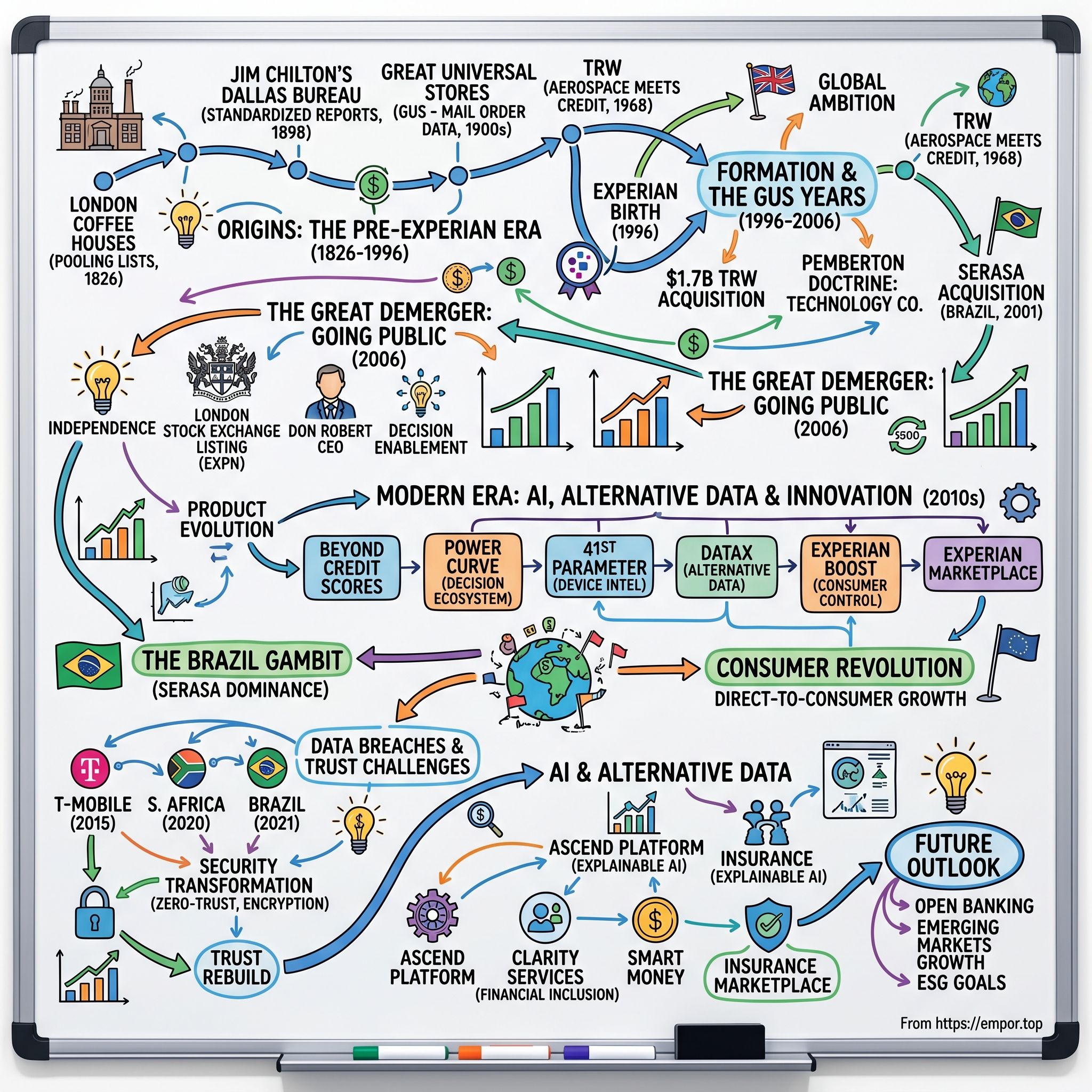
Experian plc: The Architecture of Global Credit Power
I. Introduction & Episode Roadmap
Picture a mortgage broker in Phoenix on an ordinary Tuesday morning. A young couple sits across the desk and hands over their personal details. The broker clicks a button, and within two seconds a server returns what amounts to a financial biography: every credit card they have carried, every car loan, every missed payment, and every address they have lived at for a decade. Almost nobody in that room considers where the file originated, who assembled it, or who gets paid when it is pulled. That invisibility is the business. Experian is one of three dominant credit bureaus in the United States, and the market leader in the United Kingdom and Brazil, tasked with remembering what consumers and businesses owe—and selling that memory back to the lenders who supplied the records in the first place.
The company's lineage runs through two corporate cultures that initially shared little in common. On one side were the ledgers of nineteenth-century British trade protection societies and the credit files of a Manchester mail-order empire. On the other sat the credit data division of TRW, the American aerospace contractor. The two streams merged under British retail conglomerate Great Universal Stores in 1996, gained independence through a 2006 demerger, and have compounded ever since. In the fiscal year ended March 2026, Experian reported revenue from ongoing activities of $8.43 billion, organic revenue growth of 8%, and Benchmark EBIT of $2.41 billion—an operating margin of 28.6%.1 By comparison, in its final pre-listing year before the 2006 demerger, the company generated $3.08 billion in revenue.2 Top-line revenue has nearly tripled across those two decades, while underlying operating profitability has expanded.
Today Experian plc trades in London under EXPN and over the counter in the United States as EXPGF. Its corporate headquarters are in Dublin, where the chief executive is based, while operational leadership remains divided between Nottingham in England and Costa Mesa in California.3 The group employs roughly 25,200 people worldwide.4
The core paradox
Most consumers recognize Experian through its retail-facing services: the free credit-scoring app, Experian Boost, and credit card comparison tools. That consumer operation is substantial. Consumer Services generated $2.26 billion of revenue in FY26, representing 27% of group sales, with an operating margin of 29.6% that sits just below the institutional business.4 Yet the financial core remains enterprise-focused. The business-to-business segment, split between Financial Services and specialized verticals such as automotive, healthcare, and marketing, delivered $6.17 billion, or 73% of revenue, and approximately three-quarters of divisional operating profit.4 According to management, more than 90% of group revenue is built on proprietary data assets.4 While the public interacts with a consumer app, equity investors own an entrenched data utility with a retail marketing platform attached.
The central investment question
The central question is whether an incumbent bureau can successfully evolve from a distributor of static credit files into the real-time decisioning and artificial intelligence layer embedded inside everyday lending workflows—or whether structural shifts will narrow its economic moat. Those industry pressures have intensified. FICO, the credit-scoring vendor, began licensing its mortgage scores directly to reseller channels in October 2025, bypassing bureaus and compressing a high-margin markup layer.5 The US Consumer Financial Protection Bureau filed suit against Experian in January 2025 over its credit-file dispute procedures.6 Meanwhile, across the first half of 2026, market anxiety that generative AI could commoditize proprietary information services triggered a broader sector sell-off; Experian's equity declined roughly 30% over the twelve months leading into its record May 2026 financial release.7
Why win, and what could break it
The investment case for Experian hinges on three competitive advantages: proprietary data pools that cannot be easily replicated, mission-critical workflow software with steep switching costs, and secular growth vectors spanning Brazil's credit modernization, enterprise fraud prevention, healthcare verification, and digital consumer marketplaces. The counter-thesis highlights structural vulnerabilities: Experian does not own the standard scoring algorithm in US mortgage underwriting, its largest financial clients routinely multi-source files across all three major bureaus, consumer marketplace revenue fluctuates with lending cycles, and regulatory compliance imposes an enduring cost burden. Evaluating Experian requires testing each assertion against its operational record rather than accepting management narrative or market skepticism at face value.
Roadmap
This study examines Experian across eight parts. First, the dual origins in nineteenth-century British trade protection and Cold War California aerospace. Second, its incubation inside Great Universal Stores and the 2006 London demerger. Third, the strategic acquisition and expansion of Brazil's Serasa. Fourth, the unit economics of credit bureaus and the mechanics of the global triopoly. Fifth, the direct-to-consumer pivot and the rollout of Experian Boost. Sixth, the modern cloud migration around Ascend and identity verification. Seventh, data security liabilities and regulatory confrontations. Finally, executive leadership, capital allocation, valuation frameworks, the balance of competitive advantages and risks, and the operating metrics that will determine Experian's trajectory from here. The story begins, as most data businesses do, with creditors seeking a reliable way to avoid bad debt.
 Subscribe on LinkedIn
II. Origins: The 19th-Century Data Guilds to TRW Aerospace
In 1826, industrial Britain was defined by textile mills, expanding canal networks, and frequent merchant insolvencies. When a merchant extended trade credit to a customer, there was virtually no mechanism to verify whether that customer had already defaulted on debts with other traders down the road. To manage that exposure, merchants began cooperating. According to Experian's corporate records, a group of local traders began exchanging records on customers who failed to settle accounts, establishing the Manchester Guardian Society that year—an organization that was eventually absorbed into the modern group.8 The operating logic was straightforward and remains the basis of the industry two centuries later: no single creditor can see a borrower's full liabilities, but a shared registry can.
The mail-order empire that needed to know its customers
In 1900, Abraham Rose established Universal Stores in Manchester, the enterprise that developed into Great Universal Stores, or GUS.8 GUS expanded into Britain's dominant mail-order catalog business. Catalog retail faced an underwriting vulnerability that conventional storefronts did not: merchandise was delivered to households before payment was collected, typically structured around weekly installment plans. Each mail order represented an unsecured extension of credit to an unfamiliar household. To remain solvent, GUS had to master repayment risk. Over several decades, that operational necessity generated an extensive internal repository of consumer names, addresses, and payment records, which eventually crystallized into a dedicated credit-information subsidiary named CCN.
This trajectory illustrates a persistent dynamic in the credit reporting sector: proprietary data pools rarely begin as speculative software enterprises. Instead, they emerge as by-products of businesses attempting to manage credit risk. That origin explains why this data asset remained housed inside a retail conglomerate for decades—and why public equity markets subsequently found it difficult to value as an independent enterprise.
Dallas blacklists and aerospace engineers
The American lineage originated in 1897, when Jim Chilton established a credit reporting agency in Dallas, Texas, by convincing local merchants to pool records on delinquent accounts.8 Chilton's enterprise was typical of the thousands of localized credit bureaus operating across the United States in the early twentieth century, each maintaining paper index ledgers restricted to a single town or county.
Consolidating those fragmented paper records required digital processing capacity that local merchant associations did not possess. That technical capability came from defense engineering. TRW was founded by aerospace engineers Simon Ramo and Dean Wooldridge, whose venture grew into a major contractor for US defense and space programs.8 TRW possessed advanced capabilities in mainframe computing and complex systems integration—the precise technical competencies required to manage millions of individual credit files. Capitalizing on those systems, TRW entered consumer credit reporting in the mid-1960s by assembling a centralized electronic consumer database, followed by a commercial credit registry for small businesses in the mid-1970s.9
By 1984, TRW Information Services had expanded into the largest credit reporting agency in the United States, maintaining credit files on roughly 90 million Americans.9 That scale attracted regulatory scrutiny. In December 1991, TRW entered into a consent decree with a coalition of state attorneys general, agreeing to provide consumers with prompt and accessible disclosures of their personal credit files.9 The enforcement action highlighted a structural tension that continues to define the bureau model: the underlying product is built from the personal records of individuals who are not the paying clients, creating persistent friction with consumers and oversight agencies.
The 1996 convergence: a correction to the popular version
Corporate accounts often simplify this transaction by asserting that GUS acquired TRW's credit division directly. The actual sequence involved an intermediary private equity buyout. In 1996, TRW divested its information services unit to an executive management group led by D. Van Skilling and backed by private equity firms Bain Capital and Thomas H. Lee Partners for $1.01 billion in cash alongside a 16% equity stake; the business generated approximately $540 million in annual revenue at the time of the sale.9
The buyout group rebranded the unit as Experian. Only months later, in November 1996, GUS agreed to acquire Experian for $1.7 billion, delivering the private equity sponsors an estimated $500 million gain on a short holding period, and merged the US operations with CCN, then Britain's largest credit bureau.9
The transaction revealed two market realities. First, sophisticated institutional investors recognized that proprietary consumer credit registries carried substantial scarcity value, warranting an aggressive valuation markup within months of an initial carve-out. Second, GUS leadership recognized that while consumer credit data is inherently domestic—bound by national regulatory frameworks and local lending conventions—the underlying analytics software, scoring architectures, and enterprise client relationships scale across borders. The Experian brand name, coined during the private equity buyout, was retained as the corporate identity for the combined transatlantic group.
For equity investors, this background clarifies the nature of the economic moat. Proprietary repayment registries are slow to assemble, legally entrenched, and protected by reciprocal reporting arrangements. At the same time, the historical record demonstrates that credit bureaus have always operated under regulatory pressure, as individuals and authorities challenge the handling of their financial records. The subsequent decade inside GUS determined how those regional data assets were consolidated into an integrated corporate engine.
III. Conglomerate Incubation & The 2006 Demerger
For institutional investors evaluating Great Universal Stores in 2004, the conglomerate presented a structural valuation puzzle. On one page of the annual report sat Argos, the catalog showroom retailer where customers submitted order slips at counters, alongside Homebase, the home-improvement chain. On another page sat Experian, an expanding data franchise with international operations. The conglomerate had also held a controlling stake in luxury apparel brand Burberry. To public markets, GUS was categorized primarily as a British general retailer—and valued accordingly, through the cyclical and cautious multiple typical of UK high-street merchants.
Life inside the conglomerate
Between 1996 and 2006, Experian expanded inside an enterprise dominated by traditional retail. That arrangement carried tangible strategic benefits. Predictable cash flows from retail operations provided management with patient, long-term capital to digitize paper credit files, re-architect mainframe IT systems, and acquire regional credit bureaus and data assets across international jurisdictions. Operating as an internal division meant executives did not need to justify multi-year infrastructure investments to a dedicated equity shareholder base.
The structural limitation was valuation. A high-margin, compounding data-utility business remained embedded inside a group whose share price fluctuated with British consumer spending and retail sentiment. This dynamic created a classic conglomerate discount, where the market value of the combined enterprise trailed the implied sum-of-the-parts valuation of its underlying assets. While historical data does not isolate an exact numerical measure of that discount, GUS leadership ultimately concluded that an operational and financial separation would surface uncredited value.
The separation playbook
GUS executed its breakup in deliberate stages. The group spun off Burberry first. In 2006, the board formally announced that the remaining corporate structure would split into Argos Retail Group—subsequently rebranded as Home Retail Group—and Experian. Under the demerger terms, shareholders received one share in each standalone business for every GUS share held.2 The official demerger announcement appointed John Peace as Experian's chairman and Don Robert as chief executive.2 Sir Victor Blank, then chairman of GUS, stated that the separation would allow investors to "invest directly in ARG and Experian, both of which have clear strategies for growth."2
The transaction's capital structure illustrated how the board evaluated the relative risk profiles of the two operations. GUS carried approximately £2.0 billion in net debt; the retail division was assigned roughly £200 million, while Experian absorbed the remainder.2 To reduce that initial leverage, Experian structured a capital raise of approximately £800 million alongside its public listing.2 Allocating the vast majority of conglomerate liabilities to the data business reflected board confidence in the stability of bureau subscription revenues and contractual volumes compared to cyclical storefront earnings.
The demerger became effective on October 10, 2006, and Experian shares commenced trading on the London Stock Exchange on October 11.2 Experian's historical records document an initial share price of £5.60.8 The Financial Times had reported GUS's confirmation of the split earlier that year.10
What independence changed
Securing independent public equity delivered three structural advantages. First, Experian gained a dedicated equity currency valued as a pure-play data and analytics vendor, providing capital for cross-border acquisitions and executive compensation. Second, operational focus sharpened; management no longer competed with high-street store expansions for corporate capital allocations. Third, independent listing established direct capital-market discipline, requiring management to defend acquisition returns and capital investments on standalone merits.
The demerger also established the corporate architecture that continues to define the group. Experian adopted a parent structure with its corporate head office in Dublin, where the chief executive is based, while primary operating headquarters remained situated across the United States, the United Kingdom, and Brazil.3 While the Dublin domicile provided specific tax efficiencies and governance flexibility, the underlying earnings base remained predominantly American: North America generated 67% of group revenue in FY26.1
So what
Over the subsequent two decades, operating results validated the strategic rationale of the demerger, as group revenue expanded from $3.08 billion in the final pre-demerger year to $8.43 billion in FY26.21 Yet independence also eliminated the conglomerate cushion. Operating without retail earnings to diversify cash flows meant subsequent missteps—particularly in specialized marketing services acquisitions—drew immediate scrutiny from public shareholders. Standalone status nevertheless allowed leadership to execute aggressive, balance-sheet-scale wagers. Less than a year after its London listing, Experian initiated what became one of the most profitable cross-border acquisitions in modern information services.
IV. The Serasa Acquisition: Conquering Brazil (2007–2012)
São Paulo in 2007 stood on the cusp of an unprecedented credit expansion. Brazil had stabilized after the hyperinflationary shocks of previous decades, benchmark interest rates were declining from historic highs, and tens of millions of consumers were entering the formal financial system to open their first bank accounts, secure credit cards, and finance vehicles. Every transaction required credit verification, and virtually every inquiry routed through a single domestic institution unfamiliar to most international investors: Serasa.
The asset
Serasa was founded in 1968 by a consortium of major Brazilian lenders.11 The organization digitized operations over subsequent decades, installing mainframe computing systems in 1981 and establishing direct electronic links to commercial banking databases by 1989.8 By 2007, it had grown into the fourth-largest credit bureau in the world and the largest outside the United States, commanding roughly 60% of Brazil's consumer and commercial credit reporting market.11 Its equity remained held by a consortium of domestic and international institutions, including Bradesco, Itaú, Unibanco, ABN Amro, Santander, and HSBC.11
Bank ownership was simultaneously Serasa's chief operational asset and its primary commercial constraint. Member banks fed the bureau proprietary transaction and delinquency files, ensuring unrivaled coverage. Yet a consortium structure was ill-suited to commercializing advanced risk analytics, fraud prevention software, and enterprise decisioning tools that had to be sold back to those same owner-banks at market rates. Serasa operated essentially as a back-office utility, carrying the latent economics of a high-margin data analytics platform.
Tranche one: paying up
On June 26, 2007, Experian announced an agreement to purchase an initial 65% interest in Serasa, structured to expand to 70% within six months, for R$2.32 billion, or approximately $1.2 billion.1112 During calendar year 2006, Serasa had generated R$607 million in revenue and R$138 million in EBIT, representing annual growth of 22% and 28%, respectively.11 Don Robert, Experian's chief executive, described the transaction as "a unique and transformational opportunity" that "propels us to a market leading position in one of the most attractive growth markets for credit products globally."11
On prevailing financial metrics, the acquisition carried an aggressive valuation. Committing R$2.32 billion for a 70% stake implied an enterprise valuation of roughly R$3.3 billion, or more than twenty times trailing annual EBIT. For an emerging-market data registry operating in a currency historically prone to sharp devaluations, that entry multiple demanded exceptional execution. The strategic wager rested neither on existing run-rate earnings nor on immediate cost rationalization. Instead, it was an explicit bet that Brazilian credit penetration would converge toward developed-market levels, and that Experian could layer proprietary scoring software and analytical products onto the banks' reporting pipelines.
Tranche two: the payoff becomes visible
Within five years, operating performance had substantiated the transaction's financial logic. On October 23, 2012, Experian agreed to acquire an additional 29.6% interest in Serasa for R$3.1 billion, or approximately $1.5 billion, raising its total ownership to 99.6%.1314 The sellers comprised the remaining bank consortium partners, including investment entities tied to Itaú Unibanco, Bradesco, Santander, and HSBC.13
The disclosures accompanying the 2012 buyout provided a clear operational scorecard for Experian's integration. In the fiscal year ended March 2012, Serasa generated R$1.48 billion in revenue and R$531 million in EBIT.13 Over the preceding three-year period, annual revenue had compounded at an average rate of 20%, while EBIT had grown at 28%.13 In local currency, revenue had more than doubled and operating profit had nearly quadrupled since 2006, driving operating margins from approximately 23% to 36%. Experian noted that its aggregate capital outlay of R$5.6 billion for 99.6% of Serasa represented approximately 8.5 times trailing EBITDA for the year ended March 2012.13 Strong operational compounding had effectively digested an entry multiple that appeared steep five years earlier.
The regulatory catalyst: Cadastro Positivo
For most of its history, Brazilian credit assessment relied almost exclusively on negative data. Bureaus maintained records of delinquent accounts and formal defaults, but possessed negligible insight into borrowers who serviced obligations on schedule. That structural dynamic shifted with the passage of Complementary Law 166 of 2019. Effective July 9, 2019, Brazilian consumers were enrolled automatically in the Cadastro Positivo, the national positive credit registry, with the option to opt out.15 Under the prior regulatory regime, participation required affirmative opt-in consent, leaving file coverage structurally incomplete. Financial industry groups argued that positive reporting would reduce borrowing costs across the economy by refining risk pricing, whereas consumer advocacy organizations cautioned that centralized data aggregation could exacerbate credit exclusion.15
For Serasa, the transition from an opt-in framework to default enrollment proved transformative. Comprehensive positive repayment records provided significantly deeper underwriting utility than static default registries. Lenders could price risk accurately across thin-file borrowers and individuals without prior defaults—who represent the vast majority of consumers. In turn, positive reporting stimulated higher query volumes and supplied richer inputs for automated credit scores and identity analytics.
Myth versus reality: Brazil as a permanent growth rocket
Prevailing equity market consensus has often characterized Latin America as a perpetual, double-digit organic growth engine for Experian. The FY26 financial results present a more nuanced picture. The Latin American division generated $1.30 billion in revenue, contributing approximately 15% of group sales, with overall organic growth of 8%.14 However, the internal composition revealed a pronounced operational divergence: regional Consumer Services expanded by 23% organically, whereas institutional business-to-business revenue grew just 3%.1 Management linked that B2B deceleration to a challenging Brazilian macroeconomic climate, while the regional operating margin contracted 120 basis points to 30.8%—a decline attributed primarily to the near-term dilutive impact of recent software and fraud acquisitions such as ClearSale.4 During the January 2026 trading update, executives acknowledged that Brazilian macroeconomic headwinds lingered despite incremental quarterly stabilization.16
Growth re-accelerated as the credit cycle adjusted, moving from 4% organic growth across the first half of FY26 to 12% in the second half, maintaining that 12% pace into the first quarter of FY27.117 Institutional B2B revenue in Brazil advanced 9% during that opening quarter.17 The longitudinal evidence indicates that while the Serasa transaction stands among the most lucrative capital allocation decisions in modern data services, regional B2B demand remains inherently cyclical, tethered to domestic interest rate cycles and commercial bank lending appetite. Recent regional momentum has relied substantially on consumer marketplace volumes and acquisitive scale. Rather than an unconstrained growth engine, Serasa functions as a structurally advantaged market leader navigating cyclical credit conditions. The key performance metric tracking its durability is Latin American B2B organic revenue growth across an entire Brazilian interest rate cycle.
Serasa demonstrates the enduring economic leverage generated by controlling a sovereign data substrate. Understanding why that infrastructure yields such durable pricing power requires analyzing the underlying unit economics and operational mechanics that govern the global credit reporting triopoly.
V. The Core Economic Engine: Bureau Economics, Triopoly Structure, and the B2B Flywheel
Every month, thousands of banks, card issuers, auto lenders, and utility companies transmit digital records to Experian. These files list every account on their books: who owes what, whether payments arrived on schedule, and how far delinquent an account has slipped. Crucially, they do not charge Experian for this data. Yet when a customer applies for a loan at one of those same institutions, the lender pays Experian to pull the consolidated credit file—including data contributed by its direct competitors. It is one of the most unusual operating models in modern finance, and among the most profitable.
The two-sided, zero-cost inventory
The mechanism is reciprocity. A lender that contributes its proprietary records gains access to the shared pool; a lender that refuses faces a critical blind spot. Because every credit underwriter fears an applicant who is quietly overextended across rival institutions, participation is virtually universal. Experian's operational challenge is to ingest this fragmented data, resolve identity ambiguities across misspelled names and shifting addresses, eliminate duplicates, and assemble the records into a standardized, machine-readable file.
The economic consequence is that the core inventory carries zero cost of goods sold, while the finished file can be monetized repeatedly. A single credit file can be queried by a card issuer on Monday, an auto lender on Wednesday, and a mortgage broker on Friday. Because the capital investment required to assemble and maintain the underlying registry is predominantly fixed, incremental query revenue flows almost entirely to operating profit. Industry analysts often estimate incremental gross margins on bureau inquiries at 85% to 90%—a plausible figure given the platform's economics, though Experian does not disclose product-level gross margins. What the company does disclose is the segment-level result: North America, anchored by core bureau files and institutional analytics, generated a Benchmark EBIT margin of 34.2% in FY26.1
The shape of the business today
Experian reports its business-to-business operations across two divisions. Financial Services, serving banks and institutional lenders, generated $4.46 billion in FY26—representing just over half of total group revenue—and expanded 9% organically.4 Specialized Verticals, spanning automotive, healthcare, marketing services, and data quality, generated $1.71 billion, posting 7% organic growth.4 Regionally, North America contributed $5.59 billion in revenue, driven by 12% organic B2B growth and a 14% expansion in Financial Services.4
Across the entire group, North America represented 67% of FY26 revenue, followed by Latin America at 15%, the UK and Ireland at 11%, and EMEA and Asia Pacific at 7%.1 Divisional operating profits are even more concentrated: North America produced $1.91 billion of Benchmark EBIT in FY26, compared with $399 million in Latin America, $220 million in the UK and Ireland, and $40 million across EMEA and Asia Pacific.4 Despite its London listing and Irish corporate domicile, Experian's earnings engine remains predominantly an American credit and analytics enterprise paired with a dominant Brazilian franchise.
The triopoly
In the United States, three nationwide bureaus maintain comparable credit files on most credit-active adults: Experian, Equifax, and TransUnion. Large lenders routinely pull files from multiple providers, and mortgage underwriting has historically required a "tri-merge" credit report combining records from all three.18 This oligopoly structure provides both structural defense and commercial limitations. It protects incumbent economics because no fourth entrant has established a national consumer repository in modern times. Conversely, it constrains pricing power because the largest financial institutions can play the three bureaus against one another during procurement cycles.
Beyond the United States, national credit markets remain largely divided among regional leaders. Experian maintains the leading position in the United Kingdom and, through Serasa, in Brazil. Competitors hold strongholds elsewhere; TransUnion, for instance, maintains a major position in India through CIBIL. To expand its geographic footprint in markets where it lacked critical mass, Experian completed its acquisition of illion in Australia and New Zealand on September 30, 2024.4
Historical falsification: is the core B2B moat unassailable?
The strongest version of the bull thesis contends that the credit bureau file represents an unassailable cornered resource with permanent pricing power. Testing that claim requires examining the specific structural pressures that could erode it: scoring vendors capturing the profit pool, institutional clients multi-sourcing, and regulatory frameworks unlocking alternative data rails.
The FICO squeeze. For decades, Fannie Mae and Freddie Mac required classic FICO scores on the conforming mortgages they purchased. That mandate granted FICO, rather than the bureaus, the ultimate tollbooth on the largest consumer debt market in the United States. In response, the bureaus co-founded VantageScore in 2006 as an alternative scoring model, which they continue to own jointly.18 For nearly two decades, VantageScore remained locked out of conforming mortgages. That regulatory barrier broke on July 8, 2025, when the Federal Housing Finance Agency announced that Fannie Mae and Freddie Mac would accept VantageScore 4.0 alongside FICO.18
FICO reacted by restructuring its distribution architecture. On October 1, 2025, it introduced its Mortgage Direct License Program, enabling tri-merge resellers to compute and distribute FICO scores directly to mortgage originators, bypassing bureau distribution channels.5 FICO priced the classic score at $4.95 per inquiry under a performance model—characterizing the rate as a 50% discount to prevailing credit bureau pricing—while establishing a $33 fee per borrower per score on funded loans.19 Industry commentary described the initiative as eliminating an estimated 100% markup that credit bureaus had historically layered onto FICO scores, sending FICO shares sharply higher while bureau equities declined.5
This structural confrontation illustrates that controlling the raw underlying credit data does not guarantee control over the final decisioning layer. FICO possessed sufficient market power to alter industry distribution unilaterally.
Pricing power on the data side. Yet the same operating period demonstrated Experian's pricing leverage on its underlying data files. During the January 2026 trading update, management disclosed that North American mortgage revenue expanded 45% in the third quarter despite flat origination volumes, supported by pricing gains in the mid-forties percentage range.16 The FY26 annual report reiterated that mortgage credit profile revenue expanded substantially, driven primarily by higher realized file prices.4 By July 2026, management stated that 11 of the top 15 US mortgage lenders had integrated VantageScore 4.0, accounting for nearly 30% of the mortgage market.20 In effect, the bureaus raised prices on their proprietary data files precisely as FICO targeted their score markup. The commercial reality is that while pricing power remains constrained on third-party scoring algorithms, it persists on proprietary bureau records, leaving the distribution of industry economics subject to ongoing renegotiation.
Customer multi-sourcing and cyclicality. Tier-one American banks routinely multi-source files across Experian, Equifax, and TransUnion, and total query volumes inevitably fluctuate with credit origination cycles. The most direct operational test of Experian's customer stickiness occurred during FY26, a major institutional contract renewal year. Management reported a 100% contract renewal rate across its top North American strategic accounts, alongside an average duration extension of nearly 10% to more than four years and double-digit percentage uplifts in total contract value.4 These renewal metrics challenge the notion that major institutional lenders are successfully compressing Experian's core margins. Nevertheless, because these disclosures represent management-selected cohorts from a single renewal cycle, sustained pricing power requires monitoring whether subsequent renewal vintages achieve comparable terms.
Regulatory unbundling. The CFPB's personal financial data rights rule under Section 1033 of the Dodd-Frank Act aims to give consumers direct ownership of their bank transaction data, allowing them to share records directly with third-party underwriters. Theoretically, direct account aggregation could enable cash-flow underwriting to bypass traditional credit bureau files. In practice, Experian has absorbed those alternative data rails into its existing institutional offerings. Management reported substantial commercial adoption for its cash-flow verification products, citing an internal library of nearly 6,000 predictive attributes and up to a 25% improvement in risk prediction when cash-flow histories are blended with traditional bureau records.4 Rather than disintermediating the bureau, open banking data has functioned thus far as an adjacent, margin-accretive analytical layer.
Verdict
The historical record narrows the moat claim rather than disproving it. The credit bureau file remains exceptionally difficult to replicate, and Experian's FY26 renewals and mortgage data pricing confirm genuine pricing power on proprietary records. However, the score layer remains contested by FICO, the mortgage profit pool faces structural disruption, and a meaningful portion of FY26 revenue growth came from price increases on mortgage files that cannot compound indefinitely. The key performance indicator to watch is the organic growth rate of North America Financial Services excluding mortgage pricing, evaluated alongside VantageScore's volume share in conforming mortgages. If underlying Financial Services growth holds up as mortgage pricing normalizes, the core moat remains intact. If growth decelerates as price increases lap, the FY26 figures overstated the structural trend.
Proprietary credit data, in short, is necessary but no longer sufficient on its own. The subsequent chapter examines Experian's push to capture more of the value created after records leave the bureau—by establishing a direct relationship with the consumer.
VI. The Cloud & Analytics Pivot: Ascend, PowerCurve, and ClearSale
For most of credit bureau history, the core commercial product was a static file. A lender requested a report, the bureau delivered it, and the lender's internal risk team determined how to evaluate it. Brian Cassin, who became chief executive in July 2014, inherited a company whose foundational credit files were indispensable yet increasingly commoditized in the eyes of large institutional customers.21 The defining strategic question of his tenure has been whether Experian could transition from supplying raw data ingredients to owning the analytical kitchen where decisions are made.
From files to platforms
That transition materialized through integrated decisioning software and analytics platforms. PowerCurve, Experian's decisioning suite, enables lenders to automate credit underwriting by embedding proprietary rules and risk models directly alongside incoming bureau feeds. The Ascend product line began as an analytical environment where institutions could run predictive algorithms against deep pools of anonymized historical credit files; Experian's corporate records date the rollout of the broader Ascend Platform to 2023.8
The operational shift altered customer workflows fundamentally. Traditionally, a credit bureau functioned like a reference library where an underwriter could only check out one file at a time as a borrower applied. Ascend operates more like a secure enterprise reading room: lenders study longitudinal patterns across millions of anonymized records to train and back-test models, then deploy those automated decisions straight back into their origination pipelines. As an institution embeds its core risk models inside that environment, switching costs compound.
By FY26, management reported more than 2,300 client solutions implemented on Ascend and 37 product capabilities provisioned globally.4 While industry commentary frequently cites "over 3,000 clients," Experian's formal disclosures track implemented client solutions rather than individual institutional accounts. Management also stated that Experian generated $2 billion of revenue in FY26 from "new and scaling products," a grouping that includes Ascend modules alongside digital consumer marketplaces.4 Because that figure represents an internal management category rather than an audited financial segment, public investors should view it as directional evidence of product traction.
The cloud migration
Underpinning these software offerings was a costly, multi-year migration of legacy mainframe systems onto cloud infrastructure. In FY26, management announced that the transition was largely complete across North America and Brazil, excluding the specialized Health business, and projected meaningful cost reductions beginning in FY27 as the dual-run expenses of operating legacy and modern platforms simultaneously began to decline.14 Leadership also highlighted efficiency gains from artificial intelligence, citing a 10% to 15% uplift in internal coding productivity and group labor costs falling to 32% of revenue, more than 300 basis points lower than two years earlier.4
These efficiency gains underpin the group's forward profitability guidance. For FY27, management guided to Benchmark EBIT margin expansion of approximately 50 basis points at constant currency, citing operating leverage, diminishing dual-run technology expenses, and AI productivity gains.4 That target sits at the top end of Experian's medium-term framework, which calls for 30 to 50 basis points of annual margin expansion.4 Management established credibility on this target during FY26, when group operating margin expanded 60 basis points at constant currency, running ahead of initial guidance.1
The agentic turn
The most recent iteration of this platform strategy positions Ascend as operating infrastructure for "agentic" artificial intelligence—software agents authorized to execute tasks on behalf of users. Management outlined new agentic workflows designed to handle fraud referrals and dispute case management, highlighted a multi-year partnership with ServiceNow utilizing the Model Context Protocol to embed Experian's identity and fraud prevention tools into ServiceNow's platform, and introduced an "Experian Agent Trust" framework co-developed with partners including Visa, Cloudflare, and Akamai to verify connections between consumers and AI agents.4 During the July 2026 trading call, Cassin described commercial reception for the new Ascend Agentic Operating System at the Money20/20 conference as "really fantastic."20
Here the discipline that certification does not equal commercialization remains essential. Distribution partnerships, governance frameworks, and conference demonstrations do not constitute booked revenue. Management's claim of having identified over $15 billion in AI-enabled addressable opportunities represents an internal market-sizing exercise rather than a contracted sales pipeline.4 The clearest evidence of commercial traction with AI software appears in the specialized Health vertical: management reported that its Patient Access Curator tool reduces medical insurance claim denials by an average of 30% and has matured into a scaled, revenue-generating product.4 That demonstrable operational utility illustrates the concrete performance proof investors require across the broader AI portfolio.
Fraud and identity: buying capabilities
Enterprise fraud prevention has served as Experian's most consistent acquisition corridor. In 2013, the group purchased device-intelligence specialist 41st Parameter for $324 million.[^22] It subsequently acquired Clarity Services, a specialty bureau focused on alternative financial services such as small-dollar and point-of-sale financing, expanding visibility across more than 62 million consumers for an undisclosed sum.22 To integrate these specialized data streams, Experian built CrossCore, an orchestration platform that harmonizes identity and fraud signals from multiple internal and external providers.
The group's most substantial recent fraud transaction took place in Brazil. On October 4, 2024, Experian agreed to acquire ClearSale, a leading Brazilian digital fraud prevention provider, for R$10.56 per share—a 23.5% premium to its previous close—representing total consideration of up to approximately R$1.9 billion, or roughly $350 million.23 The transaction closed in April 2025, and ClearSale was delisted.24 During FY26, Experian completed four acquisitions for a combined $792 million, absorbing ClearSale alongside AtData, an email-intelligence database spanning more than 10 billion addresses, and KYC360, a UK financial crime compliance platform.4 Management expanded that perimeter further in April 2026 by agreeing to purchase idwall, a Brazilian digital identity vendor, for R$430 million, or roughly $86 million, closing the transaction on July 1, 2026.417
Historical falsification: can Experian export the platform model anywhere?
The bull thesis contends that Experian's analytics software and platform architecture can be exported profitably into any geographic market. The company's operating record demonstrates clear geographic limits.
EMEA and Asia Pacific. For years, Experian has struggled to generate attractive returns across continental Europe and Asia, where credit registries are frequently state-controlled or owned by bank consortia, and where stringent local privacy laws fragment credit data. The reported results underscore that structural ceiling. In FY26, EMEA and Asia Pacific generated $599 million of revenue from ongoing activities but delivered only $40 million in Benchmark EBIT—an operating margin of 6.7%, even after rising from 3.4% the prior year.4 That margin improvement stemmed largely from integrating illion in Australia and New Zealand, which management reported contributed to a near doubling of regional margins.4 Experian also reclassified several underperforming regional B2B units to "exited activities" and completed subsidiary divestments, primarily across EMEA and Asia Pacific, during the year.4 That corporate restructuring reflects the reality that sub-scale international software units struggled to generate acceptable economic returns. Regional momentum slowed further entering the new fiscal year, with organic revenue growth decelerating to 1% in the first quarter of FY27.17
The UK. Even in the United Kingdom, a consolidated credit market where Experian is the clear bureau leader, institutional B2B organic revenue remained flat in FY26, with Specialized Verticals contracting 7%.4 Regional Benchmark EBIT margin came in at 23.4%, trailing North America by more than a thousand basis points.4 That contrast illustrates an important operational nuance: dominant data ownership is necessary for superior financial returns, but not sufficient on its own. In mature, low-growth economies, sovereign bureau leadership cannot fully insulate earnings from macroeconomic sluggishness.
ClearSale. ClearSale entered the Experian portfolio after a difficult public market tenure in Brazil, during which its equity fell substantially from its IPO valuation, prompting Experian to acquire the business at a premium. In Latin America, regional operating margins declined in FY26, an outcome management attributed primarily to the near-term dilution of newly acquired businesses.4 Management reported positive commercial momentum in transactional fraud solutions.4 Whether ClearSale ultimately covers its cost of capital remains unproven until regional margins recover.
Verdict
Experian's historical track record qualifies the platform narrative. The company's analytics and software model compounds at high margins where Experian owns proprietary credit data at national scale (the United States and Brazil). It operates as a steady utility business in mature markets where it leads (the United Kingdom). However, it has struggled to generate superior returns in jurisdictions where it acts merely as a software vendor without data exclusivity. The operating metric to track is the EMEA and Asia Pacific Benchmark EBIT margin: if illion's integration lifts regional margins sustainably into double digits, the turnaround playbook is working; if profitability stalls in the single digits, the region remains a chronic drag on group returns. The more immediate test of Experian's product ambitions, however, has played out on the consumer side, where the bureau bypassed institutional lenders to engage directly with the individuals listed in its files.
VII. The Consumer Disruption: FreeCreditReport.com, Experian Boost, and Marketplace Volatility
In the late 2000s, American television audiences could hardly escape the catchy commercials featuring a musician singing about working in a seafood restaurant because bad credit had derailed his life. The advertisements promoted FreeCreditReport.com, an Experian subsidiary, turning a staid credit repository into a household name. They also embodied an underlying commercial tension: the advertised "free" credit report was bundled with an automatically renewing paid subscription. Regulatory scrutiny inevitably followed, prompting the consumer division to spend the subsequent decade redesigning its business model to monetize retail relationships without drawing regulatory enforcement.
From defense to direct relationship
Credit bureaus historically approached consumers from a defensive posture. Bureaus compile financial biographies on millions of individuals who never explicitly applied to be cataloged. Offering those individuals direct access to their credit files, scores, and monitoring services originated as a blend of statutory disclosure compliance, brand defense, and incremental revenue. TRW had introduced an early direct-to-consumer credit monitoring service called Credentials as early as 1986.8
Over the following decades, the direct-to-consumer model evolved from paid monthly credit-monitoring subscriptions toward a broad, free-tier membership base monetized through digital marketplaces. Rather than charging consumers directly, Experian matches users with targeted credit cards, personal loans, and insurance policies, collecting referral commissions from underwriters and carriers when loans are originated or policies bound. By the close of FY26, Experian reported more than 215 million free consumer members globally, including over 85 million across North America, representing an 8% year-over-year increase.4
Experian Boost: the clever idea
On March 18, 2019, Experian launched Experian Boost, fundamentally altering consumer engagement dynamics.25 The mechanism was straightforward: consumers granted permission to link their online bank accounts, allowing Experian to identify on-time utility, telecom, and streaming payments and voluntarily incorporate those records into their Experian credit files, instantly calculating an updated FICO score.25 During pilot testing, roughly two-thirds of participating consumers registered credit score gains, with typical improvements exceeding 10 points.25 The product directly targeted thin-file borrowers, addressing what Experian characterized as a pool of more than 100 million Americans with limited or non-existent traditional credit histories.25
Strategically, Boost achieved two objectives simultaneously. First, it created an organic consumer acquisition funnel, reducing customer acquisition costs relative to fintech aggregators that rely on heavy digital ad spend. Second, it captured consumer-permissioned alternative data that sat entirely outside conventional bureau furnishing pipelines. In doing so, it established an element of counter-positioning: rather than relying strictly on institutional lenders to define creditworthiness, consumers could actively furnish evidence of disciplined repayment.
Evaluating Boost's commercial significance requires separating marketing reach from systemic credit impact. Experian reported that between 2019 and FY26, more than 360,000 Boost transactions enabled previously unscorable US consumers to establish a formal credit score.4 While socially meaningful for those individual borrowers, that figure represents a modest fraction of an American adult population exceeding 200 million. Boost functions primarily as an engagement anchor and data-aggregation funnel rather than as a direct line-item revenue generator.
Peripheral ventures, sized correctly
Experian has layered ancillary consumer finance products onto that digital membership base. In 2024, the group introduced Smart Money, a digital checking account, alongside a digital auto and home insurance marketplace.8 During FY26, management expanded membership features to include a high-yield savings account, integrated an insurance marketplace application within ChatGPT, and subsequently acquired Own Up, an AI-enabled mortgage shopping platform, following the close of the fiscal year.4 For equity analysts, these offerings are best understood as retention mechanisms engineered to deepen marketplace conversion rather than as the foundation of an independent digital banking franchise. Experian does not break out their individual economics, and they warrant little standalone enterprise valuation.
Historical falsification: is Consumer Services a high-retention subscription machine?
The bullish investment thesis asserts that Experian has converted a historically cyclical lead-generation brokerage into a resilient, subscription-driven consumer platform. The operational record indicates a more volatile reality.
The lending cycle. Digital marketplace revenue remains fundamentally tethered to institutional credit appetite. When benchmark interest rates climb and lenders tighten underwriting standards, financial institutions curtail marketing budgets, reducing lead-generation volumes and referral fees. In FY26, North American Consumer Services revenue expanded by just 6% organically, trailing the 12% organic growth generated by the regional B2B division.1 Membership revenue grew only modestly.4 During the July 2026 trading update, executives noted that North American marketplace growth had ticked up from 1% to 2% quarter over quarter, a rate that reflects cyclical stabilization rather than compounding platform expansion.20
The data-breach contracts. A less visible source of volatility involves Partner Solutions, Experian's institutional breach-monitoring unit, which provides credit-tracking services to consumers affected by large-scale enterprise cyber incidents. As two major multi-year breach-remediation contracts concluded, North American consumer revenue contracted 2% organically in the first quarter of FY27; excluding that contractual roll-off, underlying regional consumer growth stood at 3%.17 That headwind dragged global Consumer Services organic growth down to 2% during that opening quarter.17 While management announced a substantial multi-year consumer monitoring partnership with a major US bank, executives indicated that meaningful revenue contributions would not materialize until FY28.4 That timing creates a temporary growth void across the consumer segment.
The marketing services legacy. Experian's consumer and marketing operations have previously required portfolio retrenchment following speculative expansions. In April 2017, the company agreed to sell a controlling interest in its email and cross-channel marketing unit—built largely through its prior acquisition of CheetahMail—to private equity firm Vector Capital for approximately $400 million on a cash- and debt-free basis, retaining a 25% equity interest and a $75 million vendor loan note.26 Brian Cassin framed the divestment as part of an effort to "further focus our portfolio."26 While the sale represented disciplined capital reallocation, the necessity of the exit demonstrated that earlier attempts to diversify into commoditized digital marketing tools struggled to generate durable economic returns.
The counterweight. Other operational metrics highlight structural progress. The Consumer Services Benchmark EBIT margin expanded 220 basis points in FY26 to 29.6%, delivering nearly 500 basis points of margin expansion across two fiscal years.4 Furthermore, international consumer operations expanded rapidly: Latin American Consumer Services posted 23% organic revenue growth in FY26, propelled by Serasa Limpa Nome, a debt renegotiation platform through which Brazilian consumers renegotiated $19.4 billion of delinquent obligations, while UK Consumer Services grew 12% organically.4
Verdict
The historical record qualifies the consumer platform narrative. Experian Boost and an expanding free membership base provide tangible customer acquisition efficiencies, while operational discipline has elevated segment margins toward 30%. However, North American consumer revenue remains cyclical, dependent on institutional lending appetite and sensitive to lumpy breach-monitoring contracts, lacking true subscription-style stability. The critical performance indicator to monitor is North American Consumer Services organic growth excluding breach contracts: sustained mid-single-digit expansion in a neutral credit environment would validate the marketplace thesis, whereas deceleration into low single digits would confirm that the consumer franchise functions primarily as a cyclical marketing channel with attractive margins. Managing direct consumer relationships, however, introduces institutional liabilities that no digital marketplace can eliminate: the consumers utilizing those platforms, and the regulatory agencies supervising them, maintain continuous scrutiny over how Experian secures and handles personal financial records.
VIII. The Regulatory Crucible & Breach Paradox: The Dark Side of Data
On September 15, 2015, Experian's security team detected an unauthorized intrusion on a server. A week later, it confirmed that attackers had exfiltrated a file.27 The data did not come from Experian's core consumer credit repository, but belonged to an enterprise client: T-Mobile US, which contracted Experian to process credit checks for applicants seeking cellular service and device financing. Approximately 15 million individuals had their names, dates of birth, addresses, Social Security numbers, and driver's license numbers compromised.27 The affected consumers had never signed up for an Experian product; they had simply applied for a mobile phone.
The breach record
That intrusion illustrates the fundamental operational vulnerability of the credit bureau model. A commercial data repository is a perpetual target by definition, holding sensitive personal records on millions of individuals who maintain no direct contractual relationship with the firm. Experian's subsequent security record reflects that persistent exposure.
In August 2020, Experian South Africa disclosed that it had released records covering 24 million South African consumers and 793,749 commercial entities to an individual impersonating a legitimate client.28 The company secured an Anton Piller court order under which the suspect's computer hardware was impounded and the data recovered and deleted, stating that no consumer credit or financial records had been compromised.28 The incident was not a technical network penetration, but an institutional breakdown in client verification—a procedural failure that highlights the vulnerability of human vetting workflows relative to network perimeters.
In Brazil, an unauthorized database containing personal records linked to 223 million Brazilian taxpayer identification numbers (Cadastro de Pessoas Físicas, or CPF) surfaced online in early 2021, prompting public allegations linking the cache to Serasa. Serasa has consistently denied that its systems were breached.29 The legal fallout remains active: in January 2024, Brazilian federal prosecutors sought civil penalties of at least R$200 million alongside individual compensation claims of R$30,000 per affected person; Serasa noted that the plaintiffs' preliminary injunction had been rejected, and the proceeding remained pending before the federal courts in São Paulo.29 For public investors, the litigation represents an unresolved contingent liability rather than a closed chapter.
The Equifax asymmetry
The contrast with Equifax's catastrophic 2017 security breach is instructive. That incident exposed the personal records of approximately 147 million consumers and culminated in a 2019 global settlement of up to $700 million with the Federal Trade Commission, the Consumer Financial Protection Bureau, and 50 US states and territories.30 It represented an institutional breakdown far larger than any incident in Experian's operational history. Industry observers frequently contended that Experian and TransUnion captured commercial market share as risk-conscious lenders diversified query volumes away from Equifax. While commercially intuitive, neither bureau has publicly disclosed the precise magnitude of any share migration, making quantitative attribution speculative.
The deeper strategic reality is that all three nationwide bureaus carry identical tail-risk exposure. A systemic breach compromising the core consumer credit registry, rather than a peripheral client batch file or a social-engineering lapse, would test regulatory forbearance in a manner none of Experian's past incidents has provoked.
Historical falsification: does Experian face only minor regulatory slaps?
The bullish investment thesis contends that regulatory supervision constitutes an operational nuisance rather than an existential threat to cash flows. The historical record substantiates that claim regarding nominal financial penalties, but contradicts it regarding ongoing operating constraints.
Score marketing. In March 2017, the CFPB ordered Experian to pay a $3 million civil money penalty for deceptive marketing practices, alleging that the bureau misled consumers by representing that the credit scores it sold to retail users were the proprietary models lenders utilized in commercial underwriting decisions, when financial institutions actually relied on different algorithms.[^32]
Marketing communications. In August 2023, Experian Consumer Services agreed to a permanent injunction and a $650,000 civil penalty to resolve FTC allegations that it transmitted promotional emails to consumers—including individuals who had opened accounts solely to freeze their credit files—without providing a compliant unsubscribe mechanism, while deceptively labeling marketing messages as containing "important information about your account."31[^34] Although financial commentators occasionally misstate the settlement as a $3 million penalty, the actual sanction was $650,000.
Dispute procedures. The most consequential regulatory challenge remains unresolved. On January 7, 2025, the CFPB filed suit against Experian, alleging that the bureau conducted superficial investigations when consumers disputed inaccurate file records: maintaining deficient intake channels, failing to forward complete dispute documentation to data furnishers, accepting furnisher verifications without independent scrutiny, and failing to deploy automated controls preventing deleted entries from reappearing under altered furnisher identities.6 Experian responded that the enforcement action was without merit.4 In its FY26 financial accounts, management affirmed that the company was contesting the complaint vigorously, noting that the board did not expect the ultimate resolution of ongoing litigation or regulatory inquiries to exert a materially adverse effect on the group's financial position.4 The same disclosure highlighted concurrent US class action lawsuits alleging willful violations of the Fair Credit Reporting Act—which expose bureaus to statutory damages ranging from $100 to $1,000 per consumer violation if liability is established—alongside ongoing General Data Protection Regulation supervisory reviews in the European Union.4
Consumer credit reporting has ranked as the single largest category of consumer complaints submitted to the CFPB for years.[^35] The systemic threat to bureau profitability is rarely a headline civil penalty; it is the structural risk that enforcement mandates labor-intensive, individualized dispute handling, introducing permanent compliance overhead across Experian's US operations.
Verdict
The empirical record qualifies the bull case without disproving its financial substance. No single enforcement penalty has posed a material threat to balance-sheet solvency; even aggregate historical fines register as immaterial against Experian's $2.41 billion in annual Benchmark EBIT.1 Yet regulatory oversight fundamentally dictates the commercial boundaries of direct-to-consumer marketing, dictates the baseline operating cost of dispute resolution, and amplifies the legal severity of data custody failures. Regulation functions as a permanent tax on operational efficiency, and the pending CFPB dispute complaint, the Brazilian data-leak proceeding, and US statutory class actions represent persistent corporate overhangs. The pivotal operational milestone to monitor is the judicial resolution of the CFPB dispute complaint: whether it concludes with a manageable financial settlement or enforces structural, cost-intensive procedural mandates on credit file investigations. How management navigates these compliance frictions while allocating the enterprise's substantial free cash flow forms the subject of the final chapter.
IX. Management, Governance & Capital Allocation: The Brian Cassin Era
Brian Cassin understood Experian's corporate mechanics well before joining its executive ranks. As a managing director at Greenhill & Co., the Dublin-born banker advised Great Universal Stores on the 2006 demerger and subsequently advised Experian as an independent firm.213 When he joined as chief financial officer on April 30, 2012, then-CEO Don Robert described him as "an immensely talented individual, who is well known to the Experian team."21 Two years later, on July 16, 2014, Cassin assumed the role of chief executive.3 An adviser who helped design the corporate separation was now running the standalone enterprise.
The leadership team
Cassin's career background—spanning Baring Brothers, the London Stock Exchange, and Greenhill—is that of a corporate financier rather than an enterprise technologist or credit bureau operator.3 That profile reflects the defining characteristics of his tenure: systematic portfolio pruning, disciplined capital distributions, and a regular cadence of targeted acquisitions rather than balance-sheet-threatening wagers. In addition to his executive role at Experian, Cassin served nine years as a non-executive director of British retailer J Sainsbury.3
Lloyd Pitchford joined as chief financial officer in September 2014 from testing and inspection group Intertek, where he had served as CFO since 2010 following prior finance roles at BG Group and Mobil Oil.32 The partnership between an investment banker as chief executive and an industrial finance specialist as CFO has spanned twelve years, an unusually stable tenure by FTSE 100 standards.
Board leadership underwent a significant transition in mid-2026. Mike Rogers retired as chairman at the July 22, 2026 annual general meeting after nine years of board service, succeeded by Adam Crozier, chair of BT Group and Kantar and former chief executive of ITV and Royal Mail.33 Crozier's appointment brings seasoned oversight of large, highly regulated, data-intensive enterprises, although without prior operating experience in consumer credit reporting.
What management promised and what it delivered
A critical test of executive stewardship is whether financial performance matches public guidance. Experian's medium-term operating framework targets high-single-digit organic revenue growth alongside 30 to 50 basis points of annual Benchmark EBIT margin improvement.4 In FY26, organic revenue growth reached 8% and the operating margin expanded 60 basis points at constant currency, exceeding the top of that guidance corridor.1 Management reported that the group had delivered sustained compound growth across revenue, EBIT, and earnings per share over the preceding six fiscal years.4 Capital efficiency improved in tandem, with post-tax return on capital employed rising from 16.6% to 17.2%.14
Forward guidance for FY27 presents a more conservative posture. Management guided to organic revenue growth between 6% and 8%, citing macroeconomic caution.4 Because the 7% midpoint sat roughly one percentage point below consensus expectations, Experian shares initially slipped on results day before recovering to close broadly flat.7 Performance in the first quarter of FY27 aligned with that measured outlook, delivering 7% organic growth.17 That delivery underscores an executive team that prefers managing investor expectations conservatively over stretching for ambitious targets, while signaling that organic momentum is temporarily tracking the lower bound of its medium-term high-single-digit ambition.
Remuneration and alignment
Experian's executive incentive framework balances growth in earnings per share, return on capital employed, cash flow generation, and relative total shareholder return, reinforced by mandatory executive shareholding guidelines; specific performance metrics and weightings are established through periodic policy reviews and detailed in annual reports.[^38] Shareholder voting results provide a tangible barometer of institutional sentiment. At the July 2026 annual meeting, the advisory remuneration report received 94.01% approval, while the triennial remuneration policy passed with 90.58% support, indicating dissent from nearly one in ten voting shares.34 By contrast, Cassin and Pitchford secured re-election with 99.37% and 98.06% of votes, respectively.34 Those outcomes reflect decisive institutional backing for executive leadership alongside recognizable, though manageable, investor scrutiny over executive pay design.
Historical falsification: is capital allocation disciplined?
The hits. The Serasa acquisition in Brazil represents the group's preeminent capital allocation triumph. Among subsequent transactions, management noted that alternative-lending bureau Clarity Services contributed meaningfully to double-digit organic growth within North American Financial Services during FY26.4
The misses. Aggressive diversification into generic digital marketing during the 2000s proved commercially unviable, culminating in the 2017 divestment of the email and cross-channel marketing operations for approximately $400 million.26 Geographically, the EMEA and Asia Pacific division has generated low- to mid-single-digit operating margins for years, requiring serial portfolio disposals and restructuring programs.4 While these transactions avoided balance-sheet distress, they demonstrate that capital deployed outside core national credit registries has yielded an uneven record.
The current pattern. Corporate development now concentrates on specialized identity, fraud, and data bolt-on acquisitions valued between $25 million and $350 million. In FY26, total acquisition spending reached $792 million.4 In parallel, cash returns to shareholders accelerated: Experian repurchased $725 million of shares and distributed $590 million in dividends over the course of the fiscal year.4 Management expanded that distribution program by authorizing a $1 billion share buyback in January 2026, announcing an additional $1 billion repurchase in May, and increasing the full-year dividend by 11% to 69.25 US cents per share.4 Net debt closed the year at $5.18 billion, representing leverage of 1.7 times Benchmark EBITDA—comfortably below the board's 2.0 to 2.5 times target range—underpinned by $1.58 billion in Benchmark free cash flow.4
The activist stress test
An institutional investor scrutinizing Experian's capital discipline would pose four specific questions. First, why does the group retain capital in EMEA and Asia Pacific after years of depressed operating returns, and what is the milestone timeline for illion to validate that regional thesis? Second, how much of FY26's North American revenue growth reflected one-time pricing increases on mortgage files rather than underlying query volume or market share expansion? Third, with balance-sheet leverage running below the target corridor, does the acceleration in buybacks reflect strategic conviction, or a lack of high-return organic investment opportunities as the core cloud migration winds down? Fourth, how much of the $2 billion attributed to new and scaling products represents genuinely differentiated software rather than repackaged bureau data? These questions do not suggest corporate malfeasance; they represent the rigorous accountability required of long-term owners.
Verdict
The operational record demonstrates that Brian Cassin and Lloyd Pitchford have overseen a more disciplined corporate era than their predecessors, characterized by reliable guidance execution, strengthening returns on capital, and consistent portfolio rationalization. Yet that record falls short of unblemished capital stewardship: international software operations have chronically underperformed, and recent acquisitions such as ClearSale have introduced near-term margin dilution. The primary operational benchmark for assessing capital allocation is post-tax ROCE, which should hold above 17% as recent fraud and identity assets integrate. With executive governance and balance-sheet discipline established, the broader analytical frameworks clarify why Experian's economic moat continues to generate sustained financial returns.
X. The Strategic Frameworks: Hamilton Helmer's 7 Powers & Porter's Five Forces
Imagine a well-funded startup attempting to build a fourth nationwide credit bureau in the United States. It hires engineers, raises venture capital, and constructs cloud data architecture. Then it contacts the largest credit card issuers in America and requests their monthly borrower files. The response is predictable: why would a major lender furnish proprietary records when the newcomer has nothing to return? That impasse, repeated across thousands of potential furnishers, captures the economic moat in a single interaction.
The flywheel in words
The institutional flywheel operates as a self-reinforcing loop. Creditors submit monthly borrower repayment records to Experian. The bureau standardizes that data into credit files, risk scores, and automated underwriting decisions, which institutions use to originate new loans. Those newly extended credit lines generate subsequent payment histories, which flow straight back into Experian's databases. On the retail side, that same data substrate powers the free consumer app, attracting millions of members whose permissioned accounts and marketplace inquiries channel lead-generation volume back to institutional lenders. Each cycle deepens the data pool, making departure costlier for participants on both sides.
Hamilton Helmer's 7 Powers
Cornered resource: strong. Decades of historical repayment records, legally entrenched within statutory frameworks such as the US Fair Credit Reporting Act and Brazil's Cadastro Positivo, cannot be scraped from public web indices or replicated by well-capitalized software entrants. The operational limit is exclusivity: in the United States, that same underlying asset is shared among Equifax, TransUnion, and Experian. It functions as a cornered resource shared by an oligopoly.
Network economies: strong in the core. The reciprocal reporting architecture generates two-sided network effects. Each additional furnisher contributing account records increases the completeness and predictive utility of the aggregate file, creating compelling economic incentives for every other creditor to participate. This structural reciprocity creates a nearly insurmountable barrier to entry for prospective standalone bureaus.
Switching costs: strong in decisioning, moderate in raw data. When an enterprise lender embeds its proprietary risk models and automated underwriting rules directly inside PowerCurve or Ascend, replacing that operational environment requires extensive model re-validation, custom systems integration, and heightened regulatory scrutiny. Experian's FY26 renewal disclosures—highlighting a 100% renewal rate among top North American strategic accounts alongside extended contract durations—are consistent with substantial switching costs.4 By contrast, raw credit file pulls can be routed between competing bureaus with relative ease, which explains why tier-one financial institutions systematically multi-source.
Scale economies: strong. The heavy fixed costs of ingesting records, maintaining secure cloud databases, and funding regulatory compliance are distributed across billions of annual transactions. North America's 34.2% Benchmark EBIT margin demonstrates the operating leverage inherent in high inquiry volumes.1 The depressed operating margin in EMEA and Asia Pacific underscores the inverse reality: without national data scale, the economic engine yields modest returns.
Counter-positioning: moderate, in consumer. Through Experian Boost, the group enabled consumers to contribute alternative payment data directly into their files, an approach that challenged the traditional convention where creditworthiness was established exclusively through institutional furnishers.
Branding: moderate. High consumer name recognition supports app downloads and digital marketplace conversion, but corporate brand equity exercises negligible pricing influence in institutional B2B procurement, where technical reliability, hit rates, and contract pricing govern vendor selection.
Process power: unproven. Management highlights proprietary cloud-native architectures and artificial intelligence productivity gains in internal software engineering. While these workflows deliver measurable operational efficiencies, they remain unproven as a durable structural advantage distinct from technology upgrades equally accessible to Equifax and TransUnion.
Porter's Five Forces
Threat of new entrants: very low in core credit reporting. Establishing a viable nationwide consumer credit registry requires reciprocal data-furnishing agreements that incumbents have spent decades assembling under established regulatory protections. The barrier is considerably lower across adjacent domains, such as cash-flow analytics, fraud prevention, and digital identity verification, where specialized fintechs and data aggregators compete actively.
Supplier power: low for data, high for scores. Enterprise creditors furnish transaction records at zero cost to access the shared pool. By contrast, specialized scoring vendors exercise significant leverage: FICO demonstrated that market power in October 2025 by unilaterally restructuring mortgage distribution economics and licensing scores directly to resellers.519 In addition, hyperscale cloud infrastructure providers have become critical input suppliers following Experian's infrastructure migration.
Buyer power: moderate to high among the largest lenders. Tier-one financial institutions maintain multi-bureau procurement relationships and exercise significant leverage during renewal cycles. While strong FY26 contract renewals indicate that client purchasing power did not force aggregate price concessions, institutional multi-sourcing serves as a persistent ceiling on core file pricing.
Threat of substitutes: moderate and rising. Account-aggregation feeds under open-banking rules, alternative cash-flow scoring frameworks, and emerging artificial intelligence platforms capable of synthesizing disparate behavioral signals represent potential substitutes for portions of the conventional credit file. The equity sell-off across early 2026 reflected investor anxiety over that prospective technological displacement.7 The practical defense is regulatory: commercial underwriting mandates auditable, dispute-tested, and legally compliant data substrates governed by the Fair Credit Reporting Act, which general-purpose AI models cannot provide.
Competitive rivalry: disciplined. Competition among the three nationwide US bureaus concentrates on specialized software analytics, fraud prevention suites, vertical datasets, and geographic expansion rather than destructive price competition on foundational credit records. Equifax's reliance on employer-payroll verification and TransUnion's international emerging-market footprint illustrate how each incumbent seeks differentiated profit pools outside the shared core.
What the frameworks say together
Synthesized across both frameworks, the structural analysis yields a straightforward conclusion: Experian's economic moat is exceptionally durable where it controls sovereign, legally entrenched data assets at national scale—specifically in the United States and Brazil—and structurally vulnerable where it operates merely as an unmoated software vendor. The principal risks confronting the enterprise do not originate from prospective new bureau entrants. Instead, they stem from adjacent power centers: FICO capturing score economics, large commercial banks moderating pricing power through multi-sourcing, regulatory bodies imposing labor-intensive dispute mandates, and platform-level AI interfaces threatening to disintermediate decision workflows. That balance of power frames the final assessment of Experian's investment case.
XI. The Bear vs. Bull Case & The 3 Critical KPIs
On May 20, 2026, Experian reported what management characterized as a record year. Revenue from ongoing activities grew 13% at actual exchange rates, Benchmark EPS rose 15%, and the board announced another $1 billion share buyback.1 Yet the stock slipped sharply in early trading before recovering to close broadly flat, having shed roughly 30% of its value over the preceding twelve months.7 One broker highlighted that the equity had dropped 19% during a single leg of that sell-off "due to fears of disruption from AI."7 Record headline numbers set against a compressed valuation multiple: that tension defines the contemporary investment debate.
The bull case
Operating leverage from the cloud. Infrastructure modernization is largely complete across North America and Brazil, dual-run technology expenses are projected to diminish from FY27, and management guided to Benchmark EBIT margin expansion of approximately 50 basis points.4 If internal engineering productivity gains from artificial intelligence persist, operating margins could continue expanding toward the upper boundary of the corporate target band for multiple years.
Brazil's credit depth. Brazil's positive-credit reporting regime remains in a multi-year maturation phase, with Serasa deeply embedded across commercial banking underwriting and direct-to-consumer channels. The rebound to 12% organic revenue growth in Latin America across the second half of FY26 and the first quarter of FY27 indicates that cyclical credit headwinds may be receding.117
Pricing power and renewals. The FY26 strategic renewal cohort—marked by lengthened contract durations and double-digit percentage uplifts in total contract value—alongside realized mortgage file price increases demonstrates that the foundational data repository retains durable commercial pricing power among its largest institutional clients.4
Capital returns. With balance-sheet leverage standing at 1.7 times Benchmark EBITDA and an operating cash conversion rate of 93%, Experian generates substantial balance-sheet capacity to fund specialized bolt-on acquisitions, progressive dividends, and large-scale share repurchases concurrently.14
New verticals. Strategic expansion beyond traditional credit—including medical insurance claim validation through Patient Access Curator, automotive verification through AutoCheck's integration across US digital portals, and identity verification suites for agentic commerce—provides non-cyclical growth runways.4
The bear case
The FICO and VantageScore renegotiation. FICO's direct licensing architecture bypasses credit bureaus and compresses historical markups on mortgage scores, while mainstream lender adoption of VantageScore 4.0 remains in its early deployment stages.1920 Furthermore, a significant portion of FY26's North American mortgage revenue expansion stemmed from file price increases that cannot compound at mid-forties percentage rates indefinitely.16
AI disintermediation. Equity market skepticism centers on the risk that generative and agentic artificial intelligence could commoditize proprietary data synthesis, automate underwriting without traditional bureau inputs, or capture the primary customer interface. Management's defensive initiatives—embedding Experian verification models into ChatGPT, ServiceNow, and multi-vendor agentic frameworks—represent sensible distribution partnerships, yet remain unproven as material commercial revenue drivers.4
Consumer softness. Global Consumer Services organic growth decelerated to 2% in the first quarter of FY27 as major enterprise breach-remediation contracts concluded, while meaningful revenue contributions from the newly signed bank consumer monitoring partnership are not expected until FY28.174
Regulatory and legal overhangs. The CFPB enforcement lawsuit over credit file dispute handling, statutory class actions under the US Fair Credit Reporting Act, the civil litigation surrounding the Brazilian data leak, and European GDPR supervisory reviews remain unresolved legal overhangs.429
Geographic drag. Sluggish macroeconomic conditions have kept UK business-to-business growth flat, while the EMEA and Asia Pacific division generates single-digit operating margins, leaving group earnings compounding overwhelmingly dependent on North America and Brazil.4
Cyber tail risk. Because credit bureaus warehouse non-public personal information on hundreds of millions of consumers who never chose to furnish their records, an intrusion compromising the core consumer credit registry would represent an operational and regulatory crisis fundamentally distinct from any peripheral file breach in Experian's corporate history.
The 3 North Star KPIs
1. Group organic revenue growth at constant currency. This metric provides the cleanest barometer of whether the core data and software franchise is genuinely compounding. Management's medium-term framework targets high-single-digit expansion, while FY27 guidance anticipates 6% to 8% growth.4 Sustained performance at or above the 8% upper bound would confirm that new software products, Brazilian credit expansion, and institutional pricing power are firing simultaneously. Conversely, deceleration below 6% would suggest that prior mortgage price increases were masking sluggish underlying query demand, or that FICO disintermediation and generative AI headwinds are eroding transaction volumes.
2. Benchmark EBIT margin progression. Experian's medium-term financial architecture targets 30 to 50 basis points of annual margin expansion, with FY27 guidance pointing to the top of that band at approximately 50 basis points.4 This serves as the definitive test of whether cloud migration milestones and internal AI software efficiencies translate into structural operating leverage. Sustained margin expansion as duplicate mainframe operating costs fall away would validate the platform thesis; stalled margins would signal that technology savings are being competed away or absorbed by rising regulatory compliance overhead.
3. North America Financial Services organic growth. Generating the core of the group's institutional profit pool, this division expanded 14% organically in FY26.4 The line item consolidates core bureau file pricing, mortgage origination exposure, Ascend platform penetration, and cash-flow verification tools into a single operational readout. As mid-forties mortgage file price increases lap and FICO's direct licensing model permeates reseller channels, this performance metric will reveal whether Experian's flagship franchise can compound organically through volume, software adoption, and analytical breadth without relying on outsized single-year price hikes.
XII. Business & Investing Lessons
Every durable business teaches something beyond its own financial statements. For institutional investors, Experian's corporate arc provides an unusually clear case study because its history documents both structural compounding and the limits of data-driven expansion.
Lesson 1: The rarity of the zero-cost raw material
Experian's institutional customers furnish its core inventory for free and subsequently pay to query it in refined form. Few commercial models share that architecture. The underlying lesson for investors is to look for structural reciprocity loops, where contributing data is individually rational for every participant and the central clearinghouse becomes indispensable to all of them. Such businesses are exceptionally rare, require decades to assemble, and are typically reinforced by statutory reporting frameworks. Yet that same architecture carries an enduring hazard: an enterprise built on personal records gathered without affirmative consumer consent will face persistent regulatory friction and reputational exposure proportional to its commercial scale.
Lesson 2: Transformational home runs versus distracting bolt-ons
The acquisition of Serasa demonstrated the compounding power of acquiring an entrenched, sovereign data registry in a rapidly expanding credit market. Experian paid an aggressive entry multiple, integrated proprietary scoring tools, and watched local-currency revenue more than double while operating profit nearly quadrupled within five years of the initial tranche.1113 By contrast, opportunistic expansions into commoditized digital marketing tools—such as email delivery platforms—acquired software assets that enjoyed neither statutory protection nor data exclusivity, eventually requiring divestment at depressed valuations.26 The operational distinction offers a reliable filter for acquisitive data firms: an acquisition that deepens a legally protected, proprietary data registry can compound through market cycles, whereas buying generic software tools in open, competitive markets routinely erodes returns on capital.
Lesson 3: Owning the data is not owning the standard
While credit bureaus warehouse the foundational credit files, FICO controlled the standard mortgage underwriting score for decades. In October 2025, FICO demonstrated the commercial leverage inherent in standard ownership by restructuring reseller distribution to bypass bureau markups directly.19 Even after the Federal Housing Finance Agency approved VantageScore 4.0 for conforming mortgages, adoption across enterprise lenders has been measured.1820 The investment takeaway is that possessing the underlying raw data does not guarantee control over the final decisioning tollbooth. When an analytical score or algorithm is codified into industry regulations and institutional workflows, that interpretive layer often captures the ultimate pricing power across the value chain.
Lesson 4: Re-platform before you are forced to
Experian committed substantial capital and nearly a decade to migrating legacy mainframes to cloud infrastructure and constructing the Ascend platform, absorbing years of duplicate operating overhead. Management reported that the foundational migration was largely complete across North America and Brazil, projecting margin benefits as dual-run technology expenses diminish from FY27 onward.4 Whether that infrastructure modernization insulates the franchise from technological displacement remains an active test. If Ascend succeeds as the operational environment where financial institutions run agentic artificial intelligence workflows, the multi-year capital commitment will have preserved its enterprise moat. If external foundation models and alternative data aggregators capture that workflow instead, cloud migration will have served merely as an expensive table-stakes upgrade. Modernizing enterprise architecture before obsolescence strikes is necessary for institutional survival, but operational execution alone determines whether re-platforming expands terminal value.
XIII. Epilogue & Forward Horizon
Returning to that mortgage broker in Phoenix: a decade from now, the couple across the desk may never sit in a broker's office at all. An artificial intelligence agent operating on their behalf could compare lending terms, ingest permissioned bank transaction records, verify their identities, and submit a completed mortgage application in seconds. For Experian, the defining strategic question is whether its credit files, fraud models, and decisioning software sit directly inside that automated workflow—or whether autonomous platforms learn to route around the traditional bureau entirely.
The long-term outlook
The operational direction of travel points toward real-time synthesis. Underwriting workflows are transitioning from retrospective evaluations—reviewing what a borrower repaid over the prior billing cycle—toward instantaneous risk assessments that blend longitudinal bureau files with live cash-flow analytics, digital identity signals, and fraud prevention tools at the point of transaction. Experian has positioned for this shift through proprietary cash-flow verification tools, identity acquisitions such as AtData and idwall, and agentic governance frameworks developed alongside partners including Visa and ServiceNow.417
Diversification beyond conventional consumer credit follows the same integration strategy. In healthcare, the enterprise has deployed artificial intelligence tools designed to verify insurance eligibility and reduce claim denials.4 In workforce solutions, active records for employment verification reached 66 million in FY26.4 In automotive, management reported that AutoCheck serves as the exclusive vehicle history report provider across nearly every major US consumer shopping portal.4
What would change the story
Three structural developments would materially alter the investment thesis. The first is the commercial outcome of the US mortgage score renegotiation: whether VantageScore secures meaningful volume share among conforming mortgage originators and whether credit bureaus retain their historical distribution economics as FICO's direct licensing architecture expands. The second is the judicial resolution of the CFPB dispute lawsuit and whether it mandates cost-intensive, structural overhauls to how bureaus handle consumer credit file investigations. The third is whether foundation AI platforms function as enterprise distribution partners that embed Experian's proprietary data into autonomous workflows, as management expects, or evolve into alternative underwriting architectures that commoditize traditional registries, as equity markets have feared.
Final synthesis
Experian's two-century evolution is a study in institutional accumulation: nineteenth-century British trade societies pooling delinquent ledgers, a mail-order catalog empire learning to evaluate customer repayment risk, an American defense contractor digitizing paper credit records, a retail conglomerate merging them into an international group, a 2006 demerger unlocking standalone market valuation, and a well-timed Brazilian acquisition securing a dominant sovereign registry. That trajectory produced an enterprise whose core asset—reciprocal repayment registries reinforced by statutory reporting laws and entrenched commercial practices—has resisted outside disruption for generations.
Yet the operational record also delineates the limits of that moat. The standard mortgage scoring algorithm belongs to a third party. The largest institutional banking clients possess the scale to multi-source files and constrain pricing. The direct-to-consumer business remains tethered to the cyclical fluctuations of retail credit. International expansion beyond the United States, the United Kingdom, and Brazil has repeatedly generated depressed returns. And regulatory oversight continuously challenges the operational protocols of a data utility whose underlying inventory comprises the private financial records of individuals who never chose to become its product. Experian's ultimate trajectory depends not on whether modern economies will continue to demand credit histories—which remains virtually certain—but on whether an incumbent bureau can retain economic control over the automated decisions constructed on top of them.
References
-
Full-year results FY26 — Experian plc, 2026-05-20 ↩↩↩↩↩↩↩↩↩↩↩↩↩↩↩↩↩↩
-
Demerger of ARG and Experian — GUS plc via Investegate, 2006-07-27 ↩↩↩↩↩↩↩↩
-
Strong FY26 strategic and financial performance: Full-year results announcement — Experian plc, 2026-05-20 ↩↩↩↩↩↩↩↩↩↩↩↩↩↩↩↩↩↩↩↩↩↩↩↩↩↩↩↩↩↩↩↩↩↩↩↩↩↩↩↩↩↩↩↩↩↩↩↩↩↩↩↩↩↩↩↩↩↩↩↩↩↩↩↩↩↩↩↩↩
-
FICO Lets Mortgage Lenders Bypass Credit Bureaus — PYMNTS, 2025-10-02 ↩↩↩↩
-
CFPB Sues Experian for Sham Investigations of Credit Report Errors — Consumer Financial Protection Bureau, 2025-01-07 ↩↩
-
Experian Shares Fall Despite Record FY26 Results as AI Fears Weigh — Investomania, 2026-05-20 ↩↩↩↩↩
-
Experian Information Solutions Inc. company history — FundingUniverse ↩↩↩↩↩
-
GUS Confirms Demerger of Experian and Argos Retail Group — Financial Times, 2006-03-28 ↩
-
Experian to Buy Majority Stake in Serasa of Brazil for $1.2 Billion — The Wall Street Journal, 2007-06-25 ↩
-
Experian further strengthens position in Brazil with proposed acquisition of additional interest in Serasa — Experian plc, 2012-10-23 ↩↩↩↩↩↩
-
Experian Agrees to Buy Remainder of Brazil's Serasa for $1.5 Billion — Reuters, 2012-10-23 ↩
-
Cadastro positivo compulsório entra em vigor nesta terça-feira — Agência Brasil, 2019-07-09 ↩↩
-
Experian Q3 Earnings Call Highlights — Yahoo Finance, 2026-01-21 ↩↩↩
-
Trading update, first quarter FY27 — Experian plc, 2026-07-16 ↩↩↩↩↩↩↩↩↩↩
-
VantageScore 4.0 Allowed for Use on All Fannie Mae and Freddie Mac Mortgages Effective Immediately — VantageScore, 2025-07-08 ↩↩↩↩
-
Experian Q1 Earnings Call Highlights — Yahoo Finance, 2026-07-16 ↩↩↩↩↩
-
Appointment of Chief Financial Officer — Experian plc, 2012-03-01 ↩↩↩
-
Experian expands lenders' visibility and improves credit access for responsible borrowers — PR Newswire, 2018-03-19 ↩
-
Experian plc Proposed Acquisition of ClearSale S.A. Regulatory Announcement — London Stock Exchange, 2024-10-04 ↩
-
ClearSale S.A. Merger and Delisting Confirmation — ClearSale Investor Relations, 2025-04-01 ↩
-
Consumers across America empowered to potentially boost their credit score by adding telecommunications and utility bill payments to their credit file — Experian plc, 2019-03-18 ↩↩↩↩
-
Experian signs agreement to sell controlling interest in Email/Cross-Channel Marketing — Experian plc, 2017-04-03 ↩↩↩↩
-
Experian Breach Affects 15 Million Consumers — Krebs on Security, 2015-10-01 ↩↩
-
Experian says it recovered and deleted data on 24 million South Africans — The Register, 2020-08-20 ↩↩
-
MPF pede que Serasa seja multada em R$ 200 mi por vazamento de dados — Migalhas, 2024-01-18 ↩↩↩
-
CFPB, FTC and States Announce Settlement with Equifax Over 2017 Data Breach — Consumer Financial Protection Bureau, 2019-07-22 ↩
-
FTC lawsuit reminds businesses: CAN-SPAM means CAN'T spam — Federal Trade Commission, 2023-08-14 ↩
-
Experian appoints Chief Financial Officer and a new independent Non-Executive Director — Experian plc, 2014-04-29 ↩
-
Adam Crozier to be next Experian chair — Board Agenda, 2026-04-21 ↩
-
Results of Annual General Meeting — Experian plc via Investegate, 2026-07-22 ↩↩
 LinkedIn
 WhatsApp
 Reddit
 Hacker News
 Email
Email Kindle
 RSS Feed
 Spotify
 Apple Podcasts
 Amazon Music
 Audible
 YouTube