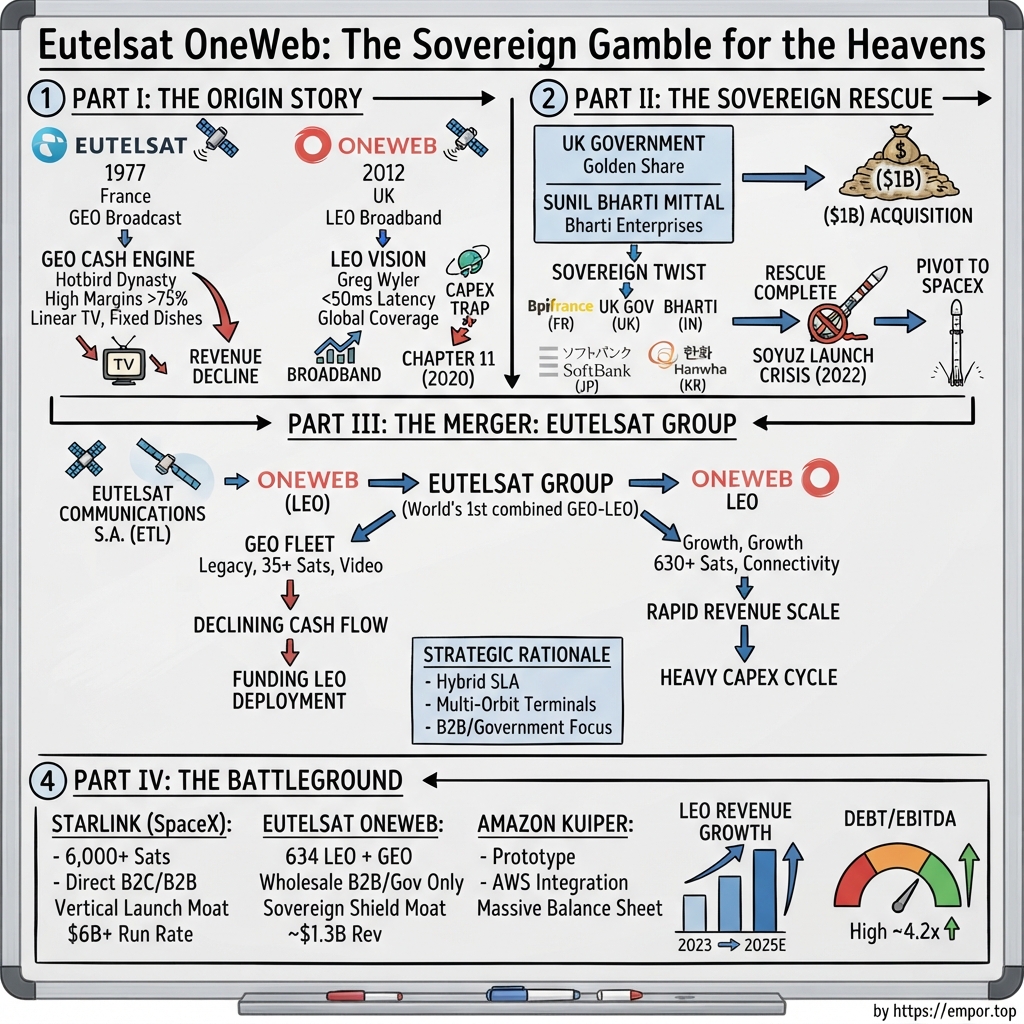
Eutelsat OneWeb: The Sovereign Gamble for the Heavens
I. Introduction & Episode Roadmap (0:00 – 14:00)
On 7 August 2026, the board of a 49-year-old French satellite operator met in Paris to sign off on numbers that would have been unthinkable in its founding era. Group revenue for the twelve months to 30 June 2026 came in at €1,235.9 million, down 0.6% as reported. Adjusted EBITDA stood at €632.4 million, representing a margin of 51.2%—down 3.2 percentage points. The group share of the net result was a loss of €457.3 million, marking its third consecutive annual deficit, narrowed only because the prior year's €720 million in goodwill and satellite write-downs had already cleared the balance sheet.1
Behind those headline figures sat the primary driver of investor attention. Low-Earth-orbit (LEO) revenue from the OneWeb constellation grew 69.5% to €297.0 million, now accounting for nearly a quarter of group revenue.1 Three years after Eutelsat acquired the restructured British satellite venture in an all-share transaction valuing it at roughly $3.4 billion, the LEO business has reached material scale.2 Over that same three-year stretch, however, legacy shareholders have seen roughly nine-tenths of their equity value erased.
This divergence frames the central tension. For four decades, Eutelsat operated one of the most cash-generative commercial models in European telecoms: a fleet of geostationary satellites stationed over Europe and the Middle East, beaming video broadcast signals to tens of millions of satellite dishes with virtually zero incremental distribution cost on long-term, non-cancellable contracts. In FY 2023–24, the first full fiscal year consolidating OneWeb, Eutelsat still delivered a 59.3% adjusted EBITDA margin.3 Two years later, that margin stands at 51.2%, with management projecting a rebound toward 65% by FY 2028–29.1 The company's investment thesis rests entirely on whether this projected recovery reflects operational reality or optimistic financial modeling.
The ownership structure further distinguishes Eutelsat from any typical publicly listed telecom asset. Following a €1.5 billion recapitalization completed in late 2025, the French State—via the Agence des Participations de l'État—holds approximately 29.65% of the capital and voting rights. Bharti Space, controlled by Indian telecom industrialist Sunil Bharti Mittal, holds about 17.88%. The UK Government holds 10.89%. Global shipping group CMA CGM holds 7.46%, and the French institutional fund Fonds Stratégique de Participations holds 4.99%, leaving a free float of roughly 29%.4 Two sovereign states and an industrial conglomerate effectively control a company listed on Euronext Paris. The UK also retains a special "golden" share in the OneWeb subsidiary, granting statutory veto power over national-security decisions, headquarters location, and any proposed transfer of assets to hostile foreign entities.5
Analyzing this structure requires a specific analytical lens. While OneWeb originated as a venture-backed startup that raised billions, entered Chapter 11 bankruptcy, and underwent sovereign rescue, there is no standalone prospectus or independent S-1 filing to evaluate. The constellation operates inside Eutelsat Communications S.A., which has traded publicly since December 2005 and files an annual Universal Registration Document with the Autorité des Marchés Financiers.6 This dynamic offers audited group financials and a multi-year track record against corporate guidance, but presents analytical limits: OneWeb lacks a separately broken-out P&L, standalone operating cost structure, or distinct balance sheet. Its financial profile must be pieced together from disclosed LEO revenue lines and executive commentary. Where standalone unit economics are estimated, this analysis identifies them explicitly as inferences.
The pivotal question is not whether demand for multi-orbit satellite connectivity exists—it clearly does. Rather, the question is whether an operator generating €632 million in adjusted EBITDA, carrying €1.46 billion in net debt following an equity rescue, and committing €1.2 billion to capital expenditures in the current fiscal year alone can sustain and refresh a low-Earth-orbit constellation while competing against SpaceX's Starlink—a network that deployed over 10,000 active satellites, reached twelve million subscribers, and completed a historic public offering over the same period.78
The roadmap begins with the commercial zenith of geostationary broadcast and its cash generation. Second, Greg Wyler's initial LEO vision, SoftBank's capital deployment, and the March 2020 insolvency. Third, the UK-Bharti rescue and the launch disruptions following Russia's invasion of Ukraine. Fourth, the 2022–23 merger and what Eutelsat actually acquired. Fifth, the revenue engine, examining segment durability, commercial pipeline, and utilization. Sixth, the competitive landscape reshaped by a publicly traded SpaceX. Seventh, a stress test of Eutelsat's multi-orbit architecture. Eighth, corporate governance, capital allocation, and a valuation framework. Ninth, the bull and bear cases alongside the critical operating metrics that will determine the outcome.
 Subscribe on LinkedIn
II. The Golden Age of GEO: Eutelsat’s Broadcast Cash Engine (1977–2014) (14:00 – 32:00)
Eutelsat did not begin as a commercial enterprise. It originated in 1977 as an intergovernmental organization established by European states to construct the continent's satellite telecommunications infrastructure—a treaty body rather than a corporation, launching its first satellite, EUTELSAT I-F1, in 1983.6 That origin remains foundational: the regulatory framework of the satellite industry—governing orbital slot allocations, frequency rights, and coordination priorities—was designed by governments for governments, placing Eutelsat inside international spectrum administration from its inception.
The physics that built the commercial model explain both its golden age and its eventual decline. A satellite placed 35,786 kilometers above the equator orbits at the precise angular velocity of Earth's rotation, appearing stationary from the surface. That single orbital property enabled households to install an inexpensive, fixed dish antenna, point it once, and receive a continuous signal without tracking hardware. It also meant a single satellite transponder could illuminate an entire continent, reducing the marginal distribution cost of reaching an additional broadcast viewer to zero.
Eutelsat commercialized that dynamic through its HOTBIRD constellation, deployed from 1995 at the 13° East orbital position to aggregate hundreds of channels at a single orbital location.6 At this scale, satellite transmission evolved into a two-sided platform marketplace. Once tens of millions of European households aligned dishes to 13° East, television broadcasters seeking broad distribution had to secure transponder capacity at that specific longitude. As the broadcast lineup expanded, consumer adoption reinforced dish orientation toward the same orbital slot. Eutelsat effectively operated the distribution exchange and controlled access to the venue. A comparable dynamic established the 7/8° West neighborhood serving the Middle East and North Africa—an asset Eutelsat continued to monetize in the first half of FY 2025–26 through a capacity renewal with beIN Media Group for direct-to-home broadcast distribution across the MENA region.9
Corporate structure caught up with commercial operations in 2001, when the intergovernmental body transferred its assets and operational activities into Eutelsat S.A., a private Paris-based operating company.6 Private equity investment introduced leverage to the balance sheet, and on 2 December 2005, Eutelsat listed on Euronext Paris at €12 per share, raising approximately €860 million on a 34% stake and establishing an implied market capitalization of roughly €2.5 billion.10 That valuation provides a telling historical anchor: twenty-one years later, despite acquiring a low-Earth-orbit constellation and executing a €1.5 billion equity recapitalization, the company's equity market capitalization remains below its 2005 IPO value.11
For roughly a decade following its listing, the commercial model delivered predictable financial returns. Broadcast contracts typically spanned five to fifteen years under non-cancellable terms, working capital requirements remained minimal, and capital expenditure followed a steady cadence tied to fifteen-year geostationary satellite lifecycles. Furthermore, the International Telecommunication Union's frequency allocation rules created formidable regulatory barriers, insulating incumbents with established orbital coordination. The outcome was a communications utility combining the high-margin cash characteristics of a software network with the tangible asset base of an industrial infrastructure operator.
The seeds of decline emerged from two distinct constraints: one commercial and one physical. Commercially, linear direct-to-home television steadily lost market share to fiber-to-the-home broadband, internet protocol distribution, and on-demand streaming services. While geostationary broadcasting excels at transmitting a single identical signal to tens of millions of receivers simultaneously, it cannot deliver customized, bi-directional, on-demand streams to individual users. As consumer media consumption shifted toward interactive formats, the fixed broadcast architecture became a strategic constraint. That transition is now clearly reflected in corporate disclosures: Video revenue fell 13.1% in FY 2025–26 to €519.2 million, reducing the division from a dominant contributor to 43% of group revenue.1 While European sanctions on Russian broadcasting created an annualized revenue loss of approximately €16 million in FY 2025–26, the underlying secular contraction in what management describes as a "mature business" was established well before geopolitical interventions.9
The physical barrier is latency. A radio frequency signal traveling to geostationary orbit and back covers roughly 143,000 kilometers over a complete round trip between a user terminal, satellite, and ground gateway. Moving at the speed of light, that transmission path incurs nearly 500 milliseconds of propagation delay before accounting for terrestrial routing or application-layer handshakes. While propagation delay has no impact on passive television broadcasts, it degrades performance for interactive applications, including cloud software, enterprise virtual private networks, financial trading systems, 5G cellular backhaul, and remotely piloted operations. By the mid-2010s, enterprise connectivity growth had shifted toward low-latency data applications that geostationary orbits cannot reliably support.
This dynamic framed Eutelsat's strategic dilemma. The company operated a highly cash-generative broadcast franchise with a shrinking core, while broader telecommunications demand migrated toward low-latency orbital regimes it did not occupy. Entering low Earth orbit was not an effort to expand into adjacent markets; it was a structural necessity to access the only segments of satellite connectivity that were continuing to expand.
III. Greg Wyler, SoftBank, and the LEO Dream: OneWeb 1.0 (2012–2020) (32:00 – 58:00)
The serial entrepreneur of orbit
Greg Wyler's career is a study in executing a single core concept across three distinct orbital regimes. His earlier venture, O3b Networks—named for the "Other 3 Billion" people without internet access—placed satellites in medium Earth orbit roughly 8,000 kilometers above the planet, cutting latency by a factor of four compared to geostationary systems. O3b was eventually acquired by SES, which now operates the successor architecture as O3b mPOWER.
In 2012, Wyler founded WorldVu, later renamed OneWeb, with a more radical technical proposition: hundreds of small satellites deployed at an altitude of approximately 1,200 kilometers, low enough to achieve round-trip latency under 50 milliseconds—comparable to standard terrestrial broadband.12
The asset that actually mattered
The satellites were not the primary strategic prize; the spectrum rights were.
Wyler secured early International Telecommunication Union filings for Ku- and Ka-band frequencies in non-geostationary orbit. Under ITU regulations, priority is governed by the date of filing: later constellations must prove they will not cause unacceptable interference to earlier claimants, rather than the reverse. In an orbital environment that would eventually hold tens of thousands of spacecraft, spectrum seniority represents a durable regulatory barrier to entry.
Eutelsat emphasized this dynamic in its 2025 capital-raising presentations, asserting that "barriers to entry into LEO—in particular access to, and the requirement to share spectrum secured by Eutelsat—mean only a limited number of players will participate in the massive growth ahead."13 While this spectrum position provides genuine regulatory protection, it also represents the company's most heavily marketed competitive moat—warranting rigorous evaluation rather than uncritical acceptance.
The cap table that built and broke the company
OneWeb's early shareholder register assembled a roster of prominent strategic and corporate investors, including Richard Branson's Virgin Group, Qualcomm, Airbus, and Coca-Cola. Airbus expanded its commitment by establishing Airbus OneWeb Satellites, a joint venture in Florida engineered to manufacture smallsats using automotive-style assembly lines rather than bespoke aerospace fabrication.12
In December 2016, SoftBank led a $1.2 billion funding round with a $1.0 billion direct investment alongside existing backers.12 Masayoshi Son's thesis mirrored the broader playbook of the Vision Fund era: deploy massive upfront capital to capture global infrastructure scale ahead of rivals, deferring unit-level economics to a later phase. At the time, SpaceX had announced Starlink but had yet to deploy an operational satellite.
Two design decisions that mortgaged the future
OneWeb 1.0 made two critical architectural choices that would constrain its operating economics for a decade.
The first was the decision to omit optical inter-satellite links. Because Starlink satellites can route traffic directly to one another in orbit via laser crosslinks, a terminal in maritime waters or remote terrain can communicate through neighboring satellites until reaching an available terrestrial gateway. OneWeb's first-generation satellites lacked crosslinks, operating strictly as "bent pipes" where each spacecraft must maintain simultaneous line-of-sight visibility with both the user terminal and a ground gateway station. This requirement forced OneWeb to construct and license approximately forty ground gateway stations worldwide—each demanding landing rights, local frequency clearances, operational partnerships, and extensive bilateral negotiations with national regulators.
The second decision was procuring launch capacity entirely as an external merchant customer. OneWeb contracted with Arianespace to secure Soyuz-2 launches operated by Roscosmos from the Baikonur Cosmodrome. While Soyuz represented a reliable and cost-effective medium-lift launcher at the time, this procurement strategy tied OneWeb's entire deployment timetable to the geopolitical and industrial policies of the Russian Federation.
March 2020
By early 2020, OneWeb had deployed roughly seventy satellites into orbit while carrying an operating cost base designed to support a planned 648-satellite constellation.12 The company was negotiating a follow-on equity round of approximately $2 billion, once again anchored by SoftBank. When the onset of the COVID-19 pandemic disrupted global financial markets, SoftBank declined to fund the round, and on 27 March 2020, OneWeb filed for Chapter 11 bankruptcy protection in the U.S. Bankruptcy Court for the Southern District of New York.14
The failure illustrates a structural vulnerability common to capital-intensive infrastructure startups. A pre-revenue enterprise facing high fixed capital expenditure commitments and reliant on a single dominant financial sponsor possesses minimal financing flexibility; when the anchor investor reprices risk, operations do not merely contract—they halt.
What survived the restructuring were the core regulatory and orbital rights. The ITU spectrum priority filings, national market landing rights, and the operational satellites already in orbit provided the foundation for an eventual acquirer, while existing equity holders were entirely wiped out.
IV. The Geopolitical Rescue & The Soyuz Crisis (2020–2022) (58:00 – 1:24:00)
A government buys a satellite company
On 3 July 2020, a consortium comprising Bharti Global and the UK government won the bankruptcy auction for OneWeb's assets with a $1 billion commitment, split equally at $500 million from each party.15 The company emerged from Chapter 11 protection on 20 November 2020, with Bharti Global and the British government each holding roughly 42.2% of the reorganized equity, while SoftBank and Hughes Network Systems retained minority stakes.14
The British government's rationale was strategic rather than commercial. Following Brexit, the UK lost access to the secure, encrypted public regulated service of the European Union's Galileo satellite navigation system and sought a sovereign orbital asset. While acquiring a bankrupt broadband constellation to address a navigation deficit drew domestic criticism—the spacecraft were engineered for high-throughput communications rather than precision timing—the transaction delivered direct state control over an operational global satellite network.
The golden share
The UK government did not merely purchase an equity interest; it secured a special "golden" share granting statutory veto power over national-security decisions, any proposed relocation of corporate headquarters outside the UK, and any transfer of assets to hostile foreign jurisdictions, alongside preferential rights on domestic launch and procurement.5 When the Eutelsat combination was finalized, the British government retained these governance protections and secured a board seat at the French parent company.16
For public market investors, this sovereign oversight creates structural trade-offs. The golden share establishes a permanent barrier against hostile foreign takeovers and offers institutional reassurance to Western defense and security clients. Conversely, it removes standard commercial flexibility from the board: strategic decisions regarding manufacturing locations, customer eligibility, and corporate domicile remain subject to state interests that may diverge from maximizing equity returns.
Eutelsat buys in
In April 2021, Eutelsat acquired a 24% stake in OneWeb for $550 million in cash, securing board representation and diluting existing shareholders.1718 While subsequently viewed as the opening phase of the full merger, the initial equity purchase functioned primarily as a strategic hedge: an option on low-Earth-orbit connectivity without immediately consolidating OneWeb's operating losses on Eutelsat's income statement.
The transaction also reinforced a defining characteristic of OneWeb's capital structure. Every funding round since the 2020 insolvency has been set by strategic or sovereign participants: a national government seeking orbital sovereignty, a telecom operator securing regional distribution, or a geostationary incumbent purchasing technological insurance. Valuation benchmarks established by strategic capital reflect policy objectives and commercial hedging rather than independent financial underwriting of intrinsic equity value.
The hostage crisis
On 2 March 2022, days after Russia launched its full-scale invasion of Ukraine, Roscosmos Director General Dmitry Rogozin demanded that the UK government divest its ownership stake in OneWeb and that the company guarantee its satellites would not be deployed for military operations as conditions for launching thirty-six spacecraft stacked on a Soyuz rocket at the Baikonur Cosmodrome.19
OneWeb refused the ultimatum. In response, Russian authorities rolled the rocket off the launch pad and impounded the thirty-six satellites, later proposing to exchange them for seized Soyuz hardware.20 The satellites were never recovered, forcing an operational write-off.
The episode underscored the vulnerability created by OneWeb's reliance on a single merchant launch provider. When geopolitical conflict severed commercial relations, a critical operational asset was seized without legal or contractual recourse, transforming supply chain concentration from an abstract risk disclosure into an immediate operational crisis.
The humiliating fix
To complete the constellation, OneWeb turned to its primary market rival. In March 2022, the company contracted with SpaceX for multiple Falcon 9 launches, alongside a separate procurement agreement with NewSpace India Limited for LVM3 launch vehicles.12 Deployments resumed in late 2022, enabling OneWeb to complete its first-generation operational constellation by May 2023.
Contracting launch services from SpaceX to deploy a constellation designed to compete with Starlink underscored the asymmetric industrial dynamics of the launch sector—a structural cost advantage that continues to shape Eutelsat's multi-orbit economics.
V. The Merger: Eutelsat Combines with OneWeb (2022–2023) (1:24:00 – 1:52:00)
The deal
Eutelsat announced in July 2022 that it would combine with OneWeb in an all-share transaction, closing the combination on 28 September 2023 after receiving approval from more than 87% of voting shareholders.2 Eutelsat issued new equity to OneWeb’s investors for the remaining stake it did not already own, valuing OneWeb at approximately $3.4 billion at announcement.2 Legacy Eutelsat shareholders and incoming OneWeb owners each ended up with roughly 50% of the combined group, while preserving a primary listing on Euronext Paris alongside a secondary line in London.
Governance was split across both predecessor entities. Eva Berneke, appointed CEO in January 2022, continued to lead the combined group, while Dominique D’Hinnin remained chairman. Sunil Bharti Mittal, formerly OneWeb’s executive chairman, assumed the role of Vice-Président and co-chair. The board was configured with fifteen members—including ten independents—composed of seven directors proposed by each side alongside the CEO.3
What management promised on day one
This baseline provides the standard against which subsequent operational execution must be evaluated. In the completion announcement on 28 September 2023, Eutelsat management outlined financial targets for the combined entity:3
- Revenue of €1.32–1.42 billion in FY 2023–24, rising to €1.55–1.75 billion in FY 2024–25, and reaching approximately €2.0 billion by FY 2026–27.
- Adjusted EBITDA of €725–825 million in FY 2023–24, €900 million–1.1 billion in FY 2024–25, and roughly €1.4 billion by FY 2026–27.
- Average annual capital expenditure of €725–875 million from FY 2023–24 through FY 2029–30, front-loaded and stepping down significantly after 2030.
- Adjusted EBITDA minus capex returning to positive territory by FY 2024–25 or FY 2025–26.
- Synergies delivering over €1.5 billion in after-tax net value creation after factoring in implementation costs.
- Leverage of approximately 4x pro forma net debt to EBITDA at June 2023, de-leveraging to approximately 3x over the medium term.
- Suspension of the annual dividend for three fiscal years.
What actually happened
Results across the initial three fiscal years diverged sharply from those commitments.
In FY 2023–24, group revenue came in at €1,213.0 million, falling short of the €1.32–1.42 billion guidance range. Adjusted EBITDA landed at €718.9 million, just beneath the lower boundary of the target band, while the group share of the net result was a loss of €309.9 million.3
In FY 2024–25, group revenue reached €1,243.7 million against guided expectations of €1.55–1.75 billion—a deficit of roughly 20% compared to the midpoint. Adjusted EBITDA contracted to €676.2 million against the €900 million–1.1 billion target, missing expectations by nearly a third. The net loss widened to €1,081.9 million, driven by a €535 million goodwill impairment on legacy geostationary assets and €186 million in satellite write-downs. Net debt closed at €2,626.6 million, pushing leverage to 3.88x EBITDA—higher than at transaction close rather than tracking downward.21
In FY 2025–26, revenue stood at €1,235.9 million. While FY 2026–27 had originally been targeted as the €2.0 billion revenue inflection point, management has deferred equivalent targets, projecting €1.5–1.7 billion by FY 2028–29.113
Furthermore, the initial claim of over €1.5 billion in net synergy value creation has not been reconciled against operational savings in subsequent corporate reporting, leaving it unverified by formal segment accounting.
Did Eutelsat overpay?
Evaluating the transaction strictly through the lens of purchase price obscures the core strategic trade-off.
Industry consolidations over the same period offer useful points of comparison. In 2023, Viasat completed its acquisition of Inmarsat for a headline enterprise value of roughly $7.3 billion, securing an established global mobility customer franchise with mature cash flows. In April 2024, SES agreed to acquire Intelsat for $3.1 billion in cash, closing the transaction on 17 July 2025; that combination created a fleet of roughly 120 satellites generating pro forma revenue of approximately €3.7 billion and adjusted EBITDA of €1.8 billion.2223
Comparing the two strategies illustrates differing capital allocation philosophies. SES paid $3.1 billion in cash to consolidate scale, secure cash flow, and expand its footprint in U.S. government procurement within a mature geostationary market. Eutelsat, by contrast, committed roughly half its equity base—representing approximately €3.1 billion in market value at announcement—for an early-stage asset with negligible initial revenue, zero operating profit, and substantial forward capital expenditure obligations.
However, direct financial comparisons between geostationary consolidation and constellation development have analytical limits. SES bought scale in a contracting orbital band, whereas Eutelsat acquired operational exposure to expanding low-latency demand. Evaluated as a long-term growth call option rather than a cash-flow multiple, €3.1 billion for senior ITU low-Earth-orbit spectrum priority, a deployed 600-satellite constellation, and institutional alignment across two Western governments represented a viable technological shortcut. Developing an equivalent constellation independently would have required comparable capital and years of lead time.
The fundamental breakdown resided not in the strategic logic of the asset, but in the financing structure and operational underwriting.
The currency problem
Using equity as transaction currency transferred half the ownership of a high-margin, cash-generative broadcast business to holders of a capital-intensive, pre-profit network precisely when the acquirer’s stock price was vulnerable to repricing. Eutelsat shares fell sharply between announcement and completion, reflecting an investor base adjusting from an income-focused infrastructure utility to a speculative, high-capex buildout.24
Legacy public shareholders absorbed a 50% dilution, an immediate dividend cancellation, elevated leverage, and a multi-year operational plan that missed day-one targets. That compression of returns eroded equity market confidence, ultimately requiring sovereign capital rather than public markets to lead subsequent recapitalizations.
The funding problem
The structural defect in the merger model lay in the operating assumptions underpinning capital expenditure. Management guided annual capex of €725–875 million through FY 2029–30 while anticipating EBITDA scaling toward €1.4 billion by FY 2026–27.3 At €1.4 billion in annual EBITDA, constellation deployment and maintenance would have been self-funding. However, with adjusted EBITDA standing at €632 million and FY 2026–27 capital expenditure guided at €1.2 billion, the cash shortfall became acute.1
This widening spread between modeled and realized cash flow drove the subsequent sovereign intervention. The transaction ran into difficulty not because the low-Earth-orbit network lacked commercial utility, but because the business plan miscalculated the near-term cash generation required to sustain it, leaving a leveraged balance sheet with no margin for operational delay.
VI. Business Architecture & Segment Breakdown: Where the Money Comes From (1:52:00 – 2:24:00)
The shape of the company today
Eutelsat reports four operating verticals alongside a minor "other" revenue line. For FY 2025–26, operating vertical revenue totaled €1,197.1 million, up 1.8% like-for-like within total group revenue of €1,235.9 million.1
Video generated €519.2 million, declining 13.1% to represent 43% of total group revenue. Fixed Connectivity generated €270.0 million, up 15.6%. Government Services delivered €235.5 million, rising 17.7%. Mobile Connectivity generated €172.4 million, advancing 15.9%.1
Disaggregating revenue by orbital regime rather than customer vertical reveals a more telling operational divide. LEO revenue expanded 69.5% to €297.0 million, accounting for 25% of group revenue and over 40% of total connectivity sales. In contrast, geostationary connectivity revenue contracted 6.6% like-for-like to €380.9 million.1
The group effectively operates three distinct commercial engines within a single income statement: a large, high-margin, structurally contracting broadcast franchise; a mid-sized, gradually eroding geostationary connectivity operation; and a fast-scaling low-Earth-orbit constellation approaching €300 million in annual run-rate.
Video: the cash engine that is running down
Video remains the primary reason Eutelsat continues to generate €632 million in adjusted EBITDA on €1.2 billion of top-line revenue. While the company does not disclose margin profiles by vertical, the trajectory is clear from group-level disclosures. Adjusted EBITDA margin stood at 59.3% in FY 2023–24, compressed to 54.4% in FY 2024–25, and fell to 51.2% in FY 2025–26, while group revenue remained essentially flat.1321 A flat revenue base paired with compressing margins during a period when LEO is the sole growth driver confirms that the contracting broadcast segment carries a substantially higher margin structure.
The Video division presents two contrasting characteristics. On a contract-by-contract basis, cash flow quality remains solid: multi-year, multi-transponder renewals with beIN Media Group across the MENA region and Polsat Plus at the HOTBIRD orbital position were signed in the first half of FY 2025–26 as take-or-pay commitments rather than usage-sensitive volumes.9 Simultaneously, secular contraction continues: segment revenue fell 13.1% for the full year and 14.1% like-for-like in the second quarter alone.19
Approximately €16 million of the annualized FY 2025–26 revenue reduction stemmed from European sanctions on Russian broadcast channels—a discrete regulatory shock.9 Adjusting for that impact leaves an underlying annual contraction rate in high single digits to low double digits. On a €519 million revenue base, that rate translates to €45–65 million in high-margin broadcast revenue eroding annually. Lower-margin LEO connectivity must therefore add roughly €100 million in annual top-line growth simply to maintain group adjusted EBITDA at parity. In FY 2025–26, LEO expanded by €110 million, yet group adjusted EBITDA still declined 3.1% like-for-like.1 This margin asymmetry represents the fundamental mathematical challenge facing the equity story.
Government Services: the best business in the group
Government Services expanded 17.7% to €235.5 million, supported by initial revenue recognition on the CENTAURE contract under France's NEXUS procurement framework.1 NEXUS is a ten-year framework agreement established in June 2025 with the French Ministry of the Armed Forces for low-Earth-orbit satellite capacity, carrying a ceiling value of €1 billion.13
This vertical is where sovereign state shareholdings transition from a governance friction into a direct commercial moat. An operator anchored by French state equity and protected by a British golden share can offer sovereign defense buyers within NATO encrypted, low-latency satellite capacity with assured non-U.S. operational jurisdiction—a structural characteristic SpaceX cannot replicate.
However, several caveats frame these figures. A €1 billion ten-year framework establishes an upper spending limit rather than an upfront financial commitment; actual cash conversion depends on individual task orders, and the first formal call-off under NEXUS was executed only during FY 2025–26.1 Government procurement also introduces quarterly volatility: Government Services revenue fell 2.2% year-on-year in the second quarter of FY 2025–26 and 11.7% sequentially, reflecting softer U.S. procurement cycles and delayed terminal shipments following a strong first quarter.9 Furthermore, a significant portion of sector growth is tied to European defense procurement responding to the war in Ukraine—a demand driver subject to shifting geopolitical priorities. While the German government has financed Ukrainian access to Eutelsat capacity, deployed operational terminals remain in the hundreds compared to tens of thousands of active Starlink terminals deployed across the theater.25
Mobile Connectivity: the clearest evidence of real operating progress
Mobile Connectivity rose 15.9% to €172.4 million.1 Disclosed operational data in this vertical provides the most reliable indicator of how low-Earth-orbit capacity converts order backlog into active billing.
At the close of FY 2024–25, Eutelsat reported approximately 100 certified aircraft antenna installations against an order backlog of roughly 1,000 airframes. By 31 December 2025, certified installations had reached nearly 600 against an expanded backlog exceeding 1,500 aircraft.9 This represents a sixfold increase in the active airborne installed base within six months alongside continuous order-book expansion.
Aviation connectivity represents high-barrier commercial revenue in the satellite sector. Commercial airlines commit only after terminals achieve rigorous airworthiness certification for specific airframes, and billings commence only once hardware is installed and operational. Certified installations therefore provide physical verification of backlog conversion. This ramp explains why Mobile Connectivity revenue accelerated to 34.5% like-for-like growth in the second quarter of FY 2025–26 as newly equipped airframes entered commercial service.9
Conversely, this deployment cycle highlights the primary commercial bottleneck for LEO economics. Satellites in orbit do not generate cash flow independently; monetization requires type-certified terminals from a concentrated hardware supplier base, ground gateway stations with licensed spectrum landing rights, and market-by-market national regulatory clearances. Corporate materials note that comprehensive global coverage is "expected to be fully achieved in calendar year-end 2026"—three years after initial constellation deployment concluded.13 The multi-year lag between placing spacecraft in orbit and activating commercial revenue across global jurisdictions is the phase where constellation operators absorb substantial capital outlays before generating operational cash.
Fixed Connectivity: growth with a quality caveat
Fixed Connectivity grew 15.6% to €270.0 million.1 The vertical comprises wholesale cellular backhaul, corporate wide-area networks, and rural enterprise broadband distributed through regional partners, exemplified by agreements with MSTelcom in Angola and Paratus across Southern Africa during the first half of FY 2025–26.9
One specific accounting disclosure warrants closer examination. First-half Fixed Connectivity revenue growth of 17.2% included a one-off positive impact of approximately €7 million resulting from the upfront revenue recognition of a long-term geostationary capacity contract.9 On a €132 million half-year segment base, that discrete contract accounted for roughly five percentage points of reported growth. While fully disclosed by management, the underlying organic growth rate tracked closer to 12%, demonstrating the need to evaluate top-line expansion net of revenue-timing adjustments.
Revenue quality, tested
Although recurring revenue remains a prominent feature of Eutelsat's commercial profile, contractual durability varies across segments. Video is multi-year, take-or-pay, and shrinking. Government Services is contracted and legally protected, but subject to budgetary cycles. Mobility is anchored by airline-level commitments that ramp with physical hardware installation. Fixed Connectivity relies heavily on wholesale intermediaries, leaving it exposed to partner churn and competitive repricing.
Contract backlog provides the most transparent measure of forward durability, and its multi-year trend highlights a structural shift. Group backlog stood at €3.9 billion at June 2024, declined to €3.5 billion at June 2025, and closed at €3.4 billion at June 2026—representing 2.7 years of annual revenue, down from 3.1 years at December 2024.1921
Management attributes this contraction to changing product mix: LEO connectivity contracts are substantially shorter than standard ten-to-fifteen-year geostationary broadcast leases, only minimum committed amounts under take-or-pay arrangements are recognized in backlog, and variable pay-as-you-go volumes are excluded entirely.9 Connectivity has consequently expanded to 61% of total backlog, up from 57% a year earlier.1 A mix shift from long-term broadcast leases to shorter connectivity terms mechanically reduces headline backlog duration even as underlying commercial activity expands.
Nevertheless, this transition alters the group's financial profile. Forward visibility is decreasing as the company trades long-term contracted cash certainty for growth-oriented market exposure. For public equity investors, accepting shorter visibility in exchange for higher top-line growth alters the risk-reward equation and broadens the range of appropriate valuation multiples.
Concentration and channel dependence
Eutelsat operates a strictly wholesale distribution model for its low-Earth-orbit capacity, partnering with telecom operators, systems integrators, and regional service providers rather than selling directly to retail end-users. Management positions this strategy as a core competitive differentiator, marketing the business as "the only one exclusively focused on the B2B and B2G markets."13
A pure wholesale model eliminates direct customer acquisition costs, retail support infrastructure, and consumer churn management. It also establishes Eutelsat as an aligned partner for major telecom operators such as Bharti Airtel, Orange, and Telstra, which face direct retail disintermediation from Starlink. However, wholesale distribution caps unit pricing power, surrenders direct customer relationships to third parties, and introduces channel concentration. The commercial integration with Bharti Airtel is particularly significant: Bharti is simultaneously the company's second-largest shareholder, a board co-chair, and a primary regional distributor—a relationship visible across commercial deployments, including connectivity for Indian Army operations in Sri Lanka and enterprise rail networks in Gabon.9
Neither customer-level revenue concentration nor the specific volume generated through Bharti-affiliated entities is separately quantified in the interim disclosures reviewed. For institutional investors, this related-party exposure represents an important area for verification in forthcoming regulatory filings.
The reachable market, not the category
In its 2025 capital-raising materials, Eutelsat cited third-party research projecting that the global B2B LEO connectivity market reached $2.1 billion in 2025 and would expand at a 28% compound annual growth rate through 2029, multiplying fivefold over eight years.13
Applying that growth rate implies a total addressable B2B LEO market of approximately $5.8 billion by 2029. With Eutelsat currently generating €297 million in annual LEO revenue, maintaining market share within an industry growing at 28% would scale its constellation revenue to roughly €800 million by FY 2029–30. When combined with a contracting geostationary broadcast base, that trajectory aligns with management's revised group revenue target of €1.5–1.7 billion for FY 2028–29.1 The financial guidance is internally consistent on paper.
The critical variable is competitive market share. Starlink is not restricted to the consumer broadband segment; it competes aggressively for maritime, commercial aviation, and enterprise connectivity contracts. Starlink's global average revenue per user stood at $66 in the second quarter of 2026, down from $85 a year earlier, illustrating a willingness to utilize launch cost advantages to drive pricing pressure.7 Eutelsat's realistic addressable market is therefore not the broader B2B LEO category in its entirety, but the specific segment where customers require non-U.S. sovereign control, European or Indian regulatory alignment, existing telecom partner integration, or integrated multi-orbit resilience. That addressable niche is commercially viable and strategically defensible, but materially more concentrated than top-line industry forecasts suggest.
VII. Competitive Crucible: The New Space Super-Powers (2:24:00 – 2:50:00)
The competitor became a public company
The single most consequential event in the satellite communications sector since the merger had little to do with Eutelsat directly. On 12 June 2026, SpaceX listed on Nasdaq under the ticker SPCX, pricing at $135 per share and closing its first trading session at roughly $161—marking the largest initial public offering in history, raising approximately $75 billion at an implied valuation near $1.77 trillion.8
For Eutelsat, this public market debut transformed the competitive environment in three distinct ways, only one of which offers strategic comfort.
What the disclosure reveals
SpaceX's regulatory filings and initial quarterly disclosures provided the satellite industry with its first audited look into Starlink's operating profile.
Starlink generated approximately $11.39 billion in revenue in 2025, accounting for roughly 61% of SpaceX's total sales, before expanding to approximately 69% in the first quarter of 2026. In that first quarter of 2026, the connectivity segment produced $3.3 billion in revenue and $2.1 billion in adjusted EBITDA. The subscriber base stood at 10.3 million at the close of the first quarter of 2026, up from 5.0 million twelve months earlier, before reaching 12 million by the end of the second quarter of 2026—a doubling of active customers within a single year. Group-level revenue in the second quarter of 2026 reached $7.8 billion, representing a 92% increase, alongside a net loss of $541 million.726
Two specific disclosures carry outsized implications for Eutelsat.
The first is the connectivity segment's adjusted EBITDA margin of roughly 64% in the first quarter of 2026—surpassing Eutelsat's entire group margin of 51.2%, while operating on a revenue base approximately ten times larger and expanding at triple digits.126 The thesis that low-Earth-orbit networks cannot achieve operating profitability at scale has been countered by audited financial disclosures.
The second metric is average revenue per user, which stood at $66 in the second quarter of 2026, down from $85 a year earlier.7 Starlink is actively trading price for subscriber volume. In a wholesale connectivity market where Eutelsat's telecom partners continuously benchmark alternatives, a dominant operator systematically compressing unit pricing represents a direct challenge to Eutelsat's wholesale pricing power.
The launch asymmetry, restated precisely
SpaceX surpassed 10,000 active Starlink satellites in orbit on 17 March 2026, operating approximately 10,876 spacecraft by late July 2026.27 The company is deploying next-generation V3 satellites via its Starship launch vehicle and has applied for regulatory approval to operate a constellation of up to 100,000 spacecraft.27
By comparison, Eutelsat's low-Earth-orbit fleet comprises roughly 600 satellites, complemented by 31 in geostationary orbit.2 To refresh its constellation, Eutelsat ordered 440 replacement satellites from Airbus—commencing with 100 in December 2024 and expanding with 340 announced on 12 January 2026—to be manufactured on a dedicated assembly line in Toulouse, with initial deliveries scheduled for late 2026 representing a projected capital outlay of approximately €2.2 billion.2829 Eutelsat is also seeking to diversify launch access through a multi-launch agreement with France's MaiaSpace for missions starting in 2027.9
This industrial asymmetry is not simply a matter of launch cost per kilogram; it is a structural difference in innovation cycles. SpaceX designs, builds, and launches satellites internally, allowing each generation of Starlink to become less expensive and more capable on an internally controlled development schedule. Eutelsat, by contrast, procures satellites from Airbus under commercial aerospace contracts and purchases launch capacity from merchant providers, meaning each constellation refresh reflects external supply-chain pricing and delivery timetables. One operator's cost curve declines by internal engineering design; the other is set through commercial negotiation.
This dynamic creates a critical second-order consequence: Eutelsat's 440-satellite procurement is a replacement program rather than a capacity expansion. First-generation OneWeb satellites launched between 2020 and 2023 reach the end of their design lives in 2027 and 2028.28 Eutelsat is committing approximately €2.2 billion largely to maintain existing capacity while integrating technology upgrades, during the same multi-year window in which Starlink is compounding orbital throughput by orders of magnitude.
Amazon Leo
Amazon rebranded Project Kuiper as Amazon Leo in November 2025. The venture has deployed more than 375 satellites toward an initial orbital design exceeding 3,000 spacecraft at altitudes of 590 to 630 kilometers, securing over 80 launch missions across Arianespace, Blue Origin, SpaceX, and United Launch Alliance, while operating a manufacturing facility in Kirkland, Washington, designed to produce up to five satellites per day. An enterprise preview began in November 2025 ahead of a broader commercial rollout planned through 2026, offering user terminals supporting downlink speeds of up to 1 Gbps for enterprise clients. Initial commercial partners include Delta Air Lines for in-flight connectivity starting in 2028 and South African broadband provider Herotel.30 The enterprise beta opened more broadly in April 2026.31
While Amazon remains behind schedule relative to its initial Federal Communications Commission deployment milestones, and its operational fleet remains a fraction of Starlink's, it directly challenges Eutelsat's commercial positioning. Amazon Leo targets enterprise and mobility verticals, distributes through commercial partners, natively integrates with Amazon Web Services, and is funded by a corporate balance sheet unconstrained by equity recapitalizations. If Amazon executes its deployment schedule, Eutelsat's positioning as the principal non-SpaceX wholesale LEO operator narrows primarily to sovereign and defense mandates.
The GEO consolidators
SES completed its acquisition of Intelsat on 17 July 2025, creating an operator with approximately 120 satellites across geostationary and medium Earth orbits.22 For FY 2025, SES reported revenue of €2,627 million and adjusted EBITDA of €1,196 million, with combined like-for-like net leverage of 3.9x, capital expenditure for 2026 guided at approximately €700 million, and a maintained annual dividend of €0.25 per A-share.23
SES offers the most direct strategic comparison in the European sector. It generates roughly twice Eutelsat's revenue, delivers higher absolute EBITDA, maintains shareholder dividend distributions, and operates with comparable leverage. It also serves as a co-investor alongside Eutelsat in the IRIS² consortium, making it simultaneously a primary peer and an industrial partner. Across the Atlantic, Viasat's integration of Inmarsat addresses the global mobility segment through a similar consolidation strategy.
The strategic divergence between these models is distinct. Geostationary consolidators are acquiring scale and cash flow in mature orbital regimes to harvest profits while investing selectively in medium Earth orbit. Eutelsat, conversely, is deploying cash flows generated by mature broadcast assets to finance a high-capex low-Earth-orbit constellation. Consolidating mature orbits preserves near-term free cash flow, whereas Eutelsat's approach requires equity markets and sovereign backers to fund multi-year cash absorption.
IRIS²: the sovereign card
The European Union's institutional response to Starlink is IRIS²—Infrastructure for Resilience, Interconnectivity and Security by Satellite. On 16 December 2024, the European Commission signed a twelve-year concession agreement with the SpaceRISE consortium comprising SES, Eutelsat, and Hispasat, originally scoped at 290 satellites and €10.55 billion in total value.32
On 7 August 2026, the European Commission, the European Space Agency, and SpaceRISE concluded a program review that expanded and accelerated the deployment: 348 satellites—comprising 330 in low Earth orbit and 18 in medium Earth orbit—with total investment exceeding €15.6 billion, backed by €11.6 billion in public funding from the Commission and ESA and up to €4 billion from the industrial consortium. Eutelsat committed €2.23 billion to the revised structure and will supply the 330 low-Earth-orbit spacecraft, with operational services scheduled to commence progressively from 2029, ahead of the original 2030 target.33
The positive interpretation of this arrangement is that European institutions have agreed to finance the vast majority of a next-generation orbital network that Eutelsat could not fund independently, while guaranteeing long-term sovereign demand. The countervailing risk is equally evident: Eutelsat, an enterprise generating €632 million in annual EBITDA and carrying €1.46 billion in net debt, has committed €2.23 billion of its own capital to an infrastructure program that generates no commercial revenue until 2029.133
Both perspectives reflect operational reality. Which dynamic ultimately determines Eutelsat's financial trajectory depends on whether its commercial low-Earth-orbit operations can achieve self-funding status before capital commitments under IRIS² reach peak intensity.
VIII. Strategic Analysis: 7 Powers & Porter's 5 Forces (2:50:00 – 3:12:00)
Strategic frameworks are valuable only when they test whether competitive claims hold up under scrutiny rather than simply restating marketing narratives. Applied to Eutelsat, much of the competitive "moat" emphasized in corporate presentations holds up against two of Hamilton Helmer's seven powers, but weakens under the remaining five.
Cornered resource: the strongest claim, and it is real
Eutelsat's primary cornered resource is legal and regulatory rather than physical: senior International Telecommunication Union filings for Ku- and Ka-band non-geostationary spectrum, alongside established geostationary broadcast positions at 13° East and 7/8° West.129
The defining test of a cornered resource is whether a competitor with virtually unlimited capital could replicate it. SpaceX operates with immense financial and launch resources, yet it cannot purchase retroactive ITU priority; it must coordinate orbital frequencies around Eutelsat's senior filings. This priority represents a durable, non-replicable regulatory asset—the core property that preserved residual enterprise value through OneWeb's 2020 bankruptcy.
However, two qualifications prevent this resource from providing a complete commercial moat. First, spectrum priority confers regulatory transmission rights rather than customer contracts: it lowers the regulatory friction of operating, not the commercial cost of winning market share. Second, this spectrum is held under sovereign oversight, where British golden-share provisions and French state ownership place statutory constraints on how assets can be monetized or transferred.
Counter-positioning: a real strategy, but weakening
A wholesale-only distribution model represents textbook counter-positioning in the Helmer framework: SpaceX cannot easily adopt a pure wholesale strategy without cannibalizing its direct-to-consumer Starlink franchise, which reached twelve million subscribers by mid-2026.7 Telecom operators wary of retail disintermediation have a structural incentive to partner with a satellite wholesaler committed to avoiding direct consumer sales.
Commercial results offer initial validation for this channel strategy: in FY 2025–26, Fixed Connectivity revenue rose 15.6% and Mobile Connectivity grew 15.9%, largely driven by wholesale distribution partners.1 Yet this counter-positioning is coming under pressure from two directions. Amazon Leo is entering the market with an enterprise model that also relies on commercial partners, while Starlink's declining average revenue per user narrows the margin spread that wholesale intermediaries can capture.730
Furthermore, counter-positioning carries an inherent structural vulnerability. It shields an incumbent only as long as the dominant market leader finds that specific distribution channel commercially unattractive. If SpaceX decides that wholesale telecom capacity is worth pursuing aggressively at scale, Eutelsat's channel insulation diminishes.
Switching costs: high where it matters, small where the revenue is
The strongest switching costs across Eutelsat's portfolio reside in commercial aviation and government defense. An airline that has engineered and certified an airborne antenna across an entire aircraft fleet—a segment where Eutelsat reached nearly 600 certified installations by the end of 2025—has absorbed significant engineering, regulatory, and downtime costs that a competing network would have to convince the carrier to duplicate.9 Deep integration into sovereign military communications architectures creates even higher organizational inertia.
Yet these high-friction verticals account for roughly a third of group revenue. In Fixed Connectivity, switching costs sit primarily with regional wholesale distributors rather than enterprise end-users, and wholesale intermediaries routinely renegotiate capacity across competing orbital networks.
Scale economies, network effects, process power, branding
Across the remaining four powers, the competitive dynamic turns sharply against Eutelsat.
Scale economies operate in reverse. SpaceX manages more than 10,000 active satellites compared to Eutelsat's constellation of roughly 600, manufactures both spacecraft and launch vehicles internally, and delivered a connectivity-segment adjusted EBITDA margin near 64% in the first quarter of 2026 against Eutelsat's 51.2% group margin.261 In low-Earth-orbit telecoms, unit-cost advantages of industrial scale currently favor the market leader.
Network effects are largely absent in satellite broadband. Orbital bandwidth is a shared resource where each additional subscriber consumes throughput rather than enhancing utility for other users. The single genuine network effect Eutelsat controls is its legacy video neighborhood at 13° East, an asset tied to a structurally declining broadcast market.
Process power is outsourced rather than proprietary. Eutelsat's 440 replacement satellites are being manufactured by Airbus on a dedicated assembly line in Toulouse.29 While Airbus's manufacturing efficiency represents an important industrial capability, that operational learning curve belongs to the aerospace supplier, which remains free to offer similar production capacity to third parties.
Branding, within a wholesale B2B and B2G business model, plays a negligible role in customer procurement.
Porter, honestly applied
Evaluating Eutelsat through Porter's Five Forces highlights similar structural pressures.
Barriers to entry remain formidable in absolute terms—requiring heavy capital expenditure, international spectrum priority, and landing rights across dozens of national jurisdictions—but the relevant market entrants are capitalized tech and aerospace giants for whom capital barriers present little friction.
Buyer power is substantial and expanding. Telecom partners and enterprise clients can now evaluate multiple low-Earth-orbit networks alongside geostationary capacity, while the sector's price leader continues to lower average revenue per user.7
Supplier power remains a central vulnerability. Launch services remain heavily concentrated in the hands of direct or indirect competitors, while satellite production relies on a single key contractor. Eutelsat's multi-launch agreement with MaiaSpace for missions beginning in 2027 represents a logical effort to diversify launch access, but cannot fully resolve supply-chain concentration in the near term.9
Threat of substitutes continues to mount as terrestrial fiber-to-the-home and 5G networks absorb accessible population centers, concentrating the addressable satellite market into remote geographies, mobile platforms, and defense applications.
Competitive rivalry is among the most capital-intensive in global telecommunications, positioning Eutelsat as the smallest well-capitalized participant in the low-Earth-orbit segment.
The synthesis
Applying these strategic frameworks produces a clear assessment. Eutelsat controls a durable, non-replicable regulatory asset and a viable wholesale channel position, yet operates with a structural cost disadvantage and an outsourced industrial supply chain. This balance of forces does not point to an operator capable of capturing broad market dominance in low Earth orbit. Instead, it describes a company positioned to defend a sovereign and enterprise niche—provided its balance sheet can fund the necessary constellation refreshes long enough to occupy that space.
That dynamic makes capital structure and cash-flow management, rather than pure strategy, the decisive determinant of the investment thesis.
IX. Management, Governance & Capital Allocation (3:12:00 – 3:26:00)
A change of leadership, and what it signaled
On 5 May 2025, Eutelsat announced that Eva Berneke would step down as chief executive, succeeded by Jean-François Fallacher, who assumed leadership on 1 June.3435 Berneke had led the company since January 2022, overseeing the OneWeb merger and its initial integration.
Fallacher’s background signaled a clear strategic pivot. He arrived from Orange, having served as chief executive of Orange France after earlier leading the group’s operations in Spain, Romania, and Poland.34 Eutelsat chose a telecom operator rather than an aerospace executive—a leader whose career centered on selling connectivity to and through telecom carriers, and managing capital-intensive network infrastructure against established competitors.
Six weeks after Fallacher took office, the company unveiled the €1.5 billion recapitalization that had eluded previous management.13 While sequencing alone does not establish causation, it marked a decisive realignment under new executive leadership.
Judging management by promises against results
Evaluating management against the merger-day targets outlined in Section V demonstrates significant underperformance: actual results fell short by roughly a third on FY 2024–25 adjusted EBITDA and by approximately 20% on revenue.321
What distinguishes the current management team is a willingness to provide granular disclosures and revise guidance transparently. When the planned sale of the passive ground segment to EQT Infrastructure VI collapsed on 29 January 2026 after conditions precedent went unfulfilled, Eutelsat disclosed the full financial impact within days: approximately €550 million in foregone net proceeds, an avoided annualized EBITDA drag of €75–80 million, a leverage forecast revised from 2.5x to approximately 2.7x EBITDA, and an upgraded FY 2028–29 adjusted EBITDA margin target from 60% to 65% resulting from the cancellation of the dilutive master service agreement.9
Management presented the outcome candidly, acknowledging that a failed divestment ironically improved headline margin projections. Similarly, the cancellation of the Flexsat Americas satellite program "following a review of the business case," which eliminated over €100 million in forward commitments, was disclosed directly in financial reporting.9
Evaluating management therefore yields a balanced picture: while the initial merger projections proved overly optimistic, current leadership has demonstrated greater capital discipline, improved disclosure transparency, and delivered on its FY 2025–26 financial targets.1
Governance: two states, a shipping family, and a 29% float
Eutelsat’s board was reconstituted at the 20 November 2025 annual general meeting, establishing a twelve-member structure with five women and a 50% independent ratio. Shareholders approved subscription commitments from the French State, Bharti Space, the UK Government, CMA CGM Participations, and Fonds Stratégique de Participations, alongside a revised shareholders' agreement. Jean-Baptiste Massignon and Jérémie Gué subsequently joined the board on 21 November 2025 upon completion of the reserved capital increase.9
Three governance dimensions warrant scrutiny from public equity investors.
First, the French State’s 29.65% stake sits deliberately below the 30% mandatory tender-offer threshold under French takeover regulations. Transaction documentation stated explicitly that the reserved investors "would not be in a position to launch a public takeover" and would operate under a non-concerting agreement with board representation proportional to shareholding.13 This structure confers effective strategic control without requiring the payment of a control premium to minority shareholders.
Second, the UK government’s special share provides statutory veto power over corporate headquarters location, national-security policies, and any transfer of key operating assets.5 While safeguarding sovereign defense interests, this governance mechanism substantially reduces the probability of a commercial takeover at a market premium.
Third, Bharti Space’s dual status as the second-largest shareholder, board co-chair, and key commercial distributor introduces persistent related-party dynamics. Disclosed interim financials do not separately break out revenue derived from Bharti-affiliated entities, leaving this counterparty exposure as a key area for verification in future regulatory filings.
What the strategic investors did
The most telling indicator of institutional conviction lies in the actions of early strategic backers.
Hanwha Systems divested its entire 5.4% stake in Eutelsat for €77.6 million in June 2025.36 Hanwha had originally invested in OneWeb during its post-bankruptcy reorganization. A South Korean defense contractor with strategic rationale for holding European sovereign connectivity assets chose to exit its position weeks before the recapitalization was announced.
In December 2025, shortly after the recapitalization closed, Eutelsat shares declined on reports that SoftBank was trimming its position.37 SoftBank no longer appears among the disclosed reference shareholders on the post-raise share register.4
Two of the three original strategic sponsors of the low-Earth-orbit thesis exited at substantial losses just as sovereign entities stepped in to underwrite the next phase. While strategic investors rebalance portfolios for diverse corporate reasons, the exit of commercial backers alongside expanding state ownership marked a transition in the shareholder base from market-driven capital to policy-oriented sovereign backing.
The capital structure, built from what is actually disclosed
Total share capital comprised 475,178,378 ordinary shares of €1 nominal value at 30 June 2025, expanding to 1,178,308,106 ordinary shares at 31 December 2025, alongside 407,063 treasury shares held under a liquidity agreement.9
This expansion occurred in two distinct tranches. A reserved capital increase of €828 million was priced at €4.00 per share—a 32% premium over the 30-day volume-weighted average price of €3.02 as of 18 June 2025—subscribed by the French State via APE, Bharti Space, CMA CGM, FSP, and the UK Government, completing on 21 November 2025.134 A rights issue of approximately €670 million followed at €1.35 per share, issuing 496,129,728 new shares on an 8-for-11 ratio, with roughly €475 million (approximately 71%) pre-committed by reference shareholders.38 Total net proceeds reached €1,475.8 million.9
This recapitalization altered the equity profile in several key respects.
Existing public shareholders absorbed 148% dilution in total share count. Investors unable or unwilling to exercise their subscription rights saw their proportional ownership reduced by roughly 60%.
Furthermore, anchor investors committed capital at €4.00 in the reserved tranche and €1.35 in the rights issue—a blended entry cost well above the prevailing share price of approximately €1.86.11 The French State remains significantly underwater on its equity investment, demonstrating that sovereign participation does not automatically establish an economic valuation floor.
The capital structure contains no disclosed preferred shares, convertible debt instruments, SAFEs, or warrant pools; equity consists entirely of single-vote ordinary shares, aligning economic ownership directly with voting rights.13 While interim statements note that first-half operating expenses benefited from "the re-evaluation of share-based compensation schemes," the fully diluted share count cannot be established from these documents alone.9 Market valuations calculated on 1,178.3 million shares should therefore be viewed as close baseline approximations rather than fully diluted figures.
The enterprise-value bridge
Because Eutelsat files audited financial statements, its enterprise-value bridge can be calculated directly.
At 30 June 2026, net debt stood at €1,464.6 million, down €1,162 million year-on-year following the application of equity proceeds. Net debt to adjusted EBITDA dropped from 3.88x to 2.32x. Shareholders' equity closed at €3,686.6 million against total assets of €8,093.9 million, with available liquidity of approximately €2.3 billion in cash and undrawn credit lines, including an undrawn €690 million export-credit facility.1
At a share price of roughly €1.86 across 1,178.3 million shares, equity value stands at approximately €2.19 billion, yielding an implied enterprise value of roughly €3.66 billion before adjusting for associates and non-controlling interests.111
This valuation implies multiples of approximately 5.8x EV to FY 2025–26 adjusted EBITDA of €632.4 million, and roughly 3.0x EV to group revenue of €1,235.9 million for the twelve months ending 30 June 2026.1
These trading multiples reflect current market pricing rather than intrinsic benchmarks. The €4.00 reserved-tranche issue price, the €8.00 market peak in March 2025, and the €1.35 rights-issue price represent transaction points governed by sovereign policy, market momentum, and balance-sheet restructuring rather than steady-state commercial valuation.
The refinancing, and what it bought
Eutelsat executed significant balance-sheet restructuring across the fiscal year, completing a €5 billion comprehensive debt refinancing and securing nearly €1 billion in export credit agency commitments.19 Following the capital increase, Moody’s upgraded the group’s credit rating two notches to Ba3, and Fitch upgraded it three notches to BB with a stable outlook.9
The remaining vulnerability resides in maturity profile rather than absolute liquidity. At 31 December 2025, the weighted average debt maturity stood at 2.3 years, down from 3.0 years twelve months earlier, carrying an average post-hedging borrowing cost of 4.17%.9 Operating with a sub-investment-grade rating and an average maturity of just over two years while entering a multi-year, capital-intensive deployment phase requires continuous access to debt capital markets.
Valuing the business from the inside
Assessing intrinsic valuation requires testing cash flows against management targets: revenue guided to €1.5–1.7 billion by FY 2028–29 at an adjusted EBITDA margin near 65%; capital expenditure guided at approximately €1.2 billion for FY 2026–27 within a four-year investment program of roughly €4 billion through 2029; a €2.23 billion IRIS² capital commitment weighted from FY 2027–28; and $504 million in gross U.S. C-band clearing incentive proceeds expected in 2031.11333
Near-term cash flow settles the self-funding question. FY 2025–26 generated €632 million in adjusted EBITDA against €593.9 million in gross capital expenditure and €129 million in net finance costs, on €529 million in operating cash flow.1 Operations essentially broke even prior to debt servicing. In FY 2026–27, capital expenditure is projected to double to €1.2 billion against broadly stable EBITDA.1 Free cash flow after capex and interest will turn sharply negative and remain in deficit until constellation replacements and IRIS² outlays moderate.
Modeling the four years through FY 2029–30 highlights this funding requirement. Cumulative adjusted EBITDA of €2.8–3.5 billion against roughly €4 billion in baseline capex plus €500–700 million in cumulative interest payments indicates a multi-year cash shortfall of €1.5–2.0 billion, excluding IRIS² outlays not captured in the baseline capex plan. While existing liquidity of €2.3 billion and export credit lines provide immediate coverage, they leave limited financial cushion against operational delays.
The terminal value depends on steady-state cash generation. If Eutelsat reaches the midpoint of its guidance—€1.6 billion in revenue at a 62% margin, generating roughly €990 million in EBITDA by FY 2028–29—and annual sustaining capex normalizes at €500–650 million to fund seven-year LEO replacement cycles, GEO renewals, and ground infrastructure, normalized EBITDA minus capex would range between €340 million and €490 million.28 Subtracting €100–140 million in interest on normalized debt and applying an effective tax rate near 10%—consistent with first-half FY 2025–26 reporting—yields sustainable normalized free cash flow of approximately €200–350 million.9
Capitalizing that cash flow at a 9–11% cost of capital appropriate for a sub-investment-grade, state-influenced infrastructure asset implies a terminal enterprise value of €2.0–4.0 billion in the early 2030s. Discounting back to present value and deducting current net debt of €1.46 billion alongside additional bridge borrowing yields an implied equity valuation range of €1.2 billion to €4.0 billion, or roughly €1.00 to €3.40 per share.
The current market price of approximately €1.86 sits within the lower half of that valuation range.11 The wide spread reflects the sensitivity of the model to execution variables: a five-percentage-point miss on operating margins or a €200 million annual capex overrun alters intrinsic equity value by more than €1 billion.
Valuing the business from the outside
Comparable analysis requires benchmarking against operators with equivalent operational profiles.
The primary listed peer is SES: a European operator combining geostationary infrastructure with non-geostationary medium-Earth-orbit assets, similar customer exposure, and a shared role in IRIS². For FY 2025, SES reported revenue of €2,627 million and adjusted EBITDA of €1,196 million, with like-for-like leverage of 3.9x, 2026 capex guided at roughly €700 million, and a maintained annual dividend of €0.25 per A-share.23 SES generates approximately twice Eutelsat’s revenue, delivers higher absolute EBITDA, maintains shareholder dividend payouts, and trades at a lower valuation multiple following a share price decline from a 52-week high of €9.89 to roughly €4.84.11 This re-rating demonstrates that public markets have compressed multiples across the broader European satellite sector.
Other industry peers offer partial comparisons. Viasat shares exposure to government and mobility markets but operates under a U.S. regulatory and capital framework. Iridium demonstrates that a fully deployed, cash-generative LEO constellation can sustain premium valuation multiples once peak capital expenditure concludes, but operates in narrow-band mobile services with distinct unit economics.
Starlink and AST SpaceMobile represent inappropriate direct valuation benchmarks. Starlink operates with roughly ten times the connectivity revenue, faster top-line growth, higher EBITDA margins, and proprietary launch integration; applying its valuation multiples would overstate Eutelsat's commercial reach. AST SpaceMobile represents a pre-commercial direct-to-device network evaluated on speculative long-term spectrum monetization rather than industrial telecommunications cash flows.
Benchmarked against SES, Eutelsat’s forward multiple of roughly 5.8x EV/EBITDA on FY 2025–26 results represents neither a severe valuation discount nor an excessive premium. It reflects a market balancing Eutelsat's superior top-line growth profile against smaller scale and elevated constellation capital requirements.
Reconciling the two views
Both intrinsic cash-flow modeling and market comparables point to a consistent conclusion: at approximately €1.86 per share, market pricing embeds the execution of management’s baseline plan without factoring in significant outperformance.
Current valuation levels assume that LEO revenue expands toward €800 million, group revenue reaches the guided €1.5–1.7 billion range by FY 2028–29, adjusted EBITDA margin recovers from 51.2% toward the low 60% range, capital expenditure normalizes after 2029, additional dilutive equity issuance is avoided, and IRIS² delivers commercial returns on the €2.23 billion committed rather than functioning purely as industrial policy.11333
Valuation upside depends on European defense budgets allocating structural sovereignty premiums for non-U.S. encrypted connectivity, or public markets re-rating Eutelsat as the sole listed European LEO network—a dynamic that briefly drove shares higher in March 2025.39
Conversely, downside risks remain tied to capital structure and liquidity. A 29% free float concentrates trading liquidity, leaving share prices sensitive to marginal order flow.4 Furthermore, an equity story that has required two substantial recapitalizations within three years carries an embedded structural discount, as public investors price in the possibility of future dilution if capital expenditure exceeds operational cash flow.
X. The Bear vs. Bull Case & The 3 Critical KPIs (3:26:00 – 3:38:00)
A lesson in price versus value, delivered in eight trading days
Before weighing the competing investment theses, an episode from early 2025 offers an instructive cautionary tale. On 27 February 2025, Eutelsat shares traded around €1.20. Over the following week—sparked by escalating friction between U.S. and Ukrainian leadership and surging market speculation that European defense required an autonomous, non-American satellite network—the stock jumped 77% in one session and 120% the next, peaking near €8.00 on 11 March for an aggregate gain of roughly 560%.39 The rally dissipated within weeks as market scrutiny turned toward the constellation's actual capacity to substitute for Starlink across frontline theaters.40
The operational fundamentals of the business did not change across those eight trading days. Revenue, contracted backlog, margin structure, operational fleet capacity, and net debt were identical on 11 March to what they were on 27 February. What changed was a powerful geopolitical narrative colliding with a tightly held 29% free float. The episode underscores that in capital-intensive space telecommunications, market pricing and intrinsic value can diverge rapidly—and explains why strategic private valuation marks warrant the same analytical skepticism as public market spikes.
The bull case
Sovereignty has evolved from a political preference into a funded procurement category. The ten-year, up-to-€1 billion NEXUS framework agreement with the French Ministry of the Armed Forces, initial task-order billing under the CENTAURE call-off flowing into Government Services, and operational deployments in Ukraine demonstrate that European and allied defense buyers are willing to pay a structural premium for guaranteed non-U.S. jurisdictional control.1319 Government Services expanded 17.7% in FY 2025–26, establishing itself as the group's most defensible, high-quality revenue driver.1
The wholesale distribution model compounds without direct consumer acquisition costs. Fixed Connectivity and Mobile Connectivity each expanded by roughly 16% through established telecom and enterprise partners, while the commercial aviation installed base ramped from approximately 100 certified aircraft antennas to nearly 600 in six months against an order backlog exceeding 1,500 aircraft.19 This operational ramp represents a visible, contracted pipeline converting directly into recurring connectivity revenue as certified hardware enters commercial service.
Public co-funding absorbs the majority of next-generation constellation capital expenditure. Out of more than €15.6 billion in total program investment for the expanded IRIS² architecture, €11.6 billion is funded directly by the European Commission and the European Space Agency; Eutelsat's capital commitment is limited to €2.23 billion to supply the 330 low-Earth-orbit satellites, with commercial services scheduled to commence in 2029.33 Operating within a sovereign industrial consortium enables the group to deploy orbital infrastructure that no European commercial operator could finance on a standalone balance sheet.
The balance sheet has been structurally de-risked. Net debt decreased by €1.16 billion to €1.46 billion following the 2025 equity recapitalization, lowering leverage from 3.88x to 2.32x adjusted EBITDA, supported by €2.3 billion in available liquidity, a completed €5 billion debt refinancing, nearly €1 billion in export credit agency facilities, and credit rating upgrades from both Moody's and Fitch.19
The bear case
The group's margin trajectory must reverse an established three-year contraction. Adjusted EBITDA margin compressed from 59.3% in FY 2023–24 to 54.4% in FY 2024–25 and 51.2% in FY 2025–26, while management targets a rebound toward 65% by FY 2028–29.1321 Achieving that target requires low-Earth-orbit connectivity—currently margin-dilutive due to high fixed gateway and operating costs during its commercial ramp—to become sharply margin-accretive precisely as high-margin legacy Video revenue continues to contract at double-digit rates.91 This operating-leverage thesis remains unproven over a sustained multi-year period.
Free cash flow will deteriorate significantly before reaching steady-state recovery. Capital expenditure is guided to roughly double to €1.2 billion in FY 2026–27 against broadly stable operating profit, anchoring a four-year capital expenditure program of approximately €4 billion through 2029 alongside a €2.23 billion IRIS² commitment weighted from FY 2027–28.133 Meanwhile, the $504 million gross U.S. C-band clearing incentive does not materialize until 2031.1 Deleveraging to 2.32x provided essential breathing room, but does not eliminate the cash absorption required across four consecutive deficit years.
Constellation replacement represents sustaining maintenance rather than capacity expansion. Committing €2.2 billion to procure 440 Airbus satellites is required simply to replace first-generation spacecraft reaching the end of their operational design lives in 2027 and 2028—preserving baseline network coverage while the market leader expands orbital throughput at more than ten times that pace.2827
Industrial and launch dependencies remain a structural vulnerability. Satellite manufacturing and launch operations remain entirely externalized, leaving Eutelsat exposed to commercial supplier pricing, delivery timetables, and merchant launch procurement—where one of only two primary launch providers is its principal direct competitor.
Contract backlog duration continues to compress. Group backlog contracted from €3.9 billion in June 2024 to €3.5 billion in June 2025 and €3.4 billion in June 2026, reducing revenue visibility from over three years to 2.7 years.1219 While management attributes this compression to shorter-duration LEO connectivity contracts displacing fifteen-year broadcast leases, it structurally lowers multi-year cash-flow certainty.
The ownership structure prioritizes policy objectives over minority equity returns. With commercial strategic sponsors exiting at substantial realized losses, two sovereign governments and an industrial shipping family control roughly 66% of the share capital and set strategic priorities, limiting takeover optionality and corporate flexibility.36374
The three KPIs that settle it
1. Low-Earth-orbit revenue growth and its conversion into group operating margin. LEO revenue reached €297.0 million, up 69.5%, with management guiding to more than 30% top-line expansion in FY 2026–27.1 The critical indicator is not revenue growth in isolation, but top-line expansion paired with group EBITDA margin stabilization. Generating 30% LEO growth alongside steady or expanding group margins would confirm operational leverage. Conversely, continued LEO top-line expansion accompanied by further margin compression would indicate that incremental connectivity revenue cannot cover network operating overhead, invalidating the FY 2028–29 margin target.
2. Free cash flow after capital expenditure and the inflection year. FY 2025–26 achieved roughly cash break-even prior to financing charges, generating €529 million in operating cash flow against €593.9 million in gross capital expenditure and €129 million in net finance costs.1 FY 2026–27 will register a steep cash deficit by design as capital outlays double. The decisive test is whether that cash trough remains within guided boundaries and can be funded entirely through committed credit lines without requiring additional equity dilution.
3. Leverage trajectory through the peak capital expenditure cycle. Operating at 2.32x net debt to EBITDA with roughly €632 million in adjusted EBITDA and a guided €1.2 billion capital program will cause leverage to rise over the next twenty-four months.1 Whether leverage peaks near 3.0x or accelerates toward 4.0x will determine whether Eutelsat can refinance maturing debt on sustainable commercial terms or face another dilutive sovereign recapitalization.
Catalysts and the reckoning
The near-term operational milestones are clearly defined. First-half FY 2026–27 results in February 2027 will provide the initial evidence of whether guided margin stabilization is taking hold. Forthcoming bond issuances will establish the credit market's pricing of the group's upgraded balance sheet. Initial deliveries from Airbus's Toulouse assembly line and SpaceRISE milestone payments under IRIS² begin in late 2026. Furthermore, SpaceX's quarterly public disclosures now provide transparent tracking of Starlink's revenue growth across aviation, maritime, and enterprise backhaul—offering an unprecedented direct benchmark for competitive market share.7
The ultimate reckoning arrives toward the end of the decade. By FY 2029–30, the replacement constellation will be operational, IRIS² services will be active, and peak capital expenditure will conclude. At that juncture, Eutelsat will either generate the hundreds of millions of euros in recurring normalized free cash flow required to support its enterprise value, or it will demonstrate that low-Earth-orbit telecoms cannot out-earn their ongoing constellation replacement cycles.
XI. Playbook: Business & Investing Lessons (3:38:00 – 3:45:00)
Lesson 1: In orbit, sunk cost sets the price floor at zero.
A satellite in orbit carries virtually zero marginal delivery cost and no alternative commercial use. It cannot be moved to another geography or repurposed for another application. When an operator faces excess orbital throughput, the economically rational response is to price down to whatever covers immediate cash operating expenses, because the capital expenditure is already sunk. Starlink's average revenue per user dropping from $85 to $66 within a single year is not an anomaly; it is the predictable behavior of an operator utilizing abundant capacity to capture volume.7 Any business model built on fixed, non-redeployable orbital capacity must be underwritten on the assumption that competitors will price aggressively, rather than maintaining artificial price discipline.
Lesson 2: Sovereign ownership is a moat and a set of handcuffs, and they arrive together.
The French State's near-30% equity stake and the UK government's golden share provide structural advantages no commercial competitor can purchase: preferential access to European defense procurement, statutory protection against hostile takeovers, and an anchor shareholder base willing to backstop recapitalizations when private capital markets retreat.135 Yet these same protections impose real constraints. The company cannot easily command a private market takeover premium, cannot freely optimize its manufacturing footprint or corporate domicile, and remains accountable to owners whose primary mandate is sovereign autonomy rather than return on equity. An investor buying into a state-anchored infrastructure asset is taking on a bond-like political safety net tied to an equity-like operational risk profile—a challenging combination unless the core operating business generates self-sustaining cash flow.
Lesson 3: Never build a capital-intensive hardware network when your competitor owns the railway.
OneWeb's initial operational crisis stemmed from outsourcing launch procurement to a geopolitically vulnerable provider, which resulted in the loss of thirty-six impounded satellites and a full year of deployment delay.1920 Its ongoing structural challenge is that the primary alternative launch provider is its principal commercial rival. The broader industrial lesson extends far beyond aerospace: when a direct competitor controls a critical input and iterates on its technology in-house, the resulting cost and innovation gap compounds over time. Diversifying launch access through agreements like the MaiaSpace contract mitigates supply-chain concentration, but cannot overturn the underlying launch cost curve.9
Lesson 4: Wholesale trades marketing spend for control, and control is the more expensive thing to lose.
Distributing satellite capacity exclusively through telecom operators and systems integrators eliminates direct customer acquisition costs, avoids channel conflict with key carrier partners, and establishes the counter-positioning that serves as Eutelsat's primary commercial pitch.13 However, a pure wholesale model also means the operator surrenders direct customer relationships, lacks visibility into end-user churn, cannot easily raise prices without intermediary consent, and remains vulnerable to being displaced inside a partner's bundle by lower-cost capacity. Commercial aviation—where Eutelsat's hardware is certified onto specific airframes—demonstrates how wholesale distribution functions when technical switching costs are genuinely high.9 Outside of certified mobility and sovereign defense niches, wholesale distribution provides minimal insulation against aggressive price competition.
Lesson 5: A merger's price is rarely what breaks it; the operating plan attached to it usually is.
Committing half the company's equity to secure global ITU spectrum priority and a deployed low-Earth-orbit constellation was a strategically defensible transaction. What proved fatal was attaching to that asset a financial model targeting €2.0 billion in revenue by FY 2026–27, against an actual outcome of €1.24 billion in FY 2025–26.31 The fundamental failure was not the choice of asset, but the construction of a leveraged capital structure that depended entirely on optimistic operational milestones with zero margin for execution delay. When cash generation fell short of projections, a strategically sound acquisition transformed into a balance-sheet crisis—leaving sovereign state intervention as the only viable mechanism to bridge the shortfall.
References
-
Eutelsat Communications: Full Year 2025-26 Results — Eutelsat Communications S.A. / Investegate, 2026-08-06 ↩↩↩↩↩↩↩↩↩↩↩↩↩↩↩↩↩↩↩↩↩↩↩↩↩↩↩↩↩↩↩↩↩↩↩↩↩↩↩↩↩↩↩↩↩
-
Eutelsat completes multi-orbit OneWeb merger after shareholder vote — SpaceNews, 2023-09-28 ↩↩↩↩
-
Eutelsat and OneWeb Combination Heralds New Era in Connectivity (Day 1 press release) — Eutelsat Group, 2023-09-28 ↩↩↩↩↩↩↩↩↩
-
Eutelsat Launches a €828 million Reserved Capital Increase, Representing the First Step in Its Comprehensive Financing Strategy — Eutelsat Group / Euronext, 2025-11-18 ↩↩↩↩↩
-
With Eutelsat OneWeb investment, UK government's 'golden share' has new meaning — Space Intel Report ↩↩↩↩
-
SpaceX (SPCX) Q2 2026 Earnings Report: Live updates — CNBC, 2026-08-04 ↩↩↩↩↩↩↩↩↩
-
SpaceX IPO takeaways: SPCX closes at $161, jumping 19% after record debut — CNBC, 2026-06-12 ↩↩
-
Eutelsat Communications 2025-2026 Half-Year Financial Report (July–December 2025) — Eutelsat Communications S.A., 2026-02-13 ↩↩↩↩↩↩↩↩↩↩↩↩↩↩↩↩↩↩↩↩↩↩↩↩↩↩↩↩↩↩↩↩↩↩
-
After a Four-Year Wait, Eutelsat Successfully Goes Public — SpaceNews, 2005-12 ↩
-
Contemplated capital increase of €1.35 billion, to secure the execution of Eutelsat long-term strategic vision, anchored by the French State and other reference shareholders — Eutelsat Group, 2025-06-19 ↩↩↩↩↩↩↩↩↩↩↩↩↩↩↩
-
OneWeb Successfully Emerges from Chapter 11 with $1 Billion Investment from Bharti and HMG Consortium — Cravath, Swaine & Moore LLP, 2020-11-20 ↩↩
-
British-Indian team puts in a winning $1B bid for OneWeb satellite broadband venture — GeekWire, 2020-07-03 ↩
-
Blast-off for Eutelsat-OneWeb deal as UK govt approves takeover — The Stack ↩
-
OneWeb Secures $550 Million In New Funding: Eutelsat To Take Significant Equity Stake In The Company — OneWeb / PR Newswire, 2021-04-27 ↩
-
France's Eutelsat Invests $550 Million in Musk Satellite Rival OneWeb — Bloomberg, 2021-04-27 ↩
-
OneWeb satellites caught in Russia Roscosmos standoff amid Ukraine crisis — CNBC, 2022-03-02 ↩↩
-
Russia removes Soyuz rocket with 36 OneWeb satellites from launch pad — Space.com, 2022-03 ↩↩
-
Full Year 2024-25 Results — Eutelsat Communications S.A., 2025-08-05 ↩↩↩↩↩↩
-
SES Completes Acquisition of Intelsat, Creating Global Multi-Orbit Connectivity Powerhouse — SES S.A., 2025-07-17 ↩↩
-
Eutelsat to Buy OneWeb in Gamble to Rival Musk's Starlink — Bloomberg, 2022-07-26 ↩
-
Exclusive: Germany Funds Eutelsat Internet in Ukraine as Musk Tensions Rise — Reuters / U.S. News & World Report, 2025-04-04 ↩
-
SpaceX is heavily reliant on Starlink for growth and profit as it marches toward Nasdaq listing — CNBC, 2026-05-21 ↩↩↩
-
SpaceX launches 10,000th active Starlink satellite into low Earth orbit — Space.com, 2026-03 ↩↩↩
-
Eutelsat orders 340 additional satellites to replenish OneWeb constellation — SpaceNews, 2026-01-13 ↩↩↩↩
-
Airbus awarded Eutelsat contract for further 340 low Earth orbit OneWeb satellites — Airbus, 2026-01-12 ↩↩
-
Everything you need to know about Amazon Leo, Amazon's satellite broadband network — Amazon ↩↩
-
Amazon Leo's satellite broadband roars to life with business beta — Fierce Network, 2026-04 ↩
-
SES-led SpaceRISE Signs Concession Contract With EC to Deliver IRIS² — SES S.A., 2024-12-16 ↩
-
IRIS² Gets Green Light With More Money and More Satellites — European Spaceflight, 2026-08-07 ↩↩↩↩↩↩
-
Eutelsat Appoints Orange Exec Jean-François Fallacher as CEO, Replacing Eva Berneke — Via Satellite, 2025-05-05 ↩↩
-
Eutelsat announces the appointment of its new Chief Executive Officer — Eutelsat Group, 2025-05-05 ↩
-
Hanwha offloads Eutelsat stake as Starlink rival seeks new investors — The Korea Herald, 2025-06 ↩↩
-
Musk's Starlink rival Eutelsat shares tumble after report of SoftBank selloff — CNBC, 2025-12-03 ↩↩
-
Eutelsat Announces Today the Launch of a c. €670 Million Rights Issue as Part of Its c. €1.5 Billion Capital Raise — Eutelsat Group / Euronext, 2025-11-25 ↩
-
A European Starlink rival's shares skyrocketed 390% in a week — here's why — CNBC / NBC New York, 2025-03-11 ↩↩
-
Starlink Rival Eutelsat's 300% Stock Rally Stalls as Doubts Grow — Bloomberg, 2025-03-20 ↩
 LinkedIn
 WhatsApp
 Reddit
 Hacker News
 Email
Email Kindle
 RSS Feed
 Spotify
 Apple Podcasts
 Amazon Music
 Audible
 YouTube