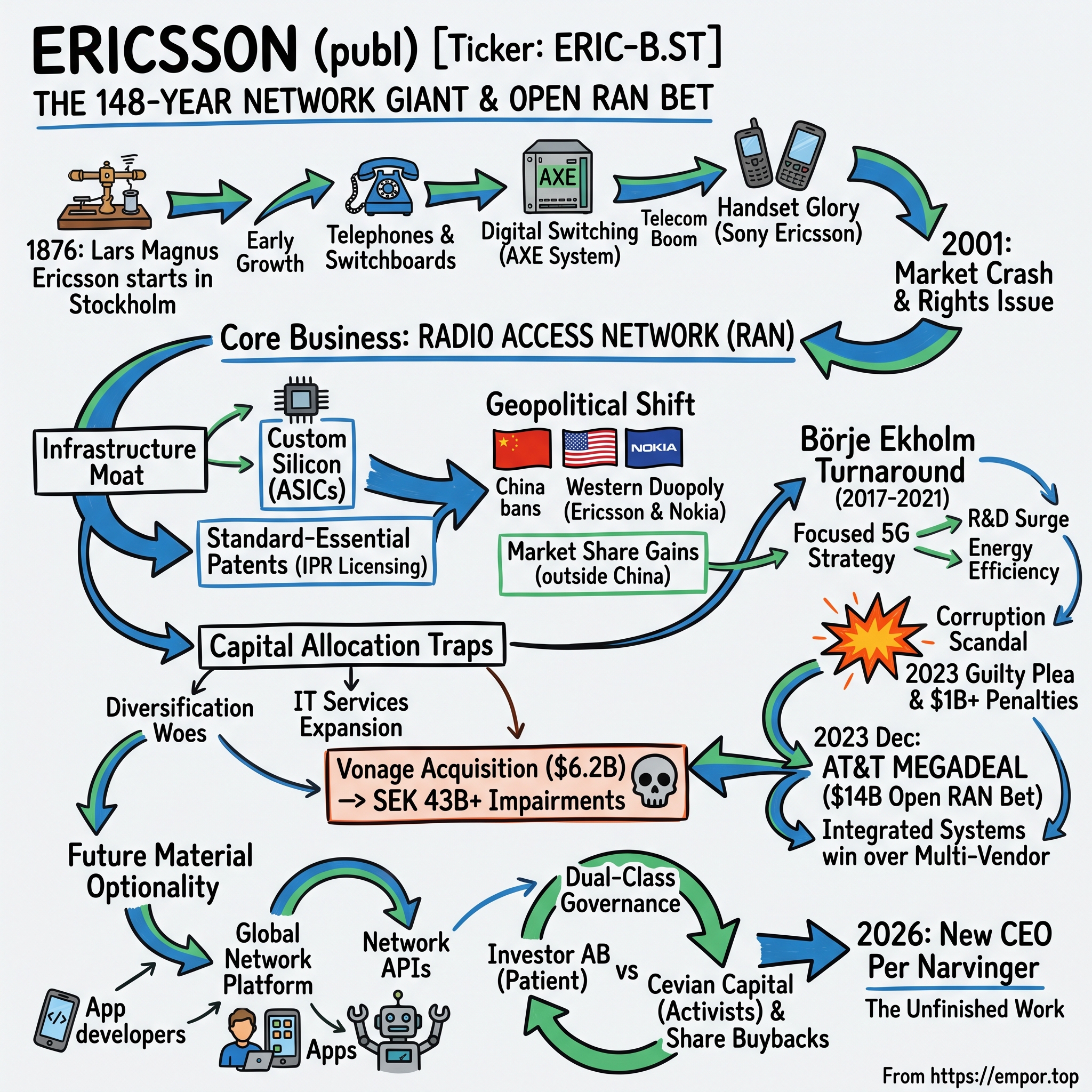
Telefonaktiebolaget LM Ericsson (publ): The 148-Year Network Giant, Capex Cycles, & The $14B Open RAN Bet
I. Introduction & Episode Roadmap
Somewhere above you, right now, a signal is finding its way from a phone to a tower to a distant server and back again in less time than it takes to blink. You will never see the machinery that makes it happen. It sits bolted to the top of a steel mast, painted a dull grey, humming in the wind. And there is a very good chance that box — the radio, the antenna, the silicon inside it — was designed by a company founded in 1876 in a rented workshop in Stockholm by a man who repaired telegraph instruments for a living.
That is the strange grandeur of Telefonaktiebolaget LM Ericsson. It is one of the oldest continuously operating technology companies on Earth, and almost nobody who depends on it every day could pick its logo out of a lineup. Ericsson does not sell to you. It sells to the carriers — AT&T, Verizon, Deutsche Telekom, Bharti Airtel, Vodafone — the handful of giant operators who own the towers. Outside China, Ericsson's equipment carries a very large share of the world's mobile traffic, a claim that makes it, in the most literal sense, part of the invisible plumbing of modern civilization.
And yet here is the central paradox that makes this a genuine business story rather than a victory lap. This 148-year-old titan generated roughly SEK 237 billion in net sales in 2025 — call it $24 billion — and dominates the global market for Radio Access Network hardware, the radios and antennas that turn a cell tower into a cell tower.2 It is the reigning champion of one of the most technically demanding industries humans have built. But it has spent much of the last two decades getting battered: by the brutal boom-and-bust rhythm of telecom capital spending, by a $6.2 billion acquisition of a company called Vonage that it wrote down by roughly $4 billion within two years, and by a corruption scandal so serious that in March 2023 the company pleaded guilty to a criminal charge in a United States court.7[^13]
To grasp the scale of what that plumbing carries, consider that Ericsson's equipment sits inside the networks of most of the world's largest operators outside China, spanning roughly 180 countries, touching billions of subscribers who have never heard its name. It is, in the truest sense, systemically important infrastructure owned by a company few consumers could identify — a business whose product is measured not in units sold but in the fraction of humanity's data it quietly moves. And yet systemic importance has never translated into a serene stock or a predictable earnings stream, which is the puzzle this story exists to unpack.
The pivot point of the modern story arrived on a December morning in 2023. Ericsson announced that AT&T had chosen it as the anchor vendor for a sweeping, five-year network transformation — a deal in which AT&T's spending could approach $14 billion, the largest single agreement in Ericsson's history.34 In one stroke, Ericsson ripped its rival Nokia out of a huge slice of AT&T's wireless network. The press called it a "hammer blow" to Nokia.5 It was also something more interesting: a real-world verdict on whether the industry's fashionable idea — "Open RAN," the notion that you could mix and match network gear from many vendors like Lego bricks — actually beats the old model of buying an integrated system from one deeply trusted supplier.
Here is the roadmap for the story we are about to tell. First, the infrastructure moat — the custom silicon Ericsson designs in-house, the century of radio-frequency engineering, and the thicket of standard-essential patents that lets it collect royalties from nearly every phone maker on the planet. Second, the geopolitical hand it was dealt — how Western bans on China's 华为 Huawei and 中兴 ZTE handed Ericsson and Finland's Nokia a comfortable Western duopoly, and what that gift costs. Third, the capital-allocation traps — the repeated, expensive temptation to diversify away from hardware, of which Vonage is only the most recent casualty. And fourth, the governance tension at the top, between the patient, century-old Swedish industrial stewardship of the Wallenberg family's Investor AB and the impatient prodding of the activist fund Cevian Capital.
To understand why any of this matters, we have to go back to the telegraph shop.
 Subscribe on LinkedIn
II. Swedish Origins & The Birth of LM Ericsson (1876–1990s)
Lars Magnus Ericsson was born poor. His father died when he was a boy, and he worked the mines of central Sweden before apprenticing as an instrument maker. In 1876 — the very year Alexander Graham Bell was patenting the telephone an ocean away — Ericsson opened a small workshop in Stockholm to repair telegraph equipment. He was thirty. He had a mechanic's hands and a stubborn conviction that he could build a better instrument than the ones he was fixing.
What he could not have engineered was his luck of geography. Stockholm in the late nineteenth century became, improbably, the most telephone-dense city on the planet. The reason was a peculiarly Swedish accident: a fierce commercial rivalry between a private operator, Stockholms Allmänna Telefonaktiebolag, and the state telegraph monopoly, Telegrafverket. Where most countries let a single lumbering monopoly ration out telephone lines, Stockholm had two aggressive players racing to wire up every apartment and office. Competition drove density; density drove demand for handsets and switchboards; and Ericsson, sitting in the middle of the most connected city on Earth, had a laboratory-scale market on its doorstep before the technology was mature anywhere else.
That head start compounded. Ericsson began exporting electromechanical telephones and manual switchboards across Europe, into Tsarist Russia, and as far as Latin America well before the First World War. The company learned early a lesson it would relearn painfully a century later: the money in telecom is not only in the shiny device the customer touches, but in the unglamorous switching gear that routes the calls. For decades that meant crossbar switches — rooms full of clacking electromechanical relays — operated by armies of human operators plugging cables into boards.
The transformation that made modern Ericsson came in the 1970s with a system called AXE. This was the leap from mechanical switching to digital, computer-controlled switching — from relays and cables to software and processors. It is hard to overstate how important this was culturally. AXE forced Ericsson to become a software company disguised as a hardware company, to build the disciplines of carrier-grade reliability: systems that must run for years without failing, because a telephone exchange that crashes takes a city's phones down with it. That obsession with reliability-at-scale is the deep root of the switching-cost advantage we will examine later. Carriers do not buy from Ericsson because it is cheap. They buy because when you are running a network that millions of people dial into, "it usually works" is not good enough.
AXE was not born inside Ericsson alone. It grew out of Ellemtel, a joint research lab Ericsson ran with the Swedish state telecoms administration — a very Nordic arrangement in which a private manufacturer and a public operator pooled their best engineers to design a national switching platform, then let the manufacturer sell it to the world. That structure mattered more than any single circuit. It gave Ericsson a guaranteed, sophisticated home-market customer to co-develop with, and a design that had been hardened in real network conditions before it ever went for export. AXE eventually shipped to well over a hundred countries and became one of the most widely deployed switching systems in telecom history. The pattern — build it with a demanding domestic partner, then scale it globally — would repeat with wireless. It is also why Ericsson's culture prizes standards work and long development cycles over the move-fast instincts of consumer technology; the company was shaped by customers for whom a decade-long equipment lifetime is normal and an outage is a scandal.
Then came the revolution that made Ericsson a global name. In the 1980s, European regulators and engineers coalesced around a common standard for the coming wireless age called GSM — the technology that became 2G, the foundation of the first truly mass-market mobile phones. Ericsson was central to writing that standard, and standards are destiny in this industry: whoever helps define the rules of the road tends to build the best vehicles for it, and — crucially — owns patents on the road itself. By the early 1990s Ericsson was not merely a Swedish success. It was the indisputable king of the global cellular network, the company that sold the guts of the mobile revolution to operators on every continent. And for a brief, dizzying moment, it was about to become something it had never really been: a brand that ordinary people loved.
III. The Telecom Boom, Handset Glory, & The 2001 Crash (1990–2011)
For roughly a decade, the mobile industry felt like a machine that only ran in one direction: up. Every year brought more subscribers, more towers, more spectrum auctions, more operators desperate to build out 2G and then, at the turn of the millennium, to bid staggering sums for 3G licenses. Ericsson was Sweden's corporate crown jewel, the pride of Stockholm, an engineering culture flush with confidence and cash.
And for a while, it had a consumer face. The Ericsson T28, launched at the end of the 1990s, was a marvel — a flip-open, feather-light phone that fit in a shirt pocket when rivals still made bricks. The T68 that followed brought a color screen and became a cult object. For a stretch, Ericsson was not just infrastructure; it was a thing you wanted in your hand.
Then the music stopped. The 2001 telecom bust was one of the great capital-destruction events in modern industrial history, and it hit Ericsson at both ends. Operators had loaded themselves with debt to buy 3G licenses and build networks for demand that had not yet arrived. The European 3G spectrum auctions of 2000, in Britain and Germany especially, extracted well over $100 billion from carriers for licenses to a technology that would not generate meaningful revenue for years — money that came straight out of the equipment budgets vendors like Ericsson were counting on. Worse, vendors had juiced the boom with vendor financing — essentially lending their own customers the money to buy Ericsson equipment. It is a seductive trick in a boom and a noose in a bust: when the operators wobbled, Ericsson was exposed both to collapsing orders and to loans it might never collect.
The unwind was savage. Ericsson's headcount, which had swelled past 100,000 in the boom, was cut by roughly half over the following years. The company burned through cash and, in 2002, launched a rights issue to raise fresh equity from shareholders at a moment when its share price had collapsed by more than 90% from the peak — a humiliating, dilutive rescue for what had been the pride of Swedish industry. The lesson seared into Ericsson's institutional memory was about the shape of its demand, not its level: it sells to a cyclical, capital-intensive customer base whose spending swings violently, and it must carry a balance sheet strong enough to survive the troughs without begging shareholders for a bailout. That memory is why, two decades later, management would prize a large net-cash position almost to a fault. The crown jewel had very nearly cracked.
The handset business, meanwhile, was bleeding. Ericsson had brilliant radio engineers but no real feel for consumer taste, software, or retail. In 2001 it did the sensible thing: it folded its phone unit into a 50-50 joint venture with Japan's Sony, creating Sony Ericsson. The logic was elegant on paper — Swedish radio brilliance married to Sony's consumer brand and multimedia stack. The Walkman and Cyber-shot phones that followed were genuine hits, and for several years the venture threw off real profit.
But the joint venture was a house built on a fault line, and in January 2007 the fault line moved. Apple unveiled the iPhone. The Android wave followed. In the span of a few years the entire logic of a mobile phone — hardware plus a bit of custom software — was replaced by a logic Ericsson and Sony had no answer for: a pocket computer defined almost entirely by its app ecosystem. Sony Ericsson's profits unraveled. And in October 2011, the two partners made the clean break: Sony bought out Ericsson's half of the venture for €1.05 billion, taking the phone business entirely.17
For Ericsson, the exit was a moment of hard clarity. It walked away from the consumer world for good and bet its future on a narrower, less glamorous, but far more defensible idea: it would be the company that built and ran the networks, licensed the essential patents, and sold the software behind the scenes. B2B, carrier-grade, invisible. It was the right instinct. The execution over the next five years would be a mess.
IV. The Lost Decade: IT Services Expansion & Vendor Wars (2011–2016)
Picture the competitive map around 2012. Ericsson and Nokia and a fading Franco-American player called Alcatel-Lucent were the Western establishment. And rising fast from the south of China was a company most of the West had barely registered a decade earlier: 华为 Huawei, founded by 任正非 Ren Zhengfei, a former engineer in the People's Liberation Army. Alongside it came 中兴 ZTE. These were not fringe players. Backed by generous Chinese state export-credit financing that let them offer operators irresistible terms, and staffed by armies of low-cost Shenzhen engineers who would customize gear at a speed European vendors could not match, the Chinese vendors went on the offensive across Europe, Asia, and Africa. They undercut on price, out-hustled on service, and took share relentlessly.
Ericsson's response, under CEO Hans Vestberg — a company lifer and former CFO who took the top job in 2010 — was to look for higher ground. If hardware was becoming a knife fight with subsidized competitors, the thinking went, Ericsson should climb toward services and software, where margins were supposedly stickier. So it pushed into IT consulting, systems integration, managed services, and media and broadcast solutions. At its peak the services organization employed well over 60,000 people, many of them running carriers' networks under multi-year managed-services contracts — a labor-intensive business where Ericsson was effectively renting out engineers by the hour. On paper, "move up the value chain" is the oldest strategy consulting slide there is. In practice, Ericsson was diluting the one thing that made it special — radio engineering — to compete in generic IT services against specialists who did it better and cheaper, while taking on the low-margin, people-heavy economics of a consultancy.
There was a strategic logic to managed services that is worth stating fairly, because it explains why smart people pursued it. As networks grew fiendishly complex, many operators wanted to hand the day-to-day running of them to a vendor and focus on marketing and spectrum. Owning that operational relationship, in theory, locked in the customer and generated recurring revenue. But the reality was that managed services contracts were frequently bid at wafer-thin or even negative margins to win footprint, staffed by tens of thousands of people whose costs were fixed while the contract prices only fell. Ericsson had bought itself revenue and headcount, not profit — and it had done so by pointing its scarce management attention away from the radio business at the exact moment the Chinese vendors were attacking it hardest.
Two decisions from this era stand out as self-inflicted wounds. The first was ST-Ericsson, a semiconductor joint venture with Franco-Italian chipmaker STMicroelectronics, launched to build application processors for smartphones. It was a bet on winning inside the phone at the exact moment the phone was being conquered by Qualcomm, Apple, and the Android ecosystem. The venture hemorrhaged money and was dissolved in 2013, hundreds of millions of dollars later.
The second wound was quieter and, in hindsight, more damaging: Ericsson under-invested in the custom chips at the heart of its own radios. Rather than designing proprietary application-specific integrated circuits — ASICs, chips built for one purpose and therefore small, cheap, and power-efficient at scale — Ericsson leaned on field-programmable gate arrays, or FPGAs. Think of an FPGA as a Swiss Army knife: flexible, reconfigurable, wonderful for prototyping, but bulky, power-hungry, and expensive compared to a purpose-built tool. Every base station shipped with expensive, hot, heavy FPGAs inside was a base station that cost more to build and more to power than a competitor's — a structural handicap in a business decided by exactly those numbers.
The results spoke plainly. Operating margins cratered, market share bled, and the diversification strategy delivered neither growth nor profit. By July 2016 the board had seen enough, and Hans Vestberg was pushed out amid open investor fury. Ericsson was adrift — a great engineering company that had spent five years forgetting what it was great at. The person the board turned to next was not an operator or an engineer. He was a financier, and he came from the most powerful family in Swedish business.
V. The Börje Ekholm Turnaround & "Focused 5G Strategy" (2017–2021)
Börje Ekholm was, in a sense, always going to get this call. He had spent years as CEO of Investor AB, the Wallenberg family's storied holding company and Ericsson's largest and most influential owner. He had sat on Ericsson's board. He knew where the bodies were buried, knew the Swedish corporate establishment intimately, and — critically — was trusted by the owners who mattered. When he took the CEO chair in January 2017, he was not a fresh set of eyes so much as the establishment reasserting control over a company that had wandered off.
Ekholm's diagnosis was blunt and, for a company addicted to the idea of reinvention, almost heretical: Ericsson's problem was not that it was too focused on telecom equipment. It was that it was not focused enough. The strategy he laid out — later branded the "Focused Strategy" — amounted to a systematic reversal of the Vestberg years. Ericsson would exit the low-margin IT and media services businesses, even at the cost of walking away from billions in revenue. It would cut layers of corporate overhead, ultimately shedding many thousands of positions. And it would take the money saved and pour it back into the one thing that actually mattered: being the best in the world at building radios.
It is easy, from the vantage of a recovered Ericsson, to forget how badly this bet was going at first. The turnaround did not begin with a triumphant quarter; it began with deeper losses. In 2017, Ekholm's first year, Ericsson reported a substantial net loss as he took the axe to bloated contracts and wrote down the detritus of the previous strategy — the kind of "kitchen-sink" cleanup a new CEO uses to reset the base. The share price languished, some investors grumbled that the Wallenberg insider had simply been installed to protect the establishment, and the payoff from all that R&D spending was still years away in a 5G cycle that had not yet started. This is the part of the story most relevant to judging management today: Ekholm set a specific, measurable 2020 target for Networks margins and group operating margin, communicated it relentlessly, and — unusually for this industry — largely hit it. Whatever one concludes about the later Vonage disaster, the early turnaround is a genuine mark in the credibility column, because the promises were concrete and the delivery was checkable.
That meant R&D at a scale that made analysts nervous. Ericsson ramped research spending toward the high-SEK-40-billions annually, well into the high teens as a share of sales — an enormous bet for a company whose margins were still weak. And the single most important object of that spending was to fix the silicon mistake of the previous decade. Ericsson built out its own custom chip capability, "Ericsson Silicon" — purpose-designed ASICs to replace the power-hungry FPGAs. This is the unglamorous heart of the whole turnaround, so it is worth being concrete about why it mattered. In a cell tower radio, three things decide whether you win: how much data you can push, how much the radio weighs (because a technician has to climb the mast and bolt it up), and how much electricity it burns (because power is an operator's single largest running cost). Custom silicon improves all three at once. A lighter, cooler, faster radio is not a marketing claim; it is a lower total cost of ownership that a carrier's procurement team can put in a spreadsheet.
The timing coincided with the arrival of 5G, and Ekholm made a "5G first" bet — re-architecting the whole hardware line, especially the Massive MIMO radios, around energy efficiency and performance. It is worth pausing on what Massive MIMO actually is, because it is the technical heart of the 5G moat. An old cellular antenna broadcast signal the way a lightbulb throws light — outward in all directions, most of it wasted on empty air. A Massive MIMO antenna packs dozens or hundreds of tiny transmitters into a single panel and uses software to combine their signals into focused beams, aiming a concentrated stream of data straight at each individual phone and following it as it moves — less a lightbulb than a cluster of hundreds of tiny, steerable spotlights. Doing that in real time, for thousands of users at once, without cooking the radio or draining the grid, is a brutal computation-and-physics problem, and it is exactly the problem custom silicon and decades of radio-frequency algorithms exist to solve. When the 5G buildout wave hit, Ericsson had, for the first time in a decade, the best gear on the truck — lighter to hang, cheaper to power, and better performing in the field.
Then geopolitics handed Ekholm a gift he could not have engineered. Beginning in earnest around 2018–2020, the United States, United Kingdom, Australia, and a wave of European governments moved to ban or rip out 华为 Huawei equipment on national-security grounds, with 中兴 ZTE swept up alongside. Overnight, the most feared low-cost competitor was legally excluded from the richest Western markets. Ericsson and Nokia were the obvious beneficiaries. Ericsson's share of the RAN market outside China climbed to roughly 39%, up from the low-30s a few years earlier.18
By the end of this period the financial recovery was real: group gross margins climbed from the low-20s percent range of the dark years back toward the mid-40s, and the core Networks business was hitting the mid-teens operating margins Ekholm had promised.1 The skeptical investor's fair question, though, is how much of this was Ekholm's execution and how much was simply the Huawei ban plus a generational 5G upgrade cycle lifting every Western vendor at once. The honest answer is: both, inseparably. Ericsson made itself competitive and the board was cleared of its most dangerous rival. Which brings us to what Ericsson actually sells, and where the money truly comes from.
VI. Core Business & Segment Financials: Networks, RAN Economics, & The AT&T Megadeal
If you want to understand Ericsson as an investment rather than as a piece of engineering history, you have to internalize one uncomfortable fact: this is a company with essentially one profit engine and several passengers. Let us walk the segments.
Networks is the empire. In 2025 it generated roughly SEK 151 billion of Ericsson's SEK 237 billion in sales — about two-thirds of the company — and it delivered a segment operating margin near 20%, throwing off the overwhelming majority of group profit.2 This is the RAN business: the 5G and 4G radios, the Massive MIMO antennas, the baseband processors, Cloud RAN, and microwave backhaul. The economics are a scale machine. The fixed cost of designing a new radio generation and its custom silicon is enormous, but once designed, each incremental unit shipped across a global base spreads that cost thinner. This is why R&D scale is itself a moat: a smaller competitor amortizing the same design effort over fewer shipments simply cannot match Ericsson's unit economics. When management insists Networks is a "flattish market" at the top line, the point is that the value creation comes not from volume growth but from defending share and squeezing margin — which, on the Q2 2026 call, is exactly the discipline Ekholm kept returning to.15
Cloud Software and Services is the second segment, around SEK 63 billion of sales in 2025 — roughly a quarter of the company.2 This is the core network software (the 5G Standalone "core" that actually runs a modern network), the billing and operations-support systems, and managed operations where Ericsson runs a carrier's network for it. For years this was a margin swamp: low-value manual integration work that barely broke even. The interesting recent development is that it finally turned a real profit, swinging to a positive operating margin in 2025 after a multi-year turnaround; on the Q2 2026 call management pointed to the rolling EBITA margin reaching a new high near the low teens, and pushed back gently on the idea that it was a one-off, crediting years of commercial discipline and portfolio focus.215 The bull would call this proof the software pivot can work when it sticks to telecom software. The bear would note it took the better part of a decade.
Enterprise is the third segment and the problem child, roughly SEK 21 billion of sales in 2025.2 This is where Ericsson parked its two big enterprise bets: Cradlepoint, the enterprise wireless-WAN business, and Vonage, the cloud-communications platform. For years the segment was a persistent operating-loss drag, dragged underwater by Vonage. The 2025 numbers finally showed the segment turning an operating profit, but that figure was flattered by portfolio moves, and as one analyst bluntly noted on the Q2 2026 call, Enterprise had been "consistently loss-making" for five years.15 Ekholm's answer — that a plan is in place and the business "cannot be consistently loss-making" but that he would not put a timeline on it because "I'm not the one to deliver on it" — was a candid acknowledgment that this remains unfinished business handed to his successor.15
And then there is the quiet cash machine that does not get its own segment box: IPR licensing, Ericsson's patent-royalty business. Because Ericsson helped invent the essential technologies in 3G, 4G, and 5G, it holds standard-essential patents that virtually every phone maker — Apple, Samsung, Lenovo, the Chinese OEMs — must license to build a compliant device. In 2025 this generated roughly SEK 14.5 billion, up from SEK 14.0 billion in 2024, at gross margins north of 90%.12 Think of it as an annuity: near-pure profit that flows regardless of the capex cycle, most of it booked inside the Networks segment, cushioning the hardware business through downturns. On the Q2 2026 call, management pegged the current IPR "run rate" at about SEK 13.5 billion including newly signed agreements — a reminder that this stream is lumpy, punctuated by one-off back-royalty settlements when a long-running licensing dispute finally settles.15
Now the industry structure. Outside China, RAN is a tight oligopoly: Ericsson around 39%, Nokia in the high-20s to 30% range, Samsung a distant third in the high single digits, with 华为 Huawei dominant inside China and largely walled out of the West.1819 It is a market where the top five vendors control almost everything, and where the buyers — the tier-one carriers — are themselves giant and concentrated. That last point is the structural vulnerability. When your customers are a handful of the most powerful, capital-disciplined companies on Earth, and they buy in generational waves — 2G, then 3G, then 4G, then 5G, each roughly five to seven years apart — you live and die by the capex cycle. When carriers are mid-upgrade, orders flood in. When they have finished deploying and shift to "digesting" what they built, orders fall off a cliff. The severe post-5G rolloff in North America and India after 2022 gutted Ericsson's revenue precisely because its two biggest markets stopped buying at once. This is not a company weakness; it is the physics of selling to a powerful, concentrated buyer.
It is worth dwelling on the India dynamic, because it is a perfect miniature of the whole cyclical problem. In 2022 and 2023, Reliance Jio and Bharti Airtel raced to blanket the subcontinent with 5G at a speed the industry had rarely seen, and Ericsson's India revenue exploded — one of the fastest large-scale network builds in history. Then, almost as abruptly, the build finished, the orders evaporated, and India swung from a growth engine to a drag inside a couple of quarters. A vendor cannot staff up and staff down that fast, so the swing lands directly on margins. This is why management's insistence on planning for a "flattish" market even when it is privately optimistic — a theme Ekholm returned to repeatedly on recent calls — is not false modesty but hard-won discipline: the cardinal sin in this business is to build permanent cost against temporary demand.15 The deeper investor question is whether the 5G cycle's peak is simply behind the industry, with the next great wave — 6G — not arriving in volume until the end of the decade, leaving Ericsson to grind through a multi-year plateau where market-share defense and cost control matter more than any grand growth story.
Which is what makes the AT&T deal of December 2023 so consequential. AT&T committed to a five-year transformation of its wireless network with Ericsson as anchor vendor, spending that could approach $14 billion.34 The strategic dagger was aimed at Nokia, which lost the vast majority of its AT&T RAN footprint; AT&T set a target of having 70% of its wireless traffic running across open-capable platforms — built primarily on Ericsson — by late 2026.3 For Ericsson it was the single largest contract in its history and a multi-year anchor of demand in a market that had just gone cold.
But sit with the irony, because it is the whole point. The deal was sold under the banner of Open RAN — the industry's dream of "disaggregation," of carriers assembling networks from interchangeable multi-vendor parts to escape lock-in. The theory is genuinely appealing to a carrier: if the radio, the baseband, and the software all speak standardized interfaces, a buyer could shop each layer separately, play vendors against one another, and never again be captive to a single supplier's prices and roadmap. Governments loved it too, seeing Open RAN as a way to seed new competitors and reduce dependence on the incumbents. And yet AT&T's answer to that dream was to hand almost the entire job to one deeply integrated vendor with its own custom silicon.
The lesson buried in the largest Open RAN deal in history is that when a carrier actually has to bet its network's reliability, the theory of open multi-vendor assembly bends to the reality that integrated, carrier-grade systems still win. "Open" in the AT&T deal really means interface-open — Ericsson's gear will expose the standardized connection points so that, in principle, other vendors' equipment could slot in later — not multi-vendor today. That distinction is the entire commercial ballgame. Ericsson gets to bank the revenue now while promising optionality later, and it converts a movement designed to weaken incumbents into a mechanism for cementing one. The skeptic's counterpoint is fair, though: by publicly blessing open interfaces, Ericsson is also helping build the very standards that could, over a longer horizon, let a cheaper rival pry open its installed base. Ericsson is betting that its silicon and integration lead will always keep it a generation ahead of anyone trying to walk through the open door it just built. That tells you something durable about Ericsson's moat — and it sets up the harder question of whether management can be trusted with the cash that moat generates.
VII. The Capital Allocation Trap: M&A Blunders & Compliance Scandals
Here is the tension that has defined Ericsson's modern era: the core business generates cash, and management keeps finding ways to set it on fire trying to become something other than a network-equipment company. To be fair, the record is not uniformly bad, and you have to start with the deal that worked.
In September 2020, Ericsson agreed to buy Cradlepoint, a maker of enterprise wireless-WAN routers and private-5G gear, for about $1.1 billion.11 It was a clean, strategically coherent bolt-on: Cradlepoint sold connectivity to enterprises, adjacent to Ericsson's core competence, and it grew. The strategic logic was to extend Ericsson's reach from the carrier core out to the enterprise edge — the branch offices, retail stores, and vehicles that increasingly run on cellular connections rather than fixed lines — a genuinely adjacent market where Ericsson's radio expertise transferred. By 2026 management was pointing to Cradlepoint's wireless-WAN bookings as one of the few Enterprise bright spots.15 If every Ericsson acquisition looked like Cradlepoint — adjacent, digestible, bought at a sane price — there would be no section to write here. The contrast with what came next is the entire point: the same management team that made a disciplined billion-dollar bolt-on turned around and made an undisciplined six-billion-dollar leap, which tells you the failure was not a lack of M&A skill but a specific loss of pricing discipline when the strategic prize looked big enough.
Then came Vonage, and Vonage is a case study they will teach in business schools. In November 2021, at what would prove to be almost the exact top of the tech-valuation bubble, Ericsson agreed to pay $6.2 billion in cash — $21.00 per share — for Vonage, a cloud-communications company.67 The strategic thesis had a certain ambition to it: Vonage owned a "communications platform as a service" business and, more importantly, a developer ecosystem of more than a million software developers. Ericsson's dream was to fuse that with its network assets to build a "Global Network Platform" — a way to expose 5G network capabilities to app developers and finally break out of the flat, cyclical hardware business. Ekholm believed the future value of 5G lay in software, and Vonage was his down payment on it.
The price was the problem. Roughly 16 times EBITDA, paid at the peak, for a business whose core CPaaS and unified-communications markets promptly slowed as the pandemic-era software boom deflated. Enterprise adoption of the grand network-platform vision lagged badly. And the accounting caught up in two brutal steps. In October 2023, Ericsson announced a non-cash impairment of SEK 32 billion against the Vonage goodwill — roughly half of what it had allocated to the acquisition, wiped out in a single charge.89 Then in July 2024 it took a further SEK 11.4 billion impairment, again mostly Vonage.10 Together those charges destroyed on the order of $4 billion — call it roughly two-thirds of what Ericsson had paid — in under two years. On the Q2 2026 call, an Arete analyst put the accumulated damage starkly: something like SEK 30 billion of restructuring charges and SEK 60 billion of write-offs across Ekholm's tenure, while the stock badly lagged the NASDAQ-100.15 Ekholm's response was notably un-defensive: asked whether he could have been bolder, he conceded, "For sure, we could have. Any other answer would be, I think, inaccurate."15 That candor is worth something in a CEO — but candor does not refund $4 billion.
There is a subtler accounting point worth flagging for the diligent investor. An impairment is a non-cash charge — it does not drain the bank account in the quarter it is booked, because the cash left the building back in 2022 when Ericsson paid for Vonage. What the write-down does is finally force the balance sheet to admit that the asset is worth far less than what was paid. So the impairments are not the damage; they are the acknowledgment of damage already done. The real cost was the $6.2 billion of shareholder cash spent, plus the years of management attention and additional R&D poured into a business that has yet to earn its keep. When a company takes a large goodwill impairment barely a year after an acquisition closes, it is essentially conceding that the original deal thesis was wrong — and doing so twice on the same asset, as Ericsson did, is about as clear a self-indictment of an M&A decision as public accounting produces.
The Vonage saga is the cleanest expression of a recurring pattern: a strong core business, a genuine anxiety about its cyclicality, and a temptation to buy a way out of that cyclicality at exactly the wrong price. It is the single most important thing a skeptical investor should hold management accountable for — and it is why the arrival of a first-ever buyback in 2026, discussed later, reads less as a triumph than as a belated admission that returning cash to owners would have beaten spending it on Vonage.
Running underneath the M&A story is a darker overhang: corruption. In December 2019, Ericsson reached a settlement with the U.S. Department of Justice and the SEC to resolve foreign-bribery charges, paying over $1 billion — roughly a $520 million criminal penalty plus around $540 million to the SEC — for a scheme of improper payments across Djibouti, China, Vietnam, Indonesia, and Kuwait stretching from 2000 to 2016.12 The company entered a deferred prosecution agreement and accepted an independent compliance monitor. That should have been the end of it.
It was not. A leaked internal investigation surfaced evidence of historic misconduct in Iraq, including payments that may have flowed to routes controlled by the terrorist group ISIS. The disclosure detonated in early 2022 when Ekholm, ahead of a leak by an international consortium of journalists, admitted the company could not fully account for where some payments in Iraq had ended up — an extraordinary thing for a CEO to say aloud. The DOJ determined Ericsson had breached its deferred prosecution agreement — in part by failing to disclose the Iraq conduct in time — and in March 2023 the company pleaded guilty and agreed to pay an additional roughly $206 million.[^13]13
A 148-year-old blue-chip pleading guilty to a criminal charge in a foreign court is not a footnote; it is a governance event. The shareholder fallout showed up at the 2022 AGM, where investors voted to deny discharge from liability to Ekholm and the board — a rare and pointed rebuke in Swedish corporate life, where the annual "discharge" vote is normally a formality. It does not by itself impose personal liability, but it keeps the legal door open and signals that owners were furious. The episode illustrates a structural risk that is easy to underweight in a clean-looking Western company: much of Ericsson's historical growth came from emerging markets where the line between doing business and paying for access could be blurry, and the statute of limitations on that era's conduct has a long tail. The compliance saga is both a reputational scar and a live reminder that Ericsson's growth in less-regulated markets has historically carried real ethical and legal tail-risk. It is against that backdrop of expensive mistakes that management asks investors to believe in its next big idea.
VIII. Future-Material Optionality: Global Network Platform & Network APIs
[!IMPORTANT] Enterprise and Network APIs currently account for roughly 10% of group revenue and represent a net operating-margin drag today. They are included strictly as future-material strategic optionality and must not obscure the fact that Networks drives current enterprise valuation.
With that guardrail firmly in place, it is worth understanding the idea Ericsson is chasing, because it addresses the deepest strategic anxiety in the entire telecom industry — the one that keeps every carrier CFO awake at night.
Here is the anxiety, stated plainly. The world's telecom operators collectively spent more than a trillion dollars deploying 5G. And who captured the value that 5G created? Not the operators. It was Apple, Google, Meta, Microsoft — the hyperscalers and app makers who ran their services over the networks the carriers paid to build. The carriers became, in the industry's own bitter phrase, "dumb pipes": capital-intensive utilities laying the pavement while others sold the traffic. It is the worst position in any value chain — enormous fixed costs, commoditized output, someone else's brand on the experience.
Ericsson's proposed escape is called network APIs, and the vehicle is an alliance of network operators building on the industry's CAMARA standardization effort. The idea, translated out of jargon: today a network's capabilities are locked inside the carrier. Network APIs would expose those capabilities as programmable services that any software developer could call, like ordering from a menu. Want guaranteed low-latency "quality of service on demand" for a moment of cloud gaming or an autonomous-driving maneuver? Call an API. Want to verify a user has not just had their SIM swapped by a fraudster before approving a bank transfer? Call an API. Want real-time device location as a network-verified fact? Call an API.
The commercial dream is to convert flat, all-you-can-eat data plans into usage-based, metered API calls with software-like gross margins — potentially north of 80%. In 2024, Ericsson helped stand up a joint venture pooling network APIs from a roster of the world's largest operators, including AT&T, Bharti Airtel, Deutsche Telekom, Orange, Reliance Jio, Singtel, Telefónica, T-Mobile, Verizon, and Vodafone, onto a single developer marketplace. The logic is sound: a developer will only build on network APIs if they work identically across many carriers, so the operators must cooperate to make the market exist at all.
There is a hard-won history that should temper enthusiasm here. The telecom industry has tried to become a software platform before, and it has almost always lost. Carriers built app stores, mobile-payment schemes, messaging platforms, and developer programs throughout the 2000s and 2010s, and the app economy routed around all of them, straight to Apple's and Google's stores. The reason is structural: developers build where the users and the tooling already are, and a fragmented industry of hundreds of carriers each with slightly different systems is the opposite of the single, frictionless global platform a developer wants. The network-API joint venture is a direct attempt to fix exactly that fragmentation by presenting many carriers as one programmable surface. That is the right diagnosis. Whether a consortium of fierce competitors — who must agree on pricing, standards, and revenue splits — can move with the speed and coherence of a single platform company is the open question, and consortia in this industry have a poor track record of moving fast.
The neutral verdict is that this is a real idea with unreal timing risk. The technology works; the standards are maturing; the operator coalition is genuine. What is entirely unproven is developer demand at scale — whether app makers will actually pay for these capabilities in the volumes needed to move a $24 billion company's revenue. On the Q2 2026 call, Ekholm folded network APIs into a broader "AI moves into the physical world" thesis — robots, humanoids, smart glasses all demanding high-uplink mobile connectivity — while conspicuously refusing to bet Ericsson's cost structure on it arriving soon: "when the demand happens, we need to make sure that we have the right products... and not build on speculation in advance of that happening."15 That is the correct posture. It is also an admission that, for now, this is a call option, not a cash flow. Whether investors are being asked to fund that option prudently is precisely the fight playing out in Ericsson's ownership register.
IX. Governance & Activist Stress Test: Investor AB vs. Cevian Capital
To understand who really controls Ericsson, you have to understand a peculiarly Nordic piece of financial machinery: the dual-class share structure. Ericsson has A-shares, which carry ten votes each, and B-shares, which carry one. This lets a small group of long-term owners control the company's direction while owning a far smaller slice of its actual economic value — and it sets up the central governance drama.
On one side sits Investor AB, the publicly listed holding company of the Wallenberg family, the closest thing Sweden has to industrial royalty. The Wallenberg sphere has stewarded great Swedish companies — Ericsson, ABB, AstraZeneca, Atlas Copco — for well over a century, and its philosophy is patient, national, and long-term to the point of stubbornness. Investor AB is Ericsson's largest owner by votes. Per the company's 2024 annual report filed on Form 20-F, Investor AB controlled roughly 24.5% of the votes while owning about 9.3% of the equity capital — the dual-class structure doing exactly what it is designed to do, concentrating control well above economic ownership.16 Alongside it, AB Industrivärden — another storied Swedish sphere investor — held around 15% of votes on a much smaller capital base.16 Between them, the two traditional Swedish owners can effectively steer the company.
On the other side sits the irritant, and in a story like this the irritant is often the most useful character. Cevian Capital, Europe's largest activist fund, co-founded and run by Christer Gardell, who has built a career prodding complacent Nordic and European industrials. Cevian holds a stake structured almost as the mirror image of Investor AB's: heavy on economic capital, light on votes, holding around 4.6% of the equity but only about 2.7% of the votes.16 That asymmetry is the whole fight in miniature. Cevian has real money at risk and comparatively little say, while the sphere owners have decisive say with less money at risk.
Run the activist stress test — the questions a hard-nosed long/short investor would put to management — and Cevian has pressed most of them. On capital allocation, it condemned the Vonage deal as exactly the kind of top-of-market, value-destroying overpayment the numbers later confirmed. On operational discipline, activists have pushed for deeper structural cost cuts and for returning cash to shareholders rather than gambling it on speculative software M&A — and here the record shows movement: Ericsson kept cutting headcount (down to roughly 88,800 employees by the end of 2025 from over 94,000 a year earlier, with a further Swedish reduction announced in January 2026), raised its dividend, and — notably — launched its first-ever share buyback program, up to SEK 15 billion, in 2026.220 A buyback is precisely what a capital-discipline activist demands, and its arrival tells you the pressure worked. On governance itself, the perennial activist demand is to collapse the dual-class structure so that votes align with economic risk — a demand the Wallenberg sphere has every incentive, and every ability, to resist.
The dual-class structure deserves a neutral hearing on both sides, because it is genuinely double-edged. The case for it is that patient, entrenched owners can fund a decade of heavy R&D and ride out a brutal cycle without being panicked into short-term cuts by a falling share price — exactly the temperament that let Ericsson keep investing through the 2017–2019 losses when a more skittish shareholder base might have starved the 5G program. The case against it is that the same entrenchment insulates management from the consequences of value destruction: the owners with the votes to fire a board over a $6.2 billion blunder are the very owners who backed the CEO who made it. Cevian's push to collapse the structure is, at bottom, an argument that accountability should track economic risk — that the people with the most money on the line should have a proportionate say. The Wallenberg sphere's incentive to resist is obvious, and control premiums of this kind rarely surrender voluntarily. An investor buying B-shares should simply price the reality: they are along for the ride the sphere chooses to take.
The honest read is that this tension is a feature, not a bug. The sphere owners provide the patient capital and stability that let Ericsson fund a decade of heavy R&D through a brutal cycle; the activist provides the counter-pressure that shows up as buybacks and cost discipline. The risk is when patient stewardship curdles into tolerance for value destruction — as it arguably did with Vonage. Which raises the ultimate question for any investor: strip away the drama, and does Ericsson actually have a durable business here, or just a cyclical one dressed in a century of prestige?
X. Playbook: Business & Investing Lessons
Step back from the quarter-to-quarter noise and Ericsson's long arc offers a handful of lessons that generalize far beyond telecom.
First: pure-play focus tends to beat unrelated diversification. The single clearest pattern in this story is that Ericsson nearly destroyed itself twice by trying to be something broader than a network company — an IT-services conglomerate under Vestberg, a software-platform company via Vonage — and recovered both times by refocusing on radio engineering and custom silicon. Diversification feels like risk reduction; in practice, for a company with a genuine technical moat, it is usually risk creation, because it funds mediocrity in businesses where you have no edge with cash from the one business where you do.
Second: the capex-cycle trap is structural, not manageable. When you sell to a small number of powerful, disciplined buyers who purchase in generational waves, you will have booms and you will have troughs, and no amount of management brilliance smooths them fully. The North American and Indian rolloffs after 2022 were not an execution failure; they were the shape of the industry. The investing implication is that Ericsson must be judged across a full cycle, not at the peak or the trough — and that management's job is to defend margin and share through the trough, not to pretend the trough is optional.
Third: buying adjacencies at the top of the market destroys capital. Vonage is the lesson, expensively taught. The strategic logic of diversifying into higher-margin software was defensible; paying 16x peak-cycle EBITDA to do it was not. Strategy and price are separate decisions, and a good strategy executed at a terrible price is just a bad decision.
Fourth: geopolitical moats are real but double-edged. The Huawei bans were a genuine windfall, handing Ericsson share it could never have won on merit alone. But a business whose share depends on government policy is a business exposed to government policy — to retaliation in non-Western markets, to localization requirements, to the possibility that the political winds that filled your sails shift. A moat granted by regulators can be narrowed by regulators.
Fifth: patents are the annuity that funds the cycle. Ericsson's decision, over decades, to invest in the core technologies of each mobile generation and secure standard-essential patents produced a high-margin royalty stream that pays out regardless of the capex cycle. It is the buffer that lets the company keep investing through downturns. Owning the standard is worth more, over time, than owning any single product built to it.
Those lessons are the theory. The bull-and-bear case is where they get stress-tested against the actual competitive terrain.
XI. Strategic Position, 7 Powers / Porter's 5 Forces, & Bull vs. Bear Case
Let us war-game Ericsson properly, using Hamilton Helmer's 7 Powers as the lens for durable advantage.
The strongest power is scale economies. Ericsson's roughly SEK-48-billion annual R&D budget and its in-house Ericsson Silicon spread across a global shipment base give it a unit-cost structure smaller rivals cannot match; the fixed cost of a chip design is the same whether you ship it on a thousand radios or a million, and Ericsson ships it on far more. Nearly as important are switching costs, and they are extreme. Ripping out and replacing radio gear across tens of thousands of cell sites costs a carrier billions and risks the one thing carriers cannot tolerate — network downtime. Nokia just learned this in reverse at AT&T, watching an incumbent position evaporate; the same dynamic that cost Nokia protects Ericsson everywhere it is installed. The third power is process power — over a century of accumulated radio-frequency algorithms, Massive MIMO beamforming software, and hard-won carrier-grade reliability engineering that cannot be bought or quickly copied.
The sharpest test of whether these powers are real is the head-to-head with Nokia, the one true peer. For years the two were treated as interchangeable European incumbents, but the AT&T outcome exposed a gap. Nokia spent much of the 2010s digesting its acquisition of Alcatel-Lucent, juggling incompatible product lines and falling behind on the custom silicon that decides radio efficiency; Ericsson, having concentrated its fire on Ericsson Silicon and a unified 5G portfolio, arrived at the crucial tenders with better-performing, more power-efficient gear. That is the concrete, checkable evidence behind the "process power" claim — not a slogan but a lost contract worth billions. Samsung, the third force, is a formidable manufacturer with the balance sheet of a giant, and it has won footprint at Verizon and in Japan, but it remains a distant challenger in RAN share and lacks the standard-essential-patent depth that lets Ericsson tax the whole industry. And 华为 Huawei — still the global volume leader and technically excellent — is the ghost at the feast: walled out of the West by policy, dominant at home, and a permanent reminder that Ericsson's most dangerous competitor is kept at bay by governments rather than by any advantage Ericsson can defend on its own.
A myth worth puncturing while we are here: the popular story that Ericsson "won" the 5G era outright. The reality is more contingent. Ericsson defended and modestly grew its share of a Western market that shrank as Huawei was expelled — a smaller, safer pond in which it is a bigger fish. Its absolute exposure to the fastest-growing region on Earth, China, is minimal, and its revenue in 2025 was lower than in 2020 despite the 5G supercycle, because the cycle giveth and then taketh away. The bull who assumes Ericsson simply compounds from here is fighting the arithmetic of a flat-to-shrinking core market; the edge is real but it is an edge in margin and resilience, not in growth.
Run Porter's Five Forces and the picture is a business with a strong position and one glaring vulnerability. Supplier power is moderate: Ericsson depends on advanced foundries — principally TSMC — to fabricate its custom chips, and the 2025–2026 surge in memory and component costs, which management flagged repeatedly on the Q2 2026 call as a live margin threat it is fighting with price increases and product redesign, shows that dependence has teeth.15 Buyer power is the real problem: extremely high. A handful of tier-one carriers — AT&T, Verizon, T-Mobile, Deutsche Telekom, Vodafone — command brutal pricing leverage, and Ericsson's own long-term contracts, as Ekholm conceded, contain no automatic cost pass-through, meaning input inflation lands on Ericsson first and gets clawed back only through slow, contract-by-contract renegotiation.15 Competitive rivalry is high within a consolidated oligopoly of Ericsson, Nokia, and a walled-off Huawei. Threat of substitutes is moderate-to-high, embodied by the Open RAN disaggregation movement and hyperscaler private-network offerings. Threat of new entrants is low — the capital, patents, and standards expertise required are prohibitive.
If you are tracking this company, ignore the noise and watch three KPIs. One: RAN market share outside China, the single cleanest measure of whether the moat is holding — the number to watch against that ~39% anchor. Two: Networks segment EBITA margin, because Networks is the profit engine and its margin (running around 18–20% in 2025) is the truest gauge of pricing power surviving the component-cost squeeze.2 Three: IPR licensing revenue and free-cash-flow conversion — the SEK 13.5–14.5 billion annuity and the cash it helps produce, which fund the dividend, the new buyback, and the R&D that sustains everything else.215
The bull case. The AT&T megadeal proves the integrated-vendor model wins even under an Open RAN banner, and it may trigger a multi-year wave of Western carriers modernizing and consolidating onto Ericsson — with Nokia the likely donor of share. The Cloud Software turnaround shows the software pivot can work when disciplined. And if the "AI moves into the physical world" thesis is even partly right, a coming demand for high-uplink, low-latency mobile connectivity — the exact thing 5G was built for and Ericsson's silicon is optimized for — could break the industry out of its flat-market rut, with network APIs adding high-margin optionality on top.
The bear case is equally coherent. Carriers may simply keep capital intensity permanently lower, letting 5G monetization stall and pushing the next big 6G spending wave past 2030 — a long trough for a cyclical supplier. Open RAN could, over time, genuinely commoditize hardware and lower barriers for cheaper entrants like Samsung, Fujitsu, and Mavenir. Vonage could keep bleeding and require further write-downs. Component-cost inflation could compress Networks margins faster than renegotiations can offset. And Ericsson's growth in less-regulated markets carries the compliance tail-risk its own history has proven is not hypothetical. The neutral truth is that both cases rest on the same facts, weighted differently — which is exactly why this is a company to track rather than to caricature.
XII. Epilogue & Outro
There is a nice symmetry in how this chapter ends. On the Q2 2026 earnings call — his last as chief executive — Börje Ekholm announced he was handing the company to Per Narvinger, a near-thirty-year Ericsson veteran who had run the Networks juggernaut and, before that, engineered the Cloud Software turnaround, effective October 1, 2026.1415 Ekholm closed with a line that reached back 148 years to a telegraph-repair shop: "Ericsson has long believed that connectivity is a basic human need."15
The line is sincere, and it is also, in the end, the investor's question restated as a creed. Lars Magnus Ericsson built a company on the conviction that connecting people was a business worth spending a life on. His successors turned that conviction into the invisible radio backbone of the mobile age. But conviction is not cash flow. Ekholm's real legacy — and the mandate he now hands Narvinger — is the unfinished work of converting an infrastructure monopoly's engineering dominance into consistent, cycle-proof free cash flow and dividend growth, without lighting the next $4 billion on fire chasing an escape from the very cyclicality that defines the business. Whether Ericsson can finally do that, in an industry it helped invent but no longer fully controls, is the story's open question — and the one worth watching from here.
References
-
Ericsson reports fourth quarter and full-year results 2024 — Ericsson, 2025-01-24 ↩↩
-
Ericsson reports fourth quarter and full-year results 2025 — Ericsson / PR Newswire, 2026-01-23 ↩↩↩↩↩↩↩↩↩
-
AT&T to accelerate open and interoperable RAN in the US through new collaboration with Ericsson — Ericsson, 2023-12-04 ↩↩↩
-
AT&T picks Ericsson for $14 billion telecom network upgrade — Reuters, 2023-12-04 ↩↩
-
Ericsson's $14 billion AT&T win is a hammer blow to rival Nokia — Bloomberg, 2023-12-05 ↩
-
Ericsson to acquire Vonage to spearhead creation of Global Network Platform — Ericsson, 2021-11-22 ↩
-
Ericsson to buy cloud communications firm Vonage for $6.2 billion — Wall Street Journal, 2021-11-22 ↩↩
-
Ericsson announces impairment charge of SEK 32 billion and provides update on Q3 earnings — Ericsson, 2023-10-11 ↩
-
Ericsson hit by $2.9bn charge on Vonage acquisition — Financial Times, 2023-10-11 ↩
-
Ericsson announces non-cash impairment charge mainly relating to Vonage — Ericsson, 2024-07-03 ↩
-
Ericsson to acquire Cradlepoint to accelerate Enterprise 5G growth — Ericsson, 2020-09-18 ↩
-
Ericsson agrees to pay over $1 billion to resolve FCPA case — U.S. Department of Justice, 2019-12-06 ↩
-
U.S. Department of Justice resolves 2019 deferred prosecution agreement breaches with Ericsson — Ericsson, 2023-03-02 ↩
-
Per Narvinger appointed new President and CEO of Ericsson as Börje Ekholm steps down — Ericsson, 2026-06-16 ↩
-
Ericsson reports second quarter results 2026 — Ericsson / PR Newswire, 2026-07-14 ↩↩↩↩↩↩↩↩↩↩↩↩↩↩↩
-
Ericsson Annual Report on Form 20-F (fiscal year 2024) — U.S. Securities and Exchange Commission, 2025-03 ↩↩↩
-
Sony to buy out Ericsson's stake in handset venture for $1.47 billion — TechCrunch, 2011-10-26 ↩
-
Ericsson and Nokia now face a timid Open RAN challenge — Light Reading, 2023 ↩↩
-
Ericsson announces proposed headcount reduction in Sweden — Ericsson, 2026-01 ↩
 LinkedIn
 WhatsApp
 Reddit
 Hacker News
 Email
Email Kindle
 RSS Feed
 Spotify
 Apple Podcasts
 Amazon Music
 Audible
 YouTube