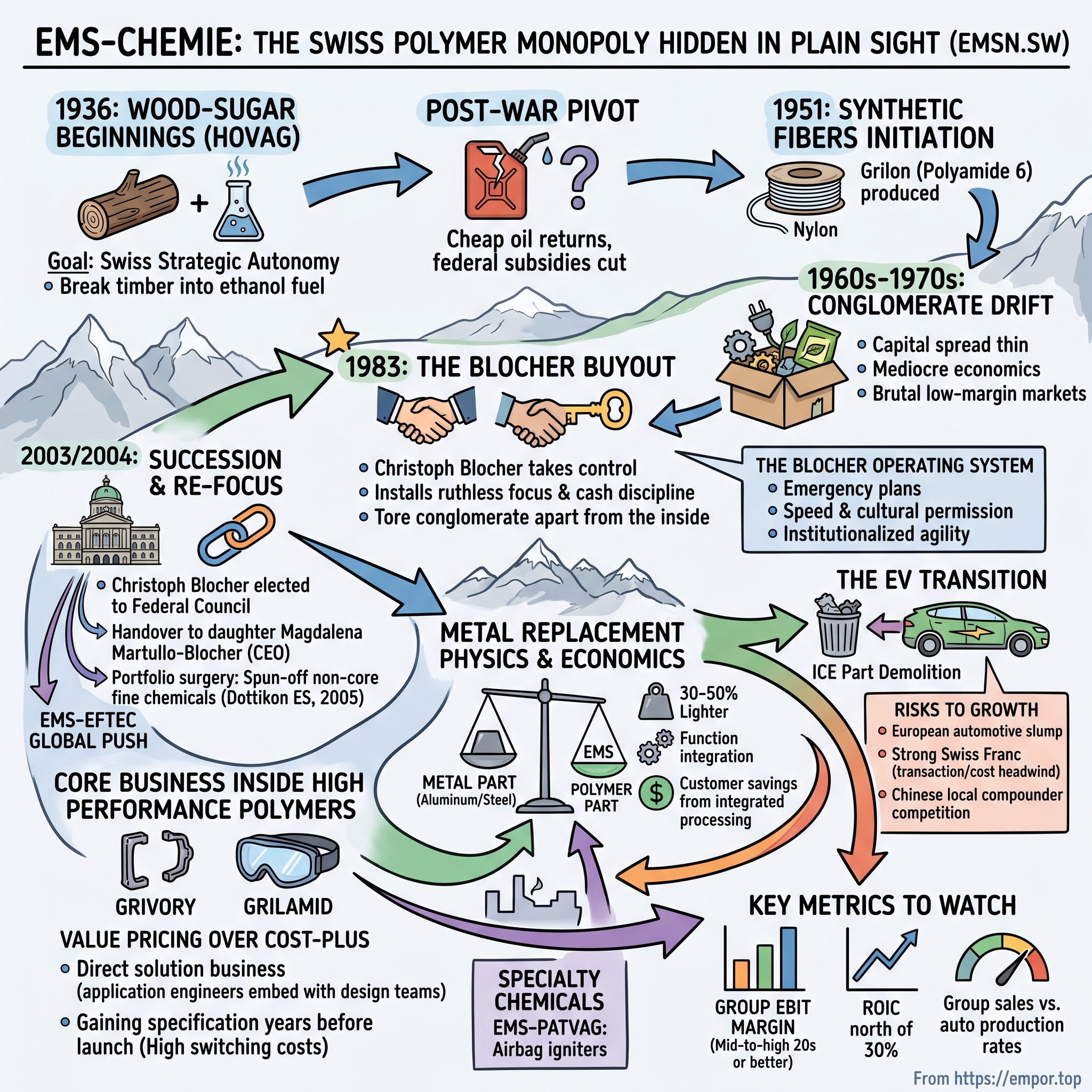
Ems-Chemie: The Swiss Polymer Monopoly Hidden in Plain Sight
I. Introduction & Episode Roadmap
Start with the number that does not make sense. The global chemical industry is, for the most part, a commodity business dressed in a lab coat. BASF, Dow, LyondellBasell — the titans of the trade — convert oil and gas into building-block molecules at colossal scale, and for their trouble they earn single-digit to low-double-digit operating margins that swing violently with the price of a barrel of crude. Into this world walks a company barely a twentieth the size of BASF, tucked into an Alpine valley, posting EBIT margins near 30% and a return on invested capital that has spent two decades north of 30%.1 The obvious question — the one that animates this entire story — is how, and the second question, the one that matters to anyone thinking about owning the shares, is for how much longer.
The short answer to the first question is that EMS is not really in the chemical business at all, not in the way BASF is. It is in the business of replacing metal. Its core product is a family of high-performance polyamides — engineering plastics sold under the brand names Grivory and Grilamid — that are strong enough, heat-resistant enough, and precise enough to stand in for die-cast aluminum, magnesium, and steel inside a car, a smartphone, or an industrial pump. EMS does not sell these polymers by the tonne into an anonymous market. It sells engineered solutions, co-developed with a customer's design engineers years before a product launches, priced on the value they create rather than the cost of the raw material that goes in. That distinction — value pricing versus cost-plus — is the whole ballgame, and we will spend a good deal of time on why it is so hard for larger rivals to copy.
The second thread running through this story is a family. EMS is inseparable from the Blochers. It was Christoph Blocher, a lawyer who joined the company as a young in-house counsel, who bought it in a 1983 leveraged deal and rebuilt it around ruthless focus and cash discipline. It was his election to the Swiss Federal Council in December 2003 that forced him to hand the company to his four children — and it is his daughter, Magdalena Martullo-Blocher, who has run it as CEO since January 2004 while simultaneously sitting in the Swiss National Council as one of the most prominent politicians of the right-wing Schweizerische Volkspartei (SVP, the Swiss People's Party).6 Concentrated family control, an owner-operator at the helm, and a politician-CEO are all part of the machine — and all part of the risk.
Before we start, three pieces of consensus wisdom about EMS deserve to be checked against the record, because each is half-true in a way that misleads. The first myth is that EMS is "a chemical company," and therefore a cyclical commodity play to be bought and sold on the petrochemical cycle; the reality is that its value-priced, designed-in solutions behave far more like a specialty industrial franchise, which is why its margins barely flinch when raw-material prices swing. The second myth is that the electric-vehicle transition is a straightforward tailwind; the reality, as we will see, is a genuinely mixed bag of parts won and parts lost, whose net effect depends on execution and on disclosures the company does not fully break out. The third myth is that a founder's daughter running the company part-time from a parliamentary seat must be a governance weakness dragging on performance; the reality is a twenty-year operating record that is the envy of the industry — though that record does not, by itself, retire the legitimate questions about concentration and succession. Holding these tensions rather than resolving them prematurely is the whole discipline of analyzing this company.
Here is the roadmap. We begin in 1936 with a wood-sugar factory built for a war. We follow the post-war pivot to synthetic fibers, the Blocher buyout and the operating system he installed, the 2003 political watershed and the succession that markets doubted, and the portfolio surgery that turned a sprawling conglomerate into a focused polymer house. Then we go inside the economics — segment by segment, the physics of metal replacement, the named competitors (Evonik, Celanese, Solvay's spin-off Syensqo, Arkema, BASF), the electric-vehicle transition, and the capital-allocation playbook. We close with the frameworks — Helmer's 7 Powers, Porter's 5 Forces — a hard-nosed risk radar, and an honest bull-versus-bear reckoning. Throughout, the posture is that of a skeptical outsider, not a fan. Where management says it will win, we will ask what evidence supports the claim and what would prove it wrong.
It starts, improbably, with sawdust.
 Subscribe on LinkedIn
II. Strategic Foundations & Wartime Roots (1936–1982)
In the late 1930s, a small, landlocked, mountainous democracy looked out at a continent sliding toward war and did the arithmetic of a siege. Switzerland had no oil, no coal to speak of, and a ring of increasingly hostile neighbors who controlled every import route. What it did have was forest. In 1936, Dr. Werner Oswald founded Holzverzuckerungs AG — literally "wood-saccharification corporation," mercifully abbreviated to HOVAG — with an idea that sounds like alchemy: break down domestic timber into wood sugar, ferment the sugar into ethyl alcohol, and blend that alcohol into motor fuel so that Swiss trucks and aircraft could keep running even if every drop of imported gasoline were cut off.3
The product had a name that has passed into Swiss industrial folklore: Emser Wasser, "Ems water." Production began at Domat/Ems in 1942, in the depths of the war, and it worked well enough that by 1945 HOVAG's alcohol fuel was covering something on the order of 30% of Switzerland's motor-fuel needs, employing nearly 200 people and making the company by far the largest industrial employer in the poor mountain canton of Graubünden.3 This is the origin myth that matters, and not for sentimental reasons. EMS was born as a strategic-autonomy project — a business whose entire reason to exist was to substitute a domestic, engineered product for an imported commodity. Substitution is in the company's DNA. It began by substituting for oil; it would spend the next eighty years substituting for metal.
Then peace nearly killed it. The war economy that justified Emser Wasser evaporated, and cheap imported oil came flooding back into Europe. Wood-derived ethanol was hopelessly uneconomic against a barrel of Middle Eastern crude; the only thing keeping it alive was a federal subsidy that required Swiss refiners to buy the stuff. In 1956, Swiss voters — asked at the ballot box, in the direct-democratic fashion the country prefers — declined to keep subsidizing it.3 Overnight, the company's founding product became worthless. This is the first of several near-death experiences in the EMS story, and it established a pattern: when the ground shifts, pivot fast into higher-value chemistry rather than defend a dying commodity.
The pivot had, in fact, already begun. Since 1951 the company had been making a synthetic textile fiber it called Grilon — polyamide 6, a form of nylon — from caprolactam it produced itself.3 As the fuel business died, fibers became the future. The company reorganized: in December 1962 the modern corporate vehicle, Chemie Holding EMS AG in Domat/Ems, was founded, and the EMS-Chemie name took hold.3 Here begins the awkward middle chapter that every focused company likes to forget. Through the 1960s and 1970s, flush with fiber cash and Swiss optimism, EMS drifted into conglomeration — synthetic fibers, engineering services, power generation, fertilizers, a scattering of industrial ventures. Capital was spread thin across a grab-bag of mostly low-margin, capital-hungry businesses, precisely the kind of undifferentiated bulk activity that gets crushed when oil shocks and recession hit European industry, as they did repeatedly in that era.
It is worth dwelling on the fibers business for a moment, because it is where the seed of everything modern was planted. Polyamide — nylon — is a chemistry that can be spun into a thread or molded into a solid, and the same molecular know-how that let EMS make Grilon textile fiber from caprolactam also let it, decades later, make Grivory structural parts. The company was, without quite realizing it in the 1960s, accumulating deep expertise in a polymer family that would turn out to be extraordinarily useful for replacing metal. But in the conglomerate years that expertise was a tool without a strategy, deployed across too many markets at once. Fibers themselves became a brutal, low-margin, globally oversupplied business as Asian producers scaled up; power generation and fertilizers were capital sinks with no relation to the company's core skill; engineering services were a distraction. The whole was worth less than the sum of its parts precisely because no one had forced the question of which parts actually earned their keep.
The lesson an investor should take from the pre-Blocher decades is not that the early managers were foolish — they were competent operators of their time — but that structure is destiny in chemicals. A company that competes in commodity markets earns commodity returns, no matter how clever its people. EMS in 1980 was a middling industrial conglomerate with a proud heritage and mediocre economics, its best asset a fibers-and-polyamide franchise buried inside a portfolio that diluted it. What it needed was someone willing to take an axe to the whole thing — and, crucially, someone with the authority and the stomach to accept the short-term pain of shrinking a company deliberately, which hired managers judged on revenue almost never do. That someone was already inside the building, a lawyer with unusual convictions about focus, cost, and control.
III. The Blocher Era & The 1983 Buyout (1983–2003)
Christoph Blocher did not arrive at EMS as an industrialist. He arrived in 1969 as a young man from a Protestant parsonage — one of eleven children of a pastor — who had worked as a farmhand before studying law, and who joined the company's legal department almost as a way station.[^11] He turned out to be something else entirely: a man with an almost ideological belief in ownership, thrift, and the moral seriousness of running a business well. He rose quickly, and by 1972 he was chairman of the board, running the company he had joined as staff counsel only three years earlier.[^11]
The defining moment came after founder Werner Oswald died in 1979. Blocher was entrusted with a delicate task: find a buyer for the founding family's controlling stake. The buyer he found, after some maneuvering, was himself. In 1983, backed heavily by debt against personal savings, securities, and his own home, Blocher executed a leveraged buy-in and took majority control of EMS-Chemie.6[^11] It was an audacious bet — a man of modest means mortgaging everything to seize control of an underperforming conglomerate — and it is the hinge on which the entire modern company turns. Everything good and everything questionable about EMS today flows from the fact that in 1983 it stopped being a widely held public company run by professional managers and became the personal property, and personal project, of one intensely focused owner.
The manner of the acquisition also tells you something about the man, and it has been the subject of decades of Swiss debate. In the version reported in the Swiss press, Blocher — the trusted adviser tasked with finding a buyer for the Oswald heirs — presented the family with a discreet purchaser who would honor their conditions, and only later did it emerge that the mysterious buyer was Blocher himself.6 Whether one reads that as brilliant opportunism or as a conflict of interest depends on one's politics, and in Switzerland almost everything about Blocher divides along political lines. What is not in dispute is the outcome: a leveraged bet on a business he understood better than anyone, executed at a price that, in hindsight, looks like one of the great value acquisitions in Swiss industrial history. The buyout worked because Blocher was not buying a stock; he was buying operational control of a company whose latent earning power he intended to unlock personally.
What Blocher did next is the template. He tore the conglomerate apart from the inside. Low-margin commodity lines were pruned or shut. Inefficient plants were closed. R&D and engineering talent were redirected away from undifferentiated bulk products and toward high-value custom polyamide formulations — the specialty grades that would eventually carry the brand names Grivory and Grilamid.[^11] The logic was the mirror image of the conglomerate drift: rather than spread capital thin across many mediocre markets, concentrate it in the few niches where EMS could be the best in the world and price accordingly.
Alongside the portfolio surgery, Blocher installed something less visible but arguably more durable: an operating culture built for downturns. Chemicals is a cyclical business, and the difference between a good chemical company and a great one is often what happens in the bad years. Blocher's answer was an institutionalized "emergency plan" mentality — a management framework in which, at the first credible sign of a demand downturn, the company moves within days rather than months to freeze costs, adjust production shifts, and deploy Kurzarbeit (short-time working, the Swiss and German system that lets employers cut hours instead of firing people). The point of the emergency plan is not any single lever; it is speed and the cultural permission to pull those levers early, before a slowdown has eaten the margin. We will see this machine run in real time during the 2020 pandemic and the 2022–2024 European slump.
Finally, Blocher rewired the balance sheet. A debt-financed conglomerate became, over time, a company that funded its own growth from internal cash flow and carried little or no net debt.[^11] For an owner who had bet his house on the buyout, deleveraging was survival; for the company, it became a permanent competitive weapon, because a business that never needs the capital markets can be patient, can invest through downturns, and can refuse bad deals.
Running parallel to the business transformation was Blocher's astonishing second career, and the two cannot really be separated. Through the 1980s and 1990s he built the Schweizerische Volkspartei from a modest agrarian party into the dominant force in Swiss politics, campaigning relentlessly against Swiss membership in the European Economic Area — a 1992 referendum his side narrowly won — and later against the EU and against liberal immigration policy. He became the most polarizing figure in the country, adored and detested in roughly equal measure, and he financed and led his political movement with the same combative energy he brought to the factory floor. For EMS this dual identity was both a brand and a liability: the company became inseparable in the public mind from a controversial political dynasty, a linkage that persists to this day and that a purely financial analysis would be naive to ignore. By the time Blocher's attention turned fully to national politics at the end of the 1990s, EMS had been transformed from a sprawling, indebted conglomerate into a focused, cash-generative specialty-polymer house. The question hanging over it was succession — and it would be answered not in a boardroom but in the Swiss Parliament.
IV. The 2003 Political Watershed & Succession Drama (2003–2005)
On December 10, 2003, the two chambers of the Swiss Parliament, sitting together, elected Christoph Blocher to the Bundesrat — the seven-member Federal Council that collectively serves as Switzerland's head of state and government. It was the culmination of Blocher's second career as the driving force of the SVP, which he had built into the largest party in the country on a platform of Swiss sovereignty, opposition to EU membership, and hard lines on immigration. It also created an immediate and unavoidable conflict: a sitting federal minister could not personally control a large industrial company. Blocher's solution was clean and consequential. He transferred his equity — held through the family vehicle Emesta Holding, which owned a controlling stake in EMS — in equal parts to his four children.6
Into the CEO chair, in January 2004, stepped his second daughter, Magdalena Martullo-Blocher, then thirty-four years old. On paper she was plausible but unproven: a business degree, a stint in brand management at Johnson & Johnson, a role at the Swiss beverage maker Rivella, and a seat on the EMS board since 2001.6 On the trading floors and in the financial press, the reaction was skepticism bordering on condescension. Here was a founder's daughter, barely into her thirties, with consumer-goods marketing experience, being handed the controls of a technically demanding industrial company that a domineering father had run as a personal fiefdom for two decades. Could she hold the cost discipline? Could she command the respect of chemists and engineers? Would she simply be a placeholder for the family's wealth?
It is worth pausing on who she actually was, because the caricature of the pampered heiress was wrong in every particular. Magdalena Martullo-Blocher had grown up around the business, absorbing her father's operating philosophy at the dinner table, and she had deliberately built an outside résumé — a business degree, brand and product management at the American healthcare giant Johnson & Johnson, and a marketing role at Rivella — before joining the EMS board in 2001, three years ahead of taking the top job.6 Colleagues and journalists who covered her described a leader every bit as demanding, detail-obsessed, and cost-conscious as her father, with an operator's grasp of the shop floor and a willingness to make hard decisions fast. She was not a caretaker of the family fortune; she was a second-generation owner-operator who intended to run the company harder than it had ever been run.
The answer, delivered over the following twenty years, was emphatic, and it is central to any honest assessment of management credibility. Martullo-Blocher did not merely maintain the machine her father built; she sharpened it. Her first major act was portfolio surgery of her own. In 2005, EMS spun off its fine-chemicals arm — the exclusive-synthesis specialist EMS-Dottikon — as a separately listed company, Dottikon ES Holding AG, floated on the SIX Swiss Exchange, with EMS shareholders receiving subscription rights to the new shares.5 The Dottikon business went to her brother Markus Blocher, a chemist by training, who has run it independently ever since.5 The demerger was strategically pure: fine chemicals and high-performance polymers are different businesses with different capital needs and customer bases, and separating them let each be run for its own economics rather than as compromises inside one conglomerate.
The same instinct drove the rest of the housecleaning. Non-core legacy operations — power generation, general trading, and the tail end of the old low-margin synthetic-fiber lines — were sold or wound down, concentrating the company ever more tightly on high-performance polymers. And in the one area where EMS chose to add rather than subtract, the logic was consolidation, not empire-building: the company moved to take full control of EFTEC, its automotive adhesives and sealants joint venture, folding it in as EMS-EFTEC to build a global position in the bonding, structural adhesives, and sealant systems that hold modern car bodies together. The pattern that emerged in Martullo-Blocher's first eighteen months would define her entire tenure: subtract aggressively, add rarely and only at the core, and never chase scale for its own sake. With the portfolio finally pruned to its profitable heart, the story shifts from corporate history to industrial economics — to what, exactly, EMS makes, and why it is worth so much.
V. Inside the Core Business: High Performance Polymers vs. Specialty Chemicals
Pick up a modern car door handle, the flush kind that sits smooth against the bodywork and pops out when you approach. Look at the electric coolant pump in an EV, the frame around a smartphone camera, the clip that holds a fuel line, the housing of a power connector carrying hundreds of volts. In a growing share of these, the load-bearing part is not metal. It is a precisely engineered plastic — glass-fiber-reinforced, heat-stabilized, formulated for exactly that job — and there is a meaningful chance it came out of a compounding line in Domat/Ems or one of EMS's plants in China or the United States. This is the business, and it comes in two very unequal halves.
The overwhelming bulk of EMS is its High Performance Polymers segment, which in 2024 generated about CHF 1,874 million of net sales — roughly nine-tenths of the group's CHF 2,071 million — and CHF 504 million of the group's CHF 539 million EBIT.4 The segment is a portfolio of brands that mean nothing to consumers and everything to design engineers. Grivory is the family of ultra-rigid, high-strength partially aromatic polyamides that do the heavy structural work of metal replacement. Grilamid is the transparent, high-heat, chemical-resistant line, the material behind everything from ski goggles and eyewear to precision optical and medical parts. Griltex covers co-polyamide hot-melt adhesives — the bonding films used in textiles and laminates. And EMS-EFTEC supplies the adhesives, sealants, and structural bonding systems that automakers use to assemble and stiffen vehicle bodies. By end market, the segment leans heavily on the automobile — comfortably more than half of sales — with meaningful and faster-growing slices in consumer electronics and wearables and in a long tail of industrial, optical, and precision applications.
To understand why these grades command the prices they do, it helps to understand what "compounding" actually means, because the word makes it sound simpler than it is. A base polyamide resin is, on its own, a fairly ordinary plastic. EMS's value is added in the recipe: into that base it blends precise loadings of chopped glass fiber (for stiffness and strength), flame retardants (so a part near high-voltage electronics will not propagate a fire), heat stabilizers (so a component under the hood or beside a battery survives years of thermal cycling), impact modifiers, colorants, and processing aids — dozens of ingredients tuned to a single part's requirements. The result is less like a bulk plastic and more like a bespoke alloy. Getting the recipe right so that the material flows correctly into a thin-walled mold, sets without warping, and holds its properties for a fifteen-year vehicle life is the accumulated craft of decades, and it is not something a competitor reverse-engineers from a data sheet. A single automaker program might involve a specific grade formulated and validated over two or three years for one bracket — and once it works, no one wants to touch it.
The other half is small but revealing. Specialty Chemicals contributed roughly CHF 197 million of net sales and CHF 35 million of EBIT in 2024 — around a tenth of the group.4 It houses EMS-GRILTECH, which makes specialty fibers, crosslinking agents, and thermal initiators, and EMS-PATVAG, which makes igniters for automotive airbag systems — a tiny, safety-critical component that has to fire, correctly, exactly once, possibly years after it was installed. Specialty Chemicals is a high-margin niche cash generator, not the engine. It matters to the story mostly as proof of the EMS philosophy in miniature: find small markets with demanding technical requirements, dominate them, and earn premium returns. In broad strokes, roughly 88–90% of both sales and profit come from High Performance Polymers, with the remaining 10–12% from Specialty Chemicals.4
Now the physics, because the economics rest on it. A die-cast aluminum bracket and an injection-molded polyamide bracket can do the same job of holding an engine mount or a transmission cover in place — but the polymer version can be 30–50% lighter, will never corrode, and, crucially, can be molded in a single shot into a complex geometry that would require casting plus machining plus assembly in metal. Think of it this way: metal parts are subtracted into shape — you cast a rough form and then mill, drill, and bolt. High-performance polymer parts are grown into shape — the finished geometry, including clips, channels, and mounting points, emerges from one mold cycle. That consolidation of many metal parts and steps into one molded plastic component is where the customer's real savings live: fewer parts, less assembly labor, less weight to haul around for the life of the vehicle, and a lower carbon footprint at the assembly stage.
Here is the analytical punchline, and it is the foundation of everything that follows. Because the value EMS delivers is measured in weight saved, parts eliminated, and function integrated rather than in kilograms of plastic, EMS can price on that value rather than on the cost of its raw material. A cost-plus commodity producer sells a polymer for a small markup over the price of the monomer that went into it, and its margin rises and falls with petrochemical prices. EMS sells a qualified engineering solution whose price reflects the metal part it replaced and the problem it solved — which is why its margins have held near 30% while raw-material costs have swung wildly.1 The obvious next question is why the enormous chemical companies, with vastly more capital and scientists, do not simply take this business away. The answer is where the real moat lives.
VI. Industry Structure, Competitive Dynamics, & How EMS Wins
Imagine you are the head of engineering polymers at BASF, the largest chemical company on earth. You look at EMS's margins with a mixture of admiration and irritation, and you ask the obvious question: why can't we just do that? You have the chemistry. You have PA6 and PA66 production measured in millions of tonnes. You have R&D budgets that dwarf EMS's entire revenue. And yet, structurally, you cannot easily follow — and understanding why is the whole point of this section.
Start with the competitive map, because EMS does not compete against one company but against different rivals in different niches. In polyamide 12 (PA12), the specialty long-chain polyamide used in fuel lines, brake hoses, and increasingly in electronics, its principal rival is Evonik Industries (EVK.DE), a larger, more diversified German specialty player whose overall group margins sit well below EMS's precisely because its mix is broader and includes more commodity-adjacent lines. In broad engineering materials for automotive, Celanese (CE) is a scaled global competitor, made larger still by its debt-funded acquisition of DuPont's Mobility & Materials business — a deal that gave it enormous automotive reach but also significant integration and leverage burdens. In the highest-temperature specialty polymers — PEEK, PPA, materials for aerospace and advanced electronics — the premium competitor is Syensqo (SYENS.BR), the specialty-materials company spun out of Belgium's Solvay in 2023. Arkema (AKE.PA) of France competes with a differentiated, sustainability-flavored angle through its bio-based PA11 line, Rilsan, derived from castor oil. And looming over all of it is BASF (BAS.DE), dominant in bulk Ultramid (PA6, PA66) produced in world-scale plants at commodity margins.
Two more names belong on the map, because they define the flanks. On one side sit the former DSM engineering-materials assets — long a serious force in high-performance polyamides such as PA46 (Stanyl) and PPA (ForTii) — now folded into the Envalior joint venture created with Advent and Lanxess, a scaled European rival aimed squarely at the same automotive and electronics applications EMS serves. On the other side, and rising fast, are the Chinese domestic compounders. For years Chinese producers were dismissed as commodity players incapable of the high-end grades, but that gap has been closing: local champions are climbing the technical ladder, winning mid-tier automotive and electronics business in their home market at prices Western suppliers struggle to match, and using that base to fund R&D toward the premium tiers. This is the most important competitive dynamic to watch, precisely because Asia is where EMS's future growth is supposed to come from — the region could turn out to be both the company's biggest opportunity and the source of its most serious long-term margin threat.
That last contrast — EMS versus BASF — is the key to the whole industry structure, and it is best understood not as "big versus small" but as two incompatible business models. BASF's economics depend on running gigantic, continuous plants at high utilization, selling standardized grades in enormous volumes at thin margins, and making money on scale and integration. EMS's economics depend on the opposite: relatively small, flexible batch compounding, thousands of customized formulations, and high margins on modest volumes. A commodity producer that tried to serve EMS's fragmented, high-touch, custom-specification market would be loading tiny bespoke batches onto assets designed to run continuously at scale — a guaranteed way to destroy its own cost advantage. This is a genuine strategic bind, and it is why the giants coexist with EMS rather than crush it.
But the deeper moat is not chemistry at all; it is the sales model. EMS runs a direct-solution business with no distributor middlemen. Its application engineers embed with an automaker's or electronics OEM's design teams two to three years before a vehicle or device launches, at the moment when the part is still a sketch. They co-design the component, then formulate a specific grade — blending precise loadings of glass fiber, flame retardants, and heat stabilizers — to hit that part's exact mechanical, thermal, and safety specification. By the time the vehicle reaches production, an EMS grade is written into the engineering drawings. That is the mechanism behind the switching costs everyone cites, and it is worth being precise about why they are so high: once a specific Grivory grade is qualified into a crash-relevant bracket or an EV battery frame, replacing it means re-running the full validation — mechanical testing, thermal cycling, crash and safety re-certification, sometimes regulatory sign-off — a multi-year, expensive process that an OEM will not undertake to save a few percent on a small-value part. The supplier is, in effect, designed in.
There is a second, subtler reason the direct model is so hard to dislodge, and it concerns timing as much as chemistry. The most valuable moment in a component's life, from a supplier's perspective, is the moment before it exists — when it is a target on an engineer's screen and the material has not yet been chosen. EMS organizes its entire commercial effort around being present at that moment, which means carrying a large, expensive application-engineering organization that generates no revenue for years while it co-develops parts that may or may not reach production. A distributor-led competitor selling from a catalog cannot be in that room; it arrives after the specification is written, when the only variable left is price, which is exactly the game EMS refuses to play. The company is, in effect, paying up front — in engineering headcount and patience — to compete on value later. That is a deliberate cost structure, and it is why a rival cannot simply match EMS's prices; it would first have to rebuild EMS's entire way of going to market.
The skeptic should push here, though, because switching costs can be overstated. They protect the installed base of qualified parts on existing platforms; they do not guarantee the next platform. Every new vehicle program is a fresh competition, and EMS has to win the design-in again and again against Evonik, Celanese, DSM's engineering-plastics heirs, and increasingly capable Chinese compounders. The moat is real but it is a moat that must be continuously re-dug with every model cycle, which is exactly why the application-engineering organization — the people in the room two years early — is the true crown jewel, more than any patent. And the arena in which that re-digging now matters most is the single biggest change to hit the automobile in a century: electrification.
VII. The EV Transition & Recent Inflection Points (2015–Present)
For a company that derives most of its revenue from cars, the shift to electric vehicles is the existential question, and it cuts both ways. The bear on EMS looks at an EV and sees demolition: no internal combustion engine means no plastic intake manifolds, no engine-bay air and fuel management, no oil pans, no fuel lines — a whole catalog of qualified, high-value polyamide parts that simply cease to exist when the engine does. That is a real loss, and management does not pretend otherwise.
The bull looks at the same vehicle and counts the additions. An EV is a rolling electrical and thermal-management problem, and high-performance polymers are woven through the solution. The structural battery housing that protects the cells and stiffens the floor is a large, high-value part. The high-voltage connectors — the orange-coded components that carry lethal currents and must be flame-retardant, dimensionally stable, and electrically precise — are exactly the kind of demanding, safety-critical application where a custom grade earns premium pricing. The cooling circuits that keep batteries and power electronics in their temperature window are polymer. The drive to reduce weight, which directly extends range, makes metal replacement more valuable in an EV than in a combustion car, because every kilogram removed buys back battery range. The company's contention, then, is that the polymer content value per vehicle is higher in an EV than in a legacy car. That is a plausible and important claim, but it is worth treating as a thesis to be tested against content-per-vehicle disclosures over time, not as an established fact — the mix of what is won and lost differs by model and by how aggressively automakers push polymer adoption.
There is a further wrinkle that complicates the simple "EVs are good for EMS" story: the shape of the customer base is shifting under the company's feet. The European and American automakers that have been EMS's bread and butter are precisely the ones losing share in electric vehicles, while the fastest-growing EV makers are Chinese — companies that increasingly prefer to source high-performance polymers from domestic suppliers, both on cost and on supply-chain-security grounds. So even if the average EV carries more polymer value than the average combustion car, EMS only captures that value if it can win designs at the automakers who are actually growing. This is why the company's push to build capacity and application-engineering presence in Asia is not merely opportunistic expansion but a defensive necessity: to follow the content, it has to follow the customers, and the customers are moving east. Whether EMS's high-touch, premium model can win share against home-advantaged local compounders in China is one of the genuine open questions of the next decade.
While that structural transition plays out over a decade, the recent past has been dominated by shocks that tested the operating machine Blocher built, and here the evidence is concrete. When COVID-19 shut European car assembly lines in the spring of 2020, EMS triggered its emergency plan — the fast cost freezes, production adjustments, and short-time work described earlier — and came through the year with margins intact and cash flow positive, reporting a boosted profit margin and holding its outlook even as volumes cratered.7 That was the machine doing precisely what it was designed to do: pull the levers within days, not quarters.
The 2022–2024 stretch was a harder, grinding test of a different kind. Russia's invasion of Ukraine sent European natural gas and electricity prices to punishing levels, raising the cost of energy-intensive chemical production on EMS's home turf, while the German automotive sector — its single most important customer base — sank into a prolonged slump of weak output and stalled demand. On top of that came the Swiss franc, which strengthened relentlessly against the euro, the dollar, and the renminbi, so that even flat local-currency sales translated into shrinking franc revenue. The pattern showed up starkly in results: in mid-2023 the company reported falling sales yet defended its profit margin, an outcome the financial press flagged as the signature EMS trick of protecting profitability through a downturn.[^7]9 By early 2024 it was reporting drops in both sales and profit, explicitly blaming weak demand and the strong franc.[^8]
Two mechanics of the franc problem are worth making explicit, because they are often blurred together. The first is translation: EMS makes the large majority of its sales outside Switzerland, so when it converts euro, dollar, and renminbi revenue back into francs for reporting, a stronger franc mechanically shrinks the reported top line even if nothing changed in the underlying markets — this is an accounting effect, painful for the headline but not for the economics. The second is transaction and cost-base competitiveness, which is the more dangerous one: EMS pays a meaningful share of its wages, energy, and overhead in expensive francs while competing globally against rivals whose cost base is in cheaper currencies. A permanently strong franc therefore raises EMS's real cost of production relative to competitors, and no amount of clever accounting fixes that — only pricing power, productivity, and shifting production abroad can. The company's ability to keep margins near 30% despite carrying a franc cost base is, in truth, one of the strongest pieces of evidence that its pricing power is real rather than rhetorical.
Management's counter-strategy through this period is instructive about how EMS actually competes. Rather than chase volume by cutting prices, it leaned the other way: pass raw-material and energy inflation through to customers via strict contract pricing, prioritize high-margin niche projects over low-margin volume, and shift production flexibility toward Asia and North America to serve those markets locally and hedge the European cost base. The 2025 results vindicated the approach on margin if not on the top line — net sales slipped to CHF 1,950 million, dragged down by the franc, yet EBIT rose to CHF 567 million and the EBIT margin jumped to 29.1% from 26.0% the year before.1 Earning more profit on lower sales is the clearest possible signal that EMS's edge is pricing and mix discipline rather than volume growth — which is a strength in a downturn and, as we will see, a limitation on the upside.
VIII. Capital Deployment, Governance & The Skeptical Investor Stress Test
To understand how EMS allocates capital, watch what it does not do. It does not make large acquisitions. It does not enter bidding wars for chemical assets when the industry's periodic urge to consolidate takes hold. While Celanese was loading its balance sheet to buy DuPont's materials business, EMS sat still. Its idea of M&A is the opposite of empire-building: the occasional consolidation of a stake in a business it already knows intimately, at a conservative price, as it did in taking full control of the EFTEC adhesives venture. This restraint is a deliberate strategy, and it reflects a founder-family view that most acquisitions destroy value and that the surest way to lose the returns on a great business is to overpay for a mediocre one.
The same discipline governs organic investment. Capital expenditure is kept on a tight leash — broadly in the mid-single-digits as a share of sales — and directed at high-return capacity expansions at the three geographic pillars: the home site at Domat/Ems, China, and the United States.[^11] The philosophy is to add capacity where it earns well and to resist the commodity temptation to build big ahead of demand. The result of light capex and heavy cash generation is a balance sheet that carries essentially no net debt and a substantial net cash position — reported around CHF 435 million at the end of 2025 — which is what allows the company to invest through downturns and to refuse deals without financial pressure.8
A brief second-layer note on that cash pile, because it changes how one reads the whole company. A net cash position of several hundred million francs sitting on the balance sheet of a business earning near-30% margins is, on the surface, capital-inefficient — cash earns little, and a purely financial optimizer would lever up and buy back stock. That EMS does not is a governance choice, and a revealing one: the controlling family plainly values the fortress balance sheet as insurance and independence more than it values squeezing the last point of return on equity. For a minority shareholder this is a double-edged inheritance. The upside is that the company will never be forced into a fire sale or a dilutive raise in a downturn, and it can pay those extraordinary dividends when cash builds up beyond need. The downside is that some of the shareholders' capital is effectively parked at low returns to serve the family's preference for safety — a preference the family can indulge because it is spending its own money as much as anyone's. It is not an abuse; it is a philosophy, and one should own the shares understanding it.
What EMS does with the cash it does not reinvest is return it, generously. The company runs high dividend payout ratios — frequently in the range of 70–90% or more of net profit — distributing the excess rather than hoarding it or spending it on questionable expansion. For 2025, the board proposed an ordinary dividend of CHF 14.65 per share plus an extraordinary dividend of CHF 3.75, for a total of CHF 18.40 per share.1 That extraordinary top-up is itself a tell: rather than let cash pile up beyond what the business needs, the family-owner simply pays it out, a capital-allocation posture that is unusually shareholder-friendly precisely because the controlling shareholders are the largest recipients. Owner-operators who eat their own cooking tend to allocate capital like owners.
Which brings us to the ownership structure, and to the stress test. The Blocher family controls EMS through Emesta Holding, which as of the mid-2010s held roughly a 60% stake, with the four children having received equal quarters in the 2003–2004 transfer before two siblings sold to the other two — leaving Magdalena Martullo-Blocher and her sister Rahel as the dominant owners.6 The family's combined control is a clear majority; the free float traded on the SIX Swiss Exchange is the minority, which supplies liquidity — the company's market capitalization was around CHF 15 billion in mid-2026 — while insulating management almost entirely from short-term market pressure.8 That insulation is the double-edged heart of the governance question.
Layered on top of the ownership concentration is a genuinely unusual governance feature: the CEO is also a professional politician. Martullo-Blocher has sat in the National Council — the larger chamber of the Swiss Parliament — since 2015, representing the same SVP her father built, and she has been one of its more visible and combative members. On one reading this is a distraction and a reputational entanglement: a controlling-owner CEO splitting her time and her public identity between running a listed company and prosecuting a partisan political agenda, with all the boycott-and-backlash risk that a polarizing political brand attaches to a corporate one. On a more charitable reading, her politics — pro-sovereignty, pro-industry, hawkish on the costs that Swiss regulation and a strong franc impose on manufacturers — are simply an extension of her commercial interests, and she is lobbying, in effect, for the operating environment her company needs. Either way, an investor should treat the dual role as a real and idiosyncratic governance factor, not wave it away. The market has largely made its peace with it, but "largely" is doing some work in that sentence.
A skeptical long/short investor or activist would press three points, and they deserve straight answers rather than deflection. First, key-person risk: decision-making is intensely centralized around Martullo-Blocher, who is CEO, vice-chair, controlling owner, and a sitting member of the National Council all at once — a concentration that has produced excellent results but leaves genuinely open questions about succession depth and what happens the day she steps back. Second, the Swiss cost base: manufacturing high-margin specialties in one of the world's most expensive countries, in a relentlessly appreciating currency, is a structural headwind that the company manages through pricing and geographic shift but can never fully escape. Third, minority governance: with a family controlling the votes, public shareholders have essentially no ability to force change — they are along for the ride, and their protection is the family's own interest in the share price and dividend, not any governance lever they can pull. The honest counter to all three is not a rebuttal but a record: through the 2008 crisis, the 2020 pandemic, and the 2022–2024 European industrial slump, this concentrated, opaque, founder-controlled structure delivered high-20s EBIT margins, returns on invested capital above 30%, and a debt-free balance sheet.1 Governance purists may dislike the setup; the results have, so far, rewarded the shareholders who tolerated it. To weigh that trade-off properly, it helps to place EMS inside the standard strategic frameworks.
IX. Hamilton Helmer's 7 Powers & Porter's 5 Forces Analysis
Frameworks are only useful if they are applied honestly, including where the company scores poorly, so let us run EMS through both and resist the temptation to award it full marks.
On Hamilton Helmer's 7 Powers, EMS's strongest card is switching costs, and here the power is genuinely high. As detailed earlier, a qualified polymer grade written into a safety-relevant automotive or electronics component cannot be swapped without a multi-year, expensive re-validation, which locks EMS into the installed base of every platform it wins. Close behind is process power — the decades of accumulated, hard-to-copy know-how in compounding, formulation, and rapid mold-design support that let EMS hit narrow specifications reliably and fast; this is tacit organizational knowledge, not a single patent, which makes it durable but also dependent on retaining people. Third, and underappreciated, is counter-positioning: the commodity giants cannot adopt EMS's high-touch, custom, batch-based, direct-sales model without cannibalizing the scale economics that make their own bulk businesses work, so they are structurally deterred from competing head-on rather than merely slow to.
The remaining powers are weaker and should be labeled as such. Scale economies exist but only within the niche — EMS is a global leader in specialized high-temperature polyamides like PA12 and PPA, and that focused scale matters, but it is dwarfed in absolute terms by BASF or Celanese, so this is a moderate power confined to specific chemistries. Cornered resource is moderate and a little soft: the aligned family ownership, long-tenured engineering talent, and proprietary Grivory/Grilamid formulations and trade secrets are real assets, but "great engineers and an aligned owner" is a resource that must be continually renewed rather than a permanently cornered one. Branding is moderate-to-high but only in a B2B sense — Grivory and Grilamid function as trusted ingredient brands to design engineers, a bit like "Gore-Tex" for materials specialists, but they carry no consumer pull. And network effects are essentially absent; materials science does not get more valuable to each user as more users adopt it. The honest read is that EMS rests on two or three strong powers, not seven, but the strong ones — switching costs, process power, counter-positioning — are mutually reinforcing and hard to attack.
On Porter's 5 Forces, the picture is favorable but not impregnable. The threat of new entrants is low: the combination of capital intensity, multi-year OEM approval cycles, and deep application IP makes it extremely hard for a newcomer to break in at the high end, which is a real barrier — though, as noted, capable Chinese compounders are climbing exactly this curve in the mid-tier. The bargaining power of buyers is moderate: automotive OEMs are famously ruthless on price and will squeeze every supplier, but EMS's unique, qualified structural specs blunt that leverage on the parts that matter, giving it more pricing power than a commodity supplier and less than a monopolist. Supplier power is moderate: EMS depends on petrochemical precursor monomers (for PA12 and its other polyamides) whose prices it does not control, mitigated by long-term contracts and its ability to pass costs through. The threat of substitutes is low-to-moderate: carbon-fiber composites and advanced aluminum alloys can technically replace polyamides in some applications, but for high-volume injection-molded parts the cost-to-weight-to-manufacturability math still favors engineered polymers. And competitive rivalry is moderate: EMS faces serious rivals in Evonik, Celanese, Arkema, and Syensqo, but it deliberately sidesteps commodity price wars by living in specialized, high-margin applications where competition is on engineering capability rather than price per kilo. Taken together, the frameworks describe a business with a real, defensible, but continuously contested moat — which is exactly the setup for a disciplined bull-versus-bear reckoning.
X. Strategic Position, Material Risks, & Bull vs. Bear Case
Before the case for and against, the risk radar — limited to the risks whose business mechanism genuinely bites, not a generic macro checklist.
The first and most immediate is European automotive deindustrialization. EMS's fortunes are tied to the health of the German and broader European auto industry, and that industry has been visibly weakening — VW, BMW, and Mercedes wrestling with falling volumes, high costs, and a bruising Chinese EV challenge. Because more than half of EMS's polymer sales ride on cars, sustained weakness among its core OEM customers caps volume growth no matter how good the product. The second is the Swiss franc. EMS earns in euros, dollars, and renminbi and reports in a currency that has strengthened against all of them for decades; every leg up in the franc translates foreign earnings into fewer francs and pressures reported growth, a headwind that recurred through 2023–2025 and is essentially permanent.[^8] The third is energy and raw-material volatility — spikes in European electricity, gas, or petrochemical precursor prices raise the cost of production on the home base, as the post-2022 energy crisis showed. The fourth is succession and key-person concentration, discussed above: the company's fortunes and its single dominant leader are difficult to separate.
Now the spine of the investment case, made explicit.
The bull case rests on durability and returns. EMS has demonstrated, across three distinct crises, that its pricing power and operating discipline defend EBIT margins in the high 20s regardless of the macro weather — earning more profit on lower sales in 2025 is the proof point.1 The EV transition, on balance, plausibly raises high-value polymer content per vehicle even as it destroys some combustion-era parts. The debt-free balance sheet and high, sometimes topped-up, dividend payout generate strong cash returns to shareholders and give the company the freedom to invest and refuse bad deals. And continued capacity building in Asia and North America offers a path to offset European weakness by serving faster-growing markets locally. In this telling, EMS is a compounding, cash-gushing niche monopoly that simply keeps doing what it does.
The bear case rests on growth and price. Strip away the margin story and EMS's top line has been going sideways to down — the same discipline that protects profitability in a slump also means the company will not chase the volume that drives growth, so revenue can stagnate for years when auto production is weak. The strong franc is a permanent drag on reported earnings that no amount of operational excellence fully cures. Chinese domestic polymer producers are climbing the technical ladder and could, over time, compress margins in Asia — the very region meant to power future growth — by offering "good enough" grades at lower prices. And the shares have long traded at a premium multiple that prices in continued excellence; if growth settles into the low single digits, that multiple leaves little room for error and plenty for disappointment. The skeptic's summary is that EMS is a superb business that may already be priced as one.
It is worth naming precisely where bull and bear actually disagree, because it is narrower than it looks. They do not disagree about the quality of the franchise, the durability of the margin, or the strength of the switching costs — on those, the evidence is one-sided in EMS's favor. They disagree about growth and price: whether the top line can escape its recent stagnation, whether Chinese competition erodes the Asian margin that is supposed to power that growth, and whether a premium valuation already banks a future that the last three years have not delivered. A useful way to frame it is that EMS's business risk is low and its expectations risk is not — the company is unlikely to stumble operationally, but a stock priced for a great company can still disappoint if great is merely maintained rather than exceeded. That is a very different risk profile from a turnaround or a cyclical, and it should be analyzed on its own terms.
The intellectually honest position holds both at once: the quality of the business is not seriously in doubt, but the return to a new shareholder from here depends on growth reaccelerating and the multiple holding — neither of which the past three years' flat-to-down top line guarantees. The way to adjudicate that debate is not opinion but a short list of things to watch, which is where we close.
XI. Playbook: Business & Investing Lessons
Step back from the specifics and EMS offers a compact set of transferable lessons, each earned rather than asserted.
First, niche monopoly beats commodity scale. The entire EMS thesis is that it is far better to be the undisputed leader of a specialized, high-margin polymer niche worth a couple of billion in sales than a bit player in a twenty-billion commodity-plastics market. Structure determines returns; the pre-Blocher conglomerate proved the downside of the opposite choice, and the modern company proves the upside. For an investor, the lesson is to prize businesses that have chosen a defensible small pond over an indefensible large one.
Second, institutionalized agility is a competitive asset. The "emergency plan" — the cultural permission and operational readiness to cut costs within days of a slowdown rather than months — is not glamorous, but it is why EMS protects margins while peers bleed. Most companies talk about being nimble in a downturn; EMS built the reflex into its operating system decades ago and has fired it repeatedly. Agility, made systematic, compounds across every cycle.
Third, price on value, not on cost. The distinction between charging for the metal you replaced and the problem you solved, versus charging a markup on the monomer you consumed, is the single largest driver of EMS's margin premium. Any business that can credibly reframe its offer from input-cost-plus to customer-value-delivered captures a structurally different and better economics — but it requires the hard, unglamorous work of embedding with customers early enough to be indispensable.
Fourth, owner-operators allocate capital differently. High insider ownership — a controlling family that receives most of the dividends it declares — aligns management with long-term returns on invested capital, aversion to debt, and disciplined cash return in a way that hired managers, incentivized on growth and empire, frequently do not. The governance trade-off is real, and minority holders should never forget they have little leverage; but the historical record of this particular owner-operated structure has favored patient shareholders. The lesson is not "family control is good," but "watch what the controlling owner actually does with capital, over cycles, and judge by that."
With the lessons drawn, the only question left is what to actually watch going forward.
XII. Key Metrics to Watch & Epilogue
An investor does not need a dashboard of fifty numbers to follow EMS. Three metrics carry most of the signal.
The first is the group EBIT margin. This is the company's whole identity distilled to a single figure, and the entire bull case depends on it staying in the mid-to-high 20s or better through the cycle; the 29.1% of 2025 was, if anything, a high-water demonstration of pricing and mix discipline.1 The day that margin structurally slips toward the mid-teens is the day the thesis that EMS is different from ordinary chemistry comes under real threat, whether from Chinese competition, an unmanageable franc, or a loss of pricing power. Watch it as the master gauge.
The second is High Performance Polymers sales growth measured against global automotive production. Because more than half the business rides on cars, comparing EMS's core-segment growth to the growth of car output isolates what actually matters: is EMS gaining share and winning more content per vehicle, or merely floating on the tide of the auto cycle? Outgrowing global auto build rates is the evidence that the design-in machine and the EV content story are real; matching or trailing them would suggest the moat is defending the base but not expanding it.
The third is return on invested capital. EMS's historical ROIC north of 30% is the ultimate proof that its capital discipline and R&D actually convert into cash returns rather than just impressive margins on a bloated asset base.1 A sustained decline in ROIC — from rising capital intensity, value-destructive M&A, or eroding margins — would be the earliest quantitative warning that the compounding engine is losing efficiency, long before it showed up in the headline numbers.
And so we end where we began, in the mountains of Graubünden, with the strange and instructive arc of a company that has now reinvented itself twice to survive. It was born to turn Swiss forests into engine fuel for a war that isolation might bring, and when peace and cheap oil made that obsolete overnight, it turned to synthetic fibers to survive. When a lawyer-turned-owner saw that fibers and conglomeration were a dead end, it turned again — into the high-precision business of making plastics do the work of metal. Each pivot was a substitution: wood for oil, chemistry for scale, polymer for steel. The through-line is a company that has repeatedly refused to defend a dying commodity and has instead moved up into whatever niche offered the best return on its ingenuity. Whether that instinct carries it through the electric-vehicle transition and the rise of Chinese competition is the open question of its next chapter — but a rural wood-sugar factory that grew into a global material-science engine powering modern cars, phones, and machines has earned, at the very least, the benefit of the doubt on its capacity to reinvent itself one more time.
References
-
Annual Results 2025 — EMS Group / EMS-Chemie Holding AG press release, 2026-02-06 ↩↩↩↩↩↩↩↩
-
Key figures EMS Group: Annual Results 2025 — MarketScreener, 2026 ↩
-
Innovation is tradition at EMS — 75 Years EMS Press Information (company history), EMS-GRIVORY, 2011-04-15 ↩↩↩↩↩
-
Successful DOTTIKON spin-off — EMS-EFTEC / EMS Group, 2005 ↩↩
-
Swiss Chemical Conglomerate Mints Three Billionaire Sisters — Forbes, 2013-12-13 ↩↩↩↩↩↩↩
-
EMS-Chemie Boosts Profit Margin, Keeps Outlook — Reuters, 2020-02-07 ↩
-
EMS-Chemie stock holds firm as 2025 sales and profit metrics set the tone — ad-hoc-news.de, 2026 ↩↩
-
Swiss Polymer Maker EMS-Chemie Sales Fall on Weak Demand, Strong Franc — Bloomberg News, 2023-07-14 ↩
 LinkedIn
 WhatsApp
 Reddit
 Hacker News
 Email
Email Kindle
 RSS Feed
 Spotify
 Apple Podcasts
 Amazon Music
 Audible
 YouTube