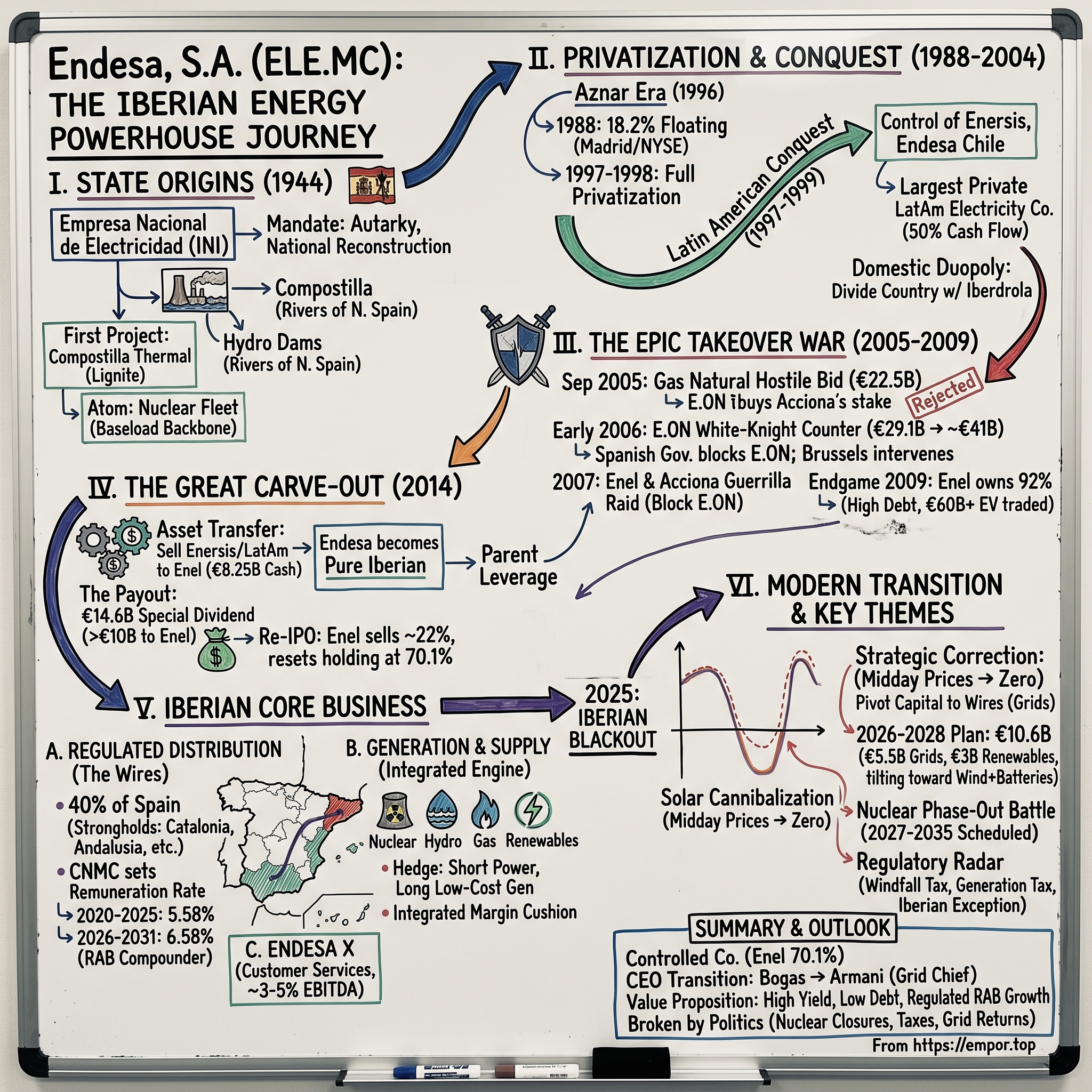
Endesa, S.A.: The Iberian Energy Powerhouse
I. Introduction & Episode Roadmap
At 12:33 on the afternoon of April 28, 2025, the lights went out across an entire subcontinent. In a span of roughly five seconds, the electricity grid of the Iberian Peninsula lost about fifteen gigawatts of generation — some sixty percent of what Spain was producing at that instant — and cascaded into the largest blackout in modern European history, leaving more than fifty million people in Spain, Portugal, and slivers of southern France without power.1 Trains froze in tunnels. Hospitals switched to diesel. Traders in Madrid stared at dead terminals. The economic damage was later estimated at roughly €1.6 billion in lost output.1 And here is the detail that frames everything that follows: at the moment the system collapsed, renewables were supplying about 78% of the grid, solar alone nearly 60%, and the handful of nuclear reactors still spinning tripped offline the instant they sensed the disturbance.2
That afternoon was, in miniature, the entire investment thesis and the entire investment risk of Endesa, S.A. Because Endesa is the company that owns the reactors that tripped, the hydro dams that helped restart the country over the following hours, and the distribution wires that carried the darkness — and then the recovery — to millions of Spanish homes.
Endesa (ELE.MC, listed in Madrid on the BME) is Spain's historic electricity champion. In 2024 it sold roughly 74 terawatt-hours of power to more than ten million customers, produced electricity across a fleet of nuclear, hydro, gas, wind, and solar plants, and earned €5.29 billion of EBITDA; by 2025 that EBITDA had climbed to €5.76 billion.34 On an enterprise value in the neighborhood of €27–30 billion, it is one of the highest-yielding large-cap utilities in Europe.
But the orientation raises an immediate paradox. Spain's quintessential national power company — the one Francisco Franco's regime founded to electrify a broken country — is 70.1% owned by an Italian company, Enel S.p.A., which is itself majority-controlled by the Italian state.5 How did the crown jewel of Spanish energy end up as the cash engine of an Italian parent? And why do minority shareholders in Madrid keep buying the 29.9% that Rome doesn't own?
This is the story of that inversion, and it turns on four themes. First, the improbable arc from Francoist state autarky to the wildest four-way takeover battle European capitalism has ever seen. Second, the 2014 "Great Carve-Out," when Endesa shipped its Latin American growth engine to its parent and rained a €14.6 billion special dividend on shareholders. Third, the strange new physics of Iberian power — where sunshine has become so abundant that at midday it can drive electricity prices to zero or below, and where the smart money is quietly retreating from building solar farms back toward the boring, regulated monopoly of the wires. And fourth, the permanent tug-of-war with Spanish politics: windfall taxes, the "Iberian Exception," and a nuclear phase-out scheduled to begin in 2027 that could strip away Endesa's cheapest source of power exactly when the country needs firm capacity most.
To understand why any of this matters, we have to go back eighty years, to a country with almost no electricity at all.
 Subscribe on LinkedIn
II. State Origins & The Electrification of Spain (1944–1988)
Picture Spain in 1944. The Civil War had ended five years earlier, leaving the country broken, isolated, and dark. Europe was consumed by a second, larger war; Franco's regime, ostracized by the Allies, had committed itself to autarquía — economic self-sufficiency by force of will. There was no Marshall Plan coming for Spain. If the country was going to have factories, railways, and lit cities, the state would have to build the power to run them itself.
So on November 18, 1944, the regime created Empresa Nacional de Electricidad, S.A. — the acronym ENDESA — as a vehicle of the Instituto Nacional de Industria (INI), the sprawling state holding company modeled loosely on Mussolini's IRI. The mandate was blunt: generate electricity to power national reconstruction, using resources Spain actually had.
What Spain had was low-grade coal and falling water. Endesa's first great project was the Compostilla thermal power station in León, burning domestic lignite — a dirty, low-energy coal that no market economy would have chosen, but which had the singular virtue of being Spanish. Alongside the coal came the dams. Through the 1950s and 1960s, Endesa and its state siblings threw concrete across the rivers of northern Spain, building the hydroelectric reservoirs that still, three-quarters of a century later, form part of the company's cheapest and most flexible generation. Hydro was the crown jewel of the autarkic era: no fuel bill, no import dependence, and — crucially for the story to come — an asset that lasts, quite literally, for a century.
Then came the atom. In the 1970s and 1980s, Spain built a nuclear fleet, and Endesa co-invested across the key sites — Ascó and Vandellós in Catalonia, Almaraz in Extremadura. Nuclear plants are the opposite of hydro in one respect (enormous upfront cost, long construction) but identical in the one that matters for Endesa's earnings: once built and paid down, they produce vast quantities of electricity at a marginal cost approaching zero, running flat-out around the clock. Endesa never owned these plants outright — Spanish nuclear stations are shared among the major utilities in fractional stakes — but the megawatts it did control became the low-cost baseload backbone that still drives its profits today. Hold that thought; it becomes the entire nuclear-phase-out drama in Section VII.
By the 1980s, Endesa had grown from a single lignite project into the spine of the Spanish power system. And a state monopoly that large, in a country now inside the European Community and hungry for foreign capital, was an obvious candidate for the great privatization wave sweeping Europe. In 1988, the Spanish government took the first step, floating an 18.2% stake on the Madrid Stock Exchange and, in a signal of ambition, listing shares on the New York Stock Exchange as well. Overnight, a Francoist bureau became a publicly traded utility with international shareholders and quarterly scrutiny.
That partial listing changed the company's DNA. Management now had to answer to markets, not just ministries. And once a national champion has a share price, the logic of the next two decades becomes almost inevitable: privatize it fully, and then send it hunting for growth beyond a saturated home market. Which is exactly what happened next — and it took Endesa clear across the Atlantic.
III. Privatization, The Latin American Conquest, & The Duopoly Era (1988–2004)
The politician who finished what 1988 started was José María Aznar. When his center-right Partido Popular took power in 1996, Spain was racing to qualify for the euro, and Aznar's government was ideologically committed to shrinking the state and manufacturing national champions large enough to compete in a single European market. Between 1997 and 1998, the government sold down its remaining stake, and Endesa became a fully private company — no longer an arm of the state, but a listed utility expected to grow.
There was just one problem with the growth mandate: Spain's own electricity market was mature. Demand grew at the sleepy pace of a rich European economy. If Endesa's new private shareholders wanted the kind of expansion that justified a premium valuation, they would have to find it somewhere the lights were still being switched on for the first time.
They found it in Latin America. Sharing a language, a legal tradition, and a wave of privatizations of its own, the region was throwing open its state power companies to foreign buyers precisely as Endesa went looking. In a rapid, aggressive campaign between 1997 and 1999, Endesa acquired control of Enersis, the Chilean holding company, and through it Endesa Chile — and with those two vehicles, a commanding position in the electricity systems of Chile, Colombia, Peru, Argentina, and Brazil. By 2000, Endesa was the largest private electricity company in Latin America, and something close to half of its operating cash flow was being generated across the Atlantic.
This was, for a decade, a genuinely great trade. Latin American power demand grew far faster than Spain's; the assets were often quasi-monopolies with captive customers; and the region's currencies and economies, for all their volatility, delivered growth a mature European utility simply could not generate at home. It also planted a time bomb inside the corporate structure — one that would not detonate until 2014. Because the crown-jewel growth assets now sat inside Endesa, on Endesa's balance sheet, owned in part by Endesa's minority shareholders. Remember who would later want those assets, and who would have to be paid to give them up.
Back home, the domestic market settled into a comfortable shape. Spanish electricity became, in effect, a duopoly: Endesa and its great rival Iberdrola divided the country between them, with Endesa dominant in Catalonia, Andalusia, Aragón, and the island systems of the Balearics and the Canaries. These were not markets you competed your way into. Distribution — the physical business of running wires to homes — is a natural monopoly; nobody builds a second set of power lines down a street that already has one. Endesa's regional grids were, and remain, exclusive franchises. That regulated wire business, unglamorous and slow, is the foundation on which everything else rests.
By 2004, then, Endesa was a formidable animal: a privatized Spanish champion, a Latin American powerhouse, and the co-owner of a domestic duopoly. It was also, precisely because it was so valuable and so strategically central, a target. What came next was not a quiet decade of compounding. It was war.
IV. The Epic Takeover War: Europe's Wildest M&A Saga (2005–2009)
If you want to understand how seriously governments take control of their electricity, watch what Spain, Germany, Italy, and the European Commission were willing to do to each other over Endesa between 2005 and 2009. It is, without much exaggeration, the wildest takeover saga in the history of European corporate finance — a four-year brawl involving three would-be acquirers, two national governments, the EU's competition authority, and a series of moves so aggressive they rewrote the rulebook on hostile bids in Europe.
It began in September 2005, when Gas Natural — the Catalan gas company, backed by the powerful Catalan savings bank La Caixa — launched a hostile bid worth roughly €22.5 billion.6 Endesa's chairman, Manuel Pizarro, a combative Aragonese lawyer and former stockbroker, rejected it flatly as far too cheap and mounted a ferocious defense. Pizarro's argument was partly financial and partly nationalistic: he cast Gas Natural's offer as an attempt to grab a national champion on the cheap, and he was prepared to fight it in every courtroom and boardroom in Spain. The battle instantly became political, because a Gas Natural–Endesa merger would have created a Spanish energy colossus — which the Socialist government of José Luis Rodríguez Zapatero rather liked, and which Endesa's own management rather did not.
Then, in early 2006, the fight went international. Germany's E.ON, one of Europe's largest utilities, crash-landed with a white-knight counteroffer of about €29.1 billion — comfortably above Gas Natural's bid — and over the following year raised it repeatedly, ultimately to roughly €41 billion, or €38.75 a share.6 For Endesa's shareholders this was a wonderful problem to have: a bidding war driving the price ever higher. For the Spanish government it was a nightmare. A German company was about to swallow the country's largest electricity producer, and Madrid was determined to stop it.
Here the saga turns from finance into a constitutional drama about the limits of economic nationalism inside the European Union. The Spanish government leaned on its energy regulator, the CNE, to attach conditions to the E.ON deal so onerous they amounted to a blocking maneuver. Brussels was not amused. The European Commission — guardian of the single market's free movement of capital — intervened directly, ruling the Spanish conditions illegal and threatening legal action against Spain for protecting a national champion in violation of EU law. It was a genuine test of whether a member state could wall off a strategic company from a fellow European acquirer. The answer, formally, was no.
So the blocking came from a different direction — not from the government, but from the market. In 2007, in what amounted to a guerrilla raid, the Italian utility Enel S.p.A. and the Spanish construction and infrastructure group Acciona quietly accumulated huge stakes in Endesa on the open market — Enel around 24.9%, Acciona around 21%.7 Together they controlled a blocking minority. E.ON, staring at a register in which nearly half the company was held by two players determined to keep it out, could no longer reach the ownership threshold its bid required. In March 2007, Enel and Acciona formalized a joint offer valuing Endesa at roughly €43 billion, and E.ON agreed to withdraw — not empty-handed, but compensated with a package of Endesa's generation and supply assets in Italy, France, and Spain.7 It was a face-saving exit for the Germans and a decisive win for the Italians.
The endgame came in 2009. The Enel-Acciona partnership was always a marriage of convenience — a global utility and a Spanish builder do not run a power company together for long. Enel bought out Acciona's roughly 25% stake for about €11.1 billion, taking its holding to a commanding 92%. Add up the whole campaign and the enterprise value changing hands exceeded €60 billion.
Now the autopsy, because this is where the investor lens matters. Did Enel overpay? The uncomfortable arithmetic says quite possibly yes. Enel bought control at something on the order of eleven times peak-cycle EBITDA — a full price for a utility — and it did so at almost the worst conceivable moment: right before the 2008 financial crisis, the European sovereign-debt crisis that would savage Spanish and Italian credit, and Spain's own 2010–2013 "tariff deficit" crisis, in which the government had for years let regulated electricity prices sit below real costs and left the utilities holding a multibillion-euro IOU. Enel had loaded up on debt to buy a Spanish asset at the top of the cycle, just as Southern Europe fell off a cliff. Within a few years, the parent would be drowning in leverage — and it would look at those Latin American assets still sitting inside Endesa, and it would want them. That is the setup for the most important financial engineering in Endesa's modern history.
V. The 2014 Great Carve-Out: LatAm Asset Transfer & The €14.6B Dividend
By 2013, Enel had a problem measured in tens of billions. The debt it had taken on to conquer Endesa, layered on top of its other ambitions, had left the Italian parent carrying more than €40 billion of net debt into the teeth of Europe's sovereign-debt crisis. Ratings agencies were circling. Something had to give. And Enel controlled the board of a subsidiary that happened to own one of the most valuable growth portfolios in the emerging-market utility world: Endesa's Latin American business, held through its 60.6% stake in the Chilean holding company Enersis.
What followed in 2014 was a masterclass in how a controlling shareholder rearranges the furniture — and a live case study in the central governance question that hangs over Endesa to this day. The transaction had three moving parts.
First, the asset transfer. Endesa sold its 60.6% stake in Enersis and its Latin American operations to Enel Iberoamérica — that is, up to its own parent — for roughly €8.25 billion in cash. In a single stroke, Endesa stopped being a globe-spanning utility with half its cash flow in Chile and Brazil, and became a pure-play Iberian company: Spain and Portugal, full stop. The growth engine had been unbolted and handed to Rome.
Second, the payout. Flush with the cash proceeds, Endesa declared a special dividend of €14.6 billion — about €13.80 per share — one of the largest single distributions in the history of the Madrid exchange.8 Because Enel owned roughly 92% of Endesa at the time, well over €10 billion of that dividend flowed straight up to Enel's balance sheet, where it went to work paying down the very parent-level debt that had motivated the whole exercise.
Third, the re-IPO. Having extracted its cash, Enel then sold about 22% of a now-simpler, pure-Iberian Endesa back to public investors, resetting its ownership at the 70.1% level it holds today.5 Enel got its money and kept control; new minority shareholders got a clean, high-yielding domestic utility.
So who won? The honest answer is that everyone got something, but not equally. Enel plainly won: it converted a subsidiary's growth assets and a subsidiary's balance sheet into cash to fix its own leverage, then sold a slice at a valuation that reflected the new, simpler story. Minority shareholders won a genuinely attractive instrument — a pure-play regulated-and-integrated Iberian utility throwing off enormous dividends — but they won it by losing the Latin American growth that had justified Endesa's expansion in the first place. This is the tension a neutral analyst has to sit with. The 2014 carve-out is often told as a shareholder-friendly bonanza, and the check was real. But it also crystallized the structural fact that Endesa's controlling owner can, when it needs to, use the subsidiary as a source of cash — buying its best assets at a negotiated price and dividending itself the proceeds. Whether that is value-sharing or value-extraction depends entirely on price, and minority investors were not the ones setting it.
To run the leaner company, Enel installed an insider. In October 2014, José Damián Bogas Gálvez — an electrical engineer who had spent his career inside Endesa's generation and commercial businesses — became CEO. He would hold the job for the better part of twelve years, and his tenure defines the modern company. To understand what he was actually managing, we need to open the hood on the Iberian utility itself.
VI. The Iberian Core Business: Economics, Segment Analysis, & Moats
Strip away the eighty years of history and the corporate drama, and Endesa today is a surprisingly legible machine. It makes money in two big ways and one small way, and the difference between the two big ways is the difference between a bond and a bet.
Regulated distribution: the balance-sheet foundation. Start with the boring part, because the boring part is the point. Endesa owns and operates the electricity distribution networks — the medium- and low-voltage wires that carry power the last mile to homes and businesses — across roughly 40% of Spain, spanning its historic strongholds in Catalonia, Andalusia, Aragón, and the island systems. This business generates on the order of €2.0–2.2 billion of EBITDA a year, and it does so with an almost eerie predictability, because the wires do not sell electricity into a volatile market. Instead, the regulator, the CNMC, sets a permitted return on the company's Regulated Asset Base — the accumulated, audited value of all those poles, transformers, and lines. Think of it as a landlord model: Endesa builds and maintains the infrastructure, and the state guarantees it a regulated return on that capital regardless of what wholesale power prices do on any given day.
The number that governs this business is the "financial remuneration rate," and it just changed in a way that matters. For the 2020–2025 period the rate was 5.58%. In late 2025 the CNMC set the rate for the new 2026–2031 regulatory period at 6.58% — a full hundred-basis-point increase.9 For a business whose profitability is literally a percentage of a multibillion-euro asset base, a hundred basis points is not a rounding error; it is a direct, durable uplift to the most reliable earnings Endesa has. It is also the single clearest reason the company is now pivoting capital toward the wires, a move we'll come to.
Generation and supply: the merchant-and-integrated engine. The second big business is where the money is larger and the ground is less solid. Here Endesa both produces electricity and sells it to end customers, earning roughly €3.0–3.5 billion of EBITDA. Its Spanish generation fleet spans nuclear (about 3,300 MW of capacity via fractional stakes in the national plants), hydro (roughly 4,700 MW), combined-cycle gas plants (the flexible, gas-fired units that fill in when wind and sun fade), and a fast-growing renewables portfolio that pushed total clean-energy capacity past 10 gigawatts in 2024.103
The genuinely important idea in this segment is vertical integration as a hedge, and it is worth slowing down on, because it is the crux of why Endesa survived a decade of price chaos better than pure renewable developers. Endesa sells far more electricity to retail customers than its own plants happen to produce — it supplies on the order of 80 terawatt-hours to the market while generating around 50. In market jargon it is "short" power: it owes more than it makes. That sounds like a weakness. It is actually the hedge. Because Endesa's own nuclear and hydro fleet produces electricity at rock-bottom marginal cost, that cheap internal generation acts as a natural buffer against swings in the wholesale market. When market prices spike, the cheap in-house power protects the retail margin; the two halves of the business lean against each other. A company that only generates is fully exposed to falling prices; a company that only retails is fully exposed to rising ones; Endesa, doing both, dampens both. That internal cash hedge is the reason its integrated margin is steadier than its raw commodity exposure would suggest — and it is a genuine, structural advantage, not a marketing line.
Endesa X and retail services: kept in proportion. The third leg is small and should be described as small. Endesa X bundles the newer, customer-facing services — EV charging infrastructure, solar self-consumption for commercial and industrial clients, home energy and repair insurance — and contributes only something like 3–5% of group EBITDA. Its plausible strategic value is not as a profit center but as a retention tool: the more services a household buys, the less likely it is to churn to a competitor, and a fleet of controllable EV chargers and home batteries is a potentially useful lever for managing demand. That is a reasonable thesis. It is not, on the current numbers, a needle-mover, and any story that leans on Endesa X to justify the valuation is reaching.
The competitive landscape and the moat. Endesa's peers each pressure a different flank. Iberdrola is the global heavyweight — larger, more internationally diversified, and carrying a richer "green premium" in its valuation. Naturgy is the gas-heavy domestic rival. EDP España and TotalEnergies press on renewables and supply. Against that field, where is Endesa's actual moat? Applying Hamilton Helmer's 7 Powers, two hold up. The first is a cornered resource: those distribution concessions in Catalonia, Andalusia, and the islands are effectively perpetual franchises over networks that physically cannot be duplicated — you cannot build a competing grid down the same street, and the regulator will not license one. The second is scale economies: the fixed costs of billing systems, call centers, grid control rooms, and customer acquisition spread across more than ten million connections, giving Endesa a lower cost per customer than a subscale entrant could ever reach. What Endesa does not have is pricing power in generation — nobody does; electricity is a commodity cleared in an auction — which is precisely why the regulated wires, not the power plants, are the durable core. And that commodity reality is about to get brutal, because Spain has built so much solar that sunshine itself has started to destroy prices.
VII. The Modern Energy Transition: Cannibalization, Grid Capex, & Nuclear Phase-Out
Return to that dark afternoon in April 2025, because it was not a freak accident — it was a symptom. Spain had spent a decade building solar faster than almost any country on earth, and by 2025 the grid was routinely running on 70–80% renewables at midday. On a sunny spring afternoon with mild demand, the physics of the situation is unforgiving: a grid dominated by inverter-based solar and wind carries very little of the spinning "inertia" that big rotating machines — nuclear turbines, hydro, gas — provide to steady the system's frequency. When a disturbance hit southwestern Spain, there was too little inertia to absorb it, protective systems tripped in a cascade, and the whole peninsula went dark in seconds.2 The blackout was, at bottom, a warning about what happens when you remove firm, synchronous generation faster than you replace its stabilizing services.
The solar cannibalization crisis. The same glut that destabilized the grid has been quietly destroying the economics of the very technology causing it. When millions of solar panels all generate at once — every sunny day, at exactly the same midday hours — they flood the market with power precisely when nobody needs extra. On the OMIE spot exchange, midday prices have repeatedly collapsed to zero and, on some days, gone negative, meaning generators effectively pay to offload power they cannot stop producing. This is "cannibalization": each new solar farm lowers the price captured by every existing solar farm, including its own. For an unhedged renewables-only developer, it is a slow-motion margin trap — you build more capacity and earn less per megawatt-hour. For Endesa, the damage is cushioned by exactly the integrated-hedge mechanism described above: cheap midday power flows into a retail book that resells it, and the nuclear-and-hydro backbone smooths the swings. But "cushioned" is not "immune," and management has read the signal clearly.
The strategic course correction. Here is where you can watch a management team change its mind in response to evidence — which is worth crediting. In its 2026–2028 strategic plan, unveiled alongside 2025 results, Endesa laid out €10.6 billion of investment, up 10% from the prior plan's €9.6 billion — but the mix is the story.411 More than half, about €5.5 billion, will go into the regulated grids, a roughly 40% increase; spending on renewables will fall by around 20%, to roughly €3 billion, with the remaining new build tilted toward wind and, critically, batteries.1112 Of about 1,900 MW of new renewable capacity planned by 2028, some 1,500 MW is wind-plus-batteries.12 The logic is coherent: batteries soak up the free midday solar and release it into the expensive evening peak, converting cannibalization from a problem into an arbitrage, while the regulated wires now earn a higher, guaranteed 6.58% return. In effect, Endesa is retreating from the commodity it cannot control and advancing on the monopoly it can. Management also disclosed a striking bottleneck: in 2025 it could authorize only 14% of the roughly 32,000 MW of grid-connection requests it received — a queue of would-be industrial and data-center customers that the grid is currently too weak to serve, and a direct justification for pouring capital into the wires.11
The nuclear phase-out battle. Now the hardest problem, and the one with the least management control. Under a 2019 agreement, Spain committed to shutting its entire nuclear fleet between 2027 and 2035 — beginning with Almaraz, whose two units are scheduled to close in November 2027 and October 2028, followed by Ascó I and Cofrentes around 2030, Ascó II in 2032, and Vandellós II in 2035.13 For Endesa, this is not abstract. Nuclear supplies roughly a quarter of its Spanish output at the lowest marginal cost in its fleet; retiring it removes the cheap, firm, carbon-free baseload that anchors the integrated hedge — and, as April 2025 demonstrated, removes inertia the grid may badly need. The utilities have pushed back hard, arguing the plants are safe to run longer and that the economics only fail because of punishing taxes — chiefly the tasa Enresa, the levy funding nuclear waste management, which was raised sharply. The tide may be turning: in mid-2026 Spain's nuclear safety council issued a favorable report on extending Almaraz's licence, and its owners — Iberdrola with 52.7%, Endesa with 36%, and Naturgy with 11.3% — formally requested a delay of the closure.14 Whether Madrid grants it is a political question, not an engineering one, and it is genuinely unresolved. An investor should treat the 2027 start date as a real risk and any extension as an unbanked option.
The regulatory friction radar. Two political levers round out the picture. The windfall revenue tax — a 1.2% levy on energy companies' Spanish revenue introduced in 2022 — cost Endesa on the order of €200–300 million a year and became a running battle. In a telling episode, Spain's parliament actually rejected the government's attempt to extend the permanent version of the tax in late 2024 and early 2025, only for the levy to be extended again for a further year, now softened by rebates of up to 60% for companies investing in the green transition.1516 Separately, in mid-2026 the government said it would phase out a long-standing 7% tax on electricity generation by 2028.17 The "Iberian Exception" — the 2022–2023 gas-price cap that Spain and Portugal won special EU permission to impose during the energy crisis — has since lapsed, but it set a precedent worth remembering: when prices spike, Madrid will intervene in the wholesale market, and utilities are price-takers on their own political risk. That structural exposure to a hands-on state is the through-line connecting every item on this radar, and it feeds directly into how one should judge the people running the company.
VIII. Management Credibility, Governance, & Capital Allocation
Every controlled company is really two questions in one: is the management competent, and is the controller fair? At Endesa the two questions are inseparable, because the CEO ultimately answers to a shareholder in Rome that owns 70.1% of the votes.5
The people. José Damián Bogas Gálvez ran Endesa from October 2014 until 2026 — a long, deliberately unflashy tenure. An engineer by training and an Endesa lifer, Bogas built a reputation for two things: operational discipline and hitting his numbers. Under him the company became a guidance-and-dividend machine, and for the most part it delivered against its own targets, which is the single most important test of a management team. In April 2026, after twelve years, Endesa's board unanimously appointed Gianni Vittorio Armani as CEO, with Bogas staying on as an external board member to smooth the handover.1819 Armani's résumé is itself a signal of strategy: an Italian, he had run Enel's global grids business — the exact business Endesa is now pouring capital into — and before that led the Italian utility Iren. Installing the parent's grids chief atop the Spanish subsidiary just as the subsidiary pivots to grids is not a coincidence; it is Enel aligning Endesa tightly with group strategy. Overseeing it all is Flavio Cattaneo, Enel's group CEO since 2023, who arrived preaching financial discipline over headline capacity growth and has enforced cash returns and capex selectivity across the empire.20
The governance stress test. Here is where a neutral analyst has to be blunt. Enel controls the board, sets the strategy, and appoints the CEO from its own ranks; the 29.9% minority is along for the ride. The structural conflict is unavoidable: does Enel run Endesa for all shareholders, or does it use the subsidiary to serve the parent? The 2014 carve-out showed the parent can extract cash on terms it negotiates with itself. On the other hand, the day-to-day evidence since has been reassuring rather than alarming. Endesa has maintained a shareholder-friendly dividend policy — a payout floor around 70% of ordinary net income — that delivers one of the richest yields in the European utility space, and it has done so while keeping leverage conservative, with net debt to EBITDA falling to about 1.8x in 2024.3 A parent looting a subsidiary does not usually let it keep a fortress balance sheet. The fair reading is that the interests are mostly aligned today, because a cash-hungry Enel and a yield-hungry minority both want the same thing — maximum sustainable dividends — but that alignment is a happy coincidence of circumstances, not a structural protection. If Enel's needs ever diverged from the minority's, the votes are all on one side.
The credibility scorecard. On execution and guidance, management earns high marks: 2024 EBITDA of €5.29 billion and 2025 EBITDA of €5.76 billion both came in at or above targets, and the dividend has been raised and honored.34 On cost control and balance-sheet discipline, high marks again. The mixed marks come on the political front — not because management handled it badly, but because there is a limit to how much a regulated utility can do when the state decides to tax its revenue or shut its reactors. Fighting windfall taxes and nuclear closures is a game Endesa can influence but not win outright, and honest scoring has to separate what management controls from what it merely endures. That distinction — controllable execution versus uncontrollable politics — is the real lesson buried in Endesa's whole history, and it is worth extracting deliberately.
IX. Playbook: Business & Investing Lessons
Step back from the Spanish specifics, and Endesa offers four transferable lessons for anyone who invests in utilities, infrastructure, or controlled companies.
1. The power of internal hedging. The most durable insight in the whole story is structural, not financial. A utility that is "long" cheap generation and "short" retail demand has built a shock absorber into its own balance sheet: the two positions move against each other, so extreme commodity swings that would wreck a pure generator or a pure retailer get muffled. Endesa's nuclear-and-hydro fleet feeding an oversized retail book is why its integrated margin held together through a decade of price chaos that flattened unhedged peers. When you evaluate any integrated energy business, the first question is not "how much power does it make?" but "how well does what it makes match what it sells?"
2. The regulatory discount is real and rational. Pure-play domestic utilities in interventionist political environments trade at persistent discounts to globally diversified peers — and they should. Endesa's entire earnings base sits inside one country whose government has shown, repeatedly, that it will impose windfall taxes, cap wholesale prices, and legislate the closure of profitable assets. Iberdrola, spread across the UK, the US, Brazil, and Spain, dilutes exactly that single-jurisdiction risk, and the market pays up for the diversification. The discount is not the market being wrong; it is the market pricing concentrated political risk correctly. A high yield in a jurisdiction like this is partly compensation for that risk, not a free lunch.
3. Renewable cannibalization is an economic law, not a temporary glitch. The intuition that "more solar is always better" collides with a hard truth: when generation is free but concentrated at the same hours, abundance destroys price. Building solar without the storage or flexible demand to time-shift it is building your own margin compression. The lesson generalizes to any commodity where supply arrives in synchronized waves. Endesa's pivot from solar toward batteries and grids is a rational response to that law — and a warning to anyone whose renewable thesis quietly assumes captured prices stay flat.
4. Minority ownership under a controlling parent is a specific, priceable risk. Owning 29.9% of a company whose other 70.1% belongs to a state-backed foreign utility means accepting that you do not set strategy, capital allocation, or the terms of related-party deals. That is not automatically bad — the parent's appetite for cash can align beautifully with a yield investor's, as it does at Endesa today. But it is a distinct risk that must be underwritten explicitly, by studying the controller's past behavior toward minorities, because when interests diverge, the minority has votes that do not count. Behavior over time, not governance charters, is the only real evidence.
Those lessons frame the final question every investor actually cares about: from here, does Endesa win, and what breaks the case?
X. Strategic Position, Bull vs. Bear Case, & KPIs
The bull case rests on a simple, sturdy proposition: Endesa is a high, reliable dividend backed increasingly by regulated cash flows, arriving at a moment when the regulated business is getting more profitable. The CNMC's rate rise to 6.58% directly lifts returns on a growing Regulated Asset Base, and the €5.5 billion grid-investment push expands that base — a compounding flywheel where every euro invested earns a guaranteed, higher return.911 Layer on structural demand growth from Spanish electrification — data centers hunting for cheap renewable power, industrial heat pumps, EVs — and the queue of 32,000 MW in unserved connection requests looks less like a bottleneck and more like a backlog of future revenue.11 The integrated hedge protects the retail margin; the ~70% payout floor delivers a yield around 6–7%; and the balance sheet is conservative. For an income investor, that is a coherent thesis.
The bear case is equally coherent and attacks the same assets. Start with nuclear: if the 2027 Almaraz closures proceed on schedule, Endesa loses its cheapest firm power exactly as the grid — post-blackout — most needs inertia and reliability, forcing it to buy replacement energy in a tighter market and squeezing the integrated margin.13 Add political risk: the windfall tax has already proven it can be resurrected by decree even after parliament kills it, and grid remuneration, though rising now, is reset by the same regulator every six years and could just as easily be cut next cycle.1516 And add the physics: solar cannibalization is worsening faster than battery storage is scaling, so merchant power margins may erode before the BESS build-out catches up. Each of these is a live, not hypothetical, threat.
A Porter and 7 Powers read. Run Endesa through Porter's five forces and the picture is bifurcated. In distribution, rivalry is nil (regional monopoly), the threat of new entrants is essentially zero (you cannot license a duplicate grid), and buyer power is mediated by a regulator — a genuinely strong position, protected by the cornered resource and scale economies powers identified earlier. In generation and supply, the story inverts: rivalry is intense, the product is an undifferentiated commodity, buyer power (customers can switch suppliers freely) is high, and the "supplier" — in the form of the Spanish state wielding taxes and price caps — holds outsized power over the whole industry. The single most important strategic fact about Endesa is that management is deliberately shifting capital from the second, weak-moat world toward the first, strong-moat one. Whether that shift outruns the erosion of the generation business is the entire investment debate.
Three KPIs worth tracking. For a company this size, resist the urge to watch everything and watch three things:
-
Regulated Asset Base growth and the CNMC remuneration rate. This is the engine of the durable earnings. RAB expansion multiplied by the 6.58% rate is, quite literally, where the reliable profit growth comes from — and the rate resets in 2031, so the trajectory of both the base and the return is the number that matters most.
-
Integrated power unit margin (€/MWh). The spread between Endesa's all-in cost of generating and procuring electricity and what it ultimately realizes selling to customers is the single cleanest measure of whether the vertical-integration hedge is still working. Watch it especially as nuclear retires.
-
Renewable captured-price ratio. The price Endesa actually receives for its wind and solar output divided by the average spot price. A ratio drifting below one — and falling — is cannibalization showing up in the accounts, and it is the early-warning gauge for whether the batteries-and-grids pivot is arriving in time.
Track those three and you are tracking the real Endesa, not the headline yield. Which leaves one last question: where does an eighty-year-old power company go from here?
XI. Epilogue & Looking Ahead
There is a certain symmetry to Endesa's story. It was born in 1944 to solve a problem of scarcity — a dark, broken country with too little power — and it now confronts the opposite problem: a sunlit country with so much midday power that electricity can be worth less than nothing. The autarkic coal-and-hydro project that lit Franco's Spain has become an integrated, listed, dividend-paying utility inside an Italian empire, wrestling with battery arbitrage and grid inertia.
The next era will be defined by whether Spain can turn its embarrassment of clean-energy riches into durable advantage. The country wants to be Europe's clean-energy hub, courting the data centers that AI is spawning by the hundred, nursing green-hydrogen ambitions, and — after April 2025 — reckoning with the uncomfortable truth that a grid running on inverters needs massive new investment in wires, storage, and stability before it can absorb all that renewable ambition. That grid bottleneck is Endesa's threat and its opportunity in a single sentence: the same weakness that darkened the peninsula is the reason the regulator is now paying more to fix it, and Endesa is pointing its capital straight at the fix.
For the investor, the through-line of eighty years is worth holding onto. Endesa has always been a cash-generating asset whose fate is decided partly by its own operators and partly by the Spanish state — and, since 2007, by a controlling owner in Rome whose interests happen, for now, to run parallel to the minority's. It is a jewel, but a jewel someone else holds. The task is not to admire the yield but to keep asking the two questions that have governed this company since 1944: what will the state do to it, and what will its owner do with it. The answers, as ever, are not fully in Endesa's hands.
References
-
The 2025 Iberian Peninsula Blackout: Early Analysis and Lessons Learned — POWER Magazine, 2025 ↩↩
-
Iberian Peninsula Blackout — Causes, Consequences, and Challenges Ahead — Baker Institute, 2025 ↩↩
-
Endesa achieves a net profit of €1.888 billion in 2024 — Endesa, S.A., 2025-02-26 ↩↩↩↩
-
2025 Results and 2026-2028 Strategic Plan — Endesa, S.A., 2026 ↩↩↩
-
Enel and Acciona Launch €43B Joint Bid for Endesa — Reuters, 2007-03-23 ↩↩
-
Endesa Approves €14.6B Dividend in Latin America Sale to Enel — Reuters, 2014-10-05 ↩
-
CNMC Sets 6.58% Return for Spanish Electricity Networks for 2026-2031 — MarketScreener, 2025 ↩↩
-
Endesa reaches 10.1 GW of clean energy capacity in 2024 — Enerdata, 2025 ↩
-
Spain's Endesa shifts focus to power grids in €10.6bn investment plan 2026-2028 — Enerdata, 2026 ↩↩↩↩↩
-
Endesa unveils €10.6 billion investment plan; 2025 results exceed targets — Investing.com, 2026 ↩↩
-
Government Confirms Plans To Phase Out Nuclear Power By 2035 — NucNet, 2023-12-04 ↩↩
-
Spanish regulator supports Almaraz licence extension — World Nuclear News, 2026 ↩
-
Spain Windfall Tax on Energy Firms Scrapped in Parliament Vote — BNN Bloomberg, 2024-12-19 ↩↩
-
Spain's energy windfall tax extended with relief for green investments — Renewables Now, 2025 ↩↩
-
Spain to Phase Out Electricity Generation Tax, Government Says — Bloomberg, 2026-06-29 ↩
-
Gianni Vittorio Armani named Endesa CEO, Jose Bogas steps down — Renewables Now, 2026 ↩
-
El Consejo de Administración de Endesa nombra a Gianni Vittorio Armani nuevo consejero delegado — Endesa, S.A., 2026 ↩
-
Flavio Cattaneo appointed Enel Group CEO — Enel S.p.A., 2023-05-11 ↩
 LinkedIn
 WhatsApp
 Reddit
 Hacker News
 Email
Email Kindle
 RSS Feed
 Spotify
 Apple Podcasts
 Amazon Music
 Audible
 YouTube