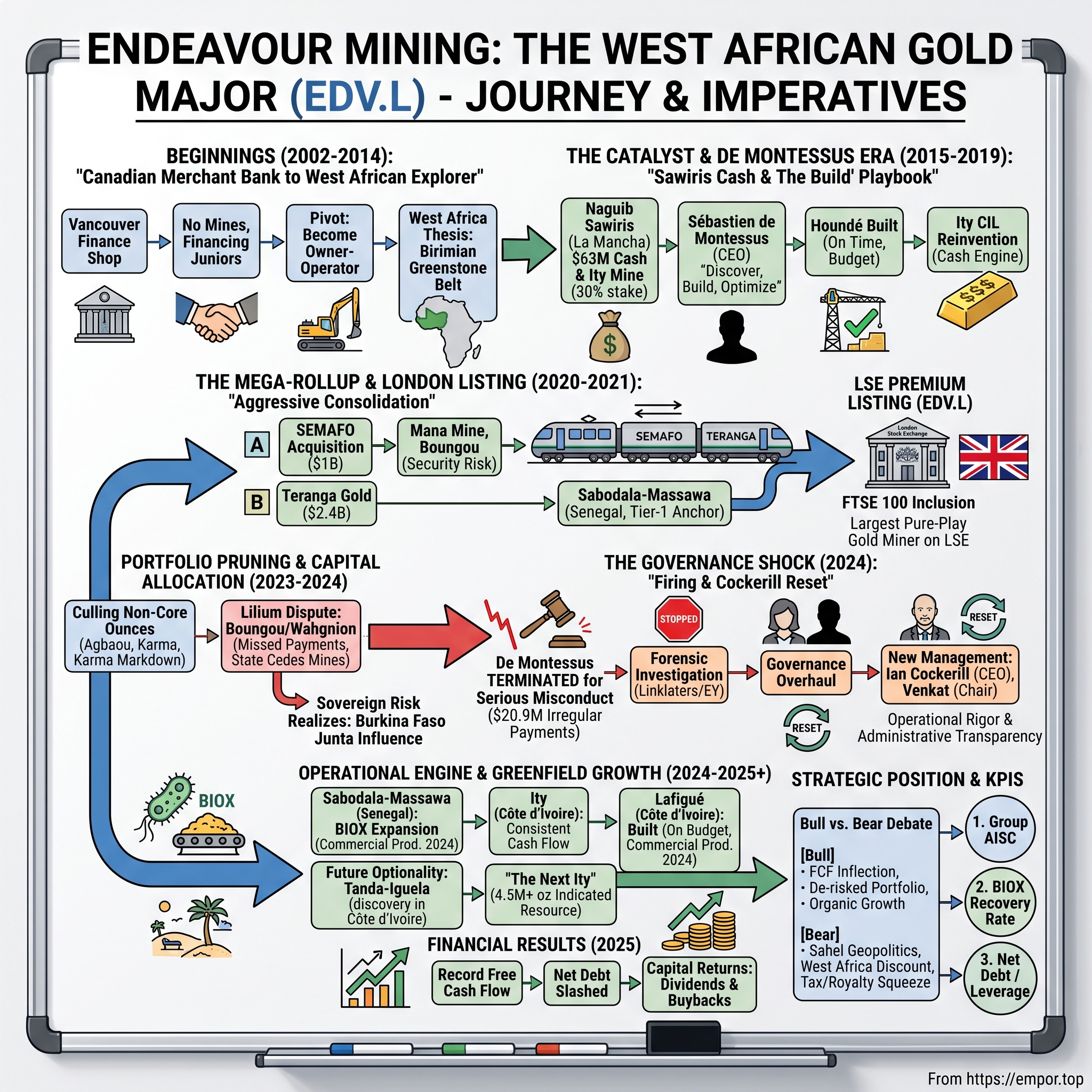
Endeavour Mining: The West African Gold Major
I. Introduction & Episode Roadmap
On the morning of January 4, 2024, investors in one of London's largest gold producers woke to a regulatory announcement that read less like a mining update and more like a corporate thriller. Endeavour Mining plc had terminated its president and chief executive, Sébastien de Montessus, "with immediate effect," citing "serious misconduct" over an irregular instruction to pay $5.9 million to a third party.1 The man being marched out was not a caretaker. He was the architect who had spent eight years turning a fragmented collection of West African pits into a FTSE 100 gold major producing well over a million ounces a year. The stock fell hard on the open. And the question hanging over the City was brutally simple: was this a company with one rogue executive, or a company whose entire growth story had been built on a culture that tolerated exactly this?
That tension — spectacular operational achievement wrapped around governance fragility — is the heart of Endeavour's story. Here is a business that mines gold in some of the most geologically blessed and politically cursed terrain on earth: the Birimian greenstone belts that arc through Côte d'Ivoire, Senegal, Burkina Faso, Mali, and Ghana. These are shallow, high-grade ore bodies that can be mined from open pits and built into producing mines faster and cheaper than the deep, aging shafts of South Africa or the permitting marathons of North America. Endeavour learned to build them on time and on budget. It also learned, the hard way, that a mine in eastern Burkina Faso can be worth a great deal one year and effectively confiscated the next.
The paradox runs deeper than geology versus politics. Endeavour spent the 2020–2021 gold boom executing one of the most aggressive roll-ups in the sector — swallowing SEMAFO and Teranga Gold in back-to-back billion-dollar deals, then jumping its primary listing from Toronto to the London Stock Exchange to court institutional capital.456 The playbook was consistent: buy mid-tier producers, prune the high-cost and high-risk ounces, and concentrate capital on a handful of Tier-1, low-cost anchors — chiefly Sabodala-Massawa in Senegal and Ity in Côte d'Ivoire. Then, having built the empire, management pivoted from dealmaking to discipline: finishing two large organic projects, committing to a dividend floor, and buying back stock.
This article traces that arc and stress-tests it. The plan: origins as a Canadian merchant-banking experiment; the Naguib Sawiris cash injection that reset the balance sheet; the mega roll-up and the London listing; the asset-by-asset economics; the governance blow-up and the Ian Cockerill reset; the mining economics through a 7 Powers and Porter lens; and finally the bear-versus-bull argument over whether Endeavour deserves its persistent discount to Canadian and Australian peers. Throughout, the posture is neutral. Management's claim is that Endeavour is a de-risked, cash-returning gold major with a Tier-1 growth pipeline. Our job is to ask what evidence supports that — and what would break it.
Consider the scale of the transformation for a moment, because it is genuinely unusual. Most gold companies are one of two things: a junior explorer that lives and dies on a single deposit, or a global super-major — Newmont, Barrick, Agnico Eagle — with assets spread across continents and decades of institutional history. Endeavour is neither. In little more than a decade it vaulted from a Vancouver financing shop that owned no mines at all to a producer of well over a million ounces a year, a member of the FTSE 100, and the largest pure-play gold miner on the premium segment of the London Stock Exchange. That kind of velocity is rare in an industry where building a single mine can take ten years. It was achieved through a specific, repeatable playbook — and playbooks that work spectacularly in a rising market are exactly the ones that hide their flaws until the market or the geopolitics turn. The entire point of this episode is to separate the parts of Endeavour's success that are structural and durable from the parts that were a bull-market illusion or a governance accident waiting to happen.
One more framing note before we begin. Gold miners occupy a strange corner of the investment universe. They are leveraged bets on a metal whose price is set by fear, real interest rates, and central-bank buying — forces entirely outside any mining executive's control. When gold rises, even a mediocre miner looks like a genius; when it falls, even a great one bleeds. The discipline in analyzing a company like Endeavour is therefore to look past the gold price and ask the operating questions that management actually controls: Is the cost position genuinely low? Are the mines in jurisdictions where the company gets to keep what it digs? Is capital being allocated with discipline or with ego? And can the people running it be trusted with shareholders' money? Those questions have clear, evidence-based answers in Endeavour's case — and, as the January 2024 announcement made brutally clear, not all of them are comfortable ones.
 Subscribe on LinkedIn
II. Origins: From Canadian Merchant Bank to West African Explorer (2002–2014)
Endeavour did not begin as a miner. It began as a way to make money from miners. In the early 2000s, Vancouver was the beating heart of the world's junior mining finance, a city where a geologist with a promising drill core and a broker with a Rolodex could raise capital before either had turned a shovel of dirt into profit. Into this ecosystem stepped Endeavour Financial, a merchant bank co-shaped by figures including Neil Woodyer and, in its orbit, the deal-maker Frank Giustra — the financier who had earlier built Lionsgate Entertainment and would become synonymous with resource-sector capital raising. Their business was not digging gold. It was arranging the money that let other people dig gold: structuring debt, brokering deals, advising juniors on how to survive the brutal cash-burn years between discovery and production.
For a financier, the trouble with financing miners is that you take much of the risk and capture little of the upside. The mine operator keeps the ounces; the banker keeps a fee. And so around 2010, the people behind Endeavour made the pivotal decision that defines everything that followed: stop financing the miners and become one. The vehicle would stop being a merchant bank and start being an owner-operator. And it would place a single, concentrated bet — West Africa.
The thesis was geological before it was financial. The Birimian greenstone belt is a two-billion-year-old band of volcanic and sedimentary rock that hosts world-class gold, running through Côte d'Ivoire, Ghana, Burkina Faso, Mali, and Senegal. Relative to the picked-over goldfields of Western Australia or South Africa's fabled but deepening Witwatersrand, the Birimian was under-explored — vast stretches had never seen a modern drill program. Better still, much of the gold sat close to surface, mineable from open pits, and could be built into a producing operation in a couple of years for a few hundred million dollars, rather than the decade and billions a deep underground mine demands. Low capital intensity, fast payback, high grade: on a spreadsheet, it looked like the best risk-adjusted gold real estate on the planet.
Why did nobody else own this real estate at scale? Partly history — the belt straddles former French and British colonies whose post-independence decades were marked by coups, currency instability, and, in the Sahel, chronic insecurity. Partly infrastructure — much of the gold sits inland, far from ports, in countries with thin road and power networks. And partly a simple perception problem: for a North American or Australian pension fund, "gold mine in Burkina Faso" and "gold mine in Nevada" were not remotely comparable investments, even if the ore in the former was richer. That perception gap was Endeavour's opportunity. If the company could operate safely and cheaply where others feared to tread, it could buy ore bodies at frontier-market prices and sell the gold at the same global spot price everyone else received. The arbitrage was not in the metal; it was in the willingness to accept — and then manage — the risk.
The catch was everything the spreadsheet did not capture. Endeavour assembled its early footprint by absorbing distressed and orphaned junior assets — pieces of Etruscan Resources, Crew Gold, and Avocet Mining — stitching together mines like Agbaou in Côte d'Ivoire, Houndé in Burkina Faso, and Tabakoto in Mali. On paper, an operating company was born. In practice, it was a fragmented portfolio of small, higher-cost mines, each with its own short reserve life, its own local politics, and its own logistics nightmare of trucking reagents and diesel down cross-border roads. A miner with one 100,000-ounce pit has no cushion: if that pit hits a bad grade patch, or a local dispute halts hauling, or the government changes the royalty, there is nothing else to absorb the blow. That is the structural curse of the sub-scale producer, and early Endeavour had it in full.
When the gold price collapsed from its 2011 peak toward $1,100 an ounce in 2013–2015, the weakness of that structure was exposed: too many marginal ounces, not enough free cash flow, no low-cost anchor to carry the group through the trough. A high-cost miner in a low-price environment is a machine for destroying capital — every ounce sold at a cost close to the price generates almost no margin, and sustaining capital must still be spent just to stand still. Endeavour had proven it could acquire mines. It had not yet proven it could own the right ones. What it needed was capital and conviction — and both arrived in the person of an Egyptian billionaire.
III. The Naguib Sawiris Catalyst & The De Montessus Era (2015–2019)
By 2015, gold was unloved, junior mining equity was radioactive, and a fragmented West African producer with stretched economics was exactly the kind of company that dies quietly in a bear market. Enter Naguib Sawiris — the Egyptian telecoms billionaire who had made and sold fortunes building mobile networks across the emerging world and who had developed a contrarian's appetite for gold precisely because everyone else had lost theirs. His private vehicle, La Mancha, was assembling a portfolio of gold interests, and Endeavour offered him something rare: an operating platform he could scale.
The transaction that closed on November 27, 2015 was elegantly structured. La Mancha injected $63 million in cash and folded in its interest in the Ity mine in Côte d'Ivoire, together with certain other assets, in exchange for common shares representing roughly 30% of Endeavour.2 In one move, the balance sheet was repaired, a cornerstone shareholder with deep pockets and a long horizon was installed, and Ity — soon to become one of the group's crown jewels — came in the door. Sawiris was not a passive check-writer. He wanted scale, and he was willing to fund it. That backing changed Endeavour's risk appetite overnight: a company that had been playing defense could suddenly play offense.
Sawiris himself is worth understanding, because cornerstone shareholders shape companies in ways that boilerplate governance disclosures never capture. Scion of one of Egypt's wealthiest families, he had built Orascom Telecom into a mobile empire spanning some of the world's most difficult markets — Algeria, Pakistan, North Korea, Iraq — before selling the bulk of it to the Russian group VimpelCom. That biography is the key to his gold bet: this was a man temperamentally comfortable deploying capital in places that terrified conventional investors, who had made his fortune precisely by operating where the risk-reward was mispriced by everyone else's fear. Gold, to Sawiris, was a hedge against exactly the monetary and political instability he had spent a career navigating. His arrival gave Endeavour not just money but a shareholder whose risk tolerance matched the West African thesis — and whose willingness to keep writing checks through the roll-up years would prove decisive. The flip side, which a governance-minded investor should note, is that a single ~30% holder concentrates influence; the interests of a controlling cornerstone and those of minority index investors do not always perfectly align, particularly on dilution and deal-making appetite.
To lead that offense, the board turned in 2016 to Sébastien de Montessus. A French executive who had risen through the nuclear group Areva — where he had run the mining division — de Montessus brought exactly the profile the situation demanded: fluent French, deep relationships across Francophone West Africa, and an aggressive, deal-hungry temperament. He was charismatic, relentless, and unusually comfortable operating in the grey zones of frontier jurisdictions where relationships with ministries and security forces mattered as much as ore grades. He framed his strategy in three words — "Discover, Build, Optimize" — a mantra that meant shedding the small, short-life mines that had burdened the early portfolio (Tabakoto, and eventually Agbaou) and concentrating capital on large, low-cost, open-pit carbon-in-leach operations. Carbon-in-leach, or CIL, is the workhorse process of West African gold: crush the ore, dissolve the gold in a cyanide solution, and adsorb it onto activated carbon. Done at scale on the right ore, it is cheap and reliable — and de Montessus wanted scale.
It is worth pausing on why "Discover, Build, Optimize" was more than a corporate slogan, because it encoded a genuine theory of value creation in gold mining. The industry's chronic disease is value destruction through the cycle: companies discover or buy ounces at the top, build over-engineered plants that run late and over budget, then write it all down when the price falls. De Montessus's framework inverted that. Discover meant growing reserves cheaply through the drill bit rather than the checkbook. Build meant an in-house engineering capability that could deliver plants on time — a competency most miners outsource and most outsourcers botch. Optimize meant ruthless portfolio surgery: constantly selling the bottom of the cost curve and reinvesting in the top. On paper it was exactly the discipline the sector lacked. The irony, only visible in hindsight, is that the man preaching capital discipline would ultimately be dismissed for the least disciplined act imaginable — moving millions of dollars off the books to an untraceable shell company.
The proof that Endeavour could build, not just buy, came at Houndé in Burkina Faso, delivered on time and under budget in 2017. In an industry where a two-year construction delay and a 30% cost overrun are almost routine, hitting the schedule and the budget was itself a competitive signal — it meant Endeavour's projected mine economics could actually be trusted, and that capital deployed would produce the returns the feasibility study promised. But the defining engineering achievement of the era was the reinvention of Ity. Ity had been a modest heap-leach operation — a low-intensity method where ore is stacked and sprinkled with solution. De Montessus's team replaced it with a large CIL plant that came online in 2019, transforming Ity into a roughly 300,000-ounce-a-year machine at industry-leading costs. Ity became the cash engine that the fragile early Endeavour had never possessed.
Not every deal aged well, and the tell came early. In 2016, Endeavour acquired True Gold Mining — and with it the Karma mine in Burkina Faso — in a transaction valued at about C$191 million.3 Karma was a low-grade, heap-leach operation dogged by community friction and stubbornly high costs. It was the mirror image of Ity: a reminder that in West Africa, an ounce in the ground is not an ounce of value, and that the difference between a Tier-1 anchor and a cash-draining orphan is grade, scale, and metallurgy. Karma would later be sold for a fraction of what was paid. That lesson — that not all ounces are created equal — would be tested at industrial scale in the roll-up that followed.
IV. The Mega-Rollup: SEMAFO, Teranga Gold, & London Listing (2020–2021)
If 2015 gave Endeavour a balance sheet and 2016–2019 gave it operational credibility, 2020 gave it a once-in-a-cycle window. COVID-19 sent central banks into emergency mode, real yields collapsed, and gold — the asset that pays no coupon and thrives when money looks fragile — powered through $2,000 an ounce for the first time in history. Suddenly every generalist fund manager wanted gold exposure, but they wanted it in size, with liquidity and a governance story they could defend. Sub-scale mid-tiers were orphans. The message from the market was unmistakable: consolidate or be left behind. De Montessus, with Sawiris's balance sheet behind him, chose to consolidate.
Why does scale matter so much to a gold miner, when gold is gold regardless of who produces it? The answer lies in the strange sociology of institutional capital. A pension fund or index-tracker cannot own a company too small to absorb its capital or too illiquid to exit — so sub-scale producers are structurally excluded from the deepest pools of money, which caps their valuation no matter how good their mines. Scale also confers procurement leverage, the ability to fund exploration and construction internally rather than through dilutive equity raises, and the diversification that lets a company survive one mine going wrong. In a consolidating sector, the mid-tiers faced a binary: become a consolidator or become consolidated. There is no comfortable middle. De Montessus understood this cold logic and moved first.
The first target was SEMAFO, a Montreal-listed producer whose assets sat right next door to Endeavour's in Burkina Faso. The all-share deal, announced in March and completed on July 1, 2020, was valued at roughly US$1 billion and made the combined group Burkina Faso's largest gold producer.4 The prize was the Mana mine, a steady producer transitioning toward underground ore. The liability — though it was not framed that way at the time — was Boungou, a high-grade mine in the country's turbulent east. Boungou carried a specific and horrifying provenance: in November 2019, under SEMAFO's ownership, a convoy of workers travelling to the site had been ambushed by militants in an attack that killed dozens. Endeavour was buying not just ounces but a security problem in one of the Sahel's most dangerous corners. Management pointed to $35–40 million in annual synergies from combining the two Burkina portfolios.4 The synergies were real. So was the risk that would later force massive write-downs.
Barely seven months later, Endeavour swallowed something far larger. On February 10, 2021, it closed the acquisition of Teranga Gold in an all-share deal valued at approximately C$2.44 billion, with Teranga holders receiving 0.470 of an Endeavour share each.5 To help fortify the enlarged balance sheet, La Mancha again stepped up with additional cash. Teranga brought two mines, but only one mattered: Sabodala-Massawa in Senegal. This was the acquisition's true purpose — a low-cost, multi-million-ounce anchor in a stable, democratic country with a fraction of the sovereign risk of the central Sahel. In hindsight, Teranga would prove the most value-accretive move Endeavour ever made; Sabodala-Massawa alone would go on to generate enough free cash flow through the gold bull market to cover much of the purchase price. The second Teranga mine, Wahgnion in Burkina Faso, was a different story — a mine that would soon become a millstone.
Step back and the pattern of the two deals is instructive about how to judge M&A in a commodity business. The market applauded the SEMAFO deal loudest at the time — it was the transformational, headline-grabbing move that made Endeavour Burkina Faso's largest producer. It applauded Teranga more quietly, partly because the premium paid to Teranga holders was modest and partly because Sabodala-Massawa's full potential was not yet obvious. Yet with a few years' hindsight the verdicts inverted: the quiet deal was the great one and the loud deal was the flawed one. The lesson for investors is that in mining, the quality and jurisdiction of the underlying ore body matters far more than the deal's optics or the premium headline — and those are precisely the things that are hardest to judge on announcement day. A cheap mine in a collapsing state is expensive; an expensive mine in a stable one can be cheap.
With the empire assembled, de Montessus made his boldest capital-markets move. On June 14, 2021, Endeavour admitted its entire share capital — some 250 million shares — to the premium listing segment of the London Stock Exchange, trading under EDV alongside its Toronto listing, without raising a penny of new capital in the process.6 It became the largest pure-play gold miner on the LSE's premium segment, expecting output above 1.5 million ounces from seven mines across three countries.6 The logic was about audience, not cash: London offered access to European income funds, a deeper pool of institutional liquidity, and — critically — a premium valuation multiple that Canadian junior markets had never awarded a West African operator. The mechanics of a valuation re-rating are worth spelling out, because "London listing" is often treated as corporate window-dressing when in fact the theory is precise. A company's share price is, crudely, its cash flow times a multiple. A miner can grow the cash flow through operations, but the multiple is set by who is allowed to own the stock and how they perceive its risk. By entering the FTSE indices, Endeavour forced every UK index-tracking fund to buy a slice, and it put itself on the screens of European income investors who prize the dividend and had never heard of a Toronto-listed junior. If those buyers assigned even a slightly higher multiple to the same cash flow, the stock would re-rate without a single extra ounce being mined. That was the bet. Whether London would actually pay up for African gold, or simply import the same discount in a fancier postcode, was the open question — and years later, the persistence of a double-digit discount to Canadian and Australian peers suggests the answer was, at best, only a partial success. Within three years, London would deliver the company its harshest lesson yet — but first, Endeavour had to clean up the empire it had just built.
V. Portfolio Pruning & The M&A Capital Allocation Record
Buying is the easy, adrenaline-soaked half of a roll-up. The unglamorous half is deciding what to throw away — and West Africa gave Endeavour a punishing masterclass in exit economics. Having assembled a portfolio through the 2020–2021 blitz, management set about doing exactly what "Optimize" promised: culling the ounces that diluted the group's cost profile or concentrated its political risk. Agbaou in Côte d'Ivoire went for around $80 million. Karma, the cautionary tale from 2016, was offloaded for roughly $25 million — a stark markdown from the C$191 million entry price that quantified, in cash, how badly a low-grade heap-leach asset ages. These were tidy, clean divestitures. The next one was neither.
The Boungou and Wahgnion saga is a case study in how selling a mine in a junta-run state can go spectacularly wrong. In June 2023, Endeavour agreed to sell the two non-core Burkina Faso mines to Lilium Mining, an affiliate of Lilium Capital, in a transaction that on paper approached and exceeded $300 million in headline value. It looked like a smart exit: shed the country risk, book the proceeds, redeploy into safer jurisdictions. Instead it unravelled. Lilium missed staged payments totalling more than $100 million and turned around to allege that Endeavour had misrepresented the financial position and operating capabilities of the mines it had sold.7 Endeavour, disputing that, pushed toward arbitration in London. A clean divestiture had become a cross-border legal brawl over whether the seller had oversold or the buyer had overreached.
The resolution, when it came, revealed who really holds the cards in the Sahel. In August 2024, the dispute was settled not merely between buyer and seller but with the State of Burkina Faso as a party: the mines were effectively transferred into state hands, and Endeavour agreed to accept $60 million in cash — $15 million upfront, $15 million by the end of the third quarter, and $30 million by year-end — plus a 3% royalty on up to 400,000 ounces of gold sold from Wahgnion.7 Set that against a headline sale price north of $300 million and the message is unambiguous: in a jurisdiction where the government can nationalize at will, a mine is worth what the sovereign decides to let you extract from it, and not a dollar more. Endeavour got out of Burkina Faso's most troubled assets, but on terms dictated by Ouagadougou, not by a London arbitration panel.
There is a broader diligence lesson buried in the Lilium episode that a skeptical investor should not miss. When a company sells a "non-core" asset, the buyer's identity and financing matter enormously. Selling a producing mine to a thinly capitalized buyer who relies on the mine's own cash flow to fund the deferred purchase payments is a structurally fragile arrangement — if the mine underperforms or the operating environment sours, the buyer simply cannot pay, and the seller is left holding a defaulted receivable and a reputational mess. Endeavour's willingness to accept staged payments from a lightly capitalized counterparty, in a jurisdiction where the state could intervene at any moment, was itself a form of risk the market underappreciated until it crystallized. The eventual sovereign-brokered settlement was less a negotiation than a demonstration of where power really sits in the Sahel's mining economy.
So what does the M&A scorecard actually say? On a risk-adjusted basis, Endeavour arguably overpaid for SEMAFO. Mana has earned its keep, but Boungou required heavy impairments and ultimately ended up ceded to the state — value that evaporated as security and sovereignty deteriorated. Teranga is the opposite verdict: even at C$2.44 billion, Sabodala-Massawa's cash generation through the bull market vindicated the price many times over. The honest read is that Endeavour's dealmaking was neither uniformly brilliant nor reckless — it was a barbell. The Senegal bet was a triumph; the eastern-Burkina bets were, at best, expensive lessons in sovereign risk. That distinction — great assets in stable states, troubled assets in fragile ones — is the through-line of everything that came next, including the crisis that nearly consumed the whole enterprise.
VI. The Governance Shock: Firing De Montessus & The Cockerill Reset (2024)
Return now to that January 4, 2024 announcement — because what looked at first like a single suspicious payment turned out to be the loose thread that unravelled a CEO. Endeavour's board disclosed that de Montessus had been terminated for serious misconduct after the audit committee identified an irregular instruction, given by him, to redirect $5.9 million to a third party in connection with an asset disposal.1 The board paired the financial finding with separate allegations concerning his personal conduct toward colleagues. For a FTSE 100 company, dismissing a sitting, high-profile CEO for cause is close to the nuclear option; boards do it only when the alternative is worse.
The alternative, it emerged, was considerably worse. Endeavour commissioned a forensic investigation — conducted by the law firm Linklaters and accountancy firm Ernst & Young, not the outline's assumed adviser — and its findings, published later, sharpened the picture into something damning.8 Investigators concluded that de Montessus had redirected a consideration payment from the Agbaou mine sale to a third-party company in March 2021 and had then "concealed this payment by subsequently making false representations to management, the Board and the Group's auditors over a period of more than two years."8 The probe further found that in 2020 he had caused Endeavour to make two payments totalling $15.0 million to the same third party, dressed up as contractor advances — bringing the diverted sum to roughly $20.9 million.813 The recipient was an entity incorporated in Ras al Khaimah in the United Arab Emirates that was liquidated the day after the $5.9 million payment cleared, and despite extensive effort the ultimate beneficiaries were never identified.8 Investigators recorded that de Montessus had offered "implausible and untrue explanations."8
There were, to be fair to the process, limits to the damage. The investigation found no evidence of bribery, sanctions violations, or terrorist financing, and concluded that no restatement of the financial statements was required.8 But the reputational and financial sanctions on the former CEO were severe. On January 18, 2024, Endeavour confirmed it would strip de Montessus of $29.1 million in remuneration — forfeiting some $17.6 million in unvested share awards and a 2023 bonus, and clawing back a $10 million one-off award granted in 2021 and a $1.5 million cash bonus from 2022.9 De Montessus, for his part, disputed the characterization, maintaining that the payment had gone to settle costs for essential security equipment — a defense that, notably, the independent investigators rejected.8 The affair even produced the surreal footnote of the departed executive paying the company a $1.35 million settlement of his own.14
The episode is worth dwelling on precisely because it cuts against the grain of Endeavour's operational success story, and because it teaches something durable about governance risk in founder-led, fast-growing companies. De Montessus was, by every operational measure, an extraordinarily effective executive — he built the mines, closed the deals, and delivered the projects. That effectiveness is exactly what made the fraud dangerous. Boards, auditors, and investors extend enormous latitude to executives who are producing results, and a charismatic dealmaker operating across opaque frontier jurisdictions, where cash payments to security firms and local partners are a normal cost of doing business, has ample cover for irregular flows. The controls that failed were not exotic; they were the basic segregation-of-duties and payment-authorization checks that should catch exactly this. The uncomfortable question for shareholders is not "how did one man do this?" but "what in the company's culture allowed a payment to be concealed from auditors for more than two years?" That is a cultural failure, not merely an individual one — and cultural failures take longer to fix than a single firing.
There is also a genuinely thorny disclosure and accounting dimension worth flagging. The investigation's conclusion that no restatement was required, and that there was no evidence of bribery or sanctions breaches, mattered enormously — a restatement would have thrown the reliability of years of reported figures into doubt and potentially triggered covenant and index-eligibility problems. That the diverted sums, while serious, did not distort the group's headline financials is a meaningful mitigant. But investors weighing the residual risk should note what the probe explicitly could not establish: the ultimate beneficiaries of roughly $20.9 million were never identified, and the recipient vehicle was liquidated within a day of the largest payment.8 A clean audit opinion coexisting with an unexplained destination for millions of dollars is precisely the kind of ambiguity that keeps a governance discount alive long after the headlines fade.
Into the wreckage stepped two of global mining's most credentialed operators. Ian Cockerill was appointed chief executive — a roughly forty-year industry veteran who had run Gold Fields and Anglo American's coal business, a man whose reputation was built on operational rigor and a conspicuous intolerance for administrative fog. Alongside him, Srinivasan Venkatakrishnan — universally known as "Venkat," the former chief executive of AngloGold Ashanti and Vedanta — took the board chair, lending exactly the kind of heavyweight institutional credibility that rattled European investors needed to see. The pair's task was less about mining than about trust: re-establishing conservative guidance, transparent cash-flow reporting, and hard compliance controls, and shifting the corporate voice from promotional to plain-spoken. Whether that reset actually took hold would be judged not in a press release but on the operating results — and on the mines themselves.
VII. Operational Engine: Mine-by-Mine Breakdown & Segment Economics
Strip away the M&A drama and the governance headlines, and Endeavour is ultimately a collection of holes in the ground, each with its own grade, cost, and political weather. Understanding the company means understanding the assets, because the group's cost curve, cash flow, and risk profile are simply the weighted sum of five mines. The portfolio is deliberately barbelled: two low-cost Tier-1 anchors in stable states carry the group, a greenfield build in Côte d'Ivoire adds fresh low-cost ounces, and two Burkina Faso mines throw off cash under a sovereign shadow.
Sabodala-Massawa (Senegal) is the crown jewel, the asset that justified the entire Teranga acquisition and anchors the largest single slice of group net asset value. It pairs a conventional open-pit CIL plant with a newly built biological oxidation — BIOX — circuit designed to unlock high-grade refractory ore. Refractory ore is gold's version of a locked safe: the gold is physically encapsulated inside sulphide minerals, so conventional cyanide leaching simply cannot reach it, and recoveries are dismal. BIOX solves this with living bacteria — cultures that literally eat the sulphides, oxidizing the mineral cage and freeing the gold for recovery. It is elegant and it is finicky: the bugs are sensitive to temperature, water chemistry, and feed consistency. Get it right and you convert previously uneconomic ore into some of the cheapest ounces in the portfolio; get it wrong and recoveries fall off a cliff. The circuit reached commercial production on August 1, 2024, on budget and on schedule, running at strong plant availability with recoveries building through ramp-up.10 With a long reserve life and low costs in a stable democracy, Sabodala-Massawa is the closest thing Endeavour has to a fortress asset.
Ity (Côte d'Ivoire) is the other pillar — the CIL plant born from de Montessus's 2019 reinvention, now a large-throughput operation processing ore from multiple open pits. Ity's defining trait is consistency: it has a long track record of over-delivering on throughput and recovery, making it the most reliable free-cash-flow converter in the group. Where Burkina's mines demand constant management of security and logistics, Ity mostly just runs — a boring, cash-spinning virtue that the market rarely prices generously but that operators prize above almost anything.
Lafigué (Côte d'Ivoire) is the newest addition and the clearest evidence that the "Build" in Endeavour's mantra still means something. Constructed for a capital cost of roughly $448 million, Lafigué poured its first gold on June 28, 2024 and reached commercial production on August 1, 2024 — on budget and ahead of schedule.1011 Management guided the mine to add incremental production over its life at a strikingly low all-in sustaining cost, deepening the group's tilt toward lower-risk Côte d'Ivoire.10 Delivering a greenfield mine on time and on budget, in the same year the company was engulfed in a governance scandal, was the single most important operational signal of 2024: the machine kept working even as the boardroom burned.
It is worth making the BIOX technology concrete, because it sits at the center of both the bull thesis and one of the key risks. Picture the refractory ore as millions of microscopic pyrite crystals, each with a fleck of gold sealed inside like a raisin baked into the middle of a rock. Conventional cyanide leaching is a solvent that can only dissolve gold it can physically touch — so with the gold locked inside the sulphide, recoveries might languish at a fraction of the contained metal, and the ore is effectively worthless by normal methods. BIOX introduces a tank of specialized bacteria that metabolize the sulphide minerals, chewing through the crystal cage over several days and exposing the gold so that conventional leaching can then recover it. The upside is dramatic: ore that was uneconomic becomes some of the highest-grade, lowest-cost feed in the portfolio. The catch is that the bacteria are, in the most literal sense, a living workforce — they need the right temperature, oxygen, nutrient, and acidity balance, and a slug of contaminated water or a swing in feed chemistry can stress or kill the culture, dropping recoveries until it recovers. That is why the BIOX recovery rate is not a footnote metric but a headline one: it is the difference between Sabodala-Massawa's expansion being a triumph or a costly science experiment.
Houndé and Mana (Burkina Faso) are the cash generators operating under sovereign risk. Houndé, lifted by the high-grade Kari Pump deposit, holds attractive costs but demands relentless attention to security overhead and cross-border supply chains. Mana sits at the higher end of the cost range as it transitions from open-pit to more expensive underground mining at its Wona and Siou deposits. Both throw off meaningful cash at prevailing gold prices — which is precisely why the strategic debate over Burkina Faso is so fraught. These are not bad mines. They are good mines in a bad neighborhood, and that tension frames the bull-bear argument to come. But before the debate, there is the question of what comes next — because a gold miner that does not replace its ounces is a melting ice cube.
VIII. Future Optionality: Tanda-Iguela & Greenfield Growth
Every gold mine is a depleting asset; the ore body that funds today's dividend is smaller tomorrow than it was this morning. The existential question for any producer is therefore reserve replacement — and the industry's default answer, buying growth through M&A, is exactly the expensive, risk-laden path Endeavour spent the roll-up years learning to distrust. Which is why the discovery in eastern Côte d'Ivoire matters so much to the long-term story.
Tanda-Iguela is Endeavour's homegrown answer to the depletion problem — a greenfield discovery that management has repeatedly described as the platform for its next Tier-1 development, in effect "the next Ity." The company has reported an indicated resource in the range of 4.5 million-plus ounces at grades around 2.0 grams per tonne, with wide, continuous mineralized zones that begin at surface and carry low stripping ratios.6 Those characteristics are the geological equivalent of beachfront property: shallow ore means cheap mining, continuous zones mean predictable planning, and surface mineralization means low waste-to-ore ratios. It is worth treating the resource figure as a company-reported estimate that will evolve with drilling rather than a bankable reserve — but the direction of travel is a large, low-cost deposit in the group's preferred jurisdiction.
Why does organic discovery matter so much more than it first appears? Because the alternative — buying reserves — is the treadmill that has destroyed more shareholder value in gold mining than any other single behavior. When a producer's mines deplete, the reflexive fix is to acquire another company's ounces, almost always at a premium, almost always near a cyclical high when acquirers are flush and confident. The acquired reserves come with the acquired company's costs, jurisdictions, and liabilities, and the premium paid is pure value transfer to the seller. A miner that can instead replace its depleting ounces from its own exploration ground, at a small fraction of the acquisition cost, escapes the treadmill entirely. That is the prize Tanda-Iguela represents — not just a big deposit, but proof of a self-sustaining growth model that does not require Endeavour to overpay at the top of every cycle. The caveat is that discovery is inherently uncertain: a resource is not a reserve until a feasibility study and a permit turn it into one, and eastern Côte d'Ivoire, while far safer than the Sahel, is not risk-free.
The strategic punchline is cost. Endeavour has argued that finding an ounce through the drill bit at a deposit like Tanda-Iguela costs a small fraction of what it costs to acquire one through M&A — discovery economics measured in the low tens of dollars per ounce against an industry acquisition benchmark several times higher. If that holds, organic growth becomes a genuine competitive edge rather than a slogan: the company can replace depleted West African reserves without issuing dilutive equity or overpaying at the top of a cycle. To feed the funnel, Endeavour has run a substantial annual exploration program across Côte d'Ivoire and Senegal — and, tellingly, has deprioritized greenfield spending in high-risk zones of Burkina Faso. Where the exploration dollars flow is itself a portfolio-strategy statement: the company is voting with its drill rigs for the stable south. That capital discipline is precisely what the 7 Powers lens is built to interrogate.
IX. The Playbook: West African Mining Economics, 7 Powers, & Cost Position
Strip a gold miner down to its investment essence and you find an uncomfortable truth: it sells a commodity it cannot price, priced in dollars it cannot influence, to buyers who do not care who mined it. In Michael Porter's language, the gold producer is a price-taker with almost no bargaining power over its customer. So the entire game — the only game — is cost position and asset quality. A miner does not win by charging more; it wins by being further down the cost curve than the next miner when the price falls, and by owning ore bodies that will still be producing when rivals' pits run dry. That reframes the question from "does Endeavour have a moat?" to "where, specifically, does its cost and asset advantage come from, and is it durable?"
Run Hamilton Helmer's 7 Powers over the business and three of the seven show up with real substance. Scale economies are genuine: operating five mines across three countries lets Endeavour negotiate shared procurement contracts for the bulk consumables that dominate a gold mine's cost base — cyanide, lime, grinding media, heavy fuel — and spread a heavy-fleet maintenance and in-house engineering capability across the group. That last point matters more than it sounds. Endeavour's ability to build its own plants, rather than hand a fat margin to external engineering-procurement-construction contractors, is why Lafigué and the BIOX circuit came in on budget while so many peers' projects blow out. Delivering complex builds on schedule is a scale-derived capability, and it is rarer in this industry than it should be.
Cornered resource is present but should be graded honestly as moderate rather than overwhelming. Sabodala-Massawa's BIOX plant is a genuinely differentiated asset — the ability to process refractory ore at scale in Senegal is not something a competitor can quickly replicate — and Tanda-Iguela, if it develops as hoped, would be a second irreplaceable ore body in a favored jurisdiction. But a cornered resource is only as good as the sovereign that lets you keep it, and in West Africa that caveat is doing heavy lifting. Process power — the accumulated, hard-to-copy know-how of running mines amid West African security threats, Francophone labor law, government relations, and customs logistics — is arguably Endeavour's most underrated edge. Global majors have repeatedly discovered that operating in the Sahel is a different sport from operating in Nevada or Western Australia, and the institutional muscle memory to do it well is not something you can buy off a shelf.
What the 7 Powers analysis pointedly does not find is any pricing power, brand power, switching costs, or network effect — the powers that let a software or consumer company compound margins. Endeavour has none of them, and neither does any gold miner, because the product is undifferentiated and the customer is the world market. This is the analytical heart of why gold equities trade the way they do: absent pricing power, the only sustainable edge is being lower-cost and better-located than the next producer, and both of those advantages are perpetually contestable. A rival can discover a richer deposit; a government can raise a royalty; a cost advantage built on a single cheap ore body erodes as that ore body depletes. So when management describes Endeavour's "moat," the disciplined reading is that it is a cost-and-know-how advantage that must be continuously re-earned through exploration and operational excellence — not a structural fortress that compounds on its own.
On the cost curve itself, the numbers tell the story. Endeavour's group all-in sustaining cost has historically sat well below the industry average — the kind of gap that, in a high gold-price environment, converts into a fat operating margin per ounce that funds dividends and capital spending simultaneously. But 2025 complicated the tidy version of that narrative: the group reported full-year AISC around $1,435 an ounce, materially higher than the sub-$1,050 levels of prior years, with management attributing much of the increase to royalties that rise mechanically with the gold price (roughly $128 an ounce of the total) plus stripping and sustaining-capital phasing.12 The important analytical nuance is that a chunk of Endeavour's "cost" inflation is not operational bloat — it is the government taking a bigger cut as gold prices soar, which is itself a form of the sovereign risk that defines the whole story. Cost leadership is real, but it is being steadily taxed by the very states whose ground the gold sits in. Which brings the analysis, unavoidably, to the risks.
X. Transcripts & Conference Call Analysis: What Analysts Pressed
The live version of any corporate story is not the press release — it is the earnings call, where prepared confidence meets analyst skepticism in real time. And no call in Endeavour's history carried more tension than Ian Cockerill's first formal outing after the de Montessus firing. Walking onto a results call as the CEO installed to clean up a fraud is an unenviable assignment: every analyst on the line is less interested in ounces than in whether the controls that failed have actually been fixed. The tone-setting question was not operational at all — it was governance.
On that first post-crisis call and those that followed, analysts from the major banks pressed hard on the guardrails: who now signs off on executive expenses, how the $5.9 million payment could have been concealed from auditors for two years, and what specific structural changes prevented a recurrence. The read on Cockerill's performance is that he answered directly and without promotional gloss — a deliberate contrast with the salesmanship that had characterized the prior regime. For a management team trying to re-establish credibility, plain-spoken, unadorned answers are themselves the product; the medium is the message. The behavioral test investors should apply is consistency over time, and the early evidence was that guidance turned conservative and disclosure turned granular — the opposite of overpromising.
There is a useful discipline in reading management credibility through the change in tone across calls rather than any single statement. The de Montessus-era communications had a promotional cadence — big targets, confident framing, an emphasis on the narrative of relentless growth. The post-crisis communications, by design, sounded different: more conservative guidance ranges, more willingness to name what had gone wrong, more granular cash-flow bridges. That shift is itself an analytical data point. A management team that under-promises and over-delivers earns back the benefit of the doubt over successive quarters; one that reverts to hype does the opposite. The test is not whether Cockerill sounded reassuring on one call, but whether the pattern of setting achievable targets and then meeting them holds across years. On that count, delivering Lafigué and BIOX on budget and hitting full-year guidance in 2025 were the kind of concrete follow-through that rebuilds trust faster than any words.12
The 2024–2025 cycle of calls shifted the interrogation from governance to execution. Analysts zeroed in on the two make-or-break ramp-ups: the recovery curve on the Sabodala-Massawa BIOX circuit — because the entire refractory-ore thesis lives or dies on whether the bacteria deliver the targeted recoveries — and the Lafigué production timeline. Management's ability to report both projects at commercial production, on budget, was the concrete proof point that answered those questions.10 The other recurring theme was cash collection and sovereign risk: analysts probed the timing of the $60 million Burkina Faso settlement payments and pushed on whether the country's revised mining code would compress future royalty margins.7 The narrative arc across the investor-day and results presentations was consistent and, importantly, falsifiable: management argued that free cash flow would inflect sharply upward as Lafigué and BIOX transitioned from capital drains to cash generators. By the 2025 results, that claim had largely been borne out in the numbers — but a call is only as good as the results that follow it, and the risks that could still derail the story are real.
XI. Current Risk Radar & Skeptical-Investor Stress Test
Imagine a landlocked mine in eastern Burkina Faso. Every drum of cyanide, every liter of diesel, every replacement part must travel hundreds of kilometers by road from the coastal ports of Abidjan or Dakar, through territory where jihadist insurgency has made whole regions ungovernable. Now imagine the government that taxes that mine is a military junta that came to power by coup. That mental image is the primary risk in Endeavour's story, and no amount of low-cost engineering makes it go away.
Geopolitical and sovereign risk sits at the top of the radar. Burkina Faso under the junta of Captain Ibrahim Traoré has pursued a resource-nationalist agenda — asserting state control over mines (Boungou and Wahgnion among them), raising royalty rates, and increasing the leverage of the state at operators' expense. The mechanism of harm is concrete and multi-pronged: direct security costs, the ever-present threat of supply-chain blockades on the transit corridors from coastal ports, higher royalties that inflate AISC, and the tail risk of outright expropriation. Endeavour's mitigation is structural and already underway — the deliberate rebalancing of production and exploration toward Côte d'Ivoire and Senegal — but the exposure cannot be engineered to zero as long as Houndé and Mana remain in the portfolio.
It is worth being precise about how sovereign risk actually transmits into shareholder returns, because "political risk" is often invoked as a vague fog rather than a set of specific mechanisms. There are at least four distinct channels. First, the royalty rate — a percentage of revenue paid to the state that rises when gold rises and directly inflates AISC. Second, the state's carried or free equity interest — the percentage of the mine the government owns without paying for, which dilutes the operator's share of profits. Third, windfall or additional taxes imposed retroactively when prices spike. And fourth, the tail risk of outright expropriation, as effectively happened with Boungou and Wahgnion. Each channel is a different way for the host government to capture more of the gold rent, and a resource-nationalist regime can pull all four levers at once. Endeavour's Côte d'Ivoire and Senegal exposure is not immune to these mechanisms — no West African jurisdiction is — but the probability and severity are materially lower in a functioning democracy than under a junta, which is the entire analytical basis for the portfolio's southward tilt.
Two operational risks compound the political one. Refractory-ore processing execution is the BIOX plant's Achilles' heel: because the process depends on living bacterial cultures, a temperature spike, water contamination, or feed variability can knock recoveries down and turn a low-cost asset into a problem child. It is a technology risk, not just a market risk, and it is specific to Sabodala-Massawa. Cost inflation and reagent volatility is the mundane but relentless pressure of a business that burns heavy fuel oil and diesel for on-site power and consumes cyanide and grinding media by the tonne — all exposed to global supply disruptions and, as the 2025 AISC jump showed, to the royalty escalators baked into host-government contracts.12
Now the activist's argument — the one a skeptical long/short investor would put to management. It goes like this: Endeavour will always trade at a 30–40% price-to-net-asset-value discount to Canadian and Australian peers like Agnico Eagle and Northern Star, purely because of its West African footprint. The rational move is to spin off or fully exit Burkina Faso, crystallizing a "clean" Côte d'Ivoire-plus-Senegal company that the market would re-rate substantially. It is a serious argument, and it has real force — the discount is observable and persistent. Management's counter is that Houndé and Mana generate significant cash at prevailing gold prices, and that this cash funds the group dividend and bankrolls Tanda-Iguela's development without dilutive equity raises. In other words, the Burkina cash flow is subsidizing the de-risking of the rest of the portfolio. Both positions can be simultaneously true — the discount is real and the cash is valuable — which is exactly why the bull and bear cases deserve a proper hearing.
XII. Strategic Position: Bull vs. Bear Case
Here is the cleanest way to frame the debate: Endeavour is a low-cost, cash-generative gold major that happens to sit on the wrong continent for a premium multiple. The bull says the operational quality will eventually force a re-rate; the bear says the geography is destiny and the discount is permanent. Both are arguing about the same facts, and 2025's results gave each side ammunition.
The bull case — why it wins from here. The central pillar is the free-cash-flow inflection. Endeavour spent 2022–2024 in a heavy capital-expenditure phase building Lafigué and the BIOX circuit; with both now in commercial production, capex falls sharply while production rises toward the group's 1.1–1.2 million ounce target range. The 2025 results validated the thesis in cash terms: the company generated record free cash flow, returned $435 million to shareholders through $350 million of dividends and $85 million of buybacks, and slashed net debt by $574 million to end the year at just $157 million — near-zero leverage.12 That is the numerical proof that the build-phase pain has converted into harvest-phase cash. Layer on the portfolio de-risking — Lafigué and BIOX push lower-risk Côte d'Ivoire and Senegal production toward a clear majority of the group — and the Tanda-Iguela optionality that offers Tier-1 organic growth without expensive M&A, and the bull has a coherent, evidence-backed story: a de-risking, cash-returning major that the market is under-pricing.
The bear case — why it might not. The first threat is Sahel contagion: the nightmare scenario is not that Burkina worsens (that is priced) but that instability or resource nationalism spreads into the very Côte d'Ivoire and Senegal assets the whole de-risking thesis depends on. The second is the tax-and-royalty squeeze — host governments across West Africa are rewriting mining codes to capture more of the windfall from high gold prices, and 2025's AISC jump showed royalties can climb mechanically as gold rises, quietly eroding the margin advantage.12 The third is the governance overhang: even with Cockerill and Venkat installed, a fraud that concealed roughly $20.9 million from auditors for two years leaves a residue of institutional hesitation in London that takes years, not quarters, to fully dissolve.8
Set against the competitive field, Endeavour's position is defensible but not dominant. In Porter's terms, the industry offers low supplier power (Caterpillar, Komatsu and cyanide suppliers compete hard), zero buyer power (gold is fungible), low threat of substitutes (nothing replaces gold's monetary role), and a high barrier to new entrants (a Tier-1 mine costs upwards of $400 million and demands an appetite for political risk that filters out most comers). Competitive rivalry for the best West African deposits is real — against Barrick, AngloGold Ashanti, Perseus Mining, and B2Gold — but Endeavour's process power in the region is a genuine differentiator. The 7 Powers verdict is that the moat is real but jurisdiction-capped: Endeavour has durable cost and know-how advantages, and a sovereign risk that will keep a lid on the multiple until the portfolio's center of gravity has shifted decisively south. The whole thesis, then, reduces to a handful of numbers worth watching.
XIII. Key Performance Indicators (KPIs) to Watch
Rather than drown in a metrics dashboard, a long-term investor can track this business through three numbers that capture almost everything that matters.
The first is group all-in sustaining cost. AISC is the single truest measure of a miner's competitive position — the fully loaded cash cost of producing an ounce, sustaining capital included. The nuance for Endeavour is to watch the composition: the 2025 rise toward roughly $1,435 an ounce was driven substantially by price-linked royalties rather than operational slippage, so the discerning reader should separate the royalty escalator (a sovereign-take issue) from any genuine cost creep (an execution issue).12 As long as the cash margin per ounce stays wide at prevailing prices, the dividend and the growth pipeline are self-funding.
The second is the Sabodala-Massawa BIOX recovery rate. This is the validation metric for the group's most important single investment. The refractory-ore thesis requires the BIOX circuit to hit and hold high recoveries; a sustained shortfall would signal that the crown jewel's expansion is underperforming its economics, while consistent delivery confirms that Endeavour has genuinely unlocked a cornered resource.
The third is the balance sheet — net debt and leverage. Endeavour's 2025 exit at $157 million of net debt and near-zero leverage is the foundation of the entire cash-return promise.12 A miner with a fortress balance sheet can hold its dividend floor through a gold-price drawdown; a leveraged one cannot. Watching net debt trend toward — or into — a net cash position is watching whether the "cash-returning major" identity is durable or merely a bull-market artifact. These three numbers, tracked over time, will tell an investor more than any quarterly narrative.
XIV. Epilogue & Operating Lessons
Endeavour Mining's arc delivers a lesson that applies well beyond gold. Building a mining major in emerging markets requires two capabilities that rarely coexist in one company: the dealmaker's appetite for aggressive, scale-building M&A, and the operator's discipline to build and run mines at the bottom of the cost curve. Endeavour had both — the roll-up that assembled SEMAFO and Teranga, and the engineering culture that delivered Ity, Lafigué, and the BIOX circuit on budget. But the same story is a warning: aggressive dealmaking creates scale, yet long-term survival depends on asset quality, cost-curve positioning, and — the dimension that nearly undid everything — corporate governance.
There is a second, subtler lesson for investors in how to read a company like this. Endeavour is a business where the two halves of the story — operational excellence and governance fragility — are not opposites but neighbors. The same aggressive, relationship-driven, frontier-comfortable culture that let the company build mines faster and cheaper than its peers, and negotiate its way through juntas and coups, was also the culture in which an unauthorized multi-million-dollar payment could hide in plain sight for years. You rarely get one without some version of the other. The temptation is to treat the operating story and the governance story as separate line items — to admire the cost curve and merely footnote the fraud. The more honest approach is to see them as expressions of a single organizational personality, and to price both. A cost advantage is worth a great deal; a control environment that failed once and must now prove it has changed is a discount that only time and clean audits can retire.
The final reflection is that this began as a Vancouver merchant bank betting that West Africa's under-explored geology was the best risk-adjusted gold real estate on earth, and became a FTSE-listed champion producing over a million ounces a year. Along the way it proved the geology thesis, discovered the hard limits of sovereign risk, and survived a fraud that would have sunk a weaker institution. What Endeavour is today — a low-cost, cash-generative gold major carrying a persistent West Africa discount and a freshly rebuilt governance framework — is an extreme case study in three things at once: capital deployment through a commodity cycle, the management of political risk that no spreadsheet fully captures, and the slow, unglamorous work of rebuilding institutional trust after it has been betrayed. Whether the market ever closes the discount is, in the end, a referendum on whether investors believe West African gold can be owned safely. Endeavour's job is to keep proving that it can.
References
-
Endeavour Mining sacks CEO Sebastien de Montessus over misconduct — Reuters, 2024-01-04 ↩↩
-
Endeavour Mining Completes La Mancha Transaction — Newswire (CNW), 2015-11-27 ↩
-
Endeavour Mining to acquire True Gold to grow its low-cost gold production — GlobeNewswire / Endeavour Mining, 2016-03-04 ↩
-
Endeavour Completes SEMAFO Acquisition — GlobeNewswire, 2020-07-02 ↩↩↩
-
Endeavour Completes Teranga Acquisition to Create New Senior Gold Producer — GlobeNewswire, 2021-02-10 ↩↩
-
Endeavour Announces Admission to Trading on the London Stock Exchange — GlobeNewswire, 2021-06-14 ↩↩↩↩
-
Endeavour Announces Settlement Agreement With Lilium — GlobeNewswire, 2024-08-27 ↩↩↩
-
Endeavour Announces Completion of Investigation and Key Findings — Endeavour Mining plc, 2024 ↩↩↩↩↩↩↩↩↩
-
Endeavour Mining says fired CEO to lose $29.1 million in pay — Mining.com, 2024-01-18 ↩
-
Endeavour Achieves Commercial Production at BIOX Expansion and Lafigué Growth Projects — GlobeNewswire, 2024-09-13 ↩↩↩↩
-
Endeavour achieves commercial production at Lafigué mine — Mining Technology, 2024-08-01 ↩
-
Endeavour reports strong FY-2025 results — Endeavour Mining plc, 2026 ↩↩↩↩↩↩↩
-
Former Endeavour CEO found to have diverted $20.9m to UAE — Miningmx, 2024 ↩
-
Endeavour's ex-CEO paid miner $1.35 million settlement after firing — Mining.com, 2024 ↩
 LinkedIn
 WhatsApp
 Reddit
 Hacker News
 Email
Email Kindle
 RSS Feed
 Spotify
 Apple Podcasts
 Amazon Music
 Audible
 YouTube