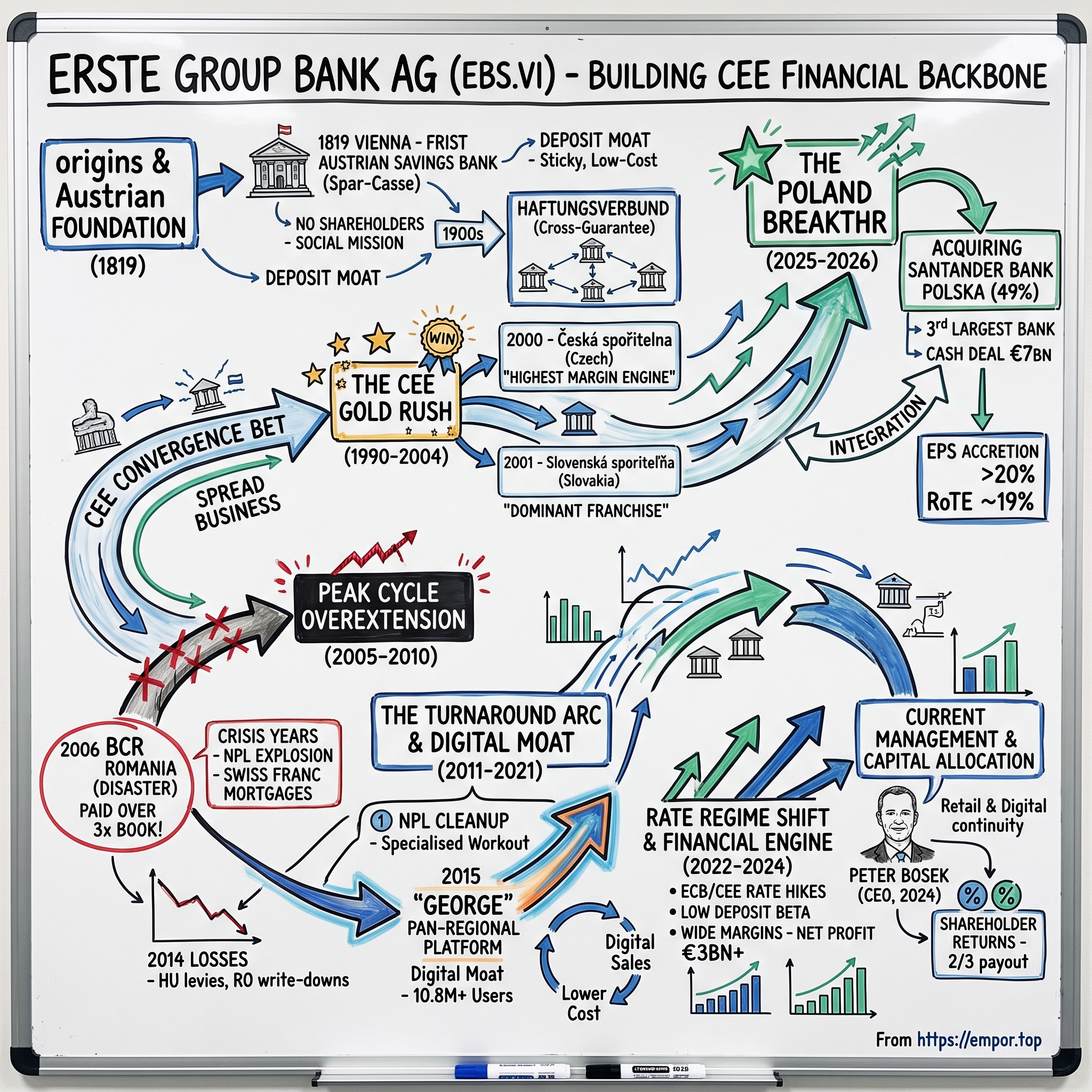
Erste Group Bank AG: Building the Financial Backbone of Central & Eastern Europe
I. Introduction & Episode Roadmap
Picture Vienna in the autumn of 1819. The Congress of Vienna is four years past, Metternich's Habsburg order sits uneasily over a patchwork of nations, and most working Viennese have nowhere to put a spare coin except under a mattress. Into that world walks a parish priest named Johann Baptist Weber, who has a peculiar conviction for a man of the cloth: that thrift is a form of dignity, and that ordinary "industrious citizens" deserve a safe place to save. He helps found Erste österreichische Spar-Casse — the "First Austrian Savings Bank" — with no shareholders to enrich and one social mission, to let a servant, a clerk, or a widow accumulate a buffer against catastrophe.[^1]
Two centuries later, that small charitable savings bank governs more than €350 billion in assets, serves roughly 23 million customers across eight countries, and generates north of €3 billion in annual net profit.12 Somewhere between the monastery and the modern balance sheet, a welfare project became one of the most consequential banking franchises in Europe. This is the story of how.
The core of that story is a single, elegant, and dangerous idea. Erste Group — trading as EBS.VI on the Wiener Börse — is a bet that the economies of Central and Eastern Europe (CEE) will keep converging toward Western European income levels for decades, and that the cleanest way to monetize that convergence is to own the retail banking plumbing of the region: the salary accounts, the mortgages, the deposits, the payment rails. It is, at heart, a spread business. Erste funds itself with sticky, low-cost savings deposits from tens of millions of households and lends into economies growing faster than the Eurozone core. When that works, it is a money machine. When the growth thesis breaks — as it spectacularly did in Romania after 2008 — it is a machine for destroying capital.
Why does this matter for an investor today? Because the spread business scales in a way that compounds. Each additional country adds deposits to fund lending, customers to sell products to, and users to spread the fixed cost of technology across — and CEE's structural growth means the pie those spreads are carved from keeps expanding faster than in the mature West. The bet works until it doesn't, and the "doesn't" is always the same: a credit cycle, a political shock, or a rate reversal that turns cheap funding into an idle asset. Holding both halves of that sentence in mind at once is the whole discipline of analyzing this bank.
This is not a company that only wins. The narrative arc runs through triumph and self-inflicted wounds in almost equal measure: the crown-jewel acquisition of the Czech savings bank Česká spořitelna, the peak-cycle disaster of overpaying for Romania's Banca Comercială Română, the grinding post-2008 cleanup of non-performing loans and Swiss-franc mortgages, the quiet building of a pan-regional digital platform called "George" before neobanks could get a foothold, and finally the €7 billion Polish acquisition that closed in January 2026 and reshaped the entire group.2 Along the way sits a uniquely Austrian institution — the Haftungsverbund, a cross-guarantee scheme binding the savings banks together — that quietly underpins everything.
So the questions this episode keeps returning to are the ones a skeptical long-term investor would ask. Is the deposit moat real, or just a low-rate mirage? Was the discipline of the Poland deal genuine reform, or the same peak-cycle ambition that sank the Romania deal, dressed in better clothes? And can a bank whose fortunes rise and fall with European interest rates and CEE politics ever be more than a leveraged play on things it cannot control? Let us start where Weber did.
 Subscribe on LinkedIn
II. Origins & Austrian Foundation: The Savings Bank Ethos (1819–1989)
The genius of the early savings bank was that it had no owner to please. A Sparkasse in the nineteenth-century Austrian model was not a company with shareholders demanding dividends; it was closer to a foundation, or a public trust, existing to gather the small savings of a community and recycle them into local credit. Deposits came in from the neighborhood; loans went out to the neighborhood; conservatism was structural rather than optional, because there was no equity cushion of outside capital to gamble with. This is the cultural DNA that Erste would carry, for better and worse, into the twenty-first century: a deep instinct for gathering cheap retail money, paired with an ingrained caution about who to lend it to.[^1]
Over the following century, the Austrian savings-bank world grew into a sprawling, decentralized network. Dozens of independent local Sparkassen dotted the country, each rooted in its own town, sharing a brand ethos but not a single balance sheet. That decentralization was a genuine strength — trust is local, and a bank the neighbors half-know is a bank whose deposits do not flee at the first rumor — but it was also a weakness in a modern financial system, where scale in technology, risk management, and regulatory compliance increasingly separated winners from losers.
The institutional answer to that tension is one of the least glamorous but most important structures in this entire story: the Haftungsverbund, or cross-guarantee association. In essence, Erste and the independent Austrian savings banks agreed to stand behind one another. It functions as an institutional protection scheme — a mutual insurance pact in which member banks provide liquidity support to any member in distress and, crucially, guarantee one another's obligations so that no single savings bank's depositors need fear its individual failure.3 Layered on top is shared infrastructure: common IT systems, joint risk models, a unified retail brand.
Why does a nineteenth-century-flavored mutual pact matter to a modern equity investor? Because it is a cost-of-capital machine. When depositors across an entire network are protected collectively, they behave as if they are banking with something larger and safer than any individual branch, which makes their deposits stickier and cheaper. Cheap, stable funding is the single scarcest resource in commercial banking. The Haftungsverbund is, in effect, a structural subsidy to Erste's cost of funds and a barrier a foreign competitor cannot easily replicate — you cannot buy your way into a two-hundred-year-old mutual trust network. Investors should note the flip side, though: mutual guarantees socialize losses as well as strength, and Erste's consolidation of the savings-bank sector into its group accounts means it carries the weaker members' risks too.
It is worth pausing on how radical the original idea was in its own time. In 1819, banking was the business of merchants and aristocrats; the notion that a domestic servant or a factory hand should have a bank account was faintly subversive, a small act of social engineering. The founders were not chasing profit — there was no profit to chase, structurally — but building an institution to make ordinary people more resilient. That founding orientation toward the mass-market household, rather than the wealthy elite or the corporate treasury, is the through-line of the entire two-hundred-year story. Every strategic move Erste has made since, from the CEE savings banks it bought to the George app it built, is ultimately about serving the same customer Weber had in mind: the ordinary saver who wants safety, convenience, and a little dignity. The bank that would eventually manage hundreds of billions never abandoned the parish priest's demographic.
By the late twentieth century, the domestic problem was simple arithmetic. Austria is a small, wealthy, mature country of roughly nine million people, and its retail banking market was saturated. Everyone already had a bank. Margins were compressed by intense competition among savings banks, cooperative Raiffeisen banks, and the big commercial players. A franchise built to gather deposits and lend them locally had run out of "local" to grow into. Management faced the classic mature-business dilemma: return capital and shrink into a utility, or find a new frontier. And there was, waiting in the wings, a man who was constitutionally incapable of choosing the utility path — a banker who would soon take the top job and spend the next two decades betting the entire institution on the frontier. Then, in the winter of 1989, the frontier arrived — a hundred miles east of Vienna, the Iron Curtain fell.
III. The CEE Gold Rush: Post-1989 Expansion & Early M&A Wins (1990–2004)
For an Austrian banker in 1989, watching the Berlin Wall come down was not only a geopolitical spectacle — it was the reopening of a map. Vienna had spent centuries as the hub of the Habsburg Empire, the commercial and financial center of a realm that stretched across what became Czechoslovakia, Hungary, Romania, Croatia, and beyond. The Cold War had severed those trade corridors for four decades. Now Prague, Bratislava, and Budapest were suddenly a short drive away and desperately short of exactly what Erste knew how to do: retail banking. The historical logic was almost poetic. Erste was not conquering foreign territory; it was, in a sense, coming home to markets that had been part of Vienna's economic hinterland since the age of Franz Joseph.
The man who saw that map most clearly was Andreas Treichl, who took over as CEO in 1997 and would run Erste for more than two decades, becoming the defining figure of its modern history. Treichl was banking aristocracy — his father and grandfather had both led Creditanstalt, the storied Austrian bank — and he had cut his teeth at Chase Manhattan in New York before returning home. He combined a patrician's confidence with an outsider's impatience for the sleepy provincialism of Austrian banking. Where others saw the fall of communism as a geopolitical event, Treichl saw a once-in-a-century commercial opening: tens of millions of Central Europeans who would, within a generation, need mortgages, car loans, savings products, and credit cards, served by state banks utterly unequipped to provide them. His conviction that Erste should race to own that plumbing before anyone else did became the organizing thesis of the company for twenty years.
But re-entering those markets took capital, and a bank with no shareholders cannot raise equity. So Treichl's first move was internal transformation. In 1997, Erste converted from its savings-bank structure into a joint-stock company and listed on the Vienna Stock Exchange, giving it, for the first time, the currency it needed to go shopping: publicly traded shares and access to institutional capital.[^1] The mutual welfare project had become a public company with an expansion mandate, and the timing could not have been better. Across the former Eastern Bloc, governments were privatizing the state-owned savings banks that held the retail deposits of entire nations — sleepy, badly run, technologically primitive institutions sitting on irreplaceable customer franchises. It was, in Treichl's framing, a fire sale of the region's most valuable banking assets, and the window would not stay open long.
The defining acquisition came in 2000: Česká spořitelna, the Czech savings bank, direct institutional heir to the retail savings culture of Bohemia and Moravia. On paper it was an unglamorous asset — a legacy state operator with creaky credit systems, an overstaffed branch network, and a portfolio riddled with bad communist-era loans. Buying it was, in the moment, a genuine gamble; several Western banks had looked and passed, wary of the cleanup involved. But in practice it was the deposit franchise of the wealthiest, most industrialized economy in Central Europe, with relationships in millions of households that no greenfield entrant could ever replicate. Where rivals saw a distressed state bank, Treichl's team saw the default financial institution of a nation that would soon join the European Union.
Erste's playbook was methodical, and it is worth understanding because it became the template applied everywhere afterward. Step one: import Western risk governance and underwriting discipline, replacing the old habit of lending to politically connected enterprises with actual credit analysis. Step two: rip out the antiquated core technology and rebuild the credit and IT systems. Step three: modernize the branch network and retrain staff to sell rather than merely process. Step four: cross-sell an entire shelf of modern products — mortgages, consumer loans, mutual funds, insurance — into a captive customer base that had literally never been offered them under communism. The transformation was not instant and it was not cheap, but it worked spectacularly. It turned Česká spořitelna into the group's single highest-margin profit engine, a position it holds to this day, contributing roughly a third of group net income.4 The Czech deal became the proof of concept that Central Europe's discarded savings banks, in the right hands, were gold mines.
Slovakia followed in 2001 with the acquisition of Slovenská sporiteľňa, the Slovak savings bank — the same template applied to a smaller neighbor: buy the dominant deposit-gathering franchise, professionalize it, and command the number-one retail position nationwide.[^1] The early playbook was now fully articulated, and it was beautiful in its simplicity. Buy the incumbent savings bank in a converging economy. Fund the balance sheet with the cheap, sticky local deposits you inherit. Lend into an economy growing faster than the Eurozone, capturing wide retail spreads. Bolt on Austrian risk management to keep losses contained. Repeat.
What made this genuinely advantaged rather than merely opportunistic was the asymmetry of the assets. Deposit franchises of this scale — the default bank of an entire nation, embedded in payroll and utility payments — simply do not come up for sale twice. Erste was buying cornered resources at the exact moment a generation of post-communist governments needed to sell them. For a few years, the strategy looked like pure genius, and the returns rolled in. Which is precisely the setup for the oldest trap in finance: a strategy that works so well, for so long, that a management team stops asking what price it should pay to keep running it.
IV. Peak Cycle Overextension: The BCR Cautionary Tale & Crisis Years (2005–2010)
By 2005, the CEE banking land grab had turned into a feeding frenzy. Every Western European bank with regional ambitions — Erste, Raiffeisen, Italy's UniCredit, Belgium's KBC — had internalized the convergence thesis, and they were all chasing the same shrinking pool of scale assets. The unbanked upside of Central Europe was being priced into every auction. Bidding wars broke out. The disciplined "buy the incumbent cheap" logic of 2000 curdled into "win the asset at any price, because there won't be another one." The scarcity that had made Erste's early deals so attractive was now inflating the prices it had to pay.
Nowhere did this play out more dramatically than in Romania. In 2006, Erste completed the acquisition of a controlling 61.9% stake in Banca Comercială Română (BCR), Romania's largest bank, for roughly €3.75 billion — a price that valued the whole institution at around €6 billion.5 It was the largest privatization in Romanian history and the crown of the CEE gold rush. It was also, in the cold light of hindsight, a textbook peak-cycle blunder. Romania was on the cusp of EU accession in 2007, optimism about convergence was euphoric, and Erste paid a scarcity premium of well over three times BCR's tangible book value — the kind of multiple that only makes sense if the good times never end. Management was extrapolating a boom at its very peak.
There is a psychological trap embedded here that is worth naming, because it recurs throughout financial history. The very success of the Czech and Slovak deals made the BCR overpayment more likely, not less. A management team that has been right, repeatedly and profitably, develops a dangerous confidence in its own judgment; the playbook that turned two distressed savings banks into profit engines felt like a machine that could be pointed at any CEE asset and print money. Treichl and his team were not fools — they were victims of their own track record, extrapolating past success into a future that looked identical right up until it didn't. Erste even sweetened the deal further, acquiring additional BCR stakes in the following months, deepening its bet at precisely the wrong moment.5
The good times ended almost immediately. When the 2008 global financial crisis hit, followed by the 2011 Eurozone debt crisis, the convergence trade went into violent reverse. Across CEE, non-performing loans exploded as economies contracted and borrowers defaulted; in Romania, the NPL ratio surged above 20% — meaning at the worst point, more than one in five loans on the books was souring. The wide spreads that had justified the boom-era prices turned into a torrent of impairments, and the €6 billion valuation Erste had implicitly paid for BCR began to look like a monument to hubris.
Then came the cruelest wrinkle, and it deserves a plain-English explanation because it is central to understanding CEE banking risk. In the boom years, banks across Romania and Hungary had sold retail mortgages denominated not in local currency but in Swiss francs or euros, because those loans carried lower interest rates. A Hungarian family would borrow in Swiss francs to buy an apartment, earning their wages in forint. As long as the exchange rate held, the low rate was a gift. But when the crisis sent investors fleeing to the safety of the Swiss franc, local currencies collapsed against it — and suddenly a family's mortgage balance, measured in the forint they actually earned, ballooned overnight through no fault of their own. Borrowers were devastated, defaults cascaded, and, critically, governments in Budapest and elsewhere responded by forcing banks to eat much of the loss through mandatory conversion schemes and consumer-relief laws. It was Erste's first hard lesson that in CEE, the sovereign can rewrite a loan contract after the fact.
The damage was measured in billions. Erste took massive impairment charges and goodwill write-downs on BCR and its Hungarian operations, and the reckoning culminated in 2014 — the year the whole decade's ambition came due — when Erste reported a heavy net loss after writing down the value of its Romanian and Hungarian franchises and absorbing the cost of Hungary's punitive bank levies and forced Swiss-franc loan conversions. To defend its Common Equity Tier 1 ratio — the core regulatory measure of a bank's solvency cushion, essentially the equity buffer standing between the bank and insolvency — Erste had earlier accepted state participation capital from the Austrian government, suspended dividends, and shrank its balance sheet aggressively.[^1] The company that had spent fifteen years buying growth was now selling assets and taking government money to survive. For Treichl, who had built the CEE empire, presiding over its near-unraveling was a personal humbling; the same man would spend the back half of his tenure cleaning up the mess his ambition had created.
For investors, the lesson from this period is more durable than any single number. Erste's franchise strength — cheap deposits, dominant retail positions — was real, but it did not immunize the equity from catastrophic capital allocation. A great deposit machine attached to loans made at the wrong price, in the wrong currency, at the top of a cycle, still destroys shareholder value. It is a warning worth carrying directly into the analysis of the 2025 Poland deal: the same institution, and until recently some of the same instincts, produced both the best and the worst acquisitions in this story. The recovery from the BCR mistake would define the next decade — and it began with a reckoning about what kind of bank Erste wanted to be.
V. The Turnaround Arc: NPL Cleanup, Restructuring, & The "George" Moat (2011–2021)
Recovering from a credit disaster is unglamorous, grinding work, and it is where banks reveal their real character. Erste's response through the 2010s was a two-front campaign: clean up the past, and build a weapon for the future.
The cleanup was a matter of institutional plumbing. Erste stood up specialized workout units — internal "bad banks" whose only job was to resolve, restructure, or sell off the toxic legacy loan portfolios accumulated in the boom. Non-performing loans were packaged and sold to distressed-debt investors, often at painful discounts, precisely so the balance sheet could be purged and the organization could stop bleeding. Just as important was a cultural reset in how management measured success. The pre-crisis obsession had been asset size — bigger loan book, bigger footprint, bigger league-table ranking. The post-crisis regime shifted the scorecard to profitability and prudence: Return on Tangible Equity (RoTE), the cost-to-income ratio, and the quality of underwriting. Growth for its own sake had nearly killed the company; disciplined, capital-efficient growth became the new religion. Whether that discipline was genuinely internalized or merely enforced by a chastened regulator is a question the Poland deal would later test.
But the more strategically consequential move of this decade had nothing to do with cleanup. Around 2015, Erste made a bet that would prove prescient: rather than let each national subsidiary limp along on a patchwork of fragmented local IT vendors, it would build a single, in-house, pan-regional digital banking platform. They named it "George" — a deliberately human name for what is essentially a shared piece of software running across borders.6 The naming was itself a philosophy. Rather than call it "Erste Online Banking 3.0," the team gave the product a person's name, treating the app not as a utility but as a companion — a small piece of design psychology aimed at the same ordinary customer the parish priest had in mind, now reached through a phone instead of a passbook.
The decision to build rather than buy was contrarian at the time. The conventional wisdom in European banking held that technology was a cost center to be outsourced to specialist vendors as cheaply as possible. Erste bet the opposite: that in a world where the phone was becoming the branch, the software was the bank, and outsourcing it would mean outsourcing the customer relationship itself. It was an expensive, multi-year commitment with no guaranteed payoff, made by a company still nursing its post-crisis wounds. That it launched in Austria and then rolled out market by market across the region reflected the core insight — build the platform once, deploy it everywhere.
Here is why that mattered, in plain terms. A traditional multinational bank is often a confederation of separate banks that happen to share a logo — different core systems, different apps, different everything in each country, with costs duplicated everywhere. George inverted that. It is one modern digital ecosystem — the app, the online interface, the product marketplace — built once and deployed across Austria, Czechia, Slovakia, Romania, Hungary, and Croatia. The economics of software are unforgiving in the best way: you pay the development and cybersecurity costs once, and then spread them across every additional user at almost zero marginal cost. By the end of 2024, George served roughly 10.8 million users, with more than 80% of Erste's active customers digitally engaged.7
To grasp why digital origination is such a powerful lever, consider the economics of a bank branch. A branch is a fixed cost — rent, staff, security, heating — that exists whether it processes one loan or one hundred. Every product a customer completes on their phone instead of at a teller window is a sale with almost no marginal cost, and every routine transaction that migrates to the app frees expensive human staff to do higher-value work or lets the branch close entirely. As digital channels came to originate a large and rising share of consumer loans and investment products across Erste's key markets — and a meaningful share of mortgages, historically the most paperwork-heavy, branch-bound product of all — the cost of serving each customer fell structurally, not cyclically. That is the difference between a bank that cuts costs in a downturn and one that has re-architected its cost base permanently.
The strategic payoff was twofold. First, George converted Erste's expensive branch network from a pure cost center into an omni-channel sales engine — a growing share of consumer loans, investment products, and even mortgages began originating digitally, slashing the unit cost of serving each customer and helping drive the group cost-to-income ratio into the high-40s, lean by European retail-banking standards. Second, and more subtly, it was a preemptive defense. The 2015–2021 window was exactly when European neobanks — the Revoluts and N26s of the world — were supposed to eat incumbent retail banks alive. Erste's answer was to make its own app good enough, and its product range broad enough, that a customer had little reason to defect to a slick app that could not offer a mortgage or a full relationship. Building a credible digital platform on top of an already-cheap deposit base is a genuinely different competitive position than a startup burning venture capital to acquire customers with no funding advantage.
By 2021, then, Erste had transformed itself: the legacy wounds were largely healed, the balance sheet was clean, discipline had replaced ambition, and a proprietary digital moat was scaling across the region. What it needed next was a tailwind. It was about to get a hurricane.
VI. The Rate Regime Shift & Financial Engine (2022–2024)
For a decade after the financial crisis, European banks lived through a slow suffocation: interest rates pinned at zero, and in the Eurozone, actually below zero. A bank makes its living on the spread between what it earns on assets and what it pays on deposits, and when rates are at zero there is almost no spread to earn. Erste's greatest asset — a vast, cheap deposit base — was, in a zero-rate world, nearly worthless as a profit driver, because the value of cheap funding only shows up when money is expensive.
Then inflation returned, and in 2022 the central banks slammed the rate lever in the other direction. The European Central Bank, the Czech National Bank (Česká národní banka), and the National Bank of Romania (Banca Națională a României) all hiked aggressively. For Erste, this was the sun finally coming out. Here is the mechanism, and it is the single most important thing to understand about the company's 2022–2024 earnings surge. When rates rise, the interest a bank charges on loans reprices upward quickly. But the interest it pays depositors — especially on the current accounts and everyday savings of tens of millions of retail customers who keep money at the bank for convenience, not yield — rises slowly, if at all. That sluggishness is called "deposit beta," and a low deposit beta is the mark of a genuinely sticky franchise. The wider the gap between fast-rising asset yields and slow-rising deposit costs, the fatter the net interest margin.
The numbers tell the story of a franchise firing on all cylinders. In 2024, Erste posted a net profit of €3.13 billion, up 4.3%, on net interest income of €7.53 billion.1 The operating result reached €5.9 billion, up 6.6%, and the cost-to-income ratio — the share of revenue eaten by operating expenses — improved to a lean 47.2%.1 Total assets stood at €353.7 billion, with €218.1 billion in customer loans funded by €241.7 billion in deposits.1 That last relationship is the whole thesis in one line: Erste holds more deposits than it lends out, meaning its lending is entirely funded by cheap customer money with a surplus to spare. Crucially, credit quality stayed pristine even as profits soared — the cost of risk, the share of the loan book set aside for expected losses, was just 18 basis points, and the non-performing loan ratio a low 2.6%.1 The nightmare of the Romania years had not returned.
But strong headline profit invites a skeptic's question: how much of this is skill, and how much is simply the rate cycle? The honest answer is a great deal of it is the cycle. A bank does not deserve full credit for a windfall handed to it by central bank policy. The genuinely revealing fact is not that profits rose when rates rose — every bank's did — but that Erste captured the upside while keeping loan losses near record lows and its efficiency near best-in-class. That combination suggests the post-crisis discipline was real, not rhetorical. The uncomfortable corollary, which the bear case will press on later, is symmetrical: what a rate cycle gives, a rate cycle can take away.
Underneath the group number is a portfolio of distinct engines, and understanding their different characters is essential to understanding the whole. The Czech Republic, through Česká spořitelna, remained the crown jewel, generating on the order of 30–35% of group profit as the unquestioned leader in Czech consumer lending, deposits, mortgages, and fund distribution.4 The Czech operation is the platonic ideal of the Erste model — a wealthy, stable, EU-member economy outside the euro, where the Czech National Bank runs its own rate policy and Erste enjoys a dominant, high-margin retail position. When people ask why Erste trades at a premium to a plain Austrian bank, the answer is largely Prague.
Austria — the home market of Erste Bank Oesterreich plus the savings banks — contributed roughly a quarter of profit, valuable less for growth than for stability. It is the ballast of the ship: low-risk, deeply liquid, with the stickiest deposits in the group, serving as the funding and liquidity anchor that lets the faster-growing CEE units lend aggressively. A dull, reliable Austrian deposit base is precisely what makes the exciting Romanian loan growth possible. Romania's rehabilitated BCR delivered something like 15% of profit, now recast as a digital growth leader with high loan-growth potential rather than the wound it once was — a genuine redemption arc for the asset that nearly broke the company. Slovakia's Slovenská sporiteľňa added a steady tenth as a stable euro-zone contributor, benefiting from Slovakia's euro membership, which removes currency risk. And the secondary markets — Hungary, Croatia, and Serbia, where Erste operates through Ерсте Банк а.д. Нови Сад Erste Bank Novi Sad — offered high local margins tempered by the ever-present risk of political interference, Hungary being the standing reminder that a government can turn a profitable market hostile overnight. The geographic spread is itself a form of risk management: no single country's populist tax or rate cut can sink the group, and the diversification across euro and non-euro economies means Erste's fate is not tied to a single central bank. That structural resilience is one of the quieter arguments in the bull case.
The engine, in short, was running hot. The question turning over in the market was who would be steering it into the next phase — and what they would choose to do with a mountain of accumulating capital.
VII. Current Management, Capital Allocation, & Governance
In October 2023, Erste's supervisory board made a telling choice about who should run the bank next. They did not reach for a financial engineer or an outside star. They brought back a company man — Peter Bosek, a lifer who had spent roughly twenty-five years inside Erste before leaving to run the Baltic lender Luminor.8 Bosek's résumé is essentially a map of the modern franchise: former Chief Retail Officer of the group, former CEO of Erste Bank Oesterreich, and — the detail that matters most — one of the driving forces behind the George platform. Handing the top job to the architect of the digital moat was a statement about where the board believed the company's future lay.
The choice also has to be read against the backdrop of the leadership chain it capped. Andreas Treichl finally stepped down in 2020 after more than two decades at the helm, moving to chair the group's foundation, and the CEO role passed through a short succession before Willi Cernko steadied the ship into the rate-boom years. Bringing back Bosek — a proven retail and digital operator who had left to run Luminor and could have stayed away — signaled that the board wanted neither a caretaker nor a revolutionary, but a builder who understood the franchise from the inside.
Bosek took over as CEO on July 1, 2024, succeeding Willi Cernko, who stepped down at the end of June and stayed on as an adviser through year-end.8 The handover was smooth and telegraphed nearly a year in advance — a small but real marker of governance stability at a bank that, a decade earlier, had been fighting for survival. Bosek returned not only as CEO but retaining the Chief Retail Officer perspective, signaling continuity of strategy rather than a reinvention. Alongside him, CFO Stefan Dörfler and Chief Risk Officer Alexandra Habeler-Drabek anchored the finance and risk functions, with the risk side maintaining the conservative provisioning posture that kept the cost of risk near historic lows even through geopolitical turbulence.1 The continuity in the risk seat matters more than it might appear: the single most important lesson of the BCR era was that a bank is only as good as its worst underwriting cycle, and keeping a steady, conservative CRO through the good times is exactly the behavior an investor scarred by 2008 wants to see.
The more consequential governance story of this era, though, is what Erste chose to do with its profits. A bank that generates far more capital than it can profitably reinvest faces a choice: hoard it, deploy it, or return it. For years after the crisis, Erste hoarded — building its CET1 ratio into a fortress as penance for past sins. By the 2020s, with the balance sheet clean and profits abundant, the posture shifted decisively toward returning capital to shareholders. For 2024, the bank proposed distributing roughly 41% of adjusted net profit as cash dividends, supplemented by a share buyback program worth another 24% of adjusted net profit — a combined payout approaching two-thirds of earnings, backed by a CET1 ratio of 15.1%.1 That is the behavior of management confident in both its earnings power and its capital position.
There is a tell in how Erste guided the market through 2024 that speaks to credibility. Rather than set an aggressive target early and scramble to defend it, management upgraded its return-on-tangible-equity outlook as the year unfolded and the rate environment cooperated, ultimately steering toward a RoTE above 16% — under-promising and then raising the bar, the opposite of the pre-2008 pattern of extrapolating a boom.1 Consistency of message across quarterly calls, transparency about where the tailwinds were coming from, and a refusal to disguise the cyclicality of the windfall all point to a management team that had internalized the lessons of the crisis rather than merely survived it. The skeptic will note this is easy to do when results are good; the real test of narrative discipline comes when the rate cycle turns and the guidance has to describe a headwind.
On the question of management credibility — the thing a serious investor cares about more than any single quarter — the record through this period is genuinely strong, and it is worth being specific about why. Erste set explicit multi-year targets (RoTE above a defined threshold, a cost-to-income ratio held under the high-40s, a CET1 floor), and it broadly hit them. It was transparent about macro risks in CEE rather than papering over them. And it maintained underwriting discipline through real turbulence. That is a very different track record than the pre-2008 team that overpaid for BCR and extrapolated a boom. An honest assessment, though, must hold the counterexample in view: the same disciplined, capital-hoarding management was about to deploy €7 billion of that carefully accumulated capital on the single largest acquisition in the company's history. The skeptic's job is to ask whether that is discipline being rewarded, or discipline being abandoned at the first irresistible temptation.
VIII. The Poland Breakthrough: Acquiring Santander Bank Polska
For decades, there was a Poland-shaped hole in Erste's map. Poland is the largest economy in Central Europe — roughly 38 million people, the fastest-growing major EU economy for a generation, the obvious keystone of any pan-CEE banking ambition. And Erste was not there. It was not for lack of desire; it was for lack of a deal at a price the post-crisis, discipline-scarred management was willing to pay. Warsaw's banking assets traded at premium valuations, and the ghost of BCR made Erste's leadership deeply allergic to paying up at the top of a cycle. So they waited. Year after year, they watched competitors operate in the region's biggest market while they held their fire.
The wait ended in May 2025. Erste announced an agreement to acquire a 49% controlling stake in Santander Bank Polska — Poland's third-largest bank and largest privately owned lender — along with 50% of the associated asset manager, Santander TFI, from Spain's Banco Santander, for total cash consideration of approximately €7.0 billion.29 For Santander, the sale was a strategic retreat from Poland to concentrate capital on its core markets in the Americas and Western Europe, and the two banks agreed to a continuing cooperation in corporate and investment banking and payments — a reminder that this was a portfolio reshuffle between two disciplined operators, not a distressed sale.10 One bank's non-core exit was another bank's missing keystone.
The all-cash offer was struck at 584 złoty per share, valuing the bank at about 2.2 times its first-quarter 2025 tangible book value — a modest premium of roughly 7.5% to the pre-announcement market price.10 Compare that 2.2x multiple to the more than 3.5x tangible book Erste paid for BCR at the 2006 peak, and you can read the entire lesson of the intervening two decades in the difference. This was not a scarcity-premium moonshot; it was a control stake in a proven, profitable franchise bought at a valuation the market itself was already assigning. The structure — 49% rather than a full buyout — is worth dwelling on. It gave Erste operational control and full consolidation while committing less capital than a 100% purchase would have required, a deliberately capital-efficient way to plant its flag in Warsaw. The trade-off is a permanent minority-shareholder base and a free-float structure that complicates future governance. After clearing regulatory approvals — with the final green light arriving in late December 2025 — the transaction closed on January 9, 2026, and the bank is to be rebranded Erste Bank Polska over the course of 2026, with the new name put to shareholders at an extraordinary general meeting in late January.21112
The financing is where the story of discipline either holds up or falls apart, and here Erste's version holds up. The entire €7 billion was funded from organic capital generation and accumulated excess CET1 — the fortress the bank had spent a decade building. There was no dilutive equity raise, no rights issue asking shareholders to pony up fresh cash.2 This is the crucial contrast with the pre-crisis playbook: Erste did not stretch its balance sheet or issue stock to win Poland; it wrote a check from savings it had deliberately hoarded for exactly this kind of opportunity. Management projected the deal would lift earnings per share by more than 20% and drive group RoTE toward approximately 19% in 2026, well above the roughly 15% market consensus for a standalone Erste, helping push group net profit toward the €4 billion mark.213
Strategically, Poland completes the network in a way that is more than the sum of its parts. For twenty-five years Erste had built a horseshoe of dominant retail franchises around Central Europe — Austria, Czechia, Slovakia, Hungary, Romania, Croatia — with a conspicuous gap where the region's largest, fastest-growing economy sat. Filling that gap does two things. It converts Erste from a strong regional bank into the definitive one, holding a top-three lending position in every major CEE economy and serving roughly 23 million customers across eight core markets.2 And it changes the corporate-banking proposition: a manufacturer with supply chains threading from a Czech factory to a Polish distributor to a Romanian customer can now, for the first time, be banked end-to-end on a single network. Cross-border corporate flows that previously leaked to rivals with a Polish presence can be captured internally. There is also a natural runway to scale the George platform toward 15 million-plus users by extending it into Poland — spreading the fixed software cost across an even larger base and deepening the operating leverage that is Erste's clearest structural edge.1 The cross-border logic is real: a company banking with Erste in Prague and selling into Warsaw can now be served on one network. But the investor's eyebrow should stay raised on two points. First, a 49% stake is a controlling but not wholly owned position, which leaves minority interests and a more complex governance structure than a clean 100% buyout. Second, the projected accretion is exactly that — a projection. Integration is where banking acquisitions go to disappoint, and migrating a large Polish bank onto group systems without alienating customers is a multi-year execution problem, not a closing-day victory. The deal that looks disciplined on paper still has to be delivered in practice.
IX. Strategic Positioning: Porter's 5 Forces & Hamilton Helmer's 7 Powers
Strip away the two centuries of narrative and ask the coldest possible question: does Erste actually have a durable competitive advantage, or is it just a well-run leveraged bet on European interest rates and CEE growth? The frameworks help war-game the answer.
Start with Hamilton Helmer's 7 Powers. The clearest one Erste possesses is Scale Economies, and its purest expression is George. A single digital software stack — with its fixed costs of development, maintenance, and, increasingly, cybersecurity — spread across some 23 million customers in eight countries gives Erste an operating-leverage advantage that a single-nation CEE competitor structurally cannot match. The Slovak bank building its own app pays roughly the same fixed development cost as Erste but amortizes it over a fraction of the users. That is a real, mechanical edge, and Poland deepens it.
The second power is Switching Costs, the quiet superpower of primary-bank retail relationships. Once a customer's salary lands in an Erste account, their utility bills auto-pay from it, their mortgage is anchored to it, and their savings and investments sit alongside it, the friction of moving everything to a competitor for a marginally better rate is enormous. This is why deposit betas stay low and why neobanks, for all their slick apps, struggle to pry away the primary relationship rather than just capturing a secondary "spending card." The third power is a genuine Cornered Resource: the Austrian Haftungsverbund and the historic savings-bank franchise rights in Czechia and Slovakia are institutional assets a competitor simply cannot acquire or recreate. You cannot buy a two-hundred-year-old mutual guarantee network or the default-bank status of a nation.
Now the Porter's Five Forces war-game, which is where the picture gets more balanced. The threat of new entrants is genuinely low: banking is a fortress of regulatory capital requirements, anti-money-laundering compliance, and brutal customer-acquisition costs, which is why the disruptors of the last decade mostly failed to dislodge incumbents. The bargaining power of depositors is low-to-moderate — fragmented retail savers prioritize safety and convenience over squeezing out the last basis point of yield, which is the entire basis of the cheap-funding moat. The bargaining power of borrowers is moderate and bifurcated: prime corporate clients can shop their business hard and compress margins, while retail mortgage and consumer borrowers have far less leverage. The threat of substitutes — fintechs, neobanks, payment apps — is real but has proven more limited than the 2015-era hype predicted, precisely because George narrowed the experience gap while Erste retained the full product shelf a startup cannot offer.
It is competitive rivalry that is unambiguously high, and here the analysis has to name names. Erste fights Raiffeisen Bank International (RBI.VI), UniCredit's Bank Austria arm, Belgium's KBC (which owns ČSOB in Czechia), Hungary's OTP Bank (OTP.BU), and Intesa Sanpaolo (via VÚB in Slovakia) across overlapping markets. But rivalry is not static, and geopolitics reshaped it in Erste's favor. Raiffeisen — long Erste's closest structural peer — spent the years after 2022 mired in its large and politically toxic Russian business (Райффайзенбанк Raiffeisenbank Russia), which consumed management attention, capital, and regulatory goodwill. While a key competitor was distracted by an exit it could not cleanly execute, Erste, a pure-play CEE operator with no Russian exposure, consolidated its position and made its move on Poland. Sometimes the most important competitive advantage is simply not being entangled in the mess your rival cannot escape.
It is worth being explicit about which of Helmer's powers Erste does not meaningfully possess, because the absences are as revealing as the presences. Erste has no real branding power in the sense of pricing power — no customer pays Erste more for a mortgage because of the logo, the way a luxury house commands a premium. It has no counter-positioning advantage, since it is the incumbent, not the insurgent; if anyone holds that card it is the neobanks, and their inability to play it against a modernized incumbent is precisely the story. And whatever process power exists in its underwriting and integration playbook is replicable in principle by a competent rival. The powers Erste genuinely holds are the structural, hard-to-copy ones rooted in funding and franchise — which is a reassuring place for the moat to live, because those are the powers that decay slowly.
The honest synthesis for an investor: Erste's moats are real but narrow. The scale, switching-cost, and cornered-resource powers protect the cost of funding and the retail franchise — genuinely durable advantages. But none of them protect the group from the two forces that actually drive its earnings: the level of European interest rates and the political posture of CEE governments. Erste has a strong moat around a business whose profits are cyclical and politically exposed. That tension — a durable franchise wrapped around cyclical, politically contingent earnings — is the crux of the bull-bear debate, and it is where a skeptical investor should push hardest.
X. Skeptical Investor Stress Test & Current Risk Radar
Put a hard-nosed short-seller in the room and let them attack the story. Where do they aim?
Their first and best shot is net interest margin compression. Erste's spectacular 2022–2024 earnings were, as established, substantially a gift of the rate-hiking cycle. That gift runs in reverse. As the ECB and the Czech National Bank pivot from hiking to cutting, the same asymmetry that inflated margins can deflate them: asset yields on loans reprice downward relatively quickly as old high-rate loans mature and new ones are written at lower rates, while there is a floor on how much further Erste can cut deposit rates that are already near zero. If asset yields fall faster than funding costs, net interest income slumps regardless of how well the bank is run. This is the single most important thing to watch, and it is largely outside management's control.
The second line of attack is CEE political risk, and it is not hypothetical — it is arguably the single most distinctive risk in owning Erste rather than a Western European bank. The region has a well-established habit of reaching into bank profits when budgets are tight or populism is ascendant. Hungary has repeatedly imposed special bank levies and windfall taxes and forced the Swiss-franc conversions that cost Erste dearly; Slovakia reintroduced a bank tax; interest-rate caps, deposit-rate floors, and mandatory borrower-relief schemes surface across the region with little warning. Foreign-owned banks are a politically convenient target — the profits flow to Vienna, but the voters are local, which makes a levy on "the Austrian bank" an easy populist win. For a bank whose entire model is earning spreads in these economies, a surprise levy is a direct, unbudgetable hit to return on equity — and the sovereign's power to rewrite a loan contract after the fact, so painfully learned in the Swiss-franc mortgage saga, has never gone away. Poland itself is instructive here: Polish banks spent years absorbing the cost of a domestic Swiss-franc mortgage scandal and a court-driven relief regime, a live reminder that Erste's newest market carries exactly this species of risk.
The third challenge is capital allocation versus integration risk. Erste just spent €7 billion — its accumulated war chest — on Poland. A skeptic reasonably asks two things. Does deploying that capital into a large, complex integration risk distracting management and consuming the very buffer that funded the group's generous buybacks, slowing shareholder returns in the near term? And is the projected 20%-plus EPS accretion robust to the messy reality of merging a Polish bank onto group systems? The disciplined price does not eliminate the execution risk; it only ensures Erste did not overpay for the privilege of taking it on.
Beyond the short-seller's script, the current risk radar carries three items worth monitoring on their own mechanics. Commercial real estate is the first, and it deserves a plain-English framing because it has been the quiet fault line under European banking since rates rose. When a developer or landlord borrows against an office tower, the loan is only as sound as the building's value and its rental income. Higher interest rates lower what any property is worth (future rents discounted more harshly) at the very moment hybrid work is emptying offices and squeezing those rents — a double blow. Like every European bank, Erste holds office and retail property loans across the DACH region and CEE capital cities, and a wave of defaults there would flow straight into impairments, testing whether the benign 18-basis-point cost of risk was a sign of genuine quality or merely of a cycle that had not yet turned. The concentration is worth watching precisely because it is the kind of exposure that looks harmless until, quite suddenly, it doesn't. Macro and regulatory volatility is the second — Erste's CEE markets are open, export-heavy economies exposed to European industrial supply chains and to inflation-driven wage growth that lifts the bank's own operating costs. And Polish execution risk is the third and most specific: the technical migration of legacy Polish IT onto the George architecture must happen without the customer churn that so often accompanies a rebranding and a systems change. None of these is a thesis-killer in isolation. Together they define the range of outcomes around a business that, for all its moats, remains a leveraged bet on cycles and politics.
XI. Investment Thesis: Bull vs. Bear & Key KPIs
So, distilled to its spine: why does Erste win from here, and what breaks the case?
The bull case rests on three pillars. First, structural convergence — the deepest and most important argument. The premise is that CEE households and businesses are still under-banked relative to Western Europe: fewer mortgages per capita, thinner consumer credit, smaller wealth-management pools, less developed capital markets. As these economies grow real GDP something like 150–200 basis points faster than the Eurozone core and their citizens grow richer, the ratio of credit to GDP rises toward Western levels — a form of financial deepening that generates loan growth structurally above what a saturated German or French bank can achieve. It is not a bet on a single year's rates; it is a bet on a multi-decade catch-up, and Erste owns the retail plumbing that catch-up flows through. This is the tailwind Western European banks, stuck in mature markets with credit-to-GDP already maxed out, simply do not have. Second, the Poland synergy: a successfully integrated Erste Bank Polska completes the regional network, and if the projected EPS accretion above 20% and RoTE near 19% materialize, Erste re-rates from a solid CEE bank into the dominant one. Third, the retail deposit moat: the combination of structurally cheap funding and rising digital monetization through George is what allows Erste to protect margins across rate cycles better than a bank without those advantages. In the bull telling, the moats are underappreciated and the growth is structural.
The bear case is the mirror image, and it is not a strawman. Aggressive rate cuts across Central Europe compress the net interest margin faster than loan-volume growth can offset, and earnings that surged on the way up give much of it back on the way down. Escalating bank levies and interventionist policy across CEE act as a permanent tax on structural returns, capping the RoTE that the bull case celebrates. And a downturn in commercial real estate — or any credit shock — forces impairment provisions well above the benign 18-basis-point cost of risk of recent years, reminding everyone that this is, ultimately, a leveraged institution whose good times are cyclical. The bear does not need Erste to be badly run; the bear only needs the cycle and the politics to turn.
There is also an activist-style question worth putting on the table, even though Erste is not an obvious activist target. A skeptical long/short investor would probe whether a bank sitting on the Poland integration, a controlled-but-not-owned Polish subsidiary, and a sprawling map of eight core markets plus savings-bank consolidations is becoming structurally complex enough to warrant a "conglomerate" scrutiny — whether the sum of transparent, well-run national franchises is being obscured by group-level complexity and minority interests. The counter is that Erste's disclosure is granular by segment and its capital returns are concrete rather than promissory: a two-thirds-of-earnings payout backed by buybacks is hard to fake. The more pointed challenge is simpler — having promised discipline and hoarded capital for years, management has now spent the war chest, and the market is entitled to hold it accountable for the exact accretion it advertised. If the Poland numbers disappoint, the credibility built over a decade is what gets spent next.
The intellectually honest position sits between them, and it points to what actually deserves monitoring. Three KPIs matter more than any others for tracking whether the bull or bear case is winning:
First, net interest margin and net interest income resiliency — the direct readout of the central tension. Watching how asset yields reprice against deposit betas as European rates normalize will reveal, quarter by quarter, whether the deposit moat is holding margins or whether the rate cycle is clawing back its gift.
Second, the cost-to-income ratio — the cleanest gauge of operating discipline and the efficiency payoff from George. Holding group CIR below the high-40s while simultaneously absorbing the costs of Polish integration would be strong evidence that the scale advantage is real and the integration is on track; a rising CIR would suggest the opposite.
Third, cost of risk and the NPL ratio — the early-warning system for a repeat of history. This is the metric that, had anyone watched it closely enough in 2007, would have screamed a warning about BCR. Monitoring loan-loss formation across the CEE retail and corporate books is how an investor knows whether Erste's celebrated underwriting discipline is holding or whether the next credit cycle is quietly building on the balance sheet.
These three numbers, tracked over time, will tell the story faster than any narrative. They are the dashboard for a bet whose outcome depends on things — rates, politics, credit cycles — that even excellent management cannot fully command.
XII. Playbook: Business & Investing Lessons
Two centuries of Erste's history compress into a few durable lessons, each earned the hard way.
Lesson one: in banking, the funding is the franchise. It is tempting to think a bank competes on its lending — on finding the best borrowers, the highest yields, the cleverest products. But loan growth is the easy part; anyone can grow a loan book by lowering standards or raising rates. The scarce, defensible asset is the other side of the balance sheet: sticky, low-cost retail deposits that stay put when rates rise and do not flee when trouble comes. Everything durable about Erste — the Haftungsverbund, the savings-bank heritage, the George platform's grip on the primary relationship — ultimately serves the single goal of protecting that funding advantage. The deposit franchise is the moat; the lending is just what you do with it.
Lesson two: in M&A, price and timing are almost everything, and the cycle is a liar. The same company bought the Czech crown jewel cheaply in 2000, overpaid disastrously for Romania at the 2006 peak, and then — chastened — bought Poland at a disciplined 2.2x book, funded entirely from capital it had deliberately saved. The difference between generational value creation and a decade of balance-sheet agony was not the quality of the assets, which were all good franchises. It was the price paid and the moment chosen. Peak-cycle euphoria whispers that scarce assets justify any multiple; the wreckage of BCR is what that whisper costs. Discipline means being willing to sit out the biggest market in your region for years rather than overpay to enter it.
There is a corollary to the funding lesson that Erste's own history proves in the negative: cheap funding is necessary but not sufficient. The bank never lost its deposit advantage, not even in 2014 — Romanian and Hungarian depositors kept their money at BCR and its sister banks throughout. What nearly sank the group was not the funding side but the asset side, loans made carelessly at the wrong price. The moat protected the liabilities; it could not protect the equity from bad underwriting. An investor who takes only "deposits are the moat" from this story has learned half of it. The full lesson is that a great funding franchise is a license to make money or to lose it faster, depending entirely on the discipline applied to what you do with the money.
Lesson three: incumbents can beat disruptors — if they build the disruption themselves. The neobank thesis of the mid-2010s held that legacy retail banks, saddled with branches and old technology, would be gutted by app-native startups. It largely did not happen to Erste, and the reason is instructive. By investing early in a genuinely modern, frictionless digital platform anchored to a zero-cost deposit base, Erste denied the disruptors their opening. A startup with a beautiful app but no funding advantage and no full product shelf is not actually a threat to a customer's primary bank; it is a supplementary card. The lesson generalizes well beyond banking: an incumbent's legacy assets become a fatal liability only when it refuses to modernize them, and a durable moat plus a modern product is a very hard combination to disrupt.
Whether those lessons translate into the next decade of returns is, as ever, unresolved. Erste enters 2026 larger, more Polish, and more profitable than at any point in its two-hundred-year history — and just as dependent as always on forces beyond the boardroom: the level of European interest rates, the temperament of CEE governments, and the eternal question of whether a bank that has finally learned discipline can keep it when the next irresistible temptation arrives.
References
-
Annual results 2024: Good performance reflects strong growth in customer business — Erste Group Bank AG, 2025-02-28 ↩↩↩↩↩↩↩↩↩
-
Erste Group successfully completes acquisition of 49% controlling stake in Santander Bank Polska — Erste Group Bank AG, 2026-01-09 ↩↩↩↩↩↩↩
-
Erste Group Investor Relations — Company & Haftungsverbund overview ↩
-
Business review 2024 — Erste Group Bank AG Annual Report 2024 ↩↩
-
Scaling up: George, Erste Group's PSD2-ready banking platform, approaching 2 million users — Erste Group Bank AG, 2018-01-15 ↩
-
Erste Group Bank AG reports strong 2024 growth — TipRanks Company Announcements, 2025-02-28 ↩
-
Peter Bosek selected as CEO of Erste Group — Erste Group Bank AG, 2023-10-04 ↩↩
-
Erste Group invests in Central and Eastern European growth with acquisition of 49% controlling stake in Santander Bank Polska — Erste Group Bank AG, 2025-05-05 ↩
-
Santander announces the sale of 49% of Santander Polska to Erste Group Bank — Banco Santander, 2025-05-05 ↩↩
-
Green light for Erste Group's acquisition in Poland, all conditions satisfied — Erste Group Bank AG, 2025-12-23 ↩
-
Santander completes the sale of 49% of Santander Bank Polska to Erste Group — Banco Santander, 2026-01 ↩
 LinkedIn
 WhatsApp
 Reddit
 Hacker News
 Email
Email Kindle
 RSS Feed
 Spotify
 Apple Podcasts
 Amazon Music
 Audible
 YouTube