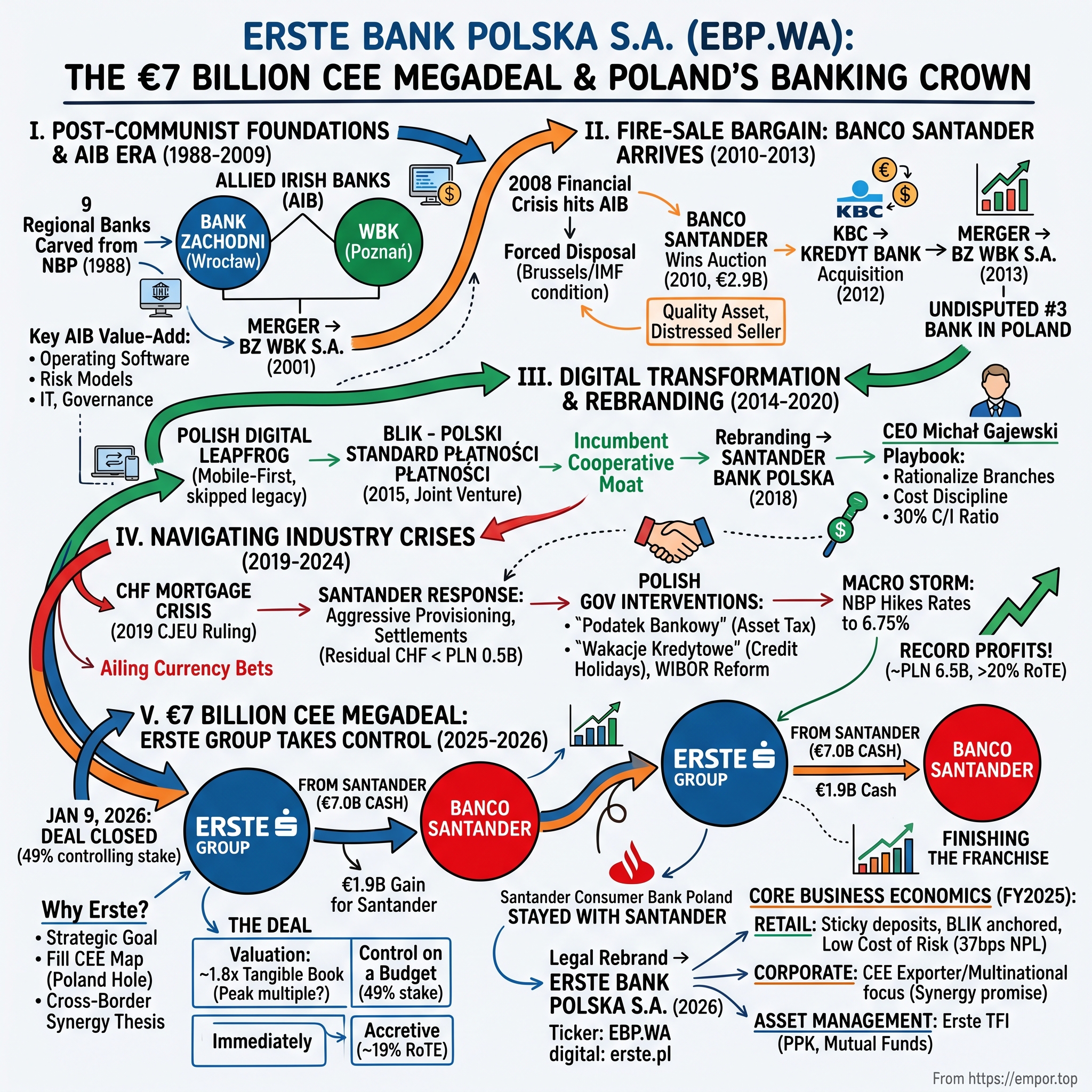
Erste Bank Polska: The €7 Billion CEE Megadeal and the Battle for Poland's Banking Crown
I. Introduction & Episode Roadmap
On the morning of January 9, 2026, two press releases hit the wires within minutes of each other—one from a glass tower on Vienna's Am Belvedere, the other from the Boadilla del Monte campus outside Madrid. The Austrian one announced a beginning; the Spanish one announced an ending. Erste Group Bank AG had just closed its acquisition of a 49% controlling stake in Santander Bank Polska S.A., Poland's third-largest lender, for roughly €7.0 billion in cash.1 Banco Santander, on the other side of the trade, booked a net capital gain of about €1.9 billion and walked away from a business it had spent fifteen years building into one of the most profitable banks in Europe.2
That is the paradox worth sitting with before we go anywhere else. One of the best-run banks on the continent—an institution earning a return on tangible equity most Western European lenders can only fantasize about—changed hands not because it was broken, but because it was finished. Santander had extracted what it came for. Erste believed the best part was still ahead. Both cannot be entirely right, and figuring out who is closer to the truth is the whole point of this story.
The asset itself is genuinely remarkable. By the end of 2025 the bank carried roughly PLN 380 billion in total assets, reported a full-year net profit of PLN 6.463 billion, and posted a return on equity of 23.6% against a cost-to-income ratio of just 30.3%.6 Those are not typos. A Western European retail bank that clears a 10–12% return on equity is considered a strong performer; this one was running at more than double that, with an efficiency ratio that would embarrass most of its peers in Frankfurt, Paris, or Milan.
So how did a merger of two sleepy post-communist regional state banks—Bank Zachodni in Wrocław and Wielkopolski Bank Kredytowy in Poznań—become the crown jewel that a €350 billion Austrian banking group was willing to pay a premium multiple to own? And what exactly is Erste buying: a durable franchise, or the top of a cycle?
Three questions frame the episode. First, the M&A puzzle: Santander is a famously disciplined seller. Did it cash out at the peak of Poland's interest-rate cycle, or did Erste secure the one missing piece of its Central and Eastern European (CEE) map at a fair price of roughly 1.8x tangible book? Second, the moat test: how does a bank sustain a ~20% return while absorbing systemic body-blows—the Swiss franc mortgage litigation crisis, government-mandated wakacje kredytowe (credit holidays), and a punitive podatek bankowy (bank asset tax)? Third, digital dominance: how much of the deposit stickiness rests on Polski Standard Płatności—the BLIK payment rail that Poland's banks built together and that turned smartphones into the primary anchor of the Polish current account?
There is a fourth question lurking underneath all three, and it is the one that makes this a business story rather than a press release. Banking, unlike most industries, offers almost no proprietary product. A mortgage is a mortgage; a current account is a current account; the money one bank lends is indistinguishable from the money the next one lends. In a business where the product is a commodity and the raw material—money—is the same for everyone, the only durable advantages are structural: how cheaply you fund yourself, how disciplined your costs are, how well you price risk, and how sticky your customers are. Everything that follows in this story is really an inquiry into whether Erste Bank Polska possesses those structural advantages in a form that survives a rate cycle, a rebrand, and an interventionist government—or whether the eye-watering returns of 2024 and 2025 were, at bottom, a gift from the interest-rate gods that the new owner mistook for a moat.
We begin where every good bank story begins: not with the acquisition, but with the deregulation that made the asset possible.
 Subscribe on LinkedIn
II. Post-Communist Foundations & The AIB Era (1988–2009)
In 1988, a year before the Berlin Wall fell, Poland was still nominally a communist state—but its command banking system was already cracking. The country ran a "monobank" model, in which Narodowy Bank Polski (NBP, the National Bank of Poland) was simultaneously the central bank, the commercial bank, and the state's accounting ledger. There was no lending market in any Western sense, only the allocation of credit by plan. That year, reformers carved nine regional commercial banks out of NBP's balance sheet, seeding an entire industry from a standing start. Two of those nine matter to this story.
The first was Bank Zachodni S.A., headquartered in Wrocław, the Gothic-and-industrial capital of Lower Silesia. Its territory was the country's manufacturing spine—coal, copper, machine tools, and the dense small-factory economy of the southwest. The second was Wielkopolski Bank Kredytowy S.A. (WBK), based in Poznań, serving Greater Poland's merchant and agricultural heartland, a region with a centuries-old commercial culture and a self-image of thrift and reliability. Neither was glamorous. Both were regional, deposit-funded, relationship-driven institutions—precisely the unfashionable profile that would prove so valuable decades later.
Into this scene walked an unlikely foreign patron: Allied Irish Banks (AIB). Ireland in the 1990s was the "Celtic Tiger," and its banks were flush, ambitious, and hunting for growth beyond a small home market. Poland—large, young, growing, and privatizing its state banks in a hurry—was the obvious frontier. AIB bought a major stake in WBK in 1995 and then in Bank Zachodni in 1999, positioning itself as one of the largest foreign investors in Polish banking during the great privatization wave that accompanied Poland's march toward the European Union.
The decisive move came in 2001, when AIB merged its two Polish holdings into a single institution: Bank Zachodni WBK S.A., universally shortened to BZ WBK.[^5] The logic was straightforward and, in hindsight, prescient. Rather than run two subscale regional banks competing at the edges, AIB stitched together a contiguous western-Poland corridor—Wrocław's industry married to Poznań's commerce—with the scale to matter nationally. The ambition was to build a franchise capable of standing alongside the state giants that dominated the sector: Powszechna Kasa Oszczędności PKO Bank Polski (PKO.WA) and Bank Pekao S.A. (PEO.WA).
It is worth pausing on how strange and fragile this all was at the time. In the 1990s, Poland had to conjure an entire market-based banking system essentially from memory and imported expertise. Credit officers had to learn how to assess a private borrower's ability to repay in an economy where, a decade earlier, the concept of a commercial credit decision barely existed. Deposit insurance, prudential supervision, capital adequacy rules, an interbank market—all had to be built more or less at once, while the economy underwent shock-therapy privatization and inflation ran wild in the early transition years. Foreign strategic investors like AIB were not merely providing capital; they were importing the operating software of Western banking—risk models, audit functions, IT systems, governance—into institutions that had none. This is why the foreign-ownership model came to dominate Polish banking, and why, two decades later, a franchise built under successive foreign parents could be sold from one European group to another without the customer ever feeling the ground move.
What AIB actually built, almost as a byproduct, was a culture. BZ WBK developed a reputation for conservative underwriting, disciplined cost control, and deep relationships with the small and mid-sized enterprises that powered western Poland's industrial boom. That temperament—cautious on the balance sheet, aggressive on efficiency—was not a marketing slogan; it was the accumulated habit of Irish oversight layered onto Poznań-Wrocław prudence. The bank listed on the Warsaw Stock Exchange, ran a genuine free float alongside its Irish parent, and by the late 2000s had become one of the most respected mid-tier names in the market—big enough to matter, disciplined enough to be trusted, and profitable enough to be coveted. All of which made it, from AIB's perspective, exactly the kind of asset you would only ever sell if you had absolutely no choice. It would soon be tested in a way no one at AIB anticipated, because the patron itself was about to detonate.
III. The Fire-Sale Bargain: Banco Santander Takes the Reins (2010–2013)
The 2008 financial crisis did not merely bruise Ireland; it very nearly ended it. Irish banks had inflated one of the most reckless property bubbles in modern European history, and when it burst, the losses were so vast that the Irish state guaranteed the entire banking system and then discovered it could not afford the promise. By 2010, Ireland was in a sovereign bailout, AIB was effectively nationalized, and Brussels and the IMF were dictating terms. One of those terms was brutal and non-negotiable: sell the crown jewels to raise capital. AIB's prized, profitable, entirely healthy Polish bank went onto the auction block—not because anything was wrong with it, but because everything was wrong with its owner.
This is the single most important fact about how the modern franchise was created: BZ WBK went up for sale as a forced disposal driven by Irish sovereign contagion, not Polish operational weakness. A distressed seller and a pristine asset—the ideal conditions for a disciplined buyer.
The buyers understood exactly what was on offer, and the auction had a particular flavor: everyone knew the seller was under a gun. When a distressed owner is legally compelled to sell by a certain deadline to satisfy a bailout condition, the bidders know it, and the price reflects the seller's weakness as much as the asset's strength. The field reportedly included BNP Paribas and Poland's own PKO Bank Polski—a domestic champion that would have loved to swallow a rival and remove a competitor from the board. The winner, in September 2010, was Banco Santander, which agreed to acquire AIB's roughly 70% stake for about €2.9 billion, with the total Polish transaction—including AIB's holding in the associated asset-management venture—valued near €3.1 billion.[^5] The deal completed in 2011, and BZ WBK joined the Santander group.
The purchase came at roughly one-and-a-half times book value—which is worth interrogating rather than accepting. On its face, 1.5x book is not "cheap"; plenty of European banks traded below their book value in 2010, some far below. But price is meaningless without quality. Santander was not buying an average bank at a discount; it was buying an exceptional, high-return, well-run franchise at a fair price it could only obtain because the seller was dying. The bargain was not in the multiple—it was in the mismatch between a distressed seller's timeline and a healthy asset's value. That distinction is the entire logic of crisis-era M&A, and it is a lesson Santander itself would demonstrate again, in reverse, fifteen years later, when it became the disciplined seller crystallizing a peak-of-cycle price.
Santander did not stop there. The Spanish group grasped that scale in Polish banking was the difference between a strong regional player and a national force, and it moved quickly to consolidate. In 2012 it struck a deal with Belgium's KBC Group to acquire Kredyt Bank, KBC's Polish subsidiary, in a share-based transaction, and on January 4, 2013, Kredyt Bank was legally merged into BZ WBK.5 The combination vaulted the enlarged bank to an undisputed number three position in Poland by branches, deposits, loans, and profit, with nearly 900 branches and around 3.5 million retail customers.5 After the merger, Santander held roughly 76.5% of the combined entity and KBC around 16.4%.5
The strategic elegance was in the fit. Kredyt Bank's footprint filled BZ WBK's gaps—pushing the network into Warsaw and eastern Poland, where the western-corridor bank had always been thin—while the overlap in back offices, IT, and central functions delivered exactly the cost synergies that make bank mergers work when they work at all. There is a second-order lesson buried in the KBC transaction that is easy to skip past. KBC, like AIB before it, was a Western European bank retreating from Poland under the discipline of a post-2008 European Commission restructuring plan—Belgian state aid had come with strings, and one of the strings was shedding foreign subsidiaries. In other words, Santander built its Polish champion out of two separate distress sales by two separate crisis-stricken Western owners. The pattern is almost too neat: the CEE growth story of the 2010s was, in large part, financed by the balance-sheet repair of the Western banks that had piled in during the boom and were now forced to sell at the bottom.
For Santander, absorbing Kredyt Bank was not painless. Bank mergers destroy value at least as often as they create it, and the risk lives in the integration: two core banking systems that must be fused into one, two branch networks with overlapping locations, two workforces with different pay scales and cultures, and hundreds of thousands of customers who notice every glitch. That the combined bank emerged from the 2013 legal merger with its cost discipline intact and its market position enhanced—rather than mired in the multi-year IT disasters that have swallowed other bank mergers—was itself a proof point about the quality of the operating team it inherited. A regional champion had become a national one. The question now was whether Santander could turn scale into durability, and the answer would come from an unexpected direction: the smartphone.
IV. Digital Transformation & Rebranding to Santander Bank Polska (2014–2020)
Here is a counterintuitive truth about Polish banking: it is more digitally advanced than most of Western Europe, and the reason is that it skipped a generation of legacy infrastructure. Poland never built a deep culture of paper cheques, and consumer credit-card penetration arrived late and thinly. Where a British or American consumer accumulated decades of habit around cheques, card rails, and branch banking, the Polish consumer of the 2000s was effectively a blank slate—and leapt straight to contactless cards and, then, to mobile-first banking. When you have nothing to unlearn, you adopt the new thing faster than the people who invented the old thing.
This "leapfrog" pattern is familiar from emerging markets elsewhere—mobile money in Kenya, QR payments in China—but Poland's version had a distinctive twist: it was led by the incumbent banks rather than by telecoms or technology platforms, and it was built on modern, real-time rails rather than bolted onto creaking legacy cores. Polish banks in the 2010s consistently ranked among Europe's best on mobile functionality, precisely because they were not dragging along forty years of mainframe technical debt. For a Western banker, replacing a core banking system is open-heart surgery on a running patient; for a Polish bank that only built its systems in the 1990s and 2000s, modernization was closer to a software upgrade. That structural head start is the backdrop against which the BLIK story unfolds, and it is why a mid-sized bank in a mid-sized European economy ended up helping to define a national payments standard that Western incumbents, for all their scale, never managed to replicate.
The purest expression of this leap was BLIK. In February 2015, six of Poland's largest banks—PKO Bank Polski, mBank, ING Bank Śląski, Bank Millennium, Alior Bank, and BZ WBK—jointly founded Polski Standard Płatności (PSP) and launched a shared mobile payment standard.8 The mechanism is almost aggressively simple: the app generates a six-digit code, valid for a couple of minutes, that you type into an online checkout, an ATM, or a shop terminal to move money instantly from bank account to bank account. No card networks, no plastic, no card-scheme interchange skim in the middle.
Why does this matter to an investor rather than a technologist? Because BLIK is a rare thing in banking: a genuine cooperative network effect owned by the incumbents themselves. Every bank that joined made BLIK more useful to every consumer and every merchant, and the more indispensable the payment habit became, the more the mobile app became the center of the customer's financial life. A customer who pays for groceries, transfers money to friends, and withdraws cash all through one bank's app is a customer whose primary current account is extraordinarily sticky—and a sticky current account is a cheap, stable deposit, the single most valuable raw material a bank can own. Poland's banks, in other words, built a moat together that international card networks and Big Tech wallets have struggled to breach, because the incumbents captured the payment habit before the disruptors arrived.
It is worth dwelling on why BLIK was a specifically incumbent victory rather than a fintech one, because it inverts the usual disruption narrative. In most of the world, the story of the 2010s was that nimble outsiders—PayPal, Stripe, Square, Klarna, the wave of neobanks—captured payments and eroded the banks' grip on the customer relationship. In Poland, the banks got there first, together, and on purpose. By pooling their efforts into a shared standard rather than each building a proprietary wallet that would fragment the market, the founding banks ensured that the winning payment rail was one they collectively owned. The consequence is that when a Polish consumer reaches for their phone to pay, they are almost always inside a bank app, not a third-party wallet—which means the bank, not a Silicon Valley intermediary, keeps the data, the relationship, and the deposit. For an investor, this is the difference between a bank that owns its customer and one that has been reduced to a "dumb pipe" behind someone else's interface. Polish banks avoided the dumb-pipe fate that befell so many of their Western peers, and BLIK is the reason.
Steering BZ WBK through this transition was Michał Gajewski, appointed chief executive in 2016. Gajewski was not a parachuted-in foreigner but a product of the Polish banking establishment—a BZ WBK alumnus who had left to run retail at rival Bank Pekao before returning to the top job. That biography matters more than it might seem. A chief executive who has run retail banking at a major competitor arrives knowing precisely where his own bank leaks customers and money, and Gajewski's tenure bore the marks of someone playing a long, unglamorous game of closing those leaks. His playbook was relentless and almost boring in its consistency: rationalize the branch network as customers migrated online, push new customers onto digital onboarding, hold headcount and cost flat while the balance sheet grew, and treat operational efficiency as a permanent discipline rather than a one-off cost program to be announced and then quietly abandoned. The cost-to-income ratio that would later astonish outside observers was not the product of a single restructuring; it was the compounding result of a decade of small, patient decisions in the same direction.
The most symbolically fraught decision of the era came in September 2018, when the storied BZ WBK name—an identity nearly two decades old and deeply rooted in western Poland—was retired in favor of Santander Bank Polska S.A.9 Rebranding a bank is dangerous; brand equity in financial services is trust, and trust does not transfer automatically to a new logo. Santander bet that the loss of local heritage would be more than repaid by association with a global network—international trade finance, cross-border corporate reach, and the marketing muscle of one of the world's largest banks. It was a calculated trade of local sentiment for global scale. The irony, which no one could have seen in 2018, was that this exact same trade would have to be made all over again less than a decade later—in reverse.
V. Navigating Industry Crisis: CHF Mortgages, Bank Taxes, & Inflation (2019–2024)
Every great bank story eventually collides with the loans it wishes it had never made. For the entire Polish banking sector, those were the Swiss franc mortgages. Rewind to the mid-2000s: Swiss interest rates were near zero, Polish rates were high, and so Polish banks—Santander's predecessors and Kredyt Bank prominently among them—wrote hundreds of thousands of home loans denominated not in złoty but in Swiss francs. To a Polish family, a CHF mortgage carried a dramatically lower monthly payment. It looked like free money. It was, of course, a massive unhedged currency bet placed on the household, not the bank.
To grasp why this was so dangerous, hold the mechanism in your head for a moment. When a Polish family borrowed, say, the złoty equivalent of 300,000 in Swiss francs to buy an apartment, the bank recorded a franc-denominated liability on the borrower and, to fund it, typically took on franc obligations of its own. As long as the exchange rate held, everyone came out ahead: the borrower enjoyed a low Swiss interest rate, and the bank booked a performing loan. But the borrower's income was in złoty, while the debt was in francs—a currency mismatch that turned an ordinary mortgage into a leveraged bet against the Polish currency, placed by households who mostly had no idea they were making it.
The bet went catastrophically wrong in stages. When the Swiss National Bank abandoned its euro peg in January 2015, the franc spiked, and overnight the złoty value of those mortgage balances ballooned—borrowers suddenly owed far more than they had borrowed, on homes worth far less than the loan, with monthly payments that jumped even though not a single złoty of the underlying purchase had changed. Then came the lawyers. Over the following years, the Court of Justice of the European Union issued a series of rulings—most consequentially in 2019—holding that the abusive indexation and conversion clauses buried in these contracts were unfair to consumers, opening the door for borrowers to have loans converted to złoty or annulled entirely, often on terms punishing to the banks. What began as a currency shock metastasized into a decade-long legal liability that forced the entire sector to book billions of złoty in provisions against mortgages that were, in many cases, being litigated out of existence.
Santander Bank Polska's response is a genuine credibility marker, and it is worth stating plainly rather than taking on management's word. The bank chose aggressive, front-loaded provisioning and launched voluntary out-of-court settlement programs to convert or close CHF loans before a court did it for them on worse terms. The evidence that this worked shows up years later in the numbers: by the FY2025 results the residual disputed FX-mortgage exposure had shrunk to a portfolio of only about PLN 0.5 billion, with the bank reporting favorable court rulings—the tail of a crisis that once threatened the sector's capital had been ground down to a manageable stub.6 The lesson for the analyst is that reserving conservatively when a liability is uncertain, and eating the pain early, is a form of discipline that pays off precisely when peers who deferred are still bleeding.
The CHF saga was only the most spectacular of the sector's external shocks. Poland's government treated its banks as a fiscal and political resource, and three interventions in particular functioned as a recurring tax on bank equity. First, the podatek bankowy—a bank asset tax of roughly 0.44% per year, introduced in 2016, levied on the balance sheet and pointedly excluding holdings of Polish government bonds (a not-so-subtle nudge to fund the state). Second, the wakacje kredytowe—government-mandated mortgage "credit holidays" that let złoty homeowners suspend payments during the 2022–2023 inflation spike, transferring a slug of interest income straight from bank shareholders to households by legislative fiat. Third, the slow-motion reform of the interest-rate benchmark, migrating the market away from WIBOR toward alternatives such as WIRON/POLONIA, an operational overhang layered on top of everything else.
It is worth being precise about why each of these interventions bites, because "regulatory risk" is the sort of phrase that gets used loosely. The bank tax is levied on the balance sheet rather than on profits, which means it is owed whether the bank makes money or not, and it structurally discourages banks from holding assets other than Polish government bonds—a design that quietly conscripts the banking system into funding the state's deficit. The credit holidays were arguably more painful because they were retroactive interference with existing contracts: the government simply legislated that mortgage holders could stop paying for a defined stretch, and the lost interest came straight out of bank earnings with no offsetting benefit. And the WIBOR-to-WIRON benchmark migration, while technical, forced banks to re-paper vast books of floating-rate contracts and manage the basis risk of a rate index in transition. None of these were market outcomes; all three were political choices that treated bank profits as a discretionary public resource. For an investor, the through-line is that in Poland the government sits, uninvited, on the other side of every bank's income statement.
And yet—this is the twist—the same macro storm that created these costs also handed the bank a windfall. To fight post-pandemic inflation, Narodowy Bank Polski raised its reference rate aggressively, to a peak of 6.75% by September 2022.11 High policy rates are rocket fuel for a bank funded by cheap, sticky current accounts: the bank earns far more on its assets while its deposit costs lag, and the net interest margin balloons. That dynamic is what let Santander Bank Polska absorb multi-billion-złoty CHF provisions, a bank tax, and credit holidays and still print record profits—net profit reached roughly PLN 6.5 billion in 2024 with a return on equity north of 20%.7 The franchise's quality was not that it avoided the shocks—it was that its low-cost deposit base and cost discipline generated enough excess earnings to eat them and grow anyway.
But here is where the neutral analyst has to hold two thoughts at once. The resilience was real, and it was also rate-assisted. Pull the high-rate windfall out of the picture and the picture changes: a bank still paying a bank tax and settling CHF cases, but now without the fat margin that made those costs digestible. The 2024–2025 profits demonstrate that the franchise can survive extraordinary shocks, but they do not, by themselves, prove that it can generate a 20% return in a normal rate environment—because it has not recently had to. That distinction is precisely the one Erste is being asked to pay 1.8x tangible book to resolve, and it is the reason the same numbers that make bulls confident make bears nervous. That tension—resilience proven, normalized profitability unproven—is exactly what made the asset worth buying, and exactly what makes the price debatable.
VI. The €7 Billion CEE Megadeal: Erste Group Takes Control (2025–2026)
On May 5, 2025, the market got its surprise. Erste Group announced it had agreed to buy a 49% controlling stake in Santander Bank Polska, plus 50% of the asset manager Santander TFI, for a total of about €7.0 billion in cash—priced at PLN 584 per share for the bank stake.34 To fund it entirely from internal resources, Erste scrapped a planned €700 million share buyback.3 Two questions immediately followed: why would Santander sell its best CEE asset, and why would famously cautious Erste pay up for it?
Why Santander sold comes down to capital allocation, not disappointment. Under a group strategy of concentrating capital where it holds scale and network advantages—the Americas (the United States, Mexico, Brazil) and its core European corridors of Spain and the United Kingdom—Poland had drifted into the category of a strong but secondary footprint. It was a business where Santander was a large owner but not a strategic anchor, and where the marginal euro of capital could arguably earn more, or at least more strategically, elsewhere. Selling a mature asset at peak profitability and near-peak valuation, crystallizing a €1.9 billion gain and lifting the group's CET1 ratio by roughly 95 basis points, is the textbook behavior of a disciplined portfolio manager pruning the edges of an empire.2 The uncomfortable read for Erste is that the most cost-conscious large-cap seller in European banking looked at this asset and decided now was the moment to exit.
To understand why Erste specifically wanted this, you have to understand what Erste specifically is. The group traces its roots to 1819 and a Viennese savings bank founded to serve ordinary depositors—a mission it has spent the modern era translating into a CEE-wide franchise. After the fall of communism, while other Western banks scattered opportunistically across Eastern Europe and later retreated when it suited them, Erste made a deliberate, patient bet on the specific arc of Central European convergence: the idea that the ex-communist economies would grow faster than the West, that their citizens would accumulate savings and credit, and that a bank present early with a trusted brand and dense distribution would compound alongside them. Over three decades it assembled that footprint methodically—Česká spořitelna in the Czech Republic, Slovenská sporiteľňa in Slovakia, Banca Comercială Română in Romania, and leading operations in Austria, Hungary, and Croatia.
Why Erste bought is the mirror image of Santander's exit, and it is genuinely strategic rather than opportunistic. Erste had built the most coherent CEE banking franchise in existence—but with one conspicuous, almost embarrassing hole in the map: Poland, the largest economy in the region and the biggest banking market in Central Europe. Erste had no meaningful Polish presence at all. As CEO Peter Bosek framed it, the acquisition fulfilled "a long-standing strategic goal" of broadening the group's regional leadership.3 In one stroke, the deal expanded Erste's loan book from roughly €94 billion to €131 billion and grew its CEE client base by about 50%.3 You cannot claim to be the leading bank in Central and Eastern Europe while being absent from its center of gravity; Erste had just fixed that.
There is also a hard-nosed capital-efficiency logic to buying only 49% rather than making a full takeover bid. By stopping just short of a majority while still securing effective control, Erste got to consolidate a bank it steers, deployed roughly €7 billion instead of the far larger sum a 100% acquisition would have required, and left a substantial free float in place to absorb minority capital. It is control on a budget—elegant financial engineering, though it also means Erste shares the economics of a business it fully directs with outside shareholders it does not, a tension that will recur every time the dividend is set.
The valuation is where the independent skeptic earns their keep. European bank M&A typically clears at 0.8x–1.2x tangible book value; Erste paid an estimated ~1.8x, a conspicuous premium.34 Management's justification is that Poland's superior GDP growth, structurally higher banking returns, and top-tier asset quality warrant a premium multiple—and that the deal is immediately accretive, boosting Erste's 2026 EPS by more than 20% versus consensus and delivering a 2026 return on tangible equity of roughly 19%, well above the ~15% the market had been assuming.3 That accretion math is real, and it is the crux of the bull case: even at a premium price, a bank earning ~19% RoTE that you can consolidate is instantly earnings-accretive to an acquirer whose own returns are lower. But accretion and value are not the same thing. Paying a peak multiple for a cyclically peak-earning asset is precisely the trade that looks brilliant at the top of a rate cycle and painful at the bottom, because both halves of the ratio—the price and the earnings—can be elevated at the same moment. The cleanest way to frame the risk: Erste is paying 1.8x a tangible book that is itself being compounded by an abnormally high return, and if that return normalizes, the multiple paid looks worse in hindsight than it does on the announcement-day spreadsheet. Whether 1.8x was shrewd or expensive depends entirely on how much of the ~20% return proves structural versus cyclical—a debate we will not resolve here, only sharpen.
The mechanics were completed methodically. Regulatory clearance came from Poland's Komisja Nadzoru Finansowego (KNF) and European authorities; by late December 2025 all closing conditions were satisfied; and on January 9, 2026, the transaction closed.1 One asset was deliberately carved out: Santander Consumer Bank Poland stayed with Banco Santander, with the Spanish group buying out Santander Bank Polska's majority holding before closing so that Erste acquired the core bank clean of the separate consumer-finance arm.3 The final act is the rebrand: over the second quarter of 2026, Santander's red flame gives way to Erste's identity, the legal entity becomes Erste Bank Polska S.A. trading as EBP.WA on the Giełda Papierów Wartościowych w Warszawie (GPW, Warsaw Stock Exchange), and the digital estate migrates to erste.pl.10 The bank that once traded local heritage for the Santander name now trades the Santander name for Erste's—the second identity change in eight years, at an estimated one-time rebranding cost of around PLN 250 million in 2026.6
VII. Segment Breakdown & Core Business Economics
Strip away the corporate drama and a bank is, at bottom, a machine for turning cheap deposits into profitable loans while managing the risk in between. Erste Bank Polska runs that machine across three engines, and understanding how the profit is actually generated is more clarifying than any org chart.
The dominant engine is Retail & Consumer Banking, the source of the majority of revenue and net profit and the true heart of the franchise. It serves more than five million retail customers, the overwhelming majority of them active on the mobile app, which is where the economics get interesting. The product list—złoty-denominated residential mortgages, consumer loans, credit cards, everyday payments—is unremarkable in itself. What matters is the funding side. Retail customers deposit money into current and savings accounts (industry shorthand: CASA balances) that pay little or no interest, and those low-cost, sticky balances are the cheap raw material that powers everything. In a high-rate environment, a bank funded by patient current accounts earns a fat spread; the stickier and cheaper the deposits, the fatter the spread. BLIK is the reason those deposits are so sticky, which is why a payment rail that earns modest fees is strategically worth far more than its fee income suggests—it is the moat around the deposit base, not a business line in its own right.
The second engine is Business & Corporate Banking, spanning Polish SMEs, the commercial middle market, and larger corporate and investment banking clients, and contributing a meaningful minority of the group's revenue and profit. This is the segment where the Erste ownership change is supposed to add something the Santander era could not. Erste's dense regional network—Vienna, Prague, Bratislava, Budapest, Bucharest, Zagreb—positions it to serve Polish exporters and multinationals with seamless cross-border CEE liquidity, hedging, and trade finance along the DACH-CEE corridors that Polish industry increasingly depends on. That is the revenue synergy thesis, and it is plausible. It is also, for now, a thesis: cross-sell projections are the easiest number to put in a deal deck and the hardest to actually collect, and a neutral observer should treat corporate revenue synergies as unproven until they show up in segment disclosure.
The third engine is Asset Management (Erste TFI) & Treasury, contributing the smallest slice of the profit. The former Santander TFI—now Erste TFI, held in a 50/50 joint venture structure—manages mutual funds, the government-backed Pracownicze Plany Kapitałowe (PPK) auto-enrollment pension scheme, and wealth-management assets, generating recurring fee income that is valuable precisely because it does not depend on interest rates. Treasury manages the bank's own liquidity, hedges its interest-rate risk, and underwrites Polish corporate bond issuance. It is the plumbing—unglamorous, essential, and the part of the bank that will absorb the operational load of integrating into Erste's systems.
A concrete way to see the funding advantage is to look at the FY2025 balance-sheet shape: roughly PLN 230 billion of customer deposits funding a gross loan book of about PLN 167 billion.6 That is a loan-to-deposit ratio well under 80%—meaning the bank collects far more in deposits than it lends out, with the surplus parked in liquid assets and government bonds. In banking, a low loan-to-deposit ratio is a luxury: it means the institution is not dependent on flighty wholesale funding markets to finance its lending, it has ample liquidity (the 219% liquidity coverage ratio confirms it), and it possesses the capacity to grow loans without scrambling for new funding.6 The 7% year-on-year deposit growth against 4% loan growth tells you the deposit franchise is, if anything, gathering money faster than the bank can prudently lend it—a high-class problem, and precisely the profile that lets a bank keep its funding cheap.6
The through-line across all three engines: this is a franchise whose quality lives on the liability side of the balance sheet. Anyone can lend money; the trick is funding those loans more cheaply and stickily than the competition, and that is what the five-million-customer, BLIK-anchored deposit base delivers. But there is a warning embedded in the same numbers. A deposit franchise that looks unbeatable when rates are high—because depositors tolerate low rates and the bank pockets the spread—can look far more ordinary when rates fall and the spread compresses regardless of how sticky the money is. Deposit stickiness protects volume, not margin. Which raises the obvious question—if the business is this good, how much of the credit belongs to the people running it, and how much to a rate cycle that is now turning?
VIII. Management Credibility, Incentives, & Corporate Governance
When a bank changes hands, the first thing that usually walks out the door is talent, and the first casualty is momentum. Erste's most telling early decision was to retain Michał Gajewski as chief executive through the transition—a deliberate choice for continuity over a clean sweep, aimed at holding the operating team together and reassuring five million customers that their bank was changing its shareholder, not its management. It is a low-drama move, and in bank integrations, low drama is the whole game.
Gajewski's track record is the strongest single piece of evidence in the bull case, and it deserves scrutiny rather than applause. Consider what his tenure actually navigated: he steered the institution through two brand transformations—BZ WBK to Santander Bank Polska, and now Santander Bank Polska to Erste Bank Polska—without surrendering the number-three market position, an unusual feat given that each rebrand is a live grenade for customer trust. He held the cost-to-income ratio in the mid-30s and lower through a period of genuine wage inflation and heavy IT investment, landing at 30.3% for FY2025—a level of efficiency that is the accumulated proof of a decade of discipline, not a one-year fluke.6 And on the CHF mortgages, management provisioned early and conservatively rather than deferring pain, avoiding the ugly balance-sheet restatements that catch out banks that hope a liability will simply go away.
The governance structure that Erste inherits is worth understanding precisely because it is unusual. Erste holds a 49% stake—not a majority—yet exercises de facto control, because in a widely held listed company with a large free float, a 49% block is decisively the largest and controls the board.1 The remaining shares continue to trade on the GPW, meaning minority shareholders retain their rights and the market retains a live, daily vote on the bank's performance under KNF's regulatory umbrella. This matters for the independent investor: the free float is both a discipline (Erste cannot simply run the bank as a wholly owned subsidiary; minority interests and Polish disclosure standards apply) and a source of tension (the interests of a strategic 49% parent in Vienna and a dispersed minority in Warsaw are not always identical, particularly on dividends and capital).
There is a governance question the deal structure sharpens rather than settles: dividends. A bank generating capital surplus above PLN 9 billion and meeting the conditions to distribute up to 75% of profit has real cash to return, but who decides where it goes?6 A strategic parent with 49% and effective board control has every incentive to see capital flow up to Vienna to help fund the group's ambitions and the price it paid; the Warsaw minority, holding the free float, wants the same distributions but has no comparable use for retained capital at the parent level. Under normal conditions these interests align—both want dividends—but they can diverge sharply if Erste ever prefers to retain capital in Poland for group purposes, or to structure returns in ways that favor the controlling shareholder. KNF oversight and Polish minority-protection rules are the backstop, and they are meaningful, but the structural tension is now a permanent feature of the register. A neutral observer should watch the first few dividend decisions under Erste ownership as a live test of how the controlling shareholder treats the minority.
On incentives, executive compensation is tied to the metrics that actually matter for a bank of this type—return on tangible equity, the cost-to-income ratio, ESG compliance, and successful digital integration into Erste's IT ecosystem. Aligning pay to RoTE and efficiency is sensible, but it carries a subtle risk worth flagging: RoTE-linked incentives during a rate-easing cycle can tempt management to chase margin, defer investment, or lean on financial engineering to protect a headline number that the macro environment is actively working against. The cleaner test of this management team will not be the next good year; it will be how candidly they explain the first year that returns compress—whether they attribute the miss honestly to the rate cycle they cannot control, or reach for excuses. Given where NBP rates are headed, that test may not be far off.
IX. Strategic Frameworks: Hamilton Helmer's 7 Powers & Porter's 5 Forces
Narrative is persuasive; frameworks are disciplining. To pressure-test whether Erste Bank Polska has a durable advantage or merely a lucky cycle, run it through two lenses.
Hamilton Helmer's 7 Powers
Scale Economies (High). The heaviest costs in modern banking—core IT platforms, cybersecurity, regulatory compliance, software development—are largely fixed. Spread across five-million-plus customers and a PLN 380 billion balance sheet, they produce the sector-leading efficiency the bank already demonstrates.6 Scale here is real and measurable, not asserted.
Switching Costs (High). A primary salary account wired into direct debits, standing orders, automatic bill payments, saved investment profiles, and years of app habit is genuinely painful to move. This is the mechanism behind deposit stickiness, and it is why funding costs stay low even when depositors could technically chase a higher rate elsewhere.
Network Effects (Medium-High). Co-ownership of BLIK confers a shared, self-reinforcing payment network—but note the double edge: because BLIK is co-owned by rivals including PKO, mBank, and ING, the network effect is an industry moat against outsiders (card schemes, Big Tech wallets), not a proprietary advantage over domestic peers who sit inside the same rail.
Cornered Resource (Medium). The dense branch and relationship network across Wielkopolska and Lower Silesia—the country's most economically dynamic regions—is a genuine, hard-to-replicate distribution asset, now paired with Erste's CEE cross-border reach. Real, but geographically bounded.
Process Power (High). Two decades of credit-scoring, automated underwriting, and risk-management practice, refined under Santander's global standards, is embedded institutional know-how that a competitor cannot simply buy. The 37-basis-point cost of risk and 3.7% non-performing-loan ratio at FY2025 are the visible output of that process discipline.6
Brand Power (Medium, in transition). This is the weakest link right now, and honestly so. Ripping out the Santander flame and installing the Erste brand introduces real short-term awareness friction in a market where Erste is a near-unknown consumer name, only partly offset by Erste's strong regional reputation. Brand power is being spent here, not accumulated.
Counter-Positioning (Low). The bank is the incumbent, and its digital agility roughly matches—rather than structurally out-flanks—agile challengers such as Revolut and mBank. There is no business-model asymmetry that rivals cannot copy; this power is largely absent.
Porter's 5 Forces
Rivalry (High). The top five—PKO BP, Pekao, Erste Bank Polska, mBank, ING Bank Śląski—compete fiercely for retail deposits and corporate loans in a concentrated market where share is won at the margin.
Bargaining Power of Suppliers (Low). The "suppliers" are depositors, and they are fragmented; with the Polish system running structurally surplus liquidity (the bank's liquidity coverage ratio sat at 219% at FY2025), no depositor cohort holds pricing leverage.6
Bargaining Power of Buyers (Medium). Mortgage rates and deposit yields are transparent and shoppable, but primary-account stickiness blunts churn, so buyer power is real but contained.
Threat of New Entrants (Very Low). KNF capital requirements, the bank asset tax, heavy compliance load, and the IT scale barrier make a full-service de novo bank in Poland nearly unthinkable.
Threat of Substitutes (Medium). Fintech wallets and non-bank payment apps nibble at fee income, but the incumbents' capture of the BLIK rail means the substitution largely happens inside the banking system rather than outside it.
The composite verdict is a bank with strong but conventional incumbency advantages—scale, switching costs, process—rather than a singular, unassailable monopoly power. It is instructive to compare this profile against its Polish peers, because the honest truth is that most of these advantages are shared across the top tier. PKO Bank Polski and Bank Pekao enjoy comparable or greater scale; ING Bank Śląski is widely regarded as a digital leader; mBank pioneered branchless banking in Poland and competes hard on the same app-first terrain. All of them sit inside BLIK. What distinguishes Erste Bank Polska within that pack is not a unique structural moat but a degree—a best-in-class cost ratio, a clean asset book, and a deposit franchise at the strong end of a strong field. That is a meaningful edge, but it is an edge of execution, and edges of execution have to be re-earned every year rather than banked once and defended. That is a good business. Whether it is a great investment depends on price and cycle, which is exactly where the skeptics start.
X. Activist & Skeptical Investor Stress Test
Every 20% return attracts two kinds of attention: admirers and short-sellers. A serious investor should be able to argue both sides of Erste Bank Polska with conviction.
The Bear Case
Start with the rebrand itself, because it is the freshest risk. Swapping Santander's globally recognized red shield for Erste's identity—barely known to Polish retail consumers—is a live experiment in whether a bank can change its face twice in eight years without shedding deposits or paying up for new customers. The estimated PLN 250 million rebranding spend is only the visible cost; the invisible risk is quiet attrition that shows up as slightly higher deposit betas and acquisition costs.6
The heaviest bear argument is interest-rate sensitivity. The bank's ~20% returns were manufactured, in large part, by NBP's rate hikes to 6.75%. With NBP now easing—the bank itself guided to two 25-basis-point cuts in 2026—net interest margin faces structural compression, and management disclosed sensitivity of roughly PLN 250 million of annual net interest income per 100 basis points of rate change.6 A skeptic's blunt framing: strip out the cyclical rate windfall and the "structural" 20% RoTE drifts toward a more ordinary mid-teens number, at which point paying 1.8x tangible book looks a lot less clever.
Then there is Polish political and regulatory risk, which is not a tail event but a recurring feature. The bank tax, the mandated credit holidays, and the CHF settlement pressure were all policy decisions, and the FY2025 disclosure that banking tax and regulatory costs run near PLN 3 billion a year quantifies just how large a standing claim the Polish state holds on bank profits.6 Any future government can reach into that well again. Finally, the CHF legal tail, while ground down to roughly PLN 0.5 billion, is not zero, and a shift in judicial precedent could always reprice the residual.6
The Bull Case
The bulls answer with relative returns. Even under compression, a mid-to-high-teens RoTE would tower over the ~10–12% typical of Western European banks, sustained by Polish real GDP growth around 3%, low banking penetration, and durable credit demand—a structurally better market, not merely a better year. They point to Erste cross-border synergies: a corporate client base across Germany, Austria, Czechia, and Slovakia creates a genuine, if unproven, cross-sell runway into Polish trade finance.
The most concrete bull argument is capital distribution. The bank exited 2025 with a capital surplus above PLN 9 billion and met the conditions to pay out up to 75% of profit, subject to KNF approval.6 As the CHF drag rolls off and capital generation stays strong, that payout capacity is real cash-return firepower—provided the 49% parent in Vienna and the regulator both bless it, which is not guaranteed. And underpinning it all is the digital cost advantage: BLIK penetration and branch automation that keep operating costs rising slower than inflation, which is what a 30.3% cost-to-income ratio actually means in practice.6
An activist or short-seller stress-testing this equity would push hardest on three pressure points. First, disclosure clarity through the transition: as Santander's segment reporting gives way to Erste's consolidation, will investors be able to see clean, comparable Polish numbers, or will the rebrand and integration muddy the very metrics needed to judge whether returns are holding? Second, the durability of the payout: a 75%-of-profit distribution capacity is only worth what actually gets paid, and a controlling shareholder that quietly retains capital for group purposes would convert a bull-case strength into a governance grievance. Third, cost creep during integration: the single cleanest bear signal would be a cost-to-income ratio that starts drifting up as IT migration, rebranding, and dual-running costs accumulate—efficiency is the franchise's signature, and any sustained erosion of it would suggest the discipline was more environmental than cultural.
The honest synthesis is that both cases hinge on the same variable—how much of the return is structural. The bulls are betting on the franchise; the bears are betting on the cycle. The next two years of margin and cost data will settle the argument, which is why the KPIs below matter more than any narrative.
XI. Current Risk Radar & Critical KPIs
Risk Radar
The three risks that a holder should actually lose sleep over are integration, policy, and rates. Post-acquisition integration risk is the most immediate and the most within management's control: migrating IT systems into Erste's ecosystem, spending the rebranding budget efficiently, and aligning a Vienna-headquartered parent with a Warsaw management culture without triggering talent flight or service disruption. Bank integrations fail on execution far more often than on strategy. Regulatory and macro-intervention risk is the least controllable: further podatek bankowy adjustments, extended credit holidays, or new relief programs remain a permanent feature of Polish banking, not a passing storm. And the CHF legal tail, though small, still turns on the pace of final settlements versus court invalidations.
Three KPIs to Track
Rather than drown in metrics, watch three numbers that together tell you whether the franchise is holding as rates fall.
1. Net Interest Margin (NIM). This is the master variable. NIM is where the rate-cut thesis is won or lost, and the specific thing to watch is deposit beta—how much of each rate cut the bank successfully avoids passing through to depositors. If NIM holds up better than the mechanical rate-sensitivity math implies, the deposit franchise is proving its quality; if it collapses in line with rates, the returns were cyclical after all.
2. Cost-to-Income Ratio (C/I). The efficiency number is the cleanest single proxy for management execution, and the integration period is its real test. Holding C/I low while absorbing rebranding costs and IT migration would confirm the cost discipline is structural; a sustained climb would suggest the sub-38% efficiency depended on a benign environment that is now gone.
3. Return on Tangible Equity (RoTE). The headline scorecard. The question is not whether RoTE is high today—it is—but at what level it settles once the rate cycle normalizes and the Santander-to-Erste transition costs wash through. That settling point is, ultimately, what Erste actually bought at 1.8x tangible book.
A note on how to read these three together, because in isolation each can mislead. NIM tells you what the environment is doing to the bank; C/I tells you what management is doing within it; RoTE is the combined output of both, plus the cost of risk and the capital base. A bank can post a falling RoTE for an entirely benign reason (rates dropped, NIM compressed) while its underlying execution—cost discipline, credit quality—remains excellent, and it can post a flattering RoTE for a fragile reason (a one-off provision release, an under-reserved loan book). The disciplined watcher therefore does not react to any single number but to the pattern: is NIM holding better than the rate math implies (deposit franchise winning), is C/I staying low through the integration (execution winning), and is the resulting RoTE settling at a level that still clears Erste's cost of capital? Those three signals, read jointly across the next several quarters, will reveal whether Vienna bought a structural franchise or a cyclical peak—long before any headline verdict is available.
XII. Primary Evidence & Conference Call Guidance for Writers
The temptation with a story this dramatic is to write it from press releases. The discipline is to write it from the primary record, where the tensions are sharper and the management is under live cross-examination.
Three source sets carry the most weight. The May 2025 acquisition announcement, from both Erste and Banco Santander, is where the two sides put their rationales on record—Erste's justification for a ~1.8x tangible-book price and its ~19% RoTE and 20%+ EPS-accretion claims, against Santander's capital-allocation logic for exiting a profitable asset.34[^13] Reading both sides against each other is the fastest way to locate the disagreement at the heart of this deal. The Santander Bank Polska FY2024 and FY2025 earnings calls are where the operating truth lives: CHF provisioning run-rates, the NIM trajectory under NBP cuts, cost-to-income trends, and dividend guidance under KNF rules.67 On the FY2025 call, management's framing was notably concrete—guiding explicitly to two rate cuts in 2026, quantifying rate sensitivity at PLN 250 million per 100 basis points, and stating that the bank met the conditions to distribute up to 75% of profit while declining to pre-commit the final figure.6 Finally, Erste Group's first post-closing 2026 earnings call is the place to watch consolidation mechanics, integration costs, and early Polish brand-transition data.
For writers, the analyst Q&A is where to hunt. The questions that recur—and that management should be pressed on—are the duration of the CHF legal provisions and the risk of revenue dis-synergies from losing the Santander international corporate brand. The credibility signal to watch is directness: whether management answers with specific settlement-completion rates and margin sensitivities, or retreats into generalities about "long-term CEE trade flows." Concrete answers under pressure are the tell that a management team believes its own numbers.
XIII. Business & Investing Lessons
Three durable lessons survive the details of this particular deal.
First, crisis-driven M&A can create generational value—for the buyer. Santander acquired BZ WBK at roughly 1.5x book because AIB was a forced seller wrecked by an Irish sovereign crisis that had nothing to do with the Polish bank's quality. The most attractive assets rarely come to market when they are cheap and their owners are calm; they come to market when a distant owner is dying and must sell the healthy limb to save the diseased body. The disciplined buyer's edge is the willingness to separate the asset's quality from its seller's distress.
Second, ecosystem standards are among the strongest moats a bank can hold—and the counterintuitive move is to build them with your rivals. By co-founding BLIK rather than fighting a payments war bank-against-bank, Poland's incumbents collectively erected a barrier against the international card networks and tech platforms that have eroded bank payment economics elsewhere. Sometimes the most defensive act is cooperation, and the reward is a low-cost deposit franchise that outside disruptors cannot easily pry loose.
Third, in CEE banking, regulatory absorption capacity is a core competitive advantage, not a compliance afterthought. The banks that thrive in emerging Europe are the ones that carry enough capital and earn enough excess return to absorb sudden policy shocks—bank taxes, credit holidays, adverse court rulings—without gutting their returns. Santander Bank Polska survived all three at once and still compounded, and that shock-absorption capacity, more than any single product, is what a premium multiple was really paying for.
There is a fourth lesson that belongs to the investor rather than the operator, and it is the most uncomfortable one. The sale itself is data. When the most disciplined, most cost-conscious large-cap seller in European banking looks at an asset it built and knows intimately, decides the moment is right to exit, and a buyer pays a premium to take the other side, the thoughtful investor treats the seller's judgment as information—not proof that the buyer is wrong, but a signal worth weighing. Santander did not sell because the bank was bad; it sold because it judged the risk-adjusted future return, at that price, to be better deployed elsewhere. Erste judged the opposite. Reasonable, sophisticated institutions took opposite sides of the same trade at the same price on the same day, which is a useful reminder that in markets there is no such thing as a consensus "great asset at a fair price"—there is only a price at which one informed party would rather hold cash and another would rather hold the bank.
XIV. Epilogue & Outro
The arc is almost improbable in its symmetry. Two regional state banks—one in Wrocław, one in Poznań—were carved out of a communist monobank at the very end of the old order. An Irish patron stitched them together and then, ruined by its own property bubble, was forced to sell the healthy child to save itself. A Spanish giant bought the bargain, bolted on a rival, digitized the whole thing, and rode a rate cycle to record profits—only to conclude, at the peak, that its best CEE asset was worth more sold than held. And now an Austrian group, the most methodical builder of a Central European banking map, pays a premium for the one piece it never had, and reaches for a fresh coat of paint over a franchise it did not create.
Step back far enough and the whole saga is a study in how ownership, not operations, has driven this bank's history. Through four decades the branches in Wrocław and Poznań kept opening in the morning, the SME relationships kept renewing, the deposits kept flowing—while above them the ownership deck was reshuffled again and again by forces that had nothing to do with the bank's own performance: a communist monobank breaking apart, an Irish property crash, a Belgian state-aid restructuring, a Spanish group's capital reallocation, an Austrian group's thirty-year strategic itch. The franchise proved durable precisely because it was good enough that each successive owner wanted it and careful enough that none of them broke it. That durability across owners is itself the strongest argument for the asset's quality—and the strongest reason to believe the customer will barely notice when the red flame becomes something else.
What Erste Bank Polska represents, stripped to its essence, is a concentrated bet on three things converging: Central Europe's continued economic convergence with the West, the durability of a digital, low-cost deposit franchise, and Erste's ability to extract cross-border corporate value that the Santander era left on the table. None of those is guaranteed, and the price paid assumes a fair amount of them will come true. The rate cycle is turning, the brand is mid-transformation, and the Polish state remains an unpredictable co-owner of every bank's profit and loss. The franchise that absorbed a decade of shocks and kept compounding has earned the benefit of the doubt. Whether it has earned 1.8x tangible book is a question only the next few turns of the cycle can answer—and, in Warsaw, the market will be voting on it every single trading day.
References
-
Erste Group successfully completes acquisition of 49% controlling stake in Santander Bank Polska — Erste Group Bank AG, 2026-01-09 ↩↩↩
-
Santander completes the sale of 49% of Santander Bank Polska to Erste Group — Banco Santander, 2026-01-09 ↩↩
-
Erste Group invests in Central and Eastern European growth with acquisition of 49% controlling stake in Santander Bank Polska — Erste Group Bank AG, 2025-05-05 ↩↩↩↩↩↩↩↩
-
Erste Group buys Santander's Polish arm in 7 billion euro deal — Reuters, 2025-05-08 ↩↩↩
-
Santander and KBC agree to merge Bank Zachodni WBK and Kredyt Bank in Poland — Santander Bank Polska, 2012 ↩↩↩
-
Santander Bank Polska SA Full Year 2025 Earnings Call Highlights — GuruFocus, 2026 ↩↩↩↩↩↩↩↩↩↩↩↩↩↩↩↩↩↩↩
-
Preliminary financial results of Santander Bank Polska Group for 2024 — Santander Bank Polska, 2025-02-04 ↩↩
-
Blik — Wikipedia / Polski Standard Płatności history, 2015 launch ↩
-
2018 was a year of changes for us — Santander Bank Polska Annual Report 2018 ↩
-
Monetary Policy & Interest Rate Statistics — Narodowy Bank Polski (NBP), 2026-04-10 ↩
 LinkedIn
 WhatsApp
 Reddit
 Hacker News
 Email
Email Kindle
 RSS Feed
 Spotify
 Apple Podcasts
 Amazon Music
 Audible
 YouTube