DNB Bank ASA: The Financial Architecture of the Nordic Fortress
I. Introduction & Episode Roadmap
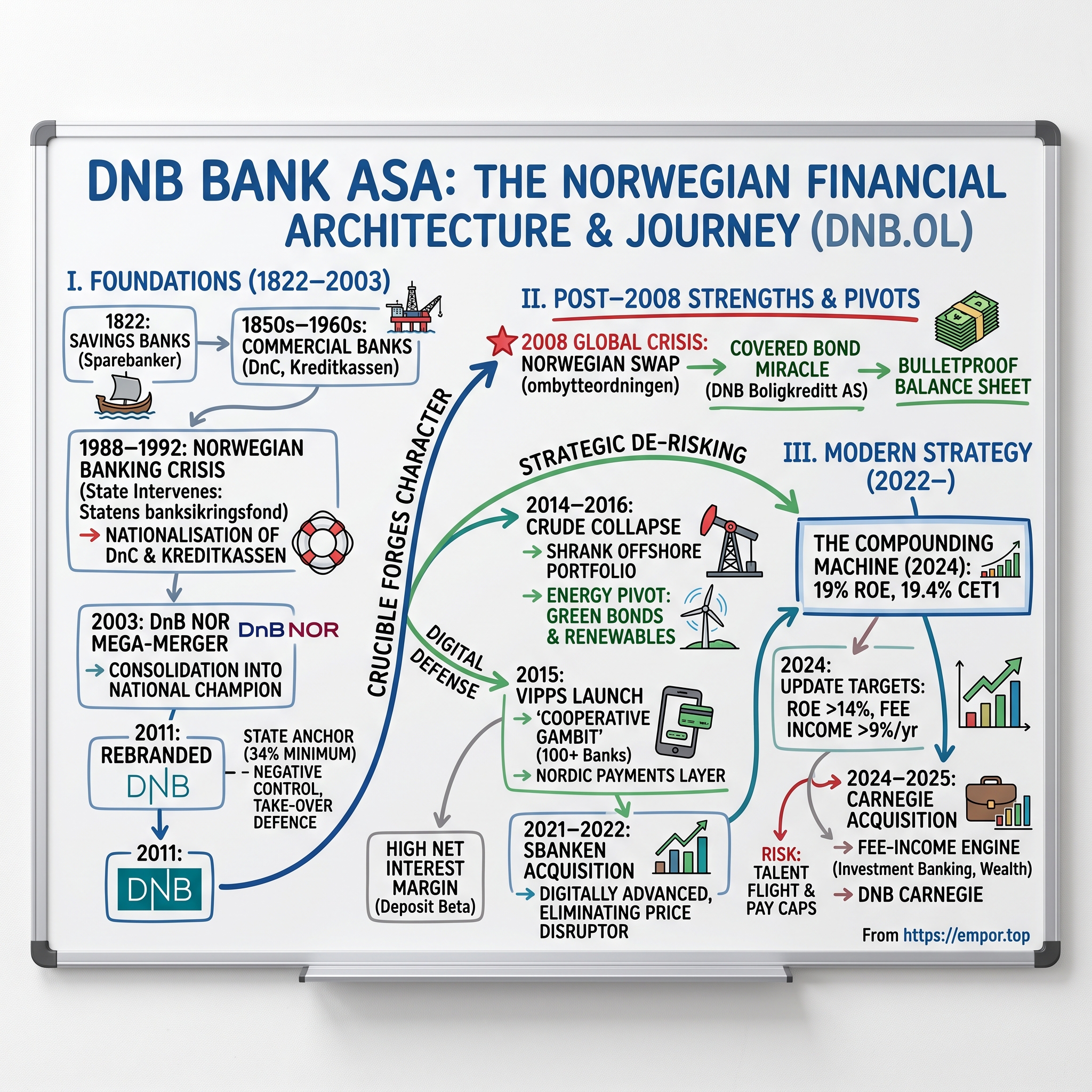
Picture a bank whose largest shareholder is a government that does not want to run it, whose home country runs the world's biggest sovereign wealth fund, and whose depositors almost never default on their mortgages. Now picture that same bank quietly earning a return on equity that most of continental Europe's proud old lenders can only dream about. In 2024, while the average eurozone bank still fought to convince investors it could earn back its cost of capital, DNB Bank ASA reported a full-year return on equity of 19% and sat on a common equity Tier 1 (CET1) ratio of 19.4%.1 That is not the profile of a sleepy Nordic savings institution. That is the profile of a financial fortress.
The hook of DNB's story is a paradox. Here is an institution born from nineteenth-century Norwegian savings banks and rescued by the state during a banking crisis so severe that Norway effectively nationalised its commercial banking system — and yet, three decades later, it is one of the most consistently profitable large banks in Europe. How did a former bailout recipient become the undisputed financial sovereign of its region?
The thesis of this story is that DNB is not really a "bank" in the way an investor thinks about a generic European lender. It is closer to a leveraged claim on the Norwegian economic fortress itself. Three structural facts anchor that claim. First, the Norwegian state owns roughly 34% of DNB, held through the Ministry of Trade, Industry and Fisheries — a stake large enough to block any hostile takeover or forced relocation, yet deliberately hands-off on day-to-day commercial decisions.2 Second, DNB commands a dominant share of Norwegian retail and corporate lending, a scale position that lets it spread fixed technology and compliance costs across the whole economy. Third, it runs an unusually disciplined capital-allocation machine, returning cash through dividends and buybacks while keeping one of the lowest cost-to-income ratios in European banking.
But this is Empor, not DNB's investor-relations department. So we will interrogate the story as much as we tell it. A state anchor is a moat — until the state's political priorities diverge from shareholders'. A high net interest margin is a gift — until rates fall and deposit competition bites, which is exactly what began happening by 2026. A fee-income acquisition is a growth engine — until the star bankers you bought decide to walk. Every strength in DNB's story has a shadow, and a serious investor needs to see both.
Here is the map. We begin in the nineteenth century and trace how Norway consolidated a fragmented banking landscape into a single national champion, culminating in the 2003 mega-merger that created DnB NOR. We then examine the two crucibles that forged DNB's modern character: the 1988–1992 Norwegian banking crisis, which taught the state to intervene, and the 2008 global crisis, which DNB navigated through a distinctly Norwegian covered-bond mechanism rather than a humiliating bailout. From there we follow the strategic pivots — out of global shipping and offshore oil after the 2014 crude collapse, into Vipps and the payments layer, and through two defining acquisitions: the contested takeover of digital challenger Sbanken and the SEK 12 billion purchase of Swedish investment bank Carnegie. We close with the segment engine room, a management and governance audit, a Helmer-and-Porter competitive war-game, and an honest bull-versus-bear reckoning. Let us start where the fortress was built — one savings bank at a time.
 Subscribe on LinkedIn
II. Origins & National Consolidation: Building Norway's Champion (1822–2003)
The story does not begin with a visionary founder in a garage. It begins with a nation of thrifty people who did not trust anyone else to hold their money. In 1822, in the young capital then called Christiania, the country's early savings-bank movement took root, and over the following decades a dense network of local sparebanker — savings banks — spread across Norway's fjords and valleys. These were not profit-maximising machines. They were mutual, community institutions, owned by no one and everyone, designed to lend a fisherman money for a boat or a farmer money for seed. That cultural DNA — banking as civic infrastructure rather than casino — never fully left the Norwegian system, and it explains a great deal about how DNB behaves even today.
Alongside the savings banks grew the commercial banks, the institutions that would eventually merge upward into DNB. Two names matter. Den norske Creditbank (DnC), founded in the 1850s, became Norway's largest commercial bank, financing the industrialisation that transformed a poor fishing-and-timber economy into a modern one after the Second World War. And Christiania Bank og Kreditkasse — universally shortened to Kreditkassen — grew into its great rival. For a century these were the twin poles of Norwegian corporate finance, lending to the shipping magnates, the hydropower builders, and eventually the oil companies that struck black gold in the North Sea in 1969.
Then came the reckoning. In the mid-1980s Norway deregulated its credit markets, and the result was a textbook bubble. Banks, suddenly free to lend, poured money into real estate and business ventures at a reckless clip. When oil prices crashed in 1986 and the domestic asset bubble burst, the Norwegian banking system experienced one of the most severe systemic crises any developed economy has faced. Between 1988 and 1992, loan losses cascaded through the commercial banks. Kreditkassen and DnC — the two giants — ran out of capital.
Here the Norwegian state made a choice that would define the next forty years. Rather than let the banks fail or hand them to foreign buyers, the government created the Statens banksikringsfond, the Government Bank Insurance Fund, and used it to recapitalise and effectively nationalise the largest commercial banks, wiping out existing shareholders in the process. It was brutal for equity holders, but it established a precedent that markets never forgot: Norway treats its core banking infrastructure as a strategic national asset, and the state will intervene to protect it. For a lender, that implicit backstop is worth more than any marketing campaign — it is a structural funding advantage that shows up, decades later, in the cost at which DNB borrows from wholesale markets.
Out of the wreckage came consolidation. In 1990, DnC merged with Bergen Bank to form Den norske Bank — DnB. Over the 1990s the state gradually returned the rescued banks toward private ownership while retaining a meaningful stake. And in 2003 came the pivotal act: DnB merged with Gjensidige NOR, itself the product of a union between commercial banking and Norway's largest mutual insurance and savings group. The combination created DnB NOR, a national champion that dominated retail deposits, corporate lending, and insurance distribution in one entity. The group was rebranded simply DNB in 2011.
The final piece of the architecture was political. When the champion was assembled, the Norwegian Parliament, the Stortinget, mandated that the state hold a minimum 34% equity stake, managed through what is today the Ministry of Trade, Industry and Fisheries.2 The number 34% is not arbitrary. Norwegian company law requires a two-thirds supermajority for the most consequential corporate decisions — relocating the head office, merging the company away, changing its fundamental structure. A 34% holder can block any such vote. The state thus granted itself negative control: it cannot direct DNB's lending or set its strategy, but it can veto anyone trying to take DNB away from Norway. Management runs the bank commercially; the state guards the gate. For investors, this is the double-edged sword we will return to repeatedly — a permanent takeover defence and funding anchor on one side, a shareholder whose ultimate loyalty is to the Norwegian public rather than to the share price on the other. The first real test of the fortress came not from a rival, but from a global financial hurricane.
III. The 2008 Financial Crisis & The Norwegian Covered Bond Miracle
In September 2008, when Lehman Brothers collapsed, the plumbing of global finance seized. The specific poison was dollar funding: European banks had built enormous balance sheets financed by short-term wholesale borrowing, much of it in dollars, rolled over every few weeks in markets that suddenly stopped functioning. A bank could be perfectly solvent on paper and still die if it could not refinance its maturing debt on Monday morning. This is what turned a US mortgage problem into a worldwide bank run.
DNB was exposed to the same mechanism — it, too, funded itself partly in wholesale markets — but Norway's response was strikingly different from the desperate bailouts seen elsewhere. Instead of injecting taxpayer equity into banks and taking toxic assets onto the public balance sheet, the Ministry of Finance and Norges Bank, the central bank, engineered a swap arrangement, the ombytteordningen. The mechanism was elegant. Banks bundled their safest assets — prime Norwegian residential mortgages — into covered bonds, and the state swapped those covered bonds for highly liquid Norwegian government securities. The banks could then use the government paper as pristine collateral to raise cash. No equity dilution, no nationalisation, no "toxic asset relief" — just a temporary exchange of one high-quality instrument for an even more liquid one.
The conduit for DNB was DNB Boligkreditt AS, its dedicated covered-bond issuer. It is worth pausing on why covered bonds mattered so much, because the concept is the quiet hero of the Norwegian banking story. A covered bond is debt secured against a ring-fenced pool of mortgages that stays on the bank's balance sheet. If the bank fails, bondholders have first claim on that specific pool — and if the pool underperforms, the bank must top it up with more good loans. It is, in effect, double security: the borrower's promise plus the bank's promise. Because Norwegian households rarely default and Norwegian house prices proved resilient, DNB's covered bonds were regarded as some of the safest paper in Europe. That let DNB keep raising money through a crisis that shut other banks out entirely.
The deeper lesson of 2008 is not that DNB got lucky. It is that Norwegian regulation had made the system robust in advance. The Norwegian FSA, Finanstilsynet, was an early and aggressive enforcer of high capital standards and, later, of specific risk-weight floors on mortgages — rules that forced banks to hold more capital against home loans than the raw statistical models suggested. At the time, bankers complained that these requirements were punitively conservative and put Norwegian banks at a competitive disadvantage. In hindsight, the conservatism was the moat. While eurozone peers spent the following decade grinding through negative interest rates, waves of non-performing-loan write-downs, and a fragmented regulatory patchwork, DNB emerged with an ironclad balance sheet.
That balance-sheet strength was not merely defensive; it was economically productive. A bank perceived as bulletproof borrows more cheaply than a bank perceived as fragile, and in banking the cost of funding is close to the cost of goods sold. DNB's low funding cost, underwritten by the covered-bond machine and the implicit state backstop, translated directly into a structurally wider margin between what it paid for money and what it earned lending it out. The crisis that broke much of European banking instead widened DNB's competitive lead. But the next shock would not come from Wall Street. It would come from the oil fields and shipping lanes that DNB had spent a century financing.
IV. De-Risking the Offshore Portfolio & The Energy Pivot (2014–2020)
For most of its history, DNB's relationship with the sea and with oil was its greatest source of pride — and, it turned out, its greatest concentration of risk. Norway is a maritime and petroleum nation, and DNB had grown into one of the world's top-three financiers of global shipping and offshore oil and gas. When a Greek shipowner ordered a tanker or a Houston operator commissioned a deepwater drilling rig, there was a good chance DNB was somewhere in the syndicate. This was relationship banking at its most lucrative — until the commodity cycle turned.
Between mid-2014 and early 2016, Brent crude collapsed from around $115 a barrel to under $30. For the offshore services industry, this was an extinction event. Offshore supply vessels (the workboats that ferry equipment to rigs) and drilling rigs are hugely expensive assets that only make economic sense when oil is expensive enough to justify offshore exploration. When oil cratered, day-rates evaporated, contracts were cancelled, and the companies that owned these assets — names like Seadrill, Havila, and Solstad — were forced into painful restructurings. DNB, as a major lender, faced the prospect of large impairments on loans it had once considered blue-chip.
What happened next is one of the most revealing episodes in DNB's modern history, because it played out live on quarterly earnings calls between roughly 2015 and 2018. Analysts pushed hard, quarter after quarter, on the same anxiety: how bad could the offshore losses get, and could contagion spread from oil services into the wider loan book? Management's posture was consistent — emphasise collateral coverage, insist on disciplined case-by-case restructuring rather than fire-sale liquidation, and refuse to panic. That consistency is itself an analytical data point. A management team that tells the same story under pressure, and whose loss numbers ultimately land inside the range it guided to, earns credibility; one that keeps discovering new problems does not. DNB's losses were real and painful, but they did not metastasise, and the collateral discipline broadly held.
The more important move was strategic, not tactical. Rather than simply riding out the cycle and rebuilding the same book, DNB used the crisis as cover to fundamentally re-shape its portfolio. It aggressively shrank its international oil-and-gas exposure, closed unprofitable foreign branches across Asia and the Americas, and pulled capital back toward the Nordic region where it enjoyed genuine informational and funding advantages. In place of cyclical global energy lending, it leaned into sectors where Norway had a structural edge: renewable energy and hydropower, aquaculture and seafood, and domestic infrastructure.
This pivot dovetailed with a genuine commercial opportunity in the green transition. Norway generates the overwhelming majority of its electricity from hydropower, and the country positioned itself as a decarbonisation leader. DNB moved to become a leading Nordic arranger of green bonds and sustainability-linked loans — turning the energy transition into a fee-generating corporate-advisory business rather than a balance-sheet-heavy lending one. A skeptic should note that "ESG leadership" is easy to claim and hard to verify, and that green-labelled lending is not automatically more profitable or less risky than the brown lending it replaces. But the strategic logic was sound in a specific way: it swapped volatile, capital-intensive, globally competitive oil-services lending for advisory and arrangement work that generated fees, consumed less capital, and leaned on relationships DNB could defend at home. The pivot from a cyclical global financier toward a capital-lighter Nordic franchise is the connective tissue running through everything DNB did next — including its most consequential bet, on the payments layer of the economy.
V. Digital Dominance & Strategic Defense: Vipps & Sbanken
In 2015, the threat facing DNB was not a rival bank. It was a phone. The smartphone had already gutted the music and taxi industries, and every retail banker in Europe understood that payments — the daily, habitual act of moving money — was the beachhead from which technology companies would attack banking. Apple Pay was coming. Denmark's Danske Bank had launched MobilePay and was pushing it across the Nordics. If a payments app owned by someone else became the default way Norwegians paid each other, DNB's direct relationship with its customers — the foundation of its cheap deposits — would be reduced to a dumb pipe in the background.
DNB's answer was Vipps, a mobile peer-to-peer payment app launched in 2015 with a deliberately simple promise: send money to a friend as easily as sending a text. The name became a verb almost overnight — Norwegians started saying they would "Vipps" someone the money for a coffee. But DNB's cleverest move was recognising the limits of owning it alone. A payment network is only valuable if everyone is on it, and a network controlled by the largest bank would inevitably provoke rival banks to build a competing consortium, fragmenting the market and destroying the very ubiquity that made payments useful.
So in 2017 DNB did something counterintuitive for a dominant incumbent: it opened the doors. It spun Vipps out and invited more than a hundred Norwegian savings banks, including the SpareBank 1 Alliance, to co-own it. This "cooperative gambit" is a beautiful piece of strategic reasoning. By sharing ownership with its competitors, DNB ensured that Vipps became the single national standard rather than one of several warring apps. It traded a larger slice of a fragmented pie for a smaller slice of the whole pie — and in a network business, the whole pie is worth vastly more. Vipps achieved near-universal penetration among Norwegian smartphone users, precisely because it was owned by nearly the entire banking industry.
The consolidation went cross-border in 2022, when Vipps merged with MobilePay — the very Danske Bank product it had been built to repel — to form Vipps MobilePay, a unified payments group spanning Norway, Denmark, and Finland, in which DNB retained a stake of roughly half.3 Think about the irony: the defensive weapon became the platform that absorbed the attacker. The result is a Nordic payments layer processing billions of transactions, sitting between consumers and merchants across three countries, and quietly reinforcing the deposit relationships that are DNB's true crown jewels. It is worth being precise about what this moat does and does not do. It does not generate enormous direct profit for DNB; a payments utility co-owned by the whole industry is designed to be low-margin. What it does is defend — it keeps Big Tech and foreign challengers from inserting themselves between DNB and its customers. It is insurance, and it is the kind of insurance a competitor cannot easily buy.
Which brings us to the other front in DNB's defensive war: the challenger bank. Sbanken ASA was Norway's pure-play digital pioneer — no branches, a slick app, cheap mortgages, and a customer base that was not merely satisfied but evangelical. In an industry where customers famously never switch banks, Sbanken had built something rare: love. And it was using that love to undercut incumbents on mortgage pricing, the single most important product in Norwegian retail banking. To DNB, Sbanken was both an irritant and a template for exactly how a disruptor could erode mortgage margins across the whole market.
DNB's response was to buy it. In 2021 it launched a recommended cash offer, initially at NOK 103.50 per share, later raised to NOK 108.85, valuing Sbanken at roughly NOK 11.1 billion — around 1.25 times tangible book value.4 But the deal hit a wall that reveals something important about the limits of DNB's home-market dominance. Late in 2021, the Norwegian Competition Authority, Konkurransetilsynet, blocked the acquisition, citing concerns not about deposits or mortgages but about the market for distributing mutual funds — a reminder that DNB's very scale makes every acquisition a competition-policy event. DNB appealed to the Competition Appeals Board, the Klagenemnda, and in March 2022 the appeal succeeded; the deal was cleared and completed.4
Was it worth it? On pure valuation, 1.25 times tangible book was defensible against the historical range for European retail-bank deals, which has tended to sit somewhere between 1.1 and 1.5 times book — so DNB did not obviously overpay on the multiple. The strategic value was in what the price bought: the removal of a structural price-disruptor and control of Sbanken's mortgage-heavy loan book. But the integration was not clean. When DNB folded Sbanken's customers into its systems and aligned fees and features, a chunk of that fanatically loyal base revolted — the very loyalty that made Sbanken valuable made its customers resent being absorbed by the giant they had chosen to avoid. DNB accepted the churn as the cost of eliminating a threat to mortgage yields. For investors, Sbanken is a case study in a specific DNB pattern: when a disruptor gets dangerous, DNB would rather buy it and swallow some backlash than compete with it on price forever. Having secured the retail flank, DNB turned to the tailwind that would define its next three years — the return of interest rates.
VI. The Interest Rate Super-Cycle & Capital Allocation Machine (2022–2024)
For more than a decade, banks lived under a curse with a clumsy acronym: ZIRP, the zero-interest-rate policy. When central banks pinned rates near zero, the core engine of banking — borrowing cheaply through deposits and lending at a higher rate — barely turned. The spread that banks earn on money, the net interest margin, was crushed. Then inflation returned, and the machine roared back to life.
Norges Bank lifted its key policy rate from 0.00% in 2021 to 4.50% by late 2023, one of the sharper tightening cycles in the bank's modern history.5 For DNB, this was rocket fuel, and the reason lies in a concept every bank investor should internalise: deposit beta. When policy rates rise, a bank re-prices its loans upward quickly — mortgage and corporate loan rates climb with the central bank. But it does not raise the interest it pays depositors by the same amount or at the same speed. Much of a bank's funding sits in checking and low-rate savings accounts that pay little regardless of the policy rate. The gap between how fast loans re-price and how slowly deposits re-price is where the profit lives. A low deposit beta means the bank keeps most of the rate increase for itself.
DNB, with its enormous base of sticky, low-cost Norwegian deposits, had one of the more favourable deposit-beta profiles in European banking, and its net interest income surged to record levels as rates climbed. The culmination was 2024: a full-year return on equity of 19% and a CET1 ratio of 19.4%, with fourth-quarter after-tax profit of NOK 12,675 million.1 To put a 19% ROE in perspective — the average large eurozone bank spent the 2010s unable to reliably earn even its cost of capital, which is typically estimated around 10%. DNB was earning nearly double that. For a few years, Norwegian banking returns looked less like European lending and more like a consumer-technology platform.
But high returns are only half the story; what a company does with the cash is the other half, and this is where DNB's discipline shows. The capital framework is built around a target CET1 ratio above 16.7%, chosen to sit comfortably above the regulator's requirement with a management buffer of roughly one to one-and-a-half percentage points.6 Everything above that target is, in principle, surplus to be returned. DNB's payout policy targets a cash dividend of more than half of profits, supplemented by regular share buybacks that steadily shrink the share count. For 2024, the board proposed a dividend of NOK 16.75 per share, up from NOK 16.00 the prior year, alongside continued buybacks.1
The analytical point is not that DNB pays a big dividend — plenty of banks do. It is the consistency between what management says and what it does. A bank that promises capital discipline and then hoards excess capital, or worse, blows it on an empire-building acquisition, reveals that its promises are cheap. DNB has instead behaved like a company that treats surplus capital as belonging to shareholders unless it has a genuinely value-creating use for it. That track record — earning a high ROE, holding a fortress capital ratio, and systematically returning the excess — is what allows DNB to trade less like a distressed European lender and more like a compounding machine. The question, of course, is what happens to that machine when rates fall and the deposit-beta gift starts working in reverse. Before we get there, DNB placed one more large bet — this time not on defence, but on growth.
VII. The Nordic Consolidation Move: The Carnegie Acquisition (2024–2025)
On October 21, 2024, DNB announced a deal that signalled a change in ambition. For years it had been the consolidator of Norwegian banking. Now it reached across the border into Sweden to buy Carnegie Holding AB — the parent of the premier Nordic investment bank and wealth manager — from the private-equity firm Altor and minority owners, for a total consideration of SEK 12 billion.78 The deal closed on March 6, 2025, with a further SEK 317 million paid to acquire minority stakes in Carnegie's subsidiaries.8
To understand why DNB wanted Carnegie, you have to understand what DNB was trying to fix about itself. For all its strengths, DNB was still, at heart, a lender — an institution whose profits rose and fell with interest rates and loan volumes. Roughly four-fifths of its revenue came from net interest income and other balance-sheet activities; fee and commission income, the capital-light stuff that investors prize because it does not require holding capital against credit risk, was a smaller slice. Carnegie was the antidote. It is a fee machine: equity and debt capital-markets underwriting, mergers-and-acquisitions advisory, institutional equity research and trading, and — crucially — private banking and wealth management, bringing several hundred billion Swedish kronor of assets under management into the fold.
DNB rebranded the combined investment-banking operation as DNB Carnegie, uniting Carnegie's brand and Nordic dealmaking reputation with DNB's balance sheet and distribution.9 The strategic logic is to create an undisputed Nordic leader across equity capital markets, debt capital markets, advisory, research, and wealth — a franchise that can compete with the likes of SEB and Nordea for the region's biggest mandates, and that generates income from activity and advice rather than from lending money.
Now the investor's question: did DNB pay a sensible price? Carnegie was acquired at a valuation in the region of twelve times forward earnings for a business that is capital-light, carries negligible credit risk, and runs operating margins that a lending bank can only envy. Twelve times earnings for a high-margin fee generator is not cheap in absolute terms, but it is a reasonable price for the kind of earnings it buys — recurring, capital-efficient, and diversifying. Critically, the deal was manageable from a capital standpoint: management framed the CET1 impact as roughly 120 basis points, comfortably absorbed given DNB's fortress starting ratio.7 And it directly served the stated goal of lifting fee income as a share of the total, pushing DNB structurally away from pure interest-rate dependence.
The skeptic's rebuttal writes itself, and it is the oldest problem in acquiring an investment bank: you are buying people, and people can leave. Carnegie's value walks out the door every evening in the form of senior dealmakers, and if those bankers depart once their earn-outs vest — lured by boutiques or by the chance to hang out their own shingle — DNB will have paid twelve times earnings for a fading brand and a client list that follows the humans, not the letterhead. Integrating a proud, partnership-culture Swedish investment bank into a state-anchored Norwegian universal bank is a genuine cultural collision, not a spreadsheet exercise. The early evidence, as of mid-2026, is mixed-to-encouraging: on the Q2 2026 call, management noted investment-banking fees had jumped nearly 20% year-on-year and that it had absorbed the roughly 820 employees the Carnegie merger added while still cutting overall group headcount by around 9% since late 2024.10 That suggests the revenue engine is running and the cost discipline is holding — but retention risk is a multi-year story, and one strong quarter does not settle it. The real test is whether DNB Carnegie still has its stars in 2028. To see why fee income matters so much to the whole, we need to look under the hood at how DNB actually makes money.
VIII. Segment Engine Room: Revenue, Profit, & Value Drivers
If you could open DNB's chest and watch the gears turn, you would see four meshing mechanisms, each with a different rhythm. Understanding how they fit together is the difference between seeing DNB as a single "bank stock" and seeing it as a portfolio of quite different businesses bolted onto one balance sheet.
The largest gear is Corporate & International Banking — the large-corporate and institutional franchise — which typically contributes on the order of half of group pre-tax profit. This is DNB at its most powerful: prime corporate lending, trade and working-capital finance, energy-transition financing, and the specialised sectors where it has a genuine informational edge, namely seafood and aquaculture, maritime, and commercial real estate. The economics here are not just about the loan. DNB lends to a large Norwegian corporate and then bundles in currency hedging, interest-rate risk management, and cash-management services — high-margin products that ride on top of the lending relationship. The loan is the anchor; the ancillary services are where much of the value is captured. The risk, equally, is concentration: commercial real estate in particular is the sector most exposed to the higher-rate world, and it sits inside this segment as the most-watched source of potential credit losses.
The second gear is Personal Customers — retail banking — contributing something in the neighbourhood of two-fifths of pre-tax profit. Its foundation is the Norwegian residential mortgage, a portfolio measured in the hundreds of billions of kroner, layered with consumer finance, credit cards, and the Sbanken brand. The magic of this business is buried in two unglamorous facts. First, Norwegian mortgages carry extraordinarily low credit losses — historically just a few basis points, meaning only a tiny fraction of a percent of the book goes bad in a typical year — because Norwegian households are wealthy, employed, and culturally committed to paying their home loans. Second, retail customers provide a huge base of stable, low-cost deposits, the cheap raw material that funds the entire bank. Retail banking, in other words, is where DNB's funding advantage is manufactured.
The third gear is DNB Markets & DNB Carnegie — investment banking and capital markets — historically a smaller contributor, perhaps a tenth to a sixth of profit, but the one management is deliberately trying to enlarge. This is advisory fees, underwriting of share and bond issues, and the sale of FX and interest-rate risk-management products to corporate clients, plus institutional equities. It is capital-light and cyclical: it booms when companies are raising money and doing deals, and goes quiet when markets freeze. The Carnegie acquisition was a bet on making this gear structurally bigger and more geographically diversified across the Nordics.
The fourth gear is Asset Management & Wealth, encompassing mutual funds, pension products, the DNB Eiendom real-estate brokerage, and DNB's insurance interests through the Fremtind alliance. This is the highest-quality gear in a certain sense: fee-based, capital-light, and generating recurring income from managing other people's money rather than risking the bank's own. As DNB's wealth franchise expands — turbocharged by Carnegie's private-banking assets — this gear should grow in importance, and it is precisely the kind of earnings the market rewards with a higher valuation multiple than plain lending.
The strategic thread tying all four together is a deliberate migration of the profit mix — from the interest-rate-sensitive lending gears toward the fee-generating, capital-light ones. That is not because lending is bad; DNB's lending economics are excellent. It is because fee income diversifies the earnings, consumes less capital, and is valued more highly by investors. Whether DNB can actually shift the mix — its stated ambition is to grow commission and fee income by more than 9% a year — is one of the central questions of the investment case, and it depends heavily on the people who run the machine.
IX. Management, State Alignment, & Capital Discipline
Kjerstin Braathen did not parachute into DNB from a rival or a consultancy. She grew up inside it. She joined the bank in 1999, spent two decades learning its businesses, served as chief financial officer, and was appointed chief executive in September 2019 — an insider's insider, elevated to run the institution she had spent her career inside.[^11] Her reputation is for operational execution rather than charisma: a leader who focuses on digital transformation, cost control, and capital discipline, and who talks to analysts in the measured, numbers-grounded register of a former CFO rather than the visionary sweep of a founder. Alongside her, Ida Lerner — who moved into the CFO seat in 2021 having previously led risk management — reinforces the same institutional bias toward balance-sheet caution and cost optimisation.[^11]
There is a governance feature of DNB that a shareholder must reckon with honestly, because it cuts both ways. As a company with a large state shareholding, DNB operates under Norwegian rules for state-influenced enterprises that constrain executive pay. There are no Wall Street-scale bonuses here; variable compensation is capped and modest by the standards of global investment banking. On one hand, this is a virtue: it removes the incentive for the reckless swing-for-the-fences risk-taking that blew up so many banks, and it keeps management focused on durable returns rather than a single year's bonus. On the other hand, it is a genuine competitive constraint — precisely in the fee businesses DNB is now expanding into, where rival investment banks and boutiques can dangle uncapped, eye-watering pay to poach exactly the dealmakers DNB just paid twelve times earnings to acquire. The Carnegie retention question and the state pay-cap are, in effect, the same problem viewed from two angles.
How, then, should we judge this management team? Not by its slogans, but by its behaviour over time — and here DNB's record is genuinely strong. Consider its target-setting. At its Capital Markets Day in London on November 19, 2024, DNB did not quietly walk back its ambitions; it raised them. It lifted the overriding ROE target from above 13% to above 14% for 2025–2027, increased the commission-and-fee-income growth ambition dramatically from 4–5% to more than 9% per year, held the cost-to-income target below 40%, and reaffirmed the CET1 target above 16.7%.6 Raising targets is a statement of confidence, and it is falsifiable — a management team that raises guidance and then misses it destroys its own credibility, so doing so is a real commitment, not cheap talk.
That is the right lens for the activist-style stress test, because two hard questions hang over this management team. The first: is DNB dangerously over-earning on net interest margins that will compress as rates fall? By mid-2026 the compression had begun — Q2 2026 ROE was 14.6%, still above target but well down from 2024's 19%, with net interest margin slipping to 170 basis points, and management pointing to competition and mix effects eating into net interest income.10 The bull's answer is that a cost-to-income ratio near 40% provides an enormous buffer: DNB can absorb meaningful margin compression and still out-earn peers whose cost bases run near 60%. The second question: will Carnegie's talent walk? Management's counter is that Carnegie retains its partnership-style incentive model and that fee-income growth is designed to offset margin normalisation — but as we have said, this is a claim to be verified with time, not accepted on assertion. The most honest read as of mid-2026 is that the guidance discipline is intact, the narrative has been consistent across calls and presentations, and the numbers are landing where management said they would — while the two big risks it faces are precisely the ones a smart skeptic would flag. To weigh those risks properly, we need to game out the competitive structure DNB sits inside.
X. Strategic Playbook: Hamilton Helmer's 7 Powers & Porter's 5 Forces
Strip away the narrative and ask the coldest possible question: what actually stops a competitor from taking DNB's profits? Hamilton Helmer's 7 Powers framework is a useful scalpel, because a "power" in Helmer's sense is not a nice-to-have — it is a specific, structural reason a competitor either cannot or will not compete the profit away.
Start with the most unusual one: Cornered Resource. The 34% Norwegian state stake is a genuine cornered resource, but not in the way a naïve reading suggests. It does not make DNB more profitable operationally. What it does is function as a permanent takeover defence and a sovereign funding anchor — DNB cannot be bought, broken up, or moved, and it enjoys a privileged relationship with the Norwegian government and municipal deposit ecosystem. No competitor can replicate a relationship with the Norwegian state, because there is only one.
Scale Economies is the most quantifiable power. Banking has enormous fixed costs — core IT systems, digital platforms, regulatory and compliance machinery — that must be built whether you serve one customer or ten million. DNB spreads those fixed costs across a dominant share of the entire Norwegian economy, which is exactly why it can run a cost-to-income ratio below 40% while the eurozone average sits closer to 60%. That roughly twenty-percentage-point efficiency gap is not a rounding error; it is the single most durable number in the DNB story, and it is a direct consequence of scale in a small, concentrated market.
Switching Costs operate at the retail level. A Norwegian household does not just have a mortgage with DNB; it has a mortgage plus a salary account plus Vipps plus perhaps insurance, a pension, and a car loan, all interwoven. Unwinding that web is a hassle, and hassle is a moat — it is what keeps deposit betas low and relationships sticky. Network Effects live in the payments layer via Vipps MobilePay, whose value rises with every additional user and merchant, making DNB's payment rails the default across Nordic commerce. And Process Power — the hardest power to see — resides in thirty-plus years of proprietary credit knowledge in niche global industries: how to underwrite an aquaculture operation, restructure an offshore-vessel loan, or finance an offshore-wind project. That accumulated workout expertise is not written in any manual a competitor could buy.
Notice which powers are missing. DNB has no meaningful Branding power in the Helmer sense of commanding a price premium — retail banking is close to a commodity, and Sbanken's success proved customers will chase a cheaper mortgage. And it has no Counter-Positioning; DNB is the incumbent, the one being counter-positioned against by challengers. That absence matters: it is why DNB's defensive strategy has been to buy its counter-positioners (Sbanken) rather than to out-innovate them.
Porter's Five Forces sharpens the picture from the industry's angle. The threat of new entrants is low: Norwegian banking is heavily regulated, capital-intensive, and overseen by a strict FSA, and DNB has a demonstrated willingness to acquire challengers before they scale. The bargaining power of suppliers — here, the wholesale capital markets that fund the bank — is low, because DNB is regarded as near-sovereign-quality credit and borrows at rock-bottom rates. The threat of substitutes is low-to-medium: Big Tech's payment ambitions are blunted by the Vipps ecosystem, and neobanks struggle because they lack the cheap local deposit base that is banking's essential raw material. Where DNB is genuinely exposed is the bargaining power of buyers, rated medium: retail mortgage borrowers can and do compare rates online, and this is the pressure point that keeps mortgage margins honest. Finally, competitive rivalry is moderate — DNB shares a disciplined oligopoly with Nordea, the SpareBank 1 Alliance, Handelsbanken, and Danske Bank, competitors who mostly prefer rational pricing to mutually destructive price wars. Add it up and DNB sits inside an unusually favourable industry structure, with real but bounded pressure on retail pricing. The final task is to translate that structural picture into a forward-looking investment reckoning.
XI. Investment Thesis, Bull vs. Bear Case, & Risk Radar
Here is the spine of the story in a single breath: DNB is a high-return, high-payout compounding engine operating inside one of the wealthiest macro environments on earth — a country whose sovereign wealth fund, the Government Pension Fund Global, is worth well over a trillion dollars and stands behind the national economy. As of mid-2026, the shares traded around NOK 297, giving DNB a market capitalisation of roughly NOK 425 billion.11 The debate is not whether DNB is a good bank — it plainly is. The debate is what you are paying for, and which direction its earnings are heading.
The bull case rests on three planks. The first is the transformation into a Nordic fee machine: if the Carnegie integration works and commission-and-fee income compounds toward the >9% target, DNB's earnings mix shifts away from rate-sensitive lending toward recurring, capital-light advisory and wealth income — the kind of earnings the market rewards with a higher multiple, potentially re-rating the whole company away from a plain bank-book valuation. The second is stickier-than-feared margins: if Norges Bank keeps policy rates elevated for longer, sustained by Norwegian wage growth and petroleum-sector investment, DNB's net interest income holds up better than the bears expect. The third is the efficiency flywheel: a cost-to-income ratio holding below 40% throws off the surplus capital that funds compounding dividends and opportunistic buybacks, quietly shrinking the share count year after year.
The bear case is the mirror image, and by mid-2026 parts of it were already visible. The first and most important risk is rate-driven margin compression: as Norges Bank eventually cuts, deposit betas that were a gift on the way up become a drag on the way down, squeezing the margin faster than loan growth can compensate. Q2 2026's slip to a 14.6% ROE and a 170-basis-point margin is the early tremor of exactly this dynamic.10 The second is commercial real estate: elevated rates stress Norwegian CRE borrowers, and this is the corner of the loan book most likely to spring an unpleasant credit-loss surprise. The third is Carnegie integration and talent flight — the risk that the star bankers leave and DNB is left holding a depreciating brand, made sharper by the state-mandated pay caps that limit how hard DNB can fight to keep them.
Weighing the two, the honest verdict is that DNB's quality is not seriously in dispute — the moat is real, the capital discipline is demonstrated, and the industry structure is favourable. What is genuinely uncertain is the trajectory of earnings from a cyclical peak, and whether the fee-income pivot can grow fast enough to cushion the descent from 19% ROE toward the >14% target. That is a debate about direction and multiple, not about solvency or franchise. Which is why the entire investment case can be monitored through a very small number of dials.
If an investor watches only three things, watch these. First, net interest margin and deposit beta — the single clearest gauge of how well DNB defends its core profitability as policy rates turn; the Q2 2026 print of 170 basis points is the current baseline against which every future quarter should be measured. Second, the cost-to-income ratio, which must stay below 40%; it is the buffer that lets DNB absorb margin compression, and any sustained breach above 40% would signal that either costs are escaping control or revenue is deteriorating faster than management can cut. Third, return on equity against the >14% target — the ultimate scoreboard, the number that tells you whether DNB is still compounding like a platform or sliding back toward the pack of ordinary European lenders. Everything else in this story is texture; these three dials are the plot.
XII. Epilogue & Final Takeaways
There is a tidy irony at the centre of the DNB story. The institution that today runs one of Europe's most enviable balance sheets is the direct descendant of banks that blew themselves up in the late 1980s and had to be nationalised. The scar tissue from that crisis became the source of the strength. Norway's regulators, chastened by the collapse, imposed conservative capital standards early and enforced them hard; DNB, having been rescued once, internalised a culture of caution; and the state, having intervened, established itself as a permanent anchor. What looked at the time like the humiliation of a failed banking system turned out to be the forging of a fortress.
The broader lesson for investors and operators is that DNB compounded capital not by taking bigger risks than its peers, but by taking fewer — embracing high regulatory capital when it was painful, consolidating domestic rivals before they grew dangerous, buying its disruptors rather than bleeding out against them, and expanding into capital-light fee businesses rather than chasing balance-sheet growth. It is a reminder that in banking, where the fundamental product is trust and the fundamental danger is leverage, the winning strategy over decades is often the boring one: hold more capital than you need, know your niches better than anyone, and return the surplus rather than gambling it.
None of which makes DNB a sure thing. It sits at what may prove a cyclical earnings peak, facing margin normalisation, a commercial-real-estate question mark, and a bet on Swedish investment bankers whose loyalty money can rent but not buy. The fortress is real, but a fortress is a defensive structure — it tells you the company is hard to destroy, not that its profits can only rise. The honest close is that DNB is a genuinely high-quality financial utility navigating the descent from an extraordinary rate cycle, and the story from here is less about whether the moat holds and more about how gracefully the earnings normalise. For a long-term investor, that is exactly the kind of question worth watching quarter by quarter — margin, costs, and returns — as the Nordic fortress writes its next chapter.
References
-
Strong results driven by high customer activity and a robust economy — Fourth quarter 2024 report, DNB Bank ASA, 2025-02-05 ↩↩↩
-
The State's ownership in DNB Bank ASA — Norwegian Ministry of Trade, Industry and Fisheries, 2024-05-01 ↩↩
-
Vipps MobilePay — Corporate overview and history, Vipps MobilePay, 2024-01-01 ↩
-
Decision on DNB Bank ASA's acquisition of Sbanken ASA — Konkurransetilsynet (Norwegian Competition Authority), 2022-03-16 ↩↩
-
Monetary policy — policy rate decisions and rate path, Norges Bank, 2025-01-01 ↩
-
Capital Markets Day: A solid foundation for growth and updated financial targets — DNB Bank ASA, 2024-11-19 ↩↩
-
Norway's DNB to buy Carnegie for $1.1 billion in Nordic wealth and IB push — Reuters, 2024-10-21 ↩↩
-
Fulfillment of the conditions for DNB Bank ASA's acquisition of Carnegie — DNB Bank ASA, 2025-03-05 ↩↩
-
DNB Bank ASA acquires Carnegie — Accelerates Nordic strategy and growth in fee-based income, DNB Bank ASA, 2024-10-21 ↩
-
Earnings call transcript: DNB posts strong Q2 2026 results — Investing.com, 2026-07-14 ↩↩↩
-
DNB Bank ASA (DNB.OL) stock quote — Financial Modeling Prep, 2026-07-22 ↩
 LinkedIn
 WhatsApp
 Reddit
 Hacker News
 Email
Email Kindle
 RSS Feed
 Spotify
 Apple Podcasts
 Amazon Music
 Audible
 YouTube