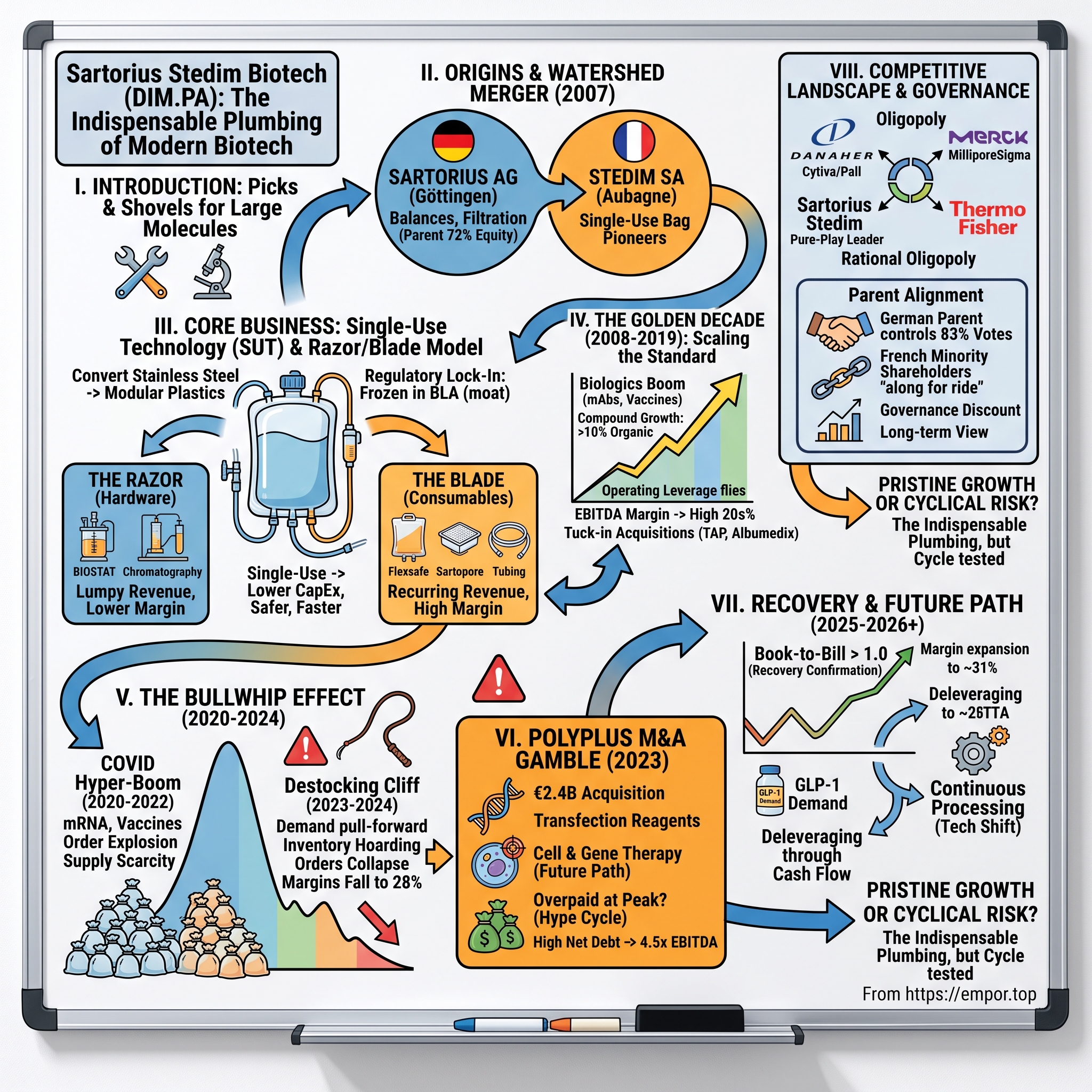
Sartorius Stedim Biotech S.A. (Euronext Paris: DIM.PA): The Indispensable Plumbing of Modern Biotechnology
I. Introduction & Episode Roadmap
Picture a modern biopharmaceutical factory. You might imagine gleaming steel, robotic arms, and rivers of liquid medicine. What you would actually see, if you walked the floor of a plant making a monoclonal antibody or an mRNA vaccine, is something closer to a very expensive, very clean kitchen full of plastic bags. Giant clear sacks of nutrient broth hang inside stainless cradles. Sterile tubes snake between them. Living cells—engineered to secrete a drug—swim inside disposable bioreactor bags that will be used once and then incinerated. Somewhere in that tangle of plastic, more likely than not, is a logo you have probably never noticed as a patient: Sartorius.
This is the strange, quiet empire we are going to unpack. Sartorius Stedim Biotech S.A., traded in Paris under the ticker DIM.PA, does not discover drugs. It runs no clinical trials, faces no binary "did the molecule work?" moment that can vaporize a biotech overnight. Instead, it sells the picks and shovels—or more precisely, the bags, filters, bioreactors, and reagents—that every large-molecule drug on Earth must pass through on its way to a patient. When Keytruda, Humira, or the GLP-1 blockbusters Ozempic and Wegovy are manufactured, the physical process of growing and purifying those biological molecules runs through equipment and consumables from a small handful of companies. Sartorius is one of them.
The central thesis is deceptively simple. Sartorius helped convert biomanufacturing from a world of cathedral-sized stainless-steel vats—capital-intensive, slow, and permanent—into modular "single-use" plastic plumbing that can be swapped, scaled, and thrown away. And here is the trick that turns a plastics business into something more interesting: once a specific Sartorius filter or bag is written into a drug's regulatory dossier with the U.S. Food and Drug Administration or the European Medicines Agency, ripping it out costs millions of dollars and years of revalidation. The customer is, in effect, married to the supplier for the commercial life of the drug.
That marriage produces a razor-and-blade economic engine: sell the hardware once, then sell the disposable consumables that feed it, batch after batch, for a decade or more. It is a beautiful model in theory. This article is about whether it is a beautiful model in practice—and about the brutal three-year stretch that tested every assumption underneath it.
What makes Sartorius Stedim an unusually instructive case for a long-term investor is precisely that it looks, on paper, like the perfect compounder—recurring revenue, high margins, structural growth, regulatory switching costs—and yet it delivered one of the most violent drawdowns in its sector's recent history. The gap between the theoretical quality of the model and the actual experience of owning the stock from 2021 to 2024 is the whole education. It is a reminder that a wonderful business bought at the wrong price, or run by managers who misjudge a cycle, can still inflict serious losses; that "recurring revenue" is not the same as "stable revenue" when your customers can hoard your product; and that switching costs protect market share far better than they protect volume. Hold those distinctions in mind as we go, because they are where the analysis earns its keep.
Our roadmap runs through five themes. First, the 2007 watershed merger, when German precision-instrument maker Sartorius AG fused its bioprocess arm with French single-use bag pioneer Stedim to create a pure-play powerhouse. Second, the post-COVID bullwhip—the demand explosion of 2020–2022 followed by the deepest destocking hangover in the history of life-science tools. Third, the €2.4 billion Polyplus gamble, a deal struck at the very top of the cell-and-gene-therapy hype cycle. Fourth, the governance puzzle of a French-listed company roughly three-quarters owned by a German parent. And fifth, the honest bull-versus-bear test: is this a pristine secular grower that merely stumbled, or a cyclical capital-goods business wearing a compounder's costume? Let us start with why anyone is locked in at all.
 Subscribe on LinkedIn
II. The Biopharma "Plumbing" Monopoly: Single-Use Technologies & The Razor-and-Blade Model
To understand why Sartorius matters, stand for a moment inside the old world it displaced. For most of the twentieth century, making a biological drug at scale meant building a stainless-steel bioreactor—a multi-story vessel holding ten or twenty thousand liters. These tanks were engineering marvels and operational nightmares. Between every batch they had to be cleaned in place and sterilized in place, blasted with purified water and high-pressure steam in validated cycles that could take days. Miss a step and you risk cross-contaminating one drug with another—a catastrophe in a regulated facility. A greenfield stainless plant could cost hundreds of millions and take years to qualify before it produced a single sellable gram.
The single-use revolution attacked that model at its root. Instead of a permanent steel tank, you drop a pre-sterilized, gamma-irradiated plastic bag into a reusable support frame. The bag arrives clean, does one batch, and gets thrown away. No cleaning validation. No cross-contamination risk between products. The capital math is stark: a single-use facility can require dramatically lower upfront investment than a stainless equivalent, and can be built and brought online far faster—months rather than years for a comparable steel plant, because you are not plumbing in the vast water-for-injection and steam-generation infrastructure a clean-in-place operation demands. For a young biotech racing a competitor to market, that compression of time-to-facility can be worth more than the capital saving itself; time, in a patent-protected drug's life, is the scarcest resource of all. For a biotech that does not yet know whether its molecule will be a blockbuster or a bust, that flexibility—the option to scale without betting the balance sheet on steel—is worth an enormous amount.
Here is the layman's version of the economics. Think of Sartorius as selling both the coffee machine and the pods. The "razor" is the durable hardware: bioreactor skids (branded BIOSTAT), chromatography systems, automated fluid-management rigs. These are sold at respectable but unspectacular margins and represent a minority of revenue. The "blades" are the consumables that flow through that hardware forever after: the single-use bags (Flexboy, Flexsafe), the sterilizing membrane filters (Sartopore), depth filters, tubing assemblies, cell-culture media, and purification products. Consumables make up the large majority of sales and carry structurally higher gross margins. Crucially, they are recurring: every batch a drugmaker runs consumes a fresh set. Sartorius's own reporting frames the business as heavily weighted toward this recurring consumable base rather than one-off equipment—which is exactly why a single bad year of hardware orders does not, by itself, break the model.
Now the part that turns recurring revenue into a genuine moat: regulatory lock-in. When a biologic wins approval, its Biologics License Application freezes the manufacturing process in extraordinary detail—down to the polymer blend of the plastic bag and the pore size of the filter membrane. Regulators care because these materials touch the drug; a filter can shed microscopic "leachables and extractables" into the product, and the approval rests on data showing the specific material is safe. Swapping to a rival's filter is therefore not a purchasing decision; it is a regulatory event, requiring new extractables studies, supplementary filings, and batch revalidation that can run into the millions and consume years. No rational manufacturer risks interrupting a drug that earns billions a year to shave a few percent off the cost of a bag.
To make the science concrete, consider what actually worries a regulator about a plastic bag. A living cell culture is a hostile chemistry experiment: warm, aqueous, agitated, sometimes acidic. Over days of contact, a plastic film can leach trace compounds into the broth—residual monomers, antioxidants, plasticizers—collectively called "leachables," and their theoretical worst-case potential is measured in advance as "extractables." Get the polymer chemistry wrong and those compounds can poison the cells, degrade the product, or, in the nightmare scenario, end up as an impurity in a drug injected into a patient. This is why a bag is not a commodity. Sartorius spends years characterizing the extractables profile of a film like Flexsafe, generating the validation dossiers its customers then fold into their own regulatory filings. When a drugmaker chooses a Sartorius bag, it is not buying plastic; it is buying a pre-assembled body of regulatory evidence it would otherwise have to generate itself. That evidence, more than the bag, is the product.
There is a second, subtler source of stickiness worth naming: the automation and data layer wrapped around the hardware. A modern bioreactor is not a dumb vessel but an instrumented one, with sensors, control software, and process-analytics feeds that plug into a customer's manufacturing execution systems. Once a biomanufacturer standardizes its operators, its standard operating procedures, and its data architecture around a particular vendor's platform, the cost of switching is not only regulatory but organizational—retraining staff, rewriting procedures, requalifying analytics. It is the same lock-in that keeps enterprises on familiar software long after cheaper alternatives appear, transplanted into a factory that makes medicine.
That is the whole game in one sentence: the switching cost is not paid by Sartorius's customer to Sartorius—it is paid to the regulator, in time and risk, which is far more expensive than money. It is worth being precise about the limit of this moat, though, because the story often overstates it. The lock-in is strongest for approved, commercial-stage products; it is much weaker in early clinical development, where a molecule may never reach market and switching is cheap. And lock-in does not guarantee volume—if a drug's demand falls, or a customer runs its existing plant at half capacity, Sartorius sells fewer blades no matter how sticky the razor. Keep that asymmetry in mind. It is the hinge on which the entire post-COVID drama turned. But first, how did a balance-maker from Göttingen and a bag-maker from Provence end up owning this chokepoint?
III. Origins & The Watershed 2007 Merger: Sartorius AG Meets Stedim SA
The German half of the story begins in 1870, when Florenz Sartorius founded a workshop in the university town of Göttingen to build precision analytical balances—the exquisitely sensitive scales that let chemists weigh a whisper of powder.17 For a century and a half, precision was the family religion. Balances led to filtration membranes, which led, eventually, to a biotechnology division making the separation and filtration products that pharmaceutical researchers relied on. Sartorius AG became the kind of quietly excellent German Mittelstand company that dominates a niche the public never thinks about.
The French half is younger and scrappier. Stedim, based in the sun-baked town of Aubagne near Marseille, cut its teeth on flexible container systems for storing and transferring sterile medical fluids. In the 1990s it made a prescient bet: the same disposable-bag technology used for blood and IV fluids could be adapted to hold something far more valuable and far more delicate—living cell cultures growing a biological drug. Stedim became a pioneer of the single-use bag for bioprocessing, precisely the product that would upend the stainless-steel establishment.
The cultural distance between the two firms was as wide as the geographic one, and that tension is part of what makes the combination interesting. Sartorius was the archetype of German engineering culture: methodical, precision-obsessed, patient, a company that measured its heritage in generations and its products in micrograms. Stedim was Provençal and entrepreneurial, a younger firm betting its future on a disruptive idea that the establishment still regarded with suspicion. In the early 2000s, plenty of process engineers viewed single-use bags as a fad—flimsy plastic that "serious" manufacturers would never trust for a commercial drug. Stedim was, in effect, selling against the grain of its own industry's instincts. That contrarian conviction is exactly the kind of asset that is cheap to acquire before it is proven and priceless afterward.
By the mid-2000s each company held one half of a natural whole. Sartorius owned world-class filtration and separation—the purification end of the process. Stedim owned the leading single-use fluid-handling bags—the containment end. A drugmaker building a modern single-use line wanted both. In 2007, Sartorius AG combined its biotechnology division with Stedim S.A. and became majority owner of the merged entity, creating Sartorius Stedim Biotech, listed in Paris.17 It was, in hindsight, a masterstroke of category definition: rather than compete across a fragmented landscape, the combined company could offer a continuous single-use chain from cell culture through filtration to final fill—one vendor for the whole plumbing diagram.
The deal also set the corporate architecture that still shapes the investment case today. Sartorius AG did not fully absorb its French offspring. It kept SSB as a separately listed S.A. on Euronext Paris, retaining majority control while leaving a minority free float. As of the company's current disclosures, the German parent holds roughly 72% of SSB's share capital and around 83% of the voting rights, the gap reflecting double-voting-right shares that reward long-term holders.9 (Older snapshots put those figures nearer 74% and 85%; the direction is unchanged—the parent is firmly in command.) That structure gives SSB its own listing, its own currency for acquisitions, and a transparent pure-play valuation, while ensuring no outsider can ever seize the wheel. It is an elegant arrangement in calm weather. Whether it serves minority shareholders in a storm is a question we will stress-test later. For now, the merger did what it was designed to do—and the next decade would prove just how large the opportunity underneath it had become.
IV. The Golden Decade (2008–2019): Scaling the Bioprocess Standard
If you want to understand why Sartorius spent the 2010s as one of Europe's great compounding machines, you have to understand a tectonic shift in what medicine itself was made of. For most of pharmaceutical history, drugs were small molecules—chemically synthesized pills like aspirin and statins, elegant and cheap to mass-produce. Then came the biologics: large, complex proteins and antibodies grown inside living cells, capable of targeting diseases that small molecules could not touch. Monoclonal antibodies for cancer and autoimmune disease, recombinant proteins, vaccines. Over two decades biologics went from a curiosity to the center of gravity of the industry's pipeline, climbing from a small minority of drug candidates to a dominant share of the most valuable ones.
Why did biologics take over? Because they can do things chemistry cannot. A monoclonal antibody is a guided missile—engineered to bind one specific target on a cancer cell or an inflammatory molecule with a precision no small pill can match. That specificity translates into efficacy against diseases that had resisted treatment for decades: certain cancers, rheumatoid arthritis, Crohn's disease, macular degeneration. The catch is that you cannot synthesize an antibody in a chemical reactor; it is too large and too complex. You have to grow it, coaxing genetically engineered cells to secrete it, then harvest and purify the result. Biology, not chemistry, becomes the factory floor—and biology needs bioreactors, filters, and media.
Every one of those biologics had to be manufactured in exactly the kind of cell-culture-and-purification process Sartorius equipped. And as the industry adopted single-use technology—first in research and clinical-scale batches, then creeping into commercial manufacturing—Sartorius rode two compounding curves at once: more biologics, and more of each biologic made with disposable plumbing. There was a third, quieter tailwind underneath: process intensification. Improvements in cell-line productivity meant a modern cell culture could yield far more grams of antibody per liter than a decade earlier, which counterintuitively favored single-use. When yields are high enough, a smaller disposable bioreactor can produce commercial quantities that once required a giant steel tank—shrinking the scale at which single-use makes economic sense and pulling adoption deeper into commercial manufacturing. The result was a business that consistently outgrew its market. Where the broader life-science tools sector might grow high-single-digits, Sartorius Stedim's bioprocess business delivered low-double-digit organic growth for years, and the operating leverage inherent in high-margin consumables pushed underlying EBITDA margins up steadily through the decade—from around 20% early in the period toward the high-20s by 2019. The mechanism behind that margin climb is the heart of why investors prize consumable-heavy models: once the fixed cost of a cleanroom and its validation is paid, each incremental bag or filter sold carries a very high contribution margin, so as volumes compound, profitability expands faster than revenue. It is the same operating-leverage flywheel that makes software attractive, transplanted into medical-grade plastics—and, crucially, it runs in reverse just as powerfully, which is the lesson 2023 would later teach in brutal fashion. Revenue reached roughly €1.44 billion by 2019, the last "normal" year before the pandemic scrambled every comparison.7
Management did not simply ride the wave; it deliberately widened the product stack through disciplined bolt-on acquisitions, each one adding a missing piece to the end-to-end offering. Cell-culture and analytics capabilities came in through deals like TAP Biosystems; testing and aseptic-processing know-how through others. The pattern was consistent and, importantly, small. Even the deals that spilled just past the golden decade kept to the template: a majority stake in Germany's CellGenix for roughly €100 million in 2021 to add cell-and-gene-therapy reagents,15 and UK-based recombinant-albumin specialist Albumedix for about £415 million in 2022.16 These were tuck-ins bought at sane prices and folded into an existing commercial machine, not transformational bets. This is the behavior that earned the management team its reputation for capital discipline—a reputation worth remembering, because it is precisely the reputation that a much larger, much later deal would put on trial.
The analytical takeaway from the golden decade is that Sartorius had, by 2019, genuinely achieved something rare: a structurally growing end market, a differentiated product set, real switching costs, and a margin trajectory heading in one direction. That is the profile of a high-quality compounder, and the market rewarded it as one, awarding the shares a premium multiple that assumed the growth would simply continue. Then a virus arrived, and for about two years it looked like the compounding story had not just continued but gone into overdrive. That overdrive turned out to be the most dangerous thing that ever happened to the company.
V. The COVID Hyper-Boom & The Brutal Destocking Cliff (2020–2024)
In early 2020, as the world locked down, Sartorius found itself sitting on exactly the inventory the planet suddenly, desperately needed. mRNA and viral-vector COVID vaccines from Pfizer/BioNTech, Moderna, and AstraZeneca had to be manufactured at civilization-scale speed—and they were made in single-use bioreactors, filtered through single-use membranes, moved through single-use tubing. Sartorius became a primary global supplier to the vaccine effort. Demand did not grow; it detonated.
The numbers tell the story of a company drinking from a fire hose. The parent Sartorius Group's revenue reached roughly €4.18 billion in 2022, with the bioprocess-heavy engine driving the surge, and group underlying EBITDA margin climbing to around 34%.6 At the SSB level, the bioprocess business ran at margins in the mid-30s—roughly 35% underlying EBITDA—levels that management itself, in calmer retrospect, would describe as elevated.6 For a business that had entered the decade in the high-20s on margin, this was a step change that looked, from inside the boom, like a permanent structural improvement.
It was not. And the mechanism that turned the boom into a bust is one every student of supply chains knows by name: the bullwhip effect. Terrified of running out during a pandemic, biopharma manufacturers and contract producers—the Lonzas, the 药明康德 WuXi AppTecs, the 삼성바이오로직스 Samsung Biologics of the world—did what any rational buyer does when supply feels scarce: they over-ordered. They placed double and triple orders, they padded safety stock, they accumulated what by some estimates amounted to a year or more of consumables sitting in warehouses. Every link in the chain built its own buffer, and each buffer amplified the demand signal reaching Sartorius until it bore little relation to how many drugs were actually being made.
It is worth pausing on why intelligent, well-run companies made this mistake in unison, because it was not stupidity—it was rational behavior producing a collectively irrational outcome. Each buyer, facing genuine uncertainty about whether the next batch of filters would arrive, chose to over-order as cheap insurance. A few months of extra safety stock costs little relative to the catastrophe of halting production of a life-saving vaccine. But when thousands of buyers all buy insurance simultaneously, and when each tier of the supply chain adds its own buffer on top of the tier below, the aggregate order signal balloons far beyond real end-consumption. Sartorius, reading its own soaring order book, could not easily tell how much was true demand and how much was phantom buffer. Neither, it turned out, could its customers.
When the pandemic emergency faded and supply chains normalized in 2022–2023, the whip cracked back. Customers stopped ordering not because they had stopped making drugs, but because they were sitting on mountains of inventory they now had to burn through first. This is "destocking," and for Sartorius it was catastrophic. Full-year 2023 sales fell to about €2.78 billion, a decline of roughly 21% organically, while order intake—the forward-looking lifeblood—collapsed by around 24%.4 Underlying EBITDA margin dropped from the mid-30s to about 28%.4 The shares, which had peaked above €500 in 2021 on the assumption that COVID-era demand was the new baseline, fell by roughly two-thirds.19
The most revealing artifact of this period is not a number; it is the shift in management's voice across the earnings calls. Through 2021 and 2022, the tone was confident, framing pandemic gains as a durable acceleration of an already-strong secular trend. Then came the reckoning. On the October 2023 nine-month call—the one where management had, a week earlier, pre-announced a fresh guidance cut—the language turned defensive and granular.5 CEO Joachim Kreuzburg told analysts the company believed it had "seen the bottom of our order intake development most likely around end of Q2," but conceded in the same breath that "the momentum is lower than initially expected." He insisted "the fundamental growth drivers" remained "intact"—while admitting to "above average volatility" driven by destocking plus weak investment in China and the U.S. Group order intake had fallen 28% in constant currency over nine months, with the bioprocess book-to-bill still below 1.0.5 Analysts were not soothed. On the same call one pressed management directly on whether leverage had climbed so high that an equity raise loomed; the CFO had to publicly designate a share issue a "fallback plan" that was explicitly "not any part of" the base case.
That exchange matters for a credibility assessment, because it exposes the real error. Management's sin was not the destocking itself—that was an industry-wide phenomenon nobody fully escaped. The sin was reading a temporary pull-forward of demand as a permanent step-up, and investing behind that misread. Sartorius poured capital into capacity expansions across sites in Europe, the Americas, and Asia precisely as the demand it was building for evaporated, leaving expensive new cleanrooms running well below the utilization the returns assumed. That is a forecasting failure with a balance-sheet consequence, and it is the honest counterweight to the "high-quality compounder" narrative.
The regional texture of the downturn deepened the pain. On the 2023 calls, management repeatedly singled out the United States and China as the softest markets—not only destocking, but genuinely weak customer investment, as smaller biotechs starved of venture funding conserved cash and larger players deferred capital projects. The bioprocess book-to-bill ratio, which had cratered to around 0.8 at the trough, told the story better than any revenue figure: for every euro of product shipped, well under a euro of new orders was coming in the door, meaning the backlog was draining faster than it refilled.5 Management's framing on those calls—orders had "bottomed" around mid-2023 but the recovery's "momentum" was weaker than hoped—was technically accurate and yet, quarter after quarter, kept having to be revised, which is precisely the pattern that erodes analyst trust: not a single large miss, but a series of "we've seen the bottom" statements that the next quarter softened. The one durable lesson from this stretch is that in a business selling into a bullwhipped supply chain, order intake is truth and revenue is history. It also set the stage for the single most controversial capital-allocation decision in the company's history—a decision made, as fate would have it, at the worst possible moment.
VI. Capital Allocation & The Polyplus M&A Gamble: Overpaying at the Peak?
Timing, in acquisitions, is everything—and Sartorius's timing on Polyplus is a case study in how a strategically defensible deal can still be a financially painful one. In March 2023, with the destocking storm already gathering, Sartorius Stedim announced it would acquire Polyplus, a Strasbourg-based maker of transfection reagents and plasmid DNA, for approximately €2.4 billion, buying it from private-equity owners ARCHIMED and an affiliate of Warburg Pincus.1 The deal completed that July.2
What does Polyplus actually make, and why did Sartorius want it? Transfection reagents are the chemical delivery vehicles that ferry genetic material into cells—the essential first step in manufacturing the viral vectors used in cell and gene therapies for AAV and lentiviral products. If gene therapy is the future of medicine for certain rare and genetic diseases, then transfection reagents are a toll booth on the road into that future, sitting upstream of the whole process. Owning Polyplus gave Sartorius a leading position in a scarce, high-margin, deeply consumable-like niche with genuine long-term optionality. Strategically, it fit the razor-and-blade logic perfectly.
Financially, the price was breathtaking. Sartorius disclosed that Polyplus generated sales "in the upper double-digit million-euro range" with a "very substantial EBITDA margin."1 Do the arithmetic: paying roughly €2.4 billion for a company with perhaps €90–100 million of revenue implies a multiple north of 20 times sales—an EV/sales figure normally reserved for hyper-growth software, not a reagents supplier. This was the absolute peak of the cell-and-gene-therapy hype cycle, when investors were paying almost any price for exposure to the theme. And then the cycle turned. Interest rates spiked, biotech venture funding froze, and dozens of clinical-stage cell-and-gene-therapy startups—precisely Polyplus's customer base—delayed or cancelled programs. Sartorius had bought a call option on a boom at the moment the boom went bust.
The balance-sheet consequences compounded the pain. Coming on top of the earnings collapse, the Polyplus outlay pushed the parent group's net debt above €5 billion and leverage to roughly 4.5 times underlying EBITDA by late 2023—an uncomfortable altitude for any investment-grade company, and doubly so during a downturn.5 Total investing cash flow for the first nine months of 2023 approached €2.7 billion, dominated by the acquisition.5 Management spent the next two years insisting the deleveraging plan rested on internal cash generation rather than an equity raise, and, to their credit, they executed it: net debt at the SSB level fell to about €2.2 billion and leverage to 2.8 times by the end of 2024, and to roughly 2.4 times by the end of 2025.311 The dilutive equity raise the skeptics feared did not, in the end, materialize. The mechanics of that recovery are worth understanding because they reveal something reassuring about the underlying business: even during the earnings collapse, operating cash flow held up remarkably well. In the first nine months of 2023, despite underlying EBITDA falling roughly 30%, operating cash flow actually rose about 20%, as the company released working capital—running down its own inventories and collecting receivables—that had ballooned during the boom.5 A business that throws off cash even while its profits are cratering is a fundamentally cash-generative one, and that quality is precisely what allowed Sartorius to deleverage without tapping shareholders. It is the strongest single piece of evidence that beneath the cyclical drama sits a genuinely high-return franchise.
There is a deeper strategic logic to Polyplus that the price obscures, and it is worth stating fairly before judging the deal. Sartorius's core franchise serves the manufacture of biologics—antibodies and proteins made by growing cells. Cell and gene therapy is a different modality: instead of harvesting a molecule the cells secrete, you engineer the cells or the genes themselves and deliver them into the patient. Manufacturing those therapies requires viral vectors—engineered viruses that act as delivery trucks for genetic payloads—and making viral vectors at scale is notoriously difficult, low-yield, and expensive. Transfection, Polyplus's specialty, is the critical upstream step. By owning it, Sartorius positioned itself not just in today's biologics but in the next modality, hedging the risk that its filtration-and-bag franchise ages as medicine evolves. That is genuine strategic foresight; the objection is entirely about valuation and timing, not direction.
How should an independent investor grade this? Set it against the industry's other landmark bets. Danaher paid about $21.4 billion for GE's biopharma business (Cytiva) in 2020, a colossal sum but one that bought a genuine scale leader with billions in revenue.12 Thermo Fisher's earlier gene-therapy move on Brammer Bio was a fraction of Polyplus's revenue multiple. Against that backdrop, Polyplus looks like the right idea executed at the wrong price and the wrong time. It is entirely possible that in 2033, with gene therapies commercialized at scale, Polyplus proves a bargain. It is equally possible that slow adoption forces a goodwill write-down running into the hundreds of millions. Both can be true of the same deal; what is not in dispute is that it consumed financial flexibility precisely when the business most needed a cushion. That tension—brilliant plumbing business, questionable peak-cycle deal—runs straight into the question of what Sartorius actually is underneath the headlines.
VII. Segment Breakdown & Core Economics: Bioprocess Solutions vs. Lab Products
Strip away the corporate structure and Sartorius Stedim is, to a first approximation, a single business wearing a thin second coat. The overwhelming majority of its revenue and nearly all of its profit come from one place: Bioprocess Solutions. This is what makes it a true pure-play, and it is the reason its shares trade less like a diversified life-science conglomerate and more like a leveraged bet on a single end market—biological drug manufacturing. That concentration is both the appeal and the vulnerability.
Bioprocess Solutions, the value driver, is best understood as four interlocking sub-segments. Fluid management is the single-use bags, sterile tubing, connectors, and transfer assemblies—the literal plumbing, where the Flexboy and Flexsafe families live. Filtration and separation covers the sterilizing-grade membrane filters, depth filters, and cross-flow cassettes (Sartopore, Sartocon) that clarify and purify the product. Fermentation and cell culture spans the single-use bioreactors (BIOSTAT STR), the cell-culture media that feed the cells, and the process-analytics instruments that watch the batch. And advanced therapies, the newest leg, is the Polyplus transfection reagents and viral-vector purification tools aimed at cell and gene therapy. What unites all four is the razor-and-blade economics described earlier: high gross margins, a heavy skew toward recurring consumables, and regulatory switching costs that make the installed base sticky once a drug is commercialized.
The smaller, non-core sibling is Lab Products & Services—premium laboratory balances (the direct descendants of Florenz Sartorius's original scales), water-purification units, and liquid-handling instruments sold to research labs. It is a decent business, but a structurally inferior one: lower margin, slower growth, and painfully sensitive to the discretionary R&D budgets of academic and early-stage biotech labs. That sensitivity showed brutally during the downturn—on the 2023 calls, management repeatedly flagged the lab division as the weaker performer, hammered by cautious cash management among smaller customers in China and the U.S.5 (In the parent Sartorius Group's structure, this sits in a separate Lab Products & Services division; within the SSB perimeter the point stands—it is the junior partner.)
The economic quality varies sharply across those four bioprocess legs, and understanding the gradient matters. Fluid management and filtration are the crown jewels: overwhelmingly consumable, deeply regulatory-locked, and sold batch after batch for the life of a drug—this is the annuity. Fermentation and cell culture is more mixed: the bioreactor hardware is lumpy and capital-goods-like, swinging with customers' facility-build cycles, while the media that feeds the cells is recurring. Advanced therapies is the highest-growth but least-proven leg, its economics dependent on a cell-and-gene-therapy market still early in its commercial life. A sophisticated investor therefore should not treat "bioprocess revenue" as one homogeneous stream; the recurring consumable core deserves a premium, while the equipment and advanced-therapy pieces carry more cyclicality and more uncertainty respectively. The 2023 downturn was so severe partly because it hit all three softer areas at once—equipment orders froze, advanced-therapy customers lost funding, and even the consumable annuity was masked by destocking.
The analytical implication of this segment mix is that Sartorius offers almost no diversification cushion. A conglomerate like Danaher or Thermo can lean on diagnostics or lab equipment when bioprocessing sneezes. Sartorius Stedim cannot; when biomanufacturing volumes fall, essentially the entire company falls with them, as 2023 demonstrated with unforgiving clarity. The flip side is leverage in the good direction: when biologics volumes compound, there is no drag from slower divisions to dilute the result. Investors are buying a purer, sharper instrument—more upside, more downside, fewer places to hide. Which raises the obvious next question: in that one market it lives or dies by, who is Sartorius actually fighting?
VIII. Competitive Landscape: Pure-Play SSB vs. The Conglomerate Oligopoly
Bioprocessing is not a free-for-all; it is a rational oligopoly dominated by roughly four players who mostly compete on innovation and service rather than ruinous price wars. Understanding the balance of power among them is essential to judging whether Sartorius's moat is as deep as the bulls claim.
At the top by sheer scale sits Danaher's Cytiva, bolstered by Pall—the product of Danaher's roughly $21.4 billion acquisition of GE's biopharma business in 2020.12 Cytiva is the heavyweight in chromatography resins and downstream purification, and its combination with Pall's filtration created a full-line competitor with enormous reach. Next is Sartorius Stedim itself, the only focused pure-play among the giants, and the acknowledged leader in single-use fluid management, membrane filtration, and single-use bioreactors. Third is Germany's Merck KGaA, whose life-science arm MilliporeSigma is a powerhouse in sterile filtration and chromatography media; its Process Solutions business unit generated roughly €3.8 billion in 2023 even after the destocking hit.13 Fourth is Thermo Fisher Scientific, the largest life-science company overall and a leader in cell-culture media (Gibco) and single-use containers, though it does not itemize a standalone bioprocessing figure in its filings.14
A crucial structural feature of this market is who the customer actually is. Increasingly, biologics are made not by the drug's owner but by contract development and manufacturing organizations—CDMOs like Lonza, 삼성바이오로직스 Samsung Biologics, and 药明康德 WuXi AppTec—that build enormous flexible facilities and manufacture on behalf of dozens of biotech and pharma clients. This concentrates purchasing power: a single CDMO commissioning a new plant places orders that dwarf any individual drugmaker's, which sharpens buyer negotiating leverage on the hardware "razor." But it cuts the other way on consumables, because once a CDMO validates a Sartorius-equipped line for a client's approved product, the regulatory lock-in transfers with it. The CDMO channel also injects a fresh geopolitical variable: the U.S. BIOSECURE Act, aimed at curbing reliance on certain Chinese biomanufacturers, threatens the volumes of large customers like WuXi, and any reshuffling of where the world's biologics get made ripples straight back to their equipment suppliers.
Within the categories that matter to Sartorius, the picture is one of leadership in some rings and hard fights in others. In single-use bags and fluid management, Sartorius is the front-runner, competing head-to-head with Thermo and Danaher. In sterile filtration it is a strong number two, generally reckoned behind Merck's MilliporeSigma. In single-use bioreactors it leads with the BIOSTAT line, dueling directly with Cytiva. No player owns the whole board; each dominates certain rooms of the house.
Here the strategic debate gets genuinely interesting, because pure-play and conglomerate are opposing bets. Sartorius's edge is focus: 100% of its attention, R&D, and commercial energy points at bioprocessing, which arguably yields faster product iteration and deeper customer intimacy, and makes it a "Switzerland" that partners without the conflicts of a competitor who also sells you diagnostics or CDMO services. The conglomerate's edge is exactly that breadth—Danaher and Thermo can bundle bioprocess consumables with clinical-trial supplies, contract manufacturing (Thermo's Patheon), and instruments, and they can absorb a downturn in one division with strength in another. During 2023–2024, that resilience was not academic: the diversified players had softer landings than the pure-play, whose stock fell further precisely because it had nowhere to hide. The competitive verdict, then, is nuanced. Sartorius has a defensible leadership position in genuine niches, protected by the switching costs already described. But it is not a monopolist; it is one of four disciplined rivals, and its purity is simultaneously its sharpest weapon and its greatest exposure. Whoever is steering that bet had better be good—so let us look at who is holding the wheel.
IX. Management, Governance, & The Parent Alignment Test
For nearly two decades, one man was Sartorius. Joachim Kreuzburg served as chief executive and chairman of both the parent Sartorius AG and its French subsidiary, steering the group through the golden decade of compounding and the pandemic boom.5 His was the confident voice on the 2021–2022 calls that framed COVID demand as a durable step-up—and also the voice that had to walk that framing back in 2023. Any credibility assessment of Sartorius has to hold both facts at once: Kreuzburg built an exceptional franchise, and he presided over the demand misread that led the company to over-invest into a cyclical peak.
The current management picture reflects a deliberate generational handover. In March 2023, René Fáber took over as CEO of Sartorius Stedim Biotech, having run the Bioprocess Solutions division since 2019 and served as SSB's deputy CEO.8 Fáber is an operator's operator—a chemist by training, with a PhD in polymer chemistry from the Technical University of Munich, who joined Sartorius in 2002 and rose through the bioprocess business he now leads.8 For a company whose moat rests on the material science of plastic films and membranes, a polymer chemist in the CEO chair is a fitting choice. At the parent level, the transition went further: by the February 2026 results call, Michael Grosse had stepped in as CEO of the Sartorius Group with Florian Funck as CFO, while Fáber continued to run bioprocessing as SSB's CEO—marking the end of the long Kreuzburg era.11 The choreography of that handover matters for how investors should read continuity of accountability. Kreuzburg did not vanish overnight; he stepped back from the CEO role while the company worked through the downturn and its aftermath, providing continuity precisely when the destocking crisis and Polyplus integration demanded a steady hand. But it also means the leaders now setting fresh targets are, in part, the same people—or their close lieutenants—who set the pandemic-era targets that missed. A skeptical investor watching the 2026 guidance should therefore weight it against that lineage: this is broadly the same management culture that misjudged the last cycle, now asking the market to trust its read on the recovery. Continuity is reassuring for execution and unsettling for accountability, and both are true at once.
The compensation architecture deserves a glance, because incentives reveal what a board actually values. Sartorius has tied executive pay to underlying EBITDA margin and revenue growth—metrics that align management with the operating levers investors care about, but which, in the pandemic boom, may have inadvertently rewarded the very capacity expansion that later proved excessive. When your bonus keys off growth and margin during a period when both are being flattered by phantom demand, the incentive to interrogate whether that demand is real weakens precisely when interrogation matters most. This is not an accusation of bad faith; it is an observation about how even well-designed incentive plans can amplify a cyclical misread. The corrective test is behavior in the downturn, and here the record is more reassuring: management launched a restructuring and cost-reduction program through 2023–2024 to defend the margin floor as revenue fell, recognizing one-time restructuring charges to right-size the cost base rather than letting profitability collapse.18
Now the governance question that hovers over every minority shareholder in DIM.PA: what does it mean to own a slice of a company that a German parent controls with roughly 72% of the equity and 83% of the votes?9 The bull framing is that this alignment is a feature. The parent takes a genuinely long-term view, shields the subsidiary from hostile takeovers and quarterly Wall Street short-termism, and has every incentive to see SSB thrive since it owns most of it. The bear framing is that concentrated control invites the classic frictions: transfer pricing between parent and subsidiary, allocation of shared corporate overhead, IP licensing arrangements, and decisions about capital raising that a controlling holder can shape to its own convenience. When one shareholder holds 83% of the votes, the other 17% are along for the ride, and there is no activist campaign, no proxy fight, and no takeover premium that can ever force a change. The minority's protection is entirely a matter of the parent choosing to treat them fairly.
On the evidence, has management earned trust? The scorecard is genuinely mixed, and honesty requires saying so. On the debit side: the demand misread and peak-cycle capex, and the eye-watering price paid for Polyplus. On the credit side: when the crisis hit, management did not hide. It cut guidance clearly and repeatedly rather than dribbling out bad news, it launched a restructuring and cost program to defend margins as revenue fell,18 and—critically—it delivered on its most-scrutinized promise, deleveraging through internal cash generation rather than the dilutive equity raise analysts openly feared on the 2023 call.511 That willingness to set a specific plan when things went wrong, and then hit it, is the strongest single argument for management credibility. The weakest is that the plan was only necessary because of choices management itself had made. That duality—capable operators who nonetheless bought high and built ahead of demand—is the honest read, and it is the right lens for stress-testing the moat itself.
X. Investor Playbook & Moat Stress-Test
Strip the narrative back to its analytical skeleton and ask the only question that matters for a long-term owner: how durable is the advantage, really? Two frameworks help pressure-test it—Hamilton Helmer's 7 Powers and Porter's Five Forces—applied not as a checklist but as an interrogation.
Start with the power that does the heaviest lifting: switching costs, and here Sartorius has one of the cleaner examples in all of healthcare. Because a specific filter or bag is written into a drug's regulatory filing, replacing it triggers revalidation costs commonly estimated in the millions per production line, plus the risk of interrupting a drug that may earn billions a year. This is not a preference; it is a structural lock that strengthens as a drug's commercial life lengthens. The honest caveat, again, is that it binds hardest on approved products and barely at all in early development. The second power is process power—decades of accumulated, hard-to-replicate know-how in polymer formulation, so that a Flexsafe film holds a batch without shedding toxic leachables or springing a pinhole leak under agitation. You cannot buy this off a shelf; you earn it over years of iteration and regulatory scrutiny, which is why new entrants struggle. Scale economies add a third layer: cleanroom manufacturing carries huge fixed costs, and high volume drives down per-unit sterilization and extrusion costs—though the 2023 overcapacity episode showed this power cuts both ways, punishing whoever built ahead of demand. Cornered resource (proprietary transfection chemistry from Polyplus, patented membrane geometries) and a historical dose of counter-positioning (pitching disposable systems against incumbents wedded to stainless steel) round out the set.
Run Porter's Five Forces and the same picture sharpens. Threat of new entrants: very low—the combination of regulatory barriers, customer risk-aversion, and deep IP is close to prohibitive for a credible full-line challenger, which is why the industry is a stable oligopoly rather than a churning market. Bargaining power of buyers: genuinely two-sided—biopharma giants have deep pockets and negotiate hard on price, but once a drug is commercialized the buyer is the locked-in party, not the supplier. Bargaining power of suppliers: moderate—medical-grade resins and specialty chemicals are specialized inputs, mitigated by dual-sourcing. Threat of substitutes: low today, with the main long-run wildcard being continuous or intensified bioprocessing, a technology shift Sartorius is itself investing in rather than being blindsided by. Competitive rivalry: moderate and, crucially, rational—four disciplined players competing on innovation and service, not the destructive price wars that would wreck the economics for everyone.
One power the bulls sometimes invoke does not really apply, and it is worth being disciplined about the distinction. There are no network effects here in the Silicon Valley sense—a Sartorius filter does not become more valuable to one customer because another customer uses it. What looks superficially like a network effect is really the accumulation of an installed base and an industry standard: because so many approved drugs already run on Sartorius equipment, new drugs default to it to piggyback on existing validation know-how, and the ecosystem of trained operators and regulatory precedent compounds. That is a genuine advantage, but it is a standard-setting and switching-cost dynamic, not a network effect, and conflating the two flatters the moat. Precision about the mechanism matters, because a standard can be dislodged by a superior new standard in a way a true network effect resists—and continuous bioprocessing, if it ever displaces batch manufacturing wholesale, is exactly the kind of paradigm shift that could reset which standard the industry validates around.
So the moat is real, but it is not the impregnable monopoly the more excitable framing implies. The most accurate description is a strong, durable oligopoly position anchored by genuine switching costs and process know-how—an advantage that compounds on the installed base of approved drugs, but one that neither guarantees volume when end-demand softens nor prevents a well-funded conglomerate from competing hard on the next new molecule. That is a high-quality moat with clearly mapped edges. The job of the next section is to press on exactly where those edges could give way.
XI. Skeptical Investor / Activist Stress-Test, Risk Radar, & Bull vs. Bear Case
Imagine a sharp activist or a skeptical long/short investor sitting across the table from management. Where do they push? First, on governance and minority extraction: with the German parent holding 83% of the votes, what assurance do French minority holders have that shared overhead, IP licensing, and transfer pricing are struck at arm's length rather than tilted toward the parent's convenience? There is no market mechanism to force fairness here—no takeover threat, no proxy leverage—so the entire protection rests on parent goodwill, which is not something a fiduciary should take on faith. Second, on returns: the industry expanded manufacturing capacity dramatically during COVID, and with equipment demand slow to recover, return on invested capital that once sat around 20% compressed toward single digits during the trough. Capital was deployed at the top of the cycle to build assets now running below their assumed utilization—the textbook definition of value-destructive timing. Third, on the balance sheet: even after diligent deleveraging, the Polyplus-inflated debt load constrained buybacks and dividend growth for years, a real opportunity cost for shareholders.
There is a fourth line of attack an activist would probably press hardest, because it is the one with a live financial mechanism: the dual-listed structure itself. Because both Sartorius AG and Sartorius Stedim Biotech trade publicly, and because the parent's fortunes are dominated by its stake in the subsidiary, the arrangement invites a permanent question about whether capital, dividends, and strategic priority flow to the benefit of the whole or the controller. A skeptic would note that SSB's reliable cash generation is useful to a parent carrying its own obligations, and would ask pointedly whether major decisions—the timing and financing of Polyplus, the pace of dividends during deleveraging, the allocation of shared R&D and overhead—were optimized for DIM.PA's minority holders or for the consolidated group. There is no public evidence of abuse, and the parent's own heavy ownership aligns most interests; but the structural point stands that minorities hold their position at the sufferance of a controller they cannot outvote, and that is a discount factor no amount of operating excellence fully erases.
The material risk radar beyond those governance and capital points has three live wires. The first is biopharma funding: a prolonged high-rate environment starves early-stage biotech of venture capital, slowing the clinical pipelines that eventually become consumable demand—the leading edge of Sartorius's growth. The second is geopolitics and China: domestic price pressure in China, uncertainty around the U.S. BIOSECURE Act's impact on Chinese contract manufacturers like WuXi, and the emergence of lower-cost local single-use competitors all threaten a region management has repeatedly flagged as soft.5 The third is equipment capex stagnation: if customers keep running their overbuilt pandemic-era facilities rather than commissioning new lines, the hardware "razor" that seeds future consumable "blades" stays depressed, capping the top line. Underneath these sits a longer-dated technology risk worth naming: the same single-use disruption Sartorius rode against stainless steel could, in principle, be run against Sartorius by the next paradigm—continuous or fully intensified bioprocessing, or a shift toward standardized, commoditized single-use components from lower-cost manufacturers, including emerging Chinese suppliers courting a domestic market under pressure to localize. The company's defense is to lead the transition rather than defend the incumbency, investing in continuous-processing R&D; whether that keeps it ahead or merely cannibalizes its own high-margin batch franchise is an open, multi-year question.
That sets up the explicit bull-versus-bear spine. The bull case is that the destocking was a violent but temporary cyclical correction inside a pristine secular story, and the numbers through 2025 support a genuine recovery: full-year 2025 revenue rose to about €2.97 billion, up roughly 10% in constant currency, with underlying EBITDA margin recovering to about 30.8%—nearly three points of expansion—and leverage falling to about 2.4 times.11 Order intake had already turned, with book-to-bill back above 1.0 and Q1 2025 revenue up double digits.10 The bull argues consumables are resuming structural high-single-digit volume growth—driven by expanding biologics, biosimilars, and surging demand to fill and finish GLP-1 blockbusters—that operating leverage drags margins back toward the low-30s and beyond, and that Polyplus is a free option on the eventual commercialization of cell and gene therapy. On the February 2026 call, incoming Group CEO Michael Grosse struck exactly this note, telling investors the company was "well positioned to benefit from continued recovery" and had "laid a solid foundation" for 2026, with group guidance for roughly 5–9% sales growth.11
There is a specific, near-term catalyst the bull leans on that deserves its own mention: GLP-1 drugs. The weight-loss and diabetes blockbusters that have reshaped pharmaceutical economics are, in their newer forms, biologically manufactured and injected, and they are being produced at genuinely unprecedented volumes to meet demand that has strained the industry's fill-and-finish capacity. Every vial requires sterile filtration and single-use fluid handling. If even a fraction of the manufacturing scale-up the GLP-1 wave implies flows through Sartorius's consumables, it represents a volume tailwind that has nothing to do with the pandemic and everything to do with a durable, mass-market therapeutic category. The bull argues this is exactly the kind of structural driver that makes the post-COVID recovery more than a mere mean-reversion.
The bear case does not dispute the rebound; it disputes its durability and its ceiling. Structural overcapacity, the bear argues, could keep equipment sales depressed for years, capping overall growth well below the low-teens the mid-term targets assume. Competitors sitting on their own underutilized factories may discount consumables aggressively, pressuring the pricing power the bull case depends on. And if gene-therapy adoption stays slow, Polyplus becomes not an option but a liability—a candidate for a multi-hundred-million-euro goodwill write-down that would crystallize the peak-cycle overpayment. There is also the plain fact that the shares still carry a premium multiple that bakes in the bull's recovery; if growth settles at the low end of the range rather than the high end, the valuation itself is the risk. The most intellectually honest position holds both cases in tension: this is a genuinely high-quality franchise that a demanding investor should nonetheless refuse to treat as risk-free, because its own recent history proves how quickly a "structural" story can reveal a cyclical spine.
XII. Key KPIs, Primary Transcripts, & What to Watch
If you could track only a few numbers to know whether the Sartorius story is on or off track, which would they be? Resist the temptation to drown in the income statement; three indicators carry most of the signal, and they map directly onto the debates above.
The first and most important is order intake and the book-to-bill ratio—orders received divided by revenue recognized. This is the leading indicator that saw both the crash and the recovery before the revenue line did. A book-to-bill sustainably above 1.0 means the order book is refilling faster than it is being drained, the single cleanest sign that destocking is truly over and underlying volume demand has resumed; it was the metric management pointed to on the October 2023 call to argue orders had bottomed, and its return above 1.0 by early 2025 was the recovery's first hard confirmation.510 The second is the consumables-versus-equipment revenue mix. Because consumables are the recurring, high-margin, regulatory-locked "blades" and equipment is the lumpier "razor," a healthy, rising consumable share signals that the recurring engine is intact even when hardware orders are soft—and it is the mix, more than the headline, that tells you how much of the revenue is genuinely sticky. The third is the underlying EBITDA margin, the clearest single gauge of how far capacity utilization has normalized: the climb back from roughly 28% in the trough toward the 30%-plus corridor is the quantitative proof of operating leverage re-engaging as volumes recover.311
A word on how to use these KPIs together, because in isolation each can mislead. Book-to-bill above 1.0 is necessary but not sufficient—a single strong quarter can reflect a customer's timing decision rather than a durable trend, which is exactly the ambiguity management wrestled with on the 2023 calls when it kept qualifying its "bottom" calls with warnings about weak momentum. The consumable mix guards against being fooled by a hardware-order spike that flatters the top line but does not compound. And the margin confirms whether the volume recovery is translating into the operating leverage the model promises, or whether pricing pressure and underutilized capacity are eating the benefit. Watched as a trio, they triangulate the one question that matters: is the recurring, high-margin annuity genuinely re-accelerating, or is the recovery a lower-quality mix of equipment catch-up and one-off restocking? A durable bull case needs all three pointing the same direction for several consecutive quarters, not one heroic print.
For primary evidence, a diligent analyst should read three sets of materials in sequence, because the story lives in the contrast between them. The October 2023 nine-month call is the "bottoming" document—the moment management detailed the full scale of destocking under aggressive analyst questioning about leverage and visibility.5 The full-year 2023 and 2024 releases and calls track the deleveraging and Polyplus integration against the promises made in the depths.43 And the 2025 calls, culminating in the February 2026 preliminary results, are where the recovery thesis gets tested against actual order intake and margin recovery, and where the new leadership sets the tone for the next chapter.1011 Read together, they let you judge the one thing no single snapshot can reveal: whether management's narrative has been consistent, or whether it bends to fit whatever the latest quarter demands. That trajectory—from confident boom to defensive bust to cautious recovery—is the real story, and it deserves a closing reflection.
Epilogue
There is a reason "picks and shovels" is the most overused metaphor in investing: it describes a genuinely enviable position. You do not have to guess which prospector strikes gold; you sell the tools to all of them and take a cut of the entire boom. Sartorius Stedim Biotech is one of the purest picks-and-shovels businesses in global healthcare—a tollbooth on the manufacture of biological medicine, protected by switching costs that regulators, not salespeople, enforce. As the world's drugs continue their long migration from small synthetic molecules to large biological ones, the demand for single-use plumbing that feeds that manufacturing is about as durable a secular tailwind as exists in the industry.
It is worth closing by testing the consensus narrative against the evidence, because the way this company is described often diverges from what the record shows. The popular framing calls Sartorius a "stealth monopoly." Reality is more precise and more useful: it is a leader within a disciplined four-firm oligopoly, dominant in some product categories and a strong number two in others, whose true protection is regulatory switching costs on approved drugs rather than any monopoly over the market as a whole. A second piece of received wisdom holds that recurring, regulation-locked revenue makes the business defensive. The 2023 collapse falsified the strong version of that claim: switching costs guard market share, but they do not guarantee volume when customers are drowning in inventory or running their plants at half capacity, and a consumable can be both sticky and cyclical at the same time. A third comfortable story treats the post-COVID crash as a pure external shock. That is only half true—destocking was industry-wide, but the decision to read pandemic demand as a permanent step-up and build capacity into it was Sartorius's own, and it is the part management can actually be held accountable for.
But the last five years should permanently inoculate any thoughtful investor against treating that quality as a substitute for judgment. The post-COVID episode was a live demonstration that a high-quality business can still be badly mispriced, badly forecast, and badly timed—that management confusing a temporary demand spike for a permanent one can turn a fortress balance sheet into a leverage problem, and that a strategically brilliant acquisition can still be a financially costly one if bought at the top. Sartorius has, by 2026, largely climbed back: growth has resumed, margins are recovering, leverage is under control, and a new generation of leadership is in place. The plumbing is as indispensable as ever. The open question—the one no framework can settle in advance—is whether the company has learned the difference between a structural growth story and a cyclical one, or whether it will have to relearn it the next time the whip cracks. For the long-term investor, that is precisely what makes Sartorius Stedim worth studying rather than simply admiring: the business is genuinely excellent, the moat is genuinely real, and neither fact was enough to spare shareholders a brutal ride when price, cycle, and judgment moved against them at once. That is the story worth watching, and it is far from finished.
References
-
Sartorius Stedim Biotech to Acquire Polyplus — Sartorius Corporate News, 2023-03-31 ↩↩
-
Sartorius Stedim Biotech Completes Acquisition of Polyplus — Sartorius Corporate News, 2023-07-18 ↩
-
Sartorius Stedim Biotech Preliminary Full-Year Results 2024 — Sartorius Corporate News, 2025-01-28 ↩↩↩
-
Sartorius Stedim Biotech Preliminary Full-Year Results 2023 — Sartorius Corporate News, 2024-01-26 ↩↩↩
-
Sartorius Stedim Biotech Pre-announces Preliminary 9-Month Results and Lowers Forecast for 2023 — Sartorius Corporate News, 2023-10-12 ↩↩↩↩↩↩↩↩↩↩↩↩
-
Sartorius Group Preliminary Results for 2022 — Sartorius Corporate News, 2023-01-26 ↩↩
-
Sartorius Stedim Biotech Annual Report 2019 — Sartorius Investor Relations ↩
-
René Fáber Takes Over as CEO of Sartorius Stedim Biotech; Kreuzburg Remains Chairman — Sartorius Corporate News, 2023-03-27 ↩↩
-
Sartorius Stedim Biotech First Quarter 2025 Results — Sartorius Corporate News, 2025-04-16 ↩↩↩
-
Sartorius Stedim Biotech Preliminary Full-Year Results 2025 — Sartorius Corporate News, 2026-02-03 ↩↩↩↩↩↩↩
-
Danaher Completes Acquisition of GE Healthcare Life Sciences (Cytiva) — Danaher Press Release, 2020-03-31 ↩↩
-
Merck KGaA Annual Report 2023 — Life Science / Process Solutions — EMD Group ↩
-
Thermo Fisher Scientific Reports Fourth Quarter and Full Year 2023 Results — Thermo Fisher Investor Relations, 2024-01-31 ↩
-
Sartorius Stedim Biotech Acquires Majority Stake in CellGenix — Sartorius Corporate News, 2021 ↩
-
Sartorius to Acquire Albumedix, Strengthening Advanced Therapy Portfolio — Sartorius Corporate News, 2022-08-08 ↩
-
Sartorius AG Combines Its Biotechnology Division with Stedim S.A. — BioSpace, 2007 ↩↩
-
Sartorius Group Preliminary Full-Year Results 2024 — Sartorius Corporate News, 2025-01-28 ↩↩
-
Sartorius Stedim Biotech S.A. (DIM:PAR) Share Price and Historical Data — Financial Times ↩
 LinkedIn
 WhatsApp
 Reddit
 Hacker News
 Email
Email Kindle
 RSS Feed
 Spotify
 Apple Podcasts
 Amazon Music
 Audible
 YouTube