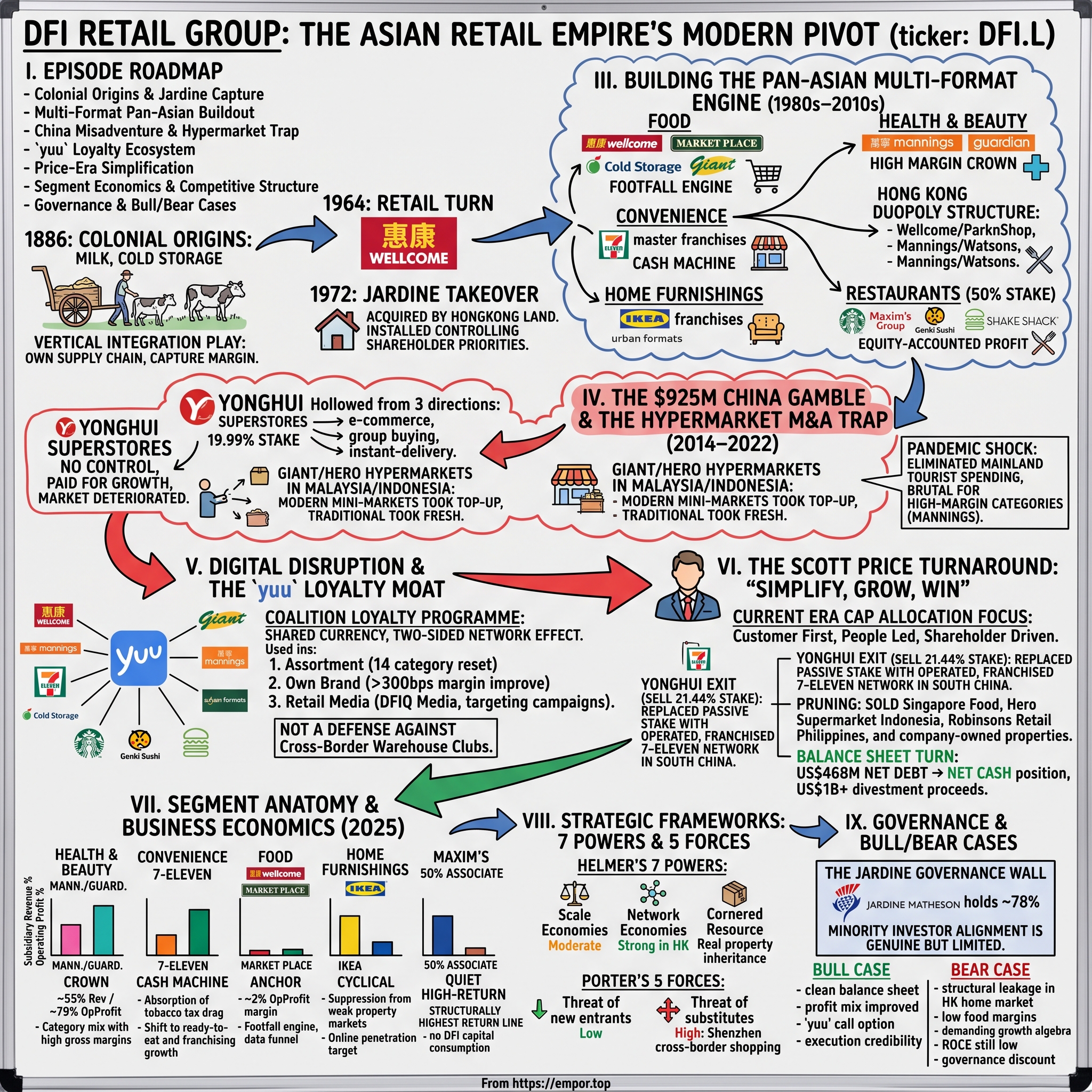
DFI Retail Group: The Asian Retail Empire's Modern Pivot
I. Introduction & Episode Roadmap
In October 2025, a 139-year-old company that began life delivering unpasteurised milk by handcart down a Hong Kong hillside did something that would have been unthinkable a decade earlier. It wrote its shareholders a cheque for US$600 million and told them, in effect: we have nothing better to do with this money than give it back to you.11
That single act is the whole story of DFI Retail Group Holdings Limited compressed into one line item. For most of the 2010s, DFI — then known as Dairy Farm International — behaved like a company convinced that the answer to every question was more. More markets. More formats. More hypermarkets in Indonesia. More exposure to the mainland Chinese consumer, purchased at the top of the market. By 2024 the accumulated bill for that conviction came due all at once: a reported loss attributable to shareholders of US$245 million, driven by a US$231 million impairment on a Philippine associate, a US$114 million loss on exiting a Chinese supermarket chain, and US$133 million of goodwill written off in Macau and Cambodia.3
And yet in the same year, the underlying business — the one that actually sells shampoo, rice balls and flat-pack furniture to Asian consumers every day — earned US$201 million, up 30%.3 Two companies were living inside one set of accounts: a decent retailer and a bad investor. The last three years have been an attempt to kill the second one.
The scale today. DFI and its associates operate 7,580 outlets across 12 Asian markets, of which 5,529 are run by subsidiaries.4 The banners are the wallpaper of daily life across the region: 惠康 Wellcome and Market Place supermarkets, 萬寧 Mannings and Guardian pharmacies, 7-Eleven convenience stores, IKEA franchises, and — through a 50% associate stake — 美心集團 Maxim's Group, the restaurant empire behind Starbucks in Hong Kong and a mooncake business that is close to a national institution.12 Reported subsidiary revenue was US$8.9 billion in 2025; counting 100% of associates and joint ventures, the system moved roughly US$25 billion of goods in 2024.43
The strategic dilemma. Note what is missing from that list. Giant hypermarkets in Malaysia: gone. Hero supermarkets in Indonesia: sold in June 2024. 永輝超市 Yonghui Superstores, the US$925 million bet on mainland China: exited in February 2025. Robinsons Retail in the Philippines: sold. Cold Storage and Giant in Singapore: divested in 2025.3410 DFI has spent three years shrinking, and the market has rewarded it for shrinking — total shareholder return exceeded 90% in 2025.10
The modern pivot. The architect is Scott Price, who became Group Chief Executive on 1 August 2023 after a career at Walmart, UPS and DHL Express.8 His mandate was not growth. It was subtraction, and then a re-pointing of the remaining capital at the two formats that actually earn their cost of capital: health and beauty, and convenience.
The question this article tries to answer is not whether the cleanup worked — it plainly did, in the narrow sense that the balance sheet is now in net cash and profits are rising.4 The harder question is what DFI is now that the shrinking is mostly done, whether a duopolist in a structurally shrinking home market can grow, and whether a controlling shareholder that owns roughly 78% of the equity and takes hundreds of millions a year in dividends will let management do anything else.10
The roadmap: colonial origins and the Jardine capture; the multi-format Pan-Asian buildout; the China misadventure and the hypermarket trap; the yuu loyalty ecosystem; the Price-era simplification; segment economics; competitive structure; governance; management credibility; and finally the bull and bear cases, with the small number of metrics that actually matter.
 Subscribe on LinkedIn
II. Colonial Origins: Milk, Cold Storage, and the Jardine Takeover (1886–1972)
Hong Kong in 1886 was a place where a glass of milk could kill you. The colony had no local dairy industry worth the name; what milk existed arrived from Chinese suppliers who, in an era before refrigeration or pasteurisation, had every incentive to stretch it with water of uncertain provenance. Infant mortality among the European population was grim, and the medical establishment had a specific and correct suspicion about why.
Into that gap stepped Sir Patrick Manson, a Scottish surgeon who would later be remembered as the father of tropical medicine for demonstrating that mosquitoes transmit parasitic disease. In 1886 Manson and five prominent Hong Kong businessmen — Sir Paul Chater, Phineas Ryrie, Granville Sharp, WH Ray and JB Coughtry — incorporated 牛奶公司 The Dairy Farm Company with capital of HK$30,000 and 80 head of cattle imported from Scotland.1 The herd was installed at Pok Fu Lam, on the green western slopes of Hong Kong Island, staffed by British livestock experts.2
Read the founding objectives and you find something more interesting than philanthropy. The company set out to supply clean, uncontaminated cows' milk; to cut the price of milk by breeding an imported herd locally rather than importing the product; and to profit its shareholders.2 That is not a charity. That is a vertically integrated import-substitution play dressed in a doctor's coat — solve a public health problem by owning the supply chain, and capture the margin that the problem had been protecting.
The company's real genius was what it built next. Milk from Pok Fu Lam had to travel four miles by handcart to reach customers in Central, which in a subtropical climate is a race against spoilage. So Dairy Farm built cold. A cold storage warehouse went up on Lower Albert Road in 1890, a Central depot followed in 1892, and in 1918 the company bought the Hong Kong Ice Company outright and renamed itself The Dairy Farm, Ice & Cold Storage Company Limited.7
Pause on that name, because it explains everything that came after. Dairy Farm stopped being a dairy and became Hong Kong's refrigeration utility. Once you own the only reliable cold chain in a tropical port city, you are no longer in the milk business — you are in the business of anything that spoils. Meat importing, food distribution, catering, and eventually groceries all became natural adjacencies, because they all ran through the same physical asset. The company spent the next seventy years monetising a temperature differential.
The retail turn came in stages. In 1960, Dairy Farm merged its food-retailing operations with those of Lane Crawford into a joint venture called Dairy Lane. Then in 1964 it acquired the 惠康 Wellcome grocery chain, founded in 1945 by Wu Chung-hai and Lau Lin.17 Wellcome is the banner that still anchors DFI's food business in Hong Kong six decades later — one of the longest-held retail brands in Asia, and a reminder that in grocery, the durable asset is rarely the store. It is the location and the habit.
The 1972 transaction, and a myth worth checking. The conventional retelling — repeated often enough to have become received wisdom — is that 怡和洋行 Jardine Matheson, the great Hong Kong trading hong, launched a hostile raid on Dairy Farm to get at its underexploited property portfolio. The primary record is more prosaic and, in some ways, more revealing. DFI's own corporate history states that in 1972 Dairy Farm was acquired by Hongkong Land — a Jardine Matheson subsidiary — and that it "retained its independence, its established operating structure and corporate personality."17
Two things follow. First, the acquirer was the property company, not the trading house, which lends circumstantial support to the real-estate reading even though DFI's own record never states a property motive. Second, and more delicious: Sir Paul Chater, one of Dairy Farm's five founding businessmen, was also a founder of Hongkong Land. The two companies had shared DNA from birth. What looks from a distance like a corporate raid looks up close more like a family reunion inside the Jardine orbit. Dairy Farm was later demerged from Hongkong Land and separately listed, but it never left the Jardine gravitational field.
That is the inheritance. DFI's retail estate — the corner sites at MTR exits, the ground floors of housing estates, the arcade positions in Central — was assembled in an era when Hong Kong's land was cheap and a Jardine company could take a long view. No competitor entering today could replicate it at any price. But the same transaction installed a controlling shareholder whose priorities are not identical to those of a minority investor, and that tension has shaped every capital allocation decision DFI has made since.
The pharmacy business arrived four years later. In 1976 Dairy Farm acquired 51% of Manning Dispensary Ltd, a chain of three pharmacies operated by a Hong Kong medical practice.1 Three stores. That acorn became 萬寧 Mannings, which today sits inside the single most profitable division in the group — proof that in retail, the best businesses are often the smallest ones you buy early and then compound for fifty years, rather than the largest ones you buy late.
With cold chain, groceries and a pharmacy licence in hand, and a patient conglomerate parent underwriting the balance sheet, Dairy Farm had assembled everything it needed to stop being a Hong Kong company.
III. Building the Pan-Asian Multi-Format Engine (1980s–2010s)
There is a particular kind of retail strategy that only works in cities where land is scarce and people walk. Call it the density playbook. You do not win by building the biggest store; you win by being the store that is already there when the customer decides they need something. In Hong Kong, Singapore, Taipei and Macau — cities of vertical housing, dense transit and small apartments with smaller refrigerators — that playbook is close to unbeatable, provided you get there first.
Dairy Farm spent thirty years running it across five formats simultaneously.
Food. Wellcome scaled across Hong Kong, joined by Market Place for the premium end and, later, banners like 3hree6ixty and Oliver's. The group acquired Cold Storage and Giant in Singapore and Malaysia, and 新苗超市 San Miu Supermarket in Macau.12 The logic was straightforward: groceries generate footfall, and footfall is the raw material every other format consumes.
Health and Beauty. The three-pharmacy Manning Dispensary became Mannings, a chain that learned to sell not just prescriptions but skincare, supplements and cosmetics at gross margins a supermarket can only envy. In Southeast Asia the group built Guardian into a parallel network across Singapore, Malaysia, Indonesia, Vietnam and Brunei.12 This is the division that would eventually carry the group.
Convenience. Dairy Farm secured 7-Eleven master franchise rights for Hong Kong, Macau, Singapore and the South China region of the Chinese mainland.12 A master franchise is an underrated corporate asset: you get a globally proven operating system and brand for a royalty, while keeping the local real estate, supply chain and merchandising economics. You are renting the software and owning the hardware.
Home Furnishings. The same insight applied to IKEA. DFI holds the IKEA franchise for Hong Kong, Macau, Taiwan and Indonesia.12 IKEA in dense Asian cities is a genuinely odd business — the classic out-of-town blue box does not fit a city with no out-of-town — and DFI has run smaller urban formats accordingly.
Restaurants. The group took a 50% stake in 美心集團 Maxim's Group, accounted for as an associate rather than consolidated. Maxim's is a Hong Kong institution: Chinese banquet restaurants, fast food, a mooncake business with seasonal pricing power that borders on the absurd, and master franchises including Starbucks, Genki Sushi and Shake Shack across several Asian markets.12 Because it is equity-accounted, Maxim's contributes profit without contributing revenue or consuming DFI's own capital — a structurally high-return arrangement, and one that would later become a rare bright spot.
The duopoly structure. In Hong Kong, this buildout produced something close to a textbook duopoly at both ends of the basket. In supermarkets, Wellcome faces CK Hutchison's 百佳 ParknShop; in 2023 the two together were estimated to account for nearly 90% of Hong Kong's supermarket market share.14 In health and beauty, Mannings faces AS Watson's 屈臣氏 Watsons. Two players, high barriers, disciplined pricing — the sort of structure that generates reliable returns for decades and attracts regulatory attention for exactly the same reason.
Here is the part worth sitting with. A duopoly built on scarce urban real estate is an extraordinarily durable position against entrants who need real estate. It is much weaker against entrants who do not. That distinction — invisible for thirty years — is the fault line along which the next decade of DFI's story cracks open. Because the threats that arrived in the 2010s were an e-commerce platform that needs no stores, a warehouse club across a border that needs no Hong Kong stores at all, and a mainland Chinese grocery market where DFI's density playbook did not apply and where it was about to spend nearly a billion dollars finding that out.
IV. The $925M China Gamble & The Hypermarket M&A Trap (2014–2022)
By 2014, Dairy Farm had a problem that every successful mature retailer eventually has: it had run out of Hong Kong. The home market was dense, saturated, and shared with a single well-capitalised rival. Growth would have to come from somewhere else, and the somewhere else that every Asian consumer company was staring at was the mainland.
On 11 August 2014, Dairy Farm announced it would pay RMB 5.69 billion — about US$925 million — for a 19.99% stake in 永輝超市 Yonghui Superstores, a Fujian-based supermarket and hypermarket operator with 288 stores across 17 provinces.6 Chief Executive Graham Allan framed it as an attractive way to participate in "the large and high growth Chinese market."6 Chinese regulatory approval came in March 2015 and the deal completed the following month.6
Look closely at the structure of that decision, because the structure is where the error lives. Dairy Farm did not buy an operating business. It bought a minority stake in a listed company it did not control, in a market where it had no meaningful operating experience, at a price that assumed the Chinese grocery sector would keep compounding. It paid for growth, took no control, and acquired no ability to fix anything if the growth failed to arrive.
It failed to arrive. Over the following decade, mainland Chinese grocery was hollowed out from three directions at once: e-commerce platforms took the packaged-goods basket; community group buying attacked fresh at prices no store could match; and instant-delivery players collapsed the convenience advantage of a nearby supermarket. The turn in DFI's own accounts is stark: the Yonghui stake contributed a positive US$29 million to underlying profit in 2020, then swung to a US$90 million loss in 2021 — a US$119 million reversal in a single year — and stayed negative thereafter, at roughly US$80 million of loss in 2022, US$36 million in 2023 and US$33 million in 2024.3 Yonghui itself kept closing stores and reporting widening net losses through the period. A stake bought for the better part of a billion dollars had become, by the end, a reliable annual subtraction from group profit.
The lesson generalises beyond China, and DFI learned it a second time closer to home. Giant and Hero hypermarkets in Malaysia and Indonesia faced their own disintermediation: modern mini-markets took the top-up shop, traditional wet markets kept fresh, and Shopee and Lazada took general merchandise. The hypermarket — a format whose entire premise is that customers will drive somewhere to buy a lot of things at once — is structurally exposed in markets where fewer people drive and everyone has a phone. DFI exited its Malaysia Food business in 2023 and completed the divestment of Hero Supermarket in Indonesia in June 2024, after which its Indonesian operations pivoted entirely to Guardian and IKEA.3
Then the pandemic removed the cushion. Hong Kong's border closures did something specific and brutal to DFI's economics: they eliminated mainland tourist spending, which had been disproportionately concentrated in exactly the high-margin categories Mannings sold — skincare, supplements, infant formula. The group's profitability through this period tells the story plainly. Reported profit attributable to shareholders was US$32 million in 2023, against underlying profit of US$155 million; the gap between the two was already US$122 million of non-trading charges even before the big 2024 writedowns.3
What the evidence actually says. It is tempting to file this decade under "bad luck with China." That reading is too kind. Three specific choices, all controllable, did the damage.
First, DFI bought optionality it could not exercise. A 20% stake gives you the full downside of a business and none of the levers. When Yonghui needed restructuring, DFI could write it down but could not restructure it.
Second, the group confused geographic diversification with risk reduction. Operating hypermarkets in Indonesia, supermarkets in Malaysia and a minority stake in China did not diversify DFI's risk; it multiplied the number of businesses simultaneously exposed to the same global shift — the migration of routine shopping from large scheduled trips to small unscheduled ones, mediated by a screen.
Third, and most damaging for a company with a controlling shareholder, capital kept flowing to the weakest assets. Every dollar tied up in Yonghui and Indonesian hypermarkets was a dollar not compounding inside Mannings and Guardian, which were quietly earning multiples of the group return the whole time.
Return on capital employed tells the story without any narrative help. Even after two years of cleanup, DFI's ROCE was 9.4% in 2025, against a stated mid-term ambition of at least 15%.11 The gap between those two numbers is the decade of 2014–2022, still on the balance sheet.
By 2020, DFI needed something that could defend the home market without requiring another acquisition. It found it in an app.
V. Digital Disruption & The yuu Loyalty Moat
The competitive threat that actually mattered to DFI was never another supermarket. It was the observation that a Hong Kong consumer, standing in a Wellcome aisle, could pull out a phone and order the same item from HKTVmall for delivery tomorrow — and that DFI had no idea who that consumer was. The company processed millions of transactions a day and knew almost nothing about the people making them. Every basket was anonymous. Every promotion was a broadcast into the dark.
On 29 July 2020, Dairy Farm announced the answer. Together with Hang Seng Bank and Jardine Restaurant Group, it launched yuu — described at the time as Hong Kong's biggest customer rewards club ever, connecting more than ten brands across over 2,000 shops and restaurants.9 The launch coalition spanned supermarkets (Wellcome, Market Place, 3hree6ixty, Oliver's), convenience (7-Eleven), health and beauty (Mannings), home furnishings (IKEA) and restaurants (KFC, Pizza Hut and PHD).9 Group Chief Executive Ian McLeod called it "a significant milestone for Dairy Farm as we have connected all our brands digitally, together with our partners."9
Why a coalition, and why it is genuinely different. Most retail loyalty programmes are a discount with a database attached. A coalition programme is a different animal, and the difference is worth explaining carefully because it is the closest thing DFI has to a modern moat.
Think of it as a shared currency. If only Wellcome issued points, those points would be worth something only when you shop at Wellcome — a narrow reason to enrol. When the same points are earned at the supermarket, the pharmacy, the convenience store, the furniture shop and the fried chicken counter, the currency becomes worth holding in its own right. Every additional merchant makes the points more useful to consumers, which brings more consumers, which makes joining more attractive to the next merchant. That is a two-sided network effect operating on top of physical retail — and unlike most network effects, this one is bounded by geography, which in Hong Kong is an advantage rather than a limitation.
The scale achieved is real. By the end of 2024, yuu had 5.3 million total members in Hong Kong with over 3 million monthly actives — in a city of roughly 7.5 million people.3 Starbucks and FWD Insurance joined as partners during 2024, and a parallel Singapore programme passed 1.8 million members with Suntec City and Singapore Airlines among the additions.3
What DFI actually does with it. Three things, in ascending order of financial interest.
The first is assortment. Management has said it used yuu data and analytics to execute a reset of 14 product categories at Wellcome, reporting uplifts in both sales and gross profit, and has begun applying the same approach to health and beauty and convenience.3 This is the least glamorous use and probably the most valuable: knowing which of 20,000 products to stop stocking is worth more than most marketing campaigns.
The second is own brand. DFI reported more than 300 basis points of margin improvement in Food own-brand products and close to a 40% increase in own-brand sales productivity in 2024 versus the prior year.3 Private label is the classic retailer margin lever, but it only works if you know exactly where the branded product is vulnerable — which is a data problem.
The third, and the one investors should watch most closely, is retail media. DFI launched its own retail media network in the first quarter of 2024, selling more than 100 targeted marketing campaigns within a year, with partners including Procter & Gamble, Unilever, Coca-Cola, Nestlé and Reckitt.3 By 2025 the media business — branded DFIQ Media — reported a fourfold revenue increase, though management was explicit that this was from a low base.11
Retail media deserves a plain-English explanation because it is the single highest-margin revenue line in modern retail. A supplier like Unilever already pays DFI for shelf space through trade terms. Retail media lets DFI sell that supplier something additional: the ability to put a specific promotion in front of the specific shoppers most likely to buy it, and then prove they bought it, because DFI owns both the ad impression and the till receipt. There is essentially no cost of goods on that revenue. Amazon built a business worth tens of billions of dollars on this mechanic.
The honest limitation. yuu is a formidable customer-retention asset and a promising media asset. It is not a defence against the two threats DFI actually faces. It does not stop a Hong Kong family taking the train to Shenzhen on Saturday to shop at Sam's Club, because loyalty points do not close a 30–40% price gap. And its economics remain small relative to the group: a fourfold increase from a low base is, arithmetically, still a low base. Management has been reasonably disciplined in saying so, describing retail media as "in the early days of a potentially significant source of profit."3 Investors should hold it to that framing rather than a grander one.
An app, however good, cannot fix a portfolio. That required someone willing to sell things.
VI. The Scott Price Turnaround: "Simplify, Grow, Win"
A note on labels before anything else, because precision matters when assessing management. "Simplify, Grow, Win" is a convenient shorthand for what DFI has done since 2023, but it is not the framework management actually articulated. The stated strategic framework, developed in the second half of 2023, has three pillars: Customer First, People Led, Shareholder Driven.3 The distinction matters because the third pillar is where all the interesting behaviour lives — it is the one under which DFI has justified selling nearly everything that was not working.
The operator, not the empire-builder. Scott Price became DFI's Group Chief Executive on 1 August 2023, succeeding Ian McLeod, who had held the role since 2017.8 His background is unusual for a retail CEO and tells you what the board was hiring for. Price spent roughly 25 years in international business, 19 of them in Asia, across retail, logistics and consumer packaged goods. He was President, International at UPS and before that its Chief Strategy & Transformation Officer; at Walmart he served as Chief Executive for Asia and then Executive Vice President, Global Leverage, running global functions to drive synergies across Walmart's four largest businesses; earlier he was President and CEO of DHL Express in Europe and, before that, CEO for Asia Pacific.8
Read that CV again. It is not a merchant's CV. It is a supply chain and corporate-restructuring CV with deep Asian mileage. Boards do not hire that profile to open stores. They hire it to take a complicated thing apart.
The Yonghui exit. On 23 September 2024 — thirteen months into Price's tenure — DFI announced a definitive agreement to sell its entire 21.44% interest in Yonghui to MINISO Group, the Guangzhou-headquartered value retailer listed in Hong Kong and New York. The stake had crept up from the original 19.99% over the decade; DFI sold 1,913.1 million shares at CNY 2.35 each for gross consideration of CNY 4,495.9 million, roughly US$623 million.53 MINISO was simultaneously acquiring stakes from other holders — including two JD.com subsidiaries — taking it to an aggregate 29.4% of Yonghui for roughly RMB 6.3 billion.16 The proceeds were received on 26 February 2025.3
Do the arithmetic honestly: roughly RMB 5.7 billion in, roughly RMB 4.5 billion out, a decade later, with cumulative equity-accounted losses in between. And the headline loss understated the damage. DFI booked a US$114 million loss on the divestment in 2024, then flagged a further roughly US$130 million charge in 2025 as accumulated foreign-exchange translation differences were recycled through the income statement — taking the total loss on the Yonghui adventure to approximately US$244 million.3 This was not a good investment rescued by a good exit. It was a bad investment terminated at a cost that took two reporting years to fully surface.
But termination has value that a spreadsheet of the round trip understates. The stake was consuming roughly a billion dollars of balance sheet, producing annual losses, and — critically — making DFI's reported earnings unreadable. Analysts could not tell what the retailer earned because the associate line kept moving. Selling it converted an illiquid, non-controlled, loss-making asset into cash, and cash into optionality. Price's own framing in the announcement was notably unsentimental about the strategic logic while remaining polite about Yonghui's prospects: the transaction "aligns with DFI Group's strategic and capital allocation framework, enabling the Group to allocate additional capital to foster the growth of its subsidiary businesses."5
Worth flagging, because it complicates the simple "exit China" narrative: in the same statement Price reaffirmed that "China is an important market for DFI Retail Group" and pointed to "ambitious plans to increase the number of 7-Eleven stores in Guangdong Province over coming years."5 DFI did not leave China. It swapped a passive minority stake for an operated, franchised, capex-light store network — the same asset class it understands. That is a meaningfully better use of the same geography.
The rest of the pruning. The Yonghui sale was the headline but not the whole programme. Hero Supermarket in Indonesia went in June 2024.3 Company-owned properties were sold through 2024, contributing US$150 million of net debt reduction.3 In 2025 DFI announced the divestment of its Singapore Food business — Cold Storage, Giant, CS Fresh and Jasons — on 24 March 2025, and also exited its Robinsons Retail stake in the Philippines.1210 Jardine Matheson's own results disclosed the outcomes: a US$88 million gain on Singapore Food and the sale of what it called a "low-yielding minority stake" in Robinsons Retail.10
Note the pattern. Every disposal shared two characteristics: low returns on capital, and no strategic connection to the density-plus-loyalty playbook that works in Hong Kong. Singapore Food is the most instructive, because it was a controlled, consolidated operating business — not a passive stake. Selling it signalled that the pruning criterion was genuinely return on capital rather than merely tidying up minority holdings.
The balance sheet turn. The cumulative effect was mechanical and fast. DFI ended 2024 with US$468 million of net debt. Completion of the Yonghui sale in February 2025 funded a US$617 million debt repayment, and the group ended 2025 with a net cash position of US$70 million, having generated over US$1 billion of divestment proceeds across Yonghui, Robinsons Retail and Singapore Food.11
The activist's question, asked early. A skeptical investor should press on one point here. Selling underperforming assets is the easiest value-creating act available to any conglomerate, and it is not repeatable. DFI has now harvested the low-hanging fruit; from here, profit growth must come from operating the remaining businesses better, not from removing bad ones. That is a materially harder task, and it is the task the next several sections examine.
VII. Segment Anatomy & Business Economics: Where DFI Makes Money
Strip away the divestments and the writedowns and DFI is four operating businesses plus one equity stake. They have wildly different economics, and understanding that spread is the single most useful thing an investor can do with this company. Here is the 2025 picture.
Health and Beauty is the crown, and it is not close. Mannings and Guardian generated US$2.6 billion of sales in 2025, up 7%, with underlying operating profit of US$228 million, up 8%.11 That is a margin of roughly 8.7% — in a group where the food business earns about 2%. The reason is category mix. A pharmacy sells skincare, supplements, cosmetics and over-the-counter medicine, all of which carry gross margins that a carton of milk cannot approach, and all of which are bought on advice and trust rather than price comparison.
Management has been building on this deliberately. Mannings Hong Kong's Pharmacare programme, run with the insurer Bupa, extended free consultations and medication for common illnesses to a network of more than 150,000 members, leaning on Mannings' position as Hong Kong's largest pharmacist network.3 The group also opened a Health Pod flagship at the International Finance Centre offering an AI-driven wellness assessment measuring over 20 metrics, and reported that customers using the service showed a basket size three times the average.3 That last statistic deserves a caveat an investor should supply themselves: customers who opt into a wellness consultation are self-selected toward higher spend. The causation runs at least partly backwards.
Guardian in Southeast Asia contributed US$857 million of 2024 sales, up 5%, with Indonesia particularly strong at 17% like-for-like growth, and healthcare products accounting for more than 60% of Singapore sales.3 This is the growth engine: DFI targets roughly 750 Guardian stores in Indonesia by 2028.11
Convenience is the cash machine with a tobacco problem. 7-Eleven generated US$2.3 billion of sales in 2025, down 2%, with underlying operating profit of US$97 million, down 6%.11 The decline has a single identifiable cause: Hong Kong raised tobacco taxes at the end of February 2024, and cigarette volumes fell. Excluding cigarettes, Convenience sales grew 1% in 2025, and in 2024 the same adjustment turned a 5% like-for-like decline into 2% growth.113
This is more interesting than a tax anecdote. Cigarettes are a high-revenue, low-margin category. Losing them hurts the top line and the footfall, but the mix shift toward what replaces them is favourable — ready-to-eat food, coffee, private label. Ready-to-eat accounted for 16% of Hong Kong 7-Eleven sales in 2024, and a striking 40% in South China and 23% in Singapore.3 A convenience store that sells lunch is a fundamentally better business than one that sells tobacco, because lunch is a daily habit at a higher gross margin. The 2024–25 numbers show a business absorbing a one-off revenue shock while its underlying mix improves — which is why Convenience profit returned to growth in the second half of 2025.11
The expansion plan here is the most capital-efficient in the group. DFI added 103 net 7-Eleven stores in South China in 2024 and targets roughly 2,400 Guangdong stores by 2028, explicitly through a capex-light franchise model.311 Franchising means the franchisee funds the store fit-out and working capital while DFI captures a royalty and supply-chain margin — growth without a proportional balance sheet.
Food is the anchor, and anchors are heavy. Wellcome and its stablemates produced US$3.0 billion of 2025 sales, broadly flat, with underlying operating profit of US$62 million, up 6% — a margin near 2%.11 In 2024 the division earned US$58 million on US$3.1 billion.3
A 2% operating margin is not a scandal; it is what grocery earns almost everywhere. But it does mean the division has essentially no error tolerance. A two-point swing in food inflation, a wage settlement, or a sustained share loss to cross-border shopping moves this business from modestly profitable to loss-making very quickly — which is precisely what happened in Singapore before the turnaround and eventual sale.
So why keep it? Because Food is not primarily a profit centre; it is the customer-acquisition engine for everything else. It generates the weekly footfall and the transaction volume that populate yuu, which in turn improves assortment and own-brand decisions in the high-margin divisions and creates the audience the retail media business sells. Judged as a standalone P&L, Food looks marginal. Judged as the top of the funnel, it is load-bearing. Investors should be alert to the risk in that argument: it is also exactly the argument every conglomerate makes for keeping a weak business.
Home Furnishings is small and cyclical. IKEA generated US$677 million of 2025 sales, down 3%, with US$26 million of operating profit — an improvement of about US$10 million on 2024, when sales fell 12% and like-for-like dropped 11%.113 The driver is property: people buy furniture when they move house, and weak property markets across Hong Kong and Indonesia suppressed big-ticket purchases. IKEA Taiwan proved more resilient.3 The 2025 profit improvement came from cost control rather than demand recovery — an important distinction, because cost control is finite. DFI targets 18–20% online penetration for IKEA by 2028.11
Maxim's is the quiet high-return asset. DFI's 50% associate contributed US$72 million of underlying profit in 2025, up 9%, on system sales of US$3.1 billion.11 In 2024 the contribution was US$66 million, down from US$79 million in 2023 on weaker mooncake sales and softer mainland restaurant performance.3 Because it is equity-accounted, Maxim's delivers profit without consuming DFI's capital or appearing in group revenue — structurally the highest-return line in the group, and a useful counterexample to the argument that DFI cannot own minority stakes successfully. The difference between Maxim's and Yonghui was never the ownership percentage. It was that one was a well-run business in a market DFI understood and the other was not.
What the segment map means. Health and Beauty plus Convenience generated roughly 55% of 2025 subsidiary revenue but around 79% of subsidiary operating profit. Management itself framed Health and Beauty as representing 55% of total operating profit.3 DFI is, in economic substance, a pharmacy and convenience company that also runs supermarkets to generate traffic — even though supermarkets are the largest thing on the revenue line.
That is a meaningfully more attractive business than the one the market owned in 2019. The question is whether it is defensible.
VIII. Strategic Frameworks: Porter's 5 Forces & Hamilton Helmer's 7 Powers
Frameworks are useful only if you let them deliver bad news. Applied honestly to DFI, they deliver a split verdict: the company holds two or three real structural advantages and at least two forces working actively against it, and the net result is a business that should earn respectable returns without ever earning spectacular ones.
Hamilton Helmer's 7 Powers
Scale Economies — real, but regional rather than global. DFI's purchasing scale across thousands of outlets gives it genuine leverage with fast-moving consumer goods suppliers, and the own-brand programme demonstrates the ability to convert that leverage into margin.3 But retail scale economies are local, not global. Being large in Hong Kong helps in Hong Kong; it does not help in Indonesia, where DFI is a challenger. And DFI's total scale is modest against the global players it increasingly competes with — a Walmart-owned Sam's Club buying globally can undercut a Hong Kong retailer on identical goods, which is precisely the mechanism driving cross-border leakage. Verdict: moderate, and weakening at the margin.
Network Economies — the strongest genuinely modern advantage. The yuu coalition creates the two-sided dynamic described earlier, and 5.3 million Hong Kong members with 3 million monthly actives in a city of 7.5 million is close to the practical ceiling of penetration.3 The power is real. Its limit is that it is a retention mechanism, not an acquisition one — nearly everyone is already a member, so future value must come from deepening engagement and monetising the data rather than adding users. Verdict: strong in Hong Kong, unproven in Singapore, absent elsewhere.
Cornered Resource — the inheritance. The prime retail locations assembled across decades of Jardine ownership genuinely cannot be replicated. MTR concourse positions, ground-floor sites in mature housing estates, and long-tenured leases in Central are finite and spoken for. Verdict: real, and the most durable of DFI's advantages — but a wasting asset in the specific sense that leases renew at market rents, and a landlord captures the value when they do.
Switching Costs — weak, and honestly so. A shopper can walk into a competitor tomorrow at zero cost. yuu points create friction, not lock-in. Any thesis resting on customer captivity in this business is a thesis resting on nothing.
Counter-Positioning — largely absent, and it cuts the wrong way. Counter-positioning describes a newcomer adopting a business model the incumbent cannot copy without damaging itself. DFI is the incumbent here. It cannot match a cross-border warehouse club's prices without destroying a 2% food margin, and it cannot go all-in on delivery without cannibalising the store network that is its main asset. Its response — a quick-commerce partnership with foodpanda, a 7-Eleven app with around 137,000 monthly and 30,000 daily active users in Hong Kong as at December 2024, more than 90 digital channels by 2025, and online penetration reaching 6.4% — is sensible mitigation rather than counter-positioning.311
Process Power and Branding round out the set modestly. Mannings and Wellcome carry genuine trust after decades of operation, which supports the pharmacy business in particular. But brand in grocery is a tiebreaker, not a pricing lever.
Porter's Five Forces
Threat of new entrants — low, and this is DFI's best force. The combination of Hong Kong and Singapore real estate costs, cold chain complexity and licensing makes greenfield entry economically absurd. Nobody is building a competing Hong Kong supermarket chain from scratch.
Bargaining power of suppliers — low. Multi-country procurement scale against global FMCG suppliers, plus a credible own-brand alternative, puts DFI in the stronger seat. The retail media network strengthens this further by giving suppliers something they want to buy.
Bargaining power of buyers — moderate and rising. Consumers face high price transparency and near-zero switching costs, but convenience and pharmacy purchases remain relatively price-insensitive. The rise is driven by consumers acquiring a genuine, cheaper alternative — see substitutes.
Threat of substitutes — high, and this is the force that matters most. Hong Kong residents made roughly 6.5 million northbound trips per month in 2024, diverting substantial consumption to Shenzhen, where Costco opened in early 2024 and where 14% of members reportedly come from Hong Kong.13 Local residents' goods consumption in the first quarter of 2025 reached only 75.7% of the 2018 level.13 This is not a cyclical dip. It is a structural change in where Hong Kong households buy things, enabled by high-speed rail, a strong Hong Kong dollar peg and a mainland cost base. DFI has no direct lever against it.
Competitive rivalry — high, and structurally shifting. The historical Wellcome–ParknShop and Mannings–Watsons duopolies were comfortable. They are being attacked from below by discount chains and from across the border. And the structure itself may be in play: in April 2026, the Financial Times reported that Jardine Matheson was in talks with CK Hutchison to acquire ParknShop and combine it with Wellcome — a transaction that would consolidate the two largest Hong Kong supermarket operators.1814 In May 2026, CK Hutchison co-managing director Dominic Lai told the company's annual general meeting there was no plan to sell ParknShop, publicly dismissing the speculation.15
That episode is worth dwelling on for what it reveals rather than what it resolves. First, it shows that the parties themselves may believe the Hong Kong grocery market is now too competitive to support two full-scale players — reporting suggested internal assessments that intensifying competition could reduce a combined entity's share to below 50%, against the roughly 90% the pair were estimated to hold in 2023.14 Second, it sits awkwardly against the simplification narrative: buying a large, low-margin supermarket chain is the opposite of what DFI has spent three years doing. Third, it would face a serious competition review. For now it is a denied rumour, and should be treated as such — but it is a live indicator of how the incumbents view their own market.
Separately, AS Watson Group — parent of Mannings' direct rival Watsons — has been reported to be planning a Hong Kong listing, which if it proceeds would give investors a cleaner public comparable for the health and beauty economics that drive most of DFI's profit.
Net assessment. DFI holds strong entrant barriers, real supplier leverage, an irreplaceable property inheritance and one genuinely modern network asset. It faces a structural substitution threat in its most profitable market that none of those advantages neutralises. That combination argues for a business that defends its position and grows modestly — not one that compounds rapidly. Any thesis promising the latter needs to explain which of these forces it expects to change.
IX. Management Credibility, Capital Allocation & The Jardine Governance Wall
The most useful way to assess management is not to read what they say about the future but to check what they said about the past against what happened. On that test, DFI's record splits cleanly into two eras with a hard boundary in 2023.
The prior era, assessed honestly. The 2014–2022 leadership set out a China growth thesis, paid a premium price for a non-controlling position, and then held it for a decade while it deteriorated. It maintained hypermarket exposure in Southeast Asia well past the point at which the format's decline was visible in the numbers. And it delayed recognition: the impairments and divestment losses that hit in 2024 reflected value that had been leaking for years. That is not hindsight — the sequence of writedowns is itself the evidence, because assets that lose US$445 million of value in a single reporting year rarely lost it in a single year.3
The current era, assessed on the same test. Price took the job on 1 August 2023 and set out a framework in the second half of that year.38 Judge him against it.
He said the group would simplify the portfolio. It divested Hero Supermarket, Yonghui, Robinsons Retail, the Singapore Food business and a set of company-owned properties within roughly two years.310 Done.
He said it would deleverage. Net debt of US$468 million became net cash of US$70 million.11 Done.
He guided 2025 underlying profit to US$230–270 million.3 The result was US$270.3 million — the top of the range.11 Guidance met, at the high end, in the first full year a range was given.
He said returns would improve. Underlying profit rose 30% in 2024 and 35% in 2025, and total shareholder return exceeded 90% in 2025.31110
That is an unusually clean two-year record of doing what was announced. It deserves credit, with three qualifications a careful investor should hold onto.
Qualification one: the easy phase is over. Divestment gains and interest cost elimination are one-time contributions. The 2026 guidance implicitly acknowledges this — DFI guided to US$270–300 million of underlying profit, which is flat to modestly up on the 2025 headline, with management noting the figure represents 13–25% growth once divestment impacts are excluded.11 That gap between headline and organic is the honest measure of how much of the recent improvement was portfolio surgery.
Qualification two: the mid-term targets are ambitious against the base rate. DFI has set out 2028 objectives of US$310–350 million underlying profit, 7–10% online sales mix, at least 15% ROCE, roughly 2,400 Guangdong 7-Eleven stores and about 750 Guardian Indonesia stores.11 The profit target implies roughly 11% compound growth from the 2025 midpoint. Achieving that from 2–3% organic revenue growth requires sustained margin expansion, which means the mix shift toward Health and Beauty and retail media has to work at scale. It is plausible. It is not yet demonstrated.
Qualification three: the disclosure has improved but the transparency is uneven. DFI reports a non-IFRS "underlying profit" measure that excludes non-trading items. In 2024 the gap between underlying (US$200.6 million) and reported (a US$244.5 million loss) was US$445 million.3 Management is entitled to that measure and explains it, but a decade in which "non-trading items" repeatedly swamped underlying profit is a reason to treat the adjusted figure as a supplement to the statutory one, not a replacement for it. The 2025 accounts — underlying US$270.3 million against reported US$234.7 million — show a far narrower gap, which is itself a form of progress.11
The Jardine governance wall
Every analysis of DFI eventually collides with the same fact: minority shareholders do not control this company and never will.
Jardine Matheson holds approximately 78% of DFI. The figure can be reconstructed from Jardine's own 2025 disclosures: Jardine reported its share of DFI's underlying profit as US$209 million against DFI's total of US$270.3 million, and received US$465 million of DFI's US$600 million special dividend.1011 Both ratios land near 77–78%.
What this rules out. An activist campaign is pointless. A hostile takeover is impossible. A proxy fight cannot succeed arithmetically. Any board or strategy change happens because Jardine wants it, or it does not happen. The 2023 CEO change, the divestment programme and the new dividend policy all occurred with Jardine's assent — which is a reasonable inference that Jardine drove them. The chairmanship itself illustrates the point: it has passed among Jardine insiders in quick succession — from Ben Keswick, who stepped down in July 2024 after eleven years, to John Witt, to Lincoln Pan by the 2025 reporting cycle — a cadence set by the parent's own succession planning rather than by DFI's board acting independently.311
What this makes more likely. Jardine's own economics depend on cash coming up from subsidiaries. Its recurring dividend income from DFI rose 24% to US$110 million in 2025, on top of the US$465 million special.10 A parent that needs dividends is a parent that will insist on disciplined capital allocation, a conservative balance sheet and consistent payouts. In 2025 that alignment produced total shareholder distributions of roughly US$740 million, a final dividend of 10.50 US cents per share — up 50% from 7.00 cents — and a new policy of paying out 70% of earnings.11
For a minority investor, this is genuine alignment, of a limited kind. Jardine wants what income-seeking minorities want: cash. What it does not necessarily want is what growth-seeking minorities want — retained earnings reinvested at high rates of return, or a sale of the whole company at a premium.
The trade-off, stated plainly. A controlled company with a cash-hungry parent is a reasonable structure for an investor who wants dividends from a defensible asset base. It is a poor structure for an investor hoping for a re-rating catalyst, because the one catalyst that reliably closes a conglomerate discount — someone buying the company — is unavailable. That is the discount, and it is not going anywhere.
The ParknShop episode is the live test of this alignment. If Jardine were to direct DFI to acquire a large, low-margin supermarket chain shortly after DFI told investors it was simplifying and returning capital, minorities would learn something important about whose framework actually governs.
X. Transcript Deep Dive: Prepared Remarks vs. Analyst Q&A
A transparency note is required here, because it affects what can honestly be claimed. DFI does not publish full earnings call transcripts on its investor relations site in the way US-listed companies routinely do. What is publicly and verifiably available is the written record: preliminary results announcements carrying the Chairman's statement and the Group Chief Executive's review, investor presentations, and transaction press releases. Rather than reconstruct analyst exchanges that cannot be sourced, what follows compares management's written narrative across successive reporting periods — which turns out to be nearly as revealing, because inconsistency between years is exactly what a skeptical reader is looking for.
The prepared narrative, tracked across three years.
In the 2024 announcement, released 10 March 2025, then-new Chairman John Witt led with a specific claim: "Effective strategy execution led to strong underlying profit growth in 2024, despite a challenging retail environment."3 The stated ambition was to "remain relevant to consumers and to increase market share further, by evolving our offering through leveraging data and expanding our omnichannel presence."3 Price's own review in the same document emphasised that reported results were "impacted by one-off items, including fair value loss, impairment of equity interest and goodwill," while stressing the balance sheet deleveraging.3
A year later, in the 2025 announcement of 3 March 2026, the framing had shifted in a specific direction: "Transformation is an ongoing journey for today's retailers... DFI has developed a renewed foundation as we execute against our strategic priorities to deliver sustained, profitable growth."11
The language moved from repair to foundation, which is what you would expect from a management team that had finished the cleanup. But note what did not change: the same three-pillar framework, the same emphasis on data-driven assortment and omnichannel, the same capital discipline vocabulary. Consistency of narrative across periods is one of the more reliable signals of managerial honesty, and DFI passes it. There has been no unexplained strategy pivot, no quiet abandonment of a previously touted initiative, and no rebranding of the framework to obscure a miss.
Where the written record is concrete, and where it is not. Three issues dominate any serious conversation about DFI, and management's disclosure quality varies sharply across them.
On the cigarette tax drag, disclosure is excellent. Management quantified it precisely and repeatedly, giving both headline and ex-cigarette like-for-like figures for two consecutive years so investors could isolate the effect: a 5% like-for-like decline becoming 2% growth in 2024, and a 2% sales decline becoming 1% growth in 2025.311 They also named the specific driver — the Hong Kong tax increase at the end of February 2024 — and explained the offsetting mix shift toward ready-to-eat. That is exactly how a management team should handle a headwind it does not control: quantify it, isolate it, and show what you are doing instead.
On the use of Yonghui proceeds, disclosure is concrete and was followed through. The September 2024 announcement committed to allocating capital "to foster the growth of its subsidiary businesses."5 What actually happened was a US$617 million debt repayment, a move to net cash, a US$600 million special dividend and a new 70% payout policy.11 Investors who worried the cash would be hoarded or spent on fresh M&A were wrong — most of it was returned or used to retire debt.
On cross-border leakage to Shenzhen, disclosure is notably softer. This is the gap. Management acknowledged in the 2024 report that "increased outbound travel of Hong Kong residents to the Chinese mainland has affected food consumption for the majority of 2024," and noted the situation "has begun to normalise" with Hong Kong supermarket retail sales returning to growth in the fourth quarter.3 What is absent is any quantification: no estimate of transactions lost, no basket-size impact, no disclosed market-share effect. Contrast this with the surgical precision applied to cigarettes.
The asymmetry is instructive. Companies quantify headwinds they believe are temporary and describe headwinds they fear are structural. A tobacco tax is a one-time step change you can annualise past. Sustained northbound travel — 6.5 million trips a month, with local goods consumption at 75.7% of 2018 levels — is not obviously temporary, and calling it "normalising" is the most optimistic available reading of the data.13
Where management became genuinely concrete was outside the filings, in the press, during 2025. Speaking in August 2025, Price described the behavioural shift bluntly — "people who go north during the weekends or for day trips are no longer bringing groceries back" — and set out a specific counter-strategy: DFI expanded Wellcome's direct-sourcing base from 26 countries to 54, cut prices on affected lines by roughly 15–20%, and framed the whole effort as being "on a journey to bring down the cost of living in Hong Kong."19 His claimed evidence that it was working was a volume metric — "our sales volume at Wellcome going up," consistent with the reported 2% Food volume growth — rather than a value one, which is exactly what you would expect from a deliberate price-investment strategy.1911 The same period brought a less comfortable signal: DFI cut support-function staff in 2025, with Price conceding that "our support function costs have increased significantly" and that the position was "not sustainable," against a Hong Kong retail sector that had contracted for fourteen straight months to May 2025.20 That is a management team defending a shrinking home market with price and cost discipline — an honest response, but a defensive one, and a reminder that this is margin being spent to hold volume, not a source of growth.
The residual concern. For a company of DFI's size, the absence of readily accessible full call transcripts is itself a mild governance observation. Analyst Q&A is where narratives get stress-tested in real time, and a company confident in its story generally makes that exchange easy to find. It is a small point. It is not nothing.
XI. Investment Thesis: Bull vs. Bear Case & Key KPIs
Everything above resolves into a single disagreement: is DFI a repaired, cash-generative, defensible franchise entering a period of steady compounding, or a structurally challenged retailer that has just monetised its last easy asset in a home market that is quietly shrinking?
Both readings fit the same facts. Here is each at its strongest.
The bull case
A clean balance sheet changes the arithmetic. The move from US$468 million of net debt to US$70 million of net cash removes an interest burden that consumed roughly US$150 million a year of financing charges gross in 2024.311 Every dollar of operating improvement now flows to shareholders rather than lenders. Combined with a 70% payout policy, DFI has become a straightforward cash-return vehicle rather than a leveraged one.11
The profit mix has genuinely improved. The company that emerged from the divestment programme is materially different from the one that entered it. Health and Beauty and Convenience — the two highest-margin, most defensible formats — now dominate group profit, and the loss-making and low-return businesses that dragged on results are gone.11 Guardian's Southeast Asian expansion and 7-Eleven's capex-light Guangdong franchising both offer growth that does not require heavy balance sheet commitment.311
Optionality on yuu and retail media is real and unpriced. A near-saturated coalition loyalty programme in a wealthy city, attached to a retail media network growing fourfold from a small base with blue-chip advertisers already signed, is a genuine call option on high-margin revenue.311 If retail media reaches even a mid-single-digit percentage of group profit, it changes the margin profile of the whole company.
Execution credibility has been earned, not asserted. Guidance met at the top of the range, targets hit, divestments completed on schedule. That record is not proof of future performance, but it materially raises the prior on the 2028 targets being taken seriously rather than dismissed.11
The bear case
The home market is structurally leaking. This is the strongest bear argument and the hardest to refute. Hong Kong consumption is being redirected across a border by a permanent infrastructure and price differential, not a temporary sentiment shock.13 DFI's densest, most profitable store network sits precisely in the market losing volume. Loyalty points, assortment resets and quick commerce mitigate; they do not reverse.
Food margins leave no room. A 2% operating margin on a US$3.0 billion revenue base means that a modest adverse move in input costs, wages or volume flips the division's contribution.11 And the strategic defence of Food — that it feeds the funnel — is unfalsifiable in the short run, which is exactly the kind of argument that keeps weak businesses alive too long.
The growth algebra is demanding. Getting from roughly US$270 million to US$310–350 million by 2028 on 2–3% organic revenue growth requires margin expansion in every year.11 There is no obvious slack left: the divestments are done, the debt is repaid, and cost control at IKEA has already been harvested once.
ROCE has a long way to go. At 9.4%, DFI is not obviously earning an attractive return on the capital it employs, and the 15%+ ambition requires either substantially higher profits on the same asset base or further capital release.11
The governance discount is permanent. With approximately 78% held by Jardine, there is no takeover premium, no activist path and no realistic route to a structural re-rating driven by ownership change.10 The valuation multiple is capped by the ownership structure, and always will be.
And a specific execution risk worth naming. Should the reported ParknShop discussions ever revive, DFI would face the awkward task of explaining a large acquisition in its lowest-margin category immediately after three years of telling investors it was simplifying.1815 The strategic logic of consolidating a duopoly is real. The consistency problem would also be real.
The three KPIs that actually matter
Most metrics for a retailer are noise. Three are not.
1. Health and Beauty like-for-like sales growth and operating margin. This division produces the majority of group operating profit. If its margin holds near the high-8% area and like-for-like sales stay positive, the group thesis works almost regardless of what happens elsewhere. If the margin compresses — through mainland tourist weakness, Watsons competition, or Guardian expansion costs in Indonesia — nothing else in the portfolio can compensate. Watch it above every other line.
2. yuu engagement and retail media revenue. Not total membership, which is close to saturated and therefore uninformative, but monthly active members, and the disclosed trajectory of retail media revenue. These are the leading indicators of whether the data asset converts into the high-margin profit stream the bull case requires. A fourfold increase from a low base is a beginning, not a result.
3. Underlying return on capital employed. The single number that adjudicates between the two cases. ROCE integrates margin, asset intensity and capital discipline into one figure, and DFI has published both the current level and the target. Progress from 9.4% toward 15% would confirm that the cleanup created a structurally better business; stagnation would suggest the improvement was a one-time balance sheet event dressed as a transformation.11
XII. Playbook & Key Investing Lessons
Lesson 1: A minority stake abroad is the most expensive way to learn a market. DFI's Yonghui investment failed for a reason that had nothing to do with China specifically. It bought a position that gave it the full economics of a business it could not influence, in a market whose competitive dynamics it did not understand well enough to underwrite. Compare it directly with Maxim's — also a non-controlling stake, also equity-accounted, but in a market and category DFI knew intimately, and consistently profitable.11 The variable that mattered was never the ownership percentage. It was whether the buyer had any genuine informational edge. Cross-border minority stakes are, in practice, a bet that the seller knows less than you do about a market where they live and you do not.
Lesson 2: Selling a bad asset creates value even at a loss, because clarity has a price. DFI exited Yonghui for materially less than it paid and booked a US$114 million loss.3 The stock's total return exceeded 90% in the year the cleanup completed.10 These facts are not in tension. Removing a loss-making, non-controlled, illiquid asset did three things a spreadsheet of the round trip misses: it released capital, it eliminated an annual earnings drag, and — most importantly — it made the remaining business legible. Investors will pay a higher multiple for earnings they can understand than for the same earnings buried under volatile associate accounting. Sunk costs are sunk; the only question is what the asset does to the enterprise going forward.
Lesson 3: Density plus a unified loyalty layer is the modern urban retail moat — with a specific limit. DFI's combination of irreplaceable locations and a coalition programme covering most of a city's adult population is a genuinely strong defence against pure e-commerce, which must solve last-mile economics that a store network already solves.39 But the lesson comes with a boundary worth remembering. This moat defends against competitors who need to reach your customers. It does nothing against competitors your customers travel to reach. Physical proximity is only an advantage while proximity is what the customer is optimising for; the moment price dominates convenience by a wide enough margin, a border crossing becomes a rounding error in the shopping trip. Any retail moat built on convenience should be stress-tested against that specific failure mode.
A fourth, quieter lesson: watch what a controlling shareholder needs. DFI's entire strategic reorientation becomes legible once you notice that its parent requires dividends. The simplification programme, the deleveraging, the special dividend and the new payout policy are all consistent with a controlling owner optimising for cash. In controlled companies, the parent's cash flow statement is often a better predictor of subsidiary strategy than the subsidiary's own strategy deck.
XIII. Epilogue & What's Next
A company that started by importing eighty Scottish cows to solve a public health crisis ends up, 140 years later, as an argument about capital allocation. That is not a decline; it is what happens when an operating business survives long enough to become a portfolio.
The arc is unusually clean. Dairy Farm built a genuine competitive advantage out of physics — it owned the cold — and converted that into a retail estate at the exact moment Hong Kong's land was cheap. It spent the second half of the twentieth century turning that estate into five formats and two duopolies. Then, in the 2010s, it made the classic error of the successful mature company: it mistook the scale of its home advantage for the transferability of it, and spent nearly a billion dollars discovering that the density playbook does not export to a market where you own no stores and control no decisions.
The current chapter is a correction rather than a reinvention. Scott Price has not invented a new DFI; he has removed the parts of the old one that were destroying value and pointed the remainder at pharmacy and convenience — which is to say, at the two things it was always best at. Judged on execution, the last three years have been strong: the balance sheet is repaired, guidance has been met at the top of the range, and shareholders have been paid.11
What comes next is harder and less flattering to narrate. The subtraction phase is complete. From here, DFI must generate profit growth from operations in a home market where consumption is being redirected across a border by economics it cannot change, while proving that a loyalty database and a young retail media business can carry the margin expansion its 2028 targets require. It must do this as a roughly 78%-controlled subsidiary of a parent whose own cash needs will always sit at the table.
Three things are worth watching over the next eighteen months. Whether the Guangdong 7-Eleven and Indonesian Guardian expansions deliver returns rather than merely store counts. Whether retail media graduates from a percentage growth story to a disclosed profit contribution. And whether the reported supermarket consolidation discussions resurface — because if they do, investors will discover whether "Shareholder Driven" is a strategy or a slogan.
The bet a DFI shareholder is making, stripped of narrative, is modest and specific: that a repaired, well-run, dividend-paying duopolist in defensible categories can compound quietly through a period of structural pressure in its home market. That is a reasonable bet. It is not a thrilling one, and the ownership structure guarantees nobody will arrive to make it thrilling.
XIV. Outro & Recommended Reading
The most valuable documents for anyone continuing to follow DFI are, in order of usefulness: the annual preliminary results announcements, which carry both the Chairman's statement and the Group Chief Executive's review alongside the segment-by-segment business review;34 the group's periodic corporate overview presentation, which is the clearest summary of the portfolio, format-by-format geography and mid-term targets;12 and the annual report's at-a-glance section, which is the fastest way to track how the outlet and market count changes as the portfolio evolves.17
For transaction history, the primary announcements are worth reading in the original — the September 2024 Yonghui divestment release for DFI's own framing of its capital allocation logic,5 and MINISO's parallel disclosure for the buyer's view of the same asset.16 For the parent's perspective, and for the arithmetic that reveals DFI's contribution to the wider group, Jardine Matheson's own results announcements are indispensable.10
On the founding history, the corporate milestones page and the Industrial History of Hong Kong Group's archival timelines are the best available records of the company's first century, and they correct several details that circulate in secondary retellings.127
Finally, for the structural question that will determine the next decade — where Hong Kong households actually spend — the commercial property research on northbound travel and retail leakage is more informative than any company disclosure currently available.13
References
-
Dairy Farm Company — The Industrial History of Hong Kong Group ↩↩↩
-
DFI Retail Group Holdings Limited 2024 Preliminary Announcement of Results (RNS) — DFI Retail Group / Bermuda Stock Exchange, 2025-03-10 ↩↩↩↩↩↩↩↩↩↩↩↩↩↩↩↩↩↩↩↩↩↩↩↩↩↩↩↩↩↩↩↩↩↩↩↩↩↩↩↩↩↩↩↩↩↩↩↩↩↩↩
-
DFI Retail Group Holdings Limited 2025 Preliminary Announcement of Results — Thailand Business News, 2026-03-03 ↩↩↩↩↩
-
DFI Retail Group Announces Divestment of Stake in Yonghui Superstores to MINISO Group — DFI Retail Group, 2024-09-23 ↩↩↩↩↩
-
Dairy Farm to Pay $925 Million for China's Yonghui Stake — Bloomberg, 2014-08-11 ↩↩↩
-
Dairy Farm Timeline — The Industrial History of Hong Kong Group ↩↩↩↩
-
DFI Retail Group names new group chief executive as Ian McLeod steps down — Marketing-Interactive, 2023 ↩↩↩↩
-
Dairy Farm in Partnership with Hang Seng and Jardine Restaurant Group Launches yuu, Hong Kong's Biggest Rewards Club Ever — Jardine Matheson, 2020-07-29 ↩↩↩↩
-
Jardine Matheson Holdings Limited 2025 Preliminary Results — Investegate, 2026 ↩↩↩↩↩↩↩↩↩↩↩↩
-
DFI Retail Group 2025 Results: US$270M Profit, US¢10.50 Final Dividend, 70% Payout Policy Announced — Minichart, 2026-03-03 ↩↩↩↩↩↩↩↩↩↩↩↩↩↩↩↩↩↩↩↩↩↩↩↩↩↩↩↩↩↩↩↩↩↩↩↩↩↩↩↩
-
DFI Retail Group Corporate Overview, First Half 2025 — DFI Retail Group, 2025 ↩↩↩↩↩↩↩↩
-
Hong Kong retail sector signals early market shift — JLL ↩↩↩↩↩
-
HK retail landscape may shift as PARKnSHOP–Wellcome merger discussed — The Standard, 2026-04-17 ↩↩↩
-
No ParknShop sale: Li Ka-shing's CK Hutchison rules out supermarket merger with Wellcome — South China Morning Post, 2026 ↩↩
-
MINISO to Acquire Stake in Yonghui Superstores, a Leading Chinese Retailer — MINISO Group Investor Relations, 2024-09-23 ↩↩
-
DFI Retail Group Annual Report 2024 — At a Glance — DFI Retail Group, 2025 ↩
-
Jardine and CK Hutchison in supermarket merger talks: FT — The Edge Singapore, 2026-04 ↩↩
-
DFI to cut Wellcome's prices to compete with Shenzhen for Hongkongers' grocery trolleys — South China Morning Post, 2025-08-05 ↩↩
-
Wellcome, 7-Eleven operator DFI cuts staff amid Hong Kong retail malaise — South China Morning Post, 2025-08-19 ↩
 LinkedIn
 WhatsApp
 Reddit
 Hacker News
 Email
Email Kindle
 RSS Feed
 Spotify
 Apple Podcasts
 Amazon Music
 Audible
 YouTube