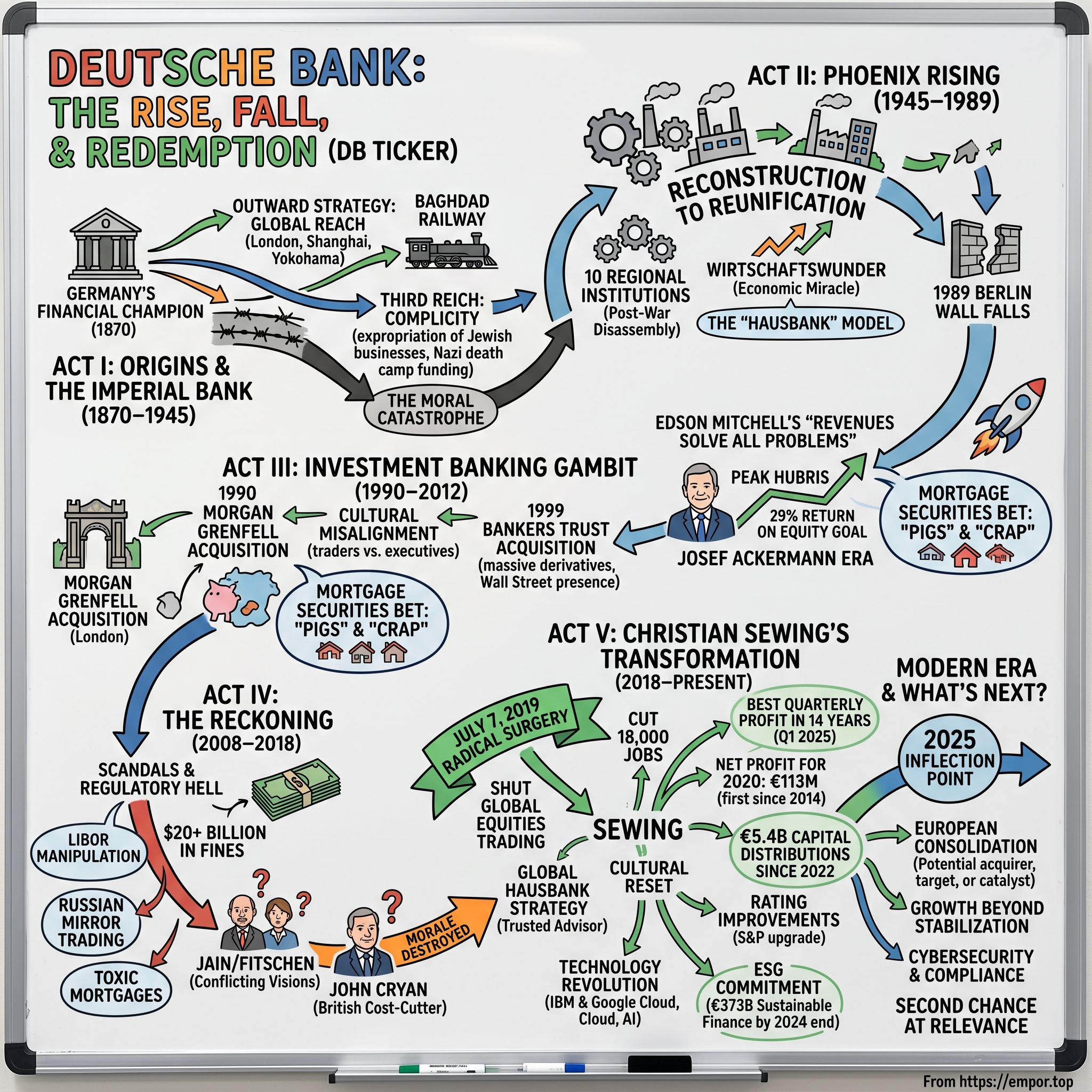
Deutsche Bank: The Rise, Fall, and Redemption of Germany's Banking Giant
I. Introduction & Episode Roadmap
A photograph taken in the mid-2000s shows Josef Ackermann flashing a V-for-victory sign in a Düsseldorf courtroom. Facing charges related to bonus payments in the Mannesmann takeover, he was also the chief executive of the world's largest bank by assets. The gesture — glib, self-satisfied, and tone-deaf — became the single most reproduced image in modern German finance. It captured something fundamental about Deutsche Bank at its zenith: a conviction that standard financial rules applied only to other institutions.
By 2007, Deutsche Bank's balance sheet had swollen past €2 trillion — a figure exceeding Italy's annual economic output — supported by a thin sliver of tangible equity. With its shares trading above €100, the bank had convinced itself, and much of the market, that a 19th-century Prussian trade-finance house could transform into a top-tier Wall Street investment bank without sacrificing its core stability.
Twelve years later, in the summer of 2019, the shares traded in the mid-single digits in euros. Fines, legal settlements, and litigation provisions had consumed more than $20 billion. The bank paid $7.2 billion to the U.S. Department of Justice over pre-crisis mortgage securities alone.1 It incurred a $2.5 billion fine for rigging LIBOR.[^2] It was caught laundering roughly $10 billion out of Russia through mirror trades. Its own chief executive publicly acknowledged that its technology infrastructure was unfit for purpose. Meanwhile, three rights issues raised more than €26 billion of fresh shareholder equity, nearly all of which was swallowed by penalties and restructuring charges rather than invested in income-generating assets.
That collapse sets up the central question for this analysis: How did a conservative German trade-finance institution — founded explicitly to free German exporters from dependence on British banks — turn into one of the most leveraged risk engines in global finance? And more critically: Has the turnaround led by Christian Sewing since 2018 genuinely rebuilt the bank's underlying earning power, or merely cleared away the wreckage?
By mid-2026, the operational picture appears more favorable than at any point since the 2008 financial crisis. Deutsche Bank met its 2025 financial targets, generating net revenues of €32.1 billion, a post-tax return on tangible equity (RoTE) of 10.3% against a target above 10%, and a cost-to-income ratio of 64% against a target below 65%.2 Net profit reached €7.1 billion, roughly double the previous year's total. In November 2025, management presented a strategic plan for 2026–2028 targeting €37 billion in revenue, an RoTE above 13%, and a cost-to-income ratio below 60%.3 Performance in the first half of 2026 ran ahead of that plan, delivering a record post-tax profit of €4.1 billion and a group RoTE of 11.9%.4
Three main themes structure this story.
First, cultural misalignment in M&A. The 1999 acquisition of Bankers Trust did not merely expand American distribution — it imported an aggressive compensation culture and risk appetite that Frankfurt could neither price nor police. It also created an autonomous trading hub in London and New York that functioned for nearly two decades as a bank within a bank.
Second, the arithmetic of hubris. Ackermann's public target of a 25% pre-tax return on equity was less a coherent strategy than a directive to take escalating risk per unit of capital, forcing the institution to reverse-engineer its balance sheet to hit the target.
Third, the radical pivot. On July 7, 2019, Deutsche Bank executed a drastic strategic shift: it exited equities sales and trading entirely, while transferring €74 billion in risk-weighted assets to a dedicated wind-down unit.5 That exit forms the cornerstone of the modern investment case.
This story sizes the four operating divisions, evaluates management's current promises against its track record, assesses the net interest income headwind as European interest rates normalize, and tests the key arguments of the bull case against the strongest counter-evidence in the bank's history. Deutsche Bank has frequently disproved its own optimistic narratives; that historical record serves as the key analytical baseline.
The history begins in Berlin, when Germany was not yet a unified country.
 Subscribe on LinkedIn
II. Origins & The Imperial Bank (1870–1945)
In the spring of 1870, a Prussian banking licence was an instrument of statecraft. The charter granted to Deutsche Bank on March 10, 1870, and the opening of business in Berlin on April 9 were not simply the launch of a commercial enterprise — they were an act of economic nationalism, approved by a government that understood exactly what it was authorising.6
The problem the founders set out to solve was concrete and pressing. German manufacturers were beginning to export at scale, but the financing of that trade — letters of credit, bills of exchange, and settlement — ran through London and was denominated in sterling. A German machine-tool maker selling to Buenos Aires paid a British bank for the privilege. Adelbert Delbrück, a private banker, and Ludwig Bamberger, an economist and politician who had spent years in Paris and London studying Anglo-French finance, proposed a German bank that could settle German trade in German currency. Georg von Siemens, of the electrical dynasty, became its driving executive force.7
The strategy was export-following from day one. Branches opened in Shanghai in 1872 and London in 1873 — a German bank establishing a footprint in the City of London three years after its founding, underscoring the founders' international ambition and intention to compete directly with British banks.6 Within two decades, Deutsche Bank was underwriting foreign infrastructure on a scale that defined its identity: financing the Northern Pacific Railroad across the American West, and — most consequentially — the Baghdad Railway, the Berlin-to-Constantinople-to-Baghdad project that made the bank an instrument of German imperial policy in the Ottoman Empire and a direct irritant to British strategic interests.
This origin establishes the institution's foundational competence: arranging cross-border payment, credit, and settlement for industrial exporters — financial plumbing rather than securities speculation. The modern Corporate Bank, detailed later in this story, is a direct lineal descendant of this business.
The interwar period compressed a century of financial history into fifteen years. Hyperinflation in 1923 destroyed the bank's capital base in real terms, and the consolidation wave that followed culminated in a 1929 merger with Disconto-Gesellschaft, creating by far the dominant financial institution in Germany just as the Great Depression arrived.6 The merged entity survived the 1931 German banking crisis only through state support.
Under the Nazi regime, Deutsche Bank was an active participant in state-directed economic crimes. It executed the forced "aryanization" of Jewish-owned businesses, profiting from transactions in which owners were compelled to sell below market value. It maintained accounts for the Gestapo and extended credit facilities to IG Farben, including financing connected to the chemical complex at Auschwitz. Decades later, the bank commissioned independent historians to document this period and published the findings through its own historical association.7
The structural consequence followed after the war. In 1948, Allied military authorities dismembered Deutsche Bank into ten regional institutions, deliberately dismantling the central power base in Berlin that had made it an instrument of the state. For an institution built on national scale and international reach, the breakup threatened its core business model.
What survived were crucial commercial relationships — with Siemens, Daimler, and major chemical and steel houses — and an executive team determined to reassemble the firm. That reconstruction laid the foundation for the most powerful financial institution in postwar Europe.
III. Phoenix Rising & The "Deutschland AG" Architect (1945–1989)
The reunification of Deutsche Bank unfolded in two stages. In 1952, Allied authorities consolidated the ten regional successor institutions into three banks. Five years later, in 1957, those three entities merged to re-establish Deutsche Bank AG. The firm chose Frankfurt am Main over Berlin as its new headquarters, a shift that helped establish Frankfurt as the financial center of West Germany.6
Over the following two decades, the bank built a model with no direct analogue in Anglo-American finance. In 1959, Deutsche Bank introduced personal loans, expanding into retail banking for ordinary households. Yet consumer banking was secondary to its primary strategic focus: Deutschland AG, or Germany Incorporated.
The mechanism relied on deep structural integration. Deutsche Bank acquired direct equity stakes in German industrial leaders, including Daimler-Benz, Allianz, and Linde. By combining these holdings with proxy votes exercised on behalf of retail custody clients, the bank secured supervisory board seats across the economy. A single Deutsche Bank executive could serve on the board of a company to which the bank acted simultaneously as primary lender, equity investor, M&A adviser, and share custodian.
While Anglo-American regulators would view this concentration of roles as a maze of conflicts of interest, in postwar West Germany it represented the Hausbank model operating at national scale. This structure provided corporate Germany with patient capital, allowing industrial firms to commit to long-term investment cycles knowing their primary bank held a board seat and was unlikely to sell its equity stake. The model became a major engine of the Wirtschaftswunder, West Germany's economic miracle.
The arrangement also yielded unmatched market intelligence. Sitting inside corporate boardrooms gave Deutsche Bank deeper insight into German industry than any competitor possessed. That knowledge formed an enduring competitive moat, establishing institutional relationships and client switching costs that continue to underpin the modern Corporate Bank.
Alfred Herrhausen recognized both the strengths and vulnerabilities of this model. Appointed spokesman of the management board — effectively chief executive — in 1985, Herrhausen brought a distinct perspective to German finance. He publicly argued that Deutschland AG's web of industrial cross-holdings was turning into a structural liability, and he advocated for Third World debt relief when such views were rare among commercial bankers. Herrhausen sought to convert Deutsche Bank into a global financial conglomerate modeled on U.S. investment banks, acknowledging that this transformation required dismantling parts of the traditional German network.
On November 30, 1989 — three weeks after the fall of the Berlin Wall and just as German reunification opened vast new markets — Herrhausen was assassinated by a roadside bomb near his home in Bad Homburg. The attack, attributed to the Red Army Faction, used a light-beam sensor calibrated to detonate at the weakest point of his armored vehicle.
Herrhausen's death left a strategic vacuum. Deutsche Bank entered a period defined by financial globalization, European monetary union, and rapid capital-market expansion without the leader who had articulated a clear vision for its global transition — and who possessed the internal authority to curb excessive risk. What followed in the 1990s was aggressive global expansion unguided by a unified strategic framework.
IV. The Wall Street Gambit: Morgan Grenfell & Bankers Trust (1989–2002)
The strategic logic driving Deutsche Bank onto Wall Street was, in isolation, coherent. German commercial banking was — and remains — structurally low-margin. Roughly half the domestic deposit market is held by Sparkassen (municipally owned savings banks) and cooperative VR-Banken, neither of which operates to maximize return on equity. When a market's dominant competitors are constitutionally indifferent to profitability, price competition never resolves, keeping domestic returns in the low single digits.
Seeking higher margins abroad, Deutsche Bank agreed in 1989 to acquire London merchant bank Morgan Grenfell for roughly £950 million — a deal announced just days before Herrhausen's assassination.6 The transaction brought Deutsche Bank an established investment-banking culture and a team capable of building an international fixed-income franchise.
Chief among those brought in to build that division was Edson Mitchell, a Merrill Lynch fixed-income executive from Maine who joined Deutsche Bank in 1995. Mitchell executed one of the largest talent raids in banking history, recruiting hundreds of colleagues from Merrill Lynch. He built Deutsche's Global Markets division in London into a powerful force in fixed income, credit, and derivatives by offering industry-leading compensation and encouraging aggressive risk-taking.
Mitchell was magnetic, relentless, and largely independent of oversight from Frankfurt. While his division reported to the management board on paper, it generated a rapidly growing share of group profits, leaving its leadership effectively autonomous.
That expansion culminated in the decade's defining transaction. On November 30, 1998, Deutsche Bank agreed to acquire Bankers Trust, closing the transaction on June 4, 1999, for approximately $10 billion — the largest corporate acquisition by a German institution in U.S. financial history.8
The acquisition brought immediate scale but severe underlying risks. Bankers Trust was a derivatives and leveraged-finance firm whose reputation was damaged by high-profile legal disputes. Procter & Gamble and Gibson Greetings had sued the firm over derivatives losses, leading to the discovery of recorded phone calls in which salespeople discussed misleading clients. In 1999, the firm also pleaded guilty following a federal investigation into unclaimed client funds. Deutsche Bank paid a premium of roughly one-third above the prevailing share price, valuing the firm at nearly twice its tangible book value, despite compliance failures that were a matter of public record and a revenue base heavily reliant on volatile trading income rather than durable fee income.
The thesis claim was: buying Bankers Trust gave Deutsche Bank immediate bulge-bracket scale in New York, including the Alex. Brown equities and technology-banking franchise alongside a broad U.S. institutional client base.
The disconfirming reality is comprehensive. While the acquisition delivered scale, it failed to establish effective management control. Deutsche Bank absorbed an aggressive compensation structure and a risk-seeking mentality that undermined its traditional credit discipline. The combined London and New York Global Markets operation became a profit engine so large and geographically detached from Frankfurt that the supervisory board could not effectively govern it. Subsequent crises — including subprime mortgage securitization, LIBOR manipulation, Russian mirror trades, and sanctions violations — stemmed directly from this structural imbalance. Rather than isolated breakdowns, these events reflected an architecture where revenue-producing units outmaneuvered risk-control functions and operated with little cultural alignment to the parent firm.
This structural fragility became acute on December 22, 2000, when Edson Mitchell died in a plane crash in Maine. Deutsche Bank was left holding Wall Street-scale risk exposures and heavy compensation commitments without the executive who built the franchise — and with no equivalent authority in Frankfurt equipped to step in.
Two other events framed the era. Merger negotiations with Dresdner Bank collapsed in 2000, largely over disagreements regarding Dresdner's investment banking unit, closing off the path toward domestic consolidation. Then in October 2001, Deutsche Bank listed on the New York Stock Exchange — becoming the first foreign company to list there after the September 11 attacks, a symbolic commitment to the U.S. market executed weeks after lower Manhattan was struck.9
In 2002, Josef Ackermann assumed leadership as chief executive. The Swiss-born executive inherited an institution with a global trading franchise it could not effectively control, a domestic commercial bank generating low returns, and an expanding U.S. shareholder base demanding American-style returns on equity. His response to those competing pressures defined the bank's trajectory over the following decade.
V. Peak Hubris: The Ackermann Era & The Mortgage Casino (2002–2012)
Josef Ackermann's defining act as chief executive was attaching a explicit number to Deutsche Bank's ambition: a 25% pre-tax return on equity.
That target implied arithmetic reality rather than mere aspiration. A commercial bank lending to German companies at spreads of a few hundred basis points, funded by deposits and constrained by regulatory capital requirements, cannot generate a 25% pre-tax return. The mathematics allow only three paths: charge dramatically higher rates, hold dramatically less capital, or take dramatically more risk per unit of capital. Deutsche Bank chose the latter two, pursuing both just as the global credit bubble made the strategy appear lucrative.
The balance sheet illustrated the scale of that gamble. Gross assets peaked at roughly €2.2 trillion in 2007 against tangible equity of well under €30 billion — representing gross leverage of more than 40 to 1. Under International Financial Reporting Standards (IFRS), Deutsche Bank presented derivatives largely on a gross basis, which inflated comparisons with U.S. peers reporting under netting conventions. Even adjusting for accounting differences, Deutsche Bank ranked among the most leveraged large financial institutions in the world. At 40 times leverage, a 2.5% impairment across the asset base eliminates the bank's entire equity. Rather than operating as a traditional lender, Deutsche Bank functioned as a highly geared hedge fund attached to a deposit franchise.
The U.S. residential mortgage market became the primary arena where this leverage met the bank's aggressive risk culture. Deutsche Bank was a major participant in the subprime securitization chain, acquiring loans, warehousing them, packaging them into residential mortgage-backed securities and collateralized debt obligations, and distributing those products to institutional investors. At the same time, the firm's proprietary traders took opposing bets. Desk heads such as Greg Lippmann built short positions against subprime credit — a strategy later chronicled in Michael Lewis's The Big Short — while the bank's securitization desks continued selling subprime exposure to clients.
A subsequent settlement with the U.S. Department of Justice documented these practices. Prosecutors found that Deutsche Bank misrepresented the quality of underlying loans backing tens of billions of dollars in mortgage securities sold to investors. To resolve the investigation, the bank paid $7.2 billion in 2017, consisting of a $3.1 billion civil monetary penalty and $4.1 billion in consumer relief.1
The bank's survival during the 2008 financial crisis generated another institutional narrative. Deutsche Bank frequently emphasized that it avoided direct German state rescue capital, unlike its domestic rival Commerzbank. While factually correct, that narrative presents an incomplete picture. The institution drew heavily on U.S. Federal Reserve emergency liquidity facilities and relied on complex structured transactions — specifically leveraged super-senior trades with gap-risk features — to defer mark-to-market losses. The SEC later penalized the bank over its accounting for those positions, following allegations that the unacknowledged exposure ran into billions of dollars. Avoiding a taxpayer bailout by declining to mark illiquid positions to market reflected accounting discretion rather than underlying balance-sheet strength.
M&A Benchmarking Pass 3: Postbank. Amid these mounting risks, Deutsche Bank undertook a major domestic acquisition whose financial repercussions persisted for more than fifteen years. Between 2008 and 2010, the bank acquired Deutsche Postbank in stages for more than €6 billion. The underlying strategic rationale was defensible: following the freeze in wholesale funding markets, management sought a large, stable retail deposit base to reduce reliance on volatile capital markets.
The disconfirming evidence on execution is overwhelming, unfolding across two separate decades. Postbank was a low-margin, branch-heavy retail operation running on an incompatible technology platform. Management repeatedly deferred integration, leaving the two institutions operating parallel IT systems for over ten years. Furthermore, the multi-stage transaction structure used to cross the control threshold triggered extensive litigation from former Postbank shareholders who alleged they were underpaid — legal disputes that were still producing billion-euro provisions in 2024.[^11] Later sections return to both integration hurdles and litigation costs. The acquisition established a familiar pattern: a defensible strategic intent executed in a manner that created long-term financial liabilities.
By 2012, Ackermann had departed. He left behind an institution whose reported returns depended on extreme balance-sheet leverage, whose risk controls had been compromised by trading desks, and whose full legal liabilities remained unquantified. Confronting those unacknowledged liabilities required the next six years and brought the institution close to collapse.
VI. The Reckoning: Fine Avalanches & Regulatory Hell (2012–2018)
On September 29, 2016, Deutsche Bank shares dropped to a record low. The immediate trigger was a report that roughly ten hedge funds had reduced their collateral and derivatives clearing exposure to the bank. That pullback followed news two weeks earlier that the U.S. Department of Justice had opened negotiations to settle the bank's mortgage-securities case for $14 billion.
That is what a modern bank run looks like: not queues outside branches, but a handful of prime brokerage clients quietly moving balances, while funding markets price in the possibility that Europe's largest bank by assets cannot absorb an American legal penalty. German officials publicly denied that a state rescue plan existed — an assurance that predictably heightened market anxiety. The final settlement, reached in January 2017 at $7.2 billion, was roughly half the initial demand, allowing the stock to recover. Yet the episode revealed how fragile the bank's capital buffer had become: a single legal figure could threaten its solvency.
The penalty ledger for this period is instructive less for its totals than for the systemic pattern it reveals.
LIBOR and EURIBOR. In April 2015, Deutsche Bank agreed to pay approximately $2.5 billion to U.S. and U.K. authorities over manipulation of benchmark interest rates, with its London subsidiary pleading guilty to wire fraud.[^2] The rate-setting process depended on banks submitting honest estimates of their borrowing costs; Deutsche Bank's traders submitted numbers tailored to benefit their derivatives positions. The Department of Justice specifically cited the bank's failure to preserve required audio recordings and mandated an independent monitor.
Russian mirror trades. In 2017, regulators in New York and London fined the bank roughly $630 million over a scheme in which clients bought rouble-denominated Russian securities in Moscow while simultaneously selling identical securities for dollars or sterling in London — a mechanism designed solely to covertly move capital out of Russia. Approximately $10 billion flowed through this channel over several years, operating via a Moscow equities desk subject to minimal supervision.
Sanctions and compliance failures. Additional penalties followed for U.S. sanctions violations involving Iran, Syria, Libya, and Sudan, followed in 2020 by a $150 million penalty from the New York State Department of Financial Services for compliance failures, including oversight of the bank's relationship with Jeffrey Epstein.
The common thread across these violations was not merely greed, but the structural absence of an effective control architecture within business units that generated too much revenue to be constrained — the exact governance dynamic imported with the 1999 Bankers Trust acquisition.
Management chaos. Following Ackermann's departure, the bank instituted a co-CEO structure: Anshu Jain, the investment banker who had risen through Mitchell's Global Markets division, paired with Jürgen Fitschen, a veteran German corporate banker. Intended to balance trading revenue against domestic commercial banking, the arrangement produced gridlock. Neither executive could impose decisions the other resisted, precisely when the institution needed decisive authority to shrink the investment bank against internal opposition.
Both co-CEOs departed in 2015 and were succeeded by John Cryan, a former UBS finance director known for turnaround management and direct communication. Cryan reported a 2015 net loss of €6.8 billion, suspended the dividend, and offered candid public assessments of the bank's operational condition. He described the technology architecture as a patchwork of more than one hundred separate booking and operating systems, likening the institution's infrastructure to a museum rather than a modern bank. He also publicly acknowledged that compensation structures rewarded staff for inappropriate behavior.
While Cryan correctly diagnosed the institutional flaws, he struggled to implement solutions. His tenure produced three consecutive annual losses, leading to his replacement in April 2018.
Historical falsification: the capital raising record. A key claim evaluating Deutsche Bank's turnaround warrants direct examination, as it bears directly on how investors should assess management's current projections.
The claim: successive capital raises provided Deutsche Bank with the fortress balance sheet required to absorb legacy liabilities and emerge stronger.
The disconfirming reality: between 2010 and 2017, Deutsche Bank executed three major rights issues — roughly €10 billion in 2010 (primarily funding the Postbank consolidation), €8 billion in 2014, and €8 billion in 2017 — raising more than €26 billion in fresh equity from existing shareholders. Virtually none of that capital funded income-generating assets. Instead, it was consumed by litigation settlements, regulatory fines, restructuring expenses, and goodwill write-downs. As the share count expanded dramatically, tangible book value per share fell by more than half. Shareholders who participated in all three raises effectively financed the cleanup of past management decisions while receiving a diminished claim on a smaller bank.
This sequence provides essential context for evaluating the contemporary investment thesis. Deutsche Bank's history is not that of a sound franchise facing temporary impairment, but of an institution that repeatedly required shareholders to cover the cost of its risk-taking. Any investment case grounded in management assurances must be weighed against this record — just as evidence of genuine capital discipline today warrants recognition precisely because it departs from past practice.
In April 2018, the supervisory board sought leadership untainted by these legacy failures.
VII. Christian Sewing's Transformation: The "Global Hausbank" Pivot (2018–2024)
Christian Sewing joined Deutsche Bank in 1989 as an 18-year-old apprentice in Bielefeld, a mid-sized city in North Rhine-Westphalia. His early career centered on retail banking — opening accounts and processing loans for local commercial clients. Over the next three decades, Sewing rose through credit risk, audit, and ultimately as head of internal audit, giving him years of direct experience inspecting the structural failures of the investment bank before he was tasked with leading the institution.
Culturally, Sewing represented a sharp departure from his predecessors. He was neither a trader, an American lateral hire, nor a Wall Street executive. When the supervisory board appointed him chief executive in April 2018, market sentiment was skeptical: a career retail and audit executive had been handed one of the most complex trading books in global finance.
Sewing's first major strategic test came in early 2019, when he explored a potential merger with Commerzbank. Encouraged by German government officials seeking a consolidated national champion, Sewing and the board evaluated the deal before terminating talks in April 2019. Management concluded that the high execution risks and restructuring costs of combining two troubled balance sheets outweighed any potential synergies — a decision that proved to be an early indicator of disciplined capital allocation.
Having rejected domestic consolidation, management turned to a far more demanding internal restructuring.
July 7, 2019. On that Sunday, Deutsche Bank announced the most aggressive restructuring plan by a major European lender since the 2008 financial crisis.5 The bank completely exited global equities sales and trading, transferring its prime brokerage and electronic equities platforms, along with client relationships, to BNP Paribas. To isolate non-core legacy assets, it established a Capital Release Unit holding approximately €74 billion in risk-weighted assets and €288 billion in leverage exposure for an orderly wind-down. The plan targeted 18,000 job cuts to reduce total headcount to roughly 74,000, incurring an estimated €7.4 billion in total restructuring costs through 2022.10 Financial targets set for 2022 included an 8% post-tax return on tangible equity and a cost-to-income ratio of 70%.
Two key factors distinguished this strategic shift. First, fully closing a global equities division represented a rare concession by a major bank board that a business built over two decades at multi-billion-euro expense was structurally uncompetitive against scale leaders like JPMorgan Chase, Goldman Sachs, and Morgan Stanley. Second, execution was clean: the platform transfer to BNP Paribas preserved client assets without operational disruption, and the Capital Release Unit achieved its asset reduction milestones ahead of schedule.
In place of capital-intensive equities trading, management launched the Global Hausbank strategy, refocusing the institution on its 1870 founding mission. The revised model prioritized corporate cash management, trade finance, treasury services, foreign-exchange hedging for exporters, private wealth management, and asset management. These activities generate stable fee income and sticky corporate deposits embedded directly in client operational workflows, replacing volatile transaction-based trading revenue.
By 2024, the top-line trajectory showed clear expansion, with net revenues reaching €30.1 billion to mark a fifth consecutive year of growth.[^13] However, underlying profitability reflected ongoing operational headwinds. Reported pre-tax profit fell 7% to €5.3 billion, driving post-tax return on tangible equity down to 4.7% — or roughly 7.1% on an adjusted basis — while the reported cost-to-income ratio rose to 76%.[^13] Relative to management's 2025 targets of an RoTE above 10% and a cost-to-income ratio below 65%, performance in 2024 signaled a temporary pause in financial momentum.
Evaluating this transformation requires testing three central claims from the 2018–2024 restructuring period against historical execution.
Claim 1: Sewing restored operational discipline. Disconfirming evidence — the Postbank IT migration. In July 2023, Deutsche Bank completed the long-delayed migration of Postbank onto its core technology platform, transferring roughly 12 million customers and tens of billions of data records. Within weeks, severe operational failures emerged: clients experienced account lockouts, failed direct debits, and stalled mortgage applications, triggering a surge in customer complaints. Germany's financial regulator, BaFin, issued a formal reprimand and appointed a special monitor in October 2023 to oversee remediation — the second regulatory intervention of Sewing's tenure.11 BaFin's leadership cited the volume of complaints against a single bank as unprecedented, leading the supervisory board to reduce management board bonuses.12
This failure went beyond routine integration friction. The platform consolidation was a core operational project deferred since 2010 with over a decade of lead time, yet its execution required direct regulatory oversight. The breakdown establishes clear boundaries around claims of operational excellence — a consideration directly relevant to management's target of €2 billion in gross cost savings through 2028, which relies heavily on technology integration and automation.3
Claim 2: legacy legal risk was resolved. Disconfirming evidence — the Postbank squeeze-out litigation. In April 2024, a Cologne court issued an oral indication favoring claims brought by former Postbank shareholders regarding takeover pricing — an exposure management had left unprovisioned. Deutsche Bank subsequently recorded a €1.3 billion litigation provision in the second quarter of 2024. While settlements reached in August 2024 with a majority of claimants allowed a partial provision release,[^11] resolving the primary share exposure as reported by the Financial Times,13 the upfront legal charge pushed reported RoTE down to 4.7% for the year and delayed planned share buybacks.[^13]
The significance of this charge lay less in its immediate financial impact than in its governance implications. The legal dispute stemmed from a 2010 transaction litigated for fourteen years, during which management repeatedly expressed confidence in its legal standing. Surprises of this magnitude underscore an ongoing vulnerability in reserving for long-tail legal liabilities.
Claim 3: absolute cost discipline. Disconfirming evidence — target softening. Management's original 2025 cost-to-income ratio target of 62.5% was gradually adjusted upward to "below 65%," the threshold against which success was ultimately measured.2 While management cited inflation, regulatory levies, and essential technology investments for the revision, the shift illustrates how baseline metrics were recalibrated as cost pressures mounted.
By the end of 2024, the restructuring presented a divided picture: strategic realignment away from equities trading was complete and effective, but operational execution remained subject to legacy integration hurdles and legal provisions. The subsequent two years would demonstrate whether the institution could bridge that operational gap.
VIII. Current State & Deep Segment Economics (2024–2026)
On January 29, 2026, Christian Sewing presented full-year financial results that marked a clear operational turning point for his tenure.
Deutsche Bank reported full-year 2025 net revenues of €32.1 billion, up 7% year over year, with profit before tax surging 84% to €9.7 billion and net profit reaching €7.1 billion — roughly double the previous year's total.2 The bank achieved a post-tax return on tangible equity of 10.3%, surpassing its target of more than 10%, while bringing its cost-to-income ratio down to 64% against a target below 65%. Balance-sheet strength improved as the Common Equity Tier 1 (CET1) capital ratio rose from 13.8% to 14.2%. Reflecting this capital expansion, the management board proposed a €1.00 per share dividend totaling approximately €1.9 billion, alongside a €1 billion share buyback authorization.2
The importance of these numbers lies less in the absolute level of return — a 10.3% return on tangible equity remains modest alongside top-tier U.S. peers — than in execution discipline. Having established public multi-year targets in 2022 and suffered severe operational setbacks in 2024, Deutsche Bank met its self-imposed benchmarks. For an institution defined for decades by missed targets, that milestone provides a meaningful test of operational credibility.
That operating momentum carried into 2026. First-half net revenues increased 5% to €17.2 billion, delivering a record post-tax profit of €4.1 billion and a group return on tangible equity of 11.9%.4 Performance in the second quarter was equally resilient, generating €8.5 billion in revenue (up 9%), pre-tax profit of €2.7 billion, and an improved cost-to-income ratio of 63.0%, while keeping the CET1 capital ratio at a healthy 13.9%. Relying on this momentum, management announced a €500 million share repurchase program for the second half of 2026. Crucially, this marked the first buyback funded directly from current-year earnings rather than prior-year capital reserves, signaling a degree of supervisory confidence unseen since before the financial crisis.4
An examination of the four core operating divisions illustrates how this income is generated across the firm.
Investment Bank — €11.5 billion of 2025 revenue, up 9%, the largest single contributor.2 The modern Investment Bank bears little resemblance to its pre-crisis predecessor. Having fully dismantled its equities sales and trading unit, the division centers on Fixed Income & Currencies (FIC) — spanning credit trading, foreign exchange, rates, emerging markets, and financing — alongside Origination & Advisory. Fixed income remains Deutsche Bank's primary market strength, driven by leading market shares in euro-denominated rates and European credit trading, where capital scale, clearing infrastructure, and corporate client relationships create meaningful barriers to entry. In the second quarter of 2026, FIC generated a record €2.6 billion in revenue, up 16%, while Origination & Advisory revenues rose 36% to €559 million.4 The 2023 acquisition of U.K. corporate broker Numis for £410 million represented a targeted attempt to rebuild advisory fees across European mid-cap markets, where American competitors maintain a less dominant hold.
A realistic competitive assessment underscores a sharp structural divide: Deutsche Bank preserves a durable European fixed-income trading hub alongside a structurally constrained advisory business. Investment banking fee pools remain concentrated in U.S. capital markets, where scale leaders such as JPMorgan Chase, Goldman Sachs, and Morgan Stanley leverage larger balance sheets, home-market dominance, and integrated equities platforms. Management's 2026–2028 strategic plan reflects these constraints, targeting an Investment Bank return on tangible equity above 14% on annual revenue growth of roughly 5% — the most conservative growth projection among all four operating units.3
Private Bank — €9.7 billion in 2025, up 3%.2 Encompassing German retail operations under the Deutsche Bank and Postbank brands alongside international Wealth Management, the Private Bank serves as the primary deposit engine and the most rate-sensitive division in the group. Strategic focus has pivoted toward higher-margin wealth management, where revenues expanded 11% in the first half of 2026. The 2028 plan targets €1 trillion in client assets and a divisional return on tangible equity above 18%.3 Reaching that return profile requires downsizing and automating low-margin domestic retail branches while expanding wealth advisory assets — an essential pivot in a German retail landscape dominated by cost-insensitive savings banks and cooperative institutions.
Corporate Bank — €7.4 billion in 2025, down 1%.2 Although lower interest rates squeezed deposit margins and pushed revenue down slightly, the Corporate Bank remains the firm's highest-returning unit and its most defensible franchise. Corporate cash management provides deep structural lock-in: payment processing, multi-currency liquidity pools, and treasury workflows are integrated directly into client enterprise software and regulatory compliance channels. Replacing a primary cash-management provider requires complex multi-year integration projects. When bundled with trade credit, foreign-exchange hedging, and corporate lending, these operational ties generate durable switching costs that protect client relationships.
This institutional architecture is exceptionally difficult for rivals to replicate. Deutsche Bank functions as the primary Hausbank for a majority of DAX 40 corporations and a broad segment of Germany's export-oriented Mittelstand, backed by a global euro-clearing network developed over more than a century. Reflecting this structural advantage, the 2028 strategic plan sets ambitious division targets: annual revenue growth of roughly 8% and a return on tangible equity above 20%.3 Management relies on expansion in underlying transaction volume to offset narrowing interest margins, citing €8 billion in loan growth and €26 billion in net deposit growth during the first half of 2026.4 However, whether sustained volume gains can fully counter lower interest rates across an extended monetary easing cycle remains an untested operational question.
Asset Management (DWS) — €3.1 billion in 2025, up 16%, the fastest-growing division.2 Deutsche Bank retains an 79.5% majority stake in listed asset manager DWS Group. Total assets under management climbed past €1 trillion, buoyed by net inflows into Xtrackers exchange-traded funds and active fixed-income strategies.14 That momentum accelerated in 2026, with DWS attracting record quarterly net inflows of €25 billion in the second quarter and €36 billion across the first half.4 The division's 2028 strategy targets cumulative net asset inflows exceeding €160 billion and annual pre-tax profit growth of 10%.3
Disconfirming evidence on execution. DWS suffered significant reputational and regulatory damage following a greenwashing investigation initiated by allegations from a former sustainability officer, who reported that the firm exaggerated environmental, social, and governance (ESG) integration across its investment products. Law enforcement authorities raided DWS and Deutsche Bank offices in Frankfurt in May 2022, prompting the immediate resignation of Chief Executive Asoka Wöhrmann. In September 2023, the SEC charged DWS, resulting in a $25 million penalty covering greenwashing and anti-money-laundering compliance failures,15 alongside additional fines from German prosecutors. While the financial penalties were negligible relative to group earnings, the regulatory enforcement damaged the credibility of a fiduciary asset manager dependent on investor trust.
Capital return. Cumulative capital distributions through dividends and share buybacks totaled approximately €5.4 billion between 2022 and 2024. At its November 2025 investor update, management raised the group payout target from 50% to 60% of net income beginning in 2026, committing to return capital whenever the CET1 ratio sustainably exceeds its 13.5% to 14.0% operating target band.3 With the CET1 ratio standing at 13.9% in mid-2026, capital levels sit within that target range rather than above it. Consequently, future expansion of share repurchases depends on ongoing earnings generation and strict risk-weighted asset discipline rather than an unallocated capital buffer.
That structural constraint underscores the central strategic question facing the firm: whether this operational recovery represents durable earning power or a cyclical high-water mark.
IX. Strategic Frameworks: Helmer's 7 Powers & Porter's 5 Forces
Evaluating Deutsche Bank's long-term competitive position requires examining what structural mechanisms, if any, allow the institution to earn above its cost of capital on a sustained basis. In global banking, where most institutions struggle to generate excess returns over a full economic cycle, outperformance depends on specific, defensible advantages.
Applying Hamilton Helmer's 7 Powers framework produces a mixed scorecard with one primary structural moat.
Process Power — high, and concentrated in transaction banking. Process power exists when an institution's advantage lies in accumulated organizational routines that competitors cannot easily purchase or replicate. Deutsche Bank's euro clearing and corporate treasury infrastructure fits this definition. When a German industrial exporter pays an overseas supplier, the transaction requires currency conversion, sanctions screening, correspondent banking, cross-border settlement, multi-jurisdictional regulatory reporting, and automated treasury reconciliation. Deutsche Bank has built and refined that operational pipeline since the 1870s. Competitors can recruit individual talent, but replicating a century and a half of institutional edge-case management is far more difficult.
Switching Costs — high in the Corporate Bank, weak elsewhere. High switching costs protect the Corporate Bank, where payment workflows and liquidity management are integrated directly into client enterprise software. However, this advantage does not extend across the rest of the institution. Fixed Income & Currencies (FIC) market-making features negligible switching costs, as hedge funds and institutional investors execute trades based on real-time pricing. German retail banking shows minimal customer stickiness, while wealth management provides moderate relationship stability — driving management's strategy to expand relationship manager headcount under its 2026–2028 plan.3
Scale Economies — medium-high, but geographically constrained. Fixed-income market-making involves substantial fixed overhead, including trading platforms, risk management infrastructure, clearing memberships, and balance-sheet capacity. Operating higher transaction volumes across this fixed cost base improves unit economics and allows tighter market pricing. Deutsche Bank maintains critical scale in euro rates and European credit trading, but lacks equivalent scale in U.S. markets and has fully exited equity trading. As a result, its scale advantage remains regional rather than global.
Branding — moderate, and only recently restored. Five credit rating upgrades across major agencies in 2024 helped restore institutional standing following the 2016 funding crisis. In domestic retail banking, however, the brand commands no pricing power over competitors.
Network Effects — low. Interbank clearing systems operate as shared industry utilities rather than proprietary platforms, generating minimal network effects for individual participants.
Cornered Resource — low. Financial capital remains fungible and trading talent is mobile, leaving the firm without a unique cornered resource.
Counter-Positioning — absent, and inverted domestically. Domestic competitors such as Sparkassen and cooperative VR-Banken possess a structural positioning advantage that Deutsche Bank cannot replicate: they operate without profit-maximizing shareholders, benefit from public-mandate deposit gathering, and maintain dense local branch networks. Private commercial banks cannot out-price institutions that do not require market returns on capital, keeping German retail banking structurally low-margin.
An analysis using Michael Porter's Five Forces framework underscores how broader industry dynamics constrain profitability.
Threat of new entrants — very low. Strict banking licenses, stringent Basel capital requirements, resolution planning mandates, and the massive technology investment required for systemically important institutions make de novo entry nearly impossible at scale. High regulatory barriers protect Deutsche Bank's core franchise more effectively than internal strategic initiatives.
Bargaining power of buyers — high, and rising. Corporate treasurers and institutional asset managers systematically multi-source their financial services. A DAX 40 treasurer typically maintains a panel of banking partners, shifting transaction share to whichever firm offers optimal terms on a given mandate. This buying power caps pricing power, keeping bank revenue growth closely aligned with nominal GDP growth.
Threat of substitutes — moderate to high. Private credit funds have captured market share in leveraged lending and are expanding into middle-market corporate credit, operating on balance sheets unencumbered by bank capital rules. Concurrently, non-bank payment infrastructure exerts downward pressure on cross-border transaction fees. Both substitutes directly target business segments Deutsche Bank considers core.
Competitive rivalry — intense and structurally asymmetric. U.S. universal banks benefit from a home capital market that is deeper, more fee-generative, and more consolidated than Europe's, enabling higher returns and greater reinvestment in technology. European banking remains fragmented across national markets with an incomplete banking union, intensifying competitive pressure on European lenders.
Synthesis. Deutsche Bank possesses one primary structural moat in corporate transaction banking, a defensible regional franchise in euro fixed income, a growing asset manager facing lingering regulatory scrutiny at DWS, and a domestic retail operation constrained by structural market dynamics. In favorable economic conditions, this business mix can generate double-digit returns on tangible equity. Whether that earning power persists through a full credit cycle remains the central question for the bank's long-term outlook.
X. Management Credibility & Governance Audit
Evaluating bank leadership ultimately depends on comparing prior strategic commitments against actual operational outcomes. Deutsche Bank provides an extensive track record for this assessment, having issued a series of public long-term targets and restructuring promises over the past decade.
Christian Sewing. Now in his ninth year as chief executive, Sewing is among the longest-tenured leaders of a major European bank. His total annual compensation ranges between €9 million and €10 million, structured with a base salary of roughly €3.4 million and variable components tied to return on tangible equity, cost-to-income performance, CET1 capital preservation, and sustainability metrics — with a substantial portion deferred into equity. While this structure aligns executive pay with key shareholder metrics, deferred equity incentives can also incentivize management to prioritize meeting short-term annual targets.
Sewing's track record reflects a clear distinction between strategic positioning and operational execution.
Decisions — strong. Management made pivotal strategic choices, including abandoning potential merger talks with Commerzbank in 2019, fully exiting equity sales and trading rather than managing a slow decline, and establishing and unwinding the Capital Release Unit on schedule. Rebuilding corporate advisory capabilities through the targeted acquisition of Numis replaced the need for an expensive organic expansion. These decisions supported five consecutive years of top-line growth through 2024, extending to a sixth year in 2025. Crucially, the bank met its 2025 targets after a setback in 2024, requiring revenue expansion and cost reduction to align for the first time in a decade.
Execution — mixed, with specific operational vulnerabilities. The problematic migration of Postbank customers onto Deutsche Bank's IT platform highlights ongoing execution challenges. Significantly, this operational breakdown occurred within retail banking — the segment defining Sewing's own professional career. Despite years of lead time, the failure required direct regulatory intervention and highlighted ongoing operational risks under leadership that was uniquely positioned to oversee the project.
The CFO transition. James von Moltke, chief financial officer since 2017 and a former Citigroup treasurer, brought disclosure discipline and conservative capital planning to the bank. However, his tenure was also marked by persistent underestimation of legal tail risks, demonstrated most prominently by the €1.3 billion Postbank litigation provision in 2024. After announcing he would not seek a contract extension beyond June 2026, von Moltke was succeeded by Raja Akram. Akram — previously deputy CFO at Morgan Stanley and former global controller and chief accounting officer at Citigroup — joined Deutsche Bank in October 2025, joined the management board in January 2026, and subsequently assumed the CFO role.16
This transition represents a critical governance shift. Akram brings capital and expense discipline from Morgan Stanley at a time when Deutsche Bank has committed to a three-year strategic plan requiring €2 billion in gross cost efficiencies and a cost-to-income ratio below 60%. The appointment introduces external discipline, though it also means the financial executive who established the 2028 targets is not responsible for delivering them.
The credibility scorecard.
Earned credit: Management fully executed the strategic exit from equities sales and trading as announced. The Capital Release Unit met its risk-weighted asset reduction targets ahead of schedule, and the bank achieved its self-imposed 2025 financial benchmarks on stated definitions. Five credit rating upgrades in 2024 provided independent validation of improved balance-sheet strength, while five consecutive quarters of return on tangible equity above 10% marked a significant operational stabilization for a bank plagued by crisis between 2015 and 2019.
Unearned credit and open questions: Management revised its original cost-to-income target of 62.5% upward to "below 65%" prior to declaring victory, representing target recalibration rather than absolute target achievement. The unexpected 2024 litigation charge on a fourteen-year-old Postbank dispute exposed ongoing deficiencies in legal reserving. Furthermore, BaFin's appointment of a special monitor reflected an external finding of operational weakness rather than an internally self-corrected outcome. Most critically, the 2026–2028 plan requires accelerating revenue growth, cutting absolute costs, and increasing capital distributions simultaneously — three concurrent objectives that test a management team whose historical weakness has been maintaining cost discipline while expanding payout targets.
Key primary documentation provides direct evidence for evaluating these governance outcomes: the July 7, 2019 strategy announcement establishing the restructuring framework;5 the November 17, 2025 investor day presentations detailing 2026–2028 targets;3 the second-quarter 2024 earnings call covering the Postbank legal provision and buyback pause; and the January 2026 full-year call detailing 2025 target delivery.2 The 2025 Annual Report, published in March 2026, details litigation reserves and commercial real estate exposures, while Form 20-F filings with the SEC provide identical disclosures under U.S. reporting standards.1722
XI. Current Risk Radar
Four risks are material enough to alter Deutsche Bank's financial trajectory. The rest are secondary.
The net interest income cliff. This mechanism represents the dominant near-term threat and the one most likely to be underappreciated by investors anchoring on 2025's results.
The underlying mechanics are straightforward. When a corporate treasurer parks €100 million with Deutsche Bank overnight, the bank pays a deposit rate and earns a higher rate deploying those funds. When the European Central Bank kept policy rates elevated, that spread widened significantly, generating low-risk profit on existing deposits. Deutsche Bank earned a substantial share of group revenue from this spread with minimal incremental risk. As the ECB cuts interest rates, the yield earned on assets compresses immediately, while deposit costs adjust downward more slowly — squeezing net interest margins from both sides.
The Corporate Bank's 1% revenue decline in 2025 provides early evidence of this compression.2 Management's strategy relies on volume growth and fee income to offset narrowing spreads, pointing to deposit and loan growth in the first half of 2026 along with an expansion in treasury services, payments, and advisory fees.4 The preliminary data is supportive but incomplete; the bank has yet to be tested across a full monetary easing cycle under this strategic model. The analytical test is clear: if Corporate Bank revenues fall in consecutive years while the 2028 strategic plan projects roughly 8% annual growth, the volume-offsets-margin thesis fails.
U.S. commercial real estate. Deutsche Bank holds a commercial real estate portfolio of approximately €30 billion, featuring substantial U.S. office exposure — a legacy of its pre-2019 investment banking origination. Commercial property values in major U.S. urban markets remain depressed, and a wave of loan refinancings originated at 2021 valuations and low interest rates continues to mature. Group provisions for credit losses totaled €1.7 billion in 2025, down 7% year-over-year, with commercial real estate serving as a major driver; second-quarter 2026 credit provisions eased to €460 million, down 11% sequentially.24 While the loss trend is stabilizing, structural exposure persists. Credit losses in commercial real estate are inherently uneven, meaning a single large default can impact quarterly earnings.
The technology spending gap. JPMorgan Chase invests upward of $15 billion annually in technology, whereas Deutsche Bank operates on a fraction of that budget. In capital markets trading, where execution speed, real-time risk aggregation, and pricing analytics define competitive advantage, that investment disparity compounds over time. Chief Executive Christian Sewing has positioned artificial intelligence as central to achieving the bank's €2 billion gross efficiency target, framing it on the second-quarter 2026 earnings call as a dual mechanism to improve client service and lower structural costs.18 While AI implementation is a standard industry objective across global peers, Deutsche Bank faces distinct execution risks. Its capacity to manage complex IT programs was severely tested during the 2023 Postbank platform migration. Relying on AI-driven efficiency gains after an operational failure of that scale requires empirical results rather than presentation slides.
Basel IV / CRR3 output floors. The final Basel IV framework introduces an output floor that limits how far banks using internal models can lower their risk-weighted assets relative to the standardized approach, with implementation phasing in through the late 2020s. Because Deutsche Bank relies extensively on internal risk models, the output floor will mechanically expand its risk-weighted asset base over time, absorbing Common Equity Tier 1 capital that would otherwise support share repurchases. With the CET1 ratio at 13.9% against a target operating range of 13.5% to 14.0%, capital buffers remain thin.4 Consequently, management's promised 60% payout ratio is not funded from surplus capital — it depends entirely on ongoing earnings and assumes the regulatory asset expansion remains manageable.
A broader strategic constraint completes this risk profile: the German political and regulatory environment is not neutral toward its largest bank. BaFin's willingness to appoint independent monitors, the domestic political sensitivity of retail banking, and ongoing European consolidation debates continuously limit management's strategic flexibility in ways that American peers rarely face.
XII. Bear vs. Bull Case
The Bear Case
The revenue peak has passed, and 2025 was the top. The bear argument begins with the premise that Deutsche Bank's record 2025 performance was largely driven by high interest rates. As the European Central Bank continues its easing cycle, that tailwind diminishes. If deposit margin compression outpaces fee growth — which itself remains vulnerable to broader asset market fluctuations — reaching the €37 billion revenue target for 2028 will require fee-generating divisions to perform at an unprecedented scale.
The Investment Bank is still the swing factor, and FICC is cyclical. Generating roughly a third of group revenue, the Investment Bank remains the primary determinant of annual profitability. Fixed Income & Currencies (FIC) trading revenues depend heavily on market volatility and client trading flow, both of which fluctuate cyclically. The record second-quarter 2026 FIC performance reflected exceptionally favorable market conditions. Meanwhile, origination and advisory market share gains occurred against a historically low baseline, leaving the addition of Numis offering only modest protection should major U.S. competitors aggressively target European mid-cap corporate advisory.
A structural profitability ceiling. High German labor costs and influential works councils constrain the pace and scope of operational restructuring. At the same time, technology modernization requires sustained capital investment rather than one-time expenditure, while unprovisioned legal liabilities have repeatedly disrupted earnings. From a skeptical perspective, these structural headwinds threaten to keep the cost-to-income ratio in the upper 60% range across a full economic cycle, capping return on tangible equity (RoTE) near the bank's cost of capital and limiting net value creation.
The valuation trap. European lenders have traded at persistent discounts to tangible book value for fifteen years due to banking sector fragmentation, overcapacity, and lower structural returns relative to U.S. peers. Under the bear thesis, Deutsche Bank remains subject to these broader market dynamics, shifting from a severe valuation discount to a slightly narrower one rather than achieving a sustained re-rating.
The activist stress test. A rigorous analytical audit highlights three unresolved structural questions: First, a conglomerate discount persists. Combining a volatile FICC trading business, a mass-market German retail network, an international wealth manager, and a 79.5% majority stake in separately listed DWS raises whether the group's structure generates synergy or obscures underlying asset value — particularly given DWS's visible market capitalization inside a parent trading below book value. Second, financial disclosure heavily relies on adjusted metrics, highlighted by a gap exceeding two percentage points between reported and adjusted RoTE in 2024. Third, governance accountability remains limited, as operational failures such as the BaFin monitor appointment and unreserved legal liabilities resulted in executive bonus cuts rather than leadership changes.
The Bull Case
The Global Hausbank mix shift is genuine and measurable. The core argument for the bull case rests on revenue composition rather than headline profit alone. Asset Management revenue rose 16% in 2025 and generated record asset inflows in 2026, Wealth Management revenue expanded 11% in the first half of 2026, and the Corporate Bank achieved substantial loan and deposit growth even as narrowing spreads pushed division revenue down slightly.24 These fee and volume drivers operate independently of central bank policy rates, offering a pathway toward reduced structural rate sensitivity if target growth rates are sustained.
A necessary qualification accompanies this structural transition: management's own 2026–2028 targets project annual revenue growth of roughly 5% for the Investment Bank compared to 8% for the Corporate Bank, acknowledging that the firm's largest division is projected to be its slowest-growing.3 Consequently, describing the strategic mix shift as complete remains premature; the transition is ongoing, spans a multi-year execution horizon, and has yet to be tested across a full economic cycle.
The capital return machine is now operating. Increasing the planned capital distribution payout ratio to 60% beginning in 2026, launching a share buyback funded directly from current-year earnings for the first time, and maintaining a CET1 ratio of 13.9% marks a distinct departure from the era when the bank absorbed €26 billion in shareholder equity.34 With capital returns tied directly to net income growth across an expanded equity base, this enhanced payout structure represents the firm's clearest operational break from its historical restructuring cycle.
Cost discipline is finally producing operating leverage. Reducing the reported cost-to-income ratio from 76% in 2024 to 64% in 2025 represents the largest single-year efficiency gain in the bank's modern history, a trajectory maintained by a 63.0% ratio in the second quarter of 2026.24 Generating sustained positive operating leverage — expanding revenues faster than operating expenses — provides the critical mechanism required to convert top-line growth into durable shareholder returns, a trend demonstrated across six consecutive quarters.
Re-rating optionality. Sustaining a return on tangible equity above the 13% target outlined in the 2028 strategic plan would position the bank above its cost of capital — the fundamental condition required for price-to-tangible-book expansion. Reaching that profitability threshold structuralizes the transition from a discounted valuation multiple to trading near or above tangible book value.
Synthesis. The historical record refutes the expansionist bull thesis — that Deutsche Bank has definitively transformed into a high-returning global franchise — because achieving targets for a single full year following a decade of restructuring establishes operational turnaround rather than cycle-tested durability. However, empirical evidence supports the narrower investment case: the institution has lowered its structural cost base, eliminated uncompetitive trading operations, fortified its capital reserves, and established a functioning capital return framework. Confirming the broader thesis requires the Corporate Bank to maintain revenue growth through a complete European monetary easing cycle; conversely, any resumption of target recalibration would invalidate the turnaround narrative.
XIII. Forward KPIs
Three key metrics best capture Deutsche Bank's forward trajectory.
1. Corporate Bank revenue growth through the rate cycle. This figure serves as the primary indicator of long-term strategic execution, though market attention frequently defaults to group return on tangible equity. The 2028 strategic plan targets roughly 8% annual revenue growth from a division whose revenue fell 1% in 2025 as interest rates declined.23 Every structural claim regarding the Global Hausbank — its process power, switching costs, and transition toward fee-based income — ultimately depends on whether this division can expand transaction volume and fees to offset narrowing deposit spreads. Falsification: consecutive annual revenue declines in the Corporate Bank, or growth remaining materially below mid-single digits, would indicate that the division functions primarily as an interest-rate proxy rather than a defensible franchise, rendering the 2028 plan unreachable.
2. Post-tax RoTE, reported rather than adjusted. Management targets a post-tax return on tangible equity above 13% by 2028, compared to 10.3% delivered in 2025 and 11.9% in the first half of 2026.24 Tracking reported results rather than adjusted figures is essential, as the divergence between the two highlights historical governance vulnerabilities — most notably in 2024, when reported RoTE stood at 4.7% against an adjusted 7.1%. Falsification: reported RoTE falling back below 10% in any full year through 2028 without a clearly identified non-recurring cause, or a persistent widening between reported and adjusted metrics, would indicate that recent performance gains reflected cyclical tailwinds rather than structural operational improvements.
3. CET1 ratio against distribution. The bank maintains a target operating range of 13.5% to 14.0% for its Common Equity Tier 1 capital ratio, standing at 13.9% in mid-2026 alongside a 60% payout ratio beginning in 2026.34 This single metric absorbs three concurrent pressures: regulatory risk-weighted asset inflation from Basel IV output floors, unreserved litigation charges, and ongoing capital distributions. It functions as both the primary capital buffer and the benchmark for payout sustainability. Falsification: a CET1 ratio drop below 13.0%, or any suspension or deferral of planned share repurchases, would signal that the capital base supporting management's distribution strategy is thinner than disclosed.
Other metrics — including headcount changes, quarterly trading fluctuations, and single-period cost-to-income ratios — remain secondary indicators relative to these three primary drivers.
XIV. Epilogue: What's Next for Deutsche Bank?
In November 2025, presenting the 2026–2028 strategic plan to investors, Chief Executive Christian Sewing outlined a vision "to be the European champion," asserting that Deutsche Bank had "everything in our hands to make this a reality."3
That statement underscores the distance traveled since 2019, when the shares traded in the mid-single digits, the bank was exiting an entire global division, and market participants questioned whether Deutsche Bank could survive independently. By mid-2026, Sewing's turnaround has evolved into a seven-year effort backed by an operational record rather than forward-looking promises alone.
Yet the phrase "European champion" carries a second, more pressing implication for the bank's next chapter. While Deutsche Bank focused on internal restructuring, European banking consolidation accelerated without its participation. UniCredit, under Chief Executive Andrea Orcel, targeted Commerzbank, increasing its position to roughly 30% in March 2026 and subsequently assembling a stake representing close to half the voting shares; talks between the two leadership teams began in August 2026 despite opposition from Berlin, Commerzbank management, and trade unions.192021
The strategic irony is pronounced. Deutsche Bank evaluated a Commerzbank merger in 2019 and abandoned talks, concluding it could not execute a complex domestic integration while repairing its own balance sheet. That decision preserved Deutsche Bank's recovery, but it also left an Italian lender positioned to lead domestic consolidation. Whether Deutsche Bank eventually acts as a consolidator elsewhere in Europe or defends its domestic footprint against a larger, integrated rival remains an open strategic question that management has yet to publicly answer.
Three broader analytical lessons emerge from Deutsche Bank's trajectory.
Culture cannot be acquired; it is either absorbed or transmitted. The 1999 acquisition of Bankers Trust delivered scale while eroding the risk discipline that previously defined Deutsche Bank. When a conservative institution acquires an aggressive trading firm, the aggressive culture often prevails because it generates immediate headline profits that dictate internal norms. Subsequent governance failures stemmed from a control structure that failed to constrain revenue-generating trading desks. For institutional investors evaluating major acquisitions, the critical question is not merely which capabilities are being acquired, but which behavioral standards will ultimately govern the combined entity.
Scale alone is not a strategy. Operating as the world's largest bank by assets in 2007 was framed as a structural triumph, but it primarily reflected extreme balance-sheet leverage. Return on capital, rather than asset volume, determines whether an institution generates shareholder value. Josef Ackermann's 25% return-on-equity target demonstrated how an aggressive financial goal untethered from sustainable business economics functions as an implicit mandate to increase risk per unit of capital.
Restructuring yields results only when executed decisively. Between 2012 and 2018, Deutsche Bank pursued incremental adjustments—changing chief executives, launching cost programs, and implementing partial retrenchments—yielding three consecutive years of net losses. The turning point arrived with the July 2019 decision to exit equities sales and trading outright and transfer €74 billion in risk-weighted assets to a dedicated wind-down unit. Recognizing that a two-decade investment in equities trading was uncompetitive, and ending the business rather than managing its gradual decline, distinguished the 2019 pivot from prior restructuring attempts.
As of September 2026, whether that radical restructuring created a durably profitable institution or simply restored baseline solvency remains unresolved. Deutsche Bank achieved its 2025 financial targets and established more ambitious goals for 2028. It fortified its capital position, resumed meaningful distributions, and reoriented toward its core trade-finance and corporate-banking competencies. At the same time, operational breakdowns—such as the 2023 Postbank platform migration and unreserved legacy litigation charges—demonstrate ongoing vulnerabilities in operational execution and risk oversight.
The evidence file remains open, and the Corporate Bank's top-line performance through upcoming interest-rate cycles will dictate the institution's next chapter.
References
-
Deutsche Bank Reaches $7.2 Billion Settlement With U.S. Over Mortgage Securities — The Wall Street Journal, 2017-01-17 ↩↩
-
Deutsche Bank hits 2025 financial targets with record full-year and fourth-quarter profits — Deutsche Bank AG, 2026-01-29 ↩↩↩↩↩↩↩↩↩↩↩↩↩↩↩
-
Scaling the Global Hausbank: Deutsche Bank launches new phase of growth and value creation — Deutsche Bank AG, 2025-11-17 ↩↩↩↩↩↩↩↩↩↩↩↩↩↩
-
Deutsche Bank reports record second-quarter post-tax profit of € 1.9 billion — Deutsche Bank AG, 2026-07-29 ↩↩↩↩↩↩↩↩↩↩↩↩↩↩
-
Deutsche Bank Restructuring Announcement: Equities Exit & CRU Creation — Deutsche Bank AG, 2019-07-07 ↩↩↩
-
Deutsche Bank History: Chronicle from 1870 until today — Deutsche Bank AG ↩↩↩↩↩
-
Deutsche Bank Investor Relations Portal — Deutsche Bank AG ↩
-
Deutsche Bank to Exit Equities Trading, Cut 18,000 Jobs in $7.4B Overhaul — Bloomberg, 2019-07-07 ↩
-
Deutsche Bank Regulator Tightens Oversight in Setback to CEO — Bloomberg, 2023-10-02 ↩
-
Deutsche Bank cuts bonuses over botched Postbank IT integration — Finextra ↩
-
Deutsche Bank Settles Major Chunk of Postbank Litigation — Financial Times, 2024-08-21 ↩
-
DWS Group Investor Relations Portal — DWS Group GmbH & Co. KGaA ↩
-
SEC Charges Deutsche Bank Subsidiary DWS $25 Million for Anti-Money Laundering and ESG Greenwashing Misstatements — U.S. Securities and Exchange Commission, 2023-09-25 ↩
-
Deutsche Bank shapes Management Board for next phase of growth strategy — Deutsche Bank AG, 2025-03-27 ↩
-
Deutsche Bank (DB) Q2 2026 Earnings Call Transcript — The Motley Fool, 2026-08-07 ↩
-
UniCredit strengthens stake in Commerzbank to 30%, laying groundwork for potential takeover — CNBC, 2026-03-16 ↩
-
UniCredit gets closer to Commerzbank merger — Axios, 2026-07-08 ↩
-
Commerzbank, German resistance wanes: UniCredit nears deal — Euronews, 2026-08-18 ↩
-
Deutsche Bank SEC EDGAR Filings (Form 20-F Archive) — U.S. Securities and Exchange Commission ↩
 LinkedIn
 WhatsApp
 Reddit
 Hacker News
 Email
Email Kindle
 RSS Feed
 Spotify
 Apple Podcasts
 Amazon Music
 Audible
 YouTube