Czechoslovak Group: The Ammunition Bet That Must Become Cash
I. €25 at the Opening Bell, €8.50 by November
On 23 January 2026, a company most European investors had never owned began trading on Euronext Amsterdam.1 Its name sounded like a museum piece, a country that had ceased to exist in 1993. Its products were anything but historical: artillery shells, armoured vehicles, military trucks, radars and hundreds of millions of rounds of small-calibre ammunition. Czechoslovak Group, or CSG, had sold its shares at €25 apiece, and with a billion shares in issue that price valued the whole enterprise at about €25bn.12 It was billed as the largest defence listing Europe had seen, and it arrived at a moment when governments from Lisbon to Vilnius were scrambling to refill arsenals emptied by the war in Ukraine.
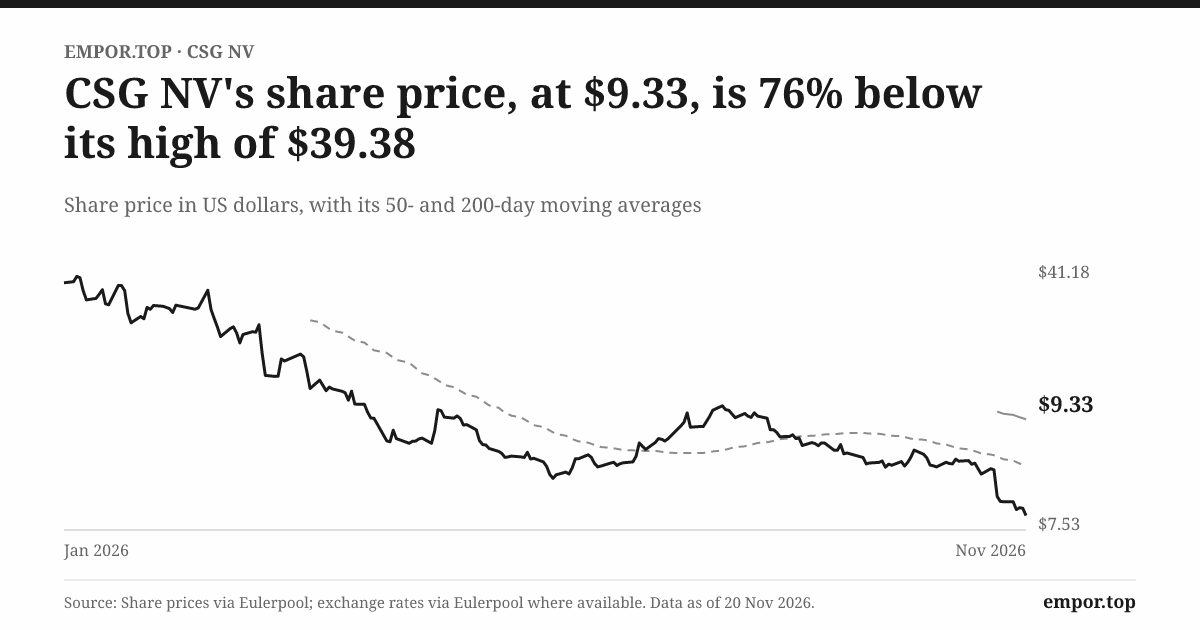
For a while the market seemed to agree with the pitch. In the weeks after the listing, the shares climbed above €33.3 Then the story began to take on water. Short sellers published investigations. Questions arose about a Spanish subsidiary and a NATO procurement agency. Cash flow, which in a manufacturing business is the final judge of whether profits are real, went sharply negative in the first half. And on 11 November, CSG told investors that its 2026 operating margin would be about 21%, not the 24% to 25% it had guided to all year.4 By the close on 20 November, the share price was €8.50, roughly a third of the offer price and almost three-quarters below its high, leaving a market value of about €8.5bn.3
The confusing part is that, on most operating measures, the business had not collapsed. Revenue for the first nine months of 2026 was €4.76bn, up about 6% on a year earlier.4 The order book stood at roughly €18bn, more than two years of revenue waiting to be built and shipped.4 Management kept its full-year revenue guidance intact.4 What the market was punishing was not demand. It was the gap between demand and money in the bank, and the speed with which management's own promises about that gap had shifted.
That shift is the first credibility test, and it happened in plain view. On the half-year call in August, management reaffirmed both the margin outlook and the target that working capital, the cash tied up in inventory and unpaid invoices, would end the year below 20% of revenue.5 Three months later, the margin guide came down by three to four percentage points and the working-capital ceiling was loosened to below 35% of revenue.46 In a single quarter, a company that had asked investors to pay €25 a share told them it would need far more cash to produce somewhat less profit than it had said.
That is why this story is worth telling at length. CSG is not a failed company. It is a large, profitable industrial group that grew extraordinarily fast, partly by building and partly by buying, and then walked into public markets just as the hardest part of the job began: turning a record backlog into delivered goods, and delivered goods into cash.
Four questions run through everything that follows. The first is whether the growth is durable once the war-driven procurement surge and the effect of big acquisitions are stripped away. The second is whether CSG's production capacity and its push to make more of its own inputs create a genuine advantage when the buyers are governments with tender power and alternatives. The third is whether orders can become cash without recurring squeezes like the one that shook the shares this year. The fourth is whether a controlling owner who still holds about 85% of the company allocates capital in a way that serves the minority shareholders who paid €25.7
One structural point needs to be settled before the story starts, because it shapes how every figure should be read. The company listed in Amsterdam, CSG N.V., was incorporated in January 2026 as a new Dutch parent sitting on top of the operating group, CZECHOSLOVAK GROUP a.s.8 The historical results therefore describe the very same operating businesses public investors now own; the Dutch holding company is a wrapper, not a separate enterprise with its own history. What the wrapper does not have is a track record as a listed company. Investors bought ten years of private-company growth and roughly ten months of public-company behaviour, and the second sample has been the more uncomfortable one.
To understand how a Czech family business got here, and why its order book is so large and its cash so stubborn, the story has to go back to a young man inheriting a company that traded in other armies' surplus.
 Subscribe on LinkedIn
II. From Surplus Tanks to a Czech Industrial Empire
The roots of CSG lie in a very particular post-Cold War trade. When the Warsaw Pact dissolved, Central Europe was left holding mountains of Soviet-era equipment, tanks, trucks, artillery and spare parts that newly democratic armies no longer wanted or could no longer afford to maintain. Jaroslav Strnad built a business refurbishing and reselling that equipment, and the company that grew from it, Excalibur Army, became the core of the family's defence interests.9 It was a business of workshops and warehouses, of knowing which old vehicle could be made to run again and which buyer in which country needed it.
His son Michal Strnad grew up inside that world. He took over leadership of the group in 2013, while still in his early twenties, and in 2018 became its owner.10 The 2018 change matters more than the earlier handover, because it marks the point at which the group's strategy became unmistakably his. Strnad has rarely sought the spotlight the way many founder-chief executives do; his public profile has been built almost entirely through deals and factories rather than speeches. His defining decisions have been consistent: buy capabilities rather than wait to build them, push the group out of its Czech base, and assemble a portfolio that could serve a modern NATO army rather than a refurbishment market that was slowly shrinking.1011
The consolidation that followed brought together Czech and Slovak engineering names, including military-truck maker Tatra, vehicle and ammunition businesses, and radar and electronics capabilities, under a single banner.9 The name Czechoslovak Group was itself a statement. It reached back to an industrial tradition that once made Czechoslovakia one of the world's notable arms exporters, and it signalled that the ambition was regional, not merely national.
The financial record of this expansion looks almost implausible at first glance. Over the ten years from 2015 to 2025, revenue grew by about 44% a year, and net profit by about 37% a year.128 In the last three of those years, revenue growth accelerated to about 88% a year.128 In 2025 alone, revenue rose about 72%, to roughly €6.7bn.1213
Those numbers deserve to be read carefully rather than admired, because they are not what they appear to be. A 44% compound growth rate over a decade, if it were organic, would put CSG among the fastest-growing industrial companies anywhere. But the decade includes a change of ownership, a string of acquisitions, and from 2022 the largest surge in European ammunition demand since the Cold War. The growth rate is real arithmetic. It is not a measure of how fast the underlying businesses grew on their own, and it is not a listed-company track record investors can extrapolate.
Two acquisitions changed the shape of the company. The first was Fiocchi, the Italian maker of small-calibre ammunition with a history stretching back to the 19th century, in which CSG took a controlling stake in 2022.811 Fiocchi gave CSG a foothold in a different market altogether: rifle and pistol cartridges sold to police forces, militaries, sport shooters and hunters, much of it through commercial channels in the United States and Europe. The second, and far larger, was Kinetic Group, the ammunition business CSG bought from Vista Outdoor in the United States and completed in late 2024.814 That deal, which gets its own chapter, turned CSG into one of the largest small-calibre ammunition producers in the world almost overnight.
Then, in January 2026, came the listing itself, which placed the whole operating group under the new Dutch parent.18 The sequence tells you something about Strnad's method. He built scale first, bought his way into the American market second, and invited public shareholders in only once the group was big enough to be valued as a European defence champion.
Here lies the complication that the rest of the story keeps returning to. The 72% revenue jump in 2025 had two engines running at once. One was booming demand for artillery ammunition and land systems from European governments and Ukraine. The other was the first full year of Kinetic's revenue sitting inside CSG's accounts, compared with only a short stub the year before.1213 Management cited both. The company does not provide a clean organic growth figure that separates the two, which means investors cannot easily tell how much of the 2025 surge would recur in a year without a transformational acquisition.
There is one more clue to how the group has been expanding, and it points to building rather than just buying. In the year to June 2026, headcount rose to about 11,550 from about 10,967, an increase of roughly 5%, while first-half revenue grew about 17%.7 Revenue rising three times faster than the workforce is what you would expect from a manufacturer adding automation and filling existing plants, though acquisitions and the shifting mix of products make it impossible to read too much productivity into the comparison. Research and development, by contrast, has stayed modest: the company estimated it at 1% to 2% of revenue, with more than €250m invested over the three years before the listing.8 That is a reminder of what kind of company CSG is. It is primarily a producer of proven hardware at scale, not an inventor of new weapons, and its economics reward factory throughput far more than laboratory breakthroughs.
The 2026 numbers offer a partial answer, and it is a sobering one. With Kinetic now fully in the base, nine-month revenue growth slowed to about 6%.4 Some of that slowdown is timing, since management says deliveries slipped into the fourth quarter. But it is also what happens when acquisition-driven growth laps itself. The decade of extraordinary expansion was built from three ingredients: a determined owner, a series of purchases, and a war. Only the first is fully under CSG's control.
Which raises the obvious next question. If demand was never the problem, what was? The answer, for most of the past four years, has been the capacity to make things at all.
III. The Bottleneck Was Capacity, Not Orders
Picture a single long-range artillery round, the 155-millimetre shell that has become the currency of the war in Ukraine. It looks like a simple object: a steel body, an explosive fill, a fuse, a propellant charge that throws it twenty, thirty or forty kilometres. In practice it is the end of a long chain. Someone has to forge the steel bodies. Someone has to produce the explosive, often TNT or a related compound, in chemical plants that require permits, safety distances and years of know-how. Someone has to make nitrocellulose-based propellant, and the longer the range, the more propellant each round needs. Someone has to make fuses, a precision component in its own right. And then someone has to fill, assemble, test and certify the whole thing.
For thirty years after the Cold War, Western governments let most of that chain wither. Demand was low, stockpiles seemed adequate, and nobody wanted to pay for idle factories. When Russia's full-scale invasion of Ukraine turned artillery into the decisive weapon of a European land war, buyers discovered that money could be appropriated far faster than shells could be made. Orders were easy to come by. The constraint was capacity, and above all capacity in the energetic materials, the explosives and propellants, that sit at the bottom of the chain.
That is the market CSG was built to exploit. The way it is organised tells the story of where its money comes from. The group reports two big operating segments. Defence Systems contains medium and large-calibre ammunition, land systems such as armoured vehicles and military trucks, and radars and electronics. Ammo+ contains the small-calibre ammunition businesses, Kinetic and Fiocchi.1315 A small Advanced Systems unit houses newer bets.
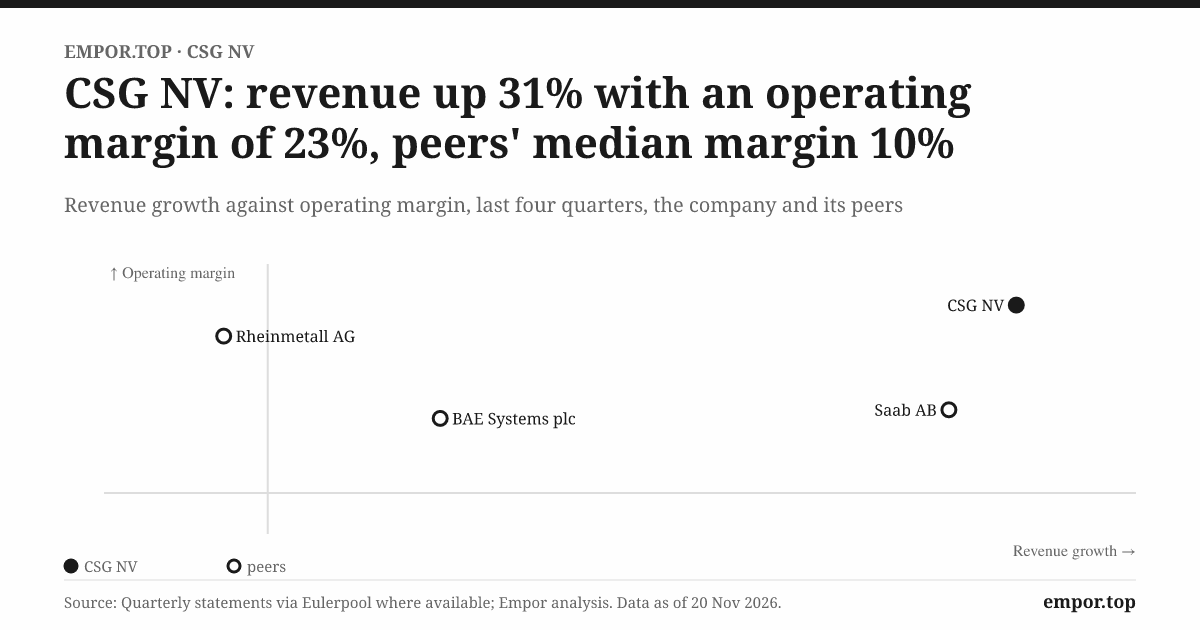
Defence Systems is the earnings engine, and the imbalance is striking. In 2025 it generated about €5.35bn of revenue and about €1.50bn of operating profit, while Ammo+ brought in about €1.40bn of revenue but only €117m of operating profit.13 The first nine months of 2026 told the same story: Defence Systems produced about €3.79bn of revenue and €1.06bn of operating profit, while Ammo+ produced €971m of revenue and €79m of operating profit.415 In other words, Defence Systems supplied about four-fifths of revenue and very nearly all of the segment profit.
The margins make the point more concretely. For every €100 of sales, Defence Systems kept about €28 as operating profit in the first nine months of 2026; Ammo+ kept about €8.415 Within Defence Systems the mix matters too. Medium and large-calibre ammunition, the shells, is the largest revenue driver and the most profitable activity. Land Systems, the vehicles, is growing fast and has become the biggest contributor to the backlog, but its margin was around 15.5% as new programmes ramped up, well below the established ammunition business.615 Radars and electronics are a smaller contributor.
Why are shell margins so high? Part of the answer is genuine scarcity. When a government needs artillery rounds this year rather than in five years, the producer with available capacity sets terms, and a 28% operating margin is the visible result. Part of it is contract structure. Ammunition contracts typically run about three years or less, with some stretching to six or seven, which allows a supplier to reprice relatively often in a rising market.8 The same short duration cuts the other way when the market turns: contracts that reprice quickly upward can reprice quickly downward too, once rival capacity arrives and buyers regain the upper hand. Investors who capitalise today's ammunition margin as a permanent feature are implicitly betting that the scarcity lasts.
So the shape of CSG's economics is this: a highly profitable artillery and medium-calibre ammunition business is subsidising both a lower-margin consumer and law-enforcement cartridge business and a vehicle business still climbing its learning curve. That shape is the key to understanding the November guidance cut, because as the mix shifts toward vehicles and toward lower-priced standard ammunition, the group margin falls even if every individual business performs as planned.
How big is CSG against its rivals? In 2025, CSG reported about €6.7bn of revenue; Rheinmetall, the German group that is the most obvious European comparison, reported about €9.9bn.1216 Beyond Rheinmetall, the competitive field includes BAE Systems, the Franco-German vehicle maker KNDS, General Dynamics, 한화에어로스페이스 Hanwha Aerospace and Israel's Elbit Systems, each of which competes with CSG in some combination of vehicles, ammunition and defence electronics. None of them has the same mix, so direct comparisons of size or margin are rough at best. What can be said is that CSG is now a genuine peer of the large Western ammunition producers, not a regional subcontractor.
To judge whether that position constitutes a durable advantage, it helps to think about the industry's power structure the way Michael Porter would, beginning with the customer. CSG's buyers are overwhelmingly governments and their procurement agencies. They are concentrated, sophisticated and politically accountable, and they run competitive tenders. In 2024, on a pro-forma basis including Kinetic, CSG's ten largest customers generated about €2.6bn, roughly half of revenue, and most of them were governments or government agencies.8 Ukraine alone accounted for about 17% of revenue in the first nine months of 2026.4 Contracts give CSG some protection. Many are take-or-pay, meaning the customer commits to the volume, and some come with advance payments. But most do not allow CSG to raise prices when its own costs rise unexpectedly.8 When input costs spike after a contract is signed, the margin squeeze lands on CSG, not on the ministry of defence.
On the other side sit the suppliers, and here the risk is less visible but just as real. Some critical inputs are available from only one source. At the time of the listing, about 30% of CSG's TNT requirements depended on a single supplier, which the prospectus identified as NitroChem.8 A shell factory without explosive is a warehouse of steel tubes. That is why CSG's investments in energetic materials, discussed later in this story, are not a diversification hobby but a direct attempt to reduce its exposure to the one link in the chain that can halt everything.
It is worth pausing on the threat of substitution too, because it is the force that matters least here and is often over-discussed. Software, sensors and artificial intelligence are changing how armies find targets and fly drones, and CSG itself lists AI and autonomous systems as development areas.10 But nothing in that wave replaces the physical shell or the armoured vehicle. If anything, drone warfare has increased the consumption of munitions and the demand for protected vehicles. The relevant technology risk is narrower: that electronics-heavy niches, such as radar and counter-drone systems, are won by specialists with deeper software capabilities than CSG's smaller electronics arm.
Barriers to entry are the strongest part of CSG's case. Making explosives and propellants requires environmental and safety permits that can take years, large capital commitments with uncertain payback, and production expertise that is not written down in any manual. New entrants cannot simply raise money and open a shell plant next quarter. Meanwhile, CSG's backlog and recent awards give it something rare in manufacturing: visibility into demand several years ahead.
But visibility is not the same as certainty, and CSG's own presentation of its backlog shows why. At the end of 2025, the company divided its order book into roughly €7bn of fixed orders, €6bn of framework agreements and €2bn of what it called soft backlog.13 Those three categories are not equally firm. A fixed order is a contract to deliver specified goods. A framework agreement sets terms under which a government may place orders, without obliging it to buy a particular quantity. Soft backlog is closer to a strong expectation. The same caution applies to the headline-grabbing Slovak framework agreement, which management has presented as worth up to about €58bn over its life.13 That figure is a ceiling of potential value, not committed sales. Investors who read "€18bn backlog" as eighteen billion euros of guaranteed revenue are reading something the company has not claimed.
So does CSG have a moat? The honest answer narrows the claim rather than rejecting it. CSG has a credible advantage in capacity and integration while supply is tight: it has plants, permits, know-how and a growing ability to make its own inputs, and governments desperate for shells have rewarded that. What the record does not show is customer lock-in or a cornered market. Governments multi-source by policy. They tender among qualified suppliers, they fund rival capacity, and as more capacity comes online across Europe, the scarcity that underpins CSG's pricing today will ease.
The way CSG wins and loses follows directly. It wins tenders when it has production available, delivers reliably, and can offer integrated packages such as vehicles plus ammunition. It loses, or at least defers revenue and margin, when export licences are delayed, when a component runs short, when a new vehicle programme takes longer to ramp, or when demand shifts from one type of round to another faster than factories can retool. Every one of those mechanisms showed up in 2026. The scarcity advantage is real but perishable, and the KPI that would confirm it is the conversion of fixed backlog into delivered revenue at stable margins as European rivals add capacity.
The small-calibre side of the business, Ammo+, behaves differently from the shells, and it was born from the boldest bet Strnad ever made: an auction across the Atlantic.
IV. The Deal That Took CSG Across the Atlantic
In October 2023, Vista Outdoor, an American company that owned some of the best-known names in American shooting, agreed to sell its ammunition business to a Czech group most American investors had never heard of.14 The business, then called the Sporting Products segment and later renamed Kinetic Group, owned Federal, Remington, CCI, Speer and other brands that line the shelves of American sporting-goods stores. For a European defence company that had been building a small-calibre platform through Fiocchi, it was a once-in-a-generation opportunity to buy scale in the world's largest commercial ammunition market.
The sale did not proceed quietly. Rival bidders emerged, regulatory and political scrutiny of a foreign buyer for a major American ammunition producer added friction, and the terms were amended as competing offers came in.1114 CSG raised its price, and by the time the deal closed in late 2024, the final consideration was about $2.29bn, roughly 20% above the original agreement.148
Was that too much? The cleanest way to judge an acquisition price is against what the business earns. In 2024, Kinetic generated revenue of about $1.5bn and EBITDA, a rough proxy for operating cash earnings before investment, of about $416m.148 Against the final price, that works out to roughly 5.5 times EBITDA, compared with about 5 times at the original offer.14 Vista had presented the original price as in line with precedent transactions in the sector.14 By the standards of defence or industrial acquisitions, five or six times cash earnings is not a heroic multiple.
So the entry price, on its own, does not suggest overpayment. But a fair multiple only tells you what you paid relative to the earnings at the time. It tells you nothing about whether those earnings were near a peak, and US commercial ammunition is a famously cyclical market, driven by election cycles, social unrest and the purchasing waves of private gun owners. The 2024 earnings CSG paid for were not depressed earnings. And the 20% increase during the bidding war is precisely the kind of drift that turns a sensible deal into a marginal one.
It is also important to keep two numbers apart. The roughly $2.29bn purchase price was the cost of Kinetic. CSG's wider borrowing in that period, including bonds and loan facilities, funded more than one transaction and the group's general expansion.8 Blurring the two overstates how much was spent on this deal, and understates how much debt the group was taking on overall.
The strategic logic was clear. Fiocchi gave CSG European and some American small-calibre presence; Kinetic gave it the dominant American brands and factories. Together they created a small-calibre platform that could sell to militaries, police forces and civilians on both sides of the Atlantic. The prospectus also flagged a reminder of what had gone wrong before: Kinetic's earlier contract to run the US Army's Lake City ammunition plant had ended in 2023, a past contract exit that reduced available ammunition and sales.8 Scale in small-calibre ammunition does not guarantee government work.
What has the outcome looked like since? In 2025, Ammo+ generated revenue of about €1.40bn but operating profit of only €117m, a margin of about 8%.13 In the first nine months of 2026 the margin was again about 8%.415 For comparison, Kinetic's 2024 EBITDA of $416m on $1.5bn of revenue implied a cash-earnings margin of more than 25% before depreciation and amortisation. Some of the gap is accounting: operating profit is struck after depreciation, and acquisitions bring amortisation of intangible assets such as brands. Some of it is the market: on the Q3 call, management described lower prices in standard-range ammunition.6 And because Ammo+ includes Fiocchi as well as Kinetic, the segment figures cannot be read as Kinetic's standalone return.
The capital kept flowing into this corner of the business. In 2025, CSG bought the remaining 30% of Fiocchi, taking full ownership.1213 It has invested in vertical integration across its ammunition businesses, and in 2026 it took a 9.5% stake in MDA Space, the Canadian space-technology company, without disclosing the purchase price.415 Each of those decisions may prove sensible. Together they describe an owner with a strong appetite for deployment, which is exactly the trait the rating agencies flagged when they listed acquisition appetite among the constraints on CSG's credit profile.17
The verdict on Kinetic therefore stays where the evidence leaves it: unproven rather than failed. CSG bought a strong set of brands at a price that did not look extravagant, then saw the segment containing them earn modest margins in a softer market. The test is the one no acquisition multiple can settle: whether the cash returns from Kinetic and Fiocchi, net of integration costs and the extra capital put in since, exceed the cost of the money used to buy them. CSG does not report Kinetic's standalone post-deal returns, so that test cannot yet be scored. The KPI to watch is simple: Ammo+ operating margin and the segment's cash generation as the US commercial cycle turns.
The Kinetic deal left CSG larger, more leveraged and more international. It also set the stage for the next move, the one that would invite outside investors in and expose the group to a level of scrutiny it had never faced as a private company.
V. The IPO's First Credibility Test
On 20 January 2026, the Dutch financial regulator approved the prospectus for a company that had existed for only a matter of weeks.18 CSG N.V. was a new holding company sitting above the operating group, and it was being offered to investors while Michal Strnad kept control through his vehicle, CSG FIN a.s.8 Three days later, trading began.1
The mechanics of the offering reveal who gained what. The company issued 30 million new shares, raising €750m for CSG itself.1 Separately, CSG FIN sold about 102 million existing shares, with an over-allotment option of about 20 million more.1 That second, much larger slice was a secondary sale: the money went to the controlling shareholder, not to the company. At €25 a share, the secondary sale and over-allotment together amounted to roughly €3bn, about four times the cash raised for the business. There is nothing improper in that structure; many founder-led IPOs combine fresh capital with a partial cash-out. But it means that when investors ask who benefited from the €25 price, the answer is primarily the seller.
After the offering, CSG FIN held 84.78% of the shares and the public about 15%.7 Michal Strnad is the ultimate beneficial owner.8 The board has nine directors, four of them independent non-executives.7 That is a meaningful independent presence, and Moody's cited governance improvements among its reasons for upgrading CSG to investment grade in February.17 It is also a minority. On any contested vote, the controlling shareholder decides.
The case for this arrangement is straightforward. An owner with 85% of the equity bears 85% of the consequences of bad decisions, which aligns his incentives with value creation more tightly than any stock-option plan could. Strnad has led the group since 2013 and owned it since 2018; he has already shown a willingness to think in decades.10 The case against is equally simple. Concentrated control can leave minority holders with limited influence over capital allocation, related-party dealings and disclosure, and the first year of a listing is when the habits of a private company meet the expectations of a public one.
Some of those habits show up in the pay disclosures. The half-year report does not disclose individual pay for the chief executive or the chief financial officer, Zdeněk Jurák.7 What it does show is that the cost of the group's key management rose to about €29m in the first half of 2026, from about €17.3m a year earlier, while the number of people counted as key managers rose from 182 to 225.7 The prospectus sets out a remuneration framework, but the public record does not yet establish the precise performance conditions that would tie executive pay to, say, cash conversion or return on capital.8
Related-party flows are modest but not trivial. In the first half of 2026, CSG recorded about €58.5m of income from related parties and €25.5m of expense, roughly 1.8% of revenue on the income side.7 Related-party receivables were about €98.8m, and the report says shareholder transactions include loans and that all related-party dealings were on arm's-length terms.7 These sums do not move the earnings needle. They matter because they are the channel through which a controlling owner's interests and the company's could diverge, and because they are what minority investors watch most closely in groups like this.
The accounting record, at least, offers no red flags of the conventional kind. Deloitte audited the group financial statements for 2022 to 2024 that were included in the prospectus, and the company had released all provisions for pending litigation in 2024 while describing ordinary-course contract, tax and product disputes.8 Contingent liabilities at the end of June were about €5.1m, a trivial sum for a group of this size.7 Those are reassurances about the books as filed. They do not address the questions that outsiders were about to raise about what sits behind them.
Then came the short sellers. On 4 May 2026, Hunterbrook Media, whose affiliated fund disclosed a short position in CSG, published an investigation challenging the group's ammunition production claims and raising questions about shareholder arrangements and disclosures.19 CSG responded the next day. It said its own production capacity for large-calibre rounds in 2025 had been about 630,000 rounds, in addition to output from recommissioned facilities and third-party partnerships, and disputed the report's conclusions.20 On a specific point the report had raised, a €275m receivable linked to disposals carried out before the IPO, CSG said the item had been disclosed and was fully settled in cash in the first quarter of 2026.20
The dispute over production is subtle and worth explaining. A company can describe its contribution to the market as the rounds it makes from scratch, the rounds it assembles from bought-in components, the rounds it refurbishes from old stock, or the rounds it sources from partners and resells. All four are legitimate businesses. They have very different margins, capital needs and strategic value. When short sellers and management argue about "production", they are often arguing about which of those categories belongs in the headline figure. The resolution investors need is not a press release from either side but measured output against stated capacity over time.
Two weeks later, Hunterbrook published a second report, this one focused on Indonesia and on a transaction involving Vývoj Martin, a Slovak business.21 CSG responded that Southeast Asia accounted for about 2.5% of its 2025 revenue, that it worked with vetted local partners, that no additional consideration had been paid in the Vývoj Martin transaction, and that the business's reconsolidation had followed international accounting standards.22 The company's figure puts the Indonesian exposure in proportion: it is not a large part of revenue. What the public record does not fully resolve is customer-level concentration in that region or the full audit trail of the Vývoj Martin transaction.
A separate story had surfaced even before the IPO's first quarter was out. On 10 March, the Dutch investigative outlet Follow the Money reported that CSG's Spanish subsidiary, Fábrica de Municiones de Granada, or FMG, had been suspended from bidding in tenders run by NATO's Support and Procurement Agency in connection with a wider corruption investigation.23 CSG said the same day that its internal legal audit had found no irregularities at FMG, and that FMG could still sell directly to NATO member states.24 The suspension and the denial are not mutually exclusive. What matters commercially is whether FMG's eligibility for NSPA tenders has been restored and what revenue, if any, the suspension cost. CSG has not quantified that impact.
None of these allegations has been established as wrongdoing, and it would be wrong to treat them as if they had. A short seller has a financial interest in a falling share price, and a company has an obvious interest in denying. But the cluster of questions, coming within months of the listing, did something important: it raised the price of trust. A company asking investors to look through a working-capital squeeze needs those investors to believe its disclosures, and the spring of 2026 made that belief more expensive.
What would lower that price is not complicated. Full disclosure of voting outcomes at CSG's shareholder meetings would show how much independent support the board's decisions command. A fuller breakdown of related-party flows and intermediary arrangements would address the questions the Indonesia report raised. And regular reporting of measured production against capacity claims would settle the argument over rounds more convincingly than any rebuttal. Until then, the governance question stays open: Strnad's incentives are strongly aligned with value creation, but the mechanisms that would let minority holders verify how that value is shared remain thinner than at older listed peers.
The governance doubts might have faded with time if the numbers had been clean. Instead, the summer brought a cash-flow statement that turned a theoretical worry into a practical one.
VI. When the Order Book Failed to Turn into Cash
On the half-year call in August, CFO Zdeněk Jurák gave analysts a reassuring message. Cash had gone out in the first half, he acknowledged, but working capital should end the year below 20% of revenue, consistent with guidance.5 The build in inventory was described as preparation for deliveries later in the year.
Three months later, on the Q3 call, the target was below 35%.6 And by the end of September, working capital stood at about 42% of the previous twelve months' revenue.4 To make that concrete: on revenue of roughly €7.5bn, the difference between 20% and 35% is about €1.1bn of extra cash tied up in the business, money that investors had been told would be released.
To see why this matters so much, it helps to understand what working capital is in a factory business. A shell maker buys steel, explosives, propellant and fuses months before it ships a finished round. It pays its workers every month. It may then wait weeks or months after delivery to be paid, especially when customers are governments with their own budget cycles. All of that money sits in the business as inventory and receivables, partly offset by the bills the company itself has not yet paid to suppliers. When production ramps up, or when lead times lengthen, that pool swells, and profits on the income statement fail to appear as cash in the bank.
The long record shows that CSG's profits have, over time, largely turned into cash. From 2015 to 2025, the group generated about €1.6bn of operating cash flow against about €1.8bn of cumulative net profit, a conversion rate of about 93%.128 That is respectable for a fast-growing manufacturer. But the annual pattern swings violently. In 2024, operating cash flow was strongly positive; in 2025 it was slightly negative on the standard accounting measure.12 The cumulative figure smooths over a business in which cash arrives in lumps, usually tied to large advance payments or big deliveries.
This is also where definitions start to matter, because CSG and its accounts measure cash differently. On the standard IFRS cash-flow statement, cash from operations in 2025 was negative.12 CSG's own presentation emphasised a positive pre-tax operating cash flow of about €61m, after a strong fourth-quarter unwind of working capital.13 Both figures can be true at once, because they are calculated differently; the company's version excludes tax and uses its own definitions. Investors should not treat them as interchangeable, and should be aware that the company-defined figure flatters the picture.
The first half of 2026 then showed the squeeze in full. CSG earned profit of about €571m and, before working-capital movements, generated about €887m of operating cash.7 Then inventory absorbed about €586m and receivables and other assets absorbed another €267m, together consuming nearly all of that pre-working-capital cash.7 Once supplier payments, interest and tax were settled, operations had used about €536m of cash.7 Half a year of strong reported profit had produced a cash outflow of more than half a billion euros.
Where did the money go on the balance sheet? Trade and other receivables were about €1.02bn at the end of June.7 Contract assets, which represent work CSG has performed but not yet invoiced, jumped to about €238m from €44m at December.7 Prepayments and accrued income stood at about €379m.7 The rise in contract assets is particularly telling, because it means revenue is being recognised on work in progress before CSG has the right to bill for it. That is normal under the accounting rules for long-term contracts, but it widens the gap between profit and cash.
It would be tempting to conclude that customers were paying late. The record does not support that conclusion. CSG does not publish an ageing schedule for its receivables, so there is no evidence of overdue invoices piling up. The group released a small net amount of receivable impairments in the first half, which, if anything, suggests collection was not deteriorating.7 Debtor days, a measure of how long customers take to pay, were about 74 in 2025, well below the 205 of 2019.12 The cash went mostly into inventory and unbilled work, not into bad debts.
The Q3 update is where the story turned from a timing issue into a credibility issue. CSG kept its 2026 revenue guidance at €7.4bn to €7.6bn, explaining that about €300m of deliveries had shifted from the third quarter into the fourth.4 But it cut its margin outlook to about 21% and loosened the working-capital ceiling to below 35%.4 Nine-month operating margin fell to about 23.1% from 24.5% a year earlier.4 Management explained the margin drop with specific drivers: longer lead times on certain ammunition, lower-priced sales of standard-range ammunition from inventory, and the Land Systems ramp-up, whose margins were still building.6
The comparison between the two calls is instructive. In August, analysts pressed on cash release, leverage and the timing of deliveries, and received broadly reassuring answers framed around the second-half pattern.5 In November, the same themes returned, but the answers were more specific: management spelled out that customers were shifting toward extended-range ammunition that needs more propellant and longer lead times, that some standard-range inventory had been sold at lower prices, and that working capital would unwind in 2027 as deliveries came through.6 Specificity is better than vagueness. It does not, however, erase the fact that the August guidance proved wrong within one quarter, or that the promised 2027 unwind is still a promise.
Leverage rose with the cash outflow. By the end of September, net debt was about €4.32bn and reported net leverage, net debt divided by a year's EBITDA, reached about 2.4 times.4 Management also presented an adjusted figure of about 1.6 times, excluding roughly €731m of investments in joint ventures and strategic stakes and about €700m of financing provided to suppliers.4 The adjustment has a logic: those are assets CSG believes it will recover. But the cash has left the company all the same, and supplier financing in particular is a reminder that CSG is lending money to secure its own supply chain. Rating agencies had cited working-capital swings as a constraint on CSG's credit rating when they assessed it in February.17 The third quarter showed why.
The cost of carrying that debt was already visible in the half-year income statement. CSG booked about €166m of financial income in the first half, a figure that might look like a meaningful cushion at about 23% of pre-tax profit, but financial expense was about €258m over the same period.7 Net of the two, financing was a drag on earnings rather than a support. At the end of June, the group held about €1.6bn of cash against about €1.8bn of bank loans and about €2.6bn of bonds, with lease liabilities of about €113m on top.7 Holding large cash balances while borrowing heavily is not unusual for a company with lumpy receipts and big contract payments, but it is expensive, and it explains why the refinancing that followed mattered.
There was one genuine piece of relief. CSG refinanced €3.1bn of senior facilities, lowering its interest cost by 125 to 150 basis points and extending maturity to six years.4 That eases near-term refinancing pressure considerably, and it suggests lenders remain comfortable with the credit. It does not change the underlying arithmetic: the company is still carrying significant debt while billions of euros sit in inventory and unbilled work.
The fair verdict is that this is a real execution and credibility setback, not evidence that reported profits are fictitious. The drivers management named are plausible and consistent with what is happening across the ammunition industry. But a company that guided to below 20% working capital in August and delivered 42% by September has to earn back the benefit of the doubt. The decisive figures are 2026 operating cash flow and year-end working capital, followed by evidence that 2027 deliveries actually release the cash.
Part of management's answer to all of this is to build its way out: to make more of its own inputs so that lead times shorten and margins recover. That is the story of the new factories.
VII. The New Factories—and the Businesses Still on Paper
In the German state of Saxony, near the town of Gnaschwitz, CSG is committing more than €100m to expand production of propellant, the energetic material that throws a shell downrange.615 The timing is not accidental. Customers are shifting toward extended-range artillery rounds, which fly further but need more propellant per shell and take longer to produce.6 A company that has to buy that propellant from others is exposed to their lead times and prices. A company that makes it in-house controls both.
Gnaschwitz is one piece of a broader puzzle. CSG has also expanded energetics production at Walsrode in Lower Saxony, and it has formed a joint venture in Greece to produce TNT.1513 The aim, management has said, is full in-house production of extended-range ammunition by the end of 2027.6 This is vertical integration as a chess move: rather than competing only on the final assembly of a shell, CSG wants to own the bottleneck inputs that limit everyone's output. If it succeeds, it reduces its dependence on the single supplier that once covered 30% of its TNT, cuts lead times, and captures margin that today goes to its suppliers.
The strategy has an obvious cost. Capital expenditure was about 3.3% of revenue in 2025, rose to 5.3% in the first nine months of 2026, and is expected to reach about 8.5% for the full year.412 At roughly €7.5bn of revenue, that implies capex of more than €600m for 2026, while operating cash flow has been negative for the first half. CSG is paying for new factories and a working-capital build at the same time, with borrowed money filling the gap.
That is a defensible decision if the factories earn their keep, and the right test is not the completion date but what comes out. Investors should look for output volumes at the new sites, production yields, the unit cost of in-house propellant compared with bought-in supply, and the return on the capital invested in the new capacity. A completed plant that runs at a fraction of capacity, or that produces at a higher cost than the market price, is a monument rather than an asset. CSG has not yet published the operating data that would let outsiders make that judgment.
There is also a question of timing. Vertical integration pays most when supply is tight. If European capacity expansion across the industry outruns demand by the time CSG's plants are fully running, the company will own its inputs just as those inputs become easier to buy. That is not a reason to avoid the investment, but it is a reason to treat the margin uplift as a scenario rather than a certainty.
Then there are the businesses still mostly on paper. On the H1 call, CFO Jurák said the propulsion business, rocket motors for missiles and similar applications, could contribute several hundred million euros of revenue in the medium term.5 CSG has also developed counter-drone systems and a vehicle called Karpat, and it houses these newer efforts in its Advanced Systems unit. In the first nine months of 2026, Advanced Systems generated about €4m of revenue.415 On the Q3 call, management acknowledged that Karpat had no signed, funded order.6
The gap between those two figures, several hundred million euros of medium-term ambition and €4m of actual revenue, is the gap between a technical story and a commercial one. Defence history is full of products that passed trials, won praise and never secured a large production contract. CSG's own record in this area is too short to judge either way, and that is precisely the point: these are options, not earnings drivers.
The same applies to the 9.5% stake in MDA Space and the investment in North Vector.415 Both extend CSG's reach toward space and advanced systems, and both may prove strategically valuable. The MDA purchase price was not disclosed, and neither investment is yet a material earnings stream. For a company asking investors to look through a cash squeeze, every euro spent on optionality is a euro not used to reduce debt, which is why a skeptical shareholder would ask for clear disclosure of what was paid and what is expected in return.
The factories address a real constraint and deserve credit for that. Their return, and the commercial value of the newer bets, remain to be proven. Which brings the story to the question every investor in CSG ultimately has to answer: at €8.50, what is the market actually pricing in?
VIII. Analysis & Bear vs. Bull Case
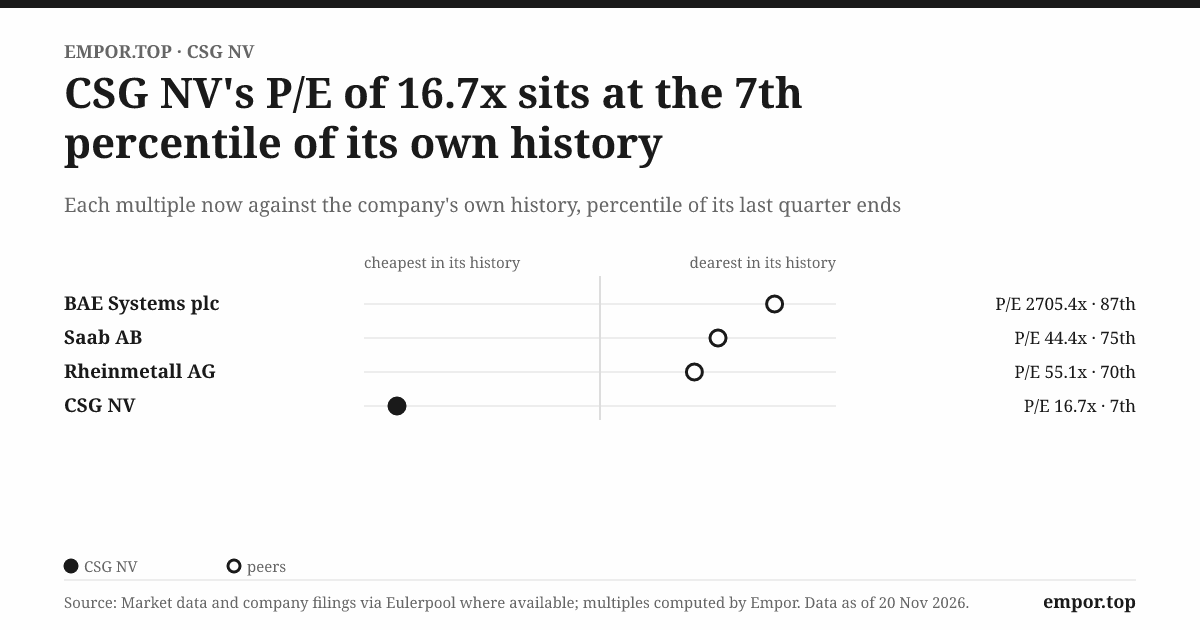
At €8.50 a share, CSG trades at about 16.7 times trailing earnings and about 6 times enterprise value to EBITDA, the measure that compares the value of the whole business, including debt, with its cash earnings.37 For context, a sector report at the end of September put Rheinmetall at about 26 times its expected 2026 earnings and BAE Systems at about 23 times.25 Those are forward multiples on different earnings bases, so they are not a like-for-like ranking. But the direction is clear: the market prices CSG at a meaningful discount to its large Western peers.
One number that circulates in screening tools needs to be thrown out entirely. A five-year median price-to-earnings ratio of about 203 times looks like a dramatic de-rating, but it does not describe any real trading history, because CSG only began trading in January 2026.1 The figure is an artefact of mechanically applying today's share count to years when the company was private and its earnings far smaller. It is not a valuation anchor.
The returns the business earns on its capital help explain why bulls see value. Over the twelve months to June 2026, return on equity was about 32% and return on invested capital, which measures after-tax operating profit against all the debt and equity funding the business, was about 23%.712 Those are high returns for a heavy manufacturer, and if they could be sustained they would justify a far higher multiple. But they flatter in one important way: the equity base is thin. At the end of 2025, total debt was about three times shareholders' equity.12 Much of the impressive return on equity comes from leverage, and leverage cuts both ways when cash flow turns negative.
The 16.7 times multiple itself deserves a caveat. It reflects earnings through June 2026, before the full effect of the November margin cut. If the full-year margin lands near 21% rather than the 23% to 25% seen earlier, forward earnings will be lower and the multiple on those earnings correspondingly higher. The discount is real but smaller than the headline suggests.
To weigh what that price assumes, it helps to apply the two frameworks investors use most often to judge competitive advantage. Porter's five forces have already been laid out in the story of the bottleneck: powerful government buyers, concentrated suppliers of critical inputs, high barriers to entry, limited substitution risk for physical munitions, and rising rivalry as competitors add capacity. The question now is what that structure means for durable returns.
Hamilton Helmer's seven powers offer a sharper lens, because they ask which specific mechanism lets a company earn returns above its cost of capital for a long time. Scale economies are partly present: CSG's size spreads fixed costs and supports investment in energetics that smaller rivals cannot afford, but Rheinmetall and others are larger in key categories. Cornered resource is the most interesting candidate. Permits, energetics plants and production know-how are scarce, and if CSG controls more of the bottleneck inputs by 2027, that scarcity could be durable. But governments are actively funding new capacity elsewhere, which erodes the resource over time. Process power, the ability to produce more efficiently in ways competitors cannot easily copy, is plausible in CSG's ammunition margins, which at about 28% in Defence Systems are high for the industry, but the evidence cannot yet separate process efficiency from wartime pricing.
The other powers are weak or absent. Switching costs exist in vehicles, where training, spare parts and maintenance tie an army to a platform for decades, which helps Land Systems. In ammunition, NATO-standard rounds are designed to be interchangeable, which means a government can switch suppliers with relatively little friction. Network effects do not apply. Brand matters in US commercial ammunition through Federal and Remington, but it has not protected Ammo+ margins. Counter-positioning, where a newcomer adopts a model incumbents cannot copy without harming themselves, does not describe CSG's strategy. The net picture is a company with a real but time-limited advantage in capacity, and a potential cornered resource in energetics that is still being built.
The bull case rests on evidence, not wishful thinking. CSG supplies scarce ammunition and land systems into procurement programmes that will run for years, as European governments rebuild stockpiles and replace equipment sent to Ukraine. Its Defence Systems segment is large and highly profitable. Its backlog of about €18bn, with a further pipeline of about €29bn, gives more forward visibility than most industrial companies enjoy.4 Its investments in energetics could improve both supply security and margins. Its credit has been upgraded to investment grade by Moody's and affirmed by Fitch, with S&P a notch lower at BB+, and the November refinancing lowered its interest costs.17264 At roughly 6 times EBITDA, a bull would argue, the market is pricing a temporary execution miss as if it were a permanent impairment.
The bear case also rests on evidence. A meaningful part of the backlog is framework and soft rather than fixed. Government customers can and do tender among qualified suppliers, and their bargaining power rises as capacity loosens. Wartime demand and acquisition contributions make the organic trend hard to read, and the slowdown to about 6% revenue growth in 2026 hints that it may be weaker than the decade's headline suggests. Inventory, receivables, supplier loans and strategic investments have absorbed earnings, leaving free cash flow negative. Customers and suppliers are both concentrated. The company has less than a year of public-market history, a controlling shareholder with 85% of the votes, and a series of unresolved allegations. A bear would argue that the discount to Rheinmetall is not a bargain but a fair price for those risks.
An activist with a long position would focus on a narrower set of questions. Why is the group investing in space stakes and early-stage systems while working capital absorbs more than a billion euros and leverage sits at 2.4 times? Why is individual executive pay not disclosed? What exactly is the return on the Kinetic acquisition, and on the capital put into Fiocchi since? Why does the company's preferred leverage figure exclude €1.4bn of cash that has left the business? Each of those questions has a possible good answer. None has yet been answered in full.
The management test is subtler than simply counting the guidance cut against them. The 2026 reduction was substantial and came only three months after a reaffirmation, which damages credibility. But management also explained the margin drivers specifically, kept revenue guidance, and shifted delivery assumptions rather than abandoning them. That is better behaviour than vague blame-shifting. The verdict on management will be written by the year-end delivery, cash and margin outcomes, and then by whether the 2027 integration milestones arrive on time.
Three numbers matter more than all the others for tracking CSG from here. The first is segment operating margin, especially the Land Systems margin, which was around 15.5% as programmes ramped and whose direction will determine whether mix shift keeps pulling the group margin down.6 The second is the conversion of fixed backlog into delivered revenue, the clearest test of whether the order book is as firm as it looks. The third is working capital as a share of revenue, which stood at about 42% at the end of September and needs to fall well below the 35% ceiling, read alongside IFRS operating cash flow and reported leverage.4
The political and operating risks matter through specific mechanisms. Procurement delays and export-licence holdups defer revenue. Input shortages and rising copper prices, copper being a key material for shell driving bands and cartridge cases, pressure margins on fixed-price contracts. Demand shifts, such as the move toward extended-range rounds, can strand inventory built for the old mix, which is partly what happened with standard-range ammunition this year. Debt amplifies all of those, because working-capital needs that a debt-free company would absorb become refinancing and leverage concerns for one with €4bn of net debt. A ceasefire in Ukraine would test the demand case directly, although European rearmament budgets suggest the procurement cycle would outlast the war. AI and space do not belong in the core risk case; unless they change the economics of CSG's products or produce material orders, they are footnotes.
The market at €8.50 is not pricing CSG as a failed business. It is pricing a profitable industrial group whose cash conversion, governance and growth quality are all unproven at the same time. The valuation is context, not proof of cheapness, and what that context assumes is that at least some of those doubts will turn out to be justified.
IX. Playbook: Business & Investing Lessons
There is a particular kind of quarter that every industrial company eventually lives through: the order book is at a record, the factories are running flat out, and the cash still goes the wrong way. CSG lived through it in the third quarter of 2026, with an €18bn backlog on one side of the ledger and a working-capital target loosened from below 20% to below 35% on the other.4 What that quarter teaches is not specific to defence, but it is unusually vivid here.
The first lesson is that a backlog buys time; only delivery turns it into a business. CSG's order book was split between fixed orders, framework agreements and soft commitments, and those categories are as different as a signed purchase order, a price list and a handshake.13 Then €300m of deliveries slipped from one quarter to the next, and the market discovered that even the firm part of the backlog had to be built, shipped, invoiced and paid before it meant anything.4 Founders in any business with long contracts should remember that customers judge the order book by its conversion, and investors should value it the same way.
The second lesson is that vertical integration is valuable when it removes a bottleneck at a return. CSG's investments at Gnaschwitz, Walsrode and the Greek TNT venture aim squarely at the inputs that limit ammunition output.15 That is the right target. But a factory that takes three years to build, in a market where every competitor is building too, has to prove that its output arrives at a lower cost and higher reliability than buying from others. Integration is a means, not an achievement. The proof is in the 2027 margin, not the 2025 groundbreaking.
The third lesson is that a fair entry multiple does not prove a good acquisition. Kinetic was bought at roughly 5.5 times the cash earnings of its last full year, a price that did not look extravagant against precedent deals.14 Yet the segment containing it has earned margins of about 8%, and CSG does not report Kinetic's standalone return.4 The multiple measured the price against a good year in a cyclical market. The return will be measured against every year that follows, and against all the extra capital invested since. Acquirers celebrate the multiple; owners should track the cash.
The fourth lesson is that a controlling owner can build for the long term and still leave minority holders with less voice. Michal Strnad built CSG into a European defence champion through decisive deals, and his 85% stake binds his fortune to the company's.7 But the IPO sent far more money to his holding company than to CSG itself, and the months since have shown how much minority investors depend on disclosure they cannot compel.1 Founder control is a commitment device and a governance risk at the same time; the balance between the two is set by what the founder chooses to publish.
The deeper lesson for investors is about sequencing. CSG asked public markets to pay for a growth story at precisely the moment that story shifted from winning orders to delivering them. The first is a sales problem, which CSG had largely solved. The second is an operations and finance problem, which no amount of demand can solve on its own.
X. Epilogue
CSG enters the last weeks of 2026 carrying three loads at once. Land Systems deliveries have slipped into the fourth quarter. Customers are asking for longer-range ammunition that takes more propellant and more time to produce. And management has lowered its margin forecast to about 21% while promising revenue of €7.4bn to €7.6bn and year-end working capital below 35% of revenue.4
The next few months will decide which version of the story holds. The first test is simply whether the roughly €300m of shifted deliveries happens in the fourth quarter, at what margin, and whether the cash comes in or merely moves from inventory into receivables.4 If CSG hits its revenue range, lands the margin near 21% and ends the year with working capital well inside its new ceiling, the November reset will look like a painful but honest recalibration. If it misses again, the market will begin to price the guidance itself as unreliable, and that is a harder discount to remove than any single quarter's shortfall.
The second test arrives over 2027. Land Systems now accounts for about 57% of the backlog, and management has set an ambition of producing around 3,000 vehicles a year.156 Vehicles carry lower margins than shells today, so the pace at which those programmes mature will largely decide whether the group margin stabilises or keeps sliding with the mix. At the same time, the energetics plants are supposed to bring extended-range production fully in-house by the end of 2027.6 If they do, and if margins recover as management expects, the integration strategy will have earned its capital. If the plants are late or the cost advantage is thinner than hoped, CSG will have spent heavily to own a bottleneck that the rest of the industry has already widened.
The third test runs quietly in the background. The MDA stake, the propulsion business and the counter-drone work are options. They become part of the investment case only when disclosed orders and revenues establish commercial scale. Until then, the more relevant question is how much capital they absorb while the core business is still turning profit into cash.
Above all of this sits the question that will outlast every quarter: whether the demand that built CSG is a peak or a plateau. European governments have committed to higher defence spending for years to come, which argues for a plateau. But the war that made artillery shells the scarcest commodity in Europe will not last forever, and every new factory across the continent reduces the scarcity CSG has profited from. The company has built an industrial position that matters. It has not yet shown that it can hold its margins when the buyers have more choice.
XI. Outro
In January, the number on the offer document was €25. In November, the number on the screen was €8.50. In between, the factories kept running, the order book kept growing, and the cash kept getting stuck somewhere between the warehouse and the customer.
CSG has built a real industrial arsenal out of a family business that once refurbished other armies' surplus. Its next proof is less glamorous and more important: getting the orders out of the factory gate and the money into the company. Picture a pallet of finished shells waiting beside a loading dock, fully paid for in steel, explosive and labour, not yet paid for by anyone else. In this business, the distance between an order and its cash is part of the product, and for CSG that distance has become the whole investment case.
References
-
Initial Public Offering notice — Euronext, 2026-01-20 ↩↩↩↩↩↩↩↩
-
9M 2026 Trading Statement — CSG N.V./Euronext, 2026-11-11 ↩↩↩↩↩↩↩↩↩↩↩↩↩↩↩↩↩↩↩↩↩↩↩↩↩↩↩↩↩
-
H1 2026 Earnings Call Transcript — StockAnalysis, 2026-08-07 ↩↩↩↩
-
Q3 2026 Earnings Call Transcript — StockAnalysis, 2026-11-11 ↩↩↩↩↩↩↩↩↩↩↩↩↩
-
Half-year Financial Report 2026 — CSG N.V., 2026-09-29 ↩↩↩↩↩↩↩↩↩↩↩↩↩↩↩↩↩↩↩↩↩
-
Final Prospectus — CSG N.V., 2026-01-20 ↩↩↩↩↩↩↩↩↩↩↩↩↩↩↩↩↩↩↩↩
-
Czech Defence Group CSG Looks to Go Global — Reuters, 2026-01-13 ↩↩
-
CSG Chief Eyes Global Stage as Kinetic Deal Nears — Reuters, 2024-04-14 ↩↩↩
-
Vista Outdoor Transaction Presentation — U.S. Securities and Exchange Commission, 2024-06-24 ↩↩↩↩↩↩↩↩
-
CSG N.V. Admission to listing and trading — AFM, 2026-01-20 ↩
-
Why the Largest Military IPO in European History Is Controversial — Hunterbrook Media, 2026-05-04 ↩
-
CSG Sets the Record Straight in Response to Short Seller Allegations — CSG/Euronext, 2026-05-05 ↩↩
-
CSG: The Indonesia Problem — Hunterbrook Media, 2026-05-18 ↩
-
European Defence Giant Entangled in NATO Corruption Scandal — Follow the Money, 2026-03-10 ↩
-
Statement Regarding FMG and the NATO Support and Procurement Agency — CSG, 2026-03-10 ↩
-
Defense/Aerospace — Mirae Asset Securities Research, 2026-09-30 ↩
 LinkedIn
 WhatsApp
 Reddit
 Hacker News
 Email
 Kindle
 RSS Feed
 Spotify
 Apple Podcasts
 Amazon Music
 Audible
 YouTube