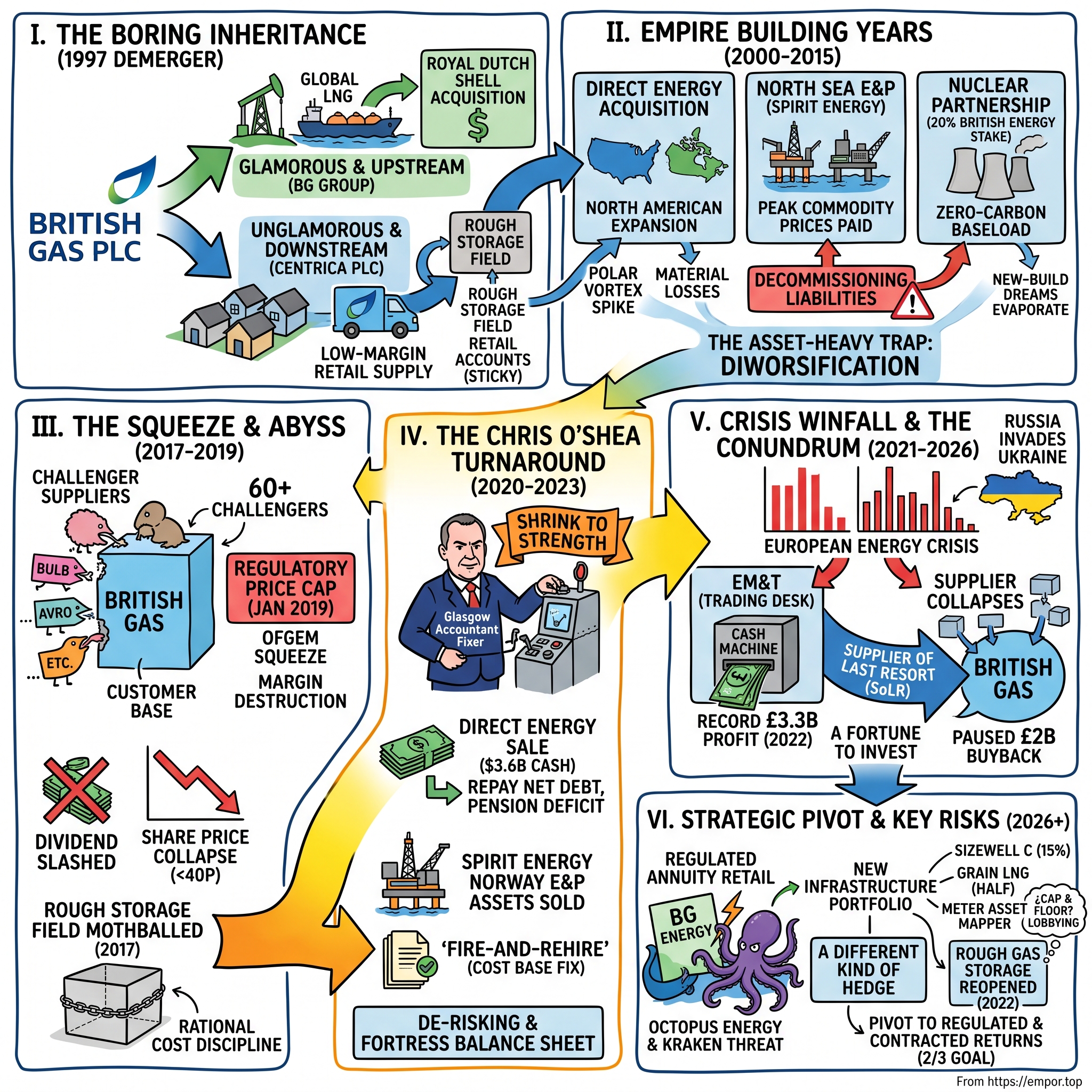
Centrica plc: From British Gas Utility to Energy Trading & Infrastructure Powerhouse
I. Introduction & Episode Roadmap
On the morning of 19 February 2026, Chris O'Shea stood in front of a room of analysts and delivered a number that, six years earlier, would have looked like a rounding error on the way down. Centrica's adjusted operating profit for 2025 had fallen to £814 million, roughly half of the prior year's £1.55 billion.1 And yet the chief executive was not apologising. He was pausing the company's £2 billion share buyback — a programme that had already retired a quarter of the shares outstanding — because, in his words, "we see incredible value creation opportunities for our shareholders from investing the capital that we've got."2
Read that again. A British utility, best known to the public as the company that heats their homes and occasionally sends them an alarming bill, had reached a point where its problem was too much capital and too many places to put it. This is not how the story of Centrica was supposed to go.
Here is the core thesis of this episode. Centrica is the corporate afterlife of British Gas — the downstream, customer-facing rump left behind when one of Margaret Thatcher's proudest privatisations split itself in two. For two decades it behaved like a company embarrassed by its own boring inheritance, chasing oil fields in the North Sea and retail customers in Texas in a doomed attempt to become something more glamorous. It nearly destroyed itself in the process. Then, between roughly 2020 and 2023, it did something genuinely rare among incumbent utilities: it shrank, de-risked, hoarded cash, and quietly discovered that the least glamorous parts of its business — a wholesale energy trading desk, a 20% slice of Britain's nuclear fleet, and the country's only large gas storage cavern — were worth far more than anyone had priced in.
Consider the scale of what Centrica is today. Through British Gas it remains the cornerstone of UK domestic energy supply, with just under eight million residential energy accounts.3 Behind that consumer brand sits Centrica Energy, one of Europe's more sophisticated wholesale energy marketing and trading operations, managing nearly 20 gigawatts of renewable and flexible generation capacity on behalf of others.3 It owns 20% of the UK's operating nuclear fleet, a stake it has spent 2025 and 2026 methodically extending.4 It controls Rough, the depleted North Sea gas field that is Britain's largest gas store. And as of early 2026 it has bought its way into two of the most heavily regulated, most contractually underpinned assets in British infrastructure: 15% of the Sizewell C nuclear project and half of the Grain LNG import terminal.1
The arc we'll trace runs like this. First, the 1997 demerger from British Gas plc and the long shadow of the "Tell Sid" era. Then the asset-heavy expansion — the overpayment for North Sea exploration and for North American retail that starved the core business. Then the mid-2010s squeeze, when a swarm of challenger suppliers, a regulatory price cap, and a collapsing dividend nearly ended the company. Then the O'Shea turnaround: the divestments, the fights with the unions, the elimination of net debt. Then the 2021–2023 European energy crisis, which turned the trading desk into a multi-billion-pound earnings machine and handed British Gas hundreds of thousands of customers from bankrupt rivals. And finally the strategic conundrum of 2026: what to do with a fortress balance sheet while Octopus Energy eats market share from below and the government dangles regulated returns from above.
Throughout, we will keep the posture of a sceptic, not a supporter. Management says it has built a "fundamentally stronger and higher quality" company.1 The job of this piece is to ask what evidence backs that, what could falsify it, and where the story is still management rhetoric rather than proven fact. Let's start where every British energy story starts — with a fictional bloke named Sid.
 Subscribe on LinkedIn
II. From "Tell Sid" to Demerger: The Genesis of Centrica
Picture Britain in the autumn of 1986. Television adverts show ordinary people whispering to each other across garden fences and pub tables: "If you see Sid, tell him." Tell him what? To buy shares in British Gas. The government of Margaret Thatcher was privatising the state-owned British Gas Corporation, and it wanted not just City institutions but millions of ordinary citizens to own a piece. The flotation, at the end of 1986, was one of the largest the world had seen and helped create a generation of first-time shareholders. British Gas — with its blue flame logo, its showrooms on every high street, its engineers who came to fix your boiler — became a cultural institution, shorthand for household safety and blue-chip stability.
The lineage stretched back much further, to the Victorian gas works and the era of town gas — specifically to the Gas Light and Coke Company, chartered in London in 1812, and to the sprawling municipal gas undertakings that Clement Attlee's post-war government swept into public ownership as the British Gas Corporation. For most of the twentieth century, gas in Britain was a monopoly: one supplier, one pipe, one bill. That monopoly is the original sin — and the original moat — of everything that follows.
The problem with a privatised monopoly is that regulators dislike it. Through the mid-1990s, competition authorities pressed British Gas plc to separate the bits that faced customers from the bits that competed globally for gas. The company chose the nuclear option: a full structural demerger. On 17 February 1997, British Gas plc split into two independent listed companies.5
On one side went BG Group — the glamorous half. It inherited the exploration and production business, the international gas fields, and the growing global liquefied natural gas trade. This was the asset-rich, high-growth entity that investors wanted to own, and its trajectory validated the thesis spectacularly: nearly two decades later, in 2016, Royal Dutch Shell acquired BG Group for roughly $53 billion. The upstream business became one of the great UK oil-and-gas prizes of its era.
On the other side went Centrica plc — the unglamorous half. It kept the British Gas retail brand, the household appliance and boiler-servicing operation, the gas production from the North and South Morecambe fields off the Lancashire coast, and the Rough offshore storage facility with its onshore processing plant at Easington.5 In short, Centrica got the customers, the vans, and the aging infrastructure. It got the bills and the complaints. What it did not get was the commodity margin.
And here lies the structural flaw baked into Centrica from birth. A retail energy supplier makes its money on the spread between what it pays for gas and power in the wholesale market and what it charges households. That spread is thin, heavily regulated, and utterly exposed to commodity swings. BG Group, sitting upstream, owned the commodity itself and captured the fat margin when prices rose. Centrica sat downstream, buying at the market price and selling into a politically sensitive retail market that no government would ever let run truly free. It was, from day one, a low-margin, high-scrutiny business without an upstream umbrella to shelter under.
What does a management team do when it inherits a business like that? For the next twenty years, Centrica's answer was to go and buy an umbrella. That instinct — to acquire hedges, to acquire scale, to acquire its way out of a structural disadvantage — is the through-line of the empire-building years, and the source of most of the value it would later destroy. To understand the turnaround, you first have to understand the mess it was turning around from.
III. The Empire Building Years: Direct Energy, E&P, and the Asset-Heavy Trap
If you want to understand how a company talks itself into two decades of value destruction, start with a plausible-sounding sentence: "We're a retail energy supplier, so we should own some energy to supply." It sounds like prudence. It sounds like hedging. In practice, at Centrica, it became a licence to deploy billions of pounds of shareholder capital into assets that earned less than they cost.
The first frontier was North America. Beginning around 2000, Centrica acquired Direct Energy, originally a Canadian retailer, and used it as a platform to bolt on a long series of deals across the deregulated US power and gas markets — retail supply in Texas, home-services businesses, commercial energy operations. The logic was that Centrica had learned to serve energy customers in Britain and could export that competence. The reality was that the United States is not one energy market but dozens of fragmented, state-by-state deregulated ones, each with its own rules, its own incumbents, and razor-thin retail margins. Centrica had no brand advantage outside the UK — an American family choosing a power provider had never heard of British Gas — and it was competing on price in markets where weather could wipe out a year's profit in a week.
That weather risk turned real in the winter of 2014, when the "polar vortex" drove US wholesale power and gas prices to extraordinary spikes. Retailers who had sold customers fixed-price contracts but hadn't fully hedged their supply were caught paying spot prices far above what they could charge. Direct Energy absorbed material losses that year, a vivid demonstration that retail energy without disciplined hedging is not a stable annuity but a short position on the weather. Over its life, the North American adventure consumed a great deal of capital and, by the company's own later admission, produced returns below the cost of that capital.
It is worth pausing on why the strategy failed, because the failure was strategic, not merely operational. The whole rationale for buying Direct Energy was diversification — the idea that adding North American cash flows would smooth out the volatility of the UK business. But diversification only creates value if the new business earns more than its cost of capital; otherwise you are simply buying volatility reduction at the price of shareholder returns, which shareholders can achieve far more cheaply by holding a diversified portfolio themselves. Centrica had assembled, at considerable expense, a sprawling North American operation serving millions of customers across dozens of jurisdictions, and the market never rewarded it with a higher multiple because it could see the returns didn't justify the capital. This is the classic "diworsification" trap: growth in revenue and customer count that masks the erosion of return on invested capital. The tell, visible only in hindsight, was that when Centrica finally sold the business in 2020, it did so at a price that implied years of value had quietly leaked away — and yet the sale was still the right move, because a mediocre business converted to cash at the right moment is worth more than the same business held through a crisis.
Meanwhile, back home, Centrica indulged the second and more expensive version of the same instinct: it decided that to be a proper energy company it needed to own oil and gas in the ground. Through the 2000s and early 2010s it built a substantial North Sea exploration-and-production portfolio, buying assets to "hedge" its retail supply. The timing was, in hindsight, close to catastrophic — much of the buying happened when commodity prices were high, so Centrica paid peak prices for barrels and therms that would be worth far less after oil collapsed in 2014–2015. Worse, North Sea assets come attached to enormous long-dated decommissioning liabilities: the legal obligation, decades hence, to plug the wells and dismantle the platforms. Centrica was signing up for those liabilities at the very moment it needed every pound to modernise a retail business that was falling behind on technology.
In 2017, Centrica tried to tidy this up by merging its E&P assets with Bayerngas Norge to form a jointly-owned vehicle, Spirit Energy, in which Centrica held 69%. It was a sensible piece of housekeeping — pooling scale, sharing costs — but it did not change the fundamental problem. Centrica was still a downstream retailer carrying upstream commodity risk and upstream decommissioning bills, and the market never gave it credit for the "hedge." It just saw complexity, cyclicality, and capital tied up in a declining basin.
The third leg was nuclear, and this one aged better than the rest. In May 2009, Centrica paid £2.3 billion for a 20% equity stake in British Energy, the operator of Britain's fleet of eight nuclear power stations, which EDF of France had just acquired.6 The two formed an 80/20 partnership, with grand ambitions to build new reactors together. The new-build dream mostly evaporated — Centrica walked away from the construction plans in 2013 — but the 20% stake in the existing fleet quietly became one of the better things Centrica owned. Nuclear provides zero-carbon baseload power: it runs day and night regardless of weather, and when power prices spike, it earns like a machine. The catch is operational. Britain's Advanced Gas-cooled Reactors are aging, prone to unplanned outages — cracks in graphite cores, extended maintenance — and they carry their own decommissioning tail. As we'll see, they generate cash and headaches in roughly equal measure.
Step back and the pattern is unmistakable. Three big capital allocation decisions — North American retail, North Sea E&P, and nuclear — all flowed from the same insecurity about Centrica's asset-light, low-margin core. Two of the three destroyed value outright. And all three bloated the balance sheet and the complexity of a company that would soon face the most disruptive assault its home market had ever seen. The umbrella-buying had left Centrica financially exposed just as the storm arrived.
IV. The Squeeze: Challenger Crises, Regulatory Price Caps, and the 2017–2019 Abyss
For most of its history, British Gas competed against a handful of large, similar incumbents — the "Big Six" — in a market that felt more like a genteel oligopoly than a knife fight. Then, in the 2010s, the government and the regulator decided the market needed more competition, lowered the barriers to entry, and got exactly what they asked for. By the late 2010s more than sixty small "challenger" suppliers had piled into UK household energy, brands like Bulb, Avro, and Pure Planet, most of them wielding a slick app and a promise to undercut the incumbents.
Here is the part the newcomers didn't advertise. Many of them were not really energy companies at all; they were marketing companies with a billing platform. They bought gas and power on short-term wholesale markets, often without any long-term hedging strategy, and passed on the low prices to customers. In a world of cheap, stable wholesale energy, this looked like genius — nimble digital disruptors humiliating the lumbering incumbents. British Gas hemorrhaged customers, and crucially it lost its most profitable ones: the long-tenured, standard-tariff households who never switched and quietly subsidised the rest.
The regulator then added a second squeeze. On 1 January 2019, following political fury over "loyal" customers being overcharged, Ofgem introduced a cap on the standard variable tariff — the default price paid by anyone who never switches — initially set at around £1,137 a year for a typical dual-fuel household and protecting roughly eleven million homes.7 The price cap was a genuine turning point. It took the single most profitable slice of British Gas's book — the sticky, inert, standard-tariff customer — and administratively compressed the margin on it. From that moment, British Gas residential supply became, in effect, a regulated utility: the regulator, not the company, would set the allowable spread. Management would later reframe this as a feature rather than a bug — a source of "through the cycle predictability"2 — but in 2019 it landed as pure margin destruction on top of the challenger onslaught.
Amid all this, Centrica made a decision that would look either negligent or prophetic depending on the year you judged it. In June 2017, facing the cost of refurbishing the aging Rough storage field and finding no government subsidy to justify it, Centrica announced it would stop injecting gas and effectively close Rough as a seasonal store.8 Rough had represented the large majority of the UK's gas storage capacity. Closing it removed most of the country's ability to stockpile gas in summer for winter. In 2017, with global gas cheap and abundant, this looked like rational cost discipline. Five years later, when Russia invaded Ukraine and Europe scrambled for every molecule of storage it could find, it would look like one of the more consequential infrastructure decisions in recent British energy history.
The financial reckoning arrived in 2019. Squeezed on every side — losing customers, capped on margins, carrying declining upstream assets and a swelling pension deficit — Centrica slashed its dividend by well over half and its long-serving chief executive Iain Conn announced he would step down. The share price, which had traded above 300 pence in better days, went into free fall, ultimately collapsing below 40 pence in the early-2020 market panic. Credit rating agencies circled. The company that Sid had been told to buy was, on paper, worth a fraction of its former self, and the whispered question in the City had changed from "is the dividend safe?" to "is the balance sheet?"
A company in that condition needs one of two things: a buyer or a fixer. Centrica didn't get a buyer. It got a Glaswegian accountant with a reputation for saying uncomfortable things out loud.
V. The Turnaround: Chris O'Shea's Fire-and-Rehire, De-Risking, and the $3.6B Direct Energy Sale
Chris O'Shea did not look like a saviour when he took the top job. He had joined Centrica as chief financial officer in 2018, part of a career built in the unglamorous engine rooms of corporate finance — training as an accountant, and finance roles across engineering and industrial groups before landing at a British energy giant in crisis. When Iain Conn departed and the search for a successor stalled through the early-2020 chaos, the board handed O'Shea the role of Group Chief Executive in April 2020, initially with the "interim" caveat that was soon dropped. He inherited a company with a battered share price, a stretched balance sheet, a global pandemic shutting down its engineers' ability to enter homes, and a workforce about to go to war with him.
His strategy was brutally simple and, for a British utility, unusually unsentimental: shrink to strength. Sell the stuff that doesn't earn its keep, fix the cost base whatever the political cost, and use the proceeds to make the balance sheet unbreakable.
The signature move came fast. In July 2020, Centrica agreed to sell Direct Energy — the entire North American retail business, the product of two decades of acquisitions — to NRG Energy of the United States for $3.625 billion in cash.9 The deal completed in January 2021.10 Judged against the capital Centrica had ploughed into North America over the years, the price was hardly a triumph. But judged on timing, it was close to a masterstroke. The cash landed on Centrica's balance sheet in the opening days of 2021 — months before wholesale energy markets went haywire. Centrica used the proceeds not to chase new growth but to do the boring, defensive thing: pay down net debt and shore up the enormous legacy pension deficit. In a business about to be hit by the largest energy price shock in a generation, walking in with a clean balance sheet was worth more than the extra pounds a patient seller might have extracted.
Then came the fight nobody enjoys. Centrica's British Gas services arm — the engineers who fix boilers — operated under a tangle of dozens of legacy employment agreements accumulated over decades. O'Shea wanted them replaced with standardised modern terms. To force the change, Centrica used the controversial "fire and rehire" tactic: employees who wouldn't sign the new contracts faced dismissal. The GMB union struck. Engineers walked out for weeks in the winter and spring of 2021 — a long, bitter dispute measured in dozens of strike days — and the episode became a political lightning rod, held up in Parliament as a symbol of everything wrong with hardball labour tactics. Management held firm. Alongside the contract overhaul, Centrica removed thousands of roles from its cost base as part of a restructuring announced in 2020 that targeted around 5,000 job cuts. The strategic point was cold: Centrica could not compete on cost against digital challengers while carrying a labour structure designed for a 1990s monopoly. The strikes were the price of fixing it.
The final act of the de-risking was to unwind the upstream mistake. In late 2021 Centrica agreed to sell most of Spirit Energy's Norwegian oil and gas assets — to Sval Energi, with the Statfjord interests going to Equinor — in a deal valued at roughly $1.1 billion, which completed in mid-2022.11 This stripped out a large chunk of the long-dated E&P exposure and decommissioning risk that had haunted the balance sheet, leaving Spirit focused on the UK's Morecambe fields and, eventually, on converting Morecambe into a carbon storage hub. The message to the market was consistent: Centrica was done being an oil company pretending to hedge a retail book.
What does this whole sequence tell us about management? It tells us O'Shea was willing to make the balance sheet the priority over the income statement, to accept a lower headline sale price in exchange for certainty and timing, and to absorb serious political and reputational damage to fix a structural cost problem. Those are the behaviours of a genuine restructurer rather than an empire-builder. The open question in early 2021 was whether all this defensive fortification would ever be rewarded — whether a de-risked, shrunken Centrica could actually make money. The answer came within months, and from a direction almost nobody in the retail investor base was watching.
VI. The 2021–2023 Energy Crisis Windfall: Supplier Collapses, EM&T's Cash Machine, and the Rough Reopening
The thing about selling insurance against a disaster is that you look foolish right up until the disaster happens. In the second half of 2021, and then explosively after Russia's invasion of Ukraine in February 2022, European gas and power prices did something they had never done in the era of liberalised markets: they went vertical, and stayed there.
For the challenger suppliers who had built their entire business on buying energy short and selling it cheap, this was an extinction event. When the wholesale price of gas rockets past the price you've promised your customers, and you have no hedges, you are selling pounds for pennies on every therm — and you die. And die they did. More than thirty UK suppliers collapsed in the space of roughly a year. Bulb, the largest of the challengers with around 1.5 million customers, was too big to be absorbed by a rival and was placed into a special government-backed administration in November 2021, eventually acquired by Octopus Energy in a process completed in December 2022.12 The rest of the failed suppliers' customers were parcelled out to survivors under Ofgem's "Supplier of Last Resort" mechanism — and the survivor with the biggest balance sheet and the most capacity to absorb them was British Gas. It took on hundreds of thousands of customers from collapsed rivals without paying a penny of the marketing and acquisition costs it would normally incur to win them. The great deregulation experiment had, in effect, handed market share back to the best-capitalised incumbent. Regulatory re-monopolisation, arriving not by decree but by bankruptcy.
That was the visible windfall. The invisible one was larger. Buried inside Centrica sat Energy Marketing & Trading — a wholesale desk that for years had been treated as a back-office risk-management function, the unglamorous plumbing that made sure British Gas had the gas it needed. When markets are calm, a trading desk like this earns modest, steady fees. When markets dislocate violently — when prices gap around, when the spread between locations and between summer and winter blows out, when whoever can physically move gas and LNG to where it's scarce can name their margin — a desk with the right contracts, storage rights, and shipping capacity can print money. Centrica's did. In 2022, the group's adjusted operating profit exploded to a record £3.3 billion, up from under a billion the year before, with the trading and nuclear operations doing the heavy lifting — the nuclear stake alone swung to roughly £724 million of profit as power prices soared.13 A company that had cut its dividend to survive in 2019 was, three years later, generating more profit than it ever had in its history.
It is worth being precise about what this windfall was and wasn't. It was not evidence that Centrica had suddenly become a great business. It was evidence that a trading desk is a call option on chaos — most of the time it's quietly out of the money, and occasionally geopolitics detonates and it pays off enormously. The skill Centrica could legitimately claim was that it had the balance sheet to keep trading when volatility demanded huge cash collateral, and the physical assets — storage, LNG offtake, pipeline capacity — to turn volatility into realised profit rather than just paper risk. Many competitors had neither and were forced to sit the crisis out or die in it.
The crisis also forced a very public reversal. In October 2022, with Europe desperate to bank every cubic foot of gas before winter, Centrica reopened the Rough storage facility it had mothballed five years earlier, restoring a chunk of the national storage capacity it had once written off.[^14] It was a vindication of Rough's strategic value and simultaneously an indictment of the decision to close it — the same asset, the same company, opposite conclusions five years apart, with the only variable being the price of gas and the political appetite to pay for security. Centrica began lobbying hard for a long-term regulated revenue framework — a "cap and floor" model — that would let it justify a roughly £2 billion investment to convert Rough into one of the world's largest methane and hydrogen storage sites. That lobbying campaign is still running in mid-2026. The UK government published a "Gas System in Transition: Security of Supply" consultation in November 2025, and Centrica expected a decision in the first half of 2026 — but as of July 2026 no supportive framework had been agreed, and the government continued to treat Rough's future as a commercial matter for Centrica.2 Its resolution is one of the live questions hanging over the stock, and O'Shea has been blunt that without a workable model the company "won't keep Rough open speculatively."2
So by 2023 Centrica had cash pouring in, a fortress balance sheet, and a story that had flipped from survival to abundance. The problem with abundance driven by a crisis is that crises end. The next chapter of the story is about what happens to each piece of this business when the windfall recedes — which is exactly the position Centrica finds itself in as of 2026.
VII. Segment Deep-Dive & Core Business Economics: Retail, Trading, & Infrastructure
To understand Centrica as an investment rather than a headline, you have to take the machine apart and look at each part's economics — how it makes money, how violently that money swings, and how much capital it eats. In 2025 Centrica reorganised its reporting into three segments: Retail, Optimisation, and Infrastructure.1 But the underlying businesses are best understood one at a time, because they could hardly be more different in character.
British Gas Energy — the regulated annuity. This is the business the public thinks of as "Centrica": supplying gas and electricity to homes. At the end of 2025 it served just under eight million residential energy accounts, of which 7.5 million were in the UK, plus around 742,000 business customer sites.3 The crucial thing to grasp is that since the 2019 price cap, this is essentially a regulated utility. Ofgem sets an allowance for costs and a slim margin; British Gas earns roughly a few percent operating margin on the standard-tariff book — in 2025 UK residential energy supply produced £163 million of adjusted operating profit, within its own medium-term sustainable range but down sharply from the prior year on warmer weather and customers shifting to cheaper fixed tariffs.3 O'Shea's framing on the results call was telling: because bad debt and costs are recovered through the price cap, "if you're better than average, it's a profit centre, and if you're worse than average, it's a cost centre."2 In other words, the whole game in regulated retail is to be more efficient than the industry average that sets the cap. Beat the average and the regulated allowance becomes a profit; lag it and you bleed.
The friction point here is bad debt. In a cost-of-living crisis, a rising share of customers simply cannot pay their bills. Centrica's total bad-debt charge rose to £418 million in 2025, split between £277 million in home energy and £132 million in business supply, and the total value of domestic debt owed to UK energy suppliers had climbed to around £4.5 billion.3 Because bad debt is recovered through the price cap on a socialised basis, the well-behaved payers subsidise the non-payers — a mechanism O'Shea has repeatedly attacked, calling for a targeted "social tariff" to separate those who genuinely can't pay from those who choose not to.2 And hanging over the segment is a reputational scar: the prepayment meter scandal, which we'll come to, still constrains how aggressively British Gas can pursue debt.
British Gas Services & Solutions — the subscription that should be a moat. This is the boiler-cover business: HomeCare contracts, the engineers, the Hive smart-home kit. In theory it's the crown jewel — a recurring, high-margin subscription relationship with millions of households, and a national field force of engineers that is genuinely hard to replicate. In practice it has been in slow structural decline, as cost-of-living pressure pushes customers to drop cover and take their chances with a local tradesman. The interesting development in 2025 was a stabilisation: the segment delivered £114 million of adjusted operating profit, roughly double the prior year and back inside its target range a year early, with margins improving to nearly 7% as the company squeezed engineer productivity.3 More strategically, Centrica began renting its field force out to others — striking "warranty partnership" deals with appliance manufacturers that added 71,000 customers, and launching a membership scheme that had drawn nearly 600,000 sign-ups by early 2026.3 Whether this pivot can reverse a decade of decline is unproven, but it is at least a genuine attempt to monetise the one asset — a dispatchable national workforce — that no software-first challenger has.
Centrica Energy / Optimisation — the call option on chaos. This is the trading and optimisation engine that made the crisis profits. Its economics are the mirror image of retail: very low asset intensity, potentially very high returns, but violent volatility and a hunger for balance-sheet liquidity, because in stressed markets it must post enormous cash collateral to keep its positions open. It now manages 19.5 gigawatts of renewable and flexible capacity for third parties through its Renewable Energy Trading & Optimisation business, and runs a growing global LNG book anchored by offtake from the Sabine Pass terminal in the US.3 Here is the honest part of the 2025 story: with volatility subsiding and the EU imposing mandatory gas-storage targets that squeezed the seasonal spreads traders feed on, Optimisation's profit collapsed to £155 million, down more than half, and management guided 2026 lower still, to around £250 million of EBITDA — below its "normal conditions" range.3 That is the option decaying back toward its baseline. The bull case is that Centrica has been steadily building fee-based, contracted earnings underneath the volatile trading layer — hedging its LNG through 2028 and beyond — so that the floor is higher than it used to be. The bear case is simpler: this is a trading desk, its best years require dislocation, and dislocation is not a business plan.
Infrastructure — nuclear, gas, and the new regulated bets. This segment now houses the 20% nuclear stake, Spirit Energy's remaining gas, Rough, the newly acquired Grain LNG terminal, and the Meter Asset Provider. In 2025 it earned £314 million of adjusted operating profit, a steep fall from the crisis-inflated £799 million, hit by lower power prices, a long unplanned outage at the Hartlepool nuclear station that cut nuclear output to 6.6 terawatt-hours, and the pausing of Rough.3 Nuclear remains a cash generator when it runs — but "when it runs" is doing a lot of work, given the AGR fleet's reliability problems and its scheduled retirement over the late 2020s and early 2030s. Rough, having paused storage operations in 2025 because seasonal spreads were uneconomic, actually delivered a smaller loss than feared (£45 million) and its future now rests entirely on a government decision.3 The genuinely new element is the Meter Asset Provider — a business barely two years old that finances and owns smart meters, reaching 1.6 million meters under management after deploying £224 million of capital in 2025.3 It is small, but it is exactly the kind of low-risk, capital-light, contracted-return annuity that Centrica's balance sheet was built to fund, and it points at where management wants to go.
Put the four together and a clear picture emerges: a regulated retail annuity, a declining-but-stabilising subscription business, a volatile trading option, and an infrastructure portfolio pivoting from merchant risk toward regulated returns. The tension in the whole enterprise is that its biggest brand — British Gas — is precisely where its most dangerous competitor is coming for it.
VIII. The Competitive Landscape & Tech Disruption: British Gas vs. Octopus Energy's Kraken Threat
For most of British Gas's life, its competitors looked like it: big, old, similarly clumsy. Then along came a company that didn't play by the same rules at all, and by 2026 the pupil had overtaken the master. Octopus Energy, founded in 2015, is now the UK's largest energy supplier overall — supplying around a quarter of the country's electricity and gas customers, with roughly 12.9 million domestic accounts across 7.3 million households.14 British Gas, which for generations was simply the energy company, is now the largest gas supplier but only the second-largest in electricity, looking up at a rival that didn't exist a decade ago.14
How did Octopus do it? The short answer is software, and its name is Kraken. Octopus built a proprietary customer operating platform — billing, metering, customer service, tariff management, all in one modern system — and it uses that platform to serve customers at a dramatically lower cost. The industry shorthand for this is "cost to serve," the all-in cost of handling a customer per year, and it is the single most important number in retail energy economics under a price cap. If the regulator caps everyone's price at roughly the same level, the supplier with the lowest cost to serve keeps the difference as profit — or can invest it in winning yet more customers. Kraken lets Octopus automate the interactions that force legacy suppliers to staff enormous call centres, and it enables genuinely new products: half-hourly dynamic tariffs that let a customer charge an electric car or run a heat pump when power is cheapest. Octopus has been so confident in the platform that it licenses Kraken to other utilities around the world as a standalone software business.
Now, here is where a neutral analyst has to slow down, because Centrica's management vigorously disputes the premise that it is losing on cost. On the February 2026 results call, O'Shea made a striking claim: "Our cost to serve is lower than Octopus's cost to serve today."2 His argument was that Octopus's costs have been rising as it has grown — he noted its accounts showed roughly a doubling of operating expenses and headcount — because as any supplier accumulates a genuinely broad customer base, it inherits the difficult-to-serve customers, not just the easy digital natives.2 British Gas, he argued, has always served the full range, has already built the muscle to handle complexity, and therefore starts from a structural cost advantage that the consolidated regulatory accounts, in his telling, bear out.
Which version is true? This is exactly the kind of claim an investor should treat as contested rather than settled. What we can say with confidence is that British Gas's residential margins are thin and its customer count has drifted down, offset in recent years mainly by rivals' collapses rather than by winning switchers. What we can also say is that Centrica is not standing still: it completed the migration of its UK customers onto a modernised platform it calls Ignition in the first half of 2025, drove its Net Promoter Score to a record and its Trustpilot rating up to 4.4 stars, and has launched a technology-led transformation programme targeting a 30% reduction in customer contact demand and heavy use of AI to automate routine work.1 Management's own framing is that customer service metrics are the best they've ever been while it still sees more efficiency opportunity than it did five years ago.2
But — and this is the crux of the competitive question — a legacy incumbent modernising its IT is running to catch a rival that was born on modern IT. O'Shea's own strategic posture betrays the difficulty: he has been explicit that British Gas will not "chase unsustainable pricing," that most competitors are losing money in retail, and that he'd be "delighted" to end a year with flat customer numbers, expecting them "probably a bit down."2 Read plainly, that is an incumbent choosing margin discipline over market share — a perfectly rational choice, but also an admission that it does not expect to out-grow Octopus, only to out-earn it per customer. Whether that holds depends entirely on which company actually has the lower cost to serve, and on whether the regulator, in setting the cap, hands the efficiency gains to shareholders or claws them back for consumers.
Myth versus reality. The consensus narrative, repeated in most press coverage, is that "Octopus has already won and British Gas is a melting ice cube." That is half right and half lazy. The reality is more textured. Octopus has unambiguously won the growth contest — it is the larger supplier, and its software genuinely lowers the cost of serving a digitally engaged customer.14 But "British Gas is dying" does not survive contact with the numbers. British Gas remains the UK's largest gas supplier, its residential energy arm still earned £163 million of operating profit in a down year, its Services business turned the corner back into its target margin range, and — critically — its earnings are far less about retail supply than the popular story assumes.3 The thing the market calls "British Gas" is, in profit terms, increasingly a trading, nuclear, and infrastructure company wearing a household brand. The myth treats Centrica as a retail-supply business losing a retail-supply war; the reality is a diversified energy group for which the retail war, however loud, is no longer the main event. That is an unresolved contest, and it is being fought on Centrica's home turf, over its most visible brand — but it is not, on the evidence, the contest that determines the group's earnings. How management is judged on that fight — and on the fortune it is sitting on — is the next question.
IX. Management Credibility, Governance, & Capital Allocation Stress Test
Judge a management team not by what it says but by what it does repeatedly, and Chris O'Shea's record has an unusual quality for a utility boss: it is consistent, and it is uncomfortable. He said in 2020 he would de-risk the balance sheet, and he did — Centrica swung from net debt of roughly £3 billion in 2019 to a substantial net cash position after the Direct Energy sale and the trading windfall. He said he would return surplus capital, and he did — over roughly three years the company bought back a quarter of its own share count, completing a £2 billion buyback in January 2026 at an average price around 136 pence, comfortably below where the shares traded afterward.1 Buying back a quarter of a company below intrinsic value, if that's what it proves to be, is genuine value creation rather than financial cosmetics, and management is right to highlight it.
The most revealing thing about O'Shea, though, is his willingness to say things a normal FTSE chief executive would never say aloud. Asked about his own pay — which reached £8.2 million for 2023 — he told the BBC flatly that "you can't justify a salary of that size."[^16] It was a remarkable moment: the boss of a company raising consumer energy bills conceding that his own compensation was indefensible. Whether you read that as refreshing candour or as a politically savvy way to defuse an unavoidable row, it is at least not the language of a man managing his image with focus-grouped platitudes. His pay remains a perennial political target, and every year of British Gas profitability reignites calls for windfall taxes and price-cap cuts.
Which brings us to the genuine activist question hanging over Centrica in 2026: why is it sitting on so much cash, and why has it now stopped returning it? At the end of 2025 the group held roughly £1.5 billion of adjusted net cash, down from £2.9 billion a year earlier as it poured capital into investments.1 In February 2026, having completed the buyback, O'Shea paused the programme entirely to prioritise investment.2 A sceptical long/short investor would frame the challenge sharply: for years you told us discipline meant handing cash back; now, just as trading earnings normalise and the stock looks cheap, you're switching to spending. Is this genuine value creation or is it empire-building 2.0 — the same asset-chasing instinct that wrecked the company in the 2000s, dressed in the language of the energy transition?
Management's defence rests on two pillars. First, the nature of the assets it's buying has changed. The new investments — 15% of Sizewell C, half of Grain LNG, the Meter Asset Provider, life extensions on the nuclear fleet — are overwhelmingly regulated or long-term contracted, the opposite of the merchant commodity bets of the 2000s. Sizewell C carries a capped £1.3 billion commitment with a regulated 10.8% real allowed return on equity underpinning a 12%-plus internal rate of return, targeting a regulated asset base of around £8 billion at commercial operations.1 Grain LNG is contracted 100% to 2029 and more than half-contracted to 2045.1 Second, on the results call the CFO was explicit that the guidance assumes no further buybacks purely to keep the modelling simple — "as surplus capital emerges and buybacks become an opportunity, that's definitely something we're looking at" — and O'Shea insisted "surplus capital will always come back to shareholders. Always."2
It helps to put concrete shape on what management is actually committing to. Centrica has laid out a roughly £4 billion growth investment programme running to the end of 2028, of which around £3 billion had been committed by early 2026, funded at roughly £600–800 million a year and continuing at a similar pace beyond 2028.1 Against that, it maintains what it calls a progressive dividend — raised 22% to 5.5 pence for 2025 — and targets dividend cover of around two times earnings by 2028, a deliberately conservative payout that leaves room to fund growth internally.1 The strategic destination management describes is a group where roughly two-thirds of earnings come from regulated or contracted sources — the price cap on retail, long-term capacity and offtake contracts, and the new regulated infrastructure — up from almost nothing today.1 If that mix shift is real, it should, in theory, earn Centrica a higher and steadier valuation multiple than a merchant energy trader deserves. Whether investors ultimately pay up for "regulated infrastructure utility" rather than "cyclical energy group" is the entire re-rating thesis, and it will be settled by delivery, not by the slide deck.
There is also a structural argument for holding cash that is specific to this company: the trading desk itself demands it. When volatility spikes, Optimisation must post very large amounts of margin collateral to maintain its positions, and a firm that runs a thin balance sheet has to close out exactly when the opportunity is greatest. O'Shea has made "financial resilience" a deliberate campaign, arguing that the thinly-capitalised challengers who couldn't post collateral are the ones who died in 2022.2 The cash pile, in this reading, isn't idle — it's the ammunition that lets Centrica trade through crises and capture the windfalls that killed its rivals.
The honest verdict is that this is a transition worth watching rather than trusting on faith. The behaviour so far — capped commitments, regulated returns, an explicit promise to walk away from projects that "don't stack up" (O'Shea noted the company has abandoned deals "days before signing")2 — is more disciplined than the 2000s playbook. But the pattern of a cash-rich utility talking itself into a large capital programme is precisely the pattern that has burned Centrica shareholders before. The proof will be in the returns these assets actually earn, and in whether the promised discipline survives contact with the temptation of a £4 billion investment pipeline.
X. Strategy, Risk Radar, Helmer's 7 Powers & Porter's 5 Forces
Strip away the narrative and ask the structural question: does Centrica actually possess durable competitive advantage, or is it a collection of regulated and cyclical businesses with no real moat? The honest answer is "some, in specific places, and weaker than the crisis profits made it look." Two analytical frameworks help locate exactly where.
Hamilton Helmer's 7 Powers. The most defensible power Centrica holds is Process Power in its trading and optimisation arm — the accumulated, hard-to-replicate know-how of running a cross-border energy desk: decades of market data, physical positions in storage and LNG and pipeline capacity, and the risk-management machinery to price dislocations faster than rivals. This is real, but it is also cyclical rather than continuous; it earns its keep in dislocated markets and lies relatively dormant in calm ones, as 2025's halved Optimisation profit demonstrated. In British Gas supply, Centrica has Scale Economies — it spreads fixed billing, regulatory-compliance, and field-service costs over millions of customers — but this power is under direct assault, because Octopus's software automation attacks the very fixed-cost base that scale is supposed to protect; whether Centrica or Octopus has the lower cost to serve is the unsettled heart of the competitive contest. The British Gas Brand is genuinely powerful but genuinely double-edged: it commands trust among older, more conservative households and provides a low-cost source of customers, yet it is also a lightning rod, the name every politician reaches for when energy bills rise. And in Counter-Positioning — the ability to adopt a new model incumbents can't copy without damaging their existing business — Centrica is weak; that's Octopus's power, not Centrica's, and the legacy supplier's digital-first pivot risks cannibalising its own regulated billing margins. The Services field force is arguably the one asset with a moat that software can't easily erode, but it is a declining business that management is only now trying to reinvent.
Porter's Five Forces. The threat of new entrants has collapsed from high to low — the challenger free-for-all of the 2010s is over, killed by its own under-hedging and buried by Ofgem's post-crisis capital-adequacy and ring-fencing rules that now demand real balance sheets to enter. That regulatory tightening is, ironically, one of the better things to happen to British Gas, restoring a barrier the regulator had earlier demolished. Buyer power is high: price-comparison sites and near-frictionless switching mean retention is expensive and loyalty is thin. Supplier power is high in tight markets, where global LNG producers and gas majors hold the whip hand over anyone who needs molecules in a hurry — though Centrica's own trading and Grain LNG position partially internalise this. The threat of substitutes is low: households cannot easily stop consuming heat and power, though electrification and heat pumps slowly reshape which energy they buy. And competitive rivalry is fierce, concentrated now among a consolidated top tier — Octopus, British Gas, E.ON Next, OVO, EDF, ScottishPower — competing on cost and service within a capped price. Add it up and Centrica sits in a structurally low-growth, regulated, rivalrous industry where its edges are real but narrow and, in retail, actively contested.
The current risk radar follows directly. The sharpest risk is regulatory and political: a Labour government with windfall-tax precedent (the Energy Profits Levy and Electricity Generator Levy have already taxed Centrica's crisis gains) could compress the price cap's margin allowance, and any visible British Gas profit recovery invites exactly that. Second is bad debt and the cost of living — a £418 million annual charge and £4.5 billion of industry debt that management flags as a working-capital and social problem awaiting a regulatory fix.3 Third is trading normalisation: the structural drift of Optimisation earnings back toward baseline as European gas volatility fades, which is not a risk but a near-certainty already underway. Fourth is execution risk in the transformation — the danger that legacy-IT migration and AI-driven cost cuts fail to close the gap with Kraken-native rivals, or that the ambitious £4 billion investment programme earns less than promised. None of these is existential on its own; together they describe a company whose upside is capped by regulation and politics and whose competitive position must be actively defended rather than passively enjoyed.
XI. Playbook & Core Investment Lessons
Every company teaches something transferable, and Centrica's near-death and recovery offer four lessons that generalise well beyond British energy.
First: asset-light and asset-heavy businesses should rarely be married for the sake of a "hedge." Centrica's original sin was the belief that a retail supplier needed to own oil, gas, and generation to protect its margins. In practice, bolting cyclical, capital-hungry, decommissioning-laden E&P assets onto a thin-margin retail book didn't reduce risk — it added complexity, tied up capital, and destroyed value, while the market refused to credit the supposed hedge. The value only became visible when management unbundled it — selling Direct Energy, carving down Spirit Energy — and let a cleaner, higher-return core stand on its own. The lesson: conglomerate "synergy" between fundamentally different capital profiles is usually a story management tells itself to justify empire-building.
Second: an energy trading desk is a deeply out-of-the-money option on disorder. For most of its life, Centrica's trading arm looked like overhead. Then geopolitics detonated and it generated more profit in a single year than the entire group had ever made. The investment insight is not "trading is great" — it's that optionality is chronically underpriced by markets that extrapolate calm. A capability that appears worthless in placid conditions can be the single most valuable thing a company owns when conditions break, provided — and this is the essential caveat — the firm has the balance sheet to keep the option alive through the volatility that makes it pay.
Third: real restructuring requires facing down the friction, not managing around it. O'Shea's willingness to endure weeks of strikes, parliamentary condemnation, and reputational damage to overhaul an unaffordable labour structure was not a side-story to the turnaround; it was the prerequisite for it. A cost base built for a monopoly cannot survive competition, and the political and human cost of fixing it is precisely why so many incumbents never do. The uncomfortable lesson is that some value can only be unlocked by absorbing pain that a more consensual management would avoid.
Fourth: deregulated "free markets" for essential services tend to re-monopolise under stress. The great UK experiment of letting dozens of low-capital suppliers compete on price worked beautifully until the first real supply shock, at which point most of them vanished and their customers were handed back, cost-free, to the best-capitalised incumbents. Markets for genuinely essential, commoditised services with thin margins and no room for hedging error are inherently fragile; when they break, scale and balance-sheet strength win. Investors in any deregulated essential-service industry — energy, insurance, parts of finance — should ask who is left standing when the cycle turns, because that is who ends up owning the market.
Those lessons frame the final question: with the balance sheet fixed, the portfolio cleaned up, and the crisis receding, is Centrica from here a compelling business or merely a cheap one?
XII. The Bull vs. Bear Case & Key KPIs to Watch
By mid-2026 the market's verdict is ambivalent. Centrica shares traded around 180 pence, giving a market capitalisation near £8 billion, within a 52-week range of roughly 153 to 220 pence — a long way from the sub-40-pence despair of 2020, but also well off the crisis-era highs, and priced on a modest multiple of normalised earnings.15 The bull and bear cases are unusually well-balanced, which is what makes the stock interesting.
The bull case starts with the balance sheet. A company holding around £1.5 billion of net cash against an £8 billion market value carries enormous downside protection and optionality; it cannot be forced into a crisis and can fund its own growth without diluting shareholders.1 The buyback has already retired a quarter of the shares at prices below the current level, mechanically boosting per-share earnings. The strategic pivot underway — into Sizewell C, Grain LNG, the Meter Asset Provider, and nuclear life extensions — is deliberately shifting the earnings mix toward regulated and contracted cash flows; management targets adjusted EBITDA of £1.7 billion by 2028 and £2.0 billion by 2030, with the proportion of group earnings coming from regulated or contracted sources rising toward two-thirds.1 If that pivot succeeds, Centrica transforms from a cyclical trading-and-supply house into something closer to a regulated infrastructure utility with an embedded trading option on top — a re-rating candidate. And the recent nuclear news adds ballast: a 20-year Contract for Difference for Sizewell B at a strike price of £70.50/MWh from 2035 to 2055 announced in July 2026, and further life extensions for the Heysham 1 and Hartlepool stations to 2030 confirmed on 22 July 2026, each adding zero-carbon, increasingly-contracted generation with little upfront capital.164
The bear case is equally coherent. The core retail business faces a structurally superior competitor: Octopus continues to win share on the back of Kraken's cost advantage, and British Gas's own management concedes it expects customer numbers to drift down rather than up.2 The company's crown-jewel earnings of 2022–2023 were a one-off gift from a geopolitical crisis, and as volatility normalises, group profits are reverting toward a far more modest baseline — the fall to £814 million of adjusted operating profit in 2025 is that reversion in action.1 Politics is a permanent overhang: every profit recovery at British Gas triggers fresh calls for windfall taxes or price-cap cuts, and the £112 million prepayment-meter settlement Ofgem secured in 2026 — including a £20 million redress payment and up to £70 million of debt write-offs — is a reminder of how quickly reputational and regulatory costs can crystallise.17 And the capital-allocation pivot, however disciplined it looks today, revives the risk that a cash-rich Centrica once again over-invests its way into mediocre returns.
Weighing these frameworks together, the "why win" case rests on balance-sheet strength, a genuine (if cyclical) trading edge, and a credible shift toward regulated returns; the "why not" case rests on a contested retail moat, earnings that are normalising downward, and a political ceiling on how profitable a household energy supplier is ever allowed to be. Both are true at once. This is not a business with a wide, obvious moat; it is a well-managed, well-capitalised company in a structurally constrained industry, whose value depends on execution rather than on any inevitability.
For investors trying to cut through the noise, three KPIs matter more than the rest.
First, Centrica Energy / Optimisation adjusted earnings. This is the swing factor and the hardest thing to forecast. The question every period is whether trading earnings are holding above the historical baseline of a few hundred million pounds or reverting to it — and whether the fee-based, contracted layer management claims to be building genuinely raises the floor. Watch the guidance range (around £250 million of EBITDA guided for 2026, below the "normal" £300–400 million) and whether reality beats or misses it.3
Second, British Gas retail cost-to-serve and bad debt. These two together reveal whether the regulated retail annuity is healthy. Falling cost-to-serve relative to peers is the only way to win under a price cap; a rising or stubbornly high bad-debt charge signals both macroeconomic stress and the limits of what the price cap will reimburse. Track the operating margin and the bad-debt line, and listen for whether management's claimed cost advantage over Octopus shows up in the numbers.
Third, free cash flow conversion and total capital returned versus reinvested. This is the discipline test. With the buyback paused and a £4 billion investment programme running, the crucial thing to watch is whether Centrica actually generates free cash to fund both its progressive dividend and its growth capex without leaning on the cash pile — and whether the returns on that capex clear the double-digit hurdle management promises. The moment reinvestment starts earning less than the cash returned would have, the whole "higher quality Centrica" thesis is in doubt.
Six years ago, the question about Centrica was whether it would survive. Today the question is subtler and, for a long-term investor, more demanding: whether a fortress balance sheet and a genuine restructuring can be parlayed into durable, compounding returns in an industry that regulation, politics, and a software-native competitor have conspired to make structurally hard. The evidence so far is encouraging on discipline and unproven on growth — which is precisely why the next three years of capital allocation, not the last three years of crisis profits, will write the ending of this story.
References
-
Preliminary results for the year ended 31 December 2025 — Centrica plc, 2026-02-19 ↩↩↩↩↩↩↩↩↩↩↩↩↩↩↩
-
Centrica 2025 Preliminary Results Presentation and Q&A transcript — Centrica plc, 2026-02-19 ↩↩↩↩↩↩↩↩↩↩↩↩↩↩↩
-
Centrica plc Preliminary Results — Business Unit Reviews, Retail, Optimisation and Infrastructure — Centrica plc, 2026-02-19 ↩↩↩↩↩↩↩↩↩↩↩↩↩↩↩
-
Further life extensions for nuclear power stations — Centrica plc (RNS via Investegate), 2026-07-22 ↩↩
-
Centrica completes acquisition of 20 per cent stake in British Energy — Centrica plc, 2009 ↩
-
Centrica to close UK's giant Rough gas storage facility — Energy Live News, 2017-06-20 ↩
-
Proposed sale of Direct Energy for $3.625 billion to NRG Energy — Centrica plc, 2020-07-24 ↩
-
Centrica Completes Sale of Direct Energy to NRG for $3.63 Billion — Bloomberg, 2021-01-05 ↩
-
Completion of sale of Spirit Energy Norway assets — Centrica plc, 2022 ↩
-
UK government approves agreement between Bulb and Octopus Energy, providing certainty to 1.5 million customers — GOV.UK, 2022-10-29 ↩
-
Centrica posts record profit as volatility boosts energy trading — Reuters, 2023-02-16 ↩
-
Octopus Energy becomes GB's largest household supplier — Cornwall Insight, 2026 ↩↩↩
-
Centrica plc (CNA.L) Stock Quote — London Stock Exchange / market data, 2026-07-21 ↩
-
Centrica plc — Sizewell B Life Extension and Regulated Returns — Centrica plc (RNS via Reuters), 2026-07-09 ↩
-
British Gas agrees settlement in relation to Ofgem's investigation of unfair treatment of prepayment meter customers — Ofgem, 2026-05-15 ↩
 LinkedIn
 WhatsApp
 Reddit
 Hacker News
 Email
Email Kindle
 RSS Feed
 Spotify
 Apple Podcasts
 Amazon Music
 Audible
 YouTube