Compagnie Financière Richemont S.A.: The Kings of Hard Luxury
I. Introduction & Episode Roadmap
On the morning of 22 May 2026, a group of analysts dialled into a conference call hosted from Geneva and Bellevue, and within the first twenty minutes the Chairman of a €22 billion luxury group had made a joke about firing his own Chief Financial Officer. Natasha Bonnet of Morgan Stanley had asked Burkhart Grund a perfectly reasonable question — what should the market expect for operating margin in the year ahead? Grund declined to answer. Johann Rupert interjected: "If he answers that, he can look for another job."1
It was a small moment, and it was also the whole company in miniature. Richemont does not guide. Richemont does not court the quarterly consensus. Richemont is controlled, through a share class that most of its investors cannot buy, by a South African family whose fortune began in tobacco and whose patriarch has spent nearly four decades telling public shareholders, with varying degrees of charm, that they are welcome to come along for the ride but they will not be steering.
And yet the ride has been extraordinary. Compagnie Financière Richemont S.A., listed on the SIX Swiss Exchange under CFR.SW, is the world's dominant owner of what the industry calls hard luxury — fine jewellery and high watchmaking. It owns Cartier, the house that Edward VII allegedly called "the jeweller of kings and the king of jewellers." It owns Van Cleef & Arpels, whose four-leaf-clover Alhambra motif has become one of the most recognisable objects in global luxury. It owns Buccellati, the Milanese engraver of Renaissance-technique gold. And it owns a constellation of haute horlogerie names — Vacheron Constantin, A. Lange & Söhne, Jaeger-LeCoultre, IWC Schaffhausen, Piaget, Panerai, Roger Dubuis — that between them represent a very large share of the world's remaining capacity to build a mechanical watch movement from scratch.
The thesis that Richemont's own history advertises is that hard luxury is a structurally better business than soft luxury. The argument runs on three legs. First, there is no seasonal obsolescence: a Cartier LOVE bracelet designed in 1969 is not marked down in January because it is last season. Second, the raw material is itself an appreciating asset — gold, platinum, and stones do not depreciate on the shelf the way a leather handbag's calfskin does. Third, the pricing power is anchored in something that cannot be built with a marketing budget: a century-plus of archives, provenance, and hand skills that no new entrant can compress into a product cycle.
That thesis deserves a serious stress test, and this piece will apply one. Because the same fiscal year in which Richemont grew sales 11% at constant currency was also the year its gross margin fell 250 basis points and its operating margin went down, not up.1 Gold does not only make inventory appreciate. It also makes inventory expensive to buy.
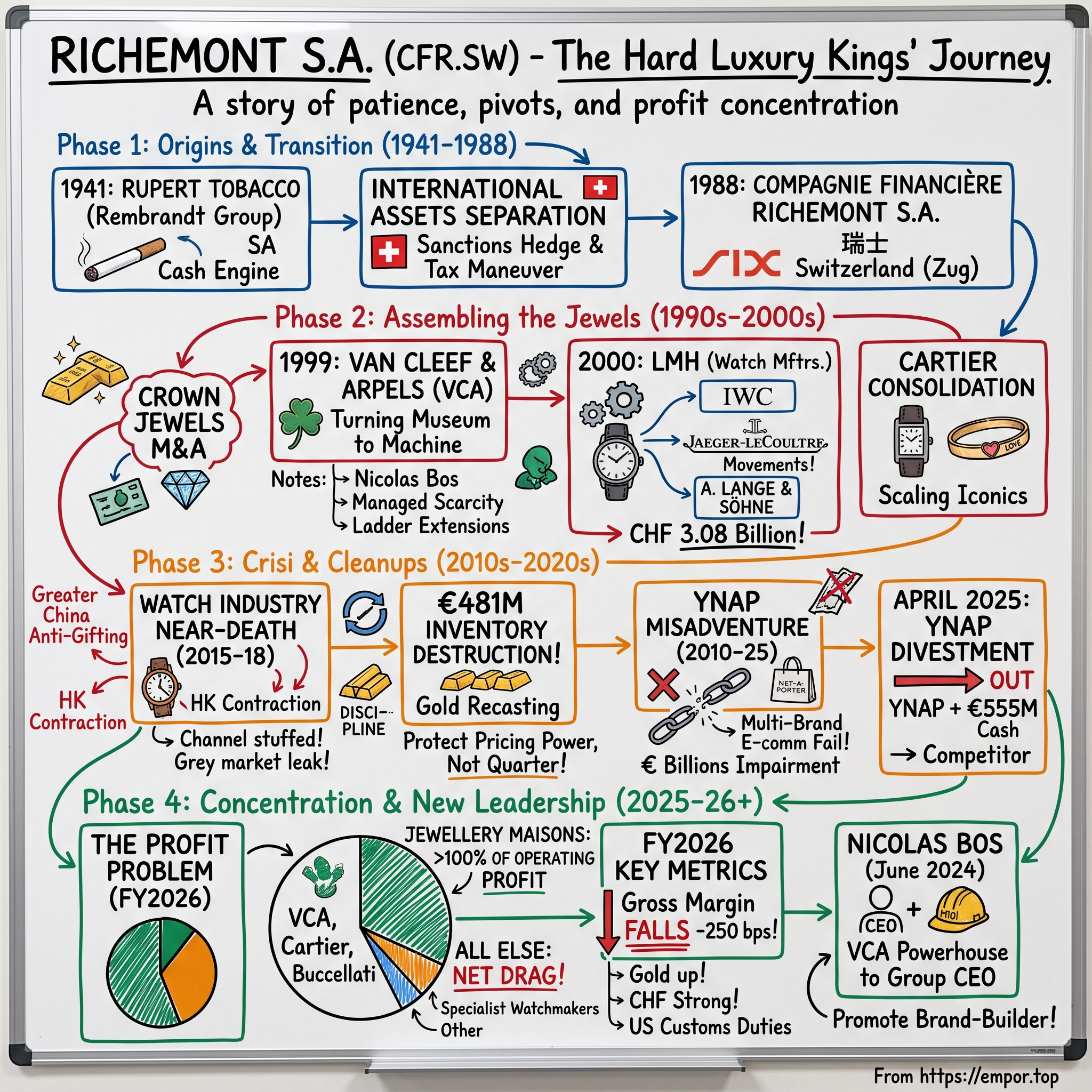
The narrative arc is unusually rich even by luxury standards. It begins in Stellenbosch, South Africa, with a chemistry graduate who started a tobacco company in a garage and ended up owning Rothmans. It runs through a 1988 corporate restructuring that was simultaneously a tax manoeuvre, a sanctions hedge, and one of the great capital reallocation decisions of the twentieth century. It passes through the watch industry's near-death experience of 2015–2018, when Richemont bought back and physically dismantled hundreds of millions of euros of unsold watches rather than let them poison its own pricing. It detours, expensively, into e-commerce — a decade-long, multi-billion-euro misadventure with YOOX Net-A-Porter that ended in April 2025 with the business handed to a competitor along with €555 million of Richemont's cash.3 It includes a 2022 activist campaign that was defeated by the arithmetic of a dual-class share structure but that arguably won on substance anyway. And it arrives, in mid-2026, at a new management chapter: Nicolas Bos, the man who built Van Cleef & Arpels into a global powerhouse, running the whole group since June 2024.4
The central question for a long-term investor is not whether Cartier and Van Cleef & Arpels are great assets. They are. It is whether a group that now derives more than all of its operating profit from two jewellery houses — with everything else, in aggregate, running at a loss after corporate costs — is a focused compounder or a concentrated bet wearing a conglomerate's clothing. To answer that, we have to start where the money came from.
 Subscribe on LinkedIn
II. Rupert Family Origins & The Rembrandt Spin-Off
The founding scene of the Richemont story has nothing to do with Place Vendôme. It takes place in Johannesburg in 1941, in a rented room, where a young chemistry graduate named Anton Rupert and two partners put up a few hundred pounds to start a tobacco business. The venture that eventually became the Rembrandt Group was, by any reasonable measure, a bootstrapped provincial start-up in a country on the periphery of the world economy.
Anton Rupert had an idea about capitalism that was unusual for his time and place. He called it "partnership in industry" — a belief that businesses should share ownership with the communities and workers around them, and that a company operating in a divided society could not simply extract. Whether one reads this as genuine conviction or as sophisticated corporate positioning in an apartheid state, it produced a distinctive corporate culture: patient, relationship-driven, allergic to leverage, and willing to hold assets for generations rather than quarters. That culture is still visible in Richemont's balance sheet today, which carried €8.5 billion of net cash at the end of March 2026 — a posture that would be considered lazy in almost any other industry.1
Rembrandt grew into a genuine conglomerate. Tobacco was the engine, and it scaled internationally through Rothmans International into one of the largest cigarette businesses in the world. Around it accreted alcohol, mining interests, financial services, and industrial holdings. By the 1980s the Rupert family controlled a sprawling South African empire — and had a serious problem.
The problem was geography. Apartheid-era South Africa was subject to escalating international sanctions, its currency was hemmed in by exchange controls, and international investors were actively divesting. A South African holding company owning world-class international assets was a structure that discounted those assets simply for the address on the letterhead. Worse, capital trapped inside the country could not easily be redeployed to buy things outside it.
The 1988 solution was elegant enough to be studied as a case in corporate structuring. Rembrandt's international assets — the luxury goods interests, the stake in Rothmans International, and various industrial holdings — were separated out and placed into a newly formed, Swiss-domiciled company, Compagnie Financière Richemont S.A., which listed on what is now the SIX Swiss Exchange.10 Overnight, the family's international portfolio was owned through a Zug-domiciled vehicle governed by Swiss law, denominated in a hard currency, and accessible to global institutional investors who would never have touched a Johannesburg holding company. The South African assets stayed in South Africa. The international assets went where international capital could reach them.
It is worth pausing on what this actually accomplished, because it is easy to read it as mere tax engineering. It was a re-domiciling of the family's future. Everything Richemont subsequently did — buying French jewellers, buying Swiss and German watch manufactures, defending itself against LVMH — required the ability to write large cheques in hard currency to European sellers. That capability did not exist inside the old structure.
Then came the second decision, which was Johann Rupert's rather than his father's. Anton's son had trained in New York on Wall Street, ran his own merchant bank in South Africa, and brought a financier's temperament to a family of operators. Through the late 1980s and into the 1990s, Richemont built and then consolidated its position in the Vendôme Luxury Group, the vehicle that housed Cartier — including the "Les Must de Cartier" line that had, controversially at the time, extended the Cartier name down into accessible leather goods and lighters.
The strategic logic behind the pivot was, in retrospect, a textbook read on terminal value. Tobacco in the late 1980s was still ferociously cash-generative, but the trajectory was legible to anyone paying attention: litigation risk in the United States, advertising bans, excise escalation, and structural volume decline in developed markets. It was a business with enormous current earnings and a shrinking runway for reinvestment. Luxury was the mirror image — smaller earnings, but a category where a brand could raise prices above inflation more or less indefinitely, where emerging-market wealth creation was about to produce hundreds of millions of new customers, and where the assets got better with age rather than worse.
Rupert chose the smaller current earnings and the longer runway. Over the following two decades Richemont progressively exited tobacco, ultimately unwinding its interests through the British American Tobacco structure, and redeployed the proceeds into Maisons. The unglamorous truth is that Cartier and Van Cleef & Arpels were substantially bought with cigarette money — a capital recycling story that ranks alongside any in modern corporate history.
The question then became: what, exactly, do you buy?
III. Assembling the Crown Jewels: M&A & The Hard Luxury Portfolio
In the late 1990s, if you had walked into the Van Cleef & Arpels boutique at 22 Place Vendôme, you would have found something close to a museum. The house had been founded in 1896 by the marriage of a stone-cutter's son and a gem dealer's daughter. It had invented the serti mystérieux — the "mystery setting," a technique in which stones are held by grooves cut into their own edges so that no metal is visible, a piece of jewellery engineering so laborious that only a handful of artisans in the world could execute it. It had dressed Grace Kelly and the Duchess of Windsor. And it was, commercially, asleep.
Richemont began acquiring in 1999, taking 60% initially and moving to full control over the following years, at a total consideration reported in the region of $450 million. What happened next is the single best argument for Richemont's entire strategy — and the best evidence for what Nicolas Bos actually did before he was handed the group.
Turning a museum into a machine
The instrument was the Alhambra. Created in 1968, it is a simple four-leaf clover motif rendered in mother-of-pearl, onyx, malachite, or diamonds, strung on a chain. It is not technically complex. What Van Cleef & Arpels did under Bos, who joined the Maison in 1992 and became its global President and CEO in 2013, was to treat the Alhambra the way a fashion house treats a signature handbag — an entry point at a few thousand euros, an unmistakable visual signature, and a ladder of extensions running up into six figures.4 Critically, they did it while keeping supply deliberately tight. The Alhambra has spent much of the last decade in a state of managed scarcity: waitlists at boutiques, limited stone allocation, no discounting, ever.
The economics of this are worth spelling out in plain terms. A jewellery house has two ways to grow. It can sell more units, which requires more stones, more setters, and more boutiques — all of which cost money and dilute exclusivity. Or it can sell the same number of units at higher prices, which costs nothing except brand equity risk. Van Cleef & Arpels found a third path: expand the ladder, so that the customer who bought a single pendant at 25 comes back at 35 for the bracelet and at 45 for the long necklace. Same brand, same motif, rising average transaction value, and every purchase reinforces the last. Bos oversaw revenue at the Maison growing severalfold over his tenure, and in September 2019 was additionally handed responsibility for Buccellati.4 When the board needed a group CEO in 2024, it did not hire a consultant. It promoted the person who had run the playbook.
The LMH masterstroke
The watchmaking half of the portfolio arrived in a single, contested transaction. In 2000, Mannesmann AG — the German industrial conglomerate then being dismembered after Vodafone's hostile takeover — was selling Les Manufactures Horlogères SA, a holding company assembled by the legendary German watch executive Günter Blümlein. Inside LMH sat 100% of IWC Schaffhausen, 90% of A. Lange & Söhne, and 60% of Jaeger-LeCoultre.
Richemont announced the acquisition on 21 July 2000, paying CHF 3,080 million on a debt-free basis: CHF 2,800 million for LMH itself, plus CHF 280 million for the remaining 40% of Jaeger-LeCoultre held by Audemars Piguet.7 It beat competing interest from both LVMH and Swatch Group. Johann Rupert's public framing was characteristically dry: "LMH is an excellent business with a remarkable record of sales growth and profitability. Its acquisition represents an outstanding opportunity for us to re-deploy assets into our luxury goods business."7
At roughly four-and-a-half times sales at what was then a cyclical peak for Swiss watches, it looked expensive, and plenty of contemporary commentary said so. The case for it was not about the multiple; it was about what was inside the box. Jaeger-LeCoultre was — and remains — one of the few genuine manufactures, a house that designs and builds its own movements and has historically supplied them to other prestige brands. A. Lange & Söhne was a Saxon house that had been nationalised out of existence by East Germany in 1948 and painstakingly resurrected after reunification, and which now sits in the very top tier of horological credibility. Owning those capabilities meant Richemont did not have to buy movements from Swatch Group's ETA subsidiary — a dependency that would become acutely uncomfortable when Swatch later moved to restrict third-party movement supply.
Buccellati and the third pillar
Nineteen years later, Richemont added the third jewellery leg. On 27 September 2019 it announced the acquisition of 100% of Buccellati Holding Italia S.p.A. from Gangtai Group.8 Richemont did not disclose the price; it was subsequently reported at around €230 million.9 Buccellati, founded in Milan in 1919, makes jewellery using Renaissance-era engraving techniques — textured gold that looks like woven fabric — across four in-house Italian workshops. Rupert's rationale was explicitly about portfolio fit: Buccellati was "one of the few Maisons in the dynamic branded jewellery market which is complementary to our existing jewellery Maisons."8
The benchmarking here is instructive. In roughly the same window, LVMH paid $15.8 billion for Tiffany & Co. and had earlier paid €3.7 billion for Bulgari. Richemont bought a genuine high-jewellery house with a century of heritage for something in the order of 1.5% of the Tiffany price. The trade-off is honest: Buccellati was tiny and needed years of boutique build-out to matter. But Richemont was buying an option on the same structural trend LVMH was paying a strategic premium for — the migration of consumers from unbranded local jewellers to branded houses — at a fraction of the entry multiple.
The structural divergence
Step back and the portfolio architecture of the three European luxury groups looks like three different bets on the same wealth boom. LVMH built its cash engine on soft luxury — Louis Vuitton's leather goods, with fashion cycles, seasonal collections, and gross margins that are extraordinary precisely because the input cost of canvas is trivially small. Kering did the same through Gucci, with the associated volatility that comes from betting on a creative director's taste.
Richemont staked its balance sheet on the opposite characteristics. Hard luxury carries a much higher cost of goods — you cannot dematerialise the gold — which structurally caps gross margin below what a handbag house earns. In exchange, it gets inventory that does not go out of style, does not need markdown, and can sit in a boutique for three years without impairment. It is a lower-gross-margin, lower-obsolescence business. Whether that trade is superior or merely different is one of the genuinely open questions in the sector, and 2026 has been supplying uncomfortable new evidence on the input-cost side.
But before the gold problem, there was the watch problem — and it very nearly broke the group.
IV. The Great Watch Crisis & The Inventory Destruction Discipline
Somewhere in Switzerland, between 2016 and 2018, workers took apart luxury watches for a living. Not to repair them. To destroy them. Cases were separated from movements, movements were broken down, gold was sent for recasting, and dials and hands went to scrap. The watches were new, unworn, and fully functional. Richemont had bought them back from its own retail partners specifically so that they could be dismantled.
To understand why a company would do that, you have to understand how the Swiss watch industry actually sold watches for most of the modern era — and how badly that model failed.
How the machine jammed
For decades, the dominant channel was wholesale. Brands sold watches to independent multi-brand retailers, who took title to the inventory and sold it on. The brand booked revenue on shipment to the retailer, not on sale to a consumer. This is a structure that quietly rewards bad behaviour: if a brand wants a better quarter, it can push more watches into the channel. The industry called it "sell-in" versus "sell-out," and for years the gap between the two was papered over by demand growth — much of it from 大中華區 Greater China, and much of that from a gifting culture in which a Swiss watch was the standard instrument for a business or political favour.
Then two things happened at once. Beijing's 反腐倡廉 anti-corruption and anti-extravagance campaign, launched in earnest from 2012, made conspicuous gifting genuinely dangerous. Simultaneously, the Hong Kong market — for years the highest-density luxury watch market on earth, supplied by mainland 代购 daigou shoppers arriving to buy tax-free — contracted sharply amid political unrest and a narrowing price arbitrage.
The result was a channel stuffed with watches nobody wanted at list price. Hong Kong and mainland retailers, sitting on unsold inventory and needing cash, began discounting. That inventory leaked into the grey market — unauthorised dealers and online platforms such as Chrono24 — where a Cartier or an IWC could suddenly be had at 30% or 40% off. For a brand whose entire proposition rests on the customer believing the boutique price is the real price, this is an existential problem. Not a margin problem. An identity problem. Once a client learns that a watch they paid full price for is available at a steep discount three clicks away, the brand's authority is damaged for years.
The decision
Richemont's response was to buy the problem back. Across the two years reported in its 2018 results, the group repurchased €481 million of unsold watches from retail partners — approximately €278 million in the first year, weighted heavily to Cartier, and €203 million in the second, drawn more from the Specialist Watchmakers stable including Piaget, IWC, and Vacheron Constantin.6 Some stock was reallocated to healthier regions. The rest was dismantled and recycled.
Burkhart Grund's explanation was blunt: "We don't believe that having our inventory in the grey market will help long-term brand equity, so that's why we bought it back."6
Consider what this cost. Richemont took a direct earnings hit — buybacks reduce revenue and crush gross margin — in order to protect a brand asset that appears on no balance sheet and can be measured by no auditor. There was no accounting requirement to do it. A management team optimising for the next two years would have let the retailers eat the loss and taken the market share. Richemont chose otherwise, and the decision was possible in large part because of the governance structure we will examine later: a controlled company can absorb two bad years in a way a widely-held one often cannot.
The honest counterpoint, which sceptics raised at the time and which deserves airing: the buybacks were also an admission of Richemont's own prior sins. The inventory was in the channel because Richemont put it there. Destroying watches is heroic brand stewardship; it is also cleaning up a mess of one's own making, and the market was entitled to ask why the sell-in discipline had been so loose in the first place.
The structural fix
The durable answer was not buybacks — it was changing the distribution model so the problem could not recur. Richemont began systematically terminating weak wholesale doors and shifting volume into directly operated stores, where the group controls the price, the presentation, and critically the inventory, because a watch sitting in a Richemont boutique is still Richemont's watch. Nothing is booked as a sale until a customer actually buys it.
That transition has run for the better part of a decade and is now largely complete at group level. In the year ended 31 March 2026, direct-to-client sales represented 77% of group sales, with the retail channel alone accounting for 71% and growing 12% at constant rates.1 Wholesale — the channel that caused the crisis — has been reduced to 23%.1
The strategic conclusion an investor should draw is specific: the sell-in/sell-out gap that made Swiss watch reporting untrustworthy for a generation has been substantially closed at Richemont. When the group reports watch sales today, it is much closer to reporting actual consumer demand. That is a genuine quality-of-earnings improvement, and it is one reason the current weakness in Specialist Watchmakers should be read as real demand softness rather than channel correction. The bad news is that this makes the segment's current profitability harder to explain away.
Distribution discipline, however, was only one half of Richemont's response to a changing world. The other half was a bet on the internet — and that one went considerably worse.
V. The YNAP Saga: E-Commerce Misadventure, Farfetch Collapse, & Mytheresa Exit
In 2010, buying Net-a-Porter looked like the smartest thing in luxury. Natalie Massenet had built a website that made online luxury feel like a magazine rather than a warehouse — black boxes, ribbon, editorial content, next-day delivery in London and New York. Every luxury executive who had spent a decade insisting that rich people would never buy a €3,000 dress on a screen was quietly revising their view. Richemont, which had taken a stake at the company's founding, moved to control.
Sixteen years later, the accumulated result of that instinct was one of the most expensive strategic errors in modern European luxury.
The build
The strategy escalated in stages. In 2015 Net-a-Porter was merged with the Italian online retailer YOOX, creating YOOX Net-A-Porter Group and giving Richemont a partner with genuine logistics and technology infrastructure. In 2018 Richemont bought out the public minorities, taking YNAP fully private in a transaction valuing the business at around €5 billion in enterprise terms and requiring roughly €2.7 billion of cash for the shares it did not own.
The vision was an "omni-channel luxury fortress": Richemont's Maisons would have a world-class digital storefront, YNAP would provide white-label e-commerce services to other brands, and the group would own the customer relationship in a channel that everyone agreed would eventually be enormous.
Every part of that thesis was directionally correct about the market and wrong about the economics.
Why multi-brand luxury e-commerce does not work
The failure mechanism is worth explaining carefully, because it recurs across the sector and it is not obvious.
A multi-brand luxury e-commerce site is, structurally, a department store with a website. It buys inventory at wholesale, holds it, and sells it at retail. That means it carries full inventory risk on fashion product — the most markdown-prone category in existence. When a season does not sell, the platform, not the brand, eats it.
On top of that sits a customer acquisition problem. A physical luxury boutique on Bond Street acquires customers through the street and through the brand's own advertising. An e-commerce platform acquires them by bidding for search and social impressions against every other retailer on earth, and those prices only go up. Then add returns: apparel and footwear return rates in luxury e-commerce routinely run at 30–50%, and every return is a round trip of shipping, inspection, repackaging, and restocking cost against a sale that never happened. Then add technology: platforms of this scale require continuous re-platforming, and YNAP was carrying the accumulated technical debt of two merged businesses on legacy infrastructure.
Now stack the strategic conflict on top. The brands YNAP needed most — the biggest, most desirable Maisons — were simultaneously building their own mono-brand e-commerce, where they capture the full retail margin and, more importantly, own the customer data. Why would Louis Vuitton or Chanel hand its best clients' behavioural data to a multi-brand competitor? Over time, the strongest brands pulled back and the platform was left with a weaker mix.
The financial record is unambiguous. YNAP consumed capital continuously for more than a decade. Richemont's disclosed impairments tell the story in instalments: by August 2022, in announcing the reclassification of YNAP as held for sale, Richemont estimated a write-down of approximately €2.7 billion based on the Farfetch share price at the time and the prevailing USD/EUR rate.19 Cumulative non-cash impairment across the ownership period ran into the billions, and in the year to 31 March 2025 Richemont recorded a further write-down of the net assets held for sale.2
The Farfetch detour
In August 2022 Richemont announced a partnership under which Farfetch and Symphony Global would acquire a 47.5% stake in YNAP, with Richemont taking Farfetch stock as consideration and an eventual path to full exit.19 The structural logic was sound — hand the low-margin logistics business to a specialist platform, take equity in the consolidator, and stop consolidating the losses.
The execution assumption was that Farfetch would still exist. It very nearly did not. Farfetch's own economics deteriorated through 2023, its shares collapsed, it faced a liquidity crisis, and in late 2023 it was rescued by the South Korean e-commerce group 쿠팡 Coupang. The Richemont transaction died with it, and Richemont was left holding a business it had publicly announced it was leaving — the worst possible negotiating position for a seller.
The Mytheresa resolution
The eventual exit, announced on 7 October 2024, was structured with a candour about YNAP's value that is rare in corporate disclosure.1314 Richemont agreed to hand 100% of YNAP to Mytheresa — a smaller, more disciplined German luxury e-tailer — in exchange for equity in Mytheresa rather than cash.
The transaction completed on 24 April 2025. Richemont delivered all of YNAP's shares together with a net cash position of €555 million and no financial debt, and additionally provided a €100 million revolving credit facility for YNAP's corporate needs. In return Richemont received 49,741,342 Mytheresa shares, representing 33% of Mytheresa's fully diluted share capital. The enlarged group was renamed LuxExperience B.V. and began trading on the NYSE under the ticker LUXE from 1 May 2025.3
Read the consideration structure literally and it says something stark: the equity value of YNAP was negative. Richemont paid a buyer more than half a billion euros of cash to take the business away, and accepted a minority stake in the acquirer as its only consideration.
What the lesson actually is
The comfortable lesson — "multi-brand digital retail is a bad business" — is true but incomplete. The sharper lesson concerns the boundary of a luxury group's competence.
Richemont's core skill is the management of scarcity: controlling supply, controlling price, controlling the point of sale. E-commerce marketplaces are the opposite discipline — they are volume, throughput, conversion optimisation, and logistics, businesses that win on scale and operating leverage rather than on restraint. Richemont bought a business whose success conditions contradicted its own institutional instincts, and then ran it for over a decade with the wrong muscles.
The immediate financial effect of de-consolidation was real: YNAP's operating losses left the reported P&L. But investors should be precise about the magnitude, because a bullish framing circulated at the time suggesting the clean-up would deliver a materially higher group margin. It has not, at least not yet. Richemont's operating margin was 20.9% in the year to March 2025 and 20.0% in the year to March 2026 — down, not up, despite an 11% constant-currency sales increase.21 Removing YNAP's drag was worth something. It was simply overwhelmed by other forces.
Which brings us to the segments themselves — and to a concentration of profitability more extreme than most investors realise.
VI. Segment-Level Deep Dive & Industry Economics
Walk into the Cartier boutique at 13 Rue de la Paix in Paris and the first thing you notice is that almost nothing is priced to be an impulse purchase and almost everything is designed to be recognised across a room. That is not an accident of taste. It is the operating model.
1. Jewellery Maisons: the entire company
In the year ended 31 March 2026, the Jewellery Maisons — Cartier, Van Cleef & Arpels, and Buccellati — generated €16.5 billion of sales, up 8% at actual rates and 14% at constant rates, delivering an operating result of €5.0 billion at a 30.5% operating margin.1 The prior year had produced €15.3 billion at a 31.9% margin.2
Now put those figures next to the group. Richemont's total operating profit in FY2026 was €4.5 billion.1 The Jewellery Maisons produced €5.0 billion of it. Specialist Watchmakers contributed €107 million. The Other segment lost €96 million. Corporate costs consumed roughly half a billion more.1
State that plainly: the jewellery division generates more than 100% of Richemont's operating profit. Everything else in the group, taken together and after central costs, is a net drag. This is the single most important structural fact about Richemont, and it is more extreme than the commonly cited "around 85% of profits" shorthand.
Cartier is the scale behemoth, and its power comes from a specific product architecture. The LOVE bracelet (1969), the Juste un Clou nail bangle (1971), the Tank (1917), the Santos (1904) — these are not collections that get refreshed each season. They are permanent objects with permanent codes, sold year after year, with prices adjusted upward at a measured cadence. Because the design is fixed, the manufacturing is amortised across decades; because the icon is recognisable, marketing spend compounds rather than resetting. It is closer to a branded consumer staple with a 30% margin than to a fashion business.
Van Cleef & Arpels is the margin and growth engine, running the deliberate-scarcity model described earlier. Richemont does not disclose Maison-level financials, so the market infers VCA's profitability from divisional mix commentary rather than reading it — a genuine disclosure gap that a sceptical investor should note. When a company will not break out the numbers for what is plausibly its best asset, one cannot fully verify the story.
Buccellati remains the smallest, in the scaling phase, with an expanding boutique network. It is optionality, not a current earnings contributor.
The industry dynamic underneath all of this is the most durable growth driver Richemont has. Globally, a large majority of fine jewellery has historically been sold unbranded — by local jewellers, family shops, and regional chains, where the customer is essentially buying gold and stones with a markup. Branded penetration has been rising for two decades, from roughly a fifth of the market toward and past 30% in industry estimates. Every point of that shift transfers volume from a low-margin fragmented industry into the hands of a small number of global houses that can charge a substantial premium over intrinsic material value. Richemont, LVMH via Tiffany and Bulgari, and Kering via Boucheron and Pomellato are the principal beneficiaries; Richemont holds the strongest hand in the highest tier.
2. Specialist Watchmakers: the problem child
The contrast is brutal. In FY2026, Specialist Watchmakers generated €3.1 billion of sales — down 4% at actual rates, up just 1% at constant rates — for an operating result of €107 million and a 3.4% operating margin.1 The prior year had been worse in direction, with sales down 13% and a 5.3% margin on €3.28 billion.2 The half-year to September 2025 ran at a 3.2% margin.17
A 3.4% operating margin in a division containing Vacheron Constantin and A. Lange & Söhne is a remarkable number, and it demands an explanation. The answer is fixed-cost mechanics. Building movements in-house means owning manufactures — factories in the Vallée de Joux and Schaffhausen and Glashütte, staffed by watchmakers, finishers, and engravers who take years to train and who cannot be laid off in a downturn without destroying the capability permanently. Add the boutique network, and a very large share of the cost base is fixed. When volumes fall 15%, essentially all of that revenue shortfall drops through to profit. Operating leverage is a wonderful thing on the way up and merciless on the way down.
There are signs of stabilisation. Grund noted on the FY2026 call that sales returned to moderate growth in the second half, with fourth-quarter growth of 2% and several Maisons showing notable improvement.116 The third quarter to December 2025 delivered 7% constant-currency growth, a second consecutive positive quarter.18 Vacheron Constantin in particular has had a genuine cultural moment, with its Overseas sports-luxury line increasingly discussed alongside the Patek Philippe Nautilus and Audemars Piguet Royal Oak as an object of desire rather than merely a fine watch.
But the competitive reality is harsh. The winners in luxury watches over the past decade have overwhelmingly been the independents — Rolex, Patek Philippe, Audemars Piguet, Richard Mille — companies that are private or foundation-owned, that produce far fewer references, and that have cultivated waiting lists rather than distribution. Richemont's watch Maisons compete against businesses that face no quarterly scrutiny at all. Swatch Group, the other listed conglomerate, has struggled similarly. The pattern suggests that in high watchmaking, being part of a listed group may itself be a structural disadvantage.
3. Other: Fashion & Accessories
The third segment houses Chloé, Alaïa, Dunhill, Montblanc, Peter Millar, Delvaux, Serapian, and the Italian footwear house Gianvito Rossi acquired in 2023. In FY2026 it produced €2.7 billion of sales — down 2% actual, up 3% at constant rates — and an operating loss of €96 million.1
This is a collection of interesting brands that do not, collectively, make money. Delvaux is a genuinely rare asset — a Belgian leather house founded in 1829, older than Hermès. Peter Millar is a profitable American premium sportswear business. Montblanc is a large, globally distributed writing-instruments-and-accessories brand. But the segment has run at or below break-even for years, and it consumes management attention and capital in a group whose profits come from somewhere else entirely.
A hard-nosed activist would look at this division and ask the obvious question. The rebuttal is that these brands are early-stage or turnaround assets whose value will show up later, and that Chloé and Alaïa in particular sit in a category where a single successful creative cycle can transform the economics. That rebuttal has now been offered for several consecutive years. At some point, patience becomes an unexamined habit.
VII. Governance, Activism, & Management Architecture
In September 2022, an Italian activist investor with a small stake and a large appetite for publicity walked into the one fight in European luxury that was arithmetically unwinnable, and lost it in a way that arguably changed the company anyway.
The structure
Richemont's share capital is split into two classes. The publicly traded 'A' shares represent 90% of the equity — these are what trades on the SIX as CFR.SW. The 'B' shares represent the remaining 10% of the economic capital but carry 50% of the voting rights, and they are held in their entirety by Compagnie Financière Rupert, the Rupert family vehicle.12
The mechanics are simple and absolute. One tenth of the money controls one half of the votes. Any proposal the family opposes cannot pass without overwhelming support from the A shares — and since A shareholders are dispersed institutions, that threshold is effectively unreachable in a contested vote.
Bluebell's campaign
Bluebell Capital Partners, run by Giuseppe Bivona and Marco Taricco, had built a practice out of small-stake, high-noise campaigns against European corporates. In 2022 it turned to Richemont with a three-part demand: equal board representation for A shareholders alongside B; the appointment of Francesco Trapani — the former Bulgari chief executive who had subsequently spent years inside LVMH — as the A shareholders' representative director; and a hard structural exit from YNAP so the group could concentrate on the Jewellery Maisons.
Rupert's counter was direct and, on this specific point, difficult to argue with: Trapani's long association with LVMH, a direct competitor, meant he might not act in Richemont's best interests.5
At the annual general meeting, the outcome was never in real doubt. Shareholders backed the incumbent Wendy Luhabe over Trapani for the A-shareholder board seat by a wide margin, and Bluebell's proposal to raise the minimum board size from three to six failed to achieve majority approval.5 Rupert's post-meeting framing was that "the board can now continue to work in a collegial manner, in the interest of all our shareholders," while conceding that there were "reservations about aspects of our governance which we will continue to address."5
Who actually won
Here is the uncomfortable part for anyone who dismisses activists as noise. Bluebell lost every vote and got most of what it asked for.
The YNAP exit — Bluebell's central substantive demand — was executed, in full, within three years. The board was refreshed, with Bram Schot appointed Non-executive Deputy Chairman from 11 September 2024, succeeding Josua Malherbe after eleven years.4 The group's strategic communication shifted decisively toward the Jewellery Maisons as the centre of the story. And the CEO role, which had been abolished in 2016 in favour of a flatter structure reporting to the Chairman, was re-established.
Whether Bluebell caused this or merely anticipated it is genuinely ambiguous. Richemont would likely have exited YNAP regardless once the Farfetch route closed. But the sequencing is suggestive, and it matters for how investors should read the governance structure: the Rupert family cannot be outvoted, but it does appear to respond to sustained, specific, publicly-argued pressure. That is a materially different governance profile from one that is simply impervious.
The current bench
Nicolas Bos became Group Chief Executive on 1 June 2024, in a role Richemont had left vacant since 2016.4 An ESSEC graduate who joined the group in 1992 and spent essentially his entire career inside Van Cleef & Arpels, Bos is a brand-builder rather than a financier. Rupert's announcement framed it in exactly those terms: "Nicolas has accepted to assume the re-established role of CEO. His vision upholding Van Cleef & Arpels' tradition will steer the Group through its next evolution phase."4 Jérôme Lambert, the former group CEO-in-all-but-name, remained on the board as Chief Operating Officer reporting to Bos.4
The appointment is a statement of priorities. Richemont did not hire an operator to fix the watch division or a dealmaker to reshape the portfolio. It promoted the person who had executed the single best organic growth story in the group's history, and asked him to do it again at scale.
Louis Ferla took over Cartier on 1 September 2024, succeeding Cyrille Vigneron, who had run the Maison through its most successful period in modern history. Ferla came from Vacheron Constantin, where he had been CEO, and before that had held senior Cartier roles including China CEO and international director for clients and business development. Handing the group's crown jewel to someone with a deep Cartier background and direct experience of the Chinese market was a coherent choice at a moment when China was the group's principal problem.
Burkhart Grund has been the constant. As CFO through the watch crisis, the YNAP unwinding, and the current input-cost squeeze, he has been the voice explaining Richemont's numbers to analysts for the better part of a decade — and, as the FY2026 call demonstrated, the person whose reluctance to give forward guidance is enforced from above.
That reluctance is itself an analytical fact. Richemont provides no margin guidance, no medium-term targets, and no Maison-level profitability disclosure. The bull reading is that this frees management to make decisions like destroying €481 million of watches. The bear reading is that a company which sets no public targets can never be caught missing them. Both are true, and investors should hold both.
VIII. Transcript Analysis: Primary Evidence from Recent Earnings Calls
The most revealing thing about a Richemont results call is what management is willing to be specific about, and what it is not. Across the FY2025, H1 FY2026, and FY2026 presentations, a consistent pattern emerges: extremely granular on regional demand and cost mechanics, near-silent on forward numbers.
The China question, asked repeatedly
For three years, the opening question on every Richemont call has been some version of "what is happening in China?" The regional disclosure explains the anxiety. In FY2025, Asia Pacific sales fell 13% while Japan rose 25% and the Americas rose 16%.2 By the third quarter to December 2025, the picture had inverted at the edges: Asia Pacific grew 6%, but China, Hong Kong and Macau combined grew just 2%, while the Middle East and Africa grew 20%, Japan 17%, and the Americas 14%.18 For the full FY2026 year, China, Hong Kong and Macau together delivered only low-single-digit constant-currency growth against Americas at 17%.1
Management's explanation has been consistent across calls, which is the first thing to check for credibility. The framing is that Chinese demand did not disappear so much as relocate — Chinese travellers took advantage of a weak yen to buy in Japan, and later shifted purchasing to Europe and the Middle East. This is testable, and the Japanese numbers broadly support it: Japan's spectacular FY2025 growth was followed by a 5% decline in the first half of FY2026 as the yen recovered and the arbitrage narrowed, before returning to 9% growth for the full year.2171 A demand pool that sloshes between geographies as currencies move is behaving exactly as the "relocation not destruction" story predicts.
More striking was Bos's willingness on the FY2026 call to concede a self-inflicted error. Asked about China, he acknowledged that "probably some of our brands... overexpanded their presence" in lower-tier Chinese cities and that the group was "fine-tuning" through selective boutique closures.16 That is a specific, falsifiable admission of over-investment during the boom — the kind of statement that is rare enough on European luxury calls to be worth noting as a credibility marker. Vague explanations and blame-shifting are the usual house style; this was neither.
Pricing versus input inflation
The second recurring theme is the one now doing the most damage to reported margins. Richemont's gross margin fell from 66.9% to 64.4% in FY2026 — a 250 basis point decline driven by higher gold prices, unfavourable currency movements, and additional US customs duties.1
Rupert's own commentary on the call captured why this cycle has been unusually painful. Historically, when gold rose it was typically because the dollar was weakening, giving a European exporter a natural offset. This time, he noted, both were up simultaneously — removing the hedge that the industry has implicitly relied on for decades.16
On tariffs, management quantified the US duty impact at roughly €300 million for the fiscal year, having flagged approximately €250 million for the second half alone at the half-year stage.1716 What is notable is the response. Asked in late May whether Richemont would raise prices to offset the tariffs, Rupert said the group had not yet decided, was "looking at what other people are doing," and would decide by month-end — while stressing that Richemont has historically not "use[d] pricing to offset tariffs."16
That is a genuinely important disclosure about how this company thinks. A business with unlimited pricing power would simply pass the cost through. Richemont's stated preference is to absorb margin rather than push prices in a way that alienates core clients. Bos quantified the actual approach: jewellery growth combined volume gains, favourable mix, and "limited yet real price increases" in the region of 5–6%.16 Set against gold price inflation that has run far above that, the arithmetic explains the margin compression precisely.
The analytical conclusion cuts both ways. Richemont's pricing restraint is evidence of long-term brand stewardship and consistent with the behaviour that made these Maisons durable. It is also evidence that pricing power, in practice, is bounded — that the frequently-asserted ability to raise prices above inflation indefinitely is something management itself chooses not to test at the moment it would be most useful.
Defending the divestment
On the YNAP exit, analysts pressed on the obvious point: why hand over €555 million of cash with the business? Management's answer has been consistent — the cash was required to leave the business properly capitalised and debt-free for its new owner, and the cost of that was small against the recurring annual operating losses removed from the consolidated accounts.
The consistency of that framing across the signing announcement, the completion announcement, and subsequent calls is a point in management's favour.133 The narrative has not been rewritten. What management has been less forthcoming about is the value of the 33% Mytheresa stake it now holds — a position whose worth depends entirely on whether LuxExperience succeeds at a business model Richemont itself could not make work.
What is missing
The recurring absence across every call is forward guidance. There is no medium-term margin target, no revenue ambition, no capital allocation framework beyond the dividend. The Bonnet exchange on the FY2026 call — Grund declining to guide, Rupert joking about job security — was played for laughs, but it is the group's actual policy, and it is why sell-side models of Richemont show unusually wide dispersion. Investors buying CFR.SW are buying management's judgement, largely unmeasured against management's own stated commitments, because there are very few stated commitments.
IX. Strategic Frameworks: Helmer's 7 Powers & Porter's 5 Forces
Strip away the Place Vendôme atmospherics and ask a colder question: what, mechanically, prevents a well-capitalised competitor from taking Richemont's profits? Two frameworks help, provided we test each claim rather than asserting it.
Hamilton Helmer's 7 Powers
Cornered Resource is Richemont's strongest and least replicable power. This is the possession of a valuable asset on preferential terms that others cannot obtain. Richemont's version is threefold. First, the archives — Cartier's design records back to 1847 and Van Cleef & Arpels' to 1896 are not merely historical curiosities; they are the source material from which every new collection is legitimately derived, and no competitor can invent a 1917 Tank. Second, the people: master gem-setters, mystery-setting specialists, and guillocheurs are trained over years inside the Maisons and exist in numbers measured in dozens globally. Third, physical location — the addresses on Place Vendôme, Fifth Avenue, New Bond Street, Ginza, and Via Montenapoleone are finite and largely spoken for.
The falsification test: could a new entrant with $10 billion assemble this? It could buy locations and poach artisans. It could not buy a 179-year archive, and the market prices that impossibility.
Brand Power is real but requires precision about what it means. Cartier's brand does not merely allow a price premium over an equivalent unbranded piece — it changes what the product is. A branded piece carries resale liquidity, gift legibility, and heirloom transferability that an equivalent-quality unbranded piece does not. That is why branded penetration keeps rising: the brand is functionally part of the product's utility, not a decoration on it.
The counter-evidence, though, is exactly what FY2026 showed. Brand power sufficient to absorb a 250 basis point input-cost shock through pricing would have produced a stable gross margin. It did not. Management chose to protect volume and client relationships instead. Brand power here is a long-duration asset being deliberately under-monetised, not an unlimited pricing licence.
Scale Economies operate primarily through retail real estate and stone procurement. A group buying diamonds and coloured stones at Richemont's volume gets first look at exceptional material and better terms; a group operating hundreds of flagships can afford positions that would bankrupt an independent. There is also a scale advantage in the watch manufactures — though as the 3.4% segment margin demonstrates, scale in fixed-cost manufacturing is a liability when volumes fall.
Counter-Positioning applies in a specific and narrow sense. Richemont's business model is structurally incompatible with the fashion cycle — no seasons, no markdowns, no creative-director risk on the core icons. A fashion-led competitor cannot easily adopt this posture because its entire organisation is built around newness. The result is that Richemont's core products are immune to the write-down risk that periodically savages soft luxury.
Two powers Richemont notably lacks: there are no network effects in jewellery, and there are essentially no switching costs. A client who buys Cartier this year can buy Bulgari next year at zero friction. Richemont's moat is entirely brand-and-resource based, with nothing structural locking the customer in. That is a real limitation.
Porter's Five Forces
Threat of new entrants: very low. The barrier is time, not capital. Building a credible haute joaillerie brand requires decades of cultural accumulation. The only realistic entry path is acquisition, and there are perhaps a dozen credible targets left globally.
Bargaining power of buyers: low, but not zero. High-net-worth clients face fixed boutique prices, allocation on the scarcest pieces, and no discounting. But they have full substitutability across houses, and — importantly — the option to buy nothing at all. Luxury demand is deferrable in a way that food and software are not. That is the real buyer power in this industry: not negotiation, but abstention.
Bargaining power of suppliers: moderate and rising. This force has strengthened materially. Gold is a commodity Richemont must buy at spot, with no supplier relationship that helps; the record gold prices of the current cycle have hit gross margin directly and no amount of scale purchasing fixes it. Rough diamond supply is concentrated among a small number of miners, and traceability requirements for conflict-free and origin-verified stones add cost. For coloured stones, supply is geographically concentrated and genuinely scarce.
Threat of substitutes: low, with an emerging asterisk. Fine jewellery serves adornment, status signalling, and store-of-value functions simultaneously, and nothing else does all three. The asterisk is lab-grown diamonds, which have collapsed in price and are already reshaping the mid-market. High jewellery has so far been insulated — Richemont's clients are buying provenance, not carbon — but the long-term effect on consumer perception of natural stone value is an open question that deserves monitoring rather than dismissal.
Competitive rivalry: high, within a stable oligopoly. The contest is between Richemont, LVMH, Kering, Hermès, and the independents, and it is fought over retail locations, creative talent, and — increasingly — high-jewellery client relationships. It is not fought on price. That is the critical distinction: intense rivalry that does not degrade industry economics, because no participant benefits from discounting an asset whose value depends on not being discounted.
The forces analysis yields a clear conclusion. Richemont's competitive position on the demand side is close to unassailable. Its exposure on the supply side — input costs it cannot control and has chosen not to fully pass on — is where the model is currently under genuine pressure.
X. Current Risk Radar & Stress Test
The risks worth discussing are the ones with an identifiable mechanism connecting them to Richemont's cash flows. Four qualify.
1. Greater China and the aspirational middle. The mechanism here is often misdescribed. Richemont's very high-net-worth Chinese clients have not stopped buying; the FY2026 data showing continued growth in China, Hong Kong and Macau, however modest, confirms that.1 The pressure is on the aspirational tier — the professional buying a first Cartier LOVE bracelet or Tank — whose confidence is tied to property values and employment prospects. China's extended residential property downturn and elevated youth unemployment have compressed exactly that cohort. This matters more than it appears because the entry tier is the recruitment funnel for the high tier a decade later. A lost cohort of first-time buyers is a demand problem that shows up in 2035, not 2026. Bos's admission of over-expansion in lower-tier cities is the operational acknowledgement of the same issue.16
2. Input costs and the currency mismatch. These compound. Richemont's cost base is heavily Swiss-franc denominated — the manufactures, the headcount, much of the assembly — while revenue arrives in dollars, euros, yen, and renminbi. A strengthening franc mechanically compresses margin with no operational offset. Layer on gold at record levels and US customs duties running at approximately €300 million annually, and FY2026's 250 basis point gross margin decline is fully accounted for.116 The stress test question is straightforward: if gold stays elevated and the franc stays strong for another two years, does management eventually break its pricing restraint? Rupert's stated reluctance suggests margin absorbs it. That is a defensible brand decision and a genuine earnings risk, and investors should not pretend it is only the former.
3. The Specialist Watchmakers structural question. A division at 3.4% operating margin is not a cyclical wobble; it is a business that either recovers substantially or should not be there. The bull case is that watch demand has stabilised — two consecutive positive quarters, Q4 growth of 2%, several Maisons improving in the second half — and that operating leverage will work in reverse as volumes return.11618 The bear case is that Richemont's watch Maisons are structurally disadvantaged against private and foundation-owned competitors who can restrict supply without answering to a public market, and that the manufactures' fixed costs make them permanently margin-inferior. Two years of data will settle this. Investors should be honest that it is not settled now.
4. Governance concentration and succession. The dual-class structure means public shareholders have no mechanism to force change if the family's judgement deteriorates. For most of the past four decades that judgement has been good, which makes the structure look benign. Succession is the untested variable. Johann Rupert has been the group's controlling intelligence since 1988; the family holding will pass to a next generation whose operating judgement the market has not observed. There is no disclosed succession plan for the chairmanship. This is not a criticism of any individual — it is a straightforward observation that the single largest qualitative dependency in the investment case has no published contingency.
A fifth risk deserves a brief note rather than a section: the 33% LuxExperience stake is now a marked-to-market equity holding in a business Richemont exited because it could not make it profitable. It is small relative to the group and it is optionality rather than exposure, but it is not a source of value investors should underwrite.
XI. The Investment Story Spine: Bull vs. Bear Case & Key KPIs
Everything above reduces to a single question: is Richemont a jewellery company with some expensive hobbies, or a diversified luxury group with a jewellery problem? The financial evidence points firmly to the first.
The three metrics that matter
Most Richemont disclosure is interesting. Three items are decisive.
1. Jewellery Maisons constant-currency sales growth and operating margin. This is not one of several important metrics; it is effectively the entire earnings power of the company. The margin has moved from 31.9% in FY2025 to 30.5% in FY2026, and 32.8% in the intervening half-year.2117 The direction of that line, tracked against constant-currency sales growth, tells an investor almost everything about whether pricing is keeping pace with gold and whether the demand engine is intact. If jewellery margin sustains in the low thirties while growing double digits, the thesis is working. If margin drifts toward the high twenties, the pricing-power argument is being falsified in real time.
2. Direct-to-client share of sales. At 77% of FY2026 sales, this measures whether the distribution discipline built after the watch crisis is holding.1 A meaningful reversal — wholesale share expanding again — would be an early warning that a Maison is chasing volume through the channel, the precise behaviour that created the 2015–2018 disaster.
3. Constant-currency growth in China, Hong Kong and Macau versus the Americas. This is the geographic rebalancing gauge. The Americas at 17% and Greater China at low single digits in FY2026 describes a group currently being carried by one region while its historically most important growth market stalls.1 Convergence would confirm the "relocation not destruction" thesis. Continued divergence would mean the American consumer is doing structural work that a single recession could undo.
The bull case
The strongest argument for Richemont is that it owns the two best assets in the fastest-structurally-growing category in luxury, and that the category growth is driven by a consumer migration that has decades left to run. Branded jewellery taking share from unbranded fragmented retail is not a fashion trend; it is a durable shift in how people buy, and it converts low-margin volume into high-margin volume with every point of penetration gained.
The balance sheet supports this. Net cash of €8.5 billion at March 2026, up €0.2 billion year over year even after paying dividends, gives Richemont capacity that essentially no competitor can match without leverage.1 The board proposed an ordinary dividend of CHF 3.30 per share, up 10%, plus a special dividend of CHF 1.00 — a signal both of confidence and of the fact that the group is generating more cash than it currently knows how to reinvest.1 That cash is optionality: it funds opportunistic acquisition of the remaining independent hard-luxury houses, or it returns to shareholders.
The clean-up is also genuinely complete. The e-commerce distraction is gone from the P&L, the wholesale channel risk is structurally reduced, and the management team running the group is the one that executed the best organic growth story in its history.
The bear case
The bear case starts with a number that the bull case cannot argue away: the Jewellery Maisons produced €5.0 billion of operating profit against a group total of €4.5 billion.1 Every euro of group profit, and then some, comes from two brands. If Cartier or Van Cleef & Arpels experiences a genuine brand-fatigue cycle — the sort that happened to Gucci twice in thirty years — there is nothing else in the portfolio to absorb it.
Second, the margin evidence contradicts the pricing-power narrative at exactly the moment it should have been demonstrated. FY2026 delivered 11% constant-currency sales growth and a lower operating margin than the prior year, at 20.0% versus 20.9%.12 A business with unbounded pricing power does not compress margin in a strong demand year. The company's own explanation — deliberate pricing restraint to protect client relationships — is credible, but it reframes the moat: Richemont has enormous brand power and constrained near-term pricing power, and those are not the same thing.
Third, the watch division. A 3.4% operating margin in a segment carrying Vacheron Constantin, Jaeger-LeCoultre, and A. Lange & Söhne is either a spectacular recovery opportunity or evidence that these assets are worth more to someone else. Richemont has shown no inclination to test the second hypothesis.
Fourth, an activist's list, integrated rather than recited. The disclosure is thin — no Maison-level profitability, no guidance, no medium-term targets. The Other segment has lost money for years with no published turnaround milestones. The €8.5 billion cash pile earns a return well below the group's cost of equity and has no articulated allocation framework beyond an annual dividend decision. And the governance structure means none of this can be forced onto the agenda. Bluebell demonstrated in 2022 that these arguments can be made loudly and lost completely.5
Why it wins, and what breaks it
Richemont wins from here if the branded jewellery penetration trend continues, if Cartier and Van Cleef & Arpels sustain low-thirties margins through the input-cost cycle, and if the watch division's stabilisation converts into genuine operating leverage. The evidence for the first is strong and structural. The evidence for the second is currently mixed. The evidence for the third is two quarters old.
The case breaks if input costs stay elevated while management continues to decline to price for them, compressing margin structurally rather than cyclically; if the Chinese aspirational consumer does not return, hollowing out the future high-net-worth cohort; or if concentration risk expresses itself in a single brand cycle at Cartier. None of these is a tail scenario. All three are live.
XII. Business & Investing Playbook
Lesson 1: Product durability is a balance sheet property, not a marketing claim. The deepest structural difference between Richemont's core business and a fashion house is that Richemont's inventory does not expire. That single characteristic eliminates markdown risk, permits multi-year boutique stocking, and lets the company make decisions on a decade horizon. The counterweight, visible in FY2026's gross margin, is that non-perishable inventory made of gold is expensive to hold when gold is expensive. Durability and input-cost exposure are the same coin.
Lesson 2: Sometimes the right move is to destroy the asset. Buying back and dismantling unsold watches was an accounting loss taken to protect an unrecorded asset. It is the clearest illustration in modern luxury that brand equity behaves like a capital account — you can draw it down through discounting far faster than you can rebuild it, and there are moments when the correct entry is to write off the inventory to preserve the franchise.
Lesson 3: Know which business you are actually in. The YNAP decade cost Richemont billions because the group applied a scarcity-management culture to a throughput-and-logistics business. The lesson is not that e-commerce is bad. It is that acquiring a business whose success conditions contradict your institutional instincts means you will make the wrong decision repeatedly, with conviction, for years.
Lesson 4: Concentrated control is a two-sided instrument. The dual-class structure enabled the watch buybacks, permitted a decade of patience on Buccellati, and insulated management from the pressure to financialise the balance sheet. It also means that a shareholder who believes the Other segment should be sold, or that €8.5 billion of cash is poorly deployed, has no mechanism beyond persuasion. Investors in CFR.SW are not minority partners in a company. They are passengers in a family vehicle that has, so far, been driven exceptionally well — and the central act of diligence is forming a view on the driver, not the dashboard.
References
-
Richemont delivers strong sales growth and solid results for the year ended 31 March 2026 — Richemont, 2026-05-22 ↩↩↩↩↩↩↩↩↩↩↩↩↩↩↩↩↩↩↩↩↩↩↩↩↩
-
Richemont posts robust performance for the year ended 31 March 2025 — Richemont, 2025-05-16 ↩↩↩↩↩↩↩↩
-
MYT Netherlands Parent B.V. ("Mytheresa") and Richemont announce the successful completion of Mytheresa's acquisition of YOOX NET-A-PORTER ("YNAP") — Richemont, 2025-04-24 ↩↩↩
-
Richemont announces changes to the Board of Directors and Senior Management — Richemont, 2024-05-17 ↩↩↩↩↩↩↩
-
Richemont shareholders reject activist Bluebell's board candidate — Reuters, 2022-09-07 ↩↩↩↩
-
Richemont watch buybacks strategy analysis — Financial Times, 2018-05-18 ↩↩
-
Richemont acquires Les Manufactures Horlogères SA and the outstanding 40 per cent of Manufacture Jaeger-LeCoultre SA — Richemont, 2000-07-21 ↩↩
-
Compagnie Financière Richemont SA acquired Buccellati Holding Italia SpA from Gangtai Italia and Lauro 52 for €230 million — MarketScreener, 2019-09-26 ↩
-
Richemont results, reports and presentations archive — Richemont ↩
-
Richemont Annual Report and Accounts FY2025 — Richemont, 2025-05-16 ↩
-
MYT Netherlands Parent B.V. ("Mytheresa") and Richemont sign agreement for Mytheresa to acquire YOOX NET-A-PORTER ("YNAP") — Richemont, 2024-10-07 ↩↩
-
Mytheresa and Richemont sign agreement for Mytheresa to acquire YOOX NET-A-PORTER — Business Wire, 2024-10-07 ↩
-
Earnings call transcript: Richemont sees strong FY2026 despite challenges — Investing.com, 2026-05-22 ↩↩↩↩↩↩↩↩↩
-
Richemont delivers solid results for the six-month period ended 30 September 2025 with strong sales momentum in Q2 — Richemont, 2025-11-14 ↩↩↩↩
-
Richemont maintained strong momentum with sales up 11% at constant rates for its third quarter ended 31 December 2025 — Richemont, 2026-01-16 ↩↩↩
-
Reclassification of investment in YNAP amid anticipated sale — Richemont, 2022-08-24 ↩↩
 LinkedIn
 WhatsApp
 Reddit
 Hacker News
 Email
Email Kindle
 RSS Feed
 Spotify
 Apple Podcasts
 Amazon Music
 Audible
 YouTube