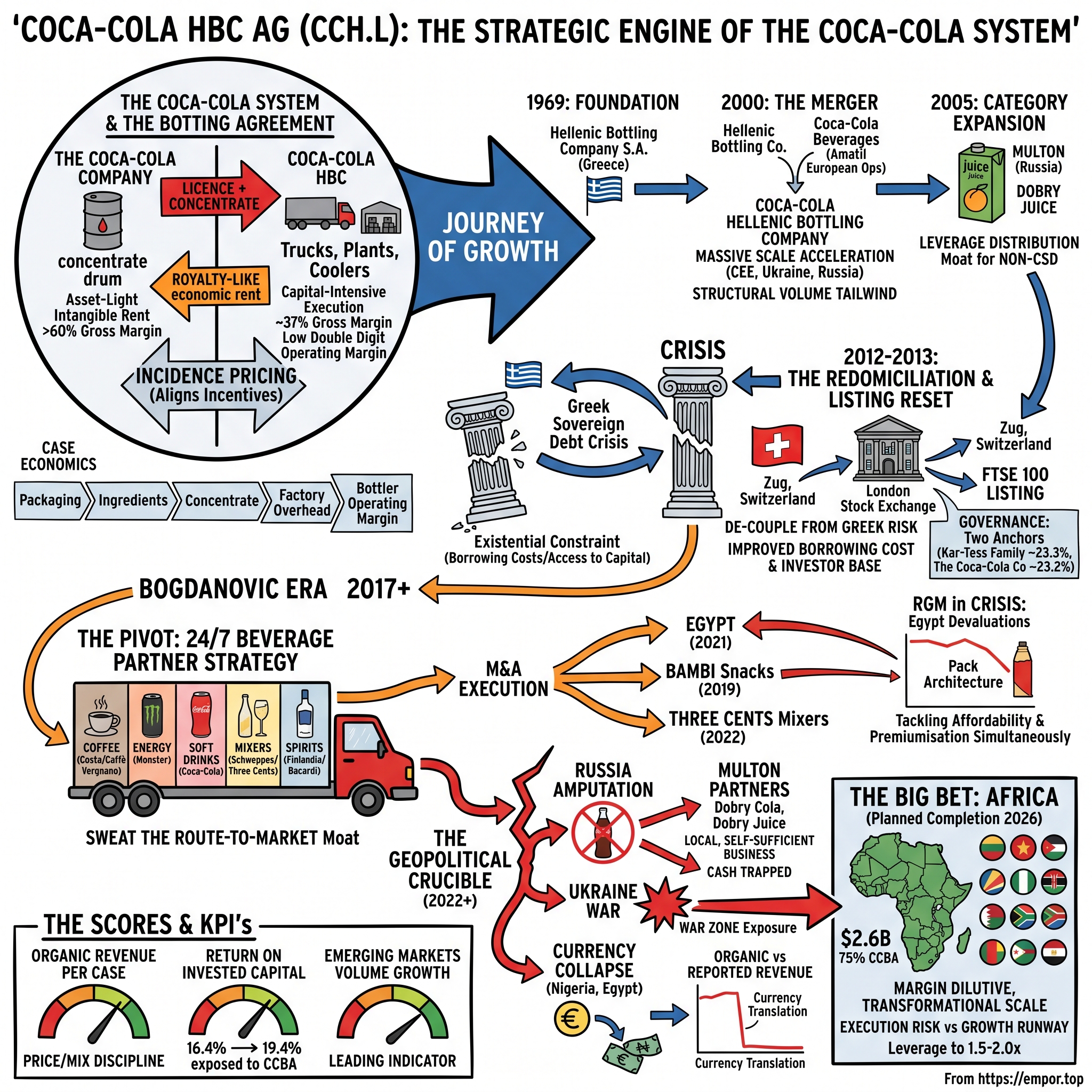
Coca-Cola HBC AG: The Strategic Engine of the Coca-Cola System
I. Introduction & Episode Roadmap
On the morning of October 21, 2025, Coca-Cola HBC AG did two things at once. It published a routine third-quarter trading update — the kind of document that normally moves a large-cap consumer stock by half a percent — and it announced that it had agreed to buy seventy-five percent of Coca-Cola Beverages Africa for $2.6 billion, valuing the whole business at roughly $3.4 billion.56 The market's verdict was immediate and unsentimental. The shares fell four percent to £33.98.6
That reaction is the perfect entry point into this company, because it captures a tension that has defined Coca-Cola HBC for its entire modern existence. Here is a business that had, at that point, strung together an unbroken run of organic revenue growth quarters, expanded returns on capital year after year, and built one of the most consistent operating records in European consumer staples. And when it proposed to do the single most logical thing available to it — buy more of the same kind of asset in the fastest-growing consumer market on earth — investors sold.
Understanding why requires understanding what Coca-Cola HBC actually is. The instinct is to file it under "soft drinks," alongside the brand owners whose logos appear on the cans. That instinct is wrong, and it is the most common analytical error made about this company.
The core thesis. Coca-Cola HBC is not a beverage brand company. It is the physical execution layer of The Coca-Cola Company across a territory stretching from the Irish Sea to the Nile Delta and from the Baltic to the Niger. It manufactures, packages, chills, delivers, merchandises, prices, and collects. The Coca-Cola Company owns the intangible asset and captures a royalty-like economic rent on it; Coca-Cola HBC owns the trucks, the plants, the coolers, and the relationships with several million individual retail outlets, and earns a margin on the physical work of getting a chilled beverage within arm's reach of desire. Both halves are essential. Only one of them requires a balance sheet.
By the close of its 2025 financial year, that execution layer generated net sales revenue of €11.6 billion, up 7.9% as reported and 8.1% on an organic basis, sold nearly 3.0 billion unit cases across 29 countries, and served a consumer base the company puts at 760 million people.1 Comparable operating profit reached €1,356.2 million — a record comparable EBIT margin of 11.7% — and return on invested capital expanded to 19.4%.1
The strategic paradox. Sit with those numbers for a moment, because their composition is stranger than their level. This is a FTSE 100 constituent with an investment-grade credit profile, a progressive dividend, and net debt of just 0.7 times comparable EBITDA at the end of 2025.1 It achieved that while operating in Nigeria and Egypt through some of the most violent currency devaluations of the past decade, while running a Russian business that was severed from the Coca-Cola brand system entirely in 2022, and while absorbing a war on its own doorstep in Ukraine. Financial conservatism at the centre; controlled chaos at the edges. The interesting question is not whether that combination has worked — the record says it has — but whether it is a repeatable capability or a run of favourable outcomes that a genuinely bad decade would expose.
What this episode covers. First, the machinery: how the Coca-Cola system actually splits economics between brand owner and bottler, and why a concept called incidence pricing determines whether that relationship is a partnership or a tax. Second, the lineage, from a Greek bottling licence granted in 1969 to a Swiss-domiciled company with its primary listing in London. Third, the pivot that began in December 2017, when a Croatian former general manager named Zoran Bogdanović took over and started arguing that a bottler should sell coffee, energy drinks, premium vodka and Serbian biscuits off the same truck. Fourth, the acquisitions — Egypt, Bambi, Three Cents — that tested whether he meant it. Fifth, the 2022 rupture in Russia and the improvised entity that emerged from it. And finally, the frameworks, the bear case, and the small number of operating metrics that actually tell you whether this machine is still working.
A note on posture before we begin. Coca-Cola HBC's management has, over the past five years, done a great deal of what it said it would do. That is a fact worth stating plainly, and it is rarer than it sounds. But a good track record is a starting point for scrutiny, not a substitute for it — and as we will see, the most credible bear case on this company today comes not from anything that has gone wrong, but from the largest thing management has chosen to do next.
 Subscribe on LinkedIn
II. The Anatomy of the Coca-Cola System & Anchor Bottler Economics
Picture a shipping container arriving at a Coca-Cola HBC plant outside Naples, or Lagos, or Kraków. Inside are drums of a viscous brown liquid. That liquid is the entire economic contribution of The Coca-Cola Company to the finished product on a supermarket shelf — a concentrate so dense that a single drum yields tens of thousands of litres of finished drink. It is light, non-perishable, and cheap to ship. It is also, by a wide margin, the highest-margin item in the entire beverage value chain.
Everything else — the water, the sugar, the carbon dioxide, the aluminium, the PET resin, the glass, the labour, the electricity, the diesel, the refrigeration, the invoicing, the credit risk — belongs to the bottler.
This split is not an accident of history. It is the deliberate architecture that has allowed the Coca-Cola brand to reach nearly every inhabited place on earth without The Coca-Cola Company itself having to finance a single bottling plant in most of them. The brand owner performs the work that scales infinitely at near-zero marginal cost: advertising, brand equity, consumer research, flavour development, and the manufacture of concentrate. The bottler performs the work that does not scale at all without capital: building factories, buying trucks, and placing coolers.
Asset-light rent versus capital-intensive execution. The consequence is two radically different financial profiles wearing the same red logo. The Coca-Cola Company operates at gross margins north of sixty percent and generates enormous free cash flow on a modest asset base. An anchor bottler like Coca-Cola HBC operates at gross margins in the mid-thirties — 36.7% at the half-year mark in 2025 — and converts that into an operating margin in the low double digits.41 To an investor scanning a screen, the brand owner looks obviously superior. But margin percentage is the wrong lens. What matters for the bottler is whether it earns a return above its cost of capital on the assets it is required to own, and whether that return can compound. On that measure, Coca-Cola HBC's expansion of return on invested capital from 16.4% in 2023 to 18.3% in 2024 and 19.4% in 2025 is the single most important financial fact about the company.13 A capital-intensive business earning high-teens returns on capital is not a worse business than an asset-light one — it is a different one, and in some respects a more defensible one, because the capital itself becomes a barrier.
The bottling agreement, and the thing called incidence pricing. Coca-Cola HBC holds exclusive territorial rights to produce and sell Coca-Cola trademark beverages across its 29 countries.1 Nobody else may do so. That exclusivity is the foundation of the whole enterprise, and it is also the source of its deepest structural dependency, because the rights are granted by a counterparty — The Coca-Cola Company — which is also a roughly 23% shareholder in the bottler.10
The mechanism that makes this relationship workable rather than extractive is incidence pricing. Here is the simplest way to think about it. Under a naive arrangement, the brand owner would sell concentrate at a fixed price per unit. If the bottler then managed to raise its retail prices, the brand owner would capture none of that upside; if the bottler's market collapsed, the brand owner would keep charging the same. Incentives would diverge immediately.
Under incidence pricing, the concentrate charge is instead set as a percentage of the bottler's net revenue per case. The brand owner's take moves up and down with the bottler's realised price. It is closer to a revenue-share than to a supply contract. The practical effect is that The Coca-Cola Company cannot arbitrarily squeeze concentrate pricing without simultaneously damaging the volume and financial health of the partner it depends on to reach the shelf — and, in this case, without damaging a stake it owns. It also means the brand owner has a direct financial incentive to help the bottler premiumise. When Coca-Cola HBC pushes single-serve cans over multi-packs, or launches a higher-priced mixer brand, both parties benefit. This alignment is genuine, but it is not symmetrical: the brand owner sets marketing strategy, approves the portfolio, and controls the licence. Investors should treat the relationship as a well-designed partnership with an unambiguous senior partner.
Where the money actually goes in a case of Coca-Cola. Strip a case of finished beverage down to its economics and the picture is dominated by things that have nothing to do with flavour. Packaging is typically the largest single line — aluminium for cans, PET resin for bottles, glass for the returnable formats that still dominate parts of Africa and Southern Europe. Ingredients come next: sugar or sweetener, the concentrate itself, carbon dioxide, juice. Then distribution — diesel, drivers, warehousing, and the cost of physically visiting hundreds of thousands of small outlets. Then factory overhead and the depreciation of an enormous fixed asset base. What survives at the bottom is a bottler's operating margin.
Management confirmed the sensitivity of this stack on the February 2026 call, guiding to low-single-digit cost of goods per case inflation for 2026, with continuing pressure in aluminium and PET partly offset by moderating sugar, and disclosing hedging coverage above 55% on key commodities, weighted toward sugar and aluminium.2 That last detail is worth pausing on, because it cuts both ways: hedging protects the company when inputs spike, but as the chief financial officer acknowledged, it also means a favourable move in sugar prices will not flow fully into the profit and loss account.2 Bottlers do not get to be pure beneficiaries of deflation.
Why net revenue per case is the number that matters. Because the cost stack is heavy and largely fixed per unit, the entire art of running a bottler reduces to a single question: can you grow revenue per case faster than cost per case, without destroying volume? The discipline for doing this has a name inside the company — revenue growth management, or RGM — and it is less exotic than it sounds. It is the systematic engineering of what is sold, in what pack size, at what price point, to which type of outlet.
The 2025 results show the machinery in normal conditions rather than crisis conditions. Organic revenue per case rose 5.1%, with pricing the largest contributor but package and category mix also positive; single-serve mix expanded 130 basis points in the year and stood 310 basis points higher on a three-year view.12 That single-serve shift is the quiet engine. A chilled 330ml can bought at a kiosk carries a far higher revenue and margin per litre than a two-litre bottle bought in a supermarket. Moving the mix toward immediate consumption is how a bottler manufactures margin without raising the shelf price of anything.
The interesting test of this discipline, though, was never the calm years. It was what happened when the currencies collapsed — which is where this story is heading. But first, the question of how a Greek bottling licence ended up controlling territory on three continents.
III. Greek Roots & Consolidation: The Leventis Legacy to CCHBC (1969–2012)
Athens in 1969 was not an obvious place to build a multinational. Greece was three years into a military dictatorship, capital was scarce, and the consumer economy was rudimentary. It was in that year that Hellenic Bottling Company S.A. — Ελληνική Εταιρεία Εμφιαλώσεως A.E. — was founded to bottle Coca-Cola for the Greek market.10
The family behind it mattered more than the country. The Leventis family had already built an industrial and trading empire that ran through West Africa, particularly Nigeria, decades before "emerging markets" was a category anyone allocated to. This is a detail that most summaries of Coca-Cola HBC skip, and it should not be skipped, because it explains something structural about the company's later behaviour. The ownership group did not acquire its appetite for operating in difficult, high-inflation, hard-to-hedge geographies during a strategy offsite in the 2010s. It has been doing that since the middle of the twentieth century. The holding vehicle through which the family's interest is held, Kar-Tess, remains one of the two anchor shareholders today.10 The 1981 combination with the Nigerian Bottling Company brought that West African lineage formally inside the group.10
For its first three decades, the Greek business was a good regional bottler in a small country. What transformed it was a single transaction in 2000.
The merger that changed the scale of everything. In 2000, Hellenic Bottling Company combined with Coca-Cola Beverages — the vehicle holding what had been Coca-Cola Amatil's European operations — to create Coca-Cola Hellenic Bottling Company.10 Overnight, a company whose centre of gravity was the Aegean acquired bottling operations stretching across Central and Eastern Europe: Poland, Hungary, Czechia, the Balkans, Ukraine, and above all Russia.
The timing is what makes this a great business story rather than a mere consolidation. The transaction landed roughly a decade after the collapse of communism, in territories where per-capita consumption of packaged beverages was a fraction of Western European levels, where modern retail barely existed, and where the incumbent competition was fragmented local production. Coca-Cola HBC did not have to invent demand. It had to build the physical capacity to serve demand that was arriving anyway as incomes rose. That is the most attractive setup a distribution-intensive business can be handed: a structural volume tailwind that rewards capital deployment rather than punishing it.
It also embedded a habit. From 2000 onward, the company's identity was not "the Greek bottler" but "the bottler that operates across wildly different stages of economic development simultaneously." The three-segment structure the company still reports today — Established, Developing, Emerging — is a direct descendant of that merger.
Russia, juice, and the first big lesson in category expansion. By the mid-2000s, the company faced a limitation that every carbonated soft drinks bottler eventually confronts: fizzy drinks are a category, not a market. Consumers drink other things.
The response came in 2005. Coca-Cola HBC and The Coca-Cola Company jointly acquired Multon, one of Russia's largest juice producers, splitting the cost equally and sharing the results between them.14 The deal was announced at the end of March 2005 and cleared by the European Commission the following month.14 Multon at the time was generating around $336 million of annual revenue on roughly 500 million litres of volume, with a portfolio led by the Dobry juice brand alongside Rich and Nico, and plants in Moscow and St Petersburg.14 Neither party confirmed a price publicly; contemporaneous reporting put estimates in the range of $600 million for the whole business, implying roughly half that for the bottler's share, but these figures were never confirmed by either company and should be treated as unverified.14
The strategic lesson was more durable than the price. Multon proved that a Coca-Cola bottler could own and scale brands that had nothing to do with The Coca-Cola Company's trademark portfolio, using the same trucks and the same retail relationships. That principle — sweat the distribution asset with more categories — became the intellectual foundation of everything Coca-Cola HBC did fifteen years later. It also, in one of the more remarkable ironies in modern corporate history, turned out to be the thing that saved the Russian business when the trademark was withdrawn.
When the home market broke. Then Greece imploded. The sovereign debt crisis that began in 2009 produced not a recession but a depression, with the Greek economy contracting by roughly a quarter over several years and unemployment reaching levels unseen in a developed European economy since the 1930s. For a beverage bottler, that is a direct hit: volumes fall, mix deteriorates as consumers trade down from single-serve to bulk formats, and the out-of-home channel — cafés, tavernas, hotels, the highest-margin outlets a bottler serves — simply closes.
But the operational damage was the smaller problem. The larger one was financial. Coca-Cola HBC was a company incorporated in Greece, listed principally in Athens, with the overwhelming majority of its revenue and assets located elsewhere. Credit markets, however, do not always price on fundamentals alone. A Greek-domiciled issuer in 2011 and 2012 faced borrowing costs and investor scepticism anchored to Greek sovereign risk, irrespective of where its cash flows actually came from. The company's operations had outgrown its passport.
For a business whose entire model depends on continuously financing plants, trucks and coolers at a cost of capital below the returns those assets generate, that mismatch was not a nuisance. It was an existential constraint on growth. Something had to change — and what changed was the company's country.
IV. The Redomiciliation & Listing Reset: Switzerland, LSE, and Governance (2012–2017)
In October 2012, Coca-Cola HBC announced one of the cleanest pieces of corporate financial engineering of the European crisis era: it would move its holding company out of Greece to Switzerland and shift its primary share listing to the London Stock Exchange.10 The reorganisation completed the following year. In April 2013 the company was renamed Coca-Cola HBC AG, its domicile moved from Greece to the canton of Zug, with a registered address in Steinhausen, and its premium listing on the London Stock Exchange began on April 29, 2013.1011
Strip away the legal machinery and the logic was almost brutally simple. The company was severing the link between its cost of capital and the creditworthiness of a country that accounted for a small and shrinking share of its business.
What the move actually bought. Three things, each of which compounds.
The first was borrowing cost. A Swiss-domiciled issuer with a diversified international asset base could be assessed on its own credit fundamentals rather than through the lens of Greek sovereign stress. For a company that must roll debt continuously to fund a capital programme running at six to seven percent of revenue, a persistent reduction in the spread it pays is not a one-off gain — it is a permanent improvement in the arithmetic of every future investment decision.
The second was the investor base. A premium London listing brought the company into the FTSE 100, which meant automatic inclusion in the index funds and mandates that anchor European large-cap ownership.1011 Passive and benchmark-aware capital is not glamorous, but it is deep, patient, and it dramatically widens the pool of buyers for any future equity issuance — a fact that would matter enormously more than a decade later, when the company issued shares as part of an African acquisition.
The third was optionality. Being a Swiss company listed in London gave Coca-Cola HBC a currency and a jurisdiction that international counterparties understood. That mattered for acquiring assets from other multinationals, for negotiating with The Coca-Cola Company as a peer institution rather than a regional subsidiary, and for recruiting a genuinely international board and management cadre.
Notably, the company retained a secondary listing on the Athens Exchange under the ticker EEE.11 That was partly symbolic and partly practical — Greek institutional investors and the country's retail base had held the stock for decades. But it also signalled something the company has been consistent about: it did not disown its origins, it repriced its risk.
The two-anchor governance structure. The ownership arrangement that emerged from this period is unusual, and any serious investor in the shares needs to understand it before anything else.
Roughly 23.3% of the ordinary shares sit with the Kar-Tess group, representing the David and Leventis family interest, and roughly 23.2% sit with The Coca-Cola Company itself, leaving a free float of about 53.5% held predominantly by international institutions.10 Two shareholders, near-identical stakes, together controlling something close to a blocking position — a structure confirmed in practice by the fact that these two holders together represented approximately 45% of voting rights in the 2026 shareholder vote on the African acquisition.10
The bull reading is that this is close to an ideal ownership structure for a capital-intensive, long-cycle business. One anchor is the brand owner, whose incentives are permanently aligned with growing volume and premiumising mix. The other is a family whose horizon is measured in generations and which has lived through Nigerian devaluations, Greek depressions and Balkan wars without selling. Neither is a hedge fund demanding a buyback. That is why Coca-Cola HBC has been able to maintain a heavy reinvestment programme through crises that would have forced a more fragmented shareholder register into retrenchment.
The bear reading deserves equal airtime. Two aligned holders with a combined stake near 45% mean that the outcome of any contested vote is effectively determined before the free float is counted. Minority shareholders' formal protection rests on independent board oversight and the governance standards attached to a premium London listing rather than on their own voting power. And the relationship with The Coca-Cola Company is inherently a related-party one: it is simultaneously the licensor, the largest supplier, a joint marketing partner, a counterparty in acquisitions — as it was in both Egypt and Africa — and a major shareholder. Every one of those roles is disclosed and governed, but the concentration of them in a single counterparty is a genuine structural feature, not a technicality. An investor buying these shares is accepting that the company's strategic direction is set in partnership with a party whose interests are aligned but not identical.
Board continuity has reinforced the long-horizon character of the structure. Anastassis G. David, representing the founding family interest, has chaired the company, providing a thread of ownership perspective running back to the Athens years.10[^21]
With its financing constraint removed, its shareholder base internationalised and its governance settled, the company entered the mid-2010s structurally sound but strategically unresolved. It was still, fundamentally, a very good carbonated soft drinks bottler in a world where carbonated soft drinks were no longer the growth story. Solving that required a change at the top — one that arrived under painful circumstances.
V. The Bogdanovic Era & The 24/7 Beverage Partner Pivot (2017–2021)
The succession was not planned. Dimitris Lois, the chief executive who had steered Coca-Cola HBC through the redomiciliation, died in October 2017.10 On December 7, 2017, the board appointed Zoran Bogdanović to succeed him.10
Bogdanović was not a parachuted-in outsider with a consulting deck. He was a career operator inside the Coca-Cola system, a Croatian who had run country businesses and regions — the kind of executive who has personally argued with a supermarket buyer over shelf space and personally watched a cooler placement decision change a kiosk's weekly order. That background shows in how he communicates. Listen to him on an earnings call and he does not reach for strategic abstractions; he reaches for markets, brands, and specific commercial mechanics. Asked in February 2026 about Egypt's performance, he answered with a five-minute inventory of concrete actions — commercial policy changes with wholesalers, upskilling of sales teams, a new can line, another line opening in Alexandria, a football club partnership, a music activation — before conceding, unprompted, that the comparison base had been easy.2 That volunteered caveat is a small thing, but it is the kind of small thing that accumulates into a credibility record.
The idea: stop thinking of yourself as a soft drinks company. Bogdanović's central strategic argument was that Coca-Cola HBC owned an asset it was systematically under-utilising. That asset was not the brand — the brand belonged to someone else. It was the route to market: the trucks, the routes, the salespeople, the coolers, the invoicing relationship, and above all the daily physical access to hundreds of thousands of retail outlets and out-of-home venues.
A truck visiting a café to deliver Coca-Cola incurs almost the same cost whether it drops one category or five. The marginal cost of adding a case of energy drink, a bag of coffee, or a bottle of premium vodka to that same delivery is close to trivial. The revenue is not. This is the entire economic logic of what the company branded the "24/7 beverage partner" strategy: own the consumer's occasions across the whole day, from morning coffee through afternoon soft drinks to evening cocktails, and let one distribution network carry all of it.
The framing is elegant. The question for an investor is whether the categories actually delivered. The record, more than eight years on, is genuinely mixed — and the mix is instructive.
Energy: the unambiguous success. The clearest win has been energy drinks, distributed through the relationship with Monster Energy — a brand in which The Coca-Cola Company itself holds a substantial minority stake, giving the whole system a shared interest in its expansion. In 2025, Coca-Cola HBC's energy volumes grew 28.3%, the tenth consecutive year of double-digit growth in the category, and energy revenue surpassed €1 billion for the first time, reaching roughly 9% of group revenue.12 The growth was not confined to rich markets: in Africa, the affordable Predator and Fury brands grew more than 40%, supported by football partnerships.2
What makes this more than a portfolio footnote is the margin structure. Energy drinks carry high revenue per case and travel through exactly the immediate-consumption channels where bottlers make their best money. Management stated on the February 2026 call that it expects the category to reach a double-digit percentage of revenue "very soon" and is backing it with dedicated coolers.2 Ten straight years of double-digit growth is the kind of evidence that converts a strategic claim into a demonstrated capability.
Coffee: the category that has not gone to plan. The contrast is instructive. After The Coca-Cola Company acquired Costa Coffee from Whitbread — a transaction completed in January 2019 — Coca-Cola HBC became the vehicle for rolling Costa across its territories, and in June 2021 it took a 30% stake in the Italian roaster Caffè Vergnano to strengthen its premium out-of-home coffee credentials.
Coffee initially grew quickly; volumes rose 23.9% in 2024.3 Then it broke. In the third quarter of 2025, coffee volumes fell 34%.6 Management's framing is that at the start of 2025 it made a deliberate decision with Costa to prioritise the out-of-home channel over ready-to-drink, and that the out-of-home business grew volumes 26.5% in 2025 as a result.2 That explanation is plausible and specific, and the out-of-home growth figure is real. But investors should hold two things simultaneously: a strategic reprioritisation that produces a 34% quarterly volume decline is also, in plainer language, the abandonment of a channel that was not working. The company has not disclosed a coffee profitability figure that would let outsiders judge whether the reset has created value. On the evidence available, coffee remains the weakest link in the 24/7 thesis and the one where management's narrative has shifted most.
Adult sparkling, mixers, and spirits: the HORECA bundle. The most conceptually interesting leg of the strategy targets hotels, restaurants and cafés — the HORECA channel. The logic runs like this: a bar needs tonic, a bar needs mixers, a bar needs spirits, and a bar already receives a Coca-Cola delivery. Why should three separate suppliers make three separate drops?
The company built this out through the Kinley and Schweppes adult sparkling brands, the acquisition of the Greek super-premium mixer Three Cents, and a set of premium spirits arrangements. In 2025, premium spirits volumes grew 12.2% and the category generated €460.4 million of revenue, up from €414.3 million.1 Crucially, the company moved from pure distribution to ownership by acquiring the Finlandia vodka brand from Brown-Forman, launching a new global campaign for it in April 2025.12 Bogdanović's explanation on the call was notably commercial rather than promotional: premium spirits works, he argued, precisely because it is not a standalone business — it drives mixability with the non-alcoholic portfolio and generates incremental transactions on both sides.2 Distribution with Bacardi expanded from two markets to eleven.2
That premium spirits grew double digits in a period when the global spirits industry was struggling is a legitimate data point in favour of the distribution-density argument. It is also a small base, and one strong year is not a trend.
Three segments, three completely different businesses. Underneath the portfolio story sits a geographic structure that investors must internalise, because the group's headline growth is an average of three businesses that behave nothing alike.
The Established markets — Italy, Greece, Switzerland, Austria, Ireland and others — are mature, high-margin, and structurally low-growth. In 2025 they grew organic revenue just 2.3%, with volumes flat, and comparable operating profit actually declined 2.8% because the company stepped up marketing investment.12 This is the segment where the 24/7 premiumisation strategy has to work, because volume growth is not coming to the rescue.
The Developing markets — Poland, Czechia, Hungary, Slovakia — sit in the middle: 6.1% organic revenue growth in 2025, modest volume growth of 0.8%, and profit growth of 5.6% with flat margins.1 Poland in particular had a difficult year after a major competitor returned to the shelves of a large retail customer, an episode management addressed directly and without evasion when pressed on it.2
The Emerging markets — Nigeria, Egypt, Romania, Serbia, Ukraine and the Russian business — are where the growth actually lives. In 2025 this segment grew organic revenue 13.2%, volumes 4.4%, and comparable operating profit 23.2%.1 Nigeria and Egypt were the standouts, with volumes up mid-single digits and low teens respectively.2
The strategic reading is unavoidable and it frames everything that follows: Coca-Cola HBC's growth is increasingly an emerging-markets story wearing a FTSE 100 listing. The European business provides stability, cash generation and a currency-safe earnings base. The growth, the volume, and the risk all come from the south and east. Which is precisely why the company spent the first half of the 2020s buying more of it.
VI. M&A Execution & Portfolio Expansion: Egypt, Bambi, & Premium Mixers
There is a particular kind of courage required to sign a large acquisition in Egypt in August 2021. The country's currency had already been devalued once in living memory; its central bank was managing an increasingly untenable peg; inflation was a persistent feature rather than an event. Any competent risk committee could have produced a memo explaining why waiting was prudent.
Coca-Cola HBC signed anyway.
Case one: Egypt. In August 2021, the company agreed to acquire approximately 94.7% of the Coca-Cola Bottling Company of Egypt for a combined $427 million, buying from the private holder MAC Beverages and from a Coca-Cola Company affiliate.[^12][^13] The transaction completed in two tranches in January 2022, with the majority stake from MAC Beverages closing on January 13 and the further stake from The Coca-Cola Company on January 25.[^12]
The strategic case was demographic and almost embarrassingly simple. Egypt is Africa's second-largest market for non-alcoholic ready-to-drink beverages, with a population above 100 million, a median age far below European levels, and per-capita consumption of packaged beverages a fraction of what the same consumer will buy at higher income.[^13] Buy the distribution now, and the growth arrives on its own schedule.
On valuation, a note of analytical discipline is required. It is widely asserted that Egypt was acquired at roughly 1.1 times enterprise value to sales, a steep discount to the multiples paid for bottling assets in developed markets. That multiple is not disclosed in any company filing this analysis could verify, and it should not be treated as company-sourced. What can be said with confidence is that $427 million for a controlling interest in the bottler of a 100-million-person market is a small absolute cheque — roughly the size of a single year's capital expenditure programme — and that the price plainly embedded significant compensation for Egyptian macroeconomic risk. That risk promptly materialised, in the form of a series of Egyptian pound devaluations over the following three years.
Which makes the operating outcome the more interesting story. Rather than retrench, the company invested through the currency crisis. Bogdanović's account on the February 2026 call was unusually granular: the team enhanced the portfolio, invested in data-informed revenue growth management, restructured commercial policy with wholesalers, upskilled the sales force, added a new can line with another opening in Alexandria, introduced energy with both Monster and the affordable Fury brand, and segmented the route to market between at-home and out-of-home customers.2 Egypt is also, he noted, by far the largest Schweppes market globally.2 The result was low-teens volume growth in 2025 and low-to-mid-twenties growth in the fourth quarter.2
The honest analytical conclusion is that Egypt validates a specific and unusual capability: the willingness to keep spending capital into a market during a currency collapse, on the thesis that competitors will not, and that share won cheaply during the crisis becomes permanent when stability returns. That is a real edge, but it is also a strategy that only looks brilliant in retrospect if the market eventually stabilises. It would look reckless in a country that never did.
Case two: Bambi, and the biscuit question. In February 2019, Coca-Cola HBC agreed to acquire the Serbian confectionery maker Bambi — Концерн Бамби A.D. — from the private equity firm Mid Europa Partners, at an enterprise value of €260 million.12[^15] Bambi generated around €80 million of revenue in 2018, more than two-thirds of it in Serbia, and its flagship Plazma biscuit brand ranked first in brand recognition in the country — a genuinely iconic local product rather than a generic snack.12 Notably, contemporaneous reporting described Bambi's operating margin as almost three times that of Coca-Cola HBC itself.12 A commonly cited multiple of roughly twelve times EBITDA is not disclosed in sources this analysis could verify; on the revenue and margin figures that are verifiable, the implied multiple was in the high single digits to low teens.
This deal is the one that most invites the "diworsification" charge, and the charge deserves to be taken seriously. A beverage bottler buying a biscuit company is, on its face, a departure from focus. The counter-argument rests on channel logic rather than category logic: Plazma and Coca-Cola are sold to the same kiosk, by the same salesperson, off the same truck, and are consumed in adjacent occasions. If the asset is the route to market, then a high-margin impulse product with dominant local brand recognition is a rational load to add.
The evidence since is partial but real. A fire disrupted the Bambi plant in 2024, with full operations returning in 2025; in October 2025 the company launched Bambi snacks in Nigeria, its first extension of the snacks business into Africa.2 That last move is the test of the thesis. If a Serbian biscuit brand can be scaled through Coca-Cola HBC's African distribution, the acquisition was a distribution play that happened to involve biscuits. If it cannot, it was a well-priced but strategically orphaned local business. It is too early to score, and management has not disclosed segment-level snacks profitability that would allow outsiders to judge.
Case three: Three Cents, the small deal with the clean logic. In August 2022, the company acquired the Greek super-premium mixer brand Three Cents at an enterprise value of €45 million, buying the business from a subsidiary of the Athens-listed IDEAL Holdings.13[^17] Three Cents had been founded in Greece in 2014 by a small group of bartenders and entrepreneurs, and made its name supplying craft tonics and sodas to cocktail bars.13
At €45 million this was a rounding error on the balance sheet, and that is precisely why it is a useful illustration. Coca-Cola HBC did not buy Three Cents for its Greek revenue. It bought a credible super-premium brand that it could inject into a HORECA distribution network spanning 29 countries — a network that took fifty years and billions of euros to build, and into which an independent Greek mixer brand could never have gained access on its own. The company continued rolling Three Cents into additional countries through 2025.2 This is the acquisition template that works best for a distribution-heavy business: buy the brand cheaply, supply the scale yourself.
And then the elephant. These three deals, totalling well under €800 million, were the warm-up. On October 21, 2025, Coca-Cola HBC agreed to acquire 75% of Coca-Cola Beverages Africa for $2.6 billion — 41.52% purchased from The Coca-Cola Company for $1.3 billion in cash, and 33.48% from Gutsche Family Investments for $308 million in cash plus 21,027,676 newly issued Coca-Cola HBC shares, equal to 5.47% of the enlarged share capital.5 The cash element and an associated debt refinancing were backed by a €2.5 billion bridge facility.5
The scale of what this buys is genuinely transformational. Coca-Cola Beverages Africa operates across 14 African markets and represents roughly 40% of the Coca-Cola system's volumes on the continent; on a 2024 pro forma basis it sold 1,102 million unit cases and generated $3,632 million of revenue and $267 million of operating profit.5 Combined, the enlarged group would sell approximately 4.0 billion unit cases on around €14.1 billion of revenue with €1.4 billion of operating profit — making Coca-Cola HBC the second-largest Coca-Cola bottler in the world by volume, and giving it, together with its existing African business, roughly two-thirds of the continent's total Coca-Cola system volume.52
Shareholders approved the transaction at an extraordinary general meeting on January 19, 2026, and the company has said it remains on track to complete by the end of 2026, subject to remaining regulatory and antitrust approvals, with a secondary listing on the Johannesburg Stock Exchange planned alongside completion.25 Management has guided to low-single-digit earnings accretion in the first full year after completion.5
Why the market disliked it is the subject of the bear case later in this story. But note the structural point now: this transaction takes a company whose growth already depended on emerging markets and increases that dependence dramatically — and it does so by buying an asset from its own largest shareholder. Every governance and concentration question raised earlier now applies at four times the scale.
VII. The Geopolitical Crucible: Navigating Russia, Ukraine, and Hyperinflation (2022–Present)
The Egyptian transaction closed on January 25, 2022. Twenty-seven days later, Russian forces crossed into Ukraine.
For most European consumer companies, the war was a demand shock and a supply chain problem. For Coca-Cola HBC it was closer to an amputation. On March 3, 2022, the company published a conflict update stating plainly that it had generated "c. 20% of 2021 volumes and EBIT from both regions," and simultaneously withdrew its guidance for the year, saying it no longer believed it prudent to forecast.9
Read that sentence again, because the precision matters and it is frequently misreported. Russia and Ukraine together represented approximately twenty percent of both volume and operating profit — not twenty percent of volume and a smaller fifteen percent of profit. The exposure was proportionate, and it was enormous. There are very few FTSE 100 companies that have ever disclosed that a fifth of their earnings had just entered a war zone.
The problem that had no precedent. When The Coca-Cola Company suspended its business in Russia, Coca-Cola HBC's Russian operation lost the thing that defined it. It could no longer produce Coca-Cola, Fanta or Sprite. What it retained was everything else: bottling plants, warehouses, a distribution fleet, thousands of employees, relationships with Russian retailers, and — critically — the juice brands acquired seventeen years earlier.
The response was to rebuild the business around what remained. The Russian entity was renamed ООО «Мультон Партнерс» Multon Partners, reaching back to the 2005 juice acquisition for its identity. It stopped producing trademark Coca-Cola beverages and reoriented its entire production base toward local brands: the Dobry juice range, Rich, Моя Семья Moya Semya, and a new locally developed cola launched under the Dobry banner, Добрый Кола Dobry Cola.
There is no polite way to describe what happened next except to say that it worked commercially. Multon Partners retained scale, retained shelf presence, and retained cash generation. In 2025, Russian volumes grew 2.6%, and the company described the operation in its full-year results as "a local, self-sufficient business focused on local brands."1
What "self-sufficient" actually means, and what it does not. This phrasing deserves careful parsing, because it is doing significant work. The company's consistent position is that the Russian business operates without group capital injections, without cross-border technology transfer, and without repatriating cash. Investors should understand the practical consequence: Multon Partners generates profits and holds cash balances that contribute to group finance income — the chief financial officer explicitly cited "ongoing income from our cash balances in Russia" as a factor in 2026 finance cost guidance — but those balances are not freely available to the group.2
This creates an awkward but honest accounting reality. A portion of Coca-Cola HBC's reported earnings and assets sits in a jurisdiction from which value cannot be readily extracted, and which carries a non-zero risk of expropriation, forced sale, or write-down should the geopolitical situation deteriorate further. The company has not been evasive about this — the disclosure is clear. But an investor valuing Coca-Cola HBC on consolidated earnings is implicitly assigning full value to a business whose cash they may never receive. That is a legitimate reason for a valuation discount, and it is a live overhang rather than a historical one.
The second crucible: currency. While the Russian restructuring was underway, a different kind of shock was hitting Africa. The Egyptian pound and the Nigerian naira both underwent severe devaluations between 2022 and 2024. For a business earning revenue in those currencies and reporting in euros, a devaluation destroys reported earnings by pure arithmetic, regardless of how well the local operation performs.
The gap this opened between operational reality and reported results was extraordinary, and it is the single most important thing to understand about reading this company's financial statements. In 2024, Coca-Cola HBC grew organic revenue by 13.8%. Reported revenue grew 5.6%.3 The entire difference — more than eight percentage points, worth roughly €800 million of notional revenue — was currency translation and perimeter effects. An investor looking only at reported figures would have concluded the business was decelerating. An investor looking only at organic figures would have concluded it was booming. Both would have been wrong; the truth was that the operations were performing exceptionally and the euro-denominated shareholder was being taxed for it by exchange rates.
How the company fought back. The response was revenue growth management applied under extreme conditions. Where inflation runs at twenty or thirty percent, a bottler faces a brutal trade-off: raise prices to protect margin and watch volume evaporate as the product becomes unaffordable, or hold prices and watch margin vanish.
The technique for escaping this trap is pack architecture. Rather than raising the price of an existing pack, the company introduces smaller entry-level packs at accessible absolute price points, while simultaneously pushing premium formats to consumers who can still afford them. The consumer paying a lower absolute price per transaction is often paying more per litre. Volume is preserved; realised revenue per case rises; the brand stays within reach of the mass market. Bogdanović described this on the February 2026 call as tackling "affordability" and "premiumisation" simultaneously in every market, and was direct about how central it had been: he questioned how the company would have navigated the inflationary years without the capability.2
Combined with a hedging programme on key commodities, this is what allowed emerging-market volumes to keep growing through a period of severe consumer stress. The evidence is fairly compelling on this point: sustaining positive volume growth alongside double-digit price/mix during a devaluation is not something most consumer companies achieved between 2022 and 2024.
The scoreboard. The financial resilience that emerged is the strongest argument in the company's favour. Comparable operating profit reached €1,083.8 million in 2023, with margin expanding and return on invested capital rising to 16.4%; it then grew to €1,192.1 million in 2024, and to €1,356.2 million in 2025.13 Management had already signalled the momentum mid-crisis, raising its full-year outlook in August 2023 on the strength of demand.15 By the February 2026 call, the company could point to twenty consecutive quarters of organic revenue growth and a five-year average of roughly 4% organic volume growth, 15% revenue growth and 14% operating profit growth.2
The correct analytical conclusion is not that Coca-Cola HBC is immune to shocks — a fifth of its profit went into a war zone and it withdrew guidance. It is that the 29-country footprint provides genuine diversification, and that the operating playbook for high-inflation markets is a real, transferable capability rather than a slogan. That is precisely the capability management is now betting on at far larger scale in Africa.
VIII. Current Management, Capital Allocation, & Corporate Governance
The most revealing moment on the February 10, 2026 earnings call was not a number. It was an analyst from Bank of America asking, in effect, why the Established markets kept absorbing investment without producing profit growth — profit had been flat in 2024 and down in 2025 — and whether that would ever reverse.2
The response was notable for what it did not do. Neither the chief executive nor the chief financial officer blamed the consumer or the weather. Anastasis Stamoulis, the CFO, acknowledged the margin pressure directly, attributed it to a deliberate joint decision with The Coca-Cola Company to step up spending behind the Share a Coke campaign and the Winter Olympics, noted that gross margin in the segment had actually improved, and then committed to a specific outcome: that 2026 would deliver positive volume growth in Established markets flowing through to profitable growth and margin expansion.2 Bogdanović had already committed to the same in his own answer.2
That is a falsifiable promise attached to a named segment and a named year. Investors should write it down. It is the cleanest available test of management credibility over the next twelve months, and it is the sort of commitment that a management team unwilling to be held to account simply does not make.
Assessing the executives on behaviour, not rhetoric. The case for Bogdanović rests on four observable behaviours over eight years. He has set medium-term targets and largely met them. He guided 2025 to organic revenue growth of 6–8% and operating profit growth of 7–11%, upgraded to the top of those ranges at the half year, and delivered 8.1% and 11.5% respectively.134 He has explained misses with specifics rather than macro hand-waving — the Poland competitive setback, the Switzerland retail negotiation, the persistent weakness in Austria where he noted consumer sentiment below the EU average while pointing out the local team was still gaining share.2 He withdrew guidance in March 2022 rather than publish a forecast he could not stand behind.9 And the narrative has been consistent: the 24/7 framing, the emphasis on revenue growth management, and the emerging-markets orientation have not changed with the weather.
The counterweights are also worth naming. Bogdanović's answers can run long and warm — asked about Coca-Cola Company leadership changes in February 2026, he delivered an effusive tribute to outgoing chief executive James Quincey and incoming leadership that contained little analytical content, and acknowledged as much himself.2 Asked what he had learned about Coca-Cola Beverages Africa in the three months since announcing the deal, he answered essentially that he was more excited than before — an answer that, however sincere, told analysts nothing about the diligence.2 And when asked directly how the African acquisition would affect the company's medium-term targets, he declined to answer, deferring to completion.2 That deferral is defensible on regulatory grounds. It also means shareholders approved a $2.6 billion transaction without an updated financial framework for the combined group.
The CFO, by contrast, was more forthcoming with detail — quantifying the hedging position, breaking down the finance cost bridge, and, when pushed by Morgan Stanley, offering that once the transaction rebased margins the company still expected to deliver within its 20–40 basis point annual margin expansion guidance.2
Where the money goes. The capital allocation framework has been notably stable, which for a capital-intensive business is itself a form of discipline.
The first claim on cash is the business itself. Capital expenditure rose €148 million in 2025 to €827.6 million, or 7.1% of revenue — inside the company's stated target range of 6.5% to 7.5%.12 That money goes into production capacity, automation, supply chain, digital and data systems, and energy-efficient coolers.2 For a bottler, this spending is not optional maintenance; it is the mechanism by which market share is bought. A cooler placed in a kiosk is a physical claim on that outlet's chilled shelf space.
The second claim is the dividend. The company targets a payout ratio of 40% to 50% of comparable earnings and describes the policy as progressive. For 2025 it proposed €1.20 per share, up 17%, representing a 44% payout — following €1.03 for 2024 at a 45% payout.13 The record here is genuinely strong: the dividend has been grown through a sovereign debt depression, a pandemic, a war and multiple currency collapses.
The third is strategic acquisitions, which brings the discussion back to Africa — and to a governance question worth stating precisely. The company bought its largest-ever asset partly from its largest customer-supplier-shareholder. Related-party transactions of this magnitude are exactly where minority shareholders should expect, and are entitled to, rigorous independent scrutiny. The transaction was put to a shareholder vote and approved.2 But the two anchor shareholders, holding roughly 45% of the votes between them, included the seller.
The fourth claim, buybacks, has been essentially theoretical. The company's medium-term leverage target is 1.5 to 2.0 times net debt to comparable EBITDA, and it ended 2025 at 0.7 times — far below the range, which under the stated framework would ordinarily argue for returning capital.1 Instead, that balance sheet capacity was deployed into Africa. Stamoulis stated that leverage after completion is expected to remain within the 1.5 to 2.0 times target range, with no expected impact on the credit rating and a commitment to sustainably maintaining an investment-grade profile.2 An activist would put it more bluntly: the company spent several years accumulating balance sheet capacity and then spent all of it at once on a single, margin-dilutive asset. Whether that was disciplined patience or an expensive use of a scarce resource is the central open question on this company today.
Long-term incentives are structured around organic revenue growth, comparable operating margin expansion, return on invested capital and sustainability metrics covering water, recycled packaging and emissions.[^22] The inclusion of return on invested capital is the most important design feature, because it is the one metric that a value-destroying acquisition cannot flatter.
IX. Strategic Position, Helmer's 7 Powers, & Porter's 5 Forces
Imagine trying to compete with Coca-Cola HBC. Not with the brand — with the company. You would need to secure a beverage brand with genuine consumer pull. Then build bottling plants across dozens of countries. Then buy a fleet. Then hire and train thousands of salespeople. Then place hundreds of thousands of refrigerated coolers into independent retail outlets that have limited floor space and no particular reason to give it to you. Then persuade those outlets to stock a product no consumer is asking for. Then wait years for the fixed cost base to be absorbed.
The capital required would run into billions. The time required would run into decades. And at the end of it, the outlet owner would still have a Coca-Cola cooler by the till.
That thought experiment is the most useful framework for this business, but let us be more systematic.
Through Hamilton Helmer's Seven Powers.
Scale economies are strong and demonstrable. The company buys aluminium, PET resin and sugar in volumes that command terms unavailable to regional players, and it runs a hedging programme with coverage above 55% on key commodities — a capability that requires both scale and treasury sophistication.2 More importantly, scale absorbs fixed costs: the same truck, the same route, the same salesperson serving more categories. The evidence for operating leverage is in the numbers — 8.1% organic revenue growth converting into 11.5% organic operating profit growth in 2025.1
Cornered resource is the strongest of the seven, and it is the reason this company exists. Exclusive territorial rights to produce and sell Coca-Cola trademark beverages across 29 countries are, in the ordinary course, not available to anyone else at any price.1 But the Russian experience proved that this power is contingent rather than absolute. When The Coca-Cola Company withdrew from Russia, the cornered resource evaporated overnight in a market representing a substantial share of group profit.9 A cornered resource granted by a counterparty is a licence, and licences have conditions.
Process power is real and underappreciated. This is the accumulated organisational knowledge of how to run a route to market — knowledge that cannot be bought or copied quickly because it lives in thousands of trained people and refined systems. The concrete evidence is specific: a dynamic routing tool live in 22 markets that cut travel time 15%; connected "Always-On" coolers whose placement rose 20% in 2025, streaming data back on in-store execution and cooler profitability; an AI-enabled logistics project reducing out-of-stocks, launched in Poland in 2025 and scaling in 2026; and a joint data initiative with The Coca-Cola Company in Nigeria that piloted across just under 4,000 outlets and produced measurably better volume and revenue per case than a control group, now being tripled in scope.2 That last item is the most interesting, because it is a controlled experiment rather than an assertion.
Counter-positioning is the weakest claim in the outline's framing, and it should be downgraded. The 24/7 multi-category model is a genuine advantage against single-category distributors, but it is not counter-positioning in Helmer's strict sense, because rival bottlers can and do pursue exactly the same strategy. There is no business-model conflict preventing an incumbent from responding.
Branding power is derived, not owned. Coca-Cola HBC benefits enormously from the consumer pull of the Coca-Cola trademark, Monster and Costa — but it does not own that equity, and it pays for it through the concentrate charge. The one genuine exception is where the company owns brands outright: Finlandia, Three Cents, Bambi's Plazma, and the Russian local brands. That is a meaningful strategic direction and a reason the ownership acquisitions matter more than their size suggests.
Switching costs and network economies are largely absent at the consumer level. A shopper switching from Coca-Cola to Pepsi incurs no cost whatsoever.
Through Porter's Five Forces.
Supplier power is the defining risk of this business model, and it is high — but structurally bounded. The Coca-Cola Company is the sole source of the input that matters, sets brand strategy, approves the portfolio, and controls the licence. What restrains it is incidence pricing, which ties its economics to the bottler's realised revenue, and its roughly 23% shareholding.10 These are real constraints. They are not the same as independence.
Buyer power is genuinely low in the fragmented traditional trade — a kiosk owner in Lagos or a taverna in Crete has no leverage over Coca-Cola HBC. It is meaningfully higher with modern retail chains, and 2025 provided two clean illustrations of exactly how it manifests: a Swiss retail negotiation that temporarily removed listings until it was resolved, and a Polish retailer that reintroduced a competitor's products, denting Coca-Cola HBC's volumes for much of the year.2 Large retailers cannot afford to delist Coca-Cola entirely, but they can reshape shelf economics at the margin, and the margin is where the profit lives.
Threat of new entrants is close to nil for the reasons the opening thought experiment illustrates.
Threat of substitutes is moderate and gradually rising. Tap water, filtered water at home, private-label soft drinks, and local coffee culture all substitute. Management's disclosure that private label share is smallest in sparkling and energy, and actually declining within sparkling, is a useful data point in the company's favour — though it also acknowledged better private-label performance in some markets, including Romania.2 The regulatory dimension of substitution — sugar taxes pushing consumers toward untaxed alternatives — is a slow, persistent headwind.
Competitive rivalry is moderate rather than intense. The principal global rival is PepsiCo and its bottling network, which competes hardest in modern retail and in specific emerging territories. The nature of beverage rivalry, though, is less about price wars than about share of chilled shelf space, share of cooler, and share of activation — and the sixth consecutive year of value share gains in non-alcoholic ready-to-drink that the company reported for 2025, worth 80 basis points, suggests it is currently winning that contest.12
The synthesis. Coca-Cola HBC's competitive position is strong, durable, and asymmetrically dependent. It is close to unassailable from below — no new entrant will replicate it — and structurally subordinate from above. The most honest way to characterise the moat is this: the company has built genuine, hard-won advantages in physical execution and local commercial capability, and it deploys them on a licence it did not create and does not control. That is a good business. It is not a sovereign one.
X. The Investment Story: Bull vs. Bear Case & 3 Critical KPIs
Myth versus reality. Three consensus narratives about this company deserve correction before the bull and bear cases are set out.
The myth that Coca-Cola HBC is a defensive European staple. The reality is that its growth engine sits in Egypt, Nigeria, the Balkans and Russia, and the pending African acquisition will increase that tilt substantially. Established markets grew organic revenue 2.3% in 2025 with declining segment profit; Emerging markets grew revenue 13.2% and profit 23.2%.1 This is an emerging-markets operator with a European listing and a European reporting currency.
The myth that organic growth is the "real" number. It is the right measure of operating performance, but it is not what shareholders receive. The 2024 gap — 13.8% organic against 5.6% reported — is the clearest illustration available of how much value currency translation can consume.3 Investors should track both, and never let the company's preferred metric become the only one they look at.
The myth that the balance sheet is a fortress. It was, at 0.7 times leverage at the end of 2025.1 It will not be after the African acquisition closes, when leverage is expected to move into the 1.5 to 2.0 times range.2 The fortress is being spent.
The bull case, and the evidence for it.
First, the demographic runway is real and is the hardest thing for any competitor to take away. Egypt and Nigeria combine large, young, growing populations with per-capita packaged beverage consumption far below developed-market levels, and Coca-Cola HBC already owns the distribution. The 2025 evidence — low-teens volume growth in Egypt, mid-single digit in Nigeria, and 4.4% volume growth across the Emerging segment — indicates the runway is being converted rather than merely described.12
Second, the category mix shift is genuinely expanding margins. Energy passing €1 billion of revenue after ten consecutive years of double-digit growth, and premium spirits growing 12.2% in a weak global spirits market, are the two strongest proof points.12 Both carry higher revenue per case than core sparkling. The record 11.7% comparable operating margin in 2025 is the aggregate evidence.1
Third, revenue growth management has been stress-tested and passed. The company sustained positive volume growth through a period of double-digit price increases in devaluing currencies — an outcome that requires either genuinely inelastic demand or genuinely skilled pack architecture, and probably both.2
Fourth, the digital and data layer is producing measurable operating gains rather than press releases. The Customer Portal B2B platform was live in 22 markets by the end of 2025, net promoter score reached 78%, and 99% of customer issues were resolved within 48 hours.2 A frequently cited figure of more than €3 billion in digital sales through this platform could not be verified in the company's 2025 results announcement and is treated here as not disclosed. The verifiable version of the claim — that digitising ordering lowers cost-to-serve for small accounts and is being scaled market by market — is more modest but better evidenced.
The bear case, and it is stronger than it looks.
First and most immediately, the African acquisition. This is where the sharpest external scrutiny has landed. In January 2026, Kepler Cheuvreux downgraded the shares from Hold to Reduce, cutting its price target, on the argument that Coca-Cola Beverages Africa introduces execution risk against an already demanding valuation.7 The specific criticisms are quantitative and difficult to dismiss: the acquired business's average operating margin of roughly 6% across 2023–24 would need to double for the deal to create value, a process the analyst argued would take multiple years; on a pro forma basis it would dilute group operating margin by around 100 basis points and return on invested capital by roughly 500 basis points; its 2024 operating profit remained below pre-pandemic levels despite revenue growth; its organic revenue growth of around 7% lags Coca-Cola HBC's own rate with currency headwinds offsetting roughly half of it; and it has suffered sustained market share losses in South Africa, its largest market.7
Put simply: Coca-Cola HBC is a high-return, margin-expanding business buying a lower-return, lower-margin one, and paying with cash, debt and 5.47% dilution of its own equity.5 Management's response is that the strategic logic is growth and that value creation will come over the long term — and the company's Egyptian record is genuine evidence it can improve an underperforming emerging-market bottler.2 But Egypt cost $427 million and Africa costs $2.6 billion. The margin for error is different by an order of magnitude, and management has declined to update its medium-term targets until completion.2
Second, currency. This risk is permanent, not cyclical. Management guided to €0–30 million of translational headwind for 2026 and was candid that the range reflects the unpredictability of African foreign exchange rather than a forecast.2 Every euro of emerging-market operating improvement remains hostage to exchange rates the company cannot control.
Third, the Russian position. A profitable, cash-generative business whose cash cannot be repatriated and whose ultimate disposition is unresolved represents both a valuation ambiguity and a tail risk.12
Fourth, regulation. Sugar taxes continue to spread across Europe; deposit return schemes are being introduced market by market — the company noted expansion into Austria and Poland in 2025, with systems in Romania, Hungary and Austria achieving average return rates above 80%.2 These schemes are environmentally sound and operationally expensive, requiring capital, working capital and administrative infrastructure. Plastic packaging regulation compounds the effect.
Fifth, the structural dependency. Everything Coca-Cola HBC has built rests on a licence. The Russian precedent demonstrated that the licence can be withdrawn by circumstance in a single market. Leadership transition at The Coca-Cola Company — with James Quincey's departure as chief executive and new regional leadership in Europe and Africa, changes Bogdanović addressed at length in February 2026 — introduces a period in which a long-established set of personal relationships is being rebuilt.2
The activist stress test. A skeptical investor sitting across the table from this board would press on four fronts. Why deploy an entire under-levered balance sheet into a single dilutive asset rather than returning capital when the stated leverage framework pointed the other way? Why should shareholders accept a major purchase from a shareholder-supplier without an updated medium-term financial framework at the time of the vote? What is the plan for the Russian business, and at what carrying value? And what is the actual return on capital of the snacks business, seven years after buying a biscuit company?
The answers available today are partial. On capital allocation, management points to a consistent framework and a record of return-on-capital expansion. On Africa, it points to Egypt. On Russia, it points to self-sufficiency. On Bambi, it points to the Nigerian launch. None of these is evasive; none is yet conclusive.
The three metrics that matter.
Investors should resist the temptation to track everything. Three measures capture whether this business is working.
Organic revenue per case. This is the purest read on commercial pricing power and mix, stripped of currency and acquisition noise. It answers the question that defines a bottler: is the company extracting more value from each unit it already sells? Watch the composition as much as the level — growth driven by single-serve and category mix is structurally higher quality than growth driven by price alone, because price-led growth in a low-inflation environment eventually meets consumer resistance.
Return on invested capital. For a business that must continuously spend seven percent of revenue on physical assets, this is the only metric that reveals whether that spending creates or destroys value. It is also the metric most exposed to the African acquisition. The trajectory from 16.4% in 2023 to 19.4% in 2025 is the strongest evidence in the bull case; a sustained reversal after completion would be the clearest possible signal that the deal was a mistake.13
Emerging markets volume growth. This is the leading indicator of whether the demographic thesis is converting into cases sold. Volume is harder to manufacture than revenue — it cannot be produced by pricing — and in markets where the strategic bet is on rising per-capita consumption, volume is the thesis. Related operating measures the company discloses, such as connected cooler placements and route-to-market digitisation, are useful supporting evidence of how that volume is being won.2
One note of caution on a commonly cited metric: total cooler placement count. The company discloses growth rates in connected cooler placements but this analysis could not verify a disclosed group-wide total cooler figure. Investors should track the disclosed growth rates rather than rely on widely circulated absolute numbers.
XI. Durable Business & Investing Playbook Lessons
The lasting lessons from Coca-Cola HBC are not about beverages. They are about what happens when a company understands precisely which asset it owns.
Alignment beats leverage in franchise systems. The relationship between brand owner and bottler could easily have been extractive — a monopolist supplier charging whatever the traffic would bear. Incidence pricing and cross-shareholding converted a potential hostage situation into a genuine partnership, because it made the licensor's revenue a function of the licensee's realised price. The generalisable lesson is that in any two-party system where one side owns the intangible and the other owns the physical, the durability of the arrangement depends on whether the contract makes the parties' economics move together. Investors evaluating franchise, licensing or platform relationships should look first at how the fee is calculated, and only second at how large it is.
Physical distribution density is a moat that compounds quietly. The most valuable thing Coca-Cola HBC owns is not any brand. It is the accumulated right to be present — in the cooler by the till, on the route the truck already drives, on the invoice the shop owner already pays. That density took decades and enormous capital to build, and it cannot be replicated at speed by anyone at any price. The investing corollary is that in physical businesses, the moat is frequently mistaken for the brand when it is actually the last mile. Ask who owns the shelf, not who owns the logo.
Portfolio density is how a distribution asset earns its keep. The 24/7 strategy is, at its core, an exercise in dividing a fixed cost across more revenue. Five categories on one invoice to one outlet maximises revenue per delivery drop and dilutes the overhead of every truck, route and salesperson. But the record here is instructive precisely because it is uneven: energy has been an unqualified success, premium spirits promising, snacks unproven, and coffee has required a significant strategic reset. The lesson is that channel logic is necessary but not sufficient — the added category must also have genuine consumer demand and workable economics of its own. "We already visit the store" is a reason to try; it is not a reason it will work.
Local adaptability preserves value when the centre fails. The Russian episode is the most extreme case study most investors will encounter of a business surviving the loss of its defining asset. What made survival possible was not a contingency plan; it was a seventeen-year-old acquisition of local juice brands that gave the operation something to make when the trademark disappeared. Optionality of this kind is rarely visible on a balance sheet and almost never valued in advance. It also carries an uncomfortable epilogue: the business survived, but its cash is trapped and its future unresolved. Preserving enterprise value is not the same as preserving shareholder value.
And the lesson currently being written. The final playbook item is not yet a lesson — it is a live experiment. Coca-Cola HBC spent five years building a record of margin expansion, rising returns on capital and balance sheet strength, and then committed all of that accumulated capacity to acquiring a larger, lower-margin, lower-return business in the hardest operating environment it has ever entered.57 If the capability that turned Egypt around is genuinely transferable, this will look in a decade like the moment a good European bottler became a great global one. If it is not, it will look like a strong operator that mistook a favourable run for a permanent skill and paid $2.6 billion to find out. The distinction between those two outcomes will not be visible in next quarter's revenue. It will be visible in return on invested capital, three to five years from now — which is exactly why that metric, and not the growth rate, is the one to watch.
References
-
Strong execution and financial performance in 2025 (FY2025 Results RNS) — Coca-Cola HBC AG via Investegate, 2026-02-10 ↩↩↩↩↩↩↩↩↩↩↩↩↩↩↩↩↩↩↩↩↩↩↩↩↩↩↩↩↩
-
Coca-Cola HBC AG FY2025 Full Year Results — Earnings Call (10 February 2026), Results, Reports and Presentations — Coca-Cola HBC AG, 2026-02-10 ↩↩↩↩↩↩↩↩↩↩↩↩↩↩↩↩↩↩↩↩↩↩↩↩↩↩↩↩↩↩↩↩↩↩↩↩↩↩↩↩↩↩↩↩↩↩↩↩↩↩↩↩↩
-
Strong execution drove continued profitable growth (FY2024 Results RNS) — Coca-Cola HBC AG via Investegate, 2025-02-13 ↩↩↩↩↩↩↩↩
-
Consistent execution delivers strong H1 results (H1 2025 Results RNS) — Coca-Cola HBC AG via Investegate, 2025-08-06 ↩↩
-
CCH to acquire Coca-Cola Beverages Africa (RNS) — Coca-Cola HBC AG via Investegate, 2025-10-21 ↩↩↩↩↩↩↩↩↩
-
Coca-Cola HBC Shares Dip 4% On African Acquisition, Q3 Trading Update — Forbes, 2025-10-21 ↩↩↩
-
Kepler downgrades Coca-Cola HBC as CCBA deal hinders near-term value creation — Investing.com, 2026-01-23 ↩↩↩
-
Coca-Cola HBC stock up on strong Q4 volume and revenue growth — Investing.com, 2026-02-10 ↩
-
Ukraine and Russia Conflict Update (RNS) — Coca-Cola HBC AG via Investegate, 2022-03-03 ↩↩↩
-
Coca-Cola HBC — corporate history, redomiciliation and shareholder structure ↩↩↩↩↩↩↩↩↩↩↩↩↩↩
-
Serbian Producer Bambi Sold For €260 Million To Coca-Cola HBC — Forbes, 2019-02-18 ↩↩↩
-
Coca-Cola HBC acquires super-premium adult sparkling beverage brand Three Cents — BeverageDaily, 2022-08-09 ↩↩
-
Coca-Cola invades Russian juice sector (Multon acquisition) — BeverageDaily, 2005-04-04 ↩↩↩↩
-
Coca-Cola HBC Raises Full-Year Outlook on Strong Demand — Reuters, 2023-08-09 ↩
-
Financial Results, Reports and Presentations — Coca-Cola HBC AG ↩
 LinkedIn
 WhatsApp
 Reddit
 Hacker News
 Email
Email Kindle
 RSS Feed
 Spotify
 Apple Podcasts
 Amazon Music
 Audible
 YouTube