 Chat with
this content: Summary, Analysis, News...
Chat with
this content: Summary, Analysis, News...
 Subscribe on LinkedIn


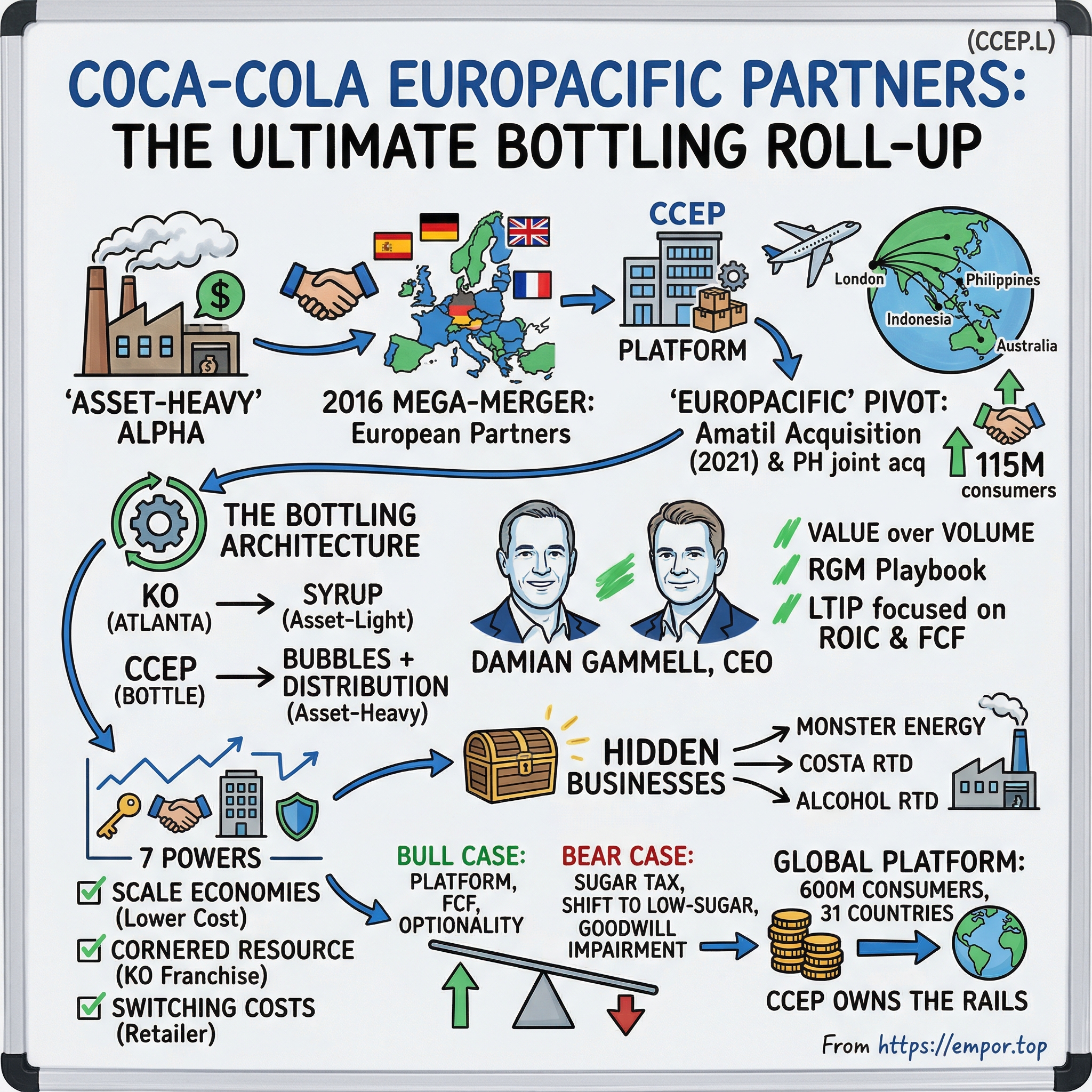
Coca-Cola Europacific Partners: The Ultimate Bottling Roll-up
I. Introduction: The "Asset-Heavy" Alpha
Here is a question that would stump most investors at a dinner party: what is the largest Coca-Cola bottler on earth by both revenue and volume? It is not based in Atlanta. It is not even American. It is headquartered in Uxbridge, just outside London, and it trades on the London Stock Exchange under the ticker CCEP.L. Coca-Cola Europacific Partners generated nearly twenty-one billion euros in revenue last year, serves over six hundred million consumers across thirty-one countries, and commands a market capitalisation north of forty billion dollars. And yet, in the popular imagination, it barely exists.
Everyone knows The Coca-Cola Company. It is the ultimate "asset-light" brand machine — a company that prints money by selling flavoured syrup and licensing one of the most recognisable trademarks in human history. Warren Buffett's favourite holding. The textbook case study in brand moats. But here is the thing that most people miss: the syrup does not get itself into the fridge at your local convenience store. Somebody has to buy the concentrate, mix it with water and sweetener, carbonate it, pour it into cans and bottles, load those onto trucks, negotiate shelf space with Tesco and Carrefour, stock the cold-drink equipment at the petrol station, and collect the money from the corner shop owner in Jakarta. That somebody is the bottler. And CCEP is the biggest one.
The thesis of this deep dive is simple but counterintuitive. Over the past decade, the most interesting story in the Coca-Cola system has not been happening in Atlanta. It has been happening in Barcelona, Sydney, and Manila. A fragmented collection of regional European bottlers — family-owned, subscale, often at war with each other over territory — was systematically consolidated into a multi-continental powerhouse. That entity then went shopping across the Pacific, acquiring operations in Australia, Indonesia, and the Philippines. The result is a company that now controls the "last mile" for one in every thirteen humans on the planet.
CCEP is technically a middleman. But calling it a middleman is like calling Amazon a bookshop. This company has become one of the most efficient capital allocators in the fast-moving consumer goods universe, generating nearly two billion euros in free cash flow in 2025 while simultaneously buying back a billion euros of its own stock. Its return on invested capital rivals many asset-light software businesses. Its beta of 0.51 makes it one of the most defensive large-caps in Europe. And its management team, led by a thirty-year Coke system veteran named Damian Gammell, has built something that increasingly resembles not a bottler but a platform — a set of distribution rails upon which an ever-expanding portfolio of brands can ride.
How did they do it? That is the story worth telling. It begins with syrup.
II. The Bottling Architecture
To understand CCEP, you first have to understand the Coca-Cola system, and the system is one of the most elegant franchise architectures ever devised. It was born from a single decision made in 1899, when two Chattanooga lawyers named Benjamin Thomas and Joseph Whitehead convinced Asa Candler — the pharmacist who had bought the Coca-Cola formula from its inventor — to grant them exclusive rights to bottle and sell Coca-Cola across most of the United States. Candler thought the real money was in soda fountains. He sold the bottling rights for a dollar.
That decision created the two-tier structure that still defines the system today. At the top sits The Coca-Cola Company, which manufactures and sells concentrate — the flavoured syrup — to independent bottling partners around the world. The bottlers buy the concentrate, add water and carbonation, package the finished product, and handle everything from manufacturing to distribution to retail execution. Think of it as the syrup versus the bubbles. Atlanta makes the syrup. The bottlers make the bubbles and get them into your hand.
The genius of this model is that it allowed Coca-Cola to scale globally without owning factories and truck fleets in every country. The brand risk sits with Atlanta. The capital risk sits with the bottlers. But the model also created a fundamental tension that has defined the system for over a century: The Coca-Cola Company wants volume. It gets paid per unit of concentrate sold. The bottlers want margin. They bear the cost of manufacturing and distribution, so they care about revenue per case, not just total cases shipped. When Atlanta pushes for aggressive pricing to win market share from Pepsi, the bottlers eat the margin compression. When the bottlers push for higher prices, Atlanta worries about volume declines.
This tension was manageable when bottlers were small and fragmented. A family-owned operation bottling Coke in Seville had little leverage against the Atlanta mothership. But as the industry consolidated, the power dynamic shifted. And nowhere was the fragmentation — and the eventual consolidation — more dramatic than in Europe.
European bottling was, for decades, a patchwork quilt of local operators. In Spain alone, seven different family-owned companies held bottling rights for different regions of the country. Germany had its own structure, with Coca-Cola Erfrischungsgetränke operating as a wholly-owned subsidiary of The Coca-Cola Company. France, Britain, Belgium, the Netherlands, the Nordics — each territory had its own bottler, its own management team, its own IT systems, its own supply chain. The inefficiency was staggering. A truck carrying Fanta might cross from Belgium into the Netherlands and encounter an entirely different bottling company with different pricing, different packaging formats, and different promotional calendars.
The solution was the "Anchor Bottler" strategy, a concept that Atlanta began championing in the 1990s and 2000s. The idea was to encourage the creation of a small number of large, well-capitalised bottling partners that could achieve the scale economies necessary to invest in modern manufacturing, digital systems, and route-to-market capabilities. Rather than managing relationships with dozens of family bottlers, Atlanta wanted a handful of sophisticated partners who could operate as quasi-independent corporations while remaining aligned with the system's long-term interests. This strategy would ultimately produce CCEP — but first, it required one of the most complex three-way mergers in European corporate history.
III. The First Mega-Inflection: The 2016 "Three-Way" Merger
Picture a conference room in London in late 2015. Around the table sit the representatives of three very different organisations, each with its own culture, its own language (literally), and its own idea of how to run a Coca-Cola bottling operation. The first is Coca-Cola Enterprises, the largest and most sophisticated of the three — a publicly traded company with deep roots in the American capital markets, though by this point its operations were entirely European, covering Great Britain, France, Belgium, Luxembourg, the Netherlands, Norway, and Sweden. The second is Coca-Cola Iberian Partners, itself the product of a 2013 consolidation of seven Spanish bottling families, including the powerful Daurella family of Barcelona through their holding company Cobega. The third is Coca-Cola Erfrischungsgetränke, the German bottling operation owned directly by The Coca-Cola Company.
Three bottlers. Three countries' worth of regulatory approvals. Three sets of IT infrastructure, three procurement departments, three separate approaches to pricing and packaging. The task was to smash them together into a single entity that could operate as a pan-European champion.
The strategic logic was compelling. Western Europe is, in many ways, a single consumer market. The same shopper who buys a Coke Zero in a Carrefour in Paris might buy one in an Albert Heijn in Amsterdam the following week. But the two cans might be different sizes, at different price points, with different promotional mechanics, produced in different factories, and delivered by different truck fleets. The fragmentation was not just inefficient — it was leaving money on the table. A unified bottler could harmonise what the industry calls "Price/Pack architecture" — the matrix of which products come in which sizes at which price points in which channels. Getting this right is one of the most powerful levers in consumer goods, and it requires scale.
The merger was announced in August 2015 and completed on May 28, 2016. The combined entity was initially named Coca-Cola European Partners, with John F. Brock, the former CEO of Coca-Cola Enterprises, serving as the first chief executive and Sol Daurella Comadran — the formidable matriarch of the Daurella family — installed as Chair of the Board. The company projected synergies of three hundred and fifty to three hundred and seventy-five million dollars within three years.
But the real value was not just cost-cutting. Anyone can fire duplicate back-office staff and rationalise warehouses. The deeper play was what Hamilton Helmer, in his framework of competitive advantages, calls "Scale Economies" — the ability to spread fixed costs over a larger base of production and distribution. CCEP could now run longer production lines, negotiate better rates with aluminium and sugar suppliers, optimise truck routes across borders, and deploy a single digital platform for customer ordering across thirteen markets. The cost per litre of getting a Coca-Cola from factory to shelf dropped meaningfully.
The merger also created something more subtle: a unified commercial capability. For the first time, a single management team could study what worked in British convenience stores and apply those lessons to Spanish bars. The "Revenue Growth Management" discipline — a data-driven approach to optimising the price, pack size, and promotional calendar for every product in every channel — could be deployed at continental scale. In Britain, for example, CCEP discovered that offering a slightly smaller bottle at a slightly lower absolute price point actually increased revenue per litre, because consumers were anchoring on the sticker price rather than the per-unit cost. That insight, refined through British data, could then be tested and rolled out across the Continent.
The market noticed. CCEP's shares, which began trading on the New York Stock Exchange and Euronext Amsterdam, outperformed the broader consumer staples sector in the years following the merger. The synergy targets were met ahead of schedule. And the management team began thinking about something much bigger: what if the platform they had built for Europe could work on an entirely different continent?
IV. The "Europacific" Pivot: The Amatil Acquisition
In October 2020, as much of the world was still grappling with rolling lockdowns and supply chain chaos, CCEP made a move that stunned the beverage industry. The company announced an approach to acquire Coca-Cola Amatil, the Sydney-based bottler that held the Coca-Cola franchise across Australia, New Zealand, Indonesia, Papua New Guinea, Fiji, and Samoa. It was a bold bet — not just geographically, but philosophically. CCEP was declaring that it was no longer content to be a European champion. It wanted to be a global platform.
Amatil was, in some ways, the Antipodean mirror image of what CCEP had been before the 2016 merger. It was a decent business with a strong market position in its core territory of Australia, but it was underinvesting, undermargined, and, most critically, sitting on one of the most tantalising growth opportunities in the entire Coca-Cola system: Indonesia.
Indonesia is the world's fourth-largest country by population, with over 275 million people. Its per-capita Coca-Cola consumption was — and remains — a fraction of what you see in developed markets. A young, urbanising population with rising disposable incomes and a growing taste for branded consumer goods made it the kind of market that Coca-Cola executives had been dreaming about since the company first went international. But Amatil, with its Australian-centric management team and relatively conservative balance sheet, had been underinvesting in Indonesian distribution and manufacturing for years. Fridges were not getting placed. Routes were not being extended into smaller cities and rural areas. The opportunity was enormous, but it required capital and operational intensity that Amatil was not delivering.
CCEP's initial offer was A$12.75 per share. Amatil's board pushed back, and in February 2021 CCEP raised its bid to A$13.50 per share — a "best and final" offer that valued the enterprise at approximately A$11.1 billion, or roughly 10.9 times Amatil's 2019 EBITDA. That multiple was squarely in line with the 10-12x range that similar transactions in the bottling sector had commanded. It was not a heroic premium, but it was not a steal either. The deal closed on May 10, 2021, and Coca-Cola European Partners became Coca-Cola Europacific Partners. The name change was more than branding. It was a statement of strategic intent.
The acquisition increased CCEP's revenue by roughly a quarter, from twelve billion euros to over fifteen billion. It nearly doubled the company's consumer reach from around three hundred million to six hundred million. And it brought capabilities that CCEP's European operations lacked. Amatil had a significant alcohol business, manufacturing and distributing ready-to-drink spirits and beer across Australia and New Zealand. It had coffee expertise. It had experience operating in a developing market with all the logistical complexity that entails — bad roads, fragmented retail, cold-chain challenges, and the need to serve hundreds of thousands of tiny shops rather than a few dozen hypermarket chains.
For Damian Gammell, the Amatil deal was personal. Earlier in his career, he had spent time at Coca-Cola Amatil as Group Commercial Director, overseeing operations in both Australia and Indonesia. He knew the business intimately. He knew where the bodies were buried and where the opportunities lay. When he pitched the acquisition to his board, he was not just presenting a spreadsheet — he was drawing on years of firsthand experience in the markets he was proposing to buy.
The integration has been, by most accounts, a success. CCEP moved quickly to install its Revenue Growth Management playbook in Australia and began accelerating investment in Indonesia. Capex in the Asia-Pacific region increased meaningfully. New production lines were installed. The distribution network was extended. And the financial results followed: the Australia, Pacific, and Indonesia segment contributed 5.5 billion euros in revenue in 2025, representing about a quarter of the group total.
Then, in February 2024, CCEP went further. The company completed a joint acquisition of Coca-Cola Beverages Philippines — the bottler covering the 115-million-consumer Philippine market — in partnership with local conglomerate Aboitiz Equity Ventures, with CCEP taking a sixty percent stake and Aboitiz holding forty percent. The enterprise value was $1.8 billion. With the Philippines added, CCEP now operates across thirty-one markets and has established a meaningful presence in Southeast Asia, one of the fastest-growing consumer regions on earth.
V. Management: The Gammell Era
Damian Gammell is not the kind of CEO who makes headlines. He does not tweet. He does not do splashy television interviews. He does not have a personal brand. What he has is thirty years of operating experience inside the Coca-Cola system, accumulated across some of the most challenging markets on the planet, and a quiet intensity that people who have worked with him describe as relentless.
Born in Ireland in 1970, Gammell studied at the College of Marketing in Dublin before earning a Master's degree in Change Management from a joint programme between Oxford and HEC Paris. He entered the Coca-Cola system in his early twenties and never left. His career reads like a travelogue of emerging markets: he ran Coca-Cola Hellenic's Russian operations from 2000 to 2004, a period when Russia was one of the most dynamic — and most dangerous — consumer markets in the world. He then moved to Australia to serve as Group Commercial Director at Coca-Cola Amatil, gaining firsthand exposure to the Indonesian market. From there he went to Germany to run Coca-Cola Erfrischungsgetränke, the very operation that would later be folded into CCEP in the 2016 merger. And before taking the CEO role, he spent five years running Anadolu Efes, the Turkish-Pakistani beer and beverage conglomerate, as its President and CEO.
This is not a McKinsey consultant parachuted into a corner office. This is a man who has run bottling plants in Novosibirsk and negotiated with Turkish regulators. When he took over as CEO in December 2016, succeeding John Brock, he brought an operator's instinct for the business. His mantra — "value over volume" — was a deliberate pivot from the old Coke system mentality of chasing market share at all costs. Under Gammell, CCEP became obsessed with revenue per case, not cases shipped.
The incentive structure reinforces this philosophy. CCEP's Long Term Incentive Plan is built around Return on Invested Capital and Free Cash Flow generation, not revenue growth. This is a critical distinction. Many consumer staples companies incentivise their management teams on top-line growth, which can lead to value-destructive acquisitions and margin-destroying price wars. CCEP's LTIP essentially tells Gammell and his team: grow if you can, but never at the expense of returns. The result has been disciplined capital allocation — acquisitions funded at reasonable multiples, leverage managed down toward the company's target range of 2.5 to 3 times net debt to EBITDA, and aggressive shareholder returns through both dividends and buybacks.
The shareholding structure provides unusual stability. Olive Partners, the investment vehicle controlled by the Daurella family and other Spanish bottling families, holds approximately thirty-six percent of CCEP's shares. Sol Daurella Comadran, the family's most prominent figure, serves as Chair of the Board. The Daurellas did not become the largest shareholders of the world's biggest Coke bottler by accident. They started bottling Coca-Cola in Spain in the 1950s through Cobega, their family holding company. Over the following decades, they systematically acquired and merged with other Spanish bottlers, culminating in the creation of Coca-Cola Iberian Partners in 2013, which brought together seven family-owned operations under one roof. When that entity then merged into CCEP in 2016, the Daurellas' stake was large enough to make Olive Partners the controlling shareholder.
Their presence at the top of the cap table matters for investors. The Daurellas are not activists looking for a quick flip. They have been in the Coca-Cola business for over seventy years. They think in decades, not quarters. This aligns them naturally with the kind of long-term capital deployment that makes CCEP's acquisition strategy credible. When Gammell wanted to spend eight billion euros on Amatil, he did not need to worry about hedge fund activism or a hostile board. He needed to convince Sol Daurella that it was the right move for the next twenty years. He did.
The Coca-Cola Company itself holds roughly seventeen to eighteen percent of CCEP's shares, with two board seats. This creates a fascinating dynamic. KO is both CCEP's largest supplier (selling it concentrate) and one of its largest shareholders (benefiting from CCEP's profitability). The relationship is governed by long-term bottling agreements under the system's "incidence pricing" model, where CCEP pays concentrate costs and brand royalties to Atlanta. KO's incentive is to keep CCEP healthy, well-capitalised, and growing — because every incremental case that CCEP sells generates concentrate revenue for Atlanta. This alignment of interest is one of the underappreciated features of the Coca-Cola system. KO does not need to own the bottling operations to benefit from their success. It just needs to own some stock and sell a lot of syrup.
The cultural shift under Gammell has been equally significant. CCEP has moved from what insiders describe as a "crate-shifting" mentality — where success was measured by how many pallets left the warehouse — to a data-driven organisation obsessed with something called Revenue Growth Management, or RGM. RGM is the science of optimising the intersection of product, price, pack size, and channel. It means understanding that a 330ml can of Coke Zero sold through a vending machine at a railway station generates a fundamentally different margin than a 2-litre bottle of Coke Original sold through a Carrefour hypermarket. Under Gammell, CCEP has invested heavily in the analytics capabilities required to make thousands of these micro-decisions every day, across thirty-one markets, for hundreds of SKUs.
VI. The "Hidden" Businesses and Segment Deep Dive
Walk into any off-licence in London, any servo in Melbourne, or any warung in Jakarta, and open the cold-drink fridge. You will see Coca-Cola, obviously. Coke Zero. Fanta. Sprite. But look more carefully. You will also see a black can with green claw marks — Monster Energy. That can did not get into that fridge by accident. It rode there on CCEP's truck, was placed there by CCEP's sales representative, and sits in a fridge that CCEP quite possibly owns and maintains.
The Monster relationship is one of the most important and least understood aspects of CCEP's business. CCEP does not own Monster. The Coca-Cola Company bought a 16.7 percent stake in Monster Beverage Corporation back in 2015 for $2.15 billion, as part of a strategic partnership that made Monster KO's exclusive energy play worldwide. Under this arrangement, Monster's products are distributed through the Coca-Cola bottling network globally. For CCEP, as the system's largest bottler, this means it serves as Monster's primary route-to-market across all of its European, Australian, and Asia-Pacific territories.
The economics are attractive. Energy drinks command premium price points — a single 500ml can of Monster sells for more than a two-litre bottle of store-brand cola in most markets. The margin per unit is significantly higher than traditional carbonated soft drinks. And the category is growing rapidly: Monster volumes through CCEP were up nearly twenty percent in 2025, a growth rate that most mature consumer goods companies would envy. CCEP does not take brand risk on Monster — it does not own the brand, fund the marketing, or develop the product. It simply manufactures, distributes, and merchandises. But it earns a healthy margin for doing so, and it benefits from Monster's growth without having to invest in brand-building.
The Monster relationship also illustrates a broader strategic concept. CCEP's distribution network — its trucks, its warehouses, its cold-drink equipment, its sales force, its relationships with hundreds of thousands of retailers — is a platform. Once you have built the infrastructure to get a can of Coca-Cola into every corner store in thirteen European countries, the incremental cost of adding another brand to the truck is minimal. The truck is already making the trip. The sales rep is already visiting the store. The fridge is already plugged in and humming. This is the essence of what makes CCEP valuable: it owns the rails.
The alcohol experiment represents another frontier. When CCEP acquired Amatil, it inherited a significant ready-to-drink spirits business in Australia, built around a long-standing partnership with Beam Suntory. For sixteen years, Amatil had manufactured and distributed products like Jim Beam and Cola and Canadian Club and Dry across Australia and New Zealand. That partnership ended in mid-2025 when Beam Suntory decided to bring its operations in-house, forming a new standalone entity called Suntory Oceania.
But rather than retreat from alcohol, CCEP doubled down. The company had already launched Jack Daniel's and Coca-Cola as a ready-to-drink product in partnership with Brown-Forman, and it became the best-selling RTD SKU in Great Britain upon its debut. An Absolut and Sprite RTD, developed with Pernod Ricard, followed. CCEP invested over A$105 million to expand its Australian manufacturing facilities, including dedicated alcohol bottling lines. The message was clear: alcohol RTD is not a legacy business that CCEP inherited and tolerates. It is a strategic growth category that leverages the same manufacturing and distribution capabilities the company uses for its non-alcoholic portfolio.
The question investors should ask is whether this template can be exported to Europe. RTD alcohol is a massive category in Australia but has historically been smaller in European markets, where consumers have tended to drink beer, wine, and spirits in traditional formats. However, the category is growing rapidly across the UK and Continental Europe, driven by younger consumers who prefer the convenience and portability of pre-mixed drinks. CCEP is uniquely positioned to capitalise on this trend. It has the manufacturing capability, the cold-chain infrastructure, the retail relationships, and now, through the Amatil integration, the operational playbook for producing and distributing alcohol at scale.
Costa Coffee is another piece of the puzzle. When The Coca-Cola Company acquired Costa from Whitbread for $5.1 billion in January 2019, the strategic rationale extended beyond Costa's cafe footprint. KO wanted to build a global coffee platform, and CCEP became the bottling and distribution partner for Costa's ready-to-drink products. Chilled RTD cans and bottles are now available in Great Britain, while hot Costa Coffee vending machines have been deployed in Germany, Belgium, Norway, and Iceland. The category is nascent but growing, and it slots neatly into CCEP's existing capabilities. If you are already delivering cans of Coke to a convenience store, adding a shelf of Costa RTD coffee requires minimal incremental effort.
Then there is the digital play, which might be the most underappreciated part of the CCEP story. MyCCEP — accessible at my.ccep.com — is a proprietary B2B ecommerce platform that CCEP has built for its direct and indirect customers. Available across eleven markets, the platform has onboarded approximately two hundred thousand customers, from convenience stores and restaurants to cafes and wholesalers. It processes billions of euros in orders and provides features including online ordering, exclusive promotions, point-of-sale materials, and data-driven insights.
For a small corner shop owner in London or a kirana in Jakarta, MyCCEP becomes the default way to order beverages. Once a retailer has set up their account, configured their regular orders, and integrated the platform into their workflow, switching to a competitor's distribution network becomes genuinely costly — not because of contractual lock-in, but because of the operational friction of changing systems. This is a classic example of what Hamilton Helmer calls "Switching Costs," and it is a competitive advantage that gets stronger over time as the platform adds more features and more customers become embedded in the ecosystem.
VII. The Playbook: Hamilton's 7 Powers and Porter's Five Forces
Analysing CCEP through Hamilton Helmer's 7 Powers framework reveals a business with multiple, reinforcing sources of competitive advantage — a rare combination in the consumer staples sector, where most companies rely on a single moat, typically brand.
The most obvious power is Scale Economies. CCEP operates the largest Coca-Cola bottling network on the planet by both revenue and volume. Its manufacturing facilities, distribution fleet, and cold-drink equipment footprint span thirty-one countries. The cost of delivering a case of Coca-Cola from factory to shelf is fundamentally lower for CCEP than for any smaller competitor, because the fixed costs — the truck, the driver, the warehouse, the route optimisation software, the fridge in the store — are spread over vastly more units. This advantage compounds as CCEP grows. Each new territory acquisition, each new brand added to the distribution network, each new customer onboarded to the MyCCEP platform adds volume without proportionally increasing fixed costs. For a potential competitor looking to replicate CCEP's distribution capability, the capital requirements are prohibitive. You would need to build factories, buy thousands of trucks, hire tens of thousands of people, deploy hundreds of thousands of refrigerators, and sign up hundreds of thousands of retailers — all before selling a single case. And even then, you would not have the brands. Which brings us to the second power.
CCEP's Cornered Resource is its exclusive bottling agreements with The Coca-Cola Company. These are long-term, typically ten-year renewable contracts that grant CCEP the exclusive right to manufacture, distribute, and sell Coca-Cola system brands within defined territories. You cannot simply decide to start bottling Coca-Cola. The franchise is not for sale. You cannot bid for it at auction. It is allocated by Atlanta, and once allocated, it is extraordinarily sticky. The Coca-Cola Company has no incentive to take the franchise away from a well-performing bottler — doing so would disrupt supply, damage retailer relationships, and risk market share losses to Pepsi. These agreements are the bedrock of CCEP's business, and they create a near-monopoly position for Coca-Cola system brands in each of CCEP's territories.
Network Effects, the third power, are perhaps more nascent but increasingly important. CCEP's B2B platform, MyCCEP, becomes more valuable as more retailers join it. More retailers mean more data, which means better insights into purchasing patterns, which means better promotional targeting, which means higher conversion rates, which attracts more brands wanting to use CCEP's distribution rails. The addition of Monster, Costa, Jack Daniel's and Coca-Cola, Absolut and Sprite, and other third-party brands to the platform creates a flywheel: more brands attract more retailers, and more retailers attract more brands. This is still early-stage compared to the network effects you see in pure digital platforms, but in the context of physical distribution, it is a meaningful and growing advantage.
Switching Costs operate at the retailer level. Once a corner shop owner has configured their MyCCEP account, established their regular order cadence, received CCEP's branded fridge and point-of-sale materials, and built a relationship with their CCEP sales representative, the cost of switching to an alternative distribution partner is high. The retailer would need to set up new systems, return or replace equipment, retrain staff, and accept a period of disruption. For most small retailers, this hassle is simply not worth it — especially when CCEP's portfolio includes the brands that their customers most want to buy.
The two powers that CCEP arguably lacks are Counter-Positioning and Process Power. CCEP has not adopted a business model that incumbents cannot copy without damaging their own business — its model is conventional bottling and distribution, executed at scale. And while CCEP's operational capabilities are excellent, they are not so uniquely embedded in the organisation as to be impossible for a well-resourced competitor to replicate over time. Brand Power, the seventh of Helmer's powers, is interesting: CCEP does not own the consumer-facing brands (those belong to KO and Monster), but it does increasingly have a brand of its own in the B2B context. Being supplied by CCEP carries a quality and reliability connotation for retailers.
Turning to Porter's Five Forces, the picture is nuanced. The Bargaining Power of Suppliers is low. CCEP's most important supplier is The Coca-Cola Company, which sells it concentrate. But KO needs CCEP at least as much as CCEP needs KO. Atlanta cannot simply switch to a different bottler in Western Europe — there is no other operator with the scale, capability, and infrastructure to handle the volume. The relationship is genuinely symbiotic, reinforced by KO's roughly eighteen percent equity stake in CCEP. Raw material suppliers — aluminium, PET plastic, sugar, CO2 — are commodity providers where CCEP's massive purchasing volumes give it significant negotiating leverage.
The Bargaining Power of Buyers is the most significant competitive pressure CCEP faces. In Europe, grocery retail is dominated by a small number of very large, very sophisticated chains — Tesco, Carrefour, Aldi, Lidl, Ahold Delhaize. These retailers have enormous purchasing power and are not shy about using it. They run private-label beverages that compete directly with CCEP's products. They demand promotional funding, slotting fees, and margin contributions. CCEP counters this with "Category Management" expertise — providing retailers with data-driven insights about how to optimise their beverage aisle for maximum revenue per square foot. In effect, CCEP makes itself valuable to retailers not just as a supplier but as a strategic partner that helps them sell more of everything, not just Coca-Cola.
The Threat of New Entrants is low. The capital requirements, exclusive bottling agreements, and entrenched retailer relationships create formidable barriers. The Threat of Substitutes is moderate and rising. Health-conscious consumers are increasingly choosing water, functional beverages, and non-carbonated drinks over traditional sugary sodas. CCEP addresses this through portfolio diversification — expanding into energy, coffee, water, and isotonic drinks. Competitive Rivalry is intense but manageable. PepsiCo and its bottling partners contest share in every market, and private-label beverages add price pressure, but Coca-Cola's brand dominance in most categories provides a durable advantage.
VIII. The Bull vs. Bear Case
The bull case for CCEP rests on the concept of a platform company disguised as a bottler. The company has built — through two decades of mergers and acquisitions — a distribution infrastructure that reaches six hundred million consumers across thirty-one markets. That infrastructure is the hard part. The trucks are on the road. The fridges are in the stores. The sales reps are making their rounds. The digital platform is processing orders. The incremental cost of adding a new product, a new brand, or even a new category to this platform is low relative to the revenue it generates.
This means CCEP has optionality that the market may not fully appreciate. The company can continue to acquire Coca-Cola bottling territories — Africa and the rest of Southeast Asia are obvious candidates — and plug them into its best-in-class operational playbook. It can add more third-party brands to its distribution network, following the Monster template. It can expand into adjacent categories like alcohol RTD and coffee, leveraging existing manufacturing and distribution capabilities. And it can continue to drive productivity improvements through scale, technology, and Revenue Growth Management discipline.
The defensive characteristics are equally compelling. CCEP's beta of 0.51 makes it one of the least volatile large-cap stocks in Europe. Beverages are among the most recession-resistant consumer categories — people keep buying soft drinks even when the economy contracts. The company's pricing power has been demonstrated repeatedly: CCEP successfully pushed through significant price increases during the inflationary environment of 2022-2023 without meaningful volume losses, proving that consumers value the brands more than they mind the price.
The free cash flow generation is impressive and consistent: nearly two billion euros in 2025, with guidance for at least 1.7 billion in 2026. This funds both reinvestment in the business and aggressive shareholder returns. CCEP completed a one billion euro share buyback in 2025 and announced another billion-euro programme starting in February 2026. The dividend has grown steadily. And the balance sheet is de-levering: net debt to EBITDA has declined from 3.09 times at the end of 2023 to 2.88 times at the end of 2025, approaching the company's target range of 2.5 to 3 times.
The bear case centres on structural headwinds that no amount of operational excellence can fully offset. The most visible is the global trend toward sugar taxes. The UK's Soft Drinks Industry Levy, introduced in April 2018, charges 18 pence per litre for drinks containing 5-8 grams of sugar per 100ml and 24 pence per litre for those above 8 grams. France has its own tiered system, with the higher tier increasing from January 2025. These levies directly impact CCEP's most profitable product — Coca-Cola Classic, which the company has chosen not to reformulate, absorbing the tax rather than changing the recipe. In France, CCEP saw single-digit volume declines in Coca-Cola Original Taste in 2025, partially offset by Zero Sugar growth.
More broadly, health-conscious consumers in developed markets are shifting away from sugary carbonated beverages. Zero and low-sugar variants are growing, but they carry lower margins per litre than the original formulations, which contain more of the high-margin concentrate that CCEP buys from Atlanta. The company is diversifying into energy, coffee, water, and functional beverages, but these categories carry different margin profiles and competitive dynamics. The risk is that CCEP ends up trading high-margin Coca-Cola volumes for lower-margin Monster and Costa volumes — a revenue mix shift that could pressure profitability over time.
There are also governance considerations. Olive Partners' thirty-six percent stake gives the Spanish families effective control of the company. This stability is a double-edged sword. It provides long-term strategic alignment but limits the ability of other shareholders to influence major decisions. If Olive Partners and KO are aligned on a strategic direction, there is very little the remaining shareholders can do to change course.
Credit quality remains solid — CCEP carries an investment-grade rating — but the balance sheet is not without risk. Goodwill and intangible assets of seventeen billion euros represent fifty-seven percent of total assets, reflecting the premium prices paid in successive acquisitions. If any of these operations were to underperform materially, impairment charges could be significant. CCEP already recognised 475 million euros in charges and impairments in 2024, though these were related to specific restructuring activities rather than broad business deterioration.
The two KPIs that matter most for tracking CCEP's ongoing performance are revenue per unit case and free cash flow conversion. Revenue per unit case captures the company's ability to execute its "value over volume" strategy — are they successfully trading consumers up to premium products, smaller pack sizes, and higher-margin categories? If this metric stagnates, it suggests pricing power is eroding or the mix shift toward lower-margin products is accelerating. Free cash flow conversion — the percentage of EBITDA that converts to free cash flow — measures whether CCEP's capital-intensive business model is generating the returns that justify continued investment. A deterioration in this metric would signal that capex requirements are outstripping the returns those investments generate, a risk in any business that relies heavily on physical infrastructure.
Investors should also keep a close eye on the Indonesia operations. This is where the growth story lives. Indonesia's per-capita consumption of Coca-Cola products remains well below developed-market levels, and CCEP has signalled that it will invest aggressively in distribution expansion and cold-drink equipment rollout across the archipelago. If Indonesia delivers on its promise, it could be the engine that drives CCEP's next decade of growth. If it disappoints — due to competitive pressure from local brands, regulatory headwinds, or the sheer logistical complexity of serving seventeen thousand islands — it would call into question the premium baked into the Amatil acquisition price.
IX. Epilogue and Reflections
Here is a fact that captures something essential about CCEP's business model: the company spends more money on refrigerators than most people would expect. Those red-branded Coca-Cola coolers in every convenience store, every petrol station, every café — CCEP owns millions of them across its thirty-one markets. Each one is a piece of physical infrastructure that must be purchased, delivered, installed, maintained, and eventually replaced. It is not glamorous. It does not show up in the kind of investor presentation that gets venture capitalists excited. But those fridges are, in a very real sense, the moat. They are the physical manifestation of CCEP's switching costs. Once a retailer has accepted a CCEP fridge, stocked it with Coca-Cola and Monster and Fanta, and watched it drive foot traffic and basket size, removing it becomes almost unthinkable. The fridge is free real estate — for the retailer and for CCEP.
There is a broader lesson in the CCEP story that extends well beyond beverage distribution. In an era when every investor and entrepreneur is obsessed with asset-light business models, software margins, and digital disruption, CCEP is a reminder that owning the physical distribution infrastructure — the rails — can be extraordinarily valuable. The brands come and go. Consumers might switch from Coke to Monster to Costa to some functional health drink that does not exist yet. But the truck still has to make the delivery. The fridge still has to be cold. The retailer still needs a single platform to order everything. If you own that infrastructure, you can let others take the brand risk while you collect the toll.
This is the insight that the Daurella family understood when they started consolidating Spanish bottlers in the 1950s. It is the insight that drove the 2016 three-way merger. It is the insight behind the Amatil acquisition and the Philippines expansion. And it is the insight that Damian Gammell articulates, in his understated Irish way, when he talks about CCEP as a "total beverage partner" rather than a Coca-Cola bottler.
The Coca-Cola system is over 125 years old. The syrup still sells. The brand still resonates. But the real alpha over the past decade has been generated not by the company that makes the formula, but by the one that gets it into your hand. CCEP is the largest, most efficient, and most strategically ambitious expression of that insight. Whether it is the best-run "old economy" company on the London Stock Exchange is a matter of debate. What is not debatable is that it has transformed what was once considered the unglamorous, capital-intensive, low-margin side of the Coca-Cola system into something far more interesting: a platform business with defensive characteristics, pricing power, and a long runway for growth in some of the world's most dynamic consumer markets.
The rails matter. CCEP owns them.
Top Links and Further Reading
- CCEP Annual Reports, 2016-2025 — tracing the evolution from Coca-Cola European Partners to a thirty-one market global platform.
- "Secret Formula" by Frederick Allen — the definitive history of the Coca-Cola system and the bottler franchise model.
- The Coca-Cola Amatil Acquisition Scheme Booklet, 2021 — detailed strategic rationale and financial analysis.
- Damian Gammell's interviews on Revenue Growth Management — available through CCEP's investor relations website and Deutsche Bank's "Flow" case study series.
- Analysis of the Olive Partners and Cobega shareholding structure — Cobega's corporate history and the Daurella family's multi-generational bottling strategy.


 RSS Feed
 Spotify
 Apple Podcasts
 Amazon Music
 Audible
 YouTube