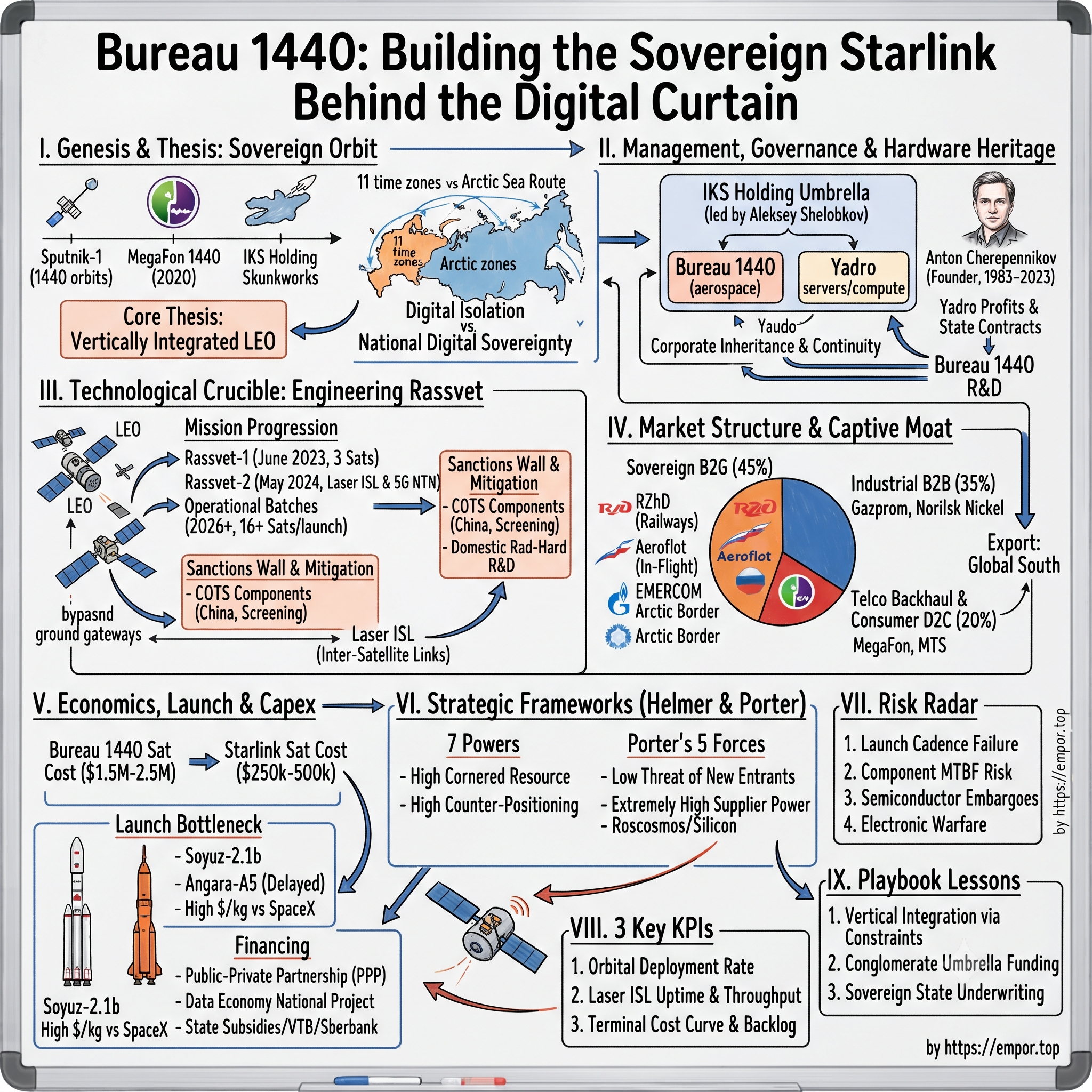
Bureau 1440: Building the Sovereign Starlink Behind the Digital Curtain
I. Introduction & The Sovereign Orbit Thesis (00:00 – 00:15)
On 23 March 2026, a Soyuz-2.1b lifted sixteen satellites off a Russian pad and, for the first time in the company's five-and-a-half-year life, Бюро 1440 Bureau 1440 stopped being an engineering demonstration and started being an infrastructure programme. The company called it the first serial batch — the moment the project crossed from experiments into building an actual communications service.1 Four months later, on 19 July 2026, a second batch of sixteen followed, taking the deployed count to thirty-two spacecraft, of which thirty-one were still working.2
Those thirty-one satellites are the entire physical asset base of a programme that intends to place 292 operational spacecraft in orbit and launch 383 in total by 2030, and whose sponsors have costed it at roughly 445 billion rubles.34 At the ruble's late-August 2026 level of about 83.8 to the dollar, that is on the order of $5.3 billion.5 Against that, the operating company's most recent public registry filing shows 2024 revenue of 493,000 rubles — under $6,000 — and a net loss of 3.42 billion rubles.6 There is no meaningful revenue. There is no DRHP, no S-1, no prospectus, no audited consolidated statement, no disclosed share count, no priced venture round with public terms. What exists is a capital programme, a federal schedule, a launch manifest, and a small number of objects in low Earth orbit whose altitudes can be independently tracked.
What is actually verifiable
That is the underwriting problem in a sentence. Everything about Bureau 1440 that a public-market investor would want to price — recurring revenue, retention, contract backlog, terminal economics, cost per gigabit — is either not yet in existence or not yet disclosed. Everything that is verifiable is physical: how many satellites went up, how many reached their assigned orbit, how fast the next rocket flies.
The hook
The interesting question is not whether Russia wants a sovereign broadband constellation. It plainly does. The interesting question is how a clandestine offshoot of a domestic IT conglomerate — one whose parent sits on the United States' blocking-sanctions list — managed to design, manufacture and fly laser-linked, 5G-capable low Earth orbit satellites at all, from inside a technology environment cut off from Western space-grade components, Western launch manifests and Western capital.7 That the first serial batch flew three months late, and that one of its sixteen satellites burned up in the atmosphere in June 2026, is not a footnote to that story; it is the story.89
The "why now"
Two forces converged. The first is that space-based broadband stopped being a consumer convenience and became a demonstrated instrument of state and military capability, a lesson Russia absorbed from the other side of a conflict in which it had no equivalent. The second is arithmetic: SpaceX's Starlink reached roughly 10.3 million subscribers and about $11.4 billion of 2025 revenue, and in June 2026 SpaceX itself listed on Nasdaq at $135 a share, closing its first day near $161 for a market value around $2.1 trillion.1011 A capability that was speculative when Bureau 1440 was founded in late 2020 is now a listed, revenue-generating, category-defining business — and one that is unavailable inside Russia on any terms.
The core thesis
Bureau 1440 is best understood not as an aerospace startup but as a state-underwritten infrastructure build wearing startup clothes. Its declared product, the Рассвет Rassvet system, is a three-layer network — satellites, gateway ground stations and user terminals — pitched at up to 1 Gbps per user with latency under 70 milliseconds, aimed at remote territory, the Arctic, maritime routes, aviation, railways and resource extraction.121 Its declared advantage is that it is the only such system a Russian counterparty is permitted, or able, to buy. That is a real advantage. It is also the source of nearly every risk in the file: a monopoly granted by the state is a monopoly the state can price, and a customer base of state-adjacent buyers is a customer base with political rather than commercial elasticity.
Episode roadmap
What follows traces the origin inside МегаФон MegaFon and the absorption into ИКС Холдинг IKS Holding; the founder, Антон Черепенников Anton Cherepennikov, whose sudden death in 2023 reshaped the ownership question; the engineering crucible of building radiation-tolerant hardware without Western silicon; the market structure and the captive-customer argument; and then the part that matters most for anyone underwriting this as a future public company — the capital programme, the unit economics of constellation replenishment, what a comparable listed satellite operator is actually worth per dollar of revenue, and what growth, margin and market share a 445-billion-ruble build would have to deliver to be worth what it costs. The frameworks — Helmer's 7 Powers, Porter's Five Forces — are applied at the end, where they clarify rather than decorate.
The through-line: Bureau 1440 has proved it can build satellites and get some of them where it wants. It has not yet proved it can build them fast enough, keep them alive long enough, or sell enough capacity to earn a return on the money being spent. Those are three separate proofs, and only the first has any evidence behind it.
 Subscribe on LinkedIn
II. The Genesis: From MegaFon 1440 to IKS Holding Skunkworks (00:15 – 00:35)
The name was the venture's first statement of identity. Sputnik-1, launched in October 1957, completed 1,440 orbits before re-entering the atmosphere. Naming the company after that milestone tethered a private Russian aerospace initiative to Soviet space heritage rather than to Silicon Valley—a deliberate framing for an enterprise that would ultimately require state underwriting far more than venture capital.13
Founding context
The venture was established in November 2020 as MegaFon 1440, an internal skunkworks within mobile operator MegaFon under Alisher Usmanov's USM perimeter. MegaFon's initial commitment was reported at 6 billion rubles over two years—roughly $80 million at then-prevailing exchange rates—against a project whose total cost was already estimated to exceed $1 billion.13 The strategic logic was clear from an incumbent telecom perspective: Russia spans 17.1 million square kilometres and eleven time zones, where the marginal economics of terrestrial cell sites break down long before coverage is complete. Tundra, taiga, the Northern Sea Route, and offshore resource basins represent most of the country's landmass. For a mobile operator facing universal-service mandates alongside steep base-station deployment costs, satellite backhaul was a solution reached by elimination.
That origin defines the commercial reality. Bureau 1440 was never designed as a consumer-facing internet platform chasing mass-market retail subscribers. It was conceived as a coverage-of-last-resort utility for a telecom incumbent, and the customer pipeline it subsequently pursued—railways, aviation, maritime shipping, mining, and state ministries—reflects that mandate. When company marketing later pivoted to the language of global subscriber counts, it departed from its own economic rationale.
The corporate reshuffle
In February 2022, Anton Cherepennikov completed a buyout of the IKS Holding IT group from USM on undisclosed financial terms. Bureau 1440 transitioned with the holding, positioning the satellite venture within IKS Holding while retaining MegaFon as an anchor strategic partner.13 Cherepennikov's group was an unconventional home for an aerospace programme: IKS developed telecom hardware, cybersecurity tools, and lawful-interception surveillance infrastructure used by domestic security services—a portfolio that subsequently drew United States blocking sanctions against the group in connection with the war in Ukraine.7
What Bureau 1440 gained from the wider holding was not legacy aerospace expertise, but industrial hardware engineering at scale. Ядро Yadro, the group's server and storage business, had become the primary domestic enterprise computing supplier following Western vendor departures, generating more than 160 billion rubles in standalone revenue by 2024.14 The practical contribution lay in core manufacturing disciplines: high-density PCB engineering, thermal management, component qualification, and the institutional capability to scale from lab prototypes to serial manufacturing lines—the exact operational hurdle that would emerge as Bureau 1440's chief bottleneck.
The geopolitical rupture
The 2022 sanctions reshaped the programme across three distinct dimensions. First, they eliminated access to Western space-grade components, notably radiation-hardened microprocessors, FPGAs, and optical transceivers. Second, they cut off access to Western commercial launch vehicles and the leased foreign satellite capacity Russian telecom operators historically relied upon. Third, they rendered Western LEO networks—such as Starlink and OneWeb—politically and operationally unavailable within Russia.
The first issue presented an engineering challenge that Bureau 1440 countered through architectural redundancy instead of specialized radiation-hardened silicon. The second created an unavoidable domestic launch cost burden. The third established the venture's core commercial moat. This created a structural paradox: the sanctions regime that inflated Bureau 1440's capital requirements is the identical mechanism guaranteeing it faces no private domestic or foreign competitor inside Russia. For any financial analyst assessing the asset, underwriting the business means underwriting the indefinite continuation of those geopolitical barriers.
State policy adapted accordingly. What began as an experimental corporate R&D initiative inside a telecom operator was formally incorporated into national digital infrastructure policy, progressing through an initial space-systems roadmap into the binding federal project framework that now governs its deployment schedule.132 Bureau 1440's launch manifest ceased to be a flexible management milestone and became an enforceable state budget commitment.
III. Management, Governance, & The Hardware Heritage (00:35 – 00:55)
On 22 July 2023, Anton Cherepennikov was found dead in his Moscow office at the age of forty, with the preliminary cause given as cardiac arrest.15 He had been the founder and controlling figure of IKS Holding, a long-time partner of Usmanov, and a director across MegaFon and USM entities. He was also the structural reason Bureau 1440 existed inside a private holding rather than within a legacy state design bureau.
The succession
Leadership passed to Алексей Шелобков Aleksey Shelobkov, the founder and head of Yadro, who assumed control of IKS Holding and took charge of Bureau 1440, with company registry filings listing him as general director of the operating entity.166 The choice reflected industrial logic: Shelobkov’s operational background is in high-volume hardware manufacturing rather than aerospace, and under his tenure IKS Holding's consolidated revenue expanded roughly 60% in 2024 to approximately 264.7 billion rubles.14 That manufacturing record is the single most relevant credential for a capital programme constrained primarily by throughput rather than basic physics.
The governance implications are considerably more complex. Reporting on the founder's estate indicates Cherepennikov's controlling stake passed to a court-appointed trustee through the inheritance process rather than to a permanent owner, leaving the ultimate beneficial ownership of the group subject to an unresolved public dispute.167 For any eventual public offering, establishing clear chain of title is the primary threshold issue: who controls the equity, under what legal terms, and with what voting rights remains undisclosed in public registries. Prospective public investors cannot currently identify the controlling counterparty.
Related parties and incentives
Bureau 1440 maintains extensive, undisclosed operational dependencies across the wider IKS Holding perimeter. Public reporting indicates VTB Group invested 2 billion rubles into the project in 2021, and that the satellite venture leases its primary facilities at the ZIL technopark for roughly 1.5 billion rubles annually.7 The equity terms of the VTB financing—including liquidation preferences, minority protections, and whether it represented primary growth capital or secondary liquidity—have not been disclosed, nor has the arm's-length basis of the facility lease.
Internal incentive structures are equally opaque. Employee equity pools, synthetic options, and group profit-sharing mechanisms remain undisclosed. Management attributes its retention of elite domestic firmware, radio-frequency, and avionics talent to group-level financial upside—supporting a stated headcount of roughly 3,500 personnel, approximately 80% of whom are engineers and technical specialists.12 However, that compensation strategy is backed by no publicly documented equity instruments.
Corporate oversight lacks independent infrastructure. Neither Bureau 1440 nor its parent entity has disclosed independent board representation, an audit committee, a remuneration committee, or a formal related-party transaction review framework. For a private holding, that deficit is conventional; for an asset evaluated as a potential listing candidate, the entire governance structure required to protect minority public capital remains unbuilt.
That opacity extends to regulatory and institutional ties. Investigative reporting identified a retired FSB colonel general serving as a senior adviser to the chief executive.7 Regardless of the operational scope of that specific appointment, the structural reality is evident: an enterprise whose parent manufactures state surveillance equipment, whose launch timetable is dictated by federal decrees, and whose primary buyers are state-owned corporations operates under a governance architecture where minority public equity rights are neither defined nor institutionalised.
Capital allocation and cross-subsidisation
The clearest strength in Bureau 1440's early financing is its corporate balance-sheet support. Rather than burning speculative venture capital raised against long-dated projections, the programme has absorbed operational cash flow from its enterprise hardware affiliate alongside direct state appropriations. The operating company's 2024 registry net loss of 3.42 billion rubles represents a manageable drag against IKS Holding's consolidated revenue of 264.7 billion rubles, demonstrating that the parent entity can absorb initial research-and-development burn without balance-sheet distress.614
That cross-subsidy model breaks down, however, as the project transitions to serial manufacturing. The 3.42 billion ruble deficit funded initial prototyping and low-volume assembly, whereas the full deployment programme is costed at 445 billion rubles—with Bureau 1440 expected to fund 329.06 billion rubles directly from its own balance sheet and commercial borrowings.4 Absorbing that capital expenditure would consume more than two full years of Yadro’s entire gross revenue. Corporate cross-subsidies explain how the venture built its initial prototypes; they cannot finance the construction and replenishment of the full orbital constellation.
Management credibility against its own promises
The operational track record reflects persistent manufacturing bottlenecks. The initial serial batch of sixteen operational satellites was originally scheduled to fly by late 2025, but slipped to March 2026 due to component qualification delays and incomplete spacecraft assembly.8 In September 2025, Roscosmos chief Dmitry Bakanov publicly stated that deployment of the initial 300-satellite constellation would begin before year-end, while in December 2025 a deputy digital development minister asserted that all sixteen spacecraft were complete.8 Neither projection was met on schedule. That recurrent pattern—aggressive public guidance followed by quiet schedule revisions citing factory constraints—identifies the defining risk across the enterprise: execution velocity is limited by factory output, not rocket availability.
IV. The Technological Crucible: Engineering the "Rassvet" Constellation (00:55 – 01:25)
The Rassvet programme—meaning "daybreak"—has evolved across three distinct iterations, and the progression between them offers the most tangible engineering evidence in the company's file.
Rassvet-1, June 2023
In June 2023, three experimental satellites of roughly 80 kilograms each launched on a Soyuz-2.1b rocket from Vostochny Cosmodrome into a 588.4-kilometre orbit at an inclination of 98 degrees. The mission demonstrated a domestically developed satellite bus and radio payload, delivering downlink speeds of 48 megabits per second at 38 milliseconds of latency and uplink speeds of 12 megabits per second at 42 milliseconds, while supporting video calls from remote regions without terrestrial cellular coverage.171 While modest by commercial LEO benchmarks, the milestone proved that a private domestic team could design and fly an operational broadband prototype within three years of inception, operating under severed access to Western aerospace components.
Rassvet-2, May 2024
The second iteration flew in May 2024 from the Plesetsk Cosmodrome, carrying three satellites of roughly double the mass of the initial prototypes, equipped with two architectural capabilities that distinguish a scalable constellation from a laboratory demonstrator.1713 The first was optical inter-satellite laser communication. The company reported conducting fourteen link tests that transferred roughly 1.5 terabytes in aggregate, demonstrating throughput above 200 gigabytes at 10 Gbps over distances exceeding 30 kilometres, alongside successful transmissions spanning more than 1,000 kilometres.17121 The second was 5G Non-Terrestrial Networks (5G NTN)—the 3GPP standards extension allowing a spacecraft to function directly as a base station rather than a passive bent-pipe relay. Bureau 1440 formally styled these units as "5G base stations in orbit."12
Both technical additions are critical to the business model. Optical inter-satellite links route data directly between orbiting spacecraft, allowing a subscriber in the Arctic Ocean or deep maritime transit to connect without requiring a local terrestrial gateway station. For Western constellations, space-based routing optimizes network latency and operating costs; for a sanctioned Russian operator, it is a structural necessity. Bureau 1440 lacks diplomatic and commercial access to establish ground stations across Africa, the Atlantic, or the Pacific, meaning any service delivery beyond Russian territory must traverse an orbital laser mesh. 5G NTN compatibility is equally decisive: it determines whether customer premises equipment requires proprietary hardware or can function as standard telecom nodes that mobile carriers like MegaFon can integrate directly into existing mobile core networks without prohibitive terminal subsidies.
The operational batches, 2026
The Rassvet-3 production series represents an entirely different class of spacecraft: approximately 370 kilograms in mass, equipped with krypton-fueled electric propulsion and optical inter-satellite terminals, engineered to deliver up to 1 Gbps per user with latency under 70 milliseconds.1712 Bureau 1440 launched sixteen units on 23 March 2026 and a second batch of sixteen on 19 July.118 By early August 2026, thirty-one of the thirty-two deployed spacecraft remained operational.2
At this stage of serial deployment, however, independent orbital telemetry began to diverge from the venture's official design specifications in ways that directly impact constellation economics.
The altitude problem
Company technical filings specify an operating altitude of approximately 800 kilometres.12 Following the March 2026 launch, the Fregat-M upper stage released the satellites into an initial insertion orbit of roughly 300 kilometres, requiring the spacecraft to raise their orbits independently using on-board electric propulsion—a gradual ascent that prioritizes propellant efficiency over thrust velocity. By 6 June 2026, six satellites had reached altitudes between 450 and 490 kilometres, while eight remained near 420 kilometres. One unit, designated Rassvet-3-4, decayed and burned up in the upper atmosphere, while a second was assessed as at risk of re-entry.919 Independent technical tracking estimated that approximately 87.5% of the initial batch—fourteen of sixteen spacecraft—remained on trajectory toward operational stationing.19 By early August, the majority of that first batch had stabilized in orbits between 518 and 541 kilometres, with three lagging at altitudes between 370 and 414 kilometres.2 Publicly catalogued orbital telemetry for the active constellation placed the operational orbital plane around 511 kilometres at an 82.3-degree inclination.17
The telemetry points to two possibilities: either the spacecraft are executing an extended orbit-raising phase toward 800 kilometres, or management has lowered the constellation's operating altitude without formal revision. Both scenarios carry clear financial ramifications. Operating in a lower orbital shell increases atmospheric drag—an effect magnified during the ongoing solar maximum cycle that contributed to the decay of the initial failed units—which shortens on-orbit operational lifespans and accelerates constellation replenishment capital expenditure.19 A lower orbital altitude also narrows the geographic coverage footprint of each individual spacecraft, requiring a larger total constellation to maintain continuous service over target regions. While aerospace specialists have characterized early orbital decay as an expected commissioning cost when deploying novel multi-satellite dispensing systems, that engineering perspective overlooks the underlying financial model.19 Orbit-raising efficiency, asset survivability, and final operating altitude directly dictate the unit economics and capital intensity of the network, and current orbital observations have yet to reconcile with management's initial design parameters.
Overcoming the sanctions bottleneck
Bureau 1440 emphasizes that its hardware is domestically designed and manufactured, noting the commissioning of an automated solar-array assembly line in February 2025.12 Independent industry analysts observe that substantial portions of the underlying electronic bill of materials across both satellites and ground terminals rely on commercial off-the-shelf components sourced from Chinese suppliers.7 These dynamics are not mutually exclusive: an enterprise can design proprietary systems architectures while integrating imported commercial-grade silicon. In small-satellite manufacturing, screening commercial parts and mitigating radiation susceptibility through architectural redundancy is a standard engineering strategy. However, this approach shifts component risk into the domain of operational reliability statistics, which take years of orbital exposure to substantiate. A single satellite loss out of thirty-two deployed across five months provides an initial data point rather than a definitive trend—yet it remains the only empirical indicator of constellation durability available.
V. Market Structure, Segments, & The Captive Customer Moat (01:25 – 01:50)
At the CIPR industrial conference in May 2024, Bureau 1440 signed cooperation agreements with РЖД Russian Railways and Аэрофлот Aeroflot covering high-speed internet on long-distance trains and commercial aircraft.13 Under the railway agreement, the company committed to prepare a technical solution for satellite connectivity across freight corridors, high-speed lines, and the long-distance passenger fleet, alongside subsequent reports that it is developing a universal satellite terminal specifically for RZhD rolling stock.2021
This represents the venture's flagship commercial evidence, and its precise contractual character matters. These are cooperation agreements and preliminary technical undertakings: no contract value, volume commitment, delivery timetable, pricing schedule, or take-or-pay provision has been disclosed for either counterpart. While they establish strategic intent and active technical engagement, they do not constitute contracted backlog. For an investor underwriting the asset, treating non-binding technical memoranda as contracted revenue assumes commercial certainty that the public record does not support.
Segment one: sovereign B2G and critical state infrastructure
This represents the domain where demand is least price-sensitive and most certain to materialize. Russian Railways operates one of the world's most extensive rail networks, and the operational case for satellite telemetry and passenger connectivity along remote corridors where terrestrial fibre is economically non-viable is clear. Coupled with Arctic maritime logistics along the Northern Sea Route, border surveillance, remote state installations, and emergency services, this establishes a captive domestic budget allocation that only a sovereign LEO network can serve—Western constellations being legally barred and operationally unacceptable under domestic security policy.
The dual-use dimension represents the more consequential facet of this segment, supported by documented operational observation rather than conjecture. Ukrainian defence-linked telemetry analysis tracking Rassvet passes over Ukrainian territory reported that early test spacecraft passed overhead two to three times daily for windows of fifteen to twenty minutes, with the deployment of the initial sixteen operational spacecraft extending coverage to multiple daily windows totaling several hours; by August 2026, the active constellation provided at least two daily communication windows exceeding one hour each.722 Defence analysts anticipate Russian military integration of Bureau 1440 terminals across unmanned platforms and field assets, given that a domestic sovereign network operates free of the geographic geofencing and operational shutoffs imposed on foreign providers.7
For the commercial enterprise, this dynamic cuts both ways. Operationally, it solidifies baseline demand: sovereign defence procurement is the least price-elastic customer in any economy, and a communications architecture with proven military utility does not rely on competitive market tenders to secure state capital. Structurally, however, it permanently eliminates access to Western capital markets, compounds secondary sanctions exposure across the parent holding, and complicates export licensing in any international jurisdiction outside Moscow's immediate geopolitical sphere.
Segment two: industrial B2B and resource extraction
Remote Siberian and Arctic mining complexes, oil and gas extraction sites, and pipeline monitoring networks currently depend on high-cost, high-latency geostationary VSAT terminals where connectivity exists at all. The economic value proposition of low Earth orbit in this segment is clear and readily quantifiable: latency drops from several hundred milliseconds to under seventy, while available site bandwidth expands by an order of magnitude. These industrial operators also generate foreign-currency earnings and maintain established capital budgets for remote infrastructure. If Bureau 1440 possesses a customer segment capable of supporting commercial pricing for a superior technical service, resource extraction is the primary candidate.
The structural limitation is addressable volume. The total count of remote industrial and resource facilities across Russia is measured in thousands, not millions. High-margin enterprise terminals generating substantial monthly average revenue per user can deliver attractive unit economics, but cannot by themselves generate the aggregate cash flow required to amortize a 445-billion-ruble capital deployment.
Segment three: telco backhaul and direct-to-cell
Backhaul connectivity for remote cellular base stations operated by domestic carriers—including MegaFon, MTS, Beeline, and T2—aligns directly with the venture's founding skunkworks mandate, where 5G NTN compliance allows telecom operators to integrate satellite links into existing core networks without proprietary interface overhead. Yet this segment also commands the weakest pricing power. Domestic mobile operators represent sophisticated, concentrated corporate buyers with established satellite alternatives and regulatory leverage; they will treat orbital backhaul as a commoditized transport input and price it accordingly. Direct-to-device consumer cellular service represents a much longer-dated optionality constrained by international spectrum coordination, device hardware standards, and terminal unit costs—none of which are commercially resolved.
The reachable market versus the category
Management and regional officials have pointed to a domestic addressable base of 1.5 to 2 million subscribers within Russia, alongside long-term ambitions of reaching up to 12 million subscribers across more than seventy international export markets.13 Financial analysis requires separating addressable demand from speculative category sizing. The domestic projection of 1.5 to 2 million users represents a plausible upper bound for Russia's remote and underserved rural geography over an extended adoption curve. The 12-million-user global target, by contrast, represents total category sizing rather than reachable market share: it presumes foreign market access, international gateway and orbital routing rights, local telecommunications licensing, low-cost consumer terminal manufacturing, and offshore distribution networks that currently do not exist. The verifiable reachable market today consists exclusively of captive Russian state, defence, and industrial demand, complemented by whatever rural retail adoption an unpriced domestic user terminal can eventually capture.
Export optionality and revenue quality
Bureau 1440's commercial pitch across the Global South frames Rassvet as an independent communications corridor detached from both American and Chinese orbital infrastructure. While this message resonates politically with governments seeking sovereign data autonomy, the offering confronts established competitor networks that are further along in serial deployment, operate at lower cost per gigabit, and carry no secondary sanctions risk for foreign counterparties. Serving those markets also requires either bilateral ground gateway agreements or an inter-satellite laser mesh operating at global scale. For financial underwriting purposes, international export represents a long-dated call option with an uncertain exercise date rather than a base-case revenue stream.
The structural composition of this customer base determines the venture's underlying revenue quality. Enterprise and public-sector satellite contracts offer structural advantages: multi-year service commitments, predictable recurring monthly access fees, and upfront hardware installation billing. However, critical contractual terms—such as duration, tariff indexation, renewal guarantees, and unilateral termination clauses—remain entirely undisclosed across all announced counterparties.1320 Furthermore, with commercial service in its deployment infancy, there is no historical cohort data to assess churn, net revenue retention, or customer payback periods.
The resulting market structure is defined by extreme customer concentration. Bureau 1440's primary counterparties are the Russian state, state-owned transport and industrial conglomerates, and domestic telecommunications operators. With no commercial diversification available, realized revenue quality depends fundamentally on state fiscal priorities and federal budget execution rather than market-driven competitive dynamics.
VI. Unit Economics, Launch Bottlenecks, & Constellation Capex (01:50 – 02:15)
In May 2025, Russia's Ministry of Digital Development conceded a problem that no amount of engineering could solve. Bureau 1440 had been promised a 93.5 billion ruble concessional loan at 3% to fund constellation deployment across 2025–2027, with the state compensating commercial lenders for the spread between that rate and market yields. But as the Central Bank's key rate climbed to 21%, the budget allocations set aside to cover the interest subsidy—3.85 billion rubles in 2025, 6.7 billion in 2026, and 6.73 billion in 2027—proved far too small to bridge an eighteen-point spread on that principal. A ministry official stated plainly that providing the loan in 2025 at the preferential rate was not possible.23
That episode represents the most revealing financial disclosure in the company's public file, underscoring structural funding constraints rather than a simple scheduling delay.
The capital programme, and what it implies per satellite
The headline programme budget is costed at approximately 445 billion rubles through 2030—roughly $5.3 billion at late-August 2026 exchange rates.45 Under the original financing structure, Bureau 1440 was expected to fund 329.06 billion rubles from its own resources, with 116 billion rubles provided by the federal budget through concessional credit, direct subsidies, and capital investments—specifically 37.5 billion rubles in concessional lending and 17.3 billion rubles in outright subsidies.4 More recent accounts of the federal commitment cite approximately 102 to 102.8 billion rubles against the company's 329 billion ruble obligation.98 That downward drift in the state's projected share reflects tightening fiscal parameters.
Weighing that capital outlay against the physical deployment plan of 383 satellites launched by 2030—of which 292 are to be operational assets and 91 are replacements—yields an all-in cost of roughly 1.16 billion rubles per satellite launched, or approximately $13.9 million each.2
That figure is not a unit bill of materials for the spacecraft alone. It encompasses research and development, factory tooling, gateway ground stations, user terminal engineering, launch services, and operational overhead across the buildout period. Yet it provides the only whole-system unit cost metric supported by the public record, serving as the relevant benchmark for assessing capital intensity.
Disaggregated data clarifies where that capital is absorbed. Launch services account for approximately 40% of the total programme budget.23 On a 445 billion ruble baseline, launch procurement represents roughly 178 billion rubles. Deploying sixteen satellites per Soyuz-2.1b mission means 383 spacecraft require approximately twenty-four dedicated launches, implying an average cost of roughly 7.4 billion rubles—or approximately $88 million—per launch.
This pricing implies two structural possibilities. If the figure reflects pure launch pricing, domestic access to orbit remains exceptionally expensive per delivered satellite compared to reusable Western launch vehicles deploying larger payloads, locking the constellation into a permanent cost disadvantage in its largest expense line item. If the 40% allocation instead encompasses range operations, upper-stage integration, insurance, and dispenser mechanisms, then direct launch charges are lower, but other programme elements are under-costed. In either case, the operational trajectory is clear: lacking a reusable first stage, domestic launch costs do not decline over time, preventing constellation replenishment from realising the economies of scale achieved by peer networks.
Excluding launch services leaves approximately 267 billion rubles across 383 spacecraft, or roughly 697 million rubles—about $8.3 million—per satellite for manufacturing, ground systems, and development overhead. For a 370-kilogram spacecraft intended for serial manufacturing, that represents a substantial cost baseline, characteristic of an early-stage production line relying on individually screened imported components without volume-driven learning curve efficiencies. The operational investment case relies on that unit manufacturing cost declining significantly at scale, though published disclosures offer no evidence of realized cost deflation.
The replenishment treadmill
A defining structural reality of low Earth orbit constellations is that orbital assets require continuous replacement rather than one-time capital expenditure. Spacecraft in these orbital regimes experience atmospheric drag and must be replaced on five-to-seven-year operational cycles—a timeline further compressed at lower operating altitudes and during elevated solar activity cycles, matching the exact orbital conditions encountered by the initial Rassvet-3 batch.19
This operational reality explains why the 91 replacement satellites in the 2030 deployment plan are critical to constellation economics. Sustaining 292 active operational spacecraft on a five-to-seven-year lifecycle requires deploying forty-two to fifty-eight new satellites annually in perpetuity once the initial network is fully established.
At an implied cost of 1.16 billion rubles per launched satellite, sustaining capital expenditure alone amounts to 48 to 68 billion rubles annually—roughly $580 million to $810 million per year—prior to accounting for network operating expenses, ground station modernization, or capacity upgrades. That ongoing capital requirement constitutes a permanent cash flow hurdle that persists throughout the operational life of the constellation.
What revenue would have to be
Working backwards from those capital requirements illustrates the scale of the commercial threshold the venture must achieve. Taking the midpoint of annual sustaining capex at approximately 55 billion rubles and adding estimated cash operating expenses for ground station maintenance, spectrum coordination, network operations, sales, and a 3,500-person workforce—the majority composed of engineering specialists—requires the business to generate roughly 95 billion rubles in annual gross cash flow simply to maintain operations.12
Factoring in a required return on the 445 billion rubles of deployed capital in an economic environment where central bank benchmark rates reached 21%, a 15% cost of capital adds approximately 67 billion rubles annually in required operating profit.23
To generate an economic return on invested capital under commercial terms, the Rassvet system would need to deliver annual steady-state revenue between 160 and 180 billion rubles. That volume represents roughly two-thirds of IKS Holding's total consolidated revenue in 2024, set against an operating entity that recorded 493,000 rubles in revenue over the same period.146
Evaluating this revenue target against domestic market projections illustrates the underlying commercial dynamic. Achieving the upper bound of projected domestic retail adoption—two million subscribers paying an average of 2,000 rubles monthly—would generate 48 billion rubles in annual revenue, which barely covers ongoing replenishment capital expenditure.13
This arithmetic demonstrates that consumer retail broadband represents a secondary financial contributor relative to total capital expenditure. Sustainable constellation economics depend on securing high-average-revenue enterprise, industrial, and government contracts—encompassing hundreds of thousands of high-yield maritime, aviation, rail, and state terminals priced well above retail consumer tariffs. Management's commercial focus on Russian Railways and state logistics corridors directly aligns with this structural requirement, whereas retail consumer subscriber projections remain largely ancillary to the core economic model.
Terminals: the undisclosed variable that decides the outcome
Bureau 1440 is developing stationary and mobile user terminals equipped with phased-array antennas, specified within dimensions of 60 centimetres, weighing under 15 kilograms, and rated for operating temperatures between −40°C and +40°C.137 However, the company has not disclosed terminal manufacturing unit costs or projected commercial pricing.
Phased-array terminal production represents a primary cost bottleneck in satellite broadband, historically requiring substantial manufacturer subsidies among Western network operators. A domestic manufacturer assembling terminals from screened imported components at low production volumes faces significant hurdles in achieving the cost efficiencies required for mass-market adoption. Without published terminal economics, commercial uptake across the retail and small enterprise segments remains difficult to underwrite.
Capital structure: what can and cannot be established
Bureau 1440's operating entity is organized as a Russian limited liability company (OOO) rather than a public joint-stock corporation, which establishes clear limits on financial analysis:6
- There is no public share capital structure: no common shares, preferred equity tiers, employee stock option pools, restricted stock units, warrants, or convertible instruments are publicly documented. Equity ownership exists as private participation interests held within the parent holding company.
- No formal corporate valuation has been disclosed. The reported 2 billion ruble investment by VTB Group in 2021 disclosed neither pre-money valuation, security classification, nor governance terms, precluding any reliable enterprise valuation benchmark.7
- Without public valuation data or market capitalization metrics, constructing a standard equity valuation bridge is unfeasible.
- Total equity capitalization and public float remain undefined, and any future domestic listing would require corporate conversion into a public joint-stock company.
The enterprise value bridge cannot be reliably calculated. Cash and cash-equivalent balances remain undisclosed. The debt profile is visible only in broad outline: a 93.5 billion ruble concessional facility was planned—including 37.5 billion rubles in state concessional lending within the original framework—but drawn loan balances, maturity structures, and debt covenants remain unpublished, with the 2025 financing shortfall indicating that parts of this facility were not disbursed as scheduled.234 Recurring obligations, such as the estimated 1.5 billion ruble annual lease for the ZIL technopark facilities, are acknowledged in public reporting but not fully accounted for across the consolidated structure.7 Under these disclosure constraints, calculating an enterprise value remains unsupportable.
What the financing episode reveals about control
The May 2025 concessional financing shortfall underscores a fundamental structural vulnerability: Bureau 1440's effective cost of capital is determined by external monetary policy and federal budget priorities rather than internal operating performance. When benchmark interest rates increased, the subsidized financing framework stalled without management having independent recourse. The ministry's subsequent policy adjustment—maintaining broad national project targets while revising the 2025 launch milestone from eighteen to sixteen satellites—illustrates the operational reality of managing within state-directed capital constraints.23
For an enterprise required to self-fund 329 billion rubles of a 445 billion ruble infrastructure programme during an extended period of elevated domestic interest rates, sovereign financing availability remains the decisive operational variable.
VII. Competitive Landscape & Strategic Dynamics (02:15 – 02:35)
The most useful development for the valuation debate surrounding Bureau 1440 occurred in New York. On 12 June 2026, SpaceX listed on Nasdaq under the ticker SPCX at $135 a share, raising roughly $75 billion, opening at $150, and closing its initial session near $161—establishing a market capitalization in the region of $2.1 trillion.10 Target valuations for that public listing had been reported months earlier closer to $1.5 trillion.24 Regardless of how the market prices that equity, the listing created an unprecedented benchmark: a publicly traded, marked, and continuously repriced comparable for commercial satellite broadband.
The category leader, and why it is not a comparable
Starlink generated roughly $11.4 billion in 2025 revenue, growing approximately 50% year-on-year and accounting for the majority of SpaceX's consolidated top line, with subscriber counts reaching approximately 10.3 million across 155 countries by 31 March 2026.1125
Bureau 1440, by contrast, operates thirty-one active spacecraft and generates effectively no commercial revenue.26 The structural gulf between them is qualitative rather than incremental. Starlink's cost structure relies on an internally owned, reusable launch architecture deploying large payload batches per flight, backed by high-volume automated manufacturing lines benefiting from years of accumulated production efficiencies. Bureau 1440 possesses none of these operational advantages and cannot access them under current sanctions.
Starlink serves the analytical underwriting process in two specific capacities: as the technical benchmark shaping what enterprise and government buyers expect satellite broadband to cost and deliver, and as the recent public listing whose market reception dictates broader sector sentiment. It is not an applicable valuation multiple comparable. Applying Starlink's financial multiples to the Rassvet constellation would equate the unit economics of a global consumer-scale platform with those of a capital-intensive regional state utility.
The genuine direct peer
Eutelsat, incorporating OneWeb. This represents the closest operational analogue available across public equity markets: a low Earth orbit constellation weighted toward enterprise, government, maritime, and aviation customers rather than mass-market consumer retail, operating under significant capital intensity and integrated alongside a legacy geostationary fleet.
For the fiscal year ended 30 June 2026, Eutelsat's LEO revenues expanded 69.5% to €297 million, accounting for roughly 25% of group revenue, while total group revenue reached approximately €1.23 billion, up 3% on a like-for-like basis.2627
Two critical insights follow from these figures. First, the growth rate indicates that enterprise and government LEO demand is expanding rapidly, supporting Bureau 1440's target segment thesis. Second, and far more challenging for the investment case, a mature constellation serving an unrestricted global customer base without sanctions exposure generated under €300 million in annual LEO revenue. By comparison, Bureau 1440 requires an estimated 160 to 180 billion rubles—roughly €1.7 billion—in annual steady-state revenue to commercially justify its capital expenditure programme. The closest operating peer operates at less than one-fifth of the revenue required by the Russian programme, despite addressing an international market many times larger.
The narrative-priced comparables, and the warning in them
AST SpaceMobile carries a market capitalization of approximately $27.9 billion against trailing revenue of roughly $85 million as of August 2026, trading at a price-to-sales multiple in the hundreds.28 Globalstar trades at an enterprise value to revenue multiple of roughly 38 times on approximately $270 million of trailing revenue, supporting a market capitalization near $10.4 billion.29
These businesses do not provide realistic valuation templates for Bureau 1440; rather, they illustrate how public equity markets price early-stage direct-to-device network optionality rather than demonstrated operating cash flow. Globalstar's valuation multiple remains heavily tied to a single dominant anchor customer relationship, while AST SpaceMobile's valuation reflects speculative pricing on pre-commercial constellation capacity. Both assets are priced on long-dated infrastructure assumptions that remain vulnerable to valuation contraction if deployment schedules slip. Any prospective domestic listing of Rassvet would face similar market dynamics, with the added vulnerability of operating without access to international capital pools.
The maturity anchor
Iridium Communications demonstrates the financial profile of a fully deployed, funded, and replenished LEO network: generating roughly $894 million in revenue, supporting a market capitalization between $4.9 billion and $5.5 billion, and trading at an enterprise value to revenue multiple of approximately 7.2 times as of mid-2026.30
This represents the most reliable valuation anchor in the peer group. Iridium serves the identical customer segments targeted by Bureau 1440—government, maritime, aviation, and industrial telemetry—having successfully executed a full constellation replacement cycle while trading at a single-digit revenue multiple. If the Rassvet system were to achieve its required 160 to 180 billion rubles in annual revenue at Iridium-equivalent multiples, the implied enterprise value would reach roughly 1.15 to 1.3 trillion rubles. While that represents a substantial return on the 445 billion rubles of projected capital expenditure, it requires achieving an absolute revenue scale that no LEO operator other than Starlink has attained, within a domestic addressable market representing a fraction of Iridium's global coverage footprint.
Two structural discounts further constrain this valuation framework. Russian equities trade at persistent discounts to international peers reflecting geopolitical risk, currency volatility, and minority governance protections, preventing a domestic issuer from capturing Western trading multiples. Furthermore, Iridium's valuation multiple reflects demonstrated free cash flow generated across a fully depreciated network lifecycle, whereas an enterprise still deploying initial capital expenditure trades entirely on execution milestones.
Exclusions, and why they matter
Several prominent space programmes are excluded from the peer benchmark set. China's 千帆星座 Qianfan and 国网 Guowang constellations represent state-funded, unlisted initiatives without published financial statements; while they act as strategic rivals across non-aligned export markets, they offer no usable valuation multiples. Roscosmos's Сфера Sphere programme initiatives represent federal budget allocations rather than self-sustaining corporate businesses. Domestic geostationary operators—including the state satellite communications enterprise and Gazprom Space Systems—rely on legacy transponder economics that Rassvet's low Earth orbit architecture is designed to displace, while international geostationary operators address structurally divergent demand profiles.
The domestic field is empty, and that is the strongest fact in the file
In June 2025, the two planned low Earth orbit constellations within Russia's Sphere programme—the Skif broadband system and the Marathon IoT network—were formally excluded from the national space project framework spanning 2025 to 2036.3132 Roscosmos had previously suspended development on both systems under fiscal consolidation measures.32 While the highly elliptical Express-RV constellation remained funded, state-directed LEO initiatives were eliminated from the federal manifest.31
This institutional retreat left Bureau 1440 as Russia's sole domestic enterprise developing a sovereign broadband constellation in low Earth orbit. That structural monopoly emerged through default rather than commercial displacement, establishing the most defensible strategic advantage in the venture's profile. However, it also creates an acute operational concentration: with no domestic state backup in development, the entire strategic mandate for national orbital broadband rests on a single corporate balance sheet, ensuring that factory bottlenecks or launch delays translate directly into federal infrastructure shortfalls.
VIII. Strategic Frameworks: 7 Powers & Porter's 5 Forces (02:35 – 02:55)
Applying strategic frameworks to Bureau 1440 clarifies why its competitive position is so unusual: virtually all of its strategic power is politically granted rather than commercially earned—a distinction that fundamentally dictates how durable those advantages will prove over time.
Hamilton Helmer's 7 Powers
Cornered resource — strong, but politically contingent. Bureau 1440 secured Ku- and Ka-band frequency allocations in November 2021 and filed three constellation registrations with the International Telecommunication Union in 2023, covering orbital planes at 60- and 88-degree inclinations.13 Following the removal of competing state initiatives from the national space project, it stands as Russia's sole corporate vehicle for sovereign LEO broadband.31 Spectrum priority and orbital rights represent genuine cornered resources: they are scarce, non-replicable, and legally exclusive.
The critical vulnerability is conditionality. A cornered resource held at the discretion of a single sovereign sponsor differs fundamentally from one secured by commercial contract or enforceable intellectual property. It erects an impassable moat against private rivals, but offers no protection against shifts in policy from the sovereign sponsor itself.
Counter-positioning — authentic, yet functionally accidental. The venture's operational model—leveraging private enterprise capital, integrated commercial hardware engineering, and rapid iterative production—is structurally incompatible with the legacy procedures of state design bureaus. Incumbent state aerospace enterprises could not adopt this approach without dismantling their institutional structures, satisfying the classic definition of counter-positioning.
Yet the domestic field cleared through state budget austerity rather than competitive disruption: Skif and Marathon IoT were suspended and subsequently excised from the national space project on cost grounds.3231 Bureau 1440 secured its domestic dominance through federal budget consolidation rather than direct market competition.
Switching costs — plausible in theory, unproven in practice. Integrating satellite links into railway signalling, pipeline telemetry, and secure government communications protocols would generate substantial operational lock-in once deployed. Proprietary terminal hardware, ground network integration, and specialized security certifications all represent significant switching barriers.
However, verified switching costs require operational customers. With commercial services still in preliminary deployment, the cooperation agreements signed with Russian Railways and Aeroflot remain non-binding frameworks with undisclosed financial terms.1320 In the current file, customer switching costs represent an operating forecast rather than an empirical observation.
Scale economies — nascent, and structurally constrained. Satellite manufacturing exhibits steep fixed-cost leverage, and the commissioning of an automated solar-array assembly line in February 2025 demonstrates clear intent to industrialize production.12 Yet an implied unit cost of approximately 697 million rubles per satellite—excluding launch charges—indicates a production line that has yet to capture volume-driven manufacturing efficiencies, while a target buildout of 383 spacecraft by 2030 represents a fraction of the scale achieved by global constellations.24 True scale economies require massive unit volumes; Bureau 1440's operational ceiling is capped by the domestic market's total capacity rather than by its technical ambitions.
Process power — the defining operational variable. The practical measure of proprietary process power is whether the venture can compress its assembly cycle sufficiently to execute seven orbital launches across five months, as required by the 2026 manifest.2 The manufacturing delays that pushed the initial serial deployment from late 2025 into 2026 indicate that proprietary, non-replicable factory efficiency remains unproven.
Network economies and branding — largely absent. Satellite broadband provides no inherent two-sided network effects for end users, and consumer brand equity carries negligible weight with state ministries and captive industrial conglomerates. Neither factor provides a meaningful competitive moat.
Porter's Five Forces
Threat of new entrants — exceptionally low. Developing a competitive orbital network requires roughly 445 billion rubles in capital expenditure, exclusive state spectrum licensing, access to sovereign launch infrastructure, and an electronics supply chain adapted to severe trade sanctions.4 No domestic challenger can clear these hurdles.
Bargaining power of buyers — elevated on pricing, constrained on technical alternatives. State ministries and public enterprises have no alternative domestic supplier, which resembles monopoly pricing power for Bureau 1440 on paper. In practice, however, these buyers establish procurement budgets through state planning processes and negotiate against a supplier whose development is backed by concessional state capital. An infrastructure operator partly funded by sovereign subsidies cannot readily extract monopoly rents from the state entities underwriting its balance sheet.
Bargaining power of suppliers — the primary binding constraint. Roscosmos controls the only domestic path to orbit, with launch services absorbing approximately 40% of total programme expenditure.23 Meanwhile, component suppliers—encompassing domestic fabrication facilities and third-party intermediaries supplying commercial Chinese electronics—exercise growing pricing leverage as trade restrictions tighten.7 Bureau 1440 possesses no alternative domestic launch provider or component supply channel.
Threat of substitutes — negligible domestically. Terrestrial fibre remains economically prohibitive across Siberian and Arctic terrain, legacy geostationary VSAT systems suffer from severe latency limitations, and alternative domestic LEO programmes have been cancelled.31 With Western satellite services legally barred, domestic substitution risk is practically nonexistent.
Competitive rivalry — absent at home, prohibitive abroad. Bureau 1440 operates without domestic competition. In international export markets, however, the Rassvet system must compete against Starlink's global scale and Chinese state-backed constellations offering lower launch costs and deeper industrial manufacturing capacity.1125 Competitors in non-aligned jurisdictions can deploy capacity faster, at lower cost per gigabit, and free of secondary sanctions exposure.
What the frameworks actually say
Synthesized across both frameworks, Bureau 1440 emerges as an enterprise with a durable monopoly across a domestic market of constrained commercial scale, alongside negligible competitive viability across larger international markets. The powers insulating its domestic position are formidable but politically contingent, while the forces pressuring its unit economics—supplier concentration, sovereign buyer pricing power, and capped addressable volume—are structural and permanent. This risk-return profile mirrors that of a state-backed utility rather than a high-margin technology platform, requiring capital underwriting grounded in utility-grade return expectations.
IX. Skeptical / Bear vs. Bull Case & Risk Radar (02:55 – 03:20)
The primary underwriting question is no longer whether the Rassvet architecture functions in orbit. Demonstrating optical laser links, executing in-orbit 5G Non-Terrestrial Network operations, and maintaining thirty-one active spacecraft confirm basic technical viability.212 The decisive financial test is whether the constellation can be manufactured at sufficient scale, maintained against orbital decay, and monetized at price points capable of amortizing a 445-billion-ruble capital programme.
The bear case
Launch cadence represents the most immediate operational hurdle. The federal deployment schedule mandates placing 156 satellites in orbit by year-end 2026. With thirty-two spacecraft deployed across two launch campaigns as of early August 2026, meeting that commitment requires delivering 124 additional satellites across seven dedicated launches within five months.2 That pace demands launching roughly every three weeks—a cadence unprecedented for a programme that has never conducted consecutive orbital campaigns closer than four months apart. Domestic aerospace officials tracking the timeline have characterized the schedule as exceptionally demanding, carrying elevated implementation risk.2
A launch schedule shortfall carries compounding financial consequences. In low Earth orbit, deploying a constellation too slowly causes early spacecraft to exhaust propellant and succumb to orbital decay before the baseline network is fully populated, breaking the capital amortization assumptions of the entire deployment.
Factory throughput, rather than launch vehicle availability, remains the proven bottleneck. The deployment delay from late 2025 into 2026 stemmed from component qualification delays and incomplete spacecraft assembly rather than rocket shortages.8 If manufacturing capacity is the binding constraint, securing additional launch manifests does not accelerate deployment, and hitting federal targets requires a dramatic increase in factory throughput that has yet to be empirically demonstrated.
Component durability remains an unproven statistical variable. Following the first serial launch, one spacecraft suffered orbital decay and burned up, while a second unit was assessed as at risk of re-entry.919 Independent industry analysts report that substantial portions of the core electronics rely on commercial off-the-shelf components sourced through non-traditional supply chains.7 While commercial parts backed by architectural redundancy is a viable engineering strategy, its empirical failure curve requires years of on-orbit radiation exposure to validate. If average operational lifespans drop toward four years rather than the projected seven, annual sustaining capital expenditure would increase roughly 50%—climbing from approximately 55 billion rubles toward 85 billion rubles on a revenue base that remains negligible.
Operating altitude discrepancies directly affect constellation economics. While company technical filings specify an 800-kilometre operating altitude, orbital telemetry tracks the operational batch stabilizing between 511 and 541 kilometres, with trailing units remaining substantially lower.12217 Lower orbital shells increase atmospheric drag, compress spacecraft lifespans, and narrow ground coverage footprints, requiring a larger total constellation to maintain continuous coverage. Until management reconciles observed orbits with published network specifications, third-party underwriting cannot accurately model constellation sizing or ongoing replenishment costs.
Financing execution risk is a demonstrated reality. The planned 93.5 billion ruble concessional credit facility stalled in 2025 after a 21% central bank benchmark rate overwhelmed the state's interest-subsidy allocation.23 Meanwhile, projected direct federal budget commitments compressed from 116 billion rubles in initial frameworks to roughly 102 billion rubles in subsequent reporting.49 With Bureau 1440 obligated to self-fund 329 billion rubles, the business must absorb elevated domestic borrowing costs while competing against defence priorities for state budget allocations. The core financial risk is not that the state abandons the programme, but that sovereign funding arrives more slowly than orbital decay consumes deployed assets.
Terminal manufacturing costs remain undisclosed. Without affordable, volume-produced phased-array user terminals, broad retail and small-enterprise adoption cannot materialize. Under that constraint, addressable demand is restricted to several hundred thousand high-yield enterprise, industrial, and government installations—a sustainable customer base, but insufficient to support a 160-to-180-billion-ruble annual revenue run-rate.
The commercial revenue baseline remains near zero. The operating entity recorded 493,000 rubles in revenue against a 3.42 billion ruble net loss in 2024.6 With commercial service slated for 2027 and nationwide coverage scheduled further out, enterprise valuation models depend entirely on unstarted commercial execution.13
The bull case
A protected domestic monopoly guarantees captive demand. With competing state initiatives removed from the national space project, Bureau 1440 faces no domestic competitors, while foreign broadband constellations remain legally barred.3132 Any domestic enterprise or state agency requiring low Earth orbit connectivity possesses a single eligible supplier.
Domestic demand is non-cyclical and driven by geography. Spanning eleven time zones, the Northern Sea Route, remote resource basins, and 85,000 kilometres of railway network, Russia presents vast coverage demands that terrestrial fibre cannot economically address. Primary commercial customers are established industrial and transport conglomerates that have already entered technical cooperation agreements with the company.2021
Dual-use strategic utility insulates pricing power. Documented expansion of orbital coverage windows over contested operational zones and reported military demand for secure satellite terminals establish an anchor government customer that prioritizes operational capability over commercial pricing negotiations.722 For an infrastructure build facing uncertain commercial returns, sovereign defence backing provides resilient baseline revenue.
Technical milestones demonstrate authentic engineering capability. Achieving 10 Gbps inter-satellite optical links, transferring over a terabyte across in-orbit test campaigns, and integrating 5G Non-Terrestrial Network protocols demonstrate substantial engineering execution delivered under severe trade restrictions.1712 Designing and launching three successive spacecraft iterations in under three years establishes a credible hardware development track record.
Parent-company backing reduces early financing fragility. Relying on an enterprise IT conglomerate that generated 264.7 billion rubles in 2024 revenue provides more durable capital support than early-stage venture funding.14 The venture operates free of short-term venture liquidation cycles, escalating liquidation preference stacks, or premature exit pressures.
International export optionality provides unpriced upside. If its orbital laser mesh operates reliably at scale, Rassvet offers non-aligned governments an independent communications network detached from both Western and Chinese infrastructure. While the reachable export market is politically constrained, the strategic optionality carries significant upside if executed successfully.
Risk radar
- Supply chain interdiction. Secondary supply routes for microelectronics and optical transceivers represent a single point of failure for serial assembly. Stricter enforcement of trade controls impacts factory throughput immediately.
- Physical and electronic survivability. Constellations supporting state and military communications face heightened exposure to electronic warfare, cyber disruption, and potential kinetic counter-space operations, with no public evidence of commercial space insurance coverage.
- Fiscal reallocation. Sovereign budget contributions have already seen downward revisions, and competing defence spending creates ongoing pressure on discretionary infrastructure appropriations.49
- Governance and title transparency. The controlling equity interest in the parent holding passed through an inheritance process with unresolved beneficial ownership questions, alongside senior management advisory ties to state security services that lack normal corporate governance safeguards.167
- Sanctions isolation. Blocking sanctions on the parent group permanently eliminate access to Western capital markets, aerospace-grade components, and international public listing venues.7
- Solar maximum and orbital drag. Heightened solar activity expands upper-atmospheric density and accelerates orbital decay—a dynamic that contributed to early spacecraft losses and remains outside engineering control.19
Diligence items for a future filing
Because Bureau 1440 operates as a private entity without a public prospectus, fundamental financial and governance variables remain unverified in the public record. Diligence requirements for any formal equity evaluation include: audited consolidated IFRS financial statements; the complete debt schedule detailing drawn balances and covenants under concessional credit lines; arm's-length terms governing related-party transactions across IKS Holding, Yadro, MegaFon, and the ZIL technopark facilities; the composition and independence of the supervisory board; executive equity incentive frameworks; binding contracted backlog and minimum-revenue commitments across Russian Railways, Aeroflot, and state agencies; unit manufacturing costs and commercial pricing for user terminals; constellation insurance policies; and verified chain of title across the parent holding. Each represents an essential underwriting input that currently lacks public disclosure.
X. 3 Key Operating KPIs to Track (03:20 – 03:30)
Three operational metrics will test this investment case faster than any management guidance, and all three can be independently verified from outside the company.
1. Launch cadence and net operational constellation count. The federal project mandates placing 156 satellites in orbit by year-end 2026, 292 by year-end 2027, 318 by 2028, and 383 total spacecraft launched by 2030.2 Thirty-two had flown by early August 2026, of which thirty-one remained operational.2
The critical indicator to track is not the announcement of a launch campaign, but the net number of satellites that successfully reach and maintain their assigned orbital slots, quarter by quarter. Bureau 1440 requires roughly one launch every three weeks through the remainder of 2026 to hit its stated target.2 If the fourth quarter of 2026 closes with materially fewer than 156 spacecraft in position, the factory bottlenecks that delayed the late-2025 manifest remain unresolved, and every downstream operational milestone—commercial service in 2027, followed by nationwide coverage—will slip accordingly.813
2. Achieved orbital altitude and satellite survival rate. This metric directly tests the venture's long-term capital model. The initial operational batch has stabilized in the 511-to-541-kilometre band against a stated design altitude near 800 kilometres, with one spacecraft lost to orbital decay and a second assessed as at risk.122919
Two operational questions follow from the telemetry: what proportion of each batch reaches its assigned station, and at what altitude the constellation ultimately operates. An 87.5% orbit-raising success rate across an initial deployment is an acceptable commissioning cost for a prototype batch, but unsustainable as a steady-state run-rate—it implies manufacturing eight satellites for every seven that enter active service.19 Operating in a lower orbital regime compounds atmospheric drag, compresses asset lifespans, accelerates replenishment cycles, and inflates the lifetime cost per delivered gigabit. Either variable deteriorating elevates the sustaining capex burden, directly determining whether the network can ever generate positive free cash flow.
3. Terminal unit costs and disclosed contracted backlog. These represent two sides of the same commercial question: whether network capacity can be sold profitably, and at what price. While physical terminal specifications have been published, manufacturing unit costs and retail prices have not.137 Similarly, while preliminary cooperation agreements with Russian Railways and Aeroflot have been announced, contract values, volume commitments, and commercial terms remain undisclosed.1320
The falsifying indicator would be an initial commercial operating year in which disclosed contracted revenue arrives in the low single-digit billions of rubles while user terminals remain prohibitively expensive enterprise hardware. The confirming indicator would be a disclosed, binding multi-year offtake contract with a major state or industrial counterparty scaling toward the 160-to-180-billion-ruble annual revenue run-rate required to amortize the capital build. Until such commitments are published, the commercial monetization thesis remains entirely unproven.
Catalysts that will force a reckoning. Three events will test the enterprise's trajectory. The first is the year-end 2026 orbital constellation count, which represents a concrete, dated federal commitment. The second is the commercial service launch targeted for 2027, which will convert an infrastructure capital programme into an operational revenue statement for the first time.13 The third is the next federal budget allocation cycle, which will reveal whether the sovereign funding share faces further downward revisions. Any prospective public listing would necessarily follow rather than precede these operational tests—and while domestic market sentiment can temporarily elevate valuations around a captive infrastructure asset, long-term equity value will ultimately be governed by verified satellites in orbit.
XI. Playbook: Business & Investing Lessons (03:30 – 03:45)
1. Building behind a sanctions wall redefines engineering excellence. Cut off from space-grade Western silicon, Bureau 1440 opted for architectural redundancy over specialized radiation-hardened components—screening commercial off-the-shelf parts, including Chinese alternatives, and engineering system-level fault tolerance rather than component-level invulnerability.7 That architectural approach placed operational broadband prototypes in orbit within three years of inception.
The broader business takeaway is that external constraints compel engineering teams to shift from component perfection to systems resilience—often a more cost-effective approach even in unconstrained environments. The investment consequence, however, is a deferred risk profile: hardware reliability becomes a statistical property that reveals itself only across years of on-orbit exposure, leaving an enterprise on this development path with an unpriced liability in its constellation replenishment schedule. When architectural redundancy substitutes for formal component qualification, underwriting models must extend their diligence horizons accordingly.
2. Corporate conglomerate cross-subsidisation provides early stability, but carries a hard financing ceiling. Bureau 1440 navigated its capital-intensive, pre-revenue development phase under the balance-sheet protection of a parent holding company that generated 264.7 billion rubles in 2024 revenue, avoiding early equity dilution, liquidation preference overhangs, and punitive private fundraising cycles.14 For a long-horizon aerospace programme, balance-sheet incubation offers clear structural advantages over early-stage venture funding.
That funding model reaches its limit at serial deployment. An industrial group capable of absorbing an annual research deficit of 3.42 billion rubles cannot internally finance 329 billion rubles of physical constellation construction from operating cash flows.64 The underlying principle is straightforward: a corporate parent can incubate technical development, but scaling capital-intensive infrastructure requires public markets or sovereign balance sheets. The defining inflection point arrives when an enterprise transitions between the two, exposing its underlying cost of capital—and when benchmark interest rates reached 21%, that sovereign funding constraint materialized immediately.23
3. Low Earth orbit represents continuous infrastructure maintenance rather than a one-time build. The 91 replacement spacecraft embedded within the 383-satellite deployment plan encapsulate the economics of low Earth orbit.2 Atmospheric drag forces continuous constellation replenishment, triggering an estimated $580 million to $810 million in sustaining annual capital expenditure the moment initial deployment finishes.
This ongoing capital intensity creates a strict commercial binary. An operator must either achieve global subscriber scale to amortize constellation replenishment across a massive retail base—with Starlink's roughly 10.3 million subscribers and $11.4 billion in 2025 revenue representing the sole operational precedent—or secure sovereign backing that funds the network as permanent national infrastructure.2511 With no viable middle tier, Bureau 1440 belongs squarely in the second category, and its long-term financial returns should be evaluated against regulated utility benchmarks rather than high-margin software multiples.
4. Counter-positioning against legacy incumbents is powerful, but investors must distinguish between competitive victory and institutional retreat. Bureau 1440 established a domestic monopoly as Russia's sole sovereign LEO broadband provider. While agile private hardware engineering outperformed legacy state design bureaus, the field was ultimately cleared when competing state programmes were suspended for cost and excised from the national space project.3231
This distinction governs the durability of the venture's market power. Advantages secured through product differentiation persist across changing market conditions; advantages secured through state budget consolidation endure only as long as sovereign fiscal priorities remain aligned. Capital allocators must evaluate whether they are pricing enduring competitive capability or a policy-driven monopoly.
5. Fundamental asset value must be decoupled from sovereign scarcity pricing. Bureau 1440 has no established public valuation. A reported 2 billion ruble financing in 2021 cannot serve as a reliable baseline without disclosed equity terms,7 while the operating company remains a private limited liability entity without public share classes or a defined capital structure.6 In any prospective domestic public offering, secondary market pricing will reflect scarcity demand for a sovereign technology champion rather than discounted cash flow fundamentals.
Underwriting discipline requires establishing asset value directly from invested capital, ongoing replenishment costs, addressable revenue, and the required cost of capital, rather than relying on market scarcity premiums. Based on current public disclosures, the investment case for the Rassvet constellation rests on unmonetized commercial demand, a factory ramp that has encountered initial schedule revisions, and a sovereign financing framework subject to budgetary compression. Those constraints do not invalidate the enterprise, but they define the exact operational milestones required for the investment thesis to hold.
References
-
Бюро 1440: что это, запуск спутников, система «Рассвет» — RBC Trends ↩↩↩↩↩
-
В ожидании "Рассвета". До конца 2026 г. у "Бюро 1440" осталось еще 7 пусков — ComNews, 2026-08-04 ↩↩↩↩↩↩↩↩↩↩↩↩↩↩↩↩↩
-
Минцифры планирует создать аналог Starlink стоимостью в 445 млрд руб. — RBC, 2024-09-17 ↩↩↩↩↩↩↩↩↩↩
-
USD/RUB US Dollar Russian Ruble — Currency Exchange Rate Live Price Chart — Trading Economics ↩↩
-
ООО "БЮРО 1440" — Москва — Гендиректор Шелобков Алексей Анатольевич — ИНН 7707446530 — Checko ↩↩↩↩↩↩↩↩↩
-
Russian Rassvet Satellite System: Strategic Threat to Ukraine and the Democratic World — Militarnyi ↩↩↩↩↩↩↩↩↩↩↩↩↩↩↩↩↩↩↩
-
Russian "Starlink" Launch Pushed to 2026 Amid Production Shortfalls — SatNews, 2026-01-24 ↩↩↩↩↩↩
-
Russia loses one of the satellites in its Rassvet constellation, billed as a Starlink rival — Meduza, 2026-06-09 ↩↩↩↩↩↩↩
-
SpaceX IPO takeaways: SPCX closes at $161, jumping 19% after record debut — CNBC, 2026-06-12 ↩↩
-
Starlink Now Drives the Majority of SpaceX's Revenue — Yahoo Finance ↩↩↩↩
-
BUREAU 1440 — Official Corporate and Technology Portal ↩↩↩↩↩↩↩↩↩↩↩↩↩
-
U.S.-Sanctioned Russian Millionaire Found Dead In His Office — RFE/RL, 2023-07-22 ↩
-
«Бюро 1440»: состоялся второй пакетный запуск космических аппаратов низкоорбитальной группировки «Рассвет» — Habr ↩
-
Звездный десант. Почти 90% первых коммерческих спутников "Бюро 1440" имеют шансы достичь целевой орбиты — ComNews, 2026-06-10 ↩↩↩↩↩↩↩↩↩
-
«Бюро 1440» разработает терминал спутниковой связи для РЖД — Telesputnik ↩↩↩↩↩
-
"Бюро 1440" работает над созданием универсального терминала спутниковой связи для поездов РЖД — Кабельщик ↩↩
-
Russian 'Rassvet' Satellites Secure Two Daily Comms Windows Over Ukraine — Kyiv Post ↩↩
-
«Бюро 1440» может не получить льготный кредит в 2025 году на спутники связи — Ведомости, 2025-05-23 ↩↩↩↩↩↩↩↩
-
SpaceX reportedly planning 2026 IPO with $1.5T valuation target — TechCrunch, 2025-12-09 ↩
-
Starlink Revenue: $17B Pace, 12M Subscribers in 2026 — ValueAdd VC ↩↩↩
-
Eutelsat Group Reports 69.5 Percent LEO Revenue Surge Driven by OneWeb Constellation Expansion — SatNews, 2026-08-09 ↩
-
Eutelsat: LEO 25% of FY revenue — Advanced Television, 2026-08-07 ↩
-
AST SpaceMobile (ASTS) — Market capitalization — CompaniesMarketCap ↩
-
Iridium — Public Comps and Valuation Multiples — Multiples.vc ↩
-
Спутники "Марафон" и аппараты "Скиф" не вошли в нацпроект по космосу — РИА Новости, 2025-06-03 ↩↩↩↩↩↩↩
-
Роскосмос изгнал "Скифов" и снялся с "Марафона" — ComNews, 2025-06-05 ↩↩↩↩↩
 LinkedIn
 WhatsApp
 Reddit
 Hacker News
 Email
Email Kindle
 RSS Feed
 Spotify
 Apple Podcasts
 Amazon Music
 Audible
 YouTube