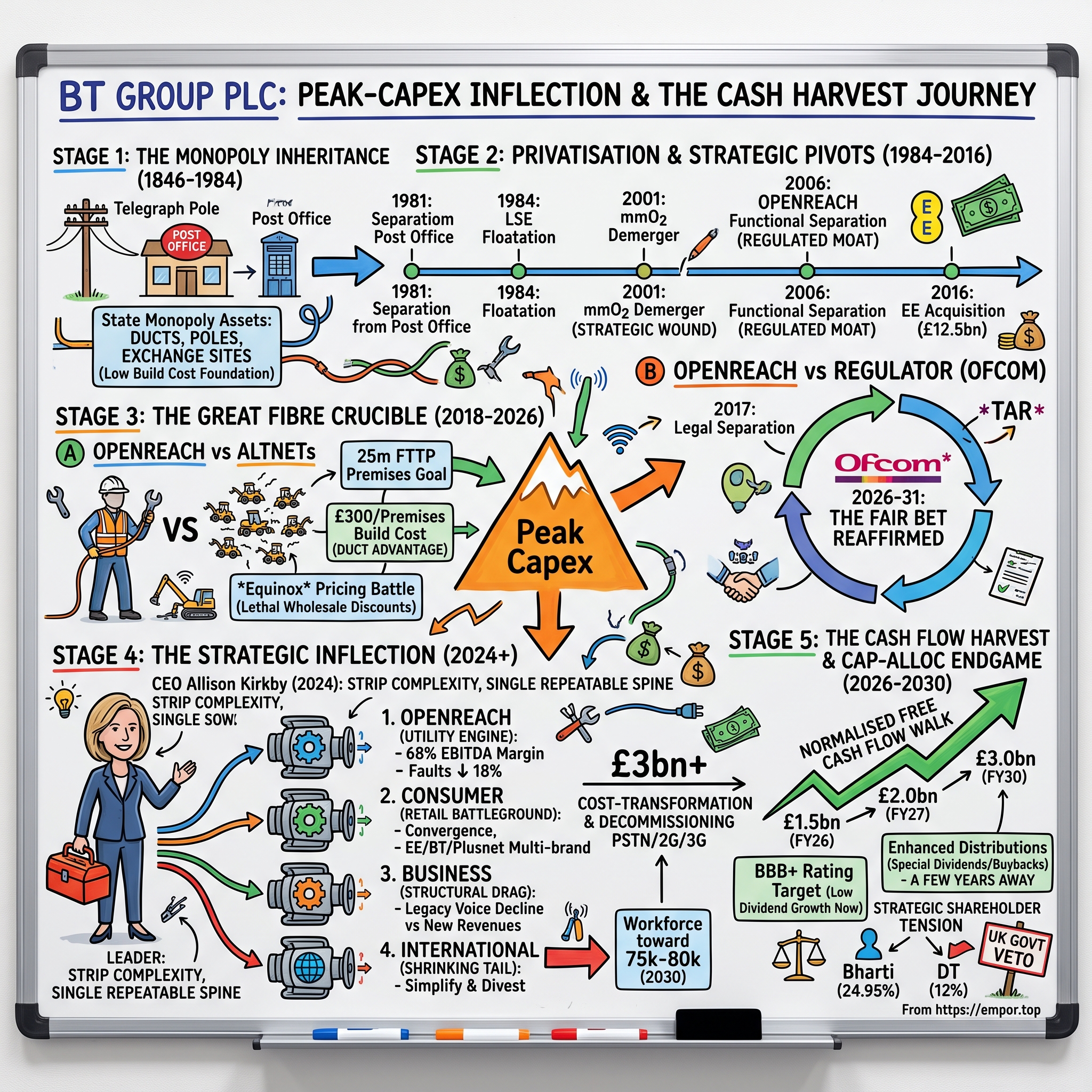
BT Group plc: The £15 Billion Telecom Giant at the Peak-Capex Inflection
I. Introduction & Episode Roadmap
Stand outside One Braham, BT's glass-and-steel London headquarters, on a May morning in 2026, and you would have found a company trying to convince the City that the hardest part was finally behind it. Inside, chief executive Allison Kirkby opened her full-year results presentation with a joke about her chairman-of-ceremonies reading a script written by artificial intelligence, then pivoted to the number the room actually cared about: Openreach had built full fibre to a record 4.8 million homes and businesses in a single year, including 1.5 million in the final quarter alone.1 Two years into her tenure, Kirkby's message was that BT had reached the summit of a mountain it had been climbing since 2019 — the largest civil-engineering project in modern British corporate history — and was about to start walking down the other side, where the cash is.
That is the thesis, and it is worth stating plainly because BT's own management states it constantly: the company is completing one of the largest infrastructure rollouts in UK history, passing 23 million premises with Full Fibre by March 2026 on the way to 25 million by December 2026, and crossing from peak capital expenditure into a free-cash-flow harvest that management says will double normalised free cash flow from £1.5 billion to £3.0 billion by fiscal 2030.12
But a thesis is not a fact, and the tension in this story is unusually sharp. This is a 180-year-old former state monopoly carrying roughly £20 billion of net debt and a pension scheme whose accounting deficit stood at £4.2 billion at the March 2026 year-end.23 Its highest-margin legacy revenues — voice calls over copper wire — are dying on schedule, and the question is whether new, lower-margin revenues can replace them fast enough. Its enterprise arm has been shrinking for years. And it faces a peculiarly British competitive problem: more than a hundred venture- and private-equity-backed "altnet" fibre builders spent the cheap-money years digging up UK streets to overbuild the very network Openreach was racing to lay.
There is also a valuation puzzle sitting underneath all of this. BT's shares traded around 196 pence in July 2026, giving the company a market capitalisation of roughly £19 billion — against a 52-week range spanning 173p to 242p.3 Put another way, the equity market values the whole of BT at less than the net debt it carries, and at a fraction of the replacement cost of the fibre network it has just finished building. That gap is either the opportunity or the warning, depending on whether you believe the harvest arrives.
The questions this story has to answer
So the roadmap for this story tracks six questions. How did a Victorian telegraph company and General Post Office department become a privatised FTSE giant? Why did the regulator carve out Openreach in 2006, and why does that compromise still define BT's economics? Did BT overpay £12.5 billion for EE in 2016 to buy back the mobile identity it had thrown away? How is the great fibre crucible — Openreach versus the altnets, refereed by Ofcom's Equinox pricing battles — actually resolving? What exactly is Kirkby's cash-harvest playbook, and does the evidence support it? And finally, why do two global telecom titans — Sunil Bharti Mittal and Deutsche Telekom's Tim Höttges — now sit on more than a third of BT's shares, and what does that concentration signal about the endgame?
A word on how to read what follows. Telecom incumbents are among the easiest businesses in the world to describe optimistically, because they generate enormous gross cash flow and own assets that sound irreplaceable. The discipline is to separate the parts of BT that genuinely earn extraordinary returns from the parts that merely look large. As will become clear, BT is not one company with a single set of economics; it is a regulated infrastructure utility with three consumer- and business-facing operations strapped to it, and the four of them behave nothing alike.
Let us begin where every British telecom story begins: with the Post Office.
 Subscribe on LinkedIn
II. From Post Office Monopolist to Privatized Pioneer (1846–2005)
The century of the state
The wires came first. In 1846 the Electric Telegraph Company strung Britain's first commercial telegraph lines, and for the next century the business of moving messages down copper was steadily absorbed into the state. By 1912 the General Post Office had nationalised the domestic telephone network, and for decades "the phones" were run not as a company but as a civil-service department — a place where getting a line installed could take months and where commercial logic was an afterthought to bureaucratic process.4
This matters more than it sounds, and not for nostalgic reasons. Everything valuable BT owns today — the ducts under the pavements, the poles along the lanes, the wayleaves and rights of access into millions of buildings, the exchange sites in every town — was assembled during that century of state monopoly, at public expense, without ever having to earn a competitive return. No private company starting from zero could accumulate that estate on any economically rational basis. It is the reason BT's fibre build costs roughly half what a rival's does, and it is the single most important inheritance in the story.
That world ended in the 1980s. British Telecommunications was separated from the Post Office in 1981, and in 1984 Margaret Thatcher's government floated it on the London Stock Exchange in a landmark privatisation that helped launch the modern era of European telecom deregulation. British Telecom — soon just "BT" — became the template: a former monopoly handed to millions of retail shareholders, then slowly disciplined by competition and regulation rather than ministerial fiat. Two things travelled with the company out of the public sector and never left: a vast defined-benefit pension scheme covering a workforce hired in the civil-service era, and a political sensitivity about who owns the nation's wires that would resurface, forty years later, in a very modern argument about an Indian shareholder.
Ambition, then the reckoning
The 1990s brought ambition and, eventually, humiliation. BT chased global scale through Concert, a transatlantic joint venture with AT&T that never delivered the world-spanning business network its architects imagined. Simultaneously, the telecom industry lost its collective mind bidding for third-generation mobile spectrum, and BT's balance sheet buckled. By 2001 the company was in a genuine debt crisis, and its response was radical surgery. It raised £5.9 billion in what was then the largest rights issue in UK history, and in November 2001 it demerged its entire mobile arm — the old BT Cellnet business — as a separately listed company, mmO2, operating under the O2 brand.[^5]
It is hard to overstate what a strategic wound that was. To survive its debt crisis, BT amputated its wireless business at the exact moment mobile was about to eat the world. O2 was later bought by Telefónica; BT spent the next decade and a half as a fixed-line company renting mobile capacity from others, a structural weakness that would eventually cost it £12.5 billion to reverse. The 2001 episode is the first data point in a recurring pattern worth holding onto: BT has repeatedly been forced into major strategic moves by balance-sheet pressure rather than choosing them from strength. It is also the origin of a habit of mind that persists in the current CFO's insistence on a BBB+ rating target — a company that has been forced by leverage to sell a crown jewel once tends not to want to be forced again.
The compromise that made modern BT
Then came the decision that shaped everything after. Between 2004 and 2006, Ofcom conducted a Strategic Review of Telecommunications and concluded that BT's grip on the "local loop" — the last-mile copper connecting every home — was throttling competition, because BT the wholesaler kept favouring BT the retailer. Rather than break the company up, the regulator extracted a set of binding undertakings from BT in 2005, and in January 2006 BT created Openreach: a functionally separate division required to sell access to its ducts, poles and local loops to every retail provider — Sky, TalkTalk, Vodafone — on equal, regulated terms.5 Openreach launched with roughly 30,000 staff, including around 25,000 engineers.5
This was the structural compromise at the heart of BT. Functional separation capped the returns BT could earn on its national access network and forced it to serve its own retail competitors. But — and this is the part the market often underweights — it also enshrined that physical duct-and-pole network as a regulated, cash-generative near-monopoly that no rival could economically replicate. BT gave up pricing freedom and gained a moat.
There is a subtler consequence too. Because Openreach must sell to everyone on identical terms, BT's retail arms have never enjoyed a network cost advantage over Sky or TalkTalk in the way a vertically integrated cable operator does. That is why, as later sections show, BT Consumer earns ordinary retail margins while Openreach earns utility margins. The regulator did not just cap BT's returns; it determined where inside BT the profit would be allowed to sit.
Whether that trade was a good one is still, twenty years later, the central argument about the stock. And it is the reason that when BT finally decided to rebuild in the 2010s, it had to rebuild the one thing it had thrown away in 2001: mobile.
III. The EE Acquisition & The Sports Money Pit (2006–2018)
Buying back the mobile identity
By the mid-2010s, BT's problem had a name: quad-play. Rivals could bundle broadband, TV, mobile and landline into a single sticky package, and BT — having demerged O2 — had no native mobile network to bundle. It was reduced to a weak mobile virtual network operator arrangement, reselling someone else's airwaves. In a market where convergence was becoming the whole game, that was an existential gap.
So in early 2016 BT closed the biggest deal in its modern history, acquiring EE — the UK's largest mobile operator, with more than 28 million customers and 4G network leadership — for £12.5 billion.[^7] The sellers were EE's joint owners, Deutsche Telekom and Orange. The consideration was part cash, part stock, and it is the stock portion that mattered most: Deutsche Telekom emerged with a roughly 12% stake in BT and Orange with around 4%. BT bought a mobile network and, in the same transaction, handed a German state-backed incumbent a permanent seat at its strategic table — a fact that would echo for a decade.
Did BT overpay? On the raw multiple, the price of around six times pre-synergy EBITDA looked reasonable against European mobile deals of the era, which often cleared higher, and closer to four and a half times once expected synergies were counted. The strategic logic was sound: a native network is worth more inside a convergent operator than as a standalone, because the same customer relationship can be monetised twice and the same retail estate, billing platform and call centre can serve both products.
The problem was execution. Integrating EE's IT estate with BT's own legacy systems took years, and the promised cross-selling — the whole point of convergence — arrived slowly. For much of the late 2010s, BT owned all the pieces of a quad-play champion without actually operating as one. The clearest evidence of how long that lag ran is that BT only relaunched EE as its flagship consumer brand in late 2023, nearly eight years after buying it, and that convergence — a customer taking two or more services — only reached 27% of the Consumer base by March 2026.1 Eight years is a very long time to hold an asset before beginning to use it as intended. The lesson is a familiar one in telecom M&A: buying the asset is the easy part; fusing two sprawling technology stacks and two sales cultures is where value quietly leaks away.
The Italian shock and the credibility reset
Two events in 2017 then reshaped the company more than the EE deal itself. The first was a governance disaster. In January of that year BT disclosed that improper accounting at its Italian business was far worse than an earlier estimate had suggested, taking a £530 million write-down after a KPMG review found what the company described as a complex web of improper sales, purchase, factoring and leasing transactions, with earnings over-reported for years.18 The shares fell as much as 19% in a single session — BT's worst day since 2008 — and billions of pounds of market value evaporated.18 Then chief executive Gavin Patterson called the practices deeply disappointing.18 For investors, the episode did lasting damage of a specific kind: it demonstrated that a sprawling international division, far from head office, could misstate results for years before detection. It is no accident that BT's subsequent strategy — carving out International, divesting five non-core businesses in a single year, "sharpening focus on the UK" — reads as a long, methodical retreat from exactly that kind of exposure.
The second 2017 event was regulatory. Under sustained pressure from Ofcom and rival ISPs, BT agreed to go beyond functional separation and give Openreach legal separation: its own board, its own staff, its own strategy and a legal duty to treat all customers equally, while remaining wholly owned by BT Group.5 It was the compromise that ended a decade of campaigning for a full structural break-up — and it is the arrangement that still governs the company today. Every subsequent argument about splitting Openreach off entirely starts from the fact that the regulator already extracted most of what it wanted without a sale.
The sports money pit
While the EE integration ground on, BT lit fire to cash on a second front. Beginning in 2012, it launched BT Sport and charged into a bidding war with Sky for Premier League and UEFA Champions League rights, ultimately spending north of £1 billion a year on content. The strategic rationale was defensive — sports would reduce broadband churn — but the venture never developed standalone media economics that could justify the outlay. It consumed management attention and cash for a decade.
BT eventually admitted the content treadmill was a trap and stepped off it. In 2022 it folded BT Sport into a 50/50 joint venture with Warner Bros. Discovery, rebranded TNT Sports, converting a capital-intensive rights war into a shared-risk partnership.6 The exit finished in 2025, when BT sold its remaining 50% stake to Warner Bros. Discovery, which had held call rights over the holding.7 For a company that had marked the stake's book value at around £630 million a year earlier, the disposal closed a chapter that stands as one of the clearer capital-allocation misadventures of the pre-Kirkby era.1 Both episodes — the slow EE integration and the sports money pit — help explain why, by the late 2010s, BT badly needed a simpler, more disciplined story. It found one, but only by committing to spend even more money first.
IV. The Great Fibre Crucible: Openreach vs. The Altnets (2018–2024)
Betting the company on glass
For most of its history, BT defended copper. Then, under former chief executive Philip Jansen, it made the biggest bet in the company's modern life: to rip out the Victorian copper network entirely and replace it with Full Fibre — fibre optic cable run all the way to the premises, or FTTP. Jansen set an audacious target of reaching 25 million UK premises by 2026 and pushed Openreach's build rate past a million premises a quarter. It is worth pausing on the physical scale of this. Fibre to the premises means sending engineers down essentially every street in Britain, threading glass through ducts and up poles to tens of millions of front doors — a rolling national excavation stretched over half a decade.
A brief word on the technology, because the economics follow directly from it. The old network sent electrical signals down copper pairs; signal quality degraded with distance, so a house far from the exchange got a worse connection than one nearby, and the copper itself corroded, flooded and failed. Fibre sends light down glass. Distance barely matters, and the physical plant is far more durable — which is why BT reports that fibre generates around 60% fewer faults than copper.1 The architecture Openreach uses, a passive optical network, splits a single fibre from the exchange among a number of homes using passive optical splitters that need no power at all in the street. That is the whole trick: fewer active electronics in the field means less energy, fewer failures and fewer engineer visits. And the same physical fibre can be upgraded to faster standards — XGS-PON, offering symmetrical multi-gigabit speeds — by swapping the electronics at each end rather than digging anything up again.1 Fibre, in other words, is not just a faster product. It is a permanently cheaper one to run, and a platform that can be upgraded without new civil engineering. Every argument BT makes about future margins rests on those two properties.
That ambition had a brutal financial cost. Group capital expenditure surged to around £5 billion a year, pushing free cash flow to multi-year lows and forcing BT to halve its dividend in 2020 to fund the build.1 The dividend cut is the single fact that most shapes how income investors view this stock: BT asked shareholders to forgo cash today for a network that would pay off tomorrow. The entire "harvest" thesis is, in essence, the promise to reverse that trade.
Here is where BT's twenty-year-old regulatory compromise turned into a weapon. Because Openreach already owns the nation's ducts and poles, it can thread new fibre through existing underground routes rather than digging fresh trenches — and under regulated Physical Infrastructure Access rules, it does so at a build cost management now puts at around £300 per premises passed for the 25-million rollout.1 The altnets, building ground-up without that legacy network, typically spend far more per premises — Kirkby has repeatedly claimed BT builds at "half to sometimes a third" of altnet costs.1 That cost gap is the closest thing BT has to a durable structural advantage, and it is not marketing: it is the direct dividend of owning the ducts.
There is a second, less discussed economic layer: the state. Under the government's Project Gigabit programme, Openreach has been winning subsidised contracts to build into rural areas that no commercial business case supports — by the March 2025 year-end it had secured seven "Type C" contracts covering around 300,000 hard-to-reach premises with a value of more than £700 million, and had taken over two further contracts where other suppliers had struggled.[^16] By 2026 BT was explicitly aligning its ambition to build beyond 25 million toward 30 million premises with the government's reprofiled rural subsidy schedule, which now runs to fiscal 2032.1 The analytical point is that the tail of BT's build — the expensive, low-density part — is being partly financed by the taxpayer, which materially improves the return profile of the last few million premises. It also deepens BT's entanglement with government, a two-edged relationship that reappears later in this story.
The altnet wave and its undertow
The altnets, though, were not built on unit economics. They were built on cheap money. During the near-zero interest-rate years, more than a hundred alternative networks — CityFibre, Netomnia, Community Fibre, Hyperoptic and dozens of regional builders — raised tens of billions to overbuild Openreach, betting they could grab enough customers to make the maths work. The break-even penetration for a fibre network sits somewhere above 30% of premises passed; many altnets were stuck in the teens. When interest rates rose sharply from 2022, the model broke. Funding dried up, build rates collapsed, and by 2026 the sector was visibly consolidating — the clearest signal being nexfibre's roughly £2 billion move to absorb Netomnia, the UK's fourth-largest network, a deal the Competition and Markets Authority referred to an in-depth Phase 2 investigation with a statutory deadline of December 2026.8 Kirkby told analysts in May 2026 that altnet build was running "something like 40% to 50%" below the prior year, and that BT was seeing "less losses to retail altnets."1
Regulatory warfare: the Equinox campaigns
BT did not simply wait for gravity to do its work. Through Openreach it deployed Equinox, a series of wholesale pricing offers that gave retail ISPs — Sky, Vodafone, TalkTalk — steep, long-dated discounts on Openreach FTTP if they committed the overwhelming majority of their new broadband orders to Openreach rather than to altnets. The structure is worth understanding because it is elegant and, from a rival's point of view, lethal. Equinox did not simply cut prices; it cut them conditionally, on volume commitments running for years. An ISP that took the discount was effectively pre-selling most of its future broadband growth to Openreach, which starved altnets of the retail distribution they needed to lift penetration above break-even. A network with no ISPs selling on it is a very expensive hole in the ground.
The altnets cried predatory pricing. Ofcom, in its Equinox 2 decision of 2023, disagreed, ruling the discounts lawful because lower wholesale prices flow through to cheaper consumer broadband.9 The regulator's reasoning is the key to the whole UK model: Ofcom's statutory duty runs to consumers, not to competitors, and it has consistently judged that a cheap, ubiquitous national wholesale network serves consumers better than a fragmented patchwork of subscale ones.17 For BT, the regulator's willingness to let Openreach compete hard on price — while the altnets' balance sheets weakened — was the single most important external development of the crucible years. It meant the incumbent could use its cost advantage aggressively rather than being frozen by the fear of a predatory-pricing finding.
The counter-move, when it came, was from the retail side. By 2025 Sky — the single largest independent buyer of Openreach's wholesale product — had begun trialling sales over CityFibre's network, and Kirkby acknowledged on the FY25 call that the ramp had been built into BT's line-loss assumptions.[^16] That is the mechanism investors should watch: altnets do not beat Openreach by winning consumers directly, they beat it by persuading one of the three or four ISPs that control most UK broadband distribution to switch wholesale suppliers in overlapping areas. It is a wholesale war fought through retail proxies.
The crucible, in other words, has been resolving in BT's favour — but through attrition and a benign regulator, not through any single knockout blow. And the resolution set up the question that now defines the equity: with the build nearly done and the rivals fading, what does BT actually earn?
V. Segment Breakdown & Engine Room Economics
Peel open BT Group and you find not one business but four, with radically different economics bolted onto a shared history. Understanding the stock means understanding which of these engines is a utility, which is a battleground, and which is a slow leak.
1. Openreach — the regulated infrastructure engine
This is the crown jewel, and the numbers show why. In the year to March 2026 Openreach generated around £6.2 billion of revenue and £4.2 billion of adjusted EBITDA — an EBITDA margin near 68%, the kind of figure normally associated with a regulated water or power utility rather than a competitive telecom.2 Revenue grew 1% and EBITDA grew 5%, and the gap between those two numbers is the whole business model in miniature. As customers migrate from copper to CPI-indexed fibre products, revenue rises modestly with inflation while the cost of serving them falls, because fibre breaks less. In FY26 that let Openreach cut direct labour by more than 10% in a single year even while building at record pace, with fault volumes down 18%.1
Underneath the headline sit two revenue streams with different characters. The larger is regulated wholesale broadband, where average revenue per line rose 4% to £16.70 in FY26, driven by contractual inflation indexation plus upselling customers to faster tiers.2 The smaller but faster-growing one is Ethernet — high-capacity dedicated circuits sold to businesses and, increasingly, to mobile operators and data centres — a roughly £1 billion business that grew 4% in FY26 after 8% the year before.1[^16] Ethernet is worth watching precisely because it is the least-discussed part of Openreach and the one most exposed to the AI-datacentre buildout now reshaping demand for backhaul capacity across Europe.
The key operating tension is the collision of two numbers: broadband lines lost to competitors versus fibre connections gained. In FY26 Openreach lost 825,000 broadband lines — better than its own 850,000 guidance — while pushing FTTP take-up to 39%, with more than 9 million premises connected out of the 23 million passed.12 Management guided to line losses falling again toward 800,000 in FY27, and pointed to a striking underlying shift: the "red zone" where a rival has fibre and Openreach does not has halved in two years.1
The read-through is that Openreach is a cost-declining, inflation-linked cash machine whose main risk is not operational but regulatory — how much of that margin Ofcom will ultimately allow it to keep. Note also what Openreach's margin structure implies for group valuation: at roughly £4.2 billion of EBITDA, this single division generates more than half of group EBITDA on less than a third of group revenue. Anyone modelling BT is, whether they admit it or not, mostly modelling Openreach.
2. BT Consumer — the retail battleground
Consumer is the largest revenue engine, at roughly £9.5 billion, but a far thinner one, generating about £2.6 billion of EBITDA on a margin near 27%.2 Its weapons are three brands aimed at three market tiers: EE as the premium, innovation-led flagship; BT as the trusted, recently relaunched mainstream brand; and Plusnet as the value option, which won Uswitch's best customer service award for an eleventh time in 2026.1
The multi-brand approach is a deliberate reversal. For years BT talked about consolidating everything under the EE masterbrand; by 2026 the strategy had settled instead on running three complementary brands to cover premium, mainstream and value simultaneously, on the theory that a single brand cannot credibly serve a market where some customers want the newest handset and others want the cheapest line. Kirkby went further on the FY26 call, arguing the brand portfolio combined with 400 retail stores, 18 UK contact centres and hyperlocal marketing data lets BT fight altnets street by street rather than only nationally.1 That is a genuine and underrated asset — but it is also an expensive one to maintain, and the FY27 guidance explicitly flags brand-refresh costs as a first-half headwind.1
The strategic thesis is convergence — selling a customer both mobile and broadband under the EE One proposition to raise revenue per user and cut churn. The evidence here is genuinely encouraging and worth crediting: FY26 was the first year in eight that Consumer grew customers across all three core products simultaneously, adding broadband, postpaid mobile and TV customers; convergence reached 27%; and management disclosed that mobile customers on EE One churn 35% below average even though most are on 30-day contracts.12
But — and this is the analytical catch that Goldman Sachs's analyst pressed hard on the FY26 call — all that operational momentum has not yet produced top-line growth. Consumer revenue fell 2% and EBITDA fell 2%, prompting a pointed question about whether Consumer is discounting heavily to buy the good KPIs while the resulting volumes flatter Openreach.12 Kirkby rejected the "robbing Peter to pay Paul" framing, insisting the units run independently with separate growth targets, but the fact that a bulge-bracket analyst raised it at all tells you the convergence payoff is still a promise rather than a proof. The fair verdict: the leading indicators (customers, churn, satisfaction) have turned; the lagging indicator (revenue) has not. Investors should demand to see the second follow the first within a reasonable window before crediting the story.
3. BT Business — the structural drag
Here is the part of BT that has resisted every turnaround plan. Business — spanning small and medium enterprises, corporate and public sector, and wholesale — produced roughly £5.3 billion of revenue and £1.3 billion of EBITDA in FY26, with both falling and EBITDA down 5%.2 It accounts for just over 15% of group EBITDA, with the three segments contributing roughly equally.1
The mechanism of decline is painful and mathematically stubborn: BT's most profitable Business revenues are legacy voice and copper circuits carrying very high incremental margins, and they are shrinking faster than lower-margin cloud, security and managed-service revenues can replace them. A pound of legacy voice revenue lost is not replaced by a pound of managed-service revenue gained — it is replaced by rather less gross profit even if the top line holds. This is why Business EBITDA falls faster than Business revenue, and it is the single clearest illustration of why "revenue stabilisation" is an insufficient target for this division.
Strip out declining voice and underlying service revenue actually grew about 1%, and management pointed to landmark wins with BAE Systems, easyJet and Northern Ireland Electricity Networks, plus a push into cybersecurity — including bringing CrowdStrike's technology to small businesses — and "sovereign" UK-controlled platforms aimed at defence and critical national infrastructure buyers.1 The sovereignty angle is strategically shrewd: in a market where European governments are increasingly wary of foreign-controlled cloud and network infrastructure, being the domestically owned incumbent is a differentiator no hyperscaler can copy.
But the honest reading is that Business remains the division where management is least able to say when decline turns to growth. Asked directly on the FY26 call when Business would inflect, Kirkby declined to promise anything better than the shape of Consumer for "the next couple of years," while noting BT holds unusually low market share in UK SMB for an incumbent — framed as opportunity, but equally an admission of decades of underinvestment in that segment.1
4. International — the shrinking tail
Alongside these three sits a fourth unit, International, carved out as its own division in July 2025. It generated roughly £2.1 billion of revenue and just £0.15 billion of EBITDA in FY26, with revenue down 15% and EBITDA down 29% as legacy and managed-contract declines compounded the effect of divesting five businesses during the year.12 Clive Selley took over the division in April 2026 with a mandate to simplify it and migrate customers onto Global Fabric, BT's network-as-a-service platform.113 For investors the relevant question about International is not growth but disposal risk and accounting: this is the division where an analyst on the FY26 call pressed Simon Lowth on whether a reduction of more than 100 basis points in the discount rate used for its goodwill test was what kept it from an impairment — a question Lowth acknowledged was arithmetically correct but "rather hypothetical."1 It is a small division carrying a disproportionate share of BT's accounting judgement risk.
Add it up and the group produced £19.6 billion of adjusted revenue, £8.2 billion of adjusted EBITDA — essentially flat, or up just under 1% excluding divestments — and £5.1 billion of capex in FY26.2 The shape of the whole thing is clear: one utility-grade cash engine, one improving but low-margin retail engine, one shrinking legacy business that the harvest thesis quietly depends on stabilising, and one tail being wound down. Which brings us to the person now steering all of it.
VI. The Strategic Inflection: Allison Kirkby & The Cash Flow Harvest
The operator the board went shopping for
When Allison Kirkby took the chief executive's chair in February 2024, she arrived with a reputation the BT board had specifically shopped for: a Scottish-born, numbers-fluent operator, trained as an accountant, who had run turnarounds at Sweden's Telia and Tele2, known for cost discipline and capital simplicity rather than empire-building. She had already sat on BT's board as a non-executive director before taking the executive role, so she inherited the strategy without inheriting the excuse of unfamiliarity.
Her instinct, visible in every results call since, is to strip complexity out of the story — to make BT legible to investors who had spent a decade struggling to model it. She sells non-core assets rather than defending them, she repeats the same three-pillar framing at every reporting date, and she is unusually willing to name what has not worked: on the FY25 call she opened the line-loss discussion by saying flatly that it was "the area where we haven't been happy," rather than burying it in a slide.[^16] Her running joke on results days about being introduced by "an AI chatbot" is trivial; her insistence on a single, repeatable financial spine is not.1
The counterweight has been Simon Lowth, CFO since 2016 and one of the more consequential finance chiefs in recent UK corporate history — a man who, as Kirkby put it in his valedictory results presentation, had to cope with a major fraud, fund a generational fibre programme "without taking on any funky financing," steer the company through COVID and absorb the cost shock after 2022.1 That phrase about funky financing deserves emphasis, because it describes a genuine and underappreciated decision. Several European incumbents funded their fibre builds by selling stakes in their networks to infrastructure funds or spinning them into joint ventures — raising cash today at the cost of permanently sharing the asset's future returns and adding structural complexity. BT did not. Kirkby made the point explicitly in 2026: BT ends the build with "the largest wholly owned fibre asset in Europe," with no sale-and-leaseback and no network JV to unwind.1 Whether that was worth carrying £20 billion of debt through the build is arguable; that it leaves the equity with undiluted claim on the finished asset is not.
The spine: three claims, repeated
That spine was set out in May 2024 and has been repeated, almost word for word, at every reporting date since — which is itself an analytical fact worth weighing when judging management credibility. The claims are three. First, that FY24 marked peak FTTP capex, after which capital spending would fall by well over £1 billion by FY30. Second, that a cost-transformation programme would strip out £3 billion of gross annualised savings while cutting the total workforce, contractors included, from around 130,000 toward a range of 75,000 to 90,000 by 2030.10 Third, that these levers together would double normalised free cash flow from roughly £1.5 billion to £2.0 billion by FY27 and £3.0 billion by FY30.
Two years on, the scorecard is mixed-to-credible, and the details matter. On cash flow, BT has hit its guidance "on the nose" — £1.6 billion in FY25, £1.5 billion in FY26 — and reconfirmed the £2 billion FY27 and £3 billion FY30 targets that CFO Simon Lowth first set out.1 On cost, BT is running ahead of plan: it delivered £580 million of annualised savings in FY26, £1.5 billion cumulatively over two years, and in May 2026 it extended and enlarged the programme to £3.7 billion of gross savings by FY30, now guiding the workforce to the lower end of its range, 75,000 to 80,000.1 Notably, management framed the extra £700 million of savings not as a reason to raise the FY30 cash target but as insurance to protect it against inflation and regulatory shocks — a conservative, under-promise posture that reads as more credible than the reverse.1 The delivery risk is real, though: much of the cost cut depends on shedding tens of thousands of jobs, a plan first announced under Jansen in 2023 that runs straight into the Communication Workers Union.11
It is worth being precise about what the cost programme actually is, because "£3.7 billion of savings" is the kind of number that invites scepticism. Lowth broke it into four buckets on the FY26 call: reshaping the Openreach workforce once the fibre build ramps down; network engineering efficiencies plus the shutdown of the PSTN, 2G and 3G networks, which also cuts energy; simpler products and processes that reduce IT spend; and continued organisational restructuring across the group.1 Three of those four are essentially mechanical — they follow automatically from finishing the build and switching off old networks — which is why the programme has run ahead of schedule. The fourth, organisational restructuring, is the one that depends on negotiation and goodwill, and it is where slippage would show first. Cumulatively, management says the decade to FY30 will have delivered £6.7 billion of gross savings, which it argues has offset severe inflation and is what allows EBITDA to grow while revenue does not.1
Artificial intelligence sits inside this programme rather than alongside it. Kirkby's framing on the FY26 call was notably restrained compared with the industry norm — AI is helping contact-centre agents serve customers with better information and cross-sell more, and BT has created nearly a thousand data and AI apprenticeships and signed an AI-operations partnership with Accenture.1 There is no claim of a step-change in headcount from AI, only of "further upside to come." For a sector prone to AI theatre, the restraint is a modest credibility marker; it also means investors should not underwrite an AI-driven margin surprise that management itself is not promising.
Switching off the past
The single biggest lever behind the harvest is the least glamorous: switching off the past. BT is decommissioning the Public Switched Telephone Network — the analogue voice network some of whose architecture is a century old — with closure targeted for January 2027, having already migrated nearly two million customers off it in FY26 alone.1 It is shutting 2G and 3G mobile networks, and it is closing legacy copper exchanges, vacating some ahead of a 2031 property lease expiry and having closed its first exchange, at Deddington, during the year.1 Each shutdown removes energy cost (BT's total energy bill runs around £500 million a year), maintenance, real estate and headcount, and lets BT sell the redundant copper for scrap — a source of cash it has been "forward selling" to help fund the fibre build.1 This is the unglamorous machinery of the harvest: the cash does not come from a new product, it comes from switching off old ones faster than the revenue they carry declines.
Two further items belong on this ledger because they quietly de-risk the harvest. On energy, where BT spends around £500 million a year and roughly half of that is non-commodity levies rather than the commodity itself, the company entered FY27 about 90% hedged at pre-conflict prices and roughly half hedged into the medium term — meaningful protection at a moment when conflict in the Gulf has pushed energy costs up.1 On pensions, BT has begun funding part of its obligation through a co-investment vehicle structured so that any money not ultimately needed by the scheme returns to BT from 2032 — a mechanism that converts what would be a one-way cash outflow into a partially recoverable one.1 Neither is glamorous. Both reduce the variance around the £3 billion target, which for a leveraged company is exactly the kind of work that matters.
The capital-allocation endgame
The capital-allocation endgame is where the story gets genuinely interesting for shareholders, and where the FY26 call produced its sharpest exchange. Bank of America's analyst put it bluntly: BT cut its dividend in half to build fibre, the fibre is nearly built, so why not simply double the dividend back? Lowth's answer was disciplined to the point of caution: BT will hold a BBB credit-rating floor, target a BBB+ rating "through-cycle," and only once leverage falls to metrics consistent with BBB+ will "residual cash flow" be freed for "enhanced distributions" — special dividends or buybacks — which the board said were "a few years away."1 Until then, dividend growth is capped at low-to-mid single digits. For income investors that is the crux: BT is promising a large, sustainable cash flow but deliberately withholding most of it from shareholders in the near term to repair its balance sheet first. Whether that patience is prudence or excessive conservatism is precisely the kind of judgement an activist would seize on — and there are activists, of a sort, already on the register.
There is a subtlety in the mechanics worth flagging, because it is where a bull and a bear will genuinely disagree. The distributable pool is "residual" cash flow — normalised free cash flow less restructuring costs — and restructuring falls sharply over the plan, from roughly £400 million a year to around £100 million by FY30 as the transformation completes.1 Residual cash flow therefore grows faster than headline free cash flow, which is management's argument for why capacity for enhanced distributions builds quickly late in the decade. The bear's response is equally simple: a company that needs to spend £1.4 billion to deliver £3.7 billion of savings, and that keeps discovering new restructuring to fund, has a habit of finding uses for cash that never quite reaches shareholders. Both readings fit the same disclosure. The resolution will be empirical, and it will show up in the FY28 and FY29 numbers.
A leadership handover at the pivot
The team executing all this is also turning over. Lowth, the CFO who funded a generational fibre build without resorting to the sale-and-leaseback or joint-venture financing structures many European peers used, announced his retirement; Patricia Cobian, who helped build Virgin Media O2 and served as its CFO, joins as CFO designate in July 2026 and takes the role on 1 September 2026.112 At Openreach, Clive Selley handed the chief executive role to his deputy Katie Milligan on 1 April 2026, moving across to run BT International.13 Adam Crozier chairs the board. It is a management transition happening at the exact moment the strategy pivots from building to harvesting — continuity of plan, discontinuity of people.
VII. Competitive Landscape, Porter's 5 Forces & Helmer's 7 Powers
The battlefield map
To war-game BT from here, start with the battlefield map Kirkby herself drew for analysts: divide every Openreach broadband line into four zones. In the first, Openreach is the only fibre provider — pure growth. In the second, a large and expanding competitive zone where two or more networks overlap. In the third, neither Openreach nor anyone else has yet built, where customers may drift to mobile or satellite. And in the fourth, the danger zone, a rival has fibre and Openreach does not — and BT's claim is that this red zone, where roughly half its line losses occur, has shrunk by about half in two years as it builds.1 The strategic point is simple and, on the evidence, largely true: building faster is BT's best defence, because every premises it passes converts a battleground into a stronghold.
The main combatants are three. Virgin Media O2, the Liberty Global–Telefónica joint venture, is the primary fixed-mobile rival, with a cable footprint of around 16 million premises now upgrading to full fibre through the nexfibre vehicle — the same nexfibre now absorbing Netomnia in a deal that would create an alternative platform covering roughly 9.9 million premises.8 That consolidation is double-edged for BT: it removes a swarm of small retail-altnet nuisances but assembles a single scaled fibre challenger with a credible national wholesale proposition. Asked at the FY26 results whether he supported or opposed it, Kirkby pointedly declined to take a side, noting only that it would let VMO2 upgrade its ageing coaxial network — a diplomatic answer that also happens to acknowledge the deal's strategic logic.1 CityFibre, meanwhile, has opposed the merger on competition grounds, arguing the CMA should assess it on granular local overlap rather than a national market definition.8
The Vodafone–Three UK mobile merger reshapes the other half of the board, creating a network operator with the scale to challenge EE's mobile leadership. BT's defence here is not scale but quality: EE won top placings from RootMetrics, umlaut and Opensignal in FY26 and has pushed 5G Standalone — marketed as 5G+ — to over 70% population coverage, targeting 99% by FY30.1 Whether network-quality awards translate into pricing power in a market where consumers largely buy on price is the open question.
And a long tail of independent altnets persists, funding-starved and consolidating. The most interesting competitive question Kirkby was asked in 2026 came from Bernstein: what stops a scaled rival building a genuine wholesale challenger to Openreach? Her answer was essentially about time and machinery — rivals have been talking about scaled wholesale "for at least half a decade" without doing the deal, while Openreach has built to three-quarters of the country and operates an established, high-efficiency provisioning engine that takes years to replicate.1 It is a credible answer, but it is an answer about lead time, not about permanence.
Myth versus reality
Three consensus narratives about BT deserve testing against the evidence.
Myth: the altnets are killing Openreach. Reality: they hurt, but the damage is measurable, shrinking and concentrated. Openreach's line losses fell from the prior year to 825,000 in FY26 and are guided lower again; the zone where a rival has fibre and Openreach does not has halved in two years; and altnet build rates have fallen 40–50%.1 The more accurate statement is that altnets inflicted a bounded, one-time market-share transfer during the years Openreach's own footprint was incomplete, and that the window for that transfer is closing as the build finishes.
Myth: Openreach's monopoly means BT has pricing power. Reality: it means the opposite in the way most investors assume. Openreach's prices are set within an Ofcom framework, and its main lever is inflation indexation plus upselling customers to faster tiers — not the discretionary price-setting a true monopolist enjoys. Meanwhile BT's retail arms, where genuine pricing discretion would live, operate in one of Europe's most price-competitive consumer markets, which is precisely why Consumer ARPU was slightly down in FY26 despite record customer satisfaction.1 BT's advantage is a cost advantage, not a price advantage. That distinction determines everything about how the harvest converts to profit.
Myth: peak capex means the cash arrives now. Reality: capex falls to around £4.3 billion in FY27 from £5.1 billion, and by more than £1 billion in total by FY30 — but a large share of the released cash is spoken for by deleveraging toward a BBB+ rating and by pension funding before shareholders see it.1 The harvest is real; the harvest reaching shareholders is a separate, later and more conditional event.
Hamilton Helmer's 7 Powers
Run BT through Hamilton Helmer's 7 Powers and two powers stand out as genuinely strong, the rest as weak or contested. Scale economies in Openreach are real: the ~£300-per-premises build cost, roughly half the altnet average, is a structural advantage rooted in owning the ducts, and it is the single hardest thing for a rival to replicate.1 Cornered resource is the twin of that — the nationwide duct-and-pole network, the exchange buildings, the rights of way — an asset assembled over a century under state monopoly that no amount of venture capital can recreate. These two powers are why Openreach earns utility margins. The weaker claims are switching costs: convergence and the EE One bundle do measurably reduce churn (that 35%-below-average figure is the best evidence), but UK consumers remain price-sensitive and switching broadband is easy, so this power is medium at best.1 And BT has essentially no counter-positioning power — it is the incumbent, constrained by legacy contracts and regulated wholesale prices, unable to pull the disruptive judo moves available to insurgents.
Two other powers deserve a brief verdict. Process power — the accumulated organisational know-how of building and connecting at scale — is BT's most underrated advantage and the one Kirkby leans on hardest: a provisioning machine that connected 2.2 million customers in a year, 20,000 field engineers, and trenching innovations that lower cost per metre are not things a competitor buys off a shelf.1 Branding power is weak-to-moderate: BT and EE are among the most recognised names in Britain, but recognition in a commoditised connectivity market supports share, not premium pricing. And network economies — the classic power where a product gets better as more people use it — barely apply here at all; broadband is not a social network. Investors who reach for that framework with telecoms are usually confusing scale economies with network effects.
Porter's Five Forces
Porter's Five Forces sharpen the same picture. The threat of new entrants has fallen from high to low, not because barriers rose but because the cost of capital did — the altnet funding wave that once looked threatening is now receding, and no one is going to raise tens of billions to trench a fourth UK fibre network in a higher-for-longer rate world. Buyer power is medium: Ofcom deliberately arms the big retail ISPs with regulated wholesale access, and a Sky or a TalkTalk shifting volume toward CityFibre is a real lever, as BT's own line losses to "one challenged CP" showed.[^16] Supplier power is low-to-medium, with equipment concentrated among Nokia, Ericsson and Ciena, though the government-mandated removal of Huawei kit imposed real, unavoidable cost. The threat of substitutes — 5G fixed wireless and Starlink-style low-earth-orbit satellite — is one management watches but has so far dismissed; Kirkby noted in 2026 that fears of the fixed market migrating to fixed-wireless and satellite had not materialised, and BT is itself partnering with Starlink for the hardest-to-reach homes rather than being disrupted by it.1 And competitive rivalry remains high in both consumer mobile/broadband pricing and, brutally, in the structural decline of B2B. The honest synthesis: BT's moat is powerful precisely where it is a wholesaler (Openreach) and thin-to-ordinary everywhere it is a retailer. The investment case lives or dies on how the regulator treats the strong half.
VIII. Strategic Shareholder Tension & Skeptical-Investor Stress Test
Every share register tells a story, and BT's now reads like a diplomatic incident. More than a third of the company is held by two of global telecom's most formidable operators, and neither is a passive index fund.
The Bharti question
The larger is Bharti. In August 2024 Sunil Bharti Mittal's Bharti Global bought the entire 24.95% stake that French tycoon Patrick Drahi's Altice had accumulated, for around £3.2 billion, instantly making the builder of India's Airtel BT's largest shareholder.14 By September 2025 the influence was formalised: Mittal himself and Airtel's chief executive Gopal Vittal joined the BT board as non-independent non-executive directors, bringing the operational playbook of a company that runs one of the world's most cost-efficient mobile networks.15 Bharti's stake sits at exactly 24.95% for a reason — one-hundredth of a percent below the 25% threshold that triggers formal scrutiny under the UK's National Security and Investment Act. And in May 2026 the tension went public: reports emerged that the UK government would move to block any attempt by Bharti to cross 25%, on national-security grounds tied to BT's ownership of critical national infrastructure, and BT shares fell around 4% on the news.16 The signal is unmistakable. Bharti would plainly like to own more of BT; the British state has quietly drawn a line at a quarter of the company.
What Bharti brings is not capital — the stake was bought, not injected — but a playbook. Airtel operates in one of the world's most brutally price-competitive telecom markets and has become one of the lowest-cost network operators on earth by necessity. Applying that cost obsession to a British incumbent with 108,000 people on its books is, in theory, exactly the kind of shareholder pressure that accelerates a transformation. The counter-argument is governance: two non-independent directors representing a quarter of the register sit on a board also charged with protecting minority shareholders, and the interests of a strategic industrial holder and a passive index investor are not always the same.
Deutsche Telekom and the endgame
The second anchor is Deutsche Telekom, holding the roughly 12% stake it received as part of the 2016 EE sale.[^7] Tim Höttges's group has been a patient but at times visibly frustrated holder, its stake a permanent reminder that BT's mobile rebuild came at the price of a strategic shareholder it did not choose. Deutsche Telekom's own valuation has been transformed since 2016 by its American business; watching a legacy European stake go sideways over the same period has not made it a quiet holder.
With Bharti and DT together controlling over a third of the equity, the obvious question is the endgame. Three broad paths exist. A full takeover by Bharti, which the UK government has now signalled it will resist on national-security grounds. A structural break-up separating Openreach — a regulated, inflation-linked infrastructure asset that would likely attract a higher multiple as a standalone — from the lower-quality retail and enterprise operations. Or the status quo, in which two strategic holders simply apply pressure for faster cost cuts and larger distributions.
The break-up case is the one most often floated and least often examined. Its logic is that infrastructure funds pay far more for regulated fibre than public markets pay for integrated telcos. Its problems are threefold: Ofcom already extracted legal separation in 2017, so the regulatory prize is smaller than it looks; Openreach's fair-bet returns depend on a regulatory settlement that a change of ownership could reopen; and separating the two would strand BT's retail arms as sub-scale buyers of a network they no longer own, at precisely the moment convergence is finally working. None of that makes a break-up impossible. It does mean it is a financial-engineering trade rather than an operational one — and BT's history with financial engineering, from Concert to the sports JV, is not encouraging. What is certain is that a register this concentrated, with a government veto now explicit, is not a stable equilibrium, and it is the single most important governance fact about the stock.
The bear case, made properly
Now the stress test — the case a skeptical long/short investor would build. First, the enterprise sinkhole. BT Business has been declining for years, and management still will not commit to a date when it stabilises; if legacy voice and MPLS keep falling faster than cyber and cloud grow, Business drags group revenue for the rest of the decade, and the harvest thesis quietly assumes a stabilisation that has not yet been demonstrated.1 Second, the balance sheet. Net debt of around £20 billion and an IAS 19 pension deficit that actually rose £100 million in FY26 (on mortality and inflation assumptions) mean a large slice of the celebrated cash flow is pre-committed to lenders and pensioners before a single extra pound reaches shareholders; the next triennial pension valuation, as at June 2026, is a live overhang.21 A short-seller would note that "normalised" free cash flow is a management-defined metric that has been flattered by working-capital moves — a £476 million working-capital benefit in FY26, including forward copper sales and handset securitisation — and would ask how much of the harvest is genuine cash generation versus timing.1 Third, regulatory risk. The entire Openreach margin story rests on Ofcom's forbearance, and the regulator resets the rules every five years.
That third risk is the one to size carefully, because it either makes or breaks the case — and the ruling is fresh.
IX. Risk Radar, Investment Spine & Essential KPIs
The ruling that mattered most
The most important document of BT's year was not written in One Braham. It was published by Ofcom on 17 March 2026: the Telecoms Access Review 2026–31, the framework that governs Openreach's pricing until the end of the decade.17 For a company whose crown jewel is a regulated monopoly, this is the risk that dwarfs all others — a single regulatory decision that determines how much of Openreach's utility margin BT gets to keep once the network is built and the "fair bet" logic of rewarding risky investment gives way to the cost-based logic of regulating a completed asset.
The verdict was, on balance, benign for BT. Ofcom reaffirmed the "fair bet" — the principle that BT should be allowed to earn a fair return on its fibre gamble even under future price regulation, retaining profits above regulated returns as reward for the risk taken.17 It carved the country into geographic zones with lighter regulation where competition is genuine and tighter rules where it is not, and it left the aggressive Equinox discount architecture intact rather than dismantling it.17 The cost to BT was modest: a roughly £100 million FY27 working-capital drag tied to changes in the regulated broadband "anchor" product, which BT said it would offset.1 Kirkby is now pushing Ofcom toward outright deregulation of the areas — she cites 40% of the market with two or more networks and 25–30% with three — where she argues sustained competition should free Openreach to compete on price with its low-cost fibre.1 Ofcom has not conceded that competition is yet "sustainable," but it has agreed to keep reviewing. The read-through for investors is that the worst-case regulatory outcome — a hard cap crushing Openreach returns the moment the build finished — did not materialise, but the fight over deregulation is the multi-year swing factor for the equity's upside.
One nuance in the TAR is easy to miss and genuinely important: Ofcom raised the speed of the regulated "anchor" broadband product it price-caps, from up to 40Mbps to up to 80Mbps.17 The intent is to protect consumers by keeping a well-specified product affordable; the effect on BT is a modest, quantified working-capital drag of about £100 million in FY27, which management said it would offset partly through further forward copper sales.1 It is a small number, but it illustrates the permanent feature of BT's world: the regulator can move a single parameter and reshape a year's cash flow, and always will. That is the price of owning a national monopoly with a licence to earn utility returns.
The rest of the radar
Beyond regulation, the risk radar has three live items with real business mechanisms behind them. Execution risk in B2B, already covered — the inability to cut legacy Business overhead as fast as its revenue erodes. Labour and restructuring friction — cutting toward 75,000–80,000 people means tens of thousands of redundancies negotiated against the CWU, and restructuring cash costs of just over £200 million a year through FY28.1 And refinancing risk — rolling £20 billion of debt in a higher-for-longer rate environment, though management stresses the debt is well "termed out" and leverage is set to fall.1 Note too the second-layer overhangs: BT's insistence on a BBB+ target reflects how tightly the credit rating is bound up with its cost of capital, and an analyst on the FY26 call probed whether International's goodwill escaped impairment only because BT lowered its discount rate — a fair, if hypothetical, accounting question that management answered by pointing to auditor sign-off.1
The investment spine
So, the investment spine, stated as honestly as the evidence allows. Why BT could win from here: it owns an irreplaceable, cost-advantaged national fibre asset earning utility margins, protected by a regulator that has just reaffirmed the fair bet; it is genuinely past peak capex, with capex guided down to around £4.3 billion in FY27 from £5.1 billion; it is delivering cost cuts ahead of plan; the altnet threat is fading into consolidation; and Consumer has returned to customer growth for the first time in eight years.12 Why it might not: a chronically declining Business division that has never convincingly stabilised; a balance sheet where £20 billion of debt and a rising pension deficit pre-claim much of the cash; a "normalised" cash-flow metric flattered by working-capital engineering; deliberate near-term withholding of shareholder returns; a scaled Virgin Media O2/nexfibre rival assembling itself; and a share register split between a would-be acquirer the government has moved to block and a frustrated German incumbent. The bull and bear cases are not evenly matched across the business — they are the same business seen from its wholesale versus its retail end.
The three numbers that matter
For readers who want to hold BT to account rather than take management's word, three KPIs carry almost all the signal:
- Openreach FTTP build and take-up. Cumulative premises passed against the 25-million-by-December-2026 target (23 million reached by March 2026), and crucially the take-up rate on that footprint — 39% and climbing, with net line losses the number that reveals whether "build and connect" is actually stemming the bleed.12
- Normalised free cash flow. The whole thesis is a number: the walk from £1.5 billion in FY26 to £2.0 billion in FY27 to £3.0 billion in FY30. Miss the interim steps and the harvest is in doubt; hit them and the enhanced-distribution endgame comes into view.1
- Cost-transformation delivery. Annualised gross savings against the raised £3.7 billion target, and headcount against the 75,000–80,000 FY30 goal — the operational proof that EBITDA can grow even as revenue stays flat.1
X. Epilogue & Primary Evidence Guide for Transcripts
The transcripts that carry the story
The paper trail on this story is unusually rich, and for anyone testing management against its own words, three calls do most of the work.
The May 2024 full-year results and strategy update is the foundational document — the moment Kirkby set the entire spine: peak capex, the £3 billion cost programme, the workforce range, and the £3 billion free-cash-flow-by-2030 target that every subsequent call has been measured against.[^21] The May 2025 full-year results call is where the plan first met reality: Openreach passing more than 18 million premises, take-up rising to 36–37%, and — importantly — the first admission of pain, with Kirkby conceding that line losses were "the area where we haven't been happy" as a shrinking broadband market bit harder than expected.[^16] And the May 2026 full-year results call is the two-year checkpoint: peak capex confirmed as passed, FTTP through 23 million and take-up at 39%, the cost programme raised and extended, and the capital-allocation endgame — BBB+ then enhanced distributions — laid out under sustained analyst pressure.1
What is most revealing is where management is precise and where it turns vague, because the pattern is consistent across all three calls. On Openreach — build cost, take-up, line-loss trajectory, capex ramp-down — the answers are specific, quantified and confident, which is exactly what you would expect from the part of the business management understands best and controls most. On the enterprise recovery timeline, the answers go soft: asked repeatedly when Business inflects to growth, Kirkby offers the shape of Consumer and "the next couple of years" rather than a date.1 And on shareholder returns, the language is deliberately withholding — "a few years away," decided "near the time" — a discipline that reads as either admirable prudence or, to a frustrated holder, as a management reluctant to commit to giving the cash back.1 Analysts from Goldman Sachs, UBS, BNP Paribas, Morgan Stanley and Bernstein pushed hardest on precisely the three soft spots: whether Consumer's KPIs are bought with discounts, whether normalised cash flow is flattered by working capital, and whether a scaled rival could finally build a wholesale threat.1 That the questions cluster there is the most honest map of the risks in this entire story.
BT Group in mid-2026 is a company at the fulcrum of its own thesis: the build is all but finished, the rivals are fading, the regulator has ruled, and the cash is beginning to inflect — yet the debt, the pension, the shrinking enterprise arm and a share register under government watch all sit unresolved on the other side of the scale. The next three years, measured against those three KPIs, will settle which of BT's two faces — the utility or the burdened incumbent — the market decides to pay for.
References
-
BT Group plc Results for the full year to 31 March 2026 — full-year results presentation and press release (transcript of CEO Allison Kirkby and CFO Simon Lowth remarks and analyst Q&A), 2026-05-21 ↩↩↩↩↩↩↩↩↩↩↩↩↩↩↩↩↩↩↩↩↩↩↩↩↩↩↩↩↩↩↩↩↩↩↩↩↩↩↩↩↩↩↩↩↩↩↩↩↩↩↩↩↩↩↩↩↩↩↩↩↩↩↩↩↩↩↩↩↩↩↩
-
Results for the full year to 31 March 2026 — BT Group plc (RNS via Investegate), 2026-05-21 ↩↩↩↩↩↩↩↩↩↩↩↩↩↩
-
BT Group plc share price and Regulatory News Service — London Stock Exchange ↩↩
-
BT and Openreach — House of Commons Library Briefing Paper CBP-7888 ↩
-
BT and Warner Bros. Discovery complete sports joint venture — Warner Bros. Discovery, 2022-09-01 ↩
-
BT nears deal to sell TNT Sports stake to Warner Bros Discovery — CNBC, 2025-05-17 ↩
-
CMA fast-tracks nexfibre £2bn Netomnia broadband merger to Phase 2 competition probe — ISPreview UK, 2026-07 ↩↩↩
-
BT Group CEO Allison Kirkby sets out path to double free cash flow — Financial Times, 2024-05-16 ↩
-
British telecom giant BT to cut up to 55,000 jobs by 2030 — CNBC, 2023-05-18 ↩
-
Simon Lowth to retire as BT's Group CFO, with Patricia Cobian appointed as successor — BT Group Newsroom, 2026 ↩
-
BT Group announces leadership succession across Openreach and BT International — BT Group Newsroom, 2026-02-10 ↩↩
-
Bharti Global to acquire 24.5% stake in BT Group from Altice UK — Reuters, 2024-08-12 ↩
-
Bharti Airtel Chairman Sunil Mittal joins BT Group board — The Economic Times, 2025-09-15 ↩
-
UK government to oppose Bharti Mittal's attempts to increase stake in BT — Business Today, 2026-05-29 ↩
-
Statement: Promoting competition and investment in fibre networks — Telecoms Access Review 2026-31 — Ofcom, 2026-03-17 ↩↩↩↩↩
-
BT to write off £530m over improper Italian accounting practices — The Register, 2017-01-24 ↩↩↩
 LinkedIn
 WhatsApp
 Reddit
 Hacker News
 Email
Email Kindle
 RSS Feed
 Spotify
 Apple Podcasts
 Amazon Music
 Audible
 YouTube