Hugo Boss AG: The Brand That Must Rebuild Its Desire
I. The €38 Question
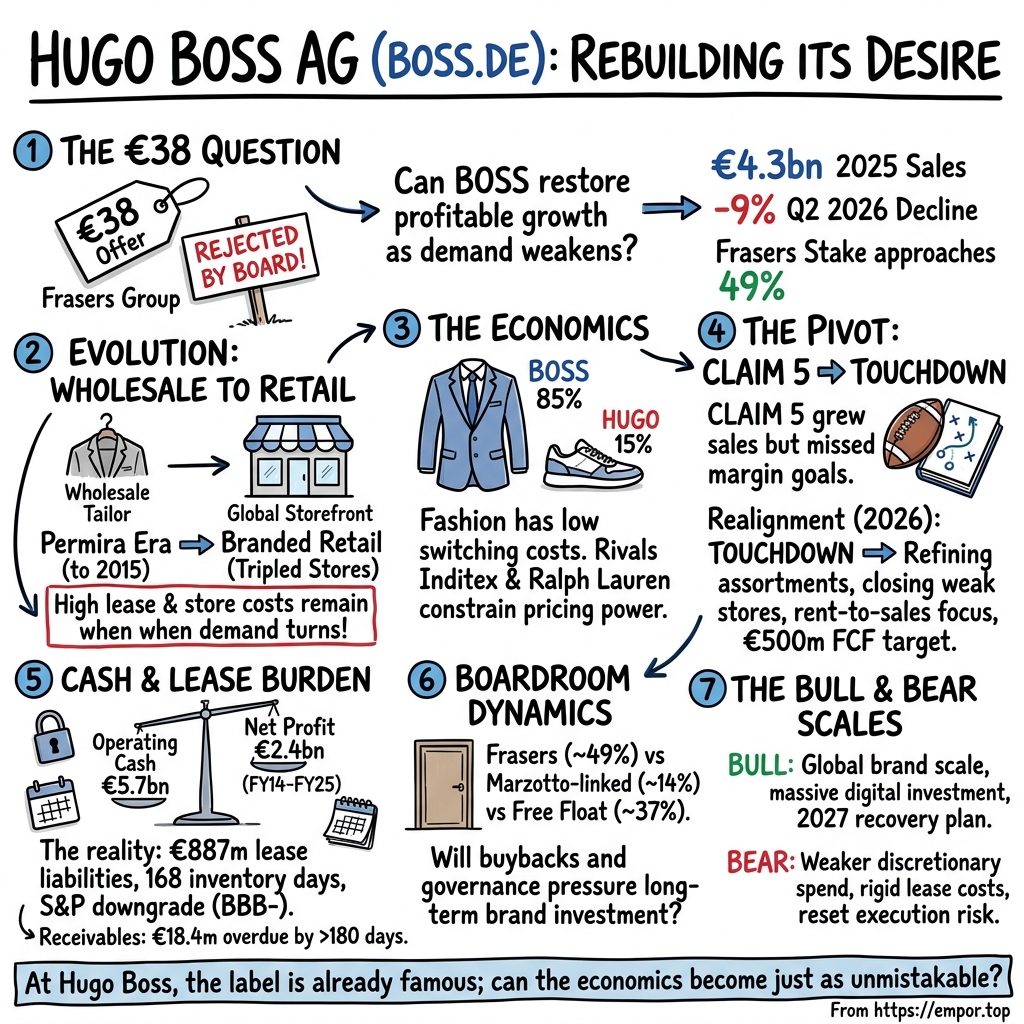
On June 25, 2026, a British retailer best known for Sports Direct put a price on one of Germany's most famous fashion labels. Frasers Group, controlled by Mike Ashley, offered €38 in cash for every Hugo Boss share it did not already own, and said in the same breath that the price was final and would not be raised.12 At the time Frasers already owned about 27% of the company, so the offer covered the remaining 73% and valued that block at roughly €1.9 billion.2
Two weeks later, on July 9, the Managing Board and Supervisory Board in Metzingen replied in a joint reasoned statement. With two outside fairness opinions in hand, they told shareholders not to sell. In their view, €38 did not reflect Hugo Boss's standalone value or its future potential for value creation.3 The company also pointed out that the offer was only about 4% above the undisturbed share price, and suggested that it looked less like a real attempt at control and more like a cheap way for Frasers to raise its stake.4
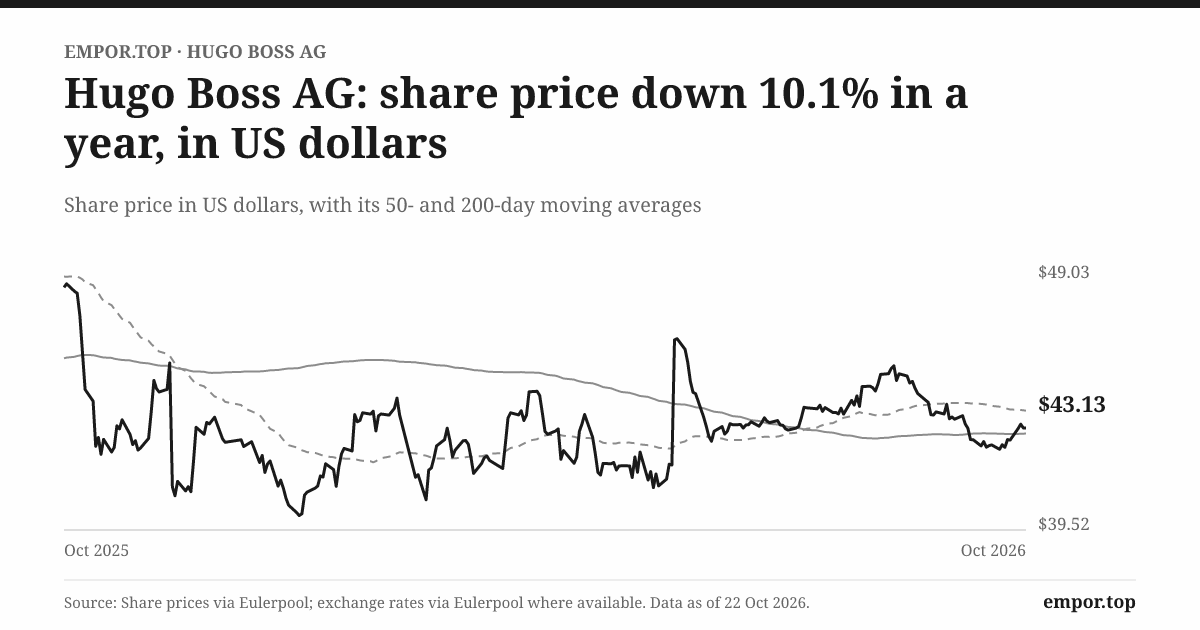
That is roughly how events played out. During the first acceptance period, which ended on July 27, only about 7% of shares were tendered. By the close of the additional period on August 13, tenders had reached about 17.6% of the share capital, which lifted Frasers' direct position plus tendered shares to about 47.9%.1 Frasers then kept buying in the market. On October 19, 2026, Hugo Boss reported that Frasers held approximately 49% of the voting rights. The Marzotto family's two holding companies held about 14%, and the free float had shrunk to about 37%.5 On October 21 the shares closed at €38.40 on XETRA.6 Months after the board called €38 inadequate, the market was paying almost exactly €38.
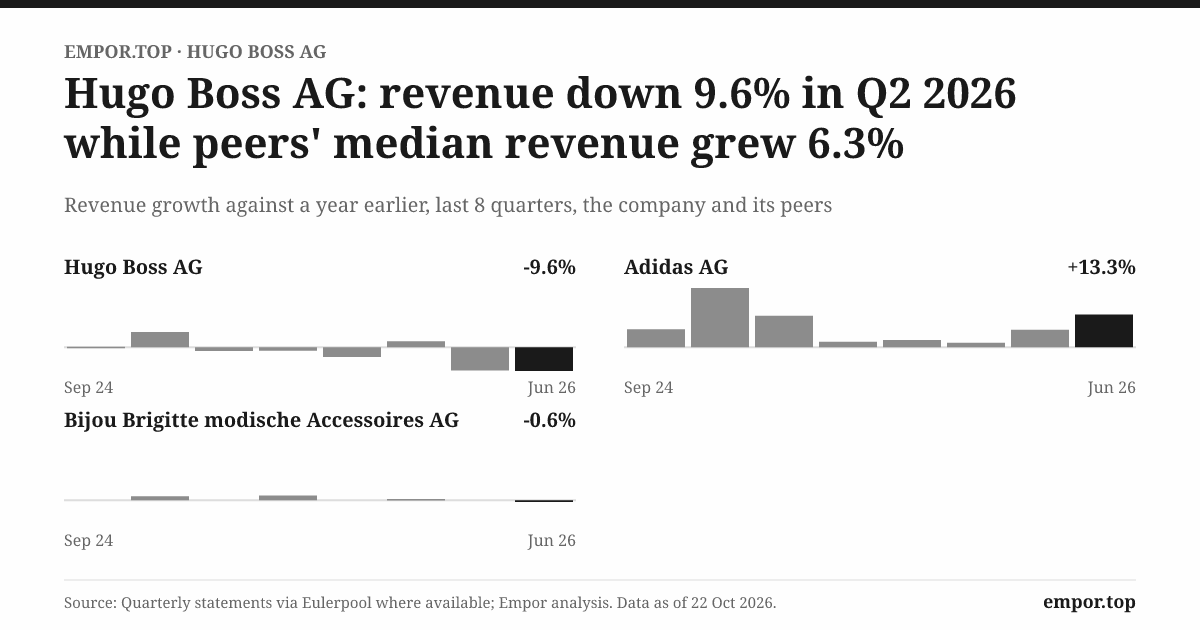
This story starts there because that number poses the question every long-term investor in Hugo Boss now has to answer. What is the company worth if sales are falling, and management says the decline is on purpose? Group sales were about €4.3 billion in 2025.7 In the second quarter of 2026 they fell 9% on a currency-adjusted basis, to €905 million.3 Management describes the decline as a planned reset: weaker wholesale accounts dropped, underperforming stores closed, collections thinned, and discounting reduced. The market's response, at least so far, has been to value the company at roughly the price a determined buyer offered and the board refused.
Before going further it helps to be exact about what the listed company is. Hugo Boss AG, based in Metzingen near Stuttgart, is the parent of a group that designs and sells clothing, shoes and accessories under two brands, BOSS and HUGO. It sells them through its own shops, its own websites, department stores and other wholesale partners, and through licences for products such as fragrances.8 Frasers is a large shareholder, a retailer that stocks the brand, and, since buying three UK outlet centres where Hugo Boss is a tenant, one of Hugo Boss's landlords.9 Frasers is not Hugo Boss's parent. Its offer did not deliver control, and the consolidated accounts in this story belong to Hugo Boss alone.
The story turns on three questions. The first concerns the brand. Can BOSS and HUGO still charge premium prices in a market full of choice, or did the growth of recent years depend on heavy marketing and widening distribution? The second concerns the plan. Can CLAIM 5 TOUCHDOWN, the strategy management launched in December 2025, turn a deliberate retreat in sales into durable profit and cash, or is it the third set of targets in five years? The third concerns ownership. Frasers is a shareholder with nearly half the votes and its own chief executive in the Supervisory Board chair. How will that change governance, the dividend, buybacks and the long-term investment a brand needs?
Management has set out its timetable. It calls 2026 the year of realignment, when currency-adjusted sales are expected to fall by a mid- to high-single-digit percentage and EBIT to come in between €300 million and €350 million, compared with €391 million in 2025. It expects growth to return in 2027, accelerate in 2028, and lift the EBIT margin to about 12% over the medium to long term.10 Those are management's commitments, and the rest of this story tests them. The first test is how a tailoring workshop in a small Swabian town came to sell clothes in more than 130 countries, and what that journey cost.
 Subscribe on LinkedIn
II. From Wholesale Tailor to Global Storefront
Metzingen is a small town at the foot of the Swabian Alb, and the factory that gave the company its name has an uncomfortable origin. Hugo Ferdinand Boss ran a clothing factory there from 1924. In 2011 a company-financed history by the economic historian Roman Köster documented that the factory had made Nazi party uniforms and used about 140 Polish and 40 French forced workers during the war. The company published a statement of "profound regret" to those who suffered there.11 That is the essential background. The modern business, a menswear house built on sharp suits and a bold capitalised logo, was formed in the decades after the war, and the history most relevant to an investor today began much later, when Hugo Boss changed from a company that supplied stores into one that ran them.
That change happened under private equity. Permira's funds controlled Hugo Boss for a little over seven years, a holding that sat alongside Valentino, which they sold in 2012. When Permira's holding company placed its last 12% in March 2015, the firm described the transformation. Hugo Boss had grown from a wholesale supplier into a fast-growing branded retailer, expanded rapidly in Asia, more than tripled its directly operated stores, and reached customers in more than 130 countries.12 After that exit the register was widely dispersed, with no controlling owner.
It is worth spelling out what the change from wholesale to retail involves, because it shapes everything that followed. A wholesaler designs the clothes, makes them, ships them to a department store, and collects payment. The store pays the rent, employs the sales staff, and takes most of the risk when a jacket does not sell. A retailer runs the shop itself. It keeps the full retail price, rather than the discounted wholesale price, and it controls how the brand is presented, from window displays to the music. In return it signs long leases, hires staff, and holds the inventory until a customer buys. In good years that gives a branded retailer higher gross margins and closer ties with customers. In bad years the costs keep running while customers stay away. Permira left Hugo Boss with a much stronger brand presence around the world, and also with a cost structure that is far less forgiving when demand falls.
Profits soon showed that second effect. In 2014, the last full year of the sponsor era, Hugo Boss earned an operating margin of about 17.5%. Over the next five years revenue stayed broadly flat, and by 2019 the margin had fallen to about 11.9%.13 The stores did not close and the brand did not disappear, but each year more of the gross profit went to the costs of running the network, and too little new demand arrived to absorb them. The pandemic then hit hard. Revenue fell by about a third in 2020 and the company made an operating loss, because with shops shut the rent, staff and inventory costs kept running while sales stopped.13
Daniel Grieder arrived with a mandate to fix that. The Supervisory Board named him chief executive in June 2020, and he started on June 1, 2021.14 He is Swiss and spent more than two decades at Tommy Hilfiger, rising to run Tommy Hilfiger Global and PVH Europe from 2014. In the fashion industry he is known as a brand builder: he favours big campaigns, celebrity faces, and a conviction that a heritage label can be made to appeal to younger customers again. The chairman who hired him said Grieder was the board's "top choice" and the man to "steer HUGO BOSS back to sales and profit growth."14 Grieder said in his first months that he saw "very considerable potential."14
He moved quickly. In August 2021 he presented CLAIM 5, which aimed to double sales to €4 billion by 2025 and restore an EBIT margin of about 12%.15 In the recovery from the pandemic, sales grew faster than almost anyone expected. They rose from about €2.8 billion in 2021 to about €4.3 billion by 2024 and 2025. For a German menswear house, that was a remarkable rebound.13
Over a longer period, the record looks more modest. Over the ten years from FY2015 to FY2025, revenue grew about 4.3% a year, which is respectable for a mature apparel company, while net profit fell about 2.4% a year.13 The faster growth of recent years, about 5.4% a year in revenue from FY2022 to FY2025, comes from a short period that started in the pandemic trough, so it is mostly a rebound rather than evidence of a new long-term growth rate.13 Over a full decade Hugo Boss got bigger without getting more profitable. Its 2025 net profit was below its 2014 net profit, even though it sold more clothes to more people in more places.
That leads to the ownership change behind the €38 offer. Frasers' near-half stake has changed the debate over capital allocation. Before looking at the boardroom, though, it is necessary to understand the economics the boardroom is fighting over: where Hugo Boss actually makes its money, and how strong those foundations are.
III. A Suit, a Sneaker, and a Store: Where the Economics Come From
Picture a BOSS store on a European high street in the autumn of 2025. Near the door there is a tailored navy suit. Further in there is a quilted jacket, a pair of white leather sneakers, a technical golf polo from the BOSS Green line, and a camel-coloured overcoat from BOSS Camel. On a screen above the till, David Beckham models the first Beckham x BOSS collections.7 Ten years ago this store would have been mainly about suits. Under CLAIM 5, Grieder's team reshaped BOSS into what it calls a "24/7" lifestyle brand, offering something for the office, the weekend, the gym and the evening.15 The bet was that a man who once bought a BOSS suit every few years could be persuaded to buy BOSS several times a season.
The money machine
The revenue model is simple, and it has no protective structure built in. Hugo Boss designs clothes and accessories, buys them from contract manufacturers, and sells them through four channels. Its own stores generated about €2.2 billion in 2025. Wholesale partners, meaning department stores, specialist retailers and franchise operators, bought about €1.1 billion. Digital sales, both its own website and online partners, were about €0.9 billion, and licences for products such as fragrances and eyewear brought in about €0.1 billion.7 There are no subscriptions, no multi-year contracts and no order backlog that would see the company through a weak season. Each season the company starts again: it has to design a collection, buy fabric months ahead, and then hope consumers want what it has made. The company's own risk disclosures say that volume depends on consumer demand, product appeal, pricing, distribution and inventory availability.8
The mix of brands is lopsided, and that matters for understanding the turnaround. BOSS accounted for about 85% of group sales in 2025, and BOSS Menswear alone generated about €3.3 billion of the €4.3 billion total.7 HUGO, the younger and more fashion-driven brand, contributed about 15%, and BOSS Womenswear only about 7%.10 Management calls BOSS Menswear the "key growth engine."10 It is also the part of the business that has held up best. Its currency-adjusted sales grew 3% in 2025, while Womenswear fell 5% and HUGO fell 4%.7 Much of the public discussion of the turnaround focuses on the problems in Womenswear and the repositioning of HUGO around contemporary tailoring. Together, though, those two businesses make up only about a fifth of sales. Fixing them would help, but if BOSS Menswear starts to slip, the group has a much bigger problem.
The demand engine depends on a few variables that are easy to name and hard to manage. The first is product appeal: whether the clothes look right this season. The second is full-price sell-through, meaning how much of the inventory sells before it is marked down. Every jacket that goes on sale at 40% off reduces gross margin and also teaches customers to wait for the next sale. Store traffic, average selling price, channel mix and inventory availability complete the picture. Fashion novelty can bring a customer into the store, but nothing holds that customer there. A man who likes his BOSS overcoat can buy his next one from Ralph Lauren, Zara or a department-store private label, and it costs him nothing to switch.
Where the brand sits in the fight
Hugo Boss's position in the industry is best described as being in the middle. Spain's Inditex, which owns Zara, had sales of about €39.9 billion in its 2025 fiscal year, roughly nine times Hugo Boss's revenue, and net profit of €6.2 billion, which is more than Hugo Boss's entire market value twice over.16 Inditex is not a direct competitor on price: it sells fast, cheap and often trend-led clothing. But it competes for the same spending and the same high-street locations, and its speed sets the expectations customers bring into every clothing store. H&M and Japan's Fast Retailing, the owner of Uniqlo, compete for basic wardrobe items such as T-shirts and knitwear. Above Hugo Boss, the luxury houses compete for the aspirational customer who wants a label that signals more.
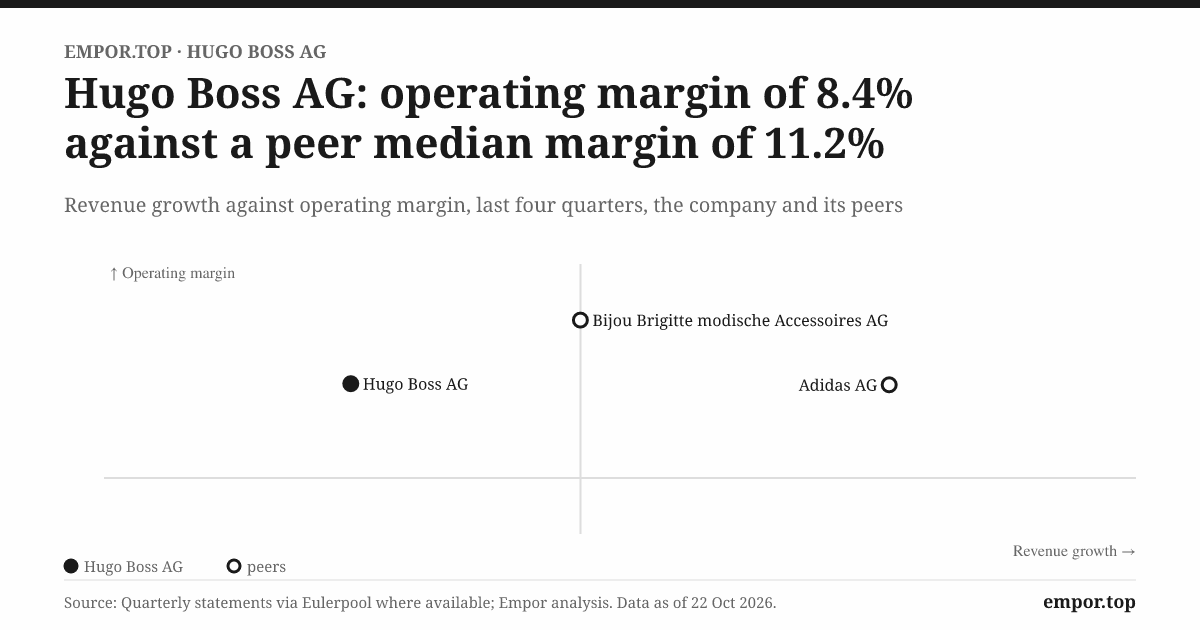
The closest peer by positioning is Ralph Lauren, an American premium lifestyle brand with a similar mix of tailoring, casualwear and accessories and a similar heritage story. The comparison is not flattering for Hugo Boss. In the fiscal year to March 2026, Ralph Lauren's revenue rose 15% to about $8.1 billion, its adjusted operating margin reached 16.0%, and its gross margin was close to 70%. Most strikingly, the company reported that its average unit retail, the price a customer actually paid per item, rose by a mid-teens percentage for the year, driven by product elevation, more full-price selling and lower discount rates.17 Ralph Lauren is showing what premium pricing power looks like: rising prices that customers pay without cutting back. Over the same period Hugo Boss was shrinking, with a gross margin about eight points lower and an operating margin a little over half of Ralph Lauren's adjusted level.7 Both companies sell heritage and lifestyle, and both have roughly similar scale, yet the market rewards one of them with growing pricing power and asks the other to prove it.
Two classic frameworks help clarify the competitive position. Michael Porter's five forces start with buyers. Consumers have an enormous range of choice and face no switching costs. Wholesale customers such as department stores and online platforms can negotiate terms, ask for markdown support, and cut orders when their own inventory is high. Hugo Boss is protected from extreme concentration because no single customer exceeded 10% of revenue in 2025.8 Supplier power is moderate: production is spread across contract manufacturers, and the company has been reducing the number of vendors to gain scale.18 Rivalry is intense, and substitutes, from fast fashion to resale platforms, are everywhere. The threat of new entrants is real but limited, because building a globally recognised brand and a network of stores takes decades and a great deal of money.
Hamilton Helmer's seven powers ask a narrower question: which of them does Hugo Boss actually hold? Network economies, switching costs and cornered resources do not apply in any meaningful way. Scale economies exist in sourcing and logistics, but Inditex is far larger, so they cannot be called a relative advantage. The one candidate is branding, which Helmer defines as the ability to charge more for an objectively identical product because of the buyer's emotional associations with it. BOSS clearly has brand recognition. Its social media following reached almost 30 million in 2026, and its loyalty programme, HUGO BOSS XP, passed 14 million members, 16% more than a year earlier, with younger consumers making up nearly half of new sign-ups.3 But recognition is not the same as branding power in Helmer's sense. The test is price realisation and retention: whether customers pay more and keep returning when times get harder. Hugo Boss's own reporting does not show that it gets better prices or keeps customers longer than its competitors.
The record of the past two years puts that claim under some strain. CLAIM 5 delivered three consecutive years of record sales from 2022 to 2024, and management repeatedly said the brands had gained substantial market share.19 Then demand weakened. Reported group sales slipped in 2025, and in the second quarter of 2026 they fell 9% on a currency-adjusted basis. Even comparable store sales, which measure stores open in both periods, fell 6%.3 A brand with real pricing power should hold up better than the market in a downturn. Ralph Lauren grew through the same consumer environment. Hugo Boss's decline does not prove that the brand has no value. Part of the fall is deliberate, as the company drops weaker wholesale accounts and cuts discounting. What the decline does show is that brand momentum has not protected the group from weak demand or from the cost of repositioning.
There is a clue that points the other way. In the second quarter of 2026 gross margin rose two full percentage points to 64.9%, which management attributed to sourcing efficiencies, targeted price increases and a higher share of full-price sales.3 On the results call, Grieder said that during the CLAIM 5 years the company had put gross margin back into the product, upgrading fabrics and quality rather than raising prices for their own sake, and that the benefit was now coming through.18 If that is right, Hugo Boss is beginning to make the move Ralph Lauren made several years earlier: fewer discounts, better product, and higher prices that customers accept. But one quarter of margin expansion during a year of falling volume is an early sign, not a result. Margins can also rise for a while simply because a company stops chasing low-margin sales.
So the right questions are clear, and many of them do not yet have answers in the company's reporting. How do comparable store sales develop as closures wash through? What is full-price sell-through by season? How does gross margin differ by channel? Can store productivity rise as space shrinks? And do loyalty members buy more often and pay more than other customers? Hugo Boss reports comparable store sales and the size of the XP programme, but it does not publish a comparable series on customer retention, lifetime value or full-price sell-through. On the second-quarter call, an analyst asked why XP membership grew by double digits while the company's own digital channel fell by double digits. Grieder answered that loyalty members shop more online and offline and that the return on investment is good, but he gave no figures.18
Hugo Boss has a broad lifestyle offer, real global reach, a recognised logo and a network of stores and partners that would take a new entrant decades to build. Those are real assets. What the company's own reporting does not show is a protected market position. Its case for winning depends on making the brand more desirable and executing better, which are things management can influence but not guarantee. Investors should therefore see Hugo Boss as a well-placed premium brand without a demonstrated moat. That raises the question the next chapter has to answer: what happened when a growth plan built on that premise ran into weak demand?
IV. The Growth Plan Hit the Reset Button
On December 3, 2025, the management team that had spent four years promoting growth walked back its ambitions. For most of that time the headline numbers had been €5 billion of sales in 2025 and an EBIT margin of at least 12%. That day the company introduced CLAIM 5 TOUCHDOWN, a framework running through 2028, and said 2026 would be a year of "deliberate realignment": currency-adjusted sales would fall, EBIT would drop to €300–350 million, and growth would only resume from 2027.107 The new strategy was written in terms of profitability, cash and the "quality of the business." The word growth was still there, but it now came later in the plan.
To judge whether that was a sensible correction or an admission of failure, it helps to look again at what CLAIM 5 promised. In August 2021 Grieder built the strategy on five pillars: boost the brands, treat product as king, lead in digital, rebalance the mix of channels, and organise for growth. The original target was to double sales to €4 billion by 2025 with an EBIT margin of about 12%. Management also promised cumulative free cash flow of about €2 billion, and gave detailed sub-targets, including more than €1 billion of digital sales and around €800 million for HUGO.15 In June 2023, when the company expected to reach €4 billion two years early, it raised the bar. The 2025 targets became €5 billion of sales and at least €600 million of EBIT, still a margin of 12% or more, together with €3.5 billion for BOSS Menswear, €1 billion for HUGO and about €500 million for Womenswear.20 Grieder said at the time that CLAIM 5 was "the right strategy at the right time."20
What the plan delivered, and what it did not
On sales, CLAIM 5 delivered a large increase. Revenue rose from about €2.8 billion in 2021 to €4.3 billion in 2024 and 2025, and the company really did reach €4 billion two years ahead of schedule.13 Brand awareness rose, campaigns attracted attention, and wholesale partners gave the brands more space. By mid-2024 the company was saying that second-quarter revenue was more than 50% above 2019 levels and that the brands had won substantial market share.19
The profit side is where the plan fell short. EBIT peaked at €410 million in 2023, fell to €361 million in 2024, and recovered to €391 million in 2025, a margin of 9.2%.13 That was well below the €600 million and 12% promised for the same year. The miss on EBIT was about a third of the target, much larger than the miss on sales. Revenue grew by more than half while profit lagged, which points to one conclusion: the extra sales came with extra costs, including marketing, stores, staff, logistics and digital platforms. The group grew larger without becoming proportionally more profitable.
The company can say that it "delivered on 2025 targets," and its full-year press release says exactly that.7 The claim is true only in a narrow sense, and investors should keep the narrow sense in mind. The targets met in 2025 were not the €5 billion and €600 million of 2023. They were the revised annual guidance, which had been reset step by step. The first cut came on July 15, 2024, when management lowered the 2024 forecast to sales of €4.20–4.35 billion and EBIT of €350–430 million, citing "persistent macroeconomic and geopolitical challenges" and particular weakness in the UK and China.19 That warning also showed costs the company controlled: marketing spending had risen 21% in the quarter, and brick-and-mortar retail costs 12%.19 By March 2025 the 2025 guidance pointed to roughly flat sales, which made the €5 billion target unreachable for now.21 So 2025 did meet its target, but the target had been lowered more than once before it was met.
How 2025 was delivered also deserves attention. In the fourth quarter, wholesale deliveries rose 14%, helped by "higher deliveries to selected partners, including a timing shift from Q1 2026 into Q4 2025," and the company deliberately increased promotions in wholesale to clear inventory. Gross margin in that quarter fell 1.6 percentage points.7 The company also said that part of 2025's strong free cash flow reflected "a pull-forward of cash generation from 2026."7 None of this breaks accounting rules, and the company disclosed it openly. But it means some of the strong finish to 2025 was borrowed from 2026, and the first quarter of 2026 showed it, with wholesale sales down 10%, partly reflecting about €20 million of deliveries shifted into December.22
What TOUCHDOWN actually changes
TOUCHDOWN rests on three pillars that management calls brand, distribution and operational excellence.10 Behind the slogans are several concrete choices. Collections are being slimmed, with a target of cutting product complexity by 20% by 2028. The Winter 2026 collection was already a mid-single-digit percentage smaller.3 Underperforming stores are being closed, mostly as leases expire: net 21 stores closed in the first half of 2026, total selling space was down 4% year on year, and the own-store count had already fallen from 1,532 to 1,462 during 2025.313 The company wants better rent-to-sales ratios, a more selective group of wholesale partners with less of the "long tail" of small accounts, and a narrower range in BOSS Womenswear and HUGO.1018 Womenswear is being rebuilt around essentials under a new senior vice president, Kerstin Dorst. Grieder told analysts that the full effect of her collections would only show in the second half of 2027.18
Marketing needs to be judged on its scale. Hugo Boss spent about €303 million, or 7.1% of sales, on marketing in 2025. TOUCHDOWN keeps that ratio at about 7%.710 Beckham x BOSS, the BOSS fashion show in Milan and the sponsorship of tennis players such as Taylor Fritz are ways of reaching consumers.718 They are not proof of additional revenue, and they are not separate growth businesses. During CLAIM 5, marketing spending rose sharply at the same time as profit fell. In the second quarter of 2024, marketing jumped 21% while EBIT fell 42%.19 The fair question is not whether the campaigns are visible, because they plainly are. It is whether they convert into full-price sales, and the company does not publish a measure of that conversion.
The investment cycle has turned. After several years of heavy spending on stores, digital systems and logistics, capital expenditure fell 32% in 2025 to €195 million, or 4.6% of sales, and the target under TOUCHDOWN is 3–4%.710 The largest single project was the expansion of the central distribution centre in Filderstadt near Stuttgart, more than €100 million, which went live in the second quarter of 2026. The CFO said the company expected to save a low double-digit million euro amount each year beginning in the third quarter by bringing HUGO apparel logistics in-house there.318 The strategy is now to use the platform already built rather than keep adding to it. That is the right sequence for a company coming out of an investment phase, but it also concedes that the earlier spending did not deliver the earlier margin targets.
The disclosed development spending fits the same picture. Collection-development research and development expense fell 4% in 2025.8 Hugo Boss does not publish a consistent decade-long series of R&D or headcount relative to sales, so any claim that the product has become step-change more innovative should be tested against launches and sell-through rather than accepted from the presentation slides. The workforce shrank about 6% in 2025, to 17,527 full-time equivalents, which shows that cost discipline is being applied to people as well as stores.7
On capital allocation, no transformative acquisition lies behind the growth story, and none of the recent growth came from buying other companies. The money went into brand building, stores, sourcing, logistics and digital operations, so the right test is whether those investments earn better margins and cash returns, not what multiple was paid for a deal. On that test the record is mixed. The 2025 EBIT margin was below the 2019 margin, even though sales were about 50% higher and several hundred million euros had been invested.13
The new commitments raise a real question. In March 2026 management announced share buybacks of up to €200 million through the end of 2027, and cut the dividend for 2025 to the legal minimum of €0.04 a share, from €1.40, to "preserve financial flexibility."7 At the same time it promised to reduce leverage and protect its investment-grade ratings. That matters because S&P Global had lowered Hugo Boss one notch to BBB−, the lowest investment-grade rating, in December 2025, citing a less supportive financial policy.23 Buybacks, operating investment and a stronger balance sheet all compete for the same cash. A company in a sales decline, rated one notch above junk by one agency, has chosen to keep a nine-figure buyback programme while cutting the dividend to almost nothing. That choice may be defensible, but it needs to be examined directly.
Management's credibility is best measured by how its story has changed over time. In early 2024 the message was momentum and market-share gains. In July 2024 it was the macroeconomic environment, though the release also acknowledged that marketing and retail costs had grown faster than sales.19 In March 2025 it was cost discipline and efficiency, with Grieder promising "a relentless focus on maintaining cost discipline and driving additional efficiencies."21 By March 2026 it was deliberate realignment.7 On the second-quarter 2026 call, the explanations were more concrete than they had been. The CFO broke the gross-margin gain down into sourcing, full-price sales, lower markdowns and pricing, and Grieder admitted that wholesale order intake for upcoming seasons was "below prior-year levels," which he described as a conscious choice to drop low-quality volume.18 Shareholders now get more explanation of factors management controls than they did in 2024. What they have not yet seen is a recovery that matches the plan, and the recovery assumption, growth from 2027, has not been tested.
CLAIM 5 delivered a real increase in sales and awareness, but it did not deliver the profit level it promised. TOUCHDOWN is more honest about trade-offs. Its credibility will depend on two things that can be measured: whether growth returns in 2027, and how much cash is left after the stores' rent is paid. That second measure is where the story goes next, because Hugo Boss's cash flow looks very different depending on whether the leases are counted.
V. When the Cash Arrives Before the Earnings
Over the twelve years from FY2014 to FY2025, Hugo Boss reported cumulative net profit of about €2.4 billion. Over the same period it generated about €5.7 billion of cash from operations, almost two and a half times as much.13 For a casual reader that looks like an exceptionally cash-rich business. In fact it is the starting point for the most important adjustment in this story.
Several things explain why operating cash is so much higher than profit. The first is depreciation, the accounting charge that spreads the cost of a store fit-out or a warehouse over its useful life. It reduces profit but costs no cash in the year it is charged. The second applies to every retailer reporting under IFRS 16, the lease accounting standard introduced in 2019. Since then a store lease has been treated as if the company had borrowed money to buy the right to use the shop. The building appears on the balance sheet as a "right-of-use asset" and the rent obligation as a lease liability. Each year the asset is depreciated and the liability is paid down. The key consequence is that the part of the rent that repays the lease liability no longer runs through operating cash flow. It appears further down, under financing, as if it were the repayment of a loan. Operating cash flow therefore looks much stronger than it would have under the old rules, even though the landlord is paid exactly the same amount.
That is why the definition of free cash flow matters. Hugo Boss reported free cash flow of €499 million in 2025, essentially unchanged from 2024.7 The company defines this as cash from operations, minus investing outflows, before lease repayments. It calls this "free cash flow before leases (i.e., including the impact of IFRS 16)."7 Total cash paid for leases in 2025 was about €436 million.8 Part of that, mostly variable and short-term rents, is already deducted inside operating cash flow. The rest, the repayment of capitalised leases, is not deducted in the €499 million figure. Management's own targets show how large that remainder is. Under TOUCHDOWN it aims for about €500 million a year of free cash flow before leases and about €300 million after them.7 On that basis, roughly €200 million a year of cash that the headline figure calls free in fact goes to landlords. It is not available for dividends, buybacks or paying down debt.
The twelve-year record also shows where the money went. Cumulative free cash flow on the basic definition, operating cash minus capital expenditure, was about €3.6 billion, and dividends absorbed about 44% of it.13 Cash and short-term investments rose only about €200 million over the whole period. Most of the remainder went to landlords through lease repayments booked under financing, with interest and other financing flows taking the rest. The headline cash generation was real, but much of it was committed to obligations before shareholders received anything.
The balance sheet tells the same story. At the end of 2025 Hugo Boss had financial liabilities of about €296 million and cash of about €343 million. Excluding leases, it had a small net cash position, which the company reported as plus €48 million.78 Including lease liabilities of €887 million, net debt was €839 million.7 The undiscounted lease commitments, meaning all future rents payable without discounting, were about €991 million, of which €227 million was due within a year.8 To call Hugo Boss debt-free would ignore the obligation that matters most. The leases are the company's real debt, and they cannot be renegotiated simply because a season goes badly.
Working capital adds a further complication. Inventory is the largest item. In 2023, as sales grew and the company bought ahead, free cash flow collapsed to about €96 million because cash was tied up in stock.13 Since then the company has reversed that build-up. Inventory days have fallen to about 168, the lowest level in more than a decade, and at the end of 2025 inventory was 21.5% of sales, down from 24.9% a year earlier.137 By June 2026 inventory had fallen another 15%.3 That improvement is genuine and sustainable to the extent that it reflects tighter buying and simpler collections. Other parts of working capital moved the other way. Debtor days rose to about 38 and payable days fell to about 97.13 In its 2025 cash-flow commentary, management explained that lower trade payables had offset the benefits of lower inventory and higher EBIT.8 As a result, operating cash flow fell from €786 million to €692 million in 2025.8 Hugo Boss was paying its suppliers faster and being paid more slowly by its customers. The next section looks closely at the second of those effects.
The credit agencies took a measured view. Moody's reaffirmed its Baa2 rating, one notch above the lowest investment grade, during 2025. S&P lowered the rating one notch to BBB− in December 2025, citing a less supportive financial policy, including a target leverage range of 1.0–2.0 times.23 A year earlier S&P had already warned that adjusted debt to EBITDA had reached about 1.4 times, close to the 1.5 times level at which it would consider a downgrade, and pointed to deteriorating working capital and falling cash.24 For liquidity, the company has a new €600 million revolving credit facility linked to sustainability targets, with no financial covenants, and a €500 million commercial-paper programme on which nothing was outstanding at year-end.23 Access to credit is not the concern. The concern is that the agencies have signalled their limits, and buybacks financed during a sales decline would bring the company closer to them.
The real stress tests are not exotic. A weaker consumer reduces sales while store rents stay the same. The second quarter of 2026 showed this: operating expenses fell 4%, but because sales fell 10%, the cost ratio still rose sharply.3 Adverse currency moves and supplier price increases can squeeze margins. Hugo Boss hedges forecast transactions and balance-sheet exposures with derivatives and publishes sensitivities, but hedging only delays the effect of a move; it does not remove the translation or transaction risk of earning in many currencies and reporting in euros.8 In 2025, reported sales fell 1% while currency-adjusted sales rose 2%, which shows that currency is a recurring difference between management's preferred measure and the euros shareholders actually receive.7
Legal or tax shocks are a lesser concern on the evidence available. The annual report contains the usual provisions and contingent-liability notes, and the auditor's report for 2025 includes no emphasis-of-matter paragraph. The company's disclosures for 2025 do not identify any single lawsuit or regulatory case as material to the business.8 That is a narrow finding about one year's disclosures, not a general assurance, but it does mean that the main balance-sheet risk is the familiar one: leases, inventory and the customers who owe the company money.
Cash conversion at Hugo Boss is strong, but operating cash is not the same as shareholder cash. Leases, capital spending and working-capital swings take a large share of it. The after-lease target of about €300 million a year is a useful test, provided the company reports against it consistently, and management has already said that 2026 will fall short of that average because some of the cash arrived in 2025.7 One part of the working-capital picture deserves its own examination: the receivables the company carries for wholesale and concession partners, especially the oldest of them.
VI. The Receivable That Took 180 Days
In the receivables note of the 2025 annual report, among routine tables, there is one figure that stands out. At December 31, 2025, Hugo Boss was owed €18.4 million by trading partners whose payments were more than 180 days overdue.8 Some of those invoices had been due since before the summer. Measured against €4.3 billion of sales, the amount is small. As a signal about the health of the company's distribution partners, it deserves attention.
The ageing table puts the figure in context. Net trade receivables at year-end were €386 million, up from €362 million a year earlier, even though sales were flat.8 Gross receivables before allowances were about €414 million. Of that, €336 million was not yet due. That is the reassuring part: most of the money owed was simply invoices that had not reached their payment date. About €61.7 million was overdue, including the €18.4 million more than 180 days late. The company held allowances of €27.8 million against expected losses, up from €22.9 million in 2024, and was still trying to recover €9.0 million of balances it had already written off, up from €7.3 million.8 Receivables rose, the allowance rose by about a fifth, and the pool of written-off balances under recovery grew. None of those moves is alarming on its own, but they all point the same way.
It is clear who owes the money. Customers in Hugo Boss's own stores and on its website pay at the till. The receivables come from wholesale customers, meaning department stores, multi-brand retailers, online platforms and franchise partners, and from concession partners, which host Hugo Boss shop-in-shops and pass sales proceeds through. Hugo Boss explicitly warns in its annual report that if the financial position of wholesale customers and concession partners worsens, write-offs could exceed the allowances already booked.8 This is not a hidden risk. The company has identified it in writing.
The timing matters. European department stores have been under pressure for years. The wholesale channel is where Hugo Boss is now cutting the weakest accounts, and its partners are buying cautiously. Grieder told analysts in August that wholesale partners continued to show "inventory discipline," and that order intake was below the previous year.18 When the customers you sell to on credit are buying less and managing their stock more tightly, the ones that can no longer pay become more visible. The 180-day bucket is where those customers appear first.
The company describes reasonable controls. It says it runs credit checks before supplying new partners, sets customer credit limits, monitors receivables by age, and retains ownership of goods until they are paid for in full.8 Retention of title is an important protection: if a partner fails, Hugo Boss can in principle reclaim unsold stock rather than join the queue of unsecured creditors. The test of those controls is the result, not their description. The figures to watch are how much of the overdue 2025 balance was collected during 2026, how much was written off, and whether the allowance had to increase again. The 2026 annual report will answer that, and those answers will show more about the quality of the channel than anything said at a capital markets day.
There is an encouraging early sign. By June 30, 2026, trade receivables had fallen 12% on a currency-adjusted basis, to €289 million, from €325 million a year earlier.3 Some of that reflects lower wholesale sales and the normal seasonal pattern. Mid-year receivables are typically lower than year-end, after the autumn shipments. But it shows that the company is not inflating sales by extending easy credit to partners in a weak market. Comparing the same date a year apart is the cleanest comparison available, and it is moving in the right direction.
Supplier finance belongs in the same picture, because it affects the other side of working capital. Hugo Boss runs supply-chain finance programmes that let suppliers receive early payment from banks against invoices Hugo Boss has approved. At the end of 2025 the programmes had a combined limit of €255 million, of which €110 million was used, down from €148 million used at the end of 2024.8 For suppliers, such programmes provide cheap and quick liquidity. For the buyer, they support longer payment terms, which flatter operating cash flow. The decline in usage helps explain why trade payables fell and why operating cash flow weakened in 2025: Hugo Boss relied less on that financing. It is a reasonable step towards a more conservative balance sheet. Investors should still treat supplier finance as a source of funding to monitor, because if the banks withdrew or the terms worsened, payables could fall quickly and take operating cash with them.
The scale of the exposure needs to be kept clear. Customer exposure is spread across many partners, with no single account exceeding 10% of 2025 revenue.8 The credit risk is spread across many partners, so the failure of one department-store chain would hurt without being fatal. But spreading exposure does not prevent losses across the whole wholesale channel if many partners weaken at the same time, which is exactly what happens in a European consumer downturn. Most of the money Hugo Boss is owed is current, and the controls look sensible, but the oldest bucket and the rising allowance make collections a meaningful test of how healthy the remaining partners are. The answer will come from cash collected and balances written off, not from management's description of the channel.
One partner sits in the middle of these issues. It is a wholesale customer, a landlord, the largest shareholder and, since September, the source of the Supervisory Board chairman. Hugo Boss's governance is now being decided as much by the Frasers relationship as by the strategy.
VII. Frasers Arrives at the Boardroom Door
Mike Ashley built Sports Direct into a British retail empire, and in the process acquired a reputation for building stakes in other companies, often partly through derivatives, and then pressing their boards. Frasers Group, the company that grew out of Sports Direct and that his son-in-law Michael Murray has run as chief executive since 2022, sells Hugo Boss products in its own stores and online.425 For years it was one shareholder among many in Metzingen. Then its position grew far beyond that.
The increase was steady before it became sudden. At the end of 2024 Frasers held 19.25% of the voting rights directly and another 8.95% through instruments. By the end of 2025 it held 25.21% directly and a further 32% through instruments, mainly put options. These are contracts under which other parties can require Frasers to buy shares at agreed prices, which give it economic exposure without owning the shares outright.26 In May 2025 Murray was elected to the Supervisory Board at the annual general meeting.25 Six months later, according to German press reports, Frasers withdrew its confidence in Stephan Sturm, the chairman elected at the same meeting, and the two sides had disagreed over a dividend payment.27 In March 2026 the company cut the dividend to the legal minimum.7
The offer as a market test
Then came the offer. The €38 bid was well designed as a way to test the market. Under German takeover law, once Frasers crossed 30% of the voting rights it would normally have to make a mandatory bid. A voluntary offer made in advance satisfied that requirement at a price Frasers chose, without forcing it to pay a control premium in the usual sense. The offer's single completion condition was satisfied on July 27, so it went ahead however few shareholders accepted.1 The boards' response, that the price undervalued the company's standalone worth, was predictable, and the reasoned statement backed it with two independent fairness opinions.3 Hugo Boss booked one-off costs in the mid-single-digit millions of euros in the second quarter related to the offer.3
The result can be read in more than one way. Holders of roughly three-quarters of the shares the offer reached, including the Marzotto family, chose not to sell at €38.15 That supports the board's view that the price was too low. But the shares then traded near €38 for months, so the market did not offer much more either.6 An offer price is not a measure of intrinsic value. It is the price at which one buyer is willing to buy a particular block on a particular day. Here it fixed a reference point: €38 is roughly the price at which long-term holders refused to sell and new buyers declined to pay much more. The offer did not secure control. Frasers has since kept buying, with a further voting-rights notification received on September 14, and has said it wants to go above 50%.2825
The related-party question can be answered from the filings. Frasers acquired three UK outlet centres in which Hugo Boss is a tenant. The existing leases continued unchanged, on terms the company describes as arm's length, and at June 30, 2026 they accounted for €3 million of lease liabilities. Hugo Boss bought no goods from Frasers in the first half of 2026.9 Against annual sales of €4.3 billion and lease liabilities of nearly €900 million, those amounts are very small. Frasers' purchases of Hugo Boss products for its stores are limited by the fact that no single customer exceeded 10% of revenue.8 On the disclosed figures, the commercial ties are minor. What matters is that the counterparty is now the controlling voice on the board, which is why lease renewals, wholesale terms and any new commercial arrangements with Frasers deserve continuing and detailed disclosure.
From shareholder to chairman
Governance should be judged by what happens, not by assumptions about strategic benefit, and events moved quickly in September. On August 4, Grieder told analysts that Frasers had "fully support[ed] the Chairman of the Supervisory Board and the entire Managing Board" in its offer document, and that Frasers had reconfirmed this after market rumours.18 Six weeks later, on September 14, Hugo Boss announced that Sturm would leave the Supervisory Board effective October 15, after "constructive discussions against the backdrop of recent changes in the shareholder structure."27 Within days the board elected Murray as chairman, and Robert Palmer, a director of Frasers Group Financial Services, was proposed for a second Frasers seat, subject to court appointment.25 On September 28 the company announced that Yves Müller, its chief financial officer and chief operating officer, would leave the Managing Board "at his own request and for personal reasons." He was replaced from October 1 by Ivica Maric, an internal executive who had been running day-to-day business operations.29 Murray said he intended to "support the implementation of strategic priorities" under the existing plan.25
The sequence is worth setting out without exaggeration. Frasers owns about 49% of the votes, not more than 50%. It does not formally control the company. But it chairs the supervisory board, which appoints and dismisses the Managing Board under German corporate law, and it has seen the chairman it lost confidence in leave and the finance chief change. The chief executive's August statement that Frasers supported the chairman did not survive the autumn. This does not show that anyone behaved improperly. It does show that the balance of power in Metzingen has changed, and that public statements from the company about shareholder relations should be read in that light.
Management pay belongs alongside the operating record. For 2025, Grieder received a short-term incentive payout of about €1.32 million, based on 80% overall target achievement for the Managing Board. The long-term incentive tranche for 2022–2025 paid about €2.45 million, at 143% of target.30 The long-term scheme combines sales, EBIT, return on capital employed and non-financial goals. Over that period sales rose strongly and EBIT increased from 2022 levels, so the payout has some basis in results. But 2025 EBIT of €391 million was below the 2023 peak and about a third below the €600 million the company had told investors to expect that year.1320 A long-term incentive that pays out at well above target in the year the company's main public target was clearly missed raises a reasonable question about how the targets were calibrated and weighted. The answer depends on the detailed scorecard, but shareholders are entitled to ask.
They have done so. At the May 2025 AGM, the 2024 compensation report received 67.96% approval and the revised compensation system 71.05%. That is a clear signal in a market where proposals of this kind usually pass with more than 90%. The 2021 system had received 93.83%.30 The boards attributed the dissent mainly to concerns about a "CEO Investment Opportunity," an arrangement outside the formal pay system.30 These votes are material governance signals, not evidence of misconduct. They show that before Frasers took over the board, a significant minority of shareholders already doubted the alignment between pay and performance.
The capital structure has also been reorganised. At the 2026 AGM, shareholders approved cancelling 1.384 million treasury shares left over from a 2004–2007 buyback, reducing the share count from 70.4 million to about 69.0 million. They also renewed authority to buy back up to 10% of the share capital until May 2030 and authorised up to €800 million of convertible or warrant-linked instruments.31 No rights issue or other equity raising has taken place recently. But the authorisations give the board, which now has a Frasers chairman, considerable room to act in either direction.
A skeptical investor would raise two challenges. The first concerns capital allocation. Is spending up to €200 million on buybacks the right use of cash when one agency rates the company one notch above junk, lease-adjusted net debt exceeds €800 million, and sales are falling? Buybacks also have a governance effect: each share repurchased and cancelled increases Frasers' percentage without Frasers spending anything. At about 49%, a buyback of a few percent of the share count would take Frasers over 50%. That is arithmetic, not an accusation, but it means the free-float shareholders need to see buyback decisions explained on their merits. The second challenge concerns the brand. Frasers is a value-oriented retailer that has done well by buying cheaply and running tight operations. Hugo Boss needs to invest steadily in marketing, product and store quality to rebuild demand. Can the largest shareholder press for returns without undermining that investment? Nobody yet knows, which is why the next two years of board decisions matter as much as the next two years of sales.
VIII. Analysis & Bear vs. Bull Case
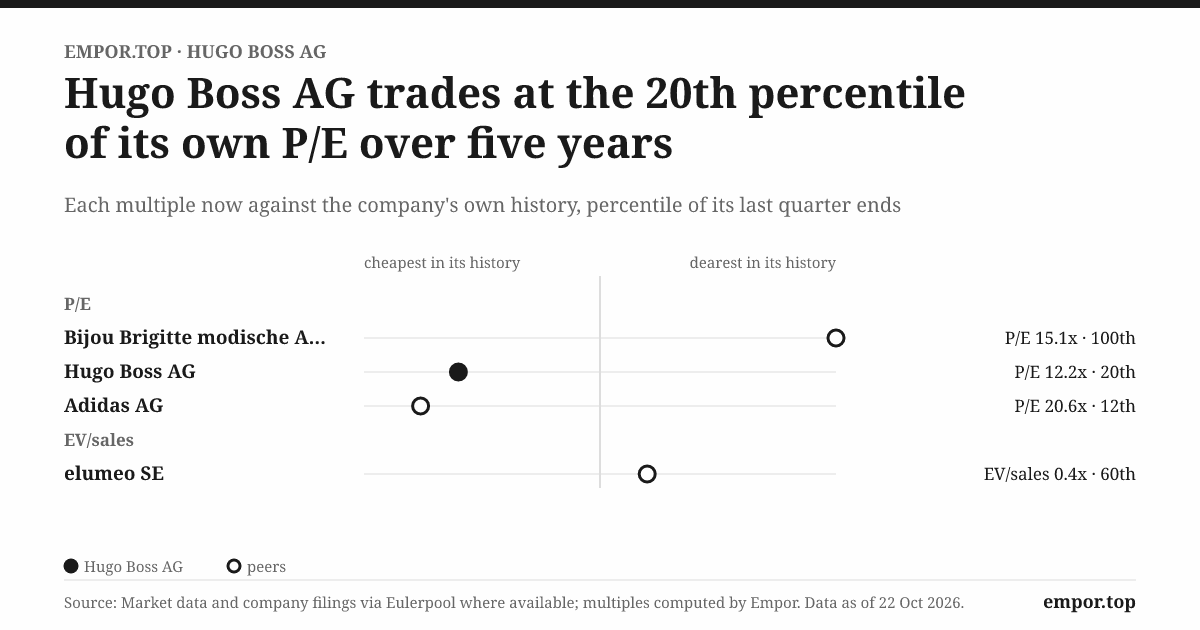
On October 22, 2026, Hugo Boss traded at about €38.50 a share, a market value of about €2.7 billion. Adding net debt, including leases, gives an enterprise value of about €3.4 billion.613 On trailing earnings the shares trade at about 12.2 times, compared with a five-year median of about 15.2 times.69 The obvious reading is that the company is cheap compared with its own history. Whether it is cheap relative to its risk is a different question.
The trailing multiple flatters the picture, so the calculation is worth doing step by step. Trailing earnings include the strong fourth quarter of 2025, which was boosted by deliveries pulled forward from 2026. Management expects 2026 net income to fall "broadly in line with EBIT," and EBIT guidance of €300–350 million implies a decline of roughly 10–23% from €391 million.3 If earnings fall by that much, the multiple on 2026 earnings would be in the low-to-mid teens rather than 12. The discount to history would be much smaller. The market is not ignoring the reset. It is valuing the company on the earnings the reset will leave behind.
The free cash flow yield needs the same adjustment. On the company's preferred definition of free cash flow before lease repayments, the yield is about 22.5%, which is unusually high.7 Using management's own after-lease target of about €300 million a year, and a market value of €2.7 billion, the yield is closer to 11%.7 That is still a substantial yield, and the company has said 2026 will be below that average. Any comparison with peers must be made on the same lease treatment, because American companies reporting under US GAAP, such as Ralph Lauren, show operating leases differently, and a mismatched comparison would give a misleading result.
The case for recovery
The bull case starts with assets. BOSS is a globally recognised brand with a broad lifestyle range, from tailoring to sportswear. It has direct access to customers through about 1,460 of its own stores and a growing loyalty programme, and a supply chain and logistics network built with heavy investment that now needs less capital.133 The first evidence from the reset supports that view. Gross margin in the second quarter rose two percentage points despite falling sales. Inventory fell 15% year on year. Free cash flow before leases was €105 million in the quarter, and comparable store sales held up better than total retail.3 If full-price sell-through and store productivity keep improving as the network shrinks, the platform could produce better margins on a smaller but healthier sales base. Then, when demand returns, the operating leverage of a lower-cost Hugo Boss would raise EBIT faster than sales. On this view, the €38 offer was opportunistic and well timed, and the market is valuing the company at the low point of its cycle.
The case against
The bear case starts with the lack of a demonstrated moat. Demand for premium apparel is discretionary. The evidence for pricing power in Helmer's sense, higher prices than competitors and better customer retention, is thin. Ralph Lauren grew 12% at constant currency, with prices per item up by a mid-teens percentage, over the same period in which Hugo Boss shrank. That shows the environment did not prevent a premium brand from growing.17 The 2026 reset combines falling sales with execution risk on several fronts at once: a Womenswear relaunch whose collections only fully arrive in late 2027, a HUGO repositioning in which sales fell 14% in the second quarter, a wholesale clean-up that reduces order books, and a new CFO who arrived in the middle of the process.31829 Europe, about 65% of the business, is where demand is weakest.18 If the recovery in 2027 comes late, the lease costs will still be there, and so will the temptation to use discounting to clear stock.
Under credit stress the picture is mixed. The company remains investment grade and has an undrawn €600 million facility without covenants, so refinancing risk is low.23 But S&P's downgrade and lease-inclusive net debt of €839 million put the balance sheet in sharper focus; that is between two and a half and three times the EBIT management expects for 2026, despite near-zero net debt excluding leases.723
The competitive frameworks point to the same conclusion: Hugo Boss has little structural protection, and its branding power remains unproven. That does not mean Hugo Boss will fail to recover. Many brands without a moat earn good returns through good execution. It does mean that the recovery depends on execution rather than on structural protection, so the right valuation multiple is lower and the evidence needed is greater.
Three measures will show which case is right. The first is currency-adjusted sales by brand and region, especially BOSS Menswear and EMEA. In the second quarter of 2026, group sales fell 9%, BOSS fell 8% and EMEA fell 13%.3 The second is the EBIT margin, which in the second quarter fell to 6.5% from 8.1% because the gross-margin gain was outweighed by fixed costs spread over lower sales.3 The third is inventory as a share of sales, read alongside free cash flow after lease payments. Inventory improved to 23.1% of sales at the end of June from 25.5% a year earlier, and management's 2028 target is about 20%.310 Rising sales with stable or higher margins and lean inventory would support the bull case. Further falls in sales, margins squeezed by costs, and inventory building up again would support the bear case.
The current position can be summarised neutrally. The brand and the distribution platform give Hugo Boss a credible route to recovery, and the first operating evidence, on margins, inventory and cash, is moving in the right direction. But the filings do not yet show that Hugo Boss can defend premium economics through a downturn. The low multiple is a discount to the company's own recent history. It is not proof that the stock is mispriced, because the history it is being compared with includes targets the company later abandoned. The next evidence will come from growth and margin delivery in 2027, not from another campaign.
IX. Playbook: Business & Investing Lessons
Hugo Boss took a famous label close to its sales targets and then had to change course. The lessons that follow belong to this company, but they apply well beyond Metzingen.
The first lesson comes from CLAIM 5's record years: a brand can travel further than its margins. Between 2021 and 2024 Hugo Boss added about €1.5 billion of sales. It went to new markets, opened stores, signed celebrity partnerships and gained space in department stores. The 12% EBIT margin it promised did not follow.13 Growth in a branded business is not the same as growth in profit when every additional euro of sales comes with additional rent, marketing and staff costs. Founders and investors should look at incremental margins, the profit earned on each additional euro of sales, not total sales. A brand that is reaching new customers but not earning more from each of them is buying its growth.
The second lesson comes from the store network: the shop window is also a lease. Permira's change from wholesale to retail gave Hugo Boss control of its brand presentation and closer contact with customers. It also left the company with about €1 billion of future rent commitments that must be paid whatever the season brings.812 Direct retail deepens the customer relationship, but the lease payments continue after the fashion season ends. Any analysis of a retailer that treats lease liabilities as an accounting technicality, as headline free cash flow and net cash figures invite readers to do, misses where the fixed costs actually are.
The third lesson comes from the twelve-year cash record: cash is a clue, not a verdict. Hugo Boss generated operating cash of almost two and a half times its net profit, which sounds impressive until the leases, inventory swings and capital spending are subtracted.13 In 2023 free cash flow almost disappeared because the company was buying stock for a boom that was beginning to slow, and in 2025 it was boosted by cash pulled forward from 2026.137 The quality of cash flow depends on what produced it. Investors should look at multi-year averages after all claims on that cash, and be skeptical of any single strong year.
The fourth lesson comes from the pay report: a target is only as demanding as its design. A long-term incentive paid out at 143% of target in the year the company missed its main public profit target by about a third, and shareholders approved the pay report with under 68% of the vote, against almost 94% for the 2021 pay system.30 Incentives should be judged by outcomes, calibration and shareholder response, not by how large the payout is. The useful question for any board is whether a bonus scheme would have paid out if the company had told investors the truth about its targets two years in advance.
All of these lessons point back to the investment question. Lasting value at Hugo Boss requires proof of full-price demand and profitable growth. Reach, activity and a new name for the strategy are not enough.
X. Epilogue
As of the evening of October 22, 2026, Hugo Boss is smaller than it was a year ago and is earning a higher gross margin. Its governance has shifted, Grieder remains in charge of the Managing Board, and its new finance chief has been in the job for three weeks.2529 Management's message has not changed: 2026 is the year of realignment, and growth returns in 2027.3
The next important date is November 3, 2026, when Hugo Boss reports its third-quarter results.3 That report will show whether the improvement in gross margin continued through the summer, when weak tourism and the Middle East disruption hit the European business, and whether EBIT for 2026 is still on track for €300–350 million. A result near the top of that range would suggest the cost base is adjusting faster than sales are falling. A downgrade of guidance during the year of realignment would damage the credibility of a strategy built on being realistic.
After that come the indicators that will determine the turnaround. Inventory needs to fall towards management's 2028 target of about 20% of sales, and trade net working capital needs to stay within management's 18–20% range, without discounting to clear stock.10 Order books for the 2027 seasons need to stop shrinking. Grieder has admitted that order intake is still below last year and has presented that as a deliberate choice.18 The Womenswear relaunch will be judged on the collections arriving in the second half of 2027. Most importantly, sales growth has to return in 2027 without a fall in margins, because a recovery in volume bought through promotions would just repeat the CLAIM 5 years.
On future calls, investors will want management to quantify things it has so far described only in words: full-price sell-through, profitability by store, mix between channels, the economics of the new brand structure, and whether XP members spend more over time. The more management puts numbers on these, the easier it will be to judge whether TOUCHDOWN is working.
The ownership question will be decided at the same time. Investors will watch whether Frasers goes above 50%, how buyback decisions are explained, whether the dividend policy changes, how future lease renewals in Frasers properties are priced, and whether leverage actually falls as promised.
The central tension remains. A global premium label has the platform to recover, a cost base that is shrinking, and a major shareholder that wants to see results. Only reported demand and margins can show whether the platform earns its keep, and the clearest evidence will come in 2027.
XI. Outro
The €38 offer remains the reference point; the next few seasons will put a number on the strategy.
Hugo Boss has spent a century building a name that people recognise in airport lounges and on high streets from Metzingen to Melbourne. What it has not yet shown is the pricing power to match that recognition.
References
-
Frasers Group Reaches 47.89% Hugo Boss Position Through €38 Per Share Takeover Offer — Pulse 2.0, 2026-08-18 ↩↩↩↩
-
Frasers Group Confirms €38 a Share Hugo Boss Takeover Offer Is Final — TheIndustry.fashion, 2026-06-25 ↩↩
-
Quartalsmitteilung zum Q2 2026 — HUGO BOSS AG, 2026-08-04 ↩↩↩↩↩↩↩↩↩↩↩↩↩↩↩↩↩↩↩↩↩↩
-
Frasers Raises Hugo Boss Stake to Nearly 48% After Takeover Offer — The Edge Malaysia (Bloomberg), 2026-08-18 ↩↩
-
Shareholder Structure, as of October 19, 2026 — HUGO BOSS AG ↩↩
-
Frasers Group Increases Stake in Hugo Boss Stock — ad-hoc-news.de, 2026-10-22 ↩↩↩↩
-
Press Release on the Full-Year 2025 Results — HUGO BOSS AG, 2026-03-10 ↩↩↩↩↩↩↩↩↩↩↩↩↩↩↩↩↩↩↩↩↩↩↩↩↩↩↩↩↩
-
Annual Report 2025 PDF — HUGO BOSS AG, 2026 ↩↩↩↩↩↩↩↩↩↩↩↩↩↩↩↩↩↩↩↩
-
CLAIM 5 TOUCHDOWN — HUGO BOSS Annual Report 2025, 2026 ↩↩↩↩↩↩↩↩↩↩
-
Hugo Boss Apologizes for Its Forced Labor Under Nazis — JTA, 2011-09-22 ↩
-
Permira IV Exits Hugo Boss After Over Seven Years — Permira, 2015-03-17 ↩↩
-
Ten-Year Overview — HUGO BOSS Annual Report 2025, 2026 ↩↩↩↩↩↩↩↩↩↩↩↩↩↩↩↩↩↩↩↩
-
Daniel Grieder Named CEO of HUGO BOSS AG — HUGO BOSS AG, 2020-06-16 ↩↩↩
-
HUGO BOSS Presents New Growth Strategy 'CLAIM 5' Aimed at Doubling Sales to EUR 4 Billion by 2025 — HUGO BOSS AG, 2021-08-04 ↩↩↩
-
Inditex Posts 6.22 Billion Euro Profit in 2025 and 3.19 Percent Sales Growth — FashionUnited, 2026-03-11 ↩
-
Ralph Lauren Reports Fourth Quarter and Full Year Fiscal 2026 Results, Form 8-K Exhibit 99.1 — Ralph Lauren Corporation, 2026-05-21 ↩↩
-
Transcript – Q&A Session, Second Quarter 2026 Results — HUGO BOSS AG, 2026-08-04 ↩↩↩↩↩↩↩↩↩↩↩↩↩
-
HUGO BOSS Announces Preliminary Second Quarter Results and Updates Its Full-Year 2024 Outlook — HUGO BOSS AG, 2024-07-15 ↩↩↩↩↩↩
-
HUGO BOSS Presents Update on "CLAIM 5" – 2025 Sales Ambition Raised to EUR 5 Billion — HUGO BOSS AG, 2023-06-15 ↩↩↩
-
Hugo Boss Warns of Flat Forecast for 2025 — Fashion Dive, 2025-03-13 ↩↩
-
HUGO BOSS Focuses on CLAIM 5 TOUCHDOWN Execution in Q1 2026, Outlook Reaffirmed Amid Volatile Environment — HUGO BOSS AG, 2026-05-05 ↩
-
Capital Structure and Financing — HUGO BOSS Annual Report 2025, 2026 ↩↩↩↩↩
-
German Apparel Retailer Hugo Boss AG Outlook Revised — S&P Global Ratings, 2024 ↩
-
Hugo Boss: Frasers CEO Michael Murray Is New Chairman of the Supervisory Board — FashionUnited, 2026-09-16 ↩↩↩↩↩↩
-
Hugo Boss Seeks New Supervisory Board Chairman — FashionUnited, 2026-09-14 ↩↩
-
Frasers Group Voting Rights Publication — HUGO BOSS AG, 2026-09-14 ↩
-
Hugo Boss Names Ivica Maric CFO and COO After Yves Müller Exit — FashionUnited, 2026-09-28 ↩↩↩
-
Review of Compensation in Fiscal Year 2025 — HUGO BOSS Annual Report 2025, 2026 ↩↩↩↩
 LinkedIn
 WhatsApp
 Reddit
 Hacker News
 Email
 Kindle
 RSS Feed
 Spotify
 Apple Podcasts
 Amazon Music
 Audible
 YouTube