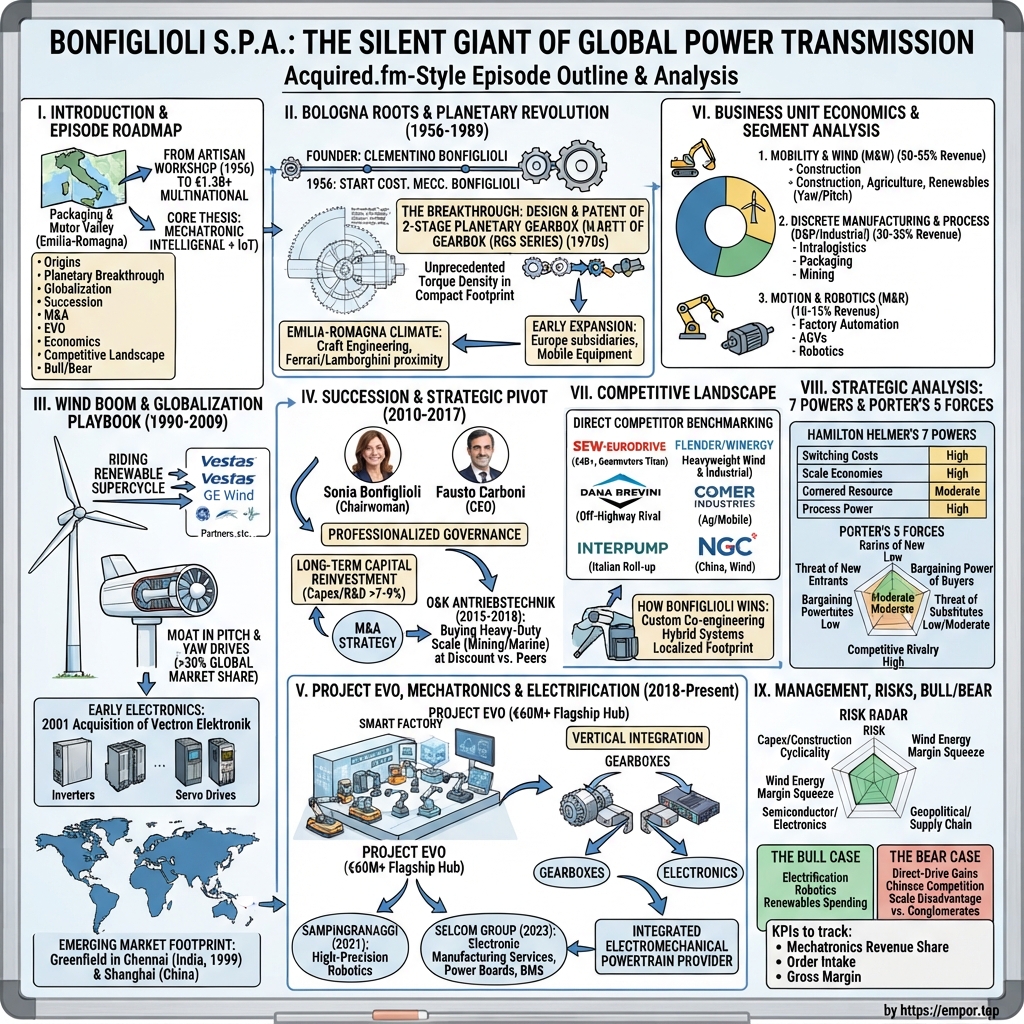
Bonfiglioli S.p.A.: The Silent Giant of Global Power Transmission
I. Introduction & Episode Roadmap [00:00 – 08:30]
On 30 March 2026, in an office building on Via Clementino Bonfiglioli in Calderara di Reno, outside Bologna, Sonia Bonfiglioli signed the board's report on the 2025 consolidated accounts of the company her father founded seventy years earlier.
Near the end of that report, past the sustainability certifications and workplace recognitions, sits a disclosure that recontextualizes the group's financial reporting. In early February 2026, the group filed a Draft Red Herring Prospectus to list its Indian subsidiary, Bonfiglioli Transmissions Limited, through an offer for sale. Bonfiglioli S.p.A. holds 100% of the subsidiary and, following regulatory approval, will have a one-year window to sell between 12% and 25% of its equity holding.1
This marks an unusual public-market entry for a seventy-year-old family industrial firm. The parent entity is not listing. There is no S-1, no F-1, and no Italian prospectus for Bonfiglioli S.p.A. itself, nor any disclosed plan to file one. Instead, the filing covers roughly one-seventh of group revenue—the subsidiary that is growing fastest, generating the highest operating margins, and operating in an equity market that places high valuation multiples on industrial hardware.
The operational scale is substantial. Bonfiglioli generated €1,172.9 million in consolidated revenue in 2025, employing 4,522 people across 17 manufacturing plants and 23 commercial sites, backed by approximately 550 distributors.1 Management reports a worldwide market share of over 30% in wind turbine pitch and yaw gearing.2 The company manufactures drives spanning 1,000 Newton-meters to more than three million Newton-meters of torque, covering applications from small warehouse conveyors to mining excavator swing drives.2
From an underwriting perspective, however, the financial profile is more restrained. Group revenue peaked at €1,311.6 million in 2023 before declining across the subsequent two years. Operating profitability narrowed over the same period: EBITDA margin fell from 12.0% in 2021 to 8.9% in 2024, before edging up to 9.2% in 2025. Consolidated net profit in 2025 stood at €22.1 million—representing a 1.9% net margin and a 4.3% return on equity—alongside €213.6 million in net financial debt.1
The central tension in Bonfiglioli is an established industrial engineering franchise delivering returns close to its cost of capital.
For over a decade, management has framed its core strategy as a transition from purely mechanical gearboxes to integrated mechatronic systems that incorporate sensing, power electronics, and digital control. That strategy motivated the acquisition of an inverter specialist in 2001, a distressed robotics precision-gear manufacturer in 2021, and a €150 million contract electronics producer in 2023. While industrially coherent, this portfolio expansion has yet to show up in structurally higher group margins.
The ownership structure provides a distinct underwriting context. Bonfiglioli has never traded publicly, but it is not a venture-backed startup. It carries no preferred liquidation preferences, convertible notes, or protective terms. Valuing the business therefore relies not on synthetic private marks, but on seven decades of audited operating history—and on evaluating why public markets may value its Indian operating subsidiary far higher than the consolidated parent.
This analysis tracks that trajectory: the founding Bologna workshop and early planetary gearbox patents; the expansion into utility-scale wind power; the founder-to-generation succession and management professionalization; the strategic rationale of the Vectron, O&K, and Selcom acquisitions; capital expenditure behind the EVO manufacturing facility; the unit economics of a business without segmented public reporting; competitive dynamics across industrial drives; and the concluding valuation framework—evaluating a 9% EBITDA business against peers earning 16%, and assessing the valuation divergence between the parent group and its Indian carve-out.
 Subscribe on LinkedIn
II. Bologna Roots & The Planetary Revolution (1956–1989) [08:30 – 24:00]
Clementino Bonfiglioli established Costruzioni Meccaniche Bonfiglioli in Bologna on 27 August 1956.3
The regional backdrop explains the business model. Post-war Emilia-Romagna was developing into one of Europe's densest concentrations of precision mechanical engineering. Rather than revolving around a single dominant industrial conglomerate, the region developed as an interconnected network of specialized machine shops subcontracting to one another. Packaging machinery builders in Bologna, agricultural equipment makers across the Po Valley, and high-performance automotive manufacturers all drew from the same regional pool of toolmakers, heat-treaters, and gear cutters.
A specialized workshop capable of cutting precise gear teeth had dozens of potential customers within a short radius, none of whom wanted to produce gearboxes in-house. That commercial environment established a structural pattern that persists seventy years later: Bonfiglioli rarely sells directly to end users; it sells to the original equipment manufacturers (OEMs) that build the machines.
The fundamental technical inflection occurred on 22 September 1964, when the company designed and patented the RAE series two-stage planetary gearbox.3 While secondary accounts occasionally date this development to the 1970s under the RGS series designation, corporate records place the RAE patent in 1964, establishing Bonfiglioli's core architecture within its first decade of operation.
The mechanical principle is central to the group's unit economics. A conventional gearbox transmits torque through a single pair of meshing gears, where one tooth contact carries the entire mechanical load. A planetary gearbox instead arranges three or more smaller planet gears around a central sun gear, all rotating within an internally toothed ring. This layout distributes the mechanical load across multiple contact points simultaneously.
Consequently, a planetary unit delivers several times the torque of a conventional gearbox of equivalent weight and diameter. Because the input and output shafts share the same axis, the compact unit fits directly inside a wheel hub or turbine nacelle rather than hanging externally. High torque density in a compact, coaxial package became the core product proposition, explaining why variations of this same architecture operate across excavator track drives, wind turbine yaw rings, and robotic joints.
This mechanical blueprint also enabled the company to span a torque range across more than three orders of magnitude without altering its core design language.2 For an industrial supplier, maintaining a scalable architecture rather than engineering bespoke systems allowed entry into adjacent end markets through dimensional scaling rather than ground-up redevelopment—generating broad market diversification with disciplined engineering overhead.
From the late 1960s through the 1980s, the company scaled its international distribution footprint. Bonfiglioli established Tecnotrans in Barcelona in 1968, followed by a French subsidiary in Paris in 1977, a UK branch in 1981, operations in Australia and South Africa in 1988, and a German subsidiary in 1989.3
Each international office operated as a sales and application-engineering outpost rather than a manufacturing plant. This rollout reflected an early operational choice: the scarce asset in industrial power transmission was not generic manufacturing capacity, but the application engineering required to specify the correct drive unit for an OEM's chassis. Manufacturing remained centralized in Emilia-Romagna, while customer-facing technical support was deployed locally.
Two structural features from this era continue to define Bonfiglioli's operating profile:
First, because Bonfiglioli operates as a tier-one supplier to OEMs, revenue is a derivative of third-party production build rates, leaving the company without a direct pricing relationship with ultimate machine operators. Demand arrives as scheduled procurement orders tied to OEM assembly volumes.
Second, the drive unit represents a low-cost, high-consequence component. A gearbox typically represents a low single-digit percentage of an industrial machine's total bill of materials, yet a mechanical failure immobilizes the entire asset. This asymmetry—low relative cost paired with high operational consequence—provides the foundation for customer retention and switching costs across multi-year OEM design cycles.
By the end of the 1980s, Bonfiglioli had established a patented mechanical architecture, an international sales network, and a solid position in mobile construction equipment alongside its industrial gearmotor baseline. What it still lacked was an end market large enough—and technically demanding enough—to establish global scale. That volume arrived in the 1990s through the commercialization of utility-scale wind energy.
III. The Wind Boom & The Globalization Playbook (1990–2009) [24:00 – 43:00]
A wind turbine incorporates two distinct families of gearing, and distinguishing between them is critical to analyzing Bonfiglioli's market position.
The main drivetrain gearbox sits between the rotor and the generator, stepping up shaft speed by roughly a factor of one hundred to handle the machine's primary power generation. This multi-tonne, high-value assembly is the domain of specialists like Flender's Winergy unit and Nanjing High Speed Gearbox. Bonfiglioli does not compete in this segment.
Instead, Bonfiglioli established its foothold in auxiliary drives: yaw drives that rotate the nacelle to track the wind, and pitch drives that twist each blade around its own axis to control how much energy it captures.4 A utility-scale turbine requires multiple units of each. These are compact planetary gearboxes—the mechanical architecture Bonfiglioli patented in 1964—operating under duty cycles far more severe than nameplate power ratings suggest.
Yaw and pitch drives spend their operating lives making continuous, micro-reversing adjustments under fluctuating aerodynamic turbulence. Installed at the top of a tower, they must endure wide ambient temperature swings across multi-decade design lives. Reversing loads are particularly damaging to gear teeth: alternating direction reloads identical tooth contact surfaces under reversed fatigue stress, accelerating wear compared to steady-state unidirectional rotation. In offshore environments, where repairing a failed drive requires specialized marine vessels, favorable weather windows, and heavy-lift cranes, component reliability becomes paramount.
This failure asymmetry transformed a specialized product line into a defensible franchise. Wind turbine OEMs qualify auxiliary drive suppliers through multi-year validation programs. Once a nacelle is certified around a specific drive's mounting flange, torque curve, and thermal envelope, switching suppliers requires substantial re-engineering and recertification across platforms carrying multi-decade warranty liabilities.
Bonfiglioli states it holds worldwide leadership with share above 30% in wind turbine gearing.2 While publicly available market commentary on pitch and yaw drives estimates Bonfiglioli's global share anywhere from the high teens to above 35% depending on how the scope and addressable market are defined, its leadership in the niche is broadly recognized. For underwriting purposes, the precise percentage represents an uncorroborated company claim, but customer procurement behavior supports the leadership thesis.
The group adheres to APQP4Wind, the wind industry's supplier quality protocol, across its manufacturing footprint.1 In 2025 Goldwind awarded Bonfiglioli do Brasil a supplier recognition described as the first the Goldwind group had granted outside China.1 In an industry defined by stringent qualification requirements, such customer commitments indicate high supplier retention.
The second consequential initiative of this era targeted power electronics. In 2001 Bonfiglioli acquired Vectron Elektronik GmbH, a German designer of inverter drives, and the company describes this as the start of the industrial development process that established the group in mechatronics.3
An inverter regulates an AC motor's speed by varying the frequency of the electrical power it receives. Packaging the motor, gearbox, and controlling inverter into a single offering transformed three discrete hardware purchases into an integrated system sale. This integration shifted technical responsibility for overall drive performance from the OEM to the component supplier, establishing an early position in mechatronics a decade before the term became standard industry vocabulary.
Yet twenty-five years later, the group still does not disclose what share of revenue comes from electronics—a significant reporting gap for a strategy that has served as the stated center of the company's identity for a quarter of a century, and an issue examined in detail in Section VI.
The third strategic pivot was geographic expansion into emerging industrial markets. Bonfiglioli India was formed in 1999 with a plant in Chennai, followed by a second facility at Mannur in 2011, a Pune assembly operation in 2017, a new Chennai plant in 2018, and a Chennai Technology Space in 2024.3 Bonfiglioli Drives Shanghai was formed in 2003, with a further site at QingPu in 2015.3
Rather than utilizing these facilities as low-cost export platforms, management built them to serve local markets—producing in India for Indian infrastructure and wind installations, and in China for domestic renewables and industrial equipment. The Indian footprint expanded steadily: Chennai operations grew across the SIDCO Thirumudivakkam and Mannur sites, and a further facility was added with capacity described at 75,000 units per year.5 A ₹100 crore assembly plant was inaugurated at Pune in November 2023.6
That commercial localization, initiated in the late 1990s, built a standalone operating business with sufficient scale and profitability to pursue an independent public listing in 2026. The public-market valuation optionality now available to the group was not the result of pre-planned financial engineering, but a byproduct of long-term industrial positioning.
IV. Succession, Governance & The Strategic Pivot (2010–2017) [43:00 – 1:04:00]
Clementino Bonfiglioli died in 2010, and Sonia Bonfiglioli took the chair.
Family succession in Italian industrial firms is frequently where enterprise value erodes, and the base rate is sobering: operational control passes to a second generation that inherits the assets without the founder's instincts, professional executives are brought in without genuine authority, and the business drifts through one cycle before faltering in the next.
The record over the subsequent fifteen years presents a more complex picture. Sonia Bonfiglioli signs the annual report as Executive Chairwoman, with the group's organization chart placing the Presidente Esecutiva at the apex, overseeing the two operating business units, Selcom, and the central corporate functions.1 In 2025 she was elected president of Confindustria Emilia, the regional industrial association, for the 2025–2029 term—a role reflecting her standing across the Emilian industrial community.7
The managerial transition, however, diverges from standard corporate professionalization narratives. Fausto Carboni previously served as chief executive and acted as the public face of the group throughout its electrification push, frequently detailing the mechatronic strategy in the trade press.8 Yet Carboni does not appear on the board disclosed in the 2025 annual report, and the group's organization chart displays no chief executive box beneath the Executive Chairwoman.1 The sole executive director named alongside Sonia Bonfiglioli is Massimo Sarti, with Luciano Bonfiglioli serving as a non-executive director.1
For outside investors, executive authority has remained concentrated within the founding family rather than diffusing into an independent management hierarchy. The departure of a long-tenured chief executive without detailed public explanation highlights the reporting opacity typical of private family groups—a governance dynamic that an eventual public prospectus would need to formalize.
Balancing this concentrated structure, the board includes four directors designated as independent: Giampiero Bergami, Roberto Carlo Testore, Federica Guidi, and Alexander John Ross III, alongside a statutory board of auditors chaired by Alessandro Gualtieri with Monica Marisaldi and Biones Ferrari.1 Consolidated financial accounts are audited by EY S.p.A. and prepared under IFRS.1
A privately owned Italian family business is under no regulatory obligation to appoint independent directors, adopt IFRS standards, or commission a Big Four audit. That Bonfiglioli does all three provides meaningful governance discipline and establishes the financial transparency that makes an external evaluation possible. It also indicates an organization that has prepared its reporting infrastructure for external scrutiny.
The capital allocation record during this era is best assessed through the acquisition of O&K Antriebstechnik. Contrary to secondary accounts suggesting O&K was purchased directly from Terex, Bonfiglioli initially acquired a 55% stake in 2015 for €25.7 million alongside Carraro, and in November 2018 the two partners purchased the remaining shares for €17 million, bringing Bonfiglioli into sole ownership.910
O&K added heavy planetary drives for large mining excavators and cranes—the upper end of the torque range, where unit volumes are small, engineering content is high, and lower-cost international competition is thinnest. For a European manufacturer, this specialized segment offered defensive positioning against product commoditization.
Financially, the transaction proved disciplined. An aggregate consideration of roughly €43 million across two tranches secured an established German drive specialist with over a century of application knowledge. Operational integration was substantial: in 2025 the group acquired O&K's previously leased industrial property in Germany, recognizing €1.4 million in land and buildings while removing the corresponding right-of-use asset.1 Purchasing the underlying freehold under a subsidiary eight years post-acquisition reflects a long-term operating commitment.
Evaluating management's broader reinvestment discipline requires testing reported figures against historical claims. While market commentary often describes ongoing reinvestment rates between 7% and 9% of revenue, the 2025 figures show €41.8 million in net capital investments and €24.1 million in research and development—a combined €65.9 million, or 5.6% of group revenue.1
At the 2023 cyclical peak, capital expenditure alone reached €86.5 million on €1,311.6 million of revenue; combined with R&D, total reinvestment did approach 8%.1 Over the following two years, however, annual capital expenditure fell by more than half, declining from €86.5 million to €58.0 million and then to €41.8 million.1
This reduction reflects either disciplined counter-cyclical cash management or the deferral of discretionary spending under margin pressure. For intrinsic valuation, the distinction is significant: if recent expenditure levels represent deferred maintenance and expansion, any normalized cash flow model must incorporate a capex catch-up liability.
V. Project EVO, Mechatronics & The Electrification Wave (2018–Present) [1:04:00 – 1:26:00]
Project EVO represents the physical embodiment of the Bonfiglioli family's long-horizon capital commitment.
Built on the Clementino Bonfiglioli site at Calderara di Reno across a 150,000-square-meter plot, the facility itself covers 58,500 square meters, flanked by roughly 56,000 square meters of green areas and forecourts.11 Total investment reached €60 million, split evenly between €30 million in Industry 4.0 production technology and €30 million in physical infrastructure, designed to manufacture 800,000 units annually and employ around 600 people by consolidating the industrial business unit's manufacturing footprint.1112 The plant opened in 2019 and became the group's registered headquarters in 2024.3
The commercial rationale for EVO rests on defect asymmetry: in an industrial setting where the true cost of component failure is measured in machine downtime rather than purchase price, manufacturing consistency serves as a competitive barrier. Automated gear grinding, in-line measurement, automated test benches, and digital unit traceability reduce defect escape rates while making quality standards auditable to OEM procurement teams. For a wind turbine manufacturer operating under the APQP4Wind framework, automated logging allows engineers to inspect the manufacturing process directly rather than sample finished parts.
The underwriting critique, however, is grounded in reported returns. EVO committed €60 million of capital to Italian manufacturing capacity, yet group EBITDA margins contracted over subsequent years. Productivity metrics show a similar plateau: revenue per employee stood at €275,000 in 2023, €249,000 in 2024, and €259,000 in 2025, offering no visible step-change in operating leverage.1
The operational reality is that EVO consolidated fragmented legacy workshops and likely prevented margin erosion that would have otherwise intensified. However, with no segregated plant reporting in public filings, evidence of an incremental return on capital remains unproven. For underwriting purposes, EVO is best analyzed as a defensive capability investment rather than an autonomous engine of value creation.
A parallel, lower-cost initiative targeted technical capabilities. In January 2016 the group established a dedicated business unit, Mechatronic Drives and Solutions, at the Polo Meccatronica technology hub in Rovereto, Trentino, planning an immediate expansion from 2,200 to 3,000 square meters alongside a further 5,000-square-meter building, and scaling headcount from 30 toward 100.13
Locating advanced product development within a specialized mechatronics cluster hundreds of kilometers from Bologna created deliberate separation between nascent software engineering and legacy mechanical culture. This structural isolation mirrors standard industrial incubation playbooks: establishing new technical capabilities with dedicated facilities, independent hiring pools, and distinct operating identities protects them from absorption by incumbent business units.
Two subsequent acquisitions defined the modern electrification strategy.
Bonfiglioli acquired Sampingranaggi through a court auction at the Court of Bologna on 12 March 2021 for €7,158,000, purchasing the assets of its Italian and Chinese operating entities at Bentivoglio, Funo di Argelato, and Shanghai, together with their inventories, the Sampingranaggi brand, patents, designs, robotics products, and all their staff.[^14]14
For approximately the cost of a single high-precision machining line, Bonfiglioli secured proprietary robotics gearing technology, an operational footprint in China, and an established technical team. Precision robotic joint gearing remains globally concentrated among specialized Japanese suppliers; securing a foothold for €7.2 million represents disciplined opportunistic capital allocation, provided the asset scales. However, because the group does not break out robotics revenue five years post-acquisition, commercial expansion remains an unverified management assertion.
The acquisition of Selcom Group represents the largest capital commitment in the company's history. Bonfiglioli announced an agreement to acquire Selcom on 7 February 2023 and completed the purchase of 100% of the share capital in March 2023, buying from funds controlled by Avenue Capital Group and Europa Investimenti.1516 Selcom, headquartered at Castel Maggiore near Bologna, generated 2022 turnover of approximately €150 million with around 750 employees across four Italian plants and two in Shanghai.16 Financial terms were not disclosed.
Selcom operates as an electronic manufacturing services and original design manufacturing business—a contract electronics house that designs and builds custom printed circuit boards for third-party customers.2 The strategic rationale centers on vertical integration: as Bonfiglioli's core powertrains integrate inverters, motor controllers, digital telemetry, and battery management systems, internalizing electronics engineering converts third-party supply dependencies into proprietary system capabilities.
The group's 2025 development work reflects that strategy, featuring prototypes of an extra-low-voltage inverter with telemetry for e-mobility and the completed validation of a first low-voltage battery management system prototype.1 Selcom also obtained AS/EN 9100:2018 aerospace quality certification in 2025, strengthening its position in regulated end markets and establishing a verified capability standard.1
The financial disclosures, however, show a more muted trajectory. Selcom's purchase price allocation released approximately €6.4 million into 2024 structure costs—a non-recurring benefit that flattered prior-year comparisons and whose absence in 2025 contributed to structure costs rising from 14.5% to 15.6% of revenue.1
More tellingly, Selcom Group S.p.A. carries €31.3 million of indefinitely carried-forward tax losses on which the group has recognized no deferred tax assets, leaving €7.5 million of unrecognized benefit.1 Under IFRS accounting standards, declining to recognize deferred tax assets reflects management's inability to establish sufficient probability of near-term taxable profits within the acquired operating entity.
Three years following the acquisition, the group's board and external auditors have not recognized these tax assets, providing a conservative assessment of Selcom's standalone earnings power. Integration initiatives across Selcom's central functions continued through 2025 with the stated aim of capturing synergies and standardizing processes—language indicating three years post-acquisition that integration is still underway.1
The overarching strategic migration—evolving from a mechanical gearbox supplier into an integrated electromechanical powertrain provider—is industrially coherent. However, tangible financial evidence of that transition has yet to materialize in consolidated operating margins.
VI. Business Unit Economics & Segment Analysis [1:26:00 – 1:44:00]
Here the analysis runs into an immediate structural boundary, and that boundary is itself the primary finding.
The 2025 consolidated notes state plainly that IFRS 8, the segment reporting standard, is not applicable to the Bonfiglioli group.1 The company discloses no segment revenue, no segment operating margins, and no segment capital employed. Regional breakdown is limited to three broad geographies: EMEA at €612.7 million (52.2%), the Americas at €256.0 million (21.8%), and APAC at €304.2 million (25.9%) for 2025.1
This reporting posture is legally compliant—IFRS 8 applies only to entities with publicly traded securities—and commercially standard for a private family enterprise. It is also disqualifying for speculative segment modeling. Circulating estimates attributing specific revenue shares to individual divisions, such as Mobility & Wind at 50% to 55% of revenue or Motion & Robotics at 10% to 15%, have no verified disclosure basis.
The group organizes around three operating business areas—Industry & Automation Solutions, Mobility & Wind Industries, and Selcom Group—and describes the remit of each, but publishes no revenue or margin figures for any of them.2 Any external investor attempting to size the standalone mechatronics opportunity is modeling an estimate rather than measuring audited results.
What the consolidated statements do disclose establishes a clear financial baseline. Gross margin reached 19.8% in 2025, up from 18.3% in 2024 and 19.3% in 2023, with cost of goods sold representing 80.2% of revenue.1 Structure costs totaled €182.9 million, personnel expenses stood at €231.6 million (19.7% of revenue), and depreciation and amortization came in at €56.8 million.1 That cascade yielded EBITDA of €108.3 million and operating profit (EBIT) of €49.6 million—a 4.2% operating margin.1
A 19.8% gross margin governs the economics of the entire enterprise. This is a materials-intensive manufacturing model: roughly four-fifths of every euro in revenue is consumed by purchased steel castings, forgings, bearings, electric motors, and electronic components before covering a single euro of operating overhead, leaving minimal gross profit cushion to absorb volume downturns.
Historical performance illustrates that operating leverage. Between 2023 and 2024, revenue contracted by €120.7 million and EBITDA declined by €23.4 million—a decremental margin of approximately 19%, matching the gross margin and demonstrating that the fixed cost base did not flex downward with falling volume.1 In European manufacturing environments with statutory labor protections, structural costs remain largely inelastic during cyclical downturns. Conversely, this operating structure delivers substantial upward leverage when industrial demand rebounds.
Working capital dynamics amplify this cyclicality. Net working capital stood at €366.2 million at year-end 2025, representing 112 days of sales, essentially flat against 111 days in 2024.1 Gross inventories reached €377.3 million before a €43.2 million obsolescence provision, while net trade receivables stood at €274.7 million.1
Nearly one-third of annual revenue is continuously committed to working capital. During growth phases, working capital requirements absorb cash flow faster than operating profits generate it; during cyclical contractions, working capital liquidation releases cash and temporarily flatters free cash flow. This dynamic explains how group net financial debt improved from €224.6 million to €213.6 million in 2025 despite net profit reaching just €22.1 million.1 Extrapolating recent cash generation into an economic recovery would double-count working capital cash releases that inevitably reverse as production expands.
Revenue quality exhibits similar cyclical characteristics. Bonfiglioli generates no contractual recurring revenue. Commercial revenue derives entirely from discrete shipments fulfilling OEM production schedules and distributor replenishment orders. The relevant leading indicator is therefore customer capital expenditure cycles rather than contract renewals, and competitive defensibility rests on design-in engineering tenure rather than subscription retention.
Key commercial details remain undisclosed. The group does not report average contract duration, customer concentration—a critical consideration given that the global wind turbine OEM market is concentrated among a few primary manufacturers—or the precise split between original equipment shipments and aftermarket replacement parts, which typically represents the primary determinant of blended industrial margins.
The aftermarket channel introduces an additional governance consideration. Disclosures on related-party transactions show that B.R.T. S.p.A., an entity owned by shareholders and directors of Bonfiglioli S.p.A., distributes Bonfiglioli spare parts in Italy and select international markets at stated arm's-length market terms.1 The financial volume of these transactions is not detailed. Because aftermarket spare parts typically command premium operating margins over original equipment sales, routing regional spare parts distribution through an affiliated private entity represents a structural governance arrangement that an external public offering would need to evaluate in full.
Sizing the reachable market, with restraint. Aggregate industry market estimates for global industrial gearmotors and drives frequently cite tens of billions of dollars, but these top-down figures obscure practical commercial constraints. Bonfiglioli's serviceable addressable market is bounded by three specific factors: applications where planetary and helical gear architectures provide technical advantages; geographic regions supported by local manufacturing and application engineering; and price tiers where a European-anchored cost structure remains competitive.
Under those practical criteria, the addressable opportunity centers on utility-scale wind pitch and yaw drives globally, off-highway mobile equipment drives across Europe, the Americas, India, and China, European industrial gearmotors supported by local aftermarket demand, emerging precision robotics gearing, and integrated power electronics deployed across these mechanical platforms. Management reports global market leadership in wind turbine gearing alongside established positions in mobile machinery and industrial automation.2
This market positioning establishes practical limits on organic top-line expansion. A supplier holding a commanding share of a specialized niche cannot outgrow the underlying end market without expanding its addressable scope, and global wind installations have experienced value deflation as component pricing pressures compress euro realization per turbine. Consequently, incremental revenue expansion depends on capturing off-highway market share against competitors such as Comer Industries, Dana, and emerging Chinese manufacturers; increasing proprietary electronic content per powertrain; and expanding within the rapidly growing Indian market.
The one segment for which real economics are now public is India, and the numbers are startling. Bonfiglioli Transmissions Limited reported revenue from operations of ₹18,640.79 million for the year ended 31 December 2024 with profit after tax of ₹1,946.89 million, and revenue of ₹14,601.74 million with profit after tax of ₹1,651.89 million for the nine months ended 30 September 2025.17
For that nine-month period, the Indian subsidiary generated an EBITDA margin of 17.36%, operating with raw material expenses at approximately 63% of revenue, domestic localization near 70%, return on capital employed approaching 30%, and a net cash surplus of ₹1,628.29 million.18 The unit operates three manufacturing facilities across Tamil Nadu and Maharashtra with annual capacity exceeding 330,000 units across three core verticals: Industry and Automation Solutions, Off-Highway Mobility, and Wind Industries.19
Translating these figures into group context highlights the disparity. At the foreign exchange rate of approximately 111.75 Indian rupees per euro on 24 August 2026, the Indian business generated approximately €167 million in 2024 revenue—representing roughly 14% of group turnover—while delivering approximately €17.4 million in profit after tax, equivalent to nearly 88% of Bonfiglioli S.p.A.'s entire consolidated net profit of €19.9 million that year.201 At the historical exchange rate applied within the Draft Red Herring Prospectus of approximately 88.9 rupees per euro, the Indian subsidiary's standalone net earnings would have exceeded the group's consolidated net profit entirely.17
Evaluating this comparison requires three technical qualifications. Standalone Indian accounting standards differ from consolidated IFRS reporting; the Indian subsidiary pays licensing royalties to the Italian parent for proprietary technology and brand rights; and standard intercompany accounting eliminations prevent simple additive profit consolidation.18
Even after accounting for these adjustments, the structural finding remains clear: an operating division contributing roughly one-seventh of consolidated revenue at a 17% EBITDA margin generates the overwhelming majority of consolidated group net income. By implication, the remaining European and international operations, representing over 70% of group revenue, operate near net break-even across the cycle. The regulatory filing of a fast-growing Indian subsidiary has provided the detailed segment transparency that consolidated group reporting omitted.
VII. Competitive Landscape & Industry Structure [1:44:00 – 1:58:00]
Industrial power transmission is not a monolithic market. It spans at least four distinct sub-segments with varying industry structures, and Bonfiglioli competes across all of them from different positions of strength.
SEW-Eurodrive serves as the primary benchmark in standard industrial gearmotors. The German family-owned firm generates more than €3 billion in annual sales with over 19,000 employees, built on a highly defensible distribution model: 17 production plants supported by roughly 85 regional assembly centers and more than 430 operating sites worldwide.21
This decentralized assembly network allows SEW to configure, assemble, and dispatch custom gearmotors within days of an order. Against a competitor that has turned rapid local availability into its core product offering, Bonfiglioli's 17 manufacturing plants and 23 commercial sites represent a substantially leaner network.1 In standard catalog industrial gearmotors, Bonfiglioli occupies a solid secondary position in Europe rather than market leadership, and its operating margins reflect that competitive hierarchy.
Flender anchors the heavy industrial and main-drivetrain segment, generating approximately €2.2 billion in revenue for the fiscal year ended September 2025.22 Its transaction history provides one of the most reliable valuation benchmarks in the sector: Carlyle acquired the business from Siemens in 2021 for roughly €2 billion and agreed in June 2026 to sell it to Triton Partners for approximately €3 billion, with transaction completion expected in the fourth quarter of 2026.2223
That valuation implies an enterprise value multiple of roughly 1.4 times revenue for a scaled, wind-exposed industrial drives business—a transaction multiple established by disciplined private equity sponsors rather than speculative public-market sentiment.
Dana Incorporated recently completed a major portfolio reshuffling. In June 2025 Dana agreed to divest its Off-Highway business—which houses Brevini, its planetary drive operations, and Bonfiglioli's most direct mobile-equipment rival—to Allison Transmission for $2.7 billion, representing approximately seven times the division's projected 2025 adjusted EBITDA.24 The transaction closed on 2 January 2026.25
Dana's remaining automotive business trades at roughly 10.3 times trailing EBITDA on an enterprise value near $5.0 billion, but because it no longer operates as a pure-play off-highway peer, it sits outside the core comparable group.20 The $2.7 billion divestiture multiple, however, establishes the most direct private-market valuation benchmark for Bonfiglioli's core mobile equipment segment.
Comer Industries offers the cleanest publicly traded comparison, and the contrast is stark. Comer is an Italian off-highway powertrain specialist with similar regional heritage and adjacent product lines. For the first nine months of 2025, Comer generated €661.1 million in revenue against €744.4 million in the prior-year period, while producing €106.6 million in EBITDA at a 16.1% margin.26
In operational terms, Comer generates nearly the same nominal EBITDA as Bonfiglioli on approximately 56% of the revenue base. As of 24 August 2026, Comer traded at €45.90 per share, giving it a market capitalization of €1,313.9 million and an enterprise value of €1,438.5 million—equivalent to 1.28 times trailing sales and 8.30 times trailing EBITDA, with net financial debt at 0.72 times EBITDA and a 12.8% return on equity.20
This margin disparity represents the central competitive dynamic facing the group. Two Emilian off-highway mechanical engineering firms, exposed to similar cyclical end markets, deliver divergent financial results: one earns a 16.1% EBITDA margin while the other operates at 9.2%. Several structural factors explain the spread—Bonfiglioli maintains a broader catalog business with lower margins, a larger developing-market footprint, and a contract electronics subsidiary (Selcom) with structurally thinner economics. Yet while these portfolio differences explain the gap, they do not bridge it. From an underwriting standpoint, that margin deficit remains a baseline reality until Bonfiglioli demonstrates operational convergence.
Interpump Group illustrates an alternative Italian industrial trajectory, having built a diversified power transmission portfolio through serial acquisitions. Interpump trades at a market capitalization of €3,919.2 million and an enterprise value of €4,225.0 million, representing 2.03 times trailing sales and 9.57 times trailing EBITDA.20 However, Interpump's valuation premium reflects a high-margin hydraulic systems core; it functions as an aspirational peer rather than a direct operating comparable, and applying its revenue multiple to Bonfiglioli would misprice the latter's mechanical baseline.
Asian manufacturers represent a growing structural influence across global pricing. In utility-scale wind turbine main gearboxes, Nanjing High Speed Gearbox operates as the primary volume supplier to the Chinese market. In industrial automation and inverter drives, Inovance has transitioned from a domestic Chinese supplier into an active international competitor. While neither serves as a direct listed peer for Bonfiglioli's consolidated group, both establish the competitive pricing floor across mid-tier applications, backed by domestic manufacturing cost structures that European facilities cannot duplicate.
Two Indian public listings illustrate the geographical valuation spread. Timken India trades at a market capitalization of approximately ₹231.7 billion, representing 6.46 times trailing revenue and 34.27 times trailing EBITDA, with a 14.9% return on equity and a net cash balance sheet.20 SKF India is excluded from direct multiple benchmarking following a corporate demerger that altered its historical trading continuity.
Timken India illustrates the valuation multiple that public equity markets in India award to local subsidiaries of multinational industrial groups—trading at roughly four times the EV-to-EBITDA multiple of Comer Industries despite operating in related engineering segments with a comparable return on equity. This divergence reflects the specific equity capital dynamics of the domestic Indian market, providing crucial context for evaluating the proposed carve-out of Bonfiglioli Transmissions Limited.
Bonfiglioli's competitive differentiation, evaluated against disclosed operational data, rests on three proven pillars: long-term co-engineering relationships with OEMs that embed high switching costs into customer platforms; the capacity to deliver integrated mechanical and electronic drive packages; and localized manufacturing in India and China, demonstrated by the Indian subsidiary's approximately 70% domestic localization rate and 30% return on capital employed.18
Conversely, Bonfiglioli faces structural disadvantages in catalog gearmotor volume, European assembly network density, and consolidated operating profitability. The first two constraints reflect deliberate capital allocation choices across different product categories; the third remains the central operational challenge for the consolidated enterprise.
VIII. Strategic Analysis: 7 Powers & Porter’s 5 Forces [1:58:00 – 2:12:00]
Strategic frameworks are instructive here only where they connect directly to reported financial performance, so this section applies them selectively, discarding assumptions that do not hold up against the audited accounts.
Switching costs represent Bonfiglioli's most defensible competitive power and the one with the clearest empirical backing. A wind turbine nacelle or an excavator chassis is engineered around a specific drive's mounting interface, torque curve, and thermal envelope; replacing an incumbent supplier requires substantial platform re-engineering and multi-year recertification.
The Indian subsidiary highlights a co-engineering model requiring roughly thirty months of pre-production integration with OEMs alongside commercial relationships spanning ten to twenty years, and operates what it describes as the only dedicated wind drive test laboratory in India.18 Thirty months of joint engineering prior to initial revenue represents a switching cost measured in calendar time, while decade-plus customer tenures provide behavioral proof rather than assertion. This barrier is tangible, explaining why the group maintained market share through a two-year cyclical revenue contraction rather than losing platform placements.
The limitation of switching costs is that they protect unit volume rather than realized price. An OEM unable to easily substitute a supplier can still resist price increases, lengthen payment terms, and enforce contractual annual cost-down targets—dynamics directly reflected in the group's compressed operating margins.
Cornered resource is considerably narrower than company positioning implies. Seventy years of gear geometry and proprietary heat-treatment expertise represent genuine accumulated industrial knowledge, but that capability is not exclusive: SEW-Eurodrive, Flender, Comer Industries, and specialized Japanese precision manufacturers possess comparable engineering depth.
Bonfiglioli spent €24.1 million on research and development in 2025, representing roughly 2.1% of revenue.1 While that level of reinvestment is standard for a mechanical drive manufacturer, it remains modest for an enterprise aiming to reposition itself as a mechatronic and software provider. Large industrial automation vendors and specialized electronics suppliers outspend this budget by orders of magnitude on control hardware and software development. The cornered-resource claim remains defensible in specialized heavy planetary gearing, but is largely aspirational in digital control and power electronics.
Scale economies work against Bonfiglioli at the consolidated group level. Generating approximately €1.17 billion in annual revenue against SEW-Eurodrive's €3 billion-plus and Flender's €2.2 billion, Bonfiglioli represents a smaller procurement counterparty for steel castings, forgings, and precision bearings, while amortizing engineering, software, and administrative overhead across a smaller revenue base.12122 Project EVO establishes plant-level scale for Italian industrial gearmotor manufacturing, but plant-level efficiency does not translate into group-level purchasing scale. Describing the company's consolidated scale economies as an advantage is not supported by peer comparison.
Process power remains plausible but unproven in reported margins. The operational ability to configure high product variety from a standardized modular architecture is a valuable capability, and EVO's automated assembly lines were engineered around that requirement. If process power provided a structural advantage, it would manifest in gross margins exceeding peer averages. Bonfiglioli's 19.8% gross margin and 9.2% EBITDA margin against Comer's 16.1% EBITDA margin demonstrate that whatever process advantage exists has yet to translate into superior unit economics.126
Evaluating Porter’s Five Forces reveals three decisive structural drivers alongside two that are frequently misinterpreted:
Buyer power is high and intensifying. Wind turbine manufacturers and off-highway OEMs are significantly larger than their drive suppliers, procure through consolidated global sourcing programs, and routinely enforce component price reductions during industry downturns. The evidence is visible in Bonfiglioli's consolidated accounts: revenue declined 9.2% in 2024 and an additional 1.5% in 2025, with EBITDA margin failing to recover beyond 9.2%.1 A supplier commanding pricing power does not surrender 280 basis points of operating margin across a four-year cycle.
Threat of new entrants is low, but provides no margin protection. High capital intensity, protracted qualification timelines, and severe defect liabilities in multi-megawatt wind turbines and mining machinery prevent unvetted entrants from emerging quickly. However, this barrier preserves customer incumbency rather than pricing power. The primary competitive pressure stems from established Asian industrial players expanding into international markets—an expansion of existing capacity rather than de novo entry. Mistaking low entry threat for margin defense overlooks this competitive dynamic.
Threat of substitutes is moderate and asymmetric. Direct-drive wind turbine architectures eliminate the central high-speed drivetrain gearbox but still require auxiliary yaw and pitch drives, leaving Bonfiglioli's specialized wind position largely insulated from architectural obsolescence. The more consequential substitution operates in reverse: hydraulic systems across construction and agricultural machinery are increasingly being replaced by electromechanical drives, and Bonfiglioli supplies the electric alternatives.
The capital commitments at Selcom and the Rovereto mechatronics center represent the group's effort to capture the value of that electromechanical transition rather than be disintermediated by third-party electronics suppliers. Whether that integration delivers economic returns remains the defining question for the business over the medium term, and the answer will appear in gross margin performance rather than corporate announcements.
Supplier power is moderate with emerging friction. Raw steel, forgings, and standard bearings remain cyclical but are supplied through competitive global merchant markets. By contrast, specialized semiconductors and discrete electronic components—which entered the group's direct cost structure through the Selcom acquisition—feature tighter supply chains and less price flexibility, exposing the consolidated entity to direct semiconductor procurement cycles.
Competitive rivalry is intense and structurally anchored. Facing four established European peers, rising Asian manufacturers, a private equity sponsor at Flender pursuing expansion, and Allison Transmission actively integrating its $2.7 billion off-highway acquisition, industry participants operate in a demanding market where excess returns must be continuously defended.24
IX. Management Credibility, Capital Allocation & Risk Radar [2:12:00 – 2:24:00]
Evaluating management behavior over corporate statements reveals a disciplined record on opportunistic acquisitions alongside unresolved questions regarding parent-level governance.
The acquisition history provides the clearest evidence of capital allocation discipline. Vectron in 2001 introduced inverter capabilities a decade before integrated mechatronics became an industry standard.3 O&K delivered heavy-planetary scale for approximately €43 million across two tranches, complemented by the subsequent purchase of the underlying industrial freehold.9101 Sampingranaggi was acquired for €7.16 million at a court auction, securing robotics gearing assets, Chinese manufacturing capacity, patents, and technical staff at distressed pricing.[^14]
These transactions reflect a consistent pattern: acquiring technical capability out of industrial distress rather than purchasing growth at peak cycle multiples. Selcom stands as the primary outlier: large in scale, undisclosed in price, and carrying €31.3 million in carried-forward tax losses on which no deferred tax asset has been recognized three years post-acquisition.116
Balance sheet management demonstrates steady financial conservatism. Net financial debt declined from €258.6 million in 2023 to €224.6 million in 2024 and €213.6 million in 2025, maintaining leverage at 2.0 times EBITDA and a net debt-to-equity ratio of 0.4.1 Net financial expenses fell from €14.8 million to €11.6 million, with EBITDA covering net interest charges 9.3 times.1 The balance sheet exhibits comfortable liquidity with no visible refinancing pressure.
Shareholder distributions have remained restrained—dividends totaled €6.0 million in 2024 and €4.0 million in 2025 against consolidated net profits of €19.9 million and €22.1 million, respectively.1 Board remuneration stood at €2.03 million in 2025, down from €2.23 million in 2024, alongside statutory auditor and audit fees of €854,000.1 Executive compensation appears conventional for an industrial enterprise of this scale, showing no signs of capital extraction. The company maintains no disclosed equity incentive plans, option pools, or synthetic equity schemes—a standard posture for a private family enterprise, though a gap that public-market underwriting would scrutinize.
Corporate reporting demonstrates technical rigor alongside notable disclosure omissions. The 2025 annual report attributes top-line contraction to currency headwinds and European sector softness, and explains rising structure costs by noting the absence of the prior year's €6.4 million purchase price allocation benefit from Selcom—a candid disclosure that private entities often conceal.1
The report also specifies that its alternative performance measures are non-IFRS metrics, are unaudited, and may differ from definitions used by peers.1 Yet against this technical rigor, the parent discloses no order backlog, book-to-bill ratios, business segment results, or customer concentration figures—the specific operating metrics external investors require to underwrite cyclical visibility.
Public-market readiness remains bifurcated between the parent and its Indian operating subsidiary. Ultimate ownership resides with BON-FI S.r.l., holding 100% of Bonfiglioli S.p.A.'s €50 million share capital, comprising 50,000,000 ordinary shares of €1 nominal value with no treasury shares held.1
Related-party disclosures show that B.R.T. S.p.A., an entity controlled by Bonfiglioli shareholders and directors, distributes spare parts across Italy and select export markets at stated arm's-length terms, though transaction volumes remain unquantified.1 Furthermore, the departure of the former chief executive from the governance disclosures remains unexplained in the public record. Because Bonfiglioli S.p.A. has filed no prospectus, standard public listing disclosures—such as formal lock-up agreements, use of proceeds, accounting elections, and comprehensive risk factors—do not exist.
The Indian subsidiary, by contrast, has methodically institutionalized its governance structure. Bonfiglioli Transmissions Limited converted from a private to a public company in October 2025, completed a bonus issue of 62,665,278 new ₹10 shares in February 2026, and appointed Ravindra Pisharody as independent chairperson alongside independent directors Sundaresan Ananthanarayanan and Rossella Schiavini.127 This deliberate sequence establishes an independent governance framework ahead of an equity carve-out, offering a benchmark for how the group might approach an eventual parent-level listing.
The risk radar highlights four active operational exposures alongside one that has already materialized:
Cyclical downturn has materialized. Revenue contracted across two consecutive years while operating margins compressed.1 The central underwriting consideration is whether the 8.9% EBITDA margin recorded in 2024 represents a cyclical floor or an ongoing structural baseline.
Wind industry pricing pressure. Component price deflation across Chinese supply chains, installation delays, and grid bottlenecks continue to compress value across utility-scale wind—the segment where Bonfiglioli holds its highest market share. Defending volume in a deflationary hardware market limits absolute earnings growth.
Unproven Selcom integration. Unrecognized deferred tax assets indicate conservative internal expectations for near-term profitability.1 Integrating contract electronics manufacturing into a mechanical drive cost structure presents operational friction that has yet to yield margin expansion.
Geopolitical friction and trade policy. The 2025 annual report highlights the US Supreme Court ruling of 20 February 2026 regarding the International Emergency Economic Powers Act alongside global tariffs taking effect on 24 February 2026, noting that policy uncertainty directly suppresses customer capital expenditure.1 With the Americas representing over 21% of revenue and Asia-Pacific nearly 26%, trade barriers represent a direct operational risk.1
Foreign exchange translation exposure. Currency movements contributed to top-line contraction in 2025, and the group's highest-margin growth engine reports in Indian rupees.1 While derivative hedging reduced net foreign exchange transaction losses from €2.3 million to €0.7 million in 2025, hedging mitigates short-term transaction volatility rather than structural balance-sheet translation risk.1
X. The Bull vs. Bear Case & What to Watch [2:24:00 – 2:36:00]
Capital structure, stated plainly. Bonfiglioli is not a venture-backed startup in any conventional sense, and applying that vocabulary would mislead.
There have been no priced funding rounds, preferred shares, liquidation preferences, participation rights, ratchets, SAFEs, convertible notes, or strategic-investor side letters, because the company has never raised external equity. The entire equity base of the parent consists of 50,000,000 ordinary shares of €1 nominal value, controlled through BON-FI S.r.l., with no treasury shares and no disclosed option or restricted stock unit pool.1 Consolidated group equity stood at €508.3 million at the end of 2025 against net financial debt of €213.6 million.1
With no synthetic private marks to validate and no dilution overhang to model, the capital structure is unusually straightforward. The central underwriting question is the inverse of standard private equity dynamics: evaluating what happens to group economics when a minority stake in the most profitable subsidiary is sold to public shareholders who will introduce their own return hurdles, disclosure demands, and scrutiny of intercompany royalty payments to the Italian parent.
The observed price, and what it is not. Bonfiglioli Transmissions Limited filed its Draft Red Herring Prospectus with the Securities and Exchange Board of India (SEBI) in February 2026 for an offer for sale of up to 46,998,958 equity shares of ₹10 face value by Bonfiglioli S.p.A., the promoter selling shareholder, with Axis Capital, BNP Paribas, ICICI Securities, and Jefferies India acting as book-running lead managers ahead of a proposed listing on both BSE and NSE.1728 The transaction is entirely a secondary sale: the operating subsidiary receives none of the proceeds, all of which flow to the Italian parent.1929
SEBI issued its observation letter on 11 June 2026, clearing the issue to proceed.3031 As of 24 August 2026, no price band, issue date, or final issue size has been formally announced. Market reporting has estimated the likely issue size above ₹2,000 crore.31
That reported figure represents market speculation rather than an established transaction price, and every figure derived from it serves as an illustrative exercise. Tested arithmetically and with appropriate skepticism: the Indian entity's disclosed 2024 earnings per share of ₹10.06 against profit after tax of ₹1,946.89 million implies roughly 193.5 million shares outstanding, meaning the 46,998,958-share secondary offering represents about 24.3% of the company—at the upper end of the 12% to 25% divestiture band described by the parent.29171
If that ₹2,000 crore estimate proves accurate for a 24.3% stake, the implied total equity value would reach roughly ₹8,200 crore, or approximately €735 million at the exchange rate of 111.75 rupees per euro prevailing on 24 August 2026.20 Measured against 2024 profit after tax, that translates to roughly 42 times earnings; against the annualized nine-month 2025 run rate, approximately 37 times. Adjusting for the ₹1,628.29 million net cash balance and annualizing the nine-month EBITDA margin of 17.36% yields an implied enterprise value near 24 times EBITDA and roughly 4.3 times 2024 revenue.1817
Every element of that calculation carries caveats that a formal price band would resolve: the share count is derived rather than explicitly stated, the February 2026 bonus issue may alter the denominator relative to historical per-share metrics, and the ₹2,000 crore figure represents press reporting rather than a regulatory filing.1 It must be understood as an implied value at a rumored price rather than an audited valuation.
Separating total equity value from free float is equally critical. Even if the maximum 24.3% stake is sold, roughly three-quarters of the Indian subsidiary would remain under the control of the Italian parent.1 A constrained float in an oversubscribed Indian industrial offering frequently causes listing-day price overshooting followed by mean-reversion as lock-ups expire—a dynamic driven by market microstructure rather than underlying business performance.
What that valuation would embed. At 37 to 42 times earnings, the Indian listing would price the subsidiary to compound net earnings at a high-teens to 20% annual rate for nearly a decade, while sustaining a 17% EBITDA margin and a 30% return on capital employed against Chinese import competition and customer cost pressure.18
It would also assume that holding an estimated 70% share of domestic wind yaw and pitch drives by value, alongside a 30% share among non-captive off-highway mobility suppliers, represents a durable moat rather than a temporary snapshot of an under-penetrated market that has yet to attract serious competition.18 These are demanding assumptions, even for an industrial supplier benefiting from India's capital expenditure cycle.
Crucially, they are assumptions contradicted by the parent's own operating record. Bonfiglioli's global leadership in wind drives did not prevent four consecutive years of margin compression in Europe. Believing that market leadership will defend margins in India requires a specific thesis on Indian market structure rather than an assumption about proprietary mechanical technology.
Valuing the parent company across multiple methodologies. Because Bonfiglioli S.p.A. has no public market price and is not pursuing a parent-level listing, any parent valuation must be modeled from audited operating results rather than observed trading multiples.
A comparable-multiples approach begins with Comer Industries, the closest direct public peer, which trades at 8.30 times trailing EBITDA on an enterprise-value basis.20 Applied to Bonfiglioli's 2025 EBITDA of €108.3 million, that multiple yields an enterprise value of approximately €899 million; deducting €213.6 million in net financial debt leaves roughly €685 million of equity value.1
The Dana Off-Highway divestiture to Allison Transmission at approximately seven times projected EBITDA provides a lower private-market benchmark, implying an enterprise value near €758 million and equity near €544 million.24 Applying Interpump's 9.57 times EBITDA multiple implies an enterprise value near €1,036 million and equity near €822 million, though Interpump's higher-margin hydraulics core makes it a stretch.20
Revenue multiples should not be applied to the consolidated group. Comer's 1.28 times enterprise value to sales and the roughly 1.4 times implied by the Flender transaction would suggest a Bonfiglioli enterprise value between €1.5 billion and €1.6 billion—but because both peers generate EBITDA margins in the mid-teens or better, applying their revenue multiples to a 9.2% margin business double-counts the very gap that makes Bonfiglioli cheaper.202226 Applying revenue multiples here would overstate enterprise value by roughly a factor of two.
An intrinsic discounted cash flow approach depends primarily on whether operating margins recover. Starting from actual 2025 cash generation: €108.3 million in EBITDA, less €41.8 million in net investment, €11.6 million in net financial charges, and €20.3 million in current taxes, leaves roughly €35 million before working capital movements—a free cash flow margin of about 3%.1 Capitalizing that baseline at a 9% to 10% cost of equity with zero growth produces an equity value in the €350 million to €400 million range. This represents the bear anchor, pricing the mechatronics option at zero.
A base case assumes the European industrial cycle normalizes, revenue recovers toward €1.30 billion to €1.35 billion by 2030 at roughly 2% to 3% compound annual growth, and EBITDA margin returns to the 11% area achieved as recently as 2022—plausible given that fixed overhead is already in place and decremental margins work in reverse on the way up.1 That trajectory yields EBITDA near €145 million to €150 million, capital expenditure normalizing around €55 million to €60 million as deferred spending from 2024 and 2025 is absorbed, cash interest falling as debt amortizes, and normalized free cash flow in the €55 million to €65 million range. Applying an eight-times exit EBITDA multiple discounted at 9.5% produces a current parent equity value broadly in the €750 million to €900 million range.
A bull case requires the mechatronics thesis to convert: electronics and integrated systems expanding to a disclosed and material share of revenue, consolidated group margin reaching 13% on €1.5 billion of sales, and the Indian subsidiary compounding at domestic multiples inside the consolidated group. That path supports parent equity value approaching or exceeding €1.1 billion, though it relies on operational milestones that do not yet exist in disclosed reporting.
Synthesizing these methods establishes a central parent equity valuation range of roughly €600 million to €900 million. This wide band reflects sensitivity to operating margins: a single percentage point of EBITDA margin on €1.17 billion in revenue represents €11.7 million of EBITDA and, at an eight-times multiple, roughly €94 million of equity value—nearly 14% of the midpoint valuation.
Reconciling parent and subsidiary valuations highlights the central paradox of the carve-out. At the reported issue size, the Indian subsidiary carries an implied equity valuation of roughly €735 million for a business contributing about 14% of group revenue—comparable to the midpoint estimate for the entire group.201
This disparity reflects differing capital market dynamics rather than an underlying divergence in business quality. Indian industrial equities are priced by a domestic institutional and retail base with limited alternatives and a structural growth narrative, which is why Timken India trades at 34.27 times trailing EBITDA while Comer Industries trades at 8.30.20 IPO scarcity, a constrained free float of at most roughly one-quarter of the equity, retail momentum, and the appeal of a multinational-parented industrial with a Frost & Sullivan-certified leadership claim will all push the listing price up.17
Those forces describe market mechanics rather than intrinsic business value. For underwriting purposes, investors must distinguish between listing momentum and fundamental earnings power—particularly when an experienced industrial owner is choosing both the carve-out asset and the listing venue to monetize high local valuations.
The bull case rests on four core pillars: the electrification of off-highway and industrial machinery converts discrete mechanical components into higher-value integrated powertrains; warehouse automation and robotics provide scalable end markets for the Sampingranaggi and Rovereto assets; wind repowering and solar tracker demand sustain a resilient baseline for the highest-share product line; and the Indian subsidiary continues compounding at 17% EBITDA margins and a 30% return on capital employed while the European manufacturing base recovers operating leverage on a fixed cost structure that is already paid for.181
The bear case centers on four structural vulnerabilities: consolidated EBITDA margin has compressed by 280 basis points over four years while return on equity languishes at 4.3%, below any reasonable cost of capital;1 the parent is subscale compared to SEW-Eurodrive and Flender, out-earned by Comer on 56% of the revenue base, and outspent on electronics R&D by every serious automation player at 2.1% of sales;12026 the largest acquisition in corporate history carries carried-forward tax losses that directors will not capitalize;1 mid-tier catalog gearmotors face intensifying pricing pressure from Chinese manufacturers; and the most valuable operating unit is being partially sold rather than scaled—with proceeds flowing to the selling shareholder, not the operating business.29
The three KPIs that would confirm or falsify the underwriting, in order of diagnostic power:
Group EBITDA margin. Everything reduces to this metric. Recovery through 10% and toward 11% to 12% would validate the base case and add several hundred million euros of implied equity value; a third consecutive year below 9.5% would confirm that the margin gap to Comer is structural rather than cyclical. The 2026 accounts provide the first formal checkpoint, and management stated that revenue and order intake through February 2026 were tracking in line with expectations, with the 2026 budget targets confirmed.1
Disclosed revenue share from electronics and mechatronics. The mechatronics thesis has served as the core strategic narrative since 2001 and remains unquantified. Publishing a segment breakdown—which a public listing of any group entity makes progressively harder to avoid—would either validate the transformation or reveal it as a small tail on a mechanical baseline.
Bonfiglioli Transmissions' post-listing revenue growth and margin retention. Once listed, India becomes the group's only continuously reported operating window. Whether a 17.36% EBITDA margin survives contact with quarterly disclosure, Chinese import competition, and public scrutiny of related-party royalty flows to the Italian parent is the cleanest available test of whether the group's claimed engineering advantage translates into durable economics.18
The nearest catalysts are the announcement of a price band and issue dates for the Indian offer—which the parent may launch at any point within a year of SEBI's June 2026 clearance, timing it against Indian market conditions, macroeconomic developments, and exchange rates—and the publication of the group's 2026 results.130
After listing, the Indian share price will move on sentiment, index inclusion, and trading liquidity as much as on fundamentals. That is standard market behavior and indicates little about underlying business quality. The true reckoning arrives when the next cyclical downturn tests whether a 17% operating margin represents a structural franchise or a cyclical peak—and when public shareholders in Mumbai first form a view on how much of their company's earnings should flow as royalties to Calderara di Reno.
XI. Playbook: Durable Business & Investing Lessons [2:36:00 – 2:48:00]
The hidden champion formula has a margin ceiling. Bonfiglioli executed the classic industrial playbook—dominating a mission-critical niche where component failure immobilizes an entire asset while accounting for a small fraction of total machine value—and built worldwide leadership in wind turbine yaw and pitch drives.2
What that positioning did not produce is a durable margin premium. A low-cost, high-consequence component protects platform incumbency; it does not by itself dictate pricing power when the procurement counterparty is a sophisticated OEM with global sourcing options and contractual cost-reduction mandates. Criticality determines whether a supplier retains platform placement, while relative scale, operating leverage, and cost structure determine what it earns on that volume. Comer Industries generating a 16.1% EBITDA margin against Bonfiglioli's 9.2% makes that structural distinction numerical.261
Embracing cannibalizing technology is necessary, but slow to pay. Acquiring an inverter specialist in 2001 and a contract electronics manufacturer in 2023 were logical responses to the migration of value from mechanical gearing to integrated mechatronics.316 Yet twenty-five years after the first transaction and three years after the second, consolidated reporting has yet to show that either has structurally expanded group margins.
Preempting a technological shift secures the right to compete in the new regime, but does not confer an inherent competitive advantage within it. The incumbents of the electrified domain—industrial automation providers and specialized power electronics manufacturers—operate with higher baseline margins and research-and-development budgets that dwarf a mechanical supplier's reinvestment capacity. An industrial manufacturer entering power electronics trades an established position in a slow-moving market for a contested position in a fast-moving one. That transition generates economic value only if the newly integrated electronic content is proprietary rather than commoditized contract assembly. On current disclosures, whether Selcom's output represents proprietary powertrain intelligence or low-margin assembly cannot be verified from the outside.
Family capital allocation discipline is real, with an underwriting caveat. Retaining the vast majority of net earnings, maintaining balance-sheet leverage at 2.0 times EBITDA through a cyclical downturn, capping board compensation near €2.0 million, and funding Project EVO across a full industrial cycle reflect the long-term horizon of generational family owners.111
The caveat is that patient capital cannot substitute for economic returns. Fifteen years of family control have culminated in a 4.3% return on equity in 2025, and a controlling ownership structure insulated from quarterly public scrutiny cuts both ways.1 The absence of short-term capital-market pressure protects long-horizon capital commitments; it also removes the external governance mechanism that forces a restructuring when that long horizon repeatedly fails to deliver margin convergence.
Distressed niche M&A represents the most transferable operating lesson. Committing €7,158,000 at a court auction to secure Sampingranaggi's robotics gearing portfolio, brand, patents, Chinese manufacturing facility, and technical workforce represents an exceptionally disciplined entry into a specialized segment dominated by Japanese incumbents.[^14] Deploying roughly €43 million across two tranches to secure O&K's heavy planetary drive franchise demonstrated identical capital discipline at larger scale.910
The underlying playbook is consistent: wait for distress to force a transaction, acquire technical capability rather than revenue volume, and integrate the acquired product lines into an established global distribution network. The strategy succeeds because the acquirer's existing sales rail is the exact asset the distressed target lacks. Conversely, applying that approach to Selcom—a significantly larger business purchased from private equity sponsors rather than a bankruptcy court—has so far yielded uncapitalized tax losses and unresolved integration friction rather than immediate operating leverage.
Valuation divergence reveals the difference between business value and market venue. The identical engineering heritage, brand equity, and planetary drive architecture are valued at roughly eight times EBITDA when held within an Italian parent company and, if market reporting holds, closer to twenty-four times when carved out into an Indian operating subsidiary preparing for an initial public offering.2018
A rational industrial owner responds by monetizing the specific asset that equity markets value most generously while retaining operating control—which is precisely what Bonfiglioli S.p.A. executed by filing a secondary offer for sale of existing shares rather than diluting the business through primary capital issuance.129 That transaction represents disciplined stewardship of family capital, and should be evaluated as an arbitrage of regional equity market multiples rather than an autonomous operational acceleration.
Monetizing high local valuation multiples is fundamentally distinct from expanding consolidated enterprise earnings power. Public investors evaluating the carve-out must distinguish between listing momentum and intrinsic unit economics—mindful that the controlling shareholder on the opposite side of the transaction has spent seven decades analyzing exactly what those assets can generate.
References
-
Annual Report 2025 (Bilancio Consolidato al 31 dicembre 2025) — Bonfiglioli S.p.A., 2026-03-30 ↩↩↩↩↩↩↩↩↩↩↩↩↩↩↩↩↩↩↩↩↩↩↩↩↩↩↩↩↩↩↩↩↩↩↩↩↩↩↩↩↩↩↩↩↩↩↩↩↩↩↩↩↩↩↩↩↩↩↩↩↩↩↩↩↩↩↩↩↩↩↩↩
-
Business Areas and Mobility & Wind Industries overview, Annual Report 2025 — Bonfiglioli S.p.A., 2026-03-30 ↩↩↩↩↩↩↩↩
-
Bonfiglioli to Expand Operations in Chennai and Pune — Gear Technology ↩
-
Bonfiglioli's New ₹100 crore State-of-the-Art Facility Inaugurated in Pune — Gear Technology India, 2023-11-29 ↩
-
Sonia Bonfiglioli eletta Presidente di Confindustria Emilia per il quadriennio 2025-2029 — Confindustria Emilia, 2025 ↩
-
Bonfiglioli in the words of CEO Fausto Carboni — Powertrain International ↩
-
Carraro: sale of 100% of O&K Antriebstechnik to Bonfiglioli finalised — Carraro Group, 2018-11-20 ↩↩↩
-
Bonfiglioli Finalizes the Acquisition of O&K Antriebstechnik GmbH — Bonfiglioli International, 2018-12-03 ↩↩↩
-
Bonfiglioli presents the EVO project, the next EVOlution of our business to Industry 4.0 — Bonfiglioli United States, 2016-10-06 ↩↩↩
-
New Bonfiglioli plant — KHL Group, International Cranes and Specialized Transport ↩
-
Bonfiglioli ha scelto: in Trentino la nuova unità di business "Mechatronic Drives and Solutions" — Ufficio Stampa Provincia autonoma di Trento, 2016-01-20 ↩
-
Bonfiglioli acquires Sampingranaggi — Industrial Vehicle Technology International, 2021 ↩
-
Bonfiglioli S.p.A. agrees to acquire Selcom Group S.p.A. — Bonfiglioli International, 2023-02-07 ↩
-
Bonfiglioli S.p.A. completes acquisition of Selcom Group S.p.A. — Bonfiglioli International, 2023-03 ↩↩↩↩
-
Bonfiglioli Transmissions Limited Files DRHP for IPO with SEBI — Autocar Professional, 2026-02 ↩↩↩↩↩↩
-
Bonfiglioli Transmissions IPO: A Proxy for India's Industrial and Renewable CapEx Cycle — HDIN Research, 2026 ↩↩↩↩↩↩↩↩↩↩
-
Bonfiglioli Transmissions Files DRHP for IPO With SEBI — Z-Connect by Zerodha, 2026-02 ↩↩
-
Market quotes and key metrics for Comer Industries (COM.MI), Interpump Group (IP.MI), Dana Incorporated (DAN), Timken India (TIMKEN.NS) and EUR/INR, retrieved 2026-08-24 — Financial Modeling Prep ↩↩↩↩↩↩↩↩↩↩↩↩↩
-
Triton Partners to acquire Flender from Carlyle — Triton Partners, 2026-06 ↩↩↩↩
-
Triton agrees €3bn acquisition of Carlyle's Flender — Private Equity Wire, 2026-06 ↩
-
Dana Incorporated Announces Agreement to Sell Off-Highway Business for $2.7 Billion; $1 Billion Capital Return Authorization — Dana Incorporated, 2025-06-11 ↩↩↩
-
Dana Incorporated Completes Sale of Off-Highway Business — Dana Incorporated, 2026-01-02 ↩
-
Press Release: 9M YTD 2025 Results — Comer Industries S.p.A., 2025-10-29 ↩↩↩↩↩
-
Bonfiglioli Transmissions Appoints New Chairperson and Independent Directors — Autocar Professional, 2026-02 ↩
-
Public Issues: Bonfiglioli Transmissions Limited — Securities and Exchange Board of India, 2026-02 ↩
-
Bonfiglioli Transmissions files DRHP for an IPO — IPO Watch, 2026-02 ↩↩↩↩
-
India markets regulator approves IPO of Bonfiglioli Transmissions — Reuters via TradingView, 2026-06 ↩↩
-
SEBI Clears IPOs Of Bonfiglioli Transmissions, Bombay Coated & Special Steels And Swaraj Green Power — The Free Press Journal, 2026-06 ↩↩
 LinkedIn
 WhatsApp
 Reddit
 Hacker News
 Email
Email Kindle
 RSS Feed
 Spotify
 Apple Podcasts
 Amazon Music
 Audible
 YouTube