Boliden AB: The Green Metals Fortress of the Nordics
I. Introduction & Episode Roadmap
Picture the Skellefteå River valley in northern Sweden in the winter of 1924. This is Norrland — a frozen, forested expanse where the sun barely clears the horizon for months, where the ground locks solid under a metre of snow, and where the nearest railway is a serious journey away. A prospecting team is working here anyway, following faint magnetic anomalies and the stubborn hunch that the ancient Fennoscandian bedrock is hiding something. They drill. What comes up is one of the richest gold-bearing sulphide deposits Europe has ever seen. Within a few years, the settlement that grows around the strike has a name — Boliden — and Sweden has its own miniature Klondike.
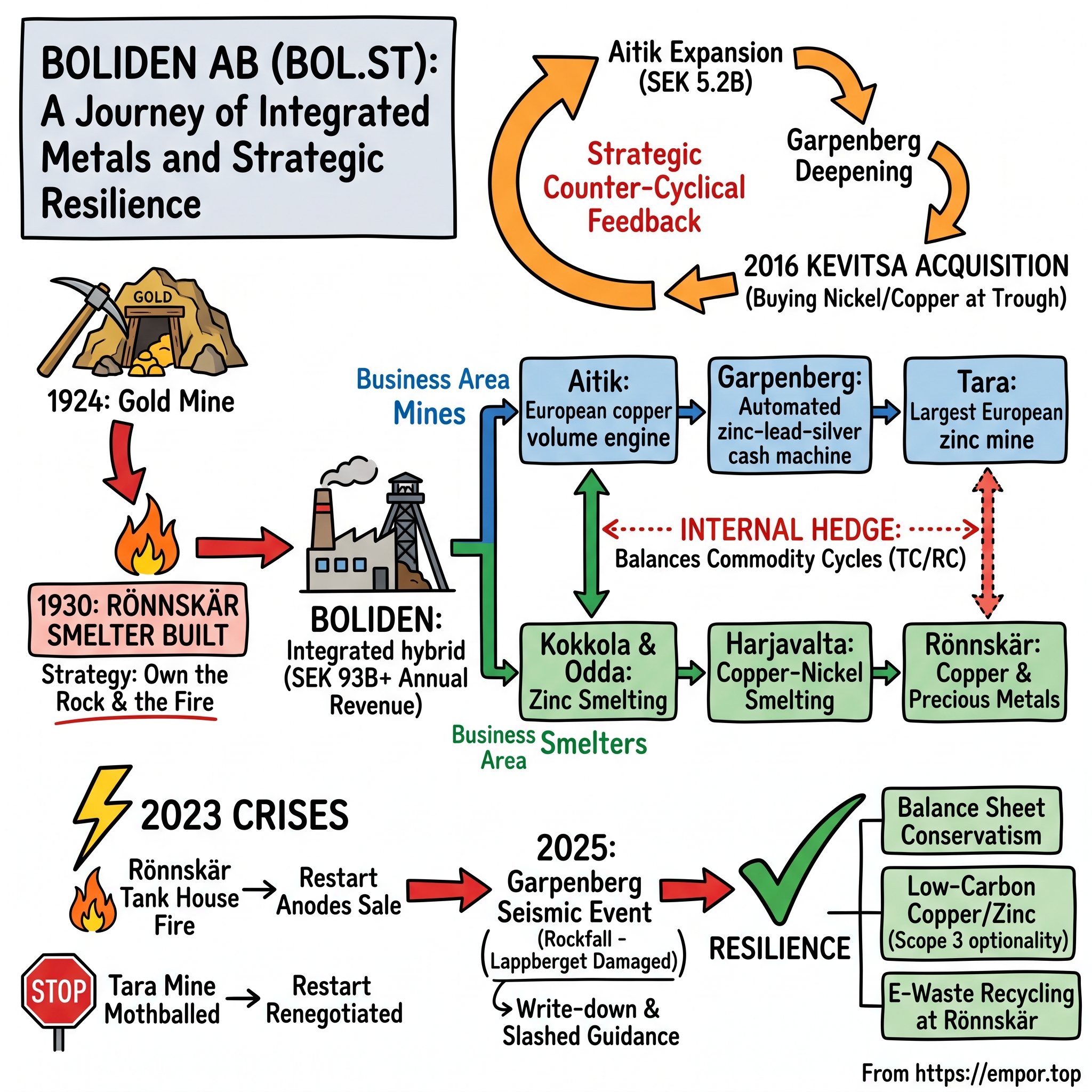
A century later, that gold rush has metamorphosed into something the original prospectors could never have imagined: an integrated metals company generating roughly SEK 93 billion in annual revenue, mining copper, zinc, lead, nickel, gold and silver across Sweden, Finland, Norway and Ireland, and then smelting and refining a large share of that output in its own furnaces.1 Boliden today is neither a pure miner nor a pure smelter. It is a deliberately engineered hybrid — a company that owns both the rock and the fire.
That structure is not an accident of history. It is the entire story.
The Business Today
Boliden operates through two tightly coupled segments, and understanding how they interlock is the key to understanding everything else about the company.
Business Area Mines runs the crown jewels. Aitik, above the Arctic Circle in Swedish Lapland, is Europe's largest open-pit copper mine and the company's volume engine. Garpenberg, in the ancient Bergslagen district, is one of the world's most automated and lowest-cost underground zinc-lead-silver mines — and, until recently, the group's most reliable profit machine. Kevitsa in Finnish Lapland supplies nickel and copper. The Boliden Area operations around Skellefteå — the original ore field — still produce complex polymetallic ore. And the Tara mine in County Meath, Ireland, is the largest zinc mine in Europe.
Business Area Smelters runs the downstream network. Rönnskär on the Bothnian coast handles copper, precious metals and electronic scrap. Harjavalta in Finland smelts copper and nickel. Kokkola, also in Finland, and Odda in Norway produce zinc. Bergsöe in Landskrona, Sweden, recycles lead. Together they convert concentrate — Boliden's own and third parties' — into finished cathode, zinc, lead, gold, silver and sulphuric acid.
The Strategic Tension
Here is the question that animates everything that follows, and it is not a comfortable one.
Boliden is a price-taker in globally traded commodities whose economics are increasingly set in Shanghai and Beijing, not Stockholm. The treatment charges its smelters earn are dictated by the balance of global smelting capacity — and that capacity has been built, overwhelmingly, in China. The copper and zinc prices its mines receive are set on the London Metal Exchange, indifferent to how elegantly the ore was extracted. Boliden operates in some of the world's highest-cost labour markets under some of its most demanding environmental permitting regimes.
So can a capital-intensive Nordic producer actually earn its cost of capital across a full commodity cycle? Or does its access to fossil-free Nordic electricity, plus the internal hedge of owning mines and smelters, give it a genuine and durable edge that lower-cost rivals cannot copy?
Management's answer is an emphatic yes. That answer is a claim to be tested, not accepted. This piece tests it.
Episode Roadmap
The road ahead runs through nine chapters. First, the Fågelström discovery and the transformational 2003 Outokumpu asset swap that created modern Boliden out of two struggling Nordic industrial companies. Second, the mining-engineering achievements at Aitik and Garpenberg that made Boliden a genuine low-cost operator. Third, the counter-cyclical Kevitsa acquisition — a masterclass in buying at the bottom. Fourth, the arcane but essential economics of smelting, the TC/RC mechanism, and the low-carbon-metal pitch that dominates Boliden's investor materials today. Fifth, the traumatic year of 2023, when a smelter caught fire and Europe's largest zinc mine had to be mothballed within weeks of each other. Sixth, the current management team and its capital-allocation record. Seventh, a framework-driven competitive analysis. Eighth, the bull-and-bear stress test — including a fresh, severe crisis at Garpenberg that erupted just months before this writing and put management's credibility on the line all over again. And finally, the transferable lessons.
Let us begin where the ore did.
 Subscribe on LinkedIn
II. The Gold Rush & Modern Genesis (1924–2003)
The Discovery That Named a Company
The Fågelström discovery of December 1924 was, in the truest sense, a Nordic frontier story. The Skellefteå ore field turned out to be a mineralised volcanic belt studded with gold, silver, copper, zinc and arsenic-rich pyrite — a geological gift from roughly 1.9 billion years of tectonic history. The Boliden deposit itself was so unusually rich in gold that for a period it ranked among the most significant gold mines in Europe, and the raw frontier town that sprang up around it lent the enterprise its enduring name.2
But the founders ran almost immediately into the iron law of mining economics, a law that has humbled far larger companies since. A miner who digs up concentrate but must ship it to someone else's smelter is at the mercy of that smelter's pricing. The refiner takes a cut, and in a downturn that cut can swallow the miner's entire margin. Worse, in a world of limited smelting capacity, the miner may simply have nowhere to send the rock at all.
The response, in 1930, was to build the Rönnskär smelter on the Bothnian coast near Skelleftehamn. In hindsight this looks visionary. At the time it was defensive — a way of ensuring that the value created in the ground actually accrued to the people who owned the ground. By controlling the furnace as well as the mine, early Boliden management captured the smelting margin internally and insulated itself from being squeezed by outside refiners.
That single architectural choice — own the rock and the fire — became the company's genetic code. It is the same logic that governs Boliden's strategy nearly a century later, and it is the reason the company looks structurally different from almost every other listed European miner.
Seven Decades of Cycles
What followed was seven decades of the brutal cyclicality that defines the metals business. Fortunes rose and fell with copper and zinc prices. The original high-grade Boliden deposits were depleted, as all deposits eventually are. New mines opened across the Skellefteå district. The company diversified, sometimes wisely and sometimes not, into fabrication, technology sales and international ventures.
By the late 1990s, Boliden was a mid-sized, financially strained Nordic player that had over-extended itself internationally and was carrying a portfolio without a clear organising logic. It mined some things, fabricated others, sold technology, and led in none of them decisively. It needed a defining move.
The 2003 Outokumpu Swap: The True Birth of Modern Boliden
That move came in 2003, and it deserves to be understood as the founding transaction of the company that exists today.
The counterparty was Outokumpu, the Finnish group that was itself trying to sharpen its identity — in its case, around stainless steel. Both companies had the same problem from opposite directions: each owned assets that mattered enormously to the other and only moderately to itself. The elegant solution was not a takeover but a swap.
Boliden acquired Outokumpu's zinc and copper mining and smelting operations. Outokumpu acquired Boliden's Fabrication and Technology Sales units — the copper-tube and brass businesses across Sweden, Belgium, the Netherlands and Britain, plus the technology-licensing arm.3 Each company would emerge focused: Outokumpu in stainless and fabrication, Boliden in mined and smelted base metals.
The assets that flowed to Boliden were transformative in a way that is hard to overstate. From Outokumpu came the Tara zinc mine in Ireland — Europe's largest — the zinc smelters at Kokkola in Finland and Odda in Norway, the Harjavalta copper smelter and Pori copper refinery in Finland, and a zinc-trading arm in the Netherlands. Those operations were valued at roughly EUR 736 million, about SEK 6.6 billion, on a debt-free basis. Against that, Boliden's departing fabrication and technology units had generated roughly EUR 270 million of net sales the prior year.3
The financing structure was as important as the assets. Rather than paying entirely in cash and levering up the balance sheet at the wrong point in the cycle, Boliden issued new shares giving Outokumpu 49 percent of the enlarged company, plus roughly EUR 373 million in cash and a subordinated debenture of about EUR 56 million.3 Outokumpu became a large shareholder in the entity it had just sold assets to — an alignment mechanism that also let Boliden preserve financial flexibility. The parties signed a letter of intent in September 2003, signed the final agreement on October 25, and completed the transaction on December 30 of that year.3
What the Deal Actually Created
The strategic result was decisive. Overnight, Boliden became the Nordic metals champion, with an integrated footprint spanning four countries, roughly 4,800 employees, and pro-forma sales of about EUR 1.6 billion — of which, tellingly, about 80 percent then came from smelting and refining and only 20 percent from mining.3 Management estimated annual synergies of EUR 25–30 million, primarily from raw-material optimisation and commercial coordination.3
That 80/20 split is worth pausing on, because it inverts the mix Boliden has today. The 2003 deal made Boliden smelter-heavy. Everything the company has done in the two decades since — the Aitik expansion, the Garpenberg deepening, the Kevitsa acquisition — has been, in part, an effort to rebalance toward mining and thereby feed its own furnaces.
More importantly, the deal embedded regional supply-chain logic into the corporate structure. Mines in one country could feed smelters in the next. Kevitsa's concentrate could go to Harjavalta. Garpenberg's and Tara's zinc could go to Kokkola and Odda. And the internal hedge between the two segments — mine profits rising when smelter margins fall, and vice versa — was now hard-wired rather than theoretical.
For investors, the 2003 transaction is the clearest early evidence of a management culture that thinks in terms of structure rather than scale. Boliden did not buy Outokumpu's assets to become bigger. It bought them to become coherent. That distinction matters enormously in an industry littered with the wreckage of scale-for-its-own-sake acquisitions.
To see how well the resulting machine can run, you have to go into the pit and underground.
III. The Engine Room: Mines, Scale & Engineering Miracles (2004–2018)
Aitik: Profiting From Almost Nothing
Stand at the rim of the Aitik pit outside Gällivare and you are looking at a hole in the ground roughly three kilometres long, more than a kilometre wide, and hundreds of metres deep — one of the largest excavations in Europe. In winter it operates in near-total darkness at temperatures that freeze hydraulic fluid. In summer the mosquitoes are legendary.
What makes Aitik remarkable is not its size but the almost absurd economics it must overcome. The copper grade in the ore is roughly two parts in a thousand — around 0.2 to 0.25 percent.[^4] To put that in human terms: for every tonne of rock blasted, hauled, crushed and ground, only a couple of hundred grams end up as copper metal. By the standards of most copper mines, that is not an ore body. That is dirt with ambitions.
A mine like that should not make money. Aitik does, and the reason is a masterclass in industrial scale.
The Boliden answer to a wretched grade is overwhelming throughput. The pivotal decision came in 2006, when the board approved an investment of roughly SEK 5.2 billion to build an entirely new concentrator and double ore production from about 18 million tonnes a year to 36 million.4 It was the largest project in the company's history to that point. The expansion came into production in the first half of 2010 and was formally opened by King Carl XVI Gustaf — a detail that captures how much Aitik matters to Sweden, not just to Boliden.5
The economics of that decision are worth spelling out because they explain the entire logic of low-grade mining. Doubling throughput does not double costs. The mine plan, the permits, the tailings facility, the management structure and much of the fixed infrastructure are largely unchanged whether you process 18 million tonnes or 36 million. So the incremental tonne carries far less than average cost, and unit cost per tonne milled falls sharply. The expansion also extended the mine's life from roughly 2016 to 2029 and added molybdenum as a new by-product alongside the existing gold and silver credits.4
Boliden has kept pushing since. Throughput has been driven toward the 45-million-tonne range, supported by a fleet designed around cost-per-tonne obsession: electric trolley-assist haul trucks that draw power from overhead lines on the steep climb out of the pit, and autonomous drill rigs that run around the clock through the polar winter.[^4]
The trolley system deserves a moment of explanation because it is more consequential than it sounds. Hauling rock up a steep grade out of a deep pit is one of the largest variable costs in open-pit mining, and diesel is the dominant input. Boliden's trucks connect to overhead catenary lines — essentially the same technology as a tram — for the uphill run, swapping expensive diesel for cheap Swedish hydropower. The effect is twofold: lower cash costs and dramatically lower emissions on the single most fuel-intensive part of the operation. It is the clearest example of Boliden's central insight that in the Nordics, clean power and cheap power are the same thing.
When you process this much material this cheaply, even a 0.2 percent grade throws off enough copper — plus gold, silver and molybdenum credits — to push Aitik toward the lower cost quartile of the global copper cost curve. The analytical lesson embedded here is fundamental: in commodities, cost position is strategy. A miner cannot control the price it receives, only the cost at which it produces. Scale, applied relentlessly to a large low-grade deposit, is the most reliable lever for driving that cost down — and it is a lever that cannot be pulled by anyone lacking a comparably enormous ore body and the capital to build around it.
Garpenberg: The Cash Machine Under Bergslagen
If Aitik is a monument to brute-force scale, Garpenberg is a monument to finesse.
Located in the old Bergslagen mining district — where ore has been extracted, on and off, since the 13th century — Garpenberg is a deep underground zinc-lead-silver mine that Boliden turned into one of the most productive and automated underground operations anywhere. The transformation came from a major expansion programme running roughly from 2011 to 2014, which deepened the mine and installed a highly automated haulage, hoisting and ventilation system allowing a relatively small workforce to move enormous tonnages from great depth.[^7]
Underground mining is normally the expensive kind. You cannot simply scale it the way you scale an open pit; every tonne must be drilled, blasted, loaded and hoisted through confined space. Garpenberg's answer was automation and orebody geometry — the Lappberget orebody in particular is large and continuous enough to support high-volume bulk mining methods that are usually impossible underground.
The payoff was a mine operating in the lowest cost decile globally and, for years, Boliden's single highest-margin asset. Its polymetallic nature — zinc, lead and a meaningful silver stream — meant it was naturally diversified against any single metal's price swing. In 2025, Garpenberg alone contributed operating profit on the order of SEK 4.4 billion.1
That last number is the tell. When one mine generates a figure of that magnitude for a group whose full-year operating profit excluding process-inventory effects was about SEK 10.7 billion, the company is more concentrated than its five-mine portfolio suggests.1 Hold that thought. Garpenberg's story takes a violent turn in 2026, and concentration risk that looks academic in good years becomes very concrete in bad ones.
Kevitsa: How to Buy at the Bottom
The third pillar of the mining story is a piece of opportunistic dealmaking that shows Boliden at its most disciplined.
In 2016, copper and nickel markets were in the doldrums. Prices had collapsed from their post-financial-crisis highs, and the industry was in retrenchment. First Quantum Minerals — a fast-growing but heavily indebted Canadian miner that had built an ambitious global portfolio — needed cash badly enough to sell a good asset.
Boliden pounced. It bought the Kevitsa open-pit nickel-copper mine in Finnish Lapland for $712 million, completing the transaction on June 1, 2016.[^8] The price reflected a market trough and a motivated, balance-sheet-constrained seller — precisely the conditions under which acquisitions tend to work.
But cheap alone does not make a good deal; plenty of trough acquisitions still disappoint because the buyer has no particular reason to own the asset. What made Kevitsa work was integration. Kevitsa's nickel-copper concentrate could be fed directly into Boliden's Harjavalta smelter, capturing downstream processing margin that a standalone buyer simply could not access. Boliden was paying a standalone-asset price for something worth more inside its own network. Within roughly a year, the asset was cash-flow positive.
Kevitsa established the template for how Boliden thinks about M&A: buy counter-cyclically, buy where you already have a downstream home for the output, and refuse to pay up at the top of the cycle for growth's sake. It is a philosophy of restraint that the company's current CEO has elevated into an operating principle — and, as we will see, one he has largely stuck to even when peers were dealmaking aggressively.
Yet no amount of mining discipline can insulate Boliden from the strange, counter-intuitive economics governing the other half of its business. To understand why Boliden owns smelters at all, and why that ownership is both a shield and a burden, we have to go into the furnace.
IV. The Smelting Paradox, E-Waste & Low-Carbon Power
Smelting Economics 101: The Toll Road Model
A smelter does not, in the main, make money by buying metal cheap and selling it dear. This surprises most people, and it is the single most important thing to understand about half of Boliden's business.
Instead, a smelter is paid a fee to process concentrate. Miners deliver copper or zinc concentrate — a muddy, metal-rich powder — and pay the smelter a Treatment Charge (TC), quoted per dry metric tonne of concentrate, and a Refining Charge (RC), quoted per pound of contained metal, to turn that concentrate into pure cathode or ingot. On top of those fees, the smelter keeps the free metal: the modest percentage of contained metal it recovers above what it contractually pays the miner for, since recovery rates in a good plant exceed the conservative levels written into contracts. And it sells the sulphuric acid produced as a by-product of roasting sulphide ores, which in a tight acid market can be a meaningful margin contributor and in a weak one can cost money to dispose of.
The cleanest analogy is a toll road. A smelter does not own the traffic. It earns a fee for every vehicle that passes through, plus a few valuable items travellers leave behind. Its profitability depends on how many vehicles come, and on what toll it can charge.
The Paradox: Why Chinese Capacity Sets Nordic Margins
Here is where it gets uncomfortable. Because TC/RCs are essentially processing fees, they are set by the balance of smelting capacity against concentrate supply — not by the metal price. If the world builds more smelters than there is concentrate to feed them, smelters compete for feed and the toll collapses. If concentrate is abundant relative to capacity, miners compete for processing slots and the toll rises.
Over the past decade, China has built an enormous amount of new smelting capacity. Producers such as 江西铜业 Jiangxi Copper and 铜陵有色 Tongling Nonferrous have expanded aggressively, often supported by strategic priorities that are not purely about smelter-level returns. That flood of capacity chasing a finite pool of mined concentrate has driven benchmark treatment and refining charges toward historic lows — at times, in copper, to levels near or below zero, meaning smelters have effectively paid miners for the privilege of processing their ore.
For a pure-play smelter, this is an existential margin squeeze with no obvious exit. You cannot innovate your way out of a negative toll. Several European smelting assets have been idled or restructured under exactly this pressure.
The Boliden Hedge — And Its Limits
This is precisely where Boliden's century-old architecture earns its keep. Because Boliden's own mines supply roughly half of its smelters' concentrate requirements, the company is structurally hedged against the TC/RC cycle.
The mechanism is worth spelling out. When TC/RCs collapse — which typically happens when concentrate is scarce, which typically coincides with strong metal demand and high metal prices — the mining segment captures the metal-price upside even as the smelting fee shrinks. Conversely, when metal prices sag but concentrate is abundant and TC/RCs are fat, the smelters do the earning while the mines struggle. The two halves lean against each other across the cycle.
Unlike many strategic slogans, this one is mechanically real. It shows up in the numbers, and it explains why Boliden's earnings, while cyclical, are less violently cyclical than a pure-play miner's.
But an honest assessment must note two limitations. First, the hedge dampens the upside as much as the downside — which is one reason Boliden's shares typically lag pure-play copper miners in a raging bull market, and a legitimate reason some investors prefer unhedged exposure. Second, the hedge is a partial one. At roughly 50 percent self-sufficiency, Boliden's smelters still buy half their feed on the open market and remain exposed to benchmark charges for that half. The structure blunts the blow; it does not eliminate it.
The Nordic Grid and the Low-Carbon Premium
Layered on top of the integration is the pitch that dominates Boliden's investor materials today.
The northern Nordic grid runs overwhelmingly on hydropower, nuclear and wind. Sweden's electricity mix is among the least carbon-intensive of any industrialised nation, Norway's is almost entirely hydro, and Finland's has decarbonised substantially. Boliden's mines and smelters therefore draw close to fossil-free power — not through offsets or accounting, but because that is simply what comes out of the wall.
The company markets certified Low-Carbon Copper with an emissions intensity it puts below 1.5 kg of CO₂ per kg of copper, against a global average it cites at around 4.0 kg, and Low-Carbon Zinc below 1.0 kg versus roughly 2.5 kg globally.6 Since smelting is fundamentally an energy-intensive process — you are applying enormous heat and electric current to separate metal from rock — the carbon intensity of a smelter is largely the carbon intensity of its power supply. A coal-fired smelter cannot fix this without either rebuilding its energy base or writing down its assets.
The strategic bet is that as the EU's Carbon Border Adjustment Mechanism phases in and European automakers, electronics manufacturers, cable makers and grid operators face Scope 3 decarbonisation obligations, they will pay a premium — or at minimum preferentially source — cleaner Nordic metal.
It is a plausible thesis with real mechanical logic behind it. But the honest investor must flag the gap between thesis and evidence. The green premium remains modest and difficult to isolate in Boliden's reported financials. Copper is copper on the LME, contracts price off the exchange, and how much extra a customer will durably pay for a lower carbon footprint — particularly in a downturn when procurement budgets tighten — is still being discovered rather than proven. Treat the low-carbon positioning as genuine optionality that may become valuable, not as a booked cash flow that already is.
The Recycling Loops: Where the Real Differentiation Hides
There is one corner of the smelting business that is genuinely differentiated and, arguably, under-discussed.
Rönnskär is one of the world's largest recyclers of electronic scrap. Shredded printed circuit boards — the guts of discarded phones, laptops, servers and consumer electronics — are fed into the copper process, where the copper, gold, silver, palladium and other metals they contain are recovered alongside the primary feed.[^10]
Why does this matter more than it appears? Two reasons. First, secondary material does not price off a TC/RC benchmark in the same way as mined concentrate, so it is partially insulated from the Chinese overcapacity dynamic. Second, and more importantly, the metallurgical capability required is genuinely hard. Electronic scrap is a chemical grab-bag: plastics, brominated flame retardants, solder, ceramics, dozens of metals in unpredictable ratios. Feeding it into a copper smelter without wrecking furnace chemistry, poisoning the product, or violating emissions permits requires decades of accumulated process knowledge. This is not something a competitor can buy off the shelf.
Alongside it sits the Bergsöe plant in Landskrona, which recycles spent lead-acid car batteries into refined lead — a small, unglamorous, steady operation with attractive returns on modest capital.
These recycling loops are not yet large enough to move the whole company's earnings. But they are the part of the smelting portfolio least exposed to the structural forces squeezing primary smelting, and they are the clearest embodiment of a capability that is genuinely difficult to replicate. For investors watching whether Boliden's moat is widening or narrowing, the trajectory of secondary-material volumes is a more informative signal than most of the headline metrics.
All of this — the integrated hedge, the low-carbon pitch, the recycling optionality — was about to be tested by fire and by financial pain in a single, brutal year.
V. The 2023 Crucible: Fire, Shutdown, and Operational Recovery
June 13, 2023: Rönnskär Burns
On the evening of June 13, 2023, an electrical fault triggered a violent explosion and fire inside the Rönnskär smelter. The blaze tore through the copper electrolysis plant — the tank house, where impure copper anodes are refined by electric current into pure cathode.7
A word on what a tank house actually is, because the loss only makes sense if you understand the function. Copper coming out of a smelting furnace is roughly 99 percent pure — good, but nowhere near good enough for electrical applications, which demand 99.99 percent. The final purification is electrolytic: impure copper anodes are suspended in acid baths alongside thin starter sheets, current is passed through, and copper dissolves off the anode and re-deposits on the cathode in near-perfect purity, leaving gold, silver and platinum-group metals behind in the sludge at the bottom. That sludge is where a large portion of a copper smelter's precious-metal revenue comes from.
So the tank house is not an ancillary building. It is where Rönnskär turns a semi-finished product into a saleable one, and where it harvests its precious metals. Losing it meant losing both.
No one was killed — an outcome that was not guaranteed given the violence of the explosion. But in a matter of hours, Boliden lost the ability to produce finished copper cathode at one of its two most important smelters.
The Response: Sell the Half-Finished Product
Management's response is a case study in operating under duress.
Rather than idling the entire plant, Boliden kept the upstream smelting furnaces running and pivoted to selling intermediate copper anodes — the semi-finished slabs that would normally have gone into the destroyed tank house — to third-party refiners.7 It was structurally lower-margin: Boliden gave away the refining margin and, critically, the precious-metal recovery that would have come from its own anode sludge. But it kept the ore moving, the mines running, the workforce employed and the cash flowing. In a business where fixed costs dominate, keeping the machine turning at reduced margin beats stopping it entirely.
The company then committed to a full rebuild, deciding to invest roughly SEK 4.8 billion in a new tank house, with production of copper cathodes and precious metals expected to ramp gradually to full capacity during the second half of 2026.89
The insurance recovery deserves detail because it demonstrates something about how well the company had prepared for a disaster it did not expect. Rönnskär's total insurance coverage at the time of the fire amounted to SEK 3.4 billion — a primary policy with a limit of SEK 2.4 billion plus excess coverage of a further SEK 1 billion.10 Boliden confirmed an insurance claim in May 2024 and recognised income of SEK 2.4 billion affecting second-quarter 2024 results, with SEK 1.0 billion of proceeds received during 2024 and the remaining SEK 1.4 billion expected in 2025.1011
The analytical point is this: Boliden absorbed the destruction of a flagship processing facility and funded a multi-billion-krona rebuild without an emergency capital raise, without breaching covenants, and without a solvency scare. That capacity is not luck. It is the direct product of a deliberately conservative balance sheet maintained through years when conservatism looked like timidity.
Tara: Knowing When to Stop Digging
The fire was not even the only crisis of that summer.
Weeks later, Boliden confronted a different kind of pain at the Tara zinc mine in Ireland. Tara had been battered by a convergence of forces: European power prices that had spiked violently in the wake of the 2022 energy shock and remained elevated, operational bottlenecks underground, and zinc prices and treatment charges that had turned sharply against it. The mine was bleeding cash on every tonne it produced.
Rather than let the losses compound in hope of a price recovery, management placed Tara into care and maintenance, suspending operations to stop the burn.12
This was a wrenching decision with genuine human cost — hundreds of jobs suspended in a community where the mine was the dominant employer — and it attracted significant political attention in Ireland. But it demonstrated a discipline that a surprising number of miners lack: the willingness to stop when each incremental tonne destroys value. The industry is full of managements that keep loss-making mines running because closure is embarrassing, because restart is expensive, or because they are personally invested in the asset. Boliden ran the arithmetic and took the reputational hit.
The company then spent the following year renegotiating labour agreements and rebuilding the operating plan around a lower-cost configuration, moving toward a phased restart of Tara through 2024, with the reopening decision explicitly flagged as affecting second-quarter 2024 results.1113
The restart is real, but it should be watched rather than assumed. Tara's cost position in a high-cost European power market remains the softest spot in the portfolio, and it is precisely the kind of asset a skeptical activist investor would press management on: either demonstrate a durable path to attractive returns through the cycle, or divest and redeploy the capital. "Restarted" is not the same as "fixed."
The Odda Bulge
Running beneath both crises was a third pressure that received less headline attention but consumed more capital.
Boliden had committed to an enormous brownfield project at Odda in Norway — an investment in excess of EUR 700 million, which ultimately absorbed a further roughly EUR 100 million of cost overrun — to expand the zinc smelter's capacity from around 200,000 tonnes toward 350,000 tonnes a year.14 At that scale, Odda would become Europe's second-largest zinc smelter and, on Boliden's telling, among the most climate-efficient in the world.1
Executing a project of that magnitude through a period of severe construction-cost inflation, while simultaneously rebuilding a burned tank house and mothballing a flagship mine, stretched the organisation hard. Much of the Odda construction was completed during 2025, with hot commissioning progressing and ramp-up commencing in 2026.114
The cost overrun deserves neither dismissal nor over-weighting. Roughly EUR 100 million on a EUR 700 million project is a meaningful miss, and management should be held to it. But in an era when large industrial projects routinely run 50 percent or more over budget, a mid-teens percentage overrun on a complex first-of-scale brownfield expansion during a global inflation shock is closer to competent than to careless. The more important question is whether the plant performs once running.
That Boliden could absorb a destroyed tank house, a suspended flagship mine and a stretched capital programme simultaneously — without diluting shareholders — says a great deal about both the balance sheet and the people running it.
So who are they, and what do they actually believe?
VI. Current Management, Capital Allocation & Governance
Mikael Staffas: The Consultant Who Runs a Mining Company
Mikael Staffas does not fit the archetype of the swashbuckling mining chief executive — the geologist-turned-dealmaker who bets the company on a discovery.
He is an engineer by training, holding an M.Sc. from Sweden's Royal Institute of Technology (KTH), with an INSEAD MBA and, most tellingly, fourteen years at McKinsey, the last five of them as a partner.15 He joined Boliden in 2011 as Chief Financial Officer, moved in 2015 to run Business Area Mines, and was appointed President and CEO with effect from June 1, 2018.1516
Read that career path carefully, because it predicts almost everything about how he runs the company. Consultant, then finance chief, then head of the operating segment that generates most of the value, then CEO. It is a progression that produces an analytical, numbers-driven leader who has personally owned both the capital-allocation decisions and the operational consequences — someone allergic to empire-building and considerably more interested in the internal rate of return on a brownfield expansion than in a headline-grabbing merger.
Staffas's stated playbook is exactly that: grow through disciplined brownfield expansion at existing sites — deepening Garpenberg, expanding Aitik, building out Odda — where Boliden already understands the geology, holds the permits, and can bolt new capacity onto existing infrastructure. Brownfield growth is cheaper, faster and lower-risk than greenfield discovery or acquisitions at cycle-peak valuations. It is also, importantly, a deliberate rejection of the value-destroying M&A binges that have humbled so many mining CEOs at the top of the cycle.
The counter-argument, which deserves airing, is that brownfield-only growth eventually runs out of runway. Every deposit depletes. Boliden's principal greenfield option is the Laver copper project in northern Sweden, for which the company received a mining concession — though the concession was appealed, which is itself a compact illustration of why building new mines in Europe is so difficult.14 Notably, when management laid out Garpenberg's long-term recovery path in 2026, it explicitly excluded any Laver contribution from the figures — a conservative framing choice, but also an acknowledgment that Laver is not yet bankable.17
Alongside Staffas sits a long-tenured finance chief. Håkan Gabrielsson, an economist by training from Linköping University, joined as CFO in 2016 after a career spanning Electrolux, Ericsson, Sapa and Fagerhult, and had previously served as Boliden's Director of Group Controlling from 2009 to 2011.18 Long CFO tenure in a cyclical business is underrated as a governance signal: it means the person enforcing the financial guardrails has personally lived through at least one full cycle at the company and does not need to relearn the lessons.
The Financial Framework
Those guardrails are explicit, publicly stated, and worth naming precisely because they form the yardstick against which management should be measured.
Boliden targets a return on capital employed above roughly 13 percent over a business cycle — a demanding hurdle for a capital-intensive business, and one that forces discipline on project approvals.6 It runs a conservative balance sheet, keeping net debt low relative to equity.
The dividend policy is deliberately simple: pay out about one-third of net profit as the ordinary dividend, and — when the balance sheet is strong, which the company defines as gearing below 20 percent including net reclamation obligations — supplement it with additional distributions, historically executed as automatic share-redemption programmes.6 For 2025, that framework produced a proposed dividend of SEK 11 per share.19
Note what the reclamation-inclusive gearing definition implies. Mining companies carry enormous future obligations to restore tailings dams and rehabilitate sites, and these obligations are real debts that happen not to be owed to banks. Including them in the leverage test is a conservative choice that many peers do not make, and it is a small but genuine signal about the seriousness of the financial framework.
The overall philosophy is countercyclical by design: hoard balance-sheet strength so that when metal prices spike you can distribute the windfall, and when disaster strikes you can self-fund the recovery rather than issuing equity at the bottom. Boliden has now demonstrated the second half of that proposition twice.
The Track Record: 2025 as a Test Case
Did the framework hold up? Largely yes, and 2025 was a genuinely strong year that showed the model working as designed.
Full-year sales rose to about SEK 93.5 billion from roughly SEK 89.2 billion in 2024.20 Net income of about SEK 9.4 billion came in slightly below 2024's roughly SEK 10.0 billion — a reminder that revenue growth and profit growth diverge in this industry depending on where in the value chain the pressure lands — while operating profit excluding process-inventory revaluation reached about SEK 10.7 billion.120
The fourth quarter alone delivered operating profit of roughly SEK 4.1 billion, which management flagged as the third-best quarter in the company's history.1 The driver was a historic rally in precious-metal prices: gold and silver, recovered as by-products from both mines and smelters, turned into an outsized earnings tailwind. Rönnskär contributed profit of roughly SEK 1 billion for the year even while still working through the tank-house rebuild, and Harjavalta contributed in excess of SEK 1.5 billion.1
The precious-metals point deserves an analytical flag. A meaningful portion of Boliden's recent earnings strength has come from gold and silver by-product credits rather than from copper and zinc fundamentals or from improved smelting margins. That is real money and a legitimate feature of a polymetallic portfolio — diversification working as intended. But investors should not mistake a precious-metals windfall for evidence that the core base-metals business has structurally improved. Strip out the by-product tailwind, and the underlying TC/RC squeeze is still there.
Management Credibility: The Honest Scorecard
Assessing credibility means looking at behaviour over time, not at the tone of the latest press release.
On the positive side, Boliden's communication through the 2023 crises was notably un-defensive. Management did not hide behind macro conditions to explain the Tara suspension or dismiss the fire as an act of God. It laid out specific rebuild and restart plans with budgets and timelines, executed the insurance recovery in line with what it had described, and delivered Tara's restart and the tank-house rebuild broadly on the schedule it had communicated. Narrative consistency across quarters has been good: the strategy described in 2018 — brownfield growth, integrated hedge, low-carbon differentiation, balance-sheet conservatism — is recognisably the strategy described today, without unexplained pivots.
On the cautionary side, the Odda cost overrun is a real miss against a stated budget, and the guidance revisions at Garpenberg in 2026 — which we come to next — were severe. There is also a governance question worth holding in mind: a company that grows almost exclusively through brownfield expansion at a handful of sites is, by construction, taking concentrated single-asset risk. Boliden's disclosure of that concentration has been adequate but not emphatic.
A management team's real credibility is measured not by how it narrates a good year but by how it handles the next unexpected blow. One was about to land squarely on the company's most important mine.
VII. Strategic Frameworks: Porter's 5 Forces & Hamilton Helmer's 7 Powers
Strip away the narrative and ask the cold analytical question: does Boliden actually possess durable competitive advantage, or is it merely a well-run operator riding a commodity cycle? Two frameworks help adjudicate, and the honest answer is more nuanced than either the bull or bear camp usually admits.
Hamilton Helmer's 7 Powers
Of Helmer's seven, Boliden plausibly holds three — one firmly, one quietly, and one only conditionally.
Scale Economies is the firm one, and it is most visible at Aitik. The entire Aitik model — profitably mining ore containing two parts copper per thousand — is only possible because the fixed cost of a 45-million-tonne-a-year ore-handling, grinding and flotation system is spread across colossal volume. The critical feature is that this advantage is not replicable at smaller scale. A competitor cannot build a half-sized Aitik and achieve proportionally similar economics; the unit-cost curve simply does not close. Combined with the fact that ore bodies of Aitik's size and geometry are geologically rare, this is a genuine and defensible barrier.
Process Power is the quiet one, and probably the most underrated thing about Boliden. It is the accumulated, largely tacit metallurgical know-how required to run complex, multi-metal ore bodies and to blend awkward feedstocks — including electronic scrap — through Rönnskär and Harjavalta without ruining furnace chemistry, degrading product quality or breaching emissions permits. This capability is not codified in patents. It lives in operating procedures, in the judgment of people who have run these plants for decades, and in a hundred small process adjustments that were learned expensively. Helmer's criterion for Process Power is that it must be hard to replicate even when the competitor knows what you are doing. Complex-feed smelting qualifies.
Counter-Positioning via certified low-carbon metal is the conditional one, and it is the most debated. The claim is that Boliden can offer green copper and zinc that high-emission competitors cannot match without either massive write-downs of existing coal-linked assets or wholesale re-powering of their operations — a move incumbents are structurally reluctant to make. There is real substance here: you cannot decarbonise a coal-fired smelter with a marketing campaign, and the asymmetry of incentives is exactly what counter-positioning describes.
But whether this rises to a durable Power depends entirely on customers paying a premium at scale, sustained through a downturn. That has not yet been demonstrated in Boliden's reported financials. Label it an emerging power, not an established one, and revisit the judgment when there is pricing evidence rather than positioning rhetoric.
Notably, Boliden holds none of the remaining four powers in any meaningful degree. There is no network economy, no switching-cost lock-in of note, no brand power in a commodity sold on exchange specification, and no cornered resource in the sense of exclusive access to something unique. That is not a criticism — it is simply what a commodity producer looks like — but it does bound how much of Boliden's return should be attributed to moat rather than to cycle.
Porter's Five Forces
Bargaining power of suppliers — meaning independent concentrate sellers relative to Boliden's smelters — runs high when metal markets are tight and concentrate is scarce. This is precisely the force that roughly 50 percent internal self-supply is designed to blunt, and it is the clearest quantifiable expression of the integrated model's value. On the other side of the ledger, Boliden's mines are themselves exposed to equipment and energy suppliers, though Nordic power markets have generally been favourable relative to continental Europe.
Bargaining power of buyers is low to moderate. European industrial customers are increasingly bound by ESG reporting requirements and carbon-border rules that tilt them toward local, low-carbon supply, which modestly strengthens Boliden's hand. But for undifferentiated tonnes, LME pricing still rules, and no customer pays above exchange price for a product it can source anywhere.
Threat of new entrants is the force most decisively in Boliden's favour, and it may be the single most durable element of the competitive position. Building a new integrated mine-and-smelter complex in Europe would require billions in capital and, more prohibitively, environmental-permitting timelines that can stretch beyond a decade — as the appeal of Boliden's own Laver concession illustrates. The barrier is not primarily money; capital is available for good projects. The barrier is European regulatory time, and no amount of capital shortens it. That moat is nearly unbreachable, and it grows stronger as European permitting becomes more demanding.
Threat of substitutes is modest but real over long horizons: aluminium substitutes for copper in some electrical applications when the price spread widens enough, and thrifting reduces metal intensity per unit of end product. Neither is a near-term threat.
Competitive rivalry is the force Boliden cannot escape. Rivalry in this industry does not express itself through price wars — nobody undercuts the LME — but through the cost curve and through capacity additions that set benchmark charges. Aurubis in Germany competes directly in European copper smelting and recycling; Glencore and Trafigura combine trading with processing at a scale Boliden cannot match; and Chinese smelting capacity sets the global TC/RC clearing price regardless of what any European operator does.
That is the permanent ceiling on the moat. Boliden can be the lowest-cost, cleanest producer in Europe and still see its earnings halved by a commodity downturn it did not cause and cannot influence. Any investment case must be built on top of that reality rather than around it.
Which is exactly why the bull and bear cases both deserve a fair hearing — and why the events of March 2026 are so instructive.
VIII. The Investor Stress Test: Bull vs. Bear Case
March 14, 2026: The Rock Moves
The clean framework above ran headlong into reality on March 14, 2026, when abnormal seismic activity struck the Garpenberg mine.
Deep underground mining creates seismicity by definition. Removing rock redistributes stress through the surrounding mass, and at depth that stress is enormous; occasional rock bursts are a known hazard managed through monitoring, support and mine design. But what happened at Garpenberg exceeded the operating envelope. The tremor triggered a substantial rockfall that displaced part of the Lappberget orebody — the zone that had historically supplied roughly 70 to 75 percent of Garpenberg's mined ore — and forced a complete halt to mining for roughly seven weeks, with operations not resuming until the end of April.21
The financial consequences were severe and immediate. Boliden recorded a SEK 700 million asset write-down and estimated a negative volume effect of around SEK 400 million, for a combined Q1 impact management put at roughly SEK 1.1 billion.212217
The guidance cut was brutal. Milled volume for 2026 was slashed to about 1.5 million tonnes from a prior plan of roughly 3.7 million. Zinc grade guidance fell to 2.7 percent from 2.9 percent, though silver grade guidance actually rose to 100 g/t from 95 g/t. The second quarter was expected to yield roughly 0.1 million tonnes — around 30 percent of the pre-event run rate. And the recovery path stretched far into the future: about 2.3 million tonnes in 2027, explicitly flagged as carrying "large uncertainty," with a return to the long-term ambition of roughly 4.5 million tonnes a year not expected until around 2032, excluding any contribution from Laver.212217
Read that timeline again. The company's single highest-margin asset — the one that generated SEK 4.4 billion of operating profit the prior year — became a six-year rebuild in the space of an afternoon.
The Bear Case, Stated at Full Strength
A skeptical investor now has substantial ammunition, and intellectual honesty requires stating it in its strongest form rather than a strawman version.
Geological risk is not hypothetical, and it is not diversifiable within this portfolio. Garpenberg demonstrates that even a world-class, highly automated, decade-optimised mine can lose most of its output for years to forces underground that no model fully captures. Worse, the concentration was hiding in plain sight: one orebody within one mine supplied the majority of the group's most profitable segment's ore. A bear would argue that Boliden's five-mine portfolio was never as diversified as it appeared, and would want to know what analogous single-point dependencies exist elsewhere.
Aitik faces a slower version of the same problem. Head grades at mature deposits decline over time — that is geology, not management failure. Holding copper output flat therefore requires moving ever more tonnage, which means rising costs per pound of copper unless productivity gains keep pace indefinitely. They will not, forever. The bear case says Aitik's cost-curve position is a wasting asset.
The TC/RC squeeze is structural, not cyclical. Chinese smelting capacity is built and will not be unbuilt. Refining charges near historic lows may be the new normal rather than a trough, permanently capping what the smelting half of Boliden can earn. If so, half the company is structurally impaired regardless of how well it is run.
Capital intensity remains punishing. Even with the heavy phase passing, capital expenditure guidance for 2026 was around SEK 15 billion, of which roughly SEK 6.5 billion was mine-sustaining spending on waste-rock removal, processing and ongoing tailings-dam raising.14 That sustaining figure is the number bears fixate on, because it never goes away. A mining company's "free" cash flow is only free after it has spent whatever is required to stand still — and in Boliden's case, standing still is expensive.
Execution risk is live right now. Odda achieved first production only on the last day of the first quarter of 2026, and management acknowledged teething problems during April requiring changes to boiler elements, pumps and other components before the plant was running again.17 The Rönnskär tank house ramps through the second half of 2026.9 Both are consuming cash before returning it, and neither is de-risked.
Non-Nordic regional exposure persists. Tara remains hostage to volatile Irish power and labour markets, and its restart economics have not yet been proven through a full cycle.
The market noticed. In 2026, Goldman Sachs initiated coverage of Boliden with a bearish stance, citing Garpenberg-related downside risk.23 An activist or skeptical long/short investor would press management hard on three things: whether the Garpenberg recovery timeline is a genuine floor or the first of several downgrades; whether the "integrated hedge" narrative obscured how concentrated group earnings had actually become in a single orebody; and whether Tara should be fixed decisively or sold.
The Bull Case, Stated at Full Strength
The bull response is that this is precisely the scenario the architecture was built for — and that it worked.
Consider what happened in the quarter that contained the disaster. Despite losing seven weeks of production at its most profitable mine and taking a SEK 1.1 billion hit, Boliden delivered first-quarter 2026 revenue of about SEK 27.8 billion, operating profit excluding process-inventory revaluation of roughly SEK 4.4 billion — up around 70 percent year on year from roughly SEK 2.6 billion — free cash flow of about SEK 1.7 billion, and earnings per share of SEK 13.45.2224 The shares rose sharply on the release.22
How does a company post a 70 percent profit increase in the quarter its best mine stops working? Diversification — across metals, across the value chain, and across geography. Strong metal prices, and in particular a historic precious-metals rally that saw gold trade above $5,000 an ounce during the quarter, lifted by-product credits flowing through both mines and smelters.22 Other mines and the smelter network carried the load. This is not a coincidence; it is the mine-smelter, multi-metal hedge doing exactly what a century of corporate architecture was designed to do.
On the earnings call, Staffas framed the response in characteristically unromantic terms: "In times like these it is even more important to focus on what you can influence."24 Management also stated that Garpenberg's critical development path was back on track and that mining positions outside the damaged upper Lappberget zone — including the two other orebodies — were largely unaffected.1721 Analysts pressed on exactly the right question: what production is possible without Lappberget, and how is future seismic risk being mitigated. Management's answers were specific about the damage and the restart sequencing rather than evasive, which is the behaviour you want to see under pressure — though specificity is not the same as accuracy, and the 2027 guidance's own "large uncertainty" caveat should be taken at face value.
The forward bull thesis rests on three legs.
First, a free-cash-flow inflection. Boliden has been in an unusually heavy capital cycle — Odda, the Rönnskär rebuild, Tara's restart, ongoing mine development — all at once. As Odda ramps toward 350,000 tonnes and the tank house reaches full capacity in the second half of 2026, capital expenditure should decline materially from the peak while earning capacity rises. That combination, if it materialises, converts into free cash flow available for the one-third dividend and periodic redemptions.
Second, the structural European green-metal thesis. Rising CBAM tariffs and hardening corporate decarbonisation mandates would gradually convert the low-carbon positioning from optionality into realised pricing. European industrial buyers have both regulatory and reputational reasons to prefer Nordic metal, and European supply is structurally constrained by the permitting barrier described above.
Third, the integrated hedge itself, now demonstrated rather than asserted. The first quarter of 2026 is the cleanest natural experiment the model has ever been given, and it passed.
The Balanced Verdict
Both cases are legitimate, and an investor who finds one obviously right and the other obviously foolish is probably not looking hard enough.
Boliden is neither a fortress immune to shocks nor a value trap. It is a well-run, integrated, cyclically-exposed producer whose structural advantages — scale at Aitik, process capability in complex smelting, a near-unbreachable European permitting moat — are genuine but bounded by commodity prices and Chinese capacity it cannot influence. Its balance-sheet conservatism has now twice proven its worth. Its geological risk has now twice proven that operating excellence does not eliminate physical uncertainty.
Three KPIs That Matter Most
An investor's job here is not to pick a side but to watch the evidence accumulate. Three metrics do more work than any others.
1. Cash cost per pound at Garpenberg and Aitik, relative to the global cost curve. This is the single best gauge of whether Boliden's cost-position moat is holding. It captures grade decline at Aitik, the efficiency of the Garpenberg rebuild, and productivity gains or losses in one number that is directly comparable to peers. If Boliden drifts from the lower cost quartile toward the middle, the core thesis is weakening regardless of what any presentation says.
2. Rönnskär rebuild and Odda ramp-up progress against stated guidance. This is the clearest ongoing test of management's execution credibility and the timing of the free-cash-flow inflection. Both projects have public schedules and budgets. Meeting them validates the capital-allocation framework; missing them repeatedly would suggest the brownfield-growth strategy is harder to execute than management has represented.
3. The self-sufficiency ratio — the share of internal concentrate feeding Boliden's own smelters. This measures whether the integrated hedge is actually functioning. With Garpenberg impaired, this ratio comes under pressure, forcing the smelters to buy more third-party concentrate in a market where treatment charges are punishing. It is the number that most directly connects the mining disruption to the smelting economics, and it is where the two halves of the company meet.
Watch those three, and the Boliden story becomes legible in real time rather than in hindsight.
IX. Playbook: Business & Investing Lessons
Step back from the furnaces and the fault lines, and Boliden offers four lessons that generalise well beyond metals.
First: counter-cyclical M&A only works when paired with downstream synergies. The Kevitsa acquisition succeeded not merely because Boliden bought at a trough from a distressed seller. Plenty of trough acquisitions still disappoint, because a cheap asset in the wrong hands is still just a cheap asset. Kevitsa worked because Boliden had a smelter waiting to consume its concentrate — meaning the mine was structurally worth more inside Boliden's network than to any standalone buyer bidding against it. Buying cheap is necessary. Having a specific, structural reason the asset is worth more to you than to anyone else is what converts a cheap purchase into a good one. Investors evaluating any acquisition should ask that second question first.
Second: geography can be a moat even in a perfectly homogeneous commodity. Copper is copper; a cathode is a cathode. And yet by anchoring production to a fossil-free Nordic grid, Boliden manufactures differentiation in a product that is otherwise entirely fungible. The broader lesson is that in commodities, sustainable advantage almost never comes from the product — it comes from an unreproducible cost input, a location, or a regulatory position. The caveat, worth repeating because it is where the thesis is most fragile, is that a differentiated input is only worth what customers will actually pay for the output, and on that question the verdict is still being written.
Third: balance-sheet conservatism is insurance you must buy before you need it. Boliden's low leverage looked almost boringly cautious through the good years — the kind of thing an aggressive investor might criticise as an inefficient capital structure. Then a smelter burned, a flagship mine was mothballed, and three years later an orebody partially collapsed. The company absorbed all three without diluting a single shareholder, and funded a SEK 4.8 billion rebuild out of its own resources and insurance. Conservative gearing is not timidity. It is the purchased option to act decisively precisely when weaker competitors are forced to raise equity at the bottom of the cycle — and in a cyclical industry, that option is worth more than the modest return drag it costs to hold.
Fourth, and most fundamentally: the integrated value chain is a two-sided hedge. An unintegrated miner is at the mercy of smelters, processing bottlenecks and refining charges. An unintegrated smelter is at the mercy of concentrate traders and a benchmark toll set by capacity decisions on the other side of the world. By owning both, Boliden built a flywheel where each half offsets the other across the cycle. The trade-off is honest and should be understood by anyone buying the shares: the same architecture that cushions the downside also mutes the upside in a boom, which is why Boliden will rarely be the best-performing metals share in a bull market. But as 2023 and 2026 both proved, the value of the structure shows up on the days when something breaks — and in mining, something always eventually breaks.
X. Outro & Canonical Source Leads
A century after prospectors pulled gold out of the frozen Skellefteå ground, Boliden has become something the founders would recognise in spirit if not in scale: a company that still lives by the principle that you should own the rock and the fire.
Its trajectory from here is inseparable from Europe's own. The continent's electrification, its industrial decarbonisation, its uneasy dependence on Asian processing capacity, and its increasingly slow and contested permitting regime all run straight through Boliden's furnaces. That dependence cuts both ways: it is the source of the company's near-unbreachable barrier to entry and simultaneously the constraint on its own growth ambitions, as the appealed Laver concession quietly demonstrates.
Whether Boliden is Europe's indispensable low-carbon metals supplier or merely its most polished cyclical producer is a question the market will keep re-answering — with every swing in the copper price, every capital milestone at Odda and Rönnskär, every quarter of treatment-charge data out of Asia, and every metre of ore Garpenberg claws back from the rockfall. The machine was engineered, over a hundred years, to endure exactly this kind of uncertainty. The next several years will show once again how well it was built.
References
-
Boliden Q4 Interim Report and year-end report for 2025: Strong metal prices — Boliden, 2026 ↩↩↩↩↩↩↩↩
-
Boliden and Outokumpu sign final agreement to create a world-leading mining and smelting company — New Boliden, GlobeNewswire, 2003-10-25 ↩↩↩↩↩↩
-
HM King Carl XVI Gustaf opened Boliden's Aitik expansion — Boliden ↩
-
Fire at Boliden Copper Smelter Rönnskär Extinguished — Reuters, 2023-06-15 ↩↩
-
Boliden to Rebuild Fire-Damaged Rönnskär Tank House — Mining.com, 2024-03-08 ↩
-
Future-proofing Boliden — Interim Report Q4 2024, Boliden, 2025-02-05 ↩↩
-
Confirmation of insurance claim for Rönnskär — Boliden, 2024-05-03 ↩↩
-
Boliden Q2 2024: Results affected by insurance income and decision to reopen Tara — Boliden, 2024 ↩↩
-
Boliden to Halt Production at Irish Zinc Mine Due to Financial Losses — Reuters, 2023-06-13 ↩
-
Boliden Prepares to Reopen Tara Zinc Mine in Ireland — Mining Technology, 2024-05-30 ↩
-
Mikael Staffas appointed as President and CEO — Boliden, 2018-02-05 ↩↩
-
Sweden's Boliden names Mines chief Staffas as new CEO — Mining Weekly, 2018-02-05 ↩
-
Earnings call transcript: Boliden Q1 2026 sees stock surge on robust results — Investing.com, 2026-04-28 ↩↩↩↩↩
-
New appointments in Boliden's Management Group — Boliden, 2015-11-19 ↩
-
Earnings call transcript: Boliden's Q4 2025 sees strong profit growth — Investing.com, 2026 ↩
-
Boliden AB Reports Earnings Results for the Fourth Quarter and Full Year Ended December 31, 2025 — MarketScreener, 2026 ↩↩
-
Consequences of abnormal seismic activity at the Garpenberg mine — Boliden, 2026 ↩↩↩↩
-
Boliden Q1 2026 slides: profit surges 70% despite Garpenberg setback — Investing.com, 2026-04-28 ↩↩↩↩↩
-
Goldman starts Boliden at sell; sees 13% downside on 2026 Garpenberg risks — Investing.com, 2026 ↩
-
Boliden's Q1 2026: Solid performance despite abnormal seismic activity in Garpenberg — Boliden, 2026-04-28 ↩↩
 LinkedIn
 WhatsApp
 Reddit
 Hacker News
 Email
Email Kindle
 RSS Feed
 Spotify
 Apple Podcasts
 Amazon Music
 Audible
 YouTube