Bunzl plc: The Unstoppable Boring-Business Compounding Machine
I. Introduction & Episode Roadmap
Walk into any supermarket, hospital ward, chain restaurant, or distribution warehouse in North America or Western Europe, and you are surrounded by Bunzl — you just cannot see it. The disposable coffee cup, the clear plastic deli container, the nitrile gloves on the nurse's hands, the hi-vis vest on the forklift driver, the blue roll of paper towel in the washroom, the carrier bag at the till, the barcode label on the back-of-house shelf: none of these carry the Bunzl name. Bunzl does not manufacture most of them. It does not brand them for consumers. It simply makes sure that tens of thousands of businesses never, ever run out of them.
Consider one concrete illustration that management offered investors in March 2026. At the American grocery chain Wegmans, Bunzl services 114 stores with more than 1,700 different product lines, fulfilling roughly 350 orders per store every week.16 That is the business in a sentence: an enormous, invisible, relentlessly repeating logistics heartbeat underneath somebody else's brand.
This is the paradox at the heart of one of the London market's quietest giants. Bunzl plc — ticker BNZL.L, a FTSE 100 constituent — reported revenue of £11.85 billion for the financial year ended 31 December 2025.12 It describes itself as a "specialist international distribution and services Group."1 In plainer language, Bunzl is the outsourced procurement and logistics department for the unglamorous, low-cost, non-food consumables that every physical business must buy to open its doors each morning. The genius — and the vulnerability — of the model is that each of these items represents a rounding error in a customer's budget, yet collectively they are indispensable.
For two decades, this was a near-perfect compounding story. Since 2004, Bunzl has committed £6.2 billion to more than 230 acquisitions, returned £3.1 billion to shareholders through dividends and buybacks, raised its dividend for 33 consecutive years, and delivered adjusted earnings-per-share growth of roughly 9% compounded annually.120 It did this while remaining asset-light, converting around 95% of profit into cash in 2025, and rarely diluting shareholders.1 The playbook was so reliable that brokers took to calling it a "sleep-easy" stock.13
Then the alarm went off. On 16 April 2025, Bunzl issued an unscheduled profit warning, cut its margin guidance, paused its share buyback, and watched its shares fall roughly 25% in a single session to a four-year low — a stock that had traded above £36 in the autumn of 2024 briefly changed hands below £23.311 By mid-2026 the market value had shrunk from about £12.6 billion in September 2024 to roughly £8.2 billion, and Elliott Investment Management — among the world's most feared activist funds — had built a stake of nearly 5%, demanding a strategic review of the very North American business that had long been the growth engine.10 The sleep-easy stock had become a battleground.
So this is not a victory lap. It is the story of how a 19th-century Central European haberdashery became the world's dominant distributor of stuff-nobody-thinks-about — and of the moment that dominance was tested. The roadmap ahead: improbable origins from Bratislava through cigarette filters; the 2005 demerger that created the modern pure-play; the roll-up machine and its true unit economics; the segment and sector architecture; the Frank van Zanten era and the own-brand strategy that both lifted margins and helped trigger the crisis; the 2024 capital-allocation pivot and its quiet abandonment; a hard-nosed moat analysis; the bear case now embodied by Elliott; the primary evidence worth reading; and the two or three metrics that will actually settle the argument.
The question the numbers force is simple. Is Bunzl a durable compounding machine passing through a self-inflicted air pocket — or is the roll-up model finally showing its age?
 Subscribe on LinkedIn
II. Historical Foundations: Haberdashery to Tobacco Oligopoly (1854–2004)
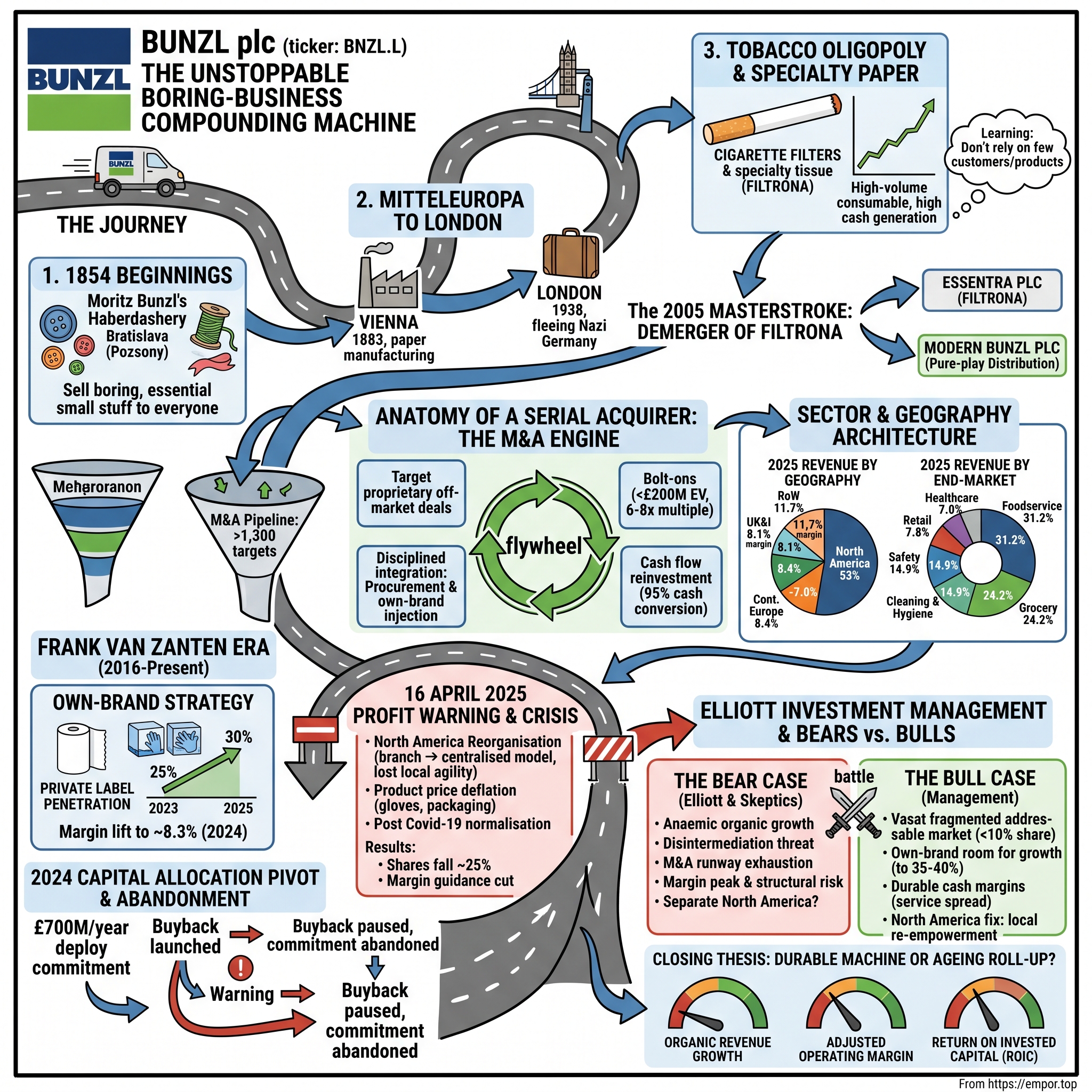
The Bunzl story begins not in a boardroom but in a shop. In 1854, Moritz Bunzl registered a haberdashery in Pozsony — the city known in German as Pressburg and today as Bratislava, capital of Slovakia.6 A haberdashery sold the small sewing goods of the age: buttons, thread, ribbons, needles. It was the archetypal low-margin, high-turnover trade, dependent on breadth of stock and reliability of supply rather than any hero product. With a century and a half of hindsight it is hard not to see the seed of the modern distributor already planted: sell the boring, essential small stuff, and sell it to everyone.
The business grew with the fortunes of Mitteleuropa. In 1883 the headquarters moved to Vienna and Bunzl began manufacturing paper — a shift from trading into industrial production that would define it for a century.6 The family prospered as an Austro-Hungarian paper and pulp dynasty until history intervened violently. In 1938, as Nazi Germany annexed Austria, the Jewish Bunzl family fled, and the headquarters relocated to London.6 It is worth pausing on that detail: the company that today embodies buttoned-down British corporate reliability exists in London only because its founders escaped fascism with what they could carry.
In post-war Britain, Bunzl rebuilt around a spectacularly profitable niche — cigarette filters and specialty tissue papers. Through the manufacturing arm later organised as Filtrona, Bunzl became a major global supplier of the filter tips, tear-tapes and specialty papers that went into the world's cigarettes.12 For a generation this was close to a licence to print money: a high-volume consumable sold into an oligopoly of tobacco giants who possessed enormous pricing power of their own. Bunzl listed on the London Stock Exchange in 1957.6
There is an important lesson buried in this chapter, and it is the mirror image of the modern thesis. The filter business had everything Bunzl's distribution arm would later prize — an essential, repeat-purchase consumable sold at scale — but it lacked the one thing that mattered most: diversification. A distributor of a thousand boring products across a thousand customers is antifragile; a manufacturer of one boring product for five giant customers is a hostage. When those five customers happen to sell a product that governments tax, litigate, and legislate into secular decline, even the fattest margins become a liability. Bunzl's later obsession with fragmentation — thousands of tiny SKUs, thousands of small accounts, no single dependency — reads, in hindsight, like a company that had learned exactly the wrong way to earn a fortune and vowed never to repeat it.
But the filter business was also a strategic trap, welding Bunzl's fortunes to a single product line serving a structurally declining and increasingly litigated industry. The response through the 1980s was diversification — much of it undisciplined. Between 1985 and 1987 Bunzl spent roughly £400 million on around 70 acquisitions, funded by rights issues and borrowing, sprawling into parcel distribution, graphic arts, food service, building supplies, plastics and electrical distribution; it entered the FTSE 100 in October 1986.22 The reckoning came fast. By 1989 profits had slumped sharply and management conceded it had made too many acquisitions too quickly; the chairman departed in 1990.22 Anthony Habgood became chief executive in 1991 and spent his first eighteen months dismantling the empire, selling or closing around twenty businesses and exiting food service and building supplies entirely.22
Buried inside the wreckage, though, was the future. Bunzl had made its first US consumables distribution acquisition in 1981 and its first European one in 1993 — the genuine early shoots of the modern company, obscured by the conglomerate around them.6 Simplification continued in 2002 with the sale of the UK and Ireland fine-paper distribution business to Australia's PaperlinX for roughly £139 million, largely ending Bunzl's involvement in paper.246
What remained was an awkward hybrid: a genuinely excellent distribution business handcuffed to a capital-intensive, ethically fraught manufacturing business. The market applied the discount such structures deserve. Separating them would define Bunzl's modern identity — and the split, when it came, was one of the cleaner pieces of corporate surgery the London market has seen.
III. The 2005 Masterstroke: The Filtrona Demerger & Pure-Play Pivot
The logic was almost embarrassingly clean once someone was willing to state it plainly. Manufacturing cigarette filters meant owning factories, buying volatile raw materials, carrying environmental and reputational risk, and earning single-digit returns for the privilege. Distributing consumables meant warehouses, trucks, modest working capital, and high returns on the capital actually employed. One business consumed cash to stand still; the other threw off cash while it grew. Why should they share a share price?
In 2005, Bunzl acted. Shareholders approved the demerger at an extraordinary general meeting on 2 June, and on 6 June 2005 Filtrona plc listed on the London Stock Exchange, with Bunzl holders receiving one Filtrona share for every Bunzl share.19 Filtrona took the manufacturing businesses — cigarette filters, protective and finishing plastic components, tapes, coated and security products — and would later rename itself Essentra plc.1912 What remained at Bunzl was a focused distribution and outsourcing group operating in 18 countries.6
Overseeing the transformation was a new chief executive. Michael Roney had joined the Bunzl board as a non-executive director in June 2003 and became chief executive in October 2005.18 He was not a City financier: Roney had spent his entire prior career, from 1981 to 2005, at Goodyear Tire & Rubber, finishing as chief executive of Goodyear Dunlop Tires Europe.18 An operator, in other words, brought in to run a business defined by logistics and purchasing rather than by clever balance-sheet engineering — and he would hold the job for a decade.
With the manufacturing baggage gone, management could finally articulate the economic sweet spot it had stumbled into. Bunzl would specialise in essential, non-food consumables: the cleaning chemicals a supermarket needs to mop its floors, the food-grade film a quick-service restaurant needs to wrap a sandwich, the safety gloves a factory needs to keep its line running. The defining characteristic is that each category typically represents a tiny slice of a customer's total operating cost — often only one or two percent. That single fact is the load-bearing wall of the entire investment thesis. Because the spend is small, customers are far less motivated to haggle over the last penny than to guarantee the stuff simply arrives, on time, every time, invoiced simply.
Here Bunzl solved a real and unglamorous pain point. A restaurant chain buying non-food items from fifty vendors drowns in purchase orders, deliveries, and invoices — administrative overhead that dwarfs the value of any individual product. Bunzl collapsed that into a single relationship: one supplier, consolidated delivery, one invoice, and increasingly vendor-managed inventory in which Bunzl tracks and replenishes stock at the customer's own site. The customer outsources a headache; Bunzl captures a sticky, high-frequency relationship. Management's account of the later Wegmans win is a textbook version of the pitch: 99% fill rates, own-brand innovation, a unified IT system, sustainability expertise, and the ability to onboard a large programme without disruption.16
The final piece was organisational, and it remains the company's most distinctive cultural feature — as well as, in time, the source of its 2025 troubles. Bunzl built a radically decentralised model. Local operating-company managers retained autonomy over customers, pricing and inventory, running their businesses as if they still owned them. The centre controlled only what genuinely benefits from scale: capital allocation, global procurement, and M&A discipline. Local entrepreneurial reflexes bolted onto central purchasing muscle — that was the machine.
The scale of that decentralisation is genuinely unusual for a FTSE 100 company, and it is easy to underestimate. By 2025 Bunzl was running a portfolio of roughly 150 separate operating companies.1 Not 150 branches of one brand — 150 businesses, many trading under the names they carried before Bunzl bought them, with their own management, their own customer relationships, and often their own local reputation built over decades. Head office in London is deliberately small. The organisational philosophy is closer to a disciplined holding company than to a conventional integrated corporate: the centre sets the capital-allocation rules, negotiates the global supply deals, and enforces financial reporting, then largely gets out of the way.
This design has an elegant logic. In a business where the customer's real question is "will my delivery arrive on Tuesday and can I call someone who knows my site," the person answering that call needs authority to solve the problem. Centralise that decision and you win a little efficiency while losing the thing customers actually pay for. The model also makes Bunzl an attractive buyer to the retiring founders it targets, because it can credibly promise that the business, the brand and the team will survive the sale — a promise a private-equity buyer or an integrating strategic rarely makes. Culture, in other words, is not soft here; it is a component of the acquisition cost advantage.
But the design carries an equal and opposite risk that would surface two decades later. A federation of 150 businesses is only as coherent as the discipline holding it together, and every so often a head office looks at that sprawl and sees duplication rather than agility. The temptation to centralise — to consolidate purchasing decisions, standardise systems, strip out overlapping management — is permanent and, on a spreadsheet, always looks accretive. The question of when that instinct is efficiency and when it is vandalism is the single hardest judgement Bunzl's leadership has to make. The question in 2005, though, was simply how efficiently the machine could be fed.
IV. Anatomy of a Serial Acquirer: The M&A Engine & Unit Economics
Picture the seller. Somewhere in Ohio, or Bavaria, or New South Wales, a family has spent three decades building a regional distributor of catering disposables or janitorial supplies. Revenue is perhaps £20 million to £80 million. The founder is approaching retirement, the children do not want the business, and a sale to Bunzl offers a clean exit at a fair price with a home for loyal staff. This scene has played out hundreds of times, and it is the raw material of the entire growth story. The global market for non-food business consumables is enormous and hyper-fragmented, populated by thousands of exactly these operators — management told investors in 2026 that it tracks a pipeline of more than 1,300 potential targets.16
Discipline in buying them is the crux of the bull case. Bunzl focuses on bolt-ons, which it defines as acquisitions with an enterprise value below £200 million, and targets purchase multiples in the range of six to eight times operating profit, at which the year-one return on invested capital comfortably exceeds the group's weighted average cost of capital.116 Crucially, it generally avoids competitive auctions for large national assets, where prices get bid up, sourcing proprietary off-market deals from retiring owners instead. Over the five years to 2025, it spent an average of roughly £300 million a year on such deals, at an average committed spend of about £25 million per business.1 These are small, repeatable, and — because they are bought below the valuations attached to splashy strategic megadeals — accretive quickly. Management has put the typical second-year return on invested capital from these deals at around 13%.16
The post-deal playbook is standardised. First, procurement: the acquired business is folded into Bunzl's global supply agreements, immediately lowering its cost of goods. Second, own-brand injection: Bunzl substitutes its own higher-margin private-label products for some of the third-party brands the target resold. Third, route and warehouse density: overlapping routes and distribution centres are merged, stripping out redundant fixed cost. In 2025 alone the group completed 36 warehouse consolidations and relocations, including a project that will cut one French business from 15 warehouses in 2024 to six by 2026.1 Fourth, and critically, Bunzl keeps the local sales force and customer-facing entrepreneurs, removing only the back-office, financing and compliance functions that scale better centrally.
The flywheel is self-funding. Because the underlying business converts roughly 90-95% of profit into cash, Bunzl pays for its acquisition programme largely from its own cash generation rather than by issuing shares or piling on debt.1 For most of the past two decades that has meant deploying several hundred million pounds a year across ten to twenty deals while keeping leverage inside a target range of 2.0 to 2.5 times net debt to EBITDA.1 The compounding math is seductive: buy cash flows at six-to-eight times, improve them, reinvest the proceeds into more of the same.
There is a second, less-discussed dimension to the playbook that the 2025 deals illustrate vividly: M&A is not only about compounding cash flow, it is about buying entry into new geographies and end-markets that would take years to build organically. The eight businesses Bunzl bought in 2025 spanned seven countries and four sectors. Hospitalia, acquired in July, made Bunzl a distributor to public and private hospitals in Chile for the first time — an instant foothold in a fast-growing Latin American healthcare market. Damito, in October, established a physical presence in Slovakia, a neat historical rhyme given the company's Bratislava birthplace. Guantes Internacionales in Mexico added an own-brand glove specialist with cross-selling potential into the United States, while Solupack brought own-brand food packaging in Brazil.1 Each is small, but collectively they show the roll-up doing something a pure financial engineer cannot: using bolt-ons as cheap options on new markets, entered at low risk because the acquired management stays and the capital at stake is modest.
Discipline, crucially, runs in both directions. A serial acquirer that only ever buys is a hoarder; a good one prunes. In January 2025 Bunzl disposed of its US R3 Safety business, its only pure wholesale safety operation in the country, which had generated around £50 million of revenue the prior year, and management noted it had sold four businesses with roughly £250 million of combined revenue and low-to-mid single-digit margins since 2022.1 Selling low-margin revenue is the unglamorous other half of capital discipline, and it is worth more analytical weight than it usually receives: it is direct evidence that management judges its portfolio on returns rather than on the vanity of a bigger top line.
But 2025 exposed the flywheel's dependence on a healthy pipeline. After a record 2024, when Bunzl committed £883 million across 13 acquisitions, 2025 collapsed to eight deals and £132 million of committed spend — well below the £460 million five-year average.114 Management blamed macroeconomic uncertainty for the timing, insisting the pipeline stayed active and that M&A "typically recovers quickly as uncertainty subsides."1 By early 2026 it was guiding to an improved year.4 That may well prove right. But it underlines a truth the bulls sometimes gloss over: when the deal machine idles and organic growth is near zero, the compounding stops. That is precisely what the market punished — and the segment numbers show exactly where the damage landed.
V. Sector & Segment Financial Architecture: Where Value Is Generated
To understand where Bunzl actually makes money — and where it recently lost its footing — you have to read the map two ways at once: by geography and by end-market. The two lenses tell different stories, and the tension between them is the whole 2025 drama in miniature.
Geographically, North America is the colossus. In 2025 the region generated £6,276.7 million of revenue, about 53% of the group, and £440.5 million of adjusted operating profit, roughly 47% of the divisional total, at a 7.0% margin.1 That margin is the story of the year: down from 7.9% in 2024, with adjusted operating profit falling 11.5%.1 This is the business serving US grocery and foodservice customers, the one that drives global purchasing scale on commodity items like gloves and packaging — and the one that stumbled on a self-imposed reorganisation.
The other three regions are smaller but, revealingly, more profitable per pound of sales. Continental Europe delivered £2,442.0 million of revenue at an 8.4% margin, spanning strong positions in the Netherlands, Spain, France and the Nordics.1 The UK & Ireland, Bunzl's home market, grew revenue a striking 15.9% to £1,883.6 million — but almost entirely through the £339 million acquisition of an 80% stake in catering-equipment specialist Nisbets, completed in May 2024, with underlying growth of just 1.4%; its margin dipped to 8.1% as Nisbets' seasonally lower-margin first half was consolidated.19 And Rest of the World — Latin America and Asia-Pacific — is the margin champion at 11.7% on £1,243.1 million of revenue, powered by mining safety in Chile and healthcare in Australia and New Zealand, though Brazil dented it when currency-driven cost increases could not be fully passed on to weakening industrial customers.1
The pattern rewards a moment's reflection. Bunzl's biggest region is also its lowest-margin, while its highest-margin businesses are its smallest. That is not accidental: North America is where competition for large national grocery and foodservice contracts is fiercest and where commodity deflation bites hardest, whereas the smaller regions contain more specialised, higher-value niches — mining safety, hospital consumables, laboratory supply. The practical consequence for an investor is uncomfortable: group margin is heavily hostage to the one region where pricing power is weakest.
Now flip to the end-market view, which cuts across geography. Foodservice is the largest customer sector at 31.2% of 2025 revenue — takeaway packaging, disposable cutlery and food-safety items sold to restaurant chains, caterers and venues.15 Grocery follows at 24.2%: the back-of-house packaging, deli wraps, labels and store-cleaning supplies supermarkets consume invisibly.15 Then safety at 14.9% (PPE, workwear, footwear and fall protection for industry, construction and mining); cleaning & hygiene at 10.7% (janitorial chemicals, paper, dispensers); retail at 7.8% (e-commerce packaging, carrier bags, display); and healthcare at 7.0% and growing, spanning examination gloves and barrier clothing for hospitals and care homes.15
It is worth pausing to explain, in plain terms, how a distributor's profit and loss account actually works, because the mechanics explain almost everything about why Bunzl's margin moves the way it does. Think of it as two thin slices. The first is gross margin — the difference between what Bunzl pays a manufacturer for a case of gloves and what it charges the customer. In 2025 that gap was 28.8% of sales.1 The second slice is the cost of running the machine that gets the case from a factory to a restaurant's storeroom: the warehouses, the trucks, the drivers, the salespeople, the IT. That consumed 21.1% of sales in 2025, up from 20.5% the year before.1 What is left over — the sliver between those two numbers — is the operating margin.
Understanding this structure explains why small changes hurt so much. Bunzl's operating margin is the residual of two much larger numbers, so a modest squeeze on either side swings the result violently. If product prices deflate, revenue falls while the warehouse lease, the truck fleet and the sales force cost exactly the same — the cost ratio rises mechanically even if the business is run no less efficiently. That is precisely what the 2025 numbers show: the increase in the operating-cost ratio was driven largely by acquisitions with different cost models, but underneath, a relatively fixed cost base was being spread over softer sales. It is also why warehouse consolidation and route density are not housekeeping but the core margin lever — and why management's willingness to cut a French operation from fifteen sites to six matters more to profit than any single customer win. For an investor, the takeaway is that Bunzl is an operational-leverage business dressed as a defensive one: wonderfully stable in cash generation, but with a margin percentage that amplifies both good and bad volume years.
The concentration matters for diagnosing the crisis. Foodservice and grocery together are more than half of group revenue — and both are exactly the sectors that felt sharpest demand pressure in North America during 2025, as softening consumer traffic hit restaurants and convenience stores.1 A portfolio that looks beautifully diversified across six sectors is, on closer inspection, still more than half-exposed to two consumer-facing end-markets concentrated in one region. When those wobbled at the same moment the company was fumbling an internal reorganisation, the effects compounded. To understand why that reorganisation happened at all, you have to understand the man who ran it and the strategy he was pursuing.
VI. The Frank van Zanten Era: Operational Elevation & Capital Allocation Shift (2016–Present)
Frank van Zanten did not arrive at Bunzl through a graduate scheme or an executive search. He arrived, in 1994, because Bunzl bought his family's Dutch disposables business and he came with it as a general manager.18 It is a fitting origin for the man who came to personify the company's culture: van Zanten is, quite literally, one of the entrepreneurs Bunzl acquires and then empowers. Born in 1967 and Dutch by nationality, he began his career at Eli Lilly, later ran the Netherlands-listed builders' merchant PontMeyer, and returned to Bunzl in 2005 as managing director of Continental Europe — a business he grew from roughly €450 million of revenue in 2004 to €1.4 billion by 2014.18 In April 2016 he succeeded Michael Roney as group chief executive.18 By 2026 he had spent more than three decades inside the machine and a decade running it, while also sitting on the supervisory board of Ahold Delhaize, keeping one foot in the grocery world Bunzl serves.7
His long-serving chief financial officer is Richard Howes, who joined as CFO in January 2020 from the distribution group Inchcape, having previously been finance chief at Coats and Bakkavor and trained as a chartered accountant at Ernst & Young.7 (A note for the diligent: several secondary summaries of Bunzl wrongly name a "Richard Tyson, formerly of TT Electronics" as CFO. That is simply wrong — Howes has held the role throughout this period.7) The chairman since April 2020 is Peter Ventress, a former chief executive of Berendsen and a veteran of the business-supplies world through senior roles at Staples and Corporate Express.7 It is a leadership team steeped in distribution rather than financial engineering — a fact that cuts both ways when a crisis demands operational surgery.
The board around them turned over materially just as the crisis hit, which is worth noting for anyone assessing governance. Julia Wilson — a former group finance director of the listed investor 3i — and Daniela Barone Soares joined as non-executive directors in December 2024, with Wilson taking the audit committee chair, and long-serving director Lloyd Pitchford stepped down at the April 2025 annual meeting.1 Fresh non-executive scrutiny arriving in the same six months as a profit warning is not a coincidence a skeptic should ignore, though nothing in the disclosures suggests the two were causally linked. On incentives, Bunzl's executive pay has long leaned on the metrics the equity story runs on — adjusted earnings-per-share growth, return on invested capital, and organic revenue growth — which aligns management with the compounding narrative but also, uncomfortably, ties a large part of their reward to the very "adjusted" figures a bear would scrutinise most closely. The tension is not unique to Bunzl, but it is sharper at a serial acquirer, where the gap between adjusted and statutory profit is structurally wide.
The defining strategic thrust of the van Zanten era has been own-brand. Bunzl scaled private-label penetration to roughly 30% of sales by 2025, up from 28% in 2024 and around 25% in 2023.1 The logic is powerful and simple: an own-brand roll of paper towel or box of gloves carries materially higher gross margin than reselling a third-party manufacturer's equivalent, because Bunzl captures the brand margin itself. This was the primary lever lifting group adjusted operating margin toward the low-8% range, and the main reason Bunzl earns more than a pure pass-through distributor should. It also has a natural ceiling that management is unusually candid about: asked on the FY2025 call about pushing own-brand harder in North America, van Zanten described a deliberately measured approach, targeting genuinely unbranded commodity categories where Bunzl will not pick a fight with the branded suppliers it also needs, and expecting only "gradual" penetration gains.16 Own-brand is a margin lever, not a switch.
Own-brand did not operate in a vacuum; it was pursued against one of the most violent demand cycles in the company's history, and how Bunzl navigated that cycle is itself a test of the model. When Covid-19 struck in 2020, Bunzl found itself sitting on exactly the products a locked-down world suddenly craved — gloves, masks, sanitiser, hygiene consumables — and its safety and healthcare businesses saw an extraordinary surge in high-margin demand. It was, briefly, the rare moment when the boring distributor was the hero. But every boom carries its hangover. As the world reopened, customers who had panic-stocked PPE worked down bloated inventories, and the prices of pandemic-inflated categories — gloves and packaging especially — deflated hard. Bunzl spent 2023 and 2024 managing this normalisation, and the FY2025 accounts still carried its fingerprints, with the chairman explicitly attributing French cleaning-and-hygiene weakness to a "post Covid-19 normalisation of pricing."1 The episode is a useful reminder that "resilient" and "immune to cycles" are not the same thing: Bunzl's absolute cash margins held up better than a manufacturer's would have, because it earns a service spread rather than a commodity spread, but volumes and reported growth still swung sharply with the cycle.
Sustainability has become the other strategic overlay of the era, and here the analytical posture should be neutral rather than celebratory. As single-use plastic bans spread across Europe and North America, Bunzl positioned itself less as a victim of regulation than as a guide through it, developing compostable, recyclable and bio-based packaging ranges and pitching a "sustainability value proposition" to large customers as a reason to consolidate spend with Bunzl rather than shop around. Management told investors it presented this proposition to more than 300 large customers in 2025 and credited it with winning significant contracts, alongside a two-percentage-point improvement in carbon efficiency over the year.1 The logic is plausible: a customer trying to hit its own environmental targets values a supplier who can swap a whole catalogue to compliant alternatives without disrupting operations, and that is a genuine upsell and lock-in vector. Whether it is a durable margin driver or simply table stakes that every distributor will eventually match is, at this stage, unproven — a claim to watch rather than to bank.
And here the story turns from triumph to cautionary tale. To push own-brand harder and sharpen its platform, Bunzl's largest North American business moved from a traditional branch-based model — in which more than 40 general managers each ran their entire local operation — to a centralised "sales and operations" model that separated supply chain from selling, largely implemented by the start of 2024.1 On paper, a sensible modernisation. In practice, it stripped local teams of speed and agility exactly when they needed it. The business lost share of wallet with local customers, particularly foodservice redistributors, because centralised processes slowed its responsiveness.1 Layer on deflation, softening end-markets, and the loss of a high-margin product programme at a grocery customer, and the result was a significant profit decline.1 The company had, in effect, undermined the decentralisation that was its own stated competitive advantage.
The reckoning came on 16 April 2025. In an unscheduled statement, Bunzl revealed first-quarter underlying revenue had fallen 0.9%, operating profit was down significantly, and full-year margin would land "moderately below 8.0%" against 8.3% in 2024, with the first half around 7.0%.3 Van Zanten's language was unusually blunt for a company that prized predictability: "I am disappointed with our performance in the first quarter."3 The market's verdict was brutal — a roughly 25% one-day fall to the lowest level since March 2021.311 The company that never surprised had delivered a nasty one.
Then came the 2024 capital-allocation pivot — and its quiet reversal, which is the most revealing governance episode in this story. At the August 2024 half-year results, with margin at 8.0% and guidance being upgraded, Bunzl had unveiled its most ambitious framework yet: a commitment to deploy approximately £700 million a year for the three years to 2027, primarily on value-accretive acquisitions and, if required, returns of capital — accompanied by an inaugural £250 million buyback.8 Howes later spelled out the arithmetic with admirable clarity: spend £500 million on deals in a year, and the £200 million balance comes back as a buyback.14 It was a genuine signal of discipline — a promise not to overpay when cash outran the pipeline.
That framework did not survive contact with 2025. The £200 million buyback launched for 2025 was paused in April after roughly £115 million had been bought, as management chose to protect balance-sheet headroom.3 It resumed at the August half-year results and was completed by October.211 But on the same August call, pressed by analysts on whether the £700 million commitment still stood, Howes indicated that with leverage back toward the lower end of the range, M&A would now be the main use of free cash flow after the dividend — effectively retiring the formulaic top-up-with-buybacks mechanism less than a year after announcing it.21 Investors are entitled to note that a capital-allocation "commitment" which quietly lapses at the first difficult year was more of an intention than a commitment.
To management's credit, the recovery plan it set out in April 2025 — leadership changes, cost savings from the second quarter, re-empowering local teams on pricing and inventory, further own-brand launches — was specific, and it broadly delivered. Full-year 2025 landed with adjusted operating profit of £910.3 million and a 7.7% margin (7.6% excluding a one-off share-based-payment credit), in line with the revised guidance, with a visibly better second half.1 On the March 2026 call, van Zanten reported that service levels were "back to their historical levels" and local agility had returned, pointing to roughly $100 million of new business won in the fourth quarter — including the expansion at Wegmans from one of two distributors to sole supplier of goods not for resale.16 Chairman Ventress acknowledged plainly that "the Group's operational performance and share price development did not meet expectations."1 That is more candour than many boards offer, and it earns management some benefit of the doubt on execution — though not on the durability of the moat, which deserves its own examination.
VII. Strategic Analysis: Competitive Moats & Hamilton Helmer's 7 Powers
Strip away the drama and ask the harder question: does Bunzl actually possess a durable competitive advantage, or is it a well-run aggregator that has been buying growth? Two frameworks help war-game it — Hamilton Helmer's 7 Powers and Porter's Five Forces — and the honest answer is that Bunzl's moat is real but narrower and more local than the bull case implies.
The primary power is scale economies, operating on two axes. On procurement, Bunzl is frequently among the largest buyers on the planet for glove manufacturers, paper mills and plastic moulders, earning volume rebates a regional distributor cannot match — and then keeping a slice of that advantage through own-brand. On distribution density, a delivery route that drops at many customers per mile costs far less per unit than a sparse one, letting Bunzl win price-competitive tenders while still earning acceptable margins. This is a genuine structural edge. But note the limit: scale economies in distribution are fundamentally local. Being the world's biggest glove buyer helps; a truck's economics still depend on route density in a specific city, not on group revenue. Bunzl's advantage is therefore a patchwork of local densities rather than a single continental fortress — which is precisely the opening Elliott exploited when it argued the North American business shares "few synergies" with the rest of the group.13
The secondary power is process power — the M&A integration engine itself. A playbook refined across hundreds of transactions, capable of extracting procurement and own-brand synergies within roughly twelve months without breaking customer relationships, is not easily copied; it lives in people and routines rather than documents. Yet 2025 revealed the flip side. The same appetite for operational "improvement" that drives integration also produced the botched North American reorganisation. Process power that can be turned against your own healthy business is a double-edged capability, and boards should treat it as such.
The tertiary power is switching costs, and these are more modest than the marketing suggests. Where Bunzl has embedded itself deeply — integrated into a customer's ERP, running automated re-ordering portals, managing inventory on-site, hitting 99% fill rates across 1,700 product lines — switching genuinely becomes operationally disruptive for a large grocery or restaurant chain.16 Digital orders reached 76% of the total in 2025, which entrenches those workflows further.1 But for a small or mid-sized account buying commodity items on price, switching costs are low. That is exactly the segment most exposed to digital competition. The moat is deep in a few places and shallow in many.
Running Porter's Five Forces confirms a business that is advantaged but not impregnable. Supplier power is low: Bunzl buys from a fragmented base of manufacturers who need its market access — though the own-brand strategy deliberately keeps those relationships cordial, which is itself a constraint on how far private label can go. Buyer power is low-to-medium: individual items are trivial in a customer's budget, so clients prioritise reliability over haggling — but the largest national accounts, especially in North American grocery and foodservice, absolutely do have power, and their pricing pressure was a direct contributor to the 2025 squeeze. As Howes put it on the FY2025 call, when the market gets more difficult, "inevitable price pressure flows from that."16 Threat of new entrants is low at national scale, since replicating a warehouse-and-route network takes decades and capital. Threat of substitutes is low: physical businesses will always need hygiene, safety and packaging. Competitive rivalry is moderate locally but limited nationally, since the mom-and-pop distributor lacks Bunzl's procurement pricing and private-label catalogue.
The peer group sharpens the point. Investors bracket Bunzl with disciplined distributors and compounders — DCC, Diploma and RS Group in the UK; Ferguson, Grainger and Fastenal in the US; Brenntag in chemicals — businesses that likewise earn high returns on modest capital through breadth, service and density rather than product innovation. In its own investor materials Bunzl has benchmarked its earnings stability against a basket of US distributors and compounders.14 The uncomfortable fact in 2026 is that, after the warning, Bunzl traded at a substantial discount to several of these peers, whose forward earnings multiples sat roughly 40-50% higher.10 A moat that produces a persistently cheaper stock than its closest comparables is, at minimum, a moat the market has begun to doubt — and doubt of that magnitude attracts a particular kind of shareholder.
A fair analysis has to be careful about what the peer contrast does and does not prove, though. Bunzl's roughly 7.7% operating margin looks thin next to the mid-to-high-teens margins that US industrial-MRO distributors such as Fastenal and Grainger have historically earned, but that comparison flatters the wrong metric. Those businesses sell more specialised, higher-value-add fasteners and industrial components with more pricing power per line item; Bunzl runs a deliberately lower-margin, higher-velocity, lower-working-capital model, moving vast volumes of commodity consumables at slim spreads. The honest yardstick for a distributor is not margin but return on the capital tied up to earn it — and on that measure Bunzl's mid-teens historical ROIC put it firmly in the company of the high-quality compounders it is bracketed with, which is exactly why its 2025 slip toward 13% is more concerning than the headline margin decline. The peer that should worry a Bunzl bull is not Fastenal but the UK compounders DCC and Diploma, which pursue a similar buy-and-improve-the-boring playbook and, through 2025, kept compounding while Bunzl stumbled. The stumble, in other words, looks company-specific rather than sector-wide — which is both reassuring (the model still works elsewhere) and damning (Bunzl's wound was largely self-inflicted).
VIII. Activist & Skeptical-Investor Stress Test
On 15 June 2026, the skeptics acquired a champion. Reports emerged that Elliott Investment Management had built a stake of almost 5% in Bunzl and was pressing for a share buyback of up to 10% of market capitalisation over twelve months — on the then-prevailing valuation, something in the order of £860 million — plus a strategic review of the North American business, potentially including its separation.1023 Elliott's thesis, as relayed by brokers, was pointed: North America operates largely independently, shares few synergies with the rest of the group, and could unlock value if separated.13 Stifel called the intervention "unsurprising" for the once "sleep-easy" Bunzl, citing the "self-inflicted execution issues" and "unusually low levels of M&A" in 2025 — while disagreeing on the scale of returns Elliott proposed.13 The shares rose on the news to around 2,632p, and the bear case graduated from a footnote in broker reports to a formal campaign.23
Strip the activist theatre away and four substantive arguments remain. First, organic-growth anaemia: is Bunzl merely a roll-up masking stagnant underlying demand? The evidence is genuinely uncomfortable. Underlying revenue growth was just 0.4% in 2025, and had been negative through the 2023-2024 deflation cycle.1 For a business that compounds by reinvesting cash into acquisitions, a near-zero organic base means the entire growth engine depends on the deal pipeline never stalling — and in 2025 it stalled.
Second, disintermediation. Could Amazon Business, direct-from-manufacturer portals, or group purchasing organisations bypass Bunzl for smaller accounts? For transactional, off-the-shelf items bought by small customers, this pressure is structural, and it maps precisely onto the low-switching-cost segment identified above. The bull rebuttal — that e-commerce platforms struggle with customised packaging, regulated healthcare and safety items, scheduled multi-site deliveries and deep vendor-managed inventory — is credible for large enterprise accounts, as the Wegmans win demonstrates, but offers thin protection at the small end. It is worth being honest that neither side of this argument is settled by hard published data; it remains a widely-held thesis rather than a measured fact.
Third, M&A runway. As regional markets consolidate, does Bunzl eventually exhaust cheap family-owned targets and get pushed up-market into competitive auctions at lower returns? Management points to a tracked pipeline of over 1,300 businesses and insists the fragmented market still offers significant consolidation opportunity.16 That is probably true today. But the 2025 collapse in deal volume — whatever its cause — is a reminder that the pipeline is not a tap that flows on command.
Fourth, margin-peak risk. Having reached 8.3% in 2024, adjusted operating margin fell to 7.7% in 2025 and guidance for 2026 is for it to be slightly lower again against the 7.6% underlying base.1 The bulls rest on own-brand climbing further and North American execution normalising; the bears argue 2024 was a high-water mark achieved partly on pandemic-era pricing now unwinding. The June 2026 pre-close added a subtler warning: management flagged that fuel costs, which run at 15-20% of selling and administrative expenses, remained elevated even as product prices began softening in some categories late in the second quarter — a scissor effect that squeezes margin from both blades.17
In fairness, the bull case has real substance too, and a neutral analyst has to state its strongest form. Management's core rebuttal is that Bunzl's addressable market is so vast and fragmented — a global non-food distribution opportunity running to hundreds of billions of pounds, in which the group holds under 10% share in most core geographies — that the runway for both acquisitions and organic share gains remains long, whatever a single soft year suggests.16 On own-brand, the argument is that penetration of roughly 30% still sits well below where it could go, with European and Rest-of-World markets offering room to climb toward the 35-40% range over time, each point of mix shift a built-in gross-margin tailwind. And on pass-through, the bulls note that Bunzl's contract structures largely protect absolute cash margins when product prices move, so deflation compresses reported revenue more than it destroys profit — which is precisely why the 2025 damage showed up as a margin percentage on shrinking sales rather than a collapse in cash generation, with free cash flow of £579 million and 95% conversion still comfortably funding the dividend and deals.1 None of these claims is self-proving, but none is fanciful either; the bull case is not that nothing went wrong in 2025, but that what went wrong was cyclical and self-inflicted rather than structural.
A rigorous skeptic would add two accounting observations, neither of which implies impropriety but both of which deserve attention. The gap between adjusted and statutory profit is large: adjusted operating profit of £910.3 million in 2025 against statutory operating profit of £735.3 million, a difference of roughly £175 million driven mainly by add-backs of acquisition-related amortisation of customer relationships, brands and technology.1 This is standard for serial acquirers, but it means the "adjusted" compounding narrative always warrants a glance at the statutory line — where basic earnings per share of 141.5p sat well below adjusted EPS of 179.3p.1 Second, returns are drifting the wrong way: return on invested capital fell to 13.0% in 2025 from 14.8%, and return on average operating capital to 37.0% from 43.2%.1 Both remain healthy in absolute terms and comfortably above any plausible cost of capital, but a serial acquirer whose returns erode toward its WACC has quietly stopped creating value, and this is the single cleanest measure of whether that is happening.
Before leaving the stress test, it is worth fact-checking four narratives about Bunzl that circulate almost unexamined, because consensus stories are where analytical errors hide.
The first myth is that Bunzl is a recession-proof defensive, immune to the cycle because businesses always need gloves and bin liners. The reality is more nuanced. Demand for the products is indeed remarkably stable — but Bunzl's earnings are not, because they sit on the operating-leverage structure described earlier and because its two largest end-markets are consumer-facing. Restaurant traffic and convenience-store footfall are cyclical, and when they soften, so does the volume flowing through a fixed warehouse network. Defensive demand and defensive earnings are different things.
The second myth is that Bunzl "never overpays" because it buys at six-to-eight times operating profit. Here the honest answer is that this is a management-disclosed range, not an independently auditable per-deal fact — Bunzl does not publish the price of individual bolt-ons. The long-run returns give the claim real credibility, but a portion of the purchase price is typically deferred or contingent on the acquired business hitting targets, which means the headline multiple is an estimate until the earn-outs settle. On the FY2025 call, management disclosed that deferred and contingent consideration on the balance sheet had fallen from roughly £375 million to £279 million, partly because expectations for the Nisbets earn-out had been reduced.16 Read one way, that is prudence and a cheaper effective price. Read another, it is an acquired business underperforming the assumptions used to buy it. Both readings are legitimate, and investors should hold them simultaneously.
The third myth is that weak organic growth was purely a deflation artefact that will reverse. Deflation was genuinely a large part of it, and the return to growth in 2026 supports the reversal thesis. But underlying growth has hovered near zero for several years rather than for one bad quarter, and in 2025 the company itself attributed a slice of the weakness not to prices but to lost share of wallet from its own reorganisation.1 Deflation was the weather; the reorganisation was the self-inflicted wound.
The fourth myth is that North America is the crown jewel. It is the largest business by far, but it is also the lowest-margin region, the epicentre of the 2025 failure, and — per Elliott — arguably the least synergistic with the rest of the group. The jewels, on a returns basis, are the smaller Rest of the World and Continental European operations. That inversion is the single most under-appreciated fact in the Bunzl story, and it is precisely what makes the activist's separation argument harder to dismiss than management would like.
The bull and bear cases collide on one question: was 2025 a stumble or a signal? The early evidence of 2026 favours "stumble" — but the market, having marked the shares down and welcomed an activist onto the register, is not yet convinced. Neither should any honest analyst be. The best way to keep testing it is to go to the source material.
IX. Primary Evidence & Earnings Transcripts Guide
For readers who want to hear the story in management's own voice and test it against analysts' pushback, four sets of primary materials repay close reading — and together they trace an arc from confidence, through contrition, to cautious recovery.
Start with the August 2024 half-year results, the high-water mark of the old confidence. Revenue was flat at constant currency but adjusted operating profit rose 7.4% and margin expanded from 7.4% to 8.0% — which van Zanten attributed to good margin management and increased own-brand penetration.8 It was here that the £700 million-a-year capital-allocation framework and the inaugural £250 million buyback were unveiled, with management describing itself as being in "an excellent position" to pursue its acquisition pipeline.8 Read against what came next, it is a lesson in how quickly a distribution business's fortunes can turn — and in why "commitments" made from a position of strength should be read as conditional.
Next, the FY2024 results of 3 March 2025 and the 16 April 2025 trading statement, six weeks apart, which together form the single most instructive pairing in the recent Bunzl file. In March, management guided to "robust" revenue growth with margin maintained in line with 2024's 8.3%.14 By mid-April that guidance was gone.3 Reading the FY2024 Q&A with hindsight is a genuinely useful exercise in analytical humility: UBS and Goldman Sachs analysts were already probing persistent deflation and whether fourth-quarter volumes had been artificially inflated by tariff-related pull-forward, and management conceded only a "low single-digit" dollar effect in safety.14 The warning that followed suggests the analysts were closer to the problem than the guidance was.
Third, the FY2025 results call of 2 March 2026 — the accountability test. Here management had to show it had delivered on the revised April promise, and on the numbers it had.1 The Q&A is where the real texture lies. Deutsche Bank pressed on the recovery timeline for the US local business, and van Zanten reiterated that the two-year recovery guidance still held while acknowledging that winning back lost customers "takes time."16 Morgan Stanley probed the ceiling on own-brand in North America, drawing the candid answer about avoiding supplier conflict.16 Most usefully, when Goldman Sachs asked about January trading, Howes declined to declare victory, noting January is seasonally the weakest month and cautioning that the strong fourth quarter was largely seasonal rather than a run-rate.16 A management team that refuses an easy upgrade after a bruising year is behaving in a way worth noting.
A fourth strand runs across all of these materials rather than sitting in any one of them: Bunzl's disclosure on digital and logistics infrastructure, which the company treats as a strategic pillar but discloses more thinly than an investor might wish. The headline metric management points to is the share of orders placed digitally, which reached 76% in 2025.1 That number is doing more work than it first appears. Every order that arrives through a customer's own procurement system or a Bunzl re-ordering portal, rather than by phone or email, is an order embedded in a workflow — cheaper to process, less error-prone, and meaningfully harder for the customer to move elsewhere. It is the closest thing a consumables distributor has to software-style stickiness. Alongside it sits an ongoing programme of warehouse consolidation, relocation and selective automation, which is the physical counterpart to the same efficiency drive.1 What Bunzl does not provide is the granular disclosure a technology investor would expect — no breakdown of automation capital expenditure, no cohort data on the retention of digitally-integrated customers versus manual ones, and no capital-markets-day-style quantification of the efficiency benefit. That is not a red flag; it is simply a limit on how far an outside analyst can verify one of the pillars of the moat, and it is worth naming rather than glossing over.
Finally, the 2026 updates trace the recovery arc, and readers should note there is no full half-year report yet — Bunzl's H1 2026 results were still to come at the time of writing, with the pre-close signalling an end-August release.17 The Q1 statement of 22 April 2026 reported underlying revenue growth of 2.0%, with North America "slightly ahead of the Group" — the first hard evidence the turnaround was taking hold.4 The 23 June pre-close went further, upgrading the revenue outlook to roughly 4% growth at constant currency for the half with underlying growth near 3%, split about two-thirds volume and one-third price, and margin modestly higher year-on-year in the half.517 Howes told analysts that service levels and product availability were "now largely restored."17 The through-line to test across all of these: does management's explanation of the North American problem stay consistent, and do the promised fixes show up in the numbers? So far the consistency is genuinely reassuring. The durability is not yet proven — which is exactly why the metrics that follow matter more than the narrative.
X. Strategic Playbook & Investment Story Spine
Boil two decades and one crisis down to their essence, and three metrics carry most of the signal for anyone tracking Bunzl from here. None of them is the share price, and none requires a spreadsheet more complicated than the company's own disclosures.
The first is the split between organic and acquired revenue growth. This is the number that separates genuine value creation from financial motion. If acquisitions merely offset an eroding organic base — as they largely did in 2025, with 2.9% acquired growth masking 0.4% underlying — the compounding is far more fragile than it looks.1 The recovery in underlying growth toward 2-3% during the first half of 2026 is the single most important datapoint suggesting the North American fix is real rather than cosmetic, and sustaining it through the second half is the test that matters most.45
The second is adjusted operating margin, read alongside own-brand penetration. Margin is where the "quality distributor versus commodity pass-through" debate is settled. The fall from 8.3% to 7.7% was the wound; whether it stabilises or drifts further will determine whether 2024 was a peak or a plateau.1 Own-brand penetration, around 30% with management describing further gains as gradual and constrained by supplier relationships, is the lever most likely to defend it — but only if pushing it does not once again disrupt the local businesses that have to sell it.16
The third is return on invested capital. This is the discipline metric — the proof that acquisitions are still being bought cheaply enough to create value. At 13.0% in 2025, down from 14.8%, ROIC remains above any reasonable estimate of Bunzl's cost of capital, but the direction of travel bears watching.1 For a serial acquirer, ROIC is the honest scoreboard; adjusted EPS can be bought, but returns on capital cannot.
The durable lessons transcend Bunzl. Boring can be beautiful: controlling unglamorous, low-cost, essential spend categories produces stickiness and pricing tolerance that flashier businesses envy. Valuation discipline separates roll-ups that compound from roll-ups that implode — buying at six-to-eight times operating profit, funded from internal cash rather than dilutive equity or reckless debt, is the guardrail that has kept Bunzl on the right side of that line for twenty years, and the 1980s conglomerate era is the company's own reminder of what happens without it.1622 And the marriage of decentralised entrepreneurship with centralised scale is a genuinely hard organisational trick — one that gives a multi-billion-pound group the reflexes of a local operator, right up until the moment head office tinkers with the decentralisation itself.
XI. Epilogue & Closing Thesis
There is a neat symmetry to Bunzl's story. It began as a haberdashery selling buttons and thread — the smallest, most essential, most invisible items of nineteenth-century commerce — and it has become an £11.85 billion distributor selling the buttons and thread of twenty-first-century commerce: the cups, gloves, wraps and vests that no business notices until they run out.1 From a family fleeing Vienna to a FTSE 100 compounding machine, the throughline is one unglamorous insight: own the boring, essential spend, and execute it with more discipline than anyone else.
But the closing thesis cannot be a victory lap, because Bunzl in mid-2026 is being stress-tested in real time. The compounding record is genuinely extraordinary — 33 consecutive years of rising dividends, roughly 9% adjusted EPS growth a year since 2004, £6.2 billion of disciplined acquisitions, £3.1 billion returned to shareholders, all with minimal dilution.1 And yet 2025 proved the model is not frictionless. A near-zero organic base leaves it dependent on a deal pipeline that can stall; its peak margins were partly cyclical; a capital-allocation framework announced with fanfare was quietly shelved within a year; and management demonstrated it can trip over its own reorganisations. Elliott's arrival, demanding a strategic review of the North American heart of the business, is the market's way of asking out loud whether the whole is still worth more than the sum of its parts.10
What to watch is therefore clear. Does underlying organic growth hold at the 2-3% the early-2026 updates promised, proving the North American turnaround durable rather than a relief rally?45 Does margin stabilise as own-brand grinds higher, or does the combination of softening prices and sticky fuel costs squeeze it further?17 Does capital allocation return to accretive dealmaking and disciplined returns — or lurch toward large buybacks to appease an activist, which would be a different company with a different risk profile? And can Bunzl defend its shallowest moats, the small-account business most exposed to digital disintermediation, while the deep ones at enterprise scale continue to hold?
Bunzl has spent more than 170 years proving that steady, disciplined execution of a simple idea can outlast far flashier competitors. The next few years will test whether it can do the harder thing: prove it again, in public, after the market has stopped taking the compounding for granted.
References
-
Annual Results Announcement 2025 — Bunzl plc News Release, 2026-03-02 ↩↩↩↩↩↩↩↩↩↩↩↩↩↩↩↩↩↩↩↩↩↩↩↩↩↩↩↩↩↩↩↩↩↩↩↩↩↩↩↩↩↩↩↩↩↩↩↩
-
Bunzl Q1 Trading Statement 2025 — Bunzl plc, 2025-04-16 ↩↩↩↩↩↩
-
Bunzl Q1 Trading Statement 2026 — Bunzl plc, 2026-04-22 ↩↩↩↩
-
Bunzl Pre-Close Statement June 2026 — Bunzl plc, 2026-06-23 ↩↩↩
-
Bunzl to acquire majority £339m stake in Nisbets — The Caterer, 2024-02-26 ↩
-
Elliott builds Bunzl stake, presses for buybacks and strategic review — Hedgeweek, 2026-06-15 ↩↩↩↩
-
ii view: profit warning plunges Bunzl shares to 4-year low — interactive investor, 2025-04-16 ↩↩
-
Bunzl gets 'unsurprising' wake-up call from activist ahead of update, says broker — Proactive Investors, 2026-06-18 ↩↩↩↩
-
Earnings call transcript: Bunzl FY2025 results — Investing.com, 2026-03-02 ↩↩↩↩↩↩↩↩↩↩↩↩↩↩↩↩↩
-
Earnings call transcript: Bunzl H1 2026 pre-close statement — Investing.com, 2026-06-23 ↩↩↩↩↩
-
Retirement of Michael Roney and appointment of Frank van Zanten as Chief Executive — Bunzl plc ↩↩↩↩↩
-
Bunzl Shares Surge as Elliott Stake Triggers Buyback Push — Financial News, 2026-06-15 ↩↩
-
Sale of fine paper operation shifts Bunzl focus — PrintWeek, 2002 ↩
 LinkedIn
 WhatsApp
 Reddit
 Hacker News
 Email
Email Kindle
 RSS Feed
 Spotify
 Apple Podcasts
 Amazon Music
 Audible
 YouTube