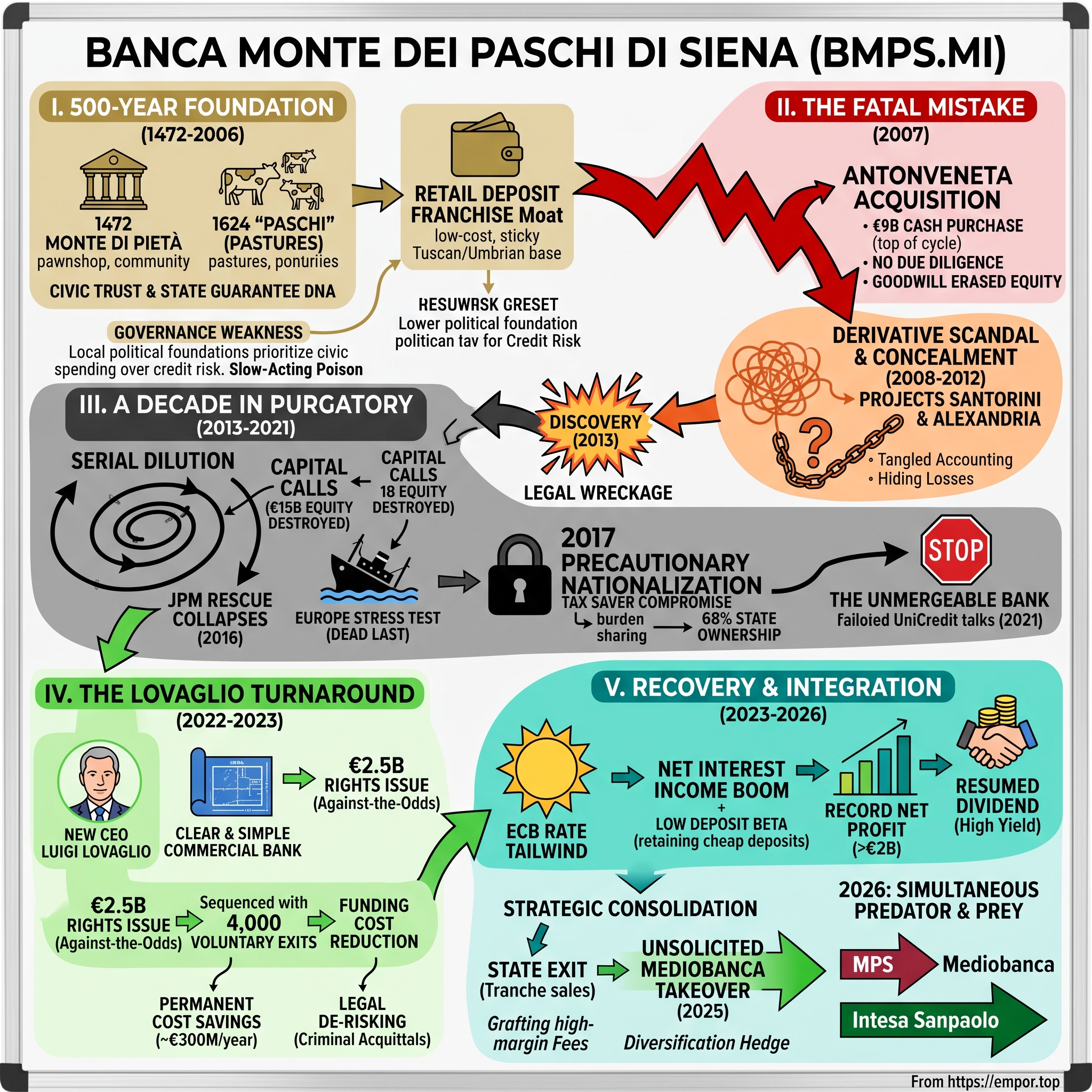
Banca Monte dei Paschi di Siena: The 550-Year Story of Survival, Scandal, & Banking Turnaround
I. Introduction & Episode Roadmap
Walk into the Piazza Salimbeni in Siena and you are standing in front of a bank that predates Columbus. The Palazzo Salimbeni, a fortress-like Gothic pile with a bronze statue of an eighteenth-century economist glowering over the courtyard, has been the head office of Banca Monte dei Paschi di Siena since the institution's earliest centuries. Founded in 1472, it is the oldest bank in the world still in operation, older than the Bank of England by more than two hundred years, older than the concept of the joint-stock company itself.1 For most of its existence it was a byword for Tuscan permanence — a civic institution as fixed in the landscape as the black-and-white marble of the Duomo down the hill.
And then, in the space of a single generation, this 500-year-old survivor very nearly ceased to exist.
Here is the paradox that makes MPS one of the most instructive business stories in modern European finance. Between 2008 and 2021, the bank destroyed well over €15 billion of shareholder equity, tapped its own investors for cash in seven separate capital calls, sat at the center of Italy's most notorious derivatives scandal, was nationalized by the Italian Treasury, ranked dead last in a Europe-wide stress test, and was passed around Rome as a problem nobody wanted — an asset so radioactive that even a €7-billion-plus dowry could not persuade UniCredit to take it off the state's hands.4 The financial press had a name for it: the unmergeable bank.
Now look at the same institution in 2026. It reported a parent-company net profit of €2.75 billion for 2025, up nearly 18% year-on-year.19 It proposed a dividend of €0.86 per share — a payout of more than €2.6 billion, one of the highest dividend yields in European banking at roughly 10%.19 Its cost-to-income ratio, once above 70%, has been ground down toward the mid-40s.19 And in a plot twist almost no one forecast, the bank that could not be given away launched an unsolicited €13-billion-plus takeover of Mediobanca — the aristocratic Milanese investment house that had spent decades as the quiet power broker of Italian capitalism — and, by September 2025, had won.20
The final irony arrived in June 2026: having become a predator, MPS itself became prey. Intesa Sanpaolo, Italy's largest bank, launched a roughly €30.6-billion offer to swallow it whole and carve it up.25 The world's oldest bank is, as of this writing, simultaneously the acquirer of one storied institution and the target of another.
How did this happen? This is a story about the difference between a franchise and a balance sheet — about how a genuinely valuable deposit business can be nearly killed by catastrophic capital allocation, and how the same franchise, once the balance sheet is repaired and rates turn in its favor, can throw off cash almost embarrassingly fast. It is a story about political ownership, accounting concealment, and the brutal arithmetic of bank recapitalizations. And it is a live case study in whether a rate-driven earnings boom is a durable competitive advantage or a cyclical mirage.
The roadmap: Part 1, the Renaissance pawnshop and five centuries of Tuscan civic trust. Part 2, the fatal 2007 deal for Antonveneta. Part 3, the derivatives cover-up and the decade in purgatory. Part 4, the Lovaglio turnaround and the recapitalization nobody thought would work. Part 5, the micro-economics of the recovery and the rate tailwind. Part 6, the great reprivatization and the sudden pivot to consolidation. And finally, the frameworks, the stress tests, and the honest bull-and-bear reckoning of a bank whose future is, once again, being decided in boardrooms in Milan and Rome.
 Subscribe on LinkedIn
II. The 500-Year Backstory: Civic Trust & Tuscan Roots (1472–2006)
Begin in 1472, in a Siena that had already passed its medieval peak. The Republic was a proud but shrinking city-state, squeezed between Florence and the papacy, and its poorer citizens were at the mercy of moneylenders charging ruinous rates. The city's General Council responded with an idea borrowed from the Franciscan reform movement sweeping Italy: a Monte di Pietà, a "mount of piety" — effectively a public pawnshop that would lend small sums to the needy at low interest, secured against pledged goods, explicitly to combat usury.1 This was the Monte Pio, the seed of everything that followed. It was not founded to make money for shareholders. It was founded as an instrument of civic welfare, and that DNA — bank as public utility — would shape the institution for the next five and a half centuries, for better and, eventually, for much worse.
The name came later, and it came from cows. By the early seventeenth century the institution needed a firmer guarantee to attract deposits. In a reform whose enabling grand-ducal decree dates to 1622 and whose new foundation was formalized in 1624, the Grand Duke of Tuscany — Ferdinand II de' Medici — granted depositors a state guarantee by pledging the income from the grand duchy's own pasturelands in the Maremma marshes.12 Those pastures were the paschi, and the customs office that collected their grazing revenues, the Dogana dei Paschi, gave the bank both its collateral and its name: Monte dei Paschi di Siena, the mount funded by the pastures. It is a wonderful detail — one of the world's great banks is named after a herd's grazing rights — but it also encodes the founding logic: MPS was, from birth, an institution whose credit rested on the backing of the state.
Fast-forward through the intervening centuries, because the relevant history for an investor is compressed at the end. MPS was declared a public-law credit institution in 1936 and operated as one for decades. The decisive modern restructuring came with Italy's Amato Law banking reforms of the early 1990s. In 1995, a Treasury decree split the old institution in two: a joint-stock bank, Banca Monte dei Paschi di Siena S.p.A., which could raise capital and eventually list on the Borsa Italiana; and a separate nonprofit entity, the Fondazione Monte dei Paschi di Siena, which inherited the bank's controlling shareholding and its civic mission.12
This structure is the hinge on which the whole tragedy turns, so it is worth dwelling on. The Fondazione was not a passive endowment. It was a political-civic body, its board effectively appointed by local Sienese and Tuscan authorities, and for years it used the bank's dividends to fund Siena's hospitals, its ancient university, its museums, and yes, the Palio — the bareback horse race run twice a summer around the shell-shaped Piazza del Campo. For the citizens of Siena, MPS was not an abstraction on a stock ticker; it was the entity that paid for the town. That produced two things at once.
On the asset side, it produced an extraordinary franchise. Generations of Tuscan families banked with MPS because their parents had, because the branch manager coached the local football team, because the bank was woven into civic life. The result was branch density and depositor loyalty in Tuscany, Umbria, and central Italy that no competitor could replicate by opening offices — a genuinely sticky, low-cost retail deposit base built on trust accumulated over centuries. That is a real economic asset, and it is the reason there is a survival story to tell at all.
On the governance side, the same structure was a slow-acting poison. A bank whose dominant shareholder is a local political foundation, whose primary objective is funding the town rather than maximizing risk-adjusted returns, is a bank in which municipal influence can quietly trump credit discipline. The Fondazione wanted the bank large, prestigious, and independent — a Sienese champion — and it was reluctant to let its stake be diluted. That combination, an appetite for scale and prestige coupled with an aversion to raising outside equity, is precisely the psychological setup for a catastrophic, debt-fueled acquisition.
It is worth being precise about the mechanism, because it recurs constantly in family- and state-influenced companies across every market. When a controlling shareholder depends on a company's dividends for its own operating budget, that shareholder acquires a powerful bias against anything that interrupts the dividend or dilutes its claim on it. Raising equity dilutes. Cutting the payout to build capital hurts. Selling control is unthinkable. So the controlling shareholder pushes the company toward growth financed by debt — which preserves both the dividend and the stake — and away from the conservative, dilutive capital management that banks in particular require. In a good decade, this looks like patriotic stewardship. In a bad one, it looks like what happened to MPS.
The Fondazione's grip also shaped who ran the bank. Senior appointments flowed through Sienese and Tuscan political channels rather than through a competitive market for banking talent, and the boardroom filled with lawyers, academics, and local notables rather than credit officers who had lived through a cycle. There is nothing uniquely Italian about this; it is what happens whenever an institution's ownership is designed around civic legitimacy instead of financial accountability. But it meant that when MPS faced the largest capital-allocation decision in its modern history, the people in the room had every incentive to say yes and very little experience of what saying yes could cost.
By 2006, then, the picture was of a genuinely valuable regional franchise sitting inside a governance structure almost purpose-built to misallocate it. The asset was five hundred years of trust. The liability was who got to spend it. What happened next is the most expensive demonstration of that mismatch in modern European banking.
III. The Fatal Mistake: The Antonveneta Acquisition & Derivative Scandals (2007–2012)
The scene is the autumn of 2007, and the man at the center of it is Giuseppe Mussari, a Calabrian lawyer who had risen to chair the Fondazione and then the bank itself. Italian banking was consolidating fast. Intesa and Sanpaolo had merged; UniCredit was on an acquisition spree; the fear in Siena was that MPS, still only a mid-sized player, would be swallowed rather than do the swallowing. Mussari wanted scale, and he wanted it before someone came for Siena.
The opportunity that presented itself was Banca Antonveneta, a Veneto-based lender that had become an orphan of the great ABN AMRO breakup. A consortium — Royal Bank of Scotland, Fortis, and Santander — had carved up the Dutch giant, and Antonveneta had landed with Banco Santander. And here is the number that should have stopped everyone in the room: Santander had valued Antonveneta at roughly €6.6 billion when it took control as part of that breakup.3 Within weeks, in November 2007, Mussari agreed to buy it from Santander for €9 billion in cash.34
Sit with that. MPS paid roughly €2.4 billion more than the price the seller had effectively just paid — a markup of about a third — for an asset that had changed hands moments earlier, in cash, at the very top of a credit cycle. The bank conducted no meaningful due diligence on the loan book it was buying. Reporting later suggested Mussari had pushed the price up partly out of fear that BNP Paribas would swoop in, negotiating against a rival he could not even see. And the timing could not have been worse: the ink was barely dry when the subprime crisis metastasized into the global financial crisis, freezing funding markets and exposing every hidden weakness in every over-levered balance sheet in Europe.
Now consider how the deal was paid for, because this is where a bad acquisition became an existential one. A €9-billion, all-cash purchase — with the all-in cost pushed toward €10 billion once you count the debt MPS assumed and had to refinance — had to be funded somehow.4 MPS did it with a roughly €6 billion equity issue, a couple of billion in junior and hybrid debt, and a bridge loan.4 In other words, it emptied its capital cushion and loaded up on expensive, fragile funding to buy an overpriced asset on the eve of the worst banking crisis in eighty years. The Tier 1 capital buffer that is supposed to absorb losses was gone, spent on goodwill that would soon be written off. When the crisis hit and Antonveneta's loans began to sour, MPS had no shock absorber left.
There is a second-order lesson buried in the financing structure that investors should not skip past. When a bank buys another bank for cash, it does not simply transfer money — it converts high-quality, loss-absorbing equity into goodwill, an intangible asset that regulators do not count as capital. So the moment the deal closed, MPS's reported balance sheet contained billions of euros of an asset that was worthless for regulatory purposes and would have to be written off the instant the acquisition disappointed. It duly was: MPS posted a loss of roughly €4.7 billion for 2011, driven largely by goodwill write-downs on exactly this transaction.4 The equity raised in 2008 to fund the purchase had, within three years, been vaporized by writing off the purchase it funded. That is the anatomy of value destruction in its purest form.
Faced with mounting, undisclosed losses, MPS's management did not raise more capital or come clean. They reached instead for financial engineering — and this is where the story crosses from disastrous judgment into alleged criminality. To paper over losses, executives entered into two now-infamous structured transactions. Project Santorini, arranged with Deutsche Bank around 2008, and Project Alexandria, arranged with Nomura in 2009, were complex derivative and repurchase trades whose economic effect, prosecutors would later argue, was to disguise losses and smooth them into the future — converting an ugly, immediate hole into a set of long-dated, deferred accounting entries that kept the reported numbers looking survivable.4
For a non-specialist, the mechanics are worth unpacking slowly, because they explain why the scandal was so corrosive to trust. Imagine a business that has lost a large sum on a bad bet and must report that loss this year. Instead, it finds a counterparty willing to sign a package of contracts whose combined effect is economically identical to the loss — the money still leaves eventually — but whose accounting treatment lets the pain be recognized in dribs and drabs over a decade rather than as one catastrophic line item today. The counterparty is paid handsomely for its cooperation, typically through favorable terms embedded elsewhere in the package. Nothing about the underlying economics improves; the loss is simply repackaged as a series of small future obligations, often bundled together with a large, leveraged position in Italian government bonds that generated carry income to help mask the drag. Crucially, the arrangement only works if the true nature of the package stays hidden — which is why the discovery of a separate "mandate agreement" documenting the real terms of the Alexandria trade, unearthed in early 2013 by new management and the Bank of Italy, was so explosive.4 It was not just that MPS had lost money. It was that the documents describing what the trades really were had been kept out of the file.
What followed the discovery was years of legal wreckage. There were, in fact, two distinct criminal tracks, and the popular account tends to blur them. In one, thirteen defendants — including bankers from Deutsche Bank and Nomura and earlier MPS managers — were convicted in Milan in 2019, only to be acquitted on appeal in May 2022, with Italy's Court of Cassation confirming the acquittals in October 2023.5 In the other, former chairman Alessandro Profumo and former chief executive Fabrizio Viola — the very team brought in to clean up the mess, prosecuted over how the legacy trades were subsequently accounted for — were convicted of false accounting and market manipulation in October 2020, sentenced to six years each, before that verdict too was overturned on appeal in December 2023 and definitively confirmed as an acquittal by the Court of Cassation in February 2025.5
Note what that sequence did to the institution. For more than a decade, essentially every senior figure associated with MPS, including the reformers, was under criminal investigation or on trial. Boards turned over repeatedly. Talented executives declined to join. And the bank carried, year after year, an unquantifiable provision for legal claims that no acquirer could underwrite and no auditor could bless with confidence — an accounting judgment that hung over every set of financial statements. The courts eventually cleared the individuals, and that mattered enormously for the balance sheet, as later sections show. But the damage to the franchise ran on a different clock than the damage to the defendants. Institutional investors do not need a conviction to conclude that a bank's disclosures cannot be relied upon; they simply stop showing up. And once they stopped, MPS's only remaining source of capital was the one it had leaned on since a Medici grand duke pledged his pastures — the state.
IV. A Decade in Purgatory: Bailouts, Nationalization, & Failed Mergers (2013–2021)
If Part 3 was the crime, Part 4 is the sentence — a decade of serial dilution so relentless that it became a dark joke in Italian finance. Picture the same grim ritual repeating every eighteen months: management announces a shortfall, calls shareholders for cash, the shares crater, existing owners are diluted toward nothing, and within a year or two the hole reopens.
The cycle began in earnest in 2013 with roughly €4.1 billion of state-backed "Monti Bonds," named for Prime Minister Mario Monti — emergency hybrid instruments that kept the bank alive but carried a punishing coupon and effectively put the Treasury on the hook.4 Then came the market cash calls: a €5 billion rights issue in 2014 and a further €3 billion in 2015.4 To understand how brutal this was for shareholders, remember that a rights issue raising more than the entire market value of the company obliterates prior owners; you were not being asked to top up an investment, you were watching your stake be reduced to a rounding error, again and again. And none of it fixed the underlying disease, because the disease was not a one-time loss — it was a mountain of non-performing loans that kept growing as the Italian economy stagnated.
The reckoning came in July 2016, when the European Banking Authority published a Europe-wide stress test. Under the adverse scenario, MPS's fully loaded core capital ratio was projected to go negative — the only bank in the exercise to fall below zero.4 Its gross bad-loan ratio had ballooned toward the mid-thirties as a share of loans, tens of billions of euros of credit that might never be repaid.4 MPS was, officially and publicly, the weakest major bank on the continent. A private-sector rescue was hastily assembled — a JPMorgan-led plan to raise €5 billion of fresh equity and offload €28 billion of bad loans — and it collapsed in December 2016 when the anchor investors balked.4
That failure forced the endgame. In 2017, the Italian Ministry of Economy and Finance stepped in with a "precautionary recapitalization" under EU state-aid rules — a mechanism that allows a government to inject capital into a solvent bank facing a hypothetical shortfall, provided junior creditors share the pain first. The European Commission approved it on July 4, 2017.6 The state injected €5.4 billion, junior bondholders and shareholders contributed several billion more through "burden sharing" as their instruments were converted or written down, and the total capital strengthening came to roughly €8 billion.6[^8] When the dust settled, the Italian taxpayer owned about 68% of the world's oldest bank.46 MPS was, in all but name, nationalized.
The phrase "burden sharing" deserves a moment, because it is where this bailout collided with Italian politics in a way that shaped everything after. Under post-crisis EU rules, taxpayer money cannot go into a bank until junior creditors have taken losses first. In most countries, junior bank debt is owned by institutions who understand the risk. In Italy, subordinated bonds had for years been sold across bank branch counters to ordinary retail savers as if they were deposits — pensioners in Tuscany holding instruments they did not understand. When those bonds were converted and written down, thousands of retail investors lost money, and the political blowback was ferocious. Rome ultimately arranged partial compensation for the worst-affected retail holders, but the episode hardened a lasting political conviction: no Italian government would ever again let a large bank restructure in a way that visibly hurt small savers. That conviction is a live, present-day fact — it is part of why Italian bank consolidation is always as much a political negotiation as a financial one, and why the state's later exit from MPS was choreographed so carefully.
Nationalization came with a leash. In exchange for the aid, MPS entered a strict EU-mandated restructuring: headcount cuts, branch closures, executive pay caps, and above all a mandate to purge the balance sheet of bad loans. The cleanup was genuine and it was enormous. In 2018, MPS executed one of Europe's largest-ever bad-loan securitizations — the "Valentine" transaction, roughly €24 billion in gross book value bundled and sold with a state guarantee under the GACS scheme.7 In 2020, "Project Hydra" transferred a further €8 billion or so of soured credit to AMCO, the state-owned bad bank.8 The effect on asset quality was dramatic: the gross bad-loan ratio, once in the mid-thirties, was driven down toward the low single digits.8 For the first time in a decade, MPS had a balance sheet that was not visibly on fire.
But a clean-ish balance sheet is not the same as a viable independent business, and the state had promised Brussels it would sell. The obvious buyer was UniCredit. Through the second half of 2021, the Treasury negotiated to hand MPS to UniCredit and its new chief executive, Andrea Orcel — a famously hard-nosed dealmaker who had spent a career advising on bank mergers before running one. Orcel's terms were the terms of a man who knew exactly what he was looking at: he wanted the Treasury to inject well over €7 billion of fresh capital, to carve out the legal risks and bad loans, and to hand over only the clean, profitable core.49 Rome considered the price too steep and the political optics of a multi-billion-euro parting gift too toxic. On October 24, 2021, the talks collapsed.9
And there it was: the unmergeable bank. MPS was left stranded — majority-owned by a reluctant state, bound by an EU commitment to privatize, and with no buyer willing to take it at any price the seller could stomach. It is genuinely hard to overstate how hopeless the situation looked at the end of 2021. The consensus view was that MPS would need yet another capital injection just to survive, that it had no independent future, and that its eventual fate was a fire sale or a managed wind-down. That consensus was about to be proven spectacularly wrong — not because the story got easier, but because two things changed at once: the man in charge, and the price of money.
V. The Lovaglio Blueprint: Surgical Turnaround & The €3.5B Rights Issue (2022–2023)
In February 2022, the Treasury installed a new chief executive, and on paper he was an unusual choice for a bank drowning in Sienese politics: Luigi Lovaglio, a then-66-year-old banker with none of the local baggage and a very specific reputation.10 Lovaglio had spent four decades largely at UniCredit, where his defining achievement was running Bank Pekao in Poland — turning it into one of central Europe's most efficient and profitable lenders. He had then taken on Credito Valtellinese, a troubled Italian regional bank, and engineered its cleanup and sale.10 His entire career, in other words, was about one thing: taking flabby, underperforming banks and making them lean. He was an operator, not a diplomat, and he arrived in Siena with what colleagues described as zero emotional attachment to the mythology of the place.
His diagnosis was blunt and, in retrospect, correct. MPS did not have a franchise problem — the deposits and the customers were still there. It had a cost problem, a legal-overhang problem, and a capital problem, and they had to be solved in the right order. In June 2022, he unveiled a 2022–2026 business plan bearing a title that was itself a rebuke to the bank's baroque history: "A Clear and Simple Commercial Bank."11 The plan set unglamorous, achievable targets — a cost-to-income ratio of 60% in 2024 falling to 57% in 2026, a pre-tax profit of roughly €700 million in 2024 rising to around €900 million in 2026, a core capital ratio comfortably above requirements, and a return to dividends with a 30% payout on 2025 and 2026 earnings — and it hinged on two hard actions: a big equity raise, and an even bigger cost cut.11
Read those targets again with the benefit of hindsight and something jumps out: they were modest to the point of being unambitious. A bank that would go on to earn over €2 billion within eighteen months was promising a pre-tax profit of €700 million two years out. This was not a failure of forecasting so much as a deliberate choice of posture. After a decade in which MPS management had over-promised and under-delivered so consistently that its guidance was worthless, Lovaglio's entire strategy for rebuilding credibility was to under-promise. Set targets low enough that they cannot be missed, hit them early, and let the pattern of quiet beats do the work that grand visions never could. It is a genuine insight into how trust is rebuilt in a business where trust is the product — and it is the single clearest piece of evidence for management credibility in the whole story.
The equity raise is the part everyone said was impossible. Here it is worth being precise, because the popular framing — including this episode's own working title — has often inflated the number. The capital increase MPS actually launched and completed was €2.5 billion, not €3.5 billion.1113 But the difficulty was not the headline figure; it was the context. When Lovaglio went to market in October 2022, MPS's entire market capitalization had shrivelled to roughly €100 million.12 Read that again: the bank needed to raise twenty-five times its own market value, in a matter of weeks, in the teeth of a European energy crisis and a war on the continent's eastern edge, for a bank whose brand was synonymous with serial dilution. The offer terms tell the story — 374 new shares for every 3 held, at €2.00 each, a hyper-dilutive structure that only makes sense when the existing equity is already close to worthless.13
How did he pull it off? Partly the state: the Treasury, still owning about 64%, committed to subscribe its pro-rata share of roughly €1.6 billion.13 But EU state-aid rules forbade the state from simply funding the whole thing — private investors had to take a meaningful slice, or the raise would count as illegal aid. So Lovaglio had to assemble around €900 million of private money.12 An underwriting syndicate of eight banks led by Bank of America, Citigroup, Credit Suisse, and Mediobanca — an irony worth savoring, given what came later — agreed to backstop about €807 million, and the London fund Algebris and asset manager Anima came in as anchor investors.12 The fees were eye-watering, around €125 million, nearly 15% of the guaranteed portion, a measure of exactly how much risk the underwriters thought they were taking.12 But it closed on November 4, 2022.13 Against the odds, MPS had its capital.
There is a political footnote to the raise that matters. The timing was nearly wrecked by Italy's own government: the collapse of Mario Draghi's coalition in the summer of 2022 threw the whole plan into doubt for months, since the state was both the majority shareholder underwriting the deal and, briefly, a caretaker administration unable to make big commitments. That MPS still got the raise away in November, into a market rattled by war and an energy shock and its own government's instability, is a large part of why it is remembered as an against-the-odds execution rather than a routine rights issue.
Crucially, Lovaglio sequenced the cost cut with the raise rather than after it — and this is the single most important operational decision in the entire turnaround. A large chunk of the €2.5 billion was earmarked not for growth but for a voluntary redundancy scheme. In late 2022, MPS negotiated with unions and the industry's solidarity fund to let more than 4,000 employees — around a fifth of the workforce — leave voluntarily, with the up-front cost of their exit packages funded directly by the freshly raised equity.1112 The structural payoff was roughly €300 million of annual cost savings, permanently lower run-rate expenses that would drop straight to the bottom line the moment revenues recovered.
Why does the voluntary nature matter so much? Because in Italian banking, involuntary layoffs are close to legally and politically impossible, and forced cuts poison the labor relations a branch bank depends on. By routing the exits through the sector's solidarity fund — which bridges older employees to retirement — and making participation voluntary, Lovaglio removed a fifth of the workforce without a strike, without litigation, and without the reputational damage that would have undercut a bank trying to persuade Tuscan families to keep their deposits. The capital raise was what made it possible: you cannot offer thousands of people attractive early-exit packages unless you have the cash to pay them up front. This is the part that separates a real turnaround from a hopeful one. Recapitalizations routinely fail because the money plugs the hole but the cost base keeps bleeding. Lovaglio used the capital to change the cost base itself — and did it in a way the Italian system would tolerate.
The third leg was legal de-risking. The litigation overhang — the tail of civil claims from the Antonveneta and derivatives era — had at its peak represented petitions for damages running into several billion euros, an unquantifiable liability that scared off any acquirer or investor.11 Under Lovaglio, the bank fought and won a series of key rulings, settled where it made sense, and — helped by the criminal acquittals working their way through the courts — reclassified large chunks of claimed risk as remote. By late 2024 the residual petitum on the legacy financial-disclosure disputes had fallen to roughly €1.3 billion, a fraction of the peak and, more importantly, a number the market could finally underwrite.14
Governance stability underpinned all of it. The Treasury installed Nicola Maione, a lawyer and MPS director since 2017, as chairman from April 2023 — a low-drama appointment that kept the board aligned with the discipline of the restructuring rather than the politics of Siena.29 For the first time in fifteen years, MPS had a management team setting modest targets and then quietly beating them. Whether that was skill or the ECB doing the heavy lifting is the question the next section has to answer honestly.
VI. Micro-Economics of the Turnaround: Segment Breakdown & The Rate Tailwind (2023–2026)
To understand why MPS's profits exploded, you have to understand what kind of machine it actually is — and then you have to be honest about how much of the machine's sudden output was skill and how much was the weather.
Strip MPS down and you find a fairly plain commercial bank, dominated by one engine. The overwhelming majority of its revenue and profit comes from commercial banking — plain retail and business banking, serving on the order of three million-plus customers through a branch network of well over a thousand offices concentrated in Tuscany, Umbria, and central Italy.11 This is the franchise the centuries built: gather cheap deposits from loyal households and small businesses, lend them out to local families as mortgages and to small and medium enterprises as commercial credit, and pocket the spread. A second, smaller layer is wealth management and private banking — fee income earned by selling asset-management products and, through a longstanding bancassurance partnership with AXA, insurance and protection products. This is the part management most wants to grow, because fees do not evaporate when interest rates fall. A third, thin sliver is corporate and investment banking and treasury — specialized corporate lending, trade finance, and the balance-sheet management function that decides how the bank invests its liquidity, much of it historically in Italian government bonds.
Now the weather. A bank like this makes its core money on net interest income — the gap between what it earns on loans and bonds and what it pays on deposits. From 2022 to 2024, the European Central Bank raised its policy rate from below zero to 4% in the sharpest tightening cycle in the euro's history, and for a deposit-funded retail bank this was manna. The yield on MPS's loans and its bond portfolio repriced upward quickly. But the cost of its funding barely moved — and why it barely moved is the single most important fact in the bull case. In banking jargon, MPS enjoyed a very low "deposit beta": as rates rose, it passed only a small fraction of the increase through to depositors. Its retail savers in Siena and central Italy, banking with MPS out of multi-generational habit rather than rate-shopping, simply left their money in low-yielding current accounts. The bank captured almost the entire benefit of higher rates and shared little of it. The result was net interest income that surged — MPS's net interest income rose roughly 49% year-on-year in 2023 alone.14
The operating leverage did the rest. Recall that Lovaglio had permanently stripped out around €300 million of annual cost. So when revenue jumped, very little of it was eaten by expenses, and the profit line went vertical. The cost-to-income ratio — the share of revenue consumed by running the bank, where lower is better — collapsed from 68% at the end of 2022 to 49% for 2023, and has since been ground down toward the mid-40s.1419 For 2023, MPS reported a net profit of €2,052 million, against a small loss the year before, and a fully loaded core capital ratio of 18.1% — no longer the weakest bank in Europe but one of the best-capitalized.14 The board declared a dividend of €0.25 per share, the first payout in more than a decade and, pointedly, two years ahead of the plan's own timetable.14 In 2024 the momentum held: net profit of roughly €1.95 billion and a dividend lifted sharply to €0.86 per share.419
There is a second, less-remarked driver of the profit surge that deserves its own line: deferred tax assets. Years of losses had left MPS with a mountain of tax credits it could only use against future profits. For most of the crisis those credits sat on the balance sheet at a heavy discount, because the bank had no profits to offset. The instant MPS became reliably profitable, accountants could re-recognize large chunks of those assets at full value, and several of the bank's headline profit figures — including in 2023 — were flattered by substantial positive tax effects rather than pure operating strength.14 This is not a scandal; it is standard accounting. But it means the reported net-profit line overstates the underlying, repeatable earnings power in the years the tax benefits landed, and a careful reader tracks pre-tax operating profit to see the real engine. It also means the tax tailwind, like the rate tailwind, fades — by management's own account the deferred-tax benefit runs down toward the end of the decade.23
So what does the evidence actually mean? Two things, and they pull in opposite directions. The bullish read is that the low deposit beta is a genuine, durable competitive asset — proof that the centuries-old franchise translates into real pricing power on the funding side, the cheapest raw material a bank has. The skeptical read is that a very large slice of the profit boom was the ECB and the tax code handing MPS a temporary windfall, both of which reverse. Both are true. By 2025 the operating picture had matured into something more balanced and more revealing: full-year revenues of roughly €5 billion, net interest income of around €2.65 billion, and — crucially — net fees and commissions of about €1.79 billion growing at 8% on the core bank, with wealth management and advisory up in the double digits.19 In other words, as the rate tailwind began to ebb, fee income was picking up some of the slack, and the cost-to-income ratio held steady around 46% even as the bank digested a large acquisition.19 The first quarter of 2026 extended the pattern: a cost-to-income ratio of 44%, cost of risk stable at a benign 42 basis points, and revenue growth driven by both net interest income and fees rather than rates alone.22 The honest question for an investor is not whether MPS got lucky — it plainly did — but whether the cost structure, the capital fortress, and a fee franchise that is finally growing can sustain attractive returns after the tailwinds fade. Management's answer to that question took the form of the boldest strategic gamble in the bank's modern history. But first, the state had to get out.
VII. The Great Reprivatization & Strategic Consolidation (2023–2026)
By late 2023, the Italian Treasury had a rare and unfamiliar problem: it owned two-thirds of a bank that people suddenly wanted to buy. The turnaround had made MPS sellable, and Rome had a binding commitment to Brussels to exit. What followed was one of the more skillfully executed state divestments in recent European memory — not a single fire sale but a patient, tranche-by-tranche placement into a rising market.
The choreography ran like this. In November 2023, the Treasury sold 25% of the bank in an accelerated placement, raising about €920 million and cutting its stake from roughly 64% to 39%.15 In March 2024, it sold a further 12.5% for about €650 million, at a materially higher price per share — evidence that the market was re-rating the story as the profits proved durable.16 In November 2024 it placed another 15%, raising about €1.1 billion at a price several times what it had received a year earlier.17 Across the three placements the state raised roughly €2.7 billion — against the €1.6 billion it had put in during the 2022 rescue — while cutting its holding to around 11.7%.17 For once, an Italian bank bailout looked like it might actually make the taxpayer money.
But the more consequential story than how much was sold is who bought it. Rome did not sell to a foreign bank or scatter the shares anonymously into the market. It steered blocks toward a hand-picked group of domestic strategic investors — a deliberate assembly of an Italian ownership core. In the November 2024 placement, Banco BPM, Italy's third-largest bank, took roughly 5%; the asset manager Anima added to its position; and two of the most powerful figures in Italian capitalism stepped in: Delfin, the holding company of the late Leonardo Del Vecchio's family (the Luxottica fortune), and the Rome-based construction-and-finance dynasty of Francesco Gaetano Caltagirone.31 This was not a random cap table. It was a coalition, and its members had their own agendas — agendas that also happened to run through Mediobanca and Assicurazioni Generali, the twin pillars of Italy's financial establishment where Delfin and Caltagirone were already the largest shareholders and were locked in a long campaign to break the old Milanese power structure.
Which sets up the twist. On the face of it, MPS in early 2025 looked like a classic re-privatization success: capital fortress, lean costs, fat dividend, a stable domestic shareholder base, and optionality to be either a consolidation target or a high-yield cash cow. The "why win from here" spine seemed simple — best-in-class capital, one of the lowest cost ratios in southern Europe, a deposit franchise competitors could not replicate, and a balance sheet finally free of its legacy. The "why not" was equally clear — extreme sensitivity to the coming ECB rate cuts, a wealth-management business far too small to offset falling rates, geographic concentration in low-growth Italy, and a bond portfolio stuffed with Italian sovereign debt that would suffer if spreads blew out.
Then MPS did something no one had on their bingo card. In January 2025, the bank that had been nationalized eight years earlier launched an unsolicited, all-share offer for Mediobanca — the €13-billion-plus bid to acquire the most prestigious investment bank in Italy, an institution that had spent seventy years as the discreet architect of Italian corporate power.18 Mediobanca's board rejected it immediately and contemptuously, calling it "devoid of industrial and financial rationale" and pointedly noting that MPS's largest shareholders, Delfin and Caltagirone, sat on both share registers — a conflict of interest dressed up as strategy.18 The bid was widely read not as an industrial masterstroke but as a proxy war: the Del Vecchio and Caltagirone camps using state-blessed MPS as a battering ram against the Mediobanca-Generali establishment they had long sought to break.
And yet it worked. After sweetening the terms with a cash component and grinding through a shareholder vote and a months-long tender, MPS secured 86.3% of Mediobanca by late September 2025 — a takeover valued at over €16 billion that consolidated the target from the fourth quarter onward.20 The share exchange, paid largely in new MPS stock, diluted the Treasury's residual holding down to under 5% — effectively completing the reprivatization not through another sale but by arithmetic, as the state's fixed number of shares shrank as a slice of a much larger company.26 In March 2026 the two boards approved a full merger by incorporation at an exchange ratio of 2.450 MPS shares per Mediobanca share, with a plan to fold Mediobanca's retail and affluent wealth arm (Mediobanca Premier and the Widiba digital bank) into MPS while housing its crown-jewel corporate-and-investment-banking and private-banking businesses — and its roughly 13% stake in Assicurazioni Generali — inside a wholly owned, unlisted subsidiary that keeps the Mediobanca name.20 Because MPS directly controls the target, the merger was formally classified as a related-party transaction and had to clear the independent-director committees of both boards — a governance safeguard that matters given the overlapping Delfin and Caltagirone stakes.20
Step back and weigh the strategic logic honestly, separate from the palace intrigue. The industrial case for MPS owning Mediobanca is real: it grafts a high-margin, fee-generating investment bank and asset manager onto a deposit-rich commercial bank, precisely the diversification that hedges against falling rates, and it accelerates the use of MPS's deferred tax assets against Mediobanca's profits. The case against is equally real: MPS paid a full price for an asset whose most valuable components — client relationships and star bankers — can resign, and the cultural distance between a mass-market Sienese lender and an elite Milanese merchant bank is vast. The unmergeable bank had become the acquirer of the bank that arranged everyone else's mergers. Whether that is a masterstroke or hubris is the question the integration will answer — and, as it turned out, the question a larger predator would try to answer for it.
VIII. Strategic Frameworks: Hamilton Helmer's 7 Powers & Porter's 5 Forces
Strip away the drama and ask the analyst's question: does MPS actually possess durable competitive advantage, or is it a cyclically-flattered commodity lender that got its balance sheet fixed at the right moment? Two frameworks help war-game it.
Hamilton Helmer's 7 Powers. The one power MPS genuinely holds is a cornered resource, and it is the whole ballgame: the centuries-deep branch density and depositor loyalty in Tuscany and central Italy that produce a sticky, low-cost deposit base. This is not marketing; it showed up quantitatively as the low deposit beta that drove the rate windfall. But grade it honestly — it is regional, not national, and it is a defensive moat around cheap funding, not an offensive engine for growth. Scale economies are real but modest: the 4,000-person headcount cut structurally lowered fixed costs and drove the sector-leading cost ratio, yet MPS remains a fraction of the size of Intesa Sanpaolo or UniCredit, and in an industry where technology and compliance spending is increasingly a fixed cost spread over the customer base, subscale is a genuine disadvantage. Switching costs are moderate and industry-wide — households and SMEs are sticky with their primary current accounts and payroll relationships, but that protects every incumbent bank, not MPS specifically. Process power — the demonstrated operational muscle to cut costs and contain legal risk — is arguably Lovaglio's personal power more than the institution's, which raises key-man risk. Counter-positioning and network economies are essentially absent; this is a traditional branch bank, not a platform. And branding sits in an unusual place: MPS spent a decade as a toxic headline and has, impressively, rehabilitated its brand back to that of a stable regional flagship — but "no longer radioactive" is a recovery, not a moat.
The verdict from the framework is sobering and useful: MPS's advantage is real but narrow. It rests almost entirely on one cornered resource — cheap, sticky central-Italian deposits — whose economic value swings enormously with the interest-rate cycle. That is a very different thing from a structural moat that compounds regardless of the weather.
Porter's 5 Forces. The threat of new entrants is very low — banking licenses, ECB capital requirements, and compliance barriers keep newcomers out, which is why bank franchises persist for centuries. Supplier power is best understood as the ECB and wholesale funding markets: MPS is a price-taker on the cost and availability of money, and that "supplier" is about to raise its prices in the bank's favor's opposite direction as rates fall. Buyer power is asymmetric — retail depositors individually have little leverage (the source of the deposit-beta advantage), but corporate borrowers shop hard on loan pricing. The threat of substitutes is rising and worth watching: Italian households can now park savings in fintech neobanks like Revolut or in retail government bonds (the "BTP Valore" program), both of which compete directly for the cheap deposits that are MPS's core asset — a slow structural pressure on the very moat the 7 Powers analysis prized. And competitive rivalry is intense: MPS fights national champions Intesa Sanpaolo and UniCredit, plus strong regional peers Banco BPM, BPER Banca, and Crédit Agricole Italia, in a mature, low-growth domestic market where the main way to grow is to buy someone — which is precisely why Italian banking is convulsed by consolidation, and precisely why MPS is now both hunter and hunted.
The synthesis: MPS is a well-run, well-capitalized incumbent with a real regional funding advantage, operating in a defensible but slow-growing and increasingly contested market, where its narrow moat is most valuable exactly when rates are high — and least valuable exactly when they fall. That is the tension every subsequent section has to resolve.
IX. Primary Evidence & Call Analysis: Prepared Remarks vs. Analyst Q&A
The most revealing way to test a turnaround is not the press release; it is the analyst call, where prepared optimism collides with skeptical professionals paid to find the hole. Across MPS's calls from the 2022 investor day to the most recent quarter, a consistent pattern emerges: management's prepared remarks emphasize the strategic narrative, while the Q&A repeatedly drags the conversation back to three uncomfortable questions — the durability of net interest income, the residual legal tail, and what on earth the bank intends to do with its excess capital.
At the June 2022 investor day, Lovaglio's prepared story was discipline: the capital raise, the 4,000 exits, the cost targets, the promise of a "clear and simple commercial bank."11 What is striking, reading it against what followed, is how conservative the targets were — a pre-tax profit of around €900 million by 2026 that the bank would blow past years early once rates turned. That gap between modest promise and large delivery is the foundation of Lovaglio's credibility, and it is worth naming as an analytical fact: management set beatable targets and beat them, the opposite of the overpromising that had defined the bank for a decade.
By the FY2023 call in February 2024, the tone had inverted — management was now delivering numbers so far ahead of plan (the €2.05 billion profit, the 18.1% capital ratio, the surprise early dividend) that the skepticism shifted from "can they survive" to "is this sustainable."14 Analysts pressed on the obvious vulnerability: net interest income sensitivity. If the ECB cuts, how much does the profit engine give back? Management's answer was to point relentlessly at the fee franchise — the Anima and AXA partnerships, wealth management — as the buffer, while committing to a payout policy of returning the majority of earnings to shareholders.
The most recent call, for the first quarter of 2026 on May 12, 2026, is the richest because it captures management defending the Mediobanca deal in real time while integrating an acquisition several times more complex than anything the bank had done since Antonveneta.23 Lovaglio's framing was almost defiant: "Uncertainty is behind us. Execution is now the focus."23 He reported that more than 30% of the €700 million of targeted merger synergies had already been secured, and — addressing head-on the awkward reality that private bankers were fleeing the acquired Mediobanca — described a "particular quarter" of departures that had "normalized" since mid-April.23 The Q&A is where the substance lived. Analysts from Bank of America, Goldman Sachs, Morgan Stanley, Deutsche Bank, and, tellingly, Intesa Sanpaolo's own research desk pushed on exactly the right pressure points: the sensitivity of net interest income to rate cuts (management quantified it at roughly €50 million per 100 basis points, notably lower than before the Mediobanca diversification), the timing of buybacks (deferred until the merger completes), the fate of the Generali stake (described dismissively as a "nice to have"), and whether the €3.5-billion-plus pre-tax profit guidance was struck before or after restructuring charges (after, management confirmed, including around €300 million of them).23
Two things stand out from listening across the calls. First, the narrative has been remarkably consistent — cost discipline, capital strength, majority payout — with no unexplained strategy lurches, which for a bank with MPS's history is itself notable. Second, the Mediobanca acquisition sits in genuine tension with that narrative: a bank that built its credibility on being "clear and simple" has bought its way into the most complex, relationship-driven corner of Italian finance, and management's answers on synergies and retention are, so far, assertions to be verified rather than results to be trusted. The calls reveal a management team that has earned the benefit of the doubt on execution — and is now asking the market to extend that credit to a far harder task.
X. Skeptical Investor Stress Test & Current Risk Radar
Now put on the short-seller's hat and attack the story where it is softest.
"Was the €2 billion-plus profit just an ECB rate-hike mirage?" This is the sharpest challenge, and it cannot be waved away. A large share of the earnings surge came from net interest income that ballooned because rates rose and MPS declined to share the gains with depositors. The ECB has begun cutting. As policy rates fall toward the low single digits, that spread compresses mechanically, and the question is whether fee income — wealth management, bancassurance, and now Mediobanca's advisory and asset-management businesses — can grow fast enough to defend a return on tangible equity in the double digits. Management's own guidance implicitly concedes the vulnerability by quantifying the sensitivity and by making the Mediobanca deal, whose fee-heavy revenue mix is precisely a hedge against rate cuts, the centerpiece of the strategy. The skeptic's fair conclusion: the peak of the pure rate windfall is behind the bank, and the entire investment case now rests on whether diversification into fees can offset the fade. That is an unproven proposition, not a demonstrated one.
"Is the litigation hangover truly dead?" Mostly, but not entirely. The criminal cases ended in acquittals, and the residual civil petitum has fallen to a manageable level relative to the bank's capital.514 But civil courts apply a lower standard of proof than criminal ones, legacy claims can resurface, and a bank with MPS's history carries a permanent tail risk that a cleaner institution does not. The provision is now a number the market can underwrite — but "underwritable" is not "zero."
"Does MPS have the scale to compete on technology?" This is the quiet, structural worry. Digital banking, fraud detection, and AI-driven risk scoring are increasingly a fixed-cost arms race, and MPS's absolute technology budget is a fraction of what Intesa or UniCredit can deploy. The Mediobanca deal helps on scale but does little for retail-technology firepower. Over a decade, subscale in technology spending is a slow erosion of competitiveness that no amount of Tuscan loyalty fully offsets.
Beyond those three, the material risk radar carries four live items. Interest-rate sensitivity is the dominant one, already discussed. Italian SME asset quality is the second: MPS's loan book is concentrated in small and medium enterprises in central Italy, and a domestic recession or a cost-inflation shock would push the cost of risk — currently benign at around 42 basis points — sharply higher.22 Post-privatization governance friction is the third and it is not hypothetical: the shareholder base is a coalition of powerful, willful investors — Delfin at over 17%, the Caltagirone group above 10%, Banco BPM, BlackRock — whose interests do not automatically align, as the extraordinary spring 2026 boardroom fight already demonstrated.26 Sovereign risk is the fourth: like most Italian banks, MPS holds a large portfolio of Italian government bonds, so its capital is umbilically tied to the spread between Italian and German yields — a channel through which any resurgence of Italian political or fiscal risk transmits straight into the bank's balance sheet.
The governance point deserves a beat of its own, because it turned live in April 2026. The outgoing board's own slate of director nominees pointedly excluded Lovaglio, setting up a proxy fight; a shareholder vehicle then filed a competing list backing Lovaglio for another term as CEO and proposing Cesare Bisoni — a former UniCredit chairman and professor emeritus — as chairman.2728 When the dust settled at the April shareholder meeting, the pro-Lovaglio, pro-Bisoni slate prevailed: Lovaglio was confirmed as CEO and Bisoni took the chair from Maione.2730 The turnaround architect kept his job, but only after a public brawl among the bank's own owners — a vivid reminder that MPS has swapped the governance risk of a political foundation for the governance risk of a fractious billionaire coalition.
XI. Bull vs. Bear Case & Key KPIs
The bull case is a story of a repaired, cash-generative franchise with unusual optionality. Start with the capital fortress: even after absorbing Mediobanca, MPS reported a fully loaded core capital ratio of 16.2% for 2025, with a buffer of roughly 720 basis points over its regulatory minimum — a cushion that both protects against shocks and funds enormous shareholder returns.19 That capital strength underwrites the dividend, and the numbers are striking: a €0.86-per-share payout for 2025, more than €2.6 billion in total, a yield near 10% that ranks among the highest in European banking.19 The lean cost base means high incremental margins; the sticky deposit franchise means cheap funding; and the Mediobanca combination, if it delivers, adds precisely the fee-income diversification the bank lacks. Management's 2026–2030 plan, unveiled on February 27, 2026, put ambitious numbers on that vision: a 2030 net-profit target of around €3.7 billion and cumulative shareholder distributions of roughly €16 billion over the plan, funded by a 100% payout and roughly €3 billion of excess capital.21 If even most of that is delivered, MPS is a cash machine.
The bear case is that most of the good news has already happened and the hard part is ahead. The peak of the net-interest-income cycle is passing as the ECB eases, and the wealth-management franchise — even with Mediobanca — remains subscale against Intesa and UniCredit, leaving the bank more exposed to rates than its larger rivals.1923 Growth is constrained by a mature, low-growth Italian home market. The sovereign-bond exposure is a permanent tail risk. And the Mediobanca integration is a genuinely difficult marriage of two opposite cultures — a mass-market central-Italian commercial bank absorbing an elite Milanese investment house whose key assets are relationships and people who can walk out the door, as some already did.23 The synergy and profit targets are, at this stage, promises. The bear's summary: you are paying up for a bank at what may be a cyclical earnings peak, betting that a complex acquisition and a fee pivot can offset a fading rate tailwind.
Both cases were then overtaken by events. On June 8, 2026, Intesa Sanpaolo launched a voluntary tender and exchange offer for all of MPS — 16 new Intesa shares plus €1.00 in cash for every 10 MPS shares, valuing the bank at roughly €30.6 billion, with a plan to keep Mediobanca and carve out around 635 MPS branches and the MPS brand itself to the insurer Unipol.25 Days earlier, Banco BPM had floated its own "merger of equals" proposal.25 MPS's board, now chaired by Bisoni and advised by UBS and BofA, pushed back hard in preliminary observations on July 16, 2026: it argued the offer's 12.5% premium was well below the roughly 30–40% typical of comparable Italian bank deals, that at recent prices the offer actually implied a discount, that MPS shareholders would contribute about 34% of the combined tangible book value but receive only a 22% stake in Intesa, and that Intesa's claimed €2.9 billion of synergies looked implausibly large relative to the MPS perimeter being combined.24 As of this writing the outcome is undecided — but two facts matter for any investor. First, Intesa's offer triggers the "passivity rule," which freezes MPS from completing its own Mediobanca merger while the bid is live.24 Second, the very existence of a €30-billion contested bid for a bank that could not be given away in 2021 is the ultimate proof of how completely the turnaround changed the facts on the ground.
The KPIs that actually matter. Amid the noise, three metrics tell you whether the story is intact. First, net interest income and deposit beta — the single most important gauge of whether the core engine is holding as rates fall; watch how much of each ECB cut MPS is forced to absorb versus pass to depositors. Second, fee and commission income growth — the direct test of whether the wealth-management and Mediobanca diversification is genuinely offsetting the rate fade, or merely a hopeful line in a plan. Third, the fully loaded core capital ratio alongside the cost-to-income ratio — together the proof that the fortress balance sheet and the cost discipline, the two hard-won foundations of the whole recovery, are being maintained rather than quietly eroded by the cost of integration. Track those three and you are tracking the thesis; everything else is commentary.
XII. Playbook & Investing Lessons
Four lessons generalize from this saga, and they are worth more than the specifics of any Italian bank.
First, the cost of M&A without diligence compounds forever. The single decision to pay €9 billion for an asset the seller had just valued at €6.6 billion — in cash, at a cycle peak, without meaningful diligence — did not merely lose €2.4 billion.34 It consumed the capital buffer that would have absorbed the coming crisis, which forced the concealment, which triggered the scandal, which destroyed the investor trust, which necessitated a decade of dilutive rescues. A single bad acquisition can set off a chain reaction that a 500-year-old institution needs fifteen years to survive. Overpayment is not a one-time charge; it is a structural wound.
Second, restructure before you recapitalize, not after. The reason MPS's seven earlier capital calls failed and Lovaglio's succeeded is not that his was larger — it was smaller. It is that he used the money to permanently change the cost base, funding 4,000 voluntary exits with the raise itself, so that when revenue recovered the savings dropped straight to profit.1112 Equity poured into an unreformed cost structure just refills a leaking bucket. The sequencing is the strategy.
Third, sticky retail deposits are a cyclical superpower disguised as a boring liability. For a decade, MPS's dense, low-yielding branch network looked like a millstone — expensive infrastructure serving unprofitable accounts in a zero-rate world. The instant rates rose, that same network became one of the most valuable assets in European banking, because loyal depositors let the bank keep almost the entire benefit of higher rates.14 The lesson for investors is that the value of a deposit franchise is deeply state-contingent: what looks like dead weight at the bottom of a rate cycle is an engine at the top. Judge the asset across the cycle, not at a point in it.
Fourth, management credibility is built in the gap between promise and delivery. Lovaglio's authority came not from bold visions but from setting modest, specific targets and beating them quietly and repeatedly — the exact inverse of the overpromising that defined the prior era.1114 In a business as trust-dependent as banking, a track record of under-promising and over-delivering is itself a form of capital. The open question — the one that will define the next chapter — is whether that hard-won credibility survives contact with the Mediobanca integration and the Intesa bid, tasks an order of magnitude harder than cutting costs.
XIII. Epilogue
Return, one last time, to the Palazzo Salimbeni. The bank founded in 1472 to lend a few florins to the poor of Siena against pledged goods has, in the span of two decades, been a national champion, a scandal, a ward of the state, a punchline, a turnaround, a predator, and now a prize. It burned through more than €15 billion of equity and was written off as unmergeable — and then generated record profits, resurrected its dividend, swallowed the aristocrat of Italian finance, and drew a €30-billion takeover bid from the country's largest bank.41925
What endures, through all of it, is the thing the pastures secured in 1624 and the branch network built over centuries: a base of loyal depositors in central Italy who make the bank's funding cheap and its franchise real. That asset nearly died of bad capital allocation and was resurrected by good operational discipline and a favorable turn in the price of money. Whether it now becomes a lasting independent institution, a division of Intesa Sanpaolo, or the core of some other combination is being decided as this is written — not in Siena, but in Milan and Rome, by the same forces of consolidation and political capital that have shaped the bank since a Medici grand duke pledged his cows.
The enduring lesson of Europe's oldest bank is almost paradoxical. Franchises are astonishingly durable — a genuine deposit moat can survive scandal, near-insolvency, and nationalization. But durability is not safety. The same institution can be nearly destroyed and fully resurrected by decisions taken in a handful of boardroom afternoons. For the long-term investor, MPS is a permanent reminder that in banking, the balance sheet is fragile, the franchise is resilient, and the distance between the two is measured in the quality of the people making the capital-allocation calls.
References
-
Decline and near-fall of Italy's Monte dei Paschi, the world's oldest bank — Reuters via Investing.com ↩↩↩
-
How Monte dei Paschi went from near collapse to buying Mediobanca — Reuters via Investing.com, 2025-09-09 ↩↩↩↩↩↩↩↩↩↩↩↩↩↩↩↩↩
-
Former Monte Paschi executives acquitted in derivatives trial — Reuters via Investing.com ↩↩↩
-
State Aid: Commission approves precautionary recapitalisation of Monte dei Paschi di Siena — European Commission, 2017-07-04 ↩↩↩
-
Siena NPL 2018 (Project Valentine) securitisation — Scope Ratings ↩
-
Monte dei Paschi trims bad loans to €8.4bn after landmark AMCO deal — S&P Global Market Intelligence ↩↩
-
UniCredit walks away from Monte dei Paschi takeover talks — Financial Times, 2021-10-24 ↩↩
-
Business Plan 2022–2026 "A Clear and Simple Commercial Bank" — Banca MPS, 2022-06-23 ↩↩↩↩↩↩↩↩↩
-
Monte dei Paschi to pay 125 million euros in fees for share sale — Euronews/Reuters, 2022-10-15 ↩↩↩↩↩↩
-
Italy's Monte dei Paschi Completes €2.5 Billion Capital Raise — MarketScreener/Reuters, 2022-11-04 ↩↩↩↩
-
Board approves preliminary consolidated results as at 31 December 2023 — Banca MPS, 2024-02-07 ↩↩↩↩↩↩↩↩↩↩
-
MEF placed 25% of the share capital of Banca Monte dei Paschi di Siena for approximately EUR 920 million — Italian Ministry of Economy and Finance, 2023-11-20 ↩
-
MEF placed 12.5% of the share capital of Banca Monte dei Paschi di Siena for approximately EUR 650 million — Italian Ministry of Economy and Finance, 2024-03-26 ↩
-
MEF placed 15% of the share capital of Banca Monte dei Paschi di Siena for approximately EUR 1.1 billion — Italian Ministry of Economy and Finance, 2024-11-13 ↩↩
-
Mediobanca rejects MPS offer as not agreed and strongly value-destructive — Mediobanca press release, 2025-01-28 ↩↩
-
Banca MPS: Board approves consolidated results as at 31 December 2025 — Banca MPS, 2026-02-10 ↩↩↩↩↩↩↩↩↩↩↩
-
Approved the plan for the merger by incorporation of Mediobanca into Banca Monte dei Paschi di Siena — Banca MPS, 2026-03-10 ↩↩↩↩
-
MPS targets €3.7bn profit in 2030 after Mediobanca merger — Global Banking & Finance Review, 2026-02-27 ↩
-
Banca MPS: Board approves consolidated results as at 31 March 2026 — Banca MPS, 2026-05-12 ↩↩
-
Earnings call transcript: Banca Monte Paschi's Q1 2026 performance — Investing.com, 2026-05-12 ↩↩↩↩↩↩↩
-
Preliminary observations on the public tender and exchange offer launched by Intesa Sanpaolo — Banca MPS, 2026-07-16 ↩↩
-
Intesa Sanpaolo voluntary public tender offer on MPS — Intesa Sanpaolo, 2026-06-08 ↩↩↩↩
-
MPS: PLT Holding presents its list, Lovaglio as CEO and Bisoni as chairman — Il Sole 24 Ore ↩
-
Monte Paschi names Lovaglio CEO after shareholders end board dispute — Bloomberg, 2026-04-23 ↩
-
Banco BPM buys 5% of Monte Paschi as Italy cuts stake — BNN Bloomberg, 2024-11-13 ↩
 LinkedIn
 WhatsApp
 Reddit
 Hacker News
 Email
Email Kindle
 RSS Feed
 Spotify
 Apple Podcasts
 Amazon Music
 Audible
 YouTube