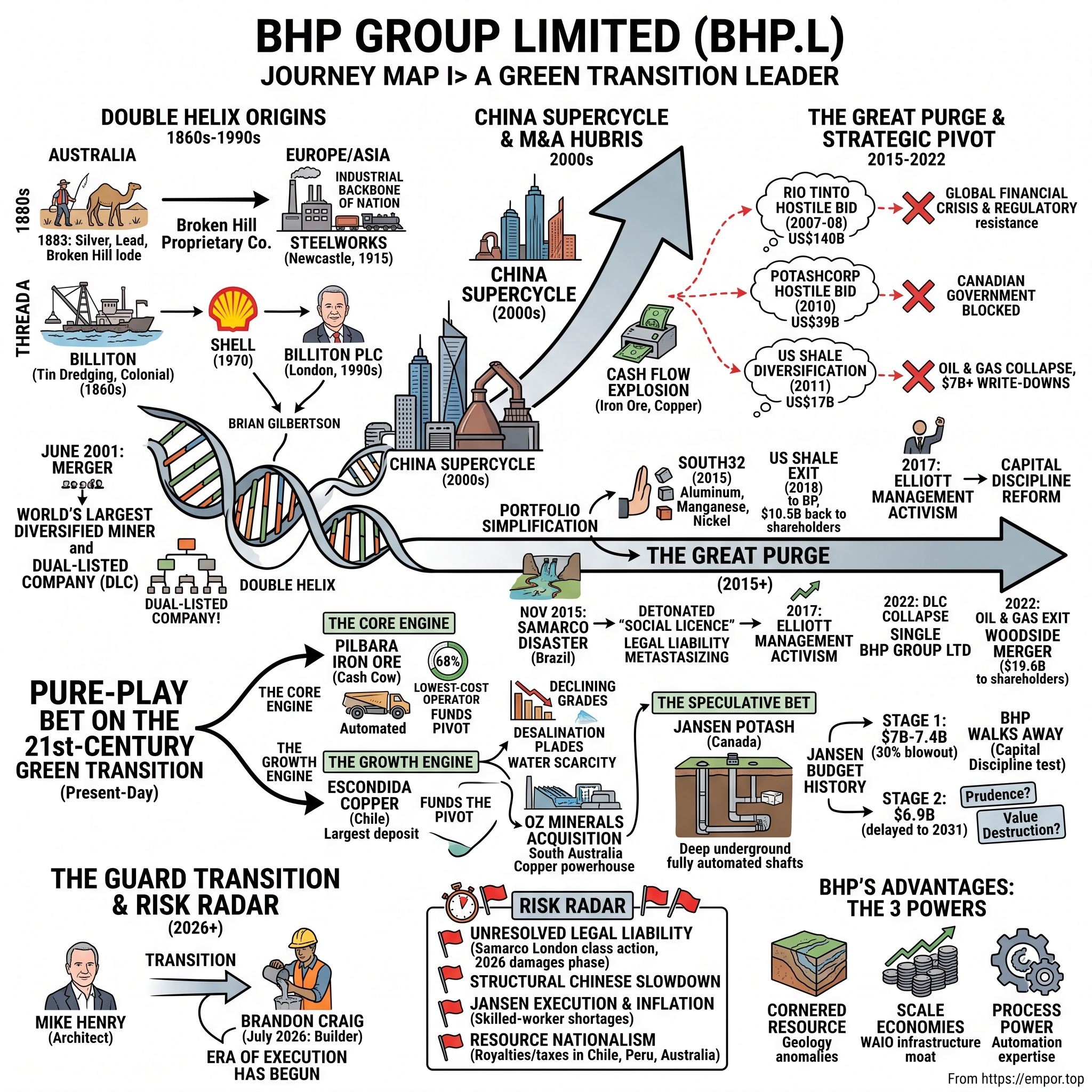
BHP Group Limited: Unearthing the Future
I. Introduction & Episode Roadmap
Somewhere in the Pilbara region of Western Australia, a driverless truck the size of a two-storey house is grinding up a haul road at four in the morning. There is no one in the cab. Two thousand kilometres of iron-rich dirt stretch to the horizon, the colour of dried blood, and every few minutes another of these autonomous machines dumps eighty tonnes of ore into a crusher. From there the rock rides a private, thousand-kilometre railway to Port Hedland, where ships longer than three football fields swallow it and turn north toward the steel mills of China. This is not a mine. It is a machine for turning geology into cash, and it is the single most profitable industrial system on the planet.
That machine belongs to BHP Group Limited, the world's largest mining company by market capitalisation and, by most measures, the physical foundation beneath a century and a half of global modernisation.1 Steel, electricity, fertiliser, copper wire, coal for the blast furnace — if it was dug, smelted, or grown at industrial scale, BHP probably touched the supply chain. And yet for all its size, the company is in the middle of the most radical self-reinvention in its 140-year history.
The big question that hangs over this episode is deceptively simple. How does a company that was born out of 19th-century silver mines in the Australian outback and tin dredges in colonial Indonesia turn itself into a pure-play bet on the 21st-century green transition? The answer is a story of two very different businesses running side by side. The first is the cash cow: the Pilbara iron ore system, the lowest-cost, highest-margin commodity operation on Earth. The second is the pivot: an aggressive, multi-billion-dollar liquidation of oil, gas, and thermal coal to fund a strategic land grab in copper and potash — the two commodities BHP has decided will define the next fifty years.
Sitting on top of all this, as of three weeks ago, is a brand-new chief executive. Brandon Craig assumed office on July 1, 2026, succeeding Mike Henry after more than six years at the helm.[^9] Craig is a lifer — twenty-five years inside BHP — and the board did not pick him by accident. His most recent job was President Americas, which means he personally ran the copper business in Chile and the enormous, troubled potash build in Canada. His appointment is the board's way of announcing that the era of portfolio surgery is over, and the era of execution has begun.
The problem is that "execution" is exactly where BHP has bled before. This is a company whose history is a pendulum swinging between disciplined brilliance and spectacular, cycle-top hubris. So the honest framing for this episode is not "will BHP win." It is: can Brandon Craig deliver a fully automated potash mine on budget, hold the line on capital discipline when the growth bug bites, and manage a multi-billion-dollar legal liability that is still, as of today, very much unresolved in a London courtroom? Let us dig.
 Subscribe on LinkedIn
II. The Double-Helix Origins & Founding Context
Every great company has an origin myth. BHP has two, and they were braided together only at the very end.
The first thread is Australian, and it begins with a boundary rider named Charles Rasp who, in 1883, was patrolling a broken, camel-backed ridge in the far west of New South Wales. Rasp thought the outcrop might contain tin. It did not. It contained the single largest silver-lead-zinc orebody ever discovered — the Broken Hill lode. Two years later, in 1885, a syndicate floated The Broken Hill Proprietary Company Limited to work it. That is the "BHP" in the name, and for decades the deposit was so rich that Australians simply called the company "The Big Australian." The silver and lead built fortunes; but the truly consequential decision came in 1915, when BHP walked away from being a pure miner and opened an integrated steelworks at Newcastle. In one move it stopped selling rocks and started selling the industrial backbone of a nation. For most of the 20th century, if you drove a car, crossed a bridge, or worked in a factory in Australia, BHP steel was underneath you. That gave the company a political and cultural weight few corporations anywhere have ever matched — a quasi-sovereign presence woven into the country's sense of itself.
The second thread is European, older, and stranger. In 1860, a group of Dutch investors formed the Billiton company, named for the tin-rich island of Belitung in the Dutch East Indies — modern-day Indonesia. Billiton was a colonial tin enterprise, dredging and smelting metal for a global market a century before "globalisation" was a word. Its most consequential owner arrived in 1970, when Royal Dutch Shell absorbed it and used its balance sheet to push Billiton into bauxite, alumina, and nickel across the world. Then, in 1994, Shell spun it back out, and Billiton fell into the hands of a hard-charging South African mining veteran, Brian Gilbertson, who listed it in London and turned it into a lean, acquisitive base-metals house hungry for scale.
The two threads met in June 2001. BHP and Billiton merged in a roughly $28 billion deal, creating the world's largest diversified miner. The structure they chose was exotic: a Dual-Listed Company, or DLC. Rather than one company owning the other, two separate legal entities — BHP Limited on the Australian exchange and BHP Billiton Plc in London — agreed by contract to run as a single economic enterprise, sharing one board, one management, and one dividend stream. The point was to sidestep the tax leakage and nationalistic capital controls that would have punished a straight cross-border takeover, letting Australian and British shareholders each keep their home-market listing and franking benefits.
The strategic thesis was scale and diversification: own the biggest, lowest-cost deposits across many commodities, so that no single price crash could sink the ship. But the deeper significance of the timing was invisible at the signing. In June 2001, China had just been cleared to join the World Trade Organization. The newly-merged giant had, entirely by accident, positioned itself directly in front of the largest macroeconomic wave in modern industrial history. What came next was less a strategy than a tsunami — and BHP was standing exactly where it broke.
III. The China Supercycle: Peak Capex & M&A Hubris
Picture the numbers a mining executive was staring at around 2004. China was pouring more concrete every three years than the United States had poured in the entire 20th century. It was laying high-speed rail across a subcontinent, urbanising hundreds of millions of people, and building steel mills faster than anyone could count them. Steel needs iron ore and coking coal. Electrical grids and construction need copper. And the cheapest, highest-grade supply of exactly those materials sat in the Pilbara and in a handful of Chilean copper pits — most of them owned by BHP.
The result was a cash flow explosion of a kind commodity markets see maybe once a century. Iron ore, which had traded for decades under an annual "benchmark" negotiation, broke free and rocketed toward $180 a tonne. Copper followed. For a company whose cash costs were among the lowest on the planet, every extra dollar of price fell almost straight to the bottom line. BHP was, for roughly a decade, a money-printing operation with a mining licence attached.
And here is where the story turns, because cash-flooded commodity companies at the top of a cycle do something predictable: they get ambitious. BHP's first grand gesture was an attempt to swallow its nearest rival. Between 2007 and 2008, BHP pursued Rio Tinto in a stock bid that at its peak valued the target at around $140 billion — a move that would have consolidated two of the three great iron ore houses into a single Pilbara colossus. The logic was pure oligopoly: control the supply, control the price. But the plan collided with reality on two fronts. Chinese steelmakers and their government, terrified of a supplier that powerful, mobilised fierce regulatory resistance. And then the Global Financial Crisis hit, commodity prices cratered, and BHP quietly withdrew in late 2008. In hindsight, the collapse of that bid was a rescue: it spared BHP from loading up on tens of billions in debt just as the world fell off a cliff.
The second grand gesture came in 2010, when BHP launched a roughly $39 billion hostile bid for PotashCorp of Saskatchewan, the crown jewel of the global fertiliser industry. This time the wall was political. The Canadian federal government invoked its "net benefit to Canada" test and blocked the deal, ruling that handing a strategic national resource to a foreign giant did not clear the bar. BHP walked away — but the episode planted a seed. If Canada would not let BHP buy the potash incumbent, BHP would build its own. That decision would eventually become the Jansen project, and we will return to it, because it is the single largest bet on the company's books today.
The third gesture was not blocked by anyone, and it is the one that hurt. In 2011, at what turned out to be almost the exact top of the market, BHP decided to diversify into American shale. It bought Chesapeake Energy's Fayetteville shale assets for about $4.75 billion in cash, then acquired Petrohawk Energy for roughly $12.1 billion in cash — an enterprise value north of $15 billion. The thesis sounded sophisticated: US natural gas was a "bridge fuel," a hedge, a way to plant a flag in cheap domestic energy. The reality was brutal. American gas and oil prices collapsed under the weight of the very shale boom BHP had just bought into, and the company was forced to book more than $7 billion in cumulative write-downs.
The strategic lesson from the shale disaster is worth dwelling on, because it explains almost everything BHP has done since. A world-class miner runs assets that last fifty years, sit at the bottom of the cost curve, and require patience above all. Shale is the opposite: thousands of short-life wells that decline 70% in their first year and demand a frantic, drill-baby-drill operating culture. BHP had bought a business it was culturally and operationally incapable of running well. The company that emerged from that humiliation would spend the next decade obsessed with a single word — discipline — and would systematically sell almost everything that was not a "Tier 1" asset. That purge is the next chapter.
IV. The Great Purge & Portfolio Simplification
By 2015, the party was over and the hangover had arrived. Iron ore, which had touched $180 a tonne at the peak, plunged below $40. The commodity supercycle had inverted, and a company built for abundance suddenly had to prove it could survive scarcity. BHP's answer was one of the most deliberate acts of corporate self-editing in modern industry.
The first move was subtraction. In 2015, BHP demerged a basket of its mid-tier, higher-cost businesses — aluminium, manganese, silver, nickel, and some thermal coal — into a newly listed company called South32, named for the line of latitude linking its Southern Hemisphere assets. The logic was surgical honesty. These were decent businesses, but they were not the best businesses; they sat higher on the global cost curve and diluted returns. What BHP chose to keep tells you its entire philosophy in four words: large, long-life, low-cost, expandable. If an asset was not world-class on every one of those axes, it was no longer welcome. This is the "Tier 1" doctrine, and it became the ideological core of the modern company.
But even as BHP was congratulating itself on portfolio hygiene, the ground was about to open up — literally. On November 5, 2015, the Fundão tailings dam at the Samarco iron ore operation in Minas Gerais, Brazil, collapsed. Samarco was a 50/50 joint venture between BHP and the Brazilian miner Vale. When the dam failed, it released a wall of liquefied mine waste that buried the village of Bento Rodrigues, killed 19 people, and poured toxic sludge down some 600 kilometres of the Doce River all the way to the Atlantic. It remains one of the worst environmental disasters in the history of mining.
It is difficult to overstate what Samarco did to BHP, and not only in human terms, which were catastrophic and irreversible. In the language investors use, it detonated the company's "social licence to operate" — the informal permission a society grants a miner to keep digging. A disaster of that scale changes the political weather in every jurisdiction the company operates in. It hardened regulators, energised litigants, and, as we will see in the risk section, produced a legal liability that is still metastasising across three continents more than a decade later. Samarco is the ghost in every BHP story, and it never fully leaves the room.
Into this bruised, defensive company walked an activist. In 2017, Paul Singer's Elliott Management built a stake and went public with a campaign attacking three things: the clumsy dual-listed structure, the value-destroying shale business, and BHP's overall capital allocation record. Elliott's critique was uncomfortable precisely because much of it was correct. The board, under incoming chairman Ken MacKenzie, did not simply fight the activist; it absorbed the pressure and began systematically doing many of the things Elliott demanded, on its own terms and timeline. What followed was a multi-year decarbonisation and simplification programme that rebuilt the company from the balance sheet up.
The pieces fell in sequence. In 2018, BHP sold its entire US onshore shale portfolio to BP for $10.5 billion in cash and returned essentially all of it to shareholders through a giant buyback — closing the book on the 2011 mistake.5 In 2022, it finally collapsed the dual-listed structure, unifying under a single Australian parent, BHP Group Limited, while keeping secondary listings in London and Johannesburg — the reason this company trades as BHP.L on the LSE today. And also in 2022, in the boldest stroke of all, BHP merged its large, cash-rich offshore oil and gas division with Woodside Energy in an all-stock deal valued at roughly $19.6 billion, then distributed the Woodside shares directly to its own shareholders as an in specie dividend.[^4] With that single transaction, BHP exited hydrocarbons entirely and handed its owners the decision of whether to stay in oil. What was left, once the purge was complete, was a leaner, cleaner machine built around two engines — and it is time to open the hood.
V. The Core Engine: Pilbara Iron Ore & Escondida Copper
Numbers first, then the story they tell. In the year to June 2024, BHP's iron ore division generated roughly US$28.0 billion in revenue and about US$18.9 billion in underlying EBITDA — a margin near 68%.3 Copper produced around US$20.0 billion in revenue and US$9.1 billion in EBITDA that year, while coal added US$7.8 billion of revenue.3 Then came the year to June 2025, and the shape of the company visibly shifted: copper output topped two million tonnes for the first time, copper EBITDA hit a record of roughly US$12 billion, and iron ore at Western Australia held its crown as the lowest-cost major producer while setting a fresh production record of 290 million tonnes.10 Group underlying EBITDA landed near US$26 billion and attributable profit at US$10.2 billion.10
Strip away the digits and here is what they mean. Iron ore is the heart that pumps the blood; copper is the limb the company is trying to grow. Iron ore's obscene margin — capturing roughly two-thirds of every revenue dollar as cash earnings — is what pays every dividend and funds every ambition in copper and potash. If the Pilbara stutters, the whole strategy stutters. So it is worth understanding exactly why that margin exists, because it is not luck.
The Pilbara moat is built from infrastructure, not just geology. BHP's Western Australia Iron Ore system is a set of massive hub mines — Newman, Yandi, Mining Area C, Jimblebar — wired together by roughly a thousand kilometres of dedicated, company-owned heavy-haul railway feeding the automated ship-loading terminals at Port Hedland.2 A rival cannot simply find good ore and compete; it would have to replicate an integrated railway and port network that costs tens of billions and takes a decade of permitting to build. That is the barrier. And on top of it sits a cost position so low that BHP's unit cash costs run in the high teens per tonne. When iron ore trades near $100, a producer spending under $20 to dig and ship it is capturing a cash margin most industries can only dream about. In FY2025 those unit costs actually improved by around 5% despite global inflation — a genuinely impressive operating result that speaks to automation and scale rather than to the commodity price.10
There is one more structural feature: this is an oligopoly. The seaborne iron ore trade is dominated by a tiny club — BHP, Rio Tinto, Vale, and the Australian upstart Fortescue. Because these four low-cost giants can flood the market whenever prices rise, they effectively cap the incentive for high-cost marginal producers elsewhere to expand. The oligopoly does not need to collude on price; its members simply sit so low on the cost curve that they set the terms of survival for everyone above them. That is a durable advantage — as long as demand holds. Which brings us to the second engine.
Copper is where BHP wants its future to be, and its flagship is Escondida in Chile's Atacama Desert — the largest single copper deposit on Earth, 57.5% owned and operated by BHP with Rio Tinto holding 30%.2 Escondida alone produces over a million tonnes of copper a year. But it is also a cautionary tale about what "cornered resource" really means, because even the best deposit ages. Copper grades at Escondida are slowly declining, meaning BHP must move more rock to produce the same metal. Water is scarce in one of the driest places on the planet, forcing a multi-billion-dollar shift to energy-hungry desalination. And Chile itself carries rising political and social risk around royalties and resource nationalism. Escondida is a crown jewel that requires constant, expensive polishing.
BHP's response has been to build a second copper province closer to home. In 2023 it acquired OZ Minerals of Australia, paying A$28.25 per share — a 49.3% premium, for an enterprise value near A$9.6 billion.[^5] The strategic idea was integration: bolt OZ Minerals' Prominent Hill and Carrapateena mines onto BHP's existing Olympic Dam complex in South Australia to create a single, efficient copper-gold-uranium powerhouse. It was disciplined M&A of the sort BHP now prides itself on — a bolt-on that made its own assets worth more.
And then, in 2024, discipline met temptation. BHP launched a run at Anglo American, ultimately making three unsolicited proposals that peaked at roughly £38.6 billion — a bid Anglo's board rejected as its "third and final" refusal.6 The prize was Anglo's premier South American copper mines: Los Bronces, Collahuasi, Quellaveco. Together with Escondida, they would have handed BHP something close to 10% of global copper supply. But BHP attached a condition Anglo found unacceptable: before any merger, Anglo would have to spin off its South African platinum and iron ore businesses, a demerger Anglo's board dismissed as carrying "disproportionate execution risk."9 BHP walked away rather than raise its terms or soften the structure.[^7] The episode is a Rorschach test for the whole investment case. To bulls, it proved capital discipline: BHP refused to overpay and let the deal die. To bears, it proved the growth bug is alive and well, and that the next cycle-top temptation is always one board meeting away. Hold that thought — it defines the management-credibility question later. First, the single biggest, riskiest bet BHP has ever made.
VI. The Speculative Bet: The Jansen Potash Megaproject
Deep beneath the wheat fields of Saskatchewan, more than a kilometre down, sits one of the richest potash deposits in the world. Potash is potassium chloride, and its job is unglamorous but non-negotiable: it is one of the three primary nutrients that make crops grow. As the global population climbs toward ten billion on a fixed and shrinking stock of arable land, the only way to feed everyone is to grow more food per hectare — and that means fertiliser. BHP's thesis is that potash is a way to bet on the arithmetic of hunger, a long-cycle demand story almost entirely uncorrelated with the industrial metal cycle that drives iron ore and copper. In theory, it is the perfect diversifier for a company whose fortunes rise and fall with Chinese steel.[^15]
That is the theory. The practice is Jansen, and Jansen is where the elegant macro story collides with the brutal reality of building the largest greenfield project in BHP's history. This is not an acquisition of a running mine; it is the construction from bare prairie of a fully automated underground operation, complete with two shafts sunk through waterlogged rock, processing plants, and rail links. It is one of the largest active mining builds on the planet, and it currently generates exactly zero dollars of revenue.
The budget history tells the real story better than any brochure. Stage 1 was originally approved at around US$5.7 billion. By mid-2025, after design changes, scope creep, and stubborn productivity problems, BHP disclosed that Stage 1 would instead cost between US$7.0 billion and US$7.4 billion — a roughly 30% blowout — and pushed first production from late 2026 to the middle of 2027.10 Stage 2, meant to double capacity, has fared no better: in 2023 the company approved it at roughly US$4.9 billion, but a detailed review in 2026 lifted that estimate to about US$6.9 billion and delayed first output from fiscal 2029 to fiscal 2031, forcing BHP to recognise around US$2.3 billion in impairment charges on the money already sunk.[^6]10 Add it up and BHP has now committed well over US$15 billion to a mine that will not ship a meaningful tonne of product until 2027 at the earliest — and whose full capacity of roughly 8.5 million tonnes a year is now half a decade away.
This is the moment where an independent lens matters most. Management frames the cost increases as prudence — deferring Stage 2 because the medium-term potash market looks oversupplied, and re-baselining Stage 1 to reflect honest engineering. That may be true. But re-baselining a budget upward by 30% after approval is precisely the pattern that destroyed value in the shale years: a mining giant discovering, mid-build, that it is harder and more expensive than the plan assumed. The company that made "capital discipline" its religion is now running its largest-ever project through repeated cost revisions and impairments. Craig's own credibility is directly staked here, because he ran the Americas when much of this happened.
And the competitive backdrop is unforgiving. Jansen is entering an industry controlled by entrenched incumbents: the Canpotex marketing arm that channels Canadian giants Nutrien and Mosaic, and the Russian and Belarusian state-backed producers Uralkali and Belaruskali, whose costs and geopolitics warp the global market. BHP's answer is the same weapon it wields in the Pilbara — be the lowest-cost producer on Earth, with a fully automated, multi-decade asset sitting at the very bottom of the cost curve. If it works, Jansen becomes a second Pilbara for the agricultural age. If it does not, it becomes the most expensive lesson in the company's history. The person who has to make it work is new, and he is the subject of the next section.
VII. The Guard Transition & Management Credibility
On July 1, 2026, Mike Henry handed over the keys. Over more than six years, Henry had executed the defining moves of the modern company — the shale exit to BP, the Woodside merger, the DLC collapse, the OZ Minerals bolt-on, and the disciplined refusal to overpay for Anglo. His tenure was, on balance, a study in portfolio restructuring: deciding what BHP should be, and shedding what it should not. He will remain to support the transition through November 2026 before departing entirely.[^9]
His successor is Brandon Craig, and the choice is a message in itself. Craig joined BHP in 1999 and spent a quarter-century climbing through operating and corporate roles, most recently as President Americas — the executive with direct responsibility for Escondida in Chile and the Jansen build in Canada.[^9] Where Henry was the architect of the portfolio, Craig is the builder of the assets. His appointment signals that the board believes the hard strategic questions are settled and that the next chapter is about delivery: pouring the concrete, hitting the tonnes, integrating the mines. That is a coherent story. It is also a convenient one, because the two hardest execution challenges BHP faces — Jansen's overruns and Escondida's declining grades — are the very assets Craig has been running. The board is betting that the man closest to the problems is the man best equipped to fix them. Skeptics might note that he was also close enough to own some of them.
The incentive structure is designed to keep his interests welded to shareholders', and it is worth reading closely because it reveals what BHP says it values. Craig's base salary is US$1,900,000 a year.[^9] On top of that sits a Cash and Deferred Plan short-term incentive targeted at 240% of base salary, with a large slice mandatorily deferred into BHP shares vesting over two and five years — so a good bonus is not fully cash today but stock he must wait years to collect. His long-term incentive is worth 200% of base in performance rights, vesting over a five-year window and tied to relative total shareholder return and capital-return metrics. And he is subject to a Minimum Shareholding Requirement of five times his pre-tax base salary — a holding he must build and then keep for two years after he leaves. The design is textbook long-termism: make the CEO think like an owner who cannot sell.
Whether that design actually restrains behaviour is the real question, and BHP's answer has a name: the Capital Allocation Framework, enforced since 2017 under chairman Ken MacKenzie. The CAF is a strict waterfall. First, maintain a strong balance sheet. Second, fund the maintenance capital needed to keep assets running and pay a minimum 50% of underlying earnings as dividends. Third — and only third — deploy whatever cash is left, either returned to shareholders or reinvested in organic growth and M&A, but only where the return clears a hard hurdle. The framework is why BHP returned roughly US$80 billion to shareholders across Henry's tenure, and why the FY2025 result carried a 60% payout ratio and a US$5.6 billion full-year dividend even as the company poured billions into Jansen.410
Here is the tension that defines the Craig era. The CAF is the discipline; the Anglo bid was the temptation; Jansen's overruns are the execution risk. All three are live at once. A credible read of management is not "they promised discipline, therefore they are disciplined" — it is watching whether the framework survives contact with a rising copper price and a CEO who came up building things. If the next few years bring another premium-heavy, cycle-top acquisition dressed up as strategy, the CAF will have been revealed as a fair-weather rule. If instead BHP keeps returning cash and lets Jansen prove itself before chasing the next deal, the discipline is real. That test is the spine of the bull-versus-bear debate — but before we get there, we have to confront the liability that could drain cash regardless of how disciplined anyone is.
VIII. Skeptical Stress Test & Risk Radar
Return to Samarco, because the bill is finally coming due — in pieces, across multiple courtrooms, over decades. In October 2024, BHP, Vale, and Samarco signed a landmark settlement with Brazilian federal and state authorities valued at roughly R$170 billion, or about US$31.7 billion.[^8]8 The structure spreads the pain: some US$7.9 billion had already been spent on remediation and compensation, about US$18.0 billion is payable to public authorities over twenty years, and a further US$5.8 billion is committed to performance obligations over fifteen years.[^8] For Brazil, at least, the company could argue it had drawn a line under the disaster.
Except the line only covers Brazil. The more dangerous front opened in London. In a judgment delivered in mid-November 2025, the English High Court found BHP liable for the Fundão collapse under Brazilian law, in a class action brought on behalf of more than 700,000 claimants — individuals, municipalities, businesses, and members of the Krenak Indigenous community.7 BHP has said it intends to appeal, and crucially the November ruling decided liability, not the money.7 The critical damages phase — where the actual payout is fixed — is scheduled for late 2026, which means that for the entire window in which Brandon Craig is finding his feet as CEO, an uncapped, multi-billion-dollar liability sits unresolved over the company's head. On top of that run parallel proceedings in the Netherlands and an Australian shareholder class action that settled for A$110 million in late 2025. Samarco, ten years on, is not a closed chapter; it is a rolling one.
That legal overhang is the first and heaviest item on the risk radar, but it is not alone. The second is structural and Chinese. BHP's entire cash engine — the Pilbara — is levered to one variable above all others: Chinese steel production, which is itself driven overwhelmingly by property construction. For two decades that was the greatest tailwind in the history of commodities. But Chinese property is no longer the growth machine it was, and steel output has plateaued. If Chinese construction demand declines structurally rather than cyclically, Pilbara's cash flow could compress meaningfully — and it is that same cash flow that funds the dividend and bankrolls Jansen and the copper expansions. The bull case for BHP's future quietly depends on the bear case for China not fully arriving.
The third risk is the one we have already seen bite: execution and inflation at Jansen. A US$15-billion greenfield mine in a tight North American labour market is uniquely exposed to skilled-worker shortages and input-cost inflation, and potash prices themselves are volatile enough that a low realised price could stretch the payback period by years. The repeated cost revisions are not an abstraction; they are the risk already materialising in real time.
And the fourth is resource nationalism. BHP's best assets sit in jurisdictions increasingly tempted to take a bigger slice — royalty hikes and new taxes in Chile and Peru, tighter environmental permitting in Australia, and the ever-present possibility that a government decides a foreign miner's returns are politically indefensible. None of these risks is fatal on its own. But stacked together — an unresolved mega-liability, a structurally slowing key customer, a bleeding flagship project, and rising political take — they explain why a company printing record copper EBITDA still trades with a permanent discount for uncertainty. The job of the next section is to ask what, underneath all this noise, actually makes BHP hard to beat.
IX. The Playbook: Business & Investing Lessons
Strip BHP down to its load-bearing walls and you find that its advantages are unusually pure examples of a few well-known frameworks. Start with Hamilton Helmer's 7 Powers, because BHP is close to a textbook illustration of the rarest and strongest of them.
The dominant power is Cornered Resource. Most competitive advantages are built — a brand, a network, a process. A cornered resource is found. BHP's deepest moat is that it owns specific, irreplaceable geological anomalies: the high-grade, shallow, vast iron ore of the Pilbara and the single largest copper deposit on Earth at Escondida. A competitor with infinite capital still cannot conjure a second Escondida into existence; the rock is where the rock is, and BHP owns it. That is why the Anglo pursuit was so revealing — when your advantage is cornered resources, the only way to grow it meaningfully is to buy someone else's, which is exactly why great deposits command ruinous takeover premiums.
The second power is Scale Economies, and here the moat is the infrastructure, not the ore. The integrated rail-and-port system of Western Australia Iron Ore spreads enormous fixed costs across hundreds of millions of tonnes, driving a cost-per-tonne that a new entrant cannot match without first spending tens of billions to duplicate the network. The scale is the barrier. The third is Process Power: decades of accumulated, hard-won expertise in automated bulk logistics and mine optimisation in two of the harshest environments on Earth — the cyclone-swept Pilbara and the waterless Atacama. Driverless trucks, autonomous trains, and desalination at altitude are not things a competitor learns in a year.
Now war-game the industry with Porter's Five Forces, and the picture sharpens. The Threat of New Entrants is very low — prohibitive capital, brutal permitting, and infrastructure bottlenecks keep the club small. The Threat of Substitutes is low: there is no cheap replacement for iron ore and coking coal in primary steelmaking, nor for copper in electrical infrastructure. The Bargaining Power of Suppliers is low, since labour and equipment are largely commoditised — though, in an interesting wrinkle, the specialised software that runs mine automation is quietly rising in value. Industry Rivalry among the oligopoly is high on the dimension of operational unit cost — everyone races to be lowest — but low on outright price-cutting, because global demand, not any single producer, sets the price.
The one force that is genuinely shifting is the Bargaining Power of Buyers. For years the miners held the whip hand over fragmented Chinese steel mills. But China has been consolidating its purchasing through the state-backed 中国矿产资源集团 China Mineral Resources Group, a deliberate attempt to concentrate buying power and claw back pricing leverage from the Pilbara oligopoly. It is the single most important structural change on the demand side, and it is worth watching closely, because a monopsony buyer facing an oligopoly of sellers is a very different game than the one BHP has enjoyed for twenty years.
The overarching investing lesson, though, is not about moats — it is about temperament. Commodity companies should be run as cyclical capital managers, not as growth stocks. The value destruction of the 2011 shale purchases and the value creation of the 2015–2026 discipline are the same company making opposite choices at opposite points in the cycle. The whole modern BHP thesis is a bet that the institution has genuinely internalised that lesson. Whether it has is, ultimately, unknowable in advance — which is why the final section frames it as a debate rather than a verdict.
X. Analysis: The Bull vs. Bear Case
Before the arguments, the scoreboard — the three KPIs that matter more than any headline, because they map directly onto the three questions the whole story turns on.
The first is WAIO unit cash cost. This is the health of the cash engine, full stop. BHP targets costs in the high teens per tonne, and any sustained rise signals that labour or operational efficiency in the Pilbara — the source of every dividend dollar — is slipping. Watch it more closely than the iron ore price, because BHP cannot control the price but it can control the cost, and the cost is where the moat actually lives. The second is Jansen Stage 1 capital and schedule. The mid-2027 first-ore target is now the single cleanest test of management credibility on the books; another slip or another budget revision would tell you the "capital discipline" narrative has a crack in it. The third is copper-equivalent production growth. This measures whether the pivot is real — whether the OZ Minerals assets are genuinely integrating and Olympic Dam is ramping fast enough to offset Escondida's declining grades. If copper volumes stall, the entire future-facing thesis stalls with them.
Now the bull case. BHP is the closest thing the public markets offer to a blue-chip proxy for two of the largest secular demand stories of the century: electrification, which runs on copper, and food security, which runs on potash. And unlike a speculative miner, it funds those bets not with debt or dilution but with the cash flows of the most profitable iron ore system ever built. Layer on a genuine institutional commitment to capital discipline — the CAF, the US$80 billion of returns, the willingness to walk away from Anglo rather than overpay — and you have a company that could compound shareholder capital through the transition while paying you to wait. The bull says: cornered resources plus discipline plus the right two commodities is a combination almost no other company on Earth can offer.
The bear case attacks the same facts from underneath. That iron ore cash machine, it argues, is dangerously exposed to a structural, not cyclical, slowdown in Chinese steel — and if Pilbara margins compress before Jansen and the copper expansions generate offsetting cash, the whole self-funding model wobbles at the worst possible moment. The growth engines are years away and already over budget: Jansen has slipped and blown its cost estimate more than once, and Escondida is fighting entropy in grade and water. And hanging over all of it is Samarco — a liability whose damages phase lands in late 2026, potentially draining billions in cash across the coming decade regardless of how well anything else is run. The bear says: you are buying a cyclical cash cow at the mercy of one customer, funding an over-budget future, under an unresolved legal cloud.
Both cases are built from the same balance sheet, and both are honest. The tension between them is not a flaw in the analysis; it is the analysis. BHP is a bet that a disciplined institution can harvest a declining-but-still-mighty cash cow long enough to birth its two replacements, while surviving a legal reckoning for the sins of the last cycle. Whether that bet pays depends on execution BHP has not yet delivered and a China nobody can forecast — which is a fittingly uncertain place to end 140 years of certainty about what the world would always need.
XI. Outro
Step back from the numbers and the courtrooms, and the arc of BHP is almost geological in scale. A silver mine in the New South Wales desert and a tin enterprise on a Dutch colonial island braided into the world's largest miner, rode the greatest industrial wave in human history, nearly wrecked themselves at its crest, and then spent a decade cutting away everything that was not the very best — all to point the whole enormous machine at copper and potash and the century to come. It is a company that has been, at various times, the backbone of a nation, a cautionary tale in cycle-top hubris, the author of an environmental catastrophe, and a disciplined returner of capital. It is usually more than one of those things at once.
What makes it worth watching now is that all of its oldest questions are live again at the same moment: a new operator-CEO taking the wheel, the largest project in company history over budget and unbuilt, a cash engine tethered to a changing China, and a liability from the last decade about to be priced by a judge. For those who want to go deeper into the mechanics — the capital allocation framework that governs every dollar, or the legal architecture of the Samarco settlements — the /goal and /plan commands are the place to keep digging.
References
-
BHP Group Limited FY2025 Annual Report / Form 20-F — US SEC (EDGAR CIK 0000811809), 2025 ↩↩
-
BHP Group Limited FY2024 Annual Report Form 20-F — BHP Group, 2024-08-30 ↩↩
-
BHP Investor Presentation: Capital Allocation and Portfolio Transition — BHP Group, 2025-11-20 ↩
-
BP Acquires BHP's Premium US Onshore Shale Assets — BP plc, 2018-07-27 ↩
-
Anglo American Rejects Final £38.6bn Proposal from BHP — London Stock Exchange, 2024-05-22 ↩
-
London High Court Rules BHP Liable for Samarco Dam Collapse — Reuters, 2025-11-06 ↩↩
-
BHP and Vale Agree $31.7bn Global Settlement in Brazil — Financial Times, 2024-10-25 ↩
-
Why BHP Walked Away From Anglo American Deal — Bloomberg, 2024-05-29 ↩
-
BHP Group Ltd (BHP) FY2025 Earnings Call Highlights: Record Production and Strategic Discipline — Yahoo Finance, 2025-08-19 ↩↩↩↩↩↩
 LinkedIn
 WhatsApp
 Reddit
 Hacker News
 Email
Email Kindle
 RSS Feed
 Spotify
 Apple Podcasts
 Amazon Music
 Audible
 YouTube